Are rankings and clicks trickling away from you? Is there a big difference between your impressions and clicks? Desperate for a solution, but don’t know how? Read on to find out more.
Organic clicks are visits from unpaid search results. They are different from paid ads, which cost money with every visit. With strong organic search optimization, each click is earned through helpful content and smart SEO, not through a bid.
This guide breaks down 7 proven strategies that help increase organic clicks from web search. You will learn how to tune title tags, optimize meta descriptions, use structured data, manage featured snippets, and improve overall rankings to optimize CTR.
So, let’s get started.
What is organic CTR and why does it matter?
Organic click-through rate (organic CTR) is the percentage of users who click your website after seeing it in unpaid search results.
As we’ve previously discussed in our what is a CTR blog, the CTR formula is simply total clicks divided by the total impressions.
In the case of organic clicks, this is the number of clicks an organic search receives divided by the number of times it’s viewed in the SERP.
Organic CTR matters because it helps you:
- Identify pages that rank but underperform
- Spot mismatches between search intent and messaging
- Estimate potential traffic gains without improving rankings
- Prioritize quick-win optimization opportunities
When impressions are high but organic clicks are low, you do not necessarily have a ranking problem. You likely have a snippet optimization problem.
The limitations of organic CTR
Organic CTR is powerful, but it is not a complete SEO metric.
#1: Organic clicks don’t tell anything about traffic quality
CTR does not measure traffic quality. A page might attract many clicks but fail to drive engagement, leads, or conversions.
#2: Organic clicks are SERP influenced
Organic CTR is heavily influenced by SERP layout changes. AI Overviews, featured snippets, People Also Ask boxes, and shopping modules can push traditional organic listings lower on the page. Even if your ranking stays the same, your click-through rate may drop significantly.
#3: Organic clicks vary dramatically due to various factors
CTR can change due to:
- Search intent (informational vs transactional)
- Device type (mobile vs desktop)
- Brand familiarity
- Industry competition
Because of this, there is no universal “good” organic CTR number.
CTR should always be analyzed alongside search rankings, impressions, engagement metrics, and most importantly, conversions.
#4: Organic clicks are not a direct ranking factor
Although this is debatable, CTR is not a direct ranking factor for Google. Organic CTR highlights opportunity. But if you only see organic clicks for a platform and no other metrics, that could mislead your strategic decisions.
Organic clicks vs paid clicks
Before diving in, it helps to compare organic clicks with paid clicks side by side.
| Aspect | Organic clicks | Paid clicks |
| Cost per visit | No direct cost per click, investment goes into content and organic SEO techniques | You pay for each visit based on bids and competition |
| Sustainability | Traffic can keep coming for months or years from the same content | Traffic stops as soon as the ad budget is paused |
| Trust level | Many users prefer and trust natural listings over ads | Some users scroll past ads or ignore them |
| Conversion behavior | Visitors often show strong intent and explore more pages | Visitors convert quickly, but may bounce fast if the ad and landing page do not align |
Now, let’s take a look at the ways in which you can boost your organic clicks and improve click-through rate for your website.
Ways to improve organic clicks in 2026
Below are 7 strategies you can apply today to improve your organic CTR.
- Write captivating titles
- Craft compelling meta descriptions
- Use structured data
- Optimize for Zero-click answers
- Improve search rankings
- Enhance user experience
- Analyze competitor data
We’ll discuss these in more detail.
1. Craft irresistible titles that demand attention
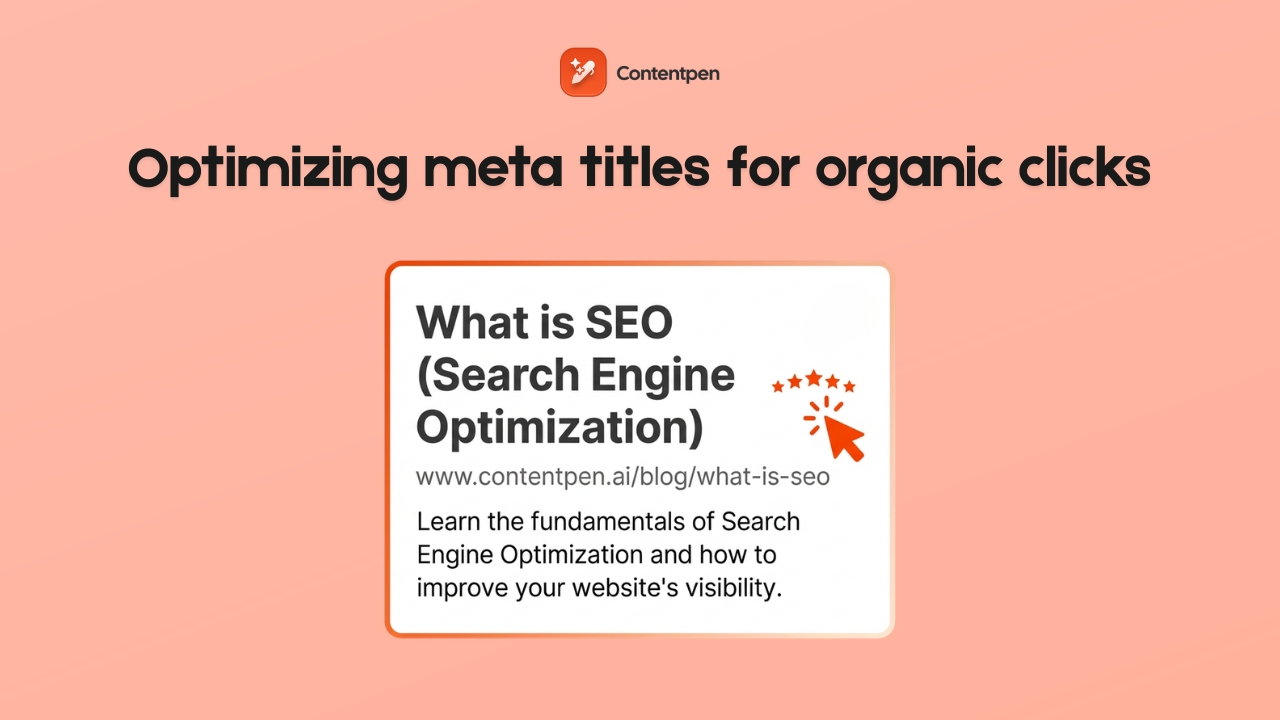
The title tag is the headline that shows in search results, and it is often the single biggest factor behind whether someone clicks or scrolls past your content.
Even if a page ranks well, a dull or confusing title can cause organic clicks to slip away to competitors. Strong titles speak directly to the searcher and promise a result that feels worth their time, matching the searcher’s intent for the given query.
A practical framework for high-CTR titles starts with placing the main keyword near the front. Then add a clear angle, such as a guide, checklist, or case study, and use numbers when they fit the topic.
Aim for 50 – 60 characters (with spaces) in the meta title so the message fits fully on the SERP. Watch out for these common mistakes that quietly hurt CTR:
- Keyword stuffing that makes titles look spammy.
- Weak phrases like “various insights” and “information” say almost nothing about the real content.
- Titles that overpromise compared to the content on the page.
The title should clearly convey a strong value promise that aligns with the page. Use Google Search Console to sort pages by impressions and CTR. Rewrite weak titles, then review the data a few weeks later to see which styles drive more organic traffic.
2. Write meta descriptions that act as compelling ad copy
If the title tag (meta title) is the headline, the meta description is the short pitch that lives right under it. Many sites treat it as a box to fill in at the last minute, but it can create the difference between an impression and a click.
A good meta description explains who the page is for, what it delivers, and why the reader should care now.
A simple formula works well for most pages:
- Name the problem or goal.
- Promise a clear outcome.
- Finish with a gentle call to action.
For example, a description for this topic might read: “Struggling to get organic clicks?” Learn 7 practical strategies to improve click-through rate, increase organic traffic, and turn impressions into visitors.”
Length matters here. Aim for about 130 – 160 characters so your full message appears on both desktop and mobile SERP versions. Include your main keyword and close variants, because search engines often bold these terms, which helps your listing stand out from others.
Use active language with verbs such as discover, learn, or compare to nudge people toward the click. Meta description optimization only helps when the promise matches the page. If a description teases a guide and the page is a thin sales pitch, visitors will leave fast.
3. Use structured data to earn eye-catching rich snippets
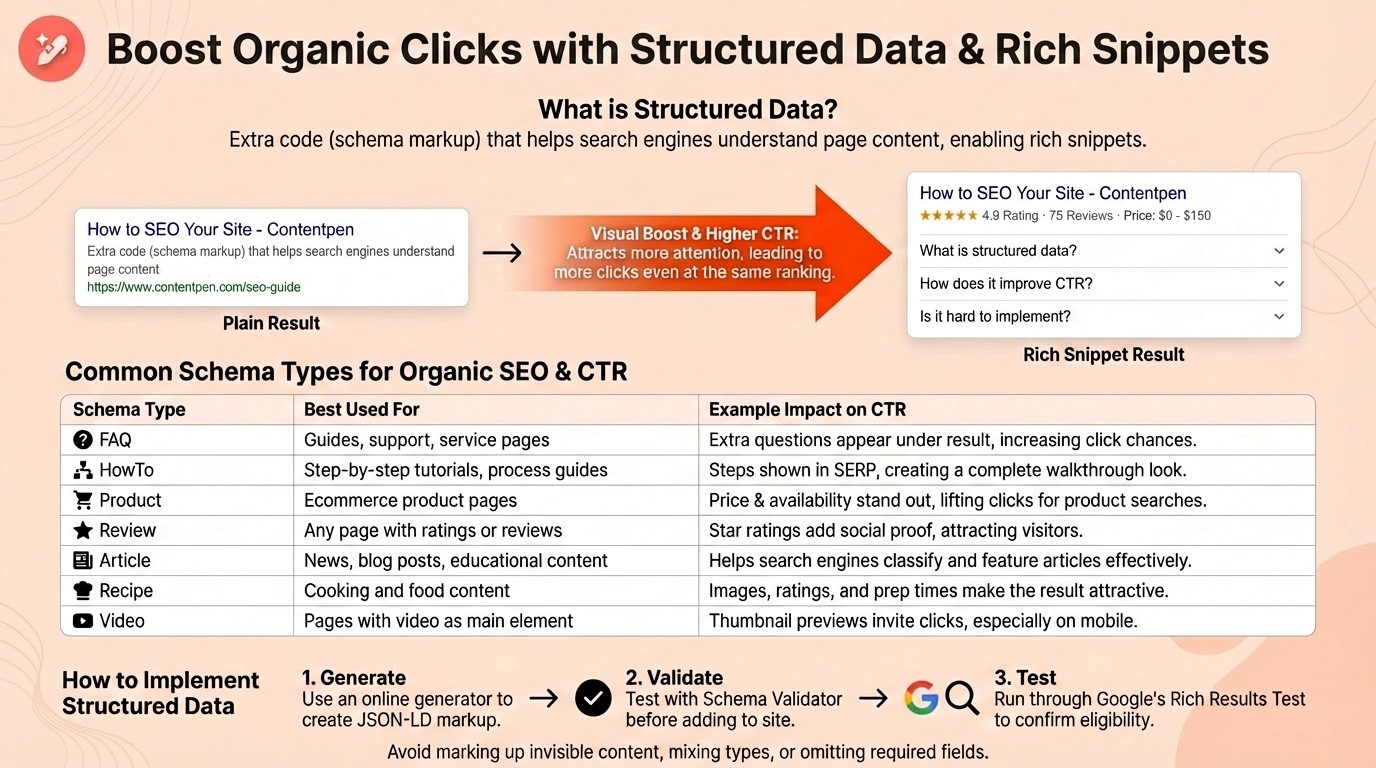
Structured data, also known as schema markup, is extra code that helps search engines understand what is on a page. When this data is clear and accurate, Google can show rich snippets such as star ratings, prices, and FAQ dropdowns.
These richer results attract more attention, often leading to higher organic clicks even when the ranking position stays the same.
The real power of structured data is the visual boost it gives your listing. A plain blue link with two gray lines of text can look flat next to a result that shows review stars, product availability, or direct answers.
For a restaurant, a review schema may show a star rating that makes searchers more confident. For a guide like this, the FAQ schema can add extra questions and answer rows under the main snippet, taking up more space and increasing the chance of a click.
Here are common schema types that help with organic SEO techniques and click-through rate:
| Schema type | Best used for | Example impact on CTR |
| FAQ | Guides, support pages, and service pages with clear questions and answers | Extra questions appear under your search result, giving more chances to win the click |
| HowTo | Step-by-step tutorials and process guides | Steps can be shown in the SERP, making your result look like a complete walkthrough |
| Product | Ecommerce product pages | Price and availability stand out, which can lift clicks from product searches |
| Review | Any page with ratings or reviews | Star ratings add social proof that attracts visitors |
| Article | News, blog posts, educational content | Helps search engines classify and feature your articles more effectively |
| Recipe | Cooking and food content | Images, ratings, and prep times make the result far more attractive |
| Video | Pages where video is a main element | Thumbnail previews invite clicks, especially on mobile |
The easiest way to add schema is to use an online generator that creates this structured data, usually in JSON-LD format. Before adding the schema to your site, test it with the schema validator to ensure that it is correctly made.
After adding it, run the page through Google’s Rich Results Test to confirm that the markup is valid and eligible for rich features. Avoid marking up content users cannot see, mixing up types, or leaving out required fields, as these mistakes can prevent rich snippets from appearing.
4. Optimize for Zero-click answers
In 2026, creating content is all about being direct and helpful in your approach while answering the common user questions for a particular topic. You can take these queries from the People Also Ask sections in Google, or use tools like AnswerThePublic for the given topic.
The benefit of answering questions regarding your topic or niche directly on your pages is that you start ranking for Google AI Overviews for the said query.
But this raises a question. If you get featured for zero-click answers, how does that benefit your organic clicks?
The answer is simple. Even though zero-click answers have contributed to the decline of click-through rates, owning the top voice in a space still helps. It facilitates brands to build strong brand awareness, earn trust, and often attract high-intent visitors to explore more details.
Besides zero-click answers, you can also win the top organic search result with content that answers real questions from real users.
To win these, place a question-style heading on the page and answer it directly in about 40 – 60 words right under that heading. Then back it up with a fuller explanation so the page also works for readers who scroll.
5. Improve your search rankings to gain more impressions
CTR varies a lot depending on where you appear in the search results. Moving from the bottom of page one into the top three can feel like turning on a new traffic channel.
While numbers vary by niche, typical CTR range values look like this:
| Google search position | Typical organic CTR range |
| 1 | 38.9% – 42.9% |
| 2 | 27.4% – 29.5% |
| 3 | 11% – 15% |
| 4 | 7% – 10% |
| 5 | 5% – 7% |
| 6 | 4% – 5% |
| 7 | 3% – 4% |
| 8 | 2% – 3% |
| 9 | 1.5% – 2% |
| 10 (if present) | 0.5% – 1.5% |
Source: FirstPageSage
These are averages taken from the Google search environment, so treat them as starting points rather than strict goals. Use them to spot pages where your organic click-through rate is far below what the position usually earns.
When impressions are strong, but organic clicks are weak, you likely have a CTR issue. When impressions are low across the board, the main problem is ranking, not snippet appeal.
Better rankings start with keyword research that matches user intent:
- Informational queries need clear explanations.
- Commercial queries want comparisons and proof.
- Transactional terms call for strong offers and simple paths to act.
Google looks for content that shows depth, originality, and real expertise, and it favors pages that stay fresh with updated details and current examples.
On-page SEO still matters. Use clear header hierarchy, place main keywords in titles, headings, and early paragraphs, and connect related pages with internal links that guide both users and crawlers.
Technical basics such as fast load times, mobile-friendly layouts, and clean site structure remove barriers that can hold rankings back. Receiving SEO backlinks from trusted sites also helps, since they act as votes of confidence.
6. Improve user experience signals to boost rankings and clicks
Search engines pay close attention to what happens after a click. When visitors stay, scroll, and interact, it indicates that the page matched their intent.
Improving the user experience (UX) makes each visit more satisfying, which can support both rankings and organic clicks over time.
Core Web Vitals give a simple way to think about performance:
- Largest Contentful Paint (LCP) measures how quickly the main content shows up.
- First Input Delay (FID) measures how quickly someone can interact with page elements.
- Cumulative Layout Shift (CLS) measures how stable the layout feels during load.
Strong scores on these metrics lead to smoother pages that feel fast and reliable, especially on mobile devices where most search engine traffic now lives.
There are many practical steps that help here. Use responsive design so pages adapt nicely to any screen size, compress large images, and trim heavy scripts that slow down browsing.
As user experience improves, behavior metrics tend to follow suit, which can raise search engine rankings, drive more impressions, and create a positive cycle of growing organic clicks.
7. Analyze competitor SERP performance to uncover CTR opportunities
No page competes alone on the SERP. For every keyword, searchers see a row of titles, descriptions, and rich results side by side. Understanding how competitors present themselves there helps you spot the changes that could bring more organic clicks to your own listings.
Start by searching for key terms and studying the top results with a critical eye. Notice how competitors phrase their title tags and meta descriptions. Some might focus only on keywords and miss the chance to promise a clear benefit or outcome.
Others may ignore emotional drivers such as saving time, avoiding risk, or gaining an advantage. These gaps open space for your pages to stand out with stronger, more specific messaging that improves click-through rate.
Analyzing competitors is one thing, but utilizing these ranking opportunities is another. You may know what to add to your blogs to win higher search rankings, but actually writing the content is where many individuals, small businesses, and agencies can struggle.
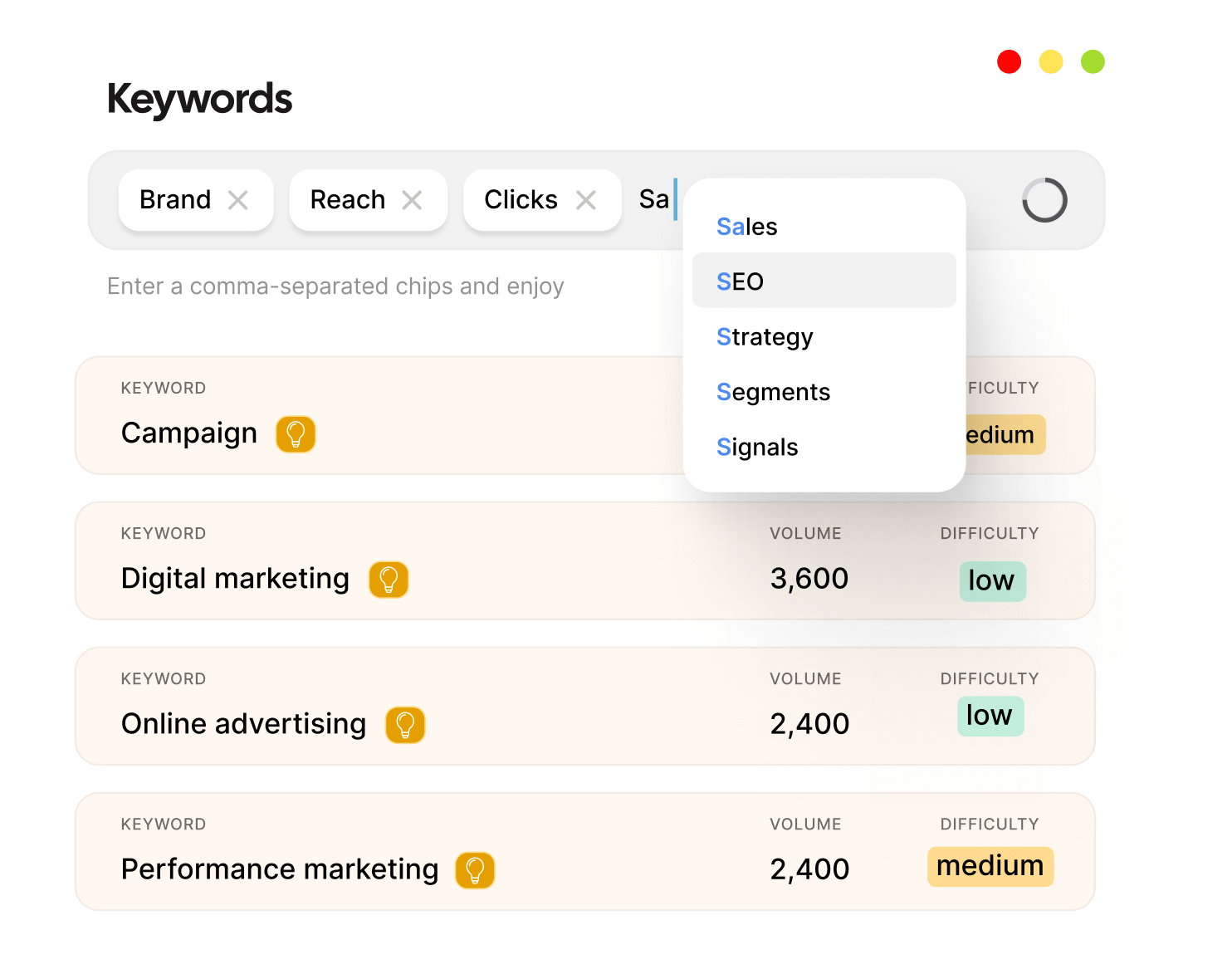
To execute these changes at scale, you can utilize Contentpen. It not only helps uncover CTR opportunities but also creates SEO and GEO-optimized content, along with high-quality visuals and metadata.
Our AI blog writer also automatically creates topical clusters that you can target to immediately improve SERP performance and organic clicks. The tool helps your brand stay on top to earn the conversions it deserves.

Create topical authority, not isolated posts that fills them

Group related content into SEO-friendly clusters
Strengthen rankings with internal relevance
Final thoughts
Increasing organic clicks is not about one magic trick. It is the result of many small, smart changes working together. Strong title tags pull attention, sharp meta descriptions act like ad copy, and structured data opens the door to rich snippets that make your results stand out.
The real power comes from the compound effect. A few percentage points of organic click-through rate improvement on dozens or hundreds of pages can add up to a big lift in organic traffic and leads, overall.
To get there, keep measuring, testing, and adjusting. Watch impressions, organic CTR, and search traffic in Google Search Console and SEO analytics tools, and treat every page with care.
Frequently asked questions
A good organic click-through rate depends heavily on where a page ranks and which industry it serves. Instead of chasing a single benchmark, compare each page’s organic clicks and CTR to your own site average in Google Search Console and focus on lifting the pages that lag behind.
Most pages start to show results from CTR optimization within 2-4 weeks. That window depends on how often Google crawls and reprocesses your pages, which usually happens faster for URLs that already sit on page one.
Done correctly, optimizing for organic clicks should improve rankings rather than hurt them. Problems appear when titles or meta descriptions drift into clickbait territory and promise something the page does not deliver.
Organic traffic comes from unpaid search engine results. Inorganic traffic (often called paid traffic) comes from ads, such as Google Search Ads or paid social campaigns.
Leave a Reply