Content marketing has emerged as one of the most effective strategies for businesses that want to shift from traditional advertising methods. It helps brands build trust and drive engagement by connecting with the audience in an authentic and organic manner.
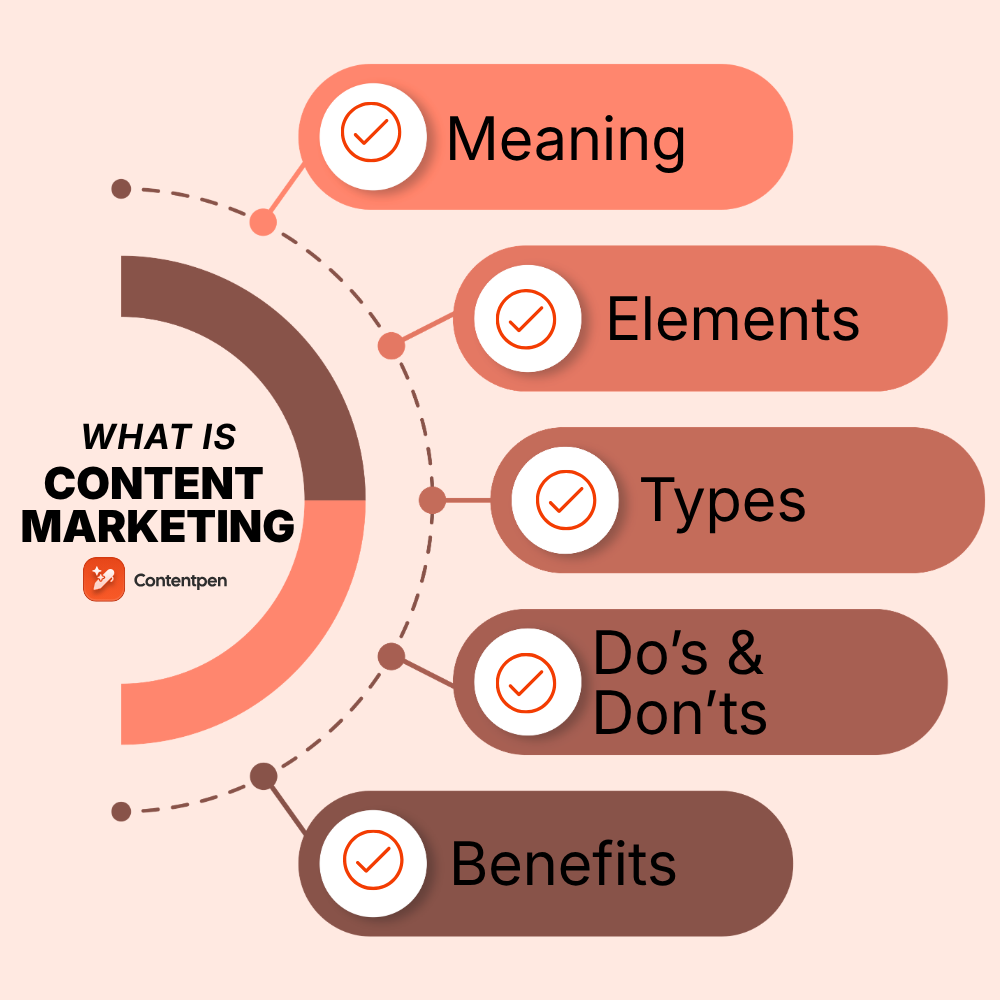
But don’t worry if you are not familiar with content marketing. In this blog, we’ll explore it from the ground up. You’ll learn the key elements and types.
We’ll also be breaking down the dos and don’ts of content marketing to ensure you can implement the right plan.
So, let’s get started and learn how exactly you can create, distribute, and optimize content with a solid content marketing strategy that delivers real results in 2026.
What is content marketing?
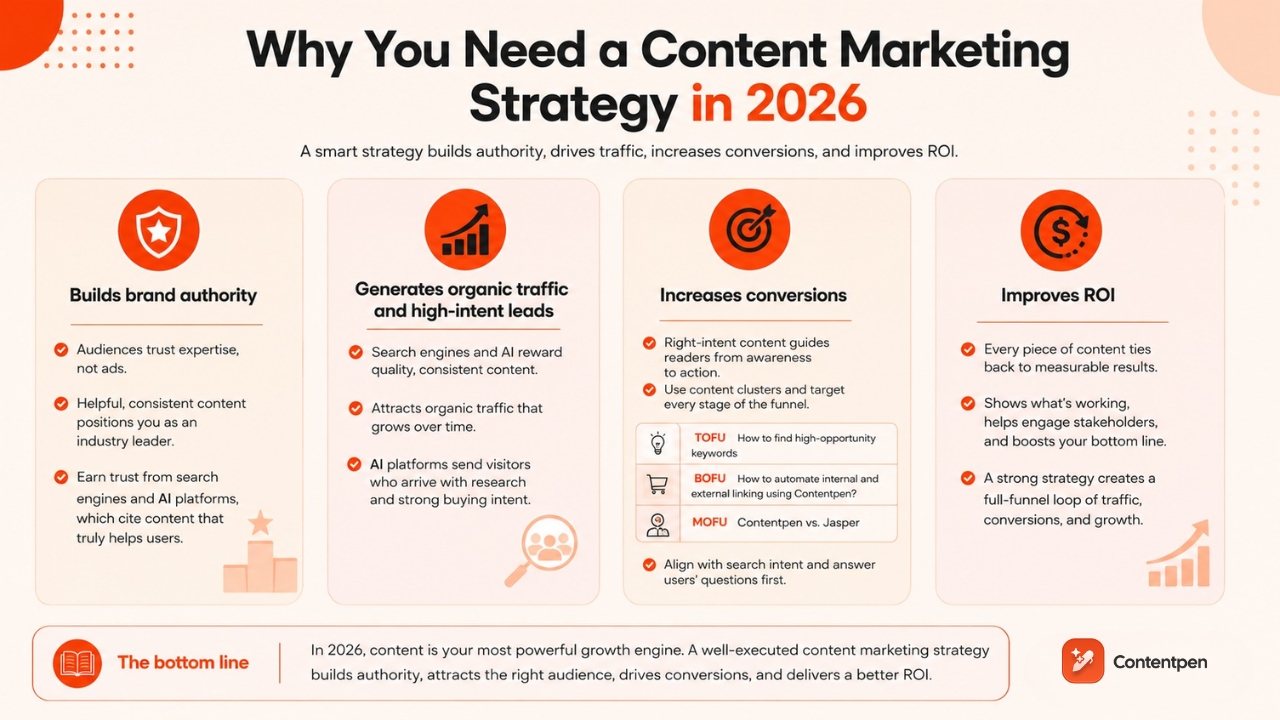
Content marketing is a strategic marketing approach focused on creating, distributing, and sharing valuable, relevant, and consistent content to attract and retain a clearly defined audience.
Unlike traditional advertising that interrupts your audience, content marketing provides genuinely useful information that helps solve problems, educates, or entertains your target customers.
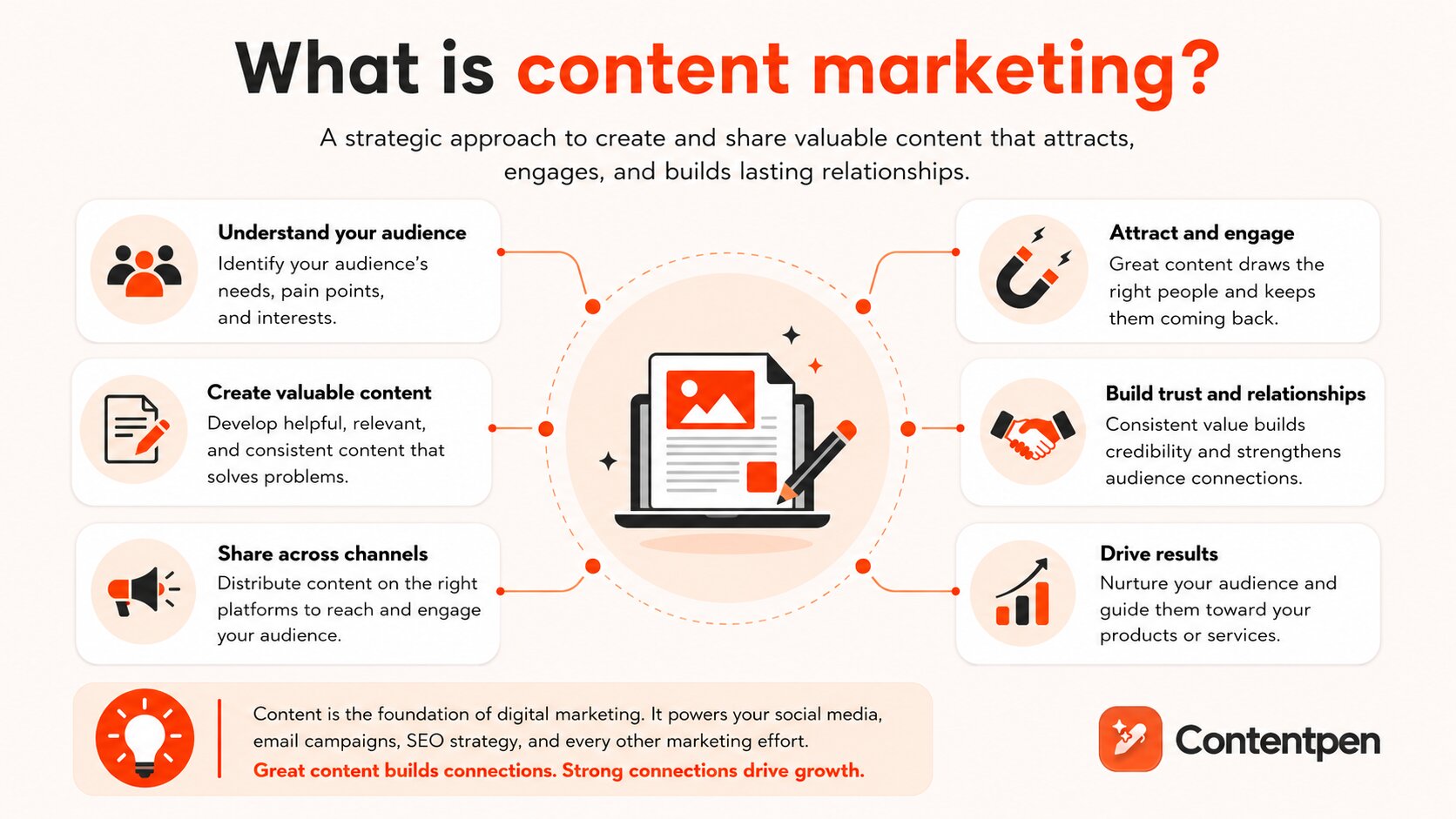
In digital marketing, content serves as the foundation that drives all other marketing efforts today.
Whether you’re running social media campaigns, email marketing, or SEO initiatives, quality content remains the core element that connects with your audience and builds lasting relationships.
The content marketing meaning extends beyond just creating blog posts or social media updates. It’s about understanding your audience’s pain points, challenges, and interests, then crafting content that addresses these needs while subtly guiding them toward your products or services.
What is the purpose of content marketing?
Content marketing serves multiple strategic purposes in modern business:
- Building trust and credibility with your target audience
- Establishing thought leadership in your industry
- Driving organic traffic to your website through search engines
- Supporting the sales funnel by nurturing leads at different stages
- Creating brand voice and improving brand recall
- Generating qualified leads who are genuinely interested in your solutions
- Reducing customer acquisition costs compared to traditional advertising methods
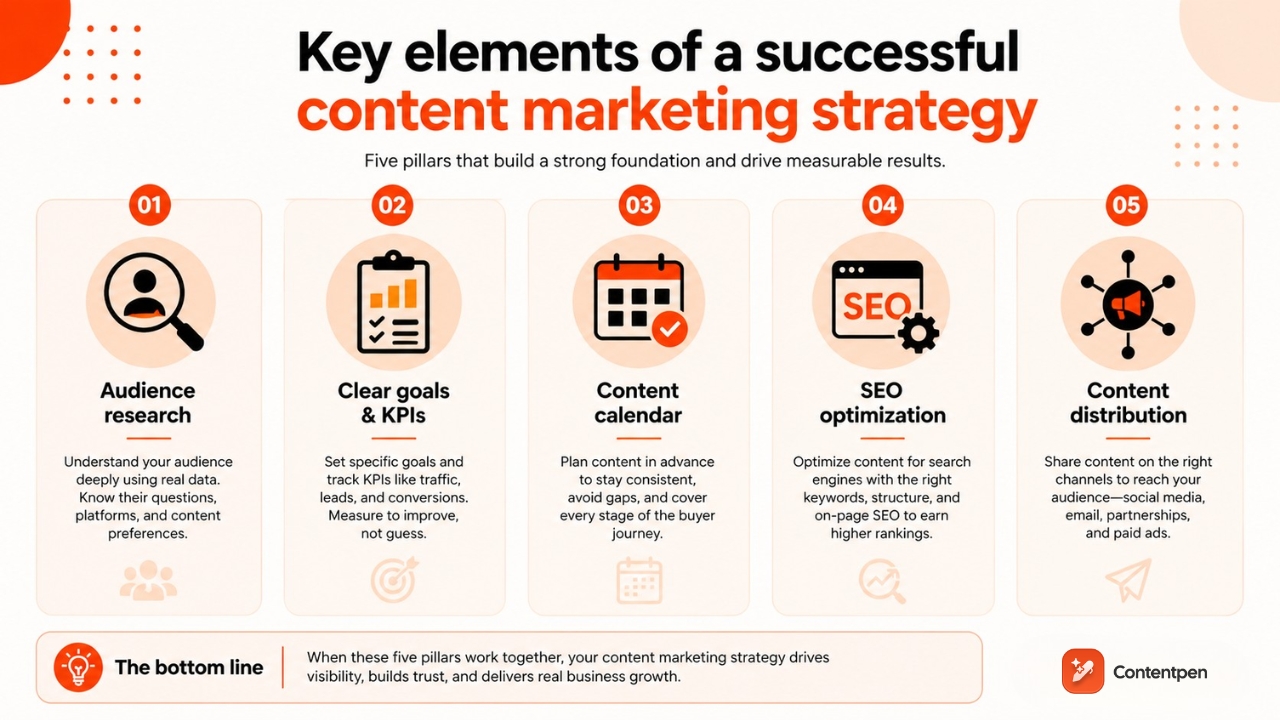
3 main elements of content marketing
Successful content marketing relies on three fundamental pillars that work together to create meaningful connections with your audience.
Content creation
This involves developing high-quality, valuable content that resonates with your target audience. Effective content creation requires understanding your audience’s needs, preferences, and challenges.
Once you know who you’re creating content for, the next step is choosing a suitable content format (more on this later).
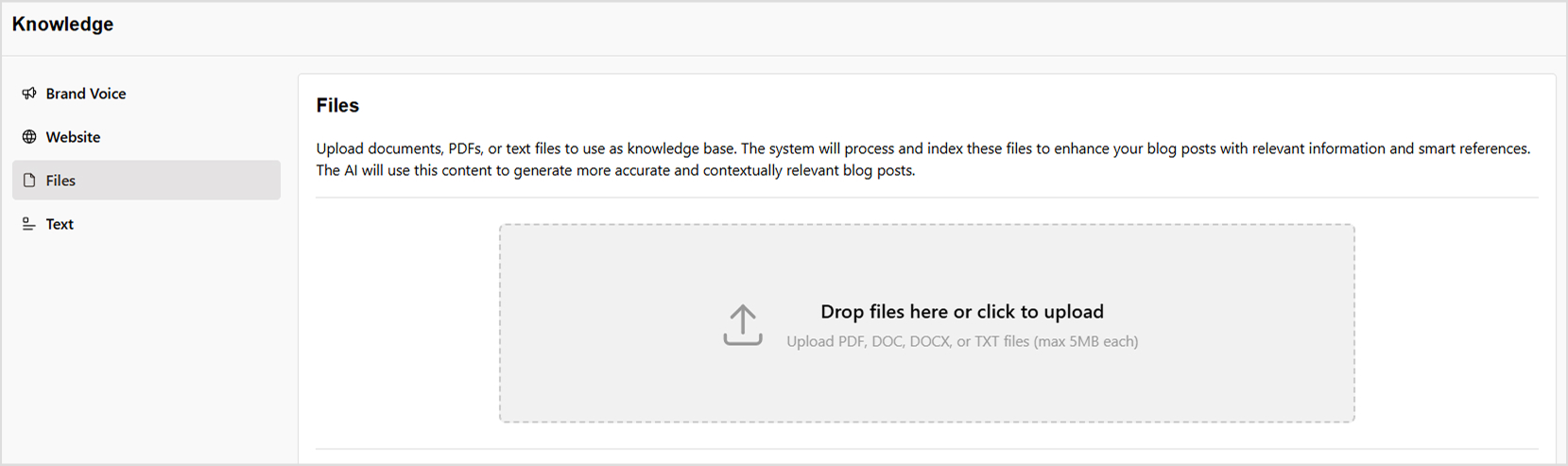
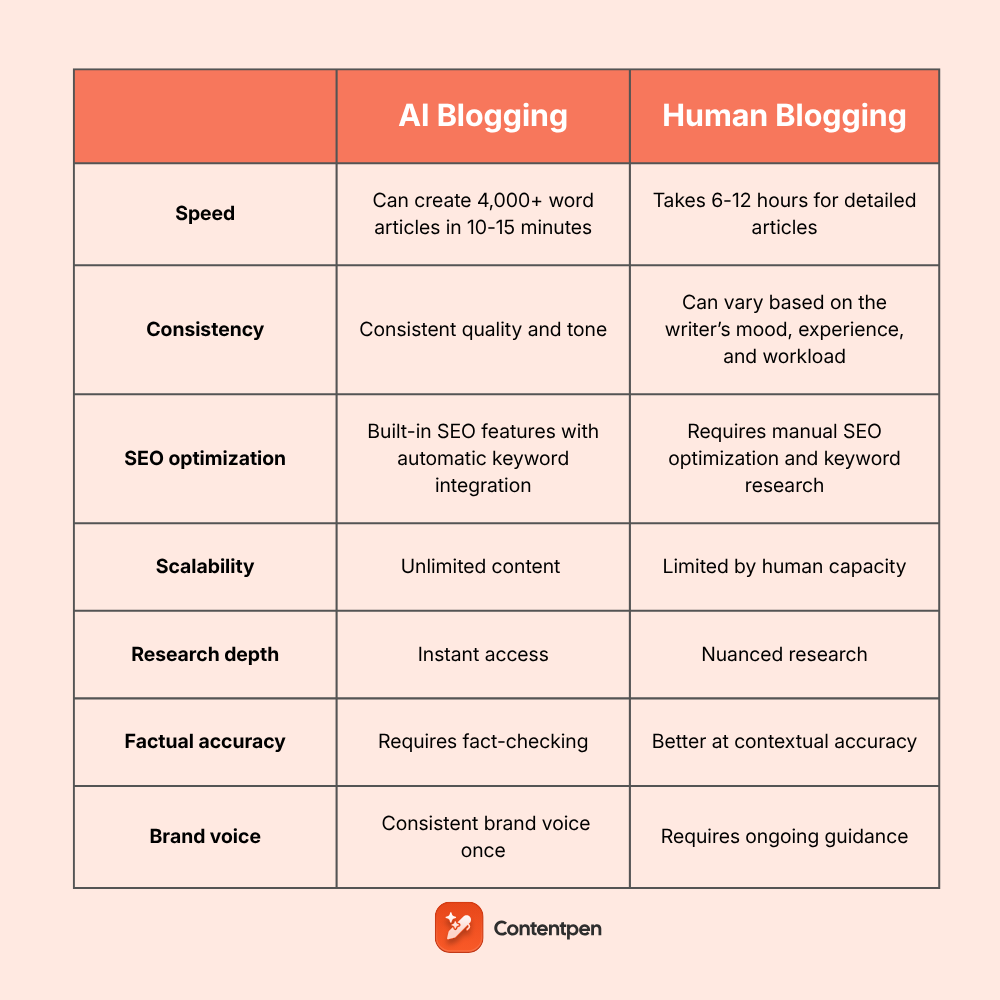
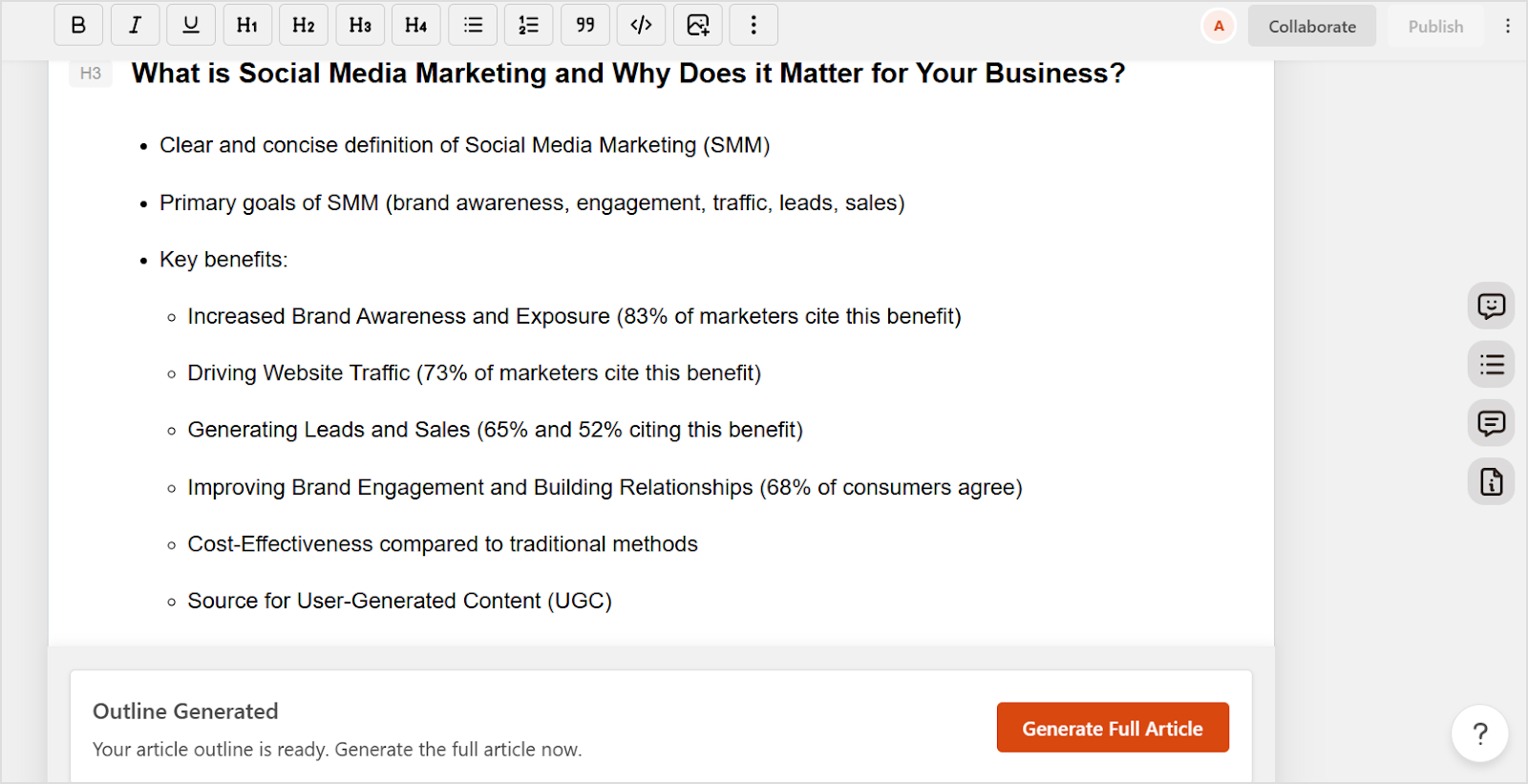
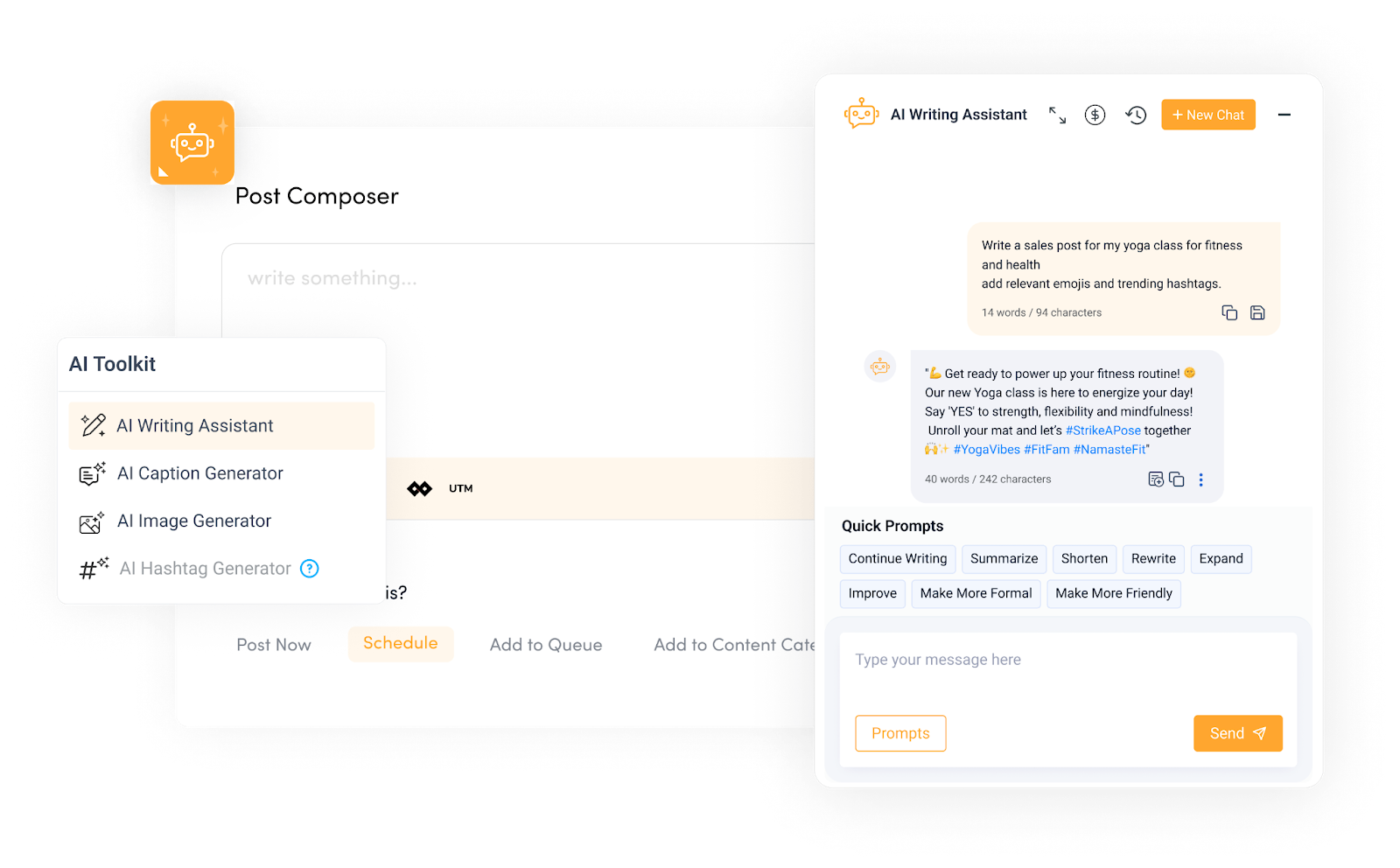
Since the rise of content marketing tools and AI platforms, the entire process of content creation has been greatly simplified. For instance, you can use AI to write blog posts to create high-quality content at scale without sacrificing quality.
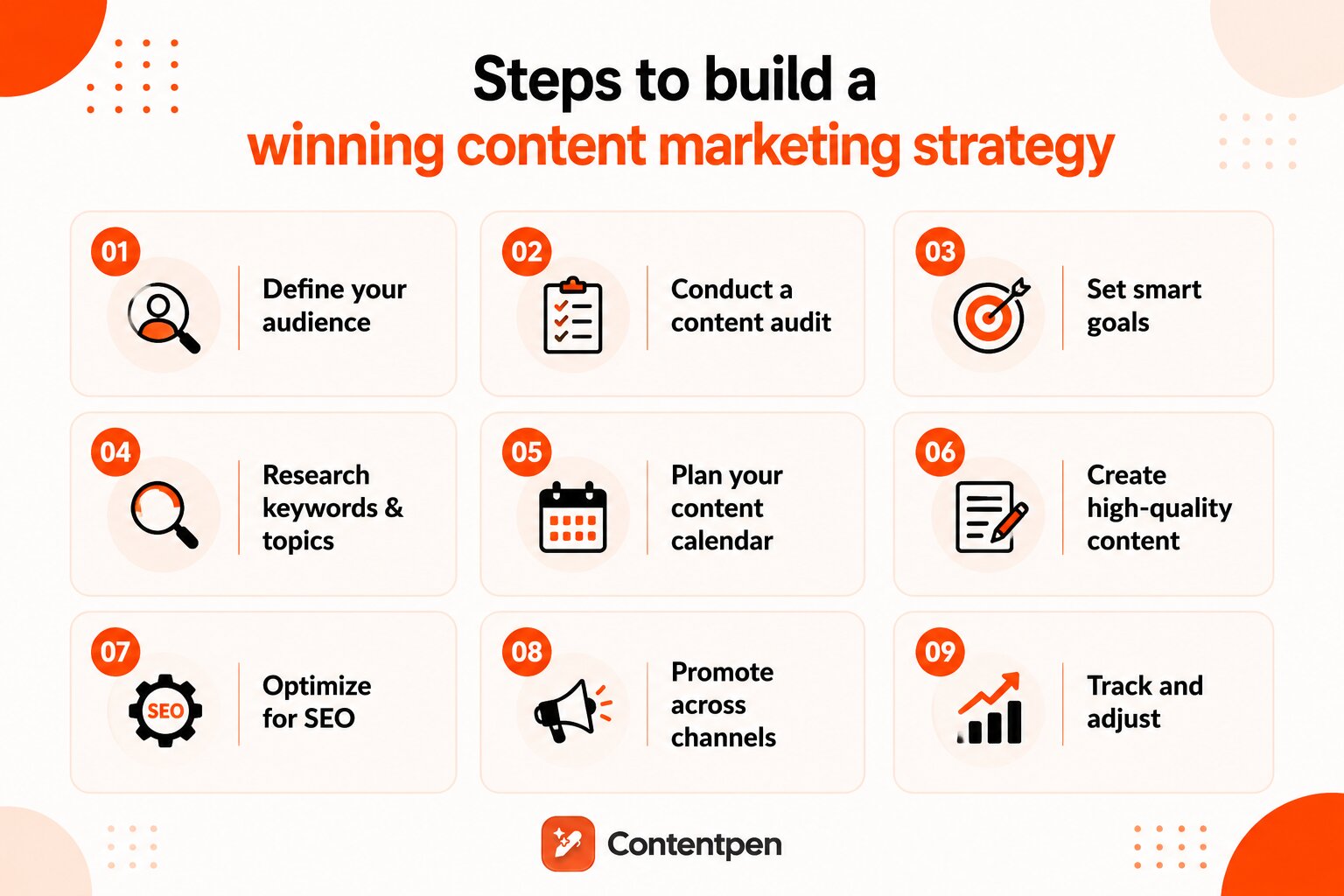
Generally speaking, you have to perform the following steps to actualize content creation:
- Researching topics
- Developing compelling headlines
- Structuring and formatting content logically
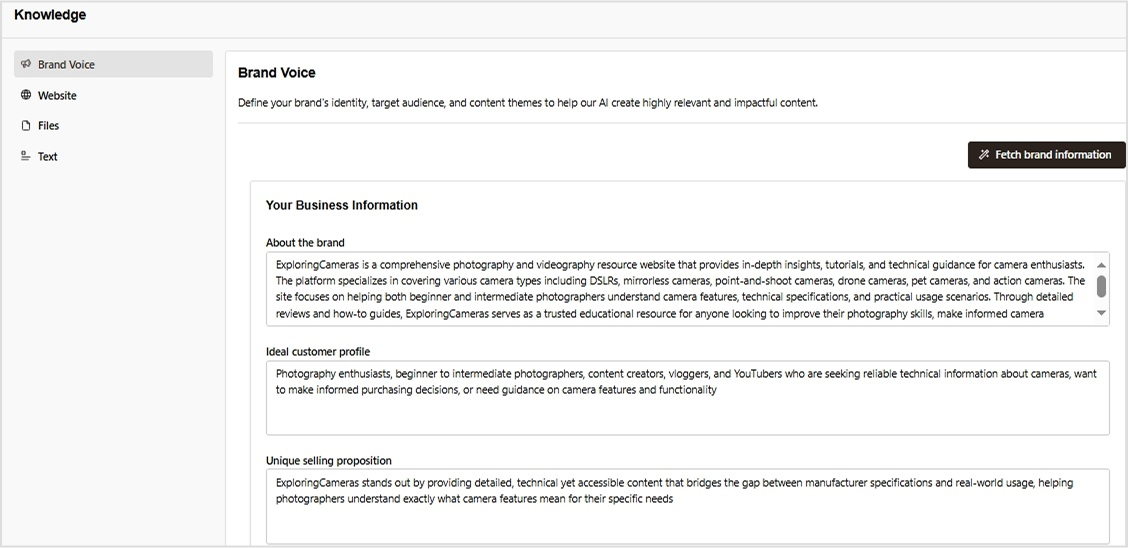
- Ensuring the content aligns with your brand voice
- Publishing and promoting content
Content distribution
Creating excellent content is only half the battle. You need strategic content distribution to reach your intended audience. This involves sharing your content across multiple channels, including your website, social media platforms, email newsletters, and third-party publications.
Distribution also includes:
- Optimizing content for different platforms
- Timing your posts strategically
- Using both organic and paid traffic to maximize reach and engagement
Here’s what a successful content distribution plan looks like in real life:
Red Bull’s example
Red Bull didn’t distribute ads. It distributed content worth seeking out and sharing. They established Red Bull Media House, a dedicated content creation and distribution wing that produces high-quality documentaries, videos, and articles related to extreme sports, music, and youth culture.
The distribution is deliberately platform-specific. They treat each social platform as a unique distribution channel.
Redbull uses YouTube for long-form documentaries and event highlights, and TikTok and Instagram Reels for “stunt clips” and POV athlete footage designed for virality.
The company also hosts popular racing events worldwide, including the Red Bull Soapbox Race and Drift Masters.

Key takeaway: Content distribution worked because it was native to each platform, not just repurposed across all of them uniformly.
Content engagement
The final element focuses on fostering meaningful interactions with your audience. This includes responding to comments, encouraging discussions, asking questions, and creating content that naturally invites participation.
Wendy’s example
A real-life content marketing example with conversational engagement could be Wendy’s on Twitter/X.
By responding to customers (and competitors) with wit and personality, they turned a brand account into a destination people follow for entertainment, and not just promotions.

Individual reply threads regularly go viral independently of any campaign, which shows that the brand is doing something right.
For SaaS content marketing campaigns, that means creating engagement to help build community around your brand.
Types of content marketing
Content marketing involves various formats, each serving different purposes and appealing to different audience preferences.
Blogging
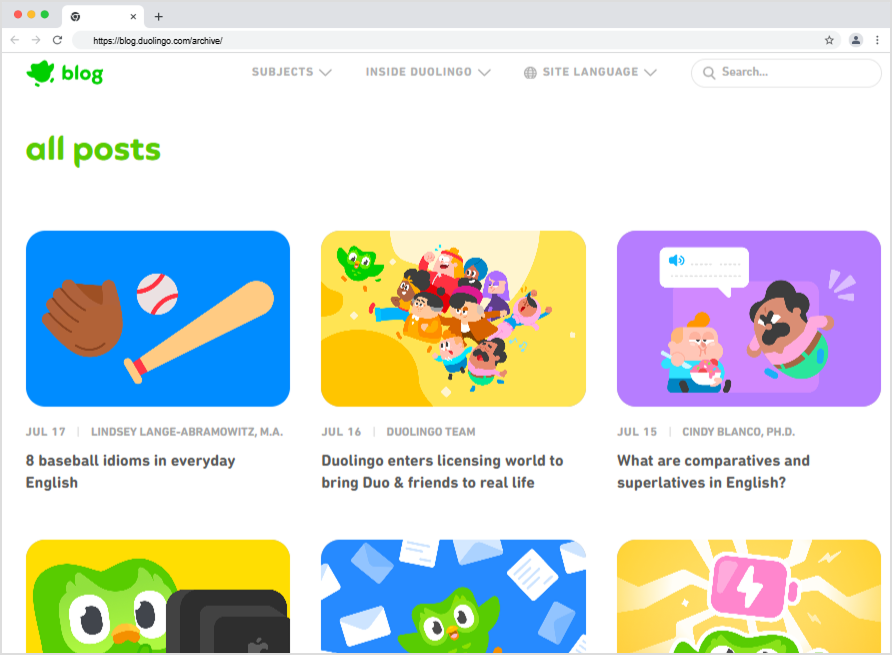
Blogging remains one of the most effective content marketing strategies. They provide opportunities to target specific keywords, share detailed insights, and establish expertise.
You can read about what is a blog in our detailed post. In short, it is typically long-form content (2000+ words) that basically acts as your organic traffic magnet. Blogs help spread brand awareness and bring in qualified leads that convert rapidly.
Knowing how to create a blog in 10 minutes demonstrates how modern tools can accelerate the blogging process. Take Contentpen as an example. Our AI writer is at the forefront of automated blogging, with AI search optimization and SEO features built directly into the workflow.
The tool ensures successful blogging so you can gain online visibility and earn from blogging without any hassle.
Videos and reels
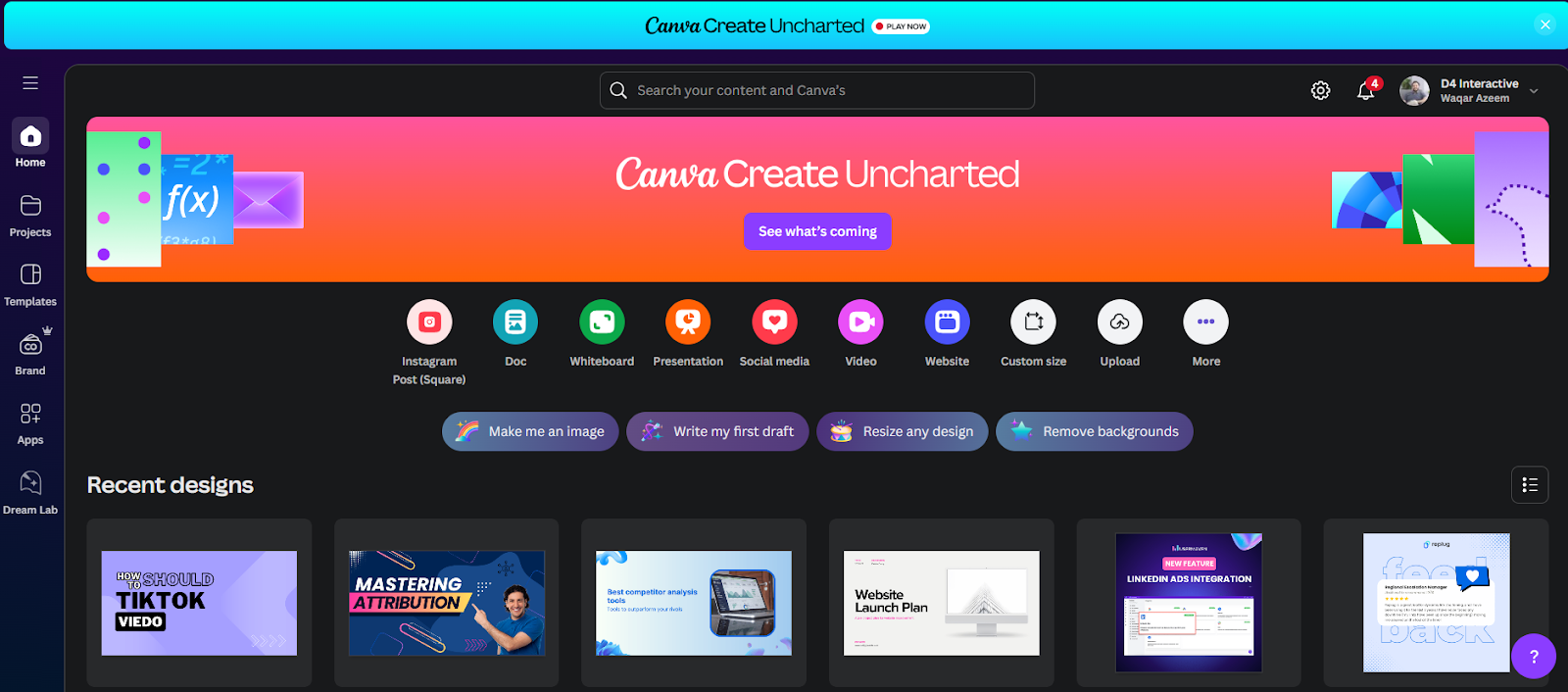
Video content captures attention effectively and can explain complex concepts in digestible formats. From educational tutorials to behind-the-scenes glimpses, videos create personal connections with your audience, whether filmed traditionally or produced with an AI Video Generator like Higgsfield.

Short-form videos like Reels and TikToks are particularly effective for reaching younger demographics and can significantly boost engagement rates across social media platforms.
Social media content
Platform-specific content tailored to each social media channel’s unique characteristics and audience expectations.

This includes everything from Instagram stories to LinkedIn articles, each requiring different approaches and tones.
Podcasts
Audio content allows audiences to consume information while multitasking, making it incredibly convenient. Podcasts build deeper relationships through the intimate nature of voice communication and can establish strong personal brands.

The growing popularity of podcasts creates opportunities for thought leadership, guest appearances, and niche audience targeting.
Regular podcast episodes help maintain consistent touchpoints with your audience, while the conversational format makes complex topics more accessible and engaging than traditional written content.
Infographics
Infographics are visual content that simplifies complex information into easily digestible formats. This type of content is highly shareable and effective in communicating data, processes, or different types of comparisons.
Infographics perform exceptionally well on social media platforms and can significantly reduce bounce rates for your blogs.
Well-designed infographics combine compelling visuals with clear data storytelling, making them valuable for link-building efforts. They’re particularly effective for explaining step-by-step processes, statistical findings, or industry trends in formats that audiences can quickly understand and share.
Email marketing
Emails are a mode of direct communication with your subscribers who have explicitly shown interest in your content.
Email marketing is about enabling personalized content delivery and nurturing leads through targeted campaigns that have a particular desired CTA.
Kareem Rahma’s example
The ‘Another New Thing’ newsletter by Kareem Rahma, who also runs the famous show ‘Subway Takes’, is a perfect example of how to build your email marketing list effectively.
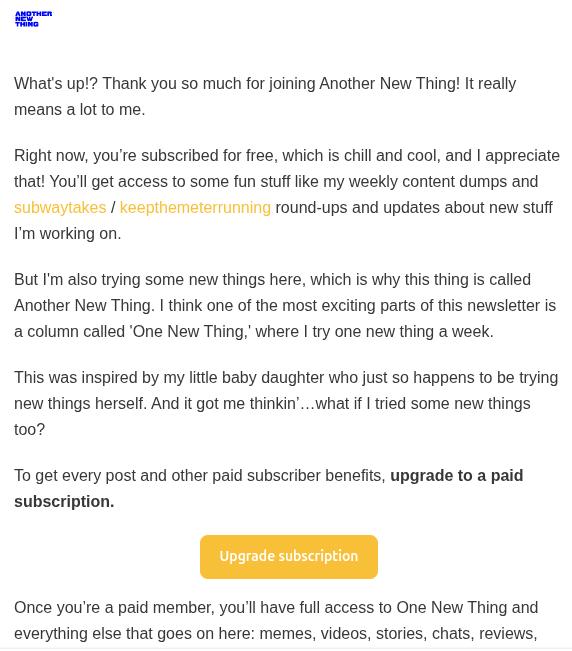
Yes, the email has limited visuals. Yes, it is short, but it does have a clear CTA at the end that doesn’t overpromise the user. People know exactly what they’ll get when clicking that button, making this a minimalist yet effective approach to email marketing.
Emails continue to have the highest ROI of any content marketing channel in 2026, with about $10-$36 for $1 spent. That is a whopping 10:1 or 36:1 ratio!
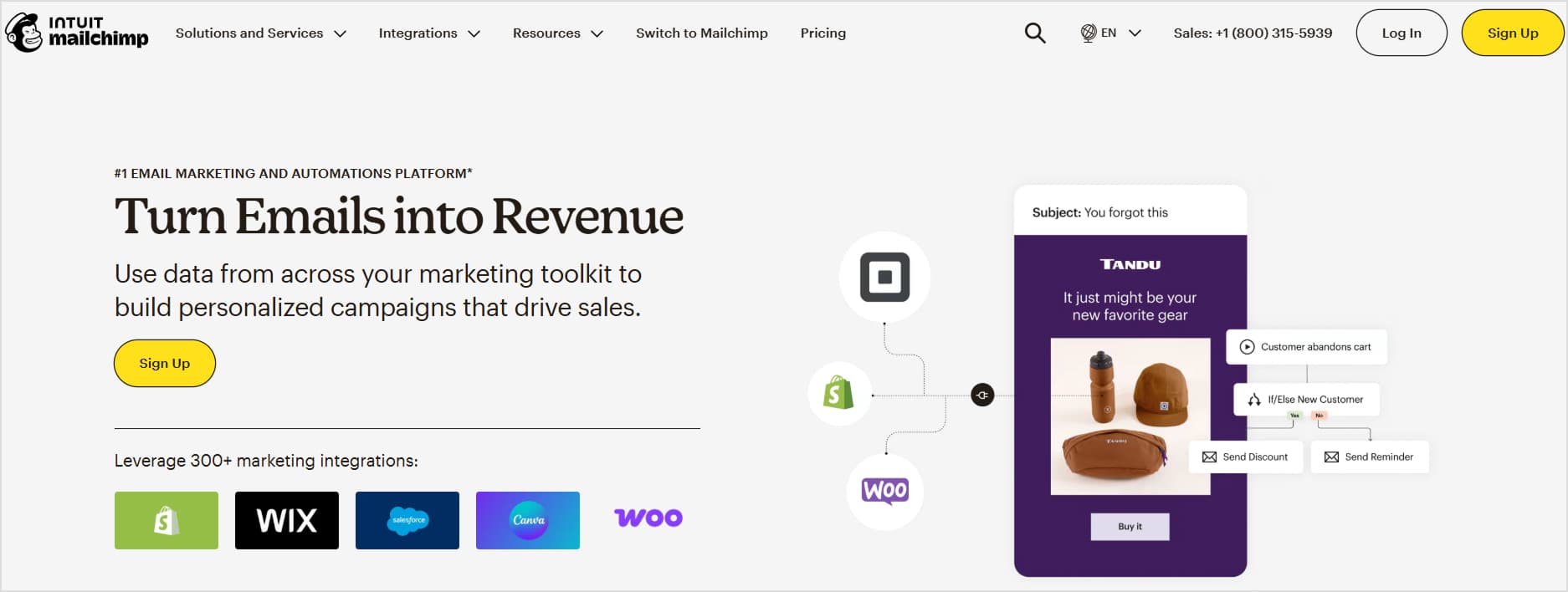
With advanced email marketing tools, like Customer.io or Mailchimp, you can also segment audiences and set up automated sequences to further enhance engagement and conversions.
There are also some other market- and niche-specific tools that you can use for emails. For example, Donorbox is used by non-profits for donor communications, Klaviyo is mostly used by e-commerce businesses building a healthy email channel, and others.
White papers
White papers are in-depth, authoritative content that demonstrates expertise in a niche and provides comprehensive solutions to specific industry challenges. This type of content is particularly effective for B2B marketing and lead generation.

The detailed reports establish credibility by presenting original research, case studies, or industry analysis that competitors cannot easily replicate. They serve as powerful lead magnets, often requiring contact information for downloads, making them valuable for building email lists.
Matching content types to the buyer journey
Not all content serves the same purpose, and the most effective content marketing strategies align the format to the stage of the buyer journey the audience is in.
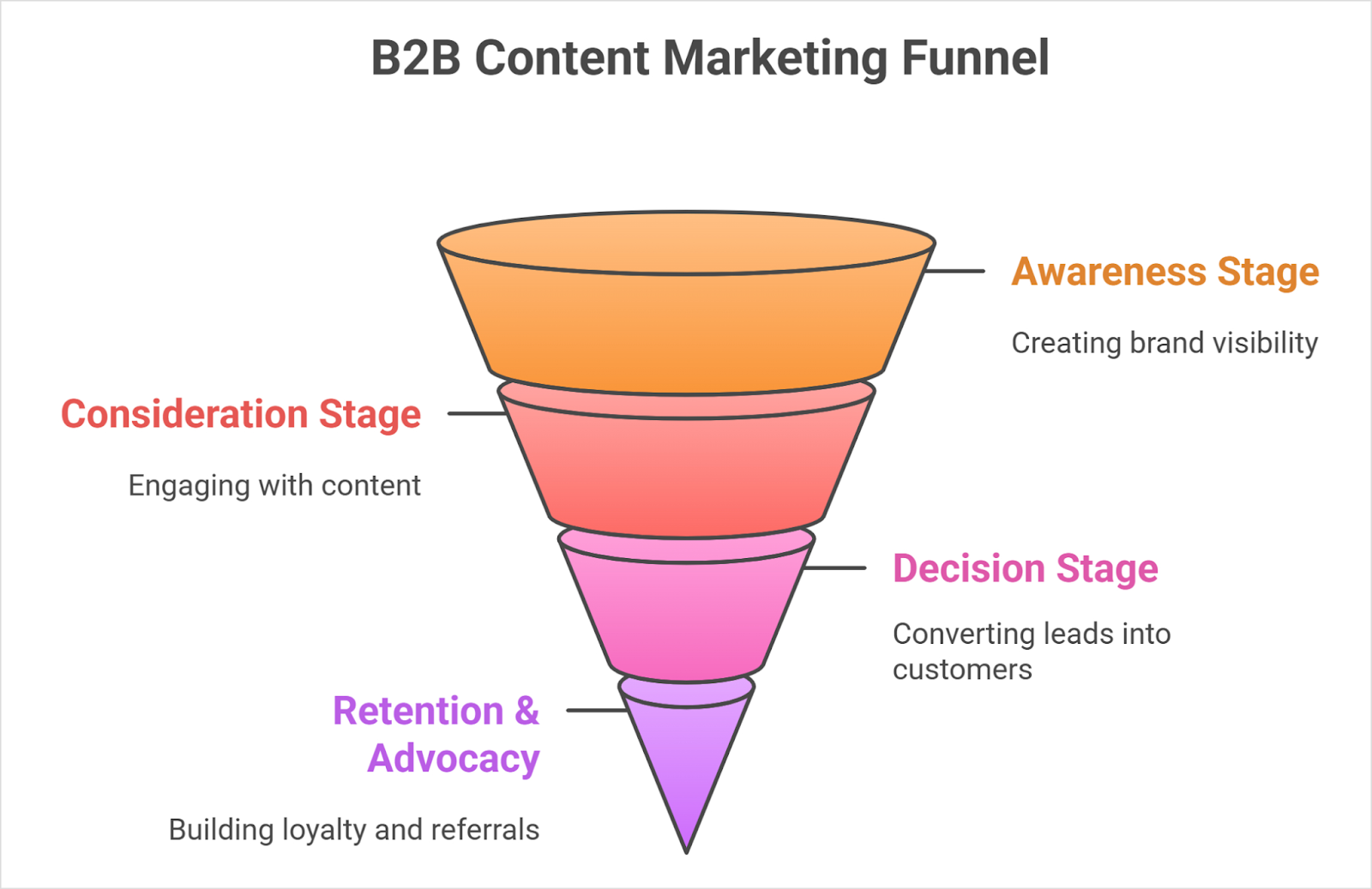
At the awareness stage, the goal is to educate and attract. Blog posts, short-form videos, infographics, and social media content work well here because they answer broad questions and introduce your brand to people who may not know they need your solution yet.
At the consideration stage, prospects are actively evaluating options. This is where podcasts, longer YouTube content, detailed guides, and email sequences shine. These formats allow you to go deeper, build trust, and demonstrate expertise over time.
At the decision stage, the reader is close to choosing. White papers, case studies, product-led blog posts, and targeted email campaigns help tip the balance by showcasing proof, addressing objections, and making the next step obvious.
Understanding this progression is what separates a list of content formats from a real content marketing strategy. Every piece you publish should have a clear answer to: who is this for, and where are they in their journey?
Do’s and don’ts of content marketing
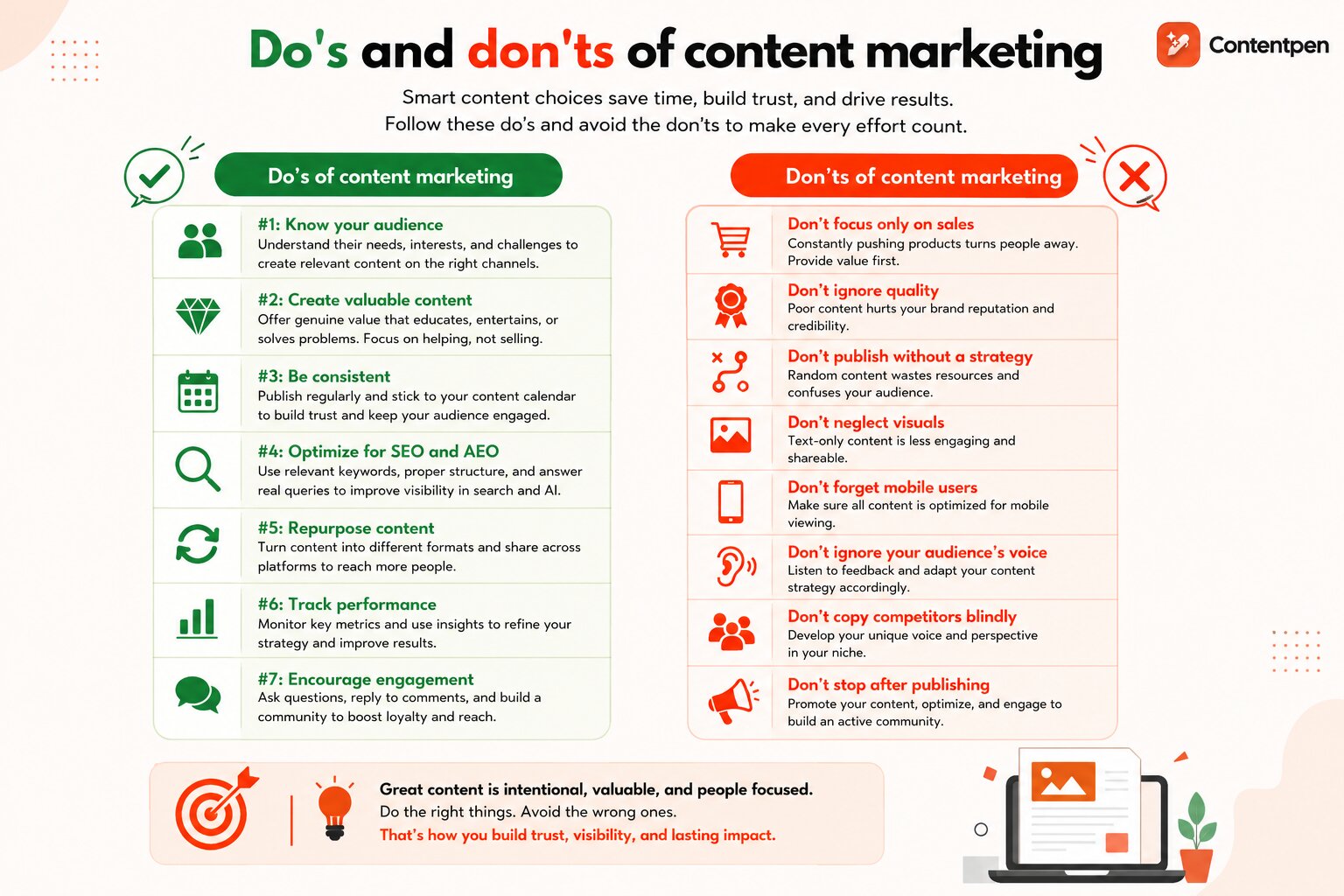
Understanding what works and what doesn’t in content marketing is crucial to save time and effort. Some do’s we’ve already covered, but will be reiterated due to their importance.
Do’s of content marketing
Do these to ensure that your content marketing efforts are fruitful:
#1: Know your audience
Successful content marketing starts with deep audience understanding.
Research your target customers well. Know their demographics, interests, challenges, and content preferences so that the content you create and the channel you send it through are aligned with each other.
For instance, most B2B brands like Adobe or Salesforce won’t be doing TikToks often since most of their audience is mature and on professional platforms like LinkedIn.
Meanwhile, a food business may post short reels on Facebook, TikTok, or Instagram to appeal to a larger audience base.
Therefore, before you implement your content marketing strategy, it is important that you first create buyer personas to help you create pieces that serve your audiences well.
#2: Create valuable content
Focus on providing genuine value rather than promotional messages. Use storytelling to build a narrative and connect with the audience on a deeper level.
Related read: Recent innovative marketing examples.
Your content should educate, entertain, or solve problems for your audience. You can also do all three at the same time, kind of like what we do there at Contentpen.
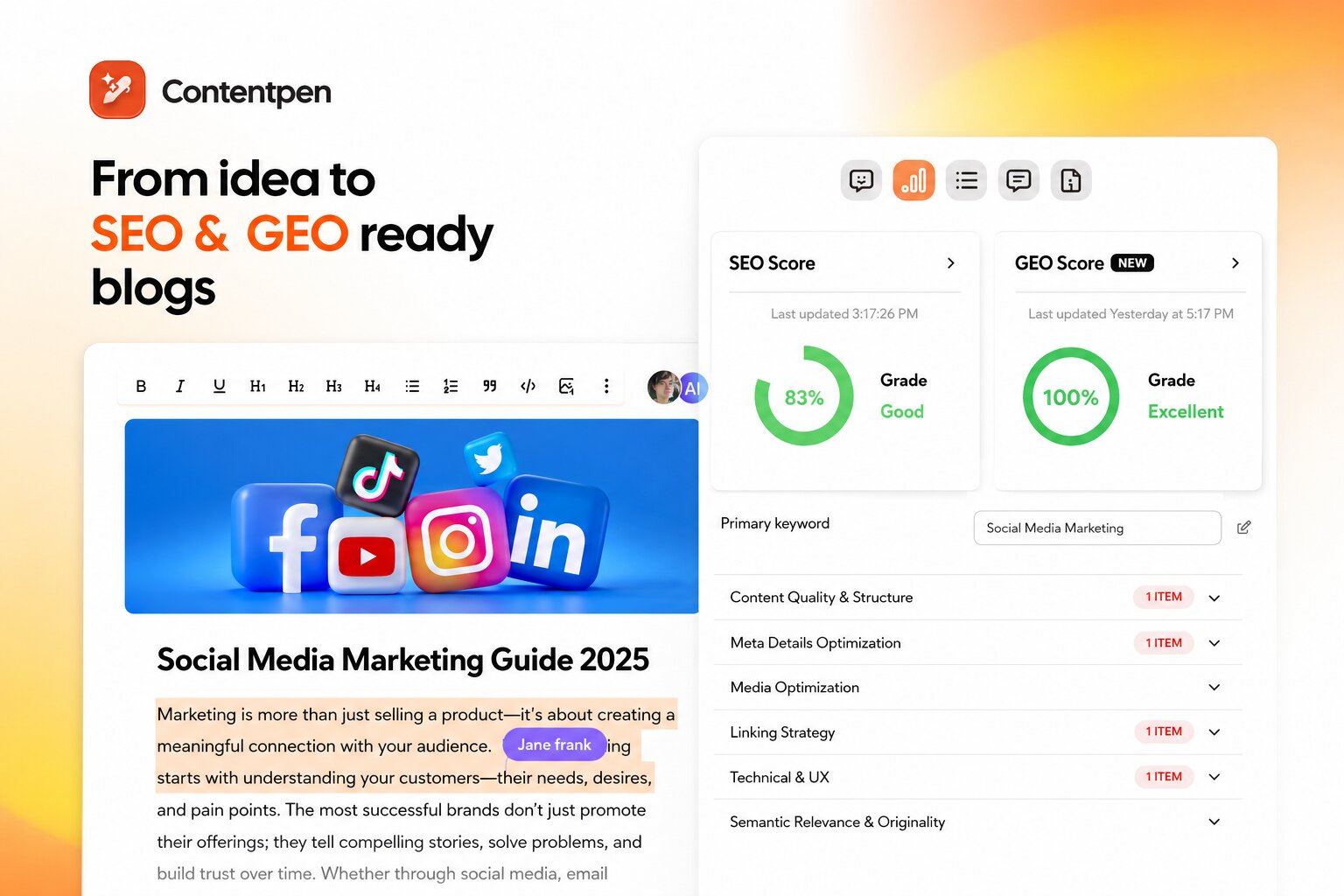
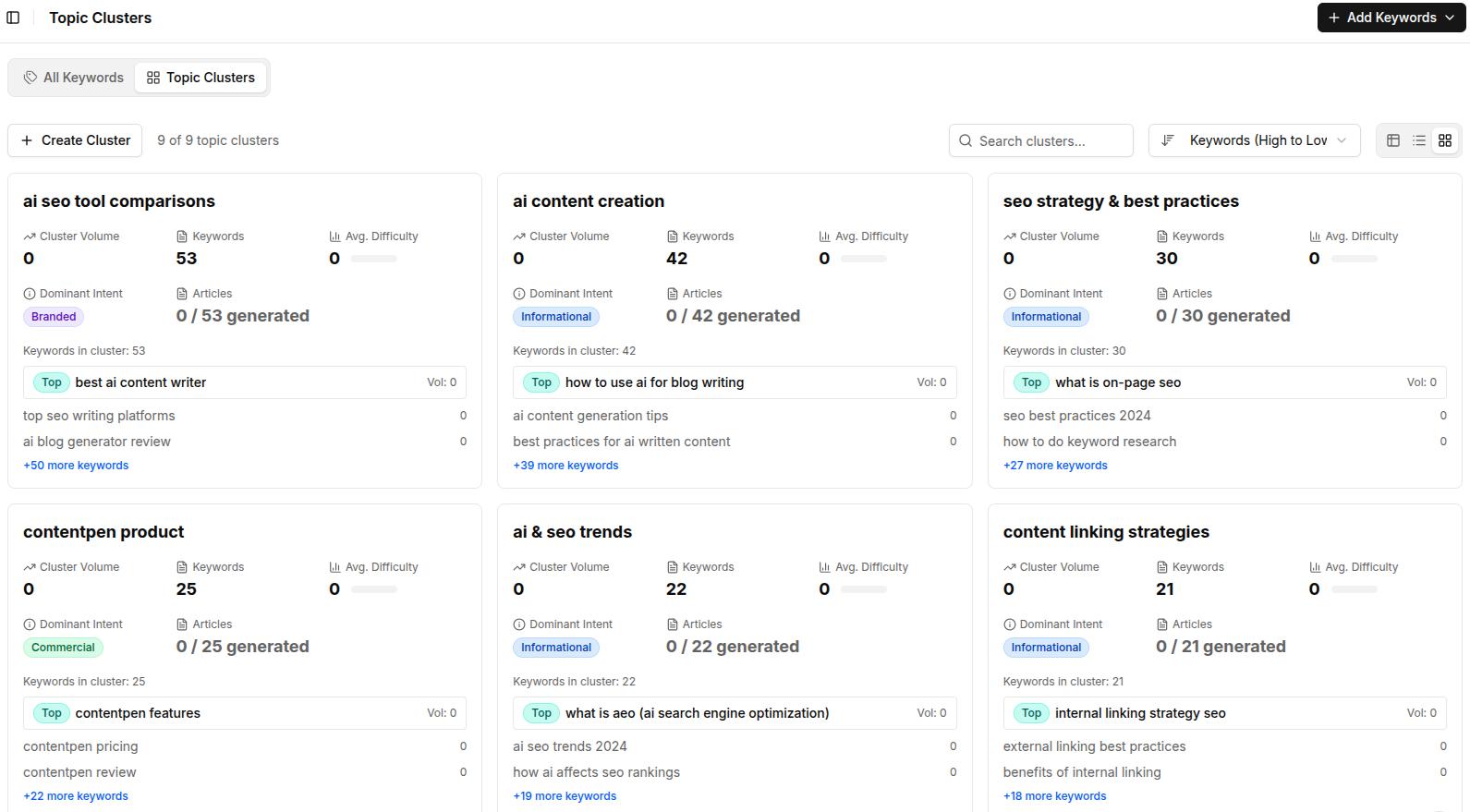
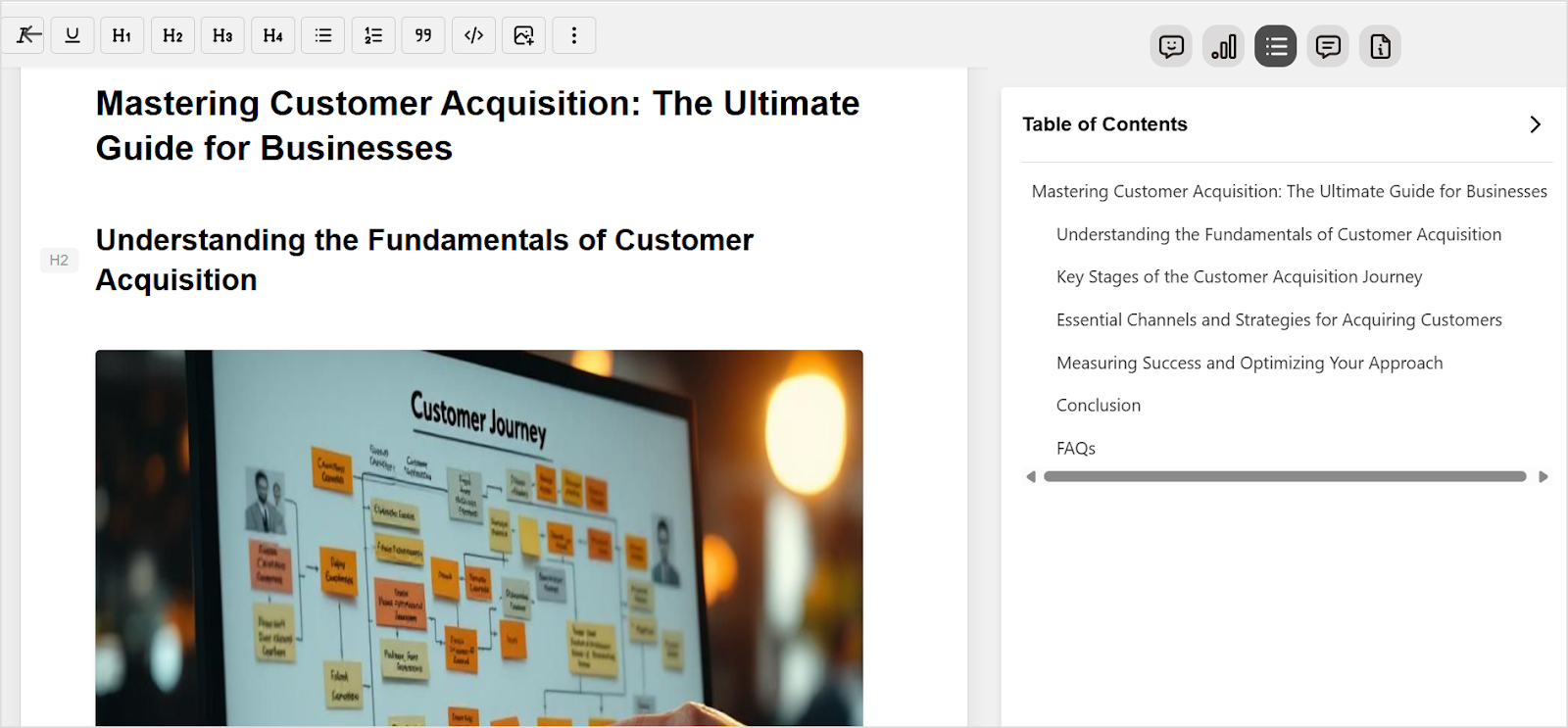
Our AI text generator keeps your content creation needs in check by providing a unifying system to research keywords, write, edit, and optimize for AI and search engines.
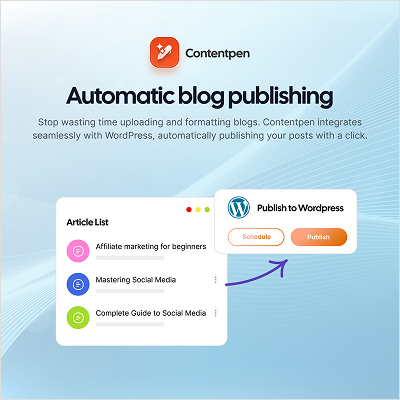
One-click publishing and post-publishing SEO opportunities features ensure that you have a clear view of what’s working and what could be improved.

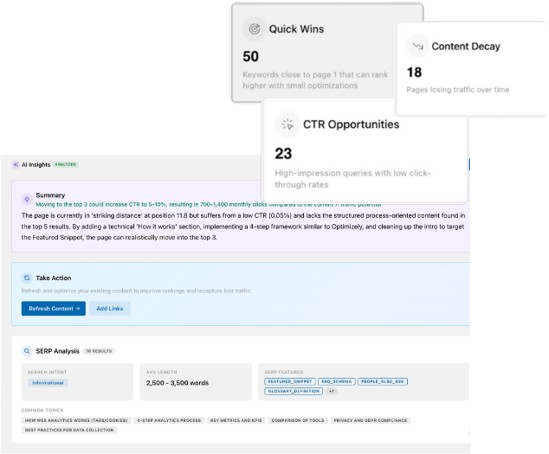
Turn existing content into growth opportunities

Identify pages losing traffic or CTR
Find quick wins to improve clicks and rankings
#3: Be consistent
Consistency builds trust and keeps your audience engaged. Develop a content calendar and stick to regular publishing schedules.
For this, we recommend using dedicated content management tools and systems, such as Trello, Asana, or Jira. Pick whichever suits your budget and needs.
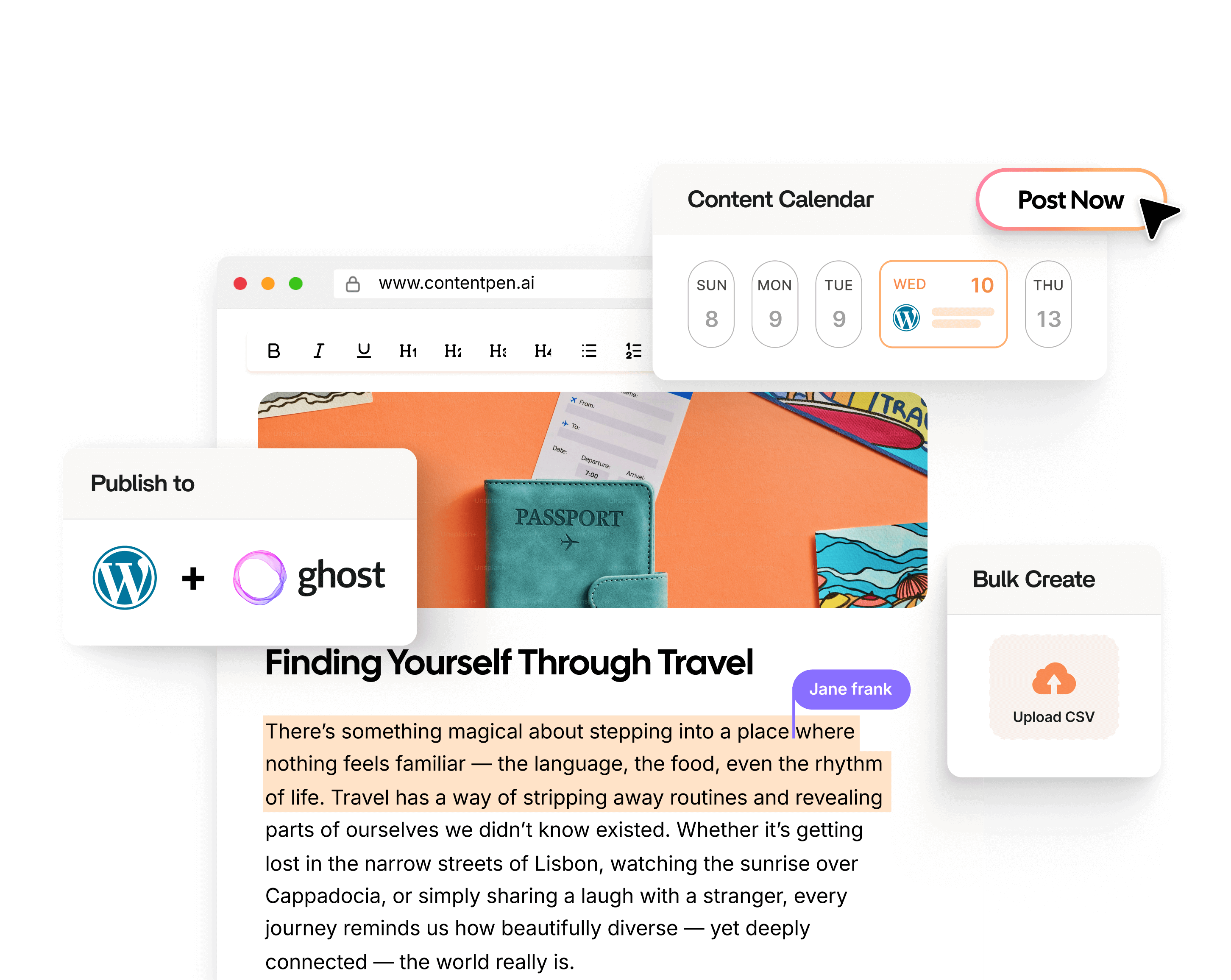
One dedicated content solution for freelancers and agencies is Contentpen. Our smart content calendar and scheduling features ensure that you never miss another date to publish.
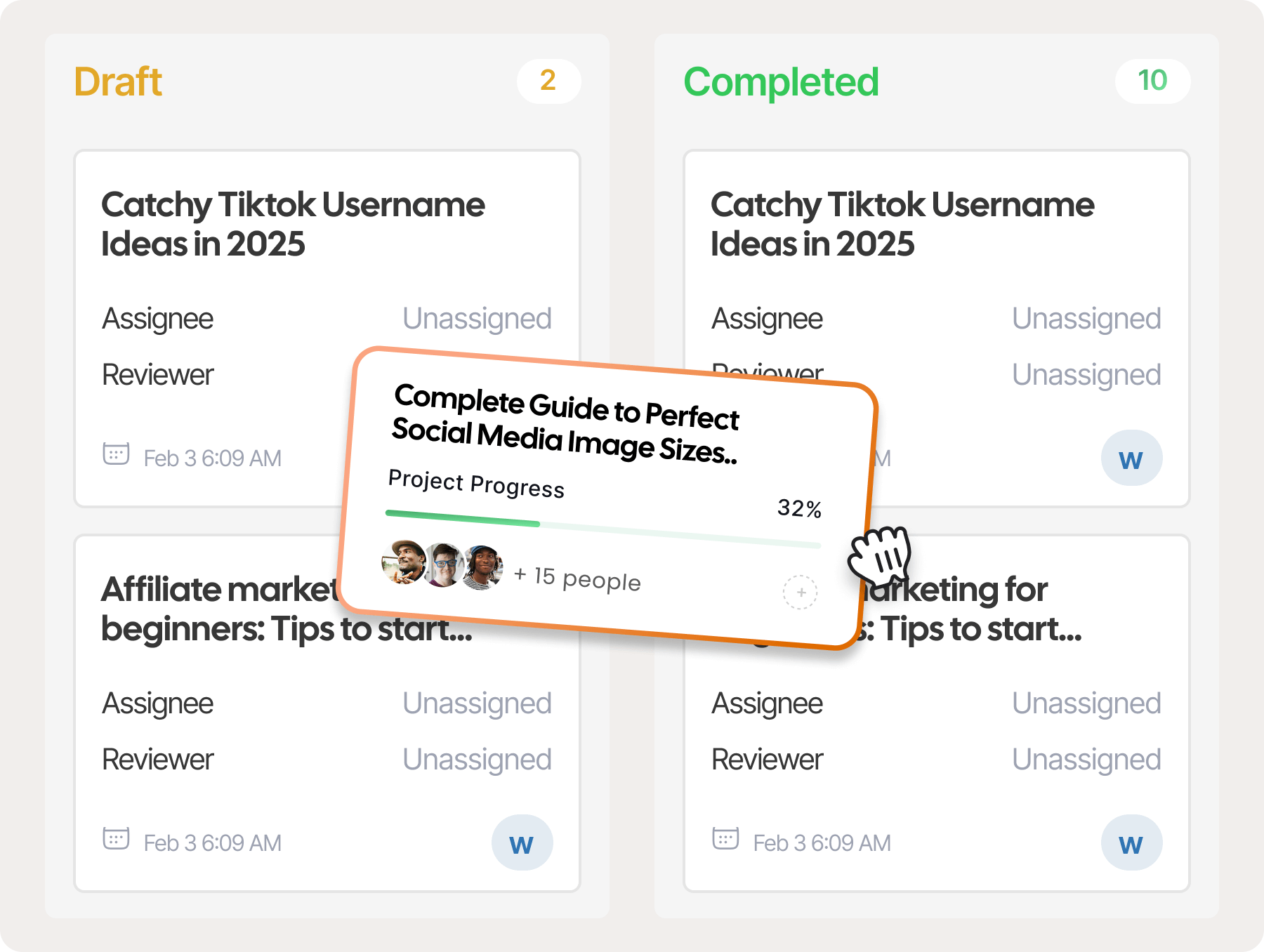
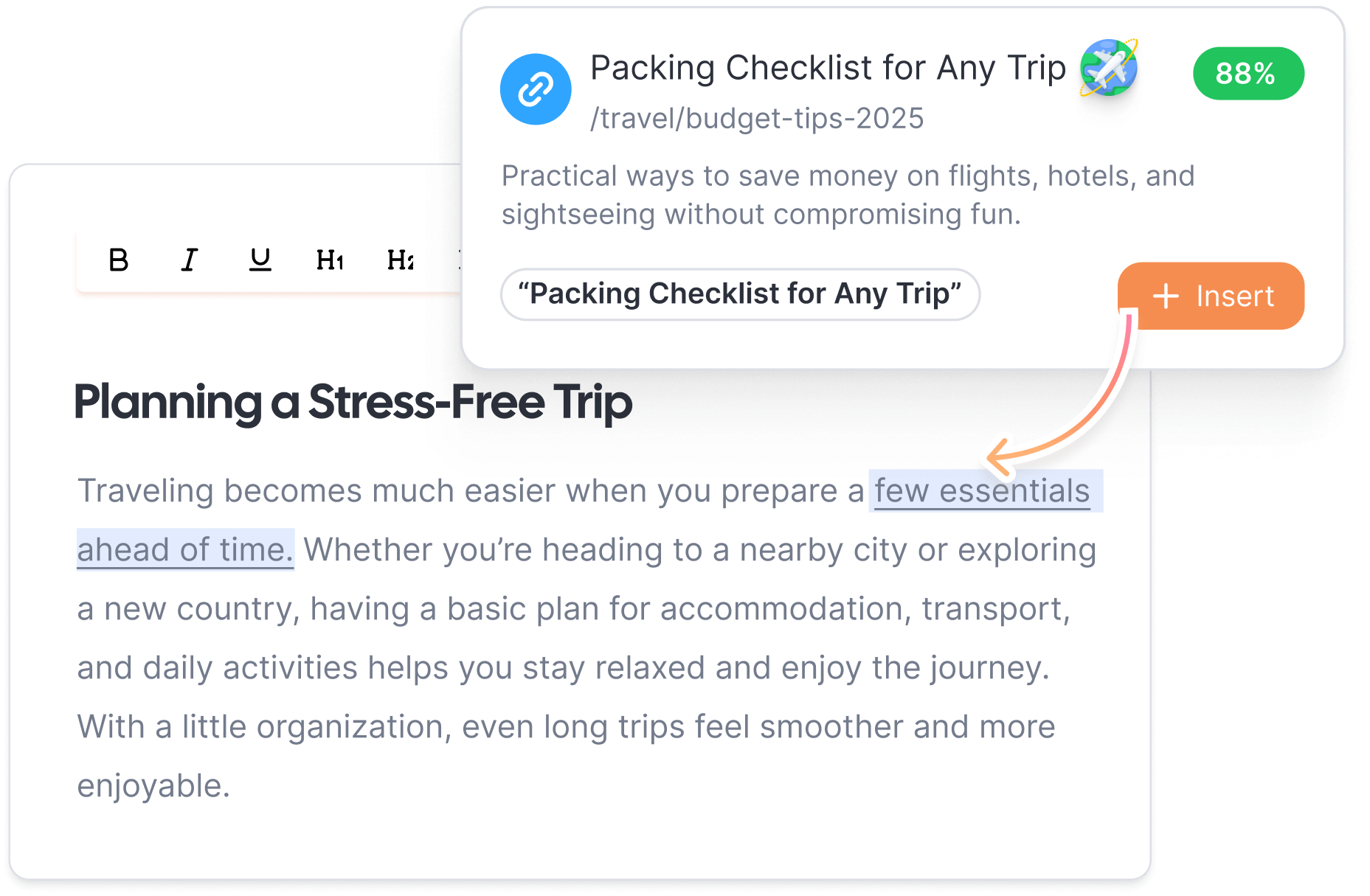
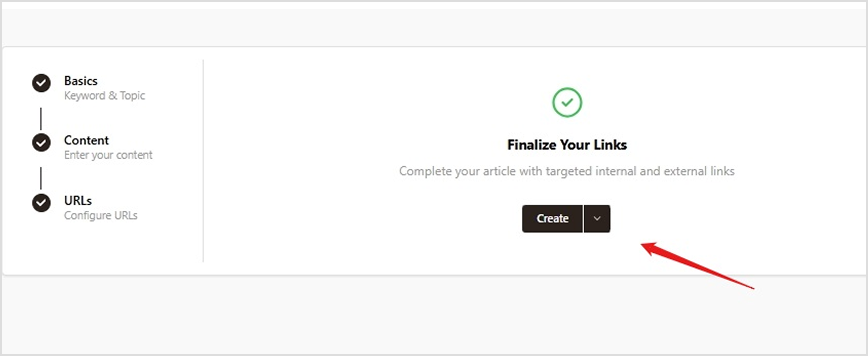
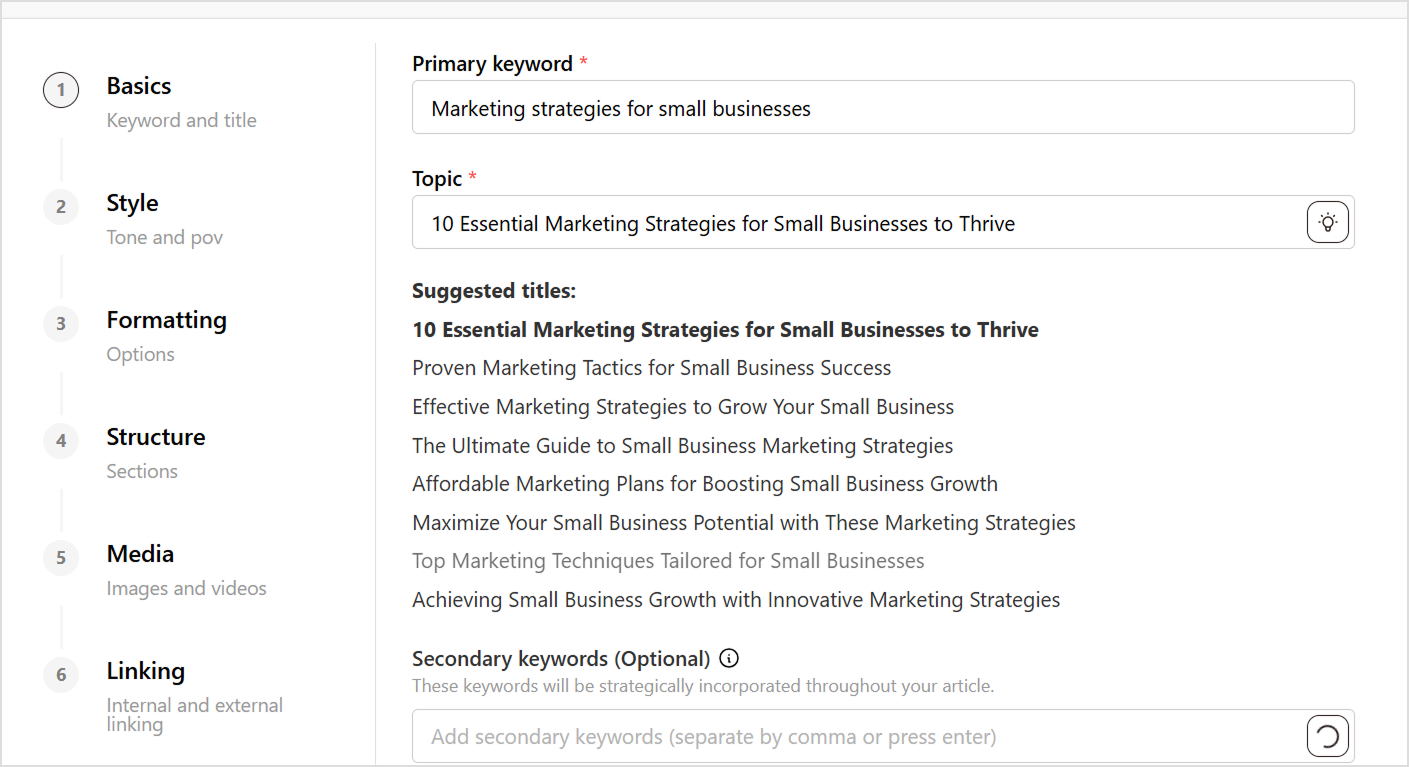
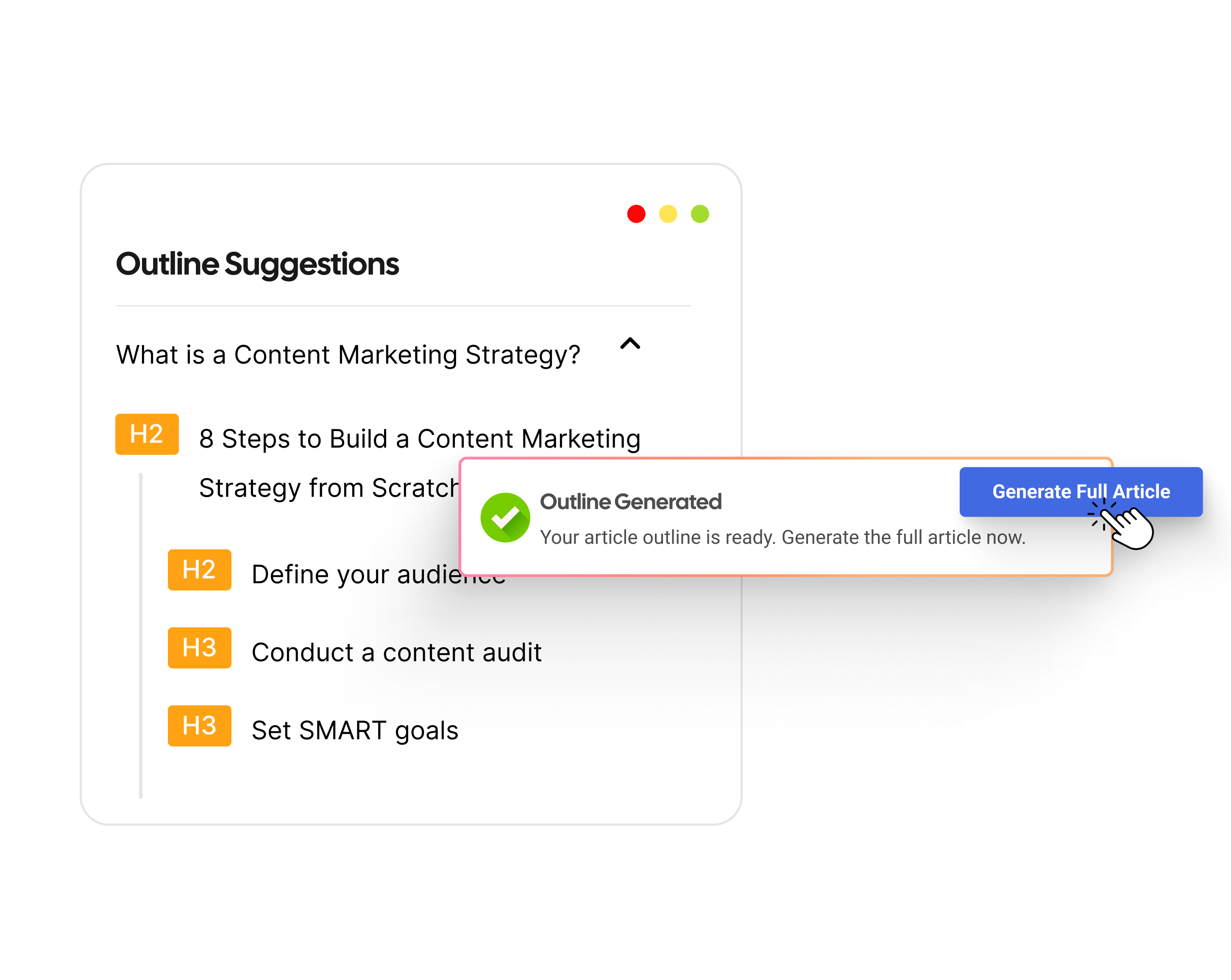
The tool is also ideal for content marketing for small businesses. It takes a keyword and a date, creates the title, generates secondary keywords, writes content, inserts links, and publishes the article to your preferred platform automatically.
#4: Optimize for SEO and AEO
Ensure your content is discoverable through search engines by incorporating relevant keywords naturally, optimizing meta descriptions, and following SEO best practices.
Also, make sure that you properly structure your content and provide genuine solutions to people’s queries for better answer engine optimization and AI extractability. In 2026, this is your winning angle, especially as a new and upcoming brand.
#5: Repurpose content
Maximize your content investment by adapting it for multiple formats and platforms. Transform blog posts into videos, infographics, or social media series to reach different audience segments effectively.
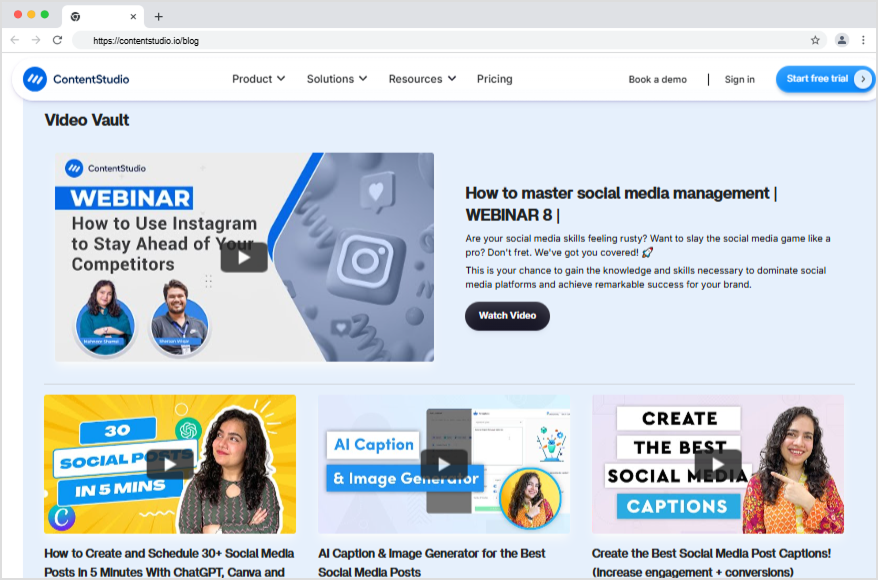
With our brand-new ContentStudio.io integration, you can now post your blog updates and content directly to your preferred social media handles. This simplifies the content repurposing process and streamlines your content calendar for steady posting and engagement.
#6: Track performance
Use analytics to understand what resonates with your audience. Monitor metrics like engagement rates, time on page, conversion rates, and social shares to refine your content marketing strategies continuously.
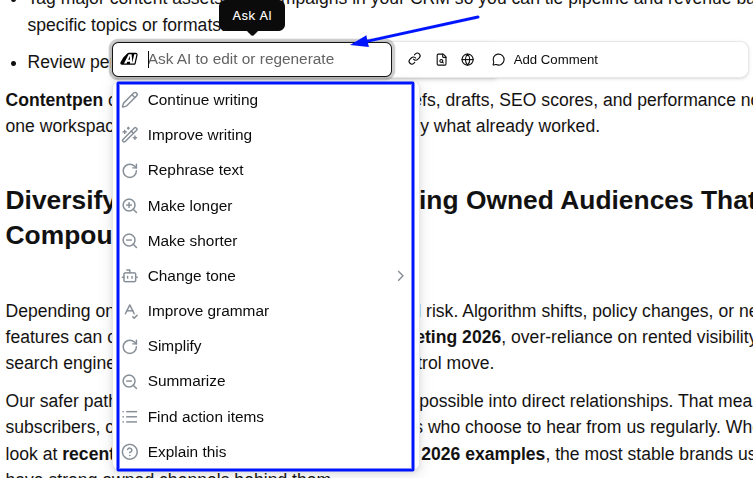
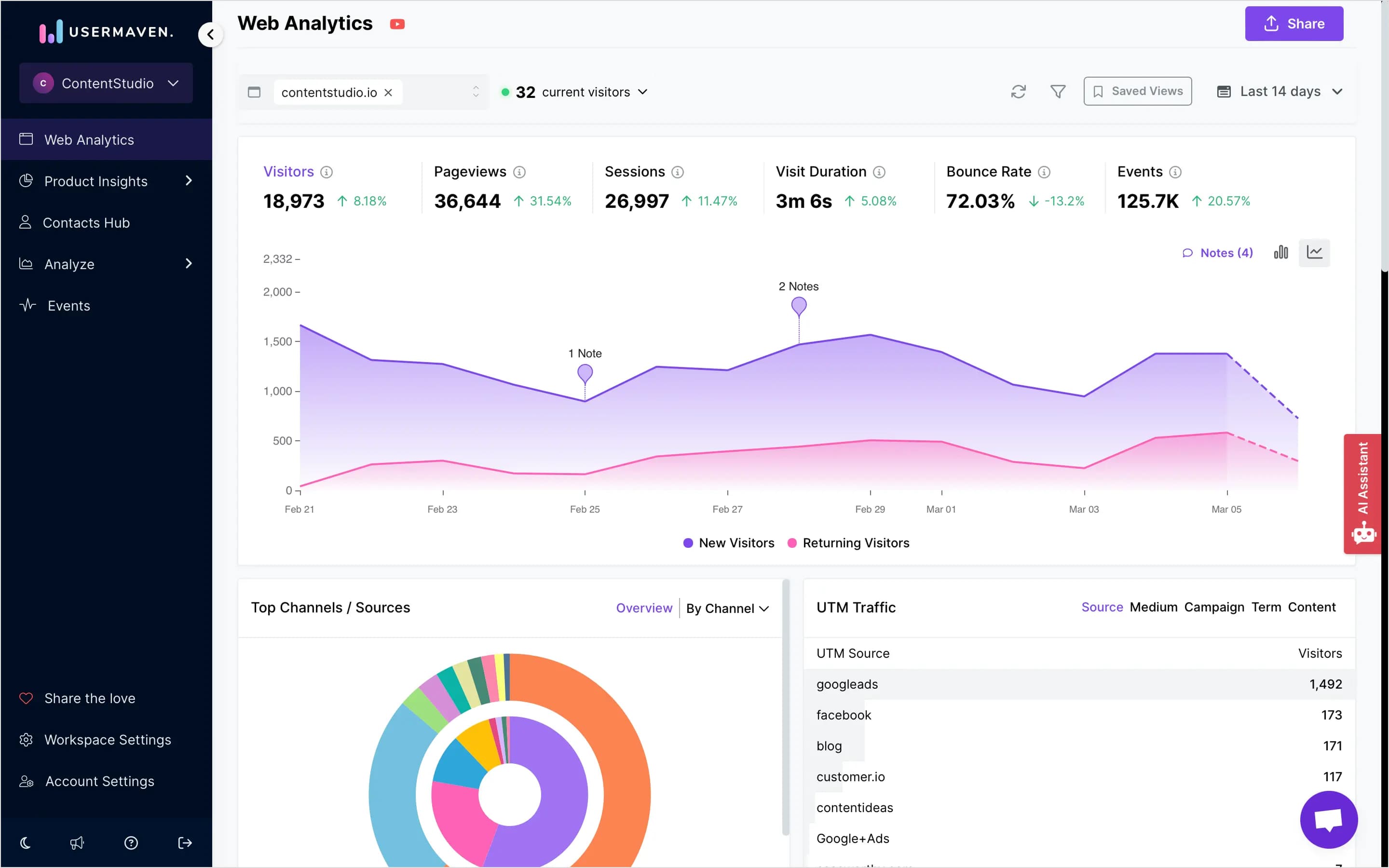
With Contentpen, you get detailed web analytics that provide CTR, average position, clicks, and impressions data for your pages. You can deeply analyze the performance of your content and make the required changes with our built-in AI.
Understand what’s working, and why with real-time analytics
Track performance and make smarter content decisions with clear insights.
View Analytics Dashboard →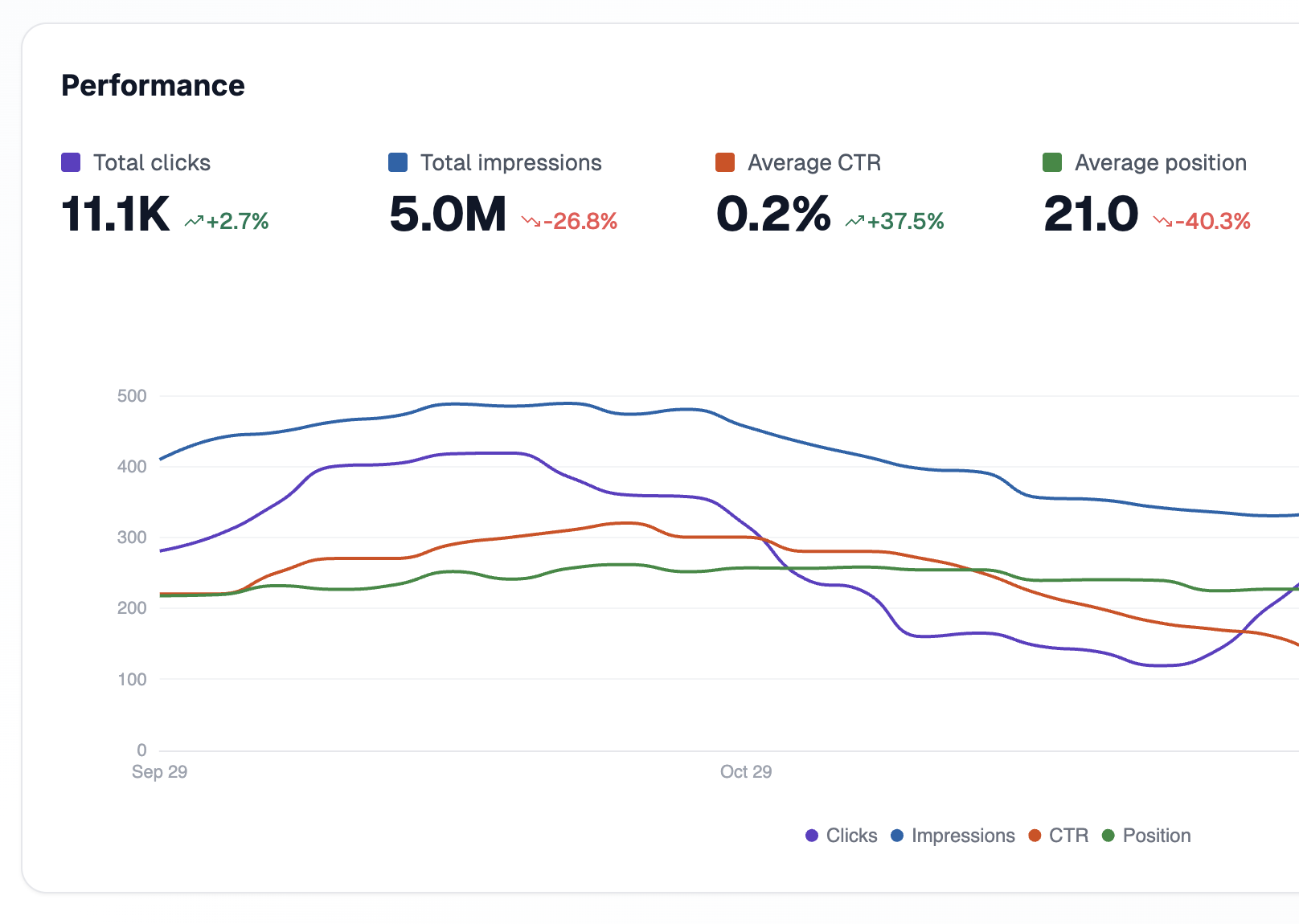
#7: Encourage engagement
Ask questions, respond to comments, and create content that invites participation. Building a community around your content increases loyalty and extends your reach through word-of-mouth marketing.
Don’ts of content marketing
You can get the best results through your content marketing strategies by avoiding these don’ts:
- Don’t focus only on sales: Constantly pushing products alienates audiences who seek valuable information on a particular topic or just want some awareness about the product.
- Don’t ignore quality: Poor content damages your brand reputation and credibility.
- Don’t publish without a strategy: Random content creation wastes resources and confuses your audience.
- Don’t neglect visuals: Text-only content is less engaging and shareable than visual content.
- Don’t forget mobile users: Ensure all content is optimized for mobile consumption.
- Don’t ignore your audience’s voice: Listen to feedback and adapt your content strategy accordingly.
- Don’t copy competitors blindly: Develop your unique voice and perspective (your say) in a niche, sector, or industry.
- Don’t stop after publishing: Promote your content actively, optimize post-publishing, and engage with your audience to build an active online community.
Content marketing and SEO
Most marketers treat content marketing and SEO as separate workflows. In practice, they’re the same job approached from two directions. SEO tells you what people are searching for, including the questions, search volume, and the keyword intent behind the query.
On the other hand, content marketing is how you answer those searches in a way that builds trust rather than just ranking. One without the other produces content nobody finds or pages that don’t resonate with the audience.
There’s also a practical implication for how you structure content. Internal links between related articles pass authority, help search engines map your site’s expertise, and keep readers moving through your content.
The bottom line: SEO finds users; content marketing earns their trust. You need both working together for either to reach its potential.
Future of content marketing
Content marketing is evolving faster in 2026 than it has in any previous year, and the brands paying attention are pulling ahead quickly.
Artificial intelligence has moved from a novelty to a core part of the content workflow. Tools now handle research, drafting, optimization, and even post-publishing analysis, which means teams that used to publish two blog posts a week can now publish ten, without sacrificing quality.
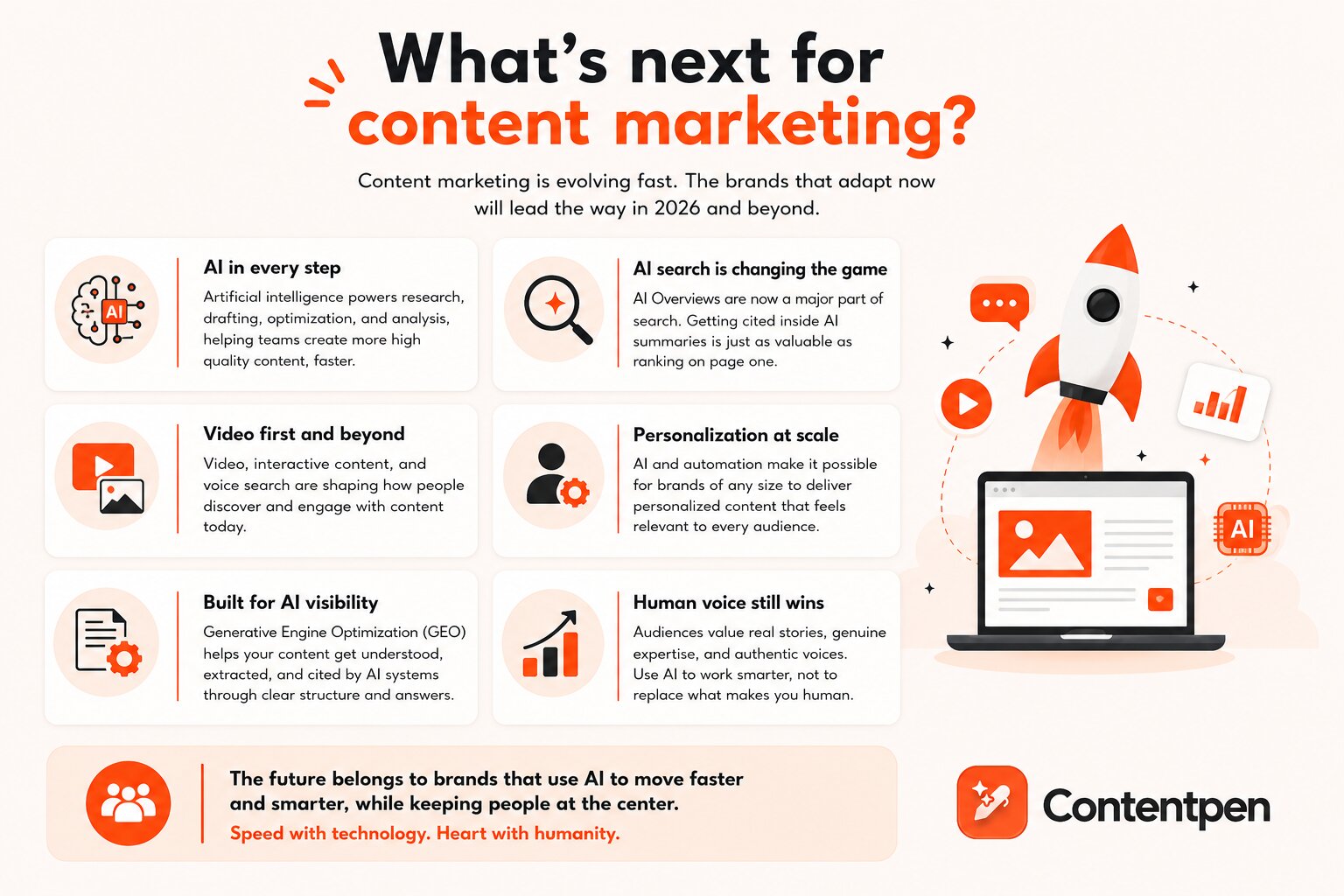
Search behavior itself is shifting. With AI Overviews now appearing in a significant portion of Google results, getting cited inside an AI-generated summary is becoming as valuable as a first-page ranking.
This is where Generative Engine Optimization (GEO) comes in. It involves structuring your content with clear answers, well-defined entities, and question-based headings so AI systems can extract and attribute your content accurately.
Video-first strategies, interactive content, and voice search are all important for a successful content marketing strategy. Meanwhile, personalization at scale is finally becoming achievable for smaller brands with content automation, thanks to AI.
The one thing that won’t change: audiences can sense when content is produced for an algorithm versus produced for them. The future belongs to brands that use AI to work faster and smarter, while keeping the human voice, genuine expertise, and real storytelling at the center.
Bottom line
Content marketing is more than a trend! It’s a value-driven way to connect authentically with your audience. If you focus on creating, distributing, engaging, and using formats like blogs, videos, and social media, you can build trust, generate leads, and drive growth.
By consistently creating helpful, optimized, and evergreen content, you not only attract qualified leads but also build lasting relationships with your audience.
As AI tools continue to reshape the content creation and marketing industry, the winning brands will be those that strike the perfect balance between efficiency and authentic human connection.
Frequently asked questions
Content marketing is one of the core pillars of digital marketing, but it operates differently from most other channels. While paid advertising, PPC, and social media ads are transactional in nature, content marketing builds compounding assets with a well-optimized blog post, video, or podcast that continues to attract traffic, generate leads, and build brand authority.
The 3 E’s are Educate, Entertain, and Engage. In other words, great content should teach something useful, capture attention, and build interaction with the audience, which drives meaningful conversations and, eventually, better results.
Content marketing is the strategy of creating valuable content to reach and convert audiences, while social media marketing focuses on distributing and promoting that content on social media platforms like Facebook, Instagram, or LinkedIn.
Content marketing focuses on providing value and building relationships through helpful information, while traditional advertising directly promotes products or services. Content marketing attracts audiences naturally, creating trust and authority that lead to better conversion rates and customer loyalty.
Consistency matters more than frequency. Whether you publish daily, weekly, or monthly, maintain a regular schedule that your audience can expect. Most successful businesses publish 1-4 blog posts per week, but quality should never be sacrificed for quantity.
Content marketing is a long-term strategy that typically shows initial results within 3-6 months, with significant growth occurring after 6-12 months. Results depend on content quality, publishing consistency, SEO/AEO optimization, and promotion efforts across multiple channels.