Blog

  • What is a blog: meaning, elements, types, and more!

    What is a blog: meaning, elements, types, and more!

    Whether you’re completely new to the digital world or looking to expand your online presence, understanding what a blog is is essential in today’s content-driven landscape. 

    A blog serves as your digital voice, allowing you to share ideas, build communities, and even generate income. 

    In this comprehensive guide, we’ll explore everything you need to know about blogs, from their basic definition to how to improve your blogs for engagement and other advanced monetization strategies.

    What is a blog?

    A blog (short for “weblog”) is a regularly updated website or web page that features content presented in reverse chronological order, with the newest posts appearing first. Blogs typically contain informal, conversational content written by an individual or team of contributors who share their thoughts, experiences, expertise, or opinions on specific topics.

    Also read: What is blogging?

    Originally emerging in the late 1990s as online diaries, blogs have evolved into powerful platforms for personal expression, business marketing, education, and community building. 

    Today, blogs serve multiple purposes, from personal storytelling to professional content marketing strategies that drive business growth.

    A blog is never static; it’s always changing and evolving. Fresh posts keep readers coming back for more. Comments and social sharing turn it into an ongoing conversation.

    What is a blog post?

    A blog post is an individual entry or article published on a blog. Each blog post typically focuses on a specific topic, question, or theme and can range from a few hundred to several thousand words.

    Blog posts are the building blocks of any blog, and they’re what readers come to consume, share, and engage with.

    Also read: How to structure a blog? Complete guide for content success

    Who is a blog for?

    Blogs serve virtually everyone in the digital ecosystem:

    • Individuals use blogs for personal expression, sharing hobbies, documenting life experiences, and building personal brands. 
    • Businesses utilize blogs as powerful marketing tools to attract customers, demonstrate expertise, improve search engine rankings, and build trust with their audience. 
    • Professionals utilize blogs to establish thought leadership in their fields, network with peers, and create additional income streams through various monetization methods.
    • Educators and students find blogs invaluable for sharing knowledge, facilitating discussions, and creating collaborative learning environments.

    What is included in a blog?

    Understanding the essential components of a blog helps you create a more professional and user-friendly experience for your readers.

    Essential blog component - Contentpen.ai

    Header

    The header appears at the top of your blog and typically includes your blog’s title, logo, navigation menu, and sometimes a tagline. It’s the first thing visitors see and should clearly communicate your blog’s purpose and brand identity.

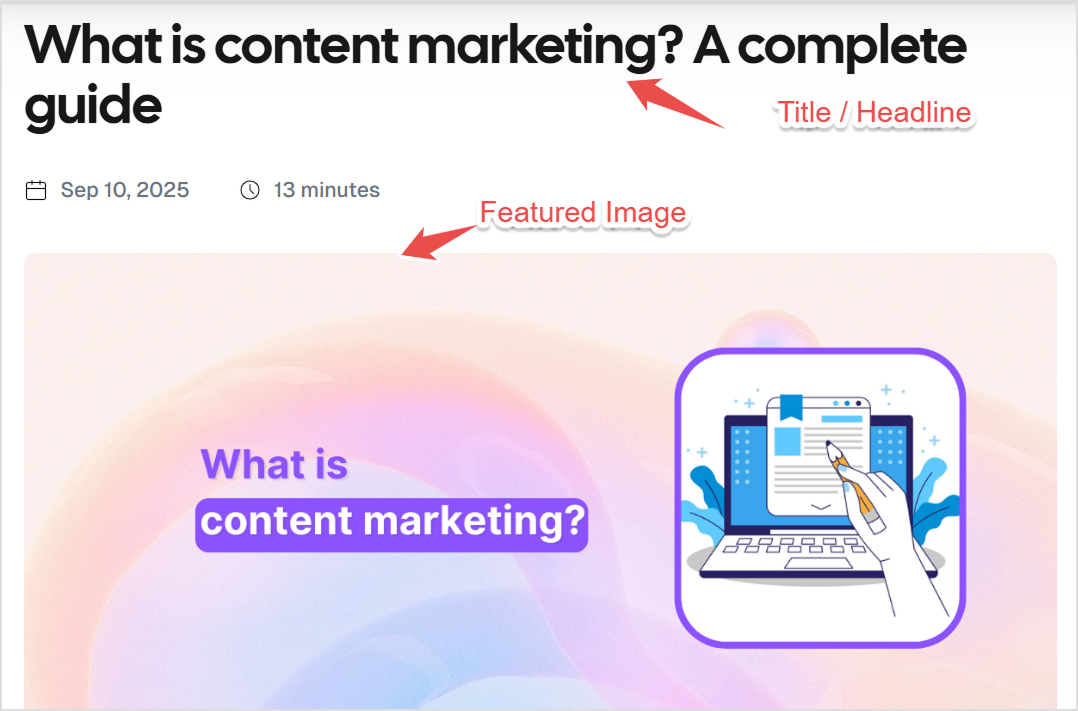
    Featured image

    A featured image is the main visual element that represents each blog post. It appears in social media shares, search results, and on your blog’s homepage. High-quality, relevant featured images significantly improve engagement and click-through rates.

    Content body

    The content body contains the main text of your blog post, including headings, paragraphs, images, videos, and other multimedia elements. This is where you deliver value to your readers through informative, entertaining, or inspiring content.

    Also read: How to start a blog post?

    Sidebar

    The sidebar typically appears alongside the main content and contains additional elements like:

    • About the author section
    • Popular posts
    • Categories and tags
    • Email signup forms
    • Social media links
    • Advertisement spaces

    Comments

    The comments section allows readers to engage with your content, ask questions, share their opinions, and build a community around your blog. Encouraging and moderating comments helps foster meaningful discussions and increases reader engagement. 

    Not every blog contains a comments section, though. It is dependent on the blog niche and the author’s preference about whether they want to open up a blog to public comments. 

    Footer

    The footer appears at the bottom of your blog and usually contains copyright information, additional navigation links, social media icons, and sometimes a brief description of your blog or contact information.

    Types of blogs

    The blogging world offers numerous niches and styles to match different interests, expertise levels, and goals. Some popular blog examples are mentioned below.

    Personal blogs

    Personal blogs serve as digital diaries where individuals share their thoughts, experiences, and life updates. These blogs often have a casual, conversational tone and cover various topics from daily life to personal growth journeys.

    Perosnal blogs -  Contentpen.ai

    Niche blogs

    Niche blogs focus on specific topics or industries, targeting audiences with particular interests. Examples include parenting blogs, pet care blogs, or tech blogs related to specific niches. These blogs often perform well because they serve dedicated communities with specific needs.

    Niche blogs  - Contentpen.ai

    Business/corporate blogs

    Business blogs help companies connect with customers, share industry expertise, and improve their online visibility. They’re essential components of content marketing strategies and help establish brands as thought leaders in their respective fields.

    Corporate blogs - Contentpen.ai

    Lifestyle blogs

    Lifestyle blogs cover broad topics related to daily living, including home decor, fashion, relationships, wellness, and personal development. They often blend multiple interests to reflect the blogger’s overall lifestyle approach.

    Lifestyle blogs - Contentpen.ai

    Travel blogs

    Travel blogs document journeys, share destination guides, provide travel tips, and inspire others to explore new places. Many travel bloggers monetize through affiliate marketing, sponsored content, and travel partnerships.

    Travel blogs - Contentpen.ai

    Food blogs

    Food blogs feature recipes, restaurant reviews, cooking techniques, and food photography. They’re particularly visual and often include step-by-step instructions, ingredient lists, and nutritional information.

    Food blog  - Contentpen.ai

    Health & fitness blogs

    Health and fitness blogs focus on wellness topics, including workout routines, nutrition advice, mental health, and healthy lifestyle tips. They often combine personal experiences with research-based information.

    Health and fitness blog - Contentpen.ai

    SaaS/technology blogs

    Technology blogs cover software reviews, gadget comparisons, tech news, tutorials, and industry analysis. They serve both consumers looking for purchasing advice and professionals seeking industry insights.

    Niche blogs - Contentpen.ai

    Educational blogs

    Educational blogs provide learning resources, tutorials, academic insights, and skill development content. They’re valuable for students, professionals, and lifelong learners seeking to expand their knowledge.

    Educational blogs  - Contentpen.ai

    News & current affairs blogs

    These blogs focus on breaking news, political commentary, social issues, and current events analysis. They often provide alternative perspectives on mainstream news coverage.

    New and curren affair blogs  - Contentpen.ai

    Fashion & beauty blogs

    Fashion and beauty blogs showcase style inspiration, product reviews, makeup tutorials, and trend analysis. They heavily rely on visual content and often partner with brands for sponsored content.

    Fashion and beauty blogs  - Contentpen.ai

    Entertainment blogs

    Entertainment blogs cover movies, music, television, celebrity news, and pop culture topics. They engage audiences through reviews, interviews, and commentary on entertainment industry developments.

    Entertainment blogs - Contentpen.ai

    Benefits of a blog

    Understanding the advantages of blogging can help you maximize your blog’s potential and achieve your goals quickly and easily.

    Share knowledge & expertise

    Blogging provides an exceptional platform for sharing your knowledge and establishing yourself as an expert in your field. When you consistently publish valuable, well-researched content, you build credibility and trust with your audience. This expertise can lead to speaking opportunities, consulting offers, and professional recognition.

    Moreover, using AI to write blog posts can help you maintain consistency and quality while scaling your content production efforts.

    Build an online presence & personal brand

    A blog serves as the foundation of your digital identity, allowing you to showcase your personality, values, and unique perspective. Through consistent posting and authentic storytelling, you create a memorable brand that distinguishes you from competitors and attracts like-minded individuals.

    Your blog becomes a central hub where people can learn about you, your work, and your expertise, making it an invaluable tool for career advancement and business development.

    Engage with an audience

    Blogs create opportunities for meaningful interactions with your audience through comments, social media shares, and email communications. This engagement builds community around your content and provides valuable feedback that can guide future blog posts and business decisions.

    Understanding how to use tone of voice in writing helps you connect more effectively with your readers and build stronger relationships.

    Monetization opportunities

    Blogging opens multiple revenue streams, including:

    • Affiliate marketing commissions
    • Sponsored content partnerships
    • Digital product sales
    • Online course creation
    • Consulting services
    • Advertisement revenue
    • Membership sites

    Many successful bloggers generate substantial income through diversified monetization strategies, though it typically requires time, consistency, and strategic planning.

    Networking & collaboration

    Blogging connects you with other professionals, industry leaders, and potential collaborators in your field. Guest posting opportunities, podcast interviews, and joint ventures often emerge from blogging relationships.

    These connections can lead to career opportunities, business partnerships, and valuable learning experiences that extend far beyond your blog.

    Long-term results

    Unlike social media posts that quickly disappear from feeds, blog content has lasting value. Well-optimized blog posts can continue attracting readers and generating results for months or years after publication, making blogging an excellent long-term investment in your online presence.

    Uses of blogs

    Blogs serve various practical purposes across different contexts and industries.

    Business

    Businesses use blogs to:

    • Attract potential customers through valuable content
    • Improve search engine rankings and online visibility
    • Demonstrate industry expertise and build trust
    • Generate leads through content marketing
    • Support customer service by answering common questions
    • Share company news and updates
    • Humanize their brand through storytelling

    SEO

    Blogs play a crucial role in search engine optimization by:

    • Providing fresh, regularly updated content that search engines favor
    • Creating opportunities to target long-tail keywords
    • Building internal linking structures that improve site architecture
    • Attracting backlinks from other websites
    • Increasing time spent on the site through engaging content
    • Improving domain authority through consistent publishing

    Related: 12 best AI SEO tools in 2025

    Marketing

    Blogs support marketing efforts through:

    • Content marketing campaigns that educate and engage audiences
    • Lead generation through valuable resources and email capture
    • Social media content creation and sharing
    • Influencer partnerships and guest posting opportunities
    • Brand storytelling and personality development
    • Customer retention through ongoing value delivery

    Blog vs. Website

    While blogs and websites both exist on the internet, they serve different purposes and have distinct characteristics.

    Blogs are dynamic, regularly updated platforms focused on fresh content creation. They feature:

    • Chronological content organization
    • Regular posting schedules
    • Interactive elements like comments
    • Informal, conversational tone
    • RSS feeds for content syndication
    • Author bylines and publication dates

    Websites are typically more static, serving as digital brochures or portfolios. They feature:

    • Fixed navigation and page structure
    • Less frequent updates
    • Formal, professional presentation
    • Service or product focus
    • Contact forms and business information
    • Timeless content that doesn’t require frequent updates

    Many successful online presences combine both approaches, using a website for core business information and a blog for ongoing content marketing and audience engagement.

    Difference between a wiki and a blog

    While both wikis and blogs publish content online, they operate on fundamentally different principles:

    Blogs are usually written by individuals or small teams. They organize content in chronological order and often share personal opinions or brand perspectives. The creators also maintain full control over what gets published and updated.

    Wikis are collaborative platforms where many users can edit and contribute content. They focus on facts instead of personal opinions and organize information by topic rather than by time. The goal is to provide neutral, encyclopedic coverage of each subject.

    The most famous example of a wiki is Wikipedia, while popular blogs include personal lifestyle blogs, company blogs, and niche industry publications.

    How to start a blog?

    Starting a blog involves several key steps that require a lot of discussion in detail. We’ll be discussing all these steps and requirements in a separate article, but for now, let’s go through the key points quickly:

    Step 1: Pick a niche

    Choose a specific topic or area of expertise that you’re passionate about and knowledgeable in. A focused niche helps you:

    • Attract a targeted audience
    • Establish expertise more quickly
    • Create consistent, cohesive content
    • Monetize more effectively
    • Compete in less saturated markets

    Step 2: Choose a platform & domain

    Select a blogging platform that matches your technical skills and goals. Popular options include:

    • WordPress.org (most flexible and professional)
    • WordPress.com (hosted solution)
    • Blogger (simple and free)
    • Medium (built-in audience)
    • Squarespace (design-focused)

    Step 3: Design your blog

    Create an attractive, user-friendly design that reflects your brand and makes navigation easy for readers. Key design elements include:

    • Clean, readable typography
    • Consistent color scheme
    • Intuitive navigation menu
    • Mobile-responsive layout
    • Fast loading times
    • Professional appearance

    Step 4: Create valuable content

    Develop high-quality content that serves your audience’s needs and interests. Focus on:

    • Solving problems or answering questions
    • Providing unique insights or perspectives
    • Using clear, engaging writing
    • Including relevant images and multimedia
    • Optimizing for search engines
    • Maintaining a consistent posting schedule

    Finally, you also need to promote to build an audience through active engagement. Develop strategies for reaching your target readers and encouraging them to return for more content.

    How to promote your blog?

    Effective blog promotion combines multiple strategies to maximize your content’s reach and impact. These key strategies are:

    Share on social media

    Use social media platforms to share your content and engage with your audience:

    • Create platform-specific content for Facebook, Twitter, Instagram, and LinkedIn
    • Join relevant groups and communities
    • Use appropriate hashtags to increase discoverability
    • Engage with other users’ content to build relationships
    • Share behind-the-scenes content to humanize your brand

    Optimize organic traffic via SEO

    Optimize your content for search engines to attract organic traffic:

    • Research and target relevant keywords
    • Create compelling meta titles and descriptions
    • Use header tags to structure your content
    • Build internal and external links
    • Optimize images with alt text
    • Focus on page loading speed
    • Use SEO writing tools to improve your SEO efforts.

    Engage in communities

    Participate in online communities where your target audience is located:

    • Join industry-specific forums and discussion boards
    • Participate in Facebook groups and LinkedIn communities
    • Comment thoughtfully on other blogs in your niche
    • Attend virtual events and webinars
    • Share valuable insights without being overly promotional

    Build an email list

    Email marketing remains one of the most effective ways to nurture relationships with your audience:

    • Offer valuable lead magnets like ebooks or checklists
    • Create compelling email signup forms
    • Send regular newsletters with exclusive content
    • Segment your list based on interests and behaviors
    • Provide consistent value in every email

    Collaborate

    Partner with other bloggers and content creators to expand your reach:

    • Write guest posts for established blogs
    • Invite guest contributors to your blog
    • Participate in podcast interviews
    • Collaborate on joint projects or challenges
    • Cross-promote content with complementary brands

    Summing it up

    Understanding what a blog is opens doors to countless opportunities for personal expression, business growth, and community building. Whether you’re looking to share your passion, establish professional credibility, or build a profitable online business, blogging provides a versatile platform that adapts to your goals and grows with your ambitions.

    So, are you ready to start your blogging journey with professional, SEO-optimized content? Try AI blog writer tool like Contentpen and discover how AI-powered writing can enhance your content creation and blogging process.

    Frequently asked questions

    What is a blog website?

    A blog website is a type of website that regularly publishes new content in a chronological format, typically featuring articles, posts, or entries on specific topics. Unlike static websites, blog websites are dynamic and frequently updated with fresh content to engage readers and improve search engine rankings.

    What is a blog article?

    A blog article is an individual piece of content published on a blog, typically ranging from 500 to 3,000+ words. Blog articles focus on specific topics, provide value to readers through information or entertainment, and are designed to engage audiences and encourage social sharing or comments.

    What is a blog slug?

    A blog slug is the part of a URL that identifies a specific blog post, typically appearing after the domain name. For example, in the URL “example.com/what-is-a-blog,” the slug is “what-is-a-blog.” Good slugs are short, descriptive, and include relevant keywords.

    What is a blog entry?

    A blog entry is another term for a blog post or blog article – it’s an individual piece of content published on a blog. The term “entry” comes from the original concept of blogs as online diaries where people would make daily “entries” about their lives and thoughts.

    What is a blog page?

    A blog page typically refers to either an individual blog post page or a static page within a blog website (like an “About” or “Contact” page). In the context of blog structure, it can also refer to archive pages that display multiple blog posts organized by date, category, or tag.

    Do bloggers make money?

    Yes, many bloggers successfully monetize their blogs through various revenue streams, including affiliate marketing, sponsored content, digital product sales, online courses, advertising revenue, and consulting services. However, generating significant income typically requires time, consistent effort, and strategic planning.

    Who is the highest-paid blogger?

    While specific earnings vary and change over time, some of the highest-earning bloggers include those in finance, lifestyle, and technology niches. Successful bloggers like Michelle Gardner (Making Sense of Cents) and Pat Flynn (Smart Passive Income) have reported earning six to seven figures annually through diversified monetization strategies.

    How long does it take to make $1000 per month blogging?

    The timeline for earning $1,000 per month from blogging varies significantly based on niche, content quality, marketing efforts, and monetization strategies. Most successful bloggers report it takes 6-18 months of consistent effort, though some achieve this milestone sooner, while others take longer.

    What kind of blogs earn the most?

    Blogs in profitable niches typically earn the most, including:
    Personal finance and investing
    Health and wellness
    Business and entrepreneurship
    Technology and software
    Online marketing and SEO
    Lifestyle and fashion
    Food and cooking

  • Content marketing strategy – meaning, elements, steps to build

    Content marketing strategy – meaning, elements, steps to build

    Content marketing has evolved into one of the most powerful ways for businesses to attract, engage, and convert their audiences. Yet, many brands still fall into the trap of creating random content without a clear plan. 

    The result? Blog posts and social media updates that don’t connect, drive traffic, or generate revenue.

    A content marketing strategy solves this problem by giving your brand a structured roadmap, one that aligns with business goals, speaks directly to your audience, and ensures every piece of content works harder for growth.

    In this comprehensive guide, we’ll explain what a content marketing strategy is, why it matters in 2026, and how to build one step by step. We’ll also show how Contentpen supercharges the process, helping you scale content marketing without compromising on quality.

    What is a content marketing strategy?

    A content marketing strategy is more than a to-do list of blog topics. It’s the master plan that connects your business objectives to your content efforts. Think of it as a bridge between your brand and your audience.

    At its core, it answers five essential questions:

    1. What content will we create? Blogs, videos, eBooks, infographics, case studies, whitepapers.
    2. Who are we creating it for? Define buyer personas with demographics, goals, and pain points.
    3. Where will we publish it? Website blog, LinkedIn, YouTube, newsletters, and industry forums.
    4. Why are we creating it? Educate, generate leads, nurture trust, boost sales.
    5. How will we measure success? KPIs like organic traffic, lead conversions, bounce rates, and time on page.

    For instance, a SaaS startup offering project management tools shouldn’t just “write about productivity.” Its strategy would target specific personas (like marketing managers or IT leads), publish content that solves their workflow challenges, and measure conversions through free trial sign-ups.

    Also read: B2B content marketing guide.

    Why do you need a content marketing strategy in 2026?

    The digital content landscape is crowded, and only those with a structured strategy rise above the noise. 

    Here’s why your brand can’t afford to skip it:

    Build brand authority

    Audiences don’t trust ads; they trust expertise. When your content consistently educates, you position your brand as an industry leader.

    For example, the blog on “Will AI replace writers?” builds authority by tackling a controversial topic with insights that show expertise.

    Generate organic traffic

    Search engines reward quality, consistent content. By targeting the right keywords and publishing regularly, your blogs attract organic traffic that compounds over time. 

    Increase conversions

    Content written with intent guides readers from awareness to action. For instance, the blog about “how to cut blogging time using AI” educates readers about a challenge, then subtly positions Contentpen as the solution, driving conversions without being “salesy.”

    Improve ROI

    Without a strategy, content efforts are scattered. With one, every article, video, or case study ties back to measurable ROI. Pair this with automation, like (how to automate internal and external linking), and you save resources while improving results.

    Also read: 27 best content marketing tools to use in 2026.

    Key elements of a successful content marketing strategy

    A strategy must be comprehensive yet flexible. The following pillars ensure success:

    Content marketing strategy - contentpen.ai

    Audience research

    The foundation of strategy is knowing your audience inside out. This means building personas based on real data, not assumptions. What questions are they asking? What platforms do they use? And what formats do they prefer?

    Clear goals & KPIs

    If you don’t measure, you can’t improve. Goals like “increase awareness” should be translated into KPIs, traffic, newsletter sign-ups, or demo requests.

    Content calendar

    A calendar brings consistency, avoids duplication, and ensures balanced coverage across buyer journey stages.

    SEO optimization

    SEO is non-negotiable. Using frameworks like the on-page SEO checklist, you ensure blogs are discoverable and rank for target keywords.

    Content distribution

    Publishing is only half the battle. A strategy includes promotion plans: email blasts, LinkedIn posts, influencer collaborations, or syndication.

    Also read: 30 recent innovative marketing examples.

    Steps to build a winning content marketing strategy

    Here’s the proven roadmap for creating a strategy that scales:

    Steps to build a winning content marketing strategy  - contentpen.ai

    Step 1: Define your audience

    Take a closer look using surveys, forums, and analytics. Build personas with clear demographics, pain points, and buying behaviors.

    Step 2: Conduct a content audit

    Review existing assets to identify strengths and gaps. Maybe you already have a strong SEO blog but lack middle-funnel case studies. A post like how to edit AI content could inspire similar improvements.

    Step 3: Set SMART goals

    Be specific: “Grow organic blog traffic by 40% in six months” is actionable and trackable.

    Step 4: Research keywords & topics

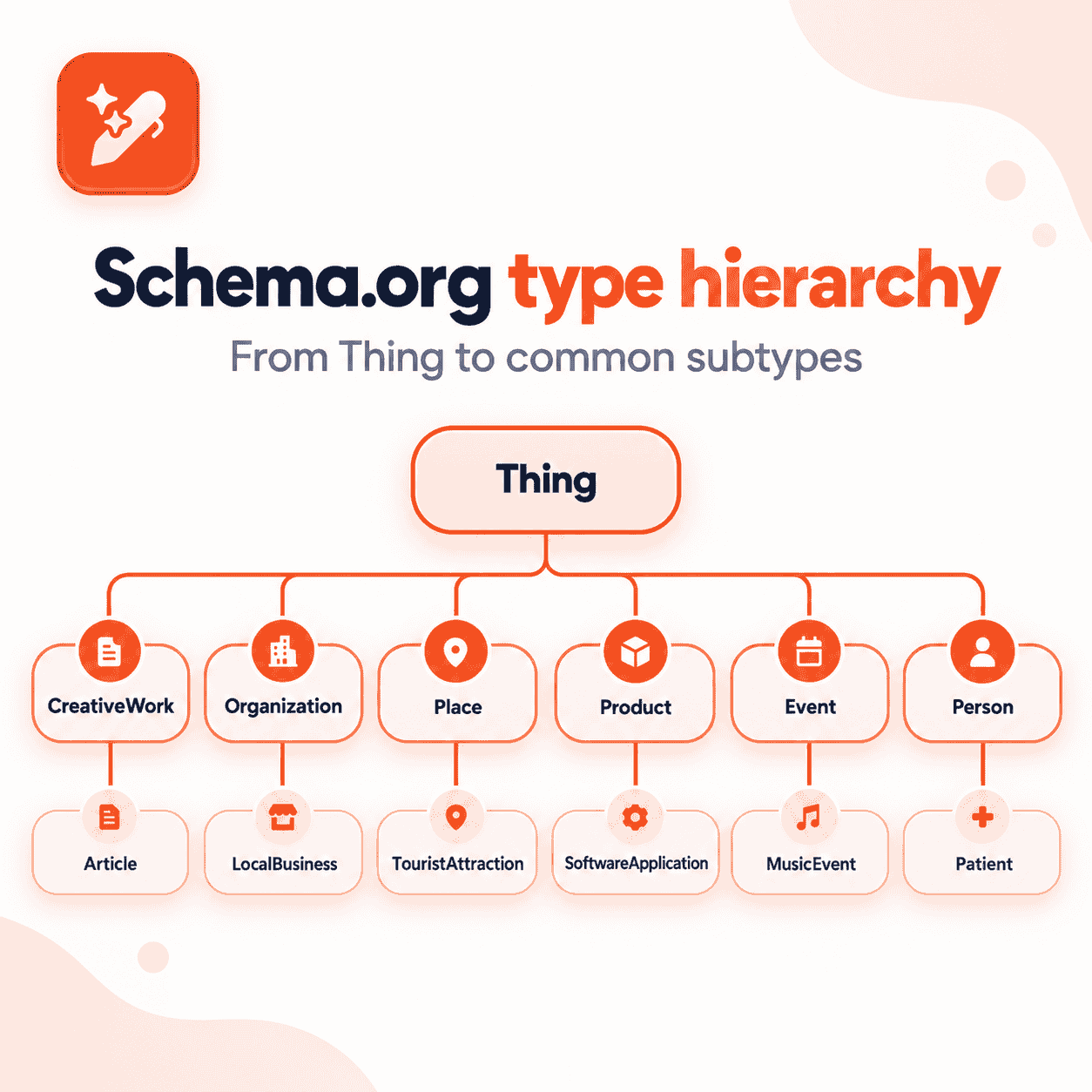
    Use SEO tools to identify topics that match buyer intent. Long-tail keywords bring in more qualified traffic. For example, the blog “best AI SEO tools” targets a niche audience actively searching for solutions.
    Step 5: Plan your content calendar

    Organize content by funnel stage (awareness, consideration, decision). Map formats how-to blogs, videos, or case studies to each stage.

    Step 6: Create high-quality content

    Your content must balance depth with clarity. Avoid fluff, focus on actionable value. Create content that is useful, engaging, and trustworthy for your audience. It should provide real value, be easy to understand, and stand out from competitors.

    Step 7: Optimize for SEO

    Strategically place keywords, optimize images, and interlink. Always connect blogs to related resources, e.g., linking a blog on keyword research to types of keywords.

    Step 8: Promote across channels

    Don’t wait for Google alone. Repurpose blogs into LinkedIn carousels, newsletters, and podcasts.

    Step 9: Track and adjust

    Measure against KPIs. If blogs drive traffic but not conversions, tweak CTAs or add middle-funnel assets like whitepapers.

    Also read: Content marketing examples that drive results in 2025.

    Common content marketing mistakes to avoid

    Even the best businesses make errors when creating content, but the cost of these mistakes is wasted time, money, and missed opportunities. By recognizing them early, you can refine your approach and ensure your content marketing strategy delivers results.

    Publishing content without aligning it to goals

    One of the biggest mistakes is creating content just for the sake of it. Without aligning blog posts, videos, or guides to business objectives, such as lead generation, awareness, or conversions, you risk producing content that doesn’t serve a purpose. 

    Ignoring keyword research

    Many brands still publish blogs without proper keyword targeting. This is like building a store in the desert, no matter how great it looks, no one will find it. 

    Keywords connect your content to what your audience is actually searching for. By skipping this step, you miss out on organic traffic and search visibility. 

    Writing for algorithms instead of humans

    In an attempt to “hack” SEO, some marketers overload their content with keywords, making it unreadable. The result? Search engines may rank it lower, and readers won’t stay on the page. 

    Instead, focus on clarity, storytelling, and problem-solving while integrating keywords naturally. 

    Failing to promote beyond the website

    Publishing content is just the beginning. If you’re not promoting it through social media, email marketing, LinkedIn posts, or newsletters, you’re leaving visibility on the table. 

    Relying solely on organic search means your content may take months to gain traction. 

    Neglecting to refresh or repurpose old content

    Many businesses forget that content isn’t “one and done.” Over time, statistics, tools, and best practices change, leaving your content outdated. 

    Search engines also reward freshness. So, revisiting, updating, and repurposing older blogs can significantly boost rankings. 

    How Contentpen makes building a content marketing strategy easier and more effective?

    Crafting a strong content marketing strategy is complex. It requires aligning business goals, audience insights, keyword research, and SEO best practices while keeping content consistent and engaging. 

    Contentpen simplifies this process tremendously. It combines advanced AI, SEO intelligence, and brand personalization to help businesses design and execute strategies that actually drive results.

    Here’s how it helps:

    AI-powered built-in content calendar 

    Contentpen helps you plan and schedule your entire content plan. With integrated calendar features and AI-suggested publishing times, you can keep your content engine running smoothly, without spreadsheets or separate tools.

    built-in content calendar  - contentpen.ai

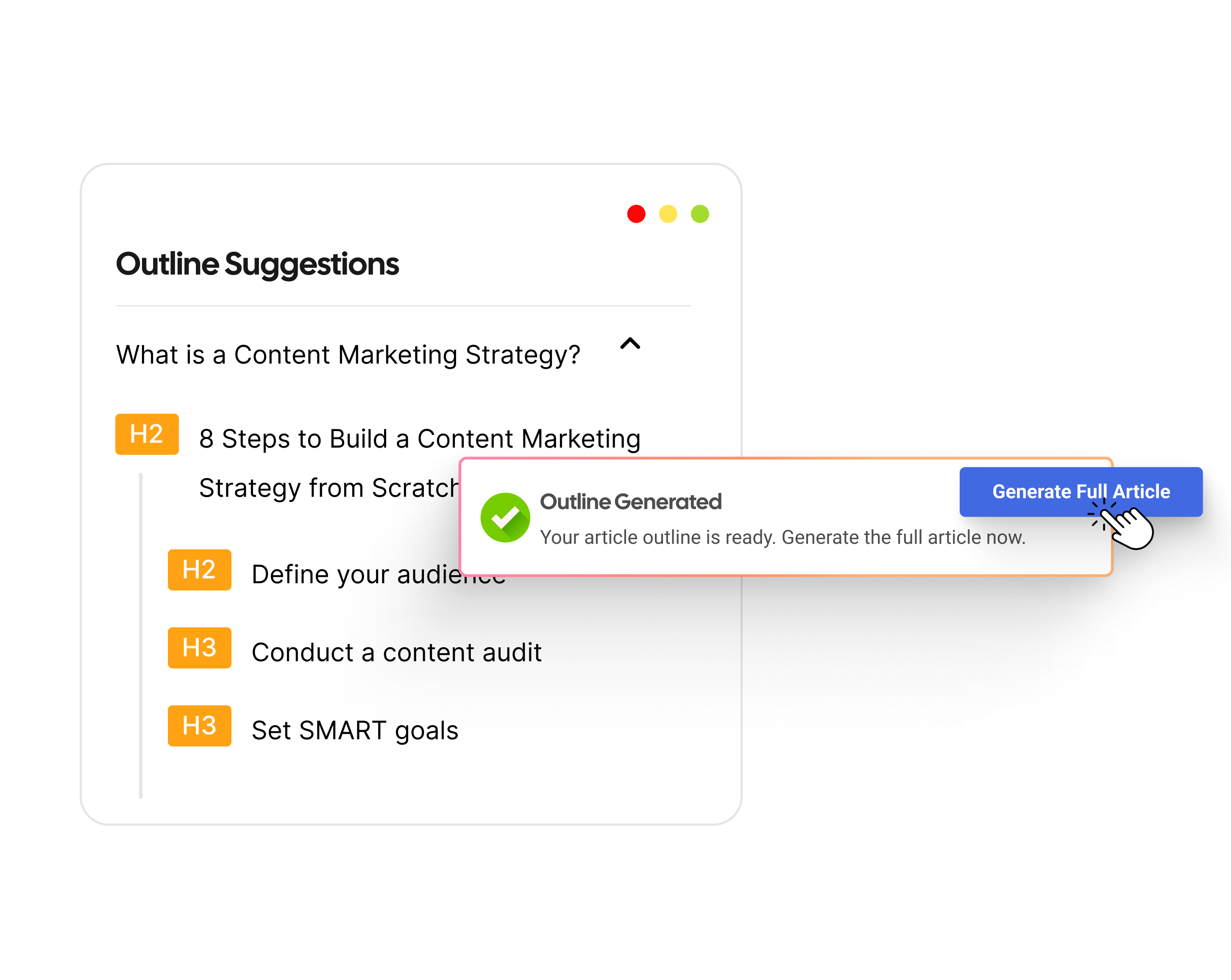
    AI-powered outlines

    Instead of starting from scratch, Contentpen generates research-backed outlines tailored to your niche, audience, and goals. 

    Whether you need a thought leadership piece, a product comparison, or an awareness-stage blog, Contentpen has you covered. It structures your content strategy, so every piece fits into the bigger picture.

    Blog outline generation - contentpen.ai

    Customizable presets for strategy-driven content

    Consistency across blogs, case studies, and newsletters is essential for a brand-led content marketing strategy. 

    With Contentpen’s presets, you can set formatting and tone guidelines once and apply them across all content types. From how-to guides and listicles to in-depth strategy explainers, your brand voice stays unified and scalable.

    custom presets - contentpen.ai

    Brand knowledge integration

    Every brand has its unique messaging and audience-specific language. Contentpen’s brand knowledge system learns from your existing content, ensuring all new blogs reflect your positioning, tone, and values. 

    This guarantees that your content marketing strategy doesn’t just look professional, it also feels yours authentically.

    Add knowledge base - contentpen.ai

    Smart keyword & topic suggestions

    Successful strategies require covering more than just target keywords; you need topical authority. Contentpen analyzes competitor content and search intent to recommend primary and semantic keywords. This makes your content strategy SEO-driven without losing readability.

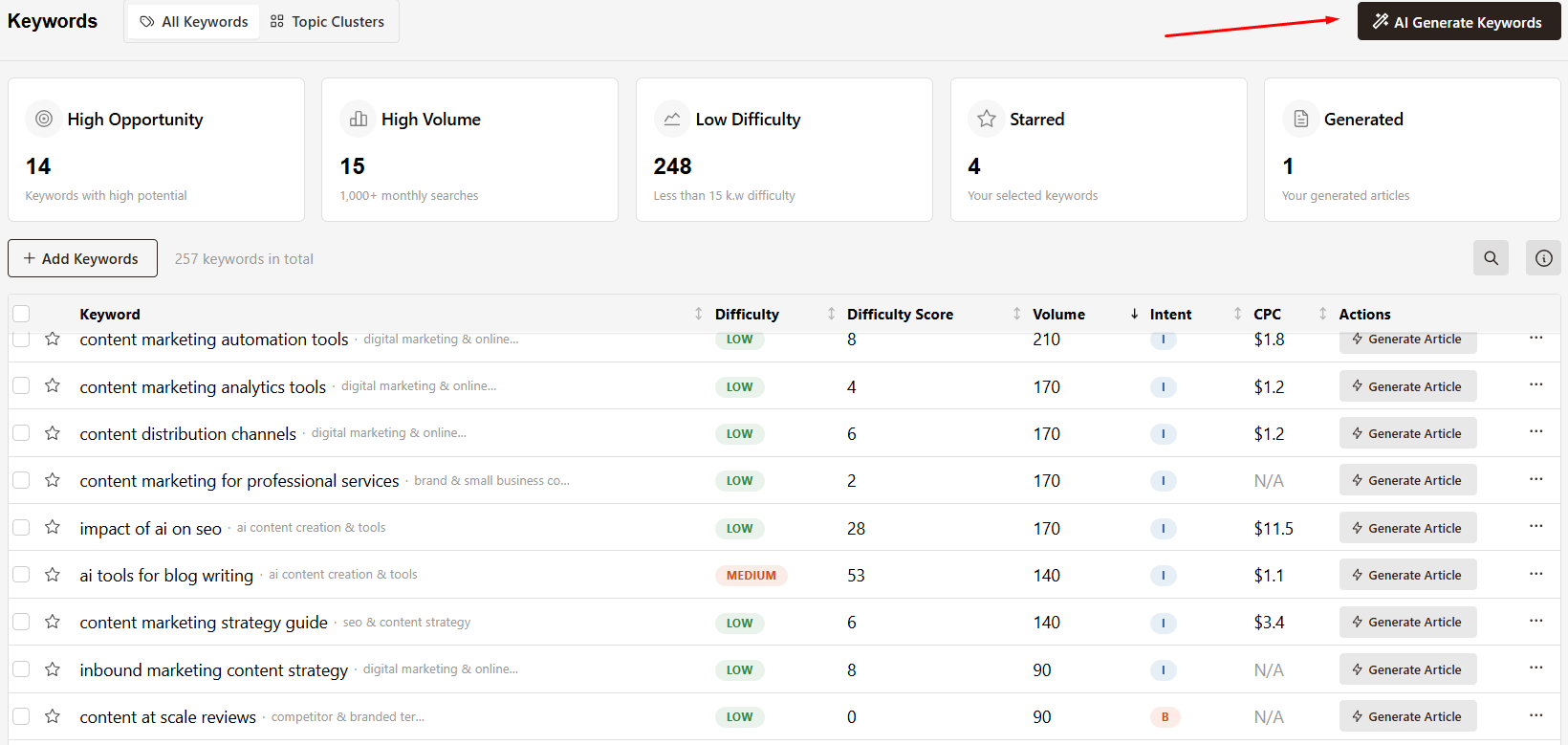
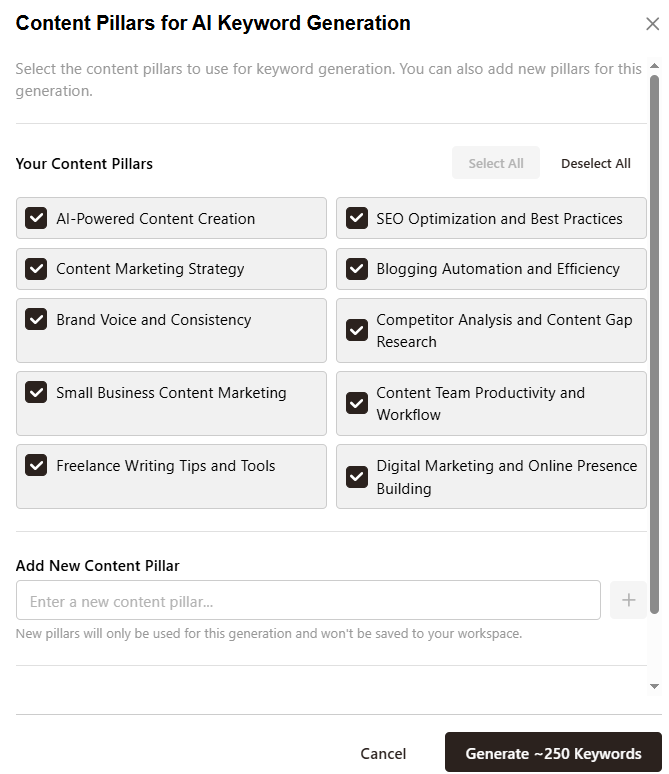
    find high-opportunity keywords in Contentpen - contentpen.ai

    Automated internal and external linking

    Linking is one of the most overlooked parts of strategy execution. Contentpen automates the linking process by identifying opportunities to connect to both internal blogs and trusted external sources, strengthening SEO and providing readers with a seamless experience. 

    For example, if your blog covers keyword research, it can automatically link to types of keywords for deeper context.

    Bulk content creation for scaling strategy

    For brands producing content at scale, strategy execution can feel overwhelming. 

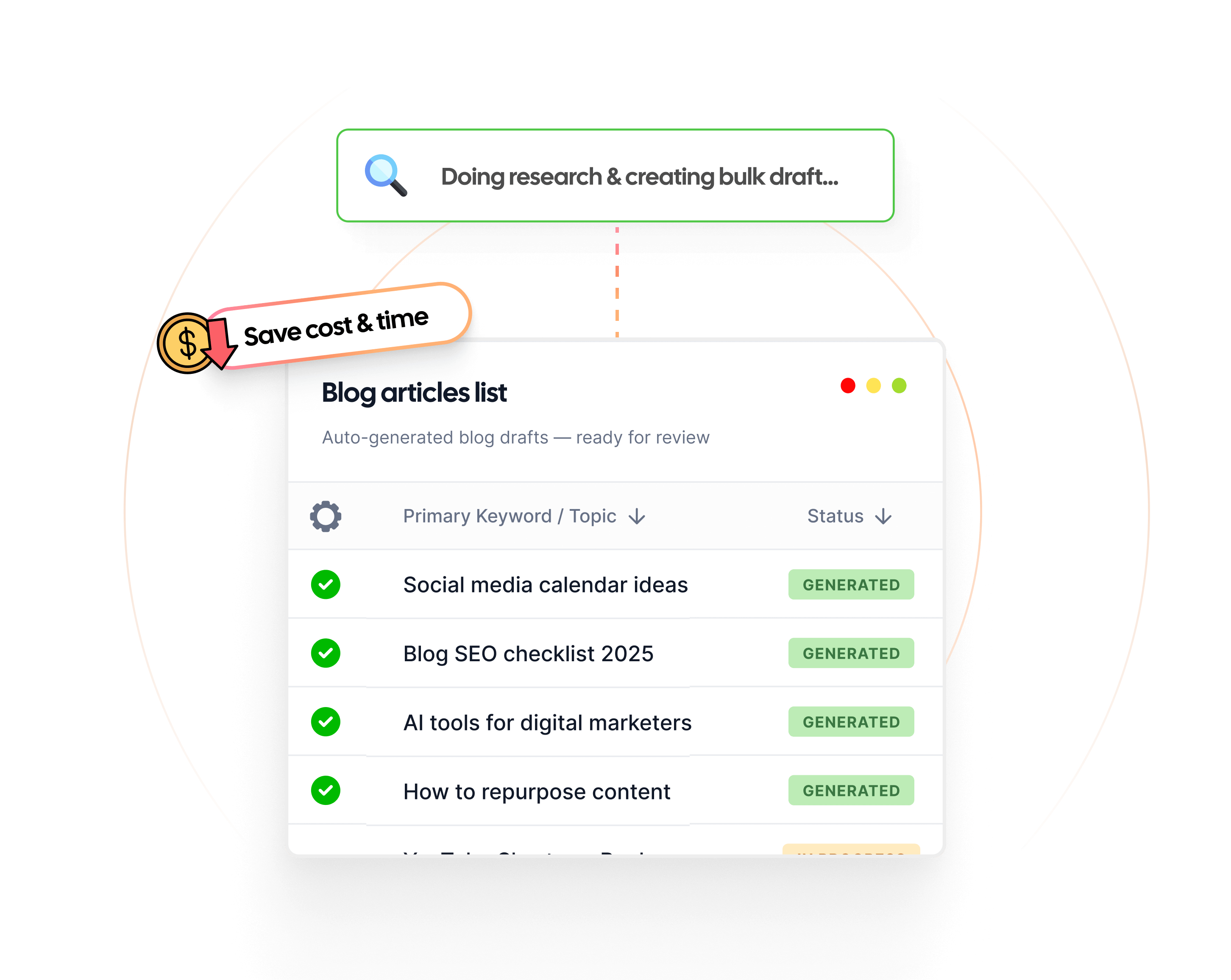
    Contentpen’s bulk article generation feature allows you to create dozens of blogs in one go , each aligned with your chosen themes, SEO framework, and brand guidelines. This makes scaling your strategy fast, cost-effective, and stress-free.

    Advanced editing and optimization

    Even strong strategies fall short without fine-tuning. Contentpen’s editorial tools enhance your drafts by boosting readability, optimizing for featured snippets, and creating a smooth flow. 

    With the right mix of depth and clarity, your content doesn’t just get published, it delivers results.

    Through these features, Contentpen turns content marketing strategy from a time-intensive process into a streamlined growth engine. 

    Instead of struggling with planning, formatting, or SEO, your team can focus on what matters most. That means creating meaningful content that builds trust, drives traffic, and turns readers into customers.

    Conclusion 

    A content marketing strategy isn’t optional in 2026; it’s the engine of growth. It helps brands build trust, increase traffic, and convert readers into customers. By combining clear planning with AI blog writer like Contentpen, you not only save time but also create a scalable system for long-term growth.

    The brands that thrive in 2026 will be those with a well-documented, data-driven content marketing strategy and the tools to execute it at scale.

  • The ultimate 15-step on-page SEO checklist for 2026

    The ultimate 15-step on-page SEO checklist for 2026

    Creating content that ranks well in search engines requires both excellent writing and strategic keyword optimization. This comprehensive on-page SEO checklist provides everything you need to optimize your blog pages for better search rankings and increased organic traffic. 
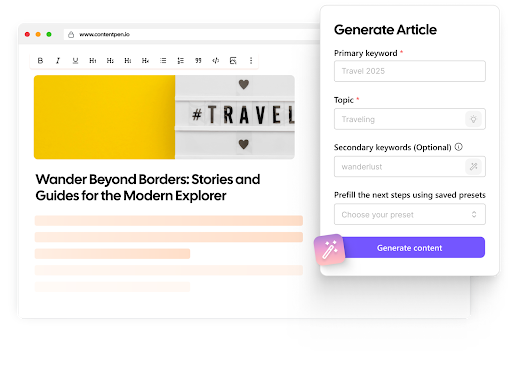
    Whether you’re a beginner or experienced marketer, these 15 essential techniques will help you maximize your content’s search visibility.

    Contentpen

    Why does on-page SEO still matter in 2026?

    Search Engine Optimization (SEO) continues to evolve, but the on-page SEO checklist remains the foundation of any successful digital marketing strategy. While Google’s algorithms become increasingly sophisticated, the fundamental principles of creating content that both users and search engines love haven’t changed.

    In 2026, on-page SEO best practices are more crucial than ever. With billions of web pages competing for attention, your content needs to stand out through strategic optimization. 

    The good news? Modern AI blog writer online like Contentpen make implementing these strategies easier than ever, automatically handling complex SEO optimization while you focus on creating valuable content.

    This streamlined SEO checklist for beginners focuses on the 15 most impactful on-page optimization techniques that can dramatically improve your search rankings and user engagement. Unlike overwhelming, extensive point checklists, this guide prioritizes the elements that deliver the biggest SEO impact for your time investment.

    Let’s start with the basics.

    What is on-page SEO?

    On-page SEO refers to the practice of optimizing individual web pages to rank higher in search engines and attract more relevant traffic. Unlike off-page SEO, which focuses on external factors like backlinks, on-page SEO deals with elements you can directly control on your website.
    On-page SEO helps your website’s pages rank higher in search results by boosting your content’s relevance, improving user experience (UX), and signaling to search engines that your page is valuable and trustworthy.

    on-page SEO

    This includes optimizing your content, HTML source code, and site architecture to make your pages more accessible to search engines and valuable to users. When you optimize content for SEO, you’re essentially creating a bridge between what people are searching for and what your content offers.

    Key components of on-page SEO

    • Content optimization: Keyword integration, search intent alignment, and comprehensive topic coverage
    • HTML optimization: Title tags, meta descriptions, header tags, and URL structure
    • Technical elements: Schema markup, page speed, mobile-friendliness, and crawlability
    • User experience factors: Navigation, internal linking, visual content, and engagement signals
    • Search intent alignment: Matching your content to what users actually want to find

    A complete 15-point on-page SEO checklist

    This complete SEO checklist covers all essential elements you need to optimize for better search rankings. Each point includes actionable steps and best practices to improve website SEO performance.

    1. Use a clear and keyword-rich page title

    Your page title is the first thing both users and search engines see. Craft compelling titles that include your primary keyword near the beginning while staying under 60 characters to avoid truncation in search results.

    Title optimization checklist:

    • Include your target keyword naturally (preferably at the beginning)
    • Keep titles under 60 characters for full visibility
    • Make each title unique across your website
    • Write for humans first, search engines second
    • Avoid keyword stuffing and clickbait tactics
    • Use title tag modifiers like “Best,” “Complete,” “2026,” or “Ultimate.”

    Best practices for title tags:

    • Front-load your keyword for maximum impact
    • Use power words that encourage clicks
    • Include your brand name when space allows
    • Test different variations to improve click-through rates
    • Add compelling modifiers to stand out in search results

    Title tag modifiers that work:

    • Best
    • Complete
    • Ultimate
    • [Current year]
    • Checklist
    • Guide
    • Step-by-step

    Example: “Complete On-page SEO Checklist: 15 Essential Steps for 2026”

    Research shows that front-loading keywords in title tags can improve rankings, and pages with optimized titles see up to 30% higher click-through rates compared to generic titles.

    2. Write a compelling meta description

    The second most important thing in our SEO checklist is meta descriptions. They don’t directly impact rankings, but they significantly influence click-through rates. Write persuasive descriptions that include your target keyword and encourage users to click.

    Meta description optimization checklist

    • Keep descriptions between 120-160 characters (approximately 680 pixels)
    • Include your primary keyword naturally (Google often bolds matching terms)
    • Write compelling copy that addresses user intent and pain points
    • Add a clear call-to-action (discover, learn, explore)
    • Make each description unique across your website
    • Use synonyms and related terms for context
    • Clearly mention what users will get from your page

    Meta description best practices

    • Write clear, complete sentences that don’t get cut off
    • Avoid duplicate descriptions across multiple pages
    • Include your brand name when space allows
    • Use active voice for better engagement
    • Test different variations to improve click-through rates

    Note: Search engines may sometimes generate their own descriptions for your pages. Writing clear, relevant descriptions that match search intent reduces the likelihood of this happening and gives you more control over how your page appears in search results.

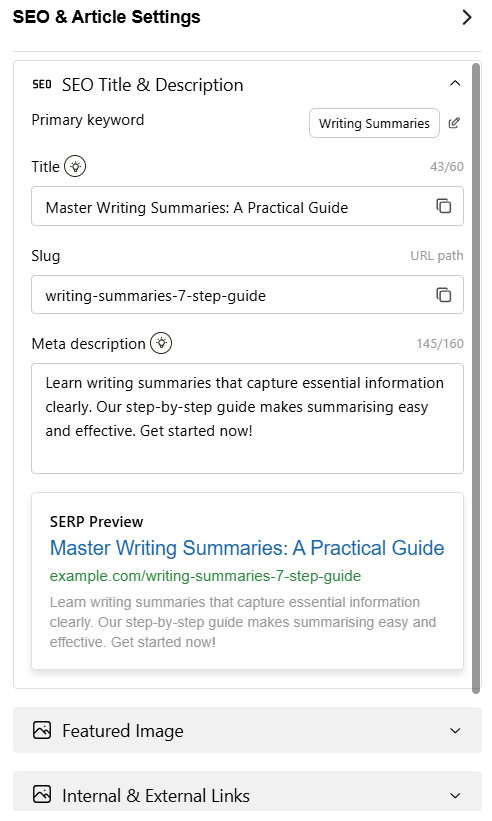
    The following image shows the examples of well-optimized meta titles and meta descriptions:

    Meta description best practices

    3. Use proper header tags (H1, H2, H3)

    Header tags create a logical content hierarchy that helps both users and search engines understand your content structure. Use them strategically to improve website SEO and enhance user experience.

    Header tag optimization checklist

    • Use only one H1 tag per page (your main headline)
    • Include your primary keyword in the H1, preferably near the beginning
    • Structure content with H2 and H3 subheadings in logical order
    • Place keywords naturally in headers without stuffing
    • Keep headers descriptive and user-friendly
    • Maintain proper hierarchy (H1 > H2 > H3 > H4)
    • Make headers compelling and scannable

    Header tag hierarchy and best practices

    • H1: Your main page title that clearly describes the content
    • H2: Major section headings that break up your content
    • H3-H6: Subsection headings that create a detailed structure

    Advanced header optimization:

    • Include relevant keywords naturally: Don’t force keywords, but include them where they make sense
    • Write compelling headlines: Use action words and benefits to engage readers
    • Create scannable content: Headers should allow users to quickly understand your content structure
    • Align with search intent: Ensure headers match what users are looking for

    Remember that you need to include related keywords in your headers naturally, but prioritize readability over keyword density. Well-structured headers improve user experience and help search engines understand your content topics and hierarchy.

    Also read: 12 best AI SEO tools in 2025: Tested & ranked by real users

    4. Include your target keyword early and naturally

    Place your primary keyword within the first 100-150 words of your content. This signals to search engines what your page is about and helps with topical relevance and search intent alignment.

    Early keyword placement strategies

    • Include the main keyword in the first paragraph naturally
    • Make it flow within the context of your introduction
    • Don’t force keywords unnaturally into sentences
    • Use variations and synonyms throughout the content
    • Focus on user intent over strict keyword density
    • Ensure the keyword placement makes sense to human readers

    Beyond the first paragraph

    • Natural keyword distribution: Spread your primary keyword throughout the content naturally
    • Contextual usage: Use the keyword when it adds value to the reader’s understanding
    • Avoid keyword stuffing: Don’t repeat the same keyword multiple times in close proximity
    • Use related terms: Include synonyms and semantic variations

    Remember: Google’s algorithms are sophisticated enough to understand context and related terms. Focus on creating comprehensive, valuable content that naturally incorporates your target keywords rather than mechanically inserting them.

    5. Optimize URL structure

    Next in our SEO checklist are URLs. Clean, descriptive URLs improve user experience and search engine crawling. Your URL should reflect your page’s content and include your primary keyword.

    URL optimization checklist

    • Keep URLs short and descriptive (under 60 characters when possible)
    • Use hyphens to separate words, not underscores
    • Include your target keyword near the beginning
    • Avoid special characters, numbers, and parameters
    • Use lowercase letters consistently
    • Make URLs readable and logical
    • Ensure each page has a single, canonical URL

    URL structure best practices

    • Place keywords toward the beginning of the URL
    • Avoid unnecessary parameters and tracking codes
    • Use canonical tags for duplicate content issues
    • Create a logical hierarchy that reflects your site structure
    • Make URLs human-readable and shareable

    Good example: /complete-on-page-seo-checklist 

    Poor example: /page123?id=4567&cat=seo&ref=blog

    6. Write high-quality, original content

    Content quality remains the most important on-page SEO ranking factor. Create comprehensive, valuable content that thoroughly addresses your audience’s needs and questions.

    Content optimization checklist

    • Write original, plagiarism-free content
    • Aim for 1,000+ words for comprehensive coverage (top results average 2,000+ words)
    • Include your primary keyword in the first 100-150 words
    • Maintain optimal keyword density (1-2% naturally)
    • Use LSI keywords and synonyms throughout
    • Structure content with clear headings and subheadings
    • Include relevant statistics, examples, and case studies
    • Update content regularly to maintain freshness
    • Focus on information gain – add unique value beyond existing content

    Content quality indicators

    • Original research and insights
    • Comprehensive topic coverage
    • Clear, engaging writing style
    • Proper grammar and spelling
    • Regular content updates
    • User engagement metrics (time on page, low bounce rate)
    • Multimedia elements (images, videos, infographics)

    The information gain principle: Don’t just rehash existing content. Add unique insights, original research, personal experiences, or expert perspectives that aren’t available elsewhere. This is what separates ranking content from the rest.

    Tools like Contentpen help you create high-quality, SEO-optimized content at scale while maintaining your brand voice and meeting search intent. The platform’s AI agents automatically research competitors and optimize content structure for better search performance.

    7. Use LSI and related keywords naturally

    Latent Semantic Indexing (LSI) keywords help search engines understand your content’s context. Include related keywords and synonyms naturally throughout your content to avoid keyword stuffing while improving topical relevance.

    LSI keyword optimization

    • Use synonyms and related terms throughout your content
    • Include long-tail keyword variations
    • Maintain natural language flow
    • Research semantic keywords using tools like LSIGraph
    • Study competitor content for related terms
    • Focus on user intent and context

    How to find LSI keywords

    • Use Google’s “People also ask” section
    • Check related searches at the bottom of Google results
    • Use tools like Semrush’s Keyword Magic Tool
    • Analyze competitor content for semantic terms
    • Look at Wikipedia entries for your topic

    Implementation tip: Naturally weave these terms throughout your content rather than stuffing them in artificially. Focus on creating comprehensive, contextually rich content that covers your topic thoroughly.

    8. Add internal links to relevant pages

    Internal linking helps distribute page authority throughout your site and keeps users engaged longer. Link to relevant pages using descriptive, keyword-rich anchor text.

    Internal and external linking

    Internal linking checklist

    • Link to related, valuable content on your site
    • Use descriptive, keyword-rich anchor text
    • Don’t overdo it (2-5 internal links per 1000 words)
    • Ensure links add genuine value for readers
    • Create a logical link structure and topic clusters
    • Use do-follow links for internal navigation
    • Link to both newer and older relevant content

    Internal linking best practices

    • Link to high-authority pages on your site
    • Use natural, contextual anchor text with target keywords
    • Balance links throughout your content
    • Regularly audit and update internal links
    • Create topic clusters with supporting content
    • Link to your most important pages from multiple locations

    Anchor text optimization: Instead of generic phrases like “click here” or “read more,” use descriptive anchor text that includes relevant keywords:

    9. Include outbound links to authority sites

    Linking to reputable, authoritative websites can improve your content’s credibility and provide additional value to readers. This practice can positively impact your SEO ranking factors by showing search engines your content is well-researched and trustworthy.

    Outbound linking checklist

    • Link to high-authority, relevant sites in your industry
    • Use descriptive, contextual anchor text
    • Open external links in new tabs to keep users on your site
    • Ensure linked content is current and valuable
    • Verify all links work properly and aren’t broken
    • Don’t overuse external links (2-3 per 1000 words)
    • Choose reputable sources like industry leaders, research studies, and official organizations

    Quality outbound links demonstrate to search engines that you’re providing comprehensive, well-researched content and aren’t afraid to reference other valuable resources in your field.

    Related: How to automate internal and external linking using Contentpen?

     10. Use image alt text for SEO

    Alt text helps search engines understand your images and improves accessibility. Include descriptive alt text that incorporates relevant keywords when appropriate.

    Image optimization checklist

    • Add descriptive alt text to all images
    • Include target keywords naturally in alt text
    • Keep alt text under 125 characters
    • Describe the image content specifically
    • Use relevant keywords in image file names
    • Optimize image file sizes for faster loading
    • Choose appropriate image formats (WebP, JPEG, PNG)

    Alt text best practices

    • Write for users first, search engines second
    • Avoid keyword stuffing in alt attributes
    • Don’t start with “image of” or “picture of”
    • Be specific and descriptive
    • Include context when relevant to the surrounding content

    Remember that images can also rank in Google Image Search, potentially driving additional traffic to your website. Optimized images with proper alt text and descriptive filenames are more likely to appear in image search results.

    11. Ensure mobile-friendliness

    With mobile-first indexing, your site must perform excellently on mobile devices. This is crucial for both user experience and SEO optimization.

    Mobile optimization checklist

    • Responsive design that adapts to all screen sizes
    • Fast loading times on mobile (under 3 seconds)
    • Easy navigation and readable text
    • Touch-friendly buttons and links
    • Optimized images for mobile viewing
    • Accessible forms and interactive elements

    SEO best practices

    • Test your site on various mobile devices
    • Use Google’s Mobile-Friendly Test tool
    • Optimize for Core Web Vitals
    • Ensure text is readable without zooming
    • Make buttons and links easy to tap

    Mobile traffic now accounts for over 60% of web traffic globally, making mobile optimization essential for SEO success.

    12. Improve page speed

    Page speed is a confirmed ranking factor and crucial for user experience. Slow-loading pages lead to higher bounce rates and lower search rankings.

    Page speed optimization checklist

    • Achieve loading times under 3 seconds
    • Optimize and compress images
    • Enable browser caching
    • Minimize HTTP requests
    • Use a Content Delivery Network (CDN)
    • Minify CSS, JavaScript, and HTML
    • Choose quality hosting with fast servers
    • Eliminate render-blocking resources

    Page speed impact on SEO

    • Google uses page speed as a ranking factor
    • Faster pages have lower bounce rates
    • Improved user experience signals
    • Better Core Web Vitals scores
    • Higher conversion rates and user engagement

    Pro tip: You can use PageSpeed Insights to check the speed of your web pages.

    PageSpeed Insights

     12. Use schema markup

    Use schema markup

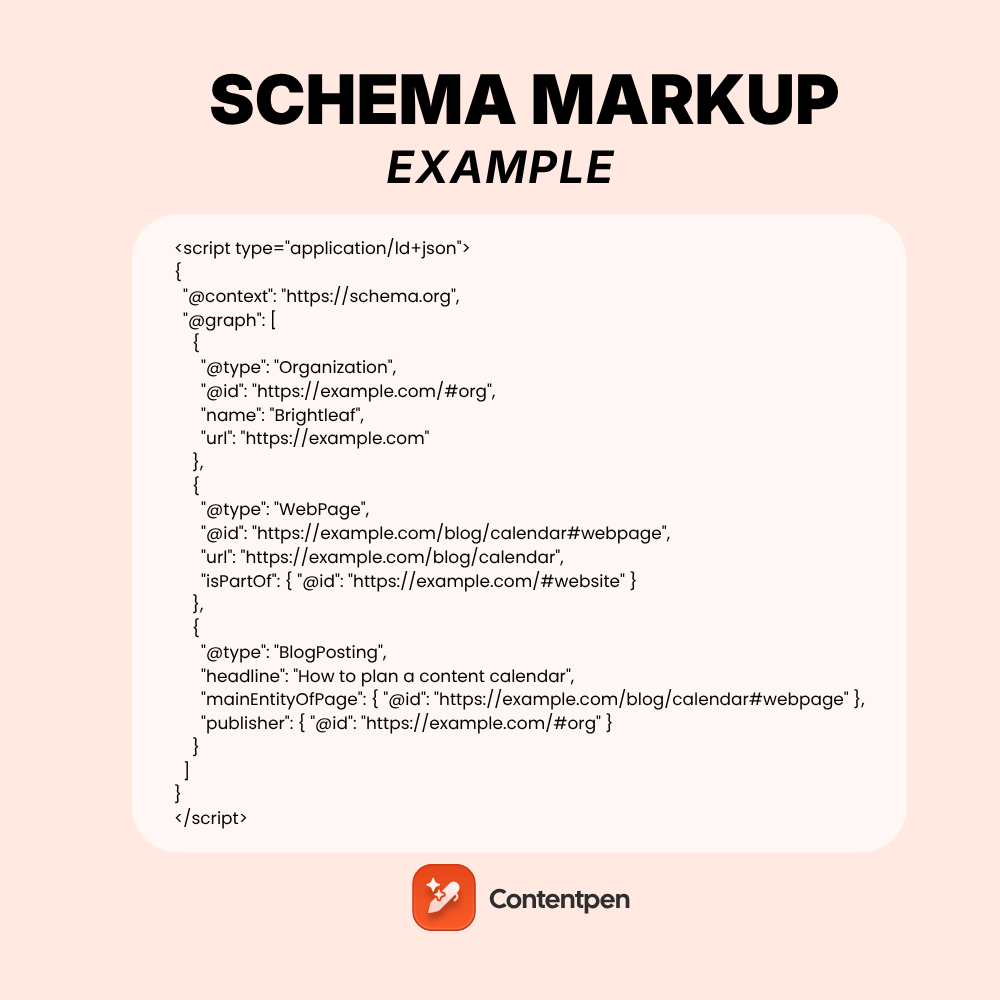
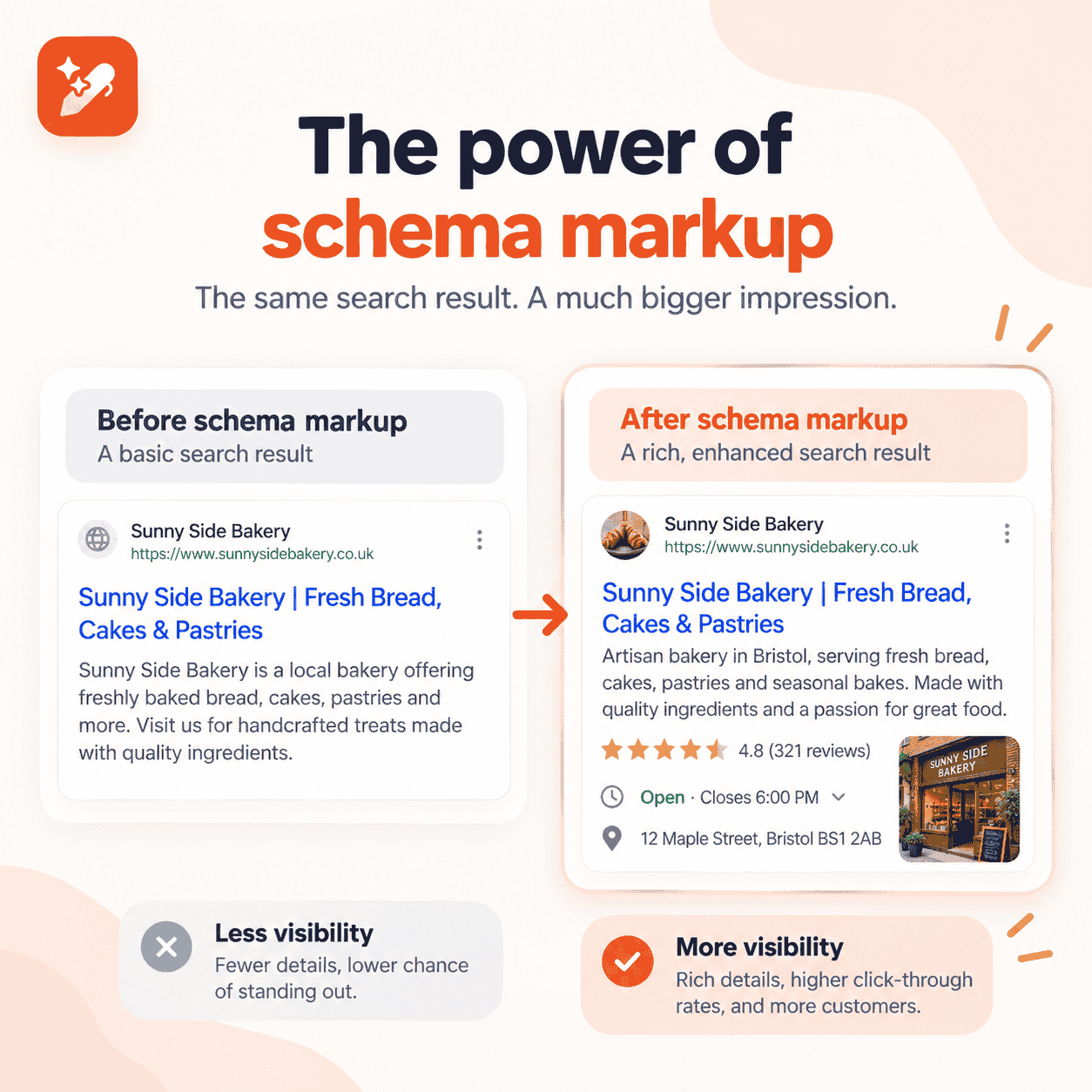
    Schema markup (structured data) helps search engines understand your content better and can lead to rich snippets in search results. This technical SEO element can significantly improve your click-through rates and search visibility.

    Schema markup benefits

    • Enhanced search listings with rich snippets
    • Better search engine understanding of your content
    • Increased click-through rates from search results
    • Improved local search visibility
    • Better content categorization and indexing

    Schema markup checklist

    • Add appropriate schema types to your content
    • Use JSON-LD format for implementation (recommended by Google)
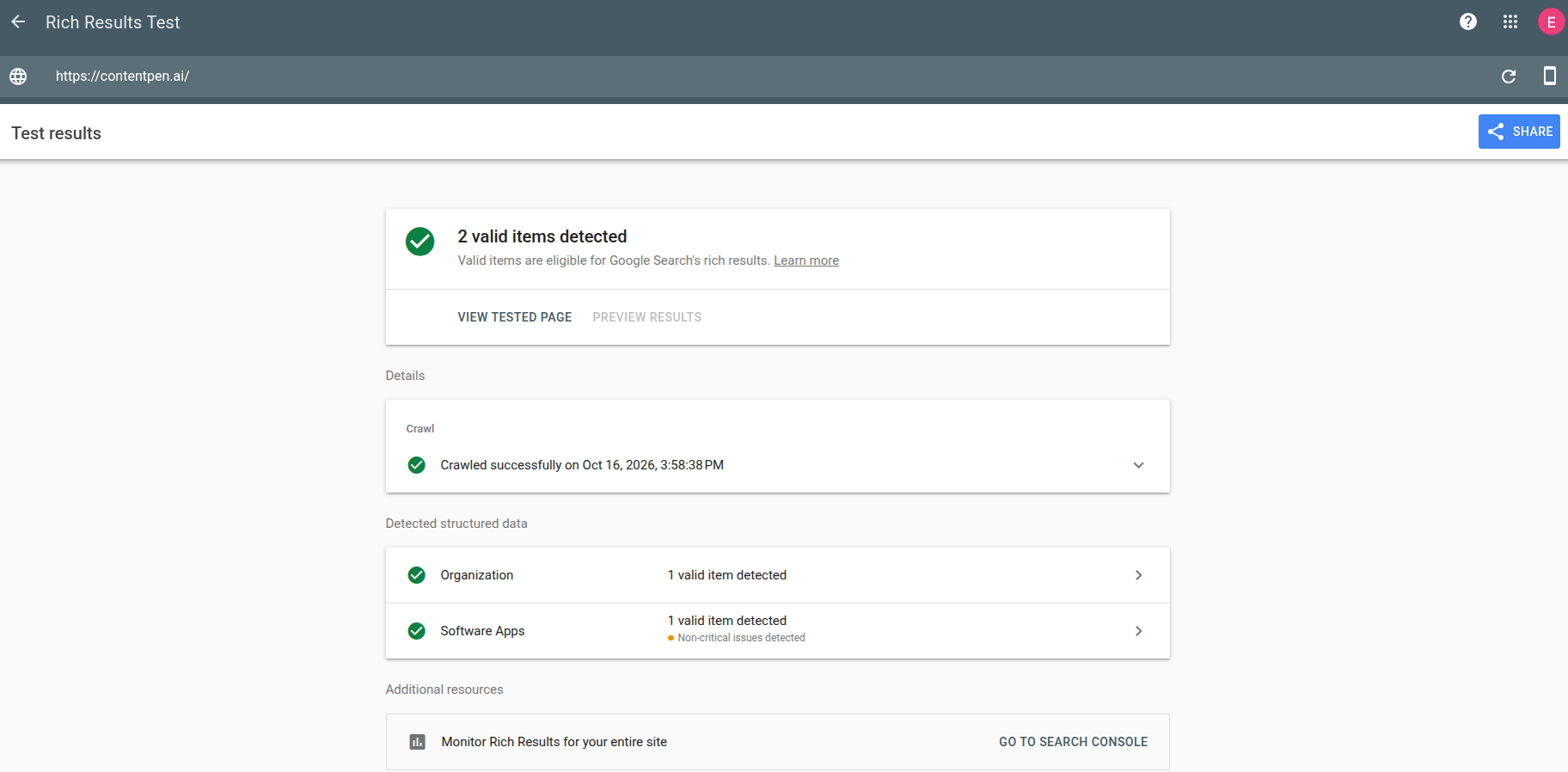
    • Test schema markup with Google’s Rich Results Test
    • Include relevant properties for your content type
    • Keep markup up-to-date with content changes
    • Validate structured data regularly

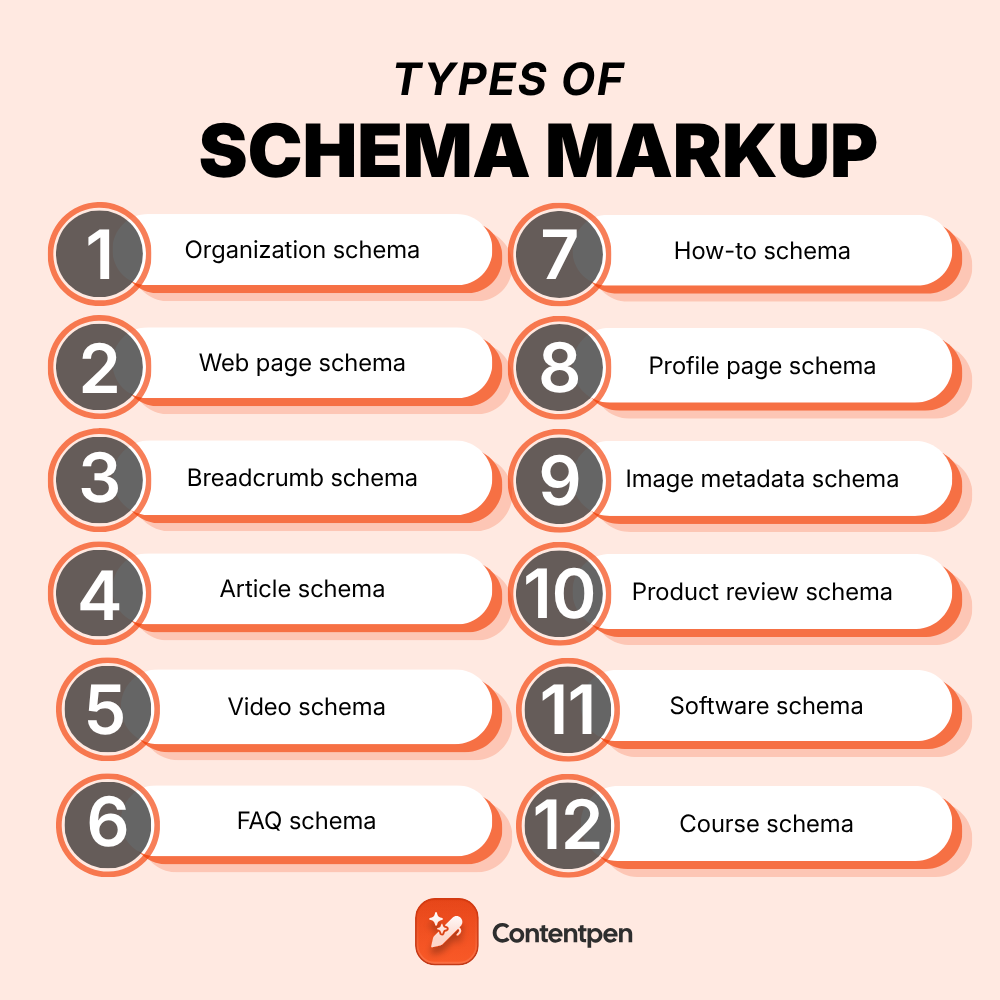
    Common schema types and use cases

    • Article schema: For blog posts, news articles, and editorial content
    • Product schema: For e-commerce pages with prices, availability, and reviews
    • LocalBusiness schema: For businesses with physical locations, hours, and contact details
    • FAQ schema: For frequently asked questions and answers
    • Recipe schema: For cooking instructions, ingredients, and nutrition information
    • Event schema: For dates, times, locations, and ticket information
    • Review schema: For product reviews, ratings, and testimonials

    Schema markup is an advanced but valuable on-page SEO technique that can set your content apart in search results and improve user engagement.

    13. Optimize for featured snippets

    Featured snippets occupy position zero in search results, driving significant traffic. Structure your content to answer common questions directly and concisely.

    featured snippets

    Featured snippet optimization tips

    • Use question-based subheadings
    • Provide clear, concise answers
    • Use lists and tables when appropriate
    • Include relevant keywords in answers
    • Structure content logically
    • Answer questions within 40-60 words

    Types of featured snippets

    • Paragraph snippets (most common)
    • List snippets (numbered or bulleted)
    • Table snippets (data comparisons)
    • Video snippets (step-by-step guides)

    Creating content that answers specific questions can significantly increase your chances of earning featured snippets and driving more organic traffic.

    14. Add a clear call-to-action (CTA)

    Every page should guide users toward a specific action. Whether it’s subscribing to your newsletter, downloading a resource, or making a purchase, include clear CTAs throughout your content.

    CTA optimization checklist

    • Use action-oriented language
    • Make CTAs visually prominent
    • Place CTAs strategically throughout content
    • Test different CTA variations
    • Align CTAs with user intent
    • Keep CTAs relevant to the content

    Well-placed CTAs can improve user engagement, reduce bounce rates, and increase conversions – all positive signals for search engines.

    15. Monitor SEO performance and update content regularly

    Publishing optimized content is just the beginning. Maintaining strong search rankings requires ongoing monitoring and improvements. Search engine algorithms change frequently, and so do user behaviors. Regularly updating your content ensures it stays relevant, competitive, and aligned with current SEO best practices.

    Performance monitoring checklist

    • Track keyword rankings with advanced SEO tools.
    • Monitor organic traffic trends and user engagement metrics (bounce rate, time on page, etc.)
    • Identify underperforming pages and optimize them for improved results
    • Update outdated statistics, facts, and broken links
    • Refresh content based on new trends or search intent
    • Re-optimize titles, meta descriptions, and headers if CTR drops
    • Review internal links and add new contextual ones where appropriate

    Why this matters:

    Google rewards fresh, high-quality content. Pages that are regularly updated tend to perform better in search results compared to stagnant content. Refreshing your content also increases the chances of earning featured snippets, improving user engagement, and extending the lifespan of your blog posts. And with that, our SEO checklist ends.

    Best writing tool that simplifies on-page SEO

    Contentpen

    Managing all these on-page SEO best practices manually can be overwhelming, especially when creating content at scale. This is where Contentpen becomes invaluable for modern content creators and businesses serious about SEO optimization.

    Contentpen

    Contentpen’s multi-agent AI system handles research, writing, and optimization simultaneously. While tools like ChatGPT require multiple prompts and manual SEO work, Contentpen delivers SEO-optimized content ready for publication.

    Contentpen automatically handles complex SEO optimization:

    • Advanced keyword integration: Naturally incorporates your target keywords throughout the content while maintaining readability.
    • SERP analysis and competitor research: Analyzes top-ranking pages to identify what works for your target keywords, ensuring your content meets or exceeds current ranking standards.
    • Content structure optimization: Creates properly formatted headers, meta descriptions, and URL structures that follow the latest SEO optimization checklist 2026 standards.
    • Automated internal linking: Intelligently suggests and adds relevant internal links from your website, improving site structure and user engagement.
    • SEO-friendly formatting: Automatically formats content with proper heading hierarchies, bullet points, and readability enhancements.
    • Maintain brand voice: Contentpen’s brand knowledge system ensures every piece of content aligns with your brand voice while meeting SEO requirements. 
    • Bulk content generation: You can use Contentpen’s bulk content generation to scale your content marketing efforts. 

    The following video shows the complete process of creating an SEO-optimized blog post with Contentpen:

    Additional on-page SEO factors to consider

    While the 15 points above form the core of effective on-page SEO optimization, several additional factors can further enhance your search performance:

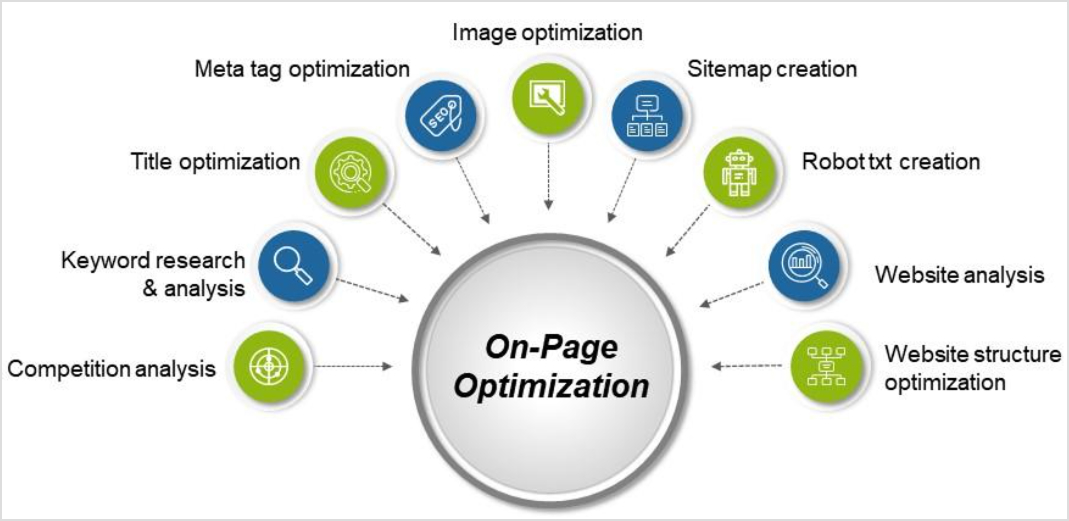
    • Technical elements: XML sitemaps, robots.txt optimization, canonical tags, Core Web Vitals, and HTML validation.
    • Content enhancements: Regular content updates, multimedia integration, social sharing buttons, and user-generated content like reviews.
    • Advanced tactics: Featured snippet optimization, voice search targeting, local SEO elements, and E-E-A-T signals through author credentials.
    • Performance: Site uptime monitoring, accessibility compliance, cross-browser compatibility, and mobile-first design.

    Implementation priority: Focus on mastering the core 15 points first, then gradually incorporate these additional elements based on your specific industry, audience, and business goals. Not every factor will be relevant for every website, so prioritize based on your unique circumstances and resources.

    Also read: How to use AI for content creation?

    Final thoughts: Turn this checklist into your SEO habit

    This complete SEO checklist provides a roadmap for optimizing every piece of content you create. However, consistency is key to seeing results. Make these practices part of your regular content creation workflow.

    Remember these key points:

    • On-page SEO is an ongoing process, not a one-time task
    • User experience should always be your priority
    • Quality content beats keyword stuffing every time
    • Regular monitoring and updates are essential
    • SEO writing tools like Contentpen can streamline the entire process

    Start implementing the tips in this on-page SEO SEO checklist today, and you’ll see improvements in your search rankings, user engagement, and overall online presence. 

    Ready to transform your content creation process? Start your free Contentpen trial and experience how AI-powered content creation can revolutionize your SEO strategy.

    Frequently asked questions

    What should I do if Google keeps changing my meta descriptions?

    If Google frequently rewrites your meta descriptions, it usually means your descriptions don’t match search intent well enough. Focus on writing more relevant, specific descriptions that directly address what users are searching for.

    How often should I update my on-page SEO?

    Review and update your on-page SEO elements at least quarterly, or whenever you publish new content. Monitor your rankings and user engagement metrics to identify pages that need optimization improvements.

    Can I do on-page SEO without technical knowledge?

    Yes! Many on-page SEO best practices are accessible to beginners. Focus on content quality, natural keyword integration, and basic HTML elements. Tools like Contentpen automate technical aspects while you focus on content strategy.

    How long does it take to see results from on-page SEO?

    On-page SEO results typically appear within 3-6 months, depending on competition and implementation quality. Some improvements, like better user engagement and click-through rates, may be visible sooner.

  • 9 best AI tools for content creation

    9 best AI tools for content creation

    Creating high-quality content consistently is tough, especially when you’re racing against deadlines, out of ideas, or short on resources. That’s where AI tools for content creation, like Contentpen, step in to transform the game. 

    From generating blog topics and social captions to designing visuals and optimizing for SEO, AI-powered platforms are helping marketers, creators, and teams produce content faster, smarter, and with less stress.

    With the right AI blog writer online in your stack, you can save hours of manual effort, streamline your content workflow, and focus more on strategy and creativity rather than repetitive tasks. But with so many tools available, finding the best ones for your needs can be overwhelming.

    That’s why we’ve handpicked nine of the best AI tools for content creation, each offering unique features to help you write, design, plan, and publish content more efficiently. 

    Whether you’re a solo creator, part of a marketing team, or running an agency, these tools are designed to supercharge your content process and deliver better results. Let’s explore!

    05 benefits of AI content creation tools

    AI content creation tools are transforming how businesses and creators approach content marketing. Here are five key benefits of using these tools:

    • Speedy content production: AI generates ideas, outlines, and drafts in minutes – cutting down hours of work and freeing you up for strategy and fine-tuning.
    • Boosted creativity: Stuck in a creative rut? AI offers fresh angles, catchy headlines, and unique suggestions to keep your content sharp and inspired.
    • Cost-efficient output: Skip the high costs of hiring multiple creators. AI tools handle repetitive tasks, helping you produce quality content on a leaner budget.
    • Better SEO performance: With built-in optimization features, AI tools suggest keywords, structure, and metadata to improve search rankings and drive traffic.
    • Consistent brand messaging: AI helps maintain a unified voice across all platforms  – from blogs and emails to social media, and keeps your content on-brand every time.

    9 best AI tools for content creation

    1. Contentpen

    Contentpen is a game-changing AI content creation tool built to help businesses scale their content production effortlessly without compromising on quality or SEO performance. Designed with growth-focused teams in mind, it combines speed, creativity, and optimization to streamline content creation at every level.

    Key features:

    • Specialized AI agents working in coherence
    • Deep brand voice analysis and integration
    • Automated keyword suggestions and research 
    • Built-in SEO optimization tools
    • Built-in content approval workflow
    • Direct WordPress publishing integration
    • Bulk content generation 
    • Content pipeline management with Kanban board

    Key steps to create high-quality content using Contentpen’s AI writer  

    • Define your topic and keywords (include primary and secondary keywords)
    • Select a tone of voice (e.g., professional, conversational, authoritative).
    • Define your target audience (marketers, business owners, developers, etc.).
    • Choose your point of view (first-person, second-person, or third-person).
    • Set formatting preferences for better readability
    • Define the article length (short, medium, or long-form).
    • Select a featured image and in-article images that align with your article (realistic, abstract, cartoon).
    • Review, refine, and optimize your article

    Pros:

    • Multiple specialized AI agents instead of one 
    • Produces large volumes of SEO-optimized content quickly
    • Highly customizable output based on features 
    • Simplified team collaboration
    • Content produced to increase organic visibility 
    • Consistent content due to a unique brand voice 

    Cons:

    • Best suited for SEO-focused blog content creation only
    • Premium features are restricted to higher-tier plans
    • Learning curve for new users, given the step-wise process

    Pricing:

    • Starter: $27/month
    • Premium: $55/month
    • Agency: $139/month

    2. ContentStudio’s AI Assistant 

    ContentStudio’s AI Writing Assistant

    ContentStudio’s AI Writing Assistant is designed to help marketers, content creators, and businesses generate high-quality, engaging content faster and more efficiently. Powered by advanced natural language processing, it assists in creating blog posts, social media captions, product descriptions, emails, and more — all tailored to your brand voice and audience. 

    Key features:

    • Customizable writing tones
    • Quick prompts and predefined prompts library
    • Chat history 
    • Text enhancement 
    • Relevant hashtag suggestions 
    • Social caption generator 
    • Unique content variations 
    • Text to image and image to text

    Pros:

    • Smart content suggestions
    • SEO-friendly keyword recommendations
    • Simplified photo creation
    • Enhanced impressions with targeted hashtags 
    • Tailored AI social content 

    Cons:

    • Dependency on input quality
    • AI performs best for short-form content

    Pricing:

    • Standard: $19/month
    • Advanced: $49/month
    • Agency Unlimited: $99/month

    3. Jasper.AI

    Jasper.AI

    Jasper, formerly known as Jarvis, was one of the first AI writing tools to hit the market, giving it a head start in refining its UI and features. It offers AI text generation for a wide range of content types, from landing pages to full marketing campaigns. Key tools include Remix for reworking existing content, an interactive Chat for brainstorming, and a handy Chrome extension.

    Key features:

    • Real-time collaboration with Kanban
    • Calendar views for managing projects
    • Smart suggestions
    • Offers chrome extension

    Pros:

    • 50 content templates
    • Integration with third-party tools
    • Supports content ideation

    Cons:

    • Enterprise pricing varies
    • Cost for third-party integrations 
    • Higher pricing compared to alternatives
    • Best for marketing content only

    Pricing:

    • Creator: $39/month
    • Pro: $59/month
    • Business: Custom pricing 

    4. Surfer SEO

    Surfer SEO

    Surfer SEO is a powerful content optimization tool designed to help marketers, content creators, and SEO professionals create high-ranking content with ease. It analyzes top-performing pages for your target keyword and provides actionable recommendations to improve your content’s structure, keyword usage, and on-page SEO elements.

    Key features:

    • Content scoring
    • Keyword density checks
    • Internal linking suggestions
    • AI-driven content outlines
    • Third-party integrations

    Pros:

    • Content editing interface with SEO optimization
    • Data-driven customization options
    • Third-party integrations with Google Docs and more

    Cons:

    • Steep learning curve
    • Focused more on optimization
    • Higher cost for solo creators 
    • Keyword stuffing risk

    Pricing:

    • Essential: $79/month
    • Scale: $175/month
    • Enterprise: Custom pricing 

    5. Copy.AI

    Copy.AI

    Copy.ai is an AI-powered writing tool designed to help marketers, entrepreneurs, and content creators generate engaging copy in seconds. It offers a wide range of templates for social media captions, blog ideas, product descriptions, email copy, and more, making it a versatile option for both short-form and long-form content needs.

    Copy.ai is particularly useful for brainstorming ideas, overcoming writer’s block, and generating drafts quickly without starting from scratch. 

    Key features:

    • The blog post wizard quickly generates full-length blog posts 
    • AI-Powered copy templates
    • Brand voice customization
    • Workflow automation
    • Multi-language support in 25+ languages

    Pros:

    • Fast content generation
    • Wide range of templates
    • Third-party integrations 

    Cons:

    • Limited long-form content control
    • Repetitive output
    • No built-in SEO optimization
    • Dependence on prompt quality

    Pricing:

    • Free
    • Starter: $49/month
    • Advanced:  $249/month

    6. Canva

    Canva

    Canva has evolved from a simple graphic design tool into a powerful AI-driven content creation platform. It’s best known for its user-friendly drag-and-drop interface that makes designing social media posts, presentations, marketing materials, and videos accessible to everyone — no design skills required.

    Key features:

    • Canva’s content planner
    • Brand kits
    • Magic Write (AI writing assistant)
    • Magic Design (instant design generation)
    • Magic Edit (AI-powered image editing)
    • Team collaboration

    Pros:

    • Combines visual design and AI writing in one tool
    • Extremely beginner-friendly with pre-made templates
    • Great for social media, marketing visuals, and quick content generation
    • Affordable pricing for individuals and small teams

    Cons:

    • Limited control over long-form content generation
    • AI writing features are basic compared to specialized tools
    • Some advanced features are locked behind paid plans
    • Not ideal for in-depth SEO-focused content creation
    • Requires manual input for brand voice customization

    Pricing:

    • Free
    • Canva Pro: $55/month
    • Canva Teams: $50/month
    • Enterprise: Custom pricing 

    7. InVideo

     InVideo

    InVideo is an AI-driven video creation platform designed to simplify the video production process for marketers, content creators, and businesses. It allows users to create high-quality videos quickly with minimal effort, even if they have no prior video editing experience. Whether you’re producing promotional videos, social media content, or explainer videos, InVideo offers a range of templates and tools to help you bring your vision to life.

    Key features:

    • Automatic scene generation
    • Text-to-video capabilities
    • Smart video editing
    • Extensive media library
    • Ready to use templates 
    • Voiceover and audio integration 

    Pros:

    • Easy-to-use interface
    • Time-saving AI tools that automate video creation tasks
    • Large selection of templates and stock media 
    • Affordable pricing, with both free and premium options

    Cons:

    • Limited advanced editing features 
    • AI-generated scripts and videos may lack creativity or nuance
    • Export quality is limited on free plans
    • May require additional manual editing to perfect the final video
    • Not as suitable for complex, high-budget video projects

    Pricing:

    • Free
    • Plus: $28/month
    • Max: $48/month
    • Generative: $96/month

    8. Murf

    Murf

    Murf is an advanced AI tool designed for creating realistic voiceovers, podcasts, and audio content without the need for professional voice actors or audio engineers. The platform uses AI to convert text into natural-sounding speech, making it perfect for a wide range of applications, from explainer videos and presentations to audiobooks and podcasts.

    Murf offers a collection of lifelike voices, which can be customized by adjusting pitch, tone, and speed, ensuring that the generated voiceover aligns with your brand and content style.

    Key features:

    • Text-to-speech conversion
    • Voice customization
    • Wide range of voices
    • Audio syncing
    • Real-time Collaboration
    • Supports multiple languages

    Pros:

    • High-quality, lifelike voiceovers
    • Easy-to-use interface suitable for beginners
    • Customizable voices to suit various content styles and tones
    • Reduces the need for professional voice actors
    • Supports a wide range of languages

    Cons:

    • Limited creative control
    • Voices may sound robotic or unnatural in certain contexts
    • Higher-tier plans are required for full access to premium features and voices
    • No video editing features
    • Output quality can vary depending on the clarity and complexity of the original text

    Pricing:

    • Creator: $19/month
    • Growth: $66/month
    • Business: $199/month
    • Enterprise: Custom

    9. Grammarly

    Grammarly

    Grammarly is one of the most popular AI writing tools, designed to help users write clear, mistake-free, and impactful content across multiple platforms.

    Beyond basic proofreading, Grammarly offers advanced features like tone detection, style suggestions, and clarity improvements, ensuring your writing matches your intent and audience. Its plagiarism checker is especially useful for content creators aiming to produce original content.

    Key features:

    • Real-time grammar, spelling, and punctuation checks
    • Tone and clarity suggestions 
    • Plagiarism checker 
    • AI-powered rewrite and improvement suggestions
    • Cross-platform compatibility (browser extension, desktop app, integrations)
    • Style guide and brand tone consistency tools for teams

    Pros:

    • Easy-to-use interface with real-time writing suggestions
    • Enhanced content clarity, engagement, and correctness
    • Helpful tone detector and rewrite suggestions
    • Works across multiple tools and platforms
    • Useful plagiarism checker

    Cons:

    • Limited features in the free version
    • May over-correct or suggest unnecessary changes for creative writing
    • The plagiarism checker is only available in premium plans
    • Not a content generation tool 
    • Requires internet access for real-time suggestions and checks

    Pricing:

    • Free
    • Premium: $12/month
    • Business: $15/month

    Which is the best AI tool for content creators?

    If you’re looking for the best AI tool for content creators, Contentpen stands out as the top choice. 

    Here’s why Contentpen leads the pack:

    • Specialized AI agents collaborate behind the scenes to generate strategic, brand-aligned content.
    • Deep brand voice integration ensures every piece of content sounds like you.
    • Built-in SEO optimization drives more organic visibility with zero manual effort.
    • Content workflows, pipelines, and publishing tools keep teams in sync and scale production easily.

    Whether you’re a solo creator or part of a growing team, Contentpen doesn’t just help you create content; it helps you create better, faster, and with intent.

    Final words

    AI tools have transformed the way content is created, helping marketers, creators, and businesses produce high-quality content faster and more efficiently than ever before. From generating blog posts and social media captions to designing visuals and optimizing for SEO, these AI-powered tools offer smart solutions for every stage of content creation.

    AI is not here to replace creativity; it’s here to enhance it. Let these tools handle the heavy lifting so you can focus on what matters most: crafting content that connects and converts.

    FAQs on the best AI tools

    What are AI content creation tools?

    AI content creation tools use artificial intelligence to help generate, optimize, and edit different types of content like blog posts, social media captions, videos, and graphics with minimal manual effort.

    Are AI writing tools good for SEO?

    Yes, many AI writing tools come with built-in SEO optimization features such as keyword suggestions, content scoring, and optimization tips to help your content rank better on search engines.

    Can AI tools create visual content too?

    Absolutely! Tools like Canva and InVideo use AI to generate visuals, videos, social media graphics, and even automate design suggestions for faster content creation.

    Are AI content tools suitable for beginners?

    Most AI content creation tools are user-friendly and designed for beginners. They offer templates, guided workflows, and automation features to make the process easy, even for non-experts.

  • How to write an article using Contentpen?

    How to write an article using Contentpen?

    Writing a well-structured, engaging article is easier than ever with Contentpen’s AI blog writer. This powerful tool helps you generate, customize, and optimize content with just a few clicks. 

    Whether you’re crafting a quick blog post or a detailed guide, Contentpen streamlines the process, saving you time while maintaining quality. 

    In this guide, we’ll walk you through each step to help you create, refine, and publish your content effortlessly. Let’s get started! 

    What is Contentpen? 
    Contentpen is an AI-powered writing assistant designed to help users create high-quality, SEO-optimized content efficiently.

    How to write an article using Contentpen in a few clicks?

    Step 1: Sign up or log in

    Visit the Contentpen website and click “Sign up” if you’re a new user or “Log in” if you already have an account. Enter your credentials and access your dashboard.

    Step 2: Create a new article

    Once inside the dashboard, navigate to the “Article list” section. Click on the “New article” button in the upper left corner to start writing.

    create new article

    Step 3: Choose a template

    Select a template based on your needs—whether you want to create a quick article, add links, or start with a blank canvas.

    choose template

    Step 4: Customize your article settings

    Contentpen offers five key customization categories:

    • Basics – Add primary and secondary keywords to optimize your article. Save your changes to proceed.
    add keywords
    • Style –  Define the tone of voice, target audience, and point of view.
    set tone of voice
    • Structure – Choose formatting options like bold, italics, and bullet points.
    set structure
    • Formatting – Set the number of headings, additional sections.
    choose no. of headings

    or set image style.

    image style
    • Linking – Enable internal and external linking or add a sitemap.
    set internal external linking

    Step 6: Export & publish

    Save your article and export it in your preferred format (Word, PDF, HTML, etc.). If supported, you can directly publish it on platforms like WordPress or Medium. Share it with your team for feedback and final edits.

    Now that you have learned how to effortlessly create content using Contentpen. Learn more on speed up your blog writing using AI.

    FAQs on article writing

    What are the best practices for using Contentpen efficiently?

    To get the best results, provide clear input, use relevant keywords, adjust AI-generated content to match your style, and review before publishing.

    How does Contentpen compare to other AI writing tools?

    Contentpen competes with tools like Jasper and Copy.ai by offering user-friendly features, SEO optimization, and customizable writing styles.

    Is the content generated by Contentpen SEO optimized?

    Yes, Contentpen ensures that every article is optimized for SEO by satisfying search intents, reviewing competitors’ content, and integrating keywords and meta details.

    Can I customize and edit the articles before publishing?

    Absolutely. You have full control over the articles and can review, customize, and edit any content before it goes live to ensure it fits your specific needs.

    Can I use Contentpen for multiple websites or projects?

    Yes, you can create multiple workspaces to manage the content of different brands separately. Each workspace allows the AI to learn from past activities, ensuring improved performance and relevance over time.

    What happens if I’m not satisfied with the content?

    You can request revisions or edit the content as needed. Contentpen also offers support to ensure the content meets your standards.

    Does Google punish AI content?

    Yes, Google can penalize AI-generated content if it’s deemed low-quality, lacks originality, or doesn’t provide value to users. Quality and relevance are key factors for SEO.

  • Search engine basics: How they work and why they matter

    Search engine basics: How they work and why they matter

    The gap between great content and real visibility almost always comes down to search engine basics. 

    Search engines sit between almost every question and almost every click. Studies show that over 80% of online experiences begin with a search query. When users discover and understand a page, traffic starts flowing. When they do not, even the best ideas stay hidden.

    Search engines can seem mysterious and deeply technical, yet the core ideas are simple enough for any marketer, writer, or founder to grasp. Once those basics click, terms like crawling, indexing, and ranking stop sounding like jargon and start feeling like a clear checklist.

    By the end of this guide, you will understand how a search engine works step by step, why that matters for business growth, and how to apply SEO fundamentals in a practical way.

    So, let’s get started.

    What is a search engine, and why does it matter?

    How search engine works diagram - Contentpen.ai

    A search engine is a web-based tool that helps people find information on the Internet. It does not scan the live internet from scratch every time someone types a query. Instead, it searches a massive prebuilt database of pages, often called the index, and uses algorithms to decide which ones to show.

    This difference between the index and the live web sits at the heart of search engine basics. When you type a keyword, you are really asking the search engine to look inside its index and return the best matches. 

    As of 2025, Google’s index alone contains information from billions of pages and occupies well over 100 million gigabytes in size across many data centers.

    For a business, that index is where visibility lives. If a page is not in the index, it cannot appear in results at all. If it is in the index but looks weak or unclear to the algorithm, it will sit many pages deep, where almost nobody clicks. 

    That is why search engine optimization focuses so heavily on making pages easy to understand and appealing to search engines.

    Different search engines use different indexes and algorithms, which is why Google and Bing’s results may vary for the same query. This is demonstrated in the statistical analysis of the search engines study, which compares major search platforms side by side.

    For marketers and content teams, understanding the split between index and algorithm makes SEO planning easier.

    How Google search engine works step by step?

    Search engine architecture - Contentpen.ai

    Every page that appears in a result goes through the same three‑stage process: crawling, indexing, and ranking (or serving). Google’s in-depth guide to how search works provides official documentation on each phase.

    To put it briefly, the three stages function as:

    • Crawling – Discovery, where bots follow links and read pages.
    • Indexing – Organization, where those pages are analyzed and added to the database.
    • Ranking and serving – Decision, where the engine matches a query to the best pages it already knows.

    This process never stops. Crawlers revisit sites, indexes update, and rankings shift as content changes, links appear, and user behavior moves. 

    Not all pages make it through each stage. Some never get crawled, some are crawled but not stored, and some are indexed but rarely or never shown.

    Here is a breakdown of those stages in the table below.

    StageWhat happensKey question for you
    CrawlBots discover URLs and fetch page contentCan search engines find and reach your pages?
    IndexSystems analyze content and add it to the search databaseIs your content clear and of high enough quality?
    ServeAlgorithms match queries to indexed pages and order the resultsDoes your page look like the best answer?

    When you hear people talk about search engine basics or SEO for beginners, they are usually talking about how to help a site move smoothly through this path. Technical SEO covers crawling and indexing, while on-page and off-page SEO influence how pages perform in the serving stage.

    Step #1: Crawling – How search engines discover your content

    Crawling is the stage where search engines learn that your pages exist. Since there is no master list of all URLs on the internet, engines use automated programs called crawlers, bots, or spiders to follow links and fetch content. Google’s crawler is often called Googlebot.

    These crawlers start with known URLs, fetch pages, and discover new ones by following links, gradually mapping the web over time.

    In simpler words, crawling in a search engine is the raw data‑gathering step. For any business that cares about SEO basics, this is where visibility starts.

    How crawlers find pages with links and sitemaps

    Crawlers rely on two main pathways to find content:

    • Internal links that connect one page to another
    • Sitemaps that act like a directory you hand to the search engine

    Internal and external links are the path crawlers prefer most of the time. When a crawler lands on a page, it looks through the links in the HTML and adds new ones to its to‑visit list. That means your internal linking structure matters a lot, because pages that are buried with no links pointing at them are much harder for bots to discover. 

    When you make sure important pages are linked from menus, category pages, and other high‑traffic content, you help crawlers find and revisit those key URLs.

    Sitemaps provide a second line of help. An XML sitemap lists important pages and optional details such as last-modified dates. Many modern content platforms can generate this file automatically, making it easy for teams without advanced technical skills to rank.

    When you submit that sitemap through tools like Google Search Console, you give crawlers a direct map of what matters on your site. Using both methods together is far stronger than relying on only one.

    Frequency rendering and limitations with crawlers

    Crawling is not random. Search engines decide how often to visit each site, how many URLs to fetch, and how deep to go based on several signals.

    Important factors include:

    • Popularity – Pages and sites that attract many links and visits tend to get crawled more often.
    • Update habits – A news site that publishes multiple times a day sends a clear signal to crawlers to return often, while a static brochure site might be checked far less often.
    • Technical health – Clean site structure and fast server response let crawlers fetch more pages without strain.

    Modern crawlers do more than read HTML. Googlebot, for example, can render pages with a headless browser similar to Chrome. That means it can run JavaScript, load dynamic content, and see most of what a human visitor sees. This is very important for single‑page apps and sites that depend on scripts for core content.

    Crawling still has limits. Robots.txt files can block entire folders or an entire site if misconfigured. Pages behind logins or paywalls are off‑limits. 

    Also, orphan pages with no internal or external links may never be found, and slow or error-prone servers can cause crawlers to back off.

    Step #2: Indexing — How search engines organize and store information

    Indexing begins after a page has been crawled. At this point, the search engine tries to understand the content and decide where and how to store it in the index.

    During indexing, the engine processes text, layout, links, and structured data. It records which words appear, which phrases stand out, and how the content is organized with headings, lists, and other markup. 

    It also looks at signals such as language, country targeting, and mobile readiness, all of which are now considered important ranking factors.

    What information gets stored in the index

    When a page is indexed, the system does not keep just one flat copy of the text. It stores several kinds of information that help with matching and ranking:

    • Words and phrases – Which terms appear on the page, how often, and in which positions. Titles, headings, and early paragraphs carry more weight than text in footers.
    • HTML and metadata – Title tags, meta descriptions, header tags (H1, H2, H3), and image alt text all provide clues about the topic. Schema markup can describe products, events, articles, How-to guides, etc., in a much more structured way.
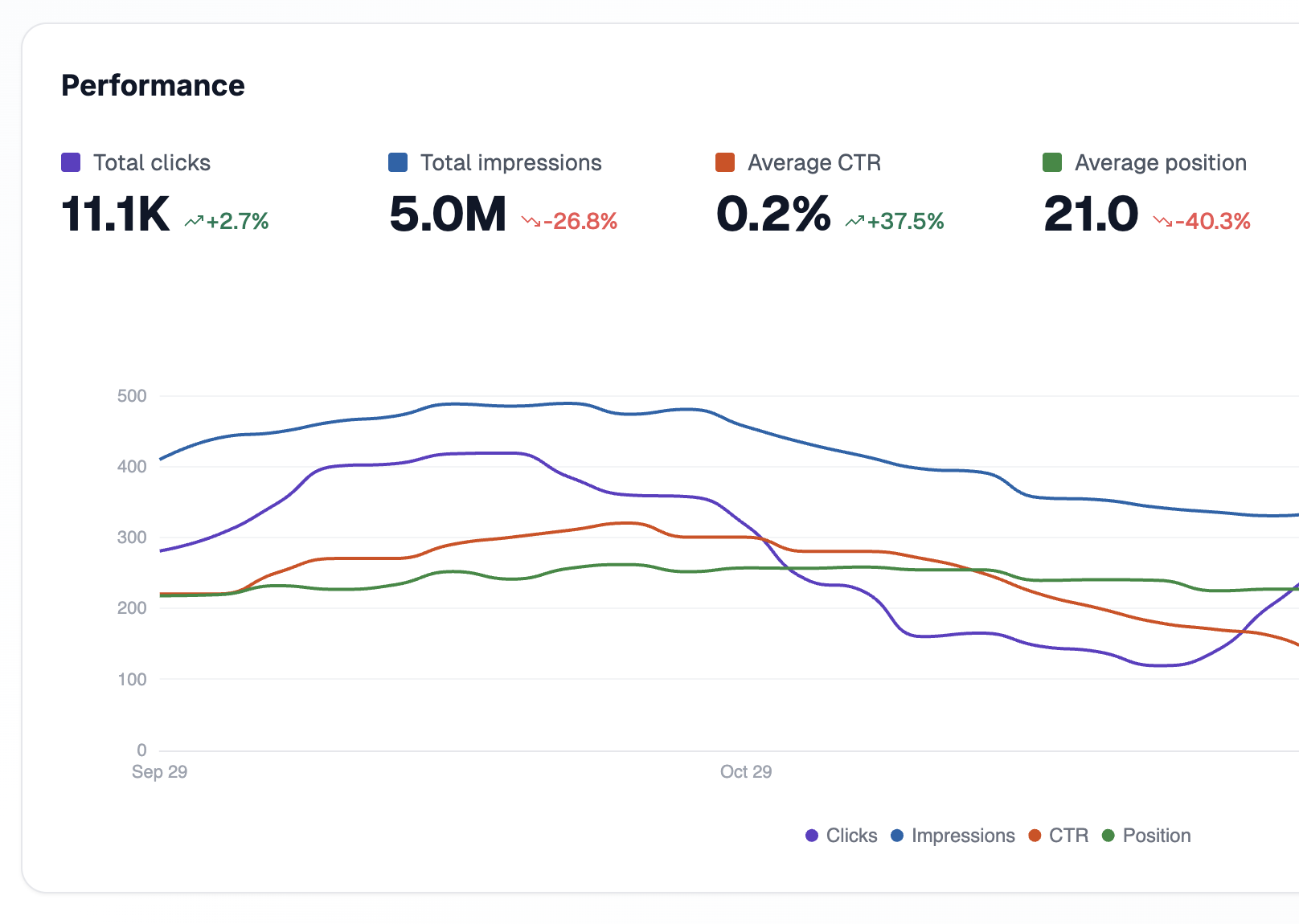
    • Broader signals – Primary language, likely geographic focus, freshness, mobile friendliness, and engagement patterns for similar pages. Over time, backlink information and user interactions also contribute to the stored profile for that URL.

    Common filler words, often called stop words, are sometimes ignored to save space and make indexing more efficient.

    Canonicalization and managing duplicate content

    The web overflows with near‑duplicate pages. The same content can appear at multiple URLs because of tracking parameters, print views, mobile versions, or simple copy‑paste behavior. Search engines need a way to sort through these clusters so that results are not filled with duplicate pages.

    Canonicalization is the process of selecting a single version from a set of duplicates. The engine tries to find the best representative page and treats that URL as the primary one for ranking purposes. Other versions are still noticed but are treated as alternates.

    Duplicates can arise for many reasons. For example:

    • An online store might show the same product under different categories with different URL paths.
    • A blog might have both www and non‑www versions, or show the same article with and without tracking codes.
    • Sometimes mobile and desktop versions live on separate subdomains.

    You can help the engine choose the correct page by using canonical tags

    A rel=”canonical” tag in the HTML head points to the preferred URL for that content. 

    When used well, this tag keeps link equity from splitting across many copies and makes ranking signals clearer.

    Common indexing problems and fixes

    Even when crawling looks healthy, pages can fail to make it into the index. Most of the time, this comes down to content quality, blocking rules, or site structure.

    • Thin content – If a page has only a few lines of text or feels spammy, search engines may mark it as crawled but not indexed.
    • Noindex directives – Meta robots directives such as noindex are useful on thank‑you pages or admin areas that should be excluded from search results. Problems arise when they end up on important pages by mistake during a template change or redesign.
    • Complex architecture and heavy JavaScript – If key content only appears after user actions, or if the HTML structure gives little hint about the topic, the engine may struggle to understand the page.

    Creating helpful content is usually the most reliable long‑term fix for businesses and platforms of all types. However, not all businesses can generate such content or create such user experiences.

    Which is why you need tools like Contentpen to help. It automatically generates high-quality, beautifully structured SEO and GEO-optimized content at scale while handling internal and external linking.

    The best part is that the tool also supports integrations to your favorite CMS platforms, such as WordPress, Ghost, Wix, and others. So, you don’t need to switch tabs when publishing content and always meet your deadlines.

    Step #3: Serving results — How search engines decide what you see?

    Searching training and development on Google

    Ranking and serving is the stage most people notice. It is what happens after someone types a query into the search box and presses enter. The search engine now has to choose which of its billions of indexed pages to show and how to order them.

    The process starts with query processing. The system parses the user’s input, infers intent, converts words into its internal numerical form, and compares it against the index. It looks for pages that match not only the literal keywords but also related concepts and common patterns for that type of search.

    The results appear on the Search Engine Results Page (SERP). This page can include standard blue links, local map results, image carousels, videos, product cards, and featured snippets that try to answer the question right away. The layout changes based on what the engine believes the searcher wants in that moment.

    Behind the scenes, hundreds of ranking factors influence which pages rise to the top. These factors fall into groups such as relevance, content quality, authority, user context, and technical health.

    Query processing from the search box to the results

    When a query comes in, the search engine first cleans and interprets it. It may correct spelling, expand abbreviations, or guess that certain words form a known phrase. Then it converts that processed query into the same kind of numerical tokens used in the index.

    Next, the engine uses math to compare the query tokens with the tokens stored for each page. It looks for close matches, related terms, and patterns that signal a strong answer. This matching step happens extremely quickly.

    Search operators give users more control when searching for specific information. Typically, this is how to use search engine for routine tasks in a daily workflow:

    Search operatorWhat it doesExample
    “”Search for the exact phrase that mentions this word or phraseNVIDIA
    OR / ISearch for results related to either one term or the otherNVIDIA OR AMD
    ANDSearch for results related to both terms mentionedNVIDIA AND AMD
    Search for results that don’t mention a specific wordNVIDIA -AMD
    Site:Search for results from a specific siteSite:NVIDIA.com
    inConvert one unit to another£84 in USD

    There are many more search operators you can use to narrow results and find the information you need quickly.

    These operators, mainly Site: and “”, are useful for competitive research, content audits, and technical checks. These also help you see how many of your pages are visible to the audience, and which require your attention for editing.

    The main ranking factors and what really matters

    While search algorithms use hundreds of inputs, many of them boil down to a few main themes. If you keep these in mind while planning content and technical work, you can cover most of what matters for search engine optimisation basics:

    • Relevance – Does the page match the searcher’s intent and query? Pages that repeat a phrase without real depth often lose out to pages that answer questions in a clear, thorough way.
    • Content quality – Search systems look for signs of expertise, author bylines that make sense for the topic, clear sourcing, and original thought. They pay attention to grammar, readability, and structure because those details affect how helpful a piece feels.
    • Authority – This flows mostly through links. A strong backlink profile includes links from relevant sites, a natural mix of anchor text, and steady growth over time.
    • User context and experience – Location, language, device type, and past behavior all influence which results someone sees. Technical factors such as page speed, mobile readiness, HTTPS, and clean site architecture also matter.

    You cannot buy higher organic rankings. 

    Paid ads can give a site visible placements marked as sponsored, but the main results depend on how well the algorithm scores your pages across all these areas.

    What you can do, instead, is focus on SEO basics rather than looking for shortcuts.

    How SERP features change based on search intent

    SERPs and AI Overview

    The SERP format shifts based on what the engine believes the user wants, often referred to as search intent.

    • For local intent searches, such as pizza near me, the SERP often shows a map with nearby businesses, star ratings, and quick buttons to call or get directions. For these searches, local SEO basics and a strong Google Business Profile matter a lot.
    • For informational intent searches, such as how to write a blog post, you may see a featured snippet at the top that pulls a short answer from one page. In this case, clear headings, direct answers, and well‑structured content can help you earn the top spot.
    • In commercial intent searches, such as best SEO competitive analysis tools, review snippets, and product grids often appear. Comparison content, rich product data, and honest reviews do well here.
    • For navigational intent searches, such as Contentpen login, results mostly show brand pages that help users quickly reach a specific site.

    Studying these types of search intents before picking target keywords is a smart move. It shows what kind of content Google expects for each phrase and gives a clearer sense of how to shape your own pages for better SERP and AI Overview visibility.

    Why search results vary across Google, Bing, and AI search engines?

    Search results can vary a lot from one engine to another, and even from one person to another on the same engine. The reasons lie in differences in indexes, algorithms, and personalization.

    Each major search engine runs its own crawler bot and keeps its own index. Googlebot, Bingbot, and others start from different seed URLs, follow different paths, and may apply different rules about what to store.

    On top of that, they use different ranking formulas. One engine might give more weight to backlinks, while another might pay closer attention to on‑page engagement signals or social cues. The exact formulas are treated as trade secrets and change over time.

    Personalization adds another layer. Location, language settings, search history, sign‑in status, device type, and even browser can influence which results rise to the top for a given person.

    From a practical standpoint, most US‑focused teams use Google as their primary source for SEO basics.

    Still, it can be useful to check other engines for competitive research and to avoid stressing over small ranking shifts that may simply reflect personalization.

    How to optimize for search engines with SEO fundamentals

    Good search engine optimization basics rest on three pillars:

    • Access – Crawlers need clear paths and fast responses.
    • Clarity – Algorithms need well‑organized, helpful content.
    • Authority – Users and other sites need reasons to trust and recommend your pages.

    Now, let’s see each of these aspects in more detail.

    Crawling optimization to ensure content discoverability

    Crawling optimization focuses on making your site easy and safe for bots to explore. Even small steps here can lead to better coverage.

    Site architecture and crawlability - Contentpen.ai
    • Create and submit XML sitemaps. Many content management systems automatically generate these files that list key URLs. By submitting them to GSC, you give crawlers a clear overview of your site.
    • Build a clear internal linking structure. Every important page should be reachable within a few clicks from the home page, ideally through logical category and subcategory paths.
    • Keep robots.txt files clean and focused. Regular audits after site changes can catch accidental blocking of key folders. Monitoring crawl errors and coverage reports in Search Console lets you spot repeated issues, such as broken redirects or error pages.

    On larger sites, considering crawl budget and trimming very low‑value pages or thin filters can keep crawlers focused on the URLs that matter most.

    Indexing optimization to make your content index-worthy

    Indexing optimization is about giving search engines content that is worth storing and easy to understand. It sits at the crossroads of content quality and technical setup.

    High‑quality, original content remains the foundation. That means writing pieces that cover a topic in real depth, speaking from experience where possible, and adding examples or data that readers cannot get from a quick skim elsewhere. 

    When you combine this with thoughtful keyword use, you support both users and algorithms.

    Our on-page SEO checklist helps convey that value:

    • Clear, descriptive title tags that include primary keywords
    • Honest meta descriptions that invite clicks
    • A clean hierarchy of H1, H2, and H3 headings
    • Descriptive alt text on images

    Technical signals matter here as well. A mobile‑friendly design, HTTPS security, and clean canonical tags reduce noise and help the index represent your site correctly. 

    Structured data with schema markup can highlight products, reviews, FAQs, and more in a format the engine understands at a glance.

    When you find thin pages with little value, either improve them or fold them into stronger related content so they do not weigh down the index profile.

    Ranking optimization to compete for top positions

    Ranking optimization pulls together keyword strategy, content quality, authority building, and user experience. This is where SEO marketing basics and more advanced tactics meet.

    • Keyword targeting – Good research helps you find phrases with real search volume and clear intent that fit your business. Long‑tail keywords often offer a balance of focused intent and realistic competition, especially for newer sites.
    • Better content than current winners – Better content does not always mean longer, but it does mean writing articles that are clearer, more helpful, and provide up‑to‑date information. You can add original data, expert commentary, step‑by‑step walkthroughs, or visuals that make hard ideas simple.
    • Authority building through backlinks – Earning links from strong, relevant sites through guest posts, partnerships, digital PR, and genuinely useful assets builds trust with algorithms. Avoid schemes that trade or buy links in unnatural ways.
    • User experience – Fast load times, smooth scrolling, stable layout, and readable typography all help visitors stay longer and engage more. Clear calls to action and helpful internal links keep people exploring instead of bouncing.

    For local businesses, claiming and optimizing a Google Business Profile, building consistent local citations, and gathering reviews play important roles in how well you show up in map packs.

    Scale your SEO with Contentpen

    Contentpen main interface - Contentpen.ai

    Optimizing content for search engines is a tough ask, especially if you have a lot of pages to manage. Researching topics, drafting or refreshing content, and even choosing and implementing the right keywords becomes a mess.

    This is where a platform like Contentpen comes in. Our AI blog writing tool is built to help teams ship SEO‑focused content faster without losing quality. It can draft well‑structured articles that already follow search engine basics, suggest on‑page improvements as you work, and keep formatting consistent across your site.

    Inside Contentpen, integrated SEO scoring highlights strengths and gaps in each draft. You can see whether titles use the right terms and whether headings fully cover the topic. Competitor insights show which topics and keywords others already win, so you can spot gaps and decide where a new article has a real chance to rank.
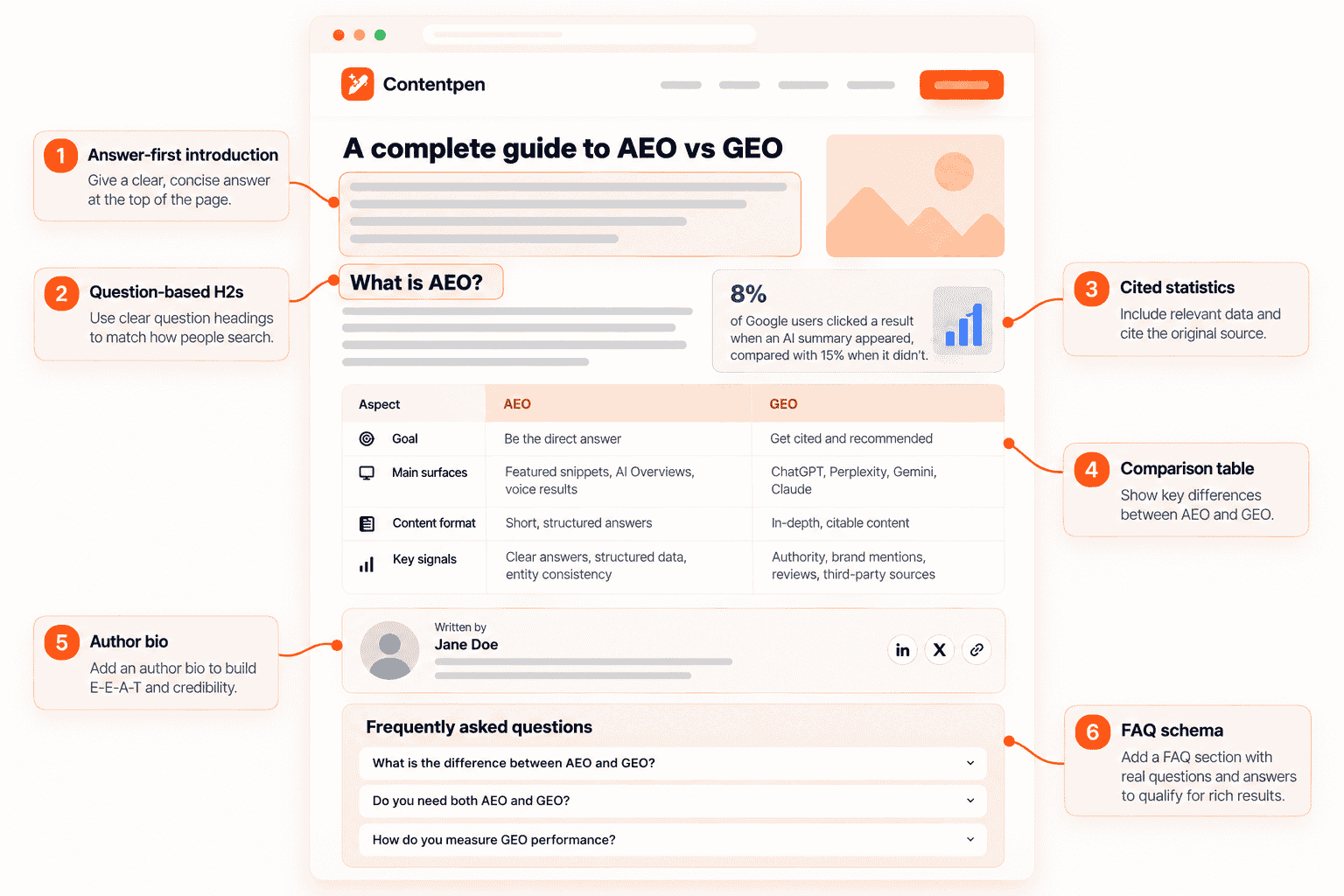
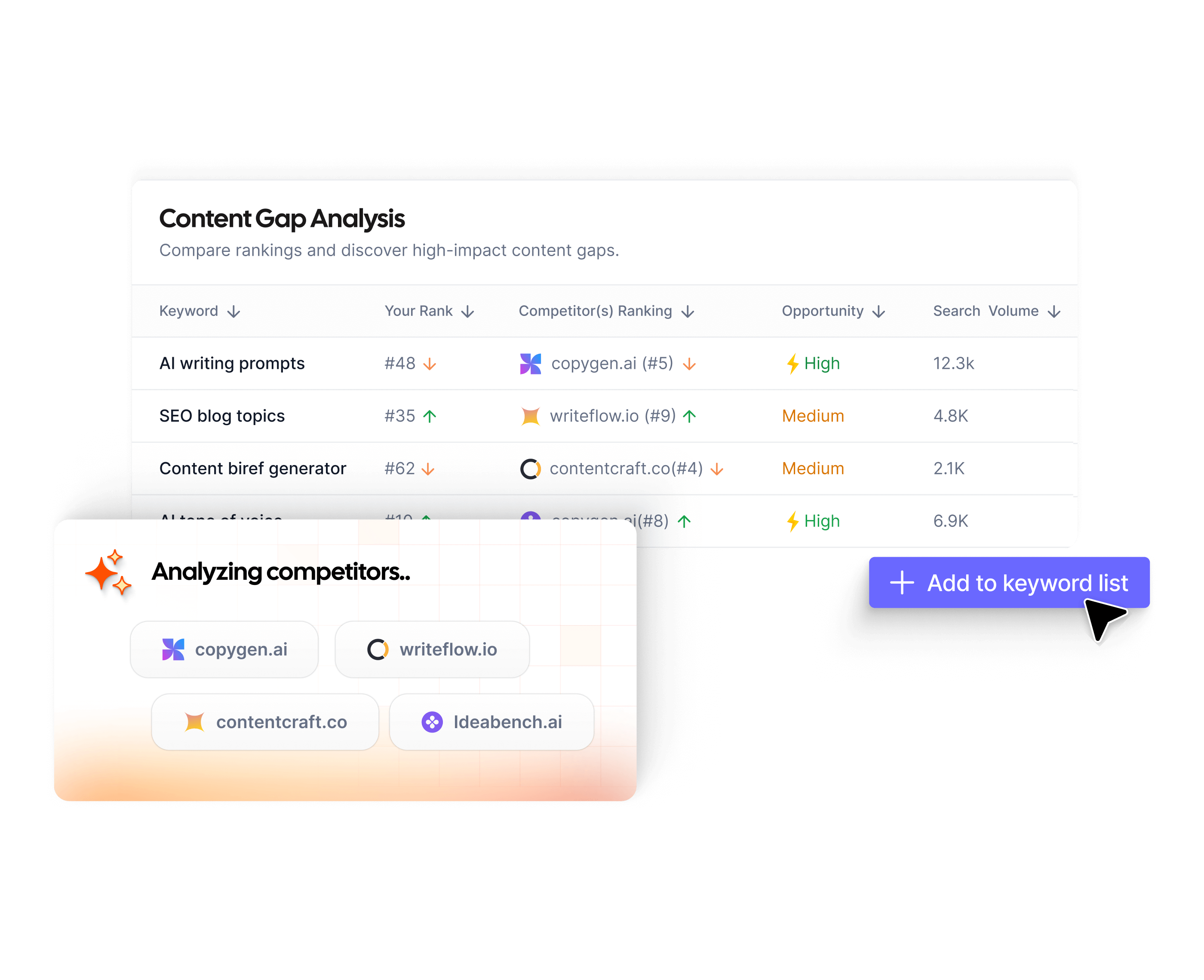
    Once a piece is ready, one‑click publishing shortens the time between idea and live page, which helps Google crawl and index your work sooner. 

    For teams handling many clients or brands, this mix of AI‑powered drafting, real‑time SEO guidance, and fast publishing makes it much easier to maintain content velocity while sticking to core SEO fundamentals.

    Final thoughts

    Search engines may run on vast data centers and complex math, but the path from your page to a search result follows a simple three‑step process. 

    First, crawlers need to find and fetch your content. Then, indexing systems need to understand it and store it. Finally, ranking algorithms check whether your answers help resolve common user queries to display them in the top results.

    When you understand search engine basics, SEO no longer feels like a mystery. It becomes a checklist you can apply to every new page and see organic traffic in no time.

    Modern tools such as Contentpen can help your SEO and GEO efforts by planning, writing, and publishing SEO‑ready content at scale. The strategic thinking still comes from you, but the heavy lifting gets lighter.

    Frequently asked questions

    How long does it take for a new page to appear in search results?

    New pages can start appearing in search results within a few days, but it can also take several weeks. The speed depends on factors such as how often your site is crawled, how strong your domain is, and whether you submit the page via tools like Google Search Console.

    Can I control how often search engines crawl my website?

    You cannot set an exact crawl schedule, but you can influence how often bots visit. Fast, stable servers and fresh content published on a steady schedule encourage more frequent crawls. Clean sitemaps and strong internal links also help crawlers move through your site efficiently.

    What is a quick way to check whether my pages are indexed?

    One quick method is to search Google using the site: operator, such as typing site:example.com plus a keyword related to your page. This shows pages from your domain that Google currently indexes.

    Why do my rankings fluctuate daily?

    Small ranking shifts from day to day are normal and happen to almost every site. Personalization can also change what you see compared to what others see. Competitor updates and new content entering the index can also add more movement.

    Do social media signals affect search rankings?

    Most evidence suggests that social metrics such as likes and shares are not direct ranking factors in Google’s core algorithm. However, social activity can still help SEO indirectly. When content spreads widely, more people discover it, and some of them may link to it on their own sites to give your platforms an organic boost.

    What is the single most important ranking factor?

    No algorithm relies on a single signal, and search engines have repeatedly said that rankings are based on a mix of different factors. For starters, write high‑quality content that closely matches search intent, followed by strong, relevant backlinks and a solid technical foundation.

  • 12 SEO competitor analysis tools to outsmart your competition

    12 SEO competitor analysis tools to outsmart your competition

    Competition gets to everyone, us included. The best way to deal with it is to keep tabs on your competitors to see what they’re doing better than you. This includes their ad placements, messaging, audience engagement, and much more.

    But surface-level tracking isn’t any good for you. You need specialized tools to benchmark performance, identify gaps in your content strategy, and provide actionable insights. This is why you need SEO competitor analysis tools to simplify the process and help you win the market.

    In this post, we tested and ranked the 12 best SEO competitor analysis tools in 2026 to help you outsmart your competition. In the end, we will also provide you with an easy framework to help you choose the right tool for your needs.

    So, let’s get started.

    What is an SEO competitor analysis tool?

    SEO competitor analysis tools help you see what others in your niche are doing to win reach, audience attention, and customer retention.

    More specifically, these tools analyze backlink profiles, keyword rankings, domain authority, and organic traffic of your competitors. 

    The insights the tools provide inform everything, from on-page SEO to content marketing strategy, enabling you to capture the market with ease.

    Why are SEO competitor analysis tools used? (Their purpose)

    SEO competitor analysis tools help you understand why competitors rank higher, which strategies drive their traffic, and where you can outperform them using data-backed decisions instead of guesswork.

    They eliminate the need to perform manual SEO site audits. Therefore, the tools save time and resources, allowing you to actually implement strategies rather than wasting time on spreadsheets and numbers.

    Also read: Best AI chatbots for professionals in 2026.

    How did we test these tools?

    We thoroughly researched all the tools with hands-on trials, user reviews, and featured analysis. Our criteria to select each tool depended upon:

    • Data accuracy: How accurate is the data provided?
    • User experience: Is the tool easy enough to use without training?
    • Key features: What does the tool offer beyond the basics?
    • Pricing: Does the tool justify its price tag?
    • Customer support: Will you be able to get some support when things go wrong?

    Let’s see our list of the best SEO competitor analysis tools while considering all these aspects.

    Comparison table: SEO competitor analysis tools at a glance

    ToolBest ForCore StrengthKey LimitationStarting Price
    ContentpenContent teams and agenciesAI-driven content gap analysis and bulk creationFree trial only lasts 7 days$27/month
    AhrefsSEO professionalsIndustry-leading backlink dataExpensive for small teams$129/month
    SemrushAll-in-one marketing teamsSEO, PPC, content, and social analysisBacklink data is weaker than Ahrefs$199/month
    TapClicksAgencies and enterprisesPPC competitor intelligence & reportingLimited organic SEO featuresNot disclosed
    SpyFuSMBs and consultantsAffordable keyword and PPC competitor researchLess accurate traffic data$39/month
    Moz ProSEO specialistsDomain Authority tracking and clean UISmaller link index$49/month
    SE RankingAgencies on a budgetWhite-label SEO competitor trackingLearning curve$65/month
    SimilarwebMarket analystsTraffic analytics and audience insightsHigh pricing$199/month
    BuzzSumoContent marketersViral content and influencer trackingLimited keyword SEO data$199/month
    SerpstatGrowing businessesKeyword clustering and topical dominanceHigher price for small teams$199/month
    VisualpingCompetitive monitoring teamsWebsite change alerts in real timeNo SEO metricsFrom $10/month
    WhitesparkLocal SEO agenciesCitation tracking and local rankingsNot useful for global SEO effortsFrom $1/location/month

    Now, we will discuss these tools in further detail.

    The 12 best SEO competitor analysis tools in 2026

    • Contentpen
    • Ahrefs
    • Semrush
    • TapClicks
    • SpyFu
    • Moz Pro
    • SE Ranking
    • Similarweb
    • BuzzSumo
    • Serpstat
    • Visualping
    • Whitespark

    1. Contentpen

    Competitor analysis - Contentpen.ai

    Best for: Agencies, small businesses, and creators that prioritize content creation and SEO optimization at scale with up-to-date competitor data.

    Contentpen is an all-in-one AI blogging platform that helps you identify content gaps and priority actions you can take right now to improve rankings and SERP visibility. It is like your personal writing assistant that allows you to outsmart your rivals with less manual work and hassle.

    Key features

    Pros

    • AI-powered insights provide quick wins and losses to save time while conducting competitor analysis.
    • Bulk content creation enables small businesses and agencies to stand toe-to-toe with big industry names.
    • A built-in media library helps users stand out from competitors with high-quality visuals.
    • Integrations with leading CMS platforms, such as WordPress, Ghost, Wix, and Webflow, enable faster publishing to beat competitors on trending topics.

    Cons

    • No backlink analysis.
    • Free trial only lasts 7 days.

    Pricing

    Paid plans start at $27/month.

    2. Ahrefs

    Ahrefs SEO competitor analysis

    Best for: SEO professionals who need comprehensive backlink analysis and competitor tracking for effective off-page strategies with one of the largest link databases available.

    Ahrefs has earned its reputation as the go-to tool for understanding why a competitor outranks you. Its Site Explorer feature is unmatched for reverse-engineering a rival’s link-building strategy, helping you rank for competitive keywords and in niche markets.

    Key features

    • Up-to-date crawler data
    • Content gap tool
    • Rank tracker with SERP feature monitoring
    • Site audit

    Pros

    • Keyword explorer provides accurate search volume and keyword difficulty scores.
    • Historical data lets you track competitor trends over months or years.
    • One of the most extensive and most frequently updated backlink indexes in the industry.

    Cons

    • Premium pricing puts it out of reach for solopreneurs and small teams.
    • Reporting features feel less intuitive compared to SEMrush.

    Pricing

    Paid plans start at $129/month.

    3. Semrush

    Semrush competitor analysis

    Best for: Marketing teams that need an all-in-one platform covering SEO, PPC, content, and social media competitor analysis.

    Semrush is known for its usefulness and adaptability when performing competitor analysis. It helps you uncover top SEO keywords and backlinks, and identify gaps in your content strategy. You can also use its AI-powered insights to secure and maintain top search positions.

    Key features

    • Competitor advertising research
    • Keyword gap analysis
    • Domain overview
    • Topic research for content

    Pros

    • Combines SEO, PPC, content, and social media competitor analysis in one dashboard.
    • Position tracking updates daily and can monitor local rankings across cities for comprehensive competitor analysis.
    • The content analyzer compares your articles directly with top-ranking competitor pages.

    Cons

    • Report export limits on lower-tier plans can be frustrating for agencies.
    • Backlink data isn’t as comprehensive as Ahrefs.

    Pricing

    Paid plans start at $199/month.

    4. TapClicks

    TapClicks landing page

    Best for: Marketing agencies and enterprise teams that need unified PPC competitor intelligence, reporting, and campaign management on a single platform.

    TapClicks, formerly known as iSpionage, provides competitive PPC research, along with campaign management, client reporting, and performance analytics. You can research competitor ads, launch your own campaigns, and report on results without switching tools.

    Key features

    • Landing page monitoring
    • Unified reporting dashboard
    • Campaign management tools
    • Keyword competition analysis

    Pros

    • Ad intelligence integrates directly with campaign execution and reporting.
    • Historical ad data reveals seasonal patterns and long-term strategy shifts.
    • Automated reporting saves hours every week for agency teams.

    Cons

    • The platform can feel complex with so many modules.
    • Organic SEO features are less robust than dedicated tools like Ahrefs.

    Pricing

    Not disclosed on the official site.

    5. SpyFu

    SpyFu competitor analysis interface

    Best for: Small businesses and consultants who need an affordable, straightforward competitor keyword and PPC research tool.

    Just like its name suggests, SpyFu looks through your competitors’ strategies and keeps you informed of all their moves. It doesn’t have the polished SEO competitor analysis capabilities of Semrush or the backlink depth of Ahrefs, but it’s surprisingly powerful for its price.

    Key features

    • Adwords advisor for PPC campaigns
    • Link-building opportunities
    • Kombat tool for competitor comparison
    • Keyword research with historical data

    Pros

    • Unlimited search queries and data exports, even on lower-tier plans.
    • Custom reporting templates save time for agencies managing multiple clients.
    • Affordable entry point for freelancers, startups, and small businesses.

    Cons

    • Traffic estimates can be less accurate for smaller websites.
    • Limited international data compared to Semrush.

    Pricing

    Paid plans start at $39/month.

    6. Moz Pro

    Moz Pro landing page

    Best for: SEO specialists who value clean, user-friendly interfaces and prioritize domain authority tracking.

    Moz Pro has been a staple in the SEO community for years, and for good reason. Its Domain Authority (DA) metric is still the industry standard for quickly assessing a competitor’s SEO strength, helping you inform your ranking strategies.

    Key features

    • Link explorer for backlink analysis
    • Rank tracker with local SEO monitoring
    • Page optimization recommendations
    • Site crawl metrics

    Pros

    • A clean, intuitive interface makes onboarding new team members quick and easy.
    • Custom reports can be white-labeled for agency use.
    • SEO professionals can quickly find weak spots in their platforms to outrank rivals.

    Cons

    • Smaller link index compared to Ahrefs.
    • The keyword database is smaller than Semrush.

    Pricing

    Paid plans start at $49/month.

    7. SE Ranking

    SE Ranking competitor analysis

    Best for: Teams that need a full SEO competitor analysis suite with white-label reporting at a mid-tier price point.

    SE Ranking is a solid all-rounder with strong competitor tracking, keyword research, and AI-powered insights that agencies love. The platform punches above its weight class, especially given how much it costs compared to the big names. 

    Key features

    • Visibility rating
    • Share of voice with competitors
    • SERP analysis
    • Comparing multiple rivals at once

    Pros

    • Page changes monitor alerts you when competitors update key pages.
    • Free to sign up without excessive screens or pop-ups.
    • On-page SEO checker compares your content directly to top-ranking pages.

    Cons

    • No social media competitor tracking on the free plan.
    • There is a slight learning curve compared to other tools, like SpyFu.

    Pricing

    Paid plans start at $65/month.

    8. Similarweb

    Similarweb competitor analysis

    Best for: Analysts who need detailed traffic analytics and audience insights beyond traditional SEO metrics.

    Similarweb is a handy SEO competitor intelligence tool that provides detailed traffic analytics to its users. You can see a rival’s top traffic sources, audience demographics, engagement metrics, and even which apps they’re investing in, allowing you to take the lead.

    Key features

    • Website analysis
    • SEO backlinks analytics
    • Extensive search tracking
    • Gen AI intelligence

    Pros

    • Audience Insights reveal competitor demographics and interests.
    • Market share reports help identify who’s winning in your niche and where.
    • Traffic journey shows how users move between competitor sites.

    Cons

    • The price can be too high for small businesses and teams.
    • Takes time to learn and implement.

    Pricing

    Paid plans start at $199/month.

    9. BuzzSumo

    BuzzSumo competitor analysis

    Best for: Content marketers and social media managers who need to track viral competitor content and influencer engagement.

    BuzzSumo is the tool we turn to when we need to see which competitor articles are being shared, linked to, and discussed across social media. Instead of tracking ranking, BuzzSumo shows you what’s resonating with real audiences, helping you quickly and effectively.

    Key features

    • Content analyzer
    • Influencer search
    • Competitor alerts
    • Question analyzer

    Pros

    • Social engagement metrics go beyond SEO to show real audience interest.
    • Backlink data, when integrated with social shares, provides a full picture of content performance.
    • Chrome extension lets you analyze any page on the go.

    Cons

    • Less focused on traditional SEO metrics like keyword rankings.
    • Pricing scales quickly if you need more searches and alerts.

    Pricing

    Paid plans start at $199/month.

    10. Serpstat

    Serpstat landing page

    Best for: Growing businesses that need an affordable all-in-one SEO platform with strong keyword clustering features.

    Serpstat is particularly useful for grouping related keywords into clusters, which makes content planning much more strategic. Serpstat helps you identify the broader topic areas where competitors dominate and provides the data to take them down, improving reach and visibility.

    Key features

    • Missing keywords to find gaps
    • Batch analysis to compare up to 200 domains
    • Text analytics to reverse-engineer top-ranking content
    • Smart keyword profiles

    Pros

    • API access allows for custom integrations and automated reporting.
    • Supports multiple countries and languages.
    • Keyword clustering reduces content overlap and improves topical authority.

    Cons

    • Backlink data can be less current for smaller websites.
    • The user interface feels less polished than that of premium competitors.

    Pricing

    Paid plans start at $199/month.

    11. Visualping

    Visualping interface

    Best for: Marketers and competitive intelligence teams who need real-time alerts when competitors change their websites.

    Visualping watches competitor websites like a hawk and alerts you the second something changes. We use it to monitor competitor pricing pages, product launches, and blog post updates to see how others in our space are modifying their web pages and strategies.

    Key features

    • Visual change detection
    • Selective monitoring 
    • Scheduled checks 
    • Team collaboration 

    Pros

    • Simple, focused tool that’s easy to set up and use immediately.
    • Alerts can be customized by changing the threshold to reduce noise.
    • API access for integrating alerts into your existing workflow.
    • Works on any website, including password-protected and JavaScript-heavy pages.

    Cons

    • No SEO metrics or keyword tracking.
    • Limited analysis features compared to full-suite platforms.

    Pricing

    Customizable payment plans, starting at $10/month and changing depending on the number of pages you scan.

    12. Whitespark

    Whitespark landing page

    Best for: Local SEO specialists and agencies focused on citation building and local search competitor tracking.

    Whitespark is purpose-built for local SEO. If your business depends on local visibility, this tool is essential. It helps you see exactly where your competitors are listed online, which citations they’ve built, and how their local rankings stack up against yours.

    Key features

    • Local citation finder
    • Google Business Profile rank tracker
    • Reputation builder for reviews
    • Local search audit

    Pros

    • Review monitoring shows how competitors manage their online reputation, enabling you to handle reviews as well.
    • Built-in outreach tools streamline the citation-building process for your business.
    • Edit locations in bulk to save time and effort while performing local SEO optimization.

    Cons

    • Narrowly focused on local SEO, so it won’t help with broader organic strategies.
    • Pricing can add up quickly for agencies managing multiple locations.

    Pricing

    Customizable payment plans, starting at $1/location/month, and change depending on the number of locations you set up or optimize.

    Best free SEO competitor analysis tools (what Google offers)

    Not every team has the budget for premium platforms. The good news is that you can start competitor website analysis without spending a cent, especially if you know where to look within Google’s own ecosystem.

    Google offers a surprising number of free competitor analysis tools that give you genuine insights, even if they lack the polish and depth of paid platforms. 

    Here’s what actually works:

    Google Search

    Don’t overlook the simplest Google competitor analysis tool of all: the search bar itself.

    Run manual searches for your target keywords and study what ranks on page one. 

    Look at:

    • Title tags and meta descriptions of SERP pages
    • Content length and structure
    • Multimedia elements (images, videos, infographics)
    • Internal and external links

    This hands-on approach to competitor analysis isn’t scalable, but it’s free and fast, and it gives you a gut-level sense of what Google rewards in your niche.

    Google Search Console

    If you have access to a competitor’s domain (or you’re analyzing your own site against rivals), Google Search Console shows which queries drive impressions and clicks. 

    You can see:

    • Which pages rank for specific keywords
    • Average position in search results
    • Click-through rates by query

    While you won’t get direct competitor data, you can reverse-engineer their strategy by analyzing your own Search Console reports and comparing them to what you see ranking in the SERPs.

    Also read: Google Gemini vs ChatGPT comparison.

    Google Trends

    Google Trends is one of the most underrated free competitor analysis tools. It shows:

    • Which topics and queries are trending in your industry
    • Seasonal patterns that affect search volume
    • Regional interest in specific keywords

    Use it to see what competitors are likely targeting based on rising trends, then validate those hunches with your own keyword research.

    Google Analytics

    If you’re running Google Ads, the Auction Insights report inside Google Analytics and Google Ads reveals how your ad performance stacks up against competitors bidding on the same keywords. You can see:

    This is especially useful for PPC competitor analysis when you’re trying to figure out who’s outbidding you and by how much.

    Google Merchant Center

    For e-commerce brands, Google Merchant Center offers two helpful reports:

    • Price competitiveness report: Shows how your product pricing compares to competitors in Google Shopping.
    • Best sellers list: Reveals which products in your category are performing best.

    These reports help you adjust pricing and product positioning without needing a separate competitor website analysis tool.

    Google News and Alerts

    Set up Google Alerts to track when competitors publish new content, get mentioned in the press, or rank for priority keywords. 

    Alerts won’t give you traffic data or backlink profiles, but they keep you informed about competitor activity in real time. This is especially useful if you’re tracking content marketing moves from your rivals, trying to outsmart them quickly and for free.

    How to choose the right SEO competitor analysis tool for your needs

    Choosing a competitor analysis tool online isn’t about finding the “best” on the market. It is about finding the one that fits your team, your budget, and the type of competitor research you actually need to do.

    Some tools are built for agencies running dozens of client campaigns. Others are designed for solo marketers who need quick wins without too much complexity. 

    Here is a simple framework to help you narrow down your options and pick the right tool for your needs:

    Define what you need to track

    Start by listing the competitor metrics that matter most to your SEO strategy:

    • Organic keywords and rankings: Tools like Ahrefs, Semrush, and Contentpen excel in this area.
    • Backlink profiles: You can use tools such as Ahrefs and Moz Pro to get up-to-date backlink data on your competitors and plan your next move accordingly.
    • PPC and ad campaigns: For this purpose, you can utilize SEO competitor tools, such as TapClicks and SpyFu, which specialize in paid search intelligence.
    • Content performance and social shares: BuzzSumo can be your go-to for monitoring competitor social shares and performance.
    • Local SEO and citations: Tools, like Whitespark, can be used for local SEO and citation monitoring.
    • Website changes and updates: Visualping is a solid choice for checking competitor site updates in real time, helping you develop new strategies to outsmart your rivals.

    Narrowing down which competitive intelligence metrics you want greatly simplifies choosing the right tool.

    Also read: How to do SEO?

    Consider your team size and skill level

    Not every tool is built for every user. Some platforms assume you already know SEO inside and out. Others are designed to onboard beginners quickly. Therefore, it is crucial to keep your workforce in mind while choosing an SEO competitor analysis tool.

    • Solo marketers and small teams: Look for simple, affordable tools like Visualping, SpyFu, or Contentpen that do not require much training and are highly affordable.
    • Agencies managing multiple clients: At this level, you will want white-label reporting, API access, and bulk analysis features found in tools like SE Ranking, Semrush, or TapClicks.
    • Enterprise teams: Platforms like Similarweb offer advanced data integrations and custom dashboards for larger teams. If your purpose is to create and optimize content, our AI blog writer also offers collaborative and integration capabilities.

    As a general rule of thumb, if your team is small, choose a tool with a clean interface and strong support. Do not create extra hurdles in your workflow, as this will defeat the whole purpose of selecting a tool.

    Also read: Best AI tool for writing SEO-rich blog content.

    Set a realistic budget

    As you’ve seen earlier with our list, SEO competitor analysis tools range from $10/month to well over $500/month. However, price does not always equal value, not for all teams, anyway.

    Do not overpay for features you will not use. If you only need keyword research and rank tracking, a mid-tier plan from Contentpen or SE Ranking will serve you better than an expensive all-in-one SEO suite, such as Semrush or Ahrefs.

    Test before you commit

    Most competitor analysis tools online, like Contentpen, offer free trials. Use them.

    Spend a week running real competitor website analysis on your actual rivals. Check how accurate the data feels, how easy the interface is to navigate, and whether the insights actually help you make the right decisions or not.

    Pay attention to:

    • Data freshness: Are keyword rankings and backlink profiles updated regularly?
    • Export and reporting: Can you pull clean reports without hitting frustrating limits?
    • Customer support: Will you get help when you can’t figure something out?

    The best tool is the one you will actually use consistently, not the one with the longest feature list.

    Think about workflow integration

    If you already use tools for content creation, publishing, or project management, check whether your SEO competitor analysis tool integrates with them.

    Contentpen, for example, connects directly to WordPress, Ghost, Wix, Shopify, and Webflow, so you can research, write, and publish without switching platforms. It also offers Webhook integrations so that you can make your own workflows without any hurdles.

    Other tools, such as Semrush, integrate with Google Analytics, Google Search Console, and dozens of marketing apps. These integrations save time and reduce the risk of data falling through the cracks.

    Prioritize actionable insights

    Some tools give you mountains of data but no clear next steps. Others highlight exactly what to do next.

    Look for platforms that surface quick wins and content gaps, rather than just showing you charts. Tools like Contentpen excel at this by turning competitor research into actionable items, such as writing an article on a particular keyword or optimizing a specific heading on a blog.

    Also read: The ultimate guide to optimized content marketing for SEO success.

    TL;DR: If a tool makes you feel smarter and more focused after using it, that is a good sign. If it leaves you overwhelmed and confused, keep looking.

    Summing it up

    SEO competitor analysis tools help you surface what your rivals are doing, how they’re doing it, and where you can take the lead. These tools power strategies and decision-making, defining the modern SEO framework.

    Choosing a suitable tool for competitor analysis in 2026 can be tricky, especially with so many options on the market. We hope our guide helped you pick the right tool for your needs so you can excel without limits.

    If you want to see real ranking keyword opportunities and detailed competitor insights for your content, sign up now at Contentpen.

    Frequently asked questions

    How often should I run competitor analysis?

    Most teams should review competitors monthly, with deeper audits quarterly. Highly competitive niches may require weekly monitoring to stay ahead of ranking shifts and content changes.

    Can I use multiple SEO competitor analysis tools at the same time?

    Yes, and many teams do. Most businesses layer a backlink-focused tool with a content or keyword tool like Contentpen or Semrush. The key is avoiding overlap that wastes budget. Pick tools that complement each other rather than duplicate the same data.

    Do SEO competitor analysis tools show real traffic numbers?

    Most tools provide traffic estimates based on models, rather than exact data. While not perfect, these estimates are accurate enough for competitive benchmarking and trend analysis.

    Can SEO competitor analysis tools help with content planning?

    Yes. Tools, such as Contentpen, reveal content gaps, top-performing competitor pages, keyword clusters, and search intent patterns that directly inform content strategy and topic prioritization.

    Do I need coding or technical skills to use SEO competitor analysis tools?

    No. Most modern tools are designed for marketers and content teams without requiring coding knowledge. However, some advanced features, such as API integrations or custom reporting, may need technical support.

    How long does it take to see results after using competitor analysis insights?

    It depends on what changes you make. Quick wins, such as optimizing title tags or targeting low-competition keywords, can show ranking improvements within weeks. Greater efforts, such as publishing content, typically take two to six months to noticeably affect rankings.

  • What is anchor text, and why does it matter for your SEO strategy?

    What is anchor text, and why does it matter for your SEO strategy?

    Anchor text is the clickable text in a hyperlink that you see and interact with on web pages. It looks simple, yet it plays a huge role in how pages appear in search results.

    With so many types of anchor text, rules, and warnings about penalties, it is easy to feel unsure about what to do next.

    This is why we created this guide to cover all about anchor texts. We will see how anchor text works in SEO, with examples and practical best practices you can apply right away to see ranking gains and traffic improvements.

    You will also see how an AI-powered platform like Contentpen can guide anchor choices as you write, so you get consistent internal links without manual work.

    So, let’s begin, shall we?

    Anchor text basics explained

    Anchor text is a relevance signal that helps search engines connect pages to topics. They serve as a roadmap for people to learn more about your services and offerings, and they tell readers what to expect on the destination page.

    But when anchor text is random, generic, or stuffed with keywords, it does more harm than good.

    In HTML, the anchor text sits between the opening and closing <a> tags. 

    Here’s how it looks:

    Anchor text in HTML - Contentpen.ai

    This is anchor text in HTML form, and it is what Google crawlers read during link analysis.

    Anchor text has a dual role:

    • It helps users decide whether to click.
    • It helps search engines interpret the topic and relevance of the linked page.

    The same principle applies when an image functions as a link. In this case, search engines rely on the image’s alt attribute to understand the link’s context. Because images contain no visible anchor text, the alt value becomes the primary descriptive signal.

    For example:

    <a href="/seo-audit-guide"><img src="audit-checklist.png" alt="SEO audit checklist"></a>

    Here, Google treats “SEO audit checklist” as the anchor text, helping associate the destination page even without visible link text.

    Why anchor text matters for SEO

    Anchor text matters because it provides context to Google. When many pages link to the same URL with relevant link text, the search engine can guess the topic of that page with more confidence. 

    If several trusted sites link with text like “what is off-page SEO,” that page is more likely to rank for searches related to off-page SEO guides.

    John Mueller from Google has explained that anchor text helps Google understand what a page is about, but it is “just one of many factors” the system uses.

    Anchor text also affects how link equity flows. When an authoritative site links with descriptive backlink anchor text, it passes both authority and topical relevance. 

    That is why a strong link anchor can move rankings, while a weakly descriptive anchor text often does far less, even if it comes from an authoritative source.

    To put it simply, relevant anchor text helps with:

    • Keyword and topic relevance
    • Stronger signals from high-quality backlinks
    • Better user expectations and click-through rates
    • Clearer internal navigation for readers and crawlers

    Now, let’s see the types of anchor texts and different scenarios where you can utilize them for better search engine optimization.

    Types of anchor text and when to use them

    Types of anchor text - Contentpen.ai

    Not all anchor text looks the same. A healthy anchor text strategy uses a mix of styles, so your profile seems natural and helpful rather than forced. Each type comes with strengths and risks, which you can balance with a simple mental anchor text formula (we’ll get to it later).

    Exact-match

    Exact-match anchors use the exact keyword that the target page wants to rank for. 

    Example: A link with the text “what is on-page SEO” pointing to a guide with the same focus. 

    Exact-match anchors send very clear relevance signals, so you should use them sparingly for important internal links.

    Partial-match

    Partial-match anchors include the main keyword plus other words. 

    Example: A phrase like “18 best blog examples you can learn from in 2026” can be a partial match for the focus keyword of ‘best blog examples’.

    This style fits better inside real sentences and feels more natural to readers. These types of anchors also work well for most internal links and many outreach efforts.

    Branded

    Branded anchors use only your brand name.

    Example: Contentpen

    These anchors help build brand strength and trust. They tend to look normal to Google because many people use brand names when linking to sites they know.

    Compound

    These combine your brand name and a relevant phrase. 

    Example: Text such as “Contentpen SEO tools” falls in this group. 

    These anchors link brand and topic in a way that supports both awareness and rankings.

    Naked

    Naked anchors show the raw URL as the anchor text.

    Example: A naked URL can be like “https://contentpen.com.” 

    People often use this style in forums, comments, and quick mentions. These links are less descriptive, yet they still count as part of a natural mix of hyperlink anchor text on the web.

    Generic

    These types of anchor texts are very general and less descriptive about the target page.

    Example: “click here,” “read more,” or “this article.” 

    Such anchors rarely help users or search engines determine the page’s topic. In most cases, it is better to avoid generic anchors and replace them with more descriptive ones.

    Image

    Image link anchors rely on the image alt text. 

    Example: 

    On-page SEO checklist

    (alt text: on-page SEO checklist)

    When image alt text is descriptive, it acts as the anchor text meaning for search engines. If the alt field is empty, the image link provides almost no context.

    Related

    Related keyword anchors use terms that are close to your main topic but not exact matches. 

    Example: For a page about “best AI chatbot for professionals,” a phrase like “AI automation tools” can serve as a related anchor. 

    This style helps you show Google the broader topic cluster around a page.

    Page title

    Page title anchors match the exact title of the target page. 

    Example: A link that uses “What is technical SEO? Your complete guide to getting started” as the anchor text. Writers often use this style when they cite articles, so it feels natural in many contexts.

    Here’s a breakdown of each anchor text type at a glance and its use cases at a glance:

    Anchor typeExampleMain use case
    Exact matchanchor text strategyStrong relevance, use in moderation
    Partial matchguide to anchor text strategyNatural linking is the most common
    BrandedContentpenBrand building and trust
    Brand + keywordContentpen SEO toolsBrand + topical relevance
    Naked URLhttps://contentpen.comMentions, profiles, citations
    Genericclick hereAvoid when you can. Not recommended
    Image (via alt text)alt=”on-page SEO checklist”Visual links with context
    Related keywordinternal linking tipsTopic clustering and synonyms
    Page titleFull article titleCitations and references

    You may also use this anchor text formula to help you get started:

    Anchor Text = Relevant Keyword + Natural Flow of Text

    Anchor text formula example - Contentpen.ai

    However, this formula is a general best practice and may vary based on your brand guidelines and SEO strategy.

    How do I create an anchor text?

    Creating anchor text starts with understanding the page you are linking to and choosing words that clearly describe it inside a natural sentence. Instead of thinking in terms of keywords first, think in terms of meaning and usefulness.

    Here’s a simple process you can follow every time.

    Identify the core topic of the destination page

    Ask yourself one question:

    What would I tell someone about this page in one short phrase?

    That phrase becomes the foundation of your anchor text. For example, if the page explains how to audit a website for SEO, your anchor should reflect that purpose rather than a vague action.

    Place the link inside a relevant sentence

    Anchor text should live inside a sentence that already supports the topic of the linked page. Instead of adding a link at the end of a paragraph, embed it where the topic naturally appears. This improves readability and strengthens topical relevance for search engines.

    Write the anchor as part of the sentence

    Good anchor text feels like normal language, not a tag or label.

    For example, instead of writing:

    Click here to read our SEO audit guide.

    Write:

    Our SEO audit guide explains how to evaluate your site’s performance step by step. 

    This keeps the content smooth and user-focused.

    Keep the anchor centered on one idea

    Each anchor should represent a single concept. Avoid stacking multiple ideas into one link or using overly long phrases.

    If a sentence introduces two different topics, it is better to use two separate links rather than forcing one long anchor.

    Adjust the wording based on context

    The same page can be linked with different anchor texts depending on the context. A guide about internal linking might be referenced as:

    • “Internal linking strategy” in one article
    • “How to structure internal links” in another

    This variation helps search engines better understand the page without repeating the same phrase over and over again.

    Anchor text best practices

    Anchor text best practices - Contentpen.ai

    Good anchor text feels natural to readers and helpful to search engines. When you plan an anchor text strategy, it helps to think about the user first and the algorithm second.

    The words you choose for an anchor must match the content of the target page. If a link says “keyword research guide” yet points to a pricing page, visitors will feel tricked. Over time, that kind of behavior can lead to lower engagement and weaker trust signals in search.

    Natural flow also matters. If the phrase feels bolted on just to add a keyword, rewrite the line. Remember that internal links are not only about the clickable words. They also rely on the surrounding copy.

    To keep things practical, you can follow a few simple rules:

    Be watchful of keyword stuffing

    Watch for keyword stuffing in anchors and nearby text. If a sentence repeats the same keyword several times just to squeeze it in, it weakens the copy. 

    Before Google’s Penguin update in 2012, many sites used exact keyword anchor text again and again to gain rankings. However, that tactic created unnatural link profiles, and Penguin went after those patterns.

    Here’s one example from Google that can help you understand what to avoid while using your anchor texts:

    Google example of keyword stuffing

    Modern Google is much smarter. It looks at anchor text, the sending page, the receiving page, domain quality, and the overall mix of anchors. 

    Exact and partial-match keyword anchor text still helps when it looks natural. Yet heavy repetition, spammy phrases, and off-topic anchors can trigger spam filters.

    A single, well-placed keyword anchor text within a single logical phrase usually sends a stronger, safer signal.

    Make the links visible

    Make sure links stand out visually on your pages. Use contrast and underlines carefully so people can see which words they can click.

    When you make links visible, you also improve your platform’s dwell time. Users notice more of your pages and check them out, giving a highly positive signal to Google, Bing, and other search engines and AI discovery tools.

    Monitor anchor texts

    Review your anchor mix regularly with SEO tools. Online tools such as Ahrefs, Semrush, and Moz can show your internal and external anchor text types and ratios. Use the tool suggestions to gain rankings and retain users on your platforms.

    Consider the accessibility of links

    Screen readers often read link text aloud, so phrases like “this article” or “click here” can be confusing. Clear anchors, such as “anchor text best practices,” are much easier to understand.

    Also, make sure to keep the anchors short and sweet. We recommend keeping it to 5 words or less.

    How Contentpen streamlines anchor text optimization

    Manually checking every link on a site and thinking through anchor text for each one takes time. It is even harder when a team manages hundreds of articles and has several writers, each with a different style. 

    In that setup, maintaining a healthy, consistent anchor text profile across the entire site can feel almost impossible.

    Contentpen tackles this problem inside the writing workflow. As an end-to-end AI blog creation platform, it guides content teams from draft to SEO review in one place. 

    Contentpen anchor text and link edit options - Contentpen.ai

    Its integrated SEO scoring highlights on-page gaps, including missed opportunities for helpful internal links. Writers see those insights as they work, so they adjust anchors before content goes live.

    Contentpen helps you automate internal and external linking. The tool selects the most suitable anchor text based on context and topic as it generates your blog. This removes the need for manual link placement entirely.

    You can think of it as an AI blog writing tool equipped with an anchor text generator that follows all the SEO best practices.

    The platform also supports smarter planning. With built-in SERP and competitor analysis, you can study how top sites in your niche use links and anchor types. That insight makes it easier to design an SEO anchor text strategy that lines up with what already works in your niche.

    Contentpen keeps teams in a single workspace for all tasks, eliminating the need to jump between tools to manage anchor optimization. 

    Over time, that leads to a site where keyword anchor text, related terms, and branded anchors follow a clear pattern without heavy manual review.

    Concluding thoughts

    Anchor text may look like a small detail, yet it carries a lot of weight. Those clickable words guide users through your content and tell search engines what each linked page is about. When that link text matches the topic, both people and algorithms get better signals.

    The goal is balance. An innovative approach mixes branded, partial-match, related, exact-match, and other anchor text types in a way that feels human. You want anchors that are relevant, clear, and easy to read, without sliding into keyword stuffing or spammy patterns.

    A good first step is to perform a simple audit of your internal links. Look for generic anchors and repeated phrases, then replace them with clear, keyword-rich anchor text that accurately reflects the target page.

    If you want help placing anchors throughout the platform, use Contentpen. Integrate anchor text optimization into your normal content process so your links deliver more today.

    Frequently asked questions

    What is the ideal anchor text ratio for SEO?

    There is no universal ratio. The best approach is a natural distribution of branded, partial-match, related, and occasional exact-match anchors that reflects real editorial linking behavior.

    Can I use the same anchor text for multiple internal links?

    You can, but using varied, relevant anchor phrases helps search engines better understand the page’s topic and improves the quality of internal links.

    How do I check my current anchor text profile?

    Use SEO tools like Ahrefs, Semrush, or Moz to analyze backlink anchors, and site crawlers or CMS exports to review internal anchors across your pages.

    What is anchor text in SEO with example?

    For example, a link text that says “how to do SEO” and points to a relevant checklist article or guide is an example of an anchor text in SEO. Now, search engines will associate that page with broader SEO topics.

    What is an anchor text in reading?

    In reading, anchor text is the visible part of a link that guides readers to related information. It acts as a navigation cue that connects one piece of content to another.

    Does anchor text matter for no-follow links?

    Yes. Clear anchor text improves user understanding, click behavior, and overall content clarity for no-follow links.

  • External linking guide for higher rankings in 2026

    External linking guide for higher rankings in 2026

    An external link is a hyperlink that points from your website to another domain, or from another domain to yours. It serves as a vote of confidence, endorsing the offerings of the linked platform and signaling to search engines and users that the linked page is worth a visit.

    While many users know the basic definition of the term, their external linking strategies are weak and inefficient. The result? They leave a lot of ranking potential on the table.

    This guide walks through the basics of what an external hyperlink really is, how search engines judge link quality, and how to build a powerful inbound link profile. It also covers tools to ease this process and how Contentpen helps you publish content that naturally attracts links.

    So, let’s get started.

    Why external links matter for SEO

    An external link connects one domain to another. When another site links to yours, that’s a backlink (or inbound link). When you link from your content to another site, that’s an outbound link in SEO.

    On a technical level, an external hyperlink looks like this in HTML:

    <a href="https://www.example.com/">Helpful SEO guide</a>

    The href attribute holds the URL of the page on another domain. The visible part between the tags is the anchor text. To a user, it is just a clickable phrase. To a search engine, it is a clue about what the linked page covers.

    Links became important when Google introduced PageRank. The idea was simple: a link from one page to another counted like a vote. The more quality votes a page earned, the more important it seemed. 

    Over time, the model grew more advanced, but the core concept stayed. A strong external link from an authoritative source passes link equity and signals that a page has value.

    Today, search engines use each external link to judge several things: popularity, trust, and topical relevance. They look at:

    • How many high‑quality sites point to a page
    • Who is doing the linking
    • How closely the topics match
    • Which words appear in the anchor text

    Together, these factors help search engines decide how a page should rank.

    External links vs internal links: Understanding the difference

    Internal links connect pages within your own website and help organize content, guide users, and distribute link equity. External links, on the other hand, point from your site to other domains and help provide context, cite sources, and connect your content to the wider web.

    As we’ve already highlighted earlier in our internal linking guide, both types of links are essential for SEO. Internal links strengthen your site’s structure, and external links improve your site’s credibility.

    How search engines evaluate external link quality

    External links visualized - Contentpen.ai

    Search engines evaluate external links based on six core signals:

    • Trust level of the linking domain. A link from a long‑standing news site, a respected .edu, or a known industry blog carries more weight than one from a site with thin, duplicated, or spam content.
    • Popularity of the source page. A mention from a page that has many strong backlinks passes more link equity than a link buried on an orphan page with no visitors.
    • Topical relevance. If a page about technical SEO links to your article on external links for SEO, the match in subject tells search engines that your content belongs in that topic. If a link comes from an unrelated niche, it may carry little value.
    • Anchor text. The words used in the anchor text give search engines a hint about what the target page covers. Descriptive phrases like “guide to external backlinks” send a much clearer message than “check this” or “click here.” At the same time, don’t repeat the exact same keyword phrase in every anchor and avoid building a linking footprint.
    • Link diversity. Earning links from many domains shows broader support than getting lots of links from a single site.
    • Ownership patterns. If several domains are owned by the same company and link heavily to one another, those links often count less than true third‑party mentions. Search engines have become good at spotting clear self‑promotion techniques.

    Collectively, these signals tell search engines about the quality of an inbound link earned by a website.

    Building a powerful inbound link profile

    Modern link building should not feel like tricks or shortcuts. The best approach is simple: write a blog post that solves real problems or answers real questions that users might have for your products. Then help the right people discover those pages so they can decide to link.

    Building a strong inbound link profile starts with:

    • Creating linkable assets
    • Utilizing broken link building
    • Investing in ethical outreach

    Let’s discuss these one by one to help you get started.

    Creating linkable content assets

    Linkable assets are pieces of content created with one main goal: earning mentions and backlinks from other websites. They give people a clear reason to reference and link to your pages.

    One of the most effective formats is the ultimate guide. These are long, structured articles that cover a topic from every angle. For example, a guide to external and internal linking might include:

    • Clear definitions
    • Visual diagrams
    • Real-world examples
    • Actionable best practices

    When a guide becomes the go-to resource, it can attract backlinks for years.

    Another powerful asset is original research. By surveying your audience, analyzing industry data, or running experiments, you can publish insights no one else has. Writers and industry leaders often link to fresh data to strengthen their own content.

    To find ideas for linkable assets:

    • Look for gaps in existing content.
    • Search your main keywords and note where the content feels thin.
    • Identify common questions in forums and channels that lack strong answers.

    For faster content creation, use our AI blog writer. It enables users like you to quickly create, edit, and publish SEO and GEO-ready content at scale without hassle. The tool also intelligently conducts the SERP analysis for you, reducing your manual workload.

    Solving content overload - Contentpen.ai

    Using broken link-building to your advantage

    Broken link building involves finding dead outbound links on relevant sites and offering your content as a replacement that covers the same topic. Since you are helping the site owner fix a problem, they are more likely to consider your suggestion.

    That said, try to send a personalized message to the site owner. Do not use generic email templates as they won’t help you get noticed.

    Invest in ethical outreach

    Ethical outreach is about bringing your linkable assets to the right people without sliding into spam.

    The mindset should be relationship first. Editors and creators hear from many people who only want a backlink. Stand out by caring about their work. 

    In each email, mention a specific article you liked and why your resource fits their audience. Explain clearly how linking to your page would help their readers understand a topic better. Keep the note short and respectful of their time.

    Timing matters too. Reach out soon after you publish a significant asset, while your own energy and focus are high. If your content ties into a fresh trend or news story, mention that link. Editors often look for timely resources to share to give their platforms a healthy boost in organic traffic.

    A few simple habits keep outreach effective:

    • Make the link easy to add by suggesting natural anchor text and where it could fit in their article.
    • Avoid pushy follow‑ups. One gentle reminder after a week or two is fine. Daily nags or guilt trips are not. You want to be seen as helpful, not as a source of pressure.
    • Track your outreach in a simple sheet or CRM. Note who you contacted, when, and how they responded. This helps you avoid sending repeat messages and lets you see which approaches work best.

    When done well, outreach turns strangers into partners and external links into the natural next step of a real connection.

    Outbound linking best practices for SEO

    Outbound linking best practices - Contentpen.ai

    When people hear “external links and SEO,” they often think only about getting backlinks. Outbound links matter as well. How you link from your content to other sites affects user trust, search engine signals, and even how other publishers see your brand.

    The starting point is simple. Every external link on your website should help the reader clearly. It might:

    • Back up a claim
    • Show comprehensive research behind a short quote
    • Provide a useful calculator or tool
    • Share an official source or policy

    Anchor text placement matters too. Links that appear inside the main body of your content usually carry more weight than a long list of references at the bottom. They are easier for readers to notice and feel more natural.

    Setting up proper rel attributes

    Link attributes provide search engines with more information about the nature of each external link. For most editorial links to trusted sources, a normal, dofollow link is fine. 

    However, for ads, affiliate links, or user‑generated content, we must use different types of attributes to help the search engines understand the context of the link. 

    rel= ”sponsored”

    Use this rel attribute if you want to tell the crawler that the page you’re linking to is a sponsorship, not a free third-party endorsement. This includes sponsorships, ads, and many affiliate links.

    rel= ”ugc”

    The rel=”ugc” attribute stands for user‑generated content. Use it for external links in comments, forums, and other areas where visitors can post their own URLs. This tells search engines that you did not place those links yourself.

    rel= ”nofollow”

    These types of rel attributes are used when you don’t want to endorse the external linked page or its services. Site owners also use nofollow to avoid leaking link equity to their competitors or other platforms in the same niche.

    Multiple values

    You can assign multiple rel attributes to a single link to give search engines clearer signals about its purpose.

    For example, if a link is both paid and user-generated, you can combine attributes like this: rel= ”sponsored ugc”. These tags can also be listed together using commas, like rel= ”sponsored, ugc”.

    From a user experience perspective, open links to external sites in a new tab. That way, visitors can explore the resource without losing their place on your page. 

    Whatever you choose, keep the behavior consistent across your content.

    Managing and maintaining your external link profile

    External links are not a ‘set it and forget it’ task. Over time, pages move, domains expire, and once‑helpful resources turn into spam. If you never review your links to external sites, your content can quietly fill up with dead or unsafe links.

    This slow decay is often called link rot. A link that once led to a helpful study might now show a 404 error. Another might redirect to a generic home page. When readers hit these dead ends, they feel frustrated, and search engines see signs that your content is not well-maintained.

    Managing an SEO external links profile means watching both directions. You need to keep outbound links healthy and monitor external backlinks pointing in. 

    The goal is to protect user experience, maintain your site’s standing with search engines, and identify new growth opportunities.

    When you find a broken external link on your website, there are several options:

    • If the link is no longer important, remove it from the page. This is the fastest fix and avoids sending people to an error page. You may tweak the surrounding sentence so it still reads well without the reference.
    • If the information is still useful, try to find a replacement on another trusted site. Search for updated studies or similar guides on the same topic. Then swap in the new URL while keeping the exact anchor text if it still fits.
    • If the content moved within the same site, update the link to the new URL. Many blogs change structure over time, and a quick search on that domain can reveal the right page.
    • If no replacement exists and the source was important, look for an archived version of the page you can link to, and preserve the reference trail for your content.

    You also need to watch for hijacked or compromised domains that were once trustworthy but are now spammy or filled with scraped articles from every niche imaginable. Remove or replace all the unsafe external links to avoid penalties to your rankings.

    Tools for monitoring and analyzing external links

    Manually tracking external links doesn’t scale. The right tools help you monitor backlinks, audit outbound links, and catch problems before they affect rankings.

    • Google Search Console is the best free starting point. It shows who links to your site, which pages earn backlinks, and how Google views your domain.
    • Ahrefs and Semrush are powerful paid tools for deep backlink analysis, broken link discovery, and outreach research.
    • Screaming Frog helps identify broken outbound links across large sites through technical crawls.
    • Wayback Machine lets you review archived versions of dead pages and recover lost references when needed.

    For most solo creators, Google Search Console plus one paid backlink tool is enough. Larger teams may use multiple tools for analysis, outreach, and technical audits.

    How Contentpen helps you create link-worthy content

    Contentpen interface - Contentpen.ai

    Every strong external link strategy starts with content worth linking to. Without that, even the best outreach plan struggles. This is where Contentpen becomes a powerful partner.

    Contentpen is an end‑to‑end AI blog creation platform. It helps marketing teams, agencies, and solo creators produce high‑quality, long‑form content with minimal effort.

    The platform’s integrated SEO scoring guides you while you write. It takes care of essential on‑page SEO factors such as headings, keyword usage, structure, and readability, and provides you with content that is easily discoverable.

    Contentpen can also automate internal and external linking to help site owners finish their drafts with confidence and successfully implement their link-building strategies.

    Since Contentpen brings research, drafting, and optimization into a single workflow, you spend less time bouncing between tools. That frees up more time for outreach and link analysis.

    Final thoughts

    External links are one of the clearest signals search engines use to decide which pages deserve to rank.

    Success with SEO external links is not about tricks. It blends solid technical understanding with consistent content creation and real relationships. Tools and platforms such as Contentpen help you use AI to write blog posts, the kind of content that naturally attracts external links.

    A simple next step is to start small and concrete. Audit your current outbound links, fix obvious problems, and improve weak anchor text. Then plan one or two new linkable assets and start reaching out to a short, handpicked list of sites that would truly benefit from them. 

    Frequently asked questions

    What is an external link symbol?

    An external link is commonly shown as a small box with an arrow pointing to the upper right (↗). In Unicode, it can also be represented as U+1F517.

    How are external links in HTML used?

    External links in HTML use the anchor tag (<a>) with the href attribute. The target URL goes inside the href attribute, and the clickable text appears between the tags.

    Are there any external links example?

    Yes. One example of how external links look is: 
    <a href=”https://www.examplesite.com”>Example Site</a>. This link points from a dummy website to another domain.

    Why are my external links not opening in Chrome?

    External links may not open due to incorrect HTML, browser extensions, cached data, or security settings. Check that your links are clickable, clear your browser cache, and disable any conflicting extensions.

    What are external links in Obsidian?

    In Obsidian, external links use Markdown format: [link text](URL). Place the visible anchor text in square brackets and the target URL in parentheses.

    How to get external links?

    To earn reputable SEO backlinks, create high-quality, helpful content and promote it through outreach, partnerships, and organic sharing.

    How many external links should a page have?

    There is no fixed number of external links per page. A good guideline is to include only as many links as needed to add value, typically 3–10 high-quality, relevant links for a standard blog post.

  • Perplexity vs Claude: Which AI is better for blog writing?

    Perplexity vs Claude: Which AI is better for blog writing?

    Are you looking for a tool that can help you create publish-ready blogs without the extra hassle? Keep reading on to find out the best AI solution for blog writing.

    Perplexity and Claude represent two distinct workflows for AI assistance. One prioritizes research and sourced information, while the other focuses on thoughtful and nuanced writing. 

    If you are a writer or blogger trying to choose between them, you should understand the Perplexity vs Claude differences in detail to determine which tool actually helps you create better blog content.

    This comparison examines Perplexity vs Claude specifically for content writing and blogging tasks. We’ll look at how each handles research, writing quality, content depth, and the practical realities of using them for regular content production. 

    General overview of Claude’s capabilities

    Claude is Anthropic’s AI assistant. It is designed with a focus on being helpful, harmless, and honest. Content writers can use Claude’s features that center on content creation to handle nuanced, complex tasks.

    Claude main interface

    The platform offers multiple model tiers. Claude 4.5 Sonnet handles most tasks efficiently, while Claude 4.5 Opus provides more sophisticated reasoning for complex work. 

    Key capabilities relevant to bloggers:

    • Extended context window. Claude can process up to 200,000 tokens in a single conversation, allowing it to work with lengthy documents, maintain context across long writing sessions, and reference substantial source material while writing.
    • Writing style range. Claude adapts to different tones and formats, from technical documentation to conversational blog posts. It can match provided examples and adjust formality levels based on guidance.
    • Nuanced instruction following. Claude handles complex, multi-part prompts reasonably well. You can provide detailed briefs with specific requirements, and you can generally expect the output to address most of your criteria.
    • Artifacts for longer content. The artifacts feature lets Claude create standalone documents, code, and other outputs that you can iterate on separately from the main conversation.

    Claude performs well for blogging at different stages, including drafting, expanding outlines, rewriting for clarity, and adapting content for different audiences. The writing tends toward thorough and considered rather than punchy and brief.

    Also read: Claude vs ChatGPT.

    General overview of Perplexity’s capabilities

    Perplexity AI positions itself as a research-first tool. Unlike traditional chatbots that generate responses from training data alone, Perplexity searches the web and synthesizes information from multiple sources.

    Perplexity main interface

    This research-centric approach has specific implications for content creators. When you ask Perplexity about a topic, it doesn’t just give you an answer; it shows you where that answer came from. Every response includes numbered citations linking to source material.

    Core features for bloggers:

    • Automatic source citation. Each claim connects to its origin, making fact-checking straightforward and helping you build credibility when you need to reference information in your content.
    • Focus modes. Perplexity lets you limit searches to specific source types: academic papers, Reddit discussions, YouTube videos, or general web results. This targeting helps when you need specific types of research.
    • Pro Search. The premium feature conducts more thorough research, asks clarifying questions, and provides deeper analysis for complex queries.
    • Collections. You can organize research by topic, building reference libraries for ongoing content projects.
    • Multi-model access. Perplexity Pro subscribers can choose from different AI models (including Claude and GPT-4) to generate responses, offering flexibility in how information is synthesized.

    The tradeoff is clear: Perplexity prioritizes verifiable accuracy over polished writing. If you need to fact-check AI-generated content, Perplexity’s citation-forward approach makes that easier than with most other AI tools.

    Also read: Perplexity vs ChatGPT.

    Comparing Perplexity vs Claude

    Here’s how Perplexity vs Claude compare across key factors for blog content creation:

    FeaturePerplexity AIClaude
    Primary strengthResearch with citationsWriting quality and nuance
    Citation qualityExcellent. Every claim is citedNone. No built-in source linking
    Real-time informationYes, searches live webYes, can retrieve real-time information from the web
    Writing styleConcise and factualAdaptable and thorough
    Best forResearch, fact-gathering, verificationDrafting, editing, and complex writing tasks
    Free tierGenerous with core featuresLimited daily messages
    Premium cost$20/month (Pro)$17/month (Pro)
    Context windowModerateVery large (200K tokens)
    SEO featuresNone built-inNone built-in
    Long-form contentLimited. Outputs are briefStrong. Maintains coherence
    Instruction followingBasicDetailed and nuanced
    Image generationAvailable in ProNot available

    Perplexity vs Claude for research

    Perplexity was built for research. Every query triggers a web search and provides inline citations you can verify. Focus mode lets you target academic papers, Reddit discussions, or general web results. 

    So, bloggers who gather facts, statistics, and current information can find this automated research with built-in verification vital for saving time.

    Perplexity web search functionality

    Claude works primarily from training data with a knowledge cutoff, meaning it can’t access current information unless you enable the web search option. What Claude does well is synthesize the information you provide, analyzing multiple sources and extracting insights.

    Verdict

    Perplexity wins for research as automatic web search with source citations beats relying on potentially outdated training data. 

    Also read: Claude vs Gemini.

    Perplexity vs Claude for reasoning

    Perplexity reasons well within its research framework, processing information across sources and identifying patterns. Pro Search considers multiple angles and provides nuanced responses.

    However, Perplexity stays close to its sources and rarely makes creative leaps or generates insights beyond what it finds online. This is intentional because of its accuracy-first approach.

    Claude shows stronger general reasoning abilities, particularly for abstract thinking, argument construction, and analysis that doesn’t require source backing. It explores implications, anticipates counterarguments, and works through complex topics systematically. 

    Claude on a phone image

    Verdict

    Claude wins for reasoning. Stronger analytical depth and creative thinking outweigh Perplexity’s source-anchored but more limited reasoning.

    Perplexity vs Claude for writing

    Perplexity generates text as an extension of its answer function. The output is competent but concise, prioritizing clarity and accuracy over style. Responses are well-organized but not distinctive or engaging.

    Claude was designed for sustained writing tasks. The output reads naturally, adapts to different styles, and maintains coherence across longer pieces. It handles shifts between formal and casual, technical and accessible, and can approximate specific brand voices with proper examples. 

    Verdict

    Claude wins for writing. It provides more natural content, a better style range, and stronger long-form capability for actual content creation.

    Also read: How to use AI for content creation.

    Perplexity vs Claude for content depth

    Perplexity achieves depth through the breadth of sources. It pulls information from multiple sites, surfacing details and perspectives you wouldn’t find in a single search. The citation system lets you follow any thread deeper by checking original sources.

    Claude handles depth through reasoning and elaboration. Give it a topic, and it explores implications, considers edge cases, and builds comprehensive arguments from its knowledge.

    Verdict

    It depends. Perplexity offers source-verified breadth, while Claude offers reasoning-driven analytical depth. Choose based on whether you need aggregated facts or developed analysis.

    Perplexity vs Claude for image generation

    Perplexity includes image generation through DALL-E integration. You can create images directly within your research workflow, which streamlines content creation when you need both information and visuals. On the other hand, Claude doesn’t generate images. 

    Perplexity image creation functionality

    Verdict

    Perplexity wins by default. Claude simply doesn’t offer image generation, leaving Perplexity as the only option between the two if you need visuals.

    Also read: Perplexity vs Gemini.

    Perplexity vs Claude in SEO understanding

    Perplexity has no built-in SEO features but researches SEO topics effectively. Ask about current best practices, search intent, or what’s ranking for target keywords, and it finds relevant, cited information. 

    Claude also doesn’t have any built-in SEO features, but it understands SEO concepts well and can discuss optimization principles knowledgeably. It analyzes content you paste in, suggesting improvements for headings, structure, and keyword variations.

    Verdict

    We’ll give a slight edge here to Claude. It provides better SEO assistance and more natural keyword incorporation, though neither of the tools replaces dedicated SEO writing tools.

    Creating a real blog with Perplexity and Claude

    To see how these tools perform in practice, we gave both the same prompt:

    “Write a short and SEO-optimized blog post about Human vs AI-Powered Blog Writing.”

    Perplexity vs Claude blog writing comparison

    The results reveal apparent differences in how each tool approaches content creation.

    Claude’s output

    Claude produced a structured article with clear sections, totaling 328 words. The content takes a balanced, analytical approach. Claude explores the nuances of when each approach works best and concludes that the hybrid model is the practical solution. The content reads like something a human editor would produce with minimal revision needed.

    Perplexity’s output

    Perplexity delivered a more explicitly SEO-optimized piece with bullet points, a numbered structure, and direct keyword inclusion, totaling 340 words. 

    The approach is more promotional in tone, ending with a direct call-to-action: “Ready to try? Test free AI tools and compare your results!” 

    Perplexity also personalized the content, and the overall writing leans heavily on lists and short paragraphs, making it scannable but less cohesive as prose. It reads more like a marketing blog than an editorial piece.

    What this comparison reveals

    The outputs reflect each tool’s core philosophy. 

    Claude prioritized writing quality, producing prose that flows naturally and makes a coherent argument. Perplexity prioritized SEO signals, producing content structured for search visibility with explicit keywords, bullet points, and actionable formatting.

    Neither output was perfect. Claude could have included more concrete examples and data points. Perplexity’s aggressive keyword insertion (“human vs AI blog writing” appears four times in 340 words) appears as over-optimization. Both would benefit from human editing before publication.

    Also read: 12 best SEO competitor analysis tools.

    Claude’s strengths

    Based on the real test and regular usage, here’s where Claude consistently delivers:

    • Natural prose quality. Claude’s output reads like polished editorial writing. Sentences flow into each other, paragraphs build logically, and the overall piece feels cohesive. You’re getting quality content that needs minimal structural editing.
    • Balanced, nuanced analysis. Rather than taking a simplistic stance, Claude explored the complexity of human vs AI writing and arrived at a reasoned conclusion. For content that requires weighing multiple perspectives, this analytical depth adds value.
    • Appropriate restraint. Claude didn’t over-optimize with keyword stuffing or aggressive formatting. The term “human vs AI” appeared naturally rather than being forced into every paragraph.
    • Professional tone without being sterile. The writing is authoritative but accessible. It sounds like a knowledgeable person explaining something rather than a textbook or a marketing pitch.
    • Complete argumentation. Claude built toward a conclusion (the hybrid approach) and supported it with reasoning throughout. Readers finish with a clear takeaway and understand why that conclusion makes sense.

    Claude’s weaknesses

    The test also revealed genuine limitations:

    • Light on specific data. Claude’s output included no statistics, percentages, or concrete numbers. Claims like “AI handles the heavy lifting” lack the supporting evidence that builds credibility. For data-driven content, you’d need to add specifics yourself.
    • Conservative formatting. While the restraint on bullet points produced better prose, some readers prefer scannable content. Claude’s wall-of-text approach may not perform as well for audiences who skim rather than read.
    • Generic examples. The piece discussed human and AI writing in abstract terms without naming specific tools, real companies, or concrete scenarios.
    • Missed explicit SEO signals. Claude doesn’t automatically provide keyword density, meta description suggestions, or structured SEO data.

    Also read: 12 best AI SEO tools.

    Perplexity’s strengths

    Perplexity on a phone image

    Perplexity showed clear advantages in several areas:

    • Explicit SEO optimization. Perplexity interpreted “SEO-optimized” literally, including the target keyword phrase multiple times, using scannable bullet points, and structuring content for search visibility.
    • Specific data and claims. The output included concrete numbers (“30-50% time savings,” “5x productivity boost”) and named actual tools (Grok, Jasper, ChatGPT, SEMrush) for readers.
    • Scannable formatting. Bullet points, short paragraphs, and clear section breaks make Perplexity’s content easy to skim. For audiences who scan before reading, this structure improves engagement.
    • Action-oriented conclusion. The piece ended with a clear call to action, encouraging readers to test AI tools. For content designed to drive specific behaviors, this direct approach is more effective than Claude’s conclusion.

    Perplexity’s weaknesses

    The test revealed significant limitations for blog writing:

    • Choppy prose flow. Individual points are clear, but the piece lacks the cohesive narrative that keeps readers engaged through longer content.
    • Promotional tone. Phrases like “Lightning-Fast Output” sound like marketing copy rather than editorial content. For blogs aiming to inform rather than sell, this tone may feel off-putting to readers.
    • Less analytical depth. Perplexity presented information in parallel lists without deeply analyzing the tradeoffs or building a sophisticated argument. The hybrid recommendation appears, but it isn’t as developed as Claude’s.
    • Inconsistent quality within sections. Some bullet points are insightful while others feel like filler. The quality varies more than Claude’s consistently polished output, requiring more editing to achieve uniform quality.

    User reviews for Perplexity and Claude

    Real user feedback reveals what marketing pages won’t tell you. Here’s what actual users say about both tools on G2, a software review platform.

    Claude user reviews

    Claude user reviews

    Users consistently praise Claude for depth and nuanced thinking. One writer noted that Claude “organized a discussion with counterarguments to develop the subject” for their novel, highlighting its strength in complex, analytical conversations.

    Technical users appreciate the model architecture. One reviewer highlighted the practical distinction between Opus 4 for “long-running, multi-step reasoning, codebase-scale refactors, and research-style synthesis” and Sonnet 4 for “daily coding, support, and agent sub-tasks”.

    The criticisms center on cost and complexity. Technical users note that “Opus 4’s higher output costs and extended thinking can increase spend and latency on verbose sessions,” requiring careful token management.

    Also read: Perplexity vs Gemini: An honest comparison for content writers

    Perplexity user reviews

    Perplexity user reviews

    Perplexity users emphasize speed and research efficiency. One reviewer praised its ability to combine “the power of an AI language model with real-time web search” for “up-to-date, sourced answers almost instantly.” The transparent source citations and clean interface came up repeatedly as standout features.

    For workplace use, Perplexity shines in specific scenarios. A marketing professional uses it “daily at work for quick research, getting summaries, and checking facts when preparing marketing or partner reports.”

    The limitations users identify align with our testing. Multiple reviewers note that “depth of answers can feel a bit limited compared to GPT-4” and that it’s “less helpful for creative writing or brainstorming.”

    Summary of user reviews of Perplexity vs Claude

    The rating difference is marginal, but the feedback patterns differ meaningfully. Claude users value depth, reasoning, and the ability to handle complex tasks. Perplexity users value speed, sources, and research efficiency.

    For blogging specifically, the reviews suggest Claude fits better when you need analytical depth and polished writing. Perplexity fits better when you need fast, verified research.

    Contentpen: A better alternative to Perplexity and Claude for blog writing

    Both Perplexity and Claude offer valuable capabilities, but neither is designed specifically for blog content creation. Perplexity excels at research. Claude excels at writing. 

    But bloggers need a tool to handle the complete content workflow: researching, writing, optimization, and publishing in one focused solution.

    Contentpen main tool interface

    Contentpen addresses this gap. Rather than adapting general-purpose AI to blogging, it’s built around what content creators actually need.

    • Research and writing together. Contentpen handles keyword research natively, helping identify high-opportunity keywords to improve SERP rankings. The writing process incorporates this research, so the content is optimized from the start.
    • SEO is built into the workflow. Where Perplexity and Claude require separate SEO tools, Contentpen includes SEO scoring that evaluates content as you create it. You see optimization opportunities in real time, along with article meta titles and descriptions.
    • Complete blog creation. Contentpen generates full, publish-ready blog posts through its blog creation feature. Also, the writing style adapts to your required brand voice, and the flow is much more natural and human-like than other AI tools on the market.
    • Direct publishing integration. Through integrations and publishing features, Contentpen connects directly to WordPress, Ghost, Wix, and other CMS platforms. This eliminates the copy-paste workflow that general AI tools require.
    • Scale when you need it. For content teams or bloggers managing multiple sites, bulk content creation lets you produce multiple optimized posts efficiently.

    The comparison isn’t entirely fair. Perplexity and Claude serve broader purposes beyond blogging, and they’re valuable for many tasks. 

    But, for bloggers and content creators specifically seeking tools to improve their content workflow, a purpose-built solution like Contentpen outperforms adapted general-purpose AI.

    Also read: Use AI to write blog posts.

    Final verdict: Which AI is better for blog writing?

    After comparing both tools across research, reasoning, writing quality, content depth, and SEO understanding, here’s the straightforward assessment of Perplexity vs Claude:

    Choose Perplexity if:

    • You write fact-heavy content requiring citations
    • You need current information and real-time web access
    • You’ll handle the polished writing yourself or with another tool
    • You want image generation capabilities

    Choose Claude if:

    • Writing quality and style matter most
    • You produce long-form content requiring sustained coherence
    • You need help with analysis, arguments, and nuanced thinking

    In practice, most bloggers find that these tools serve different functions. You might find that our AI blog writer serves you better than juggling multiple AI assistants. However, you are free to test each tool and let the results guide your choice.

    Frequently asked questions

    Is Perplexity better than Anthropic?

    Not entirely. Perplexity and Anthropic serve different purposes. Perplexity is a research tool with web search and citations, while Anthropic’s Claude AI excels at writing and reasoning.

    Which AI is better than Claude AI?

    It depends on the task. Perplexity beats Claude for research with real-time web access. GPT-5 offers similar writing quality with more integrations. For specific blogging needs, purpose-built tools like Contentpen outperform general AI assistants.

    Which is better than Perplexity?

    For research with citations, Perplexity remains top-tier. For writing quality, Claude and GPT-5 produce better prose. For complete blog creation with SEO optimization, dedicated platforms like our AI blog writing tool offer more comprehensive solutions than any general-purpose AI.

    Is Claude under Perplexity?

    No. Claude is developed by Anthropic, while Perplexity is a separate company that offers access to multiple AI models within its platform.

    Who are the Big 4 of AI?

    The major AI players are OpenAI (ChatGPT), Google (Gemini), Anthropic (Claude), and Meta (Llama). Microsoft is often included due to its OpenAI partnership and Copilot products. Perplexity, while smaller, has carved out a significant niche in AI-powered research.

    Who controls Perplexity?

    Perplexity AI is an independent company founded in 2022 by Aravind Srinivas (CEO), Denis Yarats, Johnny Ho, and Andy Konwinski. It’s backed by investors, including Jeff Bezos and Nvidia, but operates independently from major tech companies.

    Are Claude and Perplexity free?

    Both offer free tiers with limitations. Claude’s free version has daily message caps. Perplexity’s free tier limits Pro Searches but offers unlimited basic queries. Both charge a premium to provide users with higher limits and advanced features.

  • Perplexity vs Gemini: An honest comparison for content writers

    Perplexity vs Gemini: An honest comparison for content writers

    Looking for the best AI assistant for blog writing? Struggling to simplify your workflow and meet publishing deadlines? Worry not, we’ve got you covered with the solution!

    With so many options promising to transform your content workflow, two tools always stand out: Perplexity AI and Google’s Gemini.

    These platforms have varying working processes for using AI for content creation. Perplexity positions itself as an “answer engine” that prioritizes research and cited information. Gemini offers a more traditional chatbot experience with multimodal capabilities.

    But here’s the real question: which one actually helps you write better and SEO-optimized blog posts? Both of them or maybe neither? 

    This comparison breaks down Perplexity vs Gemini specifically for content writing and blogging. You’ll see how each tool handles research, reasoning, SEO understanding, and the actual writing process. 

    So, let’s get started.

    General overview of Gemini’s capabilities

    Gemini represents Google’s flagship AI mode. It is designed to compete directly with ChatGPT and other leading conversational AI systems. 

    What makes Gemini notable for content writers is its deep integration with Google’s ecosystem and its multimodal architecture.

    Gemini main interface

    The platform comes in several tiers. Gemini (formerly Bard) offers free access with solid capabilities, while Gemini Advanced provides access to the more powerful Gemini 3 Pro model through a Google One AI Premium subscription. 

    Gemini’s core strengths for content creation include:

    • Real-time information access. Unlike some AI models with fixed knowledge cutoffs, Gemini can pull current information from the web. This proves valuable when writing about trending topics or recent developments.
    • Google Workspace integration. If you’re already using Google Docs, Gmail, or Drive, Gemini can work directly within these tools. You can draft blog content in Docs with AI assistance built in.
    • Multimodal understanding. Gemini can analyze images, which helps when you need to describe visuals, create alt text, or generate content based on reference materials.
    • Long context window. Gemini 3.0 Pro offers an impressive context window (up to 1 million tokens in some configurations), allowing it to process and reference lengthy documents, research papers, or existing content libraries.

    Bloggers can use Gemini to handle tasks like generating outlines, expanding on ideas, rewriting sections for clarity, and adapting content for different audiences. 

    The writing style tends toward conversational and accessible, though it sometimes requires prompting to achieve a specific tone of voice.

    Also read: Copilot vs Gemini: The ultimate 2026 showdown

    One thing to note: Gemini’s responses often feel “safe” and generic without careful prompting. It’s designed to be helpful to a broad audience, which can work against bloggers seeking distinctive, opinionated content.

    General overview of Perplexity’s capabilities

    Perplexity AI takes a fundamentally different approach to AI assistance. Rather than positioning itself as a general-purpose chatbot, Perplexity focuses on being a research and answer engine. Every response includes citations to its sources, making it a hybrid between a search engine and a conversational AI.

    Perplexity AI main interface

    This research-first philosophy has significant implications for content writers. When you ask Perplexity a question, it doesn’t just generate an answer from its training data. Instead, it searches the web, synthesizes information from multiple sources, and presents findings with numbered citations you can verify.

    Key features that matter for bloggers:

    • Source citations on every response. Each claim links back to its origin, making fact-checking straightforward and helping you build credibility in your content.
    • Focus mode options. Perplexity lets you limit searches to specific source types, including academic papers, YouTube videos, Reddit discussions, or general web results. This helps when you need specific types of research for different content.
    • Pro Search for complex queries. The premium feature asks clarifying questions and conducts more thorough research, useful for comprehensive blog topics that require depth.
    • Collections for organizing research. You can save and organize conversations by topic, building a reference library for ongoing content projects.

    Perplexity operates on a freemium model. The free tier offers substantial functionality, while Perplexity Pro ($20/month) provides more Pro Searches.

    Also read: Perplexity vs ChatGPT: Which AI helps you write better blogs?

    The tradeoff is clear: Perplexity prioritizes accuracy and verifiability over creative content generation. It answers questions rather than writing prose, which affects how you’d integrate it into a blogging workflow.

    Comparing Perplexity vs Gemini

    Before exploring specific capabilities, here’s a quick comparison of how these tools stack up for blogging and content writing:

    FeaturePerplexity AIGoogle Gemini
    Primary strengthResearch and sourced informationConversational writing and the Google ecosystem
    Citation qualityExcellent. Every claim is citedLimited. Sources are not consistently shown
    Real-time informationYes, with web searchYes, with Google Search integration
    Writing styleFactual and conciseConversational and adaptable
    Best forResearch, fact-gathering, verificationDrafting, brainstorming, rewriting
    Free tierGenerous with core featuresFull access to the base Gemini model
    Premium cost$20/month$19.99/month
    SEO featuresNone built-inNone built-in.
    Content length handlingGood for short-to-medium contentExcellent with a long context window
    Integration optionsAPI, browser extensionDeep Google Workspace integration
    Image analysisAvailable in ProBuilt into all tiers
    Learning curveLowLow

    Now, let’s get to the details of this comparison by reviewing each tool one by one in each feature and aspect.

    Perplexity vs Gemini in research

    Research forms the foundation of quality blog content. Both tools approach this task differently, and understanding these differences helps you choose the right one for your workflow.

    Perplexity’s research approach

    Perplexity treats every query as a research opportunity. When you ask about a topic, it searches multiple sources, synthesizes the information, and presents findings with numbered citations. This happens automatically, without you needing to request sources.

    For example, if you’re researching statistics for a blog post about email marketing trends, Perplexity would pull data from recent studies, industry reports, and authoritative sources in a blink. Each statistic links back to its origin, so you can verify accuracy and cite properly in your content. 

    Free users, however, have limited access to Pro research capabilities. 

    Perplexity upgrade to pro screen

    Gemini’s research approach

    Gemini integrates Google Search capabilities, giving it access to current information. However, the experience differs significantly from Perplexity. Gemini synthesizes information more invisibly, often presenting conclusions without clear source attribution.

    When Gemini does cite sources, it typically shows them at the end of a response rather than in-text like Perplexity. This makes verification more cumbersome.

    Gemini main interface

    Verdict

    For research-heavy blog writing, Perplexity wins clearly. The automatic citations, source filtering, and verification-focused design make it significantly more practical for gathering accurate information. 

    That said, Gemini’s connection to Google’s knowledge graph gives it a strong contextual understanding. Gemini can research, but it requires more prompting and manual verification.

    Perplexity vs Gemini in reasoning

    Blogging isn’t just about collecting facts. You need to synthesize information, draw connections, build arguments, and guide readers to conclusions. Reasoning capability determines how well an AI can help with these higher-order tasks, streamlining your workflows for success.

    Perplexity’s reasoning capability

    Perplexity’s reasoning operates within its research-focused framework. It’s good at synthesizing multiple sources into coherent answers and identifying patterns across different pieces of information. When sources conflict, they will often acknowledge the disagreement rather than arbitrarily choosing one position.

    Perplexity main image

    However, Perplexity’s reasoning stays close to its sources. It’s less likely to make creative leaps or generate novel insights that go beyond the information it finds. 

    This is by design (the tool prioritizes accuracy), but it can limit its usefulness for opinion pieces or thought leadership content.

    Gemini’s reasoning capability

    Gemini shows stronger general reasoning abilities, particularly for abstract or creative thinking tasks. It handles hypotheticals well, can construct arguments from first principles, and generates insights that don’t require direct source backing.

    Gemini 3 image

    For blog writing, this translates to better brainstorming sessions. 

    Ask Gemini to explore the implications of a trend, and it will generate multiple angles and perspectives. It’s more comfortable making the kinds of logical leaps that make content interesting rather than just informative.

    Also read: Gemini vs ChatGPT: The ultimate comparison for blog writers.

    Verdict

    Gemini edges ahead for reasoning tasks, especially those involving creative thinking, argument construction, or synthesis beyond available sources. Perplexity offers more reliable reasoning when accuracy matters more than insight.

    Perplexity vs Gemini in content writing

    Both tools can generate text, but they approach the writing process quite differently.

    Perplexity’s writing capability

    Perplexity generates writing primarily as an extension of its answer functionality. When you ask it to write something, it approaches the task like it’s answering a question about how that content should be written, then provides the result.

    The writing quality is competent but not exceptional. Responses tend to be factual, well-organized, and concise. Perplexity won’t give you florid prose, and it typically prioritizes clarity over style.

    Gemini’s writing capability

    Gemini was designed more explicitly as a conversational AI, and this shows in its writing output. It handles different tones and styles more fluidly, adapts to examples you provide, and produces prose that reads more naturally.

    Ask Gemini to write a blog post in a casual, conversational tone, and it genuinely sounds casual and conversational. Request something more formal, and the shift is noticeable. This stylistic flexibility matters for bloggers who need to match specific brand voice guidelines.

    Verdict

    Gemini is the stronger pure writing tool, offering more stylistic range and better long-form capabilities. Perplexity’s writing serves its research function well, but won’t replace a dedicated writing-focused AI for most blogging needs.

    We’ll explore the writing capabilities of both of these tools in the later section as well. 

    Perplexity vs Gemini in content depth

    Content depth refers to how thoroughly a tool can explore a topic, whether it provides comprehensive coverage or only covers it at a surface level.

    Perplexity’s approach to depth

    Perplexity’s depth comes from its multi-source research capability. When exploring a topic, it pulls information from numerous sources, often surfacing details, perspectives, or data you wouldn’t find in a single search.

    The limitation is that Perplexity’s depth stays within what’s already written and indexed. It won’t generate novel analysis or fill gaps where information doesn’t exist online.

    Gemini’s approach to depth

    Gemini handles depth differently. It can go deep on topics through sustained conversation, building on previous exchanges to explore subtopics and nuances. The long context window means you can have extended discussions without the AI losing track of earlier points.

    However, Gemini’s depth comes at the cost of less verification. You’ll get detailed responses, but confirming accuracy requires more effort. The tool also sometimes generates confident-sounding information that turns out to be incorrect or slightly off.

    Verdict

    Perplexity offers verifiable depth through sourced research. Gemini offers conversational depth through sustained exploration. For factual blog content, Perplexity’s approach is safer. For conceptual or analytical pieces, Gemini’s extended thinking capability can be more useful.

    Also read: Claude vs Gemini: The ultimate showdown for content creators in 2026.

    Perplexity vs Gemini for image generation

    Blog content increasingly relies on visuals, so image generation capability matters for content creators. Both Perplexity and Gemini offer AI image generation, but the results differ noticeably in style and execution.

    To test this, we gave both tools the same prompt: 

    “Generate a realistic image of an overworked blog writer.”

    Image creation comparison: Perplexity vs Gemini

    Let’s discuss their results in detail.

    Perplexity’s image generation result

    The result shows that Perplexity leans heavily into visual storytelling. Every element reinforces the “overworked” theme. 

    The multiple screens suggest constant work, the junk food implies skipped meals, and the crumpled papers show failed attempts at creating a solid piece of content. It’s almost theatrical in how deliberately it communicates exhaustion.

    Gemini’s image generation result

    Gemini’s approach feels more understated and naturalistic. Rather than piling on visual cues for exhaustion, Gemini captured a quieter moment of late-night work. The sleeping cat adds a relatable, lived-in quality, making the scene feel less staged.

    Verdict

    Both tools produced usable images from the same prompt, but they interpreted being “overworked” differently. Perplexity went for dramatic and obvious. Gemini opted for subtle and authentic. 

    If you are creating images to be used as a blog featured image, Gemini’s output would likely work better because it feels more like a genuine photograph and less like a stock image designed to illustrate a concept. 

    Perplexity vs Gemini in SEO understanding

    Neither Perplexity nor Gemini is designed specifically for AI SEO, but understanding how they handle search engine optimization concepts matters for bloggers focused on organic traffic.

    Perplexity for SEO

    Perplexity doesn’t have built-in SEO features. It won’t analyze keyword density, suggest meta descriptions based on SERP analysis, or evaluate your content against ranking competitors. What it can do is research SEO topics effectively. 

    Ask about keyword trends, search intent for specific queries, or current best practices, and Perplexity will find and cite relevant information. It can help you understand what’s ranking for target keywords by searching and synthesizing that content.

    Gemini for SEO

    Gemini has a slight edge here due to its Google connection. It understands search concepts well and can discuss SEO principles knowledgeably. Ask about on-page SEO best practices, and you’ll get solid, up-to-date guidance.

    Gemini can also analyze content from an SEO perspective if you paste it in. It will identify potential improvements, suggest keyword variations, and help optimize headings and structure. This is basic compared to dedicated SEO tools but better than Perplexity’s approach.

    Verdict

    Neither tool replaces proper SEO writing tools or dedicated optimization platforms. Gemini offers marginally better assistance for SEO thinking, while Perplexity helps more with research about SEO topics. Bloggers serious about search rankings and positions in AI overviews need specialized tools in addition to these chatbots.

    Also read: Top SEO competitor analysis tools.

    Creating a real blog with Gemini and Perplexity

    Theory only gets you so far. To see Perplexity vs Gemini actually perform for blogging, we gave both the same prompt: 

    “Write a detailed SEO-optimized blog post on the topic: Impact of AI on Digital Marketing.”

    The results revealed fundamental differences in how each tool approaches content creation.

    Analysis of Perplexity’s output

    Perplexity AI blog output

    Perplexity produced a concise, structured response of about 264 words, organized into clear sections. The content leaned heavily on bullet points and specific statistics (like “conversion rates by up to 30%” and “147% improved segmentation”).

    The tool list was particularly detailed, naming specific platforms like ChatGPT, Albert.ai, Optimove, Tidio, Jasper AI, and Copy.ai with brief explanations of each. The writing was functional and information-dense, but read more like a summary or research brief.

    Analysis of Gemini’s output

    Google Gemini blog output

    Gemini delivered a substantially longer piece of about 609 words with a more editorial structure. It opened with context about AI becoming “the central nervous system of high-performance marketing” and organized content into narrative sections covering personalization, SEO changes, content creation tradeoffs, predictive analytics, and ethical considerations.

    The writing included more nuanced takes, like distinguishing between “AI Shovelware” and quality content, and concluded with a “Future is Hybrid” thesis about human-AI collaboration.

    What this comparison reveals

    The difference is stark. Perplexity answered the prompt like a research question, providing factual information in a condensed format. Gemini treated it as an actual blog-writing task, producing content with narrative flow, clear section transitions, and a point of view.

    Overall, Gemini’s output is closer to a usable first draft for bloggers. You would need to edit for voice and add your own insights, but the structure and flow are there.

    That said, neither output was publish-ready. Both lacked the depth, originality, and specific expertise that quality blog content requires.

    Gemini’s strengths

    Gemini on a smartphone

    Based on our real-world test and general blogging usage, here’s where Gemini consistently delivers:

    • Substantial content output. Gemini produced 609 words compared to Perplexity’s 264, more than double the length of the same prompt. Bloggers usually need comprehensive content, which Gemini can generate, especially for the first draft.
    • Editorial structure and flow. The AI marketing blog included proper sections with transitions, a clear thesis, and narrative progression from problem to solution.
    • Nuanced perspectives. Gemini introduced concepts like “AI Shovelware” to describe low-quality automated content and included a comparison table weighing traditional versus AI-augmented approaches.
    • Adaptable style. The output demonstrated range, from data-driven sections on predictive analytics to more philosophical conclusions about human creativity.
    • Practical frameworks. The “2025 Rule” Gemini proposed (use AI for the skeleton, humans for the soul) gives readers an actionable takeaway. This kind of synthesized advice is exactly what blog readers want.
    • Google ecosystem integration. For writers already in Google Docs, Gmail, and Drive, having AI assistance built into those tools streamlines workflow. You don’t need to copy and paste between applications.

    Gemini’s weaknesses

    Our test and regular usage reveal these limitations:

    • Source verification challenges. Gemini’s AI marketing blog included statistics and claims without citations. Statements like “conversion rates by up to 30%” appeared without sources.
    • Generic phrasing creeps in. Despite the strong structure, Gemini’s output included phrases like “central nervous system of high-performance marketing” and “scientific precision” that lack substance.
    • Confident presentation of potentially outdated information. Gemini wrote authoritatively about “2025” trends and specific AI capabilities that would need fact-checking. The confident tone can mask uncertainty about accuracy.
    • Limited specialized optimization. Gemini doesn’t offer SEO scoring, keyword optimization tools, or content performance predictions. You’re getting a writing assistant, not a comprehensive content platform.
    • Still requires significant human editing. While Gemini produced more blog-ready content than Perplexity, it was still not publishable without substantial revision for voice, accuracy, and originality.

    Perplexity’s strengths

    Perplexity AI logo on a mobile screen

    Our test and regular usage highlight these advantages of using Perplexity for blog writing:

    • Information density. Despite being less than half Gemini’s length, Perplexity’s output packed in specific tool names, concrete statistics, and actionable information.
    • Specific, verifiable claims. Perplexity included statistics like “cutting costs by 30% while lifting sales by 50%” and “147% improved segmentation.” While these still need verification, the tool’s specificity gives you concrete data points to work with.
    • Practical tool recommendations. Rather than speaking abstractly about AI in marketing, Perplexity named actual platforms and explained what each does. This gives readers immediate next steps, which is valuable for how-to content.
    • Built-in citation habits. Even in this test where full citations weren’t displayed, Perplexity’s research-first approach means it draws from real sources.
    • Structured information delivery. The clear sections made information easy to scan and extract. If you’re using AI output as research rather than a draft, this organization helps.

    Also read: Perplexity vs Claude: Which AI is better for blog writing.

    Perplexity’s weaknesses

    Our test revealed these significant Perplexity limitations for blogging:

    • Insufficient length for blog content. At 264 words, Perplexity’s output wouldn’t meet minimum standards for most blog posts. It answered the prompt, but didn’t write a detailed blog.
    • Heavy reliance on bullet points. The output was predominantly lists and bullets with minimal connecting prose. This format works for reference material, but doesn’t create the reading experience blog audiences expect.
    • No narrative or editorial voice. Perplexity’s response lacked a thesis, point of view, or narrative arc. It presented information without synthesizing it into an argument or story that would engage readers.
    • Missing transitions and flow. Each section felt disconnected from the others. There was no introduction framing the topic’s importance, and no conclusion tying insights together. The content would need substantial writing to function as a complete blog post.

    User reviews for Perplexity and Gemini

    Real user feedback often reveals what marketing pages won’t tell you. Here’s what actual users say about both tools on Capterra.

    Gemini user reviews

    Gemini user reviews Capterra

    Users consistently praise Gemini’s versatility across professional and creative tasks. One reviewer working in legal drafting noted that Gemini “saves significant time on legal research and document preparation, while also being creative enough for image tasks.”

    Image generation receives particular enthusiasm. One user called Gemini’s image capabilities a “killer” feature that made them consider switching to a Gemini-powered smartphone. For bloggers who need occasional visuals alongside their writing, this multimodal strength matters.

    The criticisms center on consistency. Users report “occasional output inconsistencies when handling complex or multi-step requests” and note that “some advanced features require manual fine-tuning.” For blog writing, this can lead to frustration when working on longer, more nuanced pieces that require sustained coherence.

    Perplexity user reviews

    Perplexity AI user reviews Capterra

    Perplexity users emphasize productivity gains, with one reviewer claiming it “lets me do 5 hours of work in 15 minutes” for document review and drafting. The Spaces feature, which lets users create topic-specific AI workspaces, received praise for helping users build expertise in specific fields over time.

    The ability to access multiple AI models from one interface stands out as a differentiator. One user appreciated that Perplexity automatically detects “which model is best for a specific question,” removing the guesswork of choosing between different AI engines.

    However, users flag concerns about source depth and accuracy. One user noted that “Perplexity uses fewer sources than others for a Search” and that they encountered hallucinations.

    Contentpen: A better alternative to Perplexity and Gemini for blogging

    Contentpen main landing page - Contentpen.ai

    Perplexity vs Gemini reveal significant differences and valuable capabilities of these AI tools for blogging. However, neither is designed specifically for blog content creation and content marketing

    Perplexity excels at research, Gemini at conversational writing, but bloggers often need something that combines research, writing, optimization, and publishing in one interface.

    Contentpen was built specifically for this purpose. Rather than adapting a general-purpose AI to blogging, Contentpen approaches the problem from the blogger’s perspective.

    • Integrated research and writing. Contentpen handles keyword research natively, helping you identify topics with search potential before you start writing.
    • Built-in SEO options. Where Perplexity and Gemini require separate SEO tools, Contentpen includes SEO scoring and SERP analysis that evaluates content as you create it. You see optimization opportunities in real time rather than after the post goes live.
    • Full blog creation capability. Contentpen generates complete, publish-ready blog posts. You’re not getting answers to questions or general writing assistance, but rather actual articles formatted and structured for web publication.
    • Direct publishing integration. Once content is ready, Contentpen connects directly to WordPress and other CMS platforms for integrated publishing. This eliminates the copy-paste workflow that general AI tools require.
    • Bulk content creation. For content teams or bloggers managing multiple sites, Contentpen scales efficiently. With our AI blog writer, you can create multiple optimized posts without any hurdles.

    Overall, bloggers specifically looking for tools to improve their content workflow will find Contentpen as their ideal blogging partner.

    Final verdict: Which AI is better for blog writing?

    After examining both tools across research, reasoning, writing, depth, and SEO understanding, here’s the straightforward assessment:

    Choose Perplexity if:

    • Research accuracy is your top priority
    • You write fact-heavy content that requires verification
    • You want citations built into your workflow
    • You’ll handle the actual writing yourself or with another tool

    Choose Gemini if:

    • You need help with the actual writing process
    • Your brand needs stylistic flexibility
    • You work primarily in Google’s ecosystem
    • You produce long-form content requiring sustained coherence

    Consider Contentpen if:

    • You need an end-to-end blog creation capability
    • SEO optimization is central to your strategy
    • You want publishing integration built in
    • You’re producing content at scale

    We hope this analysis helps you choose the right tool for your needs to streamline workflows and boost productivity.

    Frequently asked questions

    What’s better, Gemini or Perplexity?

    Neither is universally better. Perplexity is better for research and fact-checking, while Gemini is better for drafting and long-form writing.

    Is Perplexity AI good for content creation?

    Perplexity is best for research, sourcing, and data gathering. It’s not ideal for writing full blog posts without heavy editing.

    Which AI is better than Perplexity?

    Perplexity remains one of the strongest options available for pure research with citations. However, for blog writing specifically, purpose-built tools like Contentpen offer advantages that general AI assistants don’t.

    Which AI is better than Gemini?

    For blog writing, purpose-built tools like Contentpen often outperform Gemini because they offer built-in SEO and publishing features.

    Can you trust Perplexity AI?

    Perplexity is more trustworthy than many AI research tools, specifically because it shows its sources. You can verify each claim by clicking the cited reference. That said, you should always fact-check AI-generated content, no matter which tool you use.

  • Internal linking 101 – everything you need to know for SEO and GEO success

    Internal linking 101 – everything you need to know for SEO and GEO success

    How do the links on your webpages work? Do you know how to keep your audience engaged for longer? Find out everything related to internal linking in this post.

    Internal links are hyperlinks that connect one page on a site to another, while being on the same domain.

    Internal links are vital for both search engine optimization and the audience. For people, they act like signposts that show where to go next. For search engines, interlinking is a path for crawling that helps them understand your content.

    With this guide, we will walk you through everything you need to know to build an effective internal linking strategy. We will also discuss tools you can use to save time and effort when creating your site structure.

    So, let’s get started.

    How do internal links work?

    Passing authority through internal linking - Contentpen.ai

    Googlebot and other search engine crawlers follow internal links to discover pages, understand how they relate to each other, and decide how often to crawl them. 

    Here is a simple internal link example in HTML form:

    <a href=”https://www.yoursite.com/contact”>Contact us</a>

    This code tells the browser to send the user from one page on your domain to another.

    Good internal linking in SEO is not just about individual links. It is about how those links structure your content so people and crawlers can understand it.

    Types of internal linking

    The main types of internal links are:

    Navigational links

    These sit in the header menu, main navigation, and sometimes large sidebar menus. They point to core areas such as the homepage, service pages, pricing, and main blog categories.

    Contextual links


    Often called in‑text links, these sit inside the body of a post. They connect related topics, like linking from an article about external linking best practices to another guide on technical SEO basics

    Contextual internal link example

    Because they live within content and carry descriptive anchor text, contextual links usually have the most significant SEO impact and do much of the work for topic relevance.

    Footer links

    These appear at the bottom of each page. They often point to contact pages, legal pages, FAQs, careers, or a simple HTML sitemap. 

    Footer link example

    Footer links may not be as powerful as contextual links, but they still help crawlers reach supporting pages and help visitors find “boring” but important information.

    Sidebar links

    Sidebar blocks often show “recent posts,” “popular posts,” or “related resources.” When used well, they reduce the number of clicks required to reach deeper content and encourage visitors to view more pages per session. 

    For large blogs, sidebar modules are a simple way to build internal links at scale.

    Breadcrumb links

    Breadcrumbs show where a user is inside the site structure, in a path like Home > Blog > SEO > Internal linking. These types of internal links help visitors jump back to a higher level, and they give search engines a clear view of how categories and subcategories relate.

    Breadcrumb link example

    Image links

    These appear when a clickable image points to another internal page. Search engines read the image alt text much like they read anchor text, so clear alt text helps them understand the target page.

    Call‑to‑action (CTA) links

    These are links inside banners, buttons, or in‑content prompts, such as “Book a demo” or “See pricing.” CTA links focus more on conversions than on navigation, but they still contribute to interlinking SEO strategies by tying informative content to key pages.

    What is the difference between internal and external linking?

    Internal and external linking both matter for SEO, but they do very different jobs.

    Here is a simple comparison between them:

    AspectInternal linksExternal links
    Domain scopeConnect pages on the same domainConnect a page on your domain to a different domain
    Primary purposeGuide navigation, build site structure, and share authority within the siteCite sources, add context, and send or receive referral traffic
    SEO impactImprove crawlability, spread PageRank, and strengthen topical relevanceWhen other sites link to you, they raise your domain’s authority.
    Control levelFully under your controlYou control only the links you place out; backlinks from others are up to them.
    ExampleLinking from a blog about internal linking strategy to your SEO services page.Linking from that same blog to a research article on a university site.

    External backlinks help strengthen the entire domain, while internal links decide how that strength flows through your own pages.

    How to build an effective internal linking strategy

    Good internal linking is not random. It is a simple, repeatable process that lines up with business goals and the way people search. 

    Instead of sprinkling links wherever they fit, you should design a map and add links that follow it.

    The steps below work for blogs, SaaS sites, ecommerce stores, and even lean startup sites. These will help you build internal links that support conversions, build topical authority, and keep crawl paths clean as your content library grows.

    Step #1: Plan your site structure and hierarchy

    Website architecture explained - Contentpen.ai

    The classic site model looks like a top-down diagram. At the top is the homepage. Below that sit category or pillar pages. Under each pillar page, there are subcategories, followed by individual posts, guides, or product pages.

    This structure works well because it matches how users think. People expect to start from a broad topic, then click down into more specific answers, and so on. 

    Search engines like the same pattern because it sends a clear signal about which pages are broad overviews and which are narrow subtopics. A good rule of thumb is to keep any important page no more than three clicks away from the homepage.

    Step #2: Identify your most important pages

    Not all pages are equal. A strong internal linking strategy starts by deciding which URLs deserve the most attention, both as link targets and as sources that should send links to others.

    Focus on three main page groups:

    • Business‑critical pages:
      These include core service pages, high‑intent product pages, pricing, demo, and lead forms. If these pages do not rank or receive enough traffic, the rest of your SEO work will feel weaker than it should.
    • Pillar pages:
      These are in‑depth resources that target broad, valuable keywords, such as “email marketing starter guide.” Pillars are ideal landing pages for topic clusters and deserve significant internal focus.
    • Authority pages:
      See pages that have earned many backlinks or high search traffic. They are perfect sources to link to conversion pages, new content, and underperforming posts.

    Once you have this list, you have a clear picture of which pages should receive more internal links and which ones can share their strength.

    Step #3: Implement the pillar‑cluster content model

    Pillar-cluster content model explained - Contentpen.ai

    The pillar‑cluster model is one of the clearest ways to organize content and internal links for SEO and GEO. It makes the site easy to navigate while also sending a strong topical signal to search engines and AI systems.

    A pillar page is a broad, comprehensive coverage of a core topic. For example, what is content marketing can serve as a pillar for future articles in the same niche. 

    Pillars give readers a big‑picture view, cover main subtopics, and answer common high‑level questions. They are often long‑form content and are meant to rank for competitive keywords.

    Cluster content consists of more detailed posts, videos, or other content types that cover specific angles of the pillar topic. For a pillar, clusters might include:

    • Blog posts. For example, the post “30 recent innovative marketing examples” appears as a cluster under the pillar ‘What is content marketing.’
    • Videos
    • Podcasts
    • How-to guides
    • FAQ pages
    • Case studies

    The linking pattern is simple but powerful:

    • The pillar links out to every cluster page with descriptive anchor text.
    • Each cluster links back to the pillar.
    • Sibling clusters interlink when it is genuinely helpful.

    This creates a tight web of content around a single, broad topic, helping search engines understand that your site covers the subject in depth.

    Step #4: Link strategically from high‑authority pages

    Some pages on a site carry far more SEO weight than others, usually because they have earned many external backlinks or strong search traffic. These pages are internal linking gold. They are where you can pass authority to other important URLs with just a few new links. 

    To utilize your high-authority pages for better internal linking, you can:

    • Use tools like Ahrefs or Semrush to list pages with the most organic traffic
    • Review those pages and look for natural places to add links
    • Include key service pages, new cluster posts, or other target pages identified

    However, if adding links manually in the content is challenging for you, try to automate internal linking with Contentpen. Our tool intelligently identifies the best, most high-authority pages on your site using your sitemap and adds internal links to your content by itself.

    Step #5: Support every new piece of content

    Every new article, product page, or resource needs support from day one. Publishing without adding internal links is like putting a book on a library shelf with no index. It might get found, but chances are low.

    Right after publishing a new page, identify three to five older but relevant posts that could link to it. A quick way to find these pages is with a Google search using the site operator. 

    For example, type site:yourdomain.com “internal linking” into Google to find all your previous pages where that phrase already appears.

    Open the best matches and add natural, contextual links to the new page referencing the old posts.

    This habit prevents orphan pages and speeds up indexing. It also gives the new content a base level of authority from day one.

    Why internal linking matters for SEO and GEO success

    Google representatives have described internal linking as one of the best ways to guide Google and visitors to important pages on a website. 

    In modern SEO and GEO, internal linking does even more. By connecting related articles and resources, you create a mini knowledge graph on your domain. 

    Then, the AI systems use internal links to understand how concepts connect, which pages cover core ideas, and which content shows depth. That makes internal linking one of the few on‑page SEO tactics that support both classic rankings and future AI‑driven visibility at the same time.

    By performing internal linking for your pages, you can:

    Improve crawlability and indexing for your pages

    Internal linking improves crawlability and indexing. Search engine bots move through the web by following links. If pages are well connected, bots find new content faster and revisit important URLs more often. 

    When a page has no internal links, it can become an orphan page, stuck outside the standard crawl path. That page may sit unindexed or rarely updated in search results, even if the content is strong.

    Distribute link equity throughout the platform

    Smart interlinking in SEO helps distribute link equity and authority. 

    Most sites receive the bulk of external backlinks to a small set of pages: the homepage, a few top articles, maybe a pricing page. By adding contextual links from high‑authority pages to key pages, you pass some of that strength along and help them rank better.

    Establish a proper site hierarchy

    Internal linking helps search engines read the site’s hierarchy. When the homepage links to category pages, and those categories link to detailed posts, then Google sees a clear “parent and child” relationship.

    Enhance user engagement

    Internal linking also helps improve user engagement. When visitors always have a clear, relevant next click, they stay longer, view more pages, and are more likely to convert.

    AI overviews and search engine results also show your pages more often if they’re tied together with sensible internal linking and cover the information required directly.

    Internal linking best practices for maximum impact

    Once the structure and priorities are clear, it is time to focus on how to place internal links to help both users and search engines.

    Use descriptive, keyword‑rich anchor text

    Anchor text is the clickable text of a link. Internal linking should give readers and search engines a clear idea of what to expect on the linked page. 

    So, instead of vague phrases, use specific wording. You can also use keyword variations or long-tail versions to get descriptive anchor texts.

    As an example, consider a page about internal linking strategy. It might have anchors like:

    • SEO internal linking strategy
    • How to plan internal linking
    • Internal link structure guide

    Mixing related phrases like this feels natural to readers and gives search engines extra context without sounding spammy.

    Avoid duplicate anchor text for different pages

    Using the same anchor text to point to different URLs can confuse search engines. If two pages both receive links with the anchor “SEO services”, Google has a harder time knowing which page should rank for that phrase.

    When every key page has its own set of descriptive anchors, search engines can map keywords to URLs more confidently. That clarity reduces the risk of your own pages competing against each other.

    Prioritize placement and position

    Where you place an internal link on a page matters almost as much as what it says.

    Try to place at least one important internal link early in the content, as many users never scroll to the very bottom. This is especially true for links pointing to high‑value targets, such as pillar or key conversion pages.

    Linking from cornerstone content is also important. Your strongest guides should both link out to many related pages and receive links from other relevant posts. 

    Use “dofollow” links (avoid nofollow)

    By default, links are dofollow, which means search engines can crawl them and pass PageRank through them. For internal linking, that is exactly what you want. Internal links exist to share authority across the site and guide crawlers.

    If an internal link has a rel=”nofollow” attribute, it acts like a blocked road for authority. Search engines can still see the link, but they are told not to pass value through it. 

    Therefore, you should use nofollow for certain external links, such as untrusted user‑generated content or third-party content that you do not endorse.

    Don’t overdo it: Prioritize quality over quantity

    There is no perfect number of internal links per page. Google can crawl hundreds of links on a single page, but that does not mean people want to see them. A page full of links can feel noisy, and each link may receive less attention and less authority.

    Focus on the quality and relevance of internal links rather than hitting a specific count. 

    As a general rule of thumb, use about 2-5 strong contextual internal links in blog posts of about 1,000 to 1,500 words. That said, longer posts can include as many links as needed to clearly justify and explain the topic.

    If a page starts to look cluttered, review all internal links and remove those that are outdated, duplicated, or only loosely related.

    How to automate internal linking using Contentpen

    While dedicated SEO tools are suitable for internal linking analysis, they will not place the links into your content.

    This is where our AI blog writer comes in. It simplifies the linking process by automatically adding contextual, high-quality internal and external links to your content as you write, saving ample time and resources.

    With Contentpen, you can also add internal links to articles that you’ve already written or produced in your pipeline.

    Explore templates page - Contentpen.ai

    For this method to work, simply create a new article and select the ‘Add internal and external links’ template button. Enter your focus keyword and main title, and start uploading your content for effective interlinking.

    Fetching content for internal linking - Contentpen.ai

    Upload the required content either through the article URL or by pasting text into the box. After this, the AI blog writing tool will automatically add internal links with highly relevant anchor text and natural placements.

    Once the process is finished, you can click the newly added internal links in your blogs to open more options. Here, you can change the link text and URL or remove them completely.

    Editing and updating internal links - Contentpen.ai

    You can also click on ‘Find internal links’ to surface more relevant pages from your site, granting you full control over your interlinking efforts.

    Summing it Up

    Internal linking is an effective SEO strategy that guides search engine crawlers through your pages and makes it easier for users to navigate your platform.

    Having said that, many professionals still struggle to implement effective internal linking best practices, resulting in orphan pages, high bounce rates, and more.

    This guide was written to help individuals, agencies, and businesses rank higher in SERPs and AI overviews, making their platforms SEO- and GEO-ready with minimal effort.

    In the end, we also saw how Contentpen can help automate internal and external links, further simplifying this process for your convenience.

    FAQs on internal linking

    What is one internal linking example?

    One example could be linking from a blog post about keyword research to a related page, such as an on-page SEO guide. Always remember to use descriptive anchor text while interlinking.

    What is an internal linking website?

    Internal linking on a website means connecting different pages within the same domain using hyperlinks. A website where pages are intentionally connected through internal links to support navigation, crawling, and content hierarchy is likely to rank higher than others.

    Should I use exact‑match anchor text for internal links?

    You can use exact-match anchor text, but do so sparingly. Prefer natural variations to avoid over-optimization and keyword cannibalization.

    What’s the difference between deep links and shallow links?

    Deep links point to internal pages beyond the homepage or category level. Shallow links point to top-level pages, such as the homepage or main categories.

    How do I find internal linking opportunities?

    You can find internal linking opportunities by using a mix of manual checks and SEO tools. For faster and scalable execution, use Contentpen to automatically scan your sitemap, identify relevant linking opportunities, and insert natural internal links into both new and existing content.

  • 30 recent innovative marketing examples that drive real results

    30 recent innovative marketing examples that drive real results

    Marketing rules and tactics change all the time, and in 2026, the script has flipped upside down. 

    Today, it’s all about grabbing fans’ attention and making them feel interested in the product rather than forcing a decision.

    In this battle of attention, who wins depends on how innovative their marketing campaigns were

    Some aim to inspire the audience through engaging storytelling, while others experiment with emerging technologies, including AR (Augmented Reality).

    In this post, we will review some recent innovative content marketing examples and explain why they worked in the first place. We will also extract and discuss key insights from these content marketing examples and explain how to apply them to your own campaigns.

    So, let’s get started.

    1. KFC x Stranger Things 5 – “Hawkins Fried Chicken”

    Riding the hype wave of the famous ‘Stranger Things’ season on Netflix, KFC made a great campaign. The ad shows how committed they are to delivering to their customers, no matter the circumstances (or Vecna).

    The advert launched back in November, when the season finale was about to drop, suggesting a relation between watching this show and ordering KFC. Genius! 

    Key takeaway from the KFC campaign

    Never shy away from key trends on the internet. Use them to your advantage to go viral and rank higher in hashtags on X, Facebook, Instagram, and other social platforms. 

    That said, it is equally important to communicate your key propositions about the products or services to the audience. For instance, KFC rode the Stranger Things hype train but didn’t shy away from delivering the message and branding that highlighted their speedy delivery.

    2. OpenAI – “Dish with ChatGPT” Campaign

    OpenAI has done a marvelous job of keeping its brand lively and grounded in reality while also highlighting why its AI chatbot is a class apart.

    The scene opens, and the person instantly falls in love with the dish their partner has made with ChatGPT’s help. This single use case shows a bit of the human side of AI tools, how they’re more than just boring automations.

    Key takeaway from OpenAI

    Tech brands must learn to make their brand more approachable, emotional, and personal. Tell features of your products, but don’t box out general audiences.

    3. Lamborghini – “Driven by Dreams” Campaign

    In January 2026, Lamborghini dropped their ‘driven by dreams’ marketing campaign. 

    The advert starts off with some flashy footage of their new cars on the road. Then, it ends with ‘today, many kids have a Lamborghini poster in their rooms’ and that these kids will go on to ‘shape the world tomorrow.’ 

    This message clearly conveys how the company is repositioning itself as a brand for successful individuals – a statement to say the least.

    Key takeaway from Lamborghini’s campaign

    Utilize the legacy of your brand to show off why you are the trusted name in the industry. There’s nothing wrong with that, except that this strategy might not work for startups or newcomers to the business.

    4. Coca-Cola – “Share a Coke” campaign

    Coca-Cola has been around for decades, and they know it. The branding has always focused on symbolizing Coke’s place in our daily lives and on boosting social interaction through the ‘sharing’ element.

    With this relaunch of ‘Share a Coke’, the company introduced new tech, including QR codes that let people scan and share personalized videos on social media. However, they still kept the classic name-labeled Coke can scheme going.

    Key takeaway from the Coke campaign

    If you are a legacy brand, keep your ads simple and efficient (what worked for you in the past) while refreshing them with some new features. This technique will help you connect with younger generations, keeping your popularity high across demographics.

    5. Apple – “Shot on iPhone” campaign

    Apple started the ‘Shot on iPhone’ campaign in 2019. It was a simple branding statement that allowed users from around the world to submit their shot samples with the iPhone watermark.

    On October 31, 2023, Apple repurposed this marketing campaign by announcing that their entire keynote would be shot on iPhone and edited on Mac hardware. This sparked some debate about how much of the footage was actually raw iPhone footage.

    Key takeaway from Apple’s advertisement

    For content marketers and agencies, try to engage your user base through UGC contributions. Build a ‘living system’ where each launch builds on the previous one, compounding proof and creativity.

    6. Warner Bros. – “Barbie Selfie Generator”

    Barbie selfie generator

    In 2023, Warner Bros. dropped the ‘Barbie Selfie Generator’ to promote their upcoming movie, Barbie. This simple AI-powered app, developed with Photoroom, allowed users to upload a photo and create a personalized movie poster. 

    Key takeaway from Warner Bros. campaign

    Warner Bros. struck gold with this successful marketing campaign, attracting 13 million social media users by July 2023. The key takeaway is to embrace interactivity and technology, such as AI, in content marketing strategies to capture audience attention.

    7. Samsung – “The Ostrich”

    Ostriches can’t fly, but what if they could?

    Back in 2017, Samsung launched this advertisement with the tagline ‘we make what can’t be made’ showing how an Ostrich flew by watching a flying simulation on their new VR headsets.

    The idea was simple, but the message had a lot of gravitas. The campaign reinstated Samsung as the leader in tech innovation, especially in an era when competitors were poised to overtake it.

    Key takeaway from the Samsung example

    Keep your messaging crystal clear without shying away from creativity. Think outside the box while helping laypeople understand what you mean.

    8. Spotify – “AI DJ”

    Spotify AI DJ update image

    In 2023, Spotify shocked everyone by announcing a cool new feature for their app, called ‘AI DJ.’ By using their listening data, Spotify would help users discover new music with ease, without endless scrolling or hassle.

    Key takeaway from the Spotify example – H3

    Following this update, Spotify reported the highest Q1 subscriber add in since 2020. The reason? They actually listened to their users’ feedback and implemented a feature everyone craved for.

    If you give people what they need while incorporating the latest technology, your marketing campaigns are sure to deliver strong ROI.

    9. Canva x Stink Studios – “Can You Make the Logo Bigger?”

    Canva logo campaign

    Designers know how many times they’ve heard the clichéd phrase, ‘Can you make the logo bigger?’ in one of their client feedback meetings. 

    Leveraging this pain point, Canva worked with Stink Studios to fill billboards around the city, speaking directly to its target audience.

    Key takeaway from the “Can You Make the Logo Bigger?” campaign

    Don’t be afraid to address the stereotypical problems in your own industry or niche. Campaigns that communicate directly with their people tend to go further than those that don’t.

    Also read: The complete B2B content marketing guide: Strategy, funnel & examples.

    10. IKEA – “Sleepless Lamp” campaign

    Many marketing examples are grounded in the ideas of women empowerment, child labor, wildlife preservation, etc. However, only a few manage to tell a story so fresh and innovative.

    In March 2025, IKEA Canada launched its new campaign, which featured data for children living in poverty, some without beds, others with broken ones. The ‘Sleepless Lamp’ captured a time-lapse of their sleep with constant flickering light, showing how 500,000 children in Canada still struggle to rest well at night.

    Key takeaway from the IKEA example

    Creative advertising is challenging to do right, but worth the hassle. Being innovative allows you to express the need at hand and provide enough social proof that you are the brand people can trust today.

    11. Hyundai – “Night Fishing” campaign

    Imagine a short film shot entirely by a car camera. This was exactly the premise for Hyundai’s 2025 marketing campaign. They created and shot a short film with the cameras of their brand-new ‘IONIQ’ car model. 

    This marketing style is completely innovative and unique. 

    Hyundai did not immediately proclaim its quality but showed people what its car cameras are capable of. The 13-minute short film sparked debates, discussions, and love from fans, which helped the campaign become highly successful.

    Key takeaway from the Hyundai marketing example

    Going for traditional marketing isn’t enough. Create entertainment around your products or services to explain new features, product highlights, or key benefits that users might skip otherwise.

    12. Nike – “So Win” campaign

    https://www.youtube.com/watch?v=b0Ezn5pZE7o

    Nike has always been the center of attention as a sports brand, signing big names and inking costly sponsorships. In February 2025, Nike launched another winner campaign, “So Win,” promoting women’s empowerment in a subtle yet strong way.

    Their digital marketing campaign ad also ran in the Super Bowl, garnering a lot of attention and love from the audience.

    Key takeaway from Nike

    The company used very few words throughout its ad, yet its message was strong, powerful, and clear. Using iconic storytelling with social context can give you the win.

    13. Lewis Capaldi x Aldi – “Cap-Aldi” rooftop performance

    Lewis Capaldi surprise concert at Aldi store rooftop

    Do you remember the famous musician Lewis Capaldi? Well, he just performed at the rooftop of one of the Aldi stores in Nottingham, making the event ‘Cap-Aldi’ special.

    It is one of the most surreal moments for the shoppers. They came out of the retail store and from their cars in the parking lots to find Lewis performing his latest single ‘Something In The Heavens,” on the stage. Everybody loved the temporary Aldi DIY rebrand.

    Key takeaway from Aldi’s campaign

    Humor and cultural crossovers are two vital ingredients for social media virality. B2B companies, like Aldi, can also benefit from this playful approach to maximize attention.

    14. “Nothing Beats a Jet 2 Holiday” Anthem

    This famous commercial was initially released by the British tour operator Jet2 in 2022. But it was not until 2025 that the song became an anthem with Jess Glynne’s ‘Hold my Hand’, followed by a British woman’s “nothing beats a Jet2 holiday” declaration.

    The reason it was so viral is that the person doing the voice was so full of enthusiasm, surety, and full of life. But people used it to showcase something completely opposite: disastrous and funny.

    Key takeaway from the Jet2 commercial

    Jet2 used the virality of their ad to create fun, short TikTok videos with the same voiceover. As a result, their customer count increased by 750,000 in the first six months of 2025.

    What does this teach us? Going viral and leveraging social media hype can be a great launchpad for your business. The smart move is not to back down from the incoming attention, but to embrace it and double down when you have the chance.

    15. Astronomer x Gywenth Paltrow

    After the Coldplay CEO scandal, data analysis and mining company Astronmer came back stronger than ever. They utilized the numbers rising in their favor by marketing their top offerings, backed by influencers and celebrities like Gwyneth Paltrow.

    Key takeaway from the Astronomer campaign

    Geniune humor and self-awareness are the key to success in 2026 and beyond. A brand that understands its broad audience perception and is ready to engage with them directly does much better than those who rely on costly advertising.

    16. GoDaddy – “Act Like You Know” campaign

    What do small business owners and startups fear most? They’ll fall hard when they’re winging it. GoDaddy’s 2025 marketing campaign cast Walton Goggins as the face of their brand, walking through different scenarios where ‘doing like you know it’ can be dangerous.

    But that is not the case with their new GoDaddy Airo AI feature, which helps you feel like you know what you’re doing, even if you haven’t done it before.

    Key takeaway from the GoDaddy marketing campaign

    Addressing user queries and problems throughout your marketing campaign can turn it into a resounding success. People love a bit of honesty and humor from brands, along with some crazy, powerful visuals to support the story.

    17. WWF Denmark – “The Hidden Cost”

    WWF Denmark

    One of the best campaigns that you’ll see is subtle in its messaging but equally powerful. WWF Denmark’s ‘The Hidden Cost’ is a case in point.

    They portrayed how using everyday products like Cocoa in our lives can threaten the gorilla habitats in West Africa in the most elegant way possible.

    Key takeaway from ‘The Hidden Cost’ campaign

    For purpose-driven campaigns, it is essential to incorporate the right visuals to support your message and persuade the masses. Say less, but say with integrity and gravitas.

    18. Heinz – “Looks Familiar” marketing campaign

    Heinz leaned into nostalgia and showed us all how powerful this feeling can be. The advert shows their ketchups being used around the world, with the tagline ‘Looks Familiar’, emphasizing their dominance in this niche.

    Key takeaway from the Heinz campaign

    B2B and B2C brands can add this innovative marketing example to their playbooks. The key is to showcase distinctive brand assets, like your color scheme, product shape, language, etc., to keep winning the trust of your users.

    19. Duolingo – “Death of Duo”

    Death of Duo

    Duolingo has always been in the spotlight. But in February of 2025, they launched a social media marketing campaign on Instagram that exploded on the platform, gaining more than 2.1M likes and 39K shares.

    The post was a fun way of reminding users to complete their lessons and get back on their language learning journeys as soon as possible.

    Key takeaway from the Duolingo campaign

    Create social media stunts aligned with the brand’s established persona. Don’t do it at random. Let people be involved and always tie the chaos back to a simple action: ‘Come back and do your lessons.’

    20. LEGO x TIME – “Girls of the Year” campaign

    LEGO and TIME campaign

    LEGO conducted internal research that showed that most girls don’t see themselves as builders. To challenge this stereotype, the company launched this campaign, recognizing 10 important young leaders worldwide, each with their own LEGO version.

    The idea was to further their ‘She Built That’ anthem and encourage women to take part in activities they like. In this case, they promoted their toy blocks and encouraged everyone to buy them and build as they wanted.

    Key takeaway from LEGO’s campaign

    This marketing example is an ideal lesson for businesses that are proactive with a social cause and want to sell themselves at the same time. Don’t just talk about empowerment; show it through your campaigns.

    Conduct thorough research and gather important data that could help influence or persuade people. Keep working on the agenda while giving the audience chunks of what you have to offer (your products, services, or offers).

    21. Allbirds – “M0.0NSHOT Zero” campaign

    Allbirds campaign

    In February 2025, Allbirds launched its project M0.0NSHOT Zero – the world’s first-ever net-zero carbon shoe. The company exemplifies the importance of being environmentally responsible while providing top-notch products to customers.

    Key takeaway from the Allbirds marketing example

    Try to be the one to take the initiative rather than asking others to do so. Just like LEGO, Allbirds charged straight ahead with its M0.0NSHOT Zero campaign, showing how innovation can be applied to a product as common as a shoe.

    22. ALS Association – “#IceBucketChallenge”

    Most of us still remember the famous ice bucket challenge. Users from around the world dumped ice water on themselves to raise awareness of ALS and related diseases. Big names and celebrities participated in the challenge, helping the association raise over $115 million for ALS research.

    Key takeaway from the #IceBucketChallenge

    Create memorable marketing campaigns that solidify your brand positioning in people’s eyes. Utilize online brand challenges as an inexpensive, yet powerful and effective way of marketing your products or services.

    23. Yorkshire Tea – “Pack Yer Bags” campaign

    Yorkshire Tea came with a bang when they created their new marketing campaign ‘Pack Yer Bags’, urging customers to take their tea wherever they go.

    The famous hook of the song ‘Packed It’ showed that no vacation is complete without some Yorkshire Tea. A standout content marketing example in recent years.

    Key takeaway from the Yorkshire Tea campaign

    It is fine to center your advertisement or marketing campaign around your products or offerings and be charmingly cheeky. However, maintaining a proper balance between both is necessary. 

    Too cheeky; the message is ignored. Too product-centered; people will just bat an eye and move on.

    24. LPL Financial LLC x Anna Kendrick – “What If You Could”

    This recent innovative marketing example comes from LPL Financial LLC, featuring Anna Kendrick in a series of ad campaigns.

    The idea was to pose a simple rhetorical question, ‘What if you could’, coercing the thought of making better financial decisions and securing a prosperous future with LPL.

    Key takeaway from this marketing example

    Being direct with your wording and working your way up to the message are among the best, most successful ways to market. Start with an abstract hook, then guide your content toward the key value proposition you want to offer the audience.

    25. Khan Academy – “Khanmigo”

    Khan Academy campaign

    The education website and leader, Khan Academy, launched their AI education assistant back in 2023. The goal was to help teachers and students better understand complex concepts, all the time.

    Key takeaway from Khan Academy’s example

    Innovating in more traditionally run niches, such as education, can be a good way to boost your engagement numbers and attract the most attention. With Khanmigo, we can see that technologies like AI still have significant potential for marketing in 2026.

    26. Dove – “Real Beauty” Campaign

    Dove campaign

    More than 20 years ago, Dove launched its ‘Real Beauty’ marketing campaign, which sought to promote inclusivity for women of all types, ethnicities, and backgrounds. The company impacted many individuals globally, tackling issues such as beauty bias.

    In 2024, Dove reactivated its previous campaign by pledging not to use AI enhancements in its images to help stop the spread of unrealistic beauty standards. This campaign showed people why Dove is a trusted brand in the industry.

    Key takeaway from Dove’s “Real Beauty” campaign

    Challenging traditional marketing standards can help you connect with your audience better. You can position yourself as a staple name in the industry, enabling you to gain greater market share and recognition. 

    27. Skittles – “Deliver the Rainbow” Campaign

    Starring the famous actor Elijah Wood, this innovative marketing campaign from Skittles is one of its kind. The brand launched a big game commercial contest where real users can tune in to play it on the Gopuff app.

    Key takeaway from the Skittles Big Game Ad

    Creating interactive campaigns in 2026 is a big win for brands. You can engage customers, entertain them, and follow it up with a suitable action, like ordering the product by entering a lucky draw. There’s a lot you can explore with big game commercial contests like these.

    28. Callaway Golf – “Believe in Faster” Campaign

    Callaway Golf proved to us why simple is still better in 2026. The company gathered famous golf influencers to showcase its new line of products, Chrome Tour Golf Balls.

    Getting recognizable faces and celebrities related to your product or niche is a great way to boost your sales. Big names instill trust in users, removing the friction in making a purchase.

    Key takeaway from Callaway Golf’s campaign

    If you can afford it, get some celebrities or famous individual brands to endorse your product. The ROI on influencer marketing campaigns is impeccable, as they help audiences find someone they can relate to.

    29. Chery – “Get Carried Away” Campaign

    Recently, Chery UK launched its brand-new Cherry TIGO 9 car series with an interesting advertisement, making it one of the most innovative marketing examples on our list.

    The video showed how Cherry provides so much comfort that you almost forget why you got in the car in the first place.

    Key takeaway from Chery’s campaign

    Find a unique selling point (USP) that makes you completely different from the competition. Then, emphasize your strengths to outshine others. In Chevy’s case, their USP was their comfort. So, they launched a marketing campaign centered on that factor.

    30. Almond Breeze – “It’s Really Good” Campaign

    This advert was part of Almond Breeze’s overall campaign, where the main slogan is simply ‘It’s Really Good!” 

    The campaign busted the clichéd marketing moves most executives use to make their commercials, and products feel larger than life. In one scene, they even had Jonas Brothers flying in space (just for a bowl of cereal!)

    Key takeaway from the “It’s Really Good” campaign

    Some campaigns like this one can win over the audience. The ad, in an ad-style commercial, rips out all the fluff and marketing terms, helping the audience connect with you and your product on a deeper level.

    Plus, the message is super clear and simple: ‘It’s Really Good.’ This statement shows that the company is confident in what they’ve produced, making it easier to build trust.

    Key strategies for building innovative marketing campaigns

    Looking across all these creative marketing campaigns, clear patterns emerge. You do not need to copy these brands, but you can borrow their thinking. These ideas apply whether you run a startup, an agency, or a large team.

    Start with a clear goal

    The first step toward building an innovative marketing campaign is to decide early what you care about. Do you want more reach, sign-ups, or sales? Link each campaign element to that aim.

    When results start to come in, see what has worked for you and double down on it. Remove what does not bring in much value.

    Related: The ultimate guide to optimized content marketing for SEO success.

    Invest time in gathering audience insight

    After you’re done brainstorming for the main goal and what you want, start investing resources in gathering audience insight. 

    Choose the data from platforms that are most suitable for your target audience. Listen to what your community laughs at, worries about, and shares, then let that guide your creative flow.

    Build a strong story around one theme

    As you’ve seen repeatedly in innovative marketing examples, building a strong campaign story is all about sticking to a single theme. 

    The message should be simple, without overcomplicating the buyers’ thought process. In the end, converge the audience to a single action without sounding unnatural or forced.

    Use humor and technology wisely

    To make your campaigns a success, pick collaborators whose fans and values align with yours. As mentioned earlier, influencer marketing is a big part of commercials, advertisements, and many campaigns today because it brings in the other party’s fans to your brand.

    While influencers can boost your sales, it is also important to pay attention to the writing. When making jokes, keep them close to your real brand voice. Also, add tools like AI or AR, but only when they enhance the experience.

    Also read: 27 best content marketing tools to use in 2026.

    Stay flexible and keep content flowing

    Be ready to pivot in any direction at any time. Many recent innovative marketing examples were created during a crisis, giving them that edge over others.

    For instance, when Qatar announced that there would be no alcoholic beverages in stadiums for the FIFA 2022 tournament, Budweiser, the official sponsor, stepped in. They famously tweeted ‘Well, this is awkward ….” before they had to delete it.

    Lionel Messi on a Budweiser container

    Budweiser later pivoted to the message ‘#BringHomeTheBud’, letting everyone know it would provide unsold beer in its crates to the winning team. 

    This strong pivot allowed Budweiser to survive this horrifying situation while increasing its sales. Clever marketing, if you ask us!

    Summing it up

    In this post, we saw how creative and innovative marketing examples have a lot to teach us. From these examples, you learned to create the right campaigns that outshine others and achieve the required outcomes.

    While all these advertisements brought something fresh and unique to the table, none of them would’ve succeeded without a solid content team behind them. For big brands, this is no deal, but for startups and small agencies, a consistent system is essential.

    This is where Contentpen comes in. Our AI-powered tool simplifies your blog, article, and other types of writing workflows by automating ideation, text generation, and publication. The tool also handles content scheduling and SEO scoring to help you get the most attention online.

    Frequently asked questions

    What is an example of a market innovation?

    Market innovation means to do something that challenges industry or societal norms. Examples include Netflix’s use of data to support better streaming and Dove’s ‘Real Beauty’ campaign to break down beauty biases.

    What are the innovations in modern marketing?

    The most recent innovative marketing examples showcase extensive AI use, enabling them to create the unthinkable or the unimaginable at a rapid pace.

    Are there any recent viral marketing examples?

    Yes. Recently, the Michael Cerave starring ad for CeraVe exploded on the Super Bowl as it was on-point, funny, and told an engaging story to the audience. The strong visuals from the marketing team supported the storytelling, making the ad go viral.

    What can I learn from the best marketing campaigns 2025?

    Try to be specific and clear in your message while exploring any abstract concept you like. Be realistic in your approach and address your audience’s pain points. You can also get a famous face to be your ambassador, one with a huge following and relevant to your niche.

    Are there any new marketing campaigns this week?

    Yes. Right now, CAKE.com and the British Heart Foundation are set to run their commercials and infomercials this week and beyond (as of writing this article). In a completely different niche, Scotia Bank has dropped its rebranding update.

  • 27 best content marketing tools to use in 2026

    27 best content marketing tools to use in 2026

    Wondering which tools to use for content marketing in 2026? Read this guide to help you decide!

    Achieving success in your content marketing efforts depends heavily on the type of tools you use. With the proper support, you can streamline your writing process, enabling you to deliver content quickly and effectively.

    That said, choosing from the available tools is becoming challenging. There are too many options right now, and content marketers need clarity to decide on the right tech stack.

    This guide cuts through that noise. The 27 tools below are ones that real content teams, agencies, startups, and solo creators still rely on in 2026. Each tool was chosen for its ability to save time, fit into a day‑to‑day workflow, give measurable results, and integrate with other tools.

    So, let’s get to the list now, shall we?

    What are content marketing tools and why are they used?

    Content marketing tools are software or platforms that help you create, manage, and analyze your marketing efforts. These can include, but are not limited to, content creation, SEO research, visual design, social media management, and performance-tracking tools.

    These apps can be used for:

    • Brainstorming ideas: Keyword research, caption generators, email writers, and content planners help you discover new ideas and stay on schedule with content publication.
    • Editing content: Tools process and analyze text much faster than humans do, giving you opportunities to edit and polish your content before going live.
    • Optimizing posts: Content marketing tools help you create SEO- and GEO-optimized content, boosting organic traffic for your sites.
    • Enhancing visuals: Powerful SaaS software can assist content marketers, freelancers, and small business owners in adding appealing, engaging visuals to their content. 
    • Communicating better: Online tools help you write clear, readable messages, making it easier to get your ideas across.
    • Making data-driven decisions: No more guesswork. Content marketing tools provide valuable, data-backed insights to define the next steps clearly. 

    While these are some benefits of content marketing tools, their applications are practically endless.

    Related: The complete B2B content marketing guide: Strategy, funnel & examples.

    27 must-have content marketing tools by category

    Let’s take a look at the best content marketing tools in 2026.

    Jump to each section by clicking on the respective links above. Or read on to discover the platforms we recommend for each category, one by one.

    Content creation and optimization tools

    Writing is a big part of any content marketing strategy. These tools will help you create content at scale while being true to your brand voice.

    1. Contentpen: All-in-one solution for blog writing and optimizing

    Contentpen main interface - Contentpen.ai

    Contentpen creates SEO- and GEO-optimized blogs and articles for you. Use it to rank on SERPs and improve your organic reach.

    This content marketing tool helps you create content using different modes: one-shot, two-step, refresh existing text, add internal and external links, or create from scratch.

    How we use Contentpen

    Our marketing team uses Contentpen to get publishable content efficiently. The tool handles keyword research, SERP and gap analysis, SEO scoring, and content scheduling with ease.

    What we like about the tool

    The tool has an appealing UI that keeps the entry barrier low. You can understand all the features and functions without drowning in menus or options.

    With Contentpen, you can set custom brand knowledge and guidelines to help you write content in your preferred tone and style.

    You can also edit the generated content directly in the interface using the ‘Ask AI’ feature without switching windows. The AI assistant will help you replace any written text or create visuals in the blog to support your ideas.

    Cons we found

    Contentpen is excellent at creating high-quality, SEO-optimized content. But it does take a while to write blogs, especially for more demanding topics.

    Pricing

    The tool offers a 7-day trial period, and pricing plans start at $39/month.

    Also read: What is AI-generated content?

    2. ChatGPT: Versatile AI assistant

    ChatGPT main interface

    ChatGPT has evolved far beyond a simple AI chatbot. In 2026, it’s one of the most flexible content creation and optimization tools available for teams that need speed, adaptability, and creative support across different content formats.

    The tool generates text from prompts, answers questions, and participates in conversations to deliver the best content for your needs.

    How we use ChatGPT

    Our team uses ChatGPT as a daily writing and thinking partner. We use it to get content ideas, generate multiple CTA variations for better conversions, and expand on thin sections in our blogs and articles.

    What we like about the tool 

    ChatGPT is handy when you already have a clear idea but need help executing it faster. Instead of staring at a blank page, you can start with rough thoughts and refine them with ease.

    Cons we found

    ChatGPT doesn’t replace dedicated SEO tools. While it can write optimized content, it doesn’t perform real-time SERP analysis or keyword tracking on its own.

    It also requires good prompting. Without clear instructions, the output can feel surface-level or overly broad, leaving inexperienced users to learn how to achieve the best results.

    Pricing

    You can get free access to the GPT -5 model with some limitations. Pricing starts at $8/month.

    Also read: AI blogs vs human blogs.

    3. Grammarly: Top-notch content refinement

    Grammarly main interface

    Grammarly is more than just a grammar-refinement tool. It also provides suggestions for writing sentences, simplifying language, and using the right tone.

    How we use Grammarly

    Our team uses Grammarly to produce polished copies for web content, emails, articles, and blog posts. We turn on the Google Docs browser extension to check for typos, grammatical mistakes, and clarity issues before publishing.

    What we like about the tool

    This content marketing tool excels at subtle improvements that are easy to miss during manual editing. Grammarly doesn’t just flag errors; it explains why a change is suggested, which helps writers improve over time.

    Cons we found

    Occasionally, Grammarly’s suggestions can feel overly cautious or formal, especially for creative or conversational content. Therefore, human judgment is still necessary while using this tool.

    Pricing

    You can use this tool for free. Pricing plans start at $30/user/month.

    SEO and analytics tools

    SEO tools are essential for ranking highly in search engines and capturing the extra value that traffic brings. If you want to boost your organic reach, these tools should be in your consideration.

    4. Usermaven: AI-powered SEO analytics

    Usermaven main interface

    Usermaven is one of the most innovative AI-powered SEO tools on the market in 2026. It is built for teams that want clear, actionable insights without relying on complex dashboards.

    How we use Usermaven

    We use Usermaven regularly in our workflow to check organic traffic routes to our domains. Our team also uses it to track key metrics, such as visit duration for specific pages, bounce rate, pageviews, and total visitors (recurring and new).

    What we like about the tool

    Usermaven’s biggest strength is clarity. The platform turns analytics into insights that are easy to understand and act on, even for non-technical users.

    The AI-powered analytics and summaries help surface trends, saving time on manual analysis. Its privacy-first approach also makes it a strong alternative to traditional analytics platforms in a cookieless web environment.

    Cons we found

    Usermaven doesn’t offer the depth of technical SEO insights you’d get from tools like Semrush or Ahrefs. It’s best used alongside SEO tools rather than as a replacement for them.

    Pricing

    The tool provides a 14-day free trial. Pricing plans start at $84/month.

    5. Semrush: The SEO powerhouse

    Semrush main landing page

    Semrush is one of the most comprehensive SEO and analytics platforms available in 2026. It offers several features for content marketers looking to perform detailed competitor analysis and draft a suitable keyword strategy.

    How we use Semrush

    Although we don’t use Semrush currently, our SEO and analytics team does go back to it from time to time. We use it to track ranking, monitor site health, and perform competitor research.

    What we like about the tool

    Semrush provides a lot of options for search engine optimization. It even offers capabilities for social media and PPC, making it a suitable choice for content marketers in 2026.

    Cons we found

    The tool’s keyword volume, difficulty, and CPC estimates can be a bit less accurate than those from other options on the market, such as Ahrefs. We also found its UI to be more complex and challenging for beginners to understand.

    Semrush’s price is also higher than Ahrefs. That said, they’re both great tools, and you can’t go wrong choosing either one of them.

    Pricing

    Get a 7-day free trial for Semrush. Pricing starts at $199/month.

    6. Ahrefs: Best for planning your SEO strategy

    Ahrefs landing page

    Ahrefs is an excellent tool for marketing specialists who want accurate data for backlink analysis, keyword difficulty assessment, and long-term SEO planning.

    How we use Ahrefs

    Our team uses Ahrefs to plan content clusters and pillar pages. Ahrefs helps us assess whether a keyword is realistically achievable based on domain strength and backlink profiles.

    What we like about the tool

    Ahrefs keeps the interface relatively clean despite the amount of data it provides, making it easier to focus on strategy rather than dashboards.

    Cons we found

    Ahrefs doesn’t offer a free plan, which limits access for beginners. It’s also more focused on analysis than execution. You’ll still need content creation tools to act on the insights Ahrefs provides.

    Pricing

    Pricing starts at $129/month.

    7. Google Keyword Planner: A free keyword tool

    Google Keyword Planner main page

    Google Keyword Planner is a great option that provides free keyword trends and ideas. It is best used to find keywords for businesses that want to run paid ads.

    How we use Google Keyword Planner

    We use Google Keyword Planner mainly during the early ideation phase. It helps us discover new keyword variations, understand approximate search volumes, and identify seasonal trends.

    What we like about the tool

    The most significant advantage is that it’s free and powered by Google’s own data.

    It’s simple to use, doesn’t overwhelm you with metrics, and works well for identifying broad keyword opportunities. For beginners, it’s often the easiest way to understand keyword demand without investing in premium tools.

    Cons we found

    The data lacks precision. Search volumes are often grouped into ranges, making it difficult to accurately prioritize keywords.

    It also doesn’t provide insights into competition strength, content gaps, or ranking difficulty, limiting its usefulness for advanced SEO strategies.

    Pricing

    Free to use with a Google Ads account.

    Social media marketing tools

    Today, we have many social media management (SMM) tools available. Below are the ones our team recommends using in 2026.

    8. ContentStudio: The best overall SMM tool

    ContentStudio main interface

    ContentStudio is one of the most powerful social media management tools in 2026. It’s built for content teams that want to plan, publish, analyze, and repurpose content across multiple platforms from a single dashboard.

    How we use ContentStudio

    Our team uses ContentStudio daily to manage social publishing across multiple channels. We rely on it to discover trending content ideas in our niche, polish our posts with AI assistance, and schedule content for LinkedIn, Facebook, Instagram, X, and TikTok.

    What we like about the tool

    ContentStudio is great at content repurposing. You can take a single blog or announcement and turn it into multiple platform-specific posts without rewriting everything manually.

    The automation workflows are another highlight. Once set up, they help keep feeds active while reducing manual effort. The UI is clean and intuitive, which makes it easier for teams to collaborate without extensive onboarding.

    Cons we found

    During our time of using the tool, we found that some advanced automation features take time to configure properly. Also, the tool offers many options, which can confuse beginners.

    Pricing

    ContentStudio offers a 14-day free trial to test the tool before purchasing. Paid plan starts at $29/month.

    9. Buffer: Powerful social scheduling

    Buffer main landing page

    Buffer is a lightweight and reliable social media scheduling tool designed for simplicity and speed. In 2026, it remains one of our favorite tools for content marketing, which we use occasionally for certain features.

    How we use Buffer

    Although Buffer isn’t our daily driver, we do use it for maintaining a consistent social presence by managing posting frequency and scheduling posts in advance.

    What we like about the tool

    One of Buffer’s highlights is its hashtag performance-tracking feature. It shows the hashtags that drove the most visibility, helping you plan your next post strategically.

    Cons we found

    Buffer lacks advanced automation and in-depth analytics that other tools like ContentStudio offer. Also, it’s not ideal for large teams or for implementing complex social media strategies.

    Pricing

    The tool offers a free plan with channel restrictions. Pricing plans start at $6/month.

    10. Hootsuite: Enterprise SMM tool

    Hootsuite landing page

    Hootsuite is built for organizations managing high volumes of social media content at scale. It is a strong choice for enterprise teams that need advanced control, permissions, and reporting.

    How we use Hootsuite

    We use Hootsuite to monitor and compare content with our competitors. We also use it for social listening and managing our social communities.

    What we like about the tool

    Our team at Contentpen has reported on Hootsuite’s strengths, particularly its role-based permissions and approval workflows. Its social listening and monitoring capabilities have helped us stay on top of conversations and trends in real time.

    Cons we found

    Hootsuite wasn’t built for smaller teams or startups, and it shows through its pricing. The feature set is also way too much for newcomers to handle, setting the entry barrier relatively high.

    Pricing

    The tool comes with a 30-day trial. The pricing plans start at $149/user/month.

    11. Manychat: Best for chatbot automation

    Manychat landing page

    Manychat is a chatbot automation platform designed to help brands engage with their audience through messaging apps like Instagram, WhatsApp, TikTok, and Messenger.

    How we use Manychat

    We use ManyChat to automate customer interactions, capture leads through chat flows, and run interactive social campaigns.

    What we like about the tool

    Manychat’s visual flow builder makes chatbot creation accessible to even non-technical users. The automation saves time while keeping conversations personalized and responsive. 

    We also like the integration with CRMs and email tools, which makes it relatively easy to move leads through the funnel.

    Cons we found

    Manychat requires free plan users to create a new automation for each post they share, which can be time-consuming and tiresome. That’s why we believe that most people will benefit only from a paid plan.

    Pricing

    Free access for up to 1000 contacts. Pricing starts at $15/month.

    12. ShareThis: Innovative social sharing buttons

    ShareThis main landing page

    ShareThis provides attractive social sharing buttons for blog posts and landing pages. By making sharing easy, it increases the chance that good content reaches broader audiences through personal networks.

    How we use ShareThis

    We use the ShareThis plugin in our WordPress workflow to create social sharing buttons for our website. The tool lets us match the button colors to our site and layout styles, keeping the aesthetic clean and appealing.

    What we like about the tool

    Since the tool is free, it is a low‑effort way to support natural promotion across networks such as X, LinkedIn, Facebook, and others, directly from content pages. The tool is easy to set up and provides valuable analytical insights into what content gets shared the most.

    Cons we found

    ShareThis does not offer advanced social media management features compared to other tools in the space, such as ContentStudio.

    Pricing

    Free to use.

    Visual content and design tools

    Visuals play a significant role in how content is consumed and remembered. The right design tools help you communicate ideas faster and more effectively.

    Below are the visual content and design tools our team recommends using in 2026.

    13. Canva: Simplified visual content

    Canva main user interface

    Canva is one of the most popular tools for visual content creation and designing. Many content marketers utilize Canva’s simplified design tools and smart AI features to create compelling social media posts, presentations, ads, and more.

    How we use Canva

    We use Canva to create blog graphics, social media carousels, and newsletter images. The Canva AI helps us input our thoughts in text form to automatically create engaging visuals, saving time and effort in designing media for our content.

    What we like about the tool

    Canva’s biggest strength is accessibility. The drag-and-drop editor makes it easy for anyone on the team to create consistent, on-brand visuals.

    The brand kit feature is handy for companies in maintaining colors, fonts, and logos across all designs. The tool also integrates well with other tools, allowing quick export and collaboration.

    Cons we found

    Although Canva is very convenient for beginners, it falls short in advanced image manipulation. The content templates are also quite limited, which can hamper productivity and restrict creativity to some extent.

    Pricing

    Canva is free to use, but there are restrictions on templates, fonts, and graphics. Paid plans start at $15/user/month.

    14. Adobe Creative Cloud: Professional design software

    Adobe CC main landing page

    Adobe Creative Cloud is the professional choice for visual content creation and design. The CC package includes tools, such as Photoshop, Illustrator, InDesign, Premiere Pro, After Effects, and more.

    How we use Adobe Creative Cloud

    Our designers use Adobe Photoshop to edit feature images for our web and blog content. They also use Adobe Illustrator to create vector images if needed.

    What we like about the tool

    Adobe’s tools offer unmatched precision and flexibility. You can create exactly what you envision without template limitations. The Adobe ecosystem also works well together, allowing seamless movement between tools for complex projects.

    Cons we found

    The tradeoff with Adobe Creative Cloud is learning time and cost. It costs more per month than tools like Canva, and new users need ample training before producing anything worthwhile. 

    That said, Creative Cloud remains a core part of the tech stack for brands that rely on standout design and rich multimedia creation.

    Pricing

    Adobe offers a 30-day free trial period for new users. Paid plans start at $69.99/month.

    15. CleanSnap: Best for snapshot optimization

    CleanSnap tool interface

    CleanSnap is one of the leanest and sleekest snapshot-optimizing tools in the market. You can easily edit your screenshots for blogs, how-to guides, guest posts, social media posts, and much more.

    How we use CleanSnap

    Our marketers use CleanSnap to add screenshots to how-to guides, guest posts, or posts on social community channels.

    What we like about the tool

    The tool enables us to produce much crisper, sharper-looking snapshots effortlessly with a single click. Unlike other tools, we don’t need to navigate through several settings and options to produce publish-ready snaps.

    Cons we found

    CleanSnap cannot fulfill all your visual content creation and design needs. It is merely a supplemental tool that you can use alongside other applications such as Canva or Adobe Creative Cloud.

    Pricing

    Free to use.

    Email marketing tools

    Email remains one of the strongest channels for nurturing readers into customers. These tools handle newsletters, automated sequences, and cold outreach for promotion and links.

    16. AWeber: Super simple email marketing

    AWeber landing page

    AWeber has been in the email space for a long time and is known for strong deliverability. Its interface focuses on core tasks such as building lists, sending broadcasts, and setting up simple automations.

    It’s a solid choice for marketers who want reliability and ease of use over advanced experimentation.

    How we use AWeber

    Our teams use AWeber to track open and click-through rates for our emails. We also use AWeber and prefer it when we need to set up a simple content promotion campaign without features overwhelming our interface.

    What we like about the tool

    AWeber’s simplicity is one of the things we like about it. There aren’t many complicated pipelines or visibility channels we have to worry about. It is simple, efficient, and reliable as an email service provider.

    Cons we found

    Due to the nature of this platform, you are unlikely to find extensive automation options compared to more advanced platforms. Also, the design flexibility is basic, which may not suit highly customized campaigns or newsletters.

    Pricing

    The paid plans start at $30.00/month.

    17. Mailchimp: Best for email design and creation

    Mailchimp main landing page

    Mailchimp is one of the most widely used email marketing platforms, primarily known for its polished email design and templates. In 2026, it remains a strong option for teams that prioritize visual appeal for their messages and ease of campaign creation.

    How we use Mailchimp

    The Contentpen marketing team does not use Mailchimp regularly, but we do use it when we need to manage our segmented lists. It’s often our go-to when presentation matters.

    What we like about the tool

    Mailchimp’s drag-and-drop editor makes email design easy, making it ideal for newcomers on our team who need some adjustment time.

    Secondly, the template library helps speed up campaign creation, especially for product announcements or content launches.

    Cons we found

    The biggest con we found was that the price increases as your list grows. Enterprises with extensive subscriber lists may not find Mailchimp particularly helpful unless they upgrade to higher-tier plans.

    Pricing

    Pricing starts at $20/month for 0-500 contacts.

    18. Customer.io: Automated email outreach and segmentation

    Customer.io main landing page

    Customer.io is built for data-driven email marketing. It’s designed for teams that want to send highly targeted, behavior-based messages rather than generic broadcasts.

    How we use Customer.io

    Our team uses Customer.io to send weekly newsletters, product feature updates, and promotional campaigns to our subscribers. It is our daily driver for email marketing and automated customer outreach.

    What we like about the tool

    Customer.io excels at segmentation and automation. You can build detailed workflows based on user behavior, making campaigns more relevant and effective.

    Additionally, the platform integrates well with analytics and product data, which enhances personalization.

    Cons we found

    The tool’s level of detail may not be suitable for non-technical users. There’s also a hefty price tag for the software, which makes it less suitable for small businesses and startups.

    Pricing

    Paid plans start at $100/month.

    19. Mailshake: Best for cold emails

    Mailshake main landing page

    Mailshake is explicitly designed for cold email outreach. It’s commonly used for partnerships, PR outreach, and sales campaigns.

    How we use Mailshake

    Our team uses Mailshake to follow up on leads, track replies and engagement, and ensure success for our link-building activities.

    What we like about the tool

    Mailshake makes it easy to personalize outreach without manual work. The automated follow-ups help increase response rates while saving time and effort. It also integrates with CRMs and other tools, improving workflow efficiency.

    Cons we found

    Mailshake is only focused on cold outreach. If you want functionality for newsletters or long-term email marketing, then you should be better off with tools like Customer.io or AWeber.

    Pricing

    The starting price for Milkshake is $29/month.

    Video content creation tools

    What good is content marketing without videos? These video content creation and ideation tools help you get started on your marketing strategy without any delays.

    20. Eyecandy: Best for video inspiration

    Eyecandy main interface

    Eyecandy is a platform designed to help creators and marketers discover high-performing video ideas. Instead of guessing what might work, Eyecandy shows real examples of videos that are already gaining traction, making it easier to spot patterns and trends.

    How we use Eyecandy

    We rely on Eyecandy to discover trending video ideas in our niche. We also use this content marketing tool to get inspiration for short-form video content on TikTok, Meta, and YouTube.

    What we like about the tool

    Eyecandy removes creative guesswork. Showing real, high-performing videos helps validate ideas before production. Also, the interface is intuitive, making it easy to browse and save video inspirations for later use.

    Cons we found

    You still need video editing tools to execute your ideas, as Eyecandy is only suitable for content ideation.

    Pricing

    Free to use.

    21. Frame.io: Easy video review and collaboration

    Frame.io main landing page

    Frame.io is a collaboration tool built specifically for video teams. It simplifies the review and feedback process, making it easier to share videos, collect comments, and manage revisions for visual content.

    How we use Frame.io

    We use Frame.io when working on a new feature video release and want to get timestamped feedback from other members. Our marketing team also finds the platform useful for sharing and centralizing video content.

    What we like about the tool

    Frame.io cuts down our time on revisions, helping us move forward with our projects without the constant back-and-forth. This video marketing tool helps boost productivity for all team members involved.

    Cons we found

    One of the biggest drawbacks with Frame.io is that it is only a collaboration platform. The tool does not provide dedicated video editing or creation features.

    Pricing

    Free to use with limited resources. Paid plans start at $15/member/month + tax.

    22. Alphana: Repurpose videos quickly

    Alphana main landing page

    Alphana is an AI content manager and video repurposing tool designed to help marketers turn long-form videos into short, shareable clips.

    How we use Alphana

    Content marketers at Contentpen use Alphana to extract highlights from long-form videos, automate video captions, and create short-form clips for social platforms.

    What we like about the tool

    The tool reduces time spent on manually editing clips. It is very easy to use, so you don’t need dedicated motion graphic skills to get your work done.

    Cons we found

    While this tool does include AI-powered features, the outputs still require minor editing and human supervision before publication.

    Pricing

    Paid plans start at $25/month.

    23. Maekersuite: Efficient video research and planning

    Maekersuite landing page

    Maekersuite is a research and planning tool built for video-first content strategies. It helps creators identify trending topics, analyze competitors, and plan videos based on audience demand rather than guesswork.

    How we use Maekersuite

    Our team uses the tool to research ideas for short and long-form videos for YouTube, X, LinkedIn, and TikTok. The tool also helps us align our thoughts with the audience’s intent.

    What we like about the tool

    Maekersuite bridges the gap between SEO and video content. The insights make it easier to plan videos that are more likely to perform well, making it particularly useful for YouTube-focused brands.

    Cons we found

    The tool is more about planning videos than execution. Additionally, the tool may feel unnecessary for teams producing very limited video content.

    Pricing

    Prices start at $23/month.

    Project management and collaboration tools

    Strong content programs rely on more than just great creative spirits – they need organized processes. These tools help keep projects and people aligned to maximize productivity.

    24. Notion: An all-in-one workspace for everyone

    Notion main interface

    Over the years, Notion has become synonymous with project management and collaboration. The tool provides drag-and-drop workflow builders and unifies data in one place, helping content teams plan, execute, and document their work effectively.

    How we use Notion

    We used Notion in the past to manage blog pipelines and status updates. Writers can easily track tasks and deadlines on the dashboards, helping them stay on track with their publishing schedules.

    What we like about the tool

    Notion’s flexibility is its biggest advantage. You can shape it to match your exact workflow rather than adjust your process to fit the tool.

    The ability to combine docs, databases, and project boards keeps everything connected and easy to access. It also works well for both small teams and growing organizations.

    Cons we found

    Setting up a workspace or custom workflows takes a lot of time and effort. 

    You will have to spend considerable time making everything work and training your team to use the system. This is one of the reasons why we shifted to other alternatives like Jira for our project management and collaboration needs.

    Pricing

    Free access with basic functionality. The price starts at $12/member/month.

    25. Google Workspace: Best for team collaboration

    Google Workspace landing page

    Google Workspace is a collection of productivity tools, including Docs, Sheets, Slides, Gmail, and Drive. It remains one of the most reliable collaboration platforms for content teams in 2026.

    Its real-time editing and sharing features make teamwork effortless, especially when you’re juggling multiple deadlines and projects.

    How we use Google Workspace

    Our team loves Google Workspace for collaboration. Writers and marketers share blog drafts and ideas for short videos through Google Docs. The development and social media teams share essential data in Drive to keep content production moving.

    What we like about the tool

    Real-time collaboration is where Google Workspace shines. Multiple team members can work on the same document simultaneously without version conflicts.

    The ecosystem is stable, fast, and widely adopted, which makes onboarding new collaborators easy. Plus, the integration of Google AI makes Workspace a highly fitting solution for our needs.

    Cons we found

    The biggest challenge with Google Workspace is organizing data. All members must collectively contribute to proper folder management, which is not a realistic expectation. The result is scattered files, leading to inefficient workflows.

    Pricing

    Google Workspace is free to use. However, upgrading to the Starter package for $7/user/month unlocks Gemini access and extensive cloud storage.

    26. Jira: Visual kanbans, sprints, and more

    Jira software landing page

    Jira is a project management tool built initially for software teams, but it has proven valuable for content operations that follow structured workflows.

    How we use Jira

    Jira powers our general-purpose project management. The tool helps track progress through sprints, enabling the decision-makers to view our bottlenecks and take the mandatory next steps.

    What we like about the tool

    Jira is quite visual in its approach. You can get attractive dashboards to monitor key metrics and visual Kanban boards to assign ownership and set deadlines.

    Cons we found

    Jira offers strong visibility into complex workflows. However, it works well only for agencies that have repeatable content production flows.

    Pricing

    Jira offers a free plan for small teams. Paid plans start at $7.91/user/month.

    27. Airtable: Flexible database platform

    Airtable main landing page

    Airtable blends spreadsheets with databases. For content teams, that means one “base” can track ideas, briefs, drafts, assets, and publishing dates in connected tables. Views such as grid, calendar, and kanban show the same data in different forms depending on the task at hand.

    How we use Airtable

    Our team does not currently use Airtable. But we did use it to view content inventories, manage editorial calendars, and store content metadata.

    What we like about the tool

    The visual layouts make Airtable easier to understand. It’s an excellent tool for teams that have outgrown basic spreadsheets due to the scale of their production workflows.

    Cons we found

    Airtable’s advanced features require time to set up properly. Also, pricing increases with team size and usage.

    Pricing

    Airtable offers a free plan with limitations. Paid plans start at $24/seat/month.

    How to choose the right tool for your content marketing stack

    With so many options, it is easy to either overspend or under‑equip a team. A thoughtful process helps match content marketing tools to real needs instead of buying based on buzz.

    Assess your team size and workflow

    Start by mapping who touches content and how work flows now. A solo creator running a blog and a newsletter has very different needs from an agency with five writers, two strategists, and several designers.

    Also consider skill levels. A stack that assumes deep technical knowledge will frustrate non‑specialists.

    In such a scenario, our AI blog writing tool can help standardize processes across mixed teams by providing a clear, guided workspace for everyone.

    Budget considerations and ROI calculations

    Next, decide how much you can spend on tools. A practical way is to estimate the cost of current slowdowns. 

    Example: If one person spends 10 hours each week copying content between Google Docs and WordPress, then a tool like Contenpen that cuts that time to 1 hour has clear value.

    Think about where paid tools matter most. Avoid stacking tools that duplicate each other’s functionality to save you extra resources.

    Integration and compatibility

    A good tool stack should behave like one system. Check whether tools connect through native integrations, APIs, or platforms like Zapier. For example:

    • Can SEO data feed into your marketing content planner?
    • Can analytics send data back to a content marketing dashboard that lives in Airtable or Notion?

    If WordPress handles publishing, check whether your tool supports one-click publishing. If you want your CRM to function as a lead-nurture software, ensure that email, forms, and chat tools integrate seamlessly without extensive customization.

    Related: Recent innovative marketing examples.

    Wrapping up

    In this post, we saw all the 27 best content marketing tools that you should use in 2026. 

    The bottom line is that you don’t have to select every single one of these tools, but be smart in building the right tech stack. Assess your content workflow requirements in depth and weigh the pros and cons of every software before choosing.

    Now, we hope you can make the right decision by selecting the most suitable content marketing tools to boost your team’s productivity.

    Frequently asked questions

    What is content marketing and its tools?

    Content marketing is a strategy focused on creating and sharing valuable, relevant content to attract, engage, and convert a target audience. Content marketing tools are the platforms used to develop, optimize, distribute, and analyze this content.

    What are the 7 pillars of marketing?

    The 7 pillars of marketing are product, price, place, promotion, people, process, physical evidence, and performance. These pillars guide how businesses structure, deliver, and optimize their marketing strategies across channels.

    Are there any free content marketing tools?

    Yes. Free content marketing tools include ChatGPT (free tier), Google Keyword Planner, Canva (free plan), ShareThis, CleanSnap, Google Workspace (basic), and Notion (free). These tools are suitable for beginners and small teams.

    What is Big 4 marketing?

    Big 4 marketing refers to the four largest global marketing holding companies, including WPP, Omnicom Group, Publicis Groupe, and Interpublic Group. These firms own and operate major advertising, media, and marketing agencies worldwide.

    What are the 5 C’s of digital marketing strategy?

    The 5 C’s of marketing strategy are company, customers, competitors, collaborators, and context. They help businesses analyze internal strengths, understand their audience, evaluate the competition, leverage partnerships, and adapt to market conditions.

  • 18 best blog examples you can learn from in 2026

    18 best blog examples you can learn from in 2026

    If you have ever searched for blog examples, chances are you were not just looking to read!

    You were looking to understand what a good blog post actually looks like. How it starts, how it flows, and how it keeps people reading.

    Writing a blog post sounds simple until you sit down to do it. Suddenly, you are unsure about the tone, the structure, or even how long it should be. That is where real blog post examples help.

    In this guide, we will walk through clear, practical blog examples you can learn from and use for inspiration. We will dissect them to help you understand what makes them stand out. 

    By the end of this post, you will not just see blog post examples. You will understand why they work and how you can apply the same ideas to your own content on Contentpen.ai.

    Best blog examples by niche

    Different niches need different writing styles and formats. A personal blog will not look the same as a SaaS or marketing blog, and that is completely normal.

    That is why looking at blog examples for beginners helps you understand what works best for your topic and audience before you start writing.

    Travel blog example

    One of the best travel blogs you can learn from is Adventurous Kate. On this blog, Kate shares her personal travel stories, helpful tips, and honest insights from destinations around the world.

    1. Adventurous Kate

    Adventurous Kate blog

    Here’s why it works so well for travel content:

    Niche and unique voice

    • Focuses on solo female travel, giving the blog a clear identity.
    • Kate’s personal experiences make the content relatable and authentic.

    Content that works

    • Combines storytelling with practical advice, like safety tips, budgeting, and destination guides.
    • Posts include actionable tips readers can use immediately on their own trips.

    Structure and readability

    • Uses headings, short paragraphs, and bullet points, making the posts easy to skim.
    • Integrates engaging images and travel photography to make the content visually appealing.

    Takeaways for travel bloggers

    • Focus on a specific audience to create a strong connection.
    • Mix personal stories with practical guidance to make your posts both enjoyable and useful.
    • Present content in a way that is easy to read and visually engaging.

    Adventurous Kate is an excellent travel blog example for beginners and experienced writers alike. This is because it shows how combining niche focus, storytelling, and practical tips creates content that people want to read and share.

    Personal blog post example

    A great personal blog to learn from is Ganges Gal. On this blog, the author shares personal experiences, reflections, and lifestyle stories that feel honest and relatable. 

    It’s a perfect reference for anyone looking for personal blog post examples to inspire their own writing.

    2. Ganges Gal

    Ganges Gal blog page

    Ganges Gal shows how personal blogging can engage and inspire readers. Below, we break down the elements that make it successful.

    Authentic storytelling

    • Every post shares real experiences, emotions, and lessons from the author’s life.
    • Readers feel a personal connection, as if they are having a conversation with the blogger.

    Relatability and connection

    • Covers everyday experiences, lifestyle insights, and personal reflections that resonate with readers.
    • Encourages engagement because readers see themselves in the stories.

    Visual and emotional appeal

    • Uses images, formatting, and thoughtful reflections to make the content both visually appealing and emotionally engaging.
    • Short paragraphs and clear sections make it easy to read without losing the storytelling flow.

    Takeaways for personal bloggers

    • Share your own voice and unique perspective to make your posts feel authentic and engaging.
    • Focus on small, relatable stories or reflections that your readers can connect with in their own lives.
    • Use casual language, storytelling, and images thoughtfully to create a warm, inviting reading experience.

    Food blog example

    One of the best food blogs to learn from is Pinch of Yum. This blog shares delicious recipes, cooking tips, and meal inspiration in a way that is approachable for both beginners and seasoned cooks. 

    3. Pinch of Yum

    Pinch of Yum blog main page

    What makes this blog stand out in the food blogging world is how it combines clear instructions, engaging visuals, and personal touches. Here’s a closer look at why it works so well:

    Recipe clarity and usability

    • Each post provides step-by-step instructions that are easy to follow.
    • Ingredients and measurements are clearly listed, making it simple for readers to recreate the dishes at home.

    Engaging visuals

    • High-quality photos accompany every recipe, showing the finished dish and, in some cases, the cooking process.
    • Visuals make the posts more appealing and help readers understand each step better.

    Personal touch and storytelling

    • Posts often include short stories, tips, or anecdotes from the author’s kitchen.
    • Adds personality to the blog, making it more relatable and enjoyable to read.

    Takeaways for food bloggers

    • Make your instructions clear and easy to follow so readers can succeed.
    • Use strong visuals to make your content more engaging and easier to understand.
    • Add personal touches or small stories to connect with your audience and make your blog memorable.

    Pinch of Yum is an excellent example of a food blog because it shows how combining clarity, visuals, and personality creates content readers want to try, share, and come back for.

    Fashion blog example

    A top fashion blog to learn from is Who What Wear. This blog shares the latest trends, style tips, celebrity looks, and shopping guides in a way that’s fun, informative, and easy to navigate.

    4. Who What Wear

    Who What Wear blog page

    What makes this fashion blog stand out is its ability to combine trend reporting, practical style advice, and visual inspiration.

    Here’s what sets this blog apart and keeps readers coming back for style advice.

    Trend awareness and expertise

    • Covers the latest fashion trends, celebrity styles, and seasonal must-haves.
    • Positions the blog as a reliable source for current fashion news and guidance.

    Visual storytelling

    • Uses high-quality images, lookbooks, and outfit inspiration to engage readers.
    • Helps readers visualize trends and how to apply them in real life.

    Practical advice and accessibility

    • Posts include tips on how to style outfits, shop smartly, or adapt trends for different budgets.
    • Makes fashion content actionable rather than just aspirational.

    Takeaways for fashion bloggers

    • Stay updated on trends to provide timely and relevant content.
    • Use strong visuals to inspire and guide your audience.
    • Combine style tips with practical advice so readers can apply ideas to their own wardrobe.

    Who What Wear shows how knowing the latest trends keeps content relevant. The blog also uses strong visual storytelling to engage readers. On top of that, actionable style tips make the content practical and valuable for anyone following along.

    WordPress blog example

    If you’re looking for a WordPress blog that makes technical topics easy to understand, ValueCoders is a great place to start. The blog offers practical tips, tutorials, and insights on building and optimizing websites. It’s a clear example of how even complex WordPress content can be approachable and helpful for readers.

    5. ValueCoders

    ValueCoders blog page

    This blog works well because it combines technical expertise with approachable explanations. Here’s what makes it stand out:

    Clear tutorials and guides

    • Offers step-by-step WordPress tutorials that are easy to follow.
    • Covers a wide range of topics, from plugin setups to performance optimization.

    Practical insights

    • Posts include actionable tips that developers and site owners can implement immediately.
    • Breaks down complex technical concepts into simple, understandable language.

    Organized and user-friendly

    • Uses headings, numbered steps, and screenshots to make content easy to skim.
    • Helps readers quickly find the information they need without feeling overwhelmed.

    Takeaways for WordPress bloggers

    • Break down technical topics into simple steps to make them accessible.
    • Include visuals like screenshots to guide readers through processes.
    • Focus on practical advice that readers can implement right away.

    Business blog example

    When it comes to business insights and leadership advice, Harvard Business Review (HBR)

     It is a standout example. This blog covers management strategies, case studies, and trends in the corporate world, making complex business ideas easy to understand.

    6. Harvard Business Review (HBR)

    Harvard Business Review blog page

    Let’s explore the key features that make this business blog a trusted resource for professionals.

    Authoritative insights

    • Offers articles written by industry experts, professors, and thought leaders.
    • Covers topics like leadership, strategy, innovation, and organizational behavior.

    Practical and actionable content

    • Provides guidance and tips that business professionals can apply in real-world scenarios.
    • Breaks down complex ideas into examples, frameworks, and step-by-step approaches.

    Readable and structured

    • Uses headings, bullet points, and visuals to make dense topics more approachable.
    • Allows readers to skim or deep-dive as needed, making the content flexible for busy professionals.

    Takeaways for business bloggers

    • Establish authority by including expert opinions or research-backed insights.
    • Make complex topics practical and actionable for your audience.
    • Structure content clearly to make it easy for readers to absorb and implement ideas.

    Academic blog example 


    For students, researchers, and academic writers, The Thesis Whisperer is a standout blog. The blog focuses on writing, research tips, and navigating the challenges of academia. 

    It’s a clear example of how academic content can be practical, engaging, and easy to follow, making it a perfect resource for those looking for academic blog post examples.

    7. The Thesis Whisperer

    The Thesis Whisperer blog page

    What makes this academic blog stand out is its combination of expertise and approachable guidance. Here’s what works particularly well:

    Expert advice made accessible

    • Covers topics like thesis writing, research methods, and academic career guidance.
    • Breaks down complex academic concepts into clear, understandable guidance.

    Practical tips for students

    • Posts include actionable strategies, checklists, and examples students can apply immediately.
    • Helps readers improve writing, research, and productivity in tangible ways.

    Supportive and engaging tone

    • Uses a friendly, encouraging tone that resonates with students and early-career researchers.
    • Includes personal stories, reflections, and resources that make the blog relatable and motivating.

    Takeaways for academic bloggers

    • Share expert knowledge in a way that is easy for your audience to understand.
    • Provide actionable tips, checklists, or examples to help readers implement advice.
    • Keep your tone supportive and relatable to engage students or beginner readers.

    The Thesis Whisperer is an excellent blog example for students as it demonstrates how expert guidance, practical tips, and an encouraging tone can make even complex topics approachable and useful.

    Lifestyle blog example

    Sincerely Katerina invites readers into a mix of real-life experiences, creative ideas, and everyday inspiration. From wellness routines to travel adventures, the blog gives practical tips while sharing personal stories.

    If you’re looking for blog examples about life, this blog shows how personal insights and actionable advice can work together beautifully.

    8. Sincerely Katerina

    Sincerly Katerina blog page

    The blog shines because it mixes real-life experiences with actionable ideas. Let’s break down the elements that make it so engaging.

    Relatable personal experiences

    • Shares everyday moments, challenges, and achievements that readers can relate to.
    • Makes the content feel authentic and approachable, as if the blogger is talking directly to the reader.

    Practical lifestyle tips

    • Includes actionable advice on productivity, wellness, home organization, and travel.
    • Posts combine inspiration with practical steps readers can implement in their own lives.

    Engaging visuals and layout

    • Uses photos, clean design, and easy-to-read formatting to enhance the content.
    • Makes posts visually appealing and easy to skim, keeping readers engaged.

    Takeaways for lifestyle bloggers

    • Share personal experiences that your audience can relate to.
    • Provide practical tips or advice that readers can apply in their daily lives.
    • Use visuals and clean formatting to make your posts engaging and easy to read.

    Technolog blog example

    If you want to stay on top of tech news, startups, and innovations, TechCrunch

     is a go-to resource. The blog covers breaking news, in-depth analyses, and industry trends, making it a prime example of how a technology blog can be timely, informative, and highly engaging.

    9. TechCrunch

    TechCrunch blog page

    What sets this technology blog apart is its ability to combine fast reporting with detailed insights. Here’s how it keeps readers informed and engaged:

    Timely news and updates

    • Covers the latest developments in tech, startups, gadgets, and apps.
    • Readers can rely on the blog to stay updated with industry trends as they happen.

    Expert analysis and insights

    • Posts include commentary, data-driven insights, and expert opinions.
    • Goes beyond reporting to explain why news matters and what it means for the industry.

    Engaging and structured content

    • Uses headings, bullet points, and visuals to make articles easy to skim.
    • Headlines and summaries allow readers to quickly find the stories most relevant to them.

    Takeaways for tech bloggers

    • Combine timely reporting with expert commentary to create value for readers.
    • Structure content clearly with headings, bullet points, and summaries to improve readability.
    • Focus on trending topics to keep your blog relevant and engaging.

    Home and design blog example

    For anyone interested in interior design, decorating tips, or home styling ideas, Style by Emily Henderson is a standout resource. The blog offers creative ideas, room makeovers, and practical design tips, making it a great example of how home and design content can be both inspiring and actionable.

    10. Style by Emily Henderson

    Style by Emily Henderson blog page

    This blog works because it blends expert design knowledge with approachable advice. Here’s what makes it successful:

    Creative and inspiring ideas

    • Showcases room transformations, decor trends, and styling tips.
    • Provides readers with inspiration they can adapt to their own spaces.

    Practical guidance

    • Offers step-by-step advice, shopping guides, and DIY tips that are easy to implement.
    • Helps readers turn ideas into reality without feeling overwhelmed.

    Visually engaging presentation

    • Uses high-quality photos, videos, and layouts to make posts visually appealing.
    • Organizes content clearly so readers can easily find ideas and tutorials.

    Takeaways for home bloggers

    • Show real-life transformations or before-and-after examples to make ideas relatable.
    • Highlight practical design tips that readers can realistically implement in their own homes.
    • Organize content with clear sections and visuals so readers can easily follow and replicate your ideas.

    Finance blog example

    When it comes to understanding complex financial topics, Finance Watch makes it approachable. The blog provides insights into regulations, market trends, and economic policies, helping readers make sense of finance in a practical way.

    11. Finance Watch

    Finance Watch main blog page

    Finance Watch keeps readers informed by combining deep expertise with straightforward explanations. Let’s break down how it achieves this:

    Expert financial insights

    • Offers in-depth analysis of financial regulations, market trends, and economic policies.
    • Written by professionals with strong expertise in finance and economics.

    Clear and actionable content

    • Breaks down complex topics into digestible explanations and summaries.
    • Provides recommendations and guidance that readers can apply in financial decision-making.

    Structured and reader-friendly layout

    • Uses headings, bullet points, and visuals to make dense content easier to follow.
    • Helps readers quickly locate the sections most relevant to their interests

    Takeaways for finance bloggers

    • Focus on breaking down complex financial regulations and market trends into practical insights readers can use.
    • Provide real-world examples or case studies to illustrate abstract concepts.
    • Use charts, graphs, and tables to visualize data and make dense financial information easy to digest.

    Art and photography blog example

    If you want to see how professional photographers and artists approach their craft, AGI Fine Art is full of insights that go beyond tutorials. From mastering lighting and composition to understanding emerging art trends, the blog shows how creativity and technique come together in real projects.

    12. AGI Fine Art

    AGI Fine Art blog page

    This blog shines by combining visual inspiration with actionable advice for artists and photographers. Here’s what makes it effective:

    Creative guidance and techniques

    • Offers tutorials, tips, and advice on photography, composition, and art practices.
    • Helps readers improve their skills and apply techniques to their own projects.

    Showcasing artistic work

    • Features examples of professional artworks and photography to inspire readers.
    • Encourages creativity by demonstrating different styles, mediums, and approaches.

    Engaging and visually rich content

    • Uses high-quality images, step-by-step visuals, and clear formatting to enhance understanding.
    • Makes posts both inspiring and easy to navigate for creative learners.

    Takeaways for art bloggers

    • Provide tutorials or step-by-step advice to help readers improve their craft.
    • Include examples of professional work to inspire creativity and showcase quality standards.
    • Use high-quality visuals and clear layouts to make content engaging and easy to follow.

    Health & wellness blog example

    Staying fit and informed about health can feel overwhelming, but ACE Fitness Expert Articles makes it approachable. The blog offers evidence-based tips, exercise routines, and nutrition advice, showing how health and wellness content can be practical, trustworthy, and motivating.

    13. ACE Fitness

    ACE Fitness blog

    This blog stands out by combining scientific knowledge with clear, actionable guidance. Here’s why readers keep coming back:

    Evidence-based guidance

    • Provides fitness and wellness advice backed by research and professional expertise.
    • Ensures readers receive accurate, trustworthy information on exercise, nutrition, and overall health.

    Practical, actionable tips

    • Shares workout plans, nutrition strategies, and lifestyle advice that readers can implement immediately.
    • Breaks down routines into steps that are easy to follow, whether you’re a beginner or experienced.

    Clear structure and readability

    • Uses headings, bullet points, and visuals like charts and diagrams to make content easy to digest.
    • Allows readers to skim for the most relevant advice without losing context.

    Takeaways for health and wellness bloggers

    • Base your health content on credible research and expert insights to build trust.
    • Provide step-by-step instructions or routines so readers can apply advice easily.
    • Use visuals, headings, and bullet points to make dense wellness topics accessible and engaging.

    Types of blog posts examples

    Every blog post has its own personality and purpose. Knowing the formats that work can help you plan content that’s both engaging and effective. From educational guides to personal stories, there’s a style for every goal and niche.

    Here’s a quick look at some common types of blog posts you can explore:

    • How-to guides and tutorials: Step-by-step posts that teach readers how to do something, whether it’s setting up a website, cooking a recipe, or mastering a skill.
    • Listicles and “Best Of” blog posts: Posts organized into lists, like “10 Tips for Better Productivity” or “Best Travel Apps for 2026,” making it easy for readers to skim and absorb information quickly.
    • Reviews & comparisons blog posts: Posts that evaluate products, services, or tools, often comparing options to help readers make informed decisions.
    • Personal stories and lifestyle blog posts: Posts where writers share experiences, lessons, or reflections that inspire, entertain, or connect with readers on a personal level.
    • News & trends blog posts: Posts covering the latest updates, emerging trends, or hot topics in a niche, keeping readers informed and engaged.

    Looking at these different styles can help spark ideas for your own content. 

    The blog posts below show that whether you’re teaching, sharing a story, or analyzing a trend, picking the right format makes your posts more engaging and valuable.

    How-to guides and tutorials blog posts example

    How-to guides and tutorials are among the most practical types of blog posts you can write. They help readers accomplish a goal, solve a problem, or learn a process from start to finish. 

    Because they focus on actionable steps, they work exceptionally well for topics where readers are looking to learn something specific.

    When to use how-to and tutorial posts?

    How-to and tutorial blog posts fit best for content that involves teachable skills or clear actions, such as:

    • Educational topics: Writing, coding, language learning, or academic skills
    • Technical processes: Setting up software, troubleshooting tools, or web development
    • Creative skills: Photography techniques, crafting, design tools
    • Productivity and workflow: Setting up systems, using apps, planning routines
    • DIY and lifestyle projects: Recipes, home improvement, fitness routines

    These posts are especially helpful when your audience is actively looking to learn something step by step.

    14. How to Write a Blog Post by Contentpen

    A great real-world example of a how-to post is this guide on “How to write a blog post” from Contentpen:

    How to write a blog post blog - Contentpen.ai

    In this post, the writer breaks a complex topic into clear steps. Instead of assuming the reader already knows blogging basics, the article:

    • Explains why each step matters
    • Shows how to do it in practice
    • Uses clear language without jargon

    This makes the post useful for both beginners and experienced writers who want a solid, repeatable process.

    Common structure of how-to blog posts

    Most successful tutorial posts follow a loose but effective structure. This pattern helps readers follow along and complete the task they came to learn:

    1. Introduction

    – Explain the problem or task

    – Clarify who the post is for

    – Set expectations for what readers will learn

    2. Step-by-step instructions

    – Break the task into logical stages

    – Use numbered steps or clear headings

    – Keep each step focused and actionable

    3. Examples or visuals

    – Screenshots, photos, or diagrams that illustrate key points

    – Real examples to show the result of each step

    4. Tips, warnings, and alternatives

    – Common mistakes to avoid

    – Shortcuts or best practices

    – Different options depending on the reader’s goals

    5. Conclusion or next steps

    – Recap what was learned

    – Suggest related tasks or deeper learning

    Listicles and “Best Of” blog posts example

    Listicles and “Best Of” posts are some of the easiest types of content for readers to scan and enjoy. They break information into bite-sized chunks, making it simple to skim, absorb, and take action. 

    These posts work especially well when readers want quick ideas, comparisons, or curated recommendations without having to read a long article.

    When to use listicles and “Best Of” posts

    This type of post fits best for content that involves:

    • Curated recommendations: Best tools, resources, apps, books, or software
    • Tips and ideas: Lists of tips for productivity, writing, design, or lifestyle
    • Comparisons at a glance: Quick overviews of options with benefits and differences
    • Inspiration: Things like “top trends,” “creative ideas,” or “best examples” in a niche
    • Quick value: Posts that are easy to read and share without heavy analysis

    Listicles work well for topics where readers want fast takeaways instead of deep explanations.

    15. Best AI Tools for Content Creation by Contentpen 

    A strong example of this format is the post “Best AI Tools for Content Creation”  from Contentpen.

    9 best AI tools blog - Contentpen.ai

    In this article, the writer presents a curated list of top AI tools that help with content creation. Instead of explaining each tool in one long paragraph, the post:

    • Lists each tool clearly with a short summary
    • Highlights key features readers care about
    • Helps readers decide which tool might work best for their needs

    This makes the content easy to skim and useful, especially for busy readers who want to find options quickly rather than read a long comparison article.

    Common structure of listicle and “Best Of” blog posts

    Even though listicles can vary in length and topic, most follow a recognizable and effective pattern:

    1. Clear headline

    – Includes a number (e.g., “9 Best AI Tools…”)

    – Tells the reader what they can expect

    2. Short intro

    – Explains why the list matters

    – Sets expectations for what readers will find

    3. The list itself

    – Each item has a subheading, a short description, and sometimes a visual

    – Often includes pros, key features, or tips related to the item

    4. Wrap-up

    – Quick summary of the list

    – Suggests next steps or alternate tools

    Reviews & comparisons blog posts example

    Reviews and comparison blog posts help readers make decisions. Instead of just explaining a topic, these posts evaluate products, tools, or services and show how they stack up against each other. 

    This type of content works really well when someone is trying to choose between options and wants honest insights rather than general information.

    When to use reviews and comparison posts

    This format fits best for topics where people are weighing choices, such as:

    • Software or tools: Comparing features, pricing, and performance
    • Gadgets or gear: Evaluating pros and cons of devices or accessories
    • Services: Reviewing what you get from different providers
    • Platforms or apps: Helping readers choose which platform suits their needs
    • Any decision point: Where readers want a side-by-side look before buying or trying

    These posts are especially useful when your audience is ready to decide and just needs clear information to help them choose.

    16. Bitly vs Linktree vs Replug by Replug.io

    Check out this comparison post, “Bitly vs Linktree vs Replug” from Replug:

    Bitly vs Linktree vs Replug blog - Replug.io

    In this article, the author compares three link management tools — Bitly, Linktree, and Replug — by listing key features, strengths, and weaknesses for each. Instead of just explaining each tool on its own, the post:

    • Places the tools side by side so readers can see how they differ
    • Highlights unique features and typical use cases
    • Offers insights into pricing and best fit for different audiences

    This format helps a reader who’s trying to choose one of these tools make a quick, informed decision without visiting all three websites individually.

    Common structure of review and comparison blog posts

    Even though review posts can look different, most successful ones follow a clear and reader-friendly pattern:

    1. Introduction

    – Explain what is being reviewed or compared

    – Set expectations for what the reader will learn

    2. Overview of each item

    – Give a dedicated section for each product or option

    – Include main features, strengths, and any weak points

    3. Side-by-side comparison

    – Use tables, bullet lists, or highlighted points to compare key aspects

    – Helps readers quickly see differences and similarities

    4. Pros and cons

    – Summarize what’s good and what’s not for each item

    – Adds clarity for decision-making

    5. Recommendation or conclusion

    – Suggest which option fits which audience or use case

    – Helps the reader decide based on their priorities

    Personal stories and lifestyle blog posts example

    Personal stories and lifestyle posts give readers a window into someone’s life, thoughts, experiences, and reflections. Instead of teaching a skill or comparing tools, this type of content works well when the goal is to connect emotionally, inspire, or share authentic life experiences.

    When to use personal stories and lifestyle posts

    These posts fit best for content that focuses on:

    • Real experiences and reflections: Sharing what happened, how you felt, and what you learned
    • Life changes or milestones: Stories about transitions, challenges, or personal growth
    • Daily routines and lifestyle topics: Wellness, parenting, relationships, travel, hobbies
    • Opinion with personal context: Views supported by real-life stories rather than abstract analysis
    • Emotional connection: Posts where readers feel understood, comforted, or motivated

    This type of blog is powerful when your audience is looking for connection, relatability, or inspiration.

    17. Cup of Jo

    A strong example of this format is Cup of Jo:

    Cup of Jo blog page

    Cup of Jo mixes personal essays with lifestyle topics, including parenting, travel, relationships, and culture. Instead of just reporting on trends, the blog shares real-life perspectives that feel like conversations with a friend. In many posts, you’ll find:

    • First-person storytelling that feels honest and warm
    • Topics grounded in daily life, not theory
    • Reflections that resonate with readers because they’re relatable

    For example, when the author shares stories about parenting or travel mishaps, readers don’t just learn something, they feel something, which builds a strong connection.

    Common structure of personal and lifestyle blog posts

    Unlike technical or list posts, personal stories don’t follow a strict formula, but many effective ones use a structure like this:

    1. Hook or personal moment

    – Open with a vivid memory, feeling, or moment that draws the reader in

    – Makes readers curious or emotionally engaged from the start

    2. Context or background

    – Explain what was happening and why it mattered

    – Set the scene so readers understand the situation

    3. The story

    – Share the experience in a narrative form

    – Use honest details and personal reflection

    4. Insight or takeaway

    – Explain what you learned or how the experience changed you

    – Helps readers find meaning or relate to the story

    5. Closing reflection

    – Wrap up with a comment, question, or next step

    – Encourages readers to think or respond

    News & trends blog posts example

    News and trends blog posts focus on what is happening right now. Their goal is to inform readers, explain why something matters, and offer context around recent updates or emerging patterns. 

    This type of content works best when readers want to stay informed without digging through multiple sources.

    When to use news and trends blog posts

    This format fits well for content that covers:

    • Current events: Industry updates, global news, or breaking stories
    • Emerging trends: Shifts in behavior, technology, or culture
    • Timely insights: Updates that lose value if published too late
    • Explainer-style reporting: Helping readers understand complex or fast-moving topics
    • Ongoing coverage: Topics that evolve and need regular updates

    News and trends posts are especially effective when accuracy, clarity, and timing matter.

    18. NPR

    A strong example of news and trends content is NPR:

    NPR main blog page

    NPR covers a wide range of topics, including politics, culture, science, and global events. What makes their content engaging is that it goes beyond reporting headlines. Instead of just stating what happened, NPR focuses on:

    • Providing background and context
    • Explaining why the story matters to everyday life
    • Presenting information in a clear, balanced way

    This approach helps readers understand not only the news itself, but also its impact and relevance.

    Typical structure of news and trends blog posts

    While news content varies by topic, many effective posts follow a structure like this:

    1. Clear, timely headline

    – States what happened or what trend is emerging

    – Helps readers quickly understand the focus

    2. Opening summary

    – Brief overview of the key update or trend

    – Answers the “what” and “why it matters” early

    3. Context and background

    – Explains what led to the news or trend

    – Provides historical or industry context

    4. Key details or insights

    – Breaks down the most important points

    – Uses quotes, data, or examples where needed

    5. Broader impact or future outlook

    – Explains what this means moving forward

    – Helps readers see the bigger picture

    Key takeaways from successful blogs

    After looking at different blog niches and post types, a few clear patterns stand out. Successful blogs are not just about writing often. They focus on clarity, usefulness, and a real connection with readers.

    Here are some important lessons you can apply to your own blog:

    • Know who you are writing for
      The strongest blogs speak to a specific audience. They understand readers’ needs, questions, and goals, and create content around that.
    • Choose the correct format for the topic
      How-to guides, listicles, comparisons, personal stories, and news posts all serve different purposes. Picking the right format makes your content easier to understand and more engaging.
    • Keep content easy to read
      Short paragraphs, clear headings, and simple language help readers stay focused and scroll longer.
    • Offer real value
      Whether it’s advice, insights, or inspiration, every post should leave the reader with something useful or meaningful.
    • Be consistent in tone and quality
      Blogs that perform well have a recognizable voice and maintain quality across all posts.
    • Support your content with structure and visuals
      Good formatting, images, charts, or examples make content more appealing and easier to digest.
    • Write with honesty and purpose
      Authentic content builds trust. Readers return to blogs that feel genuine and helpful, not overly promotional.

    By applying these takeaways, you can create blog posts that are not only enjoyable to read but also more likely to perform well in search and keep readers coming back.

    Create a successful blog with Contentpen in 5 simple steps

    CP landing page - Contentpen.ai

    Creating high-quality blog content doesn’t have to take hours or require multiple tools. With Contentpen.ai, you can plan, write, optimize, and manage your blog posts from start to finish, all in one place. 

    Contentpen uses AI to make your blogs SEO-ready, aligned with your brand voice, and easy to publish without technical hurdles.

    Here’s how you can build a successful blog with Contentpen in five simple steps:

    Step 1: Choose your topic and keywords

    Keyword selection screen - Contentpen.ai

    Start with a clear idea of what you want to write about and the keywords you want to target. Contentpen helps you generate topic ideas based on search trends and keyword opportunities, so your content has a better chance of ranking in search engines.

    How this helps you:

    • You focus on topics your audience cares about
    • You avoid guesswork in keyword research
    • Your blog has stronger SEO potential

    Step 2: Build a smart outline

    Outline generated screen - Contentpen.ai

    Before you write a complete draft, Contentpen creates a detailed outline that breaks your topic into logical sections. You can review and adjust headings before generating the full article. This ensures your content has a strong structure that readers and search engines both appreciate.

    Key benefits:

    • Precise content flow from the introduction to the conclusion
    • Better organization for ideas and subtopics
    • Improved search-friendly structure

    Step 3: Generate your draft quickly

    With your topic and outline ready, you can generate a complete blog draft in minutes. Contentpen’s AI writes in a human-like tone and incorporates your brand voice, so the content feels natural and authentic.

    What you get:

    • A full draft with headings, paragraphs, and SEO in mind
    • Original content tailored to your brief
    • Drafts you can edit or publish right away

    Step 4: Optimize and refine

    Blog output for sample 'content marketing' - Contentpen.ai

    Contentpen doesn’t stop at the first draft. It gives you tools to improve readability, add internal and external links, and optimize for search engines.

    You can polish your tone, add visuals, and ensure every section serves the reader by using the ‘Ask AI’ feature.

    What to focus on:

    • Improve clarity and consistency
    • Add supporting visuals or charts
    • Ensure links lead to relevant resources
    • Implementing proper SEO elements

    Step 5: Plan, schedule, and publish

    Once your post is ready, Contentpen helps you plan and schedule it using a built-in content calendar. You can even publish directly to platforms like WordPress with just a click.

    Final touches:

    • Choose publishing date and time
    • Manage multiple posts or campaigns
    • Track performance and refine future posts

    Using these five steps with Contentpen makes blogging faster, more strategic, and more effective. Instead of juggling research, drafting, editing, and publishing separately, you can streamline the whole process in one place and focus on creating content that drives traffic and engagement. 

    Frequently Asked Questions

    How do I write a blog?

    Start by choosing a topic, creating a simple outline, and writing in a clear and friendly tone. Focus on helping the reader, keep paragraphs short, and end with a useful takeaway or next step.

    What are some examples of a personal blog?

    Personal blogs often include life experiences, reflections, daily routines, or lessons learned. Blogs that share stories about relationships, travel, or personal growth are common personal blog examples.

    How to start a blog writing examples?

    You can start a blog by introducing the topic, explaining why it matters, and sharing what the reader will learn. For example, opening with a personal experience or a common problem helps draw readers in.

    How does a personal blog look like?

    A personal blog usually has a conversational tone, simple layout, and relatable stories. It often includes personal photos, reflections, and posts written in the first person.

    How does a blog post look?

    A blog post typically includes a title, an introduction, main sections with headings, and a conclusion. It uses short paragraphs, clear formatting, and sometimes images to make reading easy.