Trying to figure out what is Jasper AI and if it’s the right tool for your team? With so many AI content creation tools available today, choosing the platform that works best for you can be challenging.
Over time, Jasper AI has evolved from a simple writing assistant into a full-scale marketing platform.
This article will explain what Jasper AI is used for, how it works, and who it’s designed to help. We will also cover its core features, pricing, and how it stacks up against general AI tools like ChatGPT. By the end, you’ll have a clear picture of what to do next.
Key takeaways
Jasper AI is an AI execution platform designed for marketing teams, agencies, and businesses that need to create high volumes of branded content.
Its key differentiators are Jasper IQ, which stores and applies your brand voice automatically, and the Canvas, a collaborative writing workspace.
Jasper AI operates on a per-user subscription model with Pro and Business plans. It offers a 7-day free trial with a credit card required.
Unlike ChatGPT, Jasper AI is built with marketing-specific workflows, team collaboration features, and enterprise-level governance.
For teams that need an all-in-one platform for blog creation with built-in SEO scoring and competitor analysis, Contentpen offers a more streamlined experience.
What is Jasper AI and how does it work?
Jasper AI is an enterprise-grade artificial intelligence platform built specifically for marketing teams to execute campaigns on a scale. It started as an AI writing assistant but has since grown into a structured platform that uses intelligent agents to manage marketing workflows.
This focus makes it fundamentally different from general-purpose chatbots like ChatGPT or Claude AI, as it’s designed for speed, brand voice control, and measurable business results.
Jasper IQ
The core of Jasper AI’s functionality lies in its intelligence layer, known as Jasper IQ. It acts as a central hub for all your company’s essential information, allowing your teams to write content for all marketing channels with a consistent tone, voice, and style.
You can upload brand voice guidelines, audience profiles, product details, and style guides, but also multimedia assets like audio and video files into its Knowledge Base.
Jasper IQ then automatically applies this rich context to every piece of content the AI generates, guaranteeing that everything from a social media post to a long-form article aligns with your brand identity.
Canvas workspace
The second key component in this AI writing tool is the Jasper Canvas. This feature is an infinite visual workspace where teams can map out entire campaigns, group assets together, and collaborate in real time.
Instead of juggling scattered documents, endless browser tabs, and disconnected notes, the Canvas provides a single, organized view of a project. It serves as a centralized hub for content briefs, initial drafts, and all feedback loops, streamlining the writing workflow.
Chat and AI agents
Besides Jasper IQ and Canvas, you can also get Jasper AI chat assistance (Jasper Chat). It’s like other conversational AI chatbots and is useful for quick brainstorming for writing, conducting research, or getting answers to questions.
Users also get Jasper Agents, which are autonomous AI agents made to handle complex marketing tasks and workflows. For instance, analyzing a competitor or personalizing a copy for a certain audience.
Apps and Studio
Jasper AI content creation covers 50+ pre-made templates or apps to carry out specific tasks, such as writing ad copy, video scripts, or an article outline. This helps marketers create content according to their needs.
You can also head to Jasper Studio to build your custom AI apps. The no-code app builder isn’t too difficult to learn, which is good news for beginners.
Targeted digital ad copy for platforms like Meta and Google
Professional press releases
High-performing landing page copy
This broad utility allows marketing teams to manage nearly all their content needs within a single environment, guaranteeing a cohesive brand message across all touchpoints.
Different roles within a marketing department can utilize Jasper AI for specialized workflows.
The bottom line is this: Jasper is an ideal tool for businesses and enterprises looking to generate brand-consistent content on scale.
A notable case study from Jasper’s website highlights just this. Adidas wrote product descriptions for 150 shoe models and saw a reduction in their content turnaround time. This highlights Jasper’s capacity to deliver content at scale without compromising brand quality.
How does Jasper AI compare to ChatGPT?
The main difference between Jasper AI and ChatGPT is their intended purpose. ChatGPT, along with similar tools like Claude AI and Gemini, is a general-purpose AI model. It excels at a wide variety of tasks but has no built-in knowledge of your specific brand, audience, or products.
To get on-brand content, you must provide detailed, repetitive prompts every time you use it, which is a challenge for brands.
Jasper AI, on the other hand, is purpose-built for marketing teams. It brings a marketing-centric approach to content creation. Jasper can also create visuals and images for your content. Sure, it may not be at the level of specialized tools, such as Midjourney, but it does the job.
Beyond that, Jasper offers features that general chatbots lack, such as team-scale content pipelines, SOC 2 Type II and GDPR compliance, and AI agents specialized in GEO tasks. It is designed to streamline professional workflows and deliver measurable marketing results.
When to choose a different tool instead
While powerful, Jasper AI is not a universal answer for every task. It is an execution tool that requires human input for fact-checking and a pre-existing marketing direction.
Jasper AI will not build your marketing strategy from scratch, define your brand identity, or conduct original market research. You still need to provide foundational brand information, specific tone guidelines, and detailed audience details for it to function effectively.
For deep research, sourced fact-checking, or academic-level information, tools like Perplexity AI are better suited.
Tip: Before adopting any AI writing tool, clearly define your content goals and team structure. Matching the tool to your specific needs is more important than choosing the most powerful AI available.
Jasper AI is a premium tool and does not have a free plan. However, it does offer a 7-day free trial on its Pro plan, which gives teams a risk-free opportunity to test its AI content creation and collaboration features before committing.
Jasper pricing starts at $69/seat/month (billed monthly) or $59/seat/month (billed annually). This unlocks agents for core marketing workflows, 2 brand voices, 5 knowledge assets, and 3 audiences. You could also get a custom Business plan to accommodate your needs.
Unlimited assets, API access, SOC 2 compliance, custom AI agents
If Jasper’s cost is a concern for you and you need high-quality, brand-consistent content at scale, then Contentpen is a solid choice. It helps you create content presets that support bulk creation, SEO analytics, and ranking opportunities, and AI search optimization in one place.
Get your content cited by AI, not just ranked on Google!
See your real-time GEO score as you write to make every piece citation-ready.
Jasper AI is a powerful, purpose-built marketing execution platform ideal for teams that produce a high volume of branded content across multiple channels. Its ability to maintain brand consistency through Jasper IQ makes it a strong choice for enterprise marketing departments.
However, it is not the perfect fit for every situation. For deep research or simple, one-off writing tasks, other cost-effective tools may be more appropriate.
Frequently asked questions
Is Jasper AI free to use?
No, you cannot use Jasper AI for free as it doesn’t have a free plan. That said, it does offer a 7-day free trial on its Pro plan so you can test its features before purchasing.
Is Jasper AI better than ChatGPT for marketing?
For structured, brand-consistent marketing campaigns, Jasper AI is generally better. ChatGPT is more suitable for general writing tasks but requires constant manual prompting to stay on-brand.
Can I use Jasper AI on my phone or browser?
Yes, Jasper AI offers a Chrome extension that allows you to use its features directly within other web platforms like Gmail, Google Docs, and WordPress. While Jasper AI doesn’t have a dedicated mobile app, you can use the Jasper website on your phone.
Is Jasper AI still worth it in 2026?
For marketing teams, agencies, and enterprises producing branded content at scale, Jasper AI is still worth it in 2026. However, for detailed SEO and GEO tasks along with content creation, tools like Contentpen are a better choice.
ClosersCopy is an AI-powered copywriting tool designed to help marketing teams, business owners, and copywriters generate sales pages, emails, and ad copy. But in 2026, users often look for ClosersCopy alternatives.
One reason is the platform’s outdated UI, lack of SEO and GEO features, and slow customer support, which fuels customer frustrations.
The copywriting itself has a lot of issues that are not addressed over time, leading people to other tools.
In this post, we will cover all the important ClosersCopy alternatives that you should know about in 2026. The guide will also share a decisive framework to help you choose the right tool for your needs.
So, let’s get started.
Key takeaways
ClosersCopy struggles to keep up with modern SEO, GEO, and AI search optimization requirements in 2026.
The best ClosersCopy alternative depends on your goals, whether it’s long-form SEO content, AI copywriting, content optimization, or conversion-focused marketing.
Before committing to any tool, test its workflow, content quality, integrations, and optimization features to ensure it matches your team’s needs.
Contentpen is the strongest all-in-one option for businesses that want SEO- and GEO-optimized content, AI visibility tracking, and post-publish analytics in one platform.
What do you get with ClosersCopy?
ClosersCopy was started in 2020 by founder Nico Engler. The platform focuses on automatically creating on-page copy with AI that helps you convert readers with minimal manual effort.
ClosersCopy features copywriting templates based on AIDA (Attention, Interest, Desire, Action), BAB (Before, After, Bridge), and PAS (Problem, Agitation, Solution) frameworks.
The tool also helps users perform SEO audits for their pages and expand their existing content using AI.
However, since its inception, ClosersCopy has done little to nothing to keep up with the changing Google algorithms, updates, and AI search optimization patterns for content.
ClosersCopy reviews
This ClosersCopy review from Roz talks about the same thing we felt when testing the AI copywriter: it is outdated to meet the content requirements in 2026.
The tool barely scratches the surface with SEO optimization and doesn’t have any advanced AI search features, such as GEO content scoring or tracking AI visibility.
ClosersCopy pricing
The same issues with ClosersCopy continue when we talk about its pricing, which starts at $49.99/month or $419.90/year.
We feel that ClosersCopy pricing doesn’t justify its cost, especially since you can get much better options today in this range.
Besides, there is no ClosersCopy free trial, so you can’t try the platform before purchasing it. You just get a limited free plan with restricted feature access.
Picking ClosersCopy alternatives for comparison
Our main criteria for picking alternatives to ClosersCopy were filling the gaps that the tool left and mentioning tools that genuinely solve a user problem.
Besides that, the basic parameters were pretty much the same to judge a tool’s inclusion on the list:
Usability: In 2026, if a tool is not usable enough, it is not good enough, no matter what features it offers. That’s the guiding principle that led us to our compilation of ClosersCopy alternatives.
Content output: The most important thing for any AI writing tool is to provide its users with content drafts that are genuinely usable with light editing. This includes content readability, brand tone consistency, clarity, coherence, and content structuring.
SEO and GEO features: With traditional and AI search overlapping, it is necessary to have tools that take care of both of them. So, in 2026, having tools with SEO and GEO or AEO features is a must.
Customer support: Having a large user base is one thing, and maintaining them is another. We combed through G2, Trustpilot, Capterra, and any other review websites to check the level of customer support these platforms provided for their users.
Integrations: Finally, a good set of integrations is necessary for growth teams, enterprises, and agencies trying to work the tool into their existing tech stack.
If any of the tools didn’t make a single mark in either of these criteria, they were not included in our list of ClosersCopy alternatives.
Top 10 ClosersCopy alternatives selected
Below is a comparison table for the 10 best ClosersCopy alternatives we chose based on the criteria mentioned earlier, user reviews, and personal testing.
Tool
Best for
Starting price (billed monthly)
Contentpen
End-to-end long-form, SEO- and GEO-optimized content
$39/month
Jasper
Creating brand-consistent copies and content
$69/seat/month
Copy.ai
Launching GTM campaigns
$29/month
Anyword
Generating performance-driven copies
$49/month
Rytr
AI copywriting on a budget
$9/month
Hypotenuse AI
E-commerce-focused copywriting
Custom
Surfer
On-page SEO scoring for copies
$119/month
Writesonic
AI-visibility-focused content generation
$99/month
HyperWrite AI
Writing assistance and productivity tasks
$19.99/month
Pepper Content
Automated workflow tools and copy generation
$99/month for 5 seats
Now, let’s review these platforms in more detail.
1. Contentpen
Contentpen is an all-in-one solution for marketers who want to create, publish, and monitor the performance of long-form, SEO- and GEO-optimized content.
It provides you with all the features necessary in 2026 to rank on Google and win AI citations.
A general content creation workflow in Contentpen looks like this:
Once you sign up, our AI extracts all details about your brand from your URL, including your company name, target audience, ICP (ideal customer profile), and USP (unique selling proposition). This helps set up the brand knowledge for tone-consistent content.
After that, Contentpen connects to your Google Search Console to extract and display your web analytics directly in the interface (you can skip this step and do it later as well).
You can start generating your first article as part of our onboarding workflow or by populating keywords first. Either way, the tool will automatically find you high-opportunity keywords relevant to your niche and create topical clusters to help with content planning.
The AI blog writer generates SEO- and GEO-optimized content for your topic with YouTube embeddings and on-brand featured and in-article images.
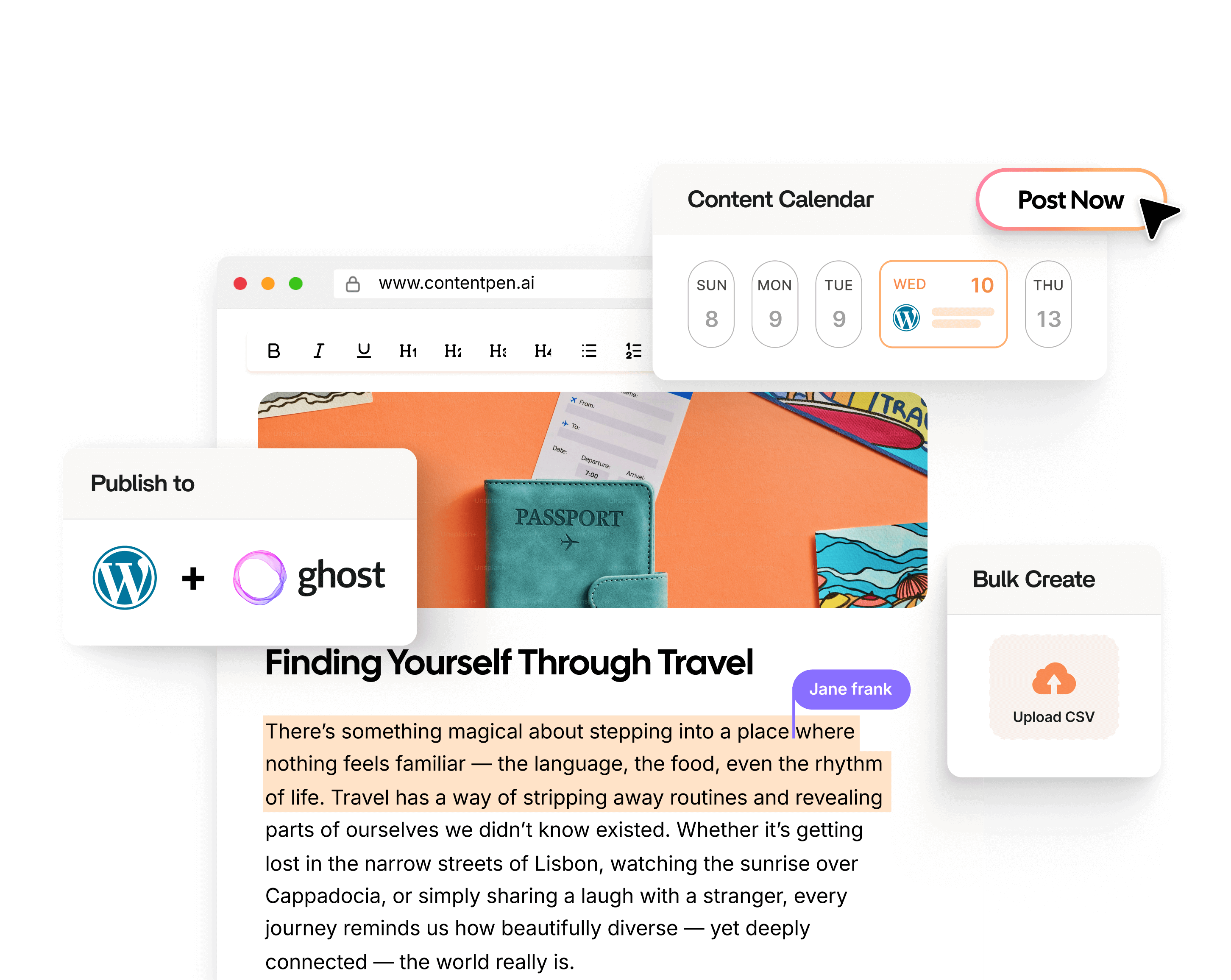
Once content is generated, you can use one-click publishing to send blogs directly to WordPress, Wix, Webflow, Ghost, and Shopify CMS platforms without manual copy-paste.
You can also share blog updates directly to your social media through ContentStudio integration.
ClosersCopy vs. Contentpen
Both of these tools are made for separate purposes. While ClosersCopy focuses on creating short-form content, Contentpen is designed for generating long-form articles and blogs that boost organic traffic and AI visibility.
If we compare features head-to-head, we can notice that Contentpen provides far more detailed SEO audits and insights than ClosersCopy.
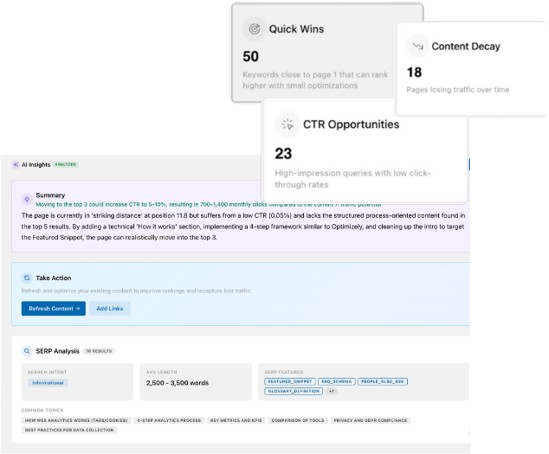
The SEO opportunities dashboard inside Contentpen provides reports that uncover decaying and near-ranking pages. Also, web analytics show clicks, impressions, and CTR data for your pages that ClosersCopy doesn’t cover at all.
Overall, the content depth and quality from Contentpen is also much better than ClosersCopy.
You get answer-first paragraphs, easy-to-read sentences, and a consistent tone throughout the content according to the language you select.
Pricing
Pricing plans for Contentpen start at $39/month (SEO platform), which provides 10 articles, 30 AI images, WordPress publishing, SERP analysis, and automated linking.
You can also get the AEO platformfeatures, including an AI visibility dashboard, separately for $39/month.
2. Jasper
Jasper is a solid ClosersCopy alternative because it carries long-form and short-form content together.
It offers 50+ templates for blogs, articles, emails, ad copies, social media posts, and others, making it a powerful platform for digital marketing purposes.
ClosersCopy vs. Jasper
Compared with ClosersCopy, Jasper offers much better brand voice controls for consistent content across different marketing channels.
It also offers SEO and GEO optimization. But that is done through its Semrush integration, not directly in the interface.
Besides that, Jasper can handle long-form content well by understanding the topic’s technical details and delivering a comprehensive piece.
Compare this to ClosersCopy, which offers only about 200 words of content generation, even in its “Long-form” mode.
Pricing
Jasper is an expensive tool for small businesses, freelancers, and individual marketers. Starting at $69/seat/month, it is targeted more towards enterprises looking to create different types of content with a brand-consistent voice.
Copy.ai is a powerful GTM (go-to-market) copywriting and content generation tool that helps businesses launch their campaigns confidently with the least manual input.
Although Copy.ai’s brand positioning has changed from a simple AI writing tool to a GTM platform, it is still a better ClosersCopy alternative at an attractive price point.
It provides 90+ content templates that cover blogs, social media, web copy, and emails, helping content marketers prepare their branding material with ease.
ClosersCopy vs. Copy.ai
Copy.ai fills gaps that ClosersCopy doesn’t fill. It provides you with automated, no-code workflows necessary to accelerate content creation to meet other businesses in the market.
ClosersCopy automation is reserved purely for writing, while Copy.ai scrapes websites for data, adding a whole new layer of competitive intelligence in its writing workflows.
Even the overall interface, AI assistance, and content output read and feel much better than robotic content you get from the ClosersCopy writing assistant.
Pricing
Pricing starts at $29/month, which provides you with 5 seats, unlimited words, and access to models from OpenAI, Anthropic, and Gemini.
4. Anyword
Anyword is a content intelligence platform built from the ground up to help you write the best copy possible to maximize conversions and ROI.
It works on A/B testing headlines, product descriptions, landing pages, and other forms of content to provide GTM teams enough context of what’s working and what’s not.
Besides all this, Anyword integrates with social platforms through Meta, HubSpot, Wrike, Marketo, and Salsify, to name a few.
This adds a lot of freedom for marketers to export their content directly to where they want without any manual intervention.
ClosersCopy vs. Anyword
There is no comparison between the two. Anyword wins at generating data-optimized content that you can publish across a diverse set of platforms.
ClosersCopy, on the other hand, lacks integrations entirely and doesn’t offer any API connections as well.
If we look at it through the lens of a marketer, Anyword is the clear winner here.
Sure, it may not help you with long-form content generation, but it is worth the investment for what it brings to the table.
Anyword pricing starts at $49/month, which provides you with 50 performance predictions, a blog wizard, and a Chrome extension to work where you like to.
5. Rytr
Rytr is what you can call the best AI copywriting tool on a budget. It provides you with over 40 pre-built content templates that you can use to create landing pages, ads, newsletters, emails, and much more.
The tool also offers blog generation, but with much less capacity compared to dedicated AI blog writers like Contentpen.
Still, for the price it has and a genuinely usable forever-free plan, it offers much better value than ClosersCopy in 2026.
ClosersCopy vs. Rytr
ClosersCopy offers proprietary AI models to create content, whereas Rytr provides a template-driven writing interface for faster content generation.
That said, Rytr doesn’t have the SERP tracking, SEO, or GEO functionalities that many of the tools on this list offer.
But it also charges much less than ClosersCopy ($49.99/month vs. $9/month), making it an attractive copywriting tool for small businesses and individuals.
The forever-free plan offers up to 10,000 characters, which are reset each month. Paid plans start at $9/month, which grants users unlimited AI content generation and 20+ pre-programmed tones of voice.
6. Hypotenuse AI
Hypotenuse AI is an e-commerce-focused copy generator and PXM (product experience management) platform created for businesses looking to enhance their product listings for a conversion boost.
The best thing about Hypotenuse AI is its SEO and GEO-optimization for the content and images it generates. This helps your product listings get mentioned on Google AI Overviews and SERP results.
ClosersCopy vs. Hypotenuse AI
Clearly, both tools serve different purposes, but it holds for a good comparison between the two.
While Hypotenuse is a tool for e-commerce businesses, it does provide a much vast variety of integrations that you can use to serve your copywriting needs.
ClosersCopy aims at creating landing pages, web copy, and ad content, but fails to deliver on its promises and meet modern content needs.
For instance, Hypotenuse provides digital asset management (DAM) for the high-quality AI images and product visuals it generates.
ClosersCopy neither generates visuals in such detail nor keeps them sorted through tags or categories.
Pricing
Hypotenuse AI pricing is not shared publicly. However, most reviews online show the starting value of $150/month for e-commerce features and $29/month for marketing and SEO.
7. Surfer AI
Most of us know Surfer as the tool for real-time SEO-scoring as you write. However, it has now grown into a platform that also offers AI search visibility and SEO- and GEO-optimized content generation for PR and brand teams.
The tool also audits your site for SEO improvements and analyzes competitors to find topic ideas that can help you win.
It will provide you with detailed CTR values, impressions, and click data in a unified dashboard, ideal for growth marketers looking to make data-backed decisions.
ClosersCopy vs. Surfer AI
ClosersCopy’s SEO functionalities are rudimentary compared to Surfer.
With Surfer, you get a content score that is calculated based on readability, keyword intent, competitor benchmarking, and other parameters.
With ClosersCopy, you get the suggested word count and one-click content structuring based on competitor analysis.
We’re not saying that the real-time SERP scraping from ClosersCopy isn’t real. We’re just saying that it fails to leave a bigger impact than Surfer’s intelligence does on your content.
With Surfer’s NLP term coverage suggestions and internal linking engine, it becomes a much stronger ClosersCopy alternative on our list.
Pricing
Surfer’s all-in-one plan starts at $119/month (billed monthly), which unlocks team collaboration tools, 25 AI prompt tracking, and 30 AI document optimizations or creations.
8. Writesonic
Writesonic is an AI-visibility-focused writing tool that covers copywriting and blog generation side-by-side.
It is a powerful ClosersCopy alternative for SEO and AEO teams looking to create content that helps them achieve better SERP results and presence in AI answer engines.
Besides providing an AI article writer and 100+ marketing copy templates, Writesonic also offers Chatsonic, an AI-powered chat assistant, to edit, optimize, and create content with real-time Google data.
If we put it up against other ClosersCopy alternatives like Contentpen, the only issue that surfaces is its higher pricing point and a steeper learning curve.
ClosersCopy vs. Writesonic
Writesonic is way better at creating marketing copy than ClosersCopy. It may not have the predictive performance capabilities like Anyword, but it does provide extensive AI visibility coverage for PR and brand teams.
While ClosersCopy provides a simplistic UI, Writesonic gets into more details of what works and how.
Writesonic also provides integrations with all the popular CMS platforms along with an API connection to integrate it into your existing tech stack – something that’s not possible with ClosersCopy.
Pricing
Writesonic pricing starts at $99/month, which gets you 50 prompt tracking, 15 AI articles, 10 site audits, and limited access to agentic workflows.
HyperWrite AI is an AI-powered writing assistant that tags along with you on your favorite apps, such as Google Docs, Notion, etc., as a browser extension.
It also offers a ‘Flexible AutoWrite’ feature that helps produce the best possible content with smart suggestions.
HyperWrite can understand your brand voice and allows users to create ‘Custom Personas’ with their brand knowledge.
The platform contains several other AI tools, such as an AI summarizer and Scholar AI that fulfill different use cases and purposes.
ClosersCopy vs. HyperWrite AI
If ClosersCopy is focused on copywriting, HyperWrite AI is more of a productivity tool that also covers copywriting as its feature set.
HyperWrite is not ideal for creating landing page copies, ad headlines, or long-form content, and it suffers greatly when it comes to SEO and GEO features.
With that said, it is a considerable ClosersCopy alternative if you’re looking for a cost-effective tool that handles a majority of writing tasks well enough.
Pricing
Paid plans start at $19.99/month (billed monthly), which provides 250 AI messages, 3 Custom Personas, and unlimited TypeAheads (contextual content auto-complete).
10. Pepper Content
Peppertype.ai or Pepper Content is now rebranded to just “Pepper” and is a good addition to our list of ClosersCopy alternatives.
Pepper’s unique standing is because of its enterprise content creation features. It allows companies to create custom-trained LLMs so that they can train the AI according to their internal knowledge and databases.
That is a feature that a rarity of tools offer in this space.
What this means for you is that your content will sound the same, no matter the type (short-form or long-form) or the publishing platform you’re targeting.
ClosersCopy vs. Pepper Content
The gaps between these two tools are visible. With Pepper Content, you get SOC 2 Type II and GDPR compliance, none of which is present in ClosersCopy.
Besides compliance, the extent of CMS integrations and workspace collaboration features you get with Pepper Content is much more than what you’d get with ClosersCopy.
It’s like both of these tools target different types of users and markets.
Which ClosersCopy alternatives do we recommend in 2026?
Picking a ClosersCopy alternative is not as easy as you’d think. First, you need to recognize the content need you have, then map the tool to it accordingly.
->If you want better organic traffic and AI visibility, pick Contentpen. It is the most suitable choice for this purpose, especially since all the other tools in this space either don’t get you the promised results or just don’t justify their hefty price tags.
You can see our customer testimonials to view real results our customers achieved using Contentpen and sign up for a 7-day free trial to test out the platform before purchasing.
Write content that’s built to rank, not just read
Create search-optimized blogs aligned with SEO and GEO signals, so your content performs well across search and AI-driven discovery.
-> If you want predictive performance built-in, pick Anyword. It provides many A/B testing features that are invaluable for growth marketers trying to create copy that converts.
->If you want tone-consistent content, pick Jasper. It is one of the most popular AI writing tools on the market that provides a wide range of marketing templates and brand-consistency features.
Jasper ensures your writing team creates content exactly like you intend to.
->If you want AI copywriting on a budget, pick Rytr. You can’t go wrong with an investment of $9/month for this tool and the 40+ content templates it provides to cover your writing needs.
->If content optimization is your focus, pick Surfer. Sure, Surfer now offers much more than SEO scoring, but it’s still a platform that is more suitable for content optimization.
The only caveat with using it is that you’ll need a separate writing tool to fulfil your content creation goals.
At the end, if you’re still confused, pick a tool and get its free trial.
Run a complete workflow on it, from keyword research to content generation, optimization, and publishing. If you don’t find it according to your needs, switch the platform before you commit fully.
Frequently asked questions
Does ClosersCopy have a lifetime deal?
Yes, there is a ClosersCopy lifetime deal that starts with $297 for the ‘Superpower Solo’ plan and goes up to $697 for a one-time payment. You can also pay the cost in 3 installments. That said, it is up to the users to decide whether this investment is worth it.
Is there a ClosersCopy discount code available?
Yes, ClosersCopy’s official website offers several discount codes on its ‘Superpower Solo’, ‘Superpower Hero’, and ‘Superpower Squad’ plans, providing a 20-25% discount (plan-dependent).
Can ClosersCopy generate long-form content?
Yes and no. It can generate blogs using its ‘BlogAI Engine’. However, the amount of manual editing the outputs require makes this feature not so usable in the long term.
Can ClosersCopy do SEO and GEO tasks?
Yes and no. You can perform simple SEO tasks with ClosersCopy, like picking keywords and building data-driven outlines. However, the tool doesn’t offer any GEO features necessary in 2026.
HyperWrite is excellent for quick writing tasks, but many users outgrow it once they need SEO, larger content workflows, or higher usage limits. That’s where dedicated HyperWrite alternatives become worth considering.
In 2026, the strongest alternatives to HyperWrite AI include Contentpen, Anyword, Sudowrite, Grammarly, Jasper, and others.
Together, these AI writing tools cover long‑form SEO blogs, performance copy, creative stories, academic papers, and detailed editing, so you can pick the tool that fits your workflow.
This guide compares HyperWrite alternatives side by side based on certain criteria we set. Keep reading to find out more about each platform.
Key takeaways
HyperWrite is helpful but limited for scale. Limited SEO support and free plan caps hold back serious, content-first teams.
Effective HyperWrite alternatives handle more than generating plain text. They help with briefs, SEO, formatting, and content publishing.
Contentpen stands out for full blog workflows. It connects keyword research, outlining, drafting, and WordPress publishing in one place.
Choose whichever tool suits your use case.
What is HyperWrite AI?
HyperWrite is a general-purpose AI writing assistant that integrates directly with Google Docs, Notion, and Chrome as an extension attached to your browser.
It is very useful for drafting quick emails, headlines, and other types of short-form copy. You can also rewrite texts for clarity or modify tone according to the context and audience. The main features include:
Flexible AutoWrite: You can use AI to write original content on any topic.
TypeAhead: The smart AI will autocomplete your sentences as you type with the context in mind.
Scholar AI: This is HyperWrite’s academic research component, helping you conduct deep research on topics and receive factual citations.
AI summarizer: Condense lengthy content into a few paragraphs to understand the key points without any hassle.
Custom Personas: HyperWrite AI will learn your writing tone to generate content exactly how you’d do.
Image generator: Helps you create detailed images and visuals using textual descriptions.
The platform also offers other types of AI tools, such as an AI speech writer and AI book reviewer, that you can use for your projects.
Why look beyond HyperWrite in 2026?
HyperWrite is good for everyday work, but it doesn’t help you achieve specific goals, such as ranking on Google or winning AI citations in your niche. For those purposes, you’ll need specialized tools.
Through user reviews and personal testing, the following issues come to light.
Outputs need significant editing: The chat writing outputs often need many rounds of editing before you see a usable draft.
No built-in SEO or GEO features: HyperWrite has no built‑in keyword research, clustering, SEO scoring, or AI search content optimization.
Pricing and usage limits: The paid plan, starting at $19.99/month, provides only 250 AI messages, which is a strict cap that makes it hard to rely on for daily content needs.
For writers, marketers, and founders, that means you need to look for HyperWrite AI competitors to gain organic traffic, online visibility, and improve conversions.
10 best HyperWrite alternatives in 2026
The 10 best HyperWrite alternatives overlap with many of the best AI writing tools for 2026 across SEO blogs, marketing copy, and content editing. Let’s see them at a glance below.
Tool
Primary strength
Starting price
Best for
Contentpen
SEO and GEO blogs workflow
$39/month
Content teams and agencies
Anyword
Conversion copy
$49/month
Performance marketers
Sudowrite
Fiction drafting assistance
$19/month
Novelists and storytellers
Grammarly
Grammar and clarity
$12/month
Everyday writing
Quillbot
Paraphrasing and citations
$19.95/month
Students and researchers
Jasper
Brand‑safe marketing copy
$69/seat/month
Marketing teams
Wordtune
Sentence rewriting
$13.99/month
Draft refinement
Jenni AI
Academic writing support
$30/month
Students and researchers
Rytr
Low‑cost short form content generation
$9/month
Freelancers and small teams
ProWritingAid
Deep style reports and writing help
$30/month
Authors and editors
Now, we will see each platform in more detail.
#1: Contentpen – Best for content teams and agencies
Contentpen is an end‑to‑end AI blog writer that does everything that HyperWrite AI does and more. It helps you create long‑form articles that rank on Google and get cited in AI answers with the least manual work.
You start with the keyword research module, then receive detailed outlines, which the tool turns into SEO and GEO-scored content in minutes. The tool also adds internal links and external citations in your content, along with on-brand images that depict your thoughts visually.
Key features:
Built-in ‘Ask AI’ assistant: While writing content, ask the AI assistant to rewrite sentences, shorten a paragraph, or expand a section. You can also change the tone, summarize, or improve grammar without leaving the interface.
Content scheduling: Away from your desk but want the content engine to keep running? No problem. With Contentpen’s content scheduling, you can plan months of content and let the tool publish whenever, wherever you like.
Bulk content creation: Contentpen helps you create multiple articles at once. Using the content presets, you can control how each piece will sound without manually changing anything.
Integrated publishing: Post your content directly to WordPress, Wix, Webflow, Shopify, and Ghost CMS platforms. You can also leverage the ContentStudio integration to post on your social media profiles from the same window.
Post-publish ranking opportunities: Contentpen continuously monitors your content after publishing to find pages that are losing their traffic, CTR gaps, and quick-win pages that need a slight nudge to regain position.
Use the AI-powered insights to understand what’s working and what’s not. Fix with one-click optimization to improve your platform performance and immediately see the impact on your web analytics dashboard.
Besides these SEO and content features, you also get our AEO platform that helps you track your AI visibility across ChatGPT, Perplexity, Gemini, Google AI, Grok, Copilot, and Claude chatbots.
Find
your brand in
AI search
Track AI citations, share of voice, and brand sentiment
Since Contentpen is also optimized for mobile devices, you can check your key SEO and AEO metrics anytime.
Cons:
Learning curve: It might take a while to learn all the features inside our SEO and AEO platform.
Focuses on long-form content: Contentpen is most suitable for long-form HowTo, informational, listicles, and comparison posts.
Pricing:
The SEO and AEO platforms are priced separately at $39/month each. You can also get our 7-day free trial to test the tool before buying.
#2: Anyword – Best for conversion-driven copy
Anyword focuses on data‑driven marketing copy. Its Predictive Performance Score estimates how each variation might perform for a target audience before launch.
You can generate and test ads, landing page headlines, email subject lines, and blog intros with built‑in tone and length suggestions.
Key features:
Brand voice: Anyword allows users to add their brand voice so every copy it generates is exactly how you sound.
Wide array of integrations: You can connect Anyword directly to Google Ads, Meta Ads Manager, Salesforce, and HubSpot.
Browser extension: Similar to HyperWrite, you can get Anyword on your browser with the extension to help you write directly on your favorite platforms.
Cons:
No built-in keyword research: Anyword doesn’t generate keywords for your niche or create topical clusters, like the other HyperWrite alternatives like Contentpen do.
Limited long-form content generation: The tool can generate blogs and articles, but those require heavy manual input and editing before publishing.
Pricing:
A 7-day free trial is available, and paid plans on Anyword’s pricing page start at $49/month, which provides 50 performance predictions.
#3: Sudowrite – Best for creating stories and deep narratives
Sudowrite serves fiction writers who want help with plot, characters, and description generation for stories instead of SEO or ad copy.
The Story Engine feature walks you through chapters scene by scene, while ‘Brainstorm’ and ‘Describe’ options expand sparse notes into vivid paragraphs.
Key Features:
Rewrite sentences: Similar to HyperWrite, Sudowrite offers to help with your sentences to fix them according to the context, tone, and style.
Content feedback: You can use the AI to review your chapters. The tool provides detailed insights on your character selection, plot details, and much more.
Visualize characters: Use the built-in image generator to visualize your characters using your descriptions.
Full screen mode: Create compelling narratives without any distractions in the full screen mode.
Cons:
Credit-based subscriptions: Since the tool uses a credit-based subscription model, you can end up paying more than the initial price as heavy AI drafting burns up tokens.
Export limitations: Exporting your manuscripts to common publishing formats, such as PDF, DOCX, or EPUB, is challenging.
Pricing:
Plans start at $19/month, with higher tiers that give more generations for heavy daily writing and ideation.
#4: Grammarly – Best for everyday writing tasks
Grammarly remains the go‑to choice for grammar, spelling, and clarity checks across apps like Google Docs, Outlook, and Slack. It flags issues in real time and suggests rewrites that match your chosen tone, such as confident, friendly, or formal.
Key features:
Rewrite ideas: You can use the built-in options to rewrite your sentences or paragraphs to improve, shorten, or make them more descriptive.
Built-in plagiarism checks: Users can directly check their drafts for originality with Grammarly.
Availability across writing apps: The tool is available to use as an extension inside MS Word, or online on Google Docs, Notion, and email clients.
Cons:
Context misinterpretation: Sometimes, the tool may provide you with incorrect grammatical suggestions that misunderstand the context of complex sentences.
Over-optimization of content: Grammarly may strip you of your natural writing style with too many suggestions or over-the-top rewrites.
Pricing:
A free plan covers basic grammar and spell checks, while paid tiers start from $12/month, unlocking advanced style checks, plagiarism detection, and team editing controls.
#5: Quillbot – Best for paraphrasing and citation generation
Quillbot started as a paraphrasing tool and still excels at rewriting sentences with different levels of formality or length. Modes like Standard, Fluency, Shorten, and Expand make it easy to adjust tone without losing meaning.
The platform also includes grammar checking, a citation generator, and plagiarism detection, which helps academic professionals keep work clean and original.
Key features:
Multiple paraphrasing modes: Switch between Standard, Fluency, Academic, Formal, Simple, Expand, or Shorten modes depending on whether you need clearer writing, simpler language, or a more academic tone than HyperWrite typically produces.
Plagiarism checker: Check for your content’s originality to make sure your drafts are fresh and unique.
Citation generator: Generate citations in APA, MLA, Chicago, and other popular styles without leaving the editor.
Cons:
Limited long-form content generation: Quillbot focuses on improving existing text rather than generating complete long-form articles from scratch.
Paraphrasing quality varies: Longer technical passages can sometimes lose nuance or introduce awkward phrasing with paraphrasing modes, which requires manual editing to fix.
Pricing:
A free tier gives limited rewrites, while paid plans start at $19.95/month, unlocking higher word limits and plagiarism checking.
#6: Jasper – Best for brand-consistent writing
Jasper centers on marketing teams that need consistent brand voice across blogs, ads, email, and social media. You can define brand guidelines, connect data sources, and generate campaigns that stay on brand across many formats.
The tool offers 50+ content templates that cover long‑form posts, product descriptions, and more. There is also a Jasper Chat view for interactive drafting.
Key features:
Brand Voice and Style Guide: Jasper learns your company’s tone, terminology, and preferred writing style so every output stays consistent across blogs, emails, ads, and landing pages.
Marketing workflows: Instead of isolated prompts like HyperWrite, Jasper includes complete workflows for campaign creation, helping teams produce multiple assets from one brief.
Knowledge assets: With this feature, you can upload product documentation, company information, and messaging so Jasper references your business instead of relying entirely on general AI knowledge.
Cons:
Expensive for individuals: Jasper’s pricing makes more sense for large-scale marketing teams rather than freelancers or individual writers.
Limited SEO workflow: Although Jasper produces quality drafts, you’ll still need separate SEO tools for keyword research, optimization, and ranking analysis that platforms like Contentpen include.
Pricing:
Plans start at $69/seat/month, which includes 2 brand voices, 5 knowledge assets, and access to marketing templates for day-to-day content creation.
#7: Wordtune – Best for sentence rewriting
Wordtune is ideal when you already wrote a draft and want each sentence to read smoother or match a specific tone. You can highlight a line and choose options such as casual, formal, shorter, or longer, then pick the version that feels right to replace existing content.
The ‘Spices’ feature can inject examples, counterpoints, or statistics into existing text when you need extra writing support.
Key features:
Sentence-level rewrites: You can rewrite individual sentences in multiple styles without changing the surrounding content, making it ideal for polishing existing drafts rather than starting from scratch.
AI summaries: Summarize articles, PDFs, webpages, and YouTube videos to quickly understand lengthy material before writing.
Fact-based writing: Wordtune can use uploaded sources as reference when generating content, helping reduce factual mistakes during drafting.
Cons:
Not built for complete workflows: Compared to other HyperWrite alternatives like Contentpen, Wordtune lacks keyword research, publishing, and work management capabilities.
Usage limits on lower plans: Frequent rewriting sessions can quickly reach monthly generation limits unless you upgrade to the paid plans.
Pricing:
Paid plans start at $13.99/month, which provides 30 AI rewrites, 15 AI summarizations, and unlimited grammar checks.
#8: Jenni AI – Best for academic writing
Jenni AI aims at academic and research writing with tools that respect citation needs. You can upload papers or notes, then have the assistant suggest paragraphs that refer back to those sources with in‑text citations in styles such as APA, MLA, or Chicago.
The ‘Autocomplete’ feature speeds up drafting for theses, essays, and literature reviews without losing content tone, style, or structure.
Key features:
Traceable citations: The tool connects every AI-suggested sentence to the precise location in your source PDF, helping you verify citations with one click.
Research discovery: Jenni AI helps you find 200M+ papers online for academic research without leaving the interface.
AI-powered reviews: You can use the ‘Reviews’ feature inside Jenni AI to proofread your content and catch unsupported arguments, grammatical mistakes, and poor word choices.
Cons:
Narrow use case: Jenni AI is designed primarily for academic writing, making it less suitable for marketing content or SEO blogs.
Occasional citation verification needed: Although references are helpful, users might still need to verify them before publishing.
Pricing:
Plans start at $30/month, giving users unlimited PDF uploads, 500 AI edits, and 10 reviews for research projects.
#9: Rytr – Best for low-cost short-form content generation
Rytr gives a friendly entry point into AI writing with one of the lowest price points on this list. It offers templates that cover emails, social captions, product descriptions, and blog ideas in 30+ languages.
A built‑in plagiarism checker and simple style editing controls help newer writers feel more confident about publishing their content online.
Key features:
My Voice tone matching: Upload writing samples, and Rytr will adjust its templated output to match your tone.
Built-in copywriting formulas: Templates are structured around formulas like AIDA and PAS, enforcing a persuasive structure without you needing to know the formula yourself.
Improve, Expand, and Rewrite tools: These editing commands work on text you’ve already written, cleaning up phrasing and tightening sentences for clarity and coherence.
Cons:
Weak long-form writing: Rytr performs well for short-form copy but struggles with comprehensive articles compared to other HyperWrite alternatives focused on blogging.
Lacks SEO and GEO features: The platform lacks advanced SEO scoring, keyword research, AI visibility tracking, and publishing workflows available in Contentpen.
Pricing:
The free plan includes a 10,000-character limit that resets every month. You can get the paid plan starting at $9/month, which unlocks unlimited AI content generation and 20+ pre-programmed tones of voice.
#10: ProWritingAid – Best for writing help and editing
ProWritingAid combines grammar correction with deep style analysis that suits serious authors and editors. Detailed reports highlight pacing issues, repeated phrases, sticky sentences, and readability scores so you can improve drafts with real data.
The ‘Sparks’ feature offers alternative phrasings while keeping voice intact, which helps both fiction and business writers.
Key features:
Scrivener integration: A direct plugin for Scrivener lets novelists run reports on individual chapters or scenes without exporting the manuscript first.
Built-in contextual thesaurus: Highlight a word to see related terms, collocations, and alliteration options, useful for varying word choice across a long manuscript without leaving the editor.
Cons:
Interface feels dated: Compared to HyperWrite’s cleaner, more modern layout, ProWritingAid’s report-heavy interface can overwhelm new users, and its browser extension runs noticeably slower than other HyperWrite competitors.
Built for revisions, not real-time writing: The tool works best as a dedicated editing assistant, not as an always-on companion while you’re actively typing.
Pricing:
Paid plans start at $30/month, which gets you unlimited word count, 5 Sparks per day, citations, and author comparisons.
How to choose the right HyperWrite alternative for your needs
Choosing between HyperWrite alternatives means matching one tool to your main writing job and budget. Some teams care about SEO, others need spotless grammar or fast short‑form output.
Once you phrase your main requirements clearly, it becomes easier to spot the best AI tools for your situation.
SEO content teams: Start with Contentpen for research, briefs, and drafting, then pair it with Grammarly for further content polishing if needed.
Performance marketers: Anyword or Jasper fit best for this use case, especially when you care about conversions, A/B tests, and brand voice controls.
Editing‑heavy roles: Wordtune and ProWritingAid work well for this purpose to clean and refine drafts from any source.
Academic writing: Jenni AI and Quillbot both support citations, paraphrasing, and structured arguments, which work quite well for academic writers compared to HyperWrite.
Fiction authors: Sudowrite is the better choice here because of its focus on plot, character, and world‑building capabilities.
Write down your main use case and budget before you test any tool. It keeps comparison focused and stops spec sheets from distracting your decision.
The bottom line
HyperWrite is still a useful tool for quick content edits and drafting. However, serious professional teams and growth marketers often outgrow its chat‑style usage limits and mundane-looking outputs.
When SEO traffic, GEO readiness, or tight workflows matter, focused HyperWrite alternatives make a clear difference.
Contentpen stands out as the best fit when you need an all‑in‑one engine for keyword research, blog drafting, optimization, and publishing.
From outline to publish-ready content
that fills them
It also offers an angle that most tools miss: tracking what happens to your content after publishing. Other tools in this list then cover sharp roles such as editing, performance copy, or academic support.
Our recommendation is to try the tool that matches your main bottleneck first, then layer a second one if gaps remain.
Frequently asked questions
How good is HyperWrite AI?
HyperWrite is solid for real‑time editing and research summaries, but it falls behind tools like Contentpen for SEO, automation, and workflows. Many teams outgrow it once they need AEO-focused, search‑driven content.
Can you use HyperWrite for free?
Yes, you can use HyperWrite on a free plan, but strict daily limits apply (around 15-50 messages per day). Those generation caps make it hard for agencies or freelancers to produce any meaningful content, especially those who write many pieces each day.
Which AI is best for copywriting in 2026?
For copywriting that needs conversions, Anyword and Jasper stand out because they mix templates with testing features and brand controls.
Which AI is currently best for writing overall?
No single AI is best for every type of writing. Contentpen leads for long‑form SEO blogs, Grammarly for editing, Sudowrite for fiction content, and Jenni AI for research papers or academic essays. Choose whichever one fulfills your purpose.
Are there any free HyperWrite alternatives?
Yes, several free HyperWrite alternatives exist, including Grammarly and Rytr. You can use them on the free plan forever, but with advanced features gated behind pricing tiers.
If Pepper Content no longer fits your workflow, the strongest Pepper Content alternatives available in 2026 might pique your interest. These options include Contentpen, Jasper, Anyword, and others that help freelancers and content marketers achieve their goals.
These platforms cover AI writing, SEO, and enterprise content operations in different ways, helping you keep your workflow smooth without any hiccups.
This guide specifically focuses on Pepper’s AI writing capabilities and explains what Pepper Content does, why many teams move away from it, and how 10 specific alternatives compare. By the end, you’ll be able to choose the right tool for your needs.
So, let’s get started.
Key takeaways
Pepper Content has evolved into Pepper, but many users still look for alternatives because of limited long-form content quality, weaker SEO, and a more complex interface.
The best Pepper Content alternative depends on your priorities. Some tools specialize in AI writing, others in SEO, multilingual content, ad copy, or enterprise automation.
Contentpen is the strongest all-in-one option for teams that need keyword research, long-form AI writing, SEO and GEO optimization, AI visibility tracking, and one-click publishing.
Testing multiple tools with the same content brief is the easiest way to compare output quality, ease of use, and overall value before committing to a subscription.
As AI search continues to grow, choosing a platform that supports both traditional SEO and AI search optimization can help improve long-term organic visibility.
What does Pepper Content do?
Pepper Content, or Pepper Type, is a content creation platform that looks to provide SEO and GEO-optimized content for companies. In October, 2025, the Head of Content, Gaurab, announced that they’re rebranding Pepper Content as just Pepper.
Now, it is a platform that targets worldwide CMOs, including their AI-tracking technology, Atlas, along with their AI writing assistant. The platform also offers a unified dashboard measuring ROI and creative performance for teams in one place.
Why do people look for Pepper Content alternatives?
Pepper Content is a powerful writing tool for enterprises, but with some problems.
SEO isn’t that polished: The tool’s keyword research isn’t that great, as it doesn’t show any ranking opportunities or tell you what to write next.
Suffers with long-form content: Pepper is great for writing short-form content, like ad copies, social media posts, etc. However, it struggles to create coherent, SEO and GEO-optimized long-form articles for organic growth.
Lacks content variety: The AI content generator starts to repeat arguments and thought processes when asked to create pieces with unique perspectives or insights.
Rebranded UI has caused consumer panic: Since the platform recently changed its interface, many users have complained that it has made the UI worse. There are many features and options to deal with, making the tool difficult to use.
High recurring costs: At $99/monthfor 5 seats, the AI writing assistant has significantly gone out of bounds for individuals and startups, leaving gaps for other Pepper Content alternatives to fill.
Some of the Pepper Content reviews on G2 highlight similar things as we have regarding the tool’s inability to produce nuanced expressions for complex topics and SEO weaknesses.
Due to such problems, users are actively looking for alternatives, as promptly highlighted by this Pepper Content review shown above.
How did we determine Pepper Content alternatives?
The tools we added in today’s list were compared based on their enterprise features, such as governance workflows and compliance frameworks supported.
Our reasoning for doing so is that Pepper Content AI is marketed toward CMOs and large-scale teams. Therefore, we picked tools that could satisfy this requirement, along with some other points:
Crtierion
What it measures
Content writing capability
How well is the tool’s first draft? Is the team spending more time fixing the output instead of using it?
Content diagnostics and optimization
Is the tool able to answer where your content is cited in AI systems? Is it able to provide a system to improve organic traffic?
Governance and scale fit
What security certifications, workflow permissions, and content scale does the tool support?
Clarity of onboarding
How does the platform onboard users? Is the process transparent and easy?
Besides this list of criteria, we also took user reviews, our first-hand experience, integrations, and customer support into account when compiling the list of Pepper Content alternatives.
Comparing the top 10 Pepper Content alternatives in 2026
Below are the best Pepper Content competitors you can choose from in 2026.
Tool
Best for
Starting price
Contentpen
End-to-end AI blog workflow from keyword to publish
$39/month for the SEO platform
Neuroflash
Multilingual, brand-aligned AI content
€42/month
Jasper
High-volume, multi-format content
$69/seat/month
Anyword
Conversion-focused short copy
$49/month
Copy.ai
GTM workflow automation
$29/month
TextCortex
Enterprise-scale AI agents on a budget
$23.99/user/month
Scalenut
Keyword clustering and planning
$59/month
Writesonic
SEO writing with deep AI visibility coverage
$99/month
Conductor
SEO research and AEO monitoring
N/A
AirOps
Scaling content operations and SEO strategies
N/A
Now let’s read about all these platforms in more detail and find out what makes them better than Pepper Content.
1. Contentpen – Best for end-to-end AI workflow
Contentpen is an all‑in‑one AI blog platform that takes you from keyword idea to published article in one workspace.
Unlike many AI writing platforms that only write drafts, Contentpen covers research, outlining, writing, optimization, and publishing in a single flow. It also offers an AI visibility tool to track your brand sentiment, share of voice, and source gaps across 7 major AI models.
This makes it a strong alternative for anyone who used Pepper Content as a central hub for their content marketing activities.
Besides this, Contentpen offers GDPR, CCPA, LGPD, and PIPEDA compliance, along with TLS encryption for its users, making it an ideal fit for enterprises.
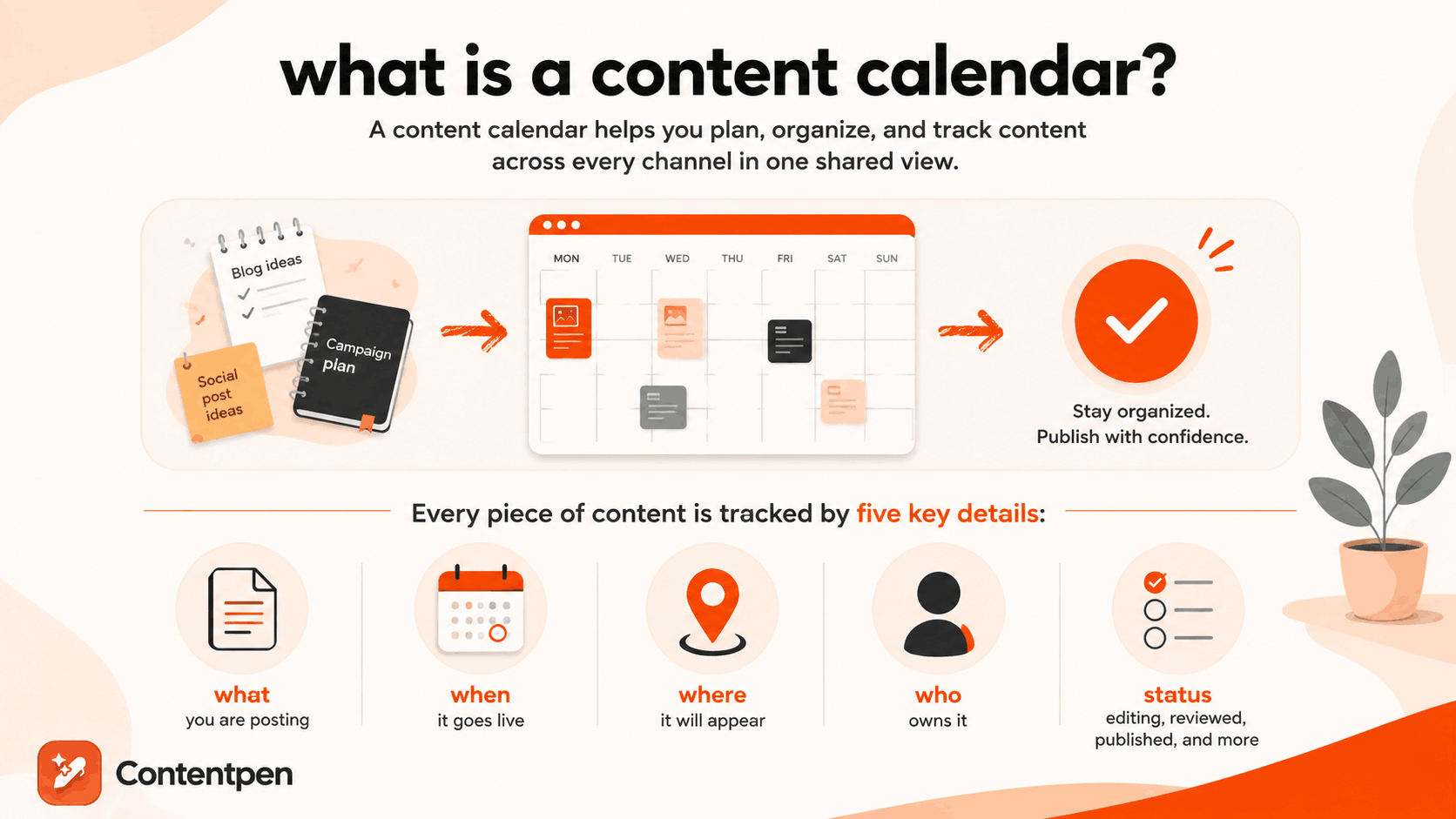
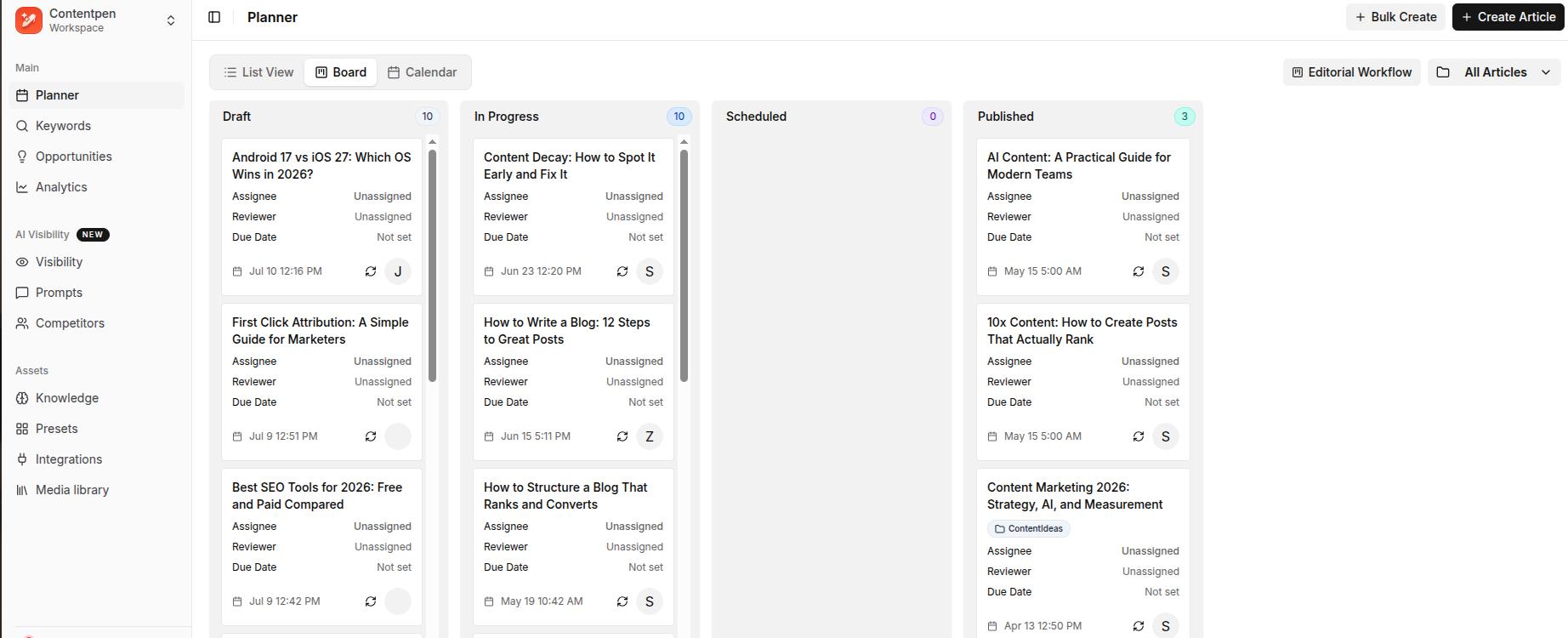
By far the most usable features inside the AI blog writer include a built-in content calendar that helps you plan and schedule on‑demand content. You also get one‑click WordPress, Ghost, Wix, Webflow, and Shopify publishing that removes copy‑paste errors.
Contentpen also bakes in AI search optimization into every article with GEO scoring and AI prompt targeting so your content is easier for systems like ChatGPT, Google AI Overviews, and Perplexity to cite.
Pricing
You can get the SEO platform for $39/month and the AEO platform for the same price separately. Users also get a 7-day free trial to test the platform entirely before committing. Check out the Contentpen pricing page for more details.
2. Neuroflash – Best for brand-aligned, multilingual AI content
Neuroflash focuses on AI writing and brand voice control for marketing content. It uses OpenAI models plus its own insight layer to help you write emails, landing pages, and blog posts in 30+ languages.
Data protection is a strong point. Neuroflash runs on ISO‑certified servers in Germany and follows GDPR rules, which supports agencies working with regulated clients.
Problems with Neuroflash
With Neuroflash, you can run into some of the following issues:
Doesn’t focus on long-form articles: Neuroflash is great if you’re shifting from Pepper Content to create emails, ads, and social posts. It is not the tool for creating 3,000+ word blogs or articles.
Onboarding is very extensive: Neuroflash is not a tool you can simply start working with. The onboarding workflow will require you to add all brand details, customer profiles, and populate their brand hub before getting the first output.
Pricing
Neuroflash pricing starts at €42/month, which unlocks 1 target audience, 6 digital twins per audience, 1 brand voice, and access to basic AI models. API is priced separately.
3. Jasper – Best for creating tonally-consistent content for enterprise teams
Jasper serves teams that need one AI content writing platform for many formats at once. You can create long‑form posts, email sequences, website copy, and social updates without switching tools.
That flexibility works well for marketing agencies and in‑house enterprise teams running campaigns on multiple channels for better content distribution.
One strength is how closely Jasper follows detailed brand guidelines. You can create brand voice profiles and templates that writers reuse for every client or product. Integration with Semrush adds recommended keywords and structure for search‑focused pieces.
Problems with Jasper AI
With Jasper, should know the following pointers:
Outputs still need editing: The articles generated by Jasper still need light editing before publishing, especially for YMYL niches.
No built-in SEO or GEO analytics: Unlike Pepper Content, you don’t get a built-in SEO or GEO scoring/analytics with Jasper. The Semrush integration does work, but it also means you will have to purchase a separate subscription for SEO audits and other tasks.
Pricing
Jasper AI is priced at $69/seat/month. This price tag puts it in the enterprise category of AI writers, made for users who are tone-conscious about their digital marketing fronts.
4. Anyword – Best for conversion‑driven, platform‑specific copy
Anyword specializes in short, punchy copy that sells. It offers 100+ content templates for ads, product pages, and social posts. This focus makes Anyword a good choice for paid media teams that care most about click‑through and conversion rates.
The standout feature is predictive performance scoring. For each variation, Anyword predicts how likely it is to perform well with your target audience. If you run campaigns across Facebook, Google Ads, and email, Anyword helps you create and test platform‑specific copy at high speed.
Problems with Anyword
Below are some friction points that we feel writers will face with Anyword.
It’s not a standalone AI blog writer: Anyword pairs well with a separate blog platform like Contentpen as it doesn’t create SEO or GEO-optimized long-form articles itself.
Starter plan isn’t going to cut it: Advanced features like copy analytics are gated behind higher pricing tiers.
Pricing
The Starter package is $49/month, but as we mentioned earlier, more lucrative features for CMOs and growth teams are available at $99/month on the Data-Driven plan or above.
5. Copy.ai – Best for GTM workflow automation
Copy.ai is a powerful GTM (go-to-market) tool that works well for marketers, sales professionals, and business owners looking to scale content production. It helps with writing web copy, email, ad headlines, social posts, and much more.
With multiple content templates available, Copy.ai ensures that your short-form content needs are covered. You can also create blog posts with this tool, but not like you would with other Pepper Content alternatives on this list like Jasper or Contentpen.
Problems with Copy.ai
Copy.ai does have the following issues:
It fulfills a niche purpose: It is made for GTM workflows, and it does exactly that. You would be disappointed with the tool if you wanted SEO and GEO-optimized articles with post-publish analytics or ranking opportunities out of it.
Fact-checking required: While this is a general AI writing tool problem, we expect better accuracy of content from an enterprise-scale tool like Copy.ai.
Pricing
Copy.ai price is very reasonable, with $29/month for 5 seats and unlimited words in AI-assisted chat. Custom Enterprise plan also offers API access.
6. TextCortex – Best for having enterprise AI agents on a budget
TextCortex provides AI agents that integrate across your enterprise-scale tech stack. It offers deep research, brand voice training, and workflow automation to help you write the best emails, articles, and reports possible with the least hassle.
You can use TextCortex inside the browser, through extensions, or in its own editor. Its user base extends from lean teams and professionals to large-scale teams looking for a content creation platform with GDPR, ISO, and SOC2 compliance.
The platform also uses a wide range of LLMs to produce content, including Claude, ChatGPT, and Gemini. TextCortex is much more transparent about their AI model usage than Pepper Content, which is one of the reasons why we included it in our list.
Problems with TextCortex
To better understand the platform, you also need to know its downsides.
TextCortex doesn’t write you long blogs: Just like the other copywriting tools we’ve covered so far (Anyword and Copy.ai), TextCortex won’t write you long-form content. Yes, it is good for short text generation, like emails and headlines, etc., but that’s it.
Inaccuracies in non-English languages: TextCortex has strong English-writing capabilities, but user reviews show thin content quality and translation problems in Czech and Slovak languages.
Pricing
TextCortex pricing starts at $23.99/month, which includes 10 GB of storage and access to all major AI models for text generation.
7. Scalenut – Best for keyword clustering and content planning
Scalenut is a powerful AI content creation tool that also helps with AI brand visibility across Reddit and other key online platforms. It provides bulk GEO-optimized content creation, which is ideal for enterprises that want organic traffic on autopilot.
The standout feature is keyword clustering and content planning. With Scalenut, you are moving toward a structural approach to content creation, allowing you to make pillar pages and their supporting clusters accordingly.
The tool also offers a backlink marketplace, where you can receive high-quality SEO backlinks for your niche. However, we would advise you to be careful with this feature as, according to Google’s spam policies, even a few bad links can hamper your online visibility and growth.
Problems with Scalenut
Although Scalenut is a powerful AI writer, with visibility features like Social Upreach, it does have a few problems worth highlighting:
Generated content needs editing: Yes, the generated content will have visuals, formatting, and a proper structure. But it can lack the depth and nuances required for YMYL topics.
Lack of multi-language support: Unlike the other AI blog writers we saw on our Pepper Content alternatives list, Scalenut only operates for the English language. That is a huge consideration point if your enterprise spans across multiple countries or regions.
Pricing
In the context of other tools, Scalenut is modestly priced at $59/month. You get 10 prompts to track across 2 AI models and 5 GEO-optimized articles with 5 keyword clusters.
8. Writesonic – Best for SEO writing with deep AI visibility coverage
Writesonic is an AI writing software with a focus on how AI is describing your company across different chatbots.
Pepper Content only offers AI visibility tracking across ChatGPT, Perplexity, Gemini, and Google AI Overviews. With Writesonic, you get access to 10 AI models, expanding your competitor analysis horizons like no other tool on this list.
Writesonic’s “Track.Act.Prove” loop is a powerful way for enterprises to prove ROI without guesswork. You can also create custom workflows and run bulk actions without interrupting your daily tasks.
Problems with Writesonic
After testing the platform ourselves, we figured out the following problems with Writesonic:
No PCI-DSS compliance: Writesonic relies on third-party processors like Stripe to handle financial data, which may cause a lack of trust from business owners in the platform.
Cluttered interface: If you are new to AI visibility and content generation platforms, it will take some time to get used to the interface with many new options and features included.
Pricing
Writesonic’s monthly billed plans start at $99/month, which gets you 15 AI articles per month and 50 prompts and answers tracked daily. You can also get their agency starter plan for $250/month or custom enterprise plan for white-labeled reports and other perks.
9. Conductor – Best for SEO and AEO research
Conductor is an SEO and AEO intelligence platform built for teams that care deeply about online presence. It surfaces brand mentions, sentiment scores, and the complete competitive landscape for your niche, enabling data-driven content marketing strategies.
The platform offers dashboards for marketing, SEO, and technical teams, giving everyone a shared picture of website health and alerting you when rankings drop or pages break.
For enterprise content writing, this level of insight prevents wasted effort on topics that do not move results.
Problems with Conductor
Here are a few shortcomings with Conductor that we found through our research:
It doesn’t have transparent pricing: Some sources online show annual contracts starting at $1,500/month, while others show a Pilot plan entry of $26,800/year. We don’t know which to trust, unless you speak to their representatives and go on lengthy calls.
Not suitable as a standalone AI writer: Conductor works best if you pair its SEO and AEO deep intelligence with a writing platform like Jasper, Scalenut, or Contentpen. You could write long-form content section-by-section, but that’s not full content automation.
Pricing
Not available.
10. AirOps – Best for scaling SEO content operations
AirOps takes a programmatic approach toward building your content. It offers the ability to create custom workflows that generate content in bulk while applying all the required SEO parameters to it.
It connects to more than 7 CMS platforms, including Webflow, Contentful, WordPress, Wix, Ghost, Sanity, and Strapi, helping you seamlessly scale content operations.
Problems with AirOps
During our deep testing of the platform, we came across the following issues in AirOps:
Repetitive, generic AI writing: When creating content in bulk, the platform starts repeating specific phrases, like ‘here’s the thing’, ‘let’s be honest’, that don’t reflect well on enterprise content.
Pricing can scale quickly: AirOps has a task-based pricing model, where every action from research to optimization and text generation consumes credits. In real-world scenarios, you’ll spend much more on the tool than you would’ve intended to.
Pricing
Similar to Conductor, AirOps doesn’t offer any public pricing details. Some unverified sources show that it starts at $200/month.
How to choose the right Pepper Content alternative for your team
Choosing among many Pepper Content alternatives starts with a clear view of what you want to replace.
You can break the decision into a few simple steps:
1. Clarify your main use cases
Write down what you actually need help with, such as long‑form SEO blogging, ad and social copy, or enterprise campaign planning and reporting.
Then, match each need to the tools we mentioned earlier. For instance, Contentpen covers scalable content creation for blogs, while Anyword shines for ad copy.
2. Audit your current tech stack
List your current CRM, CMS, analytics, and communication tools, and check integration pages for each Pepper Content alternative.
Try to avoid tools that have similar integration restrictions to the Pepper Content Writing platform so that you can fully capitalize on the features of your chosen alternative.
3. Compare pricing and run real tests
Look at free tiers, trials, and per‑seat pricing. Many of these content writing platforms offer limited free access, so you can run a real project before committing.
Have your team score each tool on quality, ease of use, and fit for current workflows, not just on feature lists.
Tip: Run the same brief through two or three tools and compare the drafts side by side. Ask reviewers to choose their favorite without knowing which platform wrote it.
The bottom line
Pepper Content helped many teams access AI content writing, but it no longer fits every workflow. The good news is that there is a wide range of Pepper Content alternatives available that you can choose from in 2026.
If you want a single place to research topics, generate outlines, write long‑form posts, optimize for SEO and GEO, and publish to your favorite CMS platforms, then Contentpen is the clearest winner. Try it today to boost your organic traffic and growth.
Write content that’s built to rank, not just read
Create search-optimized blogs aligned with SEO and GEO signals, so your content performs well across search and AI-driven discovery.
Pepper Content, or Peppertype.ai, merged into a single platform called Pepper in 2025. Their senior executives mentioned that it was a move to combine their talent marketplace and content creation capabilities in one place to target CMOs across the globe.
What is the alternative to Peppertype?
Good alternatives to Peppertype include Contentpen, Neuroflash, Jasper, Anyword, and Copy.ai. Contentpen is ideal if you need research, outlining, long‑form drafting, optimization, and publishing in one place. The others focus more on shorter marketing copy and idea generation.
Are there free Pepper Content alternatives?
Yes, several Pepper Content alternatives offer free plans, including TextCortex and Neuroflash, with usage limits. Contentpen also allows new users to explore its AI blog workflow before choosing a paid plan, which helps teams test fit without spending any sum up front.
Which Pepper Content alternative is best for SEO content writing?
Contentpen is the best Pepper Content alternative for SEO content writing. It is designed for conducting automatic keyword research, topical clustering, and generating SEO and GEO‑ready blogs that rank on Google and gain AI citations.
Arvow is an SEO AI content writer that has built a real following among agencies and marketers who want keyword research, writing, editing, and publishing in one dashboard. It’s a genuinely capable tool, yet people are still looking for Arvow alternatives.
The reason? A pattern of billing complaints and backlink promises that don’t always make the difference. Plus, the quality of content generated is quite thin, which prompts users to make multiple manual edits before finalizing the draft for publishing.
This guide covers what Arvow actually does, why people go looking for its alternatives, 14 tools compared, and how Contentpen is the best substitute for content marketers.
So, let’s get started.
Key takeaways
Arvow offers keyword research, AI writing, editing, and publishing, but users commonly report concerns about backlink quality and content that needs significant editing.
Contentpen is the best Arvow alternative for businesses that need AI-powered content creation, SEO and GEO optimization, AI visibility tracking, and post-publish analytics.
Choose an Arvow alternative based on your priorities: Contentpen for an all-in-one workflow, RankYak for similar automation, or SEOwriting.ai for low-cost bulk generation.
What is Arvow?
Arvow is an AI SEO writer and automation platform. It researches keywords, writes long-form articles based on your brand’s knowledge base, and auto-publishes them to WordPress, Shopify, Ghost, Wix, Webflow, Framer, and Blogger.
Arvow also runs an AI SEO Editor for rewriting sections and an AI SEO Agent that fixes issues like schema markup and meta descriptions automatically.
It also has an autoblog feature that can pull content ideas from RSS feeds, keywords, YouTube videos, or news events and publish articles directly to your platform without manual input.
Arvow also offers fast Google indexing through automatic Search Console submission on every published article, internal and external linking, and an LLM Brand Tracker. On paper, that’s an end-to-end SEO article writer, not just a text generator.
But here’s where the problems start to show. Even though Arvow does offer fixed-price plans, starting from $69/month, it still runs on a credit system.
Each article costs around10 credits, with each AI image costing 3 credits each.
That’s worth understanding upfront, as you’ll be spending much more than you think in real life when creating multiple blog drafts before finalizing one for your platform.
Plus, the Arvow free trial only covers 3 SEO-optimized articles, but no access to custom images, knowledge base, SEO reports, or LLM brand visibility tracking.
All of this is a very restrictive experience, which may not guide your buying decision that well.
Reasons why users consider Arvow alternatives in 2026
We read through Trustpilot reviews and tested the system ourselves to understand where the real friction points are for Arvow.
#1: The rebranding that raised many eyebrows
Arvow used to be Journalist AI. The rebrand happened without much fanfare, and it’s raised a fair question among reviewers: what changed, and why?
Arvow’s own explanation is that it reflects an evolution into a broader platform: same team, same product, new name. That may well be true, but a name change on a subscription product is the kind of thing that understandably makes some buyers pause.
#2: Billing is not transparent
Billing complaints follow a specific pattern. Arvow reviews on Trustpilot describe being charged for months after cancelling, and refund requests going unanswered when the software didn’t perform as expected.
One Arvow review mentioned that they were being charged for a full year without clear notification. This isn’t a single complaint. It shows up across reviews from different months and users.
#3: Backlink delivery doesn’t match the promise
Arvow’s Business plan ($129/month), which is honestly the only usable plan for a lot of users, advertises automatic backlinks, but reviewers reported getting links unrelated to their niche.
This can flag your site as spam in Google search, which is highly detrimental for your site.
Some users also reported that they used Arvow’s auto backlinking feature but didn’t receive any links for weeks.
This highlights that the platform has a very small backlink exchange network, unlike other tools on this list that we’ll cover shortly.
#4: Content generated is not publish-ready
Finally, content still needs real editing before it’s publish-ready. Despite Arvow’s marketing pushing the idea of ‘blogging on autopilot,’ users were not satisfied with the content quality.
They also faced technical issues with WordPress integration, which is not what an autoblogging platform should look like.
None of this makes Arvow a bad tool. Plenty of agencies still rely on it, and the underlying SEO article writer is real.
But between the rebrand history, the billing pattern, and the gap between marketing claims and content reality, it’s easy to see why so many people go looking for Arvow alternatives.
How did we pick Arvow alternatives for you?
We prioritized tools that either match Arvow’s full research-to-publish workflow with better execution, or serve a specific use case Arvow doesn’t cover well.
Our team also picked AI content writing tools based on their ability to satisfy both search intent and AI citability, as this is non-negotiable in 2026.
All 14 Arvow alternatives at a glance: Comparison table
Below are the Arvow alternatives that we gathered for 2026 with their best use case scenario, starting price, and free trial details.
Tool
Best for
Starting price
Free trial
Contentpen
Everything that Arvow does, and more
$39/month
7-day free trial
RankYak
Closest full-workflow match to Arvow
$99/month
3-day free trial
Outrank.so
Backlink-exchange-first automation
$99/month
$1, 3-day trial
BabyLoveGrowth
Technical GEO audits plus content generation
$99/month
3-day free trial
SEObot
Indie founders and SaaS content
$49/month
No free plan
Ranklytics
Full content autopilot plus AI visibility
$49/location/month
7-day free trial
Surfer SEO
SEO scoring and AI visibility tracking
$119/month
7-day free trial
Writesonic
SEO writing with AI visibility agents
$99/month
Limited free plan
Jasper
Enterprise, on-brand content generation
$69/seat/month
7-day free trial
Frase
Research, briefs, and technical audits
$49/month
7-day free trial
Scalenut
Keyword clustering and planning
$59/month
7-day free trial
NEURONwriter
Budget content optimization and creation
$23/month
7-day free trial
Byword
Consistent voice at agency scale
$99/month
5 free article credits
SEOwriting.ai
Lowest-cost bulk content generation
$19/month
3 free article credits
Pricing shifts often in this space. Therefore, please confirm current numbers before making your decision.
It also supports a strong knowledge base feature that helps users write content that actually represents their brand at scale without interruptions.
Why it’s better than Arvow
Contentpen’s brand accuracy at scale is a clear differentiator from Arvow.
Our tool ensures that you can grow on autopilot by creating publishable content on first pass and providing enough editing facilities through the Ask AI assistant without switching tabs.
Besides that, the tool offers on-brand images and infographics with the new Brand Imagery feature so every visual looks truly yours.
The YouTube embedding feature adds videos to your blogs as well, adding a whole new layer of interactivity to your content.
Arvow automates writing and publishing. Contentpen automates the whole content operation.
The AI blog writer plans months of content ahead of time and publishes directly to WordPress, Wix, Webflow, Ghost, and Shopify, with ContentStudio integration for social sharing.
And once an article is live, Contentpen keeps surfacing SEO opportunities to help you spot CTR gaps, quick wins, and decaying pages.
The AI-powered insights inside the opportunities window offer a one-click refresh option to boost existing articles without creating content from scratch.
Buying the AEO platform also unlocks AI visibility monitoring that shows your AI citations vs. your competitors, share of voice, and brand sentiment across ChatGPT, Perplexity, Grok, Claude, Google AI, Copilot, and Gemini.
Find
your brand in
AI search
Track AI citations, share of voice, and brand sentiment
None of the billing or refund patterns that show up in Arvow’s reviews apply here either. Our trial is genuinely free for 7-days, with no watermarks appearing in the generated content.
Pricing
The Starter package is $39/month (10 articles, 1 workspace) for the SEO platform. The Essential plan for the AEO platform also starts at $39/month with 80 AI credits, 10 prompts tracked, and 2 competitors mapped.
2. RankYak – Best for the closest full-workflow match
RankYak runs nearly the same workflow as Arvow end to end: keyword discovery, daily article generation, auto-publishing, and a backlink exchange.
Why it’s better than Arvow
RankYak structures articles around topic clusters rather than one keyword at a time, building toward topical authority instead of a scattered content pile.
It also offers a genuine 3-day free trial with no upfront charge, a contrast worth noting given how often “free trial” complaints show up in Arvow’s own reviews.
Worth knowing
Single pricing tier means less flexibility if you only need lightweight content generation, and daily article limits mean you can’t suddenly scale volume without adding site subscriptions.
Pricing
$99/month, covering one website with automatic keyword generation, AI linking, and daily article creation.
3. Outrank.so – Best for backlink-exchange-first automation
Outrank.so runs the same autopilot model as Arvow: keyword research, daily articles, auto-publishing, and a backlink exchange network, with support for 150+ languages.
Why it’s better than Arvow
Outrank’s multi-site collaboration tools are more built out for agencies managing several client domains at once. It also supports more publishing destinations out of the box, including Notion and Next.js Blog.
Worth knowing
Automated, reciprocal backlink exchanges carry a real risk under Google’s link spam policies, the same risk Arvow’s Business-tier backlinks carry.
Switching from one to the other doesn’t remove that risk. It just runs the same play under a different name.
Pricing
$99/month for 30 articles, with a $1, 3-day trial to test the platform.
4. BabyLoveGrowth – Best for technical GEO audits alongside content
BabyLoveGrowth is an AI content creation platform that provides SEO and GEO articles with an authority backlink network and AI visibility tracking.
The platform also provides GEO audits that scans your site for schema, metadata, and structural gaps affecting how AI engines read your pages.
Why it’s better than Arvow
That technical audit is the real differentiator. Arvow’s AI SEO Agent fixes on-page issues like schema and meta descriptions. But it doesn’t audit your broader site structure for GEO-readiness the way BabyLoveGrowth does as a core feature.
Worth knowing
It’s a newer name in this exact category, so there’s less independent, non-vendor review volume to lean on compared to more established options.
Pricing
BabyLoveGrowth pricing starts at $99/month, with a free 3-day trial to test the platform before purchasing.
5. SEObot – Best for indie founders and SaaS content
SEObot is a fully autonomous SEO agent. It’s the closest thing on this list to a tool built by someone using it on their own products daily, not just selling it.
Why it’s better than Arvow
SEObot provides a very simplistic UI to create and optimize content for SEO growth. The interface isn’t overwhelming with features, which is good news for beginners.
The tool also includes fact-checking with source citations, which directly addresses the “sounds confident but isn’t always accurate” complaint that follows a lot of autoblogging tools.
Worth knowing
It’s built with a specific audience in mind, SaaS founders and directory sites, so ecommerce or local service business content isn’t its primary focus.
Pricing
Paid plans start at $49/month for 9 SEO-optimized articles.
6. Ranklytics – Best for full autopilot plus AI visibility
Ranklytics treats content creation, optimization, monitoring, competitor tracking, reporting, and backlink exchange as a single workflow. It is closer to a full SEO operations platform rather than a single AI writing tool.
Why it’s better than Arvow
The continuous monitoring layer is where Ranklytics edges Arvow.
Arvow generates and publishes content, then offers very little post-publish monitoring.
Ranklytics keeps running in the background after publishing, flagging what’s changed with competitors and adjusting your content strategies accordingly.
Worth knowing
There is a significant learning curve with Ranklytics, especially with its rank tracking dashboard that can get complicated for new users to understand.
Pricing
Ranklytics pricing starts at $49/location/month for local SEO businesses, with a 7-day free trial to try out the tool before purchasing.
7. Surfer SEO – Best for on-page scoring and AI visibility tracking
Surfer built its reputation on the Content Editor, which scores drafts against top-ranking pages in real time. It now offers AI visibility tracking features, along with scraping content ideas from competitors to enhance organic traffic growth.
Why it’s better than Arvow
Surfer SEO’s SERP Analyzer surfaces actual topic and content ideas based on what’s working for competitors, not just feedback on a draft you’ve already written. Its AI Tracker also monitors brand visibility across AI models.
Surfer covers a much broader feature set than Arvow’s write-and-publish loop, making it a solid Arvow alternative.
Worth knowing
AI-generated articles still need real editing before they’re publish-ready. Also, the platform’s main focus is still SEO and GEO scoring, which might not be the best solution for content marketers looking to generate content at scale.
Pricing
Surfer pricing starts at $119/month (billed monthly). New users can avail the 7-day free trial on the ‘Pro’ plan.
8. Writesonic – Best for SEO writing with AI visibility agents
Writesonic pairs a standard AI article writer with SEO AI Agents that pull real data from Google Search Console and other SEO tools, plus a GEO tracking layer.
Why it’s better than Arvow
Arvow’s LLM Brand Tracker shows how your brand appears in AI chatbots, but Writesonic’s AI visibility layer goes further, tracking ad monitoring and brand sentiment across 10 AI models.
Worth knowing
Lower tiers run on a fairly restrictive credit system, which means real usage often costs more than the advertised entry price suggests.
Pricing
Entry plan is $99/month, with a limited free plan available to test Writesonic and Chatsonic (AI chat) capabilities.
Jasper is a brand voice and template-driven AI writing tool built for marketing teams producing content across different channels. It is not a dedicated SEO automation platform.
However, Jasper does offer a Semrush integration to cover those SEO and GEO tasks.
Why it’s better than Arvow
Jasper isn’t trying to out-automate Arvow at all, and that’s exactly why some teams prefer it. It has no autoblogging feature and no built-in keyword research, by its own design.
But if you already have your content strategy sorted and just need fast, consistent, on-brand execution across blog posts, ads, and landing pages, then Jasper is much better than Arvow.
Worth knowing
Jasper is an expensive tool, priced per seat, which is why it is not meant for solo creators or freelancers looking to generate tone-consistent content.
Pricing
Price plans start at $69/seat/month. There is no free plan available, but you can use a credit card to avail a 7-day free trial before you’re charged.
10. Frase – Best for research, briefs, and technical audits
Frase is an AI writing platform that offers dual SEO and GEO scoring, technical site audits, and Google Search Console integration for content decay tracking.
Why it’s better than Arvow
Frase runs site audits that flag technical SEO issues directly, alongside GEO scoring for AI citation potential. It covers more post-publish ground than Arvow’s SEO AI Agent does, making it a good Arvow alternative in 2026.
Worth knowing
Frase is a good platform to have all writing and SEO features in one workspace. However, you might still need specialized SEO tools, such as Semrush or Ahrefs, for detailed competitor analysis or other SEO tasks.
Pricing
Starter plan is $49/month (10 articles, 1 seat), the Professional plan is $129/month (40 articles, 3 seats), and the Scale plan is $299/month (100 articles, 5 seats).
11. Scalenut – Best for keyword clustering and content planning
Scalenut combines keyword planning, brief generation, AI writing, and content optimization in a single platform, aiming to be an all-in-one content system.
Why it’s better than Arvow
Its keyword clustering approach is much more sophisticated than Arvow’s one-keyword-per-article model. That helps you build a more coherent content structure over time, making it easy for search engine bots to scan, crawl, and index your pages.
Worth knowing
The interface can feel cluttered with occasional lag when switching between features.
Also, writing output some times need meaningful editing before it’s ready to publish, which is kind of a similar problem users have with Arvow.
Pricing
Scalenut pricing starts at $59/month, with a 7-day free trial available for users.
12. NEURONwriter – Best for budget optimization of existing content
NEURONwriter is an NLP-driven content editor that analyzes competitor pages and suggests semantic terms your existing content might be missing, alongside one-click AI generation.
Why it’s better than Arvow
NEURONwriter is a fraction of the price of Arvow and offers decent content writing options.
Sure, it may not have backlink features or AI visibility monitoring, but it does offer decent on-page optimization checklists for you to ensure better SERP rankings.
Worth knowing
No keyword clustering or SEO opportunities tracking is built in, so you’ll need another tool to figure out what to write about or what to write next.
Pricing
NEURONwriter pricing starts at $23/month, with a 7-day free trial to test the platform before committing.
13. Byword – Best for consistent voice at agency scale
Byword generates articles from keyword lists at scale, with brand voice training applied consistently across every piece. It is a solid tool for agencies managing content across multiple client sites.
Why it’s better than Arvow
At higher content volumes across many domains, Byword’s brand voice consistency is much better than Arvow’s. Byword’s real-time SEO scoring is also much more intuitive and detailed than Arvow.
Worth knowing
Unlike NEURONwriter, Byword isn’t a cost-effective tool. It also doesn’t have any AI visibility monitoring, which is a huge problem for brands considering tools with brand sentiment and share of voice features enabled.
Pricing
Price starts at $99/month for 25 articles. You also get 5 free article credits when you sign up to try the platform before purchasing, no strings attached.
14. SEOwriting.ai – Best for lowest-cost bulk content generation
SEOwriting.ai is a bulk content generation platform that can generate up to 100 articles on auto-post mode. The tool prioritizes content volume over per-article customization, which can be suitable for new sites, but not for established platforms with niche-specific content requirements.
Why it’s better than Arvow
In our testing, we found SEOwriting’s workflow to be much swifter than Arvow.
You give all the required parameters, from core settings to brand voice, media hub, linking, and syndication. Then, choose a destination platform and publish the article with the one-shot method without any hassle.
Worth knowing
There’s no built-in backlink building like Arvow. Also, articles are more likely to need a real editorial pass to match a specific brand voice, which is a trade-off for its article generation speed.
Pricing
The Starter plan starts at $19/month for up to 50 articles, with AI editor and content score features. SEOwriting.ai also offers 3 free article credits to test the platform before purchasing.
Bottom line: Our Arvow alternative recommendations for 2026
If you’re choosing based on what actually fixes Arvow’s core friction points, then Contentpen is the clearest answer. It offers the content planning and bulk generation features that Arvow does, plus the post-publish layer that Arvow misses completely.
If bulk volume at the lowest possible price matters most, then SEOwriting.ai is worth a look. If you want Arvow’s exact workflow, then RankYak or SEObot is the closest fit.
And if you’re already committed to a broader SEO operation and specifically need continuous competitor monitoring, then Ranklytics earns its price tag.
Frequently asked questions
What is the best Arvow alternative?
Contentpen is the best overall Arvow alternative as it offers an extensive CMS integration, content planning and scheduling, bulk generation, and post-publish web analytics with SEO opportunities.
Is Arvow the same as Journalist AI?
Yes. Arvow rebranded from Journalist AI, with the company describing it as an evolution of the same product, team, and mission under a new name.
Does Arvow actually build backlinks?
Yes, it does, but with a slight problem. It misses backlinks for some articles, while some links it adds are not suitable for the users’ specified niches. So be careful when using this feature.
Can these tools handle broader content marketing?
It depends. Arvow, RankYak, and most autopilot tools are built specifically for SEO blog articles. Tools like Jasper are made to handle broader content marketing tasks like ad copy, emails, or social posts.
RankPill is an SEO content automation platform that conducts keyword research, writing, publishing, and backlink building, all without any manual input required. For a lot of small business owners and solo founders, that’s an easy sell.
But this “set it and forget it” content approach can actually be more harmful for your rankings than you might know. That’s exactly why you should learn more about the RankPill alternatives in this post.
Today, we’ll walk through what RankPill actually does, why people go looking elsewhere, and which 12 tools genuinely deserve a spot on your list in 2026.
So, let’s get started.
Key takeaways
RankPill automates content production but lacks built-in analytics, Google Search Console integration, rank tracking, and AI visibility monitoring.
Contentpen is the best RankPill alternative for businesses that need AI-powered content creation, SEO and GEO, AI visibility tracking, and post-publish analytics in one place.
Modern SEO tools should support AI search optimization by helping brands improve visibility in Google AI Overviews, ChatGPT, Perplexity, Gemini, and other AI search experiences.
Choose a RankPill alternative based on your priorities: Contentpen for an all-in-one workflow, RankYak for a similar automation experience, or NEURONwriter for affordability.
What RankPill actually does
RankPill is an SEO automation platform that researches keywords, writes a long-form article (3,000 words+) every day, and publishes it straight to your site.
The tool connects to WordPress, Shopify, Webflow, Wix, and Framer CMS for content publishing and layers on a backlink exchange feature (30 credits a month).
RankPill also offers a Reddit marketing feature that replies to trending threads on your behalf to build brand mentions and improve share of voice in your niche.
The keyword research itself is genuinely solid. RankPill pulls real search volume and difficulty data rather than guessing from an LLM. It builds a personalized growth plan around your niche before it starts publishing.
At $99 a month for 30 articles (one a day), that’s a fair amount of automation for the price on paper.
Why people look for RankPill alternatives
If RankPill does offer all these features, then why do people go looking for its alternatives like that?
To answer this question, our team spent time testing RankPill and reading through what actual users say on review websites, and four things kept coming up.
#1: The 3-day free trial window is marketing-only
You can’t actually try RankPill for free. Yes, that’s true. RankPill advertises a trial, but it’s a paid, discounted entry point rather than a genuine no-cost test.
You’re on the hook for a card charge before you’ve seen a single finished article, which makes the “trial” more of an advertisement than a real chance to check quality first.
#2: Billing and subscription problems
Billing and subscription problems show up often.
Trustpilot reviews describe unexpected charges, disputed refunds, and accounts getting suspended mid-billing cycle after a customer questioned a charge. That’s not a one-off complaint. It’s a recurring pattern across RankPill reviews from different months.
#3: Article quality is not good
Independent reviewers and G2 users describe the writing as generic and shallow, missing real search intent, and lacking the human nuance that makes an article actually useful.
So the hours RankPill saves you upfront often get spent right back on editing before anything’s fit to publish.
#4: No post-publish analytics or tracking
Another thing worth noting here: RankPill has no Google Search Console integration and no rank tracking built in.
So, you can’t even see from inside the tool whether what it is publishing is actually working or not. It does not offer AI visibility features or AI search optimization options like the other tools on this list that we’ll explore shortly after.
None of this means RankPill is useless. The keyword research is real, the CMS coverage is broad, and plenty of reviewers report genuine traffic growth.
But between the trial that isn’t really a trial, the billing complaints, and the editing time spent on improving content quality, it’s easy to see why so many people go for something else.
How we picked RankPill alternatives in 2026
In 2026, we know that GEO or AEO is equally important to SEO. Therefore, we ensured that the tools we picked ensured faster content TAT (turnaround time) as well as the feature set to rank on Google and get cited by AI systems.
We looked for tools that either match RankPill’s automation model with better execution, or fix a specific gap RankPill leaves open, like GEO tracking, technical audits, or genuine post-publish reporting.
Quick comparison: RankPill alternatives at a glance
Let’s see the tools we selected along with their best use-case, starting price, and free trial availability.
Tool
Best for
Starting price
Free trial
Contentpen
Overall best RankPill alternative
$39/month
7-day free trial
RankYak
Closest automation match to RankPill
$99/month
3-day free trial
Arvow
Reviewable drafts before publishing
$69/month
3 free AI articles
Outrank.so
Backlink-exchange-first automation
$99/month
$1, 3-day trial
BabyLoveGrowth
Technical GEO audits plus content creation
$99/month
3-day free trial
Surfer SEO
Topic discovery, scoring, and AI visibility
$119/month
No free plan
Writesonic
SEO writing with AI visibility agents
$99/month
Limited free plan
Semrush
Full-stack SEO, content writing, and AI visibility suite
$60/month (AI writer only)
7-day free trial
Frase
Research, briefs, and technical audits in one place
$49/month
7-day free trial
Jasper
Fast execution once your content strategy exists
$69/seat/month
7-day free trial
Scalenut
Keyword clustering and content planning
$59/month
7-day free trial
NEURONwriter
Budget content creation and optimization
$23/month
7-day free trial
Pricing shifts often in this space, so treat these values as a starting point and confirm current numbers before you subscribe.
The 12 best RankPill alternatives in 2026
Now we will see each tool in more detail and how it is a better option than RankPill in 2026 to meet modern content creation requirements.
1. Contentpen – Best overall RankPill alternative
Contentpen is an AI content creation platform built around one idea: the output should be publishable from the first draft.
The tool handles keyword research, writing, SEO and GEO scoring, publishing, and what happens after an article is live, all in one workflow. The AI blog writer conducts a thorough SERP analysis before writing and ensures whatever it creates is according to the search intent.
Why it’s better than RankPill
RankPill’s biggest problem is the editing you do after it creates content. Contentpen is built to close that gap at the source.
Every article pulls data from your own knowledge base, so it reflects your actual tone, voice, language, and audience instead of a generic AI slop. That’s the difference between content you have to fix and content you can actually use.
When you do want a change, our Ask AI assistant works directly inside the writing interface. Ask it to shorten a section, expand an argument, add an example, or adjust the tone, and it makes the edit right there.
Pair that with on-brand images generated to match your visual style and YouTube embedding for video-based sections, and most articles are finished with almost no manual work required.
RankPill automates writing and publishing. Contentpen automates the whole content operation. It plans months of content ahead of time and publishes directly to WordPress, Wix, Webflow, Ghost, and Shopify, with ContentStudio integration for social sharing.
And once an article is live, Contentpen keeps working. Web analytics and SEO opportunities help you see your important SEO metrics for your platform and refresh content to avoid decaying pages and fill CTR gaps.
The AI visibility monitoring feature is another useful addition for your platform. It shows you whether you’re actually being cited by AI engines and where your competitors are mentioned, including Reddit, YouTube, and other sites.
That’s genuinely useful next to RankPill’s own Reddit marketing feature. Contentpen shows you how those mentions are actually moving your share of voice and brand sentiment, so you can plan your off-page presence with real data.
Find
your brand in
AI search
Track AI citations, share of voice, and brand sentiment
Starter plan is $39/month (10 articles, 1 workspace), and the Premium plan is $79/month (30 articles, bulk generation, analytics dashboard, content decay tracking). A 7-day free trial is also available with no watermark and no strings attached.
2. RankYak – Best for the closest automation match to RankPill
RankYak runs nearly the identical workflow to RankPill: Daily articles, auto-publishing, backlink exchange, all on autopilot. It’s the most direct like-for-like swap for the RankPill SEO tool on this list.
Why it’s better than RankPill
The core pitch is the same, but RankYak leans harder into structuring articles around topic clusters instead of scattered one-off keywords, which builds actual topical authority rather than just volume.
It also offers a genuine 3-day free trial with no upfront charge, unlike RankPill’s paid $1 entry point.
Where it falls short
With RankYak, you’re still trading editorial control for convenience. If you want a tool that lets you review and adjust before anything publishes, this isn’t the tool for that.
Pricing
RankYak pricing starts at $99/month, with 30 SEO/GEO articles, AI-generated visuals, automated backlinking, and CMS publishing. You can also avail a free 3-day trial, but you’ll need to add a credit card to proceed.
3. Arvow – Best for reviewable drafts before anything publishes
Arvow automates keyword research, writing, and publishing much like RankPill. But it’s built around an AI SEO editor where you can rewrite sections, regenerate images, and adjust tone before content goes live.
Why it’s better than RankPill
RankPill ships a finished article with minimal opportunity to intervene. Arvow keeps a checkpoint in the loop.
You get the speed of automation with a real editing layer sitting between the draft and publishing, which matters if you’ve been burned by RankPill’s quality complaints before.
Where it falls short
Internal and external linking is occasionally imprecise, sometimes pointing to a related page rather than the exact match. Therefore, a quick manual review of links is still worth doing with Arvow.
Pricing has also shifted across promotional periods, so users may not get that much clarity when making the buying decision.
Pricing
Solo plans start at $69/month, scaling to $449/month for the Ultimate plan that also contains API access. The free trial contains 3 free articles to try the tool before purchasing.
4. Outrank.so – Best for backlink-exchange-first automation
Outrank runs the same autopilot model as RankPill that contains keyword research, daily articles, auto-publishing, and a backlink exchange network. It also supports content creation for more than 150+ languages, which is a huge plus point for non-English users.
Why it’s better than RankPill
Outrank’s exchange network and multi-site collaboration tools are more built out for agencies managing several client domains at once. It also supports more publishing destinations out of the box, including Notion, which RankPill lacks.
Where it falls short
Automated, reciprocal backlink exchanges carry a real risk under Google’s link spam policies, a risk RankPill’s own exchange shares. If you’re avoiding RankPill’s backlink model for that reason specifically, Outrank doesn’t solve it. It just runs the same play.
Besides that, you also can’t set a minimum Domain Rating for sites linking to you. So, some backlinks land from lower-authority pages, which actually makes the matter worse for you.
Pricing
Paid plans start at $99/month, which contains 30 articles and auto keyword research, with a $1, 3-day trial to test the platform.
5. BabyLoveGrowth – Best for technical GEO audits alongside content
BabyLoveGrowth bundles automated content, an authority backlink network, and AI visibility tracking. It also contains technical GEO audits that scan your site for schema, metadata, and structural gaps affecting how AI engines read your pages.
Why it’s better than RankPill
That technical audit is the real differentiator. RankPill focuses purely on producing articles. It doesn’t check whether your site’s underlying structure is actually GEO-ready.
BabyLoveGrowth treats that as part of the job, along with SEO-optimized content creation that actually helps your organic growth.
Where it falls short
Users needing highly tailored, niche-specific writing should keep looking because BabyLoveGrowth’s outputs need significant editing before finalization. It’s a similar problem that RankPill users have also complained about.
Pricing
The Growth Plan starts at $99/month (down from a $247 list price), with a 3-day free trial available to test the core features before making a decision.
6. Surfer SEO – Best for topic discovery, scoring, and AI visibility
Surfer built its reputation on the Content Editor, which scores drafts against top-ranking pages in real time. In 2026, it’s grown well past that single function, offering AI search tracking, content drafting, SERP analysis, and more.
Why it’s better than RankPill
Surfer’s Grow Flow and SERP Analyzer surface actual topic and content ideas based on what’s working for competitors, not just feedback on a draft you’ve already written.
It also offers an AI Tracker, which monitors brand visibility across AI chatbots. This is a genuinely broader job than what RankPill’s write-and-publish loop does, making it a strong RankPill alternative.
Where it falls short
AI-generated articles need real editing before they’re publish-ready. Also, following every recommendation the tool provides can push content toward reading like an SEO checklist rather than something a person would actually enjoy reading.
Pricing
Surfer SEO pricing starts at $119/month, which provides 1-click content optimization, brand knowledge, and rank drop detection.
7. Writesonic – Best for SEO writing with AI visibility agents attached
Writesonic pairs a standard AI article writer with SEO AI Agents that pull real data from Google Search Console and other SEO tools to create content that resonates with people and ranks on SERPs. It also provides a GEO tracking layer that helps your AI citations.
Why it’s better than RankPill
RankPill has no AI visibility feature live yet, which is a gap that Writesonic fills very well. It also provides ad monitoring and brand sentiment tracking across 10 AI models.
Where it falls short
Writesonic has a restrictive credit system on the lower tiers, which means that you’ll end up paying a lot more for the platform than you initially intended to.
Pricing
Entry-level plan starts at $99/month, which contains 50 prompts and answers tracked daily along with 15 AI articles and 10 site audits.
8. Semrush – Best full-stack SEO and AI visibility suite
Semrush, now an Adobe company, is a powerful RankPill alternative that combines a massive keyword and backlink database with full article generation from seed keywords. It also offers a dedicated AI Visibility Toolkit for tracking brand mentions across AI search.
Why it’s better than RankPill
Semrush gives you the research and reporting layer along with automated content generation that tells you whether your content strategy is actually working or not.
It also offers technical site audits, competitor gap analysis, and a prompt database covering over 260 million prompts across 32 countries for AI visibility tracking.
Where it falls short
Semrush isn’t a plug-and-play, autopilot blog-creation replacement. You’re trading RankPill’s simplicity for a genuinely powerful but more involved platform. It may take a while to learn the features Semrush offers, which could be a deal-breaker for beginners.
Pricing
Semrush AI content writer is priced at $60/month as a separate add-on to its $199/month package for SEO and AI visibility tracking. It is undoubtedly the most pricey tool on our list, but one that provides extensive features.
9. Frase – Best for research, briefs, and technical site audits
Frase started as a content brief tool and has expanded significantly. It now includes AI writing, dual SEO and GEO scoring, technical site audits, and Google Search Console integration for content decay tracking.
Why it’s better than RankPill
This is the closest feature-for-feature match to what RankPill tries to do in one workflow, and that overlap is exactly why it earns a spot here.
Frase now runs site audits that flag technical SEO issues directly, something RankPill doesn’t touch at all, alongside its GEO scoring for enhancing AI citations for brands. It’s a genuinely more complete platform than the brief-generator reputation it built its name on.
Where it falls short
The AI writing output still needs real editorial review before publishing. It’s not meant to replace deep backlink or technical SEO suites entirely. Think of it as a strong all-in-one content workspace that still expects you to do the final review or pass yourself.
Pricing
Frase pricing starts at $49/month (10 articles, 1 seat), the Professional plan is $129/month (40 articles, 3 seats), and the Scale plan is $299/month (100 articles, 5 seats). You also get a 7-day free trial to help you learn the platform a bit more before committing.
10. Jasper – Best for fast execution once your strategy already exists
Jasper is a brand voice and template-driven writing tool built for marketing teams producing content across different channels. It is not a dedicated SEO tool, but it does offer integration with Surfer SEO, which fills that gap.
Why it’s better than RankPill
Jasper isn’t trying to compete with RankPill on strategy at all, and that’s actually its strength for a specific kind of user. It’s a tool you use once your content plan already exists, not one that builds that plan for you.
If you already have your keyword targets sorted and just need fast, on-brand execution across blog posts, ads, and landing pages, then Jasper is the tool for you. It will ensure consistent tone and voice for your brand much better than what RankPill will ever do.
Where it falls short
Jasper doesn’t have any autoblogging feature and no post-publish analytics or SEO opportunities built-in, as tools like Contentpen or Frase have. This is a caveat that you must consider before purchasing a Jasper subscription.
Pricing
Pricing starts at $69/seat/month, which contains 2 brand voices, 5 knowledge assets, and 3 types of audiences.
11. Scalenut – Best for keyword clustering and content planning
Scalenut combines keyword planning, brief generation, AI writing, and optimization scoring in a single platform, making it an all-in-one content system. Its SERP scraping and Cruise Mode are genuinely useful features that make the tool a solid addition on the list of RankPill alternatives.
Why it’s better than RankPill
Its clustering approach groups related keywords into topic clusters rather than RankPill’s one-keyword-per-article model. This helps you build a more coherent content structure over time instead of a pile of disconnected posts.
Where it falls short
Our testing of the tool showed some caveats with the tool, such as the interface being cluttered with occasional lag when switching between features. Also, the writing output needs meaningful editing before it’s ready. However, it’s still better than what you’d get from tools like Outrank or Arvow.
Pricing
Scalenut pricing starts at $59/month, with 5 article creations, 5 optimizations, and tracking of 10 prompts on ChatGPT and Google AIO. The platform also offers a free 7-day trial for users who want to test the core features before making up their mind.
12. NEURONwriter – Best for budget optimization of existing content
Finally, we have NEURONwriter on our list of RankPill alternatives. NEURONwriter is an NLP-driven content editor that analyzes competitor pages and suggests semantic terms your existing content might be missing, alongside one-click AI content generation.
Why it’s better than RankPill
Price is the honest reason to consider this one. It’s a fraction of RankPill’s monthly cost, and its semantic gap analysis is genuinely useful for improving articles you already have rather than only generating new ones.
Where it falls short
There’s no keyword research or clustering built in, so you’ll need another tool to figure out what to write about in the first place. The interface is functional but basic compared to more built-out platforms on this list.
Pricing
Paid plans start at $23/month, which gets you 15,000 monthly credits, AI templates, and more. You also get to experience the tool for free with a 7-day trial.
Editor’s pick: Tools that we recommend using instead of RankPill
If you’re choosing based on what actually fixes RankPill’s core problems, then Contentpen is the clearest answer. It closes both gaps at once: content built from your own brand voice that needs little to no rework, and post-publish tracking that shows you what’s actually landing.
Write content that’s built to rank, not just read
Create search-optimized blogs aligned with SEO and GEO signals, so your content performs well across search and AI-driven discovery.
If budget is the only real constraint, NEURONwriter is worth a look. However, if you specifically want RankPill’s exact automation style with better execution, then RankYak is the nearest match.
Finally, if you’re already deep into a broader SEO operation and just need the AI visibility layer, then Semrush can be a consideration.
Frequently asked questions
Is there a free RankPill alternative?
No, not with full automation included. Most tools here offer a genuine free trial rather than a permanent free tier, since keyword research and AI writing both carry real compute costs.
What are people saying about RankPill?
Some users are happy with the traffic growth they got from RankPill, while most are frustrated by generic content or billing surprises. The RankPill alternatives on Reddit also include AI chatbots like ChatGPT and Claude, but using those may require significant prompting.
Are these tools worth it for local businesses?
Yes, several tools here, including RankPill, are commonly used by local service businesses. The keyword research and content still need to reflect real local search intent, so whichever tool you pick, check that it can target location-specific terms rather than only broad keywords.
What is the best RankPill alternative in 2026?
Contentpen is the best RankPill alternative in 2026. Due to AI Overviews in search, AI blog writers now need to create SEO and GEO-optimized content, which Contentpen does at a much better pricing point than RankPill.
A few years ago, choosing an AI blog writer was a simple question: does it write good content with reasonable SEO? That’s no longer enough.
People aren’t just Googling information anymore. They’re asking ChatGPT, Gemini, and Perplexity for recommendations, and Google’s own AI Overviews are answering questions that used to send clicks to your blog.
A tool that only drafts paragraphs still leaves you to handle keyword research, SEO scoring, and AI visibility tracking on your own. That’s the gap we ensured to fill for you with this list.
We tested and ranked 14 of the best AI blog writers on the market right now, from full-stack platforms to specialized content drafting tools. You’ll see what each one actually does well, where it falls short, and how much it costs.
Key takeaways
Contentpen ranks as the best AI blog writer because it’s the only tool that combines keyword research, SEO scoring, GEO scoring, and AI visibility tracking across 7 AI platforms in one workflow.
We tested every tool hands-on by generating real articles from a keyword
The list spans full-stack platforms (Contentpen, Jasper, Writesonic), an autonomous agent (eesel AI), budget SEO tools (KoalaWriter, Rytr), and specialized tools (Surfer AI, Anyword, Byword, WRITER, Cuppa AI, RightBlogger).
No AI blog writer replaces editing. Every tool on this list still needs a human pass for accuracy, tone, and E-E-A-T signals before publishing.
What are AI blog writers, and why do you need one in 2026?
An AI blog writer is a tool that uses a large language model (LLM) to help you plan, draft, and publish blog content, usually with some layer of SEO built in.
The category ranges from simple AI text generators to full platforms that handle keyword research, outlining, drafting, on-page scoring, and publishing in one pass.
The bar for what counts as “good” has moved. A few years ago, an AI blog writer just needed to produce readable text fast.
Now, your content needs to be SEO and GEO-optimized to help you appear on top of SERP results as well as get cited by AI answer engines.
In 2026, more people are asking AI chatbots for recommendations instead of typing a query into classic search. If your blog content isn’t structured to be cited by these systems, a growing share of your audience never sees your brand at all.
This is why the best AI blog writing tools in 2026 do more than write.
They should research keyword intent, build outlines around what’s already ranking, score content for SEO, structure for AI citations, and track whether that citation is actually happening.
Free AI tools for content writing and basic AI blog post generators still have a place for quick drafts, but that’s about it.
How we tested and ranked these AI blog writers
To test these tools, we used every platform to generate real articles from a keyword, and we evaluated the process from research to publish-ready draft.
Our testing covered a few consistent criteria:
Research depth: Does the tool pull real SERP data, competitor structure, and search intent, or does it just expand a prompt?
Output structure: Are headings, FAQs, and intros built to be answer-first and easy for both readers and AI systems to parse?
SEO and GEO scoring: Does the tool score content for classic search and for AI answer engine readiness?
AI visibility tracking: Can the platform tell you whether your content is actually getting cited in ChatGPT, Gemini, Perplexity, or other AI tools after it’s published?
Editing and control: Can you adjust the outline, tone, and structure before generation, or are you stuck with the first draft?
Publishing and integrations: Does the tool connect to WordPress, Shopify, Webflow, or other CMS platforms, or do you have to copy and paste content manually?
Pricing and value: What do you actually get at the entry tier, and where do the real costs start?
We also weighed how each tool handled long-form content specifically, since blog writing has different demands than short-form copy like ad headlines or social captions.
Comparison table: Best AI blog writers in 2026 at a glance
Below are all the tools we picked, along with their best use case scenario, starting price, and free trial availability status.
Tool
Best for
Starting price
Free plan or trial
Contentpen
End-to-end SEO and GEO-optimized blog creation
$39/month
Yes, 7-day free trial
Jasper
Enterprise brand voice and marketing teams
$69/seat/month
Yes, 7-day free trial
Writesonic
Writing content backed by live search visibility data
$99/month
Limited free trial
Surfer AI
Pairing AI drafts with on-page SEO scoring
$119/month
Yes, 7-day free trial
Copy.ai
GTM workflows and repurposing blog content
$29/month
No
Rytr
Free AI content for short-form drafts and outlines
$9/month
Yes, free forever plan
Anyword
Predictive, performance-driven content
$49/month
Yes, 7-day free trial
WRITER
Enterprise governance and security
$39/user/month
Yes, 14-day free trial
eesel AI
Autonomous, done-for-you blog generation
$100 for 25 posts
Yes, $50 free usage credit
KoalaWriter
Budget SEO content for niche and affiliate sites
$9/month
Yes, limited free words
Byword.ai
Programmatic and bulk SEO content at scale
$99/month
Yes, 5 free article credits
Frase
Fast SEO and GEO briefs backed by live SERP research.
$49/month
Yes, 7-day free trial
RightBlogger
Solo bloggers running autoblogging workflows
$59/month
Yes, 7-day free trial
Cuppa AI
Hands-on editing with a built-in SERP sidebar
$119/month
Yes, 7-day free trial
Now, let’s see all these tools one-by-one in more detail.
1. Contentpen
Best for: SEO and GEO scoring built into one blog writing platform.
Besides these features, Contentpen also offers brand visual control, allowing you to publish blogs with infographics, images, and visual assets that follow your style.
The tool also monitors your brand’s sentiment, share of voice, and average position inside AI answer engines for ChatGPT, Gemini, Perplexity, Grok, Copilot, Google AI, and Claude.
One-click publishing to WordPress, Wix, Webflow, Shopify, Ghost, and ContentStudio for social sharing
Pros
Only tool on this list that combines keyword research, SEO scoring, GEO scoring, and AI visibility tracking in one workflow
Live SEO and GEO scoring shown side by side as you write
Tracks brand mentions and citations across 7 AI platforms, more than most dedicated visibility tools cover
Web analytics that show all your important SEO metrics from Google Search Console in one dashboard
SEO opportunities to detect decaying pages, CTR gaps, and easy wins after publishing to optimize existing content properly
Cons
The range of features means new users may take a while to learn the full workflow
AEO platform is priced separately from the SEO platform
Pricing
The plans for the SEO platform start at $39/month, which includes 10 articles, 30 AI images, auto linking, and direct CMS publishing. AEO platform pricing also starts at $39/month, which includes 80 credits, 10 prompts tracking, 2 AI models, and 1 workspace.
2. Jasper
Best for: Brand voice consistency across marketing teams.
Jasper is built for a different job than most tools on this list. Instead of optimizing purely for search rankings, it’s designed to keep tone and messaging consistent across every piece of content a marketing team ships, blog posts included.
The platform’s brand voice and knowledge asset features let you upload style guides, product information, and past content so every new post pulls from the same context.
For agencies or in-house teams managing content across multiple writers, that consistency layer solves a real coordination problem that pure drafting tools don’t touch.
During our testing, the Canvas editor felt closer to a collaborative document than a generation box. This makes it easier for editors and writers to work on the same draft together.
The tradeoff is that SEO scoring isn’t native. You need a separate Surfer SEO subscription for real on-page optimization work.
Standout features
Brand voice training that keeps tone consistent across multiple writers and a large content library
Canvas editor built for collaborative, team-based editing rather than solo drafting
Knowledge assets that let the AI reference your product details, style guides, and past content
Marketing-specific templates for campaigns, emails, and social posts alongside blog content
Pros
Best-in-class brand voice consistency for teams with multiple writers or client brands
Canvas editor supports real collaborative editing, not just single-user generation
Wide template library covers blog content plus campaigns, ads, and social copy
Strong integrations with Surfer SEO and Grammarly for teams already using those tools
Cons
No native SEO scoring
Pricing sits noticeably higher than most tools on this list for a single seat
Overkill for solo bloggers who only need one voice and no collaboration features
Pricing
The Pro plan for Jasper AI starts at $69/seat/month, and a custom plan is also available for businesses. You can avail the 7-day free trial, but with a credit card.
Best for: Writing backed by live SEO and AI search visibility data.
Writesonic leans on its Chatsonic agent to pull live data from sources like Semrush, Ahrefs, and Google Search Console while drafting. This makes it one of the more data-aware AI blog writers for teams that already track SEO metrics closely.
The structured, step-by-step article builder walks you through picking audience, tone, and competitors before generating content, which gives you more upfront control than a single-prompt tool.
Writesonic has also leaned into AI search visibility features recently, layering in some tracking of how content performs in AI-generated answers alongside classic SEO data.
Standout features
Ability to upload internal brand guidelines as PDFs to keep drafts on-brand
Powerful AI-assisted chatbot included to help with content creation
One-click WordPress publishing with built-in fact-checking and citations
Pros
Live SEO data integrations set it apart from prompt-only AI writers
Built-in fact-checking with citations helps reduce hallucinated claims
Growing AI search visibility features alongside classic SEO tracking
Cons
Advertised entry price doesn’t reflect what most teams will actually need to pay
SEO data integrations and GEO features are gated behind higher-tier plans
Learning the full article builder workflow takes longer than simpler drafting tools
Pricing
Writesonic pricing starts at $99/month, with the Growth plan reaching $499/month for the SEO, AEO, data integrations, and deeper features most content teams need.
4. Surfer AI
Best for: Pairing AI drafts with on-page SEO scoring.
Surfer built its name on content scoring before it added AI drafting, and that order still shows in how the tool works. Surfer AI generates a draft, then scores it in real time against the specific terms, structure, and length that top-ranking pages for your keyword already use.
The scoring model is genuinely granular, down to how many times a specific term should appear and which headings competitors consistently include.
As we were testing the platform, we noticed that the AI drafting felt secondary to the scoring engine itself.
Teams that want an editor that tells them exactly what to fix get real value here. But users looking for a more autonomous, hands-off blog writer will find themselves doing more manual tuning than with agent-style tools.
Standout features
Real-time content score that updates as you edit, based on top-ranking competitor pages
AI drafting generated directly against the scoring model’s recommendations
Term and structure suggestions down to heading-level detail
Content audit tools for scoring and refreshing existing published posts
Pros
Highly detailed, competitor-based scoring model most tools don’t match
Useful for auditing and refreshing older content, not just new drafts
Tight feedback loop between AI drafting and the scoring engine
Cons
Higher price point for what’s still largely a scoring-plus-draft tool, not a full platform
Not suitable for users that are getting started with on-page SEO
Pricing
Surfer SEO pricing plans start at $119/month, which includes 30 AI articles, tracking 25 AI prompts, and team collaboration features.
Best for: GTM workflows and repurposing blog content.
Copy.ai started as a short-form copywriting tool and has grown into a broader workflow platform aimed at go-to-market teams. Blog writing is one of its capabilities, but the tool really shines when it comes to repurposing long-form content for paid campaigns and socials.
The workflow builder lets you chain steps together, so a blog draft can automatically trigger a set of social posts or an email summary once it’s generated. That’s a meaningfully different use case than a standalone blog writer and the reason why it’s so popular for GTM campaigns.
In testing, the blog drafting itself was competent but not the platform’s clear strength. We would say that it’s more useful for short-form content like ad copies, landing pages, etc.
Standout features
Workflow builder that chains blog drafts into social, email, and ad copy automatically
Brand voice training to keep content consistent across formats
Broad template library spanning long-form and short-form content types
Team collaboration features for GTM and marketing operations
Pros
Strong repurposing workflows that extend blog content into other channels automatically
Useful for GTM and marketing ops teams running multi-channel campaigns
Cons
Blog-specific SEO features are lighter than dedicated content platforms
No built-in GEO or AI visibility tracking
Higher-tier plans are needed to unlock the full workflow automation features
Pricing
Paid plans start around $29/month, with unlimited words in chat and access to OpenAI, Anthropic, and Gemini models. Enterprise plans are available at a custom quote.
6. Rytr
Best for: Free AI content for short drafts and blog outlines.
Rytr is built to be the most accessible AI writer in this category, not the most powerful one. Its free plan actually works, giving you 10,000 characters a month across 40+ content templates, which makes it a reasonable option to test AI writing before paying anything.
The template-based system covers blog ideas, intros, and outlines well, but it wasn’t built to build a full 1,500-word article in one go.
During our testing, the output from the tool stayed strong through short sections and started to feel repetitive once we pushed it into longer, continuous drafting.
Rytr is a good choice for freelancers and small businesses looking for the best free AI blog writer or an AI tool on a budget. Nothing more.
Standout features
Genuine free-forever plan with no credit card required
40+ use case templates for landing pages, blogs, emails, and social posts
Support for 35+ global languages and 20+ tone presets
Chrome extension for writing help outside the main editor
Pros
Easy to use and access
Fast for short-form tasks like blog intros, outlines, and social captions
Ability to create custom use cases (for premium users)
Cons
Not built for full long-form blog posts
No native CMS integrations, so publishing requires manual copy-paste
No SEO scoring or AI visibility tracking of any kind
Pricing
Rytr provides a free plan with 10,000 characters per month. The Unlimited plan is $9/month, and the Premium plan is $29/month for expanded language support.
7. Anyword
Best for: Predictive, performance-driven content.
Anyword takes a different angle than every other tool on this list. Instead of SEO scoring, it predicts how a headline, intro, or meta description is likely to perform, using a model trained on real marketing and ad performance data.
The tool can also generate a few different versions of the same headline so you can compare their scores and pick the strongest one instead of guessing.
Overall, we felt that the content drafting experience is solid, but noticeably lighter on SEO depth than other dedicated content platforms.
Standout features
Predictive performance score that forecasts click-through-rate and conversion likelihood before publishing for each draft
Tone-targeted copy generation trained on marketing and advertising performance data
Brand voice and messaging features to ensure consistent tone in content
Pros
Strong fit for teams whose primary metric is conversion rather than just search ranking or AI visibility
Built-in headline and meta description variant testing speeds up on-page optimization
Solid brand voice controls for teams managing multiple writers
Cons
SEO and GEO features are noticeably thinner than other top AI blog writers
More suited for short-form content rather than full long-form articles
Pricing
Anyword pricing starts at $49/month, with 50 performance predictions, 100+ marketing templates, and a Google Chrome Extension. You can also try the tool using the 7-day free trial.
8. WRITER
Best for: Enterprise content with governance and security.
WRITER is built for large organizations that operate in highly regulated industries that require compliant, on-brand content. Its core differentiator is training custom models on your own style guide and content library, rather than relying purely on general-purpose models.
The platform automatically flags language that doesn’t match your approved style guide. Combined with SOC Type II compliance, SSO, and role-based permissions, it’s built to satisfy security and legal teams as much as content teams.
In testing, the appeal here wasn’t speed or SEO depth, since WRITER doesn’t compete on either. It was watching the style guide enforcement catch off-brand phrasing automatically across different writers, which is a genuinely hard problem to solve manually at enterprise scale.
Standout features
Custom-trained models built on your own style guide and content library
Enterprise governance including SOC Type II compliance, SSO, and role-based permissions
Automated style guide enforcement that flags off-brand language as it’s written
API access for embedding content generation into internal tools and workflows
Pros
Strongest governance and compliance layer of any tool on this list
Scales cleanly across large teams with many writers and approval steps
Custom model training reflects your own content library, not generic web data
Cons
Enterprise pricing and a sales-led process make it a poor fit for solo bloggers or small teams
SEO and GEO scoring are lighter than platforms built specifically around search or AI visibility
Pricing
WRITER pricing starts at $39/user/month (from Capterra) with custom pricing available. You can also avail the 14-day free trial to test the platform before buying.
9. eesel AI
Best for: Autonomous, done-for-you blog generation.
eesel AI is an agentic blog writer tool that gives you a keyword, researches, drafts, and assembles a complete, publish-ready post on its own.
The output includes AI-generated images, data tables, and even real quotes pulled from Reddit and forum discussions for social proof, all put together automatically.
Pricing is output-based rather than seat-based, so you pay per finished post instead of a flat monthly fee regardless of how much you actually publish.
The context-aware research feature stood out for us. Feed it a comparison keyword, and it automatically looks for pricing data. Feed it a product review keyword, and it goes looking for specs instead. That intent-matching happens without any manual prompting.
Standout features
Autonomous agent that researches, drafts, and formats a complete post from a single keyword
Automatic AI images, infographics, and data tables generated with the article
Real quotes and citations pulled from Reddit and other forums that help improve E-E-A-T signals
Pros
Genuinely autonomous, end-to-end generation with minimal manual work required
Assets like images and tables are included automatically, cutting out separate design tools
Strong context-aware research that adapts to the type of article you’re generating
Cons
Less suited to teams that want to closely direct tone and structure section by section
Newer tool compared to other established platforms, so the integration ecosystem and customer reviews are still growing
Pricing
The platform offers a $100 package of 25 complete blog posts, which works out to be $4 per publish-ready article. A free trial is available with $50 in free usage plus 2 blog generations, no credit card required.
10. KoalaWriter
Best for: Budget SEO content writing for niche and affiliate sites.
KoalaWriter is a solid AI blog writer for affiliate sites. Before writing a word, it analyzes the current top-ranking pages for your keyword and pulls out the terms Google expects to see, then works them into the draft.
Its Amazon Product Roundup mode is a genuinely specialized feature. Feed it a list of products or a search term, and it pulls live pricing, ratings, and specs directly from Amazon to build a formatted comparison post with your affiliate tags in place.
The SERP-first writing approach is something that most budget tools skip entirely. That said, premium models like GPT-5 and Claude in the tool consume credits at double the standard rate, so the advertised word counts shrink quite fast.
Standout features
Live SERP analysis that pulls entities and keywords from top-ranking competitors before drafting content
Amazon Product Roundup mode with live pricing and specs for affiliate content
KoalaLinks feature that suggests internal links automatically
One-click publishing to WordPress, Shopify, Webflow, and Ghost
Pros
Lowest entry price of any dedicated SEO blog writer on this list
Real-time SERP analysis genuinely informs the outline instead of just generating from a prompt
Bundle includes chat, image generation, and internal linking tools in one subscription
Cons
Output often needs a solid editing pass, especially for accuracy on YMYL topics
Weaker brand voice consistency tools compared to platforms built for teams
Pricing
Starts at $9/month for the Essentials plan with 15,000 words for KoalaWriter. Plans scale up to Professional at $49/month for 100,000 words, with higher tiers available for agencies. A free trial with 5,000 words and 25 chat messages is also available.
11. Byword.ai
Best for: Programmatic and bulk SEO content at scale.
Byword is built for creating bulk content with slight keyword variations. Its Programmatic SEO builder scans your existing site to find topical gaps, then generates matching articles from a shared template across an entire keyword list.
Before drafting, its Research Intelligence feature analyzes the SERP for each keyword to understand search intent. Then, articles are produced in a batch queue, with automatic internal linking and support for 40+ languages.
In testing, the batch workflow was the clear differentiator. Feeding it a spreadsheet-style list of keywords and getting back a queued set of drafts is a meaningfully different experience than the one-article-at-a-time editors.
That said, the output still needs a human optimization pass before publishing, as you’d expect from a bulk content generation tool.
Standout features
Research Intelligence that analyzes SERPs and identifies ranking opportunities before content generation
Programmatic SEO builder that fills numerous keyword variations from a single article template
Automatic internal linking based on your existing site content
Integrations with Zapier, Make, Airtable, Notion, and Slack for workflow automation
Pros
Clean, distraction-free interface that we liked using
Broad integration ecosystem for automating the content pipeline into other tools
Multi-language support for global content operations
Cons
Built around queue-based batch generation rather than interactive editing, so it favors throughput over per-article polish
Lacks in-app editing tools for content
Pricing
Paid plans start at $99/month. You can also avail a free trial that provides you with 5 free article credits.
12. Frase
Best for: Fast SEO and GEO briefs backed by live SERP research.
Frase is a tool made for creating SEO and GEO-optimized content. The platform also offers AI visibility and site audit functionalities to help you find and fix technical SEO gaps on your site.
The Research Panel is genuinely useful for spotting content gaps, since it highlights questions competitors answer and the ones they miss. For solo creators or small teams trying AI SEO tools for the first time, that low-friction research-to-draft loop is a real advantage.
In testing, Frase felt strongest as a research and outlining tool rather than a full drafting engine. It trades depth for speed, which is the right tradeoff for teams that need briefs fast but plan to write or heavily edit the final draft themselves.
Standout features
Automated brief creation pulled from live SERP results for your target keyword
Built-in AI writer for first drafts and section rewrites
AI image generator to generate blog visuals inside the same workflow
Pros
Strong SEO and GEO-optimization features to help you rank on Google and get cited by AI engines
Content gap analysis surfaces angles competitors have missed
AI search visibility tracking for ChatGPT, Perplexity, Claude, and Gemini
Cons
Image generation is included, but without the same brand imagery controls that other platforms like Contentpen offer
Best suited to teams willing to do real editing rather than publish-as-is
Pricing
Paid plans start at $49/month, including 10 AI-optimized articles and 50 SEO audits per month. A 7-day free trial is available.
13. RightBlogger
Best for: Solo bloggers running autoblogging workflows
RightBlogger is built for solo bloggers who want to run content production closer to autopilot. Its autoblogging feature lets you set topics or categories and a publishing schedule, then generates and publishes posts on that schedule without daily input from you.
Besides that, RightBlogger offers an AI SEO agent to automate on-page SEO tasks. You can also get backlinks for your content automatically using the Backlink Exchange feature.
During our testing, we found the autoblogging setup to be quite straightforward. You have to define your topics, set a cadence, and the queue handles the rest.
The tradeoff is that unattended publishing carries real quality risk. So the tool works best as a starting point for a new site rather than a set-and-forget solution for an established one.
Standout features
Autoblogging mode that generates and publishes posts on a set schedule without daily input
Direct WordPress, Ghost, Wix, Webflow, Shopify, and Duda integrations for content publishing
Bulk post generation for quickly populating a new blog
Pros
Purpose-built for solo bloggers who want to run a blog closer to autopilot
Straightforward setup with a minimal learning curve
Branded white-label SEO reports available for agencies to share data with clients
Cons
Autoblogging without oversight carries real quality risk if left fully unattended
Lacks the SEO and GEO scoring depth of other dedicated content platforms on the list
Less suited to teams needing brand voice consistency across multiple writers
Pricing
RightBlogger pricing starts at $59/month, with a free 7-day trial available for users.
14. Cuppa AI
Best for: Hands-on content editing with a built-in SERP sidebar.
Cuppa takes a bring-your-own-key (BYOK) approach, and a content editor that makes it stand out from others.
The tool provides a SERP sidebar that sits next to your draft, showing headings from competing pages, “PAA” questions, and an inline chat lets you refine content with AI.
The content type selector goes beyond a generic blog post template, covering listicles, reviews, how-to guides, recipe articles, and even local service pages.
A programmatic keywords feature also lets you define a template with variables for bulk generation, similar in spirit to Byword’s approach.
Cuppa felt like the tool built for people who want to edit and optimize content rather than accept a full autogenerated draft. If your workflow is mostly writer-led with AI as a research and drafting assistant, the editor experience here is more comfortable than most autopilot-style tools.
Standout features
SERP sidebar showing competitor headings and structure while you write
One-click insertion of “People Also Ask” questions directly into your draft
Inline AI chat for rewriting selected text without leaving the editor
Programmatic keyword templates for structured bulk generation
Pros
Most polished content editing experience among BYOK content tools
Built-in image and video generators that help generate on-brand visuals for your content
Content type selector covers formats like local service pages and recipes that most competitors skip
Cons
BYOK model means managing a separate AI provider bill on top of the subscriptions you already have
Newer platform with smaller user community and social proofs
Not suitable for individual users or smaller teams with the breadth of features available
Pricing
Pricing for Cuppa AI starts at $119/month, which includes Brand DNA features, performance dashboard, and unlimited words.
Editor’s picks
After testing all these AI blog writers one-by-one, we can confidently pick these tools that are worth your time in 2026. This is based on their writing depth, relevance, and the feature set they provide to boost your organic growth and AI search visibility.
Contentpen – Best AI blog writing tool. It is the only option that combines SEO scoring, AI search optimization, web analytics, image generation, topical clustering, automated linking, bulk generation, and AI visibility tracking in one platform.
Eesel AI – Best if you want to hand off blog production entirely. Its agent researches, drafts, and formats a post from a single keyword with minimal input.
Jasper – Best for teams that need brand voice consistency across multiple writers or client brands.
Writesonic – Best if you want drafting backed by live SEO data instead of a single prompt.
Surfer AI – Best if your team already thinks in content scores and wants AI drafting wrapped around that model.
Besides these mentions, we would also like to include tools such as KoalaWriter as our pick for the best budget SEO content writer.
Final thoughts
The best AI blog post writer for you depends on what you’re actually trying to fix, whether it’s research time, SEO scoring, brand consistency, or AI search visibility. You need to find a friction point in your current workflow to choose the best possible tool for your needs.
If the goal is to find a single platform that handles all the SEO and GEO tasks in one place, then Contentpen is the right choice. Not only does it write “good content”, but it also keeps track of what’s working and what isn’t to provide you with maximum clarity for your campaigns.
Write content that’s built to rank, not just read
Create search-optimized blogs aligned with SEO and GEO signals, so your content performs well across search and AI-driven discovery.
In the end, we would suggest you pick a tool that supports your goals instead of one that just produces more words. Because in 2026, focused content is much better than noise.
Frequently asked questions
Which is the best AI for blog writing?
Contentpen is the best overall pick for 2026 because it combines keyword research, SEO scoring, GEO scoring, and AI visibility tracking in one platform.
Can I use AI to write my blog?
Yes. Most businesses and bloggers already use AI to draft some or all of their blog content. The tools in this guide handle research, drafting, and SEO optimization, but you still need humans to edit and review AI content for accuracy, brand voice consistency, and flow.
Is AI-written content bad for SEO?
Not inherently. Google’s guidance focuses on whether content is helpful and people-first, not on how it was produced. Therefore, AI-generated content that’s well-researched, structured, and edited for accuracy performs similarly on SERPs as human-written content in that regard.
What are the most famous AI blog writers?
Popularity varies by use case. Jasper has one of the largest user bases among marketing teams for brand-consistent content. However, for teams that need SEO and AI visibility combined, Contentpen has become a standard recommendation.
Which AI is 100% free?
Rytr offers a genuine free-forever plan with 10,000 characters per month and no credit card required. However, it’s built for short-form content like outlines, blog intros, and section-by-section rewrites rather than for long-form posts.
Which AI is good for content writing?
It depends on the type of content. For long-form, SEO-optimized blog posts with AI visibility tracking, Contentpen is the strongest all-around option. For short-form copy like ads and captions, Copy.ai is the best pick.
Do AI chatbots like ChatGPT or Claude count as AI blog writers?
General-purpose AI chatbots can draft blog content when prompted well, but they aren’t purpose-built blog writers. They work best as a drafting assistant inside a broader content workflow, not as a replacement for it.
Junia AI is honestly a strong AI content creation platform that helps users blog on autopilot and scale efficiently. Its ease of use, quick text generation, and conversational writing flow are some of the highlights, yet people still look for Junia alternatives.
The reasons are surely visible from the tool’s output. The content sometimes lacks depth, the structure is overcomplicated, and the free plan restricts certain features.
With those pointers in mind, today we will explore the best 10 Junia AI alternatives and see which tool you should use and under what circumstances.
By the end, you’ll be able to find the right fit for your needs so that your content creation, optimization, publishing, and post-publishing workflows are streamlined.
So, let’s get started.
Key takeaways
Junia AI is a good AI writing tool, but many users want better content quality, AI visibility, and post-publishing features.
The best Junia AI alternative depends on your goals. Some tools focus on research, others on SEO, AI visibility, brand voice, or bulk publishing.
Contentpen is the best overall alternative for AI writing, SEO and GEO optimization, analytics, internal linking, and CMS publishing.
Other top alternatives include Koala.sh, Byword, and Autoblogging.ai.
The best AI content tools don’t stop at writing. They also help optimize, publish, track, and improve content after it goes live.
What is Junia AI?
Junia is an AI-powered SEO content writing platform designed to automate blog generation for marketers, brand teams, and individuals. It was founded by Yi Zhuang back in 2023 and was created with the purpose of pushing long-form articles at scale without the manual work.
Top features that Junia offers
Before looking at its alternatives, it is important to understand what Junia AI offers and what it doesn’t.
Feature
Does Junia AI offer it?
AI keyword research
✅
Bulk content creation
✅
Brand voice control
✅
GEO scoring
❌
AI visibility monitoring
❌
Post-publish analytics
❌
AI image generation
✅
Internal and external linking
✅
Ranking opportunities
❌
Multilanguage support
✅
Content templates
✅
The table clarifies that Junia is not positioned to be a platform for growth marketers, enterprises, or specialist teams, as it doesn’t offer a GEO or AI visibility layer. It is made for small businesses or individuals who want decent content quickly without post-publishing analytics or monitoring.
Even though the table gives a good rundown of the features available in Junia, there are still some clarifications to be made.
First, yes, the tool does offer brand voice and internal linking features. However, you can’t access them on the free plan without purchasing a paid license.
Second, Junia doesn’t offer any direct brand imagery control to make visuals according to your own aesthetic style or needs. You can prompt its ChatGPT-like AI assistant for help, but it’s still a lot of manual work to do.
Junia pricing details
Junia does offer a free plan that offers a substantial 5,000 words per month and 5 full writing workflows to test the platform. If you wish to create content at scale, you have to choose either of these paid plans:
Junia pricing starts at $34/month, which includes 10 articles/month, knowledge bases, auto keyword research, and automatic SEO optimization.
Why do people look for a Junia AI alternative?
Junia.AI is a very capable AI content creation platform. Throughout our testing of creating different types of articles with it, such as “how to do keyword research for SEO”, “What is AEO”, and others, we uncovered the following.
Pros:
The tool generates blogs quite quickly.
The overall user experience is smooth.
The auto-suggest images feature is actually useful to get meaningful visuals in specific sections of the blog.
YouTube-to-blog post conversion feature is genuinely a unique feature in this space.
Even after all these positives, there are issues with Junia AI that need addressing. Through our team’s thorough testing, we were able to determine the following.
Cons:
The arguments made in the article are good and external sources are cited where necessary, but the overall content quality is quite shallow. Junia just mentions everything required and moves on without providing any further explanations or examples.
Besides depth, the content structure is sometimes too complicated. There are many nested headings, which can hurt content flow and readability.
There’s no way to control brand imagery settings. The created infographic-style images can also have some text clarity issues.
The 40+ content templates available are more gimmicks and carry far fewer real-world applications.
Discovering Junia.ai reviews from Trustpilot, G2, and other websites, we were able to tally and verify our observations with other users on the Internet.
Martin T. from Trustpilot mentioned that the AI-generated images and content needed manual tweaking before publishing, which kind of defeats the purpose of ‘autoblogging’ or ‘blogging on autopilot.’
This and the overall 3.6/5 star reviews on Trustpilot that contained several users complaining about billing issues are the reasons why people look for Junia alternatives today.
How did we pick Junia alternatives in 2026?
Before we get to our tool list, we would like to explain our criteria for picking these alternative options.
Since Junia’s core appeal is fast, low-cost autoblogging, we didn’t just look for tools that generate articles. We looked for tools that fix the exact gaps Junia leaves open:
Content depth: Does the article go beyond surface-level mentions, or does it actually explain and support its claims?
Post-publish value: Does the tool do anything once the article is live, or is publishing the finish line?
GEO and AI visibility: Can the platform help content get cited by ChatGPT, Perplexity, and AI Overviews?
Pricing transparency: Are the limits and costs clear upfront, or do they only show up after you’ve committed?
We also stayed away from tools that haven’t kept pace with 2026’s content requirements or don’t have a significant enough active user base to judge their performance.
10 Junia AI alternatives at a glance: Comparison table
Below are all the alternatives to Junia AI that we think should be used in 2026 for better SERP results and AI citability.
Tool
Best for
Starting price
Free plan or trial
#1
Contentpen
Overall Junia AI alternative
$39/month
7-day free trial
#2
Koala.sh
Deep, research-backed long-form content
$9/month
5,000 free word credits
#3
Byword
Bulk keyword-to-article automation
$99/month
5 free article credits
#4
Writesonic
SEO writing plus AI visibility tracking
$99/month
7-day free trial
#5
Scalenut
Topic clusters and content planning
$59/month
7-day free trial
#6
Surfer SEO
On-page optimization scoring
$119/month
No free trial or plan
#7
Frase
SERP research and content briefs
$49/month
7-day free trial
#8
Jasper
Brand voice across marketing teams
$69/seat/month
7-day free trial
#9
NEURONwriter
Budget NLP optimization and writing
$23/month
7-day free trial
#10
Autoblogging.ai
High-volume bulk generation
$19/month
10 free AI credits
Now let’s explore these tool options in more detail.
#1: Contentpen – Best overall Junia AI alternative
Contentpen is an AI-powered content platform built for keyword research, writing, SEO scoring, publishing, and post-publish tracking in one workflow. It’s built for teams that want to scale content without losing depth or brand consistency along the way.
Why it’s better than Junia
Junia’s biggest gap, by its own feature set, is simple: no GEO scoring, no AI visibility monitoring, and no post-publish analytics. Once an article is live, Junia’s job is done.
Contentpen picks up exactly where that gap opens, with a full AEO layer, including GEO scoring, AI-targeted prompt optimization, and visibility tracking across ChatGPT, Gemini, Claude, Perplexity, Grok AI, Copilot, and Google AI.
The content itself differs too. Junia’s known weakness is shallow writing that lists points without explaining them. Contentpen writes E-E-A-T-optimized content and pulls data from your own knowledge base, so it can reference your actual voice instead of generating filler content.
After publishing content, the web analytics dashboard provides average position, clicks, impressions, and CTR values taken directly from Google Search Console. Analytics work closely with SEO opportunities to help you make quick changes to improve existing content.
Pricing
Starter plan for the SEO platform is $39/month (10 articles, 1 workspace), Premium is $79/month (30 articles, bulk generation, analytics dashboard, content decay tracking), and Agency is $199/month (100 articles, unlimited workspaces, priority support).
You can also avail a free 7-day trial to experience the platform before purchasing, no strings attached.
#2: Koala.sh – Best for deep, research-backed long-form content
Koala.sh is a platform that provides AI writing, image generation, and internal link automation. It is built specifically for SEO content, with a heavier emphasis on research depth than most autoblogging tools.
Koala is popular with niche site owners and affiliate marketers who need publish-ready articles without sacrificing content quality.
Why it’s better than Junia
If Junia’s biggest complaint is shallow content, Koala.sh is the direct answer to that specific problem.
Its Deep Research mode pulls data from real-time SERP results and treats top-ranking sources as an actual research input. The result reads noticeably more substantiated than a typical one-shot AI article.
Koala also provides features that Junia leaves out entirely, like live Amazon data integration for affiliate roundups and product comparisons.
Where it falls short
Koala doesn’t offer brand voice training across a marketing team or any GEO or AI visibility tracking. It’s built for search engines first, not for tracking how your brand shows up inside AI answers.
Pricing
Paid plans start at $9/month for the Essentials plan (15,000 words), scaling to $49/month for the Professional plan (100,000 words, Deep Research). A 5,000-word free trial is available with no credit card required.
#3: Byword – Best for bulk keyword-to-article automation
Byword is a bulk content generation platform built for teams that need to turn keyword lists into finished articles at scale, with brand voice training applied across every piece.
Why it’s better than Junia
Byword takes Junia’s bulk content feature and pushes it further.
Feed it a list of keywords, and it turns each one into a full article with optional direct WordPress publishing. That consistency at volume is the real differentiator.
Junia’s bulk mode works fine for smaller batches. But Byword is built specifically for agencies and publishers running dozens of articles across multiple domains without the voice drifting from one piece to the next.
Where it falls short
Byword’s drafts are a solid starting point, but they still need real cleanup before publishing, especially for anything in a sensitive or technical niche. It’s not a fit if you want an editorial hands-on workflow.
Pricing
Byword pricing starts at $99/month for 25 articles. You could increase the budget and go for the Standard plan that offers 80 articles for $299/month.
#4: Writesonic – Best for SEO writing plus AI visibility tracking
Writesonic pairs a standard AI article writer with dedicated AI-search visibility tools, positioning itself around both traditional SEO and how brands show up inside AI answer engines.
Why it’s better than Junia
Writesonic fills the AI visibility monitoring gap that Junia leaves open. Beyond its AI Article Writer, Writesonic runs an AIBrand Explorer that tracks how often your brand gets mentioned across AI chatbots.
It also offers an AI Traffic Analytics feature that shows how often AI crawlers are actually visiting your site, making it a well-rounded Junia alternative in 2026.
Where it falls short
Writesonic’s most useful GEO features tend to sit behind its higher tiers, not the base plan, so you won’t get the full AI visibility layer at the entry price.
Pricing
The current starting price for Writesonic is $99/month, which contains 50 prompt tracking, 15 AI articles, and 10 site audits.
#5: Scalenut – Best for topic clusters and content planning
Scalenut is a content planning and writing platform built around keyword clustering, taking a topic from research to a full outline to a finished draft.
Why it’s better than Junia
Junia writes one article at a time from one keyword at a time. Scalenut thinks in clusters. Its “Cruise Mode” takes a keyword to a full draft much like Junia’s autoblogging flow, but the standout is its keyword clustering feature.
The tool groups related terms into topic clusters, so you’re building a pillar page with supporting articles and a clear internal linking plan, not disconnected posts. That’s a completely different content marketing approach, which can help you build real topical authority in your niche.
Where it falls short
The clustering and planning tools add genuine strategic value, but also add setup time compared to Junia’s more direct connect-and-publish flow. You could also say that Scalenut is not built for pure hands-off blogging automation, like other alternatives on this list.
Pricing
Scalenut pricing starts at $59/month, which includes 5 AI articles and 10 prompts tracking. Social Upreach and advanced GEO features are available on higher tiers. Users can also avail the free 7-day trial to explore the platform before committing.
#6: Surfer SEO – Best for on-page optimization scoring
Surfer SEO is a content optimization tool built specifically for scoring drafts against top-ranking pages. Although it does generate full articles from scratch, that’s not the tool’s core functionality.
Why it’s better than Junia
Junia writes and publishes content but never tells you how your draft actually stacks up against what’s currently ranking. Surfer is built exactly around that gap.
Paste a draft in, pick a target keyword, and it scores the content against top-ranking pages, flagging exactly what to add, cut, or expand.
Surfer has also added AI-search visibility tracking alongside its classic SEO scoring. Therefore, it provides a much stronger content optimization layer to run drafts through than Junia AI.
Where it falls short
This isn’t a full write-and-publish replacement for Junia. Surfer works best paired with a separate writer, not as a standalone autoblogging replacement.
Pricing
Surfer SEO pricing starts at $119/month, which covers WordPress and Google Docs integration, 30 articles, and the Rank Drop Detection feature. However, please note that you don’t get any free plan or trial period for this AI SEO tool.
#7: Frase – Best for SERP research and content briefs
Frase is a research-first content tool that builds outlines and drafts from live SERP analysis rather than generating straight from a keyword prompt.
Why it’s better than Junia
Junia generates a draft straight from a keyword or topic. Frase does the research first. Its AI Article Wizard analyzes what’s already ranking for your target keyword, then builds an outline and draft from that analysis.
Frase.io also connects to Google Search Console to flag content decay and ranking opportunities, giving it a post-publish function Junia simply doesn’t offer.
Where it falls short
Frase’s drafting typically needs more editing than a dedicated AI writer built for finished output. Skip it if you want fully polished writing straight out of the tool.
Pricing
Plans start at $49/month, with which you get 10 articles and 50 SEO audits for your pages. A 7-day free trial is available for users looking to test the platform before buying.
#8: Jasper – Best for brand voice across marketing teams
Jasper is a brand voice-first AI writing platform built for marketing teams that need one consistent tone across blog posts, ads, email, and social content.
Why it’s better than Junia
Junia’s brand voice feature exists, but it’s locked behind a paid plan and, by most accounts, still needs real refinement to sound consistent. This is where Jasper creates the difference.
You feed it existing samples, and it holds that tone across every format it touches, not just long-form articles.
That breadth is the real edge here. Jasper is built for teams that need to run campaigns at a large scale with tone-consistent content, which Junia AI is not made to handle.
Where it falls short
Jasper has no free plan, and it lacks autoblogging features that Junia offers. It’s not the fit if you’re a solo blogger focused purely on SEO blog volume.
Pricing
Jasper pricing starts at $69/seat/month and has no free plan available. It is definitely an expensive tool, and you should only consider it if your operation scale and budget allow for it.
#9: NEURONwriter – Best for budget NLP optimization and writing
NEURONwriter combines live NLP-based content scoring with one-click AI article generation, positioning itself as a budget-friendly content-automation alternative to Junia AI.
Why it’s better than Junia
NEURONwriter is only better than Junia for pricing. That’s it. We would say that the tool’s content outputs are slightly better or equal to Junia.
However, NEURONwriter’s main edge is its content optimization features. You can get on-page SEO tips for your content along with deep SERP analysis for a target keyword.
Where it falls short
The entry pricing is low, but the caps on analyses and AI credits at the bottom tier are real. This means that you’ll be spending way more for your usual blogging workflow than what’s advertised by the platform.
Pricing
NEURONwriter pricing starts at $23/month, with a 7-day free trial on their Gold plan to try out the tool before purchasing.
#10: Autoblogging.ai – Best for high-volume bulk generation
Autoblogging.ai is a bulk content generation platform built for agencies and publishers who need content volume with a hands-off approach.
Why it’s better than Junia
Autoblogging.ai’s Bulk Generation mode processes up to 500 articles from a single CSV upload. That is a different scale of content automation entirely compared to Junia’s daily-article autoblogging pace.
It also includes an AI proofreader option on its higher tiers, which directly addresses the “still needs manual editing” complaint that follows most autoblogging tools.
Where it falls short
The bulk content creation emphasis of the tool and credit-based pricing make more sense for teams already running content at scale. It’s not the right fit for a solo blogger publishing a handful of posts a month.
Pricing
Plans start at $19/month for 40 credits, scaling up to enterprise tiers ($999/month) for companies running high volume of content.
Which Junia alternative should you choose?
Here’s a look at which Junia alternative is suitable for you, depending on different use-case scenarios and circumstances.
Consideration point
The tool that wins
Why
Fixing Junia’s GEO and post-publish maintenance gap
Contentpen
Only tool here with GEO scoring, AI-targeted prompts, web analytics, SEO opportunities, and AI visibility tracking built in
Lowest entry price
Koala.sh
$9/month is the cheapest genuine content-automation option on this list
Brand voice across all content formats
Jasper
Covers ads, email, and social content, not just long-form articles
Topical authority building and clustering
Scalenut
Groups keywords into clusters instead of one-off articles
Pure content optimization layer for existing drafts
Surfer SEO
Scores any draft against top-ranking pages, regardless of who wrote it
If you’re looking for the best overall Junia AI alternative, then our AI blog writeris the tool to consider. It covers the widest range of features out of all these options at a starting price that a wide range of users can afford.
From outline to publish-ready content
that fills them
Among the dedicated content tools, Koala.sh’s 5,000 free words, Junia’s own 5,000-word free plan, and Contentpen’s 7-day free trial are the most usable no-cost starting points. These tools will help you get SEO-focused output before paying for anything.
Which AI is best for rewriting text?
For rewriting existing articles, you could use Frase, Contentpen, or Surfer SEO. If you just need sentence-level rewording without the SEO or GEO layer, then a general tool like Claude or ChatGPT handles that faster.
Does switching away from Junia AI mean losing my published content?
No. Articles already live on your site stay exactly as they are. Most alternatives, including Contentpen, read your prior articles to keep your brand voice consistent in outputs and generate contextually rich and structured content.
Is the Junia AI app different from the web platform?
Junia AI operates as a web-based platform accessed through a browser rather than a dedicated mobile app. The Junia AI app typically refers to the same dashboard used for the writer, bulk generator, and autoblogging features, not a separate mobile product.
Outrank.so (or Outrank) built a name for itself as a “blog on autopilot” tool with keyword research, article writing, and CMS publishing features. Still, people look for Outrank alternatives, particularly because of its free trial limitations, rigid workflows, and high price point.
This guide breaks down what Outrank.so actually does, why people look for its alternative, and which 11 tools are worth using over it in 2026. You’ll also see Contentpen in the mix and how it is the best Outrank.so alternative today.
So, let’s get started.
Key takeaways
Outrank.so is a solid AI blogging platform, but many users switch because of its limited trial, editing requirements, article caps, backlink exchange, and billing concerns.
The best Outrank.so alternative depends on your needs. Some tools focus on content quality, while others prioritize SEO, AI visibility, or publishing at scale.
Contentpen is the best all-around alternative for AI writing, SEO and GEO optimization, internal linking, analytics, and CMS publishing.
Other top alternatives include ContentMonk, RightBlogger, Arvow, Byword, and Jasper.
High-quality, optimized content usually beats high publishing volume for long-term SEO and AI search visibility.
What is Outrank.so and what does it do
Outrank.so, or Outrank, is an end-to-end SEO content platform. It handles keyword research and generates long-form articles, typically 1,200 to 3,000+ words, based on detailed SERP analysis.
The tool publishes content directly to WordPress, Ghost, Webflow, Shopify, Wix, and Framer CMS platforms. You can also set up webhooks for custom notifications and connect to Notion to centralize and simplify your writing processes.
The best-known feature of Outrank.so is its backlink exchange network, where member sites automatically link to each other’s content as they publish.
Outrank also supports content generation in 150+ languages and multi-user collaboration for agencies managing multiple clients.
If we talk about Outrank pricing, the tool provides an ‘All in One’ plan for $99/month. This includes 30 auto-published articles per month (1 each day), auto keyword research, and high DR backlinks. Users can also avail the $1, 3-day trial to test the platform before committing.
Why people look for Outrank.so alternatives
Even though Outrank.so is a fairly decent tool, there are still some problems gathered from user reviews and our testing that show why people look for its alternatives.
#1: The trial isn’t actually a full trial
Outrank’s trial articles carry an Outrank watermark. Only paying subscribers get unmarked, export-ready content. So the content you get from the “test before you buy” period isn’t actually useful for solo SEO professionals or content marketers.
That’s a meaningfully different trial experience than most AI writing tools on this list provide to their users.
#2: Content quality still needs heavy editing
While testing Outrank, we created several TOFU guides, such as ‘What is AEO’, ‘How to start digital marketing’, and others, using similar prompts and parameters.
Our team also created some BOFU comparisons, such as ‘Shopify vs WooCommerce’, ‘Contentpen vs Jasper AI’, and others.
After the tests were concluded, we figured out that the AI used a lot of generic phrasing, repetitive transitions, and weak brand voice retention.
The use of phrases like ‘In today’s digital landscape’ and em dashes simply showcases weak content quality that still needs heavy editing before publishing.
Outrank.so reviews on Trustpilot also mention similar drawbacks of the system:
Besides the content needing manual modifications before publishing, the built-in image generation capability is also not good enough. Some users even mentioned that they have to regenerate images separately using Nano Banana Pro or other AI content creation tools.
#3: Fixed article caps
Outrank provides a hard cap of 30 articles per month. Sure, you can increase this limit on higher tiers, but the overall cost also increases dramatically.
This means that you can’t have the liberty to make two to three drafts of your blog before getting a final, publishable copy. The tool penalizes the normal editorial process, pushing users to look for Outrank alternatives.
#4: The backlink exchange carries real risk
Outrank’s backlink exchange is its most talked-about feature and the most polarizing one too. It automatically places contextual links between member sites as they publish.
The catch: automated, reciprocal link exchange schemes are the kind of pattern Google’s link spam policies explicitly call out.
On the entry plan, you also can’t set a minimum Domain Rating for sites linking to you, so some backlinks land from lower-authority pages.
The Trustpilot reviewer mentioned earlier also noted the backlink pool is small enough that after roughly 14 links, the system starts repeating the same source sites. This limits how much it can actually help boost your organic growth.
#5: Billing and cancellation problems
Multiple Trustpilot reviewers report being charged $99 after attempting to cancel during the trial window, citing an unclear or missing cancellation flow and slow support response times.
None of this means Outrank doesn’t work for anyone.
Several reviewers are genuinely happy with the volume and the DR gains. But between the watermarked trial, the editing load, the link-scheme exposure, and the billing complaints, it’s easy to see why people are searching for Outrank.so alternatives right now.
How did we select these Outrank.so alternatives?
Since Outrank.so primarily focuses on blogging on autopilot and backlink building, we tried to compile a list of tools that do these tasks at some scale or better.
We also considered one strong unique value that each of these tools brings to the table that Outrank.so doesn’t cover.
While testing, the tools were compared based on their:
Writing quality: Does the tool in question provide us with a first draft worth using?
Ease of use: Is the AI blog writer easy to understand and use?
Media generation: Do the users get featured or in-article images from the tool? If yes, what is the quality standard of the visuals?
Integrations: Can you run the writing tool with your existing tech stack? If yes, what connections do you get?
Customer support: Is the customer support active in solving user queries and problems? How long does it usually take for a response?
Based on these criteria, we evaluated all the selected tools in detail, summarizing their information in the table below.
Quick comparison: Best Outrank.so alternatives at a glance
Before moving on to each tool entry, let’s take a quick look at all these tool options:
Tool
Best for
Starting price
Backlink building
Contentpen
Overall Outrank.so alternative
$39/mo
No, focuses on content + AI linking
ContentMonk
Brand-consistent, high-quality content
$99/mo
No
RightBlogger
Unlimited articles for bloggers
$59/mo
Yes, own backlink exchange
Arvow
Closest Outrank-style workflow
$69/mo
Yes, on Business tier
Byword
High-volume programmatic publishing
$99/mo
No
Writesonic
Combined SEO writing + AI search visibility
$79/mo
No
Surfer SEO
On-page content optimization
$119/mo
No
Frase
SERP research and content briefs
$49/seat/mo
No
Scalenut
Keyword clustering and planning
$59/mo
No
NEURONwriter
Budget-friendly NLP optimization + writing
$23/mo
No
Jasper
Brand voice for marketing teams
$69/seat/mo
No
Please note that pricing can change for these platforms over time. Also, all the Outrank.so alternatives covered don’t push watermarks on their output on their free plans or trials.
11 top Outrank.so alternatives in 2026
Now let’s see the details for the top Outrank alternatives you can use today for better content planning, creation, scheduling, and publishing.
1. Contentpen – Best overall Outrank.so alternative
Contentpen is an end-to-end AI-powered content creation platform that covers everything, from keyword research and topical clustering to scheduling and publishing to CMS platforms.
Every plan, including the 7-day trial, produces unmarked, exportable, publish-ready articles that you can immediately use on your platforms without any problems.
Contentpen publishes directly to WordPress, Wix, Ghost, Webflow, and Shopify CMS. It also includes webhooks for custom notifications and a ContentStudio integration to distribute content on social media profiles.
The platform includes a knowledge base so the AI writing tool can pull from your own research, data, and product details instead of writing in a generic tone or voice.
Where Contentpen differs most from Outrank is in what happens after publishing. Its analytics dashboard surfaces content decay, CTR gaps, and quick-win opportunities directly from Google Search Console data, so you’re also maintaining articles after they’re created.
Contentpen vs Outrank.so:
Feature
Contentpen
Outrank.so
Watermark on trial content
None
Yes
Starting price
$39/month
$99/month
Articles included (entry plan)
10/month
30/month
AEO / AI citation optimization
✅
❌
Content decay and CTR opportunity tracking
✅
❌
AI visibility tracking (share of voice, sentiment)
✅
❌
Automated internal and external linking
✅
External links via backlink exchange only
Knowledge base for brand voice and unique data
✅
Yes, but the content is generic
Team collaboration
Up to unlimited users on Agency plan
Multi-user access
Contentpen pricing:
The ‘Starter’ plan is $39/month (10 articles, 1 workspace), Premium is $79/month (30 articles, bulk generation, analytics dashboard, content decay tracking), and Agency is $199/month (100 articles, unlimited workspaces and users, priority support). A custom plan is also available.
2. ContentMonk – Best for brand-consistent, high-quality content
ContentMonk takes the opposite approach from Outrank’s automation-first model. Instead of optimizing for volume, it’s built to learn your brand voice from samples you feed it and to incorporate your own insights and data into the writing.
The tool also supports content repurposing (turning one article into social posts or ebook sections), which Outrank doesn’t offer entirely.
Skip if:
You need high article volume with minimal per-piece cost, or you specifically want Outrank’s backlink exchange feature, which ContentMonk doesn’t replicate.
Pricing:
Paid plans start at $99/month with a 7-day free trial available. The starter plan includes 10 articles/month and 50 prompts to track daily in 4 AI chatbots.
3. RightBlogger – Best for bloggers who want unlimited articles
RightBlogger bundles an AI article writer, keyword researcher, content gap analyzer, an SEO editor, and CMS publisher in one place. There’s no cap on AI words for each plan, which is why users may feel more liberty in creating content with RightBlogger rather than Outrank.so.
Besides this, the tool also provides SEO reports for your site, which help you get to the bottom of your performance issues, including CTR drops, higher bounce rates, etc.
Skip if:
You want a single-purpose SEO editor or a dedicated marketing-team tool with brand voice training across formats like ads and email.
Pricing:
Starts at $59/month for solo creators, with unlimited AI words and brand voice features included on every plan.
4. Arvow – Best for teams that liked Outrank’s workflow but want a different price point
Arvow is the closest one-to-one workflow match to Outrank on this list. It automates the same core loop end to end (blog creation, media generation, publishing) as Outrank but with a lesser price tag. It also offers automatic backlinks, but only on its ‘Business’ plan or above.
Arvow’s new brand LLM visibility tracking capability further adds to its extensive feature list, which makes it a viable tool option today.
Skip if:
You need social post repurposing or a flexible manual editing content workflow, as Arvow doesn’t offer those features.
Pricing:
Paid plans for Arvow start at $69/month, which contains internal and external linking automation, all integrations, and unlimited autoblogs.
5. Byword – Best for high-volume programmatic publishing
Byword is a platform made for bulk content generation. Feed it a keyword or a list of keywords, and it generates a full article, with optional direct WordPress publishing.
It is similar in intent to Outrank’s autopilot model but built specifically for scale rather than a general blogging workflow.
Byword also offers detailed brand voice training, so every article you generate is according to your brand guidelines and not just random noise.
Skip if:
You care about some form of manual editorial work on every piece. Byword’s first drafts are quite decent. However, you are still required to add your unique angle and expertise in the content, especially when dealing with sensitive niches, like medical, technology, legal, etc.
Pricing:
Byword pricing starts at $99/month for 25 articles and 5 domains. You get all the 5000+ integrations marketed by the platform, mainly because of its Zapier connection.
6. Writesonic – Best for combining SEO writing with AI search visibility tracking
Writesonic is a platform where you get SEO and AEO features together. Alongside its AI Article Writer, it runs an AI Brand Explorer that tracks how often and how favorably any brand is mentioned across AI answer engines.
The platform also offers an AI Agent Analytics showing how often AI crawlers visit your site. It integrates with WordPress for one-click publishing and connects to Google Search Console to surface ranking opportunities.
Skip if:
You want a low, predictable entry price with GEO features included or a simple AI writer with no complexities involved.
Pricing:
The ‘Starter’ plan starts at $79/month, with a limited free plan available and full AI prompt diversification unlocked at higher tiers.
7. Surfer SEO – Best for on-page content optimization
Surfer SEO isn’t a direct Outrank replacement in the sense of writing full articles automatically (its AI writer is a separate add-on, not the core product).
Surfer’s strength is its Content Editor. You paste a draft, pick a target keyword, and it scores your content against top-ranking pages across the web, flagging what to add, remove, or expand.
As of 2026, Surfer has also added AI-search visibility tracking alongside its classic SEO scoring. However, the price point is even higher than Outrank.so, which makes the tool not so affordable or viable for freelancers or small businesses.
Skip if:
You want one tool that handles the entire draft-to-publish workflow the way Outrank does. Surfer works best paired with a separate writer, not as a standalone replacement.
Pricing:
The standard plan starts at $119/month, which contains the option to create or optimize 30 documents, while tracking 25 AI prompts.
8. Frase – Best for SERP-driven research and content briefs
Frase combines an AI writer with LLM visibility monitoring and GEO-optimization. Its AI Article Wizard analyzes top-ranking pages for your target keyword first, then builds an outline and draft from that analysis, rather than generating from a prompt alone.
The tool integrates with Google Search Console to flag content decay and refresh opportunities, similar in spirit to what Contentpen’s analytics dashboard does.
Skip if:
You want fully polished AI writing straight out of the tool. Frase’s drafting is functional but typically needs more editing than a dedicated AI writer built for finished output.
Pricing:
Plans start at $49/seat/month/, including 10 articles and 50 audit pages each month. You also get SEO and GEO score in the starter plan, and an opportunity to get a free 7-day trial.
9. Scalenut – Best for keyword clustering and content planning
Scalenut’s standout feature, “Cruise Mode,” takes you from a target keyword to a full outline to a complete draft, similar to Outrank’s automated flow.
What sets it apart is its keyword clustering. Instead of targeting single keywords in isolation, it groups related terms into topic clusters so you can build pillar pages and supporting content with a clear internal linking plan.
Scalenut pulls ahead of Outrank with its “Reddit Engagement” feature, which allows more visibility into your social signals and brand sentiment.
Skip if:
You’re looking for pure hands-off automation. Scalenut’s clustering and planning tools add real strategic value, but they also add setup time compared to Outrank’s more direct “connect and publish” workflow.
Pricing:
Scalenut pricing starts at $59/month, with a free 7-day trial. Some advanced features, like Social Upreach (social listening) and backlinks marketplace, are only available on higher pricing tiers.
10. NEURONwriter – Best for budget-conscious teams that still want real content optimization
NEURONwriter combines a content editor with live NLP-based scoring. It analyzes top-ranking competitors and gives you a precise list of semantic terms to cover with one-click AI article generation using advanced content templates.
That dual function, scoring plus generation, is what separates it from pure search optimization tools like Surfer, and puts it in more direct competition with tools like Outrank.so.
At roughly $23/month, it’s the cheapest genuine content-automation alternative on this list, undercutting Outrank’s Standard plan by more than 76%.
Skip if:
You need high-volume analyses, AI credits, or plagiarism checks. NEURONwriter’s entry pricing is aggressive, but the caps on those features at the bottom tier are also real.
Pricing:
Starts at $23/month, which includes 25 content writer analyses, 15,000 AI credits, and content sharing (read-only). You can also get a generous 7-day free trial on the ‘Gold’ plan with 45,000 AI credits.
11. Jasper – Best for brand voice across marketing teams
Jasper’s core strength is brand voice training. You feed it samples of existing content, and it maintains that tone across everything it generates afterward.
It also comes with 50+ marketing-specific content templates and stronger team collaboration features built for larger organizations than Outrank targets.
The tradeoff is that while Jasper nails tone, our testing scored its actual content depth similar to or only marginally better than Outrank. This means you’ll still spend time editing your content for originality and factual accuracy.
Skip if:
You’re a solo blogger or small team. Jasper has no free plan and lacks blogging-specific features like autoblogging or content gap analysis that more focused tools on this list include.
Pricing:
Jasper pricing starts at $69/seat/month, which is a higher price point for individuals and startups.
How to choose the right Outrank.so alternative
To choose the right Outrank.so alternative, you need to identify the actual friction point in your workflow and map it to the functionalities these tools offer.
For instance, if article caps are the problem, you could use RightBlogger that offers unlimited AI words on every plan or Byword that is built for programmatic scale.
But if content quality and brand voice matter most, then choosing Contentpen or ContentMonk isn’t a bad option. Plus, Contentpen also offers bulk content generation paired with content presets, so you’ll be able to scale your platform without breaking your voice.
Similarly, users more concerned with AI visibility tracking and GEO-optimizing content will find platforms like Frase, Contentpen, Writesonic, and Scalenut better than Outrank.
Lastly, if you prefer sticking to the actual Outrank.so workflow, then Arvow is the closest fit, especially because it also offers backlink exchange as a feature.
Final verdict: Which Outrank.so alternative should you choose?
If you’re comparing Outrank.so alternatives because of the watermarked trial, the editing load, or the backlink exchange risk specifically, Contentpen addresses all three directly. It also adds a GEO and AI-visibility layer that Outrank doesn’t have at all, which matters most in 2026.
However, it is worth noting that there’s no single universal winner here. The right Outrank.so alternative depends on which of Outrank’s limitations actually affects your workflow.
The better idea would be to test one real article, start to finish, for your top two Outrank.so alternative picks before committing to a monthly plan. You can also try Contentpen as an efficient way of generating and publishing SEO and GEO-optimized content at scale.
Frequently asked questions
Is there a free Outrank.so alternative?
No, not with full automated content publishing built in. Most tools on this list offer a free trial rather than a permanently free tier, since keyword research, AI writing, and SERP analysis all carry real compute costs.
Does switching away from Outrank.so mean losing my existing content or rankings?
No. Articles already published to your CMS stay exactly as they are regardless of which tool you use going forward. Most alternatives, including Contentpen, let you import existing published content as reference material or brand voice samples, so your prior work informs future articles.
Is Outrank.so’s backlink exchange actually risky?
It’s a real, documented risk category, not a hypothetical one. Google’s link spam policies specifically flag automated, reciprocal link placement between member sites. That doesn’t mean every user gets penalized, but it does mean you’re taking on a risk that manual, editorially-reviewed link building doesn’t carry.
How many articles per month do I actually need?
Most blogs need far fewer high-quality articles than automation platforms are built to produce. A consistent 4 to 8 well-researched, well-edited articles a month tends to outperform 30 rushed ones for actual ranking and AI citation purposes.
Can AI-written content from any of these tools get cited by ChatGPT or Google AI Overviews?
It can, but only if the content is structured for it. Look specifically for answer-first paragraph structure and clear definitions in the content. Use platforms that provide a dedicated AI-visibility or GEO scoring layer, just like Contentpen does.
GravityWrite is a powerful content creation platform that creates images, videos, and blogs for users. However, it doesn’t go much deeper on SEO, structure, and workflow like other AI content writing tools in 2026, which makes users consider GravityWrite alternatives.
In this post, we’ll specifically talk about GravityWrite’s writing capabilities and see which other tools you can consider to plan topics better, write faster, and publish AEO- and SEO-optimized content at scale.
By the end, you’ll be able to make the right decision based on your budget, workflow, and daily needs.
So, let’s get started.
Key takeaways
GravityWrite limitations like constricted free trial capabilities, bugs, and low-quality content push users to consider GravityWrite alternatives.
The alternatives picked were evaluated based on output quality, SEO depth, workflow coverage, pricing, and team fit.
Better options cover more of your workflow than drafting alone, helping with keyword research, competitive analysis, outlining, optimization, and publishing.
Contentpen is the best GravityWrite alternative, focusing on long-form SEO and GEO-friendly blog posts, while tools like Frase are better for SERP analysis.
What is GravityWrite?
GravityWrite is an AI-powered content creation platform for digital marketers, agencies, and content marketers. It offers over 250 tools for social media, blogs, videos, SEO, filmmaking, product management, and other purposes.
It was launched back in July 2023 by Shyam Sundar. Their focus was on providing an all-in-one solution for people trying to create content online.
Why are people looking for GravityWrite alternatives?
GravityWrite is a great tool if you like to have tons of features in your tool but no proper use for it. The real problem is that it offers so much but masters none of it.
Talking strictly about AI blog writing, the tool generates content that is not publishable on the first draft. It contains:
Em dashes that break the flow of writing a lot
AI buzzwords, which affect content readability
In-article images that contain blurry or incorrect text.
On most occasions, the created images alongside blogs were too complicated (design-wise) and barely usable for marketing purposes.
Besides that, GravityWrite features sometimes become unusable due to high load times and bugs in the system. While we were testing, the tool froze multiple times until we got our first blog output.
What do GravityWrite reviews say?
This review from Bhushan on G2 pretty much summarizes everything that we’ve already discussed so far about GravityWrite. Even the star rating for this review matches the overall rating of the product, 4.5/5 stars.
There’s also a bit of stigma around GravityWrite pricing. The strict credit limit is a problem that we’ve seen in many user reviews, which says that because the platform offers so many tools, the credits run out faster.
This causes a lot of unpredictability among users regarding GravityWrite pricing plans and their monthly workloads.
Reviewers also mention that unlike other AI writing tools, there are no strong brand voice control features. This may cause inconsistencies in tone and writing style when creating content.
How our GravityWrite alternatives were selected
These GravityWrite alternatives were selected to match how you actually plan, write, and ship content. Every tool had to show clear value over GravityWrite on strategy, scale, or quality so you are not switching for small upgrades, but meaningful additions to your workflow.
Key criteria used for this guide:
Output quality and edit time: Each tool had to produce drafts that land close to publishable after one editing pass. You should spend your energy improving ideas and adding expertise, not fixing grammar or tangled structure, especially on long-form posts.
SEO and GEO depth: Tools were checked for keyword research, SERP context, and on-page SEO support. Extra weight went to platforms that also think about GEO visibility, so your content can appear inside ChatGPT or Google AI answers.
Workflow coverage: Strong AI tools now help with brief creation, outlines, drafts, optimization, and content publishing. We made sure that all of these aspects are covered when considering GravityWrite alternatives.

Pricing transparency and scale: Pricing had to be clear, with no surprise add-ons for basic use. We also looked for a free trial or plan (if available), and if its geninuenly usable for these tools or not.
Fit for different roles: Freelancers, small business owners, and agencies work differently. Each tool is labeled by best use case so you can quickly see whether it fits your setup before you even start a trial.
By making sure we have a fair selection of alternatives, we were able to find tools that you can use today to enhance your content.
Quick comparison: GravityWrite alternatives at a glance
Now let’s see these alternatives to GravityWrite AI at a glance from this comparison table.
Tool name
Best for
Starting price/month*
G2 rating
Free trial?
Contentpen
End-to-end AI blog creation for SEO and GEO
$39/month
4.9/5
Yes, 7-days
Frase
Research-first SEO writers and content refresh work
$49/month
4.8/5
Yes, 7-days
Surfer SEO
SEO teams wanting writing plus analysis tools
$119/month
4.8/5
Yes, 7-day access to Pro plan
Scalenut
Template-friendly SEO blogs with ready structure
$59/month
4.7/5
Yes, 7-days
Writesonic
Teams wanting one SEO and content platform
$99/month
4.7/5
Yes, limited words
KoalaWriter
Solo creators on a budget
$9/month
4.5/5
Yes, limited words
Cuppa
Writers who want live SERP context in the editor
$119/month
4.8/5
Yes, 7-days
Jasper
Larger marketing teams focused on brand voice
$69/seat/month
4.7/5
Yes, 7-day access to Pro plan
SEO.ai
Small businesses wanting autopilot publishing
$149/month
4.5/5
Yes, 7-days
Machined
SEO agencies building large content clusters
$19/month
4.9/5
Yes, 3-days
*Pricing can change, so always confirm current plans on each vendor’s site.
You can use this table as your shortlisting map, then jump into the next section for a deeper look at every GravityWrite alternative in 2026.
The 10 best GravityWrite alternatives reviewed
These 10 GravityWrite alternatives give you stronger AI content writing options in 2026 by filling specific gaps in research, SEO scoring, visibility monitoring, and distribution.
#1: Contentpen
Contentpen is built as an end-to-end AI blog creation platform focused on long-form posts that rank and earn AI citations. You get a workflow that runs from keyword research through to one-click WordPress, Wix, Webflow, Ghost, and Shopify publishing.

The tool also provides AI visibility monitoring for 7 LLMs, which makes it a strong GravityWrite alternative for teams that need to know about their standing in AI engines.
Standout features
Keyword research based on search intent: You start from phrases your audience already types into Google, and Contentpen groups related ideas so you cover topics in depth across posts rather than chasing isolated keywords.
Detailed outline generation for every article: The platform creates section-level outlines before any draft is written, and you can adjust headings and talking points so each article keeps a clear angle.
Dual SEO and GEO scoring: The editor guides you toward answer-first openings, focused headings, and FAQ blocks that help you get better SERP results and positions in AI answer engines like ChatGPT, Claude, and Google AI.
Automated internal and external linking: Contentpen suggests internal links to your own pages and external references to stats, figures, and important resources while you’re writing, saving time on manual link hunting and improving site navigation.
Content calendar and CMS publishing: You can plan posts in a calendar and send them into WordPress, Wix, Webflow, Ghost, and Shopify platforms with formatting intact. This cuts out copy-paste steps and reduces formatting errors.
Web analytics and SEO opportunities: The tool keeps monitoring your content post-publish, providing you with key CTR, average position, and organic clicks data. It helps you spot ranking opportunities and act upon them without leaving the interface.
Worth knowing
Contentpen focuses on long-form blogs and articles, not short-form social posts or video scripts.
AI blog writer is not focused on providing backlink data. For those purposes, you may need to pair it with dedicated AI SEO tools.
The platform suits teams that care about rankings, structure, and workflows more than instant one-click drafts, so the process feels more guided than free-form.
Pricing
Contentpen now provides pricing for two separate products: the SEO and AEO platform. Both start at $39/month, in which you can get 10 articles, 30 AI images, and 80 AI visibility tracking credits, making a total sum of $78/month.
We also offer a free 7-day trial period for both our SEO and AEO platforms. You can get access to all our main features and decide for yourself if you want the AI blog writer or not.
#2: Frase
Frase has been around since 2016 and is popular with SEO writers who prefer detailed SERP research.
You paste in a keyword, and Frase pulls headings, FAQs, and snippets from top-ranking pages into one research view. This makes it a strong fit if you use AI mainly as a research and brief assistant.
Standout features
SERP driven outline builder: Frase shows you what top pages cover so you can pick headings and questions in a few clicks and line your outline up with real search intent.
Competitor content preview in the editor: You can open sections from rival articles without leaving Frase, making it easier to see where you can add depth, data, or new angles.
Content brief export for freelancers: Once your outline is ready, you can export it as a structured brief, so writers get context, sections, and key points in one place.
Site-level content audits: Frase can scan existing URLs and compare them against current SERPs so you spot posts that need updates instead of writing a new article for every keyword.
Worth knowing
Lower plans limit how many articles you can fully optimize each month, which can feel tight if you publish daily.
Long-form content can produce some uneven results, so many users prefer to work section by section instead of generating full posts in one go.
Pricing
Frase offers pay-as-you-go credits plus monthly plans that start at $49/month and rise for higher article limits and team features. You can test the platform according to your workflow needs for 7-days before deciding whether or not to add this tool to your tech stack.
Surfer SEO mixes AI writing with deeper SEO scoring inside one interface. You get keyword research, topical maps, SERP analysis, rank tracking, and content editing in a connected workflow, which suits SEO specialists who want data and drafting in the same place.
Standout features
Topical maps for planning clusters: Surfer helps you group related keywords into topic clusters so you can plan pillar and supporting posts that grow topical authority.
Content Editor with real-time scoring: While you write, Surfer scores your draft against top pages for word count, headings, and keyword usage so you can adjust on-page elements before publishing.
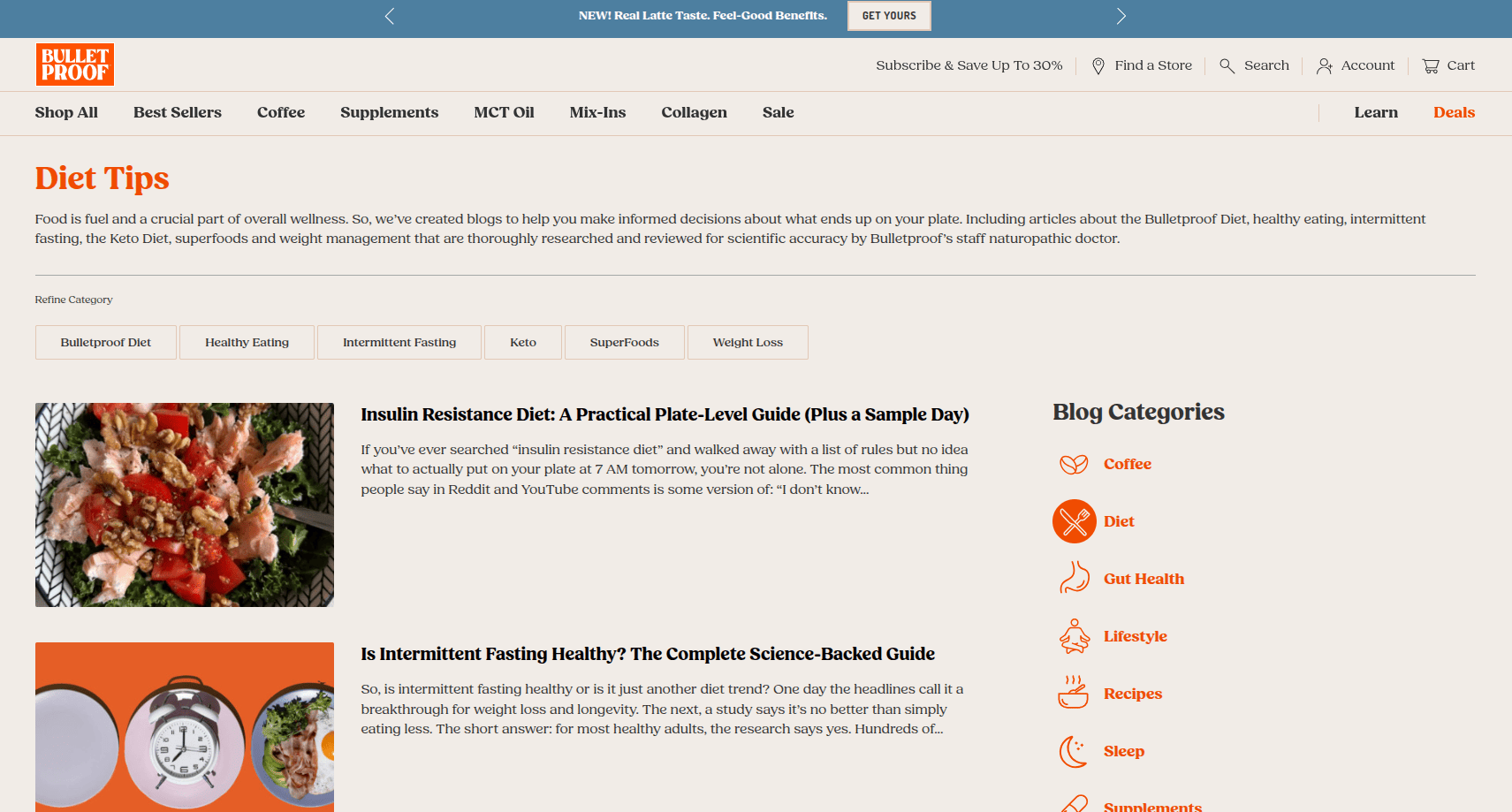
AI Articles for quick drafts: You can generate full drafts from your outline and keyword set, then have editors refine tone, examples, and internal references.
Rank tracker and SERP analysis tools: Surfer lets you follow keyword positions and examine SERPs for difficulty and intent, helping you decide what to update and which topics to tackle next.
Worth knowing
Some useful capabilities, such as deeper SERP analysis and rank tracking, sit behind add-ons, so your real monthly cost may be higher than the entry plan.
Monthly credits do not roll over, so unused editor or article slots expire at the end of each billing period.
Pricing
Surfer SEO pricing starts at $119/month (billed monthly) for a Standard plan and at $219/month for the Pro plan, with custom packages for larger teams. New users get a 7-day free trial.
Scalenut aims to give you near-publish-ready SEO drafts that follow clear patterns. It leans on strong structure with comparison tables, FAQs, and summaries already filled out in most long-form pieces, which is helpful if your team likes templates and repeatable post types.
The tool also offers the Social Upreach feature, where you can tap into Reddit threads to better understand your brand sentiment or discover exciting, new topics to write about.
Standout features
Pre-structured long-form drafts: Generated articles usually include headings, tables, and FAQ blocks, so you avoid rebuilding the layout each time and can focus edits on accuracy and voice.
AI visibility dashboards: Scalenut tracks how content performs in search and AI overviews, giving you a simple view of which topics gain traction and where to focus next.
Internal linking and topic gap tools: The platform suggests internal links and missing supporting topics so you can build simple content clusters without separate research software.
Publishing integrations with major platforms: Scalenut connects to WordPress, Shopify, and PrestaShop, letting you push content directly into your CMS instead of copying and reformatting.
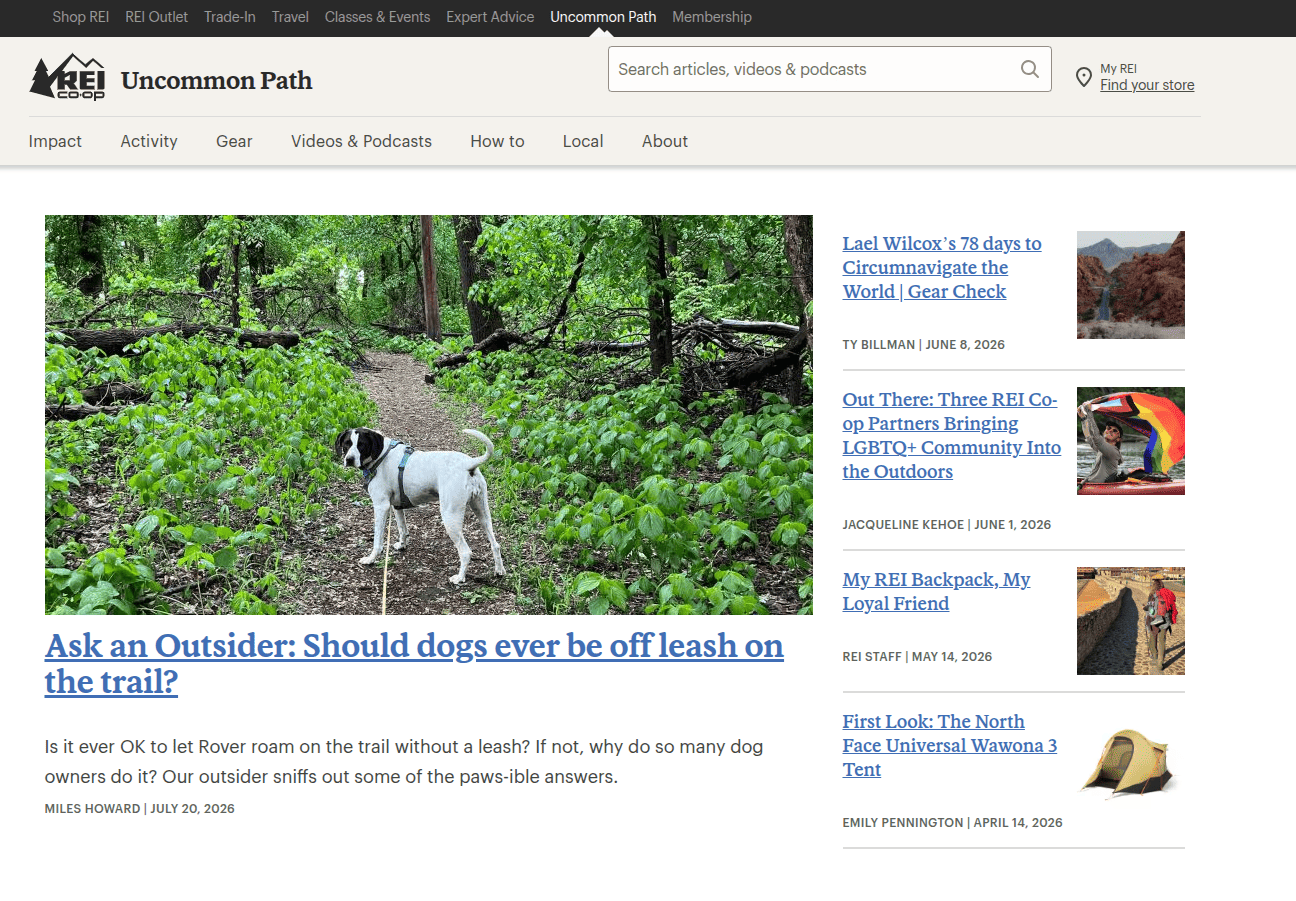
Worth knowing
The default content structure can feel rigid, so you might have to spend some extra time reshaping sections according to your requirements.
Clustering helps but is not perfect on intent, so you still need to think about overlap between similar articles.
The backlinks marketplace is very basic in functionality, so you’ll still need separate SEO tools to fulfil that purpose.
Pricing
Scalenut pricing plans start at $59/month, with 5 GEO-ready articles, 10 prompts to track, and access to only 1 workspace. You can also get a 7-day free trial to experience the Cruise Mode, content optimizer, keyword planner, and a bunch of other features before committing.

Writesonic presents itself as a full SEO content platform rather than a basic AI text generator. You can run keyword research, site audits, content generation, and basic GEO-aware optimization in one place, which is appealing if you want fewer tools in your stack.
Standout features
Guided multi-step article workflow: You pick competitors, define primary and secondary keywords, tweak tone, and approve the outline before drafting, giving you more control than a single prompt.
Automatic link and element insertion: Writesonic can add internal links, external links, FAQs, quotes, and images during generation so drafts feel richer out of the box.
Integrations for publishing and automation: The tool connects with WordPress, Sanity, Contentful, and Contentstack, helping you push drafts into your CMS directly. It also offers REST API and Zapier integrations to automate parts of your workflow.
Site audit and keyword features: You can scan your domain for content gaps and basic technical issues and tie that insight directly to new articles.
Worth knowing
The step-based mode can take several minutes to finish a single article, which may slow down teams looking to scale their content creation process.
Credit-based pricing can be confusing for users, and the word credits can diminish quite quickly when creating or auditing content for SEO or GEO.
Pricing
Writesonic pricing starts at $99/month, where you can get 50 prompts and 50 AI answers tracked daily for ChatGPT, Gemini, and Google AI Overviews. Higher plans unlock access for up to 10 AI models. You can get free access to Writesonic’s AI writing capabilities (limited words).
KoalaWriter built its reputation on fast, affordable blog generation for solo creators and small sites.
The tool skips heavy workflow steps in favor of getting a keyword to a publishable draft with minimal setup. This makes it a reasonable pick if GravityWrite’s price and reliability issues are your main complaint.
Standout features
Real-time SERP data pull: Drafts pull in live search data during generation, so outputs reference current top-ranking articles instead of relying only on the model’s training data.
Built-in AI image generation: Koala includes image creation alongside text, so you are not forced into a separate tool just to get a featured image.
Multiple AI models available: KoalaWriter provides its users with the option to choose between GPT-5 mini, GPT-5.2, and Claude 4.5 Sonnet models, providing flexibility when creating content.
Worth knowing
The tool may offer a very simplistic UI, which does look outdated to many users.
Outputs from KoalaWriter still require a lot of editing to maintain originality and technical accuracy for specific niches.
Restrictive monthly word credit system means you might have to skip some content for your clusters and plan them when the billing cycle renews.
Pricing
KoalaWriter pricing starts at $9/month for the ‘Essentials’ plan with 15,000 words and AI-powered SEO optimization.
#7: Cuppa
Cuppa is designed for writers who want robust editing controls. Instead of hiding research in another tab, Cuppa keeps headings, questions, and guidance beside the text as you write, making it a good GravityWrite alternative if you enjoy hands-on editing.
Standout features
SERP context inside the editor: You see top page headings and questions while drafting so you can cover the right angles without copying layouts.
Flexible, natural-sounding drafts: In our testing, we found Cuppa’s outputs to feel less rigid than template-heavy tools, such as Scalenut or Frase, making it easier for editors to tweak tone or structure.
Support for other types of content: Cuppa not only focuses on long-form content, but can also write landing pages, newsletters, and emails for you.
Local SEO component: Unlike many tools on this list, Cuppa AI also offers local SEO features where you can create lead-capturing service pages with proper keyword optimization according to your location.
Worth knowing
To unlock deeper research features, you need the Power User plan plus a Perplexity API key, which adds extra setup and cost.
Bulk or fully automated workflows are limited, so larger agencies may want another tool for high-volume production.
Pricing
Cuppa pricing plans start at $119/month, named as ‘Build Your Brand System’ with discounts for yearly commitments. The starter plan contains SERP analysis, brand DNA feature, and a detailed performance dashboard. You can try the tool for free for 7-days before purchasing.
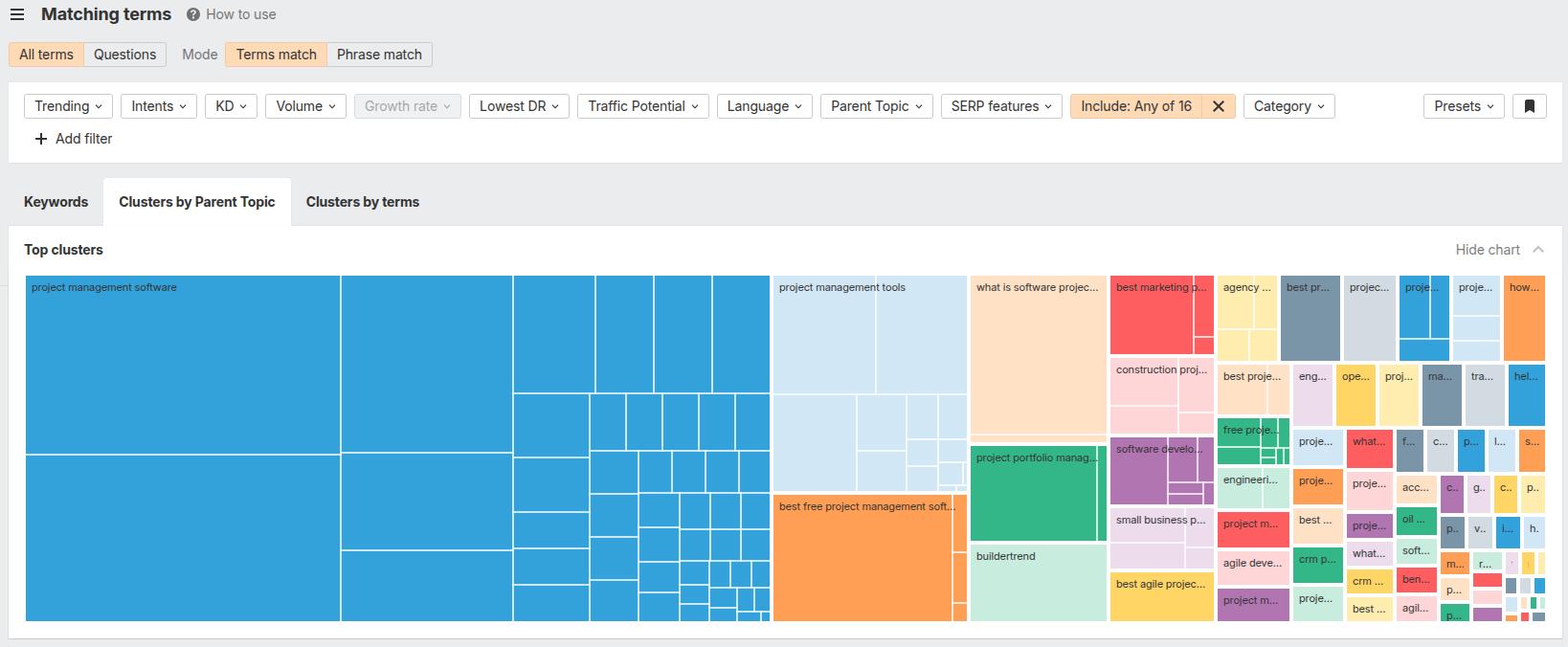
#8: Jasper
Jasper grew quickly as one of the first widely known AI writing platforms and now leans toward larger marketing teams that care about brand voice and approvals across channels. If your main worry is keeping many writers on message, Jasper can be a much better fit than GravityWrite.
Standout features
Central brand voice controls: You can set tone, style, and messaging in one place so Jasper keeps drafts closer to your brand standards across writers and formats.
Workflows for many content types: The platform supports blog posts, ads, emails, product copy, and more so you can keep most of your writing work in one system.
Collaboration and approval tools: Managers can review, comment, and approve content inside Jasper, which shortens feedback cycles and keeps work history in one place.
Template library for repeatable tasks: You get many writing templates for common copy and blog writing tasks, helping non-specialist writers produce content faster.
Worth knowing
SEO features exist but are not as deep as tools like Contentpen, Surfer, or Frase, so search specialists often pair Jasper with a dedicated SEO platform.
Pricing is per user, so large teams can see costs rise if many people need direct access to the platform.
Pricing
Jasper Pro commonly starts at $69/user/month, with custom Business plans for bigger organizations that need more seats, security, and support.
SEO.ai behaves more like a content autopilot than a regular AI writer. You give it a site, and it builds a content calendar, writes posts on a fixed schedule, and publishes them with internal links added.
It appeals to small businesses who want content without hiring an expensive in-house team or raising overheads.
Standout features
Automated content calendar creation: The tool scans your site and plans topics itself, giving you a schedule without spending hours planning different types of keywords.
Automatic writing and publishing: SEO.ai writes and posts around 4 – 8 articles per month per site, adding internal links and basic optimization with little ongoing input from you.
Localization strength: Content often reflects local phrases and context for your region and language so local service businesses can sound natural to nearby readers.
Multi-site support at higher tiers: Agencies or owners with several sites can connect them in one account and see activity at a glance.
Worth knowing
You give up fine-grained control of content structure and depth. Your tweaks may also show up, but not until the next content cycle.
This pattern suits hands-off owners more than SEO practitioners who want frequent, detailed tuning of their platform.
Pricing
SEO.ai pricing starts at $149/month for one site in one language and climbs for higher tiers that support more domains and posts per month. You can avail the 7-day free trial to learn more about the tool before purchasing it.
#10: Machined
Machined is built for SEO agencies and publishers who think in clusters, pillars, and internal linking from day one. The tool lets you define a topic and have the system plan and generate the related set of articles for you, automating your content marketing strategies.
If we do a direct Machined vs. GravityWrite comparison, we can see that Machined is the better option if you want to put your content on autopilot. While GravityWrite features are more diverse, Machined is more focused on organic growth through a systematic approach.
Standout features
Cluster-first approach to planning: Machined assigns each article a role inside a cluster so pillar content and pieces focusing on long-tail keywords work together to grow topical coverage.
Automated internal linking setup: Links between articles use natural anchor text and follow your structure, which saves hours of manual link mapping.
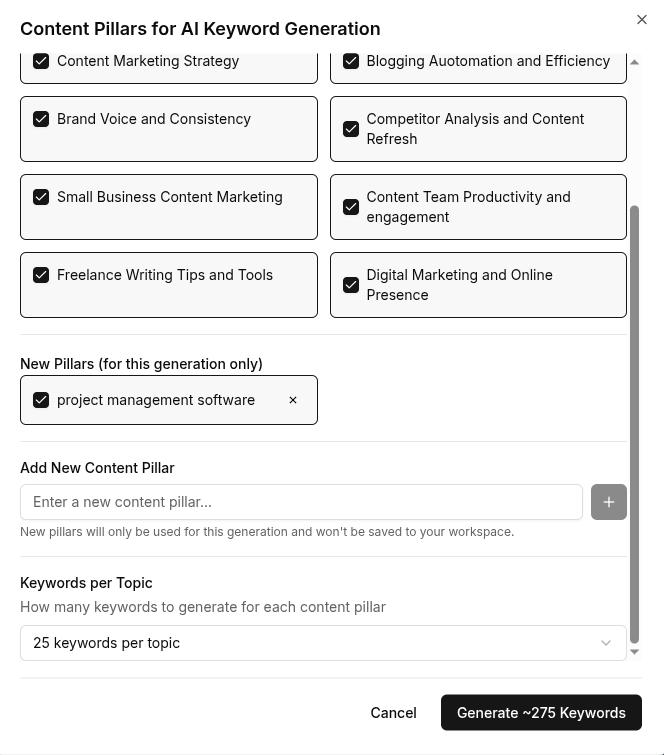
CMS ready output: Articles can be pushed into your CMS with structure and links already in place, supporting bulk content creation.
Bring your own API model: You connect your own AI provider keys so content costs stay close to raw usage, which is helpful when you publish content at scale.
Worth knowing
Machined focuses on SEO articles only, not email, ads, or social content, so you may still pair it with other AI writing tools.
Drafts need editorial review, especially on specialist subjects, before you approve them for clients or publication.
Pricing
Machined offers a starting plan of $19/month, which contains 30 articles/month, AI images, and content clusters. You can only try the tool for free for 3 days.
How to choose the right GravityWrite alternative for your needs
Choosing between these GravityWrite alternatives starts with your workflow, not the tool with the longest feature list. Every platform here solves a slightly different problem, so you get the best results when you match that strength to your main pain point.
If we review the tools by team size constraint, you can get the following recommendations:
Solo creators and freelancers: KoalaWriter works well if budget is your main constraint, while Cuppa AI suits writers who want strong SERP context in the editor and can spend a bit more.
Small content teams and startups: Scalenut or Contentpen are good fits. Scalenut gives you quick, structured SEO drafts, while Contentpen adds research, GEO optimization, and a content calendar in one workspace.
Agencies and large publishers: For agencies, Machined, Surfer SEO, or Contentpen are the best options. Machined supports cluster building, Surfer combines writing with rank tracking, and Contentpen streamlines long-form blog production for many clients.
Reviewing these GravityWrite alternatives by goals and budget surfaces these important recommendations:
Rankings and AI search visibility: For this purpose, we’ll give the edge to Contentpen, Frase, and Surfer SEO, all of which emphasize SERP intent, structure, and GEO and SEO scoring.
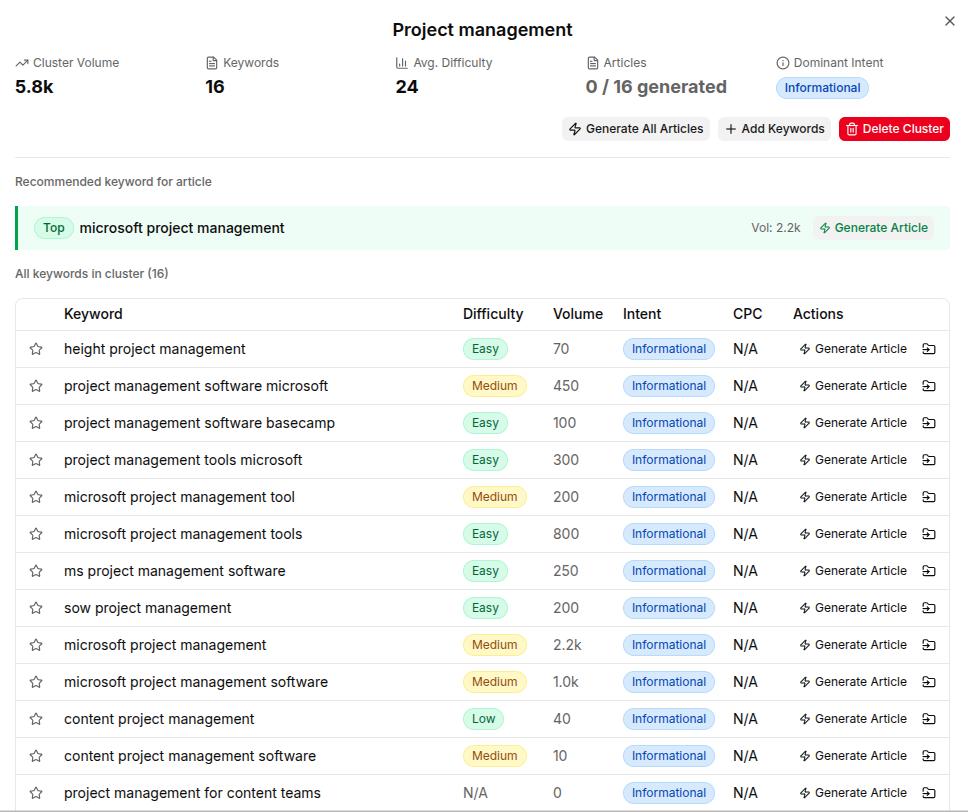
Simplifying your tool stack: Writesonic or Contentpen can reduce the number of separate apps you manage. Both of these are end-to-end solutions, with Contentpen slightly edging Writesonic on content planning and bulk creation.
Hands-off content execution: For this purpose, SEO.ai, Machined, and Contentpen are suitable options as they can run much of the content process for you without any manual hassle.
The bottom line
The best GravityWrite alternative for you depends on what is slowing you down right now. Maybe your drafts feel too generic, your SEO plan sits in scattered sheets, or you burn hours moving content between tools.
Each platform in this guide targets one of those friction points, and selecting the right one becomes easier when you understand what’s hurting your team.
You do not need a huge stack to start seeing better results. Pick one tool that fixes your biggest gap, then add others only if a real need appears.
If long-form, search-ready blog content is your main growth lever, Contentpen is worth a close look, since it covers research, drafting, optimization, and publishing for your blog in one place.
Write content that’s built to rank, not just read
Create search-optimized blogs aligned with SEO and GEO signals, so your content performs well across search and AI-driven discovery.
GravityWrite is only free to use for the first 1,000 words. After that, you’ll be required to purchase a license, starting from $49/month for the Plus plan.
Is GravityWrite worth it for content creators?
GravityWrite can be worth it if you are starting out and mainly need quick drafts at a low price. Once your content volume grows and rankings matter more, focused tools like Contentpen usually bring better long-term results.
What is the best AI for long-form content writing?
Contentpen is the best AI for blogs and articles. It covers everything, from keyword research to CMS publishing, and post-publishing analytics. Frase and Surfer SEO are also strong options when SERP alignment is your top priority.
Can GravityWrite generate AI images?
Yes, GravityWrite includes a built-in AI image generator alongside its writing features, which is handy for quick blog visuals or social graphics. If image quality is central to your brand, specialist tools like Reve AI or Manus AI usually create stronger visuals.
Which GravityWrite alternative is best for SEO and AEO teams?
For SEO and AEO teams, Contentpen works well when you need a full blog workflow from research through publishing for a brand. Machined suits teams that build large topic clusters with internal linking, while Surfer SEO is a strong choice when on-page SEO scoring is a priority.