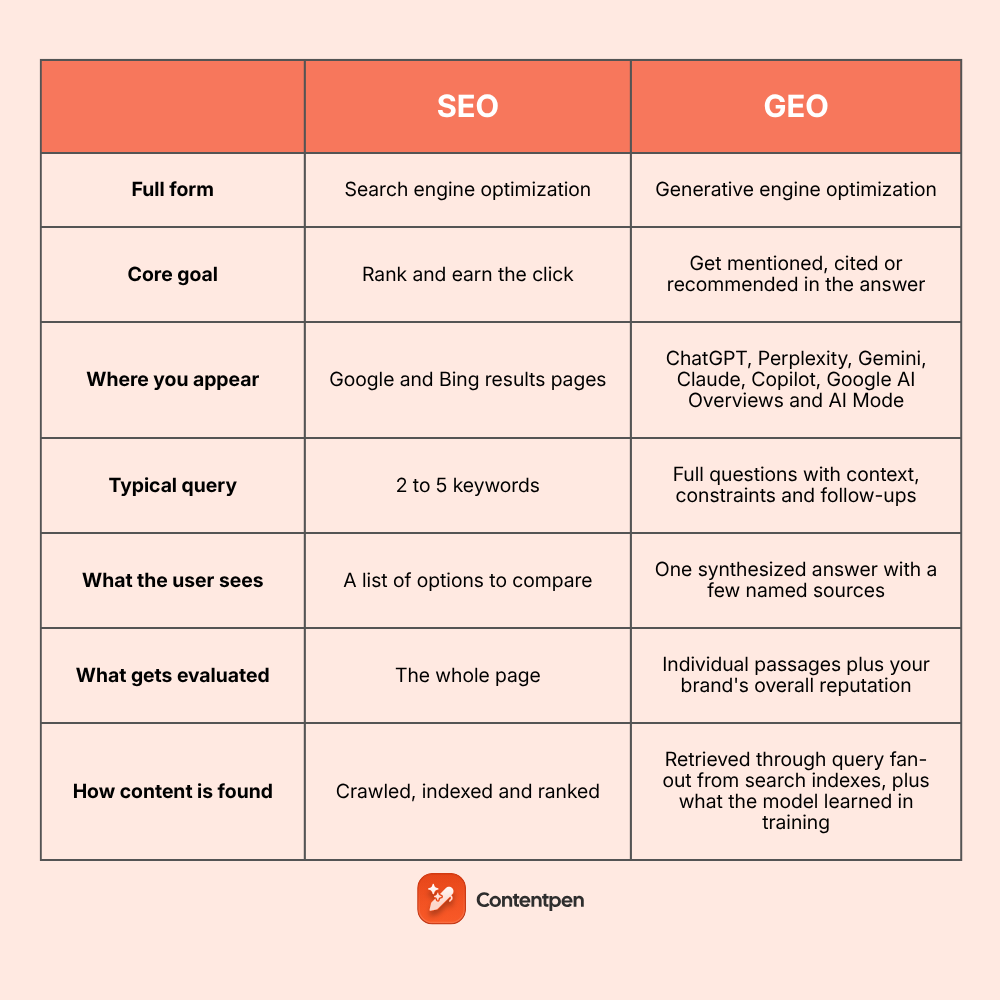
SEO (search engine optimization) helps your pages rank in Google’s results so people click through. GEO (generative engine optimization) helps your brand get mentioned and cited inside answers written by ChatGPT, Perplexity, Gemini, and Google AI Overviews.
One earns a position. The other earns a place in the answer itself.
Think about the last time you asked an AI tool for a recommendation. Did you scroll through ten blue links afterward, or did you trust the three names it gave you?
Your buyers do the same. SparkToro’s 2026 clickstream study found that 68% of US Google searches now end without a click. Strong rankings still matter, but they no longer guarantee you get seen.
The smart move isn’t to drop SEO for GEO. It’s to understand what each one rewards and run them as one strategy.
Below, you’ll see how they differ, how AI engines pick sources, which tactics carry over, and how to split your effort.
Key takeaways
- SEO wins rankings and clicks. GEO wins mentions, citations, and recommendations inside AI answers.
- SEO evaluates whole pages. GEO is judged passage by passage and across everything the web says about your brand.
- Ranking still helps you get cited, but the link is weakening as AI engines pull from deeper in the results.
- GEO is not a replacement for SEO. It’s an extra layer built on crawlable, trusted, well-structured content.
- Measure GEO with share of voice, citation rate, and sentiment alongside rankings and traffic.
- Most teams can run both with one content process and a small shift in time and priorities.
What does SEO mean in 2026?
SEO is the practice of improving your website so search engines rank it higher for relevant queries. The reward is a click from someone who chose your result over the others.
The core hasn’t changed much. You still need:
- Content that matches search intent
- A site Google can crawl, render, and index
- Backlinks and mentions that signal authority
- A page experience people actually enjoy
What has changed is the results page around you. AI Overviews, AI Mode, videos, and forums now compete for the same screen space.
What does GEO mean, and where did it come from?
GEO is the practice of shaping your content and online presence so generative AI engines mention, quote and recommend you. Success isn’t a position on a page. It’s being part of the answer.
The term comes from a 2023 research paper on generative engine optimization by researchers at Princeton and partner institutions. They showed that content changes like adding statistics, quotes, and sources could lift a page’s visibility in AI responses by up to 40%.
So what does a generative engine actually do?
It reads many sources, writes one answer, and credits a handful of them. GEO is about being one of those few, and it sits inside the wider practice of AI search optimization.
GEO vs SEO: what’s the actual difference?
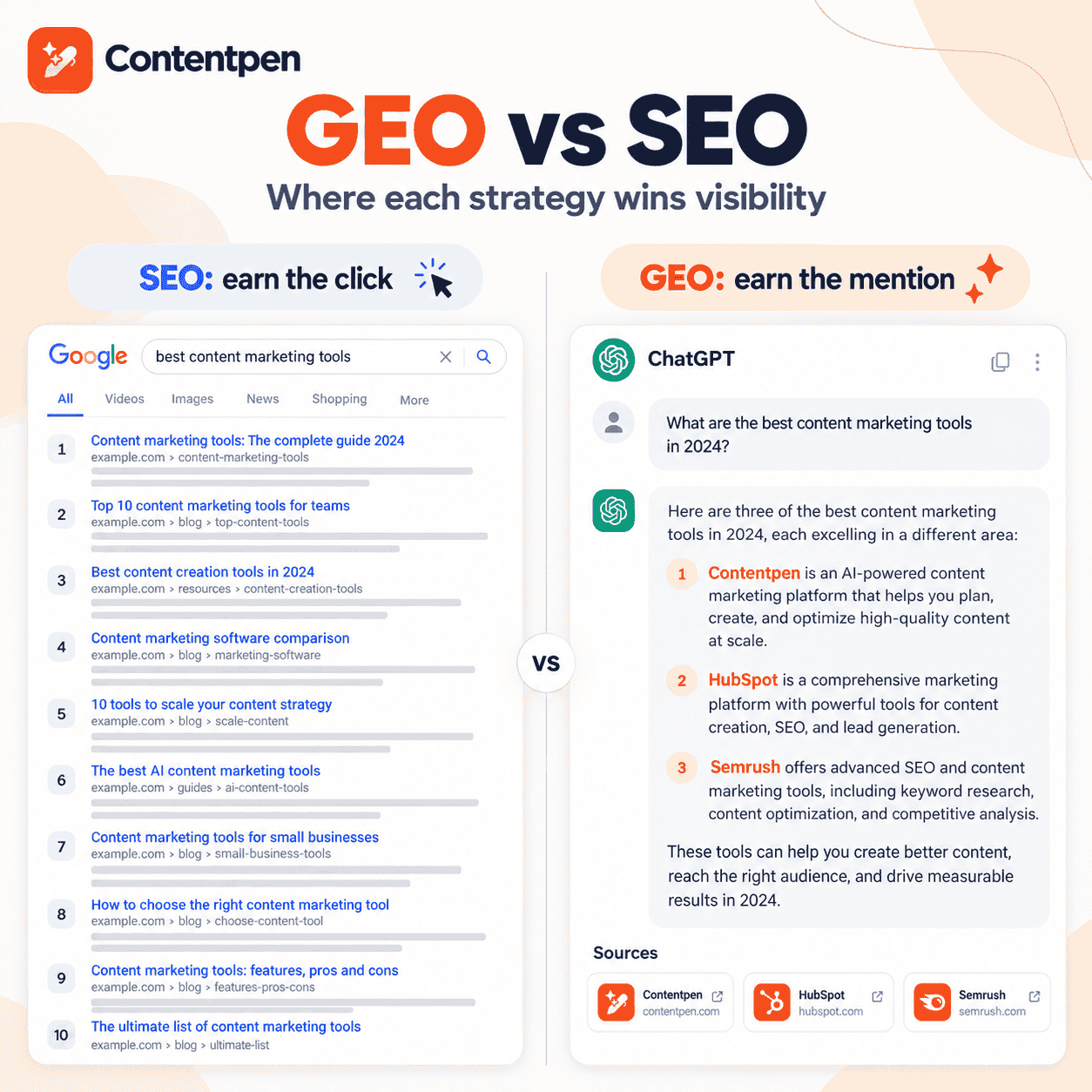
The biggest shift is what gets judged. SEO scores a page. GEO scores passages from your page plus everything else the web says about your brand.
| Dimension | SEO | GEO |
|---|---|---|
| Full form | Search engine optimization | Generative engine optimization |
| Core goal | Rank and earn the click | Get mentioned, cited, or recommended in the answer |
| Where you appear | Google and Bing results pages | ChatGPT, Perplexity, Gemini, Claude, Copilot, Google AI Overviews and AI Mode |
| Typical query | 2 to 5 keywords | Full questions with context, constraints, and follow-ups |
| What the user sees | A list of options to compare | One synthesized answer with a few named sources |
| What gets evaluated | The whole page | Individual passages plus your brand’s overall reputation |
| How content is found | Crawled, indexed and ranked | Retrieved through query fan-out from search indexes, plus what the model learned in training |
| Main selection signals | Relevance, backlinks, technical health, page experience | Clear answers, specific facts, entity consistency, third-party mentions |
| Role of links | Backlinks are a core ranking signal | Unlinked brand mentions and co-citations matter as much as links |
| Content that wins | Comprehensive pages matched to search intent | Self-contained passages, original data, quotes and comparisons |
| Off-site work | Link building and digital PR | Reviews, Reddit and forums, listicles, news coverage and community answers |
| Technical focus | Crawlability, site speed, Core Web Vitals, schema | Same basics, plus access for AI crawlers and key content in plain HTML text |
| Traffic pattern | Clicks are the main payoff | Many answers end without a visit, so visibility counts even without clicks |
| Personalization | Results vary mainly by location and device | Answers vary by wording, conversation history and follow-up questions |
| Success metrics | Rankings, CTR, organic traffic, conversions | Mention rate, citation rate, share of voice, sentiment |
| Typical tools | Search Console, Ahrefs, rank trackers | AI visibility trackers and repeated prompt testing |
| Stability | Fairly stable week to week | Answers can change between runs, models and updates |
| Time to results | Weeks to months after indexing | Days for engines that search live, longer for what models learn in training |
| Maturity | 25+ years, with official search engine guidelines | Named in 2023, with few official guidelines so far |
One row deserves a second look: what the user sees. In SEO, you compete for attention on a list. In GEO, the AI has already made the shortlist for the user.
How do AI engines decide which sources to cite?
No AI company publishes a full formula. Still, most AI search tools follow a similar path when they answer a question.
- They expand the question: One prompt becomes several related searches behind the scenes, often called query fan-out.
- They retrieve candidate pages: Many pull from a live search index, so crawlable, indexed pages have the edge.
- They pick useful passages: Short, self-contained answers with clear facts are easier to lift.
- They write the answer: The model blends those passages with what it already knows about each brand.
- They attribute sources: A few URLs get cited or linked, and some brands get named without a link.
This is where SEO and GEO start to drift apart.
In July 2025, Ahrefs found that about 76% of AI Overview citations came from pages ranking in Google’s top 10. By March 2026, Ahrefs’ updated study put that figure at roughly 38%.
In other words, ranking still helps.
But more citations now go to pages that rank lower or not at all, as long as they answer the sub-question well.
Is GEO replacing SEO?
No, and the reason is simple. Most AI engines still need the open web to answer fresh questions, and they reach it through search indexes.
If Google or Bing can’t crawl and trust your page, AI tools built on those indexes are less likely to find it. Google’s own guidance on generative AI features in Search frames this work as part of SEO, not a separate discipline.
What is changing is the payoff. A top ranking used to mean steady clicks. Now it often means being one input to an answer the user reads without visiting you.
What does SEO still do for GEO?
More than most GEO advice admits. A lot of the groundwork is shared.
- Crawlability and indexing: AI search tools can’t cite what they can’t fetch.
- Topical authority: A cluster of strong pages signals expertise to rankers and models alike.
- Backlinks and mentions: Quality SEO backlinks double as trust signals that models pick up.
- Clear on-page structure: Headings, short paragraphs, and lists help both crawlers and passage extraction.
- Freshness: Updated facts help you rank and stop AI from repeating stale details about you.
Know exactly what to fix, before publishing to get it ranked!
Get real-time SEO feedback while writing, no guesswork, no plugins.
Try SEO Scoring →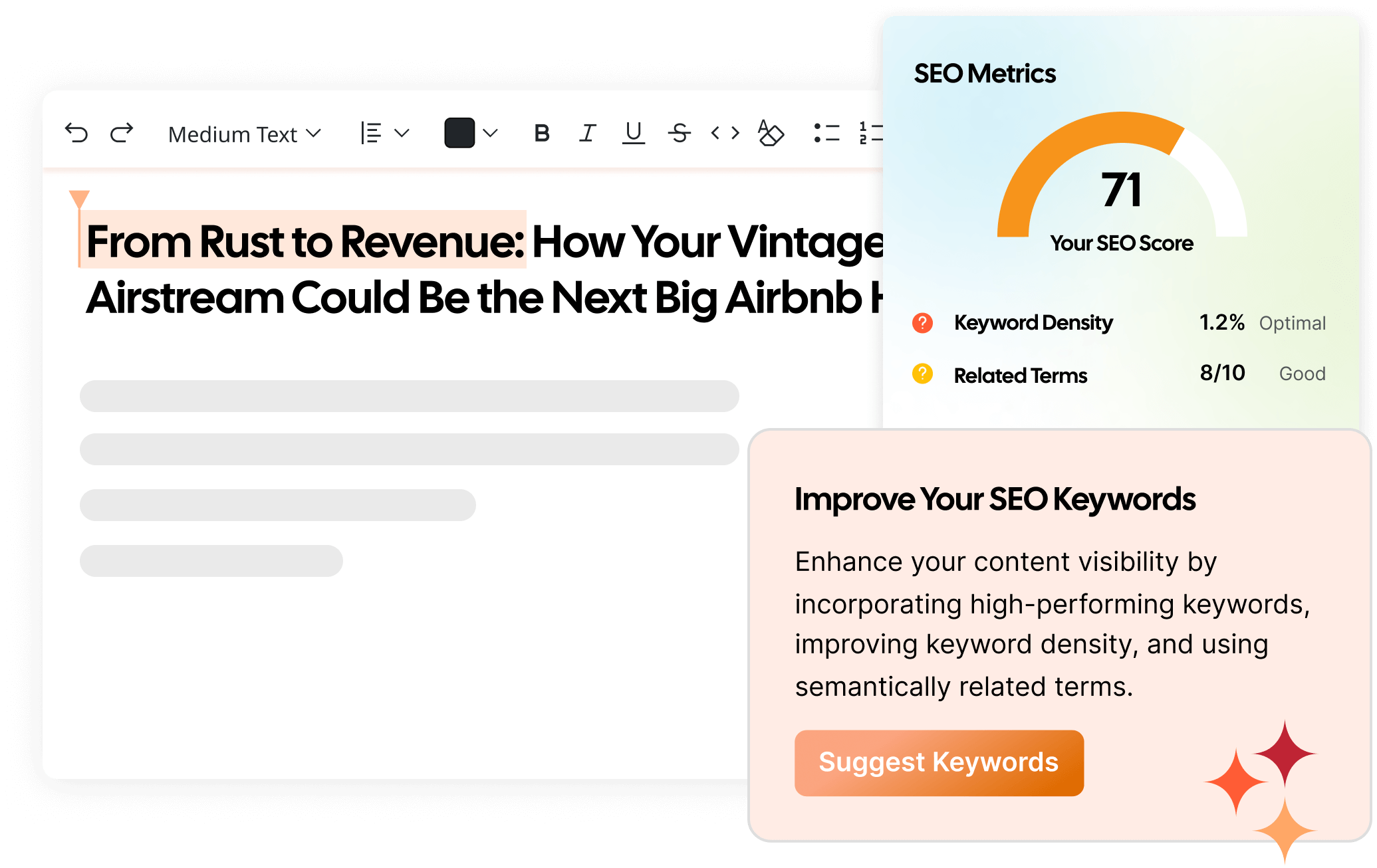
If your site already passes a solid on-page SEO checklist, you’ve done much of the GEO prep without realizing it.
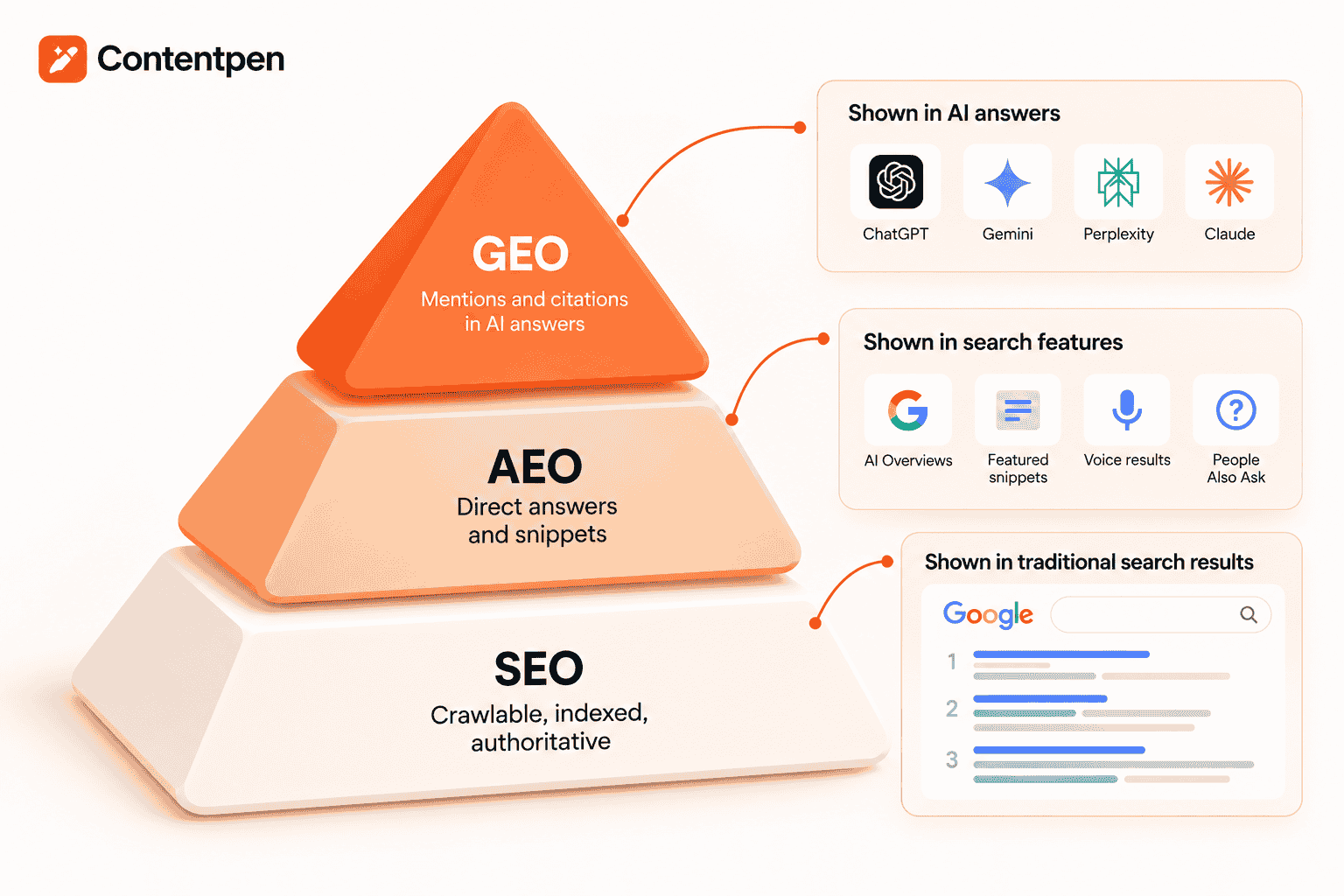
Where do AEO and AIO fit next to GEO and SEO?
You’ll see a few more acronyms in this space. Here’s the short version of each full form.
- SEO (search engine optimization): ranking pages in search results.
- AEO (answer engine optimization): winning the single direct answer in snippets, voice, and AI Overviews.
- GEO (generative engine optimization): earning mentions and citations in AI-written answers.
- AIO (AI optimization): a loose umbrella term, sometimes used just for Google AI Overviews.
Think of SEO as the foundation, answer engine optimization as the bridge, and GEO as the newest layer. The labels overlap, so focus on the outcome you want rather than the acronym.
Which SEO tactics should you keep, and what should you add for GEO?
You don’t need a second playbook. You need a few additions to the one you have.
| Keep doing this for SEO | Add this for GEO |
|---|---|
| Target keywords with clear intent | Target full questions and follow-up prompts buyers ask AI |
| Write comprehensive pages | Open every section with a direct, quotable answer |
| Build backlinks | Earn brand mentions in reviews, listicles, forums and news |
| Optimize title tags and meta descriptions | Describe your brand, category, and audience the same way everywhere |
| Add schema markup | Publish original data, quotes and named sources |
| Refresh content when rankings drop | Refresh when AI answers describe you wrongly or skip you |
Notice the theme? SEO tactics mostly live on your site. GEO tactics push you outward to the places models learn from.
Each engine also behaves a little differently. Our comparison of how Perplexity and ChatGPT differ shows why it pays to test prompts on more than one.
How do you measure GEO compared with SEO?
SEO reporting is mature. GEO reporting is newer, so you’ll need a few fresh metrics next to your usual SEO analytics.
| SEO metric | GEO counterpart |
|---|---|
| Keyword rankings | Mention rate across a fixed set of prompts |
| Organic traffic | AI referral visits plus branded search lift |
| Click-through rate | Citation rate (how often your URL is linked) |
| Share of top 10 positions | Share of voice versus competitors in AI answers |
| Backlink growth | Growth in third-party sources AI engines cite about you |
Run the same prompts every month. AI answers vary between runs, so trends tell you far more than one screenshot.
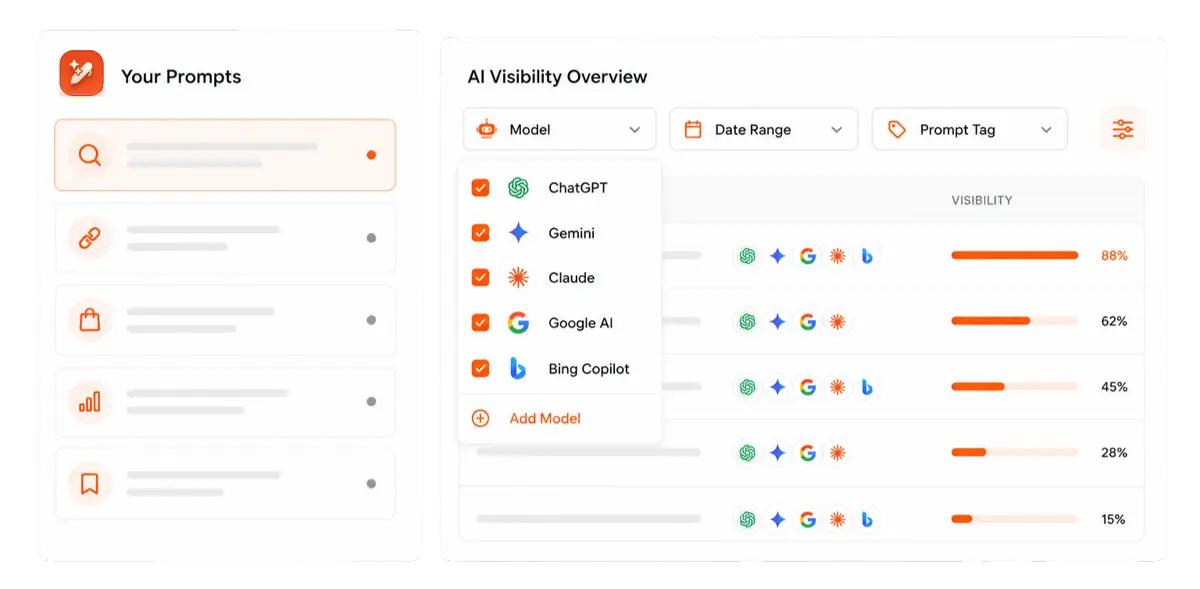
Find your brand in AI search

Track AI citations, share of voice, and brand sentiment
Find the top sources driving citations
How should you split time between SEO and GEO?
There’s no universal ratio, and anyone quoting one is guessing. Your split should follow where your buyers research.
- New site with little authority: put most effort into SEO basics. AI engines rarely cite brands nobody has heard of.
- Established site with steady rankings: keep SEO running and move a meaningful slice of time to GEO work like digital PR and prompt tracking.
- B2B or high-consideration products: lean further into GEO. Buyers often ask AI tools for shortlists before they ever search your brand.
- Local or transactional businesses: stay SEO-heavy, since many searches still end on maps, product pages, and booking forms.
Review the split each quarter. If your AI share of voice grows while rankings hold, you’ve found a balance that works.
What mistakes do teams make when moving from SEO to GEO?
A few patterns show up again and again.
- Pausing SEO to fund GEO: You weaken the foundation AI engines rely on.
- Chasing a single AI tool: Visibility in ChatGPT doesn’t guarantee visibility in Gemini or AI Overviews.
- Publishing vague thought pieces: Models quote specifics, not opinions without evidence.
- Ignoring what others say about you: Outdated reviews and old listicles shape AI answers too.
- Expecting overnight results: Off-site mentions take time to build and get picked up.
How does Contentpen help you run SEO and GEO together?
Splitting SEO and GEO across separate tools makes it hard to see the full picture. Contentpen keeps both in one workflow, from research to reporting.
- Spot what to fix first. SEO opportunities surface competitor gaps, pages worth recovering and keyword cannibalization from your Search Console data.
- Write for rankings and answers. Articles come with key takeaways, FAQs and question-based headings that AI engines can lift easily.
- Check both scores live. SEO and GEO scoring grades each draft as you write, and “Fix with AI” resolves issues from both sides at once.
- Optimize for AI search. The AI search optimization tool helps shape content for how AI engines read and cite pages.
- Track where you show up. AI visibility tracking covers ChatGPT, Google AI, Perplexity, Gemini, Copilot, Grok, and Claude, with share of voice and source gaps.
You can publish straight to WordPress, Shopify, Wix, and other platforms when a piece is ready.
Want to rank on Google and get cited by AI from one dashboard? Start with Contentpen’s AI SEO tool today.
Rank for the click, earn the citation
SEO and GEO chase different rewards. SEO wins the visit, while GEO wins a spot in the answer before anyone visits.
They still share the same roots: crawlable pages, real expertise, clear structure, and a trusted brand. Keep your SEO strong, add GEO tactics on top, and measure both every month.
The brands that do this now will be the names AI keeps repeating later.
Frequently asked questions
No. In this context, GEO means generative engine optimization. Geo-targeting and local SEO are about reaching people in a specific location, which is a separate practice.
Partly. Clicks from ChatGPT, Perplexity and similar tools often appear as referral traffic. Mentions without a click leave no session, so track branded searches and direct visits too.
Usually not. Most pages need restructuring rather than rewriting, such as adding a direct answer under each heading and updating facts.
Google focuses on quality, not on how content was produced. Our breakdown of whether Google penalizes AI content explains where the real risks are.
Write 10 to 20 questions your buyers would ask, then run them in ChatGPT, Perplexity, Gemini and Google. Note who gets named, which sources get cited and how you’re described.
Yes, at most small and mid-sized companies. The skills overlap heavily, though GEO adds more PR and community work than classic SEO.