Click-through rate (CTR) is the ratio of people who clicked your hyperlink to those who saw it.
In SEO, CTR shows how many users clicked through to your page from the SERPs, indicating the success of your content marketing efforts.
This article walks through the CTR formula, provides step-by-step examples for calculating CTR, explains what counts as a good or average click-through rate, and offers specific tactics for improving CTR in real campaigns.
It also shows how smart tools like Contentpen help content marketers and agencies write titles, body content, and descriptions that drive clicks and, therefore, revenue.
So, keep reading on to discover everything about CTR.
What is click-through rate (CTR)?
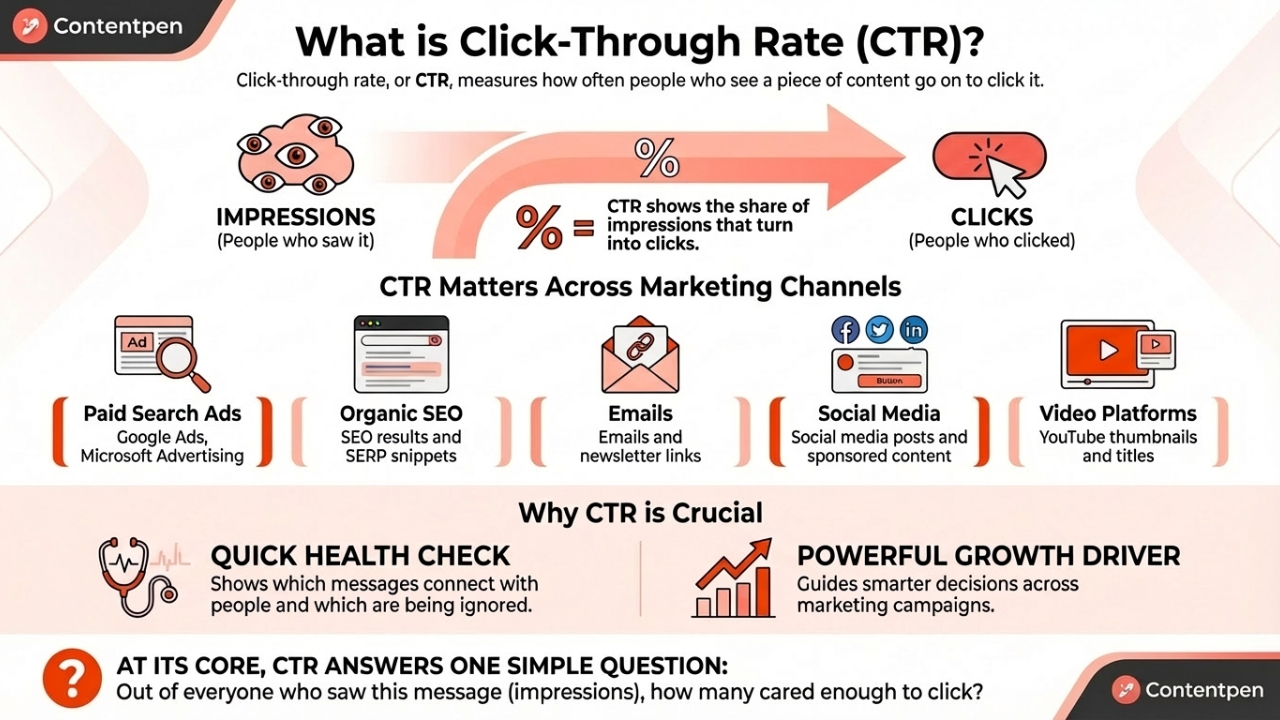
Click-through rate, or CTR, measures how often people who see a piece of content go on to click it. In simple terms, CTR shows the share of impressions that turn into clicks.
Click-through rate matters across almost every channel used in marketing, including:
- Paid search ads (Google Ads, Microsoft Advertising)
- Organic SEO results and SERP snippets
- Emails and newsletter links
- Social media posts and sponsored content
- Video platforms such as YouTube, where thumbnails and titles drive clicks
CTR serves as both a quick health check and a powerful growth driver for digital marketing campaigns. It shows which messages connect with people and which ones are being ignored.
At its core, CTR answers one simple question: Out of everyone who saw this message (impressions), how many cared enough to click?
CTR is one of those metrics that, once tracked closely, starts to guide smarter decisions across marketing campaigns.
Read more: 30 recent innovative marketing examples in 2026.
The CTR formula
The CTR formula is very simple. No matter which platform is used, calculating CTR follows the same structure.
CTR = (Total clicks ÷ Total impressions) × 100
So, if your ad was seen by 1000 people, and only 20 users clicked on it, then your CTR will be 20/1000 = 0.02 x 100 = 2%.
Even though most platforms calculate CTR automatically, understanding the formula helps spot issues faster and compare performance across channels with confidence.
Is CTR a ranking signal in Google?
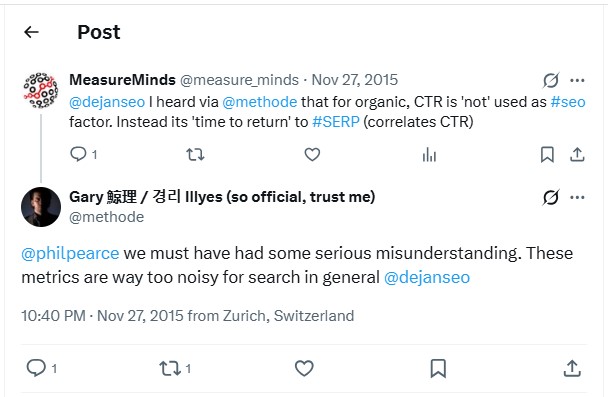
No. CTR is not a direct ranking signal for Google. As explained by Google representatives, it shows that a website is well-received by people for a particular search query, but it does not determine exactly where you appear in SERPs.
That said, CTR is a controversial topic in the SEO community. Some experts, like Rand Fishkin, conducted experiments that showed CTR is a ranking factor for Google. This created a lot of buzz among SEO specialists and led to many more debates, but sadly, to no avail.
In short, CTR can boost your rankings, but not on all platforms. It is a metric considered too noisy for search in general, as indicated by Gary Illyes in this thread:
Why CTR is critical for your marketing success
CTR is central to marketing because it shows how well ads and content connect with real people. A high CTR signals that the keyword, ad copy, creative, and offer match what the audience wants at that moment. A low CTR points to weak targeting, poor messaging, or both.
In paid search platforms like Google Ads, CTR does much more than show performance. It feeds directly into Quality Score, which is Google’s rating of how relevant an ad and keyword are for users.
One of the main pieces of Quality Score is expected CTR, which is based on how often people have clicked similar ads in the past.
Ad Rank, which decides where an ad appears on the search results page, depends on both bid and Quality Score. In simple form, the relationship looks like this:
Ad Rank = Maximum CPC bid × Quality Score
Because the expected CTR is part of the Quality Score, a higher CTR often leads to a better Ad Rank. This means your ads can place higher for a query without always raising bids.
Beyond auctions and bids, CTR also serves as a quick test of how well keywords, ads, and landing pages align.
For someone searching “emergency plumbing services,” an ad that reads “24/7 Emergency Plumbers Near You” feels like a perfect match and tends to earn a high CTR.
Meanwhile, a generic “Home Repair Deals” ad for the same search query would likely see a poor click-through rate. Watching CTR at the keyword and ad group levels helps you get more leads and revenue.
What is a good CTR? Industry benchmarks and context
There is no magic CTR number that fits every campaign. The quality of a click-through rate always depends on context, such as industry, channel, device, and the level of competition.
As a rough guide, consider the recent Google Click-Through Rates (CTRs) data by ranking position as a reference:
- Search ads in 2026 typically have a click-through rate of 1.1% to 2.1%.
- Organic results or search positions in SERPs usually have CTRs ranging from 1.6% to 39.8% for a specific query.
The strong search position numbers show that investing in organic SEO is still a powerful way to drive clicks and traffic on platforms.
Some industries draw strong personal interest, like travel, hobbies, or dating. These often have higher-than-average click-through rates.
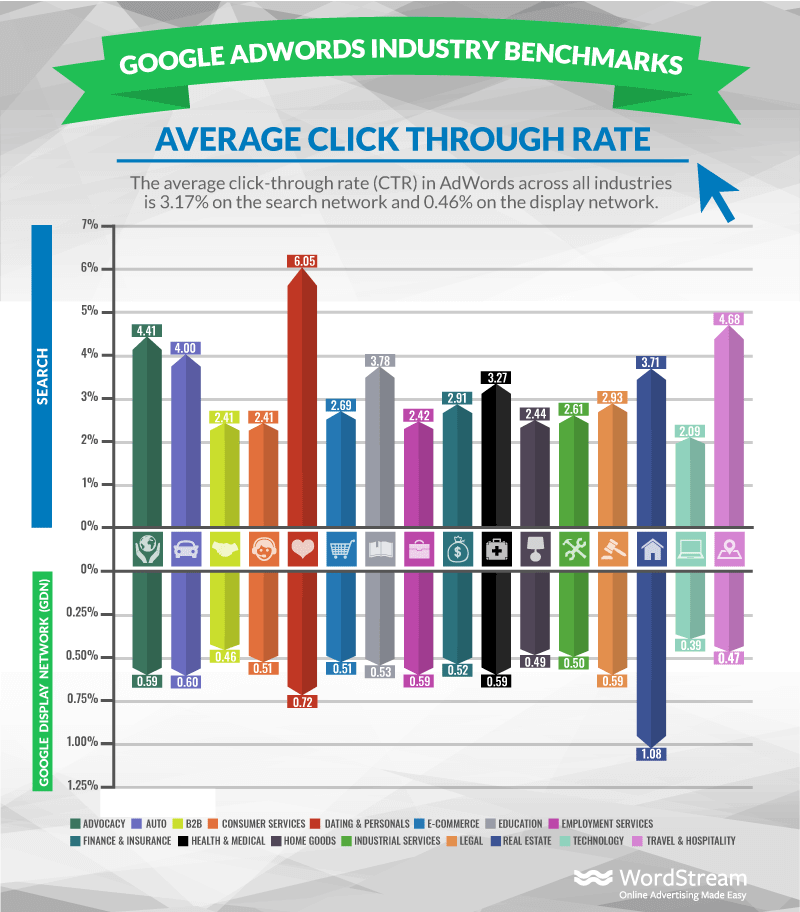
Source: WordStream.
More serious or complex fields, such as insurance and legal services, might see lower numbers than dating and personal services. This is because people often compare more legal or insurance options before purchasing, and so they move slowly through the funnel.
Other factors that influence what counts as a “good” CTR include:
- Ad position – The first paid result on a search page captures a large slice of the clicks, while position three or four shares attention with many other links.
- Brand vs. non-brand – Branded keywords, such as “Contentpen,” usually have very high CTRs because searchers already have the brand in mind.
- Device type – Some local searches do very well on mobile because click-to-call features make action easier, while longer research queries may be more useful for desktop users.
- Audience intent – Terms close to purchase (for example, “buy running shoes size 10”) typically earn higher CTR than early research terms (“best shoes for beginners”).
Rather than chasing a single benchmark, the best plan is to compare CTR against industry data and, even more importantly, against the brand’s own history.
Proven strategies to improve your click-through rate
Improving CTR is not about one secret trick. It comes from many small changes that make ads, listings, and content feel more relevant and more helpful.
The good news is that these changes are practical and can be tested quickly.
Refine keyword targeting
One important area is keyword targeting. Building tightly focused ad groups centered on closely related terms allows for very specific ad copy.
So, instead of putting “running shoes” and “dress shoes” in one group, separate them into topical clusters that you can target later on with ease.
This is where Contentpen can help you get started. The tool automatically creates topical clusters, enabling small businesses, agencies, and freelancers drive more clicks with efficient keyword targeting.
Example 1: Running shoes cluster
- Keywords: Best running shoes for men, lightweight running shoes, marathon running shoes
- Contentpen use: Generate a dedicated article optimized for performance runners, with matching titles like “Best Lightweight Running Shoes for Marathon Training” created with AI.
Example 2: Dress shoes cluster
- Keywords: Black dress shoes for men, formal leather shoes, office wear shoes
- Contentpen use: Create a tailored blog focused on professional and formal use, with headlines such as “Top Black Dress Shoes for Office and Formal Events.”
By using Contentpen to generate content for each topical cluster, your titles, meta descriptions, and on-page copy become better aligned with user intent.
Read more: What is on-page SEO?
This makes your listicles, how-to guides, and product update blogs feel more relevant and ready to improve CTR.
Improve ad and content copy
Next comes the ad or content copy. Headlines should echo the words people type into the search bar, since that instantly signals relevance.
Including the key phrase in the headline, such as “Click through rate calculator for agencies,” helps raise CTR SEO performance for that page.
If you are a service-based or product-based business, consider highlighting:
- Free or fast shipping
- Same-day or next-day service
- Extended guarantees or clear return policies
- Social proof, such as ratings or reviews
Clear calls to action, such as “Shop now,” “Get a free quote,” or “Book a demo,” guide users to the next step.
Use ad assets to earn more clicks
Ad assets provide additional ways to win clicks. They include headlines, descriptions, and business details (Name, Address, Phone Number) in your ad, making it more informative without extra cost per impression. Common asset types include:
- Sitelink assets – Send people straight to useful pages such as pricing, features, or case studies, which often improves CTR in business campaigns.
- Callout and structured snippet assets – Add short benefit phrases and lists that help your offer stand out.
- Location and call assets – Let local companies show a map pin or phone number so mobile users can call with one tap.
- Image assets – Add visuals that draw impressions for a better chance to earn clicks when several similar text ads appear together.
Testing different combinations of these ad assets often yields quick CTR lifts for your business, helping you get the required clicks quickly.
Align landing pages with ads
Landing page alignment closes the loop. When someone clicks an ad, the page should repeat the ad’s main promise in the headline and body copy. This helps audience retention because visitors quickly see that they are in the right place.
A strong landing experience usually includes:
- A headline that mirrors the ad message.
- Fast load times, especially on mobile.
- Clear layouts with one main call to action.
- Content that answers the key questions raised by the ad.
These elements support higher conversion rates, so gains from improving CTR turn into real revenue.
Bringing CTR thinking into content creation with Contentpen
Contentpen fits into this process by weaving CTR thinking into content creation. Its integrated SEO scoring and competitor analysis highlight which keywords, angles, and meta descriptions are more likely to earn a high CTR before a piece goes live.
Our AI blog writing tool also works after you’ve published your pieces. The analytics feature helps you view your website’s average CTR, pulling data directly from Google Search Console.
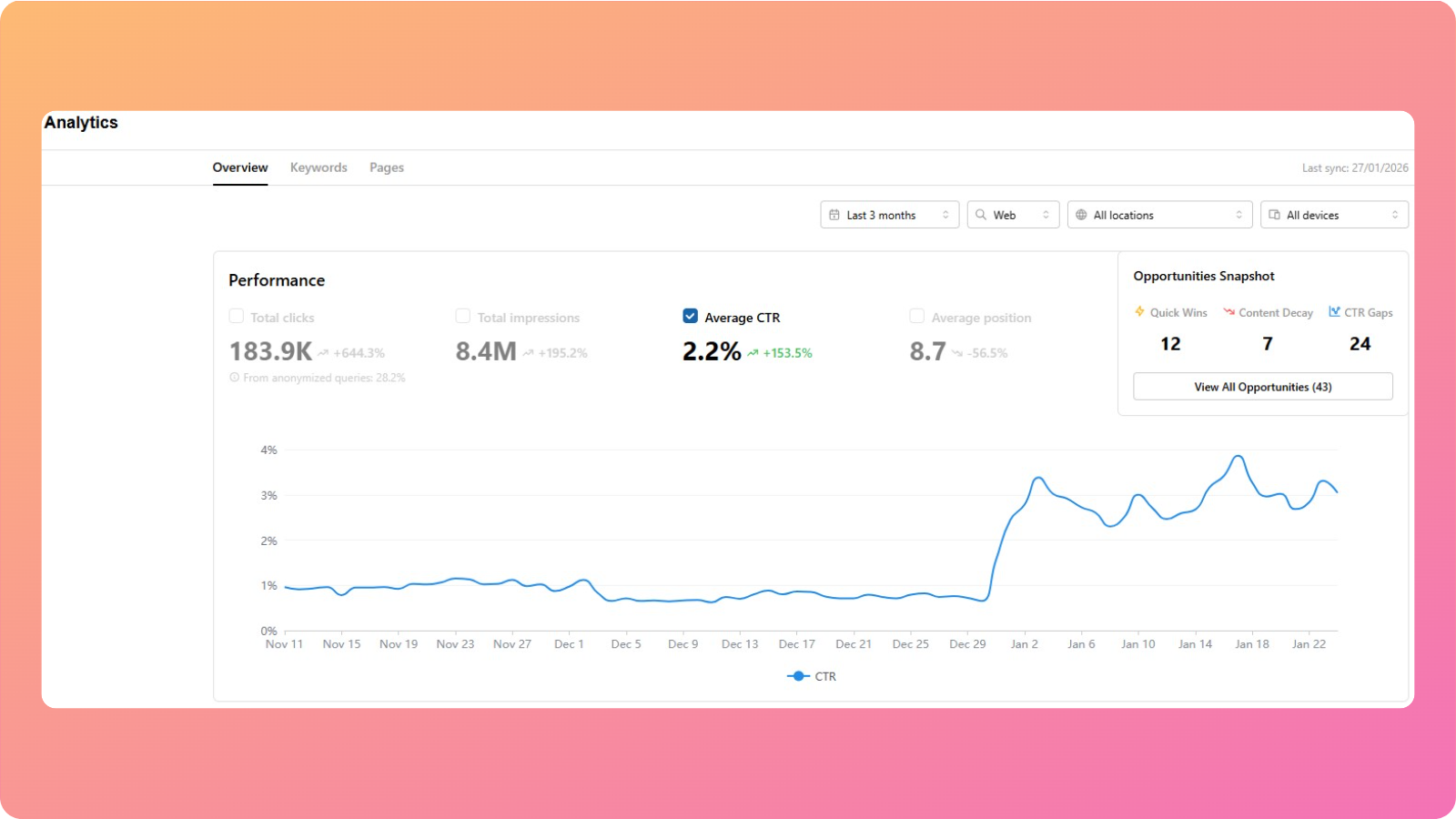
Furthermore, you can dissect CTR by keywords and pages, identify any CTR gaps using the opportunities feature, and act on the AI insights instantly to boost clicks.
The tool helps content teams and agencies create click-friendly assets that bring consistent gains across paid and organic channels over time.
Final thoughts
CTR sits between visibility and action. Impressions show how often people see a message, but click-through rate reveals whether that visibility actually sparks interest or not.
A high CTR often leads to better ad positions and lower costs, while a low CTR signals a problem with targeting, messaging, or both.
Tools such as Contentpen help by integrating CTR SEO thinking into the content workflow, from headline ideas to meta descriptions and body content.
The best next step is simple. Audit the current CTR across channels, identify the lowest performers, and test a single targeted improvement this week. Small, steady gains in CTR can compound into big wins for traffic, leads, and sales over time.
Frequently asked questions
CTR measures the share of impressions that result in clicks, while conversion rate measures the share of clicks that result in a desired action. That action might be a purchase, sign-up, download, or any other goal that matters for the business.
CTR measures the percentage of impressions that turn into clicks, while CPC (Cost Per Click) measures how much you pay for each click. In CPC marketing campaigns, improving CTR can indirectly lower overall acquisition costs because of stronger customer engagement.
In banking, CTR stands for Currency Transaction Report. It is a financial document that banks must file when a customer conducts cash transactions above a certain threshold. It is almost similar to CTR in finance, but completely different from the click-through rate in marketing.
Yes, indirectly. A consistently strong CTR can improve overall campaign performance metrics, allowing ads to compete more effectively in auctions. Better competitiveness can help maintain or increase impression share over time.
Sometimes an extremely high CTR raises a red flag instead of a celebration. If clicks are very high but the conversion rate is very low, the ad may be attracting the wrong people. This happens when you use overly broad keywords, vague messaging, or clickbait-style promises that attract curious users who never intended to buy or sign up.
Some CTR gains show up almost right away. Changes to ad copy, images, or ad assets can start to influence CTR within a few days, especially in high-traffic campaigns. Other changes, such as restructuring keywords or shifts in Quality Score, often take 2-4 weeks.
Leave a Reply