
Publishing blog posts that tick every keyword box and still sit on page three of Google can feel pretty painful. The title looks right, the main keyword is in all the “right” places, yet traffic barely moves. That is the gap semantic SEO is meant to close.
Semantic SEO shifts focus from stuffing in phrases to helping search engines understand what your page actually means.
Instead of only matching exact keywords, Google now looks at topics, context, and intent to serve results to users. That is why it is necessary to learn everything about semantic SEO in this article.
By the end, you will know what to change in your SEO strategy and how tools like Contentpen can help you do it faster and more consistently.
So, let’s begin, shall we?
What is semantic SEO, and how does it work?
Semantic SEO is a search engine optimization approach that focuses on satisfying the topics, context, and user intent, rather than targeting singular keywords or phrases in content.
The goal is content relevance at the topic level, not only at the keyword level.
Traditional SEO often meant repeating a phrase such as “best running shoes” in the title, headings, and body again and again to rank. However, this approach no longer works.
In modern SEO, you must cover related ideas in your content for the target keyword. For instance, for the keyword “best running shoes,” these thoughts can be related:
- Injury prevention
- Shoe cushioning types
- Running styles and experience levels
- Popular shoe brands and product lines
All of this gives search engines many more clues about what your page means, so it can serve the results appropriately when needed for a particular query.
A core concept inside semantic SEO is the idea of entities. An entity is a person, place, thing, or idea that is clearly defined, such as Apple, iPhone, New York City, or semantic SEO Koray when people refer to Koray Gübür’s work on the topic.
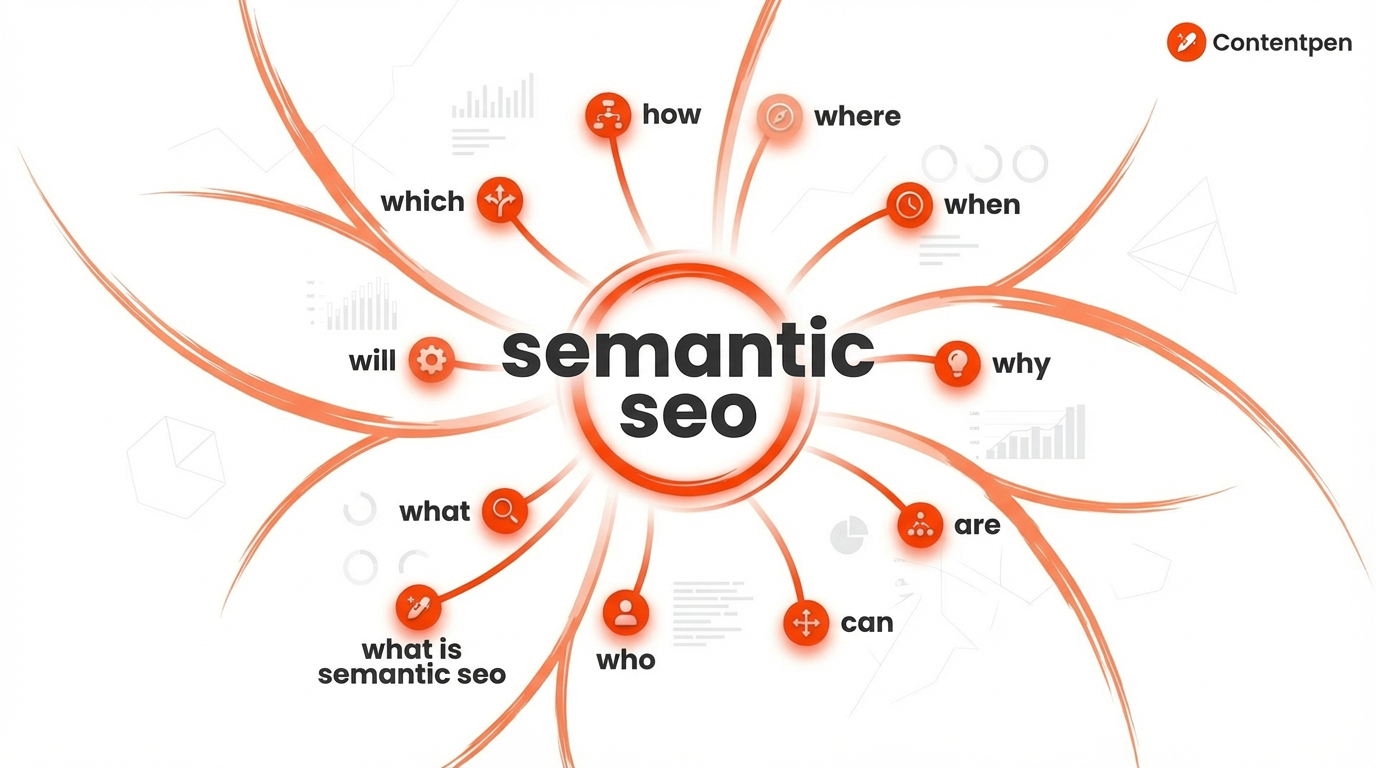
Google stores entities and their relationships in the Knowledge Graph. When someone searches for “Apple,” the engine uses surrounding entities on the page to decide whether you mean the company or the fruit.
Pro Tip: Content shouldn’t just mention an entity (e.g., Running Shoes), but should define its attributes (e.g., weight, drop height, pronation support) to help search engines build a more confident “knowledge triple.”
These words and entities are then turned into numbers called embeddings. In this numeric vector space, related word meanings sit close to each other to provide the most suitable outcome to the searcher.
So, if your article sends signals that match the same cluster of meanings as a search query, you win on the keyword without stuffing it everywhere in the content.
Evolution of semantic SEO
Over the years, several algorithm updates pushed search toward semantics and semantic search optimization. Here is a quick overview of where we started from vs. where we are today:
| Update name | Release date | Main impact on search understanding |
| Caffeine | 2010 | A much faster way to crawl and index the Internet |
| Hummingbird | 2013 | Focus on the full query and intent rather than single words |
| RankBrain | 2015 | Machine learning to guess the meaning of new or unclear queries |
| BERT | 2018 | Better reading of natural language and word order inside queries |
| MUM | 2021 | 1,000 more powerful than BERT at understanding and generating language |
| AI Overviews | 2024-2025 | Generative AI is creating answers from semantically rich sources |
Pre-2013 is often considered the “keyword era” with keyword stuffing being very common. The post-2013 era is considered the “semantic era” for Google, where writing helpful, human-first content, in line with the EEAT principles, results in better rankings.
Why semantic SEO matters for your rankings
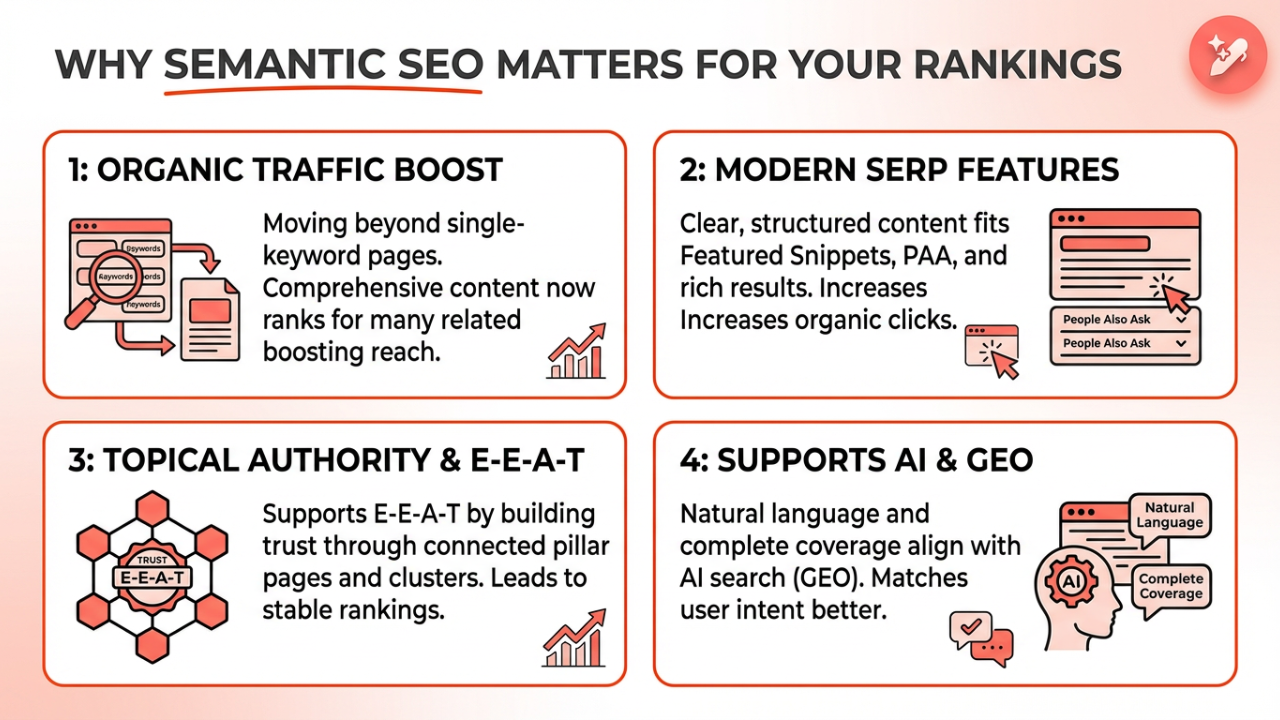
Semantic SEO matters because it aligns with how modern search engines evaluate pages.
#1: Semantic SEO affects the organic traffic of your platforms
Before Google’s Hummingbird update, you could create different pages for similar phrases and pull the traffic across them.
For instance, making four pages with the following focus keywords each: ‘tastiest burgers’, ‘best burger recipe’, ‘best recipes for burgers’, and ‘tastiest burger recipe’ to get visitors from each.
However, in 2026, this approach no longer works. Now, Google shows nearly identical results for similar phrases and keywords and actually prefers pages that comprehensively answer all the related queries and subqueries for a topic.
This means a single page can rank for many related searches at once, helping boost brand awareness and share of voice in your niche.
#2: Semantic SEO content fits better into modern SERP features
Featured snippets, People Also Ask boxes, and rich search results depend on clear answers and structured content.
When your page is well organized around a topic and has semantic depth, it is more likely to appear on users’ screens and drive more organic clicks.
#3: Semantic SEO helps build topical authority
Semantic SEO also supports topical authority and E‑E‑A‑T. When a site covers a subject through connected pillar pages and clusters, and the content is correct and helpful, Google is more likely to trust it on related searches. That leads to more stable rankings across many queries.
#4: Semantic SEO supports generative engine optimization (GEO)
AI-powered search makes semantic SEO even more important. AI Overviews and other AI semantic SEO experiences pull from pages that use natural language, clear headings, and complete coverage.
Natural language processing SEO is at the heart of those systems, so pages written in a clear, human way have an advantage over those that rely on jargonated terms to convey their thoughts.
From a user side, semantically complete content tends to match search intent better. People find what they need faster, stay longer, and interact more deeply with the site. Those behavioral signals also help rankings over time.
How to do semantic keyword research and build topic clusters
Semantic SEO starts with understanding the topic space around your main keyword. Instead of a flat list of phrases, you want a map of related terms, questions, and entities. Then you group them into clusters that match how users think.
Finding semantically related keywords and LSI keywords
LSI keywords, or Latent Semantic Indexing keywords, are a popular industry phrase for terms that often appear together with your main keyword. These terms share context, not just wording.
For example, for a page about semantic SEO, LSI-style keywords might include:
- Topic clusters
- Entity-based SEO
- Structured data
- Search intent optimization
When you use these terms in a natural way, you help search engines see the full context.
You can also find many of these with free Google features, which are very helpful to dig up LSI keywords:
- Start typing your topic into the search bar and watch Google Autocomplete. The phrases that drop down show how real users extend your seed term.
- Open a few top results and look for bolded words in snippets, since those highlight what Google sees as semantically close.
- Scroll to People Also Ask after a search. These boxes show real questions you should answer in your content, often as subheadings, headings, or otherwise.
- Check Related searches at the bottom of the SERP as well to spark ideas for extra sections or future articles.
This simple practice already gives you a strong list of semantic SEO keywords that you can use today to rank well for multiple phrases at once.
You can also use Google Search Console data from your own site to find queries your pages already rank for and expand those into new content. The key is to move from a single primary phrase to a wide web of related concepts around your topic.
Building a topic cluster strategy
Once you have your list of semantic keywords, the next step is to group them into topic clusters.
A topic cluster is a set of pages that cover one broad subject from many angles. This structure is a strong base for semantic web SEO and helps search engines read your site like a map.
Most teams use a pillar and cluster model:
- The pillar page gives a broad overview for a mid-tail phrase such as “semantic SEO.”
- Cluster pages then dive deep into subtopics such as “semantic search optimization,” “structured data SEO,” and “topic clusters SEO.”
- Each cluster links back to the pillar, and the pillar links out to each cluster. The clusters link with each other.
This internal linking pattern signals to Google that all those pages are in the same topic family.
Here is a simple example of a pillar with clusters:
| Pillar topic | Type | Example cluster pages |
Content marketing | Fundamentals | What is content marketing |
| Strategy | Content marketing strategy | |
| Tools | Content marketing tools | |
| Examples | Recent content marketing examples |
When you map and implement your pillar-cluster model in this manner, it shows the search engine that you’ve covered the topic completely.
However, manually implementing the pillar-cluster model can be a lot of work, especially when you have all the content to manage for yourself.
This is where tools such as Contentpen can help your cause. Our AI SEO content writer not only automates topical clustering but also content creation, optimization, and publishing.

Create topical authority, not isolated posts that fills them

Group related content into SEO-friendly clusters
Strengthen rankings with internal relevance
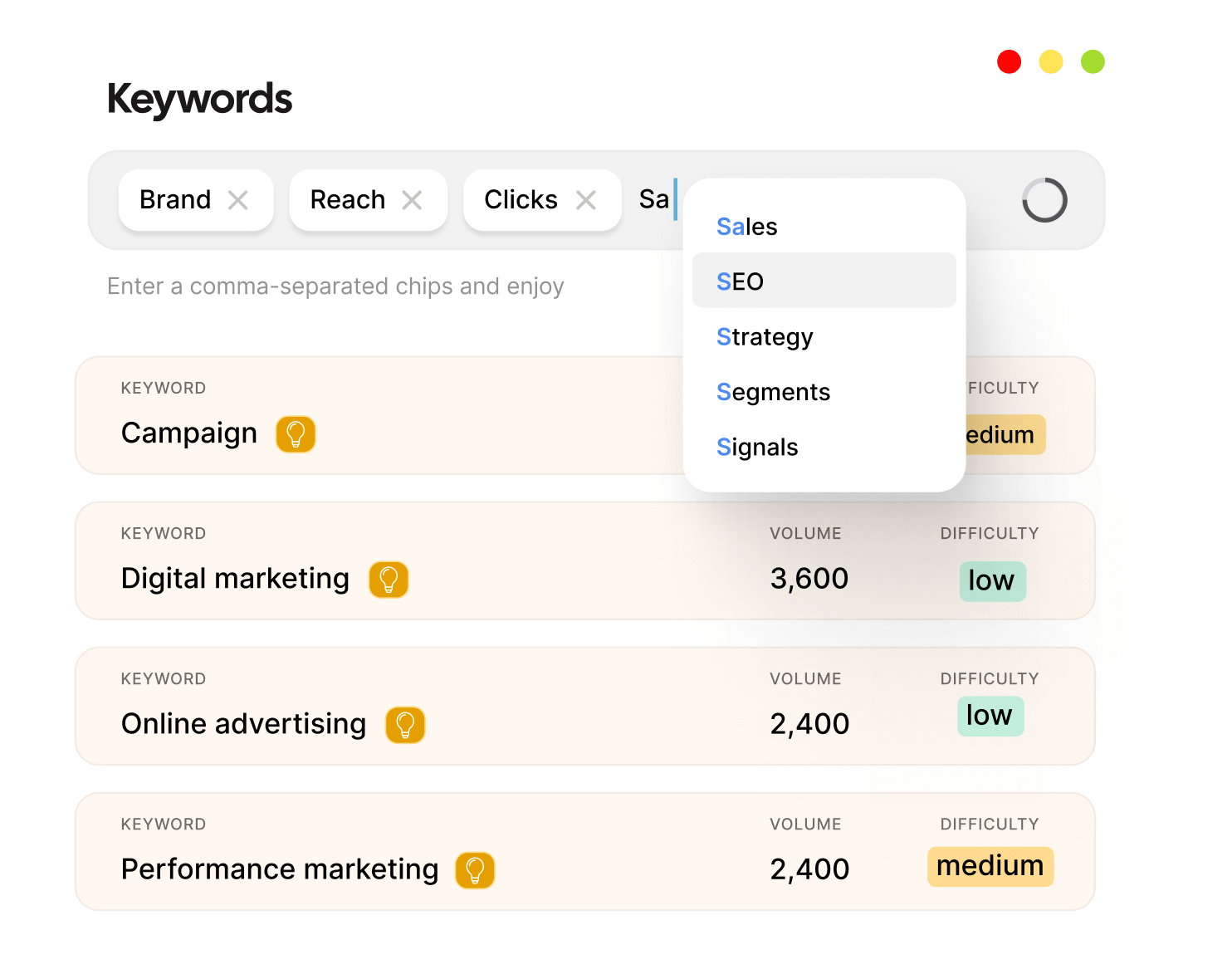
With built-in SEO scoring, SEO opportunities, and web analytics, you are bound to uncover CTR gaps and win a niche in no time.
Practical tips to create semantically optimized content
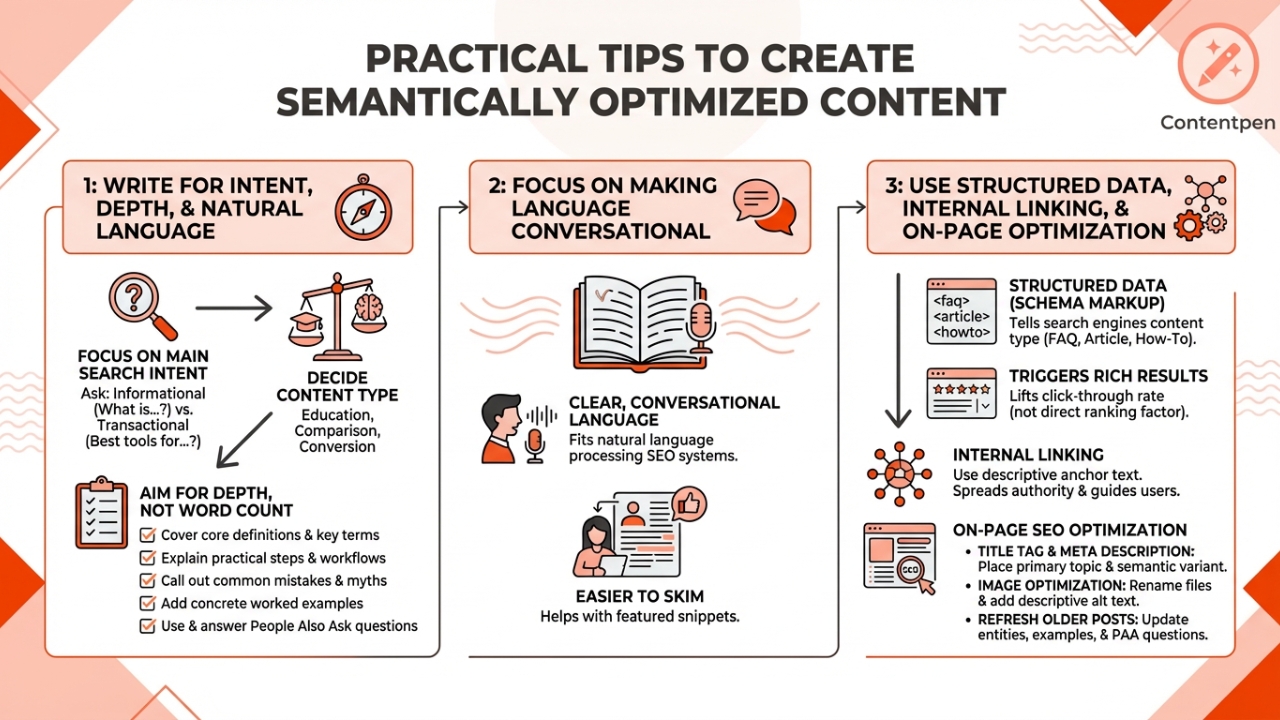
To win with semantic SEO, every piece needs strong intent alignment, topical depth, and clean on-page SEO optimization.
#1: Write for intent, depth, and natural language
Start each article by focusing on the main search intent. Ask yourself what the reader really wants to do. Is the phrase informational, like “what is content marketing,” or more transactional, like “best content marketing tools”?
When you know the intent, you can decide how much education, comparison, or conversion content to include.
#2: Focus on making language conversational
Write in clear, conversational language that fits natural language processing SEO systems.
Also, aim for depth instead of word count. For each key page, try to:
- Cover core definitions and key terms
- Explain practical steps and workflows
- Call out common mistakes and myths
- Add at least one concrete worked example
Use People Also Ask questions as subheadings and answer them directly in the following paragraph. This helps with featured snippets and makes your content easier to skim.
#3: Use structured data, internal linking, and on-page optimization
Words are not the only way to send semantic signals. Structured SEO data uses schema markup to tell search engines what kind of content is on the page.
There are different markups for blog posts, FAQ, articles, breadcrumbs, and How-To guides. Although using schema markups isn’t a direct ranking factor, it can trigger rich results such as FAQ dropdowns or user reviews, which lift your click-through rate.
Internal linking is another key aspect of SEO semantics. When internal linking, use descriptive anchor text to spread authority through your topic cluster and guide users properly through your pages.
For on-page SEO optimization, do the following:
- Place your primary topic and a semantic variant in the title tag.
- Use them naturally in the meta description, early in the introduction, and in at least one H2.
- Rename image files with simple descriptive names and add alt text that reflects the topic with a few related terms.
- Refresh older posts with new entities, updated examples, and fresh PAA questions to maintain high content relevance.
Over time, this mix of content, structure, and markup makes your pages easier for both users and search engines to understand.
How Contentpen helps you execute semantic SEO at scale
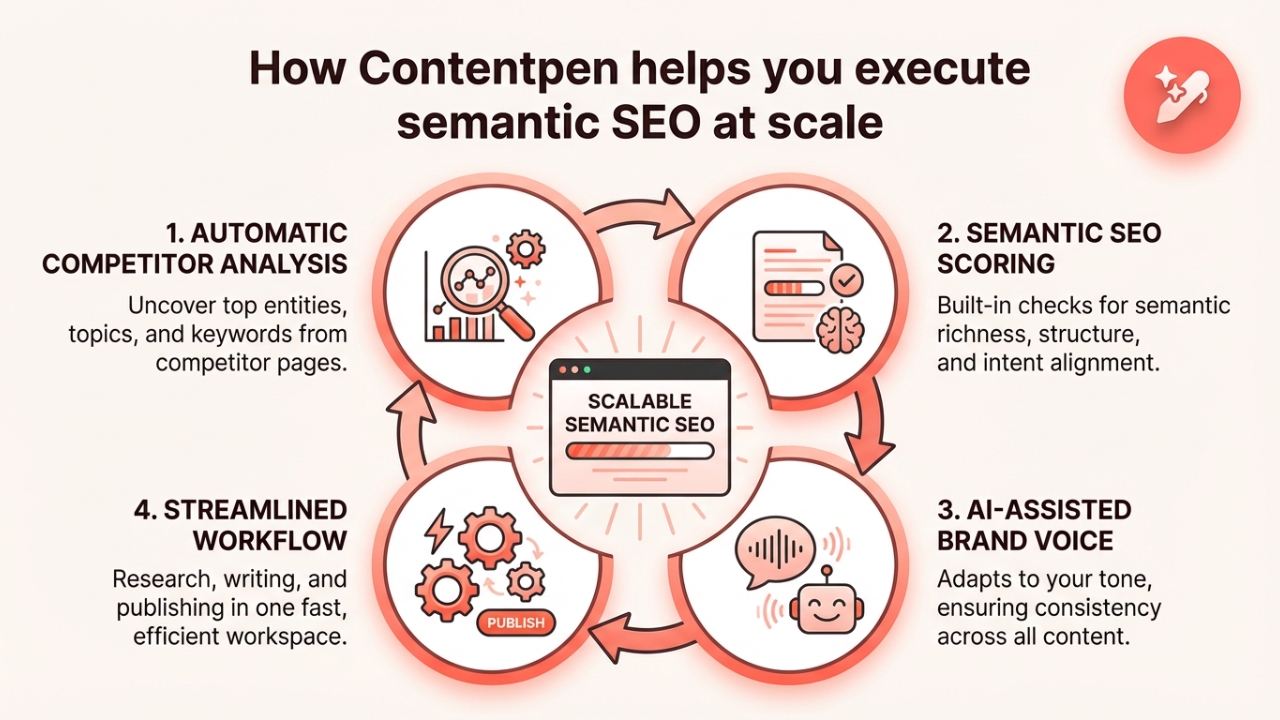
Building semantic SEO across a whole site can feel heavy without the right tools. Contentpen allows you to rank on Google by implementing semantic SEO practices into your daily workflow.
The platform runs automatic competitor analysis so you can see which entities, topics, and keywords top pages cover.
Built-in SEO scoring then checks each draft for semantic richness, structure, and alignment with intent before you hit publish. Contentpen also adapts to your brand voice, keeping the tone steady across all your pages.
Because you can perform content research, AI-assisted writing, and one-click publishing in one workspace, content teams can move faster without juggling separate tools.
Final thoughts
Semantic SEO changes how you think about rankings. Instead of chasing single phrases, you focus on user intent, entities, and full topic coverage. That shift lines up with how Google and other engines read pages.
The path is clear. Start with smarter semantic keyword research and topic clusters. Turn those clusters into comprehensive, well-structured articles that answer real questions.
Doing this across a whole site can seem like a big project, especially for lean content teams. Therefore, you must begin with one pillar page and a small set of clusters, then build from there upon.
Frequently asked questions
Traditional SEO focuses on exact-match keywords, keyword density, and on-page placements. Whereas semantic SEO looks at topics, entities, context, and search intent. Semantic SEO usually holds more stable rankings over time than traditional SEO.
Helpful semantic SEO tools include Contentpen for research, drafting, and SEO guidance, LSI Graph for LSI-style keywords, Semrush for topic research, Ubersuggest for keyword variations, and Google Search Console for real query data.
Structured data provides search engines with extra context about your page’s type and key details. It can trigger rich snippets such as reviews, FAQs, or recipe cards, which improves visibility and click rates even if rankings stay the same.
Semantic SEO examples include using related topics and entities around a main keyword instead. For instance, a page on “email marketing” may also cover related terms such as email campaigns, subscriber lists, and automation workflows.
Semantic SEO keywords are terms that share context with your main keyword instead of being exact copies. They include LSI-style keywords, related entities, and question-based variations that users type into search to find answers.