Long tail keywords are specific phrases that have lower search volume, but they match what a person wants much more closely.
In 2026, AI search assistants such as Google AI Overviews, ChatGPT, Perplexity, and Gemini have caused a spike in long-tail searches. People ask longer, more conversational questions, which makes a long tail SEO strategy more important today.
In this guide, you will see what long tail keywords are and why they matter for SEO in 2026. You’ll also see how to find them, how to use them in content, and how to track results.
The goal is simple: give you a clear playbook you can use whether you run a content team, a small business, or manage SEO for clients.
So, let’s get started.
What are long tail keywords?
Long tail keywords are very specific search phrases that usually contain three or more words and show clear search intent. Someone who searches “running shoes” is just browsing. Someone who searches “best running shoes for women with flat feet” has a defined need and is close to a decision.
Generally, long tail keywords are four or more words. However, in tight niches, even a two-word phrase can behave like a long tail term. For instance, ‘drone mapping’ is a keyword that is very small but very competitive in the niche of geospatial technologies.
Long tail phrases have a few common traits:
- They are specific (often mention audience, use case, or pain point).
- They signal clear intent (to learn, compare, or buy).
- They tend to have lower search volume but higher relevance.
- They often lead to better conversion rates than short, vague terms.
The search demand curve
In the context of long-tail organic keywords, it is very important to discuss the search demand curve. It basically explains the share of searches that each type of keyword receives.
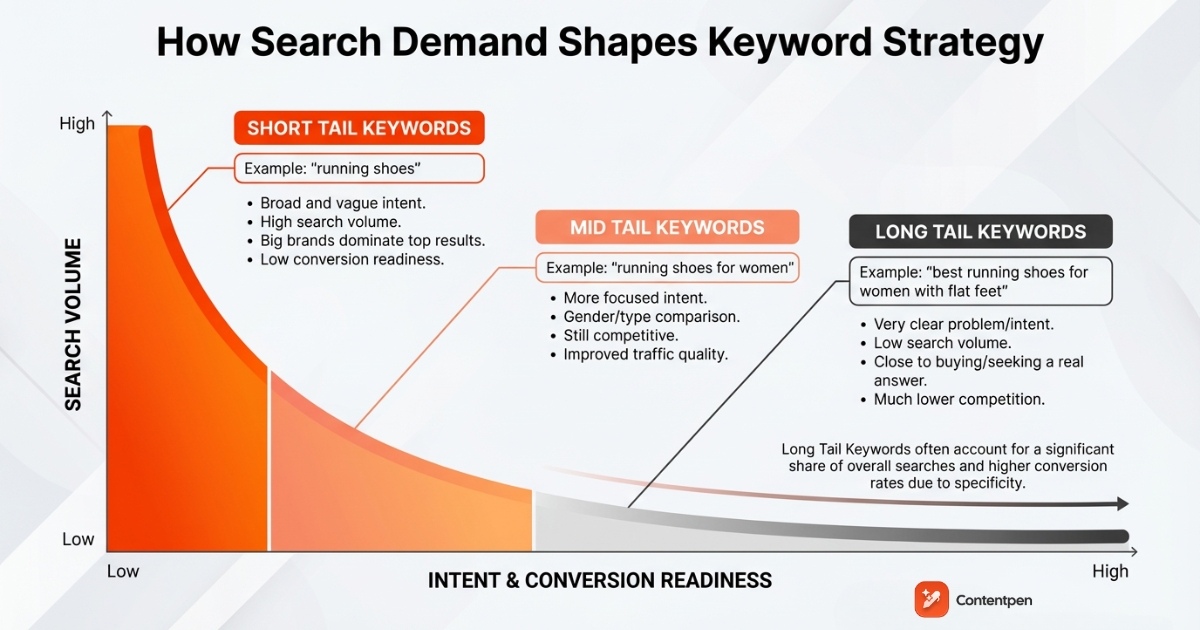
To analyze the search demand curve, we can break it down with a simple set of long tail keyword examples around one topic:
- Short tail means you target the phrase running shoes, which is broad and vague. The search volume is high, but the intent is fuzzy, and big brands dominate the top results. You might gain visibility, but most visitors will not be ready to act at all.
- Mid tail means you aim for running shoes for women, which gets a bit more focused. The person now has a gender in mind and may be comparing types of shoes. Competition is still high, but intent is clearer, and traffic quality improves.
- Long tail means you focus on the best running shoes for women with flat feet, which speaks to a very clear problem. Search volume drops, yet the person is close to buying or seeking a real answer, and competition is much lower.
Although the search demand curve is still valid, the search landscape has shifted drastically. According to a Search Engine Land study, Google receives 15% new searches daily that have never been searched before. This means that the user behavior is changing, and you need to capitalize on that to get quick wins.
People want to quickly narrow down their options without spending too much time researching online. After the surge of voice-assisted search technologies, such as Alexa or Google Assistant, long-tail keywords are in more demand than ever before.
This takes us to our next point: adaptability is key in modern SEO to keep increasing traffic and enjoy better visibility in both search engines and AI discovery platforms.
The two types of long-tail keywords
Not all long-tail keywords are created equal, and this distinction matters most for modern SEO in 2026.
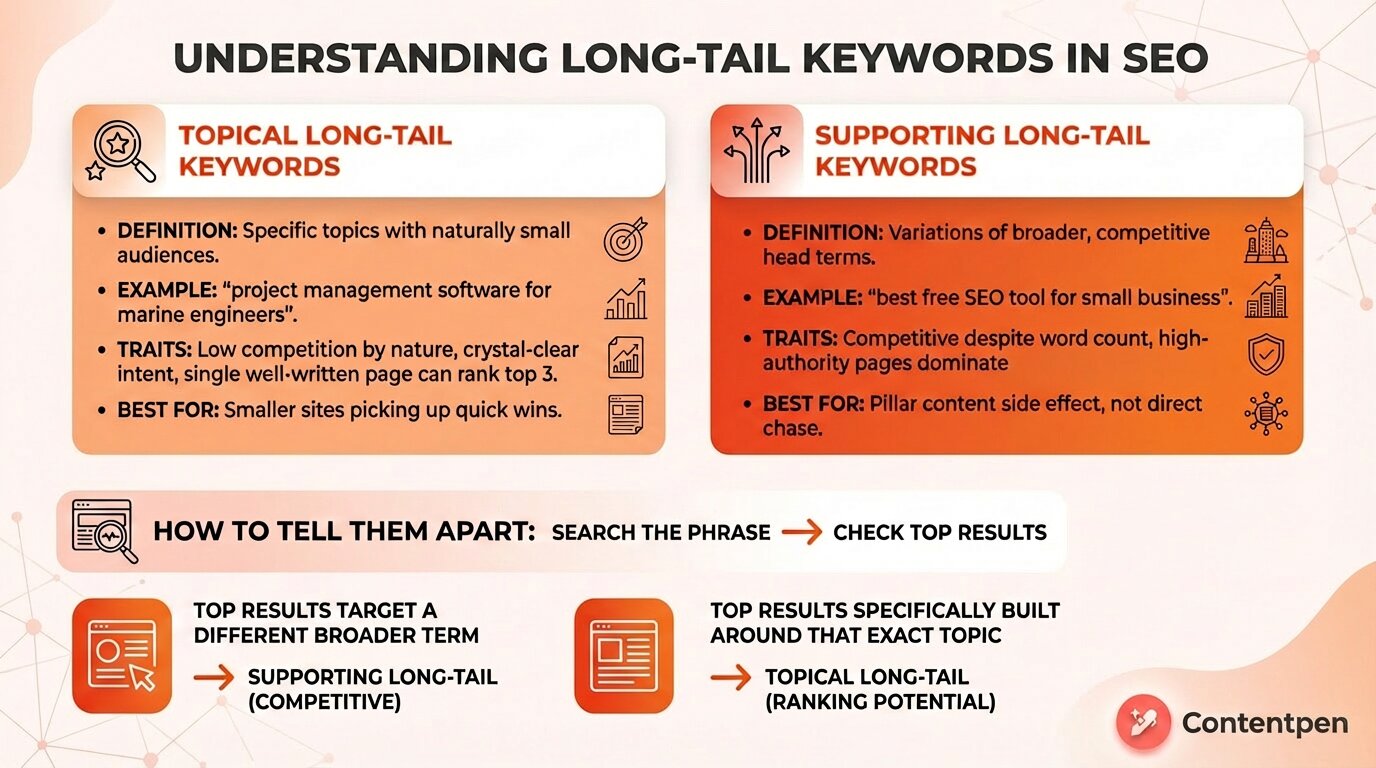
The first type is a topical long-tail keyword. These are phrases that get low search volume simply because they cover a very specific topic. Nobody searches for them in large numbers because the audience is naturally small.
For example, “project management software for marine engineers” might get 30 searches a month, but every one of those visitors has an exact, defined need. These keywords tend to be genuinely low competition because few pages bother to target such a narrow topic.
The second type is a supporting long-tail keyword. These are variations of a broader, competitive head term. Think “best free SEO tool for small business”.
This keyphrase looks long-tail by word count, but the competition is fierce because dozens of high-authority pages already target the parent topic of “best SEO tool” and naturally rank for all its variations too.
How are topical long-tail keywords important for your content plan?
Topical long-tail keywords are where smaller sites pick up real wins fast. The intent is crystal clear, the competition is low by nature, and a single well-written page can hold a top-three spot for a long time.
Supporting long-tails, on the other hand, is better earned than targeted directly. When your pillar content is already strong, you tend to rank for these as a side effect rather than chasing them one by one.
A quick way to tell them apart: search the phrase and look at the top results. If the pages ranking for it are targeting a completely different, broader term, you are looking at a supporting long-tail in a competitive space.
If the top results are specifically built around that exact topic, you have found a topical long-tail with real ranking potential.
Why long tail keywords matter for your SEO strategy
For most small and mid-sized sites, long tail keywords are the easiest path to meaningful organic traffic. They help you sidestep impossible battles for broad terms and focus on people who are already primed to act. That matters for both search rankings and business results.
#1: Lower competition, faster rankings
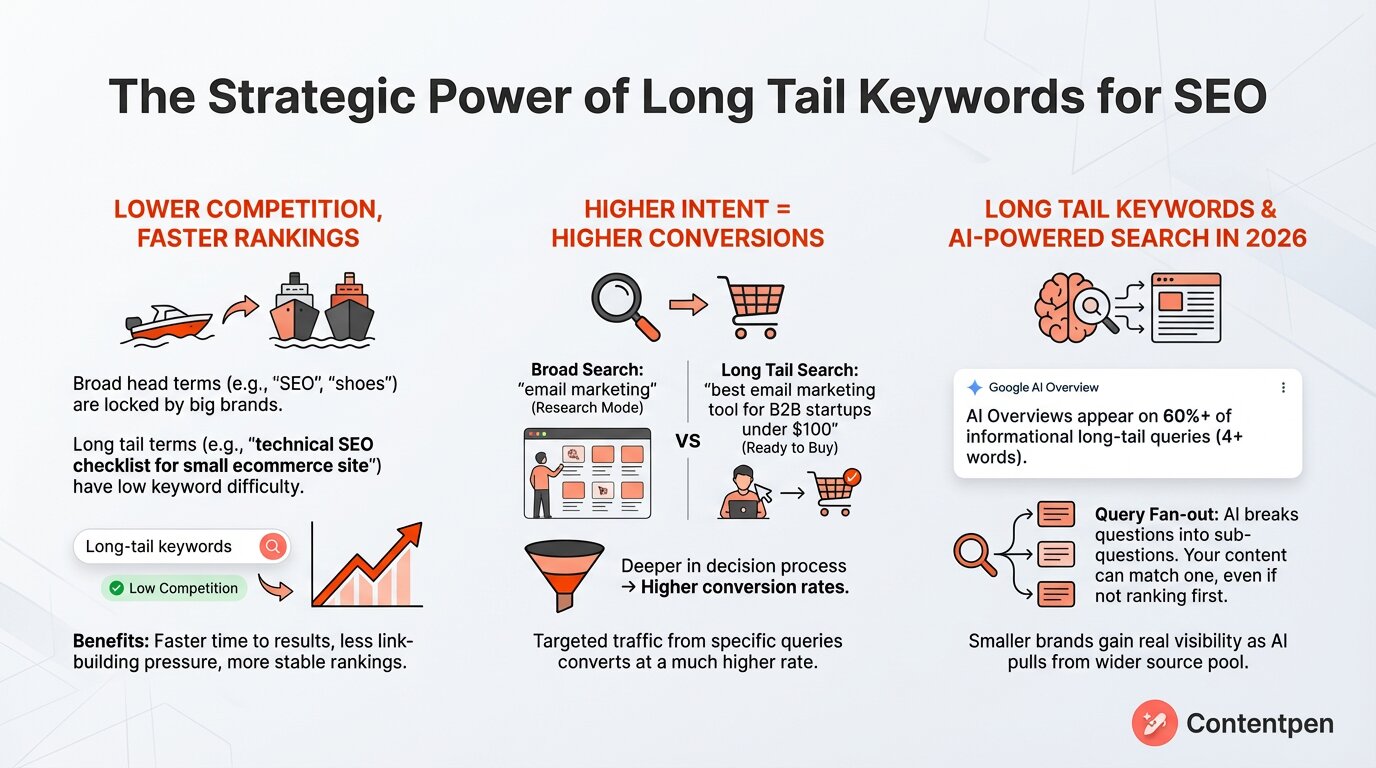
Broad head terms tend to be locked up by well-known brands with strong domains and large SEO budgets. If you chase “SEO” or “shoes,” you compete with giants and wait months, maybe years, for movement.
Whereas a typical SEO long tail keyword, such as “technical SEO checklist for small ecommerce site,” faces far fewer strong pages.
Keyword tools show this as low keyword difficulty scores and low competition. These low competition keywords do not draw huge volume on their own, yet a top three spot can still bring steady, targeted visitors.
In some cases, long-tail keywords can also mean you get an AI mention in AI Overviews, or a spot in the PAA box in Google.
Therefore, with long-tail keywords part of your SEO strategy, you gain:
- Faster time to results, because you are not waiting to outrank global brands.
- Less link-building pressure because authority requirements are lower.
- More stable rankings, because highly specific topics get fewer aggressive attacks from competitors.
#2: Long-tail keywords reward higher conversions
People who use long tail keywords are usually deeper in their decision process. The more details inside the query, the more work that person has already done.
Someone typing “email marketing” might be in research mode. Someone typing “best email marketing tool for B2B startups under $100” is hunting for a shortlist.
That higher intent leads to higher conversion rates. The traffic numbers for that phrase may look tiny compared with “keyword tool,” yet a much larger slice of those visitors will sign up, book a call, or buy. You just have to stay a bit patient.
#3: Long tail keywords are important for AI-powered search
AI assistants change how people search and how your content gets surfaced. Many AI answers now trigger on long, conversational queries instead of short phrases. Recent data shows that Google AI Overviews appear on more than 60% of informational long-tail keywords (4 words or more).
AI systems break a detailed question into many sub-questions, a process often called query fan-out. Good long tail content can match one of those sub-questions, even if you do not rank first for the main phrase. That gives your page a chance to be cited or used as context in AI answers.
This is where long-tail keywords + AI strategy come in. When your site covers very specific topics with depth, you feed both classic rankings and AI engines. Smaller brands gain a real shot at visibility here because AI pulls from a wider set of sources, not only the biggest domains.
Long tail keywords make that advice practical, because they line up very closely with what users actually type or say.
How to find long-tail keywords that actually rank
Finding long-tail keywords that have a real chance to rank starts with your audience, layers in the right tools, and ends with SERP validation.
Listen to your customers before you research
Your customers already hand you long-tail keywords every day. Sales calls, support tickets, chat logs, and product reviews all contain exact phrases people use when they describe a problem in their own words.
A sentence like “I need a way to schedule social posts without hiring someone” is not far from a rankable long-tail phrase.
Therefore, you need to make this a monthly habit: pull recent support or sales conversations and highlight phrases that describe a pain, a use case, or a budget constraint. Then, reshape them into draft queries like “best X for Y” or “how to do Z without W.”
Use keyword tools to validate and expand
Once you have a seed list from real conversations, let tools turn guesses into data-backed strategies.
Contentpen’s SERP and gap analysis surfaces what your competitors rank for that you do not. Then, the SEO platform recommends the strongest long-tail phrases to close those gaps.

Analyze SERPs, spot gaps, and create content that fills them
Find exactly where your content is falling short, and how to beat competitors.
Try FREE →
It also generates optimized content around those terms, which cuts the gap between research and a published page.
You can also use the Semrush Keyword Magic Tool, which lets you filter by keyword length and difficulty scores.
Google Search Console is also worth mentioning alongside other tools. It shows queries your pages already appear for but have not been optimized around, which are often your fastest ranking opportunities.
Use SERP features directly
Google reflects real user behavior better than any database. Three places give you long-tail ideas that tools often miss:
- Google Autocomplete adds qualifiers like “for beginners,” “near me,” or “without a subscription” to your seed phrases. Each suggestion is a real query pattern.
- People Also Ask boxes surface ready-made question formats that work directly as long-tail targets and tend to appear in both classic results and AI Overviews.
- Related searches at the bottom of the results page show how users move around a topic and can reveal an entire cluster of related phrases from a single search.
- Reddit, Quora, and niche communities fill the gaps that SERP features miss. People in these spaces describe problems in blunt, specific language that rarely shows up in keyword databases. A thread title like “Does anyone know of accounting software that works offline for freelancers?” is a long-tail keyword waiting to be written about.
As you collect ideas from these sources, group them by intent before you move into content planning. That grouping will make topical clustering much easier in the next step.
Create topical authority, not isolated posts that fills them

Group related content into SEO-friendly clusters
Strengthen rankings with internal relevance
How to use long tail keywords in your content
Finding long tail keywords is only half of the work. The next step is to place them inside the content in a way that feels natural to readers and clear to search engines. This is where many teams stall, which is why you often see long lists of ideas and very few optimized pages.
Build keyword clusters, not one-off pages
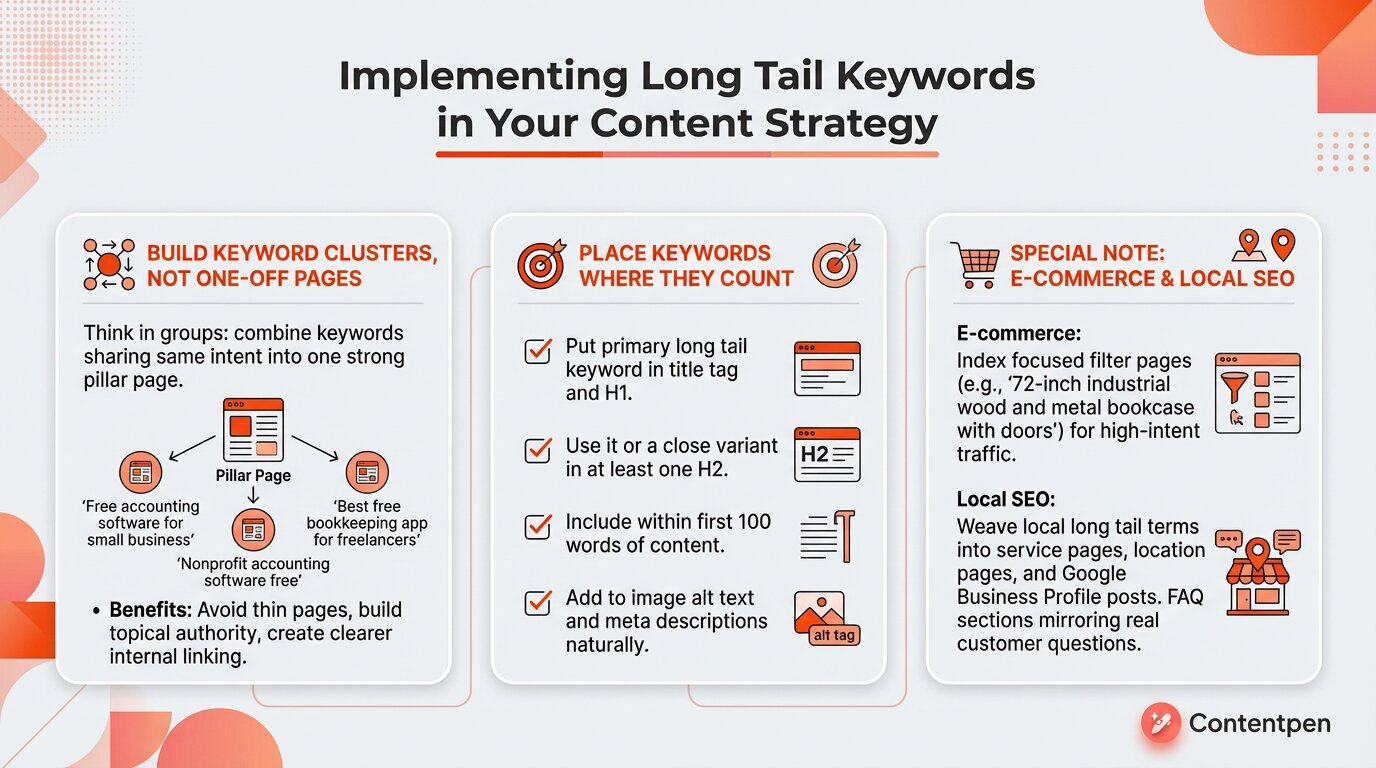
Try to think in groups, not single phrases. Take several long tail keywords that share the same intent, then create one strong page that answers all of them together. This pillar page can rank for many variations instead of just one.
For example, a SaaS company in accounting could group:
- “Free accounting software for small business.”
- “Nonprofit accounting software free.”
- “Best free bookkeeping app for freelancers.”
A single guide could discuss all of these keyword variations, how the features compare, and what trade-offs matter most.
Real brands follow this model. A well-built page about free accounting tools for nonprofits can sit in the top three spots for dozens of related long tail phrases.
Keyword clustering also helps you:
- Avoid thin, repetitive pages for each tiny variation.
- Build topical authority around themes instead of scattered posts.
- Create clearer internal linking between related articles and product pages.
Place keywords where they matter
Although this is a very straightforward point, many content marketers and teams seem to miss the point, especially when they’re implementing long-tail keywords.
- Put your primary long tail keyword in the title tag and H1. This tells both the reader and the crawler what the page covers. When possible, also place a close variant inside at least one H2 so your subtopics stay tightly linked to that main phrase.
- Use the long tail term, or a close match, within the first 100 words of your content. This quick confirmation helps search engines match page content to the query and reassures the reader that they are in the right place.
- Add keywords to image alt text and meta descriptions in a natural way. Alt text helps with accessibility and sends another hint about the topic. Meta descriptions do not drive rankings by themselves, yet they can help lift click-through rates for long tail results.
Special note for e-commerce brands and local SEO specialists
Long tail keywords shine for product and local intent.
In e-commerce, filter pages can match very specific searches, such as “72-inch industrial wood and metal bookcase with doors.”
When you let search engines index these focused filter pages and add a short description on each, you open the door to many high-intent, low competition keywords. Just make sure those pages:
- Load fast and work well on mobile.
- Have clear headings that echo the main filters.
- Include a short block of descriptive text that uses natural phrases from your keyword research.
Local SEO benefits in a similar way. Phrases such as “organic coffee shop near me open Sunday” or “emergency dentist in Austin for kids” might not get thousands of searches, yet they convert at a high rate.
When you weave these local long tail terms into service pages, location pages, and Google Business Profile posts, you help people find you first.
For local businesses, long tail work often means:
- Detailed service pages for each location and offer.
- FAQ sections that mirror real questions from calls and emails.
- Regular posts that mention neighborhoods, landmarks, and timing (for example, “open late on weekdays”).
How to track and refine your long tail keyword performance
Once your pages target long tail keywords, you need feedback. Tracking shows which phrases work, which pages need a push, and where to focus new content. Without this loop, you are guessing, and guessing does not help in SEO for long.
Use a simple set of tools and checks:
- Google Search Console is the best free starting point. The ‘Performance report’ lists clicks, impressions, average position, and click-through rate for every query. Filter by longer phrases or add filters for exact words to see how your long tail pages behave.
- You can also use Contentpen’s web analytics to see GSC data in one place where you perform keyword research, write, and publish content. This saves time in tool switching and streamlines your workflows significantly.

- Third-party rank trackers such as Semrush Position Tracking or Ahrefs Rank Tracker give daily views on your priority long tail keywords. You can watch rankings by device or location and see when a page gains features like featured snippets or AI mentions.
- Newer tools now track AI visibility across ChatGPT, Google AI Overviews, Gemini, and Perplexity. As AI answers expand, these reports help you see whether detailed pages appear as cited sources, even when classic rankings lag behind.
Over time, you can build a simple review routine that helps you sustain the rankings you secured in the first place:
- Monthly: Export long tail queries from Search Console (or otherwise) and tag winners and underperformers.
- Quarterly: Refresh content for underperforming pages by using Contentpen’s AI-powered SEO opportunities (better examples, clearer structure, stronger internal links).
- Ongoing: Feed new long tail ideas from support, sales, and community channels back into your keyword research and content roadmap.
Final thoughts
Long tail keywords give you a realistic way to win at SEO without a huge budget or a famous brand. By focusing on detailed phrases with clear intent, you avoid crowded head terms and connect with people who already know what they want.
That matters even more in 2026 as AI-powered search favors natural, specific questions over vague phrases. Content that targets these questions with depth can show up in classic results, in AI overviews, and even in answers from tools like ChatGPT and Perplexity.
The path forward is straightforward: listen to your audience’s problems, build content around the topical long-tails, place your keywords where they signal intent clearly, and track the results tightly.
Frequently asked questions
For most sites, yes. Long tail keywords have less competition, which gives you a fair chance to rank on page one. They also carry higher intent, so visitors from those phrases convert at a higher rate. That mix often beats chasing broad terms where you rarely appear.
You can go far with free options. Google Search Console and Google’s SERP features all show really useful long tail terms. Tools such as WordStream’s keyword tool add more ideas, which you can then refine with your own research.
They do. YouTube search responds well to specific phrases such as “how to set up Google Search Console for WordPress.” Placing that kind of long tail keyword in your video title, description, and tags helps your content surface for precise searches and draws viewers who actually want to consume your content.
You should target one primary long-tail keyword per page, with several close variations supporting it. A single well-focused page can rank for dozens of related phrases naturally once it covers a topic with enough depth. Trying to force multiple unrelated long-tail terms into one page usually dilutes the intent signal rather than amplifying it.