Small business owners often watch competitors with bigger budgets dominate search results and social feeds, and it feels impossible to catch up. Content marketing for small businesses solves this frustration by trading expensive ads for steady, useful content that earns trust.
This guide breaks the process into 10 easy steps. It covers everything from finding your audience’s real questions to picking formats and measuring what actually works.
You will also see how tools like Contentpen can speed up drafting and keep your content consistent without adding to your workload.
So, let’s get started.
Key takeaways
- Start by learning your audience’s real problems before you pick any content format or platform.
- Map your content to the customer journey using frameworks like TOFU, MOFU, and BOFU, so you generate both traffic and leads.
- Pick 3 to 5 SMART KPIs tied directly to leads, bookings, or retention, not vanity metrics like views.
- Repurpose one strong idea across several channels instead of creating new content for every platform.
- Use AI tools like Contentpen to draft faster while you add the real expertise and stories only your business can tell.
What is content marketing and why does it matter for small businesses?
Content marketing for small businesses means using helpful articles, videos, and posts to educate and build trust with potential customers to improve conversions.
It works because it answers real questions before, during, and after a sale, which builds a level of trust that a paid banner ad never can.
This matters more than ever, especially as small business owners increasingly explore AI tools to keep up the pace with larger competitors.
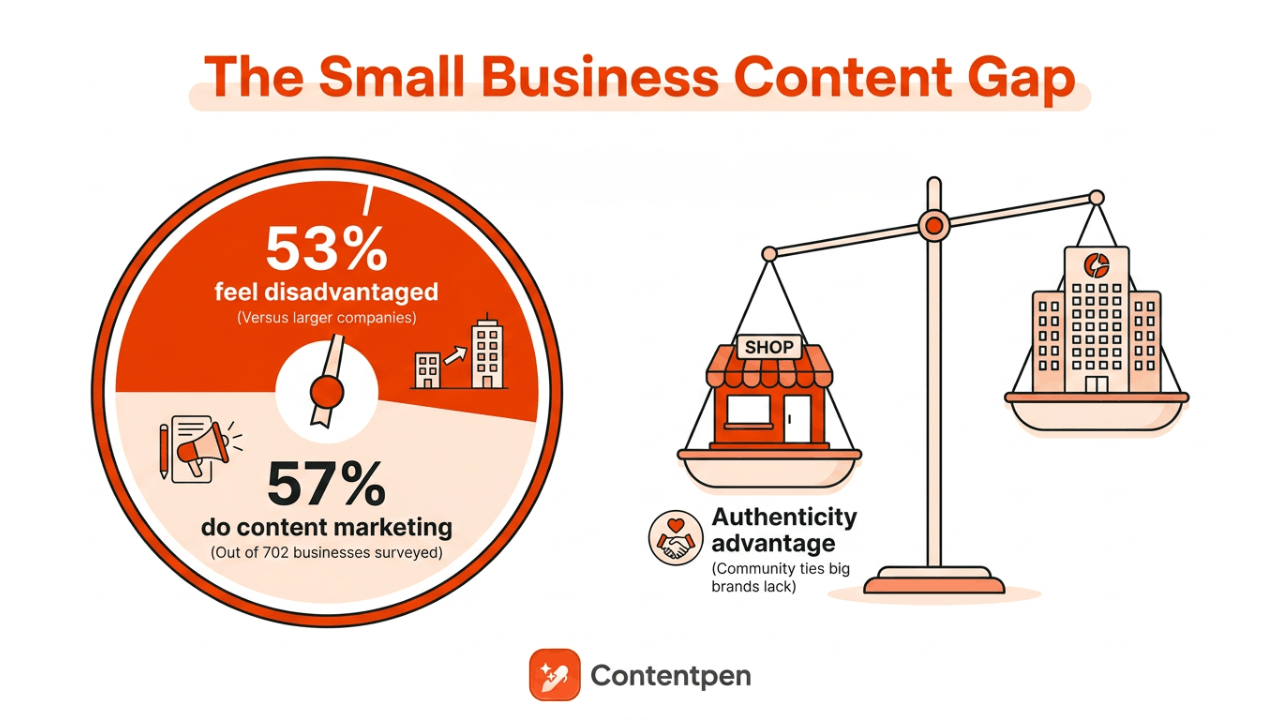
Research shows that 53% of small and medium business leaders feel at a disadvantage compared to larger companies when it comes to meeting customer expectations.
Yet a survey of 702 small businesses by Servicedirect found that only 57% currently do any content marketing at all. That gap is an opportunity for the businesses willing to start.
Benefits of content marketing for small businesses
As a small business, you have many advantages over a well-established firm or company that cannot connect on a personal level with their audience.
#1: Nurtures relationships with audience
Small businesses can lean more into authenticity and community ties. A national chain cannot share a genuine story about sponsoring your kid’s Little League team or explain the specific coffee bean it sources from a single farm.
That closeness to your community, paired with consistent and useful content, is what makes a small business content strategy work, even against much bigger marketing budgets.
In the process, the bond you build and share with your audience makes your business grow and prosper over time.
#2: Builds an unbeatable online presence
In 2026, if you are creating helpful, reliable, people-first content online, then you can capture audiences as well as, or better than, what other big brands are doing.
Good content marketing comes down to answering people’s questions and providing them with value they can’t find anywhere else. That means sharing your expertise, personal experiences, or data/insights from your industry that only you can do.
The best part is that when you give the exact information people in your industry are searching for, it automatically boosts your SEO (and AEO) as well, further helping your online presence.
#3: Establishes you as a go-to resource
Providing quality content consistently will help you build an online presence that’s evergreen and lasting. Soon, users, search engines (Google, Bing, Yahoo), and AI answer engines (ChatGPT, Perplexity, Claude) start recognizing you as an authority on a subject.
This improves your organic traffic and potentially conversions over time (we’ve talked about conversions in more detail in our SaaS content marketing blog).
#4: Produces a shareable commodity
Blog posts, articles, social media carousels, shorts, and long videos are all different formats that small businesses can utilize for content marketing.
Once you create different types of content, you make it easy for people to look you up online and share your assets, which drives repeat business.
That said, creating a shareable commodity is no easy feat (as you’ll see later in this article). But it is absolutely doable for startups, bootstrap companies, and small businesses looking to compete and win a certain niche.
How do you build a content marketing strategy in 10 easy steps?
Building a content marketing strategy for beginners comes down to 10 clear actions. Each step below builds on the last, so a solo owner or a two-person marketing team can move through them without feeling overwhelmed.
Step 1: Get to know your audience’s real problems
Most small businesses make the mistake of picking a content format before they understand who they are talking to.
A tax advisor might serve freelancers, small LLC owners, and people with a one-off tax question, and each group asks very different things.
If you have some existing users, you need to advise your team or push yourself to note what they’re actually saying. This will uncover common problems people have that you can solve through helpful content.
If you don’t have any customers to begin with, try addressing common queries or myths in your industry to spread brand awareness and get an actual audience.
Remember, the foundation of a strategy is knowing your audience inside out. This means building personas based on real data, not assumptions. Conduct on-ground or online surveys, asking people about their thoughts on a particular service or product.
Survey analysis and reporting automation can also help organize audience feedback, identify key trends, and turn survey insights into more effective content marketing decisions.
Step 2: Map your content to the customer journey
Not every reader is ready to buy today, so your content needs to match where they stand in their decision process.
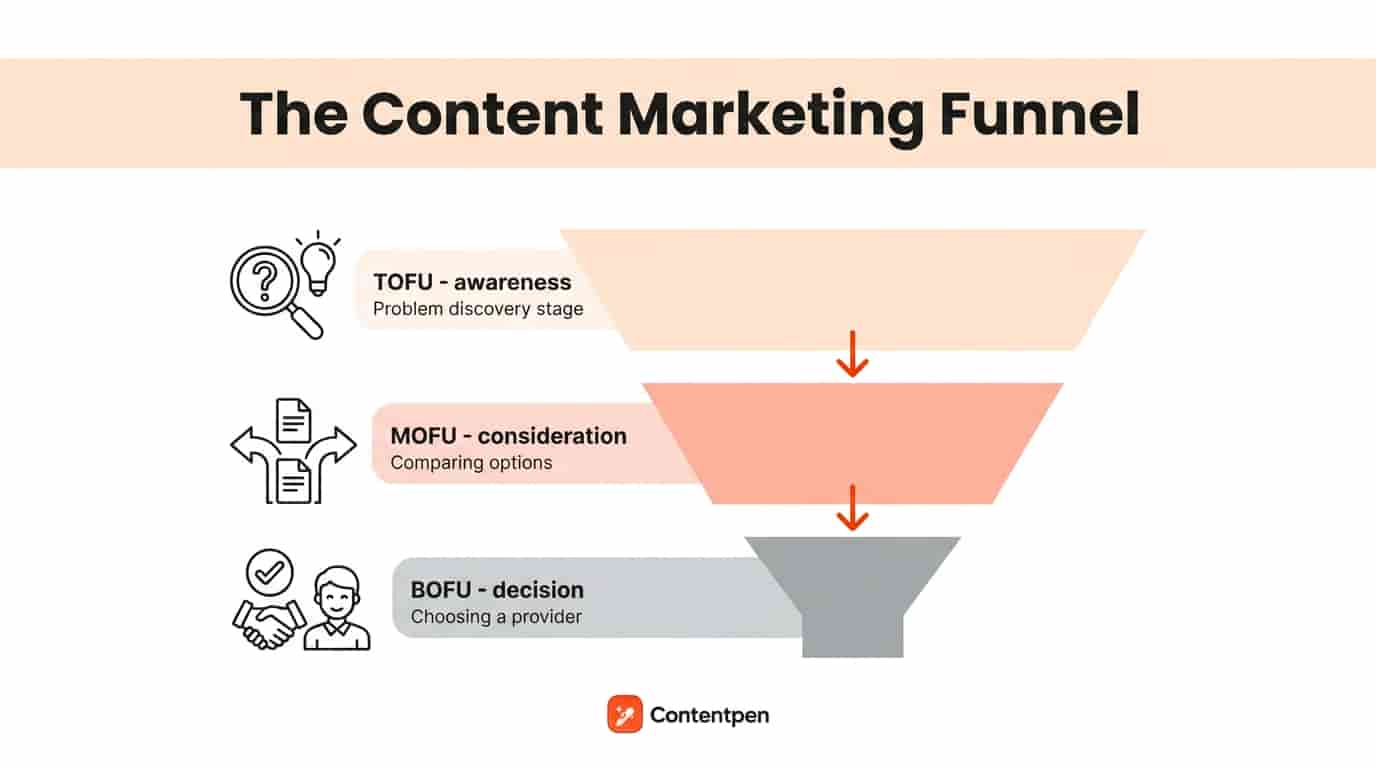
The TOFU, MOFU, and BOFU framework sorts content into top, middle, and bottom of funnel stages, moving from problem awareness to comparing options to choosing a service.
Let’s take an example below of what a homeowner might search for when looking for plumbing problems in their house.
| Query | Stage |
| “Why does my sink smell bad” | TOFU (looking for information) |
| “Best pipe repair services online” | MOFU (considering options) |
| “Pipe repair services near me” | BOFU (ready to avail the service) |
Avinash Kaushik offers a very useful model for marketers, called See-Think-Do-Care, which shows how you manage the commercial intent from one stage of the funnel to another.
Remember, businesses that only publish top-of-funnel content often get traffic without leads. On the other hand, startups that only target bottom-of-funnel queries often get an audience that may not understand the product too well, eventually slipping away to competitors.
Therefore, the idea is to create a content calendar that addresses all the TOFU, MOFU, and BOFU queries properly, creating a healthy mix.
Build your content around these different queries and look to market your product or service heavily only in the bottom stages of the content marketing funnel.
Step 3: Set smart goals and 3 to 5 core KPIs
Before you write anything, decide what success actually looks like for your business.
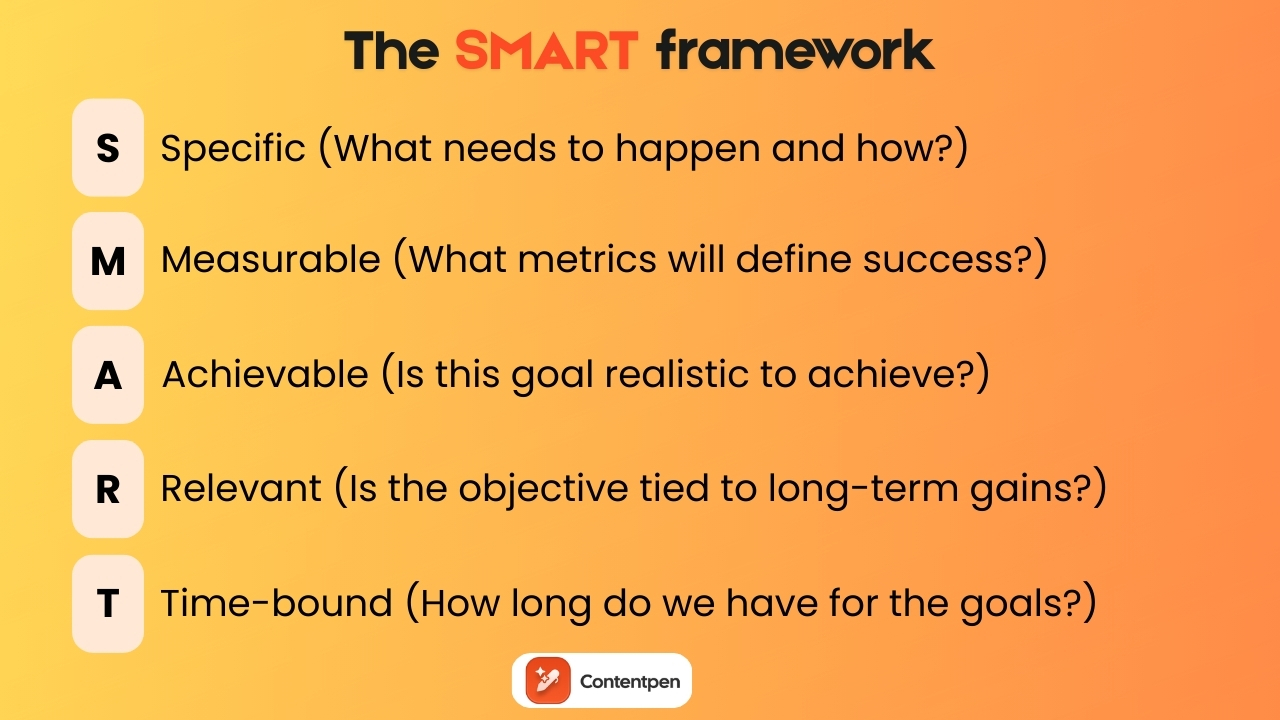
Use the SMART framework, meaning goals that are specific, measurable, achievable, relevant, and time-bound, and keep them realistic for your budget and staff size.
Good examples of SMART goals include:
- Improving quote requests by 75% in this quarter
- Getting at least 200 phone calls this month
- Get 1000 online bookings through SEO in the trimester
- Boost organic traffic to at least 6,000 unique visitors per month
The ideal next step is to pick 3 to 5 KPIs tied directly to revenue or retention rather than tracking every possible metric or number that leads nowhere.
Also read: 30 recent innovative marketing examples in 2026.
Step 4: Choose the right content formats for your business
You do not need every content format, just the one or two that fit your goals and your audience’s habits.
Most SaaS brands benefit from blogs and articles, while video, testimonials, and reviews also rank highly among small businesses.
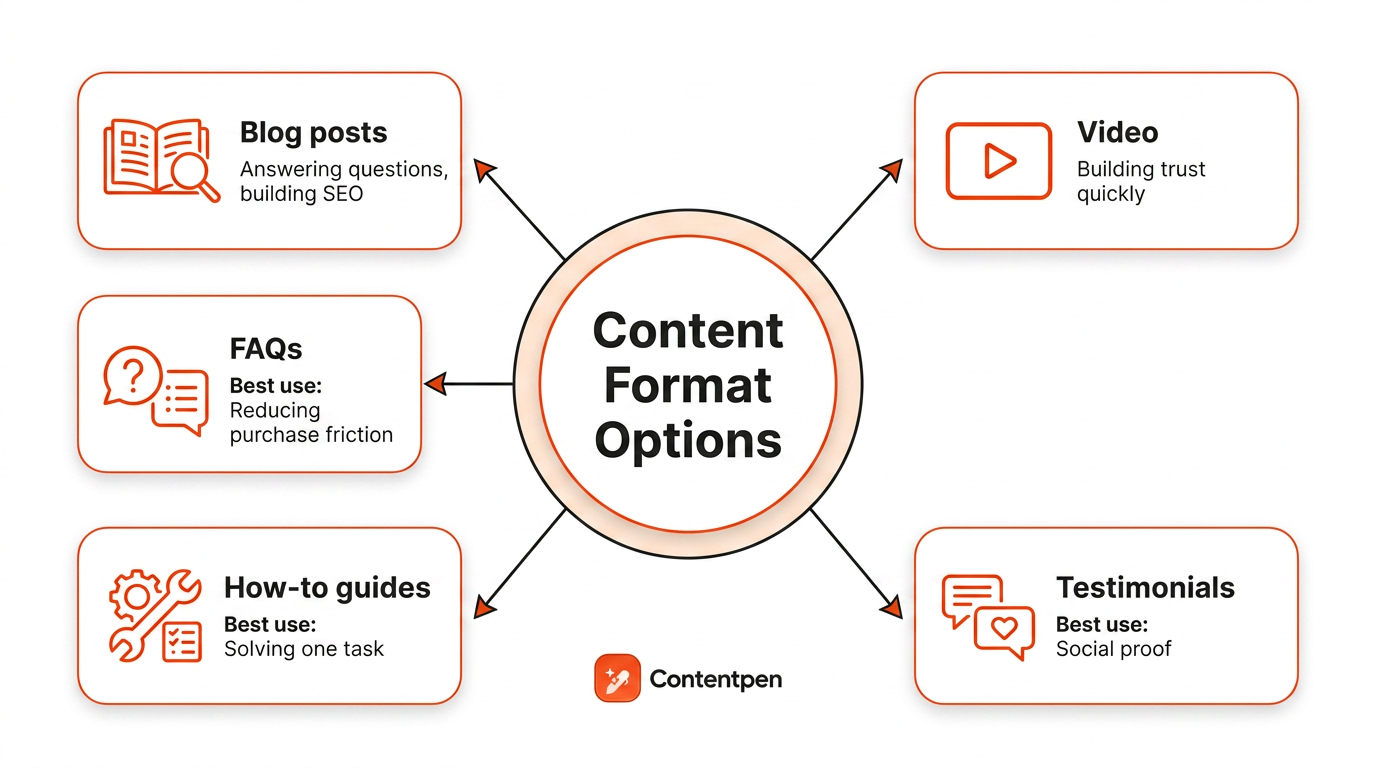
Below are some examples of different content marketing formats for small businesses:
| Format | Best use case | Example topic |
| Blog posts | Answering questions and building SEO | “How to prepare your car for a road trip” |
| Video | Building trust quickly | “Behind the scenes of a repair or service” |
| Testimonials | Social proof | “What changed my mind about a service” |
| How-to guides | Solving one task | “A moving house checklist” |
| FAQs | Reducing friction before purchase | “Cancellation and payment policy answers” |
The idea is to match the format to the job it needs to do rather than picking randomly. Choose the right format, and you’ll instantly see a rise in engagement and visitors for your platforms.
Step 5: Use video and visual content to build trust fast
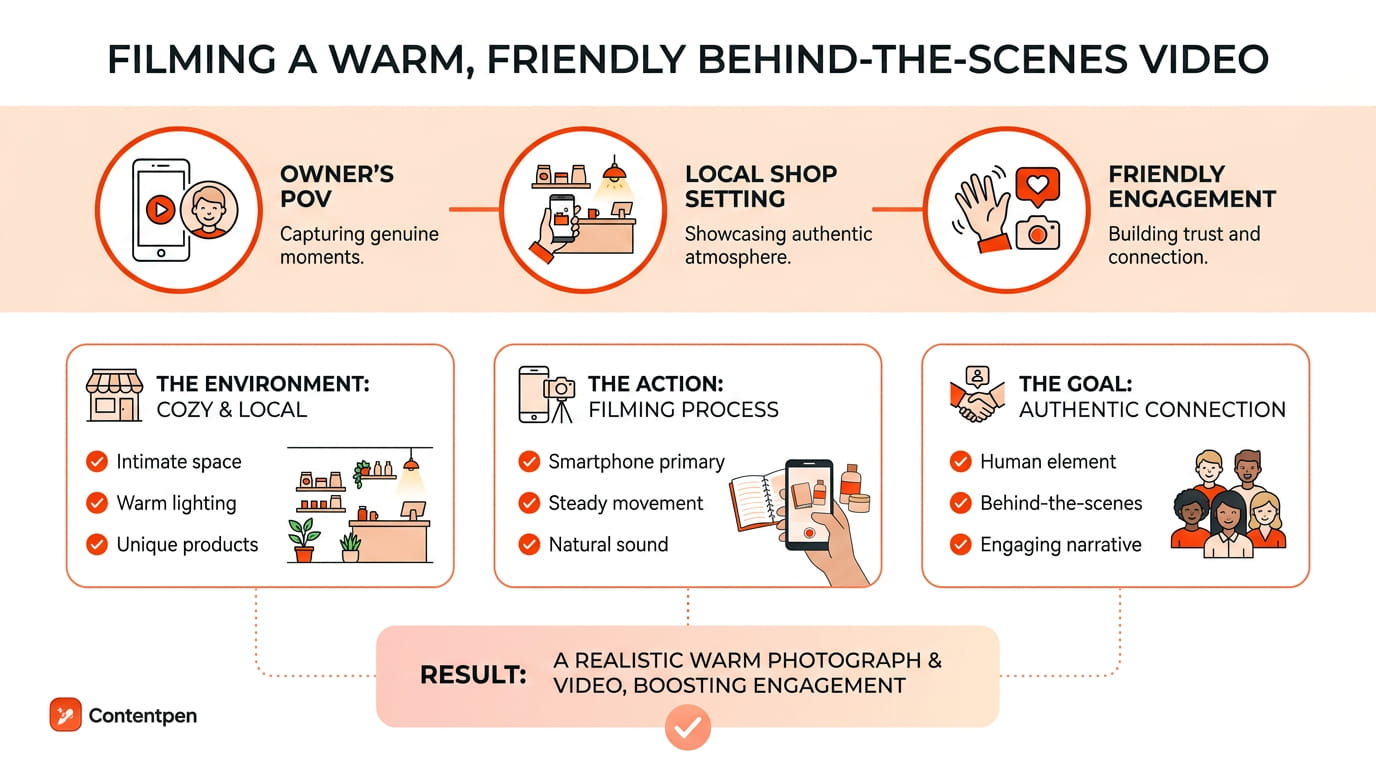
Video marketing for small business owners does not require a studio or expensive equipment. A phone camera is often enough to get started.
A quick behind-the-scenes clip, like a technician walking through a repair or a chef explaining a recipe, builds trust faster than text alone because customers see the real people behind the brand.
Once you record one video, cut it into shorter clips for social posts and email, stretching one shoot into several weeks of content. Make sure to keep adding something fresh in each post, so you keep your audiences engaged.
Step 6: Draft high-quality content faster with AI assistance
Writing consistently is often the hardest part of any small business content strategy. Lean teams often have to juggle multiple deadlines while trying to meet business goals, which can be exhausting to say the least.
This is where Contentpen fits in. The platform supports the full workflow, from keyword research and outline generation to full drafts with answer-first structuring and built-in FAQs designed for both search engines and AI chatbots.

Write better blogs in less time, without sacrificing quality.
Let AI handle structure, clarity, and flow while you stay in control of the message.
Try AI blog writing →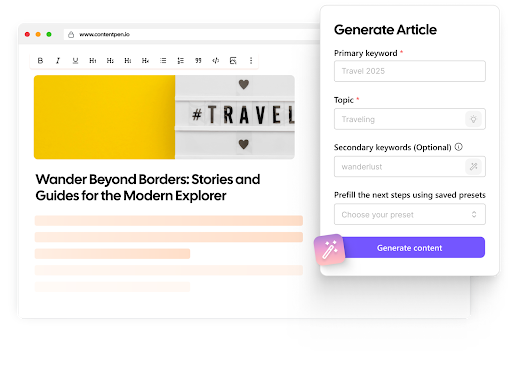
You still need to add your own examples, verify facts, and adjust the tone so it sounds like your business.
That said, the AI blogging tool does cut down the time spent juggling separate tools for SEO, writing, scheduling, and content publishing.
Step 7: Choose distribution channels where your customers already are
According to Adobe, the recommended publishing cadences are at least 5-7 posts weekly on Facebook, Instagram, and X. However, platforms like TikTok require more posts, around 1-4 videos daily, to ensure consistent presence and engagement.
As a B2B business, you can even choose to create whitepapers and leadership-style content on LinkedIn to attract more audiences to your platform.
In the end, the content distribution channels you choose are completely up to you. But choose ones that are convenient for you and your team right now. You have to start small by picking a few at a time, not all at once.
Step 8: Repurpose one idea across multiple channels
Repurposing content is a great idea to keep your marketing channels up and running. It also helps people discover you through different means.
One blog post can easily be transformed into a social carousel, a short video, or featured in an email newsletter segment. This saves you from creating brand-new material every week for every channel and keeps audiences engaged.
A house cleaning service, for example, could turn a “how to prepare for cleaners” article into a checklist graphic that they can share on LinkedIn or feature on their Yelp listing.
Another important consideration is to refresh your best-performing posts with new examples, data, or statistics rather than writing one from scratch.
You can use Contentpen’s refresh mode to help you update content automatically according to new data and SEO/GEO demands.
Update existing content without rewriting it that fills them

Improve outdated posts using live URL analysis
Refresh SEO, structure, and relevance in minutes

Step 9: Build local and community-driven content
Content marketing works best for SMBs when they lean into what a big brand cannot copy. Like featuring a longtime customer’s story or founder journeys that connect with people.
A lot of the time, these stories work best combined with social media posting.
A famous example is Kiki Couchman, who shares her struggles of launching and selling Sour Milk, a type of Greek Yoghurt with high protein.
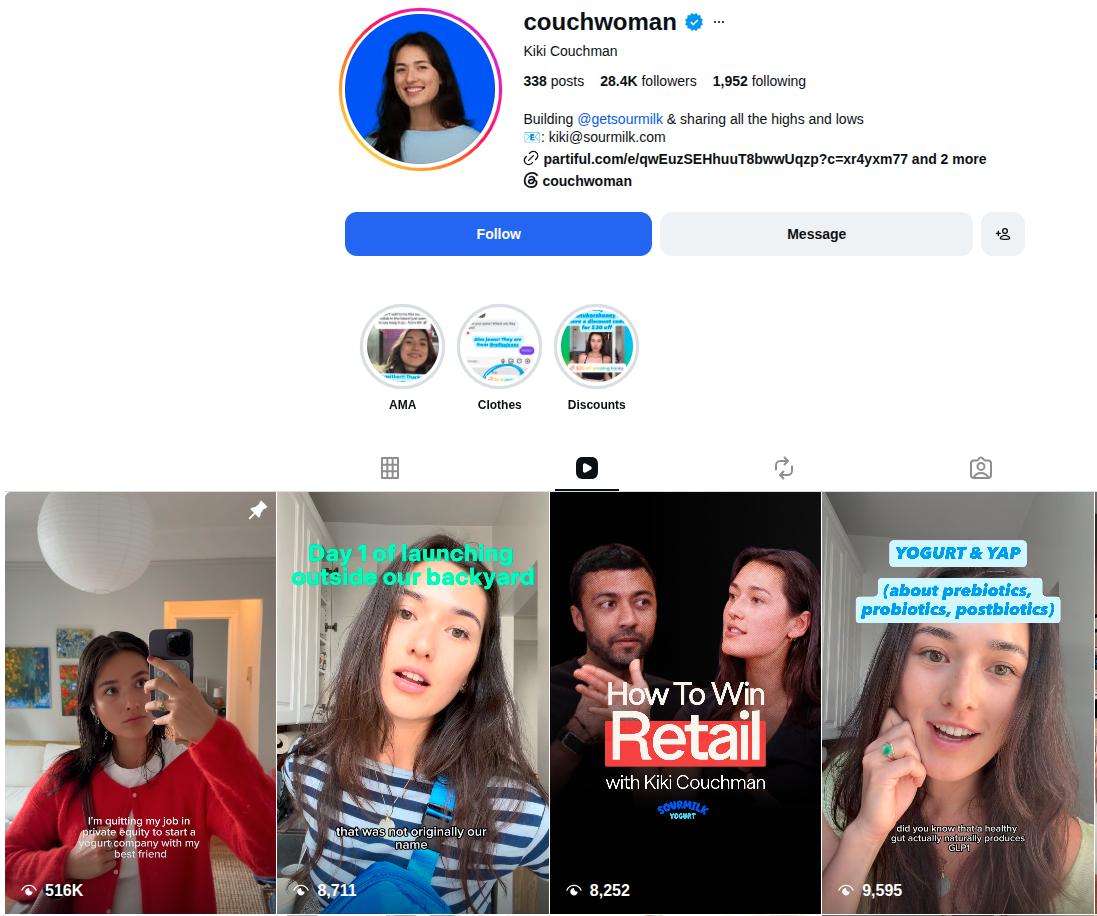
Her famous “I’m quitting my job in private equity to start a Yoghurt company” series on Instagram got her 28k+ followers and a lot of support from the community.
Content marketing that highlights real community ties builds a level of trust that national competitors simply cannot fake.
In addition to this, if you partner with a nearby, complementary business, it also extends your reach at little to no cost.
For example, a bakery teaming up with a coffee shop for a joint event or a comic book store partnering up with an action figurine seller.
Step 10: Measure results and refine your approach
Once your content is live, track the 3 to 5 KPIs you set in step 3 using tools like Google Analytics, your social media insights, and your email platform’s reports.
If you’re looking to track traffic specifically coming from your blogging efforts, then Contentpen’s web analytics serve that purpose quite well.
Understand what’s working, and why with real-time analytics
Track performance and make smarter content decisions with clear insights.
View Analytics Dashboard →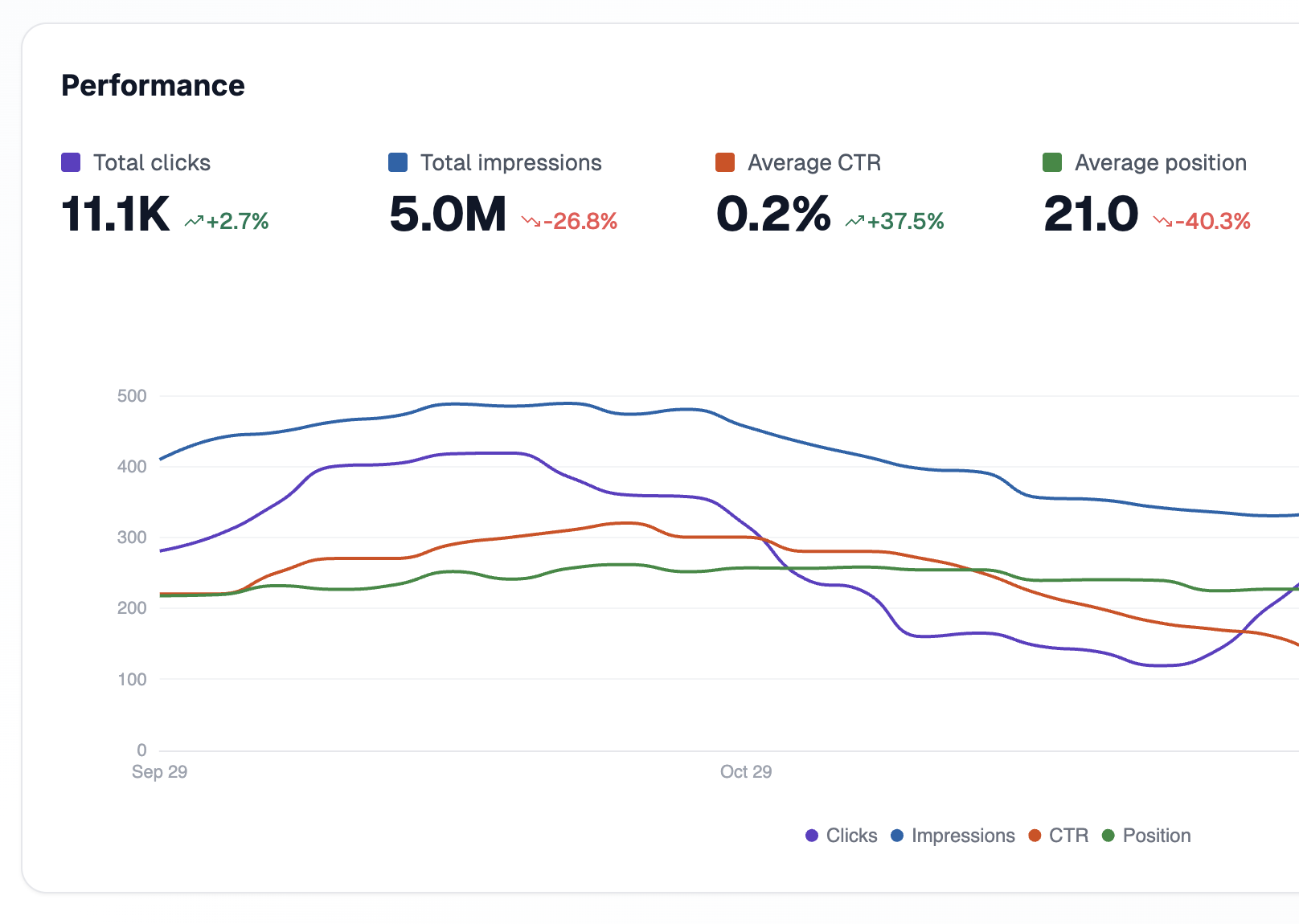
Look at which topics and formats bring in actual leads or bookings, not just clicks, and put more effort into those.
Dropping formats that get attention but no conversions frees up time for the ones that genuinely move your business forward.
Should you DIY, hire a freelancer, or work with an agency?
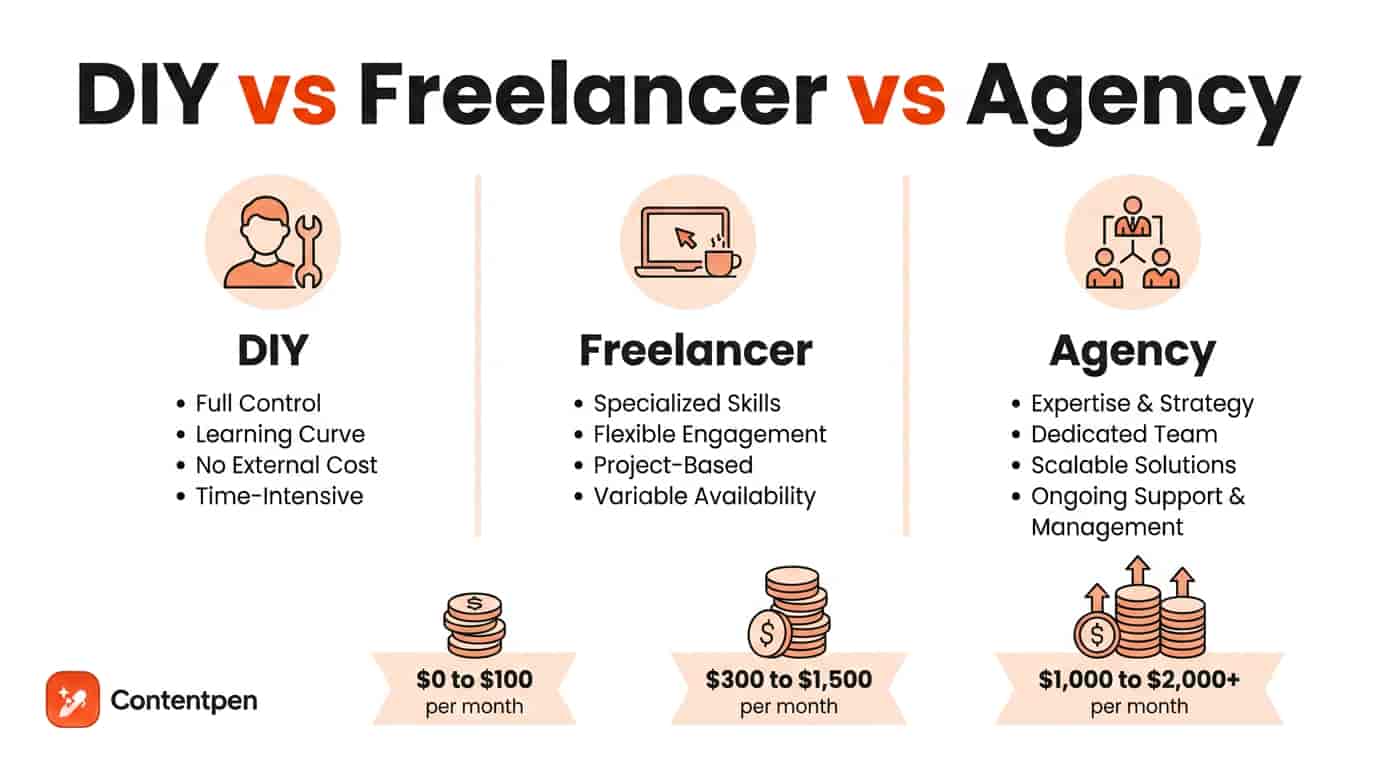
This is an important question for small businesses looking to scale their content marketing efforts.
Choosing between doing content yourself, hiring a freelancer, or working with a content marketing agency depends on your budget, time, and how complex your business has become.
Here is how each option tends to fit different situations:
- DIY content works well for solo owners and local service providers who know their customers best but need to keep their scope manageable, such as a few solid articles per month.
- A freelancer suits business owners who know what they want to say but lack the time or writing skill to turn ideas into polished posts.
- An agency fits growing businesses with multiple services or locations that need a full strategy tied to measurable outcomes.
Watch for warning signs regardless of which option you pick.
A freelancer or agency that jumps straight to a generic topic list without asking about your customers is unlikely to produce content that actually converts.
A good partner instead asks about your business, reviews your existing website, and ties every piece of content back to a KPI like improving leads or bookings.
AI writing tools support DIY efforts, since they speed up brainstorming and first drafts. But a business owner still needs to add real expertise and check every fact before publishing.
What does content marketing cost for a small business
Costs for content marketing strategies for small businesses vary widely depending on how much work you handle in-house versus hiring outside help.
- DIY content with a basic website, blog hosting, and a free or low-cost email tool typically runs $0 to $100 a month, though your time is the real cost.
- Freelance writers usually charge $100 to $400 for a couple of articles, or $300 to $1,500 a month for a package of several pieces.
- Agency retainers that combine strategy and content typically start around $1,000 to $2,000 a month and rise from there for larger projects.
Weigh any of these numbers against what you get back in leads, bookings, and brand trust rather than focusing on the price tag alone.
Wrapping up
Content marketing for small businesses does not require a massive budget or a full-time team to succeed. What it does require is consistency, real audience research, and content that speaks to your customers’ actual problems rather than generic industry talk.
Every step in this guide works together to build a content marketing plan that grows steadily over time.
For the next steps, pick just one step from this list, such as identifying your audience’s top 10 questions, and commit to it this month before adding the next step.
Then, use tools like Contentpen to help you publish high-quality content consistently, freeing up your time for the customer relationships and community ties that make your small business content genuinely stand out.
Write content that’s built to rank, not just read
Create search-optimized blogs aligned with SEO and GEO signals, so your content performs well across search and AI-driven discovery.
Try SEO Blogging FREE →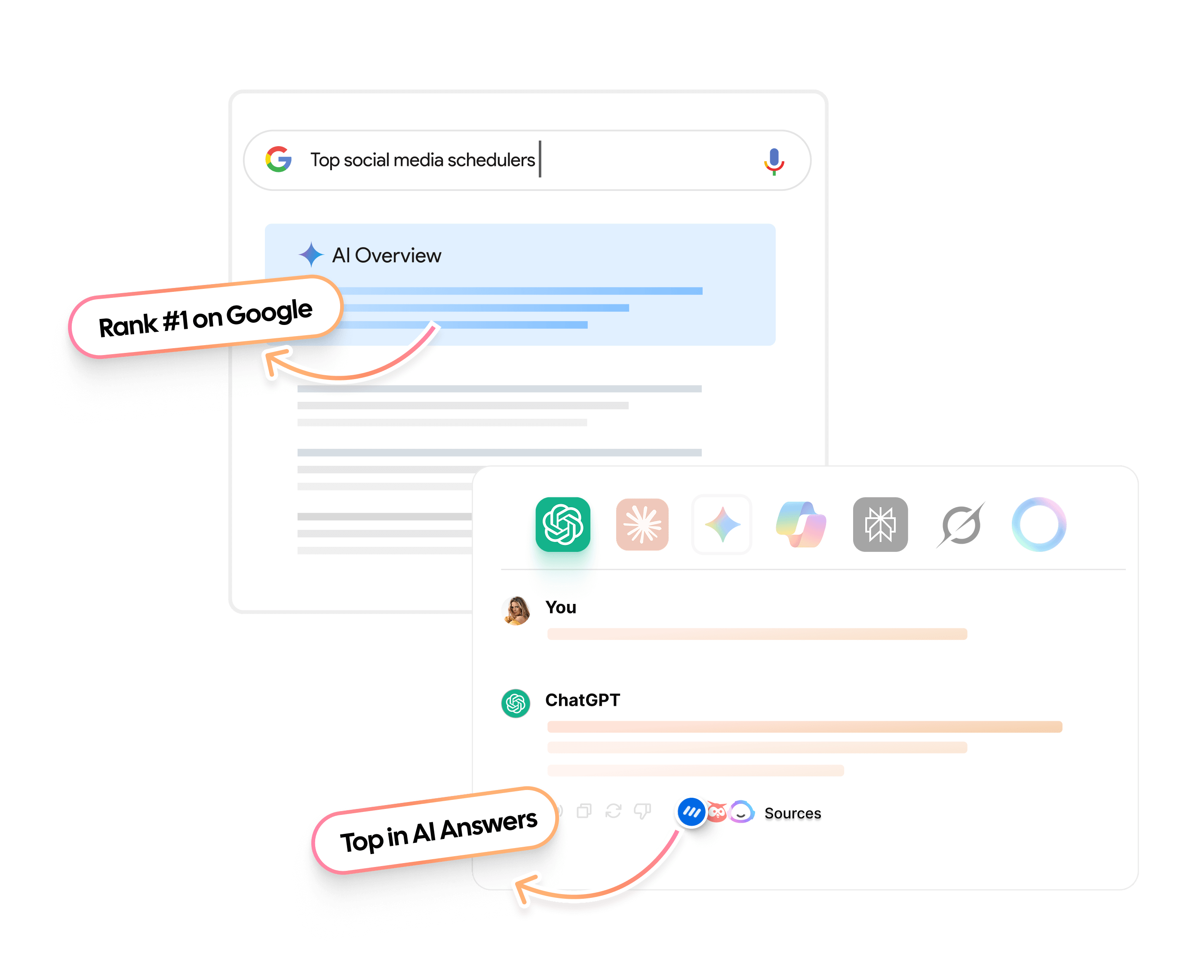
Frequently asked questions
Start with 2 to 4 hours a week, enough for one solid piece of content plus light repurposing into social posts or an email. Consistency matters far more than volume, so a single well-researched article each week beats sporadic bursts of content that stop after a few weeks.
Blog posts or short how-to guides that answer common customer questions are the easiest starting point. They require no cameras, editing software, or special skills, just a clear answer to something your customers already ask you regularly in person or over the phone.
Yes, a website with a blog and an email list can succeed on its own. Social media accounts are essentially rented space subject to sudden algorithm changes, while your own website and email list are assets you fully control, which keep working for you over the years.
Ask your front desk staff, sales team, and support tickets what customers ask most often, since these real questions turn directly into blog ideas or FAQ pages. You can also check Facebook, Reddit communities, and competitor FAQ pages for topics your audience already searches for.
The 5-3-2 rule on Instagram suggests that out of every 10 posts made, 5 should educate or entertain the audience, 3 should highlight community perspectives, and 2 should promote your brand directly. It’s not a hard-and-fast rule, but simply a starting point to know what works on IG.