More than 80% of all searches in 2026 end up without a click. If your content is not the one being cited by AI platforms, then it might as well not exist.
That shift raises a tougher question than how to do basic SEO. The real question is how to win in AI search. How does a team move from writing good blog posts to publishing answer‑focused content that shows up in Google AI Overview or ChatGPT‑style summaries?
In this article, you will see 8 real answer engine optimization examples from brands like Semrush, HubSpot, Reddit, Zapier, and Healthline.
Then we will see the answer engine optimization best practices and the AEO SEO strategy behind those results. We will also walk you through the emerging trends in 2026 and show how Contentpen helps you optimize content for AI answers at scale.
So, let’s get started.
Real-world answer engine optimization examples and what made them work
The easiest way to understand answer engine optimization is to look at brands already winning in AI search. Any content team, agency, or solo creator can adapt these strategies for better AI discoverability in 2026.
#1: Semrush turning proprietary data into a citation magnet (data-driven AEO)
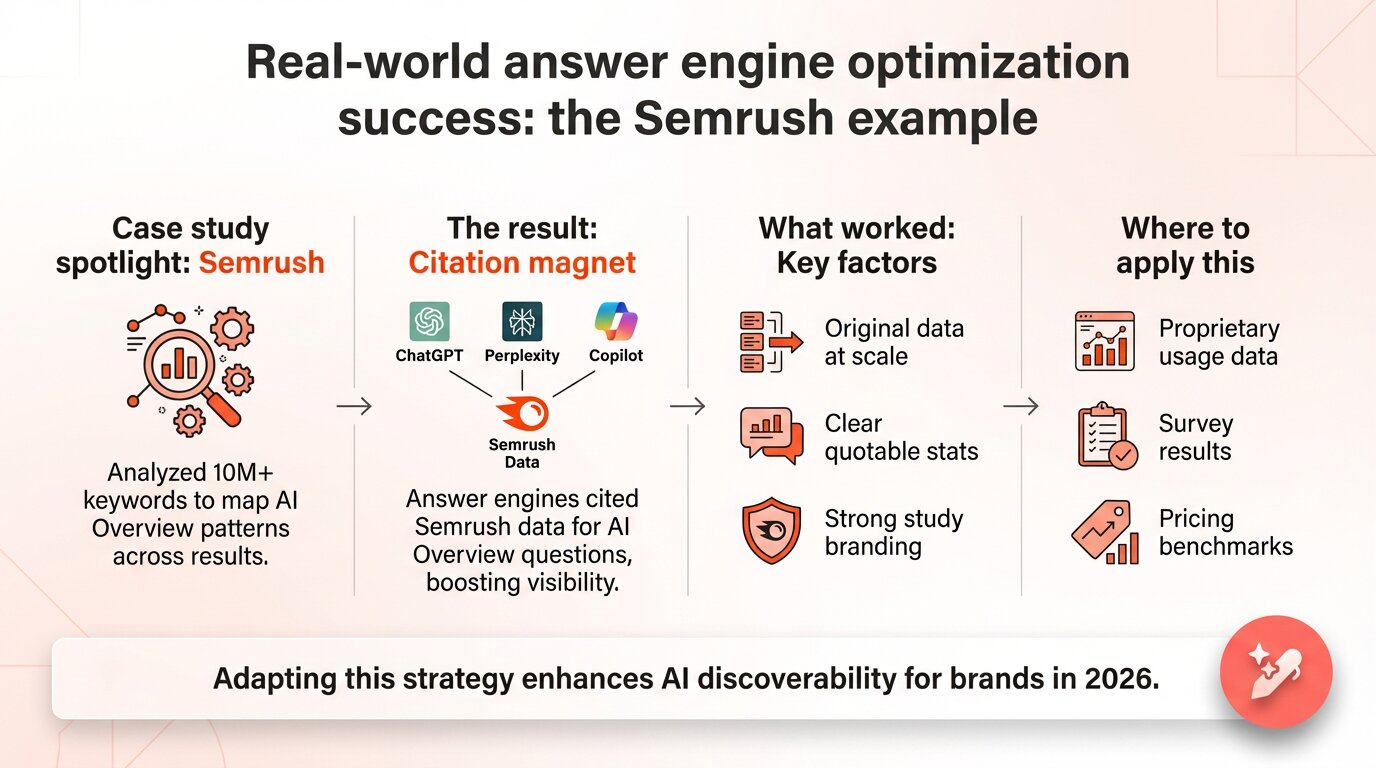
Semrush noticed confusion around how often Google shows AI Overviews and which queries trigger them. Instead of guessing, the team analyzed over 10 million keywords to map AI Overview patterns across Google’s results, then broke the findings into clear, quotable stats.
Because that dataset was early and deep, answer engines kept reaching for it. When people asked ChatGPT, Perplexity, or Copilot questions about AI Overviews and generative engine optimization statistics, those tools often pulled Semrush numbers.
Read more: How to turn off AI Overviews.
The result was a steady loop of citations, links, and branded searches that boosted both classic SEO and AI search optimization.
- What worked: Original data at scale, clear stats, and strong branding on the study.
- Where to try this: Topics where you have proprietary usage data, survey results, or pricing benchmarks nobody else can publish.
#2: HubSpot scaling question-based content architecture (definition AEO)
HubSpot already ranked for thousands of marketing queries but wanted more wins in position zero spots and AI Overviews. The barrier was not content volume, but structure.
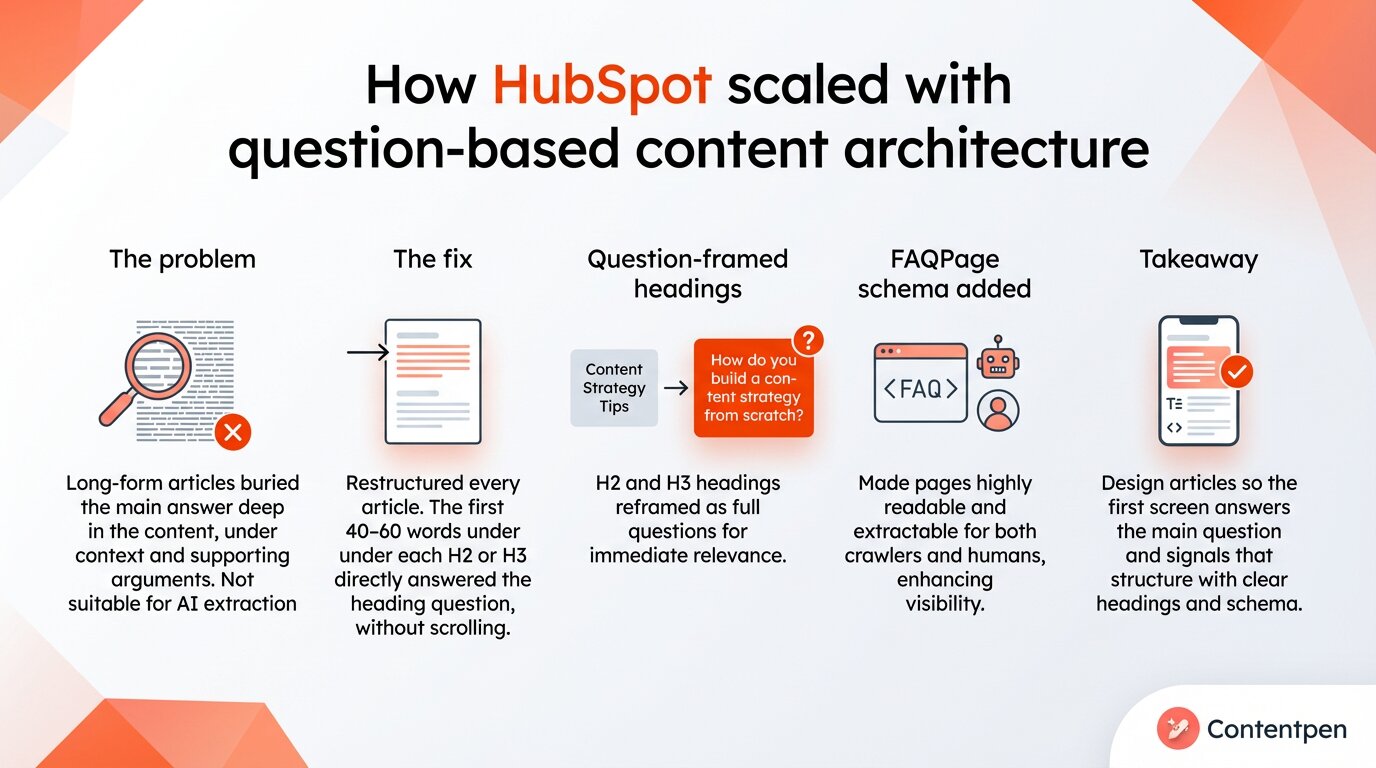
The team identified a specific problem. Most of HubSpot’s articles were written in a traditional long-form style where the main answer was buried several paragraphs down, under context, background, and supporting arguments.
That format worked for featured snippet optimization when Google pulled a mid-page paragraph. It did not work well for AI extraction, which pulls from the very beginning of a section.
The fix was a template rebuild. Every article was restructured so the first 40 to 60 words under each H2 or H3 heading answered the question that heading raised, without making the reader scroll to find it.
They framed H2 and H3 headings as full questions, like “Content Strategy Tips” became “How do you build a content strategy from scratch?” They also added the FAQPage schema to key posts, which made their pages highly readable and extractable for both crawlers and humans.
Over time, this question-based architecture turned HubSpot articles into consistent sources inside Google AI Overviews and other AI summaries, along with the featured snippet wins they were already earning.
- Takeaway: Design articles so the first screen already answers the main question and signals that structure with clear headings and schema.
#3: A regional HVAC company winning local voice queries (local AEO)
A regional HVAC company had an AI visibility problem that most content advice cannot solve. They were not competing for global traffic or brand searches. They needed to appear when someone in Phoenix searched for a term like “Who can fix my heater today?”
The agency they worked with started from the ground up. Their agency cleaned up the Google Business Profile, fixed NAP details, and built focused landing pages like ‘HVAC repair in Phoenix’ with short, spoken‑friendly answers.
LocalBusiness schema was applied across every page, telling AI engines exactly who the brand was, where it operated, and what services it provided. The FAQ schema was layered on top, covering the questions people most commonly ask before booking an HVAC appointment.
Within a few months, voice assistants started reading the company name in response to near-me prompts. Organic traffic improved, despite the brand’s domain being significantly smaller than the national HVAC chains it was competing against.
LocalBusiness schema and clear headings around common issues made those pages strong voice search optimization examples.
- Key move: Write the copy the way people speak into phones or smart speakers, then support it with the right local and structured data.
#4: Investopedia owning financial definitions at position zero (definition AEO)
Investopedia focused on direct-answer SEO for finance definitions, where searchers wanted fast clarity more than long theory. Many competitors had long, dense pages that buried the simple explanation somewhere in their content.
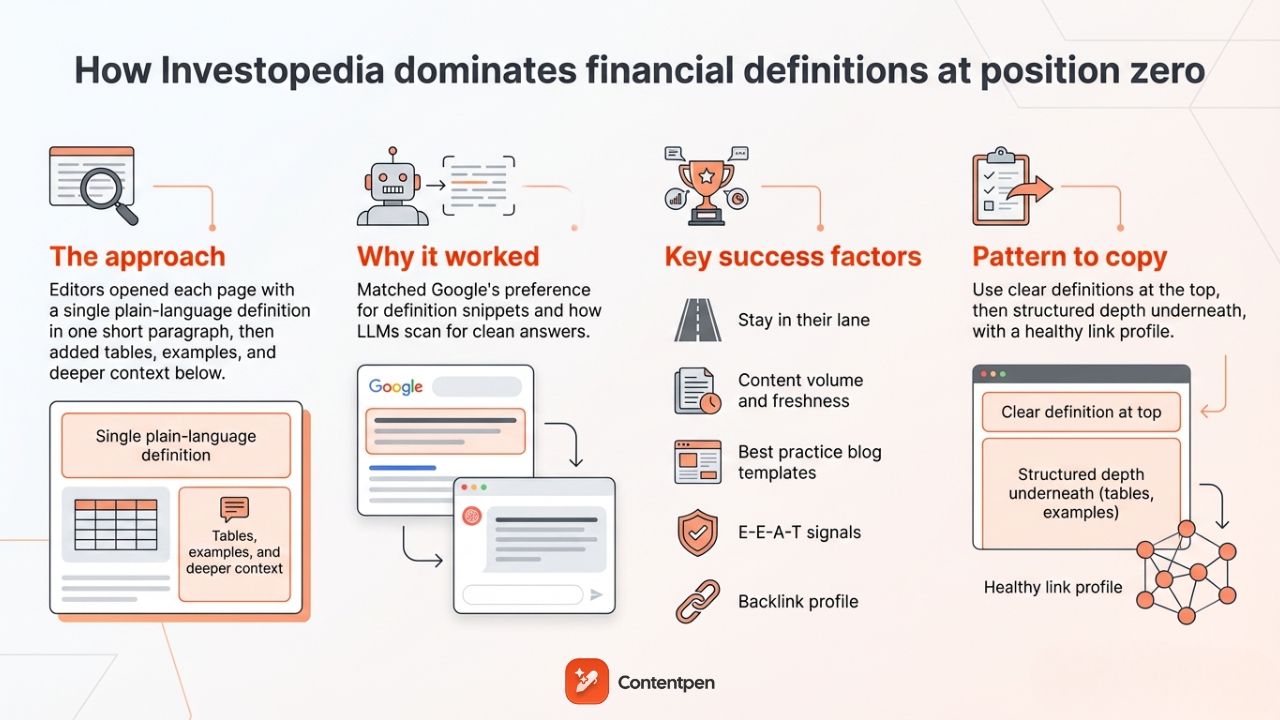
Editors reworked core pages so each one opened with a single plain‑language definition in one short paragraph, then added tables, examples, and deeper context below.
This format matched what Google already preferred for definition snippets and lined up with how LLMs scan for clean answers.
As a result, Investopedia now wins a large share of snippets for financial terms and keeps showing up as one of the most visible sites for those topics in AI chatbots. According to the Spicy Margarita case study, these are the reasons for Investopedia’s success:
- They stay in their lane
- Content volume and freshness
- Best practice blog templates and site structure
- E-E-A-T signals
- Backlink profile
Across all four brands, the common pattern is clear. They ship answer‑first content, format it so machines can extract it, and support it with strong authority signals such as data, schema, or consistent entity details.
- Pattern to copy: Use clear definitions at the top, then structured depth underneath to cover a page comprehensively while building a healthy link profile.
#5: Stack Overflow’s cautionary contrast (absence of AEO)
Not every story in AI search is a win. Sometimes the most instructive example is a brand that did not adapt in time.
Stack Overflow built one of the most comprehensive programming knowledge bases on the internet. At its peak in 2014, the platform was processing over 200,000 questions every month, and developers worldwide relied on it as the go-to source for finding coding answers.
Then ChatGPT launched in November 2022.
Within months, question volume started collapsing. By late 2025, monthly questions had fallen to under 50,000, returning the platform to 2008 levels.
That is a 76% drop in questions since ChatGPT’s release. There’s a 14% drop in visits since 2022, and Prosus, which acquired Stack Overflow for $1.8 billion in 2021, watched its most valuable asset erode in real time.
The core problem was structural. Stack Overflow’s content was built for human readers scrolling a thread, not for AI engines extracting a clean, self-contained answer.
Accepted answers were often buried under comment chains, edge-case debates, and version-specific caveats. There was no consistent answer-first structure and no schema markup guides for AI to trust the responses.
The lesson here is hard to ignore. Even a dominant, high-authority platform with years of accumulated content can lose AI visibility if the structure is not built for extraction.
- What would have helped: Clean answer-first formatting at the top of each thread, structured data identifying the accepted answer, and author credential signals on high-stakes topics.
#6: Reddit’s remarkable AEO (UGC AEO)
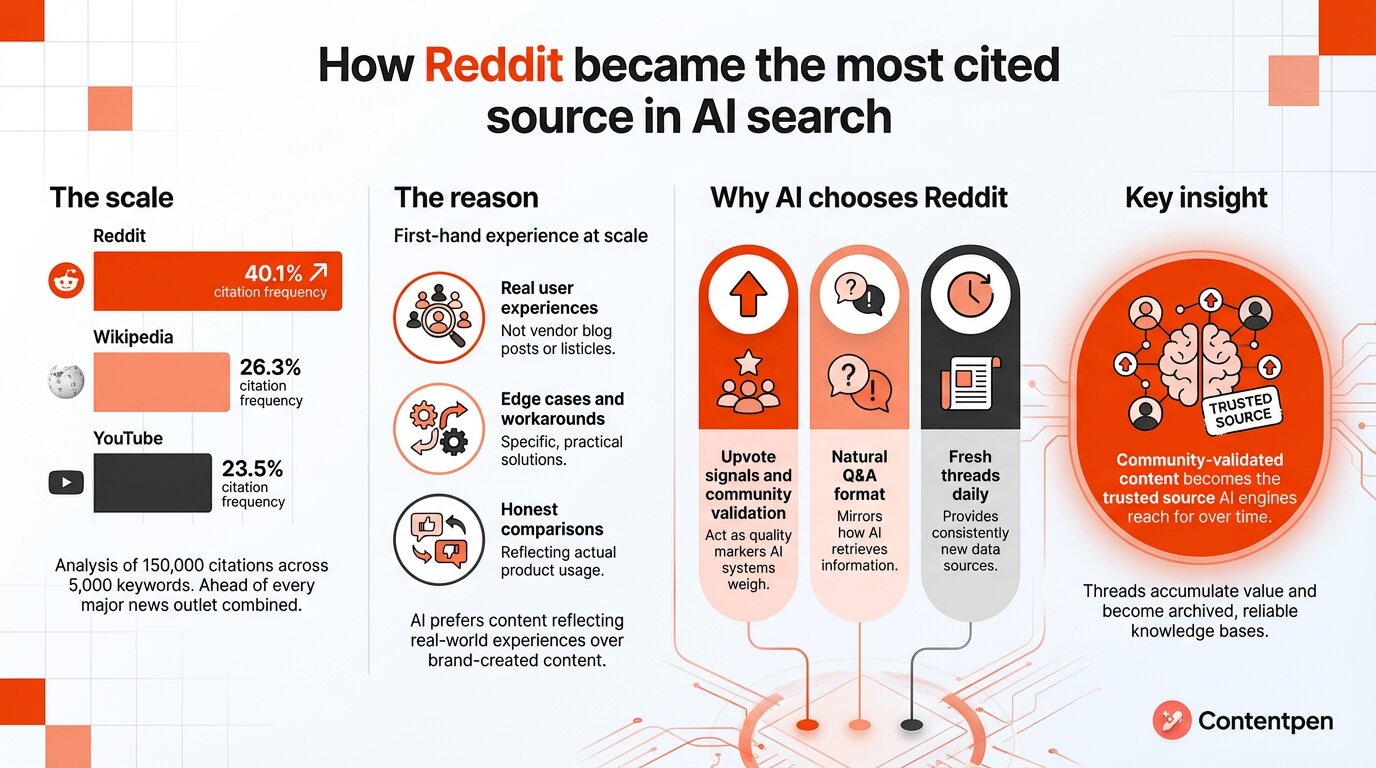
Reddit did not run an AEO campaign. It did not restructure its content for AI extraction or add schema markup to subreddit threads. Yet as of early 2026, it is the single most cited domain across ChatGPT, Google AI Overviews, and Perplexity combined.
A Discovered Labs analysis of 150,000 citations across 5,000 keywords found Reddit had a citation frequency of 40.1%, ahead of Wikipedia at 26.3%, YouTube at 23.5%, and every major news outlet combined. For Perplexity specifically, 24% of all citations in January 2026 came from Reddit alone.
The reason AI engines love Reddit is not authority in the traditional sense. It is because Reddit threads contain something that most brand content does not: first-hand experience at scale.
When someone asks ChatGPT, “What project management tool is best for a remote team of five?”, the AI is not looking for a vendor blog post or a review site listicle. It is looking for content that reflects how real people actually experienced the product, including the edge cases, the workarounds, and the honest comparisons. Reddit delivers exactly that.
Over time, those threads accumulate upvotes, get archived, and become the community-validated sources that AI engines reach for.
- Why AI chooses Reddit: Upvote signals and community validation act as quality markers that AI systems weigh. Natural Q&A format mirrors how AI retrieves information, and new threads are posted daily, giving AI a consistently fresh source of data.
#7: Zapier winning organic traffic (programmatic AEO)
Zapier does not specifically chase high-volume keywords around its own product. Instead, it built a content system that captures demand at the point of intent, across thousands of specific use cases.
The numbers tell the story. Zapier runs over 50,000 integration pages, each targeting a specific app-to-app combination. A page like /apps/gmail/integrations/slack answers one precise question: ‘How do these two tools connect?’
The format is consistent across every single page, including a plain-English description of the integration, a step-by-step setup guide, and popular automation templates. That structure generates over 5.8 million monthly organic visits, according to data from multiple SEO analysis platforms.
But the reason this matters for AEO is not the traffic number. It is how the structure performs in AI search.
Zapier solved the main challenge of programmatic content at scale by requiring app partners to provide accurate descriptions, use cases, and setup documentation during the onboarding process.
That means the people who know the app best write its content. Zapier maintains the template and structure. Partners supply the accuracy.
- What worked: Consistent template structure across all pages, partner-generated content for accuracy, answer-first formatting within each section, and deep internal linking between related integration pages.
#8: Healthline winning the share of voice in healthcare (YMYL AEO)
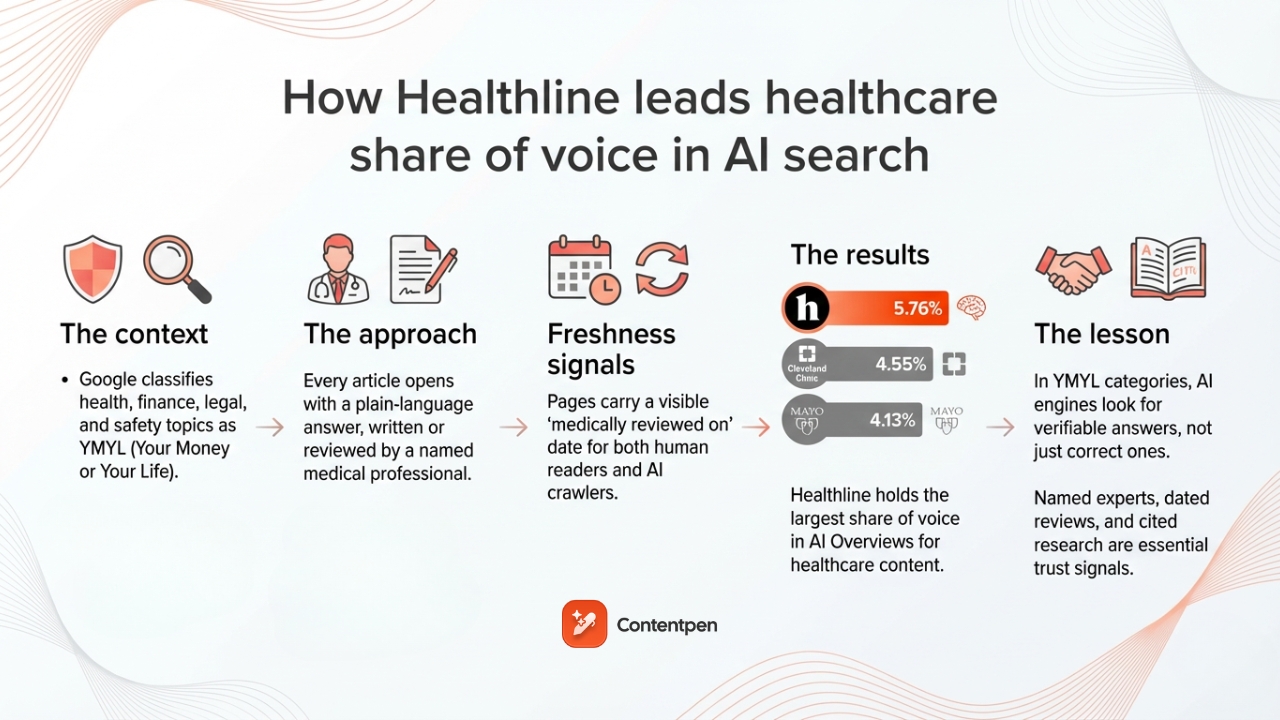
Health content operates under the strictest quality standards in search. Google classifies medical, financial, legal, and safety topics as YMYL (Your Money or Your Life), meaning AI engines apply significantly higher scrutiny before citing a source in these categories.
Healthline understood this early. Rather than competing on content volume, the brand built a system that signals trust at every layer of the page.
Every article opens with a plain-language definition or direct answer to the query, written or reviewed by a named medical professional with visible credentials.
The byline includes the reviewer’s name, specialty, and years of experience with an external link to peer-reviewed research. Pages carry a visible “medically reviewed on” date, signaling freshness to both human readers and AI crawlers.
The results are measurable. A Conductor analysis of 17 million AI-generated responses across health queries found that Healthline holds the largest share of voice in AI Overviews for healthcare content at 5.76%, ahead of the Cleveland Clinic at 4.55% and the Mayo Clinic at 4.13%.
- The lesson: In YMYL categories, AI engines are not just looking for correct answers. They are looking for verifiable answers. Therefore, using named experts, dated reviews, and cited research are essential trust signals.
Pattern classification for AEO examples
Every example in this article follows one of five distinct AEO patterns. Recognizing which pattern fits your business is the fastest way to decide where to focus first.
| Pattern | Example | Core mechanism | Who does it work for |
| Data-driven AEO | Semrush | Proprietary research becomes the only citable source on a topic | Brands with access to original usage data, survey results, or internal benchmarks that nobody else can publish |
| Definition AEO | Investopedia, HubSpot, Healthline | Plain-language answers at the top of every section match AI extraction patterns and satisfy definitional intent | Finance, health, legal, and any category where clarity beats depth at the point of extraction |
| UGC AEO | First-hand community experience fills the gaps that branded content cannot | Any brand whose audience discusses it in forums, review sites, or social communities | |
| Programmatic AEO | Zapier | Consistent, structured templates at scale capture thousands of specific use-case queries without manual writing | Businesses with large structured data sets, such as integrations, locations, product combinations, or use cases |
| Local AEO | Regional HVAC company | Voice-search-friendly answers combined with local schema, GBP optimization, and NAP consistency create a verified local entity signal | Service businesses with geographic targeting that rely on near-me and voice queries for bookings |
The pattern that consistently underperforms is attempting all six at once without data to support any of them.
Therefore, you need to start with the one that matches your existing strengths.
A brand with original usage data starts with data-driven AEO. A service business with local reach starts with local AEO. A SaaS platform with thousands of use cases starts with programmatic AEO.
Most brands will eventually use two or three patterns together. The most common combination is data-driven AEO layered with definition AEO and UGC AEO.
That combination covers the three things AI engines evaluate most heavily: do I trust this source, can I extract a clean answer, and does the wider web confirm what this brand says about itself?
Answer engine optimization best practices extracted from these examples
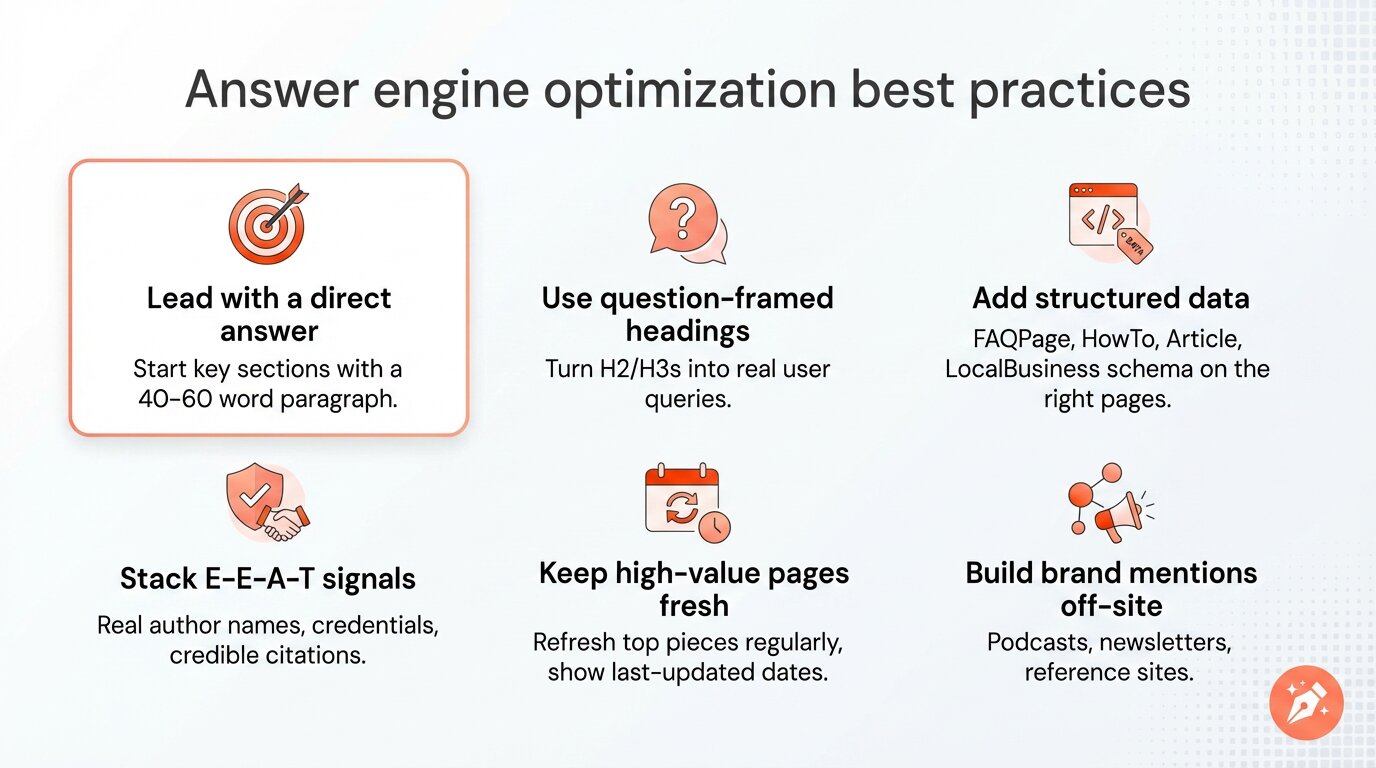
Those answer engine optimization examples were not accidents. Each one came from a set of repeatable moves that any content team can use. Think of this section as a compact framework for how to do AEO without guessing.
- Lead every key section with a direct answer
Start important sections with a 40-60-word paragraph that fully answers the question in the heading. This inverted‑pyramid style of writing works for readers and for direct-answer SEO, because answer engines can lift that block into snippets or summaries. - Use question‑framed headings throughout your content
Turn your H2 and H3 headings into the exact queries people type or speak. Examples include ‘how to appear in AI overviews’ or ‘how to rank in AI search’. This is where semantic SEO and AEO meet, since headings become clear intent signals. - Implement structured data for answer engines on the right pages
Add FAQPage to question‑heavy posts, HowTo to step‑by‑step guides, Article to long‑form resources, and LocalBusiness or Organization where it fits. - Stack E‑E‑A‑T signals around important topics
Use real author names and credentials, pull in credible citations, and add first‑person notes, such as in our research, to show real experience. These trust markers help answer engines choose your page when several sites say roughly the same thing. - Keep high‑value pages fresh and clearly dated
LLMs and AI Overviews lean toward recent content. Conduct an AI visibility audit. Refresh your top pieces at least a couple of times a year, update stats, and show a ‘last updated ‘date. - Build brand mentions beyond your own site
Work on getting quoted on podcasts, in industry newsletters, and on reference‑style sites. AI search engines treat those mentions like soft links. For many brands, this off‑site work is what separates quiet pages from sites that show up in AI chat and overviews.
You do not need to apply every best practice on every page. Start with some URLs that already rank on Google page one or pull meaningful traffic. Those are the best options for answer engine optimization in AI because a small lift can turn them into featured snippets or AI citations.
As Marie Haynes often reminds site owners, “it is not enough to say you are an expert; you have to demonstrate it through your content, authors, and references.”
Emerging AEO trends in 2026 that you shouldn’t ignore
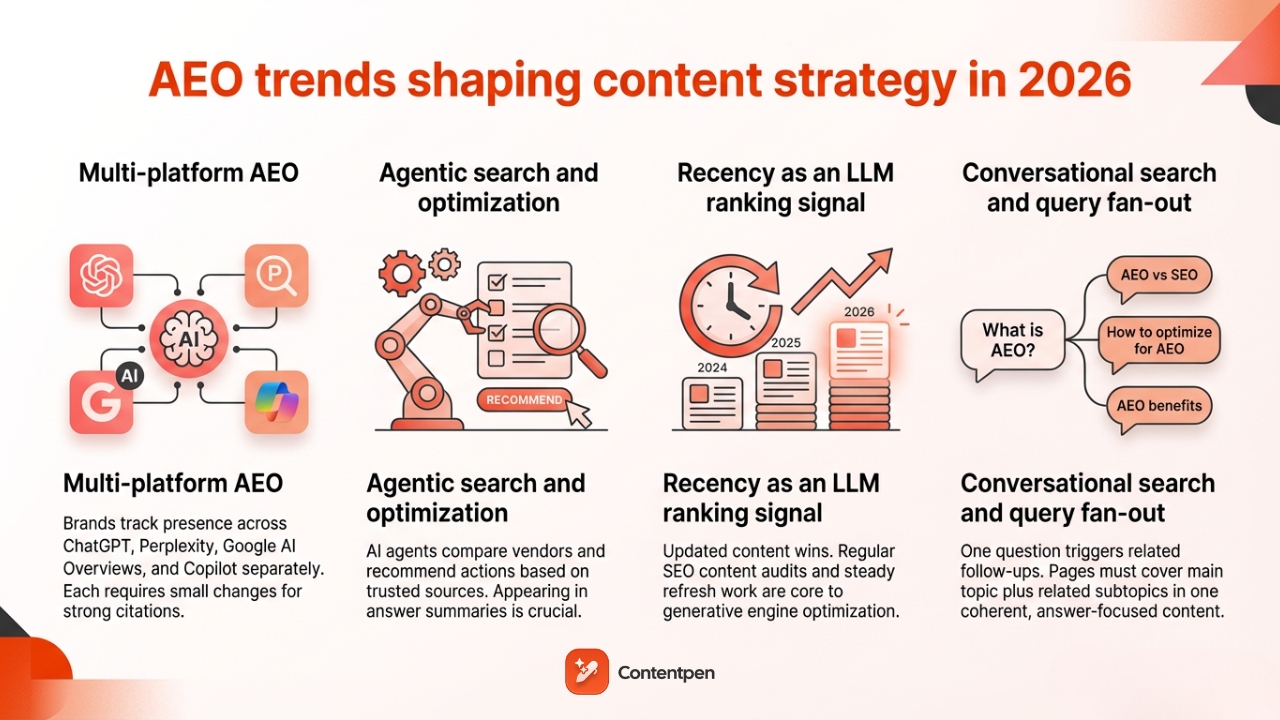
By 2026, AEO has shifted from a side project to a core content strategy. The question is no longer whether answer engine optimization matters, but how fast a team can adapt its workflow and measurement.
Key AEO trends to watch in 2026 include:
- Multi‑platform AEO. Brands now watch their presence in ChatGPT SEO optimization, Perplexity AI SEO, Google AI Overviews, and Copilot separately. Each system favors slightly different sources, so one piece of content might need small changes, extra distribution, or new internal links before it turns into a strong citation magnet.
- Agentic search and “agent engine optimization.” AI agents are starting to compare vendors, schedule demos, or even place small orders based on the sources they trust. If a brand never appears in answer‑phase summaries, it will probably not show up when those agents recommend actions later.
- Recency as a ranking signal for LLMs. Many models favor content that is clearly updated, even if older posts have more links. That makes SEO content audits and steady refresh work core parts of generative engine optimization practice.
- Conversational search and query fan‑out. A single question, such as “What is answer engine optimization?” might trigger follow‑ups about ‘AEO vs SEO’, or ‘how to optimize for answer engines’, all inside one chat. The pages that win here cover the main question plus related subtopics in one coherent, answer‑focused piece of content.
If teams ignore these shifts, competitors will keep stacking new answer engine optimization examples month after month, while older static content fades from both SERPs and AI responses.
How Contentpen helps you execute an answer-focused content strategy
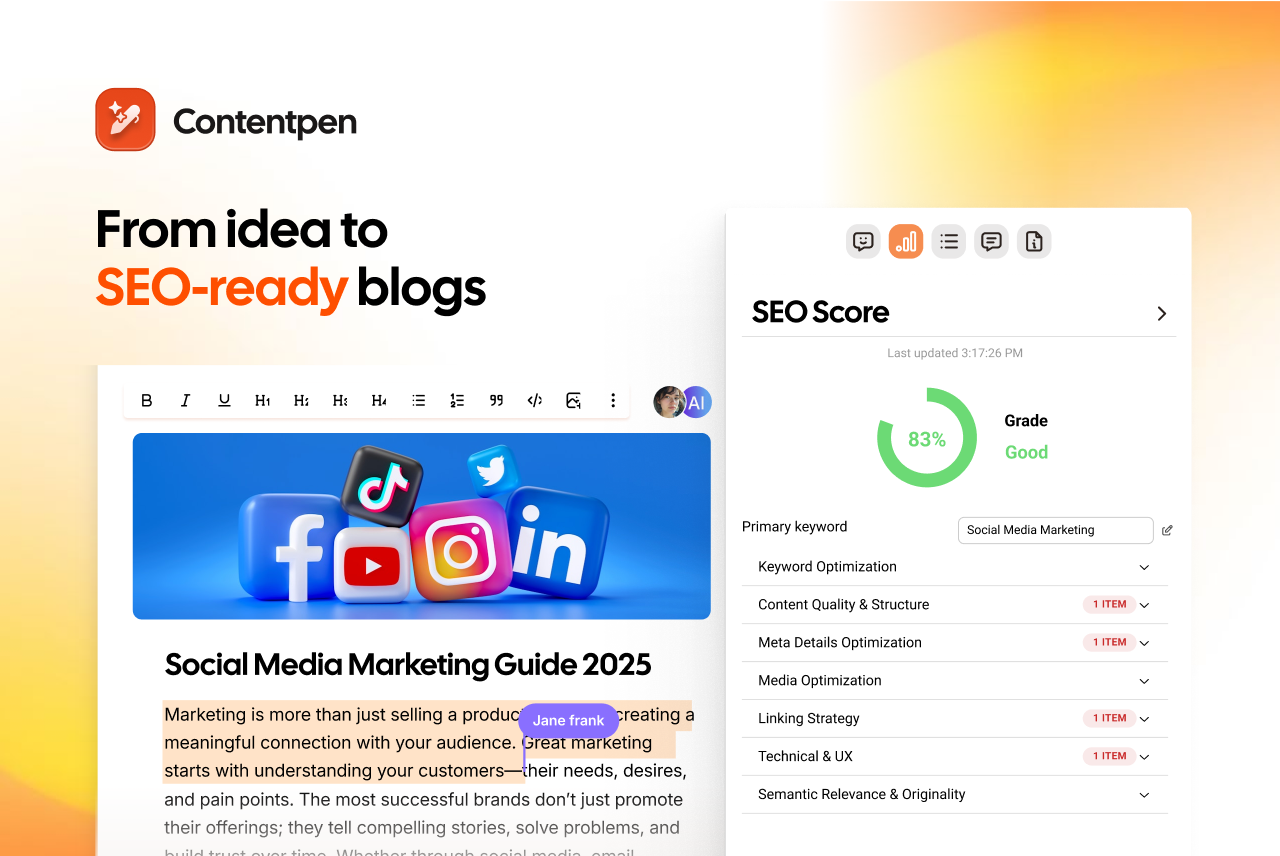
After seeing these answer engine optimization examples and trends, a natural question appears: how do you do all of this on a real content calendar without burning out your writers and editors?
Contentpen is an end‑to‑end AI blog creation platform built for teams in that exact spot. Marketing leaders, agencies, and solo creators use it to plan and ship long‑form posts that already follow an answer‑first structure and AEO SEO strategy patterns.

Get your content cited by AI, not just ranked on Google!
See your real-time GEO score as you write to make every piece citation-ready.
Try GEO Scoring →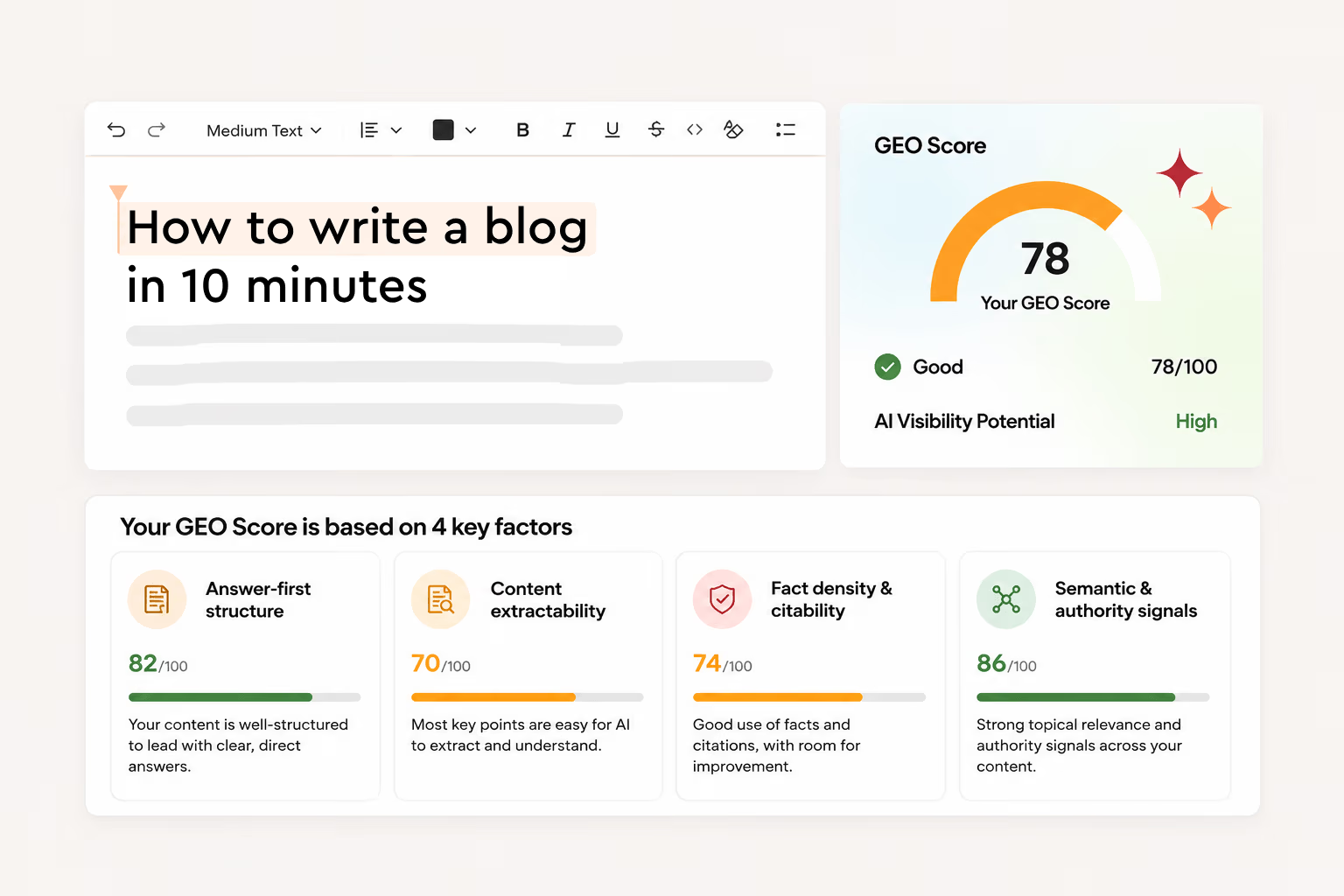
The AI‑powered content scoring helps you draft sections with clear headings, short paragraphs, and direct answers that fit featured snippet optimization and generative engine optimization.
Linking automation suggests and adds internal and external links that build topic clusters, which help the answer engines understand your site structure.
Contentpen also guides headline choices, meta descriptions, and on‑page SEO, so posts align with audience intent and position‑zero opportunities.
Also read: 16 best AI visibility tools in 2026.
The tool also offers a built‑in media library and AI image generation features to provide assets that not only help your visibility in SERPs and AI platforms but also on Google Images.
As a next step, register for Contentpen and start creating content that gets discovered and cited at scale without any hassle.
Final thoughts
The brands winning in AI search are not lucky. They publish answer engine-optimized content by answering real questions directly, structuring pages, and stacking trust signals around their most important topics.
AEO will keep changing, but the core stays stable. Helpful content and steady proof of expertise matter in classic SEO, in zero‑click search optimization, and in AI‑powered experiences.
The good news is that many of your biggest wins are probably hiding in content you already have. With smart rewrites, fresh data, and better formatting, older articles can turn into new AEO wins that show up in AI Overviews and chat tools.
Turn existing content into growth opportunities

Identify pages losing traffic or CTR
Find quick wins to improve clicks and rankings
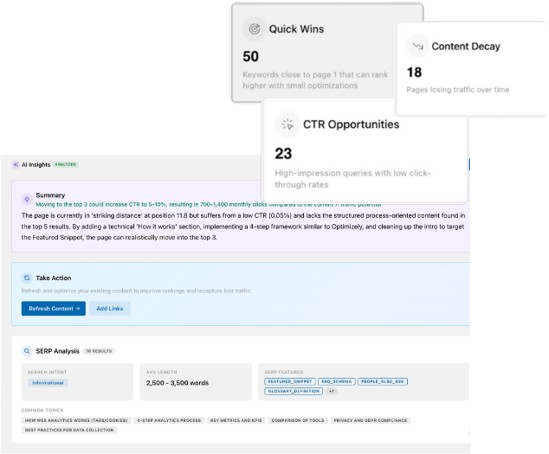
When you are ready to build that kind of system, platforms like Contentpen make it far easier to plan, draft, and ship answer‑focused content on a schedule.
Frequently asked questions
Three things: a measurable ‘before’ and ‘after’ effect, a clear enough mechanism followed, and pattern transfers, meaning another brand could apply the same tactic with their own content and data. If an example only worked because of one brand’s unique budget or equity, it is interesting but not instructive.
For pages that already sit on page one, small AEO tweaks can win a featured snippet or People Also Ask box within a few weeks. Bigger wins in AI chat tools and overviews often show up after several months of steady updates, new links, and stronger authority signals around your brand.
Isolate AI-referred traffic in your analytics and watch what those visitors actually do. Sessions from chat.openai.com, perplexity.ai, and similar sources should be segmented separately. Track time on page, form submissions, demo requests, and purchases. If they are converting at significantly higher rates than organic traffic, the citations are producing a real pipeline.
The most direct method is to run your key questions through tools like ChatGPT, Perplexity, or Google AI Overviews and see whether your brand or URLs appear in citations. Some teams also add this step to content audits, so they can spot new opportunities as they gain traction.