Author: Jawwad

  • 16+ best AI search optimization tools for 2026

    16+ best AI search optimization tools for 2026

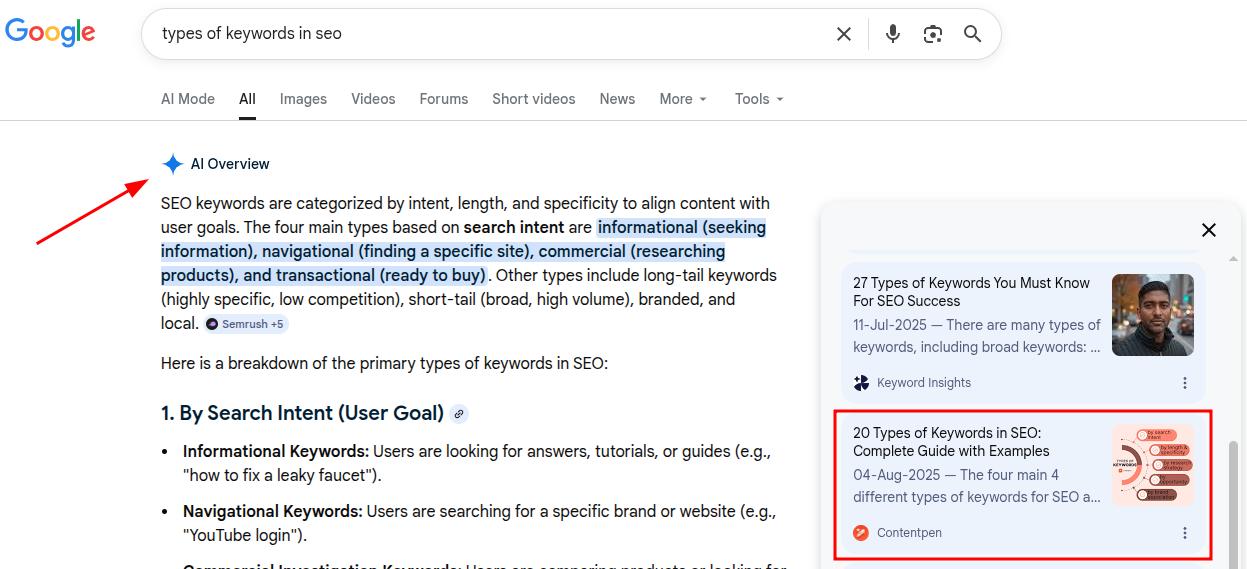
    AI search optimization tools now influence whether your brand shows up inside ChatGPT or gets skipped in AI answers. When people ask Perplexity, Gemini, or Google AI Overviews for advice, those instant summaries can replace a click to your site.

    That is the real problem. Your organic traffic can slide even while your classic rankings look fine in your old dashboards. This is where AI search optimization tools become crucial. These platforms help your content appear in those AI summaries, and not just in SERP results.

    In this guide, you will see 16+ of the best options tested and ranked for 2026 across different categories. You will also see how Contentpen fits into a modern stack, especially if you care about long-form blog posts that attract links.

    Ready to pick tools that work with AI instead of fighting it? Let us start with what these tools actually are and why they matter now.

    What are AI search optimization tools, and why do you need them in 2026?

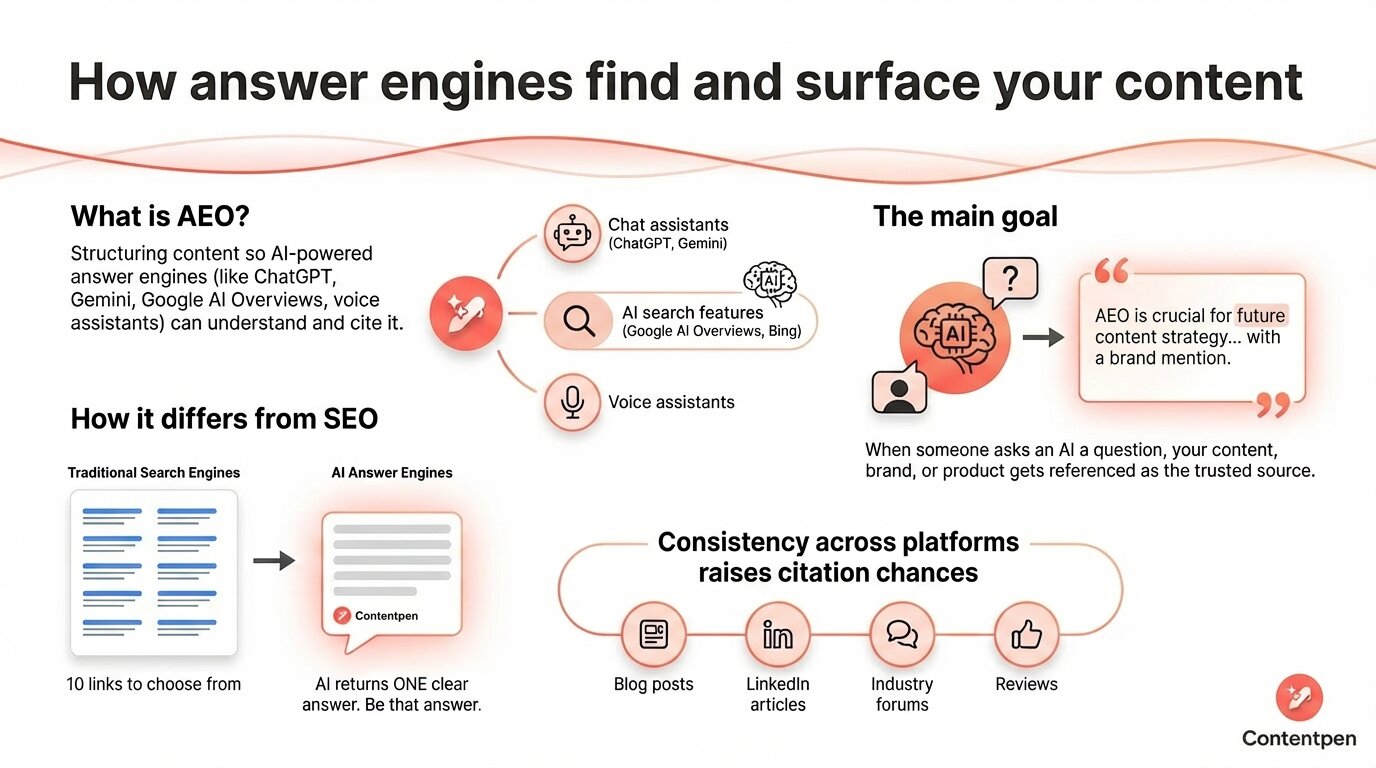
    AI search optimization tools are platforms that help your site appear in answers from AI systems like ChatGPT, Perplexity, Claude, Gemini, and Google AI Overviews. They focus on how large language models read, summarize, and cite your content. Instead of only tracking rankings, they look at prompts, entities, and citations for your brand.

    Traditional SEO chases positions on classic SERPs with blue links. That still matters, but more people now type full questions into AI chatbots when they want fast guidance, prompting the need for AEO.

    Research from Similarweb shows the average monthly visits for AI tools grew 76% year over year (YOY). This stat and a lot of AEO examples tell us that if your brand is not mentioned or cited in those AI answers, a growing audience never hears about you. 

    AI search optimization tools measure when you are mentioned, which sources those systems lean on, and how you compare to competitors. They are a necessity for brands in 2026 looking to improve share of voice in a niche and establish themselves in an industry.

    Also read: AI search optimization vs. traditional SEO.

    You also need practical help turning insights into content. Many modern AI SEO tools now combine AEO/GEO tracking with AI content optimization, on-page optimization, and automated SEO workflows for internal links, schema, and indexing. 

    These tools also help you write content that satisfies a people-first approach while still being easy for AI systems to parse and trust.

    How we tested and ranked these tools

    This list of AI search optimization tools ranks each product on real-world usefulness for content marketers, agencies, and individuals.

    We focused on how much each tool helps you show up in AI answers and how a busy team can put the insights into action.

    The tools were tested against several core criteria:

    • Prompt-level tracking across ChatGPT, Perplexity, Gemini, Claude, and Google AI Overviews
    • Multi-engine coverage for both classic and AI search
    • Citation and source intelligence for AI answers
    • Competitor benchmarking and share-of-voice views
    • Actionable recommendations instead of raw numbers and charts
    • Ease of use, setup time, and learning curve
    • Pricing and integrations with GA4, Google Search Console, and major CMS platforms

    We also favored products that support answer-first intros, clear headings, and FAQ blocks that AI platforms can easily reuse and cite in their answers.

    Note: The pricing values stated in this article are accurate as of the date of writing this article, but may vary. Always refer to the vendor website for the latest pricing updates before making a decision.

    16+ best AI search optimization tools in 2026

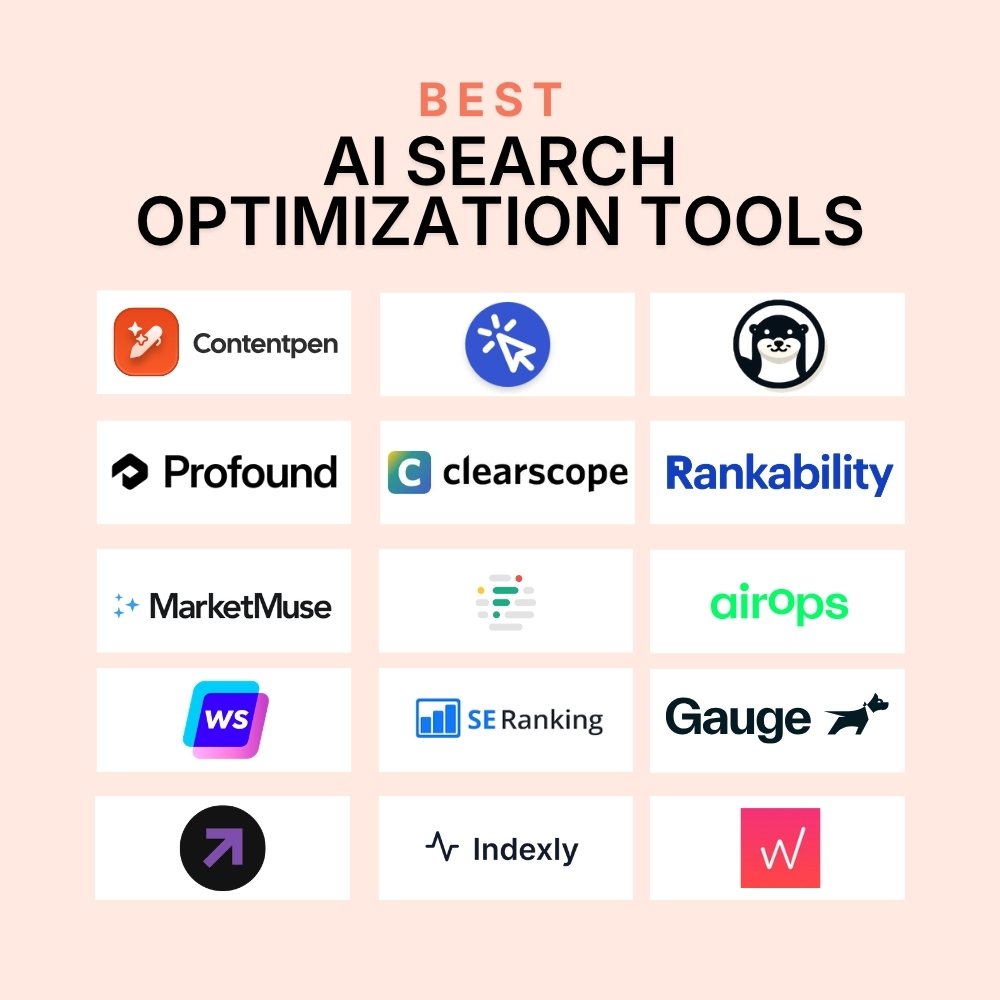
    The 16+ best AI search optimization tools in 2026 cover every part of the modern SEO + GEO stack. You get tools that provide content creation, GEO tracking, AEO audit workflows, technical indexing help, outreach, and reporting. 

    ToolBest forStarting priceFree plan?
    ContentpenGEO-friendly long-form content and AI visibility tracking$49/monthYes, 7-day free trial
    AIclicks.ioAll-in-one GEO and AI visibility tracking$59/monthYes, 3-day free trial
    OtterlyAIGEO audit workflows$29/monthYes
    ProfoundEnterprise-grade AI visibility analytics$99/monthYes, limited
    ClearscopePrecision editorial optimization$129/monthYes, 14-day free trial
    RankabilityAgencies needing NLP and expert coaching$199/monthNo
    MarketMuseBuilding topical authority and content strategy$99/feature/monthYes, limited
    HubSpot AEOAI visibility insights and marketing workflows$45/monthYes, 28-day free trial
    FraseAffordable briefs and AI drafting$49/monthYes, 7-day free trial
    AirOpsCustom AI workflows at scaleCustom pricingLimited
    WritesonicAI article writing with live SEO data$79/monthLimited
    SE RankingGoogle AI Overview monitoring$129/monthYes, 14-day free trial (complete access)
    GaugeAgentic AI marketing intelligence$99/monthYes, free trial
    Search AtlasAutomated AI SEO execution$99/monthYes, 7-day free trial
    IndexlyAutomated indexing and AI crawler access$99/monthYes
    WhatagraphAI-powered SEO and GEO reporting$229/monthYes
    GrackerAIAEO/GEO for cybersecurity brands$99/monthYes, 7-day free trial

    Each detailed tool entry explains what the AI search optimization tool does, standout features, who it suits, and how pricing starts.

    Use this section as a starting line and then mix tools into your own stack to receive maximum gains.

    1. Contentpen — Best for AI-powered blog creation and SEO + GEO content
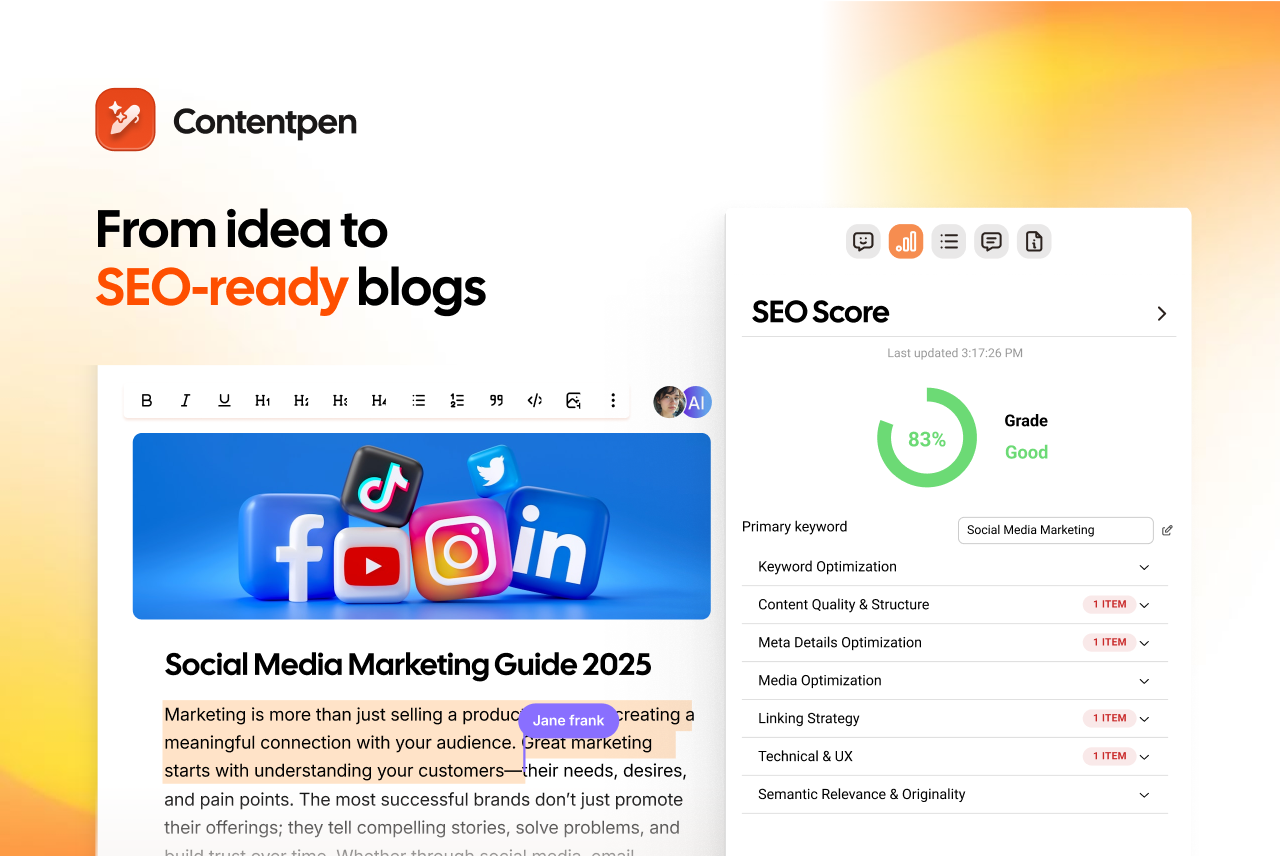
    Contentpen for AI and SEO optimized content.

    Contentpen is built for one clear job: creating long-form blog content that ranks on Google and gets cited by AI engines. It guides you from topic idea through to a polished, SEO- and GEO-optimized article, then tracks whether ChatGPT, Gemini, Perplexity, and other AI engines actually mention your brand.

    That makes it a natural starting point if you want to rank on Google as well as get cited in AI systems.

    Standout features:

    • Powerful keyword research based on real search intent
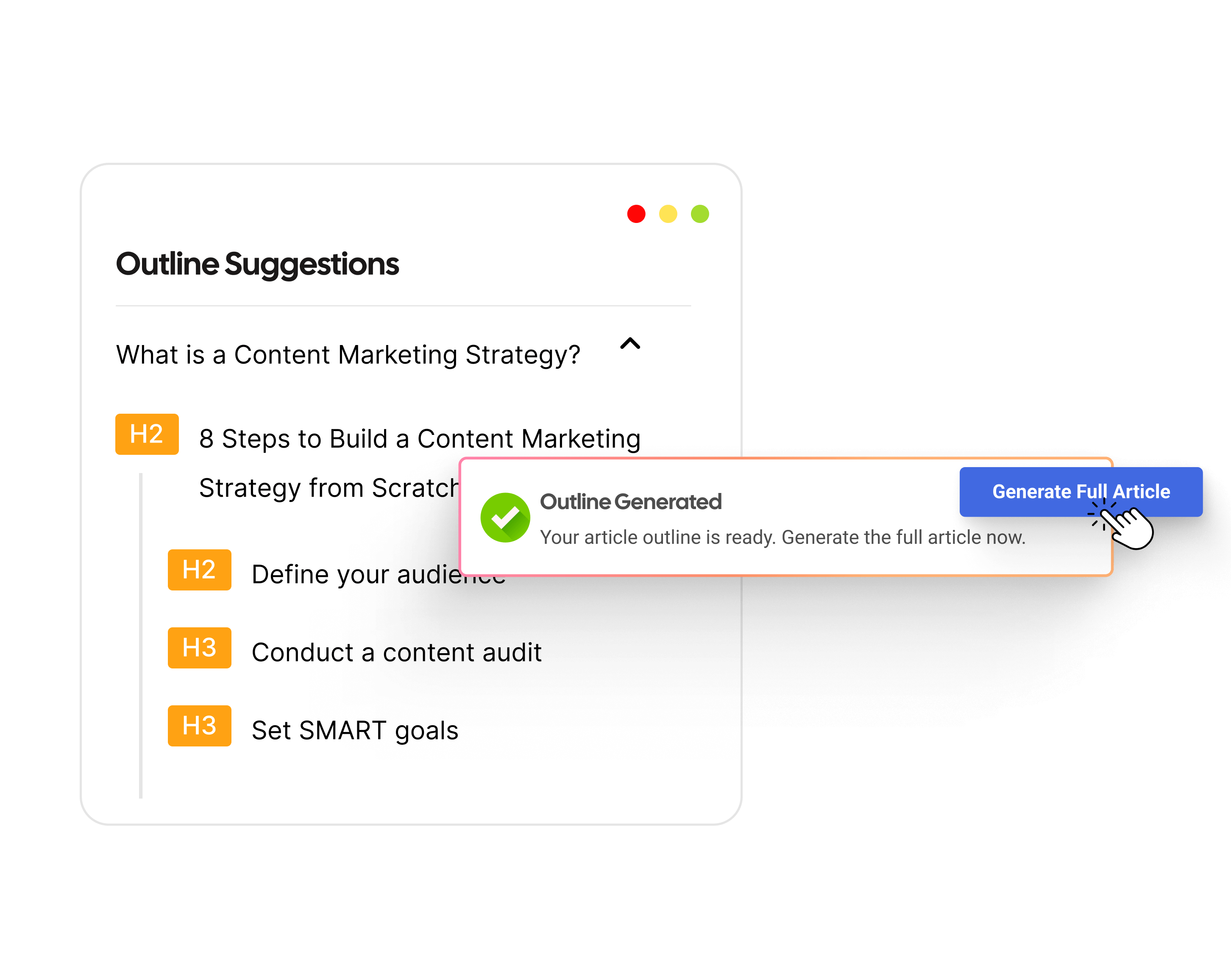
    • Detailed outlines so your output does not feel generic
    • Answer-first intros, strong headings, and FAQs that work well for GEO and AI search
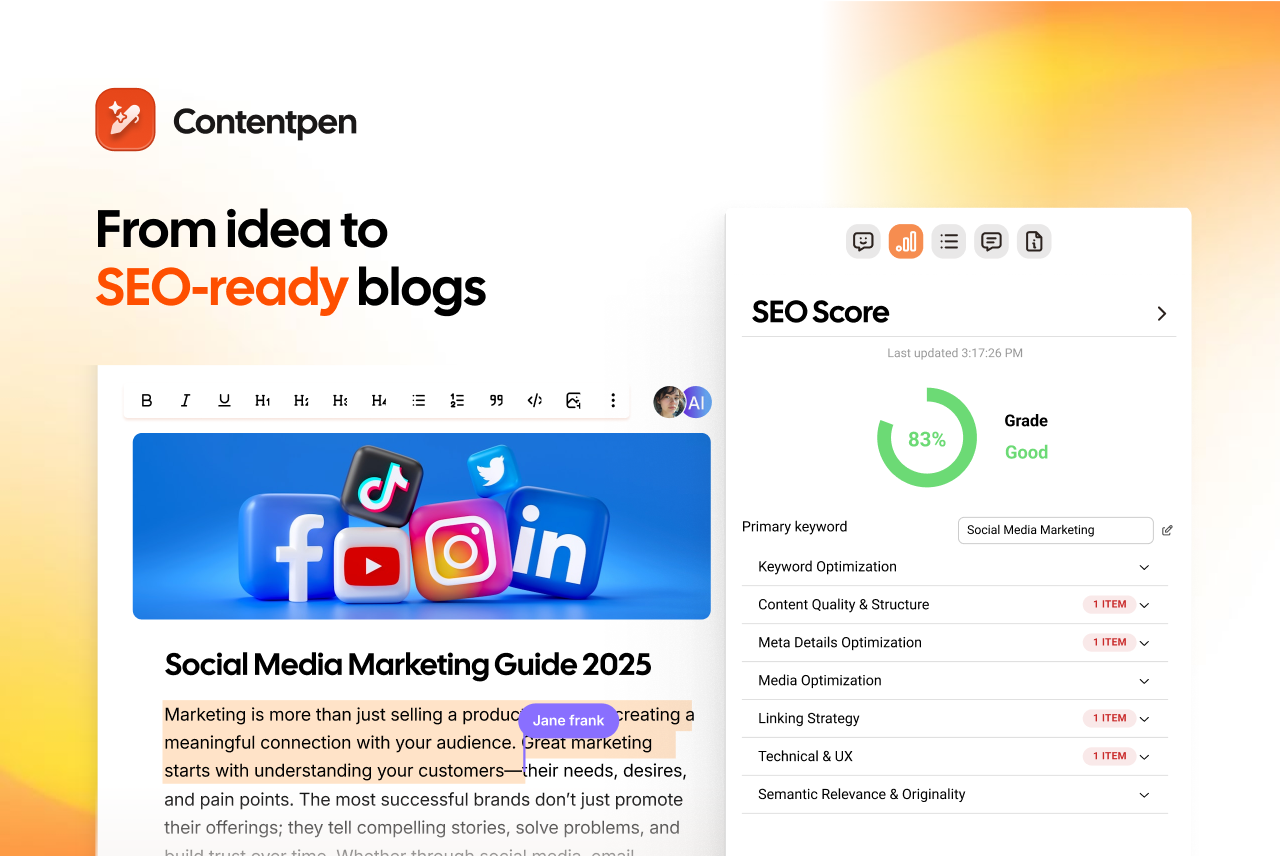
    • Live GEO scoring across 17 parameters, with Fix with AI to resolve SEO and GEO issues in one pass
    • AI visibility tracking, covering up to 7 AI engines depending on plan, with share of voice, sentiment, average position, and source gaps against competitors
    • Automated internal and external linking that ties new posts into your site architecture and wider backlink strategy
    • Built-in media library and an AI image generator for better Google Images visibility

    Use cases: 

    Small businesses, freelancers, marketing teams, and agencies that want to ship more high-quality articles without losing control of tone. 

    Worth knowing:

    Contentpen only offers a 7-day free trial, which can be enough in many cases. But new users might take a while to grasp all the features and how to use them properly.

    Pricing: 
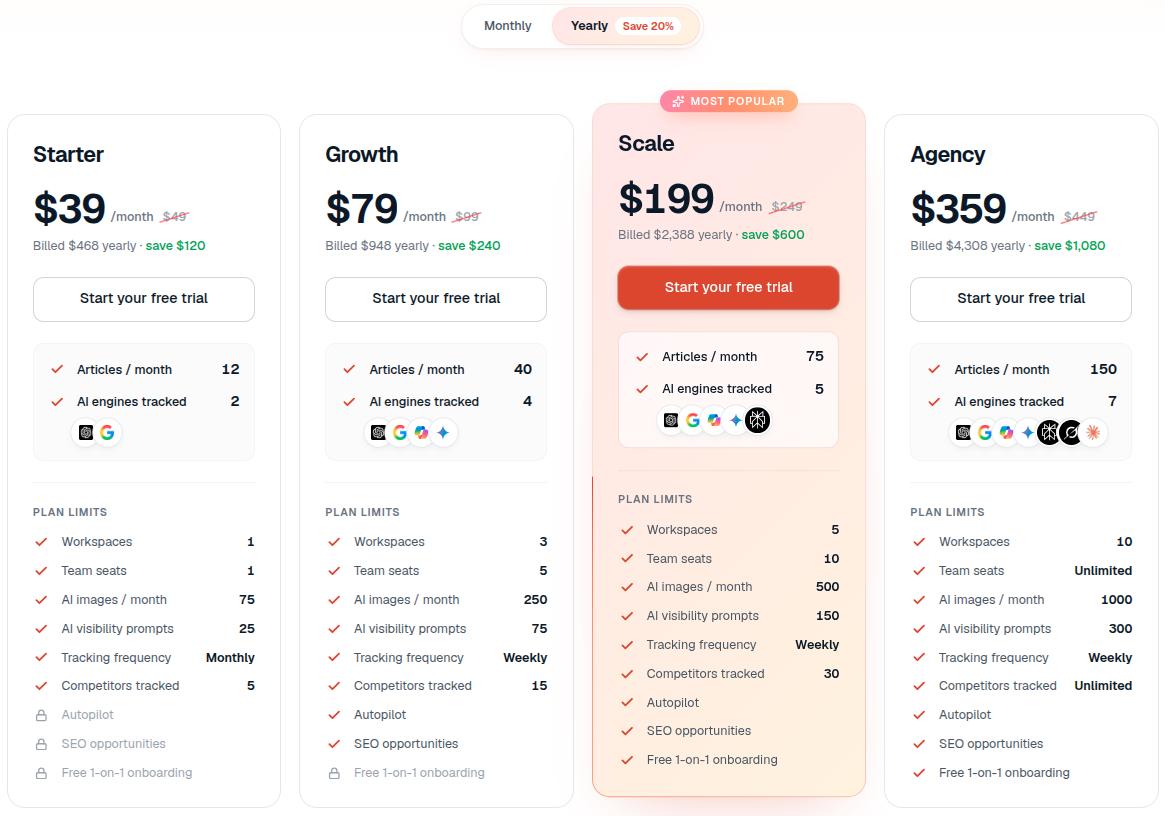
    Contentpen new pricing (billed annually.)

    Starts at $49/month, or $39/month billed annually, with 12 articles, 25 tracked prompts, and 2 AI engines (ChatGPT and Google AI), alongside content creation. Higher plans add more engines, up to all seven on Agency. It is one of the most affordable tools on this list that covers both AI search optimization and content creation.

    2. AIclicks.io — Best all-in-one GEO tracking platform
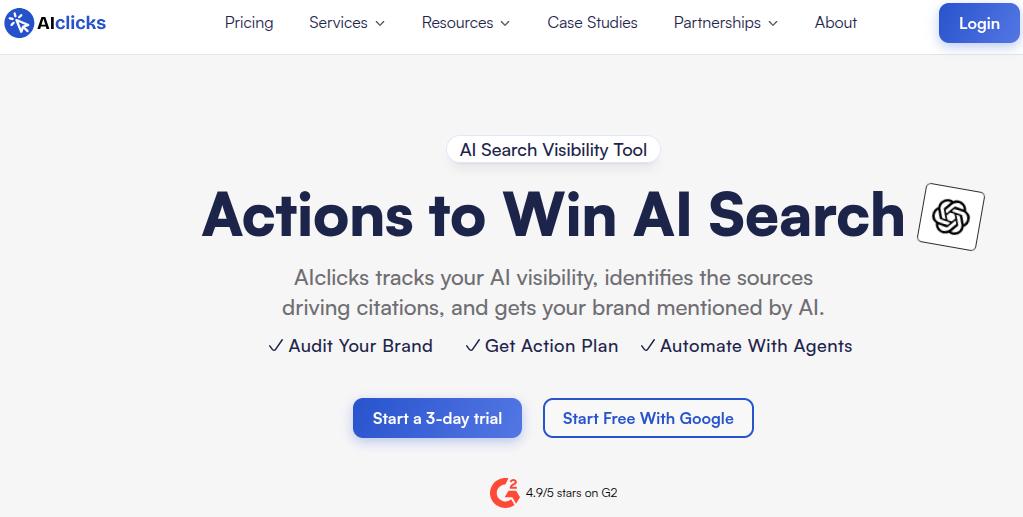
    AIclicks.io landing page.

    AIclicks.io shows you exactly how AI engines talk about your brand. Instead of guessing, you see real prompts users type into ChatGPT, Perplexity, Gemini, Claude, Grok, and Google AI Overviews for your brand, plus whether your site appears in those answers. That makes it one of the most focused AI search optimization tools for GEO.

    Standout features:

    • Tracking of brand mentions across major AI assistants
    • Lists of external domains that AI engines cite, such as Reddit threads, directories, and listicles
    • Competitor benchmarking for prompts and citations
    • An AI-optimized content drafting module that turns visibility gaps into answer-ready briefs

    Use cases: 

    Brands and agencies that want a complete AI visibility command center instead of scattered data. It suits teams that already run classic SEO and now need SEO for AI search as a connected but distinct track. 

    Worth knowing:

    The content drafting module is a supporting feature, not the core strength. If your primary need is producing high volumes of polished, long-form articles, AIclicks will feel limited on that side.

    Pricing: 
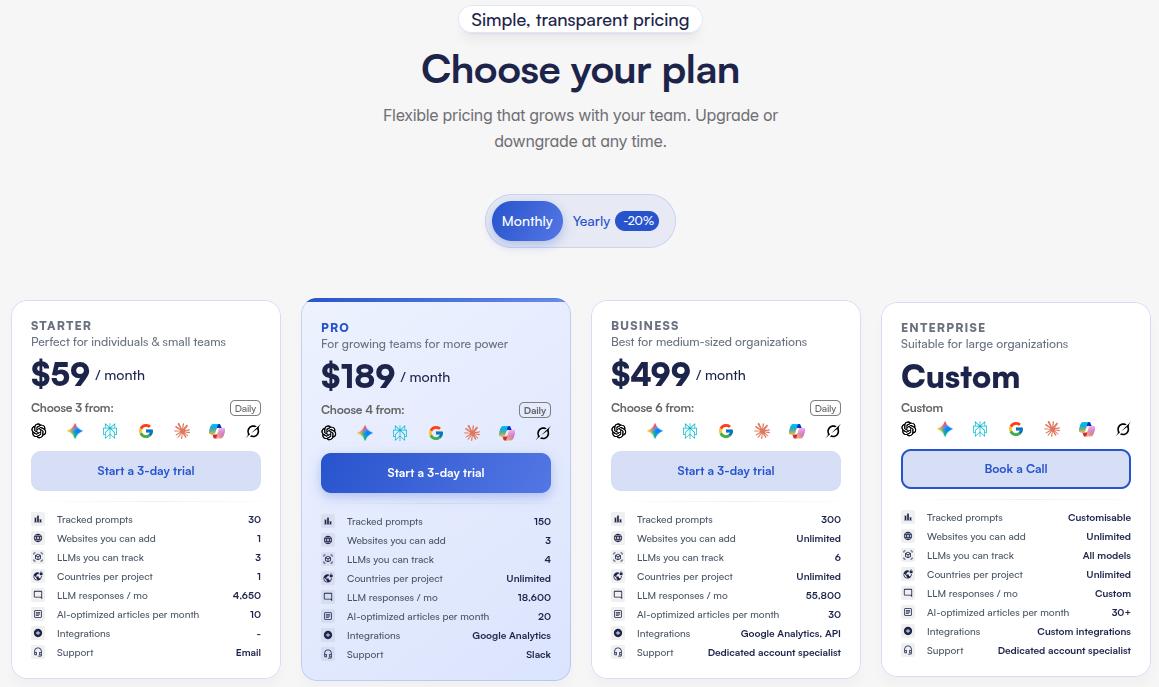
    AIclicks pricing plans.

    Pricing starts at $59/month, with yearly discounts and a refund guarantee that lowers risk while you test.

    3. OtterlyAI — Best for GEO audit workflows and agency reporting
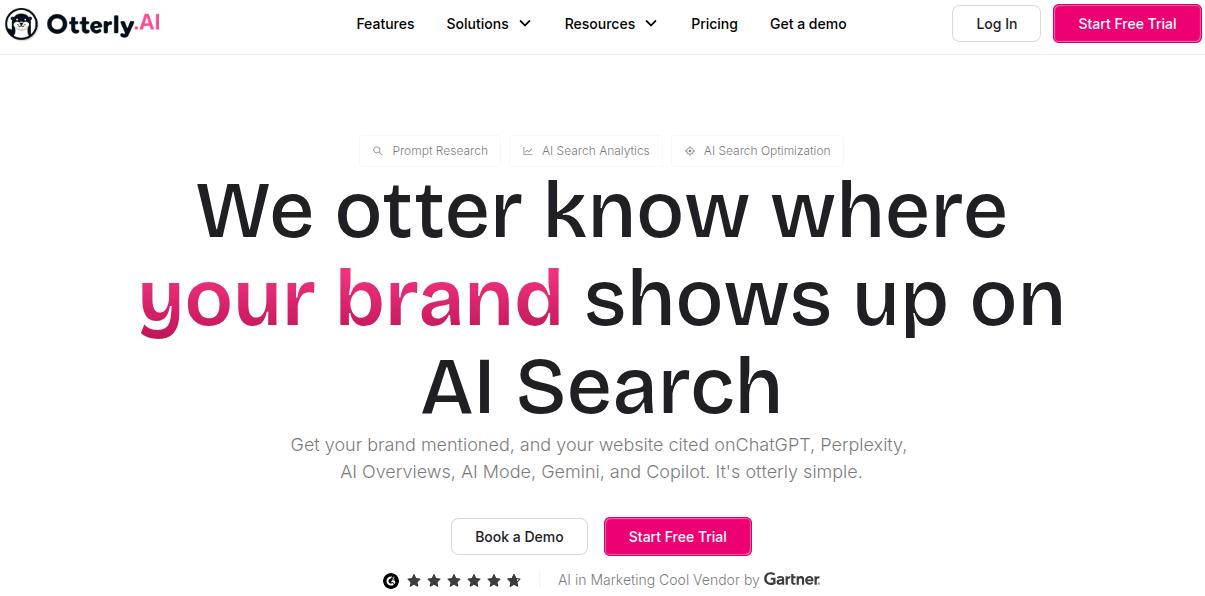
    Otterly.AI landing page.

    OtterlyAI was built from the ground up for one job: showing you exactly where your brand appears inside AI-generated answers and giving you a structured path to improve it. Unlike tools that bolt GEO tracking onto a traditional SEO dashboard, Otterly treats prompt monitoring, citation analysis, and brand visibility as the core product. That focus shows in the depth of its audit capabilities.

    Standout features:

    • A GEO Audit that runs a full SWOT-style breakdown of your AI visibility
    • A Brand Visibility Index that combines mentions, coverage, and citation signals into one KPI
    • Prompt Research that converts your seed keywords into the natural-language questions people actually type into AI systems
    • Domain and URL citation tracking that shows which pages on your site get referenced most often by AI engines

    Use cases:

    Agencies that need a clean, repeatable GEO workflow for multiple clients. It is also a strong fit for content strategists who want to move beyond raw visibility data and understand why certain pages get cited while others get skipped.

    Worth knowing:

    Otterly’s pricing scales steeply with prompt volume. The Lite plan at $29/month covers only 15 tracked prompts, which run out fast for brands monitoring multiple product lines or markets.

    Pricing:
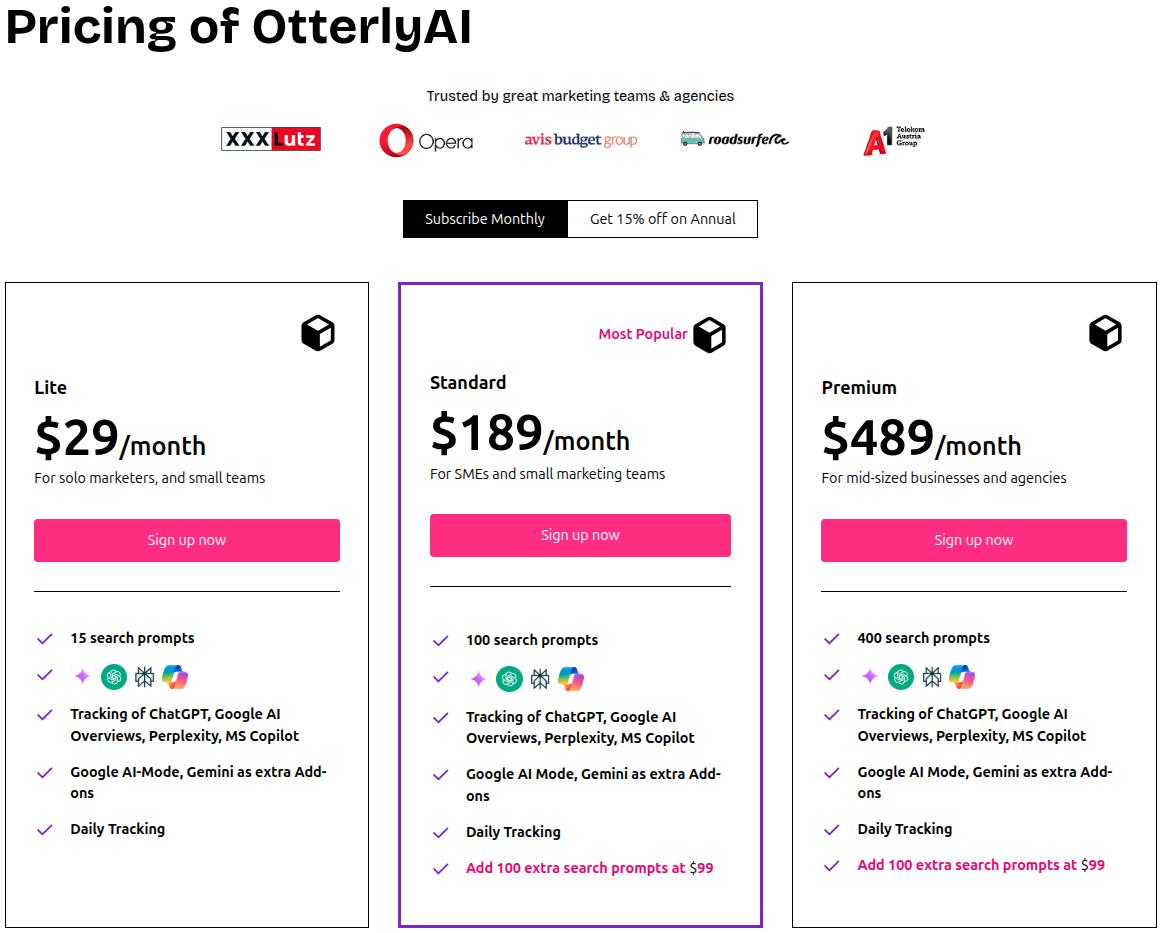
    OtterlyAI pricing details.

    The ‘Lite’ plan starts at $29/month with 15 search prompts and tracking of ChatGPT, Google AI Overviews, Perplexity, and Copilot.

    4. Profound — Best for enterprise-grade AI visibility analytics
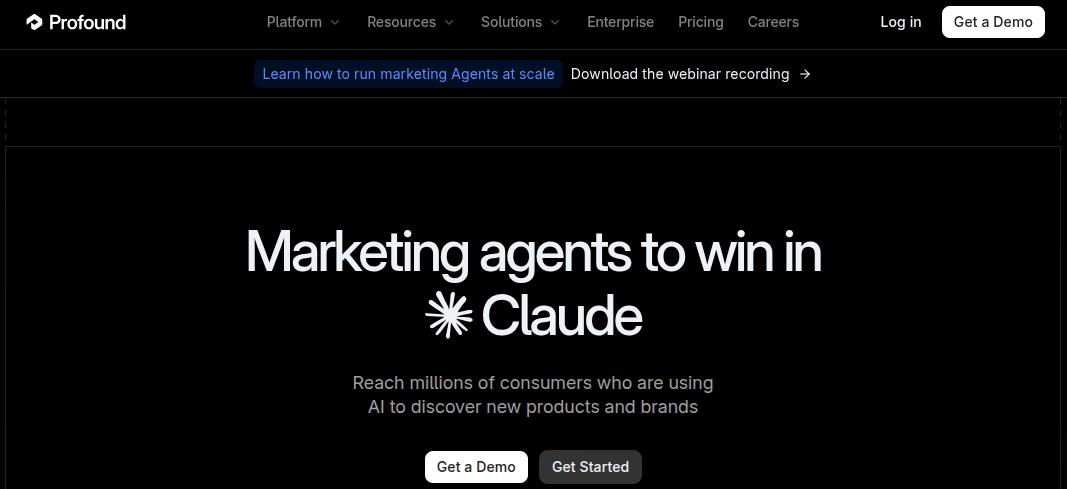
    Profound GEO visibility tool.

    Profound is built for teams that need serious depth behind their AI visibility data. It covers the major AI search platforms and focuses on connecting prompt-level tracking with competitive and citation intelligence to build a modern GEO strategy.

    Standout features:

    • Keyword and prompt-level tracking across ChatGPT, Perplexity, Google AI Overviews, and other AI platforms
    • Competitor benchmarking that shows how often rival brands appear for the same prompts, so you can see share-of-voice gaps at a glance
    • Content optimization recommendations tied directly to the visibility gaps

    Use cases:

    Enterprise marketing teams and in-house strategists who run AI visibility as a distinct channel alongside classic SEO. It suits brands that already have content and tracking infrastructure in place and now want deeper intelligence behind what AI systems say about them.

    Worth knowing:

    Profound is priced and built for enterprise teams, which means solo creators, freelancers, and small businesses will likely find it overkill for their needs.

    Pricing:
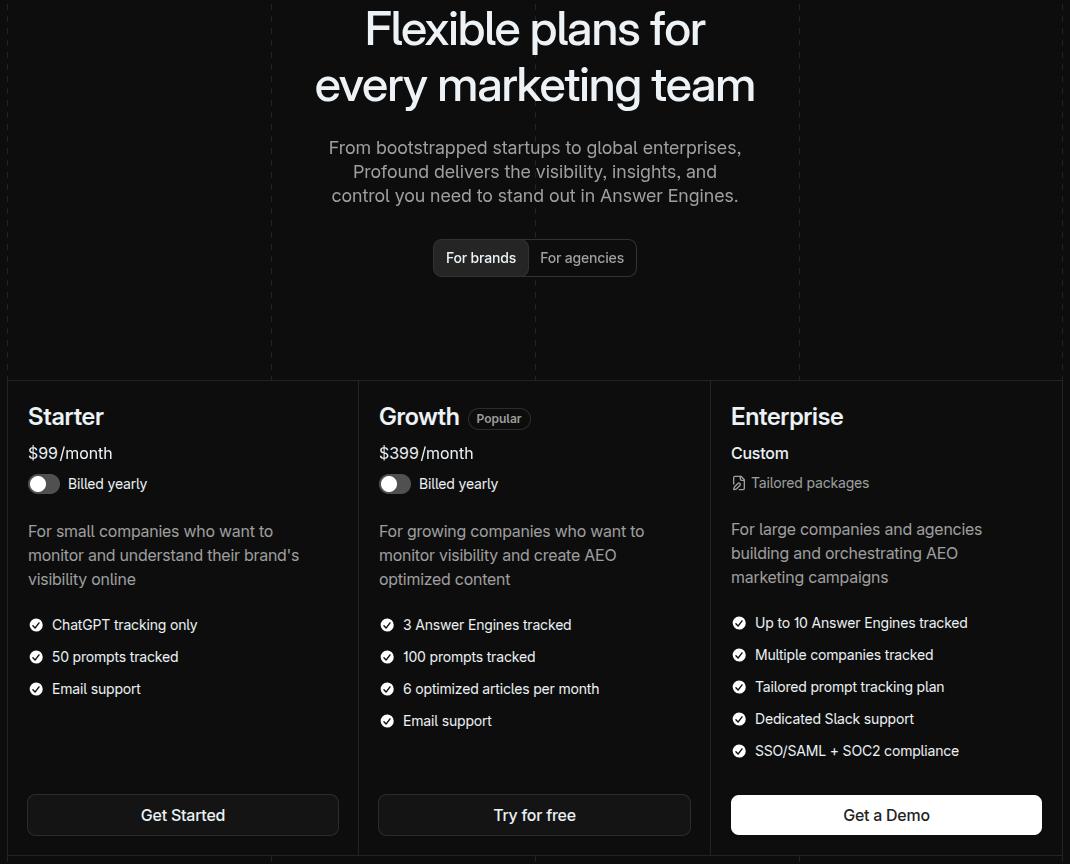
    Profound pricing plans.

    The starting price is $99/month, which provides 50 prompts tracked with email support.

    5. Clearscope — Best for precision-driven editorial teams
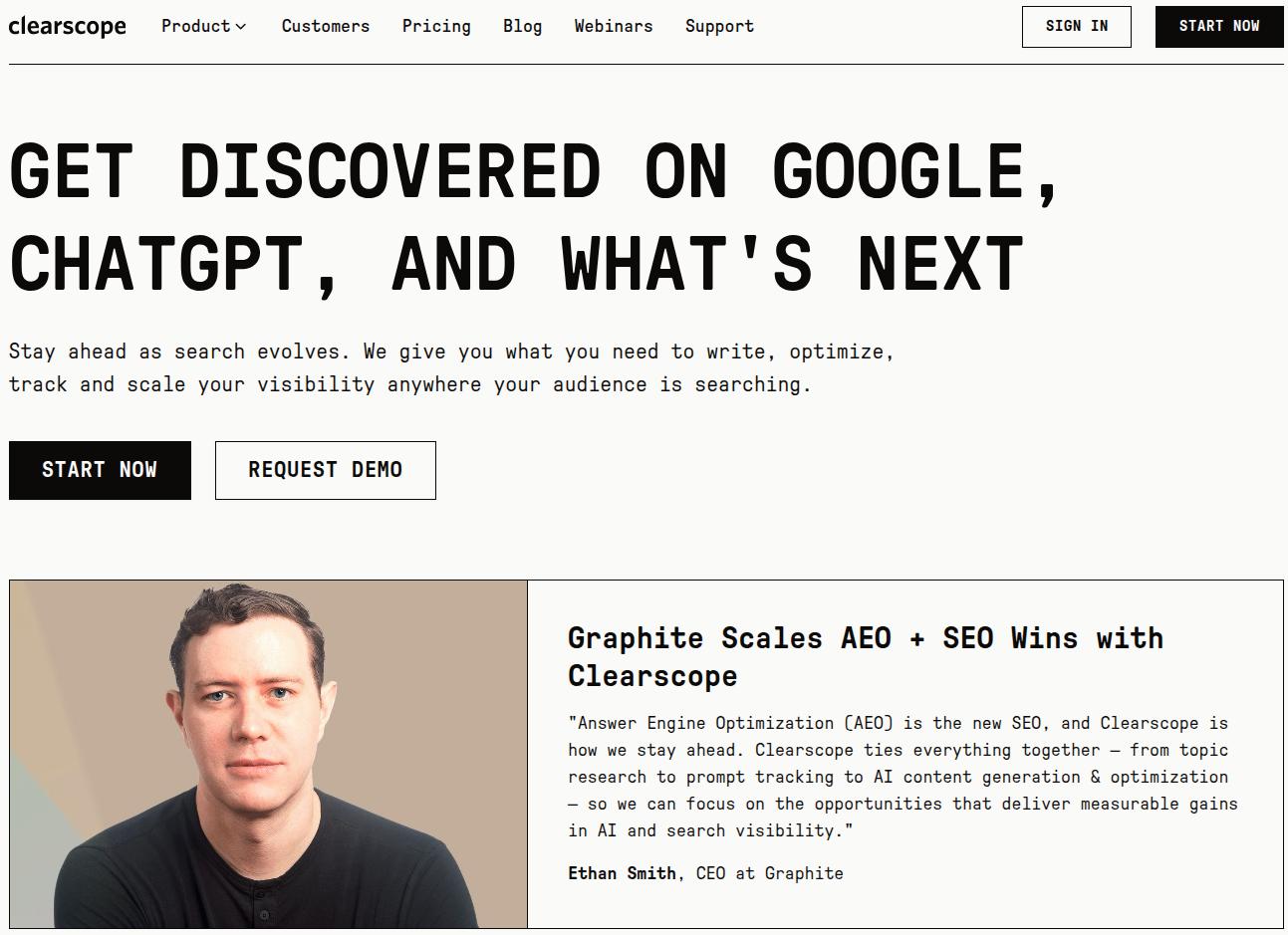
    Clearscope landing page.

    Clearscope is a favorite among editorial teams that want clean, data-backed guidance without noisy dashboards. It scores each article on an A-to-F scale while suggesting related phrases and entities that top-ranking pages already use. The focus stays on human-written quality, not only on AI SEO tools and automation.

    Standout features:

    • Content Reports that surface recommended terms and coverage gaps
    • Content Inventory views that show which pages need updates
    • Topic Research modules that help editors map out new articles
    • A Google Docs add-on that brings optimization into your normal writing workflow

    Use cases: 

    Enterprise content teams, publishers, and agencies that manage multiple writers and editors. It fits nicely in a stack where Contentpen drafts articles and Clearscope refines word choice and coverage. 

    Worth knowing:

    Clearscope focuses on refining content for search engines rather than tracking AI visibility directly. It does not tell you whether your pages are being cited in ChatGPT or Perplexity answers, so teams that need GEO tracking will still need a separate platform alongside it.

    Pricing: 
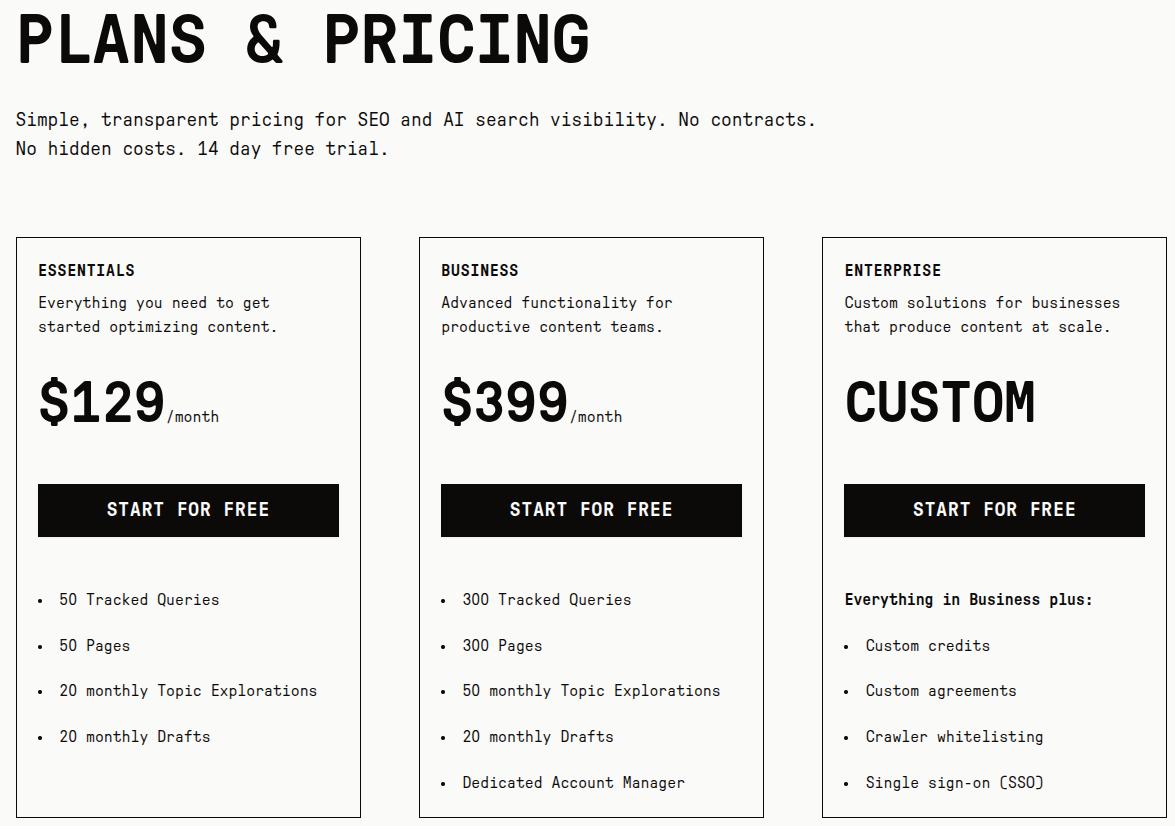
    Clearscope updated pricing 2026.

    Clearscope pricing begins at around $129/month for the ‘Essentials’ plan that provides 50 tracked queries and 20 monthly topic explorations.

    6. Rankability — Best for agencies needing NLP + expert coaching
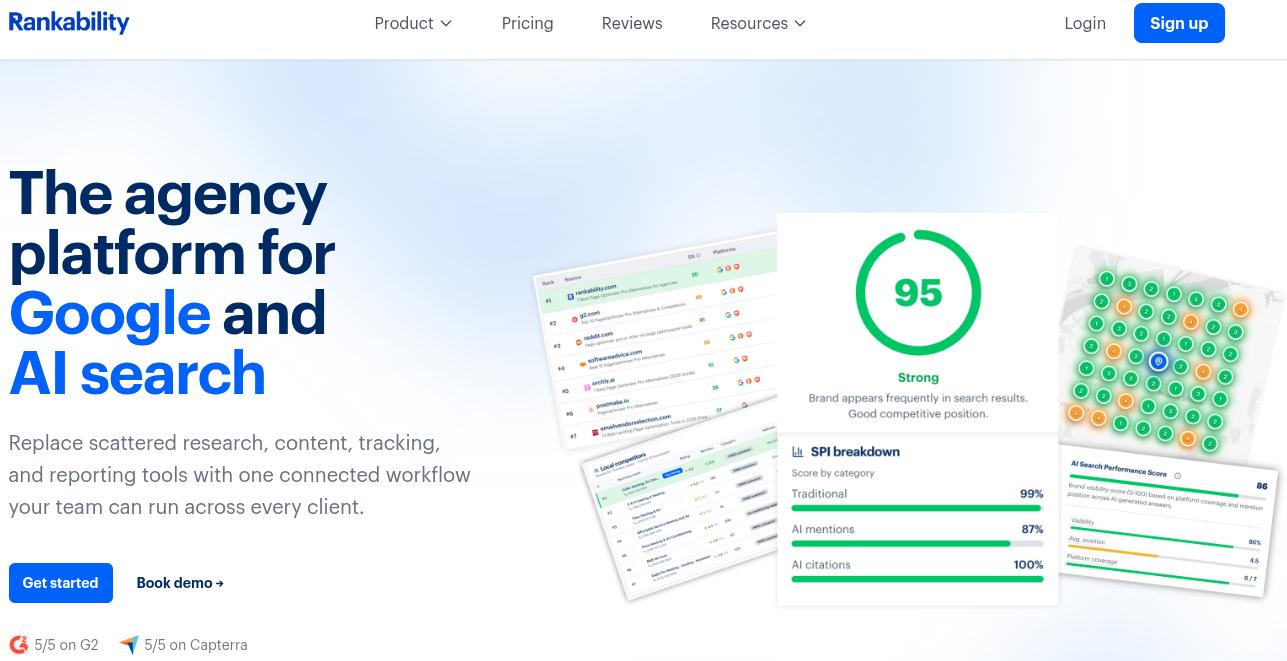
    Rankability main landing page.

    Rankability leans hard into advanced NLP and education, which makes it a strong pick for agencies learning GEO. By blending IBM Watson and Google NLU, it suggests entities and topics that matter in your niche. That means the AI SEO analyzer keeps your content strategies up-to-date according to the changing industry standards.

    Standout features:

    • Real-time content scoring with NLP-backed term suggestions
    • AI-generated briefs to guide writers
    • A built-in AI writer for generating useful first drafts
    • Weekly expert coaching calls that explain why the recommendations matter

    Use cases: 

    SEO and digital marketing agencies that want both tech and coaching in the same place. It works especially well for teams that handle many clients and need repeatable workflows. 

    Worth knowing:

    Rankability is one of the pricier content optimization tools on this list. The weekly coaching calls that justify part of that cost may not suit teams that prefer self-serve workflows or already have strong in-house SEO knowledge. 

    Pricing: 
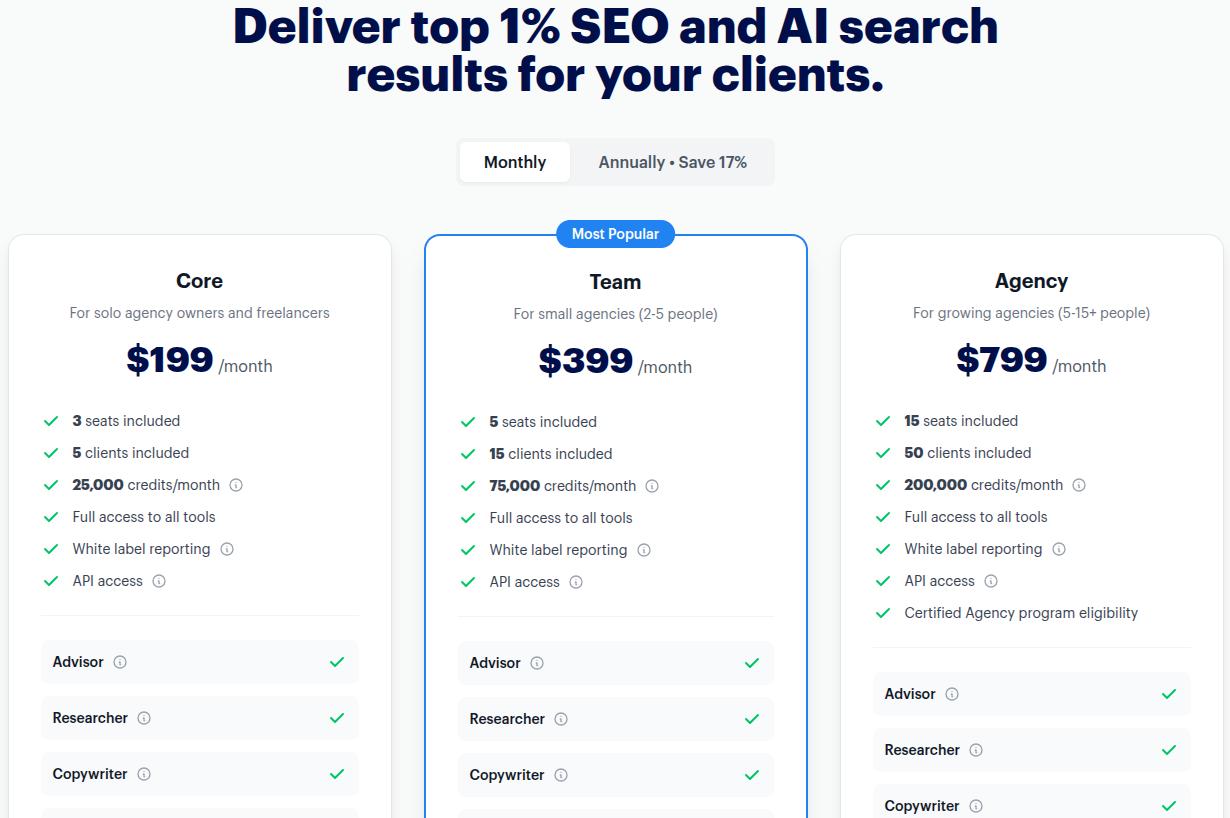
    Rankability pricing plans.

    Plans start at $199/month. You can also get annual plans with higher credit limits and save 17% overall.

    7. MarketMuse — Best for building topical authority and content strategy
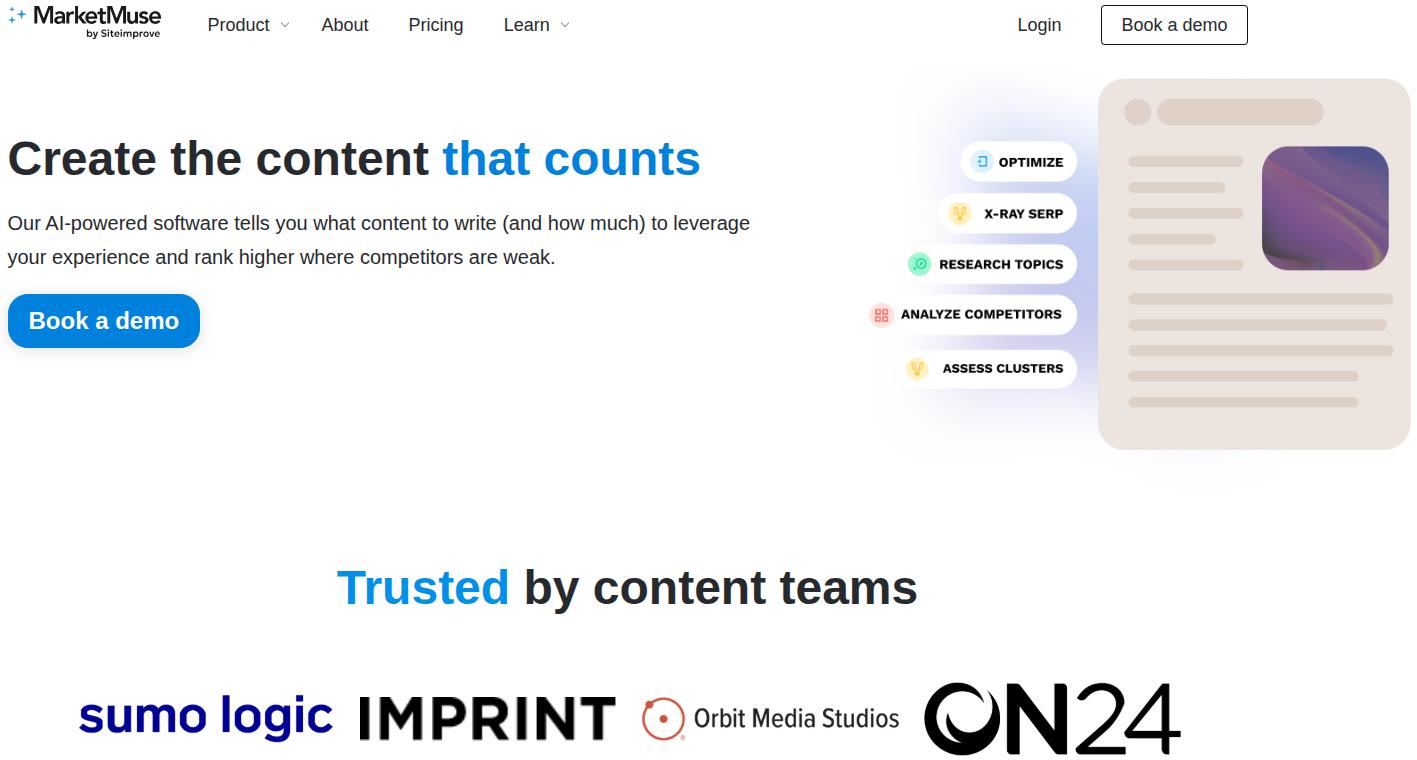
    MarketMuse landing page.

    MarketMuse focuses on building deep topical authority for your niche instead of singular, isolated pages. It scans your entire site to spot coverage gaps, then suggests which themes to expand next. If you manage a big content library, it feels more like a strategy partner than another AI content optimization tool.

    Standout features:

    • SERP X-ray and Heatmap views that show how competitors cover a topic
    • Detailed content briefs with headings, questions, and related ideas
    • Inventory and strategy documents that guide which pages to update, redirect, or expand

    Use cases: 

    Enterprise strategists and large teams that manage a large number of URLs. It pairs well with Contentpen when you want to fill gaps with new long-form posts that AI engines like to cite.

    Worth knowing:

    MarketMuse does not publish its paid plan pricing openly, which makes it harder to evaluate before purchasing the tool. The platform is also better suited to managing and auditing a large existing content library rather than helping you produce new articles quickly from scratch.

    Pricing:
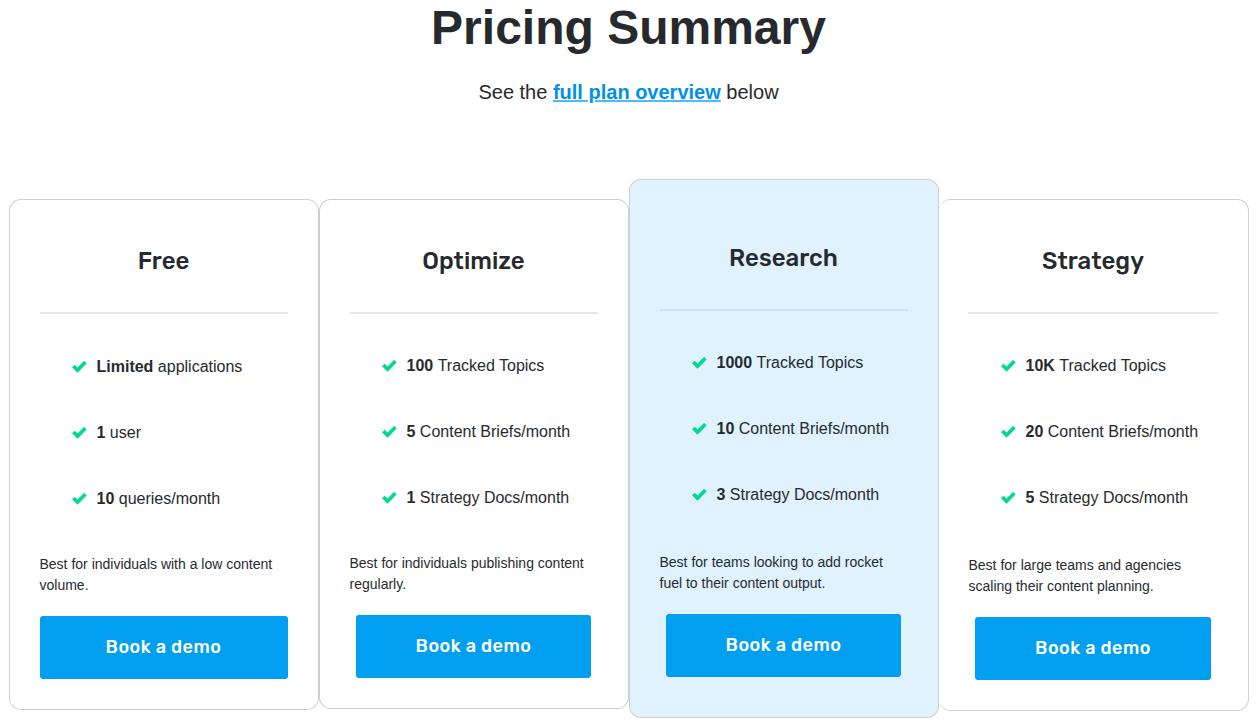
    MarketMuse pricing plans.

    There’s a free plan for MarketMuse with limited applications. No pricing figure is quoted on MarketMuse’s official website for the paid plans. However, MarketMuse’s Capterra page reveals a starting price of $99/feature/month.

    8. HubSpot AEO — Best for AI visibility insights and marketing workflows
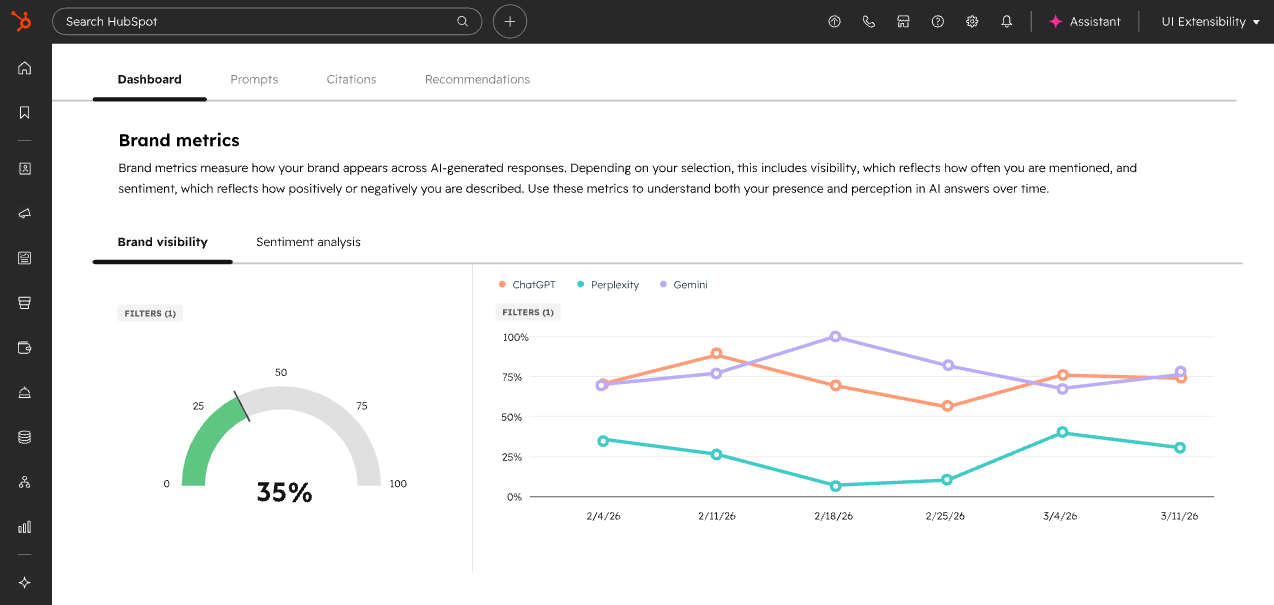
    HubSpot AEO.

    HubSpot AEO helps brands understand how they appear across AI-powered search platforms like ChatGPT, Gemini, and Perplexity. Instead of focusing only on rankings, the platform tracks prompt-level visibility, brand mentions, competitor presence, and sentiment across AI-generated answers, making it a practical tool for teams adapting to generative search.

    Standout features:

    • AI visibility tracking across ChatGPT, Gemini, and Perplexity
    • Prompt-level monitoring for real user queries
    • Competitor benchmarking and share-of-voice insights
    • Content recommendations to improve AI citations and mentions
    • Integration with HubSpot CRM and marketing workflows

    Use cases: 

    Marketing teams and brands that want to operationalize answer engine optimization without adding a separate enterprise SEO stack. It’s especially useful for businesses already using HubSpot for content, automation, and campaign management.

    Worth knowing:

    HubSpot AEO focuses more on visibility tracking and optimization strategy than on high-volume AI content generation. Teams looking for large-scale content production may still want dedicated writing tools alongside it.

    Pricing:
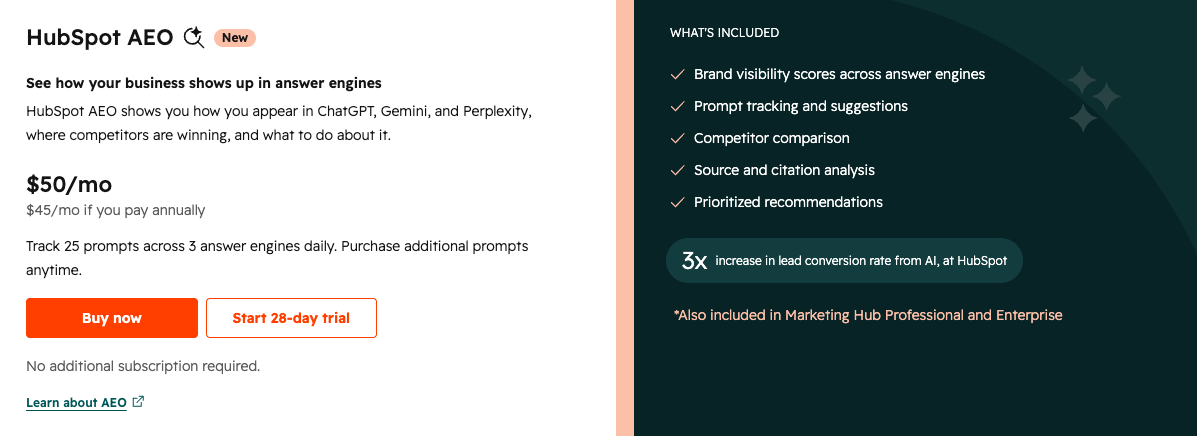
    HubSpot AEO pricing.

    Pricing starts at $45/month, with a 28-day free trial available.

    9. Frase — Best affordable all-in-one AI SEO tool for solo creators
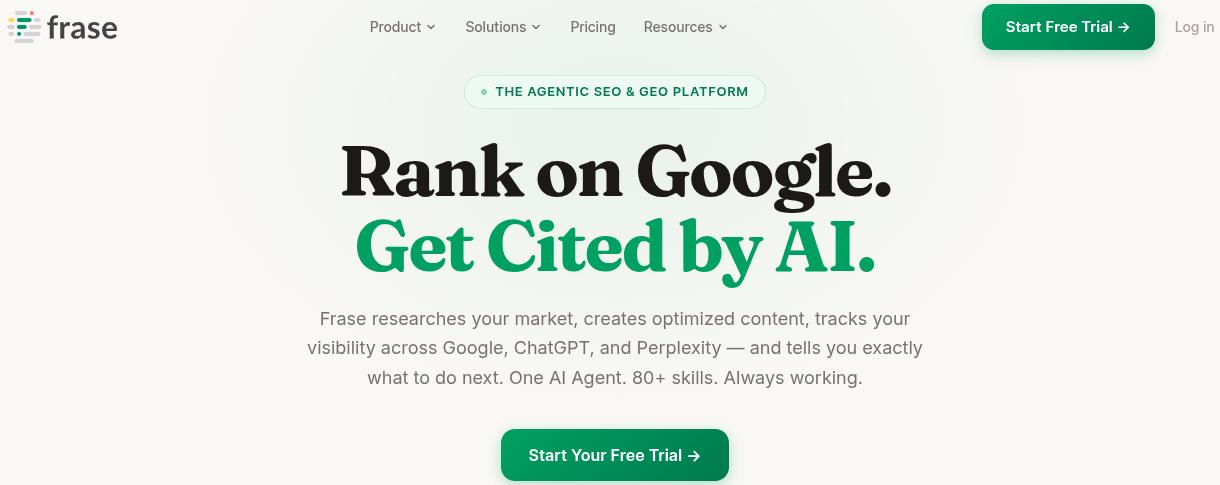
    Frase AI SEO writer.

    Frase helps you move from a keyword idea to a solid draft without too much hassle. It pulls headings, stats, and questions from the top SERP results, then turns them into an outline. That makes it a friendly entry point for solo creators trying AI keyword research tools and AI SEO content generators for the first time.

    Standout features:

    • Automated brief creation from current search results
    • A built-in AI writer for drafts and rewrites
    • A compact research view that highlights the questions competitors answer and the ones they miss
    • An AI image generator that creates relevant visuals for the content

    You can then add helpful FAQs and answer-first intros that AI tools like to quote.

    Use cases: 

    Freelancers, small businesses, and startups that want one tab for research and drafting. Frase is strong when you need speed more than deep GEO tracking.

    Worth knowing: 

    Frase is built for speed and simplicity, which means it trades depth for ease of use. It pulls data from current SERP results rather than tracking AI engine citations directly, so it works best as a drafting and brief tool rather than a full GEO or AEO platform.

    Pricing: 
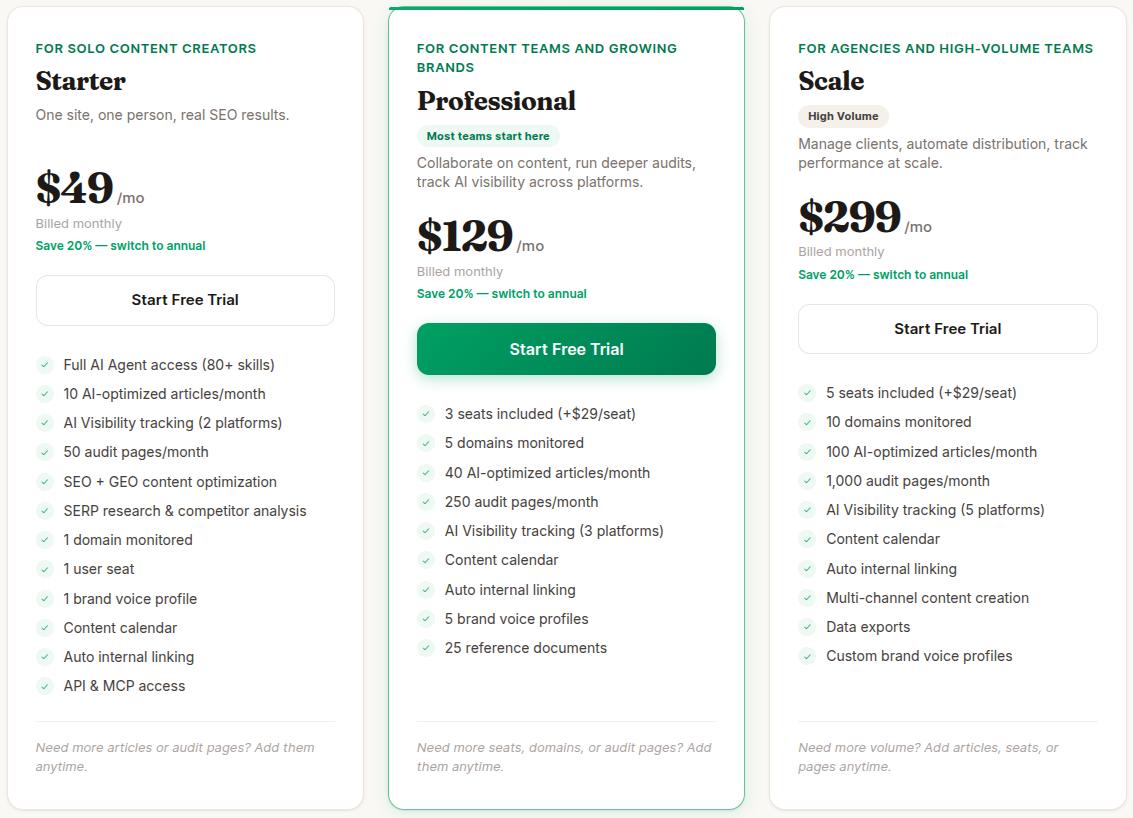
    Frase pricing.

    Paid plans start at $49/month with 10 AI-optimized articles and 50 audits per month. The platform also offers a free trial to test the software before purchasing.

    Also read: Frase vs. Contentpen.

    10. AirOps — Best for custom AI content workflows at scale
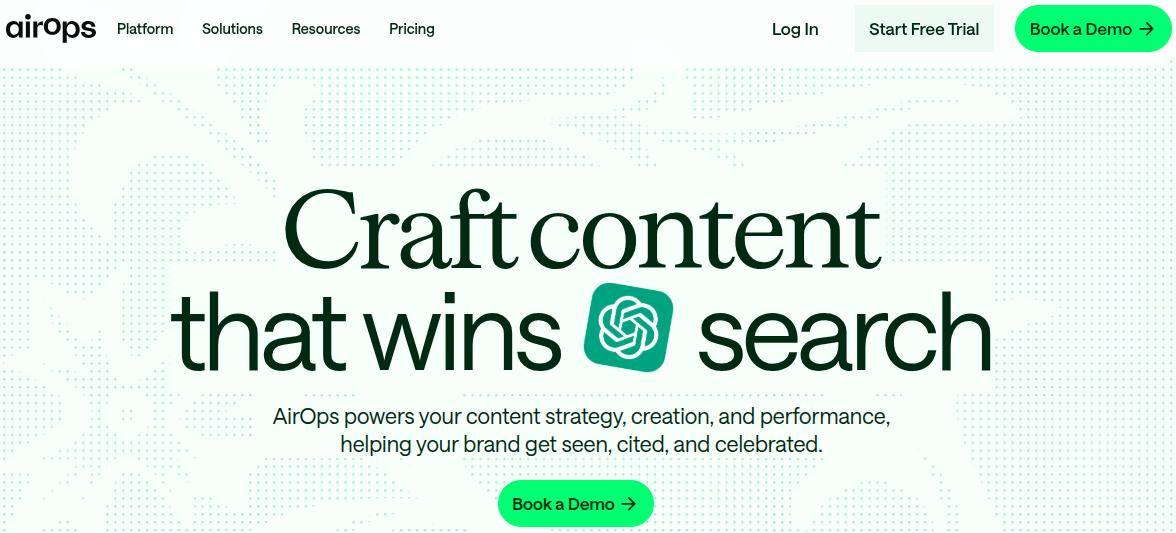
    AirOps landing page.

    AirOps helps you design custom AI workflows instead of relying on fixed templates. You can pull in GPT-5.2, GPT-4.1, Claude, Gemini, and other models, then chain them together for programmatic SEO tasks. That flexibility turns it into more than just another SEO content optimization tool, making it a complete content system.

    Standout features:

    • An automatic Brand Kit built from your URL, which captures tone and messaging
    • Connections to Webflow, WordPress, and 7 major CMS platforms to ensure seamless publishing
    • Bulk generate content to scale your platform without sacrificing quality

    Use cases: 

    In-house teams and agencies that are running high-volume campaigns, such as location pages or product descriptions.

    Worth knowing:

    The task-based pricing model is genuinely confusing for new users, and costs can climb quickly on high-volume campaigns before you realize it. Teams without a clear content workflow already in place may also find the flexibility of AirOps more overwhelming than helpful at first.

    Pricing:
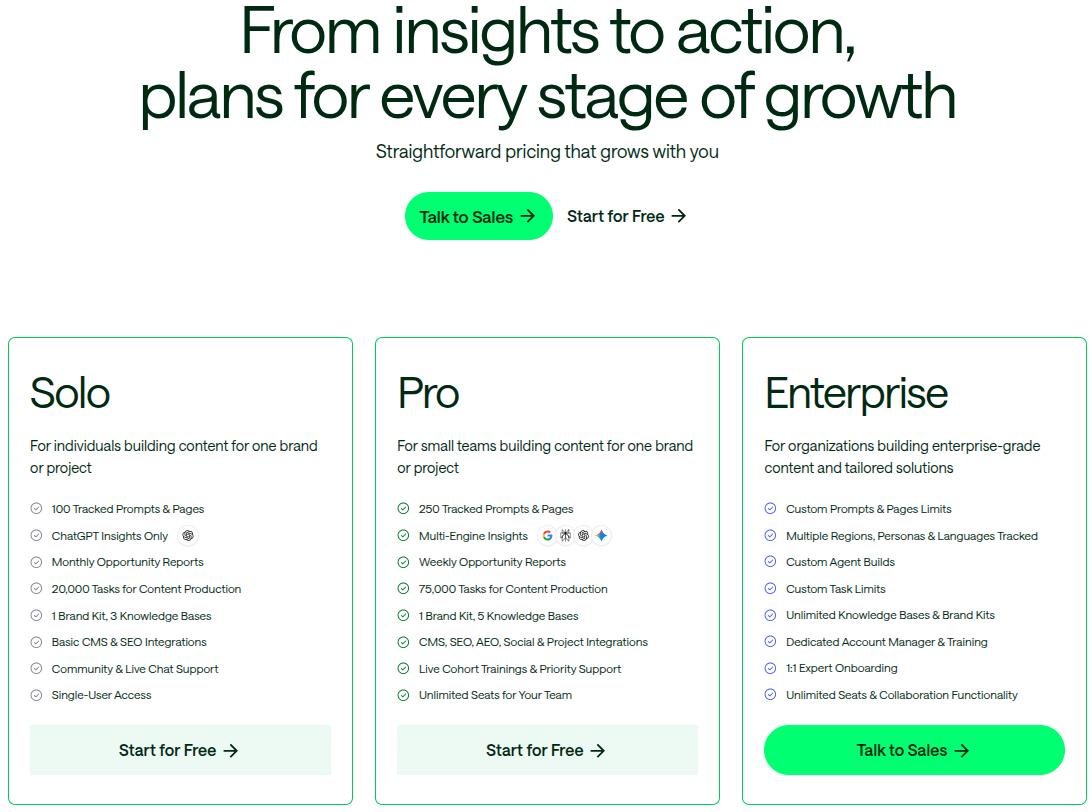
    AirOps pricing plans.

    The AI search optimization and content creation tool provides custom pricing plans on its website.

    Related read: 10 best AirOps alternatives in 2026.

    11. Writesonic — Best for AI article writing with real-time SEO data
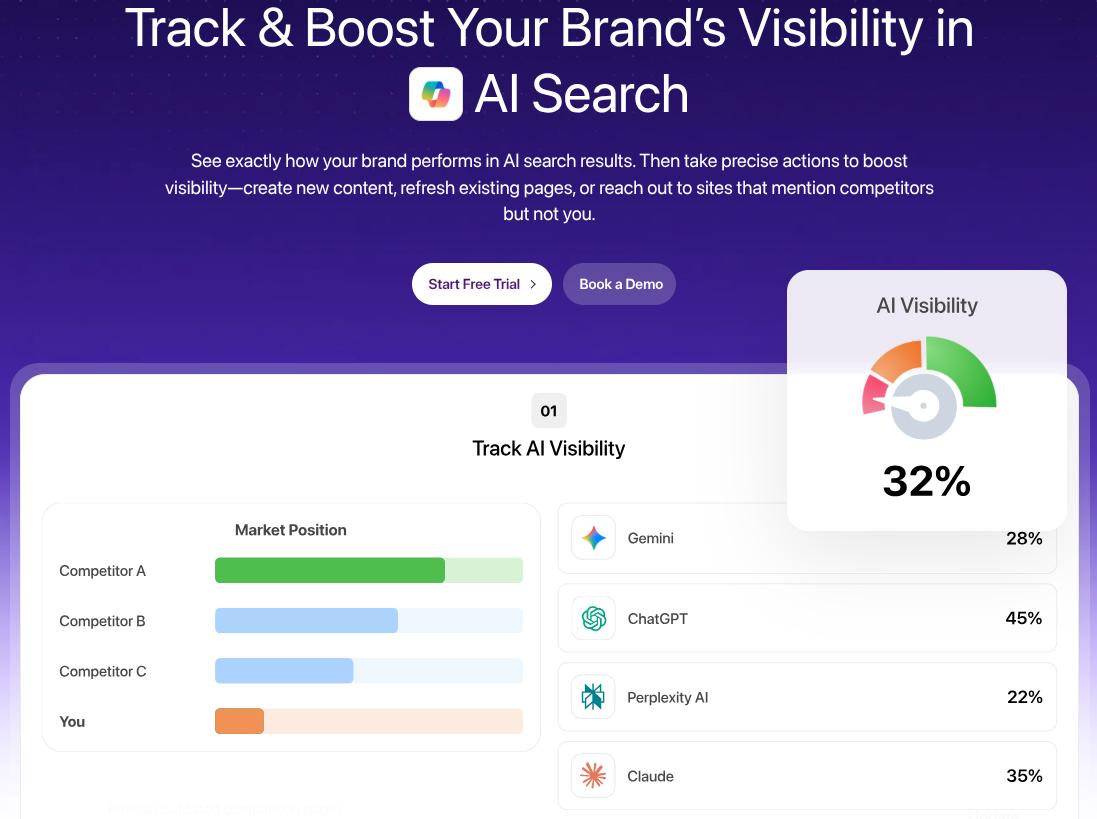
    Writesonic landing page.

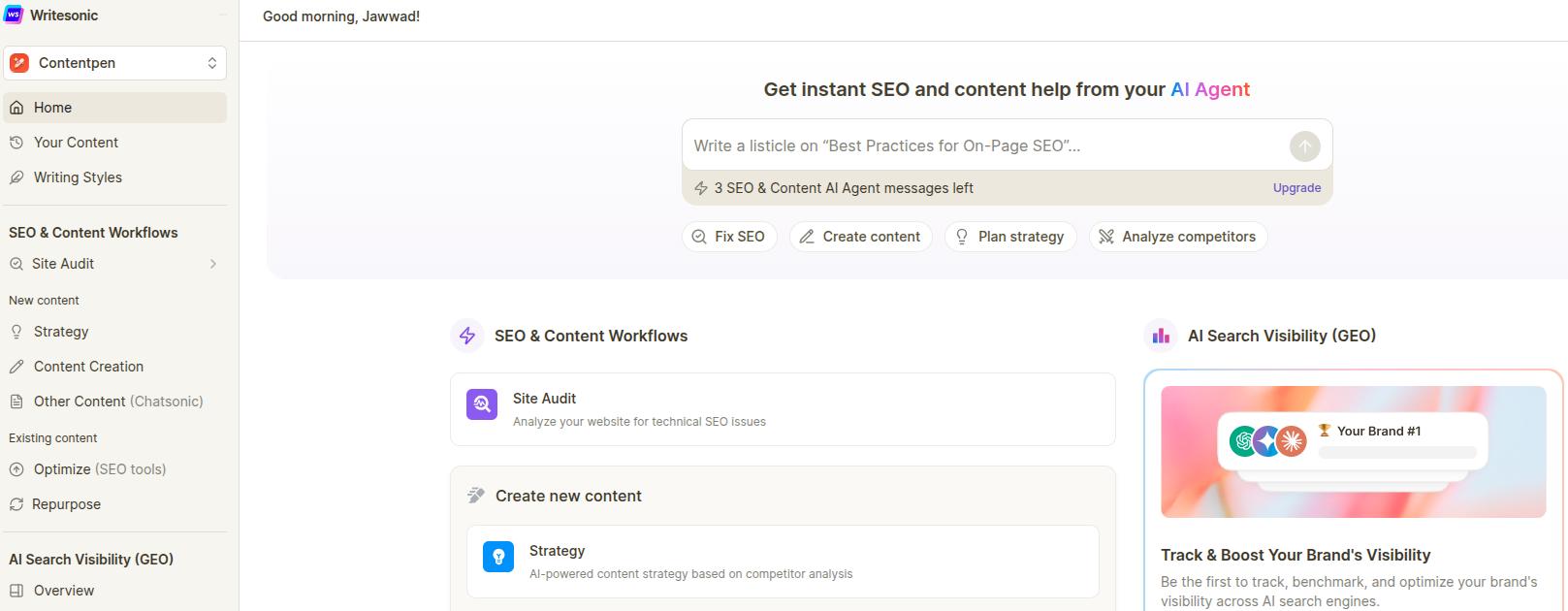
    Writesonic combines multi-model AI writing with live SEO insights. Its Chatsonic agent pulls data from Semrush, Ahrefs, Google Search Console, and other sources to guide drafts. That makes it one of the more data-aware AI SEO tools for general content.

    Standout features:

    • A structured 10-step article writer where you pick audience, tone, competitors, and other parameters to create SEO and GEO-friendly content
    • You can upload internal knowledge guidelines as PDFs so the AI SEO content generator sticks to your brand voice
    • One-click WordPress publishing and built-in fact-checking with citations

    Use cases: 

    Bloggers, content marketers, and small teams that want flexible AI writing backed by real search data. 

    Worth knowing:

    The entry price listed does not reflect the plan most content teams will actually need. Meaningful SEO data integrations and GEO features sit at higher tiers, so the real cost for a serious content operation lands closer to the $199 to $399 range.

    Pricing:
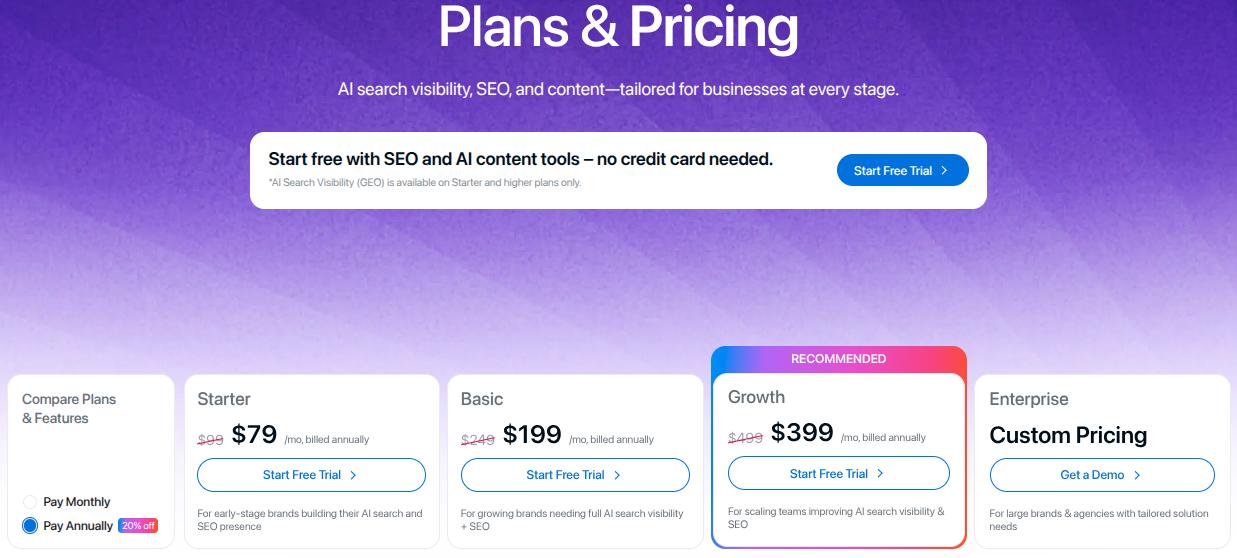
    Writesonic pricing details.

    Pricing starts at $79/month for the ‘Starter’ package and reaches $399/month for the ‘Growth’ package.

    Also read: Writesonic vs. Contentpen.

    12. SE Ranking — Best for Google AI Overview monitoring
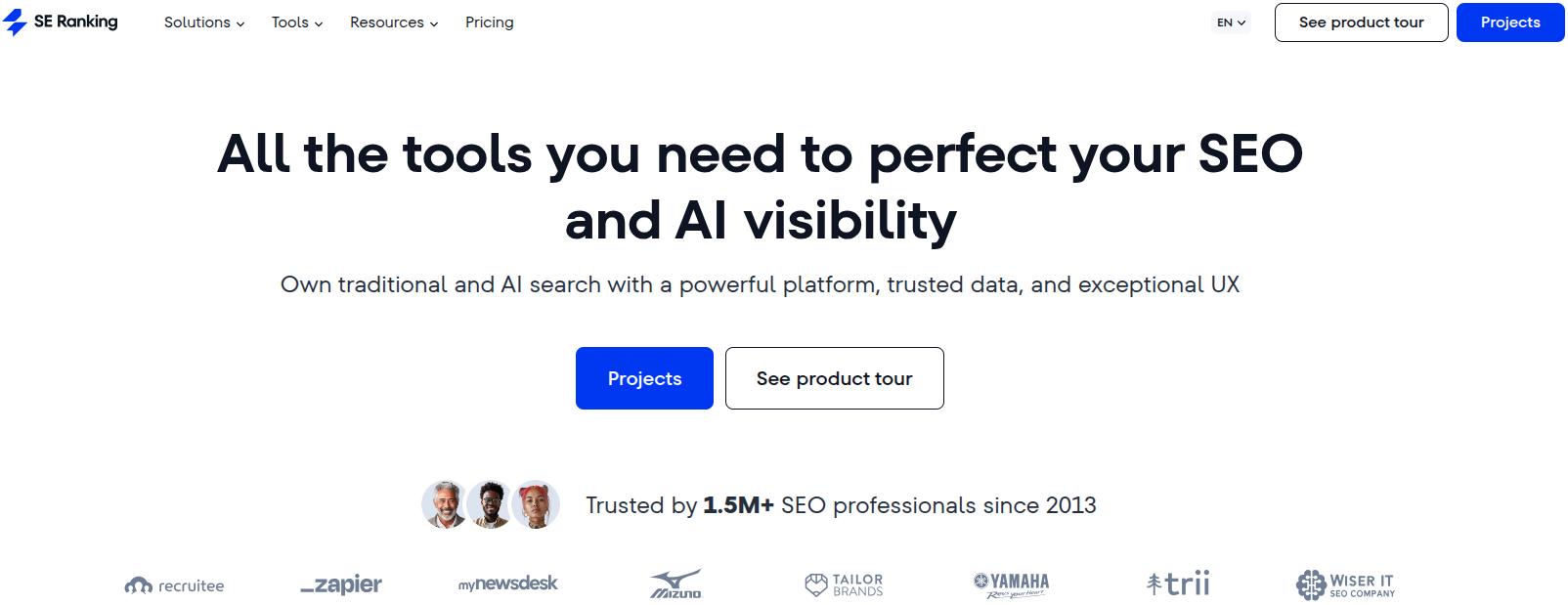
    SE Ranking AI Overview monitoring.

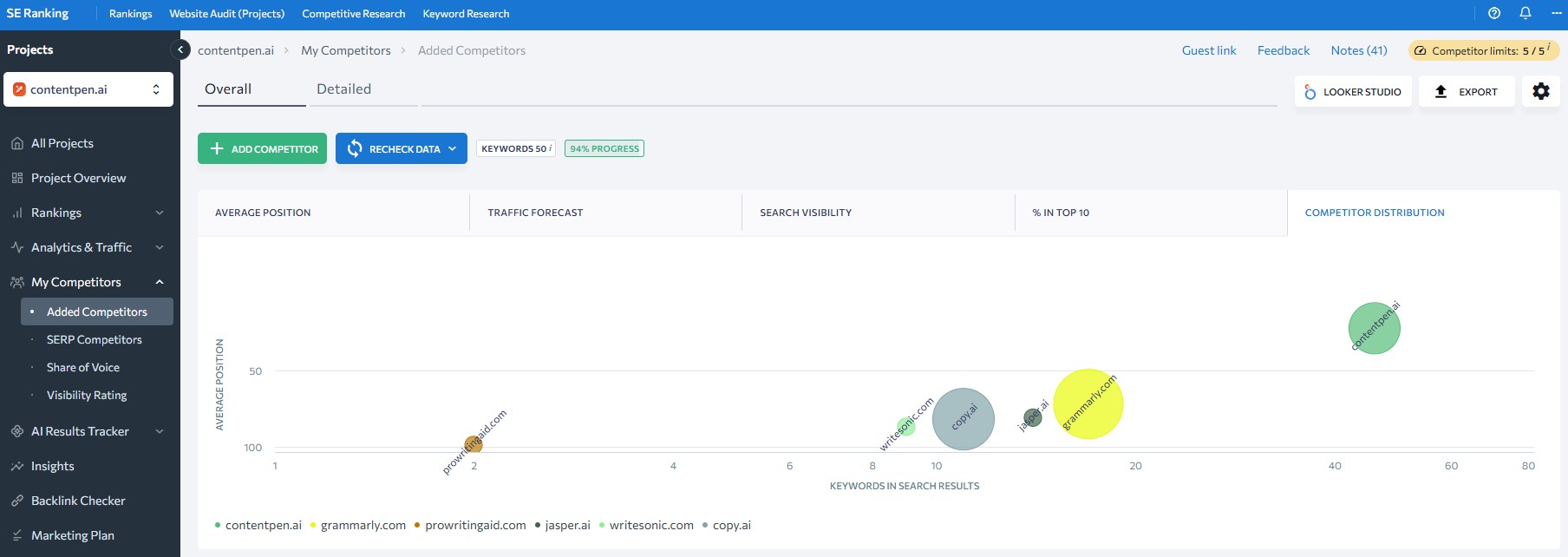
    SE Ranking is a dedicated Google AI Overviews and ChatGPT tracker. It shows which keywords trigger an Overview and whether your site is cited in it or not. That helps you shape your content for SEO and AI search, which is a growing requirement for many brands in 2026.

    Standout features:

    • An Organic AI Overlap metric that compares classic top 20 results for a particular query with AI summary links
    • Historical SERP snapshots so you can see how Overviews and ChatGPT citations change over time for a topic
    • Estimates of potential traffic you might gain or lose as Overviews appear for the organic keywords

    Use cases: 

    Teams that are looking for a tool that specializes in AI tracking and audits. It is especially useful for brands in niches where Google AI Overviews are often shown. 

    Worth knowing:

    SE Ranking’s AI tracking features are centered on Google AI Overviews and ChatGPT. So, teams that need broader coverage across Perplexity, Gemini, or Claude will find the monitoring scope narrower than that of dedicated GEO platforms like AIclicks or Otterly.

    Pricing:
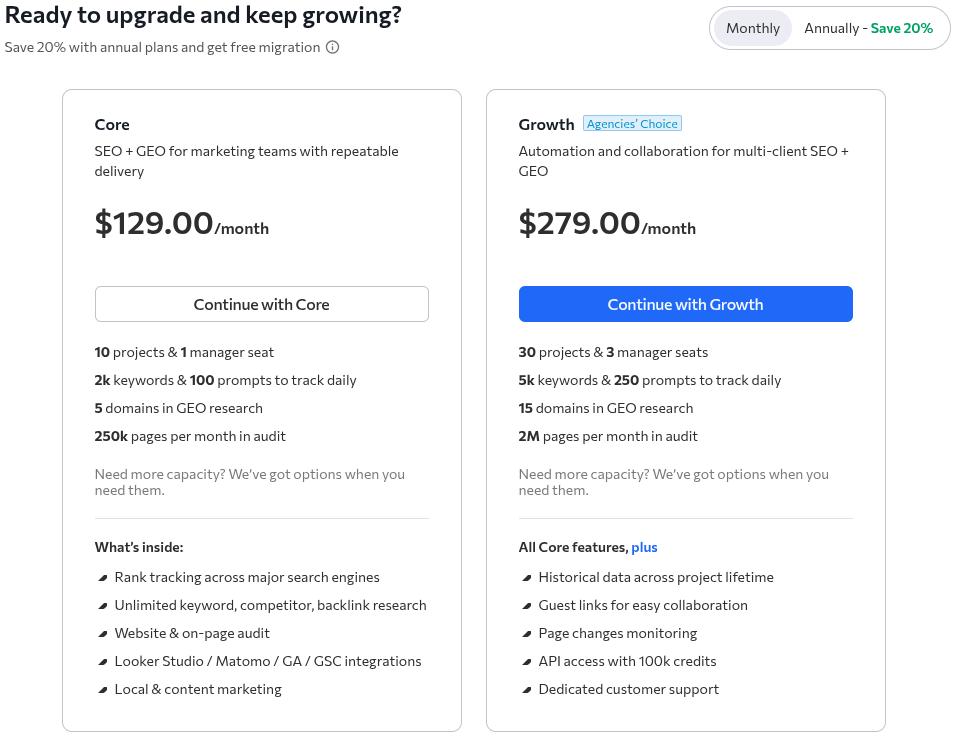
    SE Ranking 'Core' and 'Growth' pricing plans.

    Paid plans start at $129/month, with 10 projects, 1 manager seat, 2000 keywords, and 100 prompts to track daily.

    13. Gauge — Best for agentic AI marketing intelligence
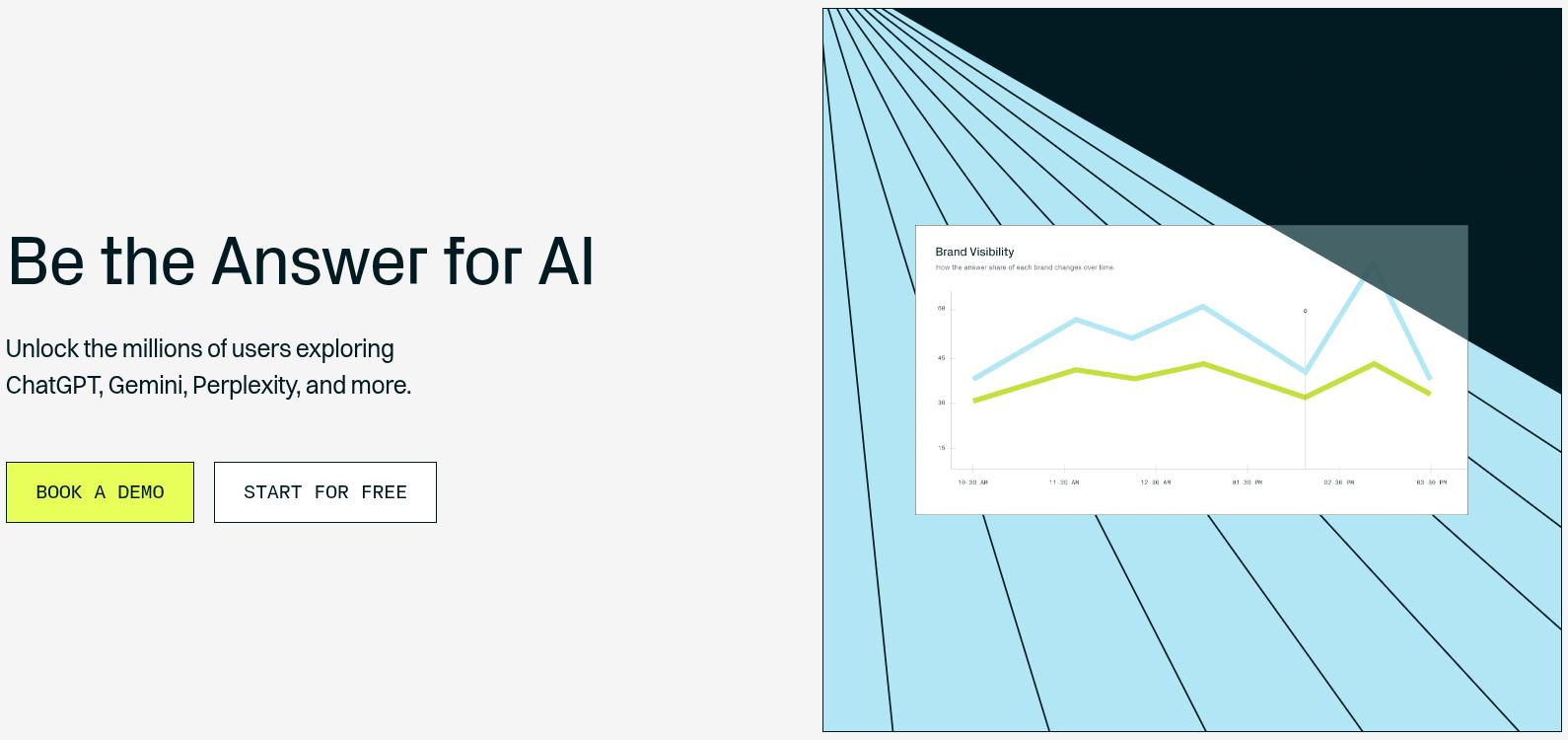
    Gauge - Best agentic AI marketing intelligence tool.

    Gauge behaves like an AI-powered marketing analyst that watches your AI visibility and website data at the same time. It tracks daily prompts and citations across ChatGPT, Perplexity, Google AI Mode, and AI Overviews. Then it answers simple questions about what to do next for your content.

    Standout features:

    • Direct connections to GA4, Google Search Console, and Semrush, plus its own prompt logs
    • Slack integration so you can ask which pages get the most AI-referred traffic and receive answers with data and suggestions in one place
    • Content briefs aimed at prompts where your brand is currently missing

    Use cases:

    Tech-forward startups and agile teams that like conversational workflows. It suits marketers who want AI search optimization tools that can think along with them, not just report what’s happening. 

    Worth knowing:

    Gauge is strongest when you already have GA4, Search Console, and Semrush connected and active. Teams without that existing data infrastructure in place will get significantly less value from the agentic features, since the agent relies on those sources to generate meaningful recommendations.

    Pricing: 
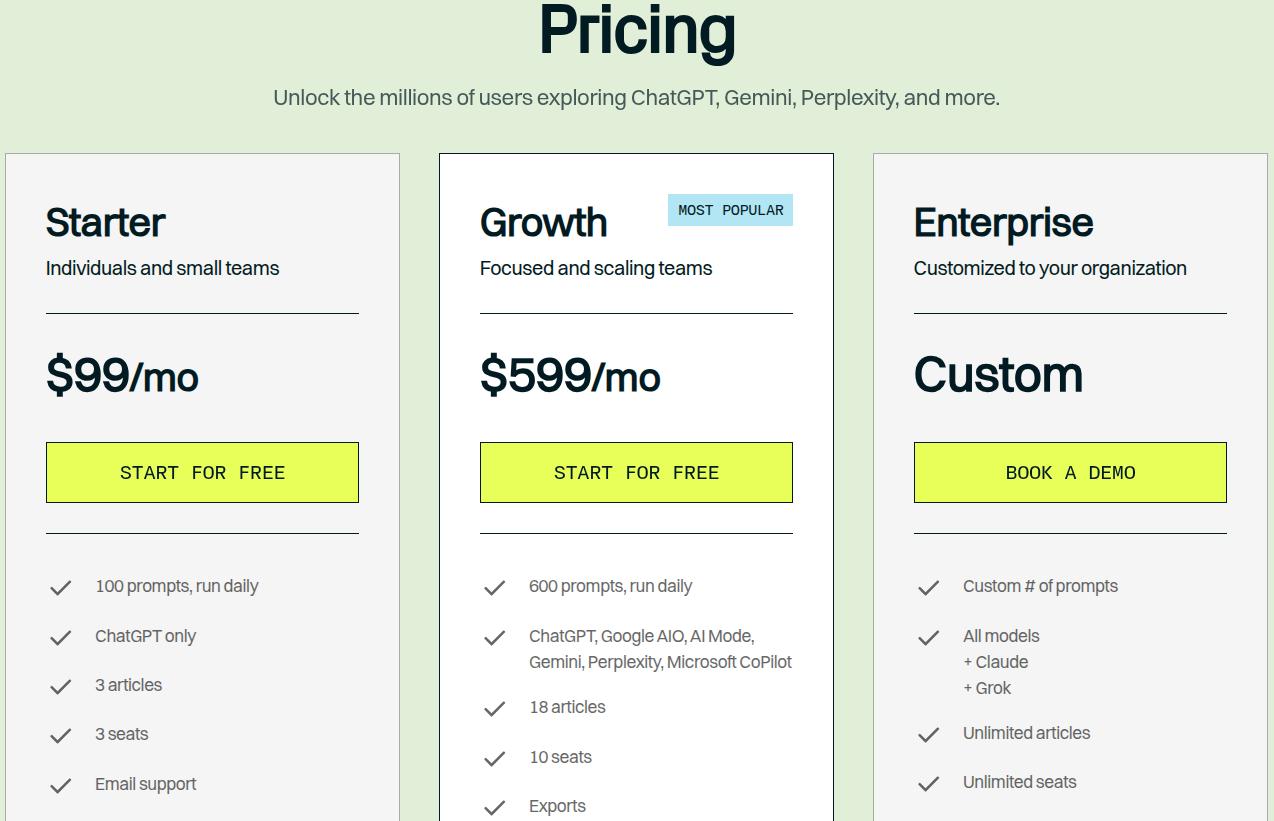
    Gauge pricing plans.

    According to the official WithGauge website, the Starter plan is $99/month, which provides 100 prompts daily and 3 articles.

    14. Search Atlas — Best for automated AI SEO execution
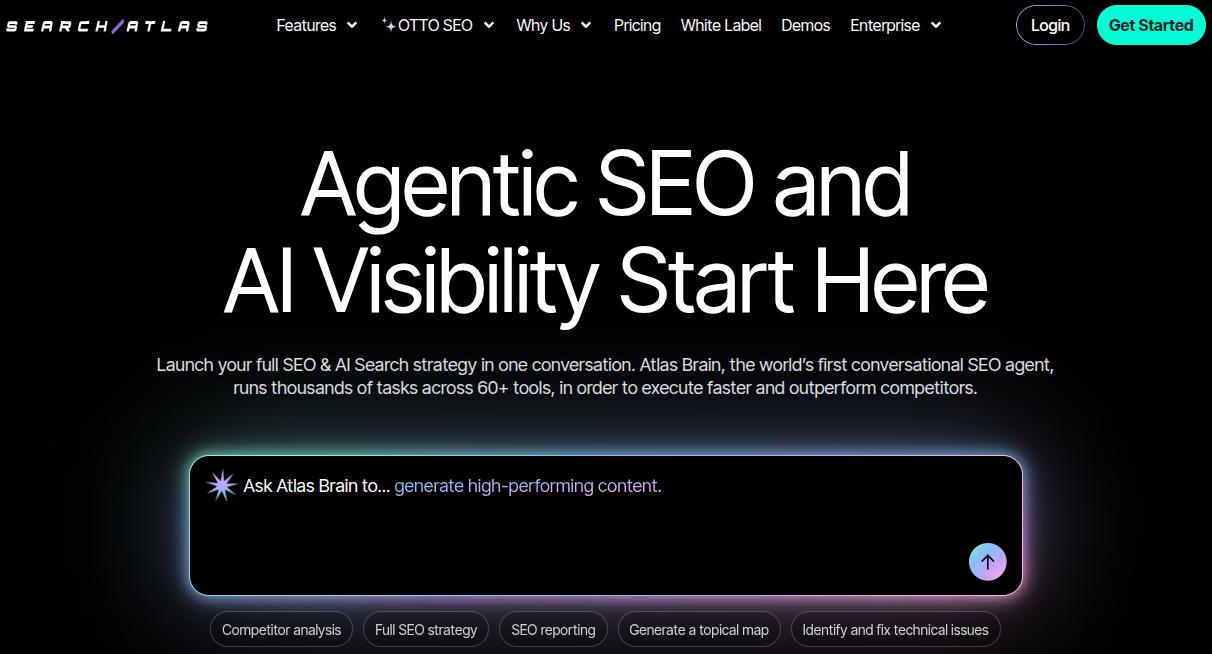
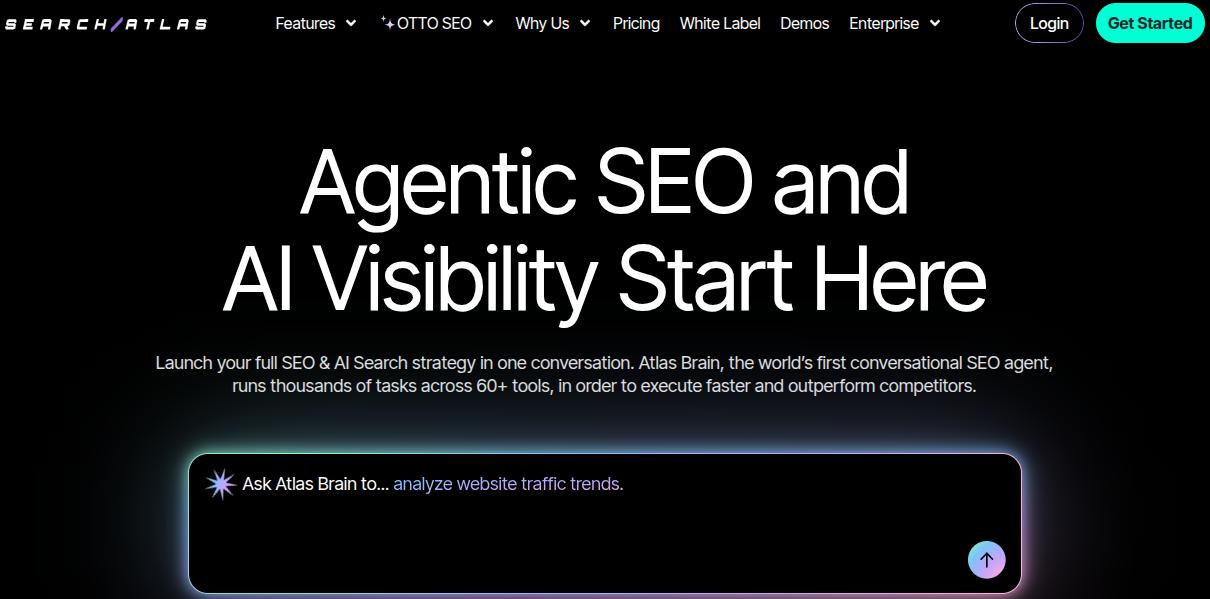
    Search Atlas  - Agentic SEO and AI visibility tool.

    Most AI search optimization tools tell you what to fix and leave the rest to you. Search Atlas is different because its OTTO SEO agent can actually deploy those fixes to your site once you approve them. That makes it less of a reporting tool and more of an execution platform.

    Standout features:

    • OTTO SEO identifies technical issues such as broken links, missing schema, and poor meta tags, then applies approved fixes directly to your site
    • A QUEST tab that tracks how your brand and content appear across ChatGPT, Gemini, and Perplexity
    • An AI content editor that scores drafts against top-performing competitors in real time and supports topical cluster planning
    • Atlas Brain, a conversational SEO assistant that can run keyword research, analyze competitors, and generate topical maps from a single prompt

    Use cases:

    Agencies and in-house teams that are tired of tools that generate recommendations but require a separate tool to implement them. It also works well for content-heavy sites that need both LLM visibility tracking and technical SEO automation without switching tabs.

    Worth knowing:

    The platform’s breadth is also its main risk. With 30-plus features across SEO, content, local, ads, and LLM visibility, some modules are more polished than others. In our testing, we found occasional instability and slower load times, so teams that need rock-solid reliability on every feature may want to run a thorough trial before committing.

    Pricing:
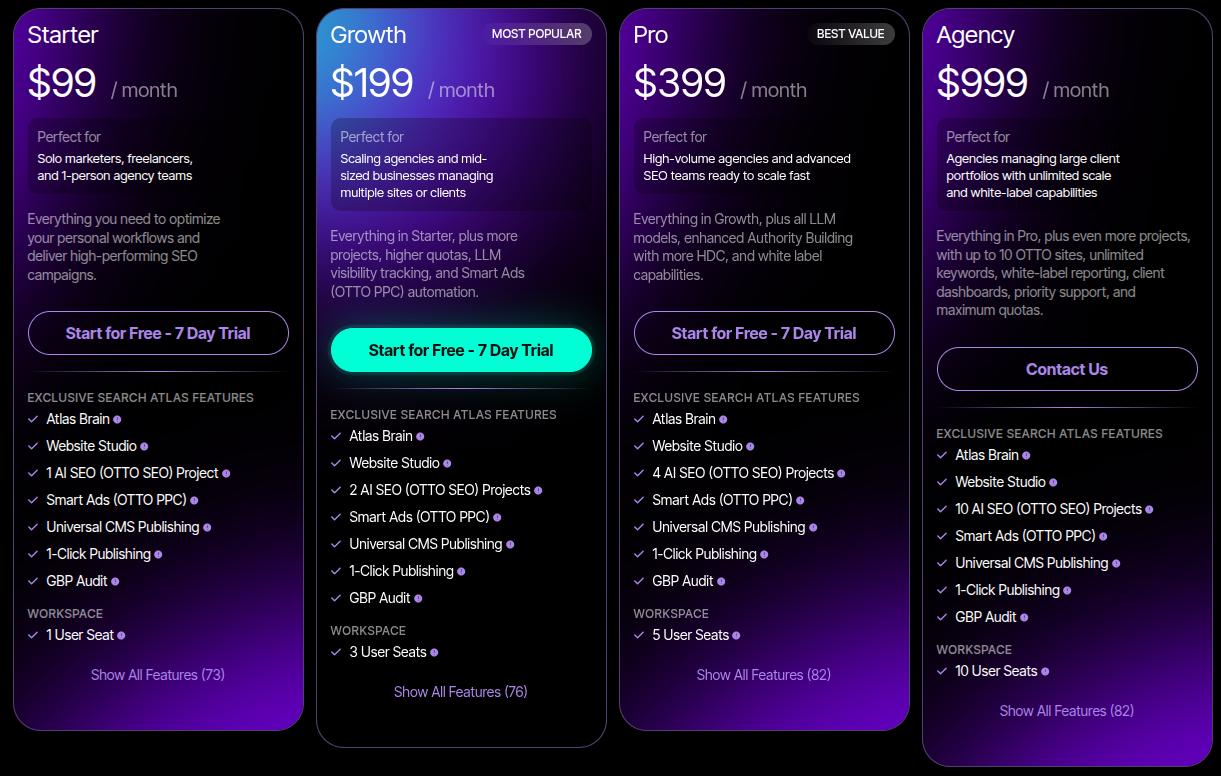
    Search Atlas pricing details.

    Plans start at $99/month with a 7-day free trial that includes full access to OTTO SEO, Content Genius, and the LLM visibility tools. Higher tiers at $199/month and above add more AI credits, deeper crawl analysis, and white-label reporting for agencies.

    15. Indexly — Best for automated indexing and improving AI visibility
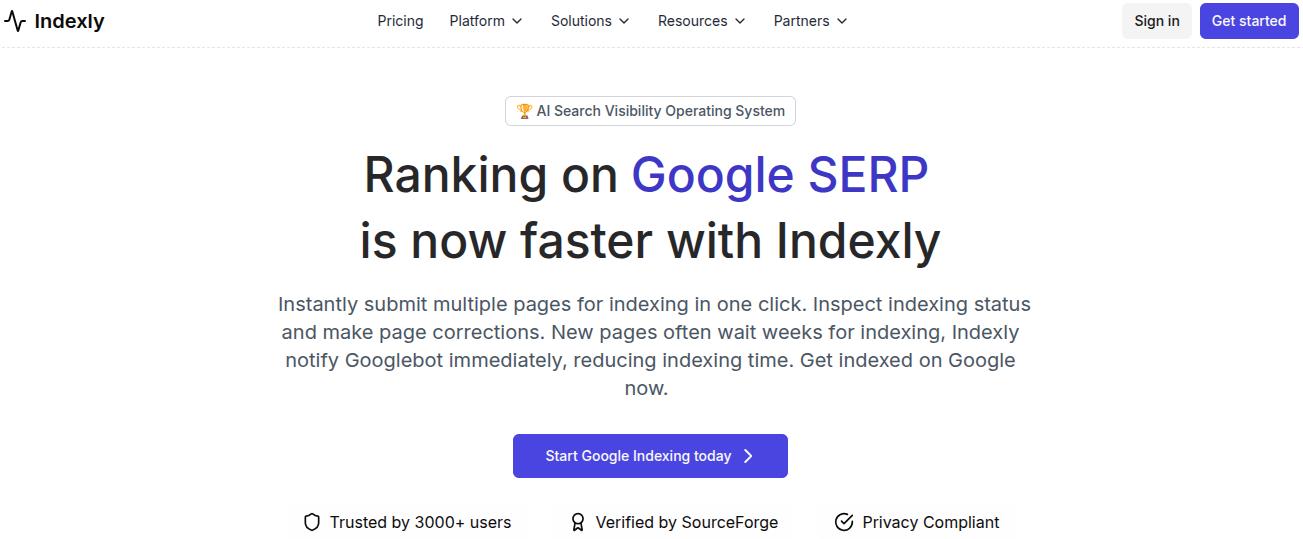
    Indexly landing page.

    Indexly solves a simple but painful problem: getting new and updated pages indexed fast. If Google and Bing do not see your content, neither will AI Overviews or any other chat-based tools. Indexly automates submissions so you do not have to fiddle with Search Console every day.

    Standout features:

    • Daily sitemap scans with automatic submission of unindexed URLs to Google, Bing, Yandex, and Naver through APIs
    • A Bing integration that helps feed content toward ChatGPT and Perplexity
    • Basic impressions, clicks, and ranking data so you can spot indexing issues early
    • AI-optimized content creation that drives qualified leads and visitors

    Use cases: 

    Technical SEO professionals, publishers, and content managers who handle multiple pages each week. 

    Worth knowing:

    Indexly solves one specific problem and does not go much further than that. It is not a content, GEO tracking, or competitive intelligence tool. So it should be treated as a supporting layer in a broader stack rather than a standalone AI search optimization solution.

    Pricing: 
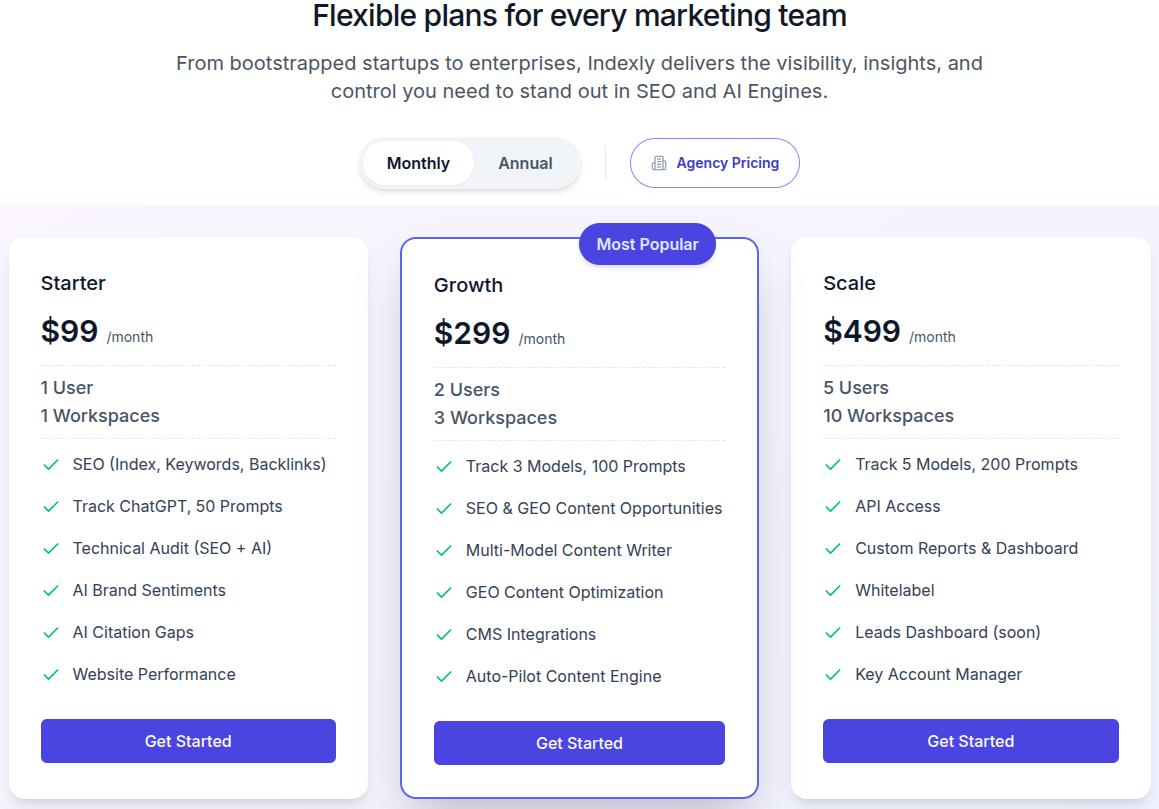
    Indexly pricing plans.

    Pricing for Indexly starts at $99/month, which provides 50 prompts to track for ChatGPT, AI brand sentiment detection, and an SEO + AI technical audit.

    16. Whatagraph — Best for AI-powered SEO + GEO reporting
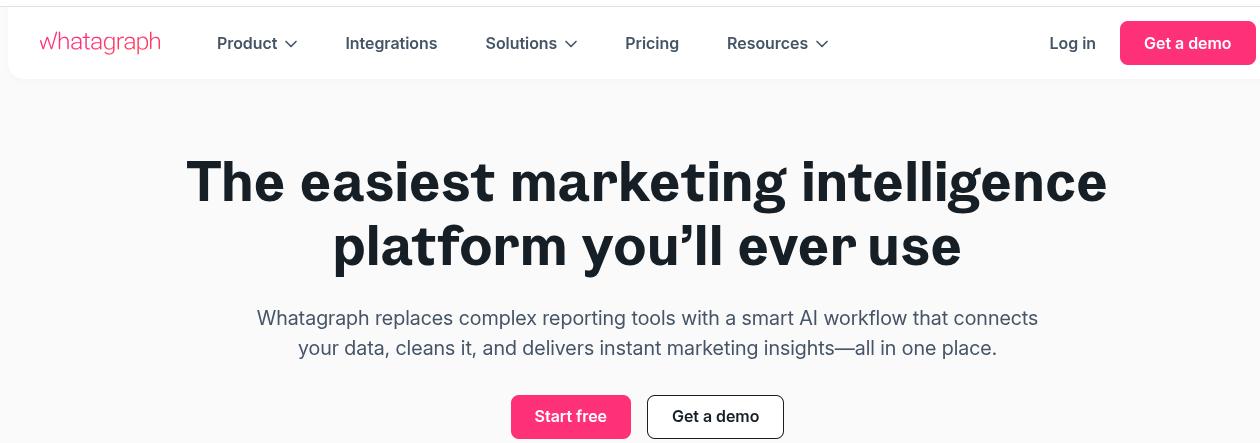
    Whatagraph SEO and GEO reporting tool.

    Whatagraph pulls data from dozens of platforms into clean, client-ready dashboards. It turns raw numbers from GA4, Google Search Console, Ahrefs, SE Ranking, and other tools into simple visuals. AI features then write easy-to-read summaries so non-technical stakeholders can also follow along and keep up with the data provided.

    Standout features:

    • Whatagraph IQ, which lets you type a prompt to generate a full SEO report
    • IQ Summary that writes narrative recaps in multiple languages
    • IQ Chat helps clients ask questions inside the dashboard regarding key figures and statistics
    • Auto-branding from a logo upload, so reports look on-brand with minimal setup

    Use cases:

    Agencies and performance marketers who spend too much time building custom reports. It is also helpful for professionals who want an AI rank tracking tool, an AI SEO audit tool, and a GEO platform in one place. 

    Worth knowing:

    Whatagraph is the most expensive tool on this list and is priced squarely at agencies billing clients for reporting time. Solo marketers or small in-house teams with simpler reporting needs will likely find the cost hard to justify compared to other alternatives.

    Pricing: 
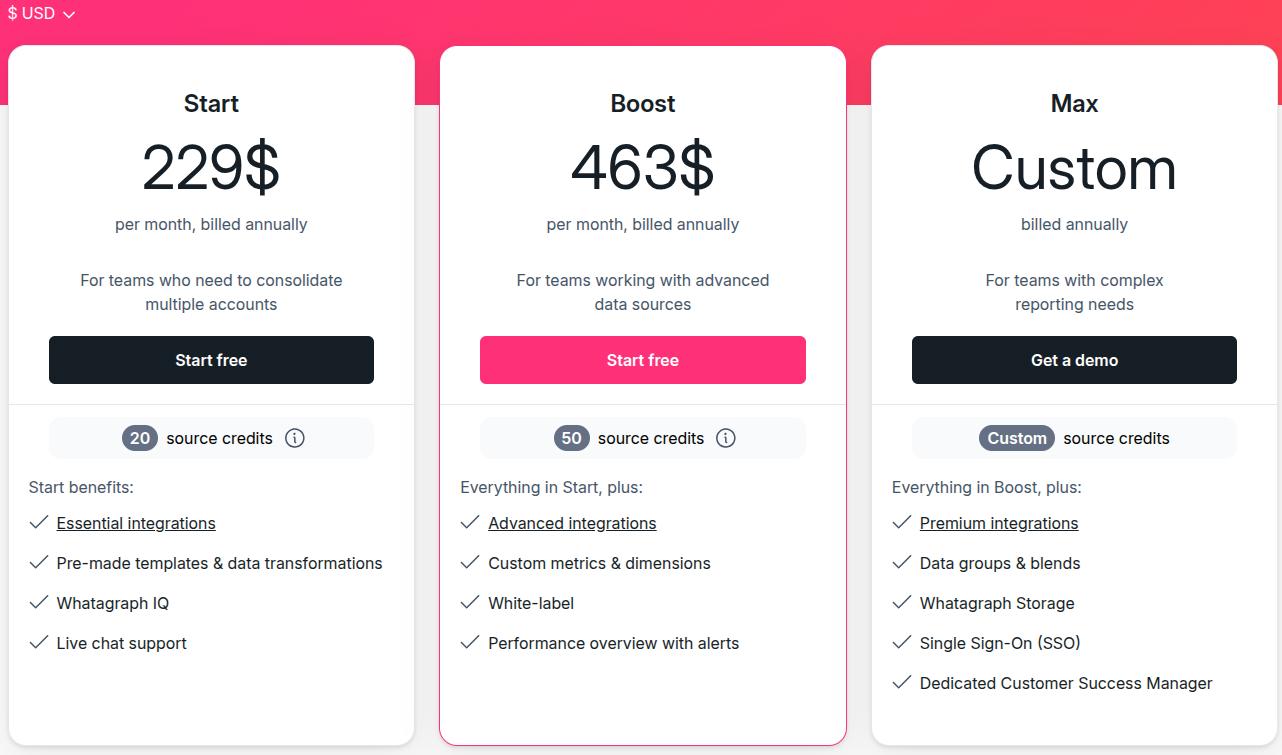
    Whatagraph pricing.

    Whatagraph pricing starts at $229/month on annual billing for the ‘Start’ plan, which includes Whatagraph IQ, live chat support, and 20 source credits.

    17. GrackerAI — Best for AEO/GEO for cybersecurity companies
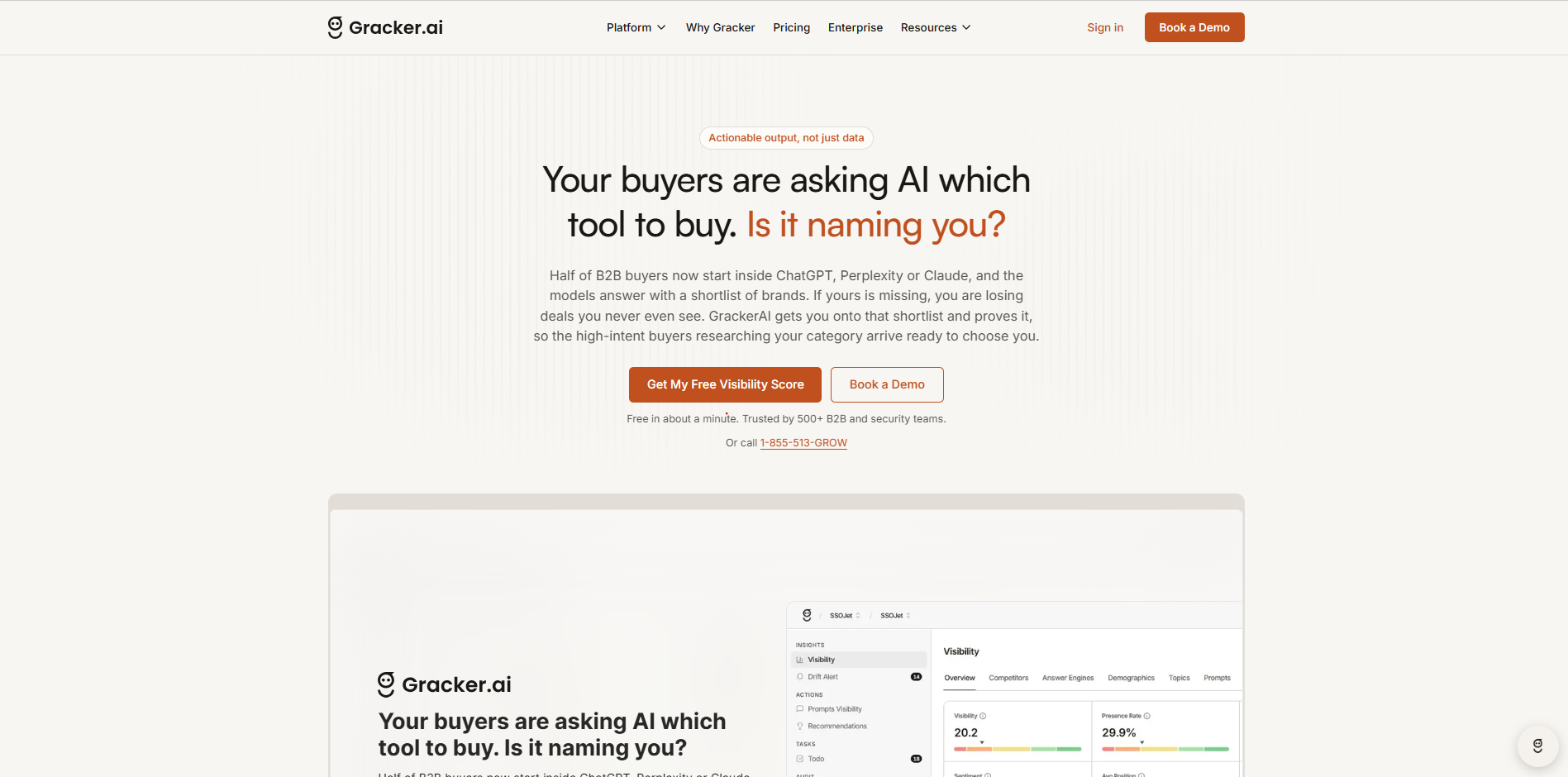
    GrackerAI landing page.

    GrackerAI is an AI visibility platform built exclusively for cybersecurity vendors. It tracks brand mentions across ten engines, including ChatGPT, Perplexity, Claude, Gemini, Copilot, Google AI Overviews, Google AI Mode, DeepSeek, Llama, and Grok.

    The tool pairs that monitoring with diagnostic agents and an article engine that fixes the gaps it finds. Most GEO tools stop at reporting. Gracker closes the loop from “why aren’t we cited” to a published fix.

    Standout features:

    • Per-engine breakdown across all 10 tracked engines with citation frequency, sentiment, average position, and share of voice
    • A Visibility Diagnosis agent that checks any prompt you’re missing, scores your existing page against it, and returns a content brief or a gap report
    • An AEO Audit that crawls the full site and grades every page on AEO Health and Technical Health
    • A Prompt Generator grounded in Google Search Console and Bing Webmaster data, so tracked prompts reflect real buyer queries

    Use cases:

    Cybersecurity marketing teams and founders who need to know if they show up when a buyer asks an AI assistant for a SIEM, IAM, or endpoint security recommendation.

    Worth knowing:

    It takes a while to learn all the capabilities of GrackerAI. Also, just like any other cybersecurity diagnosis tool, you can expect some entity resolution errors for businesses sharing common personal names that require human oversight to resolve.

    Pricing: 
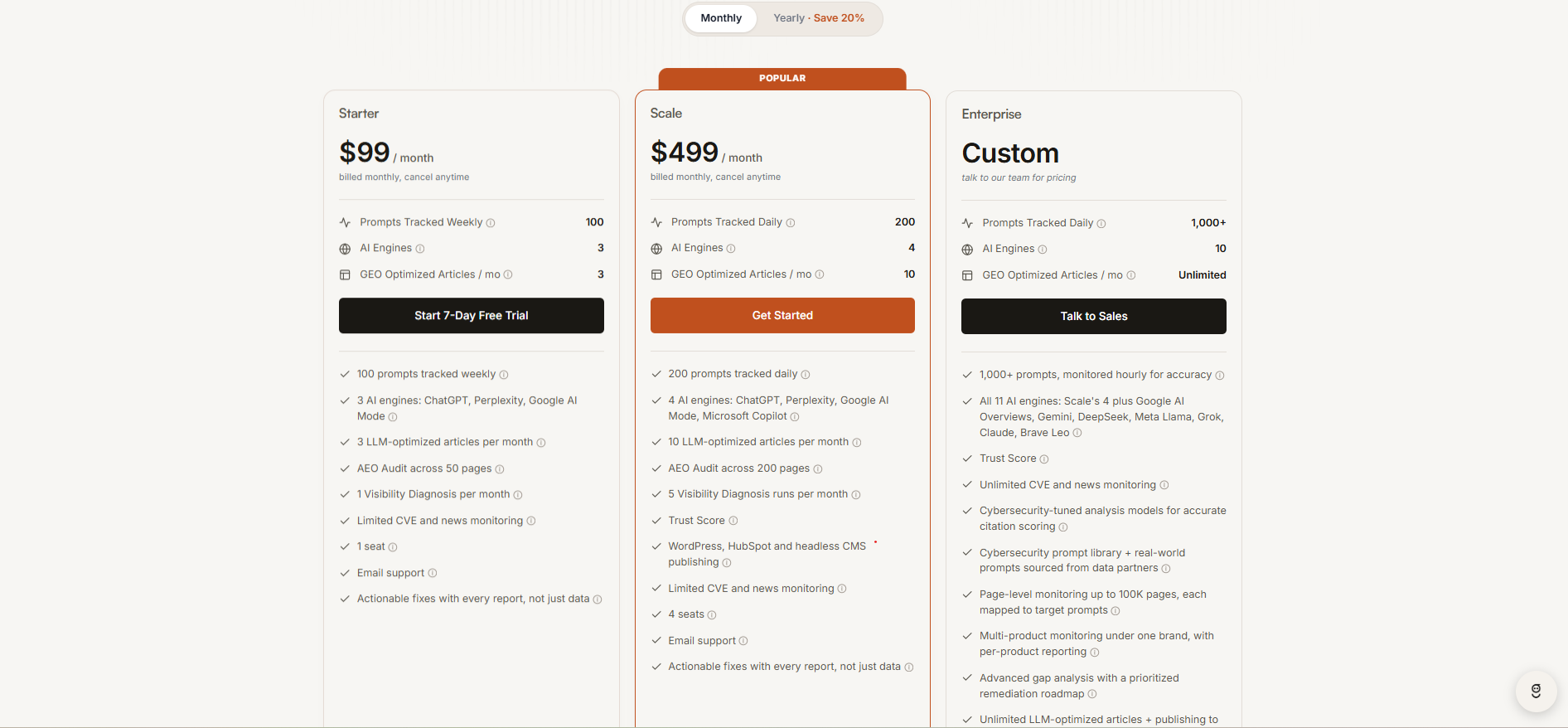
    GrackerAI pricing details.

    GrackerAI pricing starts at $99/month with the Starter plan that provides access to 3 LLMs, 3 articles, and 50 AEO audits. A 7-day free trial is available on the Starter and Scale plans.

    6 bonus tools worth exploring for AI search optimization

    The 16+ tools above cover the core of what most teams need. But the AI search optimization space is moving fast, and several other platforms are worth knowing, depending on your specific situation.

    1. Peec AI tracks brand visibility across ChatGPT, Gemini, Perplexity, and Copilot, with a particular strength in multi-country reporting. If you manage a brand across several markets and need to see how AI visibility differs by region, Peec AI fills that gap.
    2. RankPrompt is built for franchises and multi-location businesses that need to track AI visibility across different cities or service areas. It converts visibility gaps into location-specific content, making it one of the more practical tools for local SEO teams.
    3. Scrunch AI adds bot traffic monitoring. It also shows how AI crawlers are actually interacting with your site, which pages they access, and whether your content is being read before it gets cited.
    4. Goodie focuses on commercial AI visibility, including how your brand and products appear inside AI agent environments like ChatGPT shopping and Google AI Mode. Its Agentic Commerce Optimizer is a genuinely distinct feature for e-commerce brands.
    5. Respona focuses on outreach and link-building for AI search optimization. Since AI engines pull citations from trusted external sources like directories, listicles, and editorial sites, earning those placements matters for GEO just as much as for classic SEO.
    6. Pitchbox covers similar ground to Respona but with a longer track record and deeper integrations with major SEO platforms. The tool pulls live details from target pages to personalize outreach automatically, which keeps reply rates higher without manual work.

    If you’re interested in analytics and user behavior, you can check out our detailed SEO analytics tool guide for more information. 

    How to choose the right AI SEO tool for your needs

    Choosing the right AI SEO tool for your needs starts with one simple question: what do you want to improve first? 

    When you match each tool to a clear job, picking a stack feels far less confusing. Most teams do best with two or three AI search optimization tools that cover content, tracking, and technical basics.

    Begin by mapping tools to goals:

    • Content creation tools such as Contentpen, Writesonic, and Frase help you ship more long-form articles and landing pages.
    • GEO tracking tools like AIclicks.io, OtterlyAI, Gauge, SE Ranking’s AI overview tracker, and Contentpen’s AI visibility tracking tell you how AI engines already talk about your brand.
    • Technical helpers, such as Indexly, handle indexing and raw data.
    • Outreach platforms like Pitchbox secure third-party mentions and backlinks.

    Budget and team size matter as much as feature lists. 

    Solo creators and freelancers usually start with one AI SEO content generator or SEO-optimized AI content generator plus a light AI SEO audit tool. 

    Small teams can add GEO tracking once content volume grows. Larger agencies and in-house teams tend to layer in reporting platforms and outreach tools so they can show impact across the whole funnel.

    Here is a simple way to think about it:

    • Focus on content first. Without consistent, high-quality articles, even the best AI SEO tools have nothing meaningful to optimize.
    • Add AI tools once you see traffic from content. When you know where AI agents already mention you, you can sharpen future posts and landing pages. Over time, this feedback loop makes your content calendar far more targeted.
    • Layer in technical and outreach support as you scale. Raw SERP data and link building matter most when you run multiple pages. These tools keep your AI SEO optimization efforts from stalling because of crawl delays or weak authority.
    • Match pricing tiers to revenue impact. Use early wins from content and GEO tracking to justify higher-tier plans later. That way, your AI SEO platform costs grow with the value you actually see, not based on fear of missing out (FOMO).

    The right tools won’t matter if your content isn’t built to rank

    The right AI search optimization tools only work when your content itself deserves attention. If posts are shallow, poorly structured, or copied, no dashboard can fix that. AI systems favor pages that clearly answer questions and earn trust from other sites.

    Start by focusing on quality and intent. According to Google Search Central, helpful, people-first content is what earns lasting visibility, regardless of whether AI helped write it. That means you need:

    • Clear intros that answer questions fast
    • Scannable headings and short paragraphs
    • Examples grounded in real user problems

    The tool that helps you do all three consistently is Contentpen. By guiding you through keyword and topic selection, outline creation, and headline optimization, it helps you publish link-worthy posts on a steady schedule, then shows you whether AI engines are citing them.
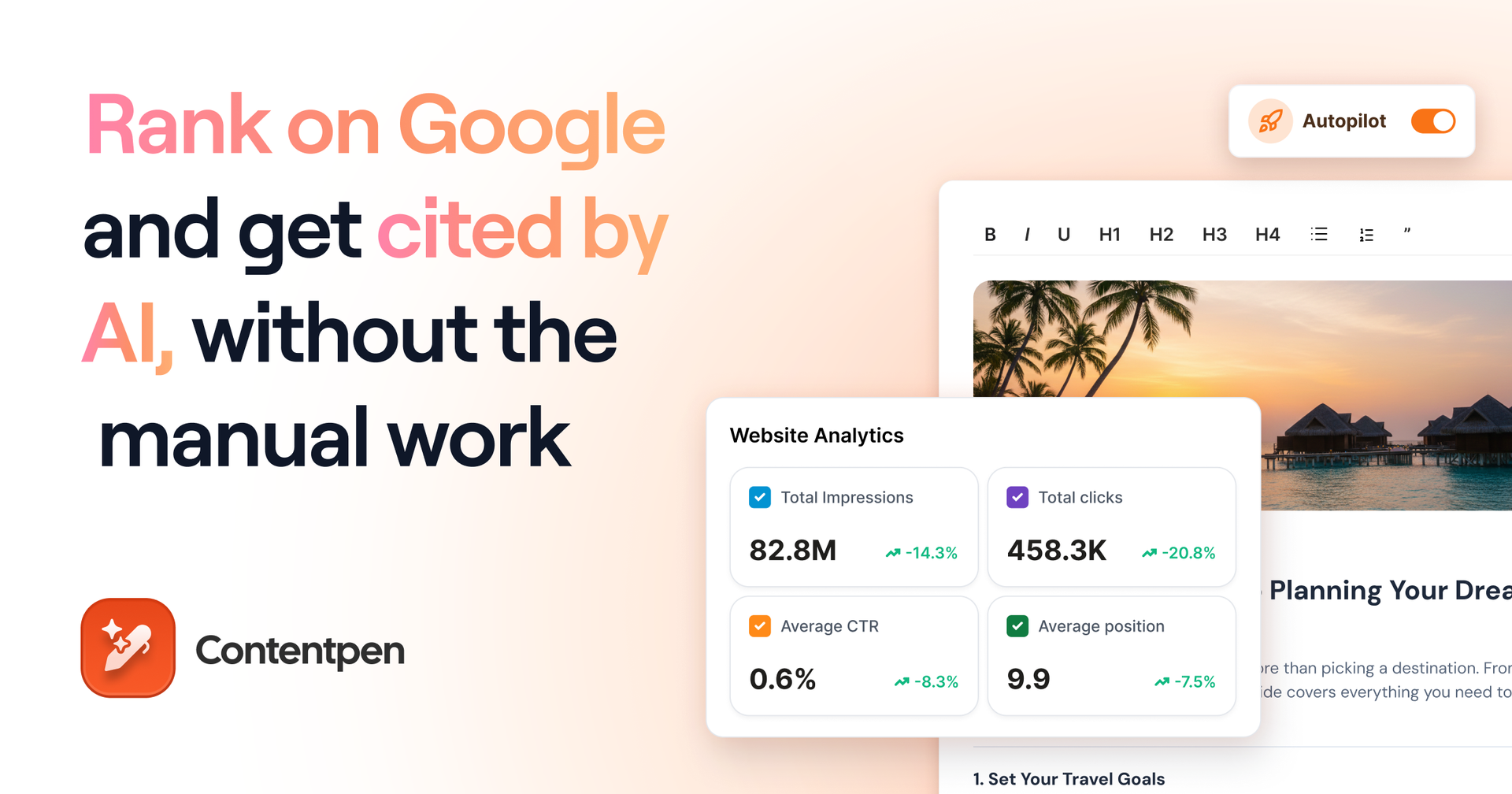
    Write content that’s built to rank, not just read

    Create search-optimized blogs aligned with SEO and GEO signals, so your content performs well across search and AI-driven discovery.

    Try SEO Blogging FREE →
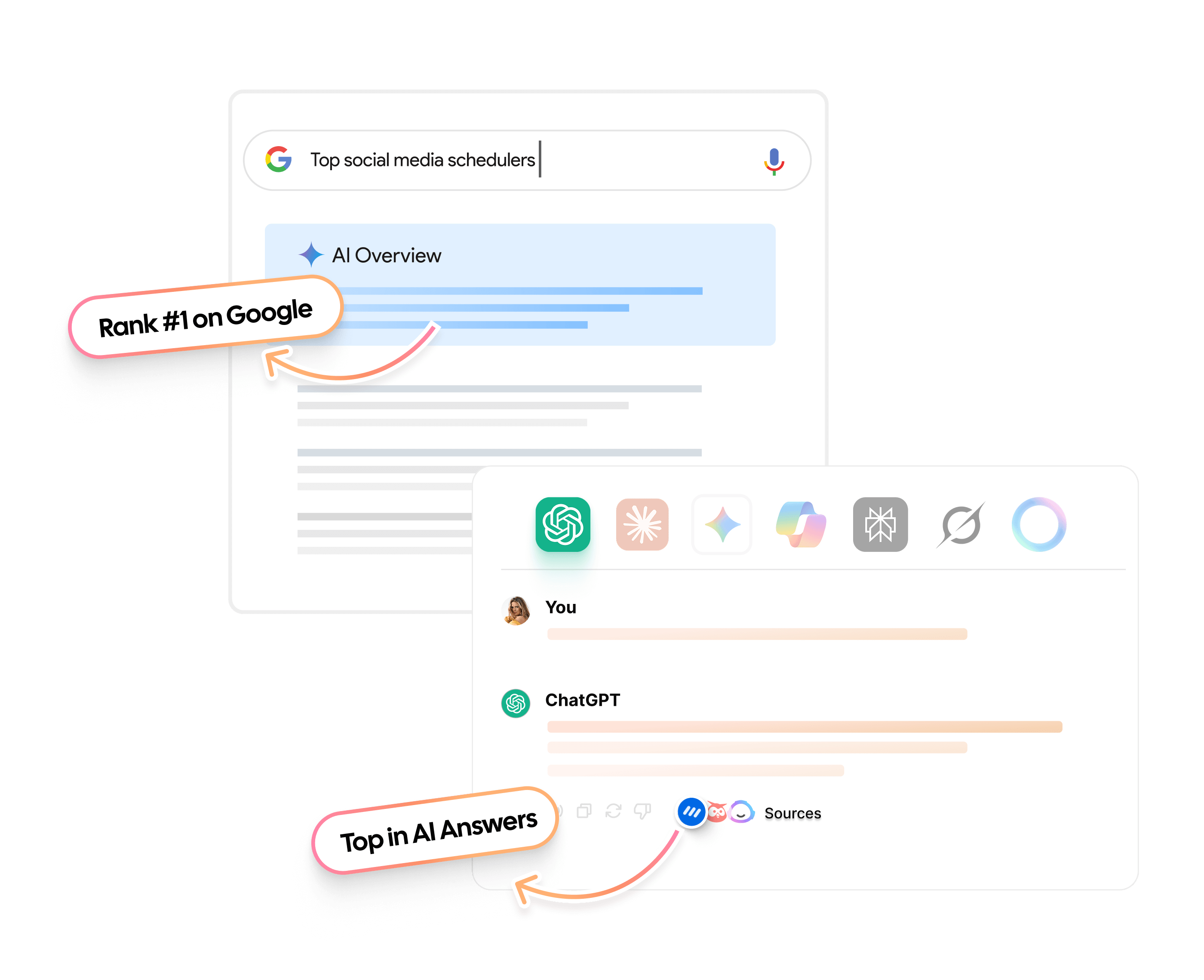
    AI SEO Interface

    Once that foundation is in place, GEO trackers, AI website optimization tools, and outreach platforms have something strong to amplify.

    In short, tools help you measure, refine, and distribute. Content still wins the click, the mention, and the sale. Brands that succeed in 2026 will invest in both smart AI search optimization tools and smarter, more helpful content.

    Frequently asked questions

    What is the best AI tool for SEO in 2026?

    There is no single best AI tool for SEO in 2026 because needs differ. For blog-heavy strategies, Contentpen is a strong choice. AIclicks.io shines when you care about GEO. Indexly helps with indexing automation for your platform.

    Are there free AI tools for SEO optimization?

    Yes, there are several free or low-cost AI tools for SEO optimization. AirOps offers a free Solo plan with a monthly task limit. Indexly provides a free tier for basic indexing, and MarketMuse has a limited exploration plan. Free plans are great for testing, but serious campaigns usually need paid tiers for deeper data and features.

    Can I use just one AI search optimization tool, or do I need a stack?

    One tool is fine to start. If content is your gap, begin with a creation tool like Contentpen. If you’re already publishing consistently but not showing up in AI answers, start with a GEO tracker like AIclicks or Otterly. Add a second tool only once you’ve exhausted what the first one tells you to do.

    Do I need a separate tool for GEO if I already use an SEO platform like Semrush or Ahrefs?

    Most legacy SEO platforms have added AI visibility features, but they are bolt-ons rather than core products. They track a narrow slice of prompts and rarely give you citation-level detail or actionable GEO recommendations. If AI search visibility is a priority, a dedicated GEO tool gives you meaningfully better data than a tab inside a traditional SEO suite.

    What content changes actually improve AI citation rates?

    The highest-impact changes are structural: answer the main question in the first two sentences, use clear, conversational-style H2s and H3s, and add FAQ blocks with direct answers. AI systems also favor content that cites sources, includes specific data points, and covers a topic without gaps.

    Is AI search optimization worth the cost for small businesses?

    It depends on whether your customers are already using AI to find solutions in your category. If they are using AI, not showing up in AI answers is a real revenue problem regardless of your size. Several tools on this list start at around $30 to $60 per month, which is low enough to justify testing before committing to anything bigger.
  • Answer engine optimization examples that you can learn from in 2026

    Answer engine optimization examples that you can learn from in 2026

    According to SparkToro, 68% of Google searches in 2026 end without a click. If your content is not the one being cited by AI platforms, then it might as well not exist.

    That shift raises a tougher question than how to do basic SEO. The real question is how to win in AI search. How does a team move from writing good blog posts to publishing answer‑focused content that shows up in Google AI Overview or ChatGPT‑style summaries?

    In this article, you will see 8 real answer engine optimization examples from brands like Semrush, HubSpot, Reddit, Zapier, and Healthline.

    Then we will see the answer engine optimization best practices and the AEO SEO strategy behind those results. We will also walk you through the emerging trends in 2026 and show how Contentpen helps you optimize content for AI answers at scale.

    So, let’s get started.

    Real-world answer engine optimization examples and what made them work

    The easiest way to understand answer engine optimization is to look at brands already winning in AI search. Any content team, agency, or solo creator can adapt these strategies for better AI discoverability in 2026.

    #1: Semrush turning proprietary data into a citation magnet (data-driven AEO)

    Semrush AEO example: Data-driven approach to answer engine optimization.

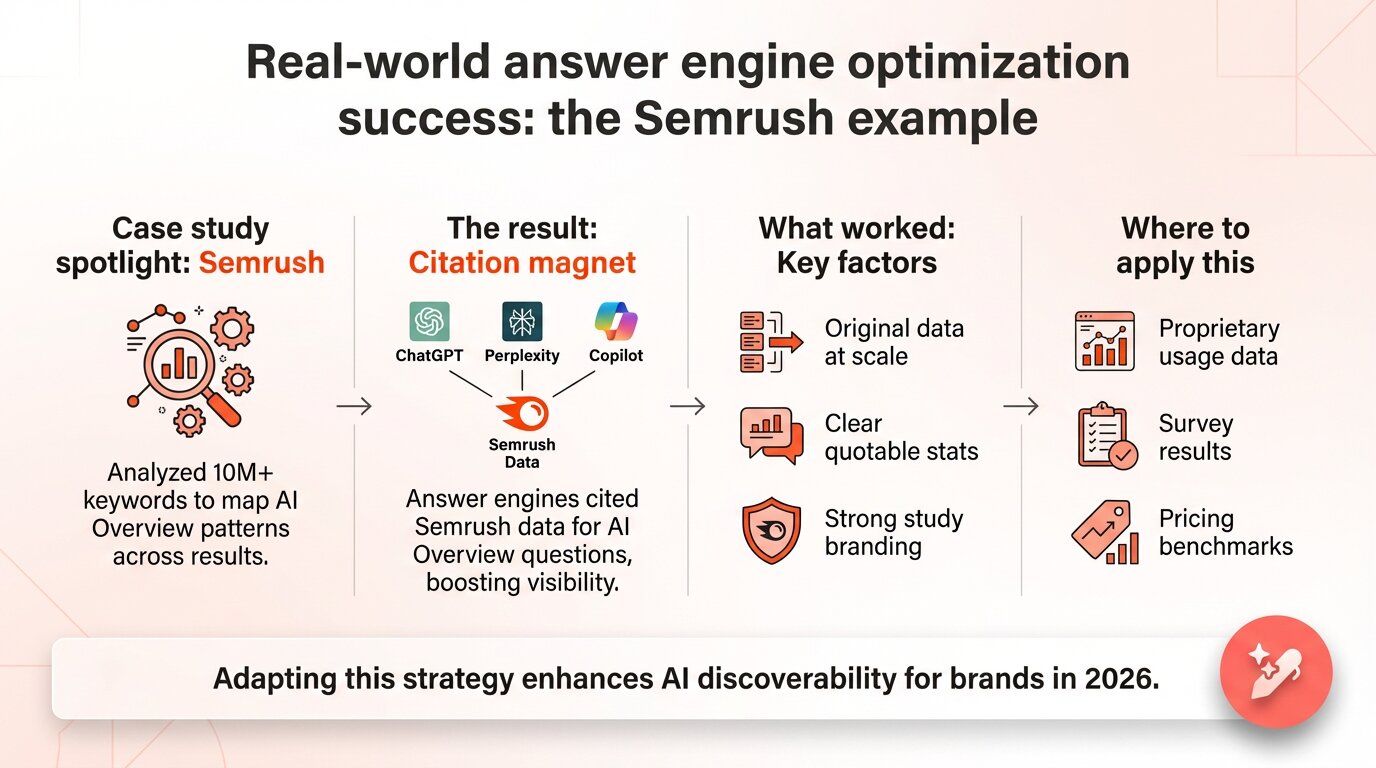
    Semrush noticed confusion around how often Google shows AI Overviews and which queries trigger them. Instead of guessing, the team analyzed over 10 million keywords to map AI Overview patterns across Google’s results, then broke the findings into clear, quotable stats.

    Because that dataset was early and deep, answer engines kept reaching for it. When people asked ChatGPT, Perplexity, or Copilot questions about AI Overviews and generative engine optimization statistics, those tools often pulled Semrush numbers. 

    Read more: How to turn off AI Overviews.

    The result was a steady loop of citations, links, and branded searches that boosted both classic SEO and AI search optimization.

    • What worked: Original data at scale, clear stats, and strong branding on the study.
    • Where to try this: Topics where you have proprietary usage data, survey results, or pricing benchmarks nobody else can publish.

    #2: HubSpot scaling question-based content architecture (definition AEO)

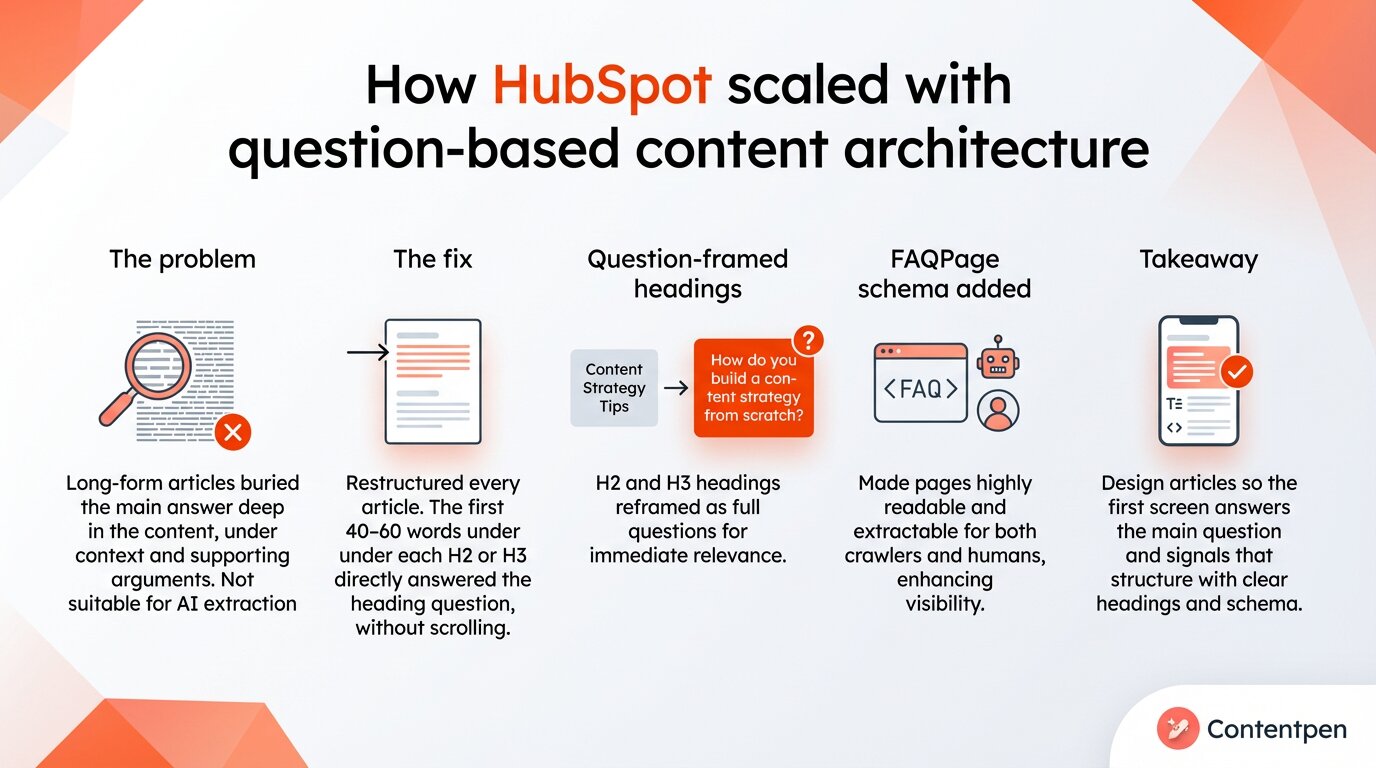
    How HubSpot scaled their platform with question-based content.

    HubSpot already ranked for thousands of marketing queries but wanted more wins in position zero spots and AI Overviews. The barrier was not content volume, but structure.

    The team identified a specific problem. Most of HubSpot’s articles were written in a traditional long-form style where the main answer was buried several paragraphs down, under context, background, and supporting arguments. 

    That format worked for featured snippet optimization when Google pulled a mid-page paragraph. It did not work well for AI extraction, which pulls from the very beginning of a section.

    The fix was a template rebuild. Every article was restructured so the first 40 to 60 words under each H2 or H3 heading answered the question that heading raised, without making the reader scroll to find it.

    They framed H2 and H3 headings as full questions, like “Content Strategy Tips” became “How do you build a content strategy from scratch?” They also added the FAQPage schema to key posts, which made their pages highly readable and extractable for both crawlers and humans.

    Over time, this question-based architecture turned HubSpot articles into consistent sources inside Google AI Overviews and other AI summaries, along with the featured snippet wins they were already earning.

    • Takeaway: Design articles so the first screen already answers the main question and signals that structure with clear headings and schema.

    #3: A regional HVAC company winning local voice queries (local AEO)

    A regional HVAC company had an AI visibility tracking problem that most content advice cannot solve. They were not competing for global traffic or brand searches. They needed to appear when someone in Phoenix searched for a term like “Who can fix my heater today?”

    The agency they worked with started from the ground up. Their agency cleaned up the Google Business Profile, fixed NAP details, and built focused landing pages like ‘HVAC repair in Phoenix’ with short, spoken‑friendly answers. 

    LocalBusiness schema was applied across every page, telling AI engines exactly who the brand was, where it operated, and what services it provided. The FAQ schema was layered on top, covering the questions people most commonly ask before booking an HVAC appointment.

    Within a few months, voice assistants started reading the company name in response to near-me prompts. Organic traffic improved, despite the brand’s domain being significantly smaller than the national HVAC chains it was competing against.

    LocalBusiness schema and clear headings around common issues made those pages strong voice search optimization examples.

    • Key move: Write the copy the way people speak into phones or smart speakers, then support it with the right local and structured data.

    #4: Investopedia owning financial definitions at position zero (definition AEO)

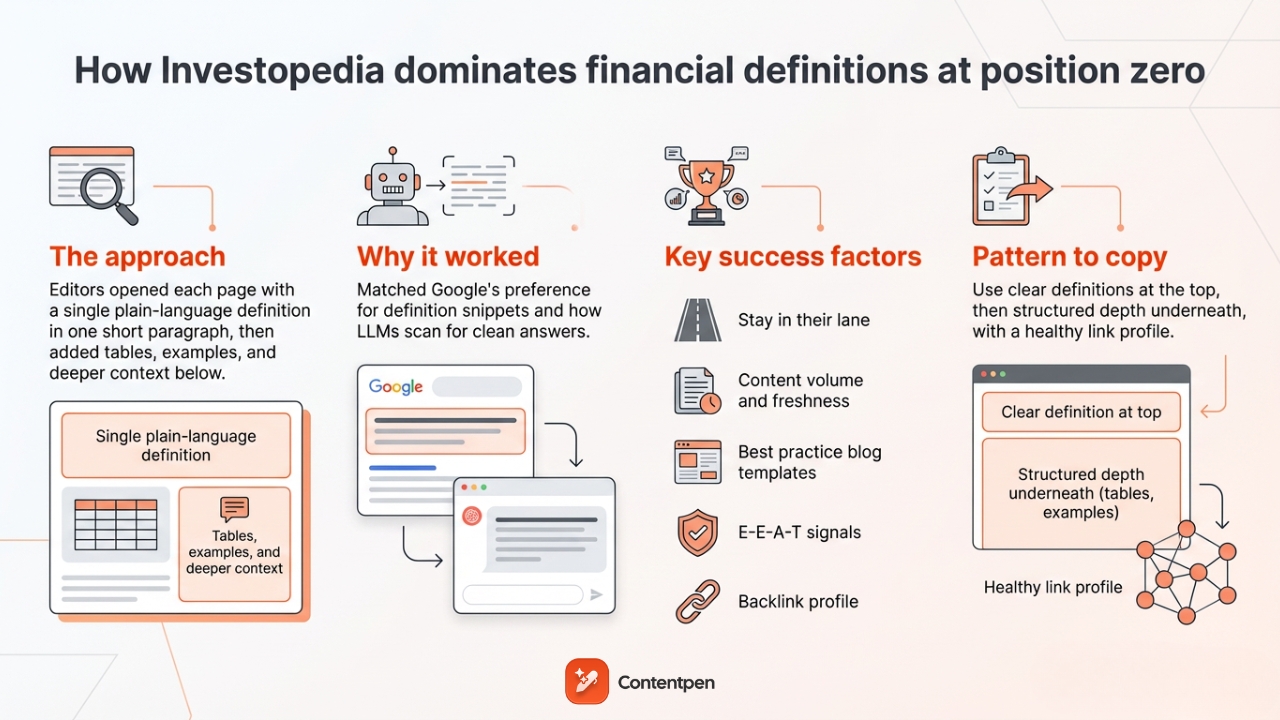
    Investopedia answer engine optimization for better SERP position.

    Investopedia focused on direct-answer SEO for finance definitions, where searchers wanted fast clarity more than long theory. Many competitors had long, dense pages that buried the simple explanation somewhere in their content.

    Editors reworked core pages so each one opened with a single plain‑language definition in one short paragraph, then added tables, examples, and deeper context below. 

    This format matched what Google already preferred for definition snippets and lined up with how LLMs scan for clean answers.

    As a result, Investopedia now wins a large share of snippets for financial terms and keeps showing up as one of the most visible sites for those topics in AI chatbots. According to the Spicy Margarita case study, these are the reasons for Investopedia’s success:

    1. They stay in their lane
    2. Content volume and freshness
    3. Best practice blog templates and site structure
    4. E-E-A-T signals
    5. Backlink profile

    Across all four brands, the common pattern is clear. They ship answer‑first content, format it so machines can extract it, and support it with strong authority signals such as data, schema, or consistent entity details.

    • Pattern to copy: Use clear definitions at the top, then structured depth underneath to cover a page comprehensively while building a healthy link profile.

    #5: Stack Overflow’s cautionary contrast (absence of AEO)

    Not every story in AI search is a win. Sometimes the most instructive example is a brand that did not adapt in time.

    Stack Overflow built one of the most comprehensive programming knowledge bases on the internet. At its peak in 2014, the platform was processing over 200,000 questions every month, and developers worldwide relied on it as the go-to source for finding coding answers.

    Then ChatGPT launched in November 2022.

    Within months, question volume started collapsing. By late 2025, monthly questions had fallen to under 50,000, returning the platform to 2008 levels.

    That is a 76% drop in questions since ChatGPT’s release. There’s a 14% drop in visits since 2022, and Prosus, which acquired Stack Overflow for $1.8 billion in 2021, watched its most valuable asset erode in real time.

    The core problem was structural. Stack Overflow’s content was built for human readers scrolling a thread, not for AI engines extracting a clean, self-contained answer. 
    Accepted answers were often buried under comment chains, edge-case debates, and version-specific caveats. There was no consistent answer-first structure and no schema markup guides for AI to trust the responses.

    The lesson here is hard to ignore. Even a dominant, high-authority platform with years of accumulated content can lose AI visibility if the structure is not built for extraction.

    • What would have helped: Clean answer-first formatting at the top of each thread, structured data identifying the accepted answer, and author credential signals on high-stakes topics.

    #6: Reddit’s remarkable AEO (UGC AEO)

    Reddit UGC AEO example.

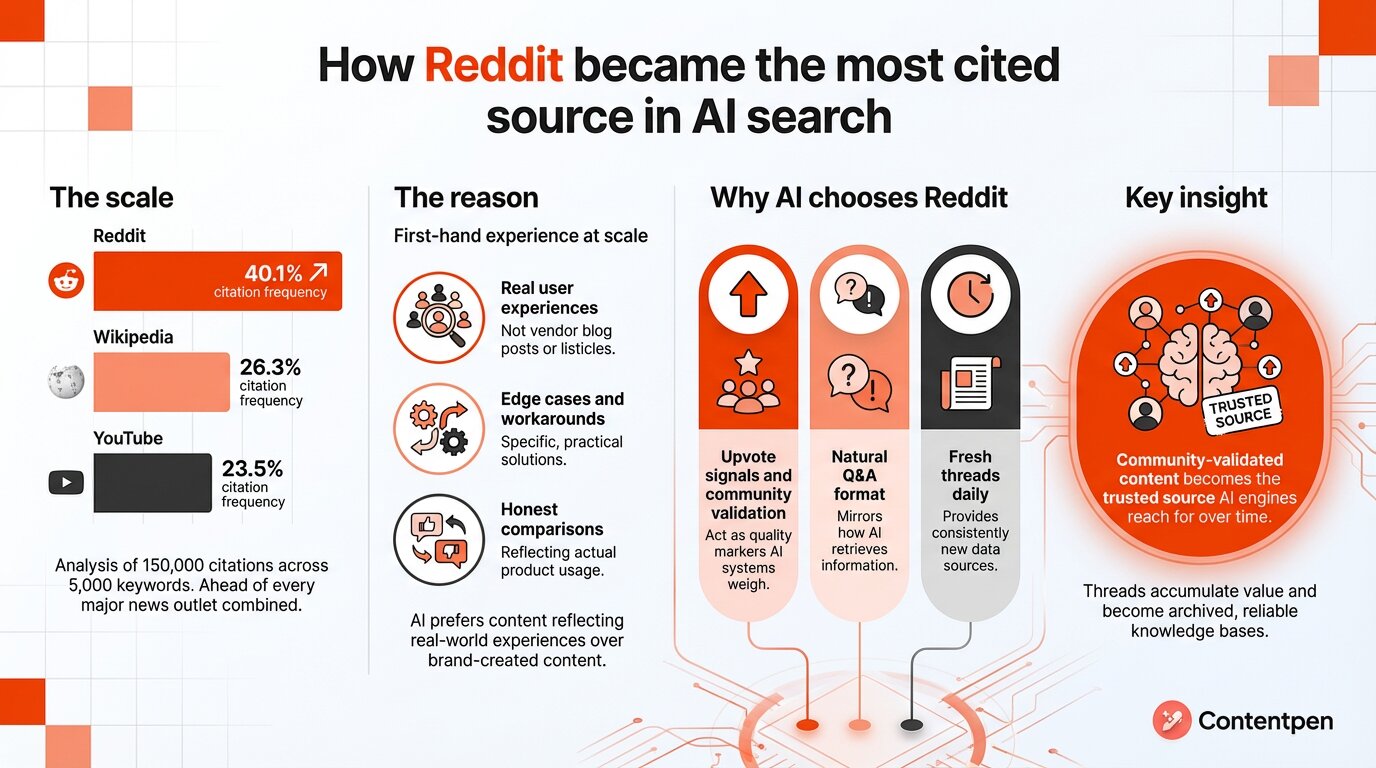
    Reddit did not run an AEO campaign. It did not restructure its content for AI extraction or add schema markup to subreddit threads. Yet as of early 2026, it is the single most cited domain across ChatGPT, Google AI Overviews, and Perplexity combined.

    A Discovered Labs analysis of 150,000 citations across 5,000 keywords found Reddit had a citation frequency of 40.1%, ahead of Wikipedia at 26.3%, YouTube at 23.5%, and every major news outlet combined. For Perplexity specifically, 24% of all citations in January 2026 came from Reddit alone.

    The reason AI engines love Reddit is not authority in the traditional sense. It is because Reddit threads contain something that most brand content does not: first-hand experience at scale.

    When someone asks ChatGPT, “What project management tool is best for a remote team of five?”, the AI is not looking for a vendor blog post or a review site listicle. It is looking for content that reflects how real people actually experienced the product, including the edge cases, the workarounds, and the honest comparisons. Reddit delivers exactly that.

    Over time, those threads accumulate upvotes, get archived, and become the community-validated sources that AI engines reach for.
    • Why AI chooses Reddit: Upvote signals and community validation act as quality markers that AI systems weigh. Natural Q&A format mirrors how AI retrieves information, and new threads are posted daily, giving AI a consistently fresh source of data.
    #7: Zapier winning organic traffic (programmatic AEO)

    Zapier does not specifically chase high-volume keywords around its own product. Instead, it built a content system that captures demand at the point of intent, across thousands of specific use cases.

    The numbers tell the story. Zapier runs over 50,000 integration pages, each targeting a specific app-to-app combination. A page like /apps/gmail/integrations/slack answers one precise question: ‘How do these two tools connect?’ 

    The format is consistent across every single page, including a plain-English description of the integration, a step-by-step setup guide, and popular automation templates. That structure generates over 5.8 million monthly organic visits, according to data from multiple SEO analysis platforms.

    But the reason this matters for AEO is not the traffic number. It is how the structure performs in AI search.

    Zapier solved the main challenge of programmatic content at scale by requiring app partners to provide accurate descriptions, use cases, and setup documentation during the onboarding process. 

    That means the people who know the app best write its content. Zapier maintains the template and structure. Partners supply the accuracy.

    • What worked: Consistent template structure across all pages, partner-generated content for accuracy, answer-first formatting within each section, and deep internal linking between related integration pages.

    #8: Healthline winning the share of voice in healthcare (YMYL AEO)

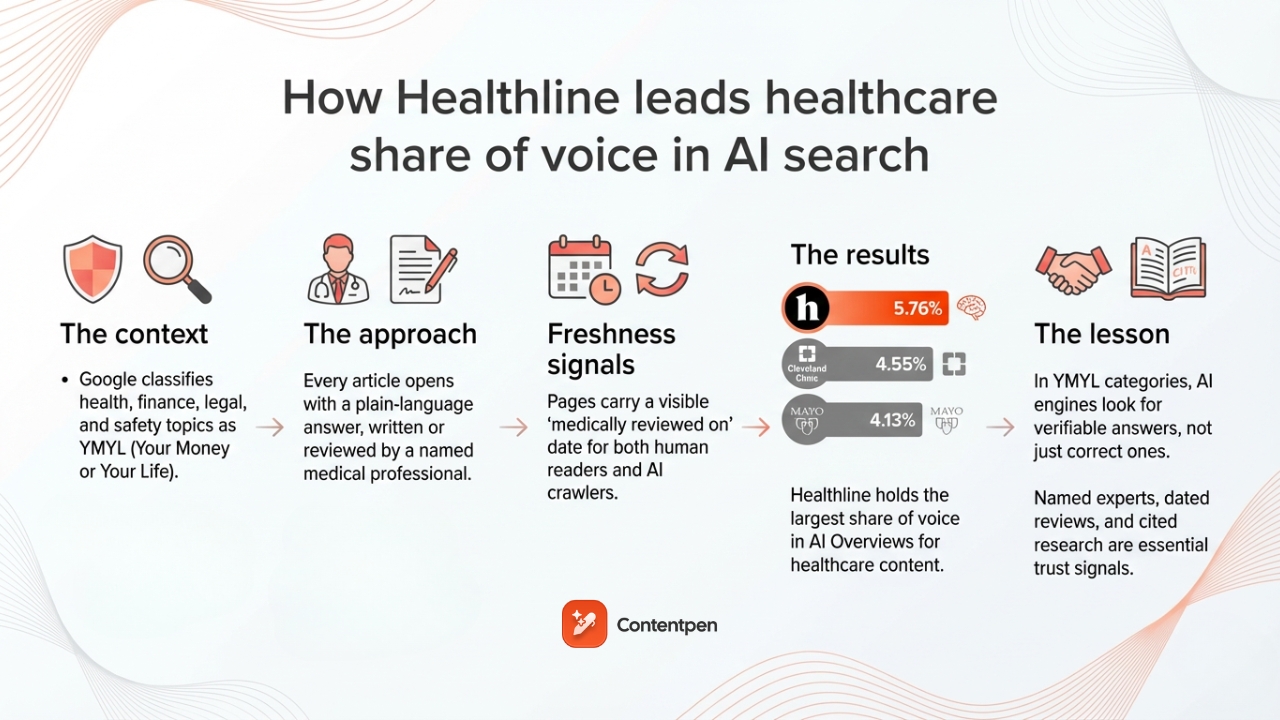
    How Healthline leads healthcare share of voice in AI search.

    Health content operates under the strictest quality standards in search. Google classifies medical, financial, legal, and safety topics as YMYL (Your Money or Your Life), meaning AI engines apply significantly higher scrutiny before citing a source in these categories.

    Healthline understood this early. Rather than competing on content volume, the brand built a system that signals trust at every layer of the page.

    Every article opens with a plain-language definition or direct answer to the query, written or reviewed by a named medical professional with visible credentials. 

    The byline includes the reviewer’s name, specialty, and years of experience with an external link to peer-reviewed research. Pages carry a visible “medically reviewed on” date, signaling freshness to both human readers and AI crawlers.

    The results are measurable. A Conductor analysis of 17 million AI-generated responses across health queries found that Healthline holds the largest share of voice in AI Overviews for healthcare content at 5.76%, ahead of the Cleveland Clinic at 4.55% and the Mayo Clinic at 4.13%. 

    • The lesson: In YMYL categories, AI engines are not just looking for correct answers. They are looking for verifiable answers. Therefore, using named experts, dated reviews, and cited research are essential trust signals.

    Pattern classification for AEO examples

    Every example in this article follows one of five distinct AEO patterns. Recognizing which pattern fits your business is the fastest way to decide where to focus first.

    PatternExampleCore mechanismWho does it work for
    Data-driven AEOSemrushProprietary research becomes the only citable source on a topicBrands with access to original usage data, survey results, or internal benchmarks that nobody else can publish
    Definition AEOInvestopedia, HubSpot, HealthlinePlain-language answers at the top of every section match AI extraction patterns and satisfy definitional intentFinance, health, legal, and any category where clarity beats depth at the point of extraction
    UGC AEORedditFirst-hand community experience fills the gaps that branded content cannotAny brand whose audience discusses it in forums, review sites, or social communities
    Programmatic AEOZapierConsistent, structured templates at scale capture thousands of specific use-case queries without manual writingBusinesses with large structured data sets, such as integrations, locations, product combinations, or use cases
    Local AEORegional HVAC companyVoice-search-friendly answers combined with local schema, GBP optimization, and NAP consistency create a verified local entity signalService businesses with geographic targeting that rely on near-me and voice queries for bookings

    The pattern that consistently underperforms is attempting all six at once without data to support any of them. 

    Therefore, you need to start with the one that matches your existing strengths. 

    A brand with original usage data starts with data-driven AEO. A service business with local reach starts with local AEO. A SaaS platform with thousands of use cases starts with programmatic AEO.

    Most brands will eventually use two or three patterns together. The most common combination is data-driven AEO layered with definition AEO and UGC AEO.

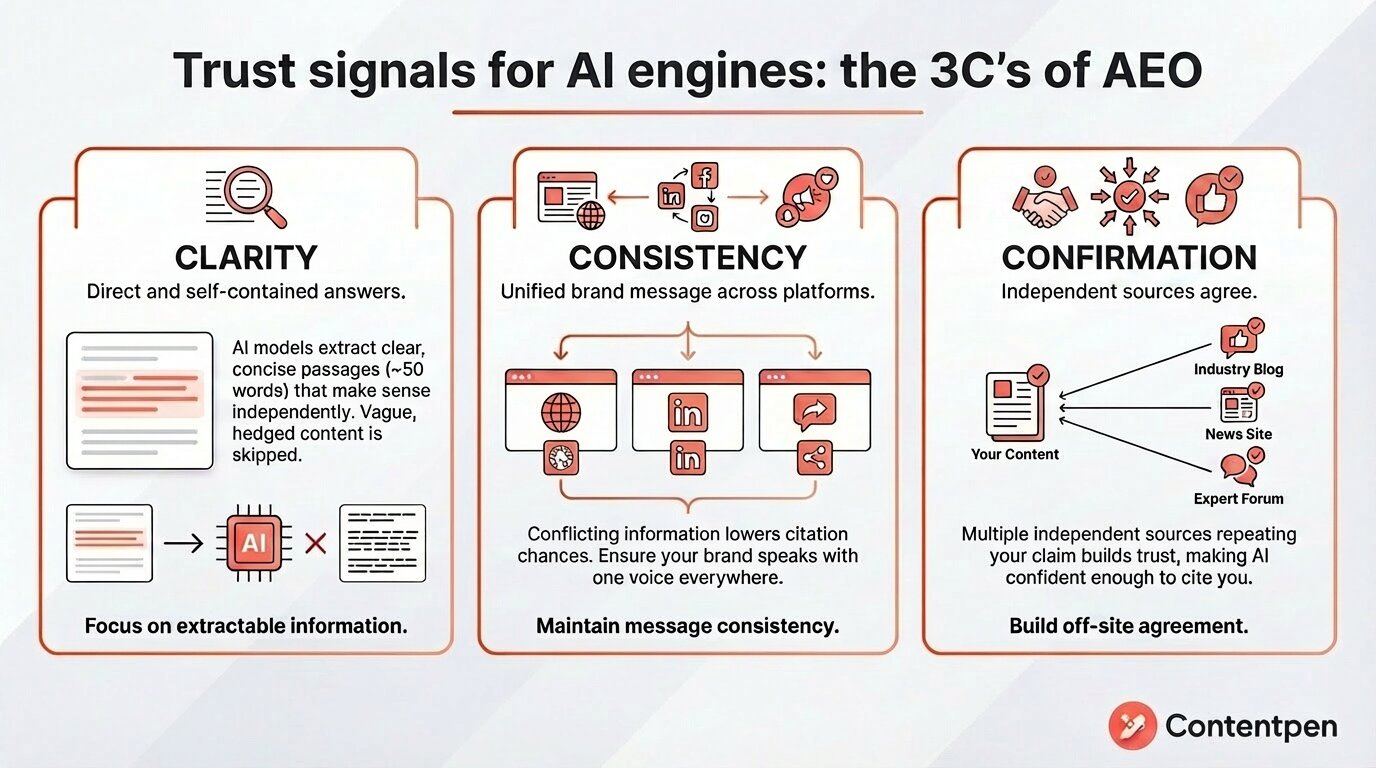
    That combination covers the three things AI engines evaluate most heavily: do I trust this source, can I extract a clean answer, and does the wider web confirm what this brand says about itself?

    Answer engine optimization best practices extracted from these examples

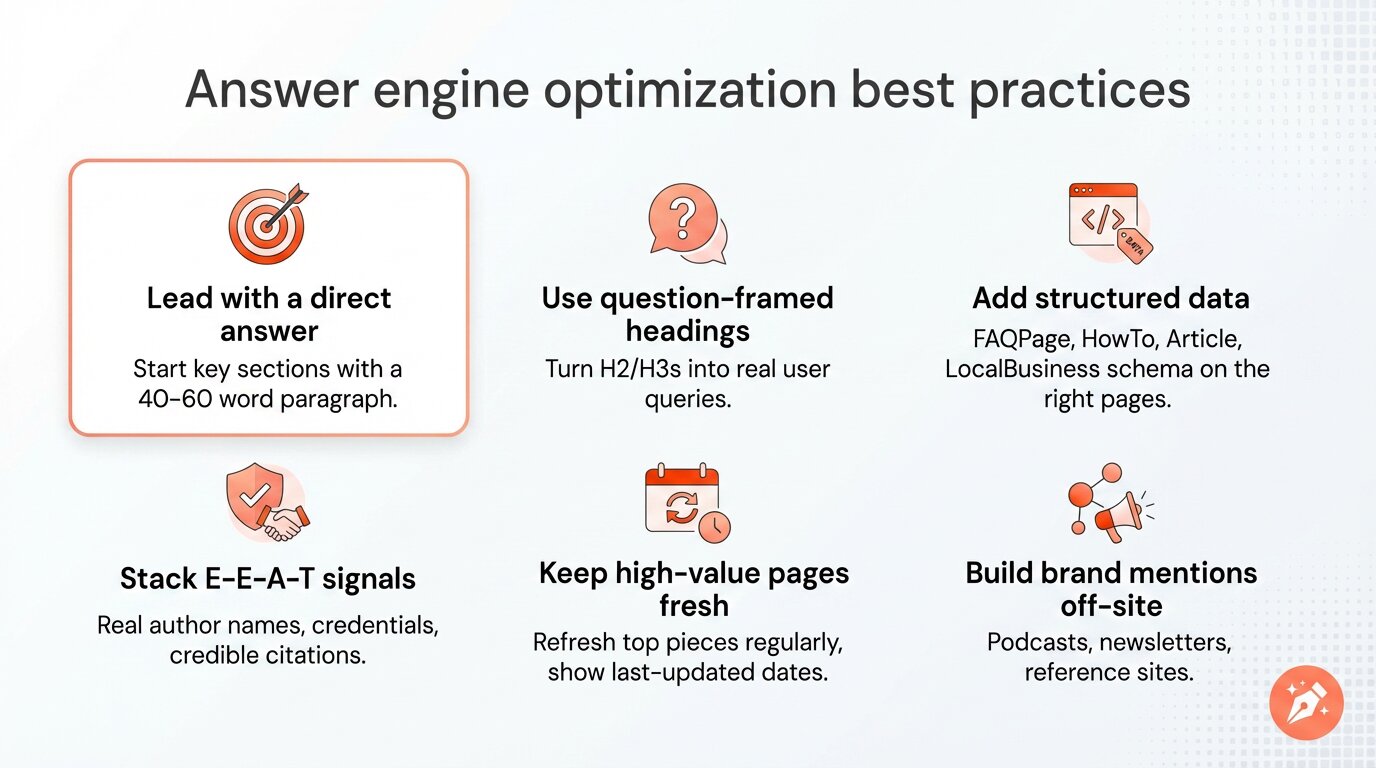
    Answer engine optimization best practices summarized.

    Those answer engine optimization examples were not accidents. Each one came from a set of repeatable moves that any content team can use. Think of this section as a compact framework for how to do AEO without guessing.

    1. Lead every key section with a direct answer
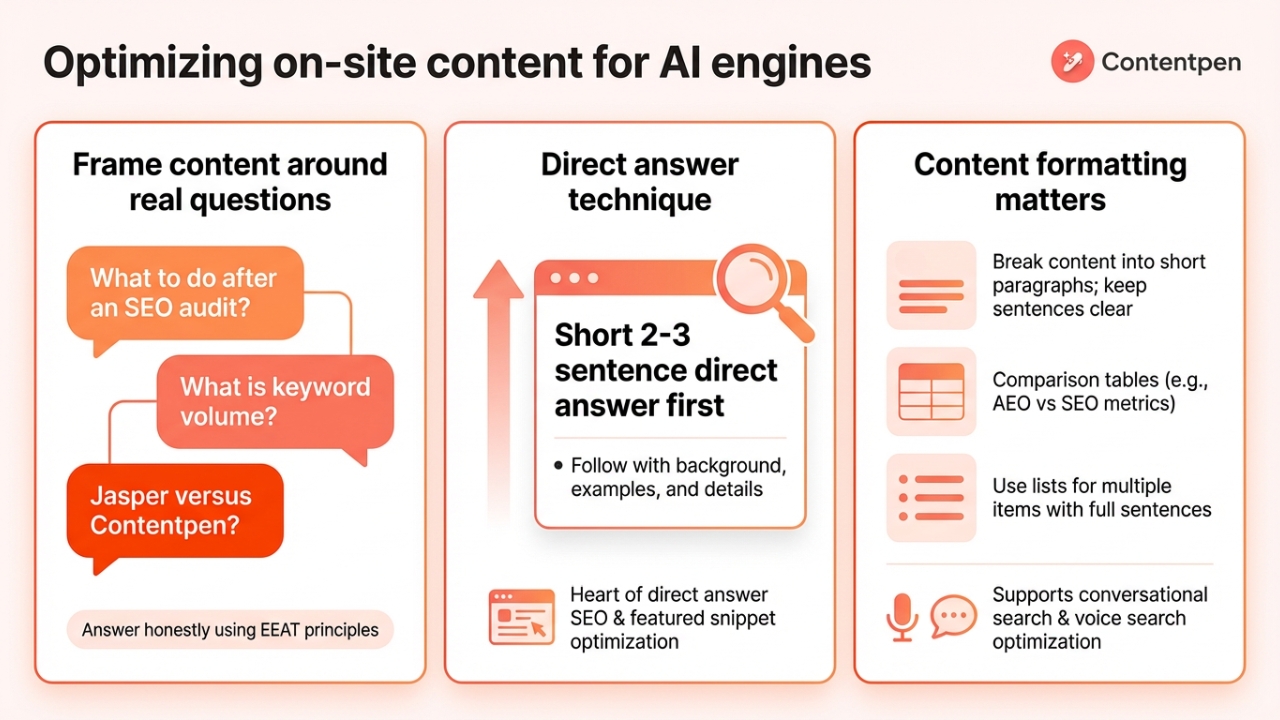
      Start important sections with a 40-60-word paragraph that fully answers the question in the heading. This inverted‑pyramid style of writing works for readers and for direct-answer SEO, because answer engines can lift that block into snippets or summaries.
    2. Use question‑framed headings throughout your content
      Turn your H2 and H3 headings into the exact queries people type or speak. Examples include ‘how to appear in AI overviews’ or ‘how to rank in AI search’. This is where semantic SEO and AEO meet, since headings become clear intent signals.
    3. Implement structured data for answer engines on the right pages
      Add FAQPage to question‑heavy posts, HowTo to step‑by‑step guides, Article to long‑form resources, and LocalBusiness or Organization where it fits.
    4. Stack E‑E‑A‑T signals around important topics
      Use real author names and credentials, pull in credible citations, and add first‑person notes, such as in our research, to show real experience. These trust markers help answer engines choose your page when several sites say roughly the same thing.
    5. Keep high‑value pages fresh and clearly dated
      LLMs and AI Overviews lean toward recent content. Conduct an AI visibility audit. Refresh your top pieces at least a couple of times a year, update stats, and show a ‘last updated ‘date.
    6. Build brand mentions beyond your own site
      Work on getting quoted on podcasts, in industry newsletters, and on reference‑style sites. AI search engines treat those mentions like soft links. For many brands, this off‑site work is what separates quiet pages from sites that show up in AI chat and overviews.

    You do not need to apply every best practice on every page. Start with some URLs that already rank on Google page one or pull meaningful traffic. Those are the best options for answer engine optimization in AI because a small lift can turn them into featured snippets or AI citations.

    As Marie Haynes often reminds site owners, “it is not enough to say you are an expert; you have to demonstrate it through your content, authors, and references.”

    Emerging AEO trends in 2026 that you shouldn’t ignore

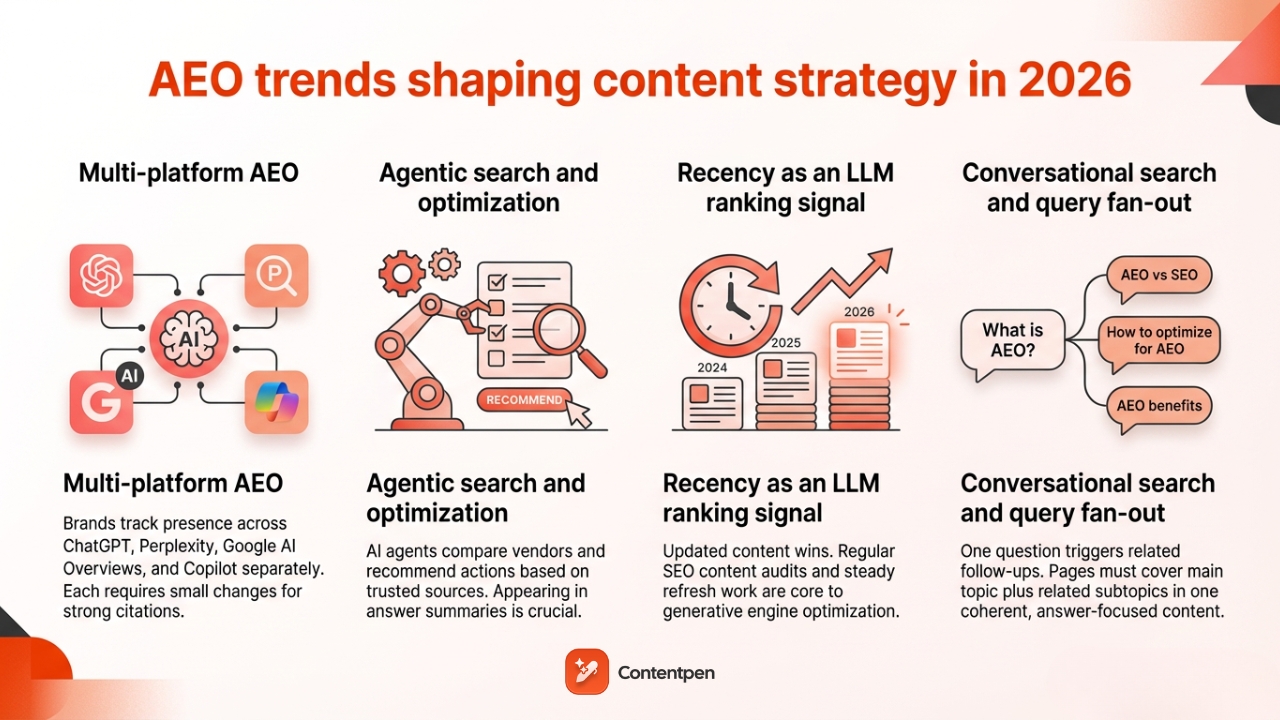
    AEO trends in 2026 and beyond.

    By 2026, AEO has shifted from a side project to a core content strategy. The question is no longer whether answer engine optimization matters, but how fast a team can adapt its workflow and measurement.

    Key AEO trends to watch in 2026 include:

    • Multi‑platform AEO. Brands now watch their presence in ChatGPT SEO optimization, Perplexity AI SEO, Google AI Overviews, and Copilot separately. Each system favors slightly different sources, so one piece of content might need small changes, extra distribution, or new internal links before it turns into a strong citation magnet.
    • Agentic search and “agent engine optimization.” AI agents are starting to compare vendors, schedule demos, or even place small orders based on the sources they trust. If a brand never appears in answer‑phase summaries, it will probably not show up when those agents recommend actions later.
    • Recency as a ranking signal for LLMs. Many models favor content that is clearly updated, even if older posts have more links. That makes SEO content audits and steady refresh work core parts of generative engine optimization practice.
    • Conversational search and query fan‑out. A single question, such as “What is answer engine optimization?” might trigger follow‑ups about ‘AEO vs SEO’, or ‘how to optimize for answer engines’, all inside one chat. The pages that win here cover the main question plus related subtopics in one coherent, answer‑focused piece of content.

    If teams ignore these shifts, competitors will keep stacking new answer engine optimization examples month after month, while older static content fades from both SERPs and AI responses.

    How Contentpen helps you execute an answer-focused content strategy

    Contentpen SEO and AEO tool.

    After seeing these answer engine optimization examples and trends, a natural question appears: how do you do all of this on a real content calendar without burning out your writers and editors?

    Contentpen is an all-in-one SEO and AEO platform built for teams in that exact spot. Marketing leaders, agencies, and solo creators use it to plan and ship long‑form posts that already follow an answer‑first structure and AEO SEO strategy patterns.

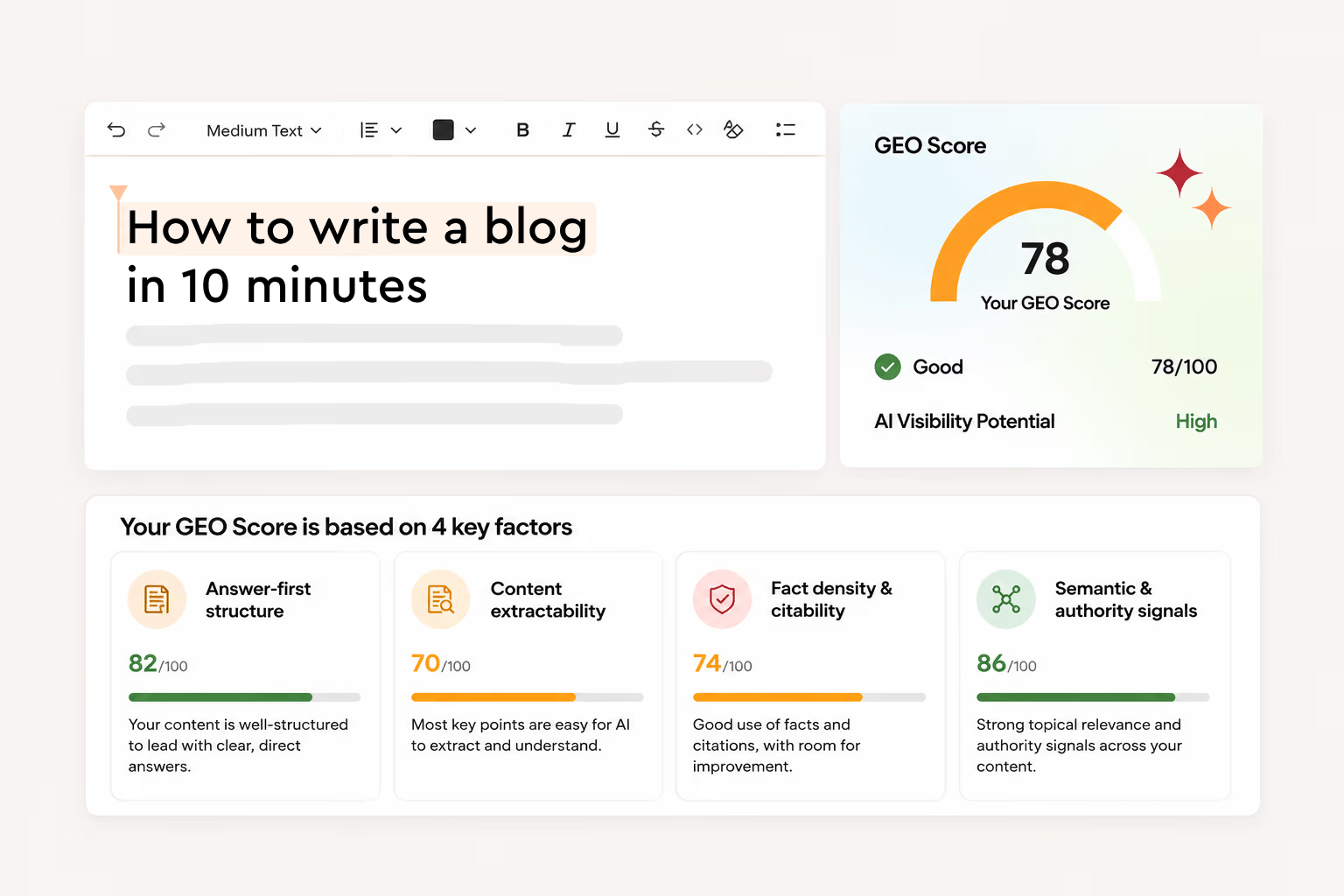
    Get your content cited by AI, not just ranked on Google!

    See your real-time GEO score as you write to make every piece citation-ready.

    Try GEO Scoring →
     GEO Scoring

    As you write, SEO and GEO scores show how well each section is structured for featured snippets and AI answers, and Fix with AI resolves issues in both, so your drafts end up with clear headings, short paragraphs, and direct answers.

    Linking automation suggests and adds internal and external links that build topic clusters, which help the answer engines understand your site structure.

    Contentpen also guides headline choices, meta descriptions, and on‑page SEO, so posts align with audience intent and position‑zero opportunities.

    Also read: 16 best AI visibility tools in 2026.

    Once your content is live, Contentpen’s AI visibility tracking, included in every plan, shows whether these patterns are working for you. You can see your share of voice and the sources AI engines cite across up to seven AI engines, the same kind of data behind the Healthline and Reddit examples above.

    The tool also offers a built‑in media library and AI image generation features to provide assets that not only help your visibility in SERPs and AI platforms but also on Google Images.

    As a next step, register for Contentpen and start creating content that gets discovered and cited at scale without any hassle.

    Final thoughts

    The brands winning in AI search are not lucky. They publish answer engine-optimized content by answering real questions directly, structuring pages, and stacking trust signals around their most important topics.

    AEO will keep changing, but the core stays stable. Helpful content and steady proof of expertise matter in classic SEO, in zero‑click search optimization, and in AI‑powered experiences.

    The good news is that many of your biggest wins are probably hiding in content you already have. With smart rewrites, fresh data, and better formatting, older articles can turn into new AEO wins that show up in AI Overviews and chat tools.

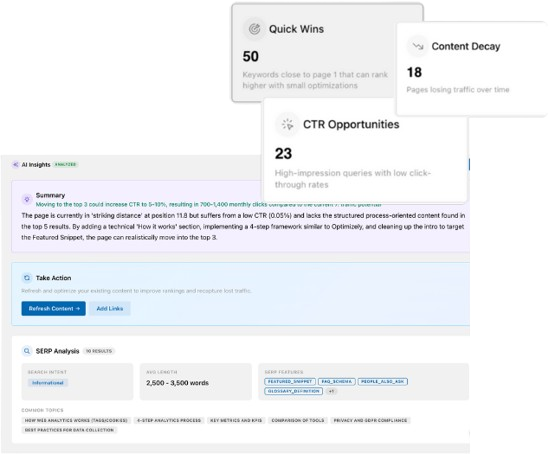
    Turn existing content into growth opportunities

    check

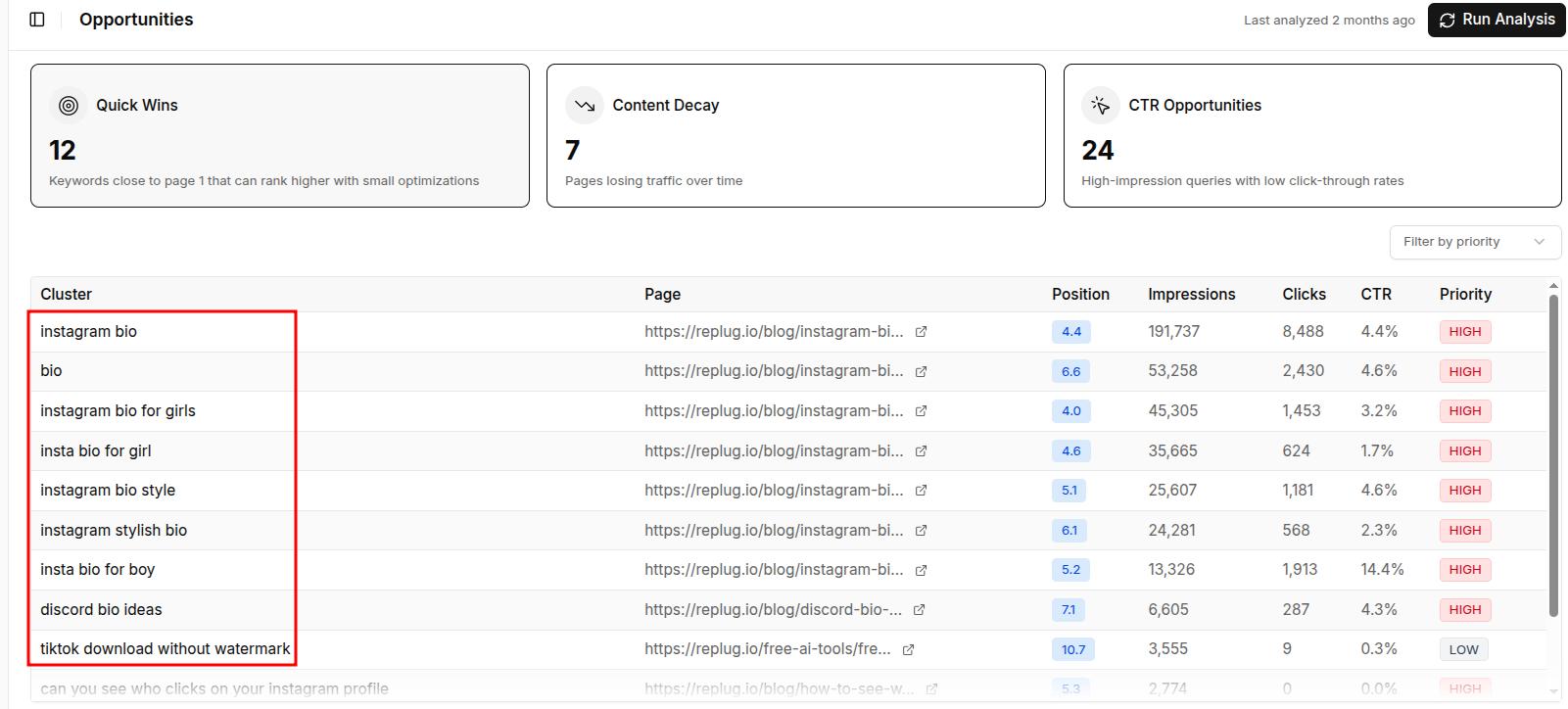
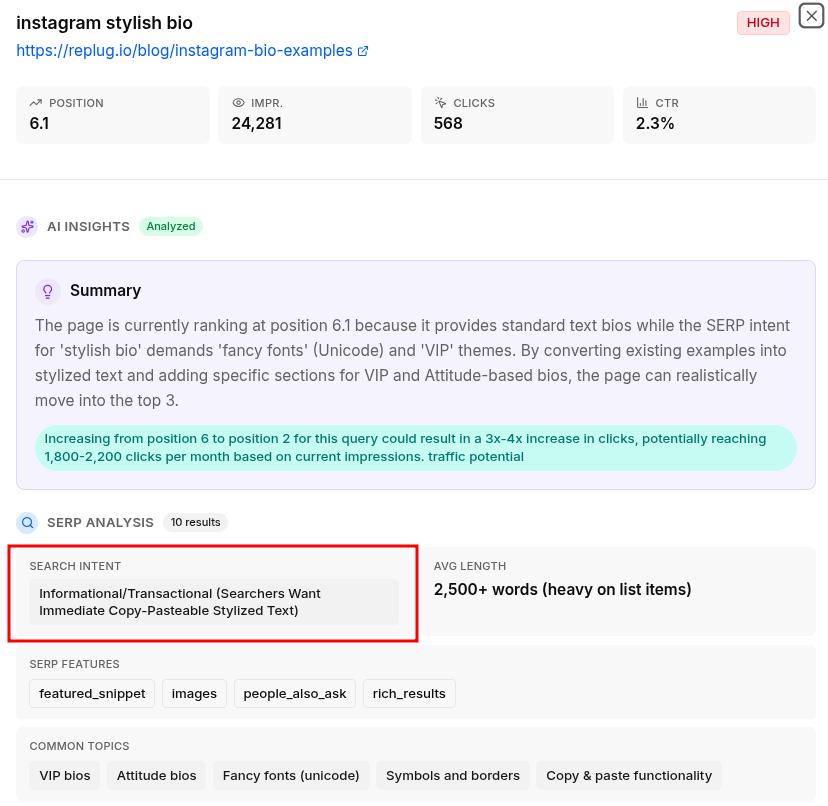
    Identify pages losing traffic or CTR

    check

    Find quick wins to improve clicks and rankings

    Find Content Opportunities →
    AI SEO Interface

    When you are ready to build that kind of system, platforms like Contentpen make it far easier to plan, draft, and ship answer‑focused content on a schedule.

    Frequently asked questions

    What makes an AEO example worth studying?

    Three things: a measurable ‘before’ and ‘after’ effect, a clear enough mechanism followed, and pattern transfers, meaning another brand could apply the same tactic with their own content and data. If an example only worked because of one brand’s unique budget or equity, it is interesting but not instructive.

    How long does it take to see results from AEO work

    For pages that already sit on page one, small AEO tweaks can win a featured snippet or People Also Ask box within a few weeks. Bigger wins in AI chat tools and overviews often show up after several months of steady updates, new links, and stronger authority signals around your brand.

    How do I know if an AEO win is driving real revenue?

    Isolate AI-referred traffic in your analytics and watch what those visitors actually do. Sessions from chat.openai.com, perplexity.ai, and similar sources should be segmented separately. Track time on page, form submissions, demo requests, and purchases. If they are converting at significantly higher rates than organic traffic, the citations are producing a real pipeline.

    How can a team check whether content is being cited in AI answers

    The most direct method is to run your key questions through tools like ChatGPT, Perplexity, or Google AI Overviews and see whether your brand or URLs appear in citations. Some teams also add this step to content audits, so they can spot new opportunities as they gain traction.

  • AI search optimization: How to get cited in 2026

    AI search optimization: How to get cited in 2026

    AI search is already deciding which brands get cited and which ones disappear before a user clicks anything. Due to this situation, AI search optimization is now essential.

    For content teams, agencies, and small businesses, this shift can feel scary. Traffic jumps around, branded searches show AI answers on top, and it is hard to tell how much visibility comes from Google, ChatGPT, Gemini, or Perplexity. 

    The good news is that AI SEO optimization is not a new way to get better clicks and reach. It is the same core SEO done with more care.

    In this guide, you will see how to optimize for AI search engines. You will get a simple playbook you can use on your next article or campaign to see better AI citations and discoverability.

    So, let’s get started.

    What AI search optimization is NOT about

    First, let’s clear up a few things about AI search optimization, because the space is full of noise.

    AI search optimization is not about:

    • Gaming prompts. There are no “magic phrases” that force AI to cite you. AI systems evaluate content quality, authority, and relevance the same way Google does, just applied differently (more on this later).
    • It’s not separate from SEO. Many AI systems rely on search indexes to find content, so strong rankings make you far easier to find and cite.
    • It’s not a one-time fix. AI citation sources rotate. Between 40 and 60% of cited sources change month-to-month across platforms like Google AI Mode and ChatGPT. This isn’t a set-and-forget strategy. It’s an ongoing content and authority-building effort.
    • It’s not just about traffic. The visitors who do arrive from AI citations convert at significantly higher rates than typical organic traffic. Therefore, quality beats search volume here.

    With these pointers in mind, let’s see why answer engine optimization is so important today.

    Why AI search optimization matters more than most people realize

    The numbers are hard to ignore. Over 800 million people now use ChatGPT weekly. Google AI Overviews appear on an estimated 15-25% of all searches, and nearly a third of the US population is projected to use generative AI search in 2026.

    Your audience isn’t waiting around for this to “get big.” They’re already there.

    And here’s the part that catches most brands off guard: around 60% of searches already end without a single click. 

    Zero-click answer for the keyword 'when was Leaning Tower of Pisa built.'

    Like the ‘Leaning Tower of Pisa’ example above, AI answers satisfy the intent right there on the page. So if you’re measuring success purely by traffic or clicks, you’re going to see a gap between your visibility and your numbers.

    Also read: How to turn off AI Overviews.

    How AI search engines actually find and use your content

    Before optimizing for AI search, you need to understand the mechanics of how these platforms work.

    Query fan-out technique explained.

    When someone asks Perplexity or ChatGPT a question, the AI doesn’t paste that question into a search engine verbatim. It breaks the query into smaller sub-searches, called “query fan-out.”

    What that means for your strategy is that your content doesn’t need to match the exact question your audience types. It needs to rank for the sub-queries the AI extracts by addressing them properly in your content.

    For example, a user can type a query, “What’s the best AI content tool for a small marketing team that also helps with SEO?” 

    AI engines will not use the exact wording to search for this query.

    Instead, the AI platforms will break this query down into smaller sub-queries, such as “AI content writing tools 2026,” “content tools with built-in SEO features,” and “AI tools for small marketing teams.”

    So, if you use these sub-queries in your content and answer them honestly to help your users, then AI discovery becomes a lot easier.

    Where does each AI platform get its data?

    Knowing which platform pulls data from where lets you prioritize your efforts accordingly. Below are some popular AI tools and their sources.

    • ChatGPT combines its own crawler (OAI-SearchBot) with third-party search results, so strong rankings across search engines help your visibility there.
    • Google AI Overviews and Gemini draw from Google’s own index.
    • Perplexity crawls the web directly and cites authoritative sources in every response.
    • Copilot runs on Bing’s search index, and Meta AI has also used Bing for web results.

    Traditional SEO isn’t dead. It’s the foundation. If you’re not indexed and ranking, AI tools literally can’t find you. What changes is the layer on top, or the signals that make you citation-worthy vs. just rankable.

    AI search optimization vs. traditional SEO: What actually changes

    Before we dive deep into the comparison of SEO vs AEO, it is important to note that you don’t have to choose between the two. You do need to understand how they’re different.

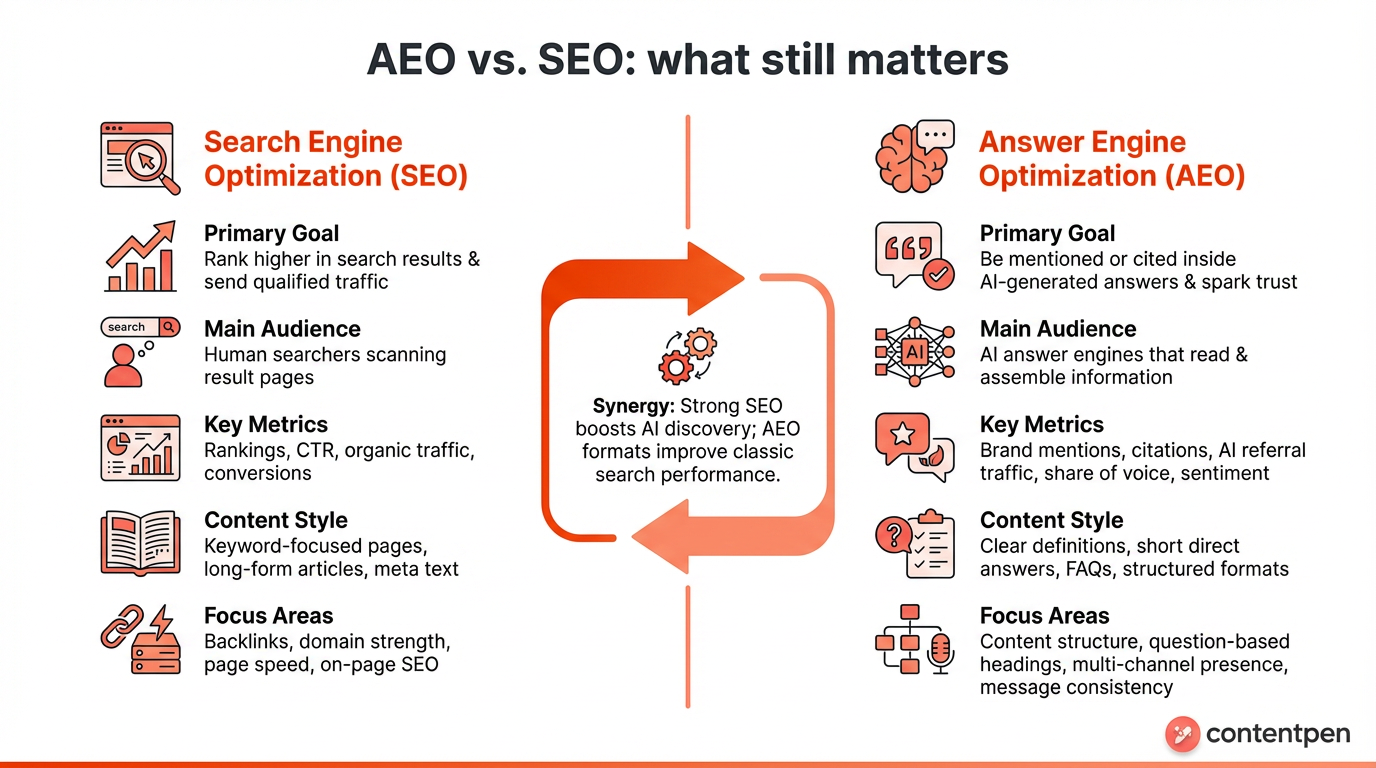
    The basics still remain the same: you do solid keyword research, optimize metadata, write in a structured way, and take care of your Schemas. Then, take a step forward toward GEO, which builds on traditional SEO. Read our guide on GEO vs SEO to compare them both in detail.

    Other key differences include:

    • People write longer, conversational prompts in AI platforms and refine them with follow‑up questions.
    • The same thread can cover the awareness, comparison, and action stages of a decision.
    • When users finally click through, they already know the basics and come ready with a higher intent.

    That is why AI search optimization focuses on depth, structure, and clear expertise more than quick tricks. You are trying to become the reference text that models feel safe quoting.

    Read more: AI search optimization vs. traditional SEO.

    How to optimize for AI search: What actually works

    How to optimize content for AI search.

    If you want to know how to rank in AI search, think in three layers:

    1. Write people‑first content that answers real questions better than anyone else to create strong EEAT signals for your content.
    2. Build topical strength and brand signals across the web.
    3. Make your site easy for both search bots and LLM crawlers to read.

    These layers map directly to common SEO strategies for AI search engines. Apply the steps below, then watch how AI tools treat that content over the next few months. That feedback will tell you where to double down.

    1. Make sure AI crawlers can read your content

    This sounds obvious, but it’s the most skipped step.

    If your content is buried behind client-side rendered JavaScript, login walls, or a robots.txt that blocks AI crawlers, none of the other work matters. 

    Therefore, check that major AI bots, such as GPTBot, OAI-SearchBot, PerplexityBot, ClaudeBot, and Google’s crawlers, are allowed in your robots.txt file.

    2. Write for chunks, not just pages

    AI systems don’t read your page the way a human does. They extract chunks, or individual sections, paragraphs, and sentences that can answer a specific sub-query. 

    To optimize for chunk-level retrieval, use clear H2s and H3s and ensure that every section on your page can stand alone as a self-contained answer. 

    Also, always prefer to start each section with a direct statement or definition and build on it with examples and case studies later on.

    For example: “An AI content brief is a structured document that outlines the topic, target audience, keywords, and content goals before writing begins. It reduces back-and-forth between writers and editors by aligning expectations upfront.”

    Don’t bury the answer in paragraph four. If someone only reads that one section, they should walk away informed.

    Therefore, the core of optimizing content for AI-generated answers is to create self-contained, extract-ready, and semantically tight passages. In short, answer-first writing.

    3. Build real topical authority

    A single blog post on a topic won’t cut it. AI systems and Google’s algorithms favor brands that have covered a topic deeply across multiple pieces of content. They look for topical depth (going genuinely far and in-depth on specific subtopics).

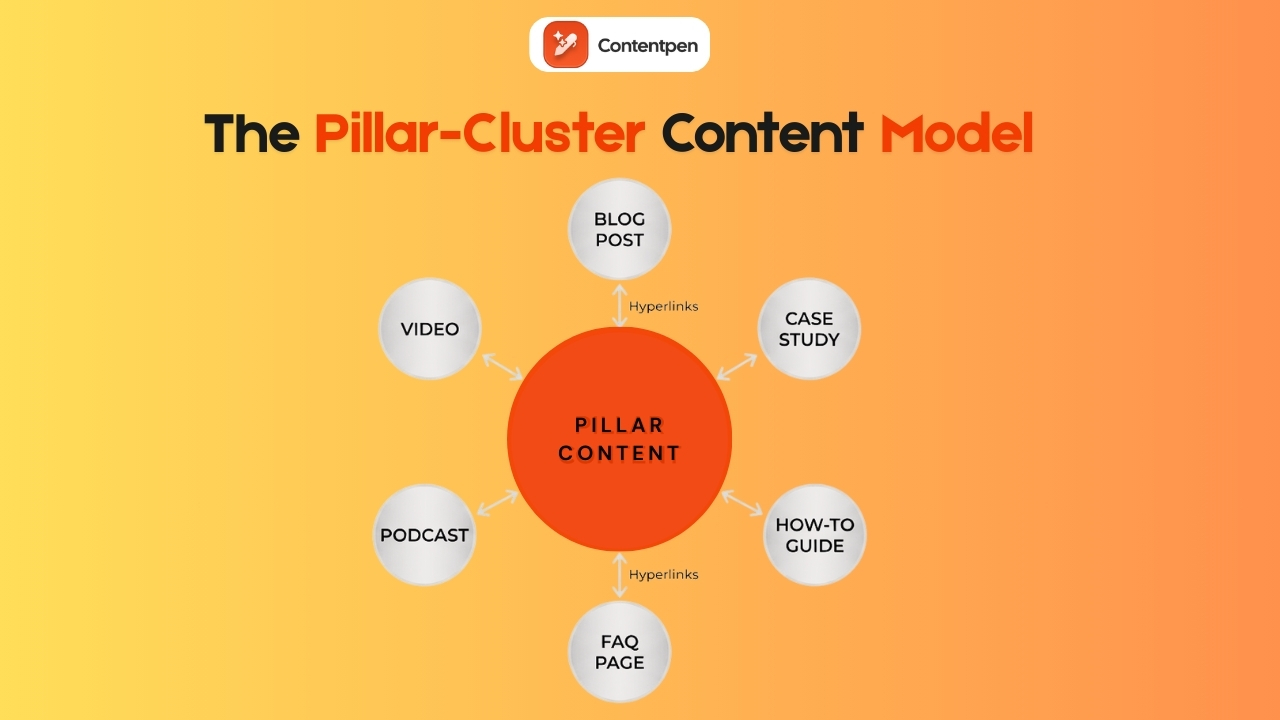
    Think about your content strategy as a topic cluster, not a collection of individual articles. 

    Pillar-cluster model shown with a diagram.

    One pillar piece covering the full scope, specific supporting articles and pieces tackling narrower questions, and internal linking to connect them all. This is the structure that tells AI, ‘this site is actually authoritative for a particular topic’, helping you get more citations and discoverability.

    4. Answer the questions people are actually asking

    AI tools pull answers from content written in response to real questions. The more directly your content maps to how people actually phrase their queries, the more likely it is to be extracted.

    Use Google’s “People Also Ask” and Autocomplete to find question formats for your topic. Build those questions into your headings. Then, answer them concisely right after each heading.

    Google PAA box for keyword 'keyword volume.'

    Remember that you’re not just optimizing for search engines here; you’re also giving AI a clear, pullable answer to show the users.

    5. Add data, stats, and original insight

    AI chatbots love citing figures, stats, and original data from your blogs or articles. This may include industry benchmarks, research, or survey results that you conducted internally. 

    Content that says “marketers report 34% higher engagement from AI-cited content” is more citation-worthy than content that says “many marketers see better engagement.”

    Also, if you can publish original research, even a small internal study, do it. Other sites will cite it. And when your content is cited by authoritative sources, AI systems notice and use your data inside their answers.

    6. Show who’s behind the content

    E-E-A-T (Experience, Expertise, Authoritativeness, Trustworthiness) isn’t just a Google thing. AI systems are trained to avoid surfacing low-quality or anonymous content. Named authors, detailed bios, links to professional profiles, and demonstrated first-hand experience all strengthen your content’s credibility signals.

    This matters especially for YMYL (Your Money, Your Life) topics, which include finance, health, legal, and anything with real-world consequences. 

    AI tools apply heightened scrutiny here, so you have to be very authoritative and knowledgeable on a topic to write and win.

    7. Use Schema Markup to feed AI direct facts

    Schema markup makes your content machine-readable in a way that plain text doesn’t. 

    FAQ schema, HowTo schema, Article schema, Organization schema, and other types of schema all help AI systems extract accurate, structured facts about your brand and content.

    Think of it as handing AI the answer on a silver platter. The less it has to guess, the more confidently it can cite your brand.

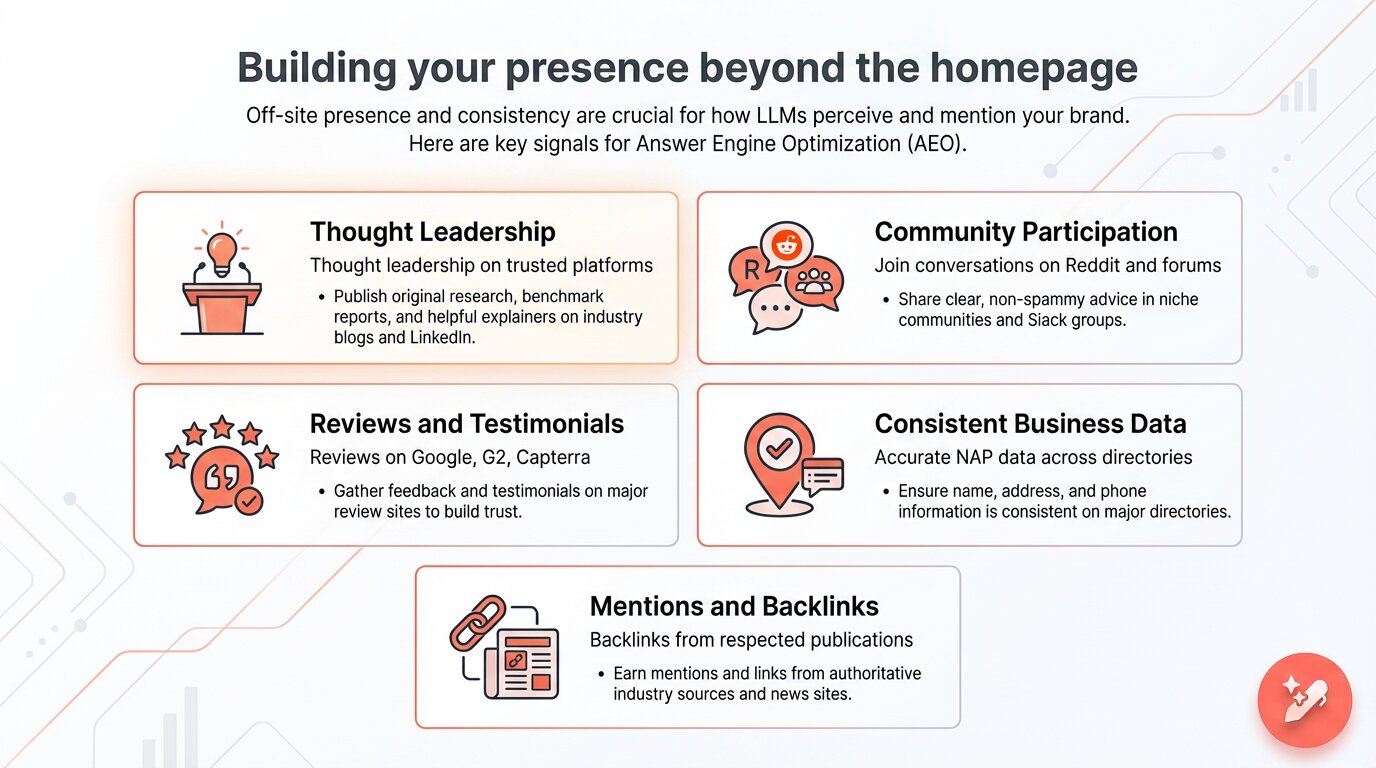
    8. Build a consistent brand presence across the web

    AI systems build their understanding of your brand from everything they can find. This includes your site, third-party mentions, reviews, social profiles, forum discussions, and more.

    Consistency matters a lot here. Your brand name, value proposition, and positioning should read the same way across every channel.

    Reddit threads, LinkedIn posts, YouTube content, and podcast appearances all contribute to what’s called your “AI authority.”

    It’s the aggregate signal that your brand gives off to AI systems, including ChatGPT, Perplexity, Gemini, and others. Over time, this improves your AI visibility, which means more relevant traffic to your platforms.

    Also read: Best AI visibility tools in 2026.

    9. Don’t ignore Bing

    Most AI search conversations focus on Google. But Copilot and Meta AI (Facebook, Instagram, WhatsApp) all run through Bing. That’s a combined audience that you should surely cater to.

    So, if you want to AI search optimize your content, then you should use Bing Webmaster Tools for audits (and it is free) If you get your site indexed and verified there, there’s a high chance of doing great in AI systems as well.

    10. Track AI visibility separately from traffic

    If you’re only measuring success by clicks, AI search will always look underwhelming. 

    Citation volume and brand mention frequency are the metrics that matter here. 

    Tools like Semrush’s AI Toolkit, Profound, or Peec AI let you track your share of voice across AI platforms.

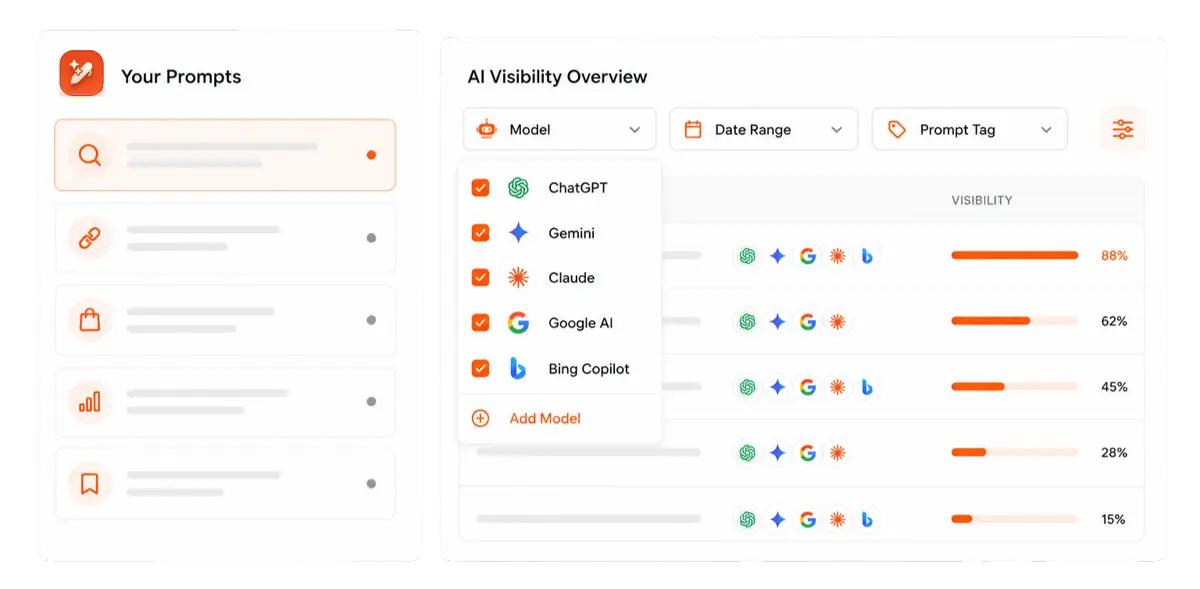
    Contentpen goes a step further and provides its AI visibility tool right where you create content. You can see your AI share of voice, brand sentiment, top citation sources, and competitor data across up to seven AI engines in one place.

    Find your brand in AI search

    check

    Track AI citations, share of voice, and brand sentiment

    check

    Find the top sources driving citations

    Try AI Visibility →
    AI SEO Interface

    Besides the tools, set up manual checks, too.

    Query ChatGPT, Perplexity, and Gemini yourself with prompts your customers would use, and see whether you’re showing up in those or not.

    This process may take a while, but it’s a good starting point for content marketers and individuals trying to learn their AI visibility hands-on.

    AI search optimization examples: What good looks like

    Concepts are helpful, but real patterns make them stick. Here are three simple AEO examples based on what tends to show up in AI answers.

    Example 1 – Structured content that gets cited

    Imagine a fintech blog that targets the question “What is compound interest?” plus related follow‑ups. 

    Take NerdWallet’s compound interest page as an example. It opens with a single plain-English definition: “Compound interest is the money your bank pays you on your balance, plus the money that interest earns over time.”

    NerdWallet example blog.

    Then the page moves through the formula, examples, and explanations with no pop-ups or clutter. 

    When someone asks an AI chatbot what compound interest is, NerdWallet’s structure gives AI a clean, pullable quote for the summary and enough depth to trust and cite the source. 

    A Goodie analysis of AI citation patterns across ChatGPT, Gemini, Claude, and Perplexity found NerdWallet to be the most consistently cited finance domain across all four platforms.

    Example 2 – Brand authority in action

    A project management SaaS with $25M ARR (Annual Recurring Revenue) had solid Google rankings but was appearing in just 8% of AI buyer queries. While competitors dominated 65% of ChatGPT and Perplexity recommendations. 

    The fix wasn’t more blog posts. It was building a consistent brand presence. The brand applied the same brand positioning across platforms, such as Crunchbase, LinkedIn, and niche forum discussions. 

    Within 90 days, their AI citation rate tripled to 24%, and AI-referred leads converted at 2.8x the rate of traditional organic traffic. 

    Discovered case study for a project management SaaS.

    The lesson here is that AI tools build their picture of your brand from all web sources. Conflicting signals reduce confidence, while consistency builds it.

    Example 3 – Multimodal optimization in practice

    Think about an e‑commerce store with rich product pages. Each item has:

    • A detailed copy that anticipates common buyer questions,
    • Clear photos with descriptive alt text,
    • An embedded demo video and transcript,
    • Up‑to‑date merchant feeds and a complete Google Business Profile.

    When someone is researching products or uploading a picture of a similar product and asking Google for details, AI Mode can tie the visual data to that well‑labeled page.

    Google confirmed this capability in its official Search blog. Retailers like Spocket, Etsy, and Wayfair are already integrated into the checkout experience inside AI Mode, as they have invested heavily in AI search optimization.

    For ecommerce brands, this makes every product image an AI-readable asset, not just a visual for human shoppers.

    Tools to help you rank in AI search results

    Think about AI search optimization tools in three buckets: content creation, monitoring, and analytics.

    On the creation side, AI SEO tools can speed up outlines, drafts, and briefs while you keep control of quality. For monitoring, new platforms track brand mentions inside AI responses. Analytics tools then show how visits from AI sources behave, so you can measure real value.

    The key is to let tools assist your AI with SEO strategy instead of driving it. You still decide which questions to target, what angle to take, and how your brand should sound.

    1. Contentpen

    Contentpen is an end‑to‑end AEO tool made for marketing teams, agencies, and solo creators. It plans and writes long-form articles that read clearly and match what both users and AI engines look for.

    As you write, SEO scoring and GEO scoring show how well each draft is optimized for search rankings and AI citations, and Fix with AI resolves issues in both. Contentpen also automates internal and external linking, so your topic clusters send a clear structure to crawlers.

    Once you publish, AI visibility tracking shows whether AI engines are citing you, so you can close the loop between writing and results. When you want consistent, audience-centric articles with regular publishing, this AI search optimization tool helps you streamline workflows and boost productivity.

    Write content that’s built to rank, not just read

    Create search-optimized blogs aligned with SEO and GEO signals, so your content performs well across search and AI-driven discovery.

    Try SEO Blogging FREE →
    AI SEO Interface

    2. Monitoring tools for AI visibility

    Once your content is live, you need to conduct AI visibility audits. Use relevant tools to track your presence inside chatbot answers and AI summaries across several engines.

    Here are a few options you can explore:

    ToolWhat it does
    ContentpenTracks your share of voice, sentiment, and citations across up to 7 AI engines, and shows the sources that cite competitors but not you
    Peec AIWatches prompts across several models and shows when your brand shows up as a cited source.
    SimilarwebIdentifies the most popular AI search platforms referring traffic to competitors.
    OtterlyFollows how often specific prompts return your pages, so you can spot gains or drops over time.
    ProfoundBreaks down which sites AI tools cite alongside you, helping you understand your real content competitors.
    AmIOnAIChecks if your brand appears at all for chosen topics and flags the gaps you might want to fill.
    Mangools AI GraderReviews pages and scores how ready they are for AI search, based on structure, clarity, and topic coverage.

    For the next steps, pick one tool, set up 5-10 prompts that match your core topics, and review the data biweekly or monthly. That steady view will keep your AI search optimization efforts grounded in reality while guiding your upcoming campaigns.

    Measuring success in AI search beyond clicks

    AI Overviews and chat answers can trim raw click counts for some queries. That hurts if you only watch traffic charts.

    When a user reads an AI summary first, they already understand the basics. The links inside that box point to sources chosen as helpful and safe. So someone who still clicks through is usually deeper in the decision process. 

    Kevin Indig’s discussion on Similarweb’s data shows that these visits often last longer and involve more actions. 

    That is why AI search ranking success in 2026 is less about sheer volume and more about the value behind each session.

    To track this, look beyond pageviews. Use your analytics tool to watch these metrics for AI-referred visitors:

    • Time on page and scroll depth – Do AI‑referred visitors actually read?
    • Session duration and pages per session – Do they explore more than one page?
    • Key conversions – Email signups, demo requests, downloads, or direct sales.
    • Micro‑conversions – People looking up your address, tapping your phone number, or sharing your content.

    In analytics, give AI sources their own segment, so visits from perplexity.ai, chat.openai.com, and similar hosts do not blend into the same bucket as organic search.

    For a cleaner view of this, you need an analytics tool that separates AI-referred sessions from everything else and tracks what those visitors actually do.

    You can use Usermaven for this task as well, which is a solid attribution and analytics tool that tracks user behavior to guide your funneling efforts.

    Over time, treat this as an iterative loop:

    1. Measure how your AI‑referred traffic behaves.
    2. See which cited pages perform best.
    3. Adjust structure, copy, and calls‑to‑action accordingly
    4. Check again after the search and model updates.

    That steady feedback is how you stay aligned with AI overview optimization patterns as they shift.

    A quick AEO checklist before you go

    Use this AI search optimization checklist as your starting point in 2026 to get more AI citations and improve discoverability:

    ☑ AI crawlers are allowed in robots.txt (GPTBot, PerplexityBot, ClaudeBot, Googlebot)

    ☑ Each page section starts with a direct, standalone answer

    ☑ H2s are phrased as questions or clear topic statements

    ☑ Content includes specific data points, stats, or original research

    ☑ Author bio includes name, credentials, and external links

    ☑ FAQ schema, Article schema, or HowTo schema implemented where relevant

    ☑ Brand presence is consistent across the site, social, and third-party profiles

    ☑ Site is indexed and verified in Bing Webmaster Tools

    ☑ The topic is covered in depth across a cluster of related content

    ☑ Content is updated regularly for statistical and data accuracy

    ☑ AI visibility is being tracked with a dedicated tool

    If you have ticked off all these items, then congratulations! You have significantly improved your AI citation chances. Now, it is all about sticking to the plan and doing regular audits moving forward.

    Final thoughts

    AI has changed how people search, but the core of AI search optimization is still simple. Do classic SEO well, write for humans first, and make your site easy for both search engines and AI models to trust.

    You saw how people‑first content, clear topic clusters, brand mentions, and sound technical habits all feed into SEO for AI‑generated answers. You also saw that success is not just about top rankings. It is being cited as a source and turning those visits into real outcomes.

    The search scene will keep moving, but these basics are steady. Start small. Pick one key page, tighten the content, clean up the technical SEO aspect, and watch how AI tools respond. 

    If you want help publishing that level of content at scale, try building your next article in Contentpen while staying in charge of your strategy.

    Create rank worthy content at scale

    check

    Faster

    check

    Consistent

    check

    SEO-ready

    check

    Efficient

    Try Bulk Content Creation →
    AI SEO Interface

    Frequently asked questions

    Can you do SEO with AI?

    Yes. You can use AI to speed up keyword research, outlines, draft ideas, and internal link suggestions. Just keep a human in charge of strategy, examples, and final editing so the content stays accurate and on brand.

    What’s the difference between AEO and GEO? 

    Answer Engine Optimization (AEO) focuses on getting your content extracted as a direct answer. Generative Engine Optimization (GEO) focuses on being one of the sources an AI draws from when synthesizing a longer response. In practice, the same content tactics serve both.

    How do you optimize for Google AI Overviews specifically?

    Start with a strong performance in a normal Google search for the query. Then structure each page around clear questions and answers, keep technical issues clean, and avoid preview rules that block snippets. This mix gives you the best shot at being pulled into an AI overview.

    What is the 30% rule in AI search? 

    Research suggests that incorporating statistics, citations, and authoritative references into your content can increase its likelihood of being cited by AI systems by roughly 30%. The takeaway: data-backed content earns more AI citations than vague, unsupported claims.

    Is AI search optimization worth it for small businesses?

    Yes, arguably more so. AI citation carries an implied endorsement, which levels the playing field for brands. A well-structured, authoritative page from a small business can get cited ahead of a large brand’s thin, generic content. Quality and clarity win here, not domain age alone.

  • 12 best Ahrefs alternatives in 2026 (tested and compared)

    12 best Ahrefs alternatives in 2026 (tested and compared)

    If you have watched your Ahrefs credits vanish halfway through the month, you are not alone.

    Ahrefs is still one of the strongest SEO platforms, but more marketers search for Ahrefs alternatives every year. Pricing, usage limits, and shaky traffic estimates can turn a helpful tool into a source of stress.

    The good news is that there are plenty of tools like Ahrefs that cost less, fit your workflow better, or add features Ahrefs skips. 

    This guide walks through 12 tested Ahrefs alternatives, from full SEO suites to focused keyword research tools and free options. 

    So, let’s explore them in detail.

    Why people are leaving Ahrefs (or looking for something cheaper)

    When people talk about Ahrefs alternatives, the first reason they mention is almost always money and limits. 

    On Lite ($108/month) and Standard ($208/month) plans, Ahrefs gives you a small pool of credits, and almost every report uses one of them. If you open Site Explorer a few times a day or pull big keyword lists, those 1000 credits in the Lite plan can disappear in a week. 

    Ahrefs pricing plans.

    After that, you either pause your work or buy more credits, which makes Ahrefs pricing feel unpredictable for freelancers, agencies, and small in‑house teams.

    Data confidence and channel coverage are the next big concerns:

    • Traffic estimates: Many users share screenshots where Ahrefs shows far more organic traffic than Google Search Console for the same site, which makes client reports harder to explain.
    • Single‑channel focus: Ahrefs focuses almost only on SEO. Teams that also manage PPC, social, or content calendars still have to pay for other platforms.
    • Learning curve: For beginners who already feel overwhelmed by the interface, that mix of price, data questions, and missing channels is enough to start testing an Ahrefs substitute that feels simpler and more complete.

    Put together, those factors explain why “ahrefs alternatives reddit” threads keep growing every month.

    How we evaluated each Ahrefs alternative

    We tested each tool on live sites across a mix of content-heavy blogs, SaaS pages, and agency client accounts.

    For keyword data, we cross-referenced volume and KD figures against Google Search Console impressions and Semrush baselines to spot gaps. 

    For backlink tools, we pulled reports on domains with known link profiles and checked for phantom links or inflated counts. 

    AI tracking features were evaluated by monitoring brand mentions across ChatGPT, Perplexity, and Google AI Overviews over a 4-week window. 

    Pricing accuracy was verified against each tool’s published plans at the time of writing. Tools that showed consistently unreliable data across two or more tests did not make this list.

    Top Ahrefs alternatives right now

    Before we move on to the detailed Ahrefs alternatives list, it is important to note that no single platform fits everyone. 

    So, the best Ahrefs alternative for you depends on your goals, channels, and budget.

    ToolBest ForStarting Price (Annual)Free TrialAI Search Tracking
    ContentpenContent creation + SEO in one place$39/month✅ 7-days✅
    WritesonicAI search and GEO visibility$79/month✅ 7-days✅
    SemrushMulti-channel agency campaigns$165.17/month✅ 7-days✅
    SE RankingSEO + social media marketing$103.20/month✅ 14-days✅
    SerpstatBudget all-in-one with AI tracking$50/month✅ 7-days✅
    UbersuggestTight budgets + lifetime deals$6.67/month✅ 7-daysLimited
    MangoolsSEO beginners and bloggers$18.85/monthLimited free✅
    SEO PowerSuiteLocal/desktop, unlimited usage$29.10/month✅ Free version✅
    Moz ProDomain authority tracking$99/month✅ 7-days✅
    MajesticPure backlink analysis$49.99/monthLimited free❌
    RankDotsTopical authority + AI search$29/month✅✅
    Search AtlasAI-guided audits for agencies$99/month✅ 7-days✅

    To keep things simple, you will see the alternatives in the following categories:

    • Content creation and strategy tools
    • Full all‑in‑one SEO and marketing suites
    • Budget‑friendly and entry‑level options
    • Specialist backlink and AI search tools

    Let’s explore each option in more detail.

    Content creation and strategy tools

    In this category of tools, you will see alternatives that are better than Ahrefs in creating SEO and GEO-optimized content for better AI visibility and SERP results.

    1. Contentpen – Best for creating content that earns links

    Contentpen SEO and AEO tool.

    Contentpen comes first because every SEO stack works better when you publish content worth ranking and linking to. It is an all-in-one SEO and AEO platform that guides marketing teams, agencies, and solo writers from topic ideas to polished long-form articles, and tracks whether AI engines cite them.

    Contentpen vs. Ahrefs

    When compared with Ahrefs, Contentpen delivers complete keyword research, with accurate CPC, keyword volume, and KD values, along with drafting, editing, and publishing in one place. It also offers GSC-style website analytics and SEO suggestions to uplift decaying pages, surface quick wins, and CTR opportunities.

    With this SEO platform, you close the loop between research, publishing, and AI visibility to streamline your workflow and boost publishing productivity.

    Other than these perks, you get the following features with Contentpen that Ahrefs doesn’t provide:

    But the one area where Contentpen differs from a tool like Ahrefs by design is deep competitor backlink analysis. If your workflow is heavily link-prospecting-first, you may want to pair Contentpen with a specialist backlink tool. 

    But for teams whose primary output is content and who want SEO data, writing, and publishing in a single window, then Contentpen is the most practical starting point.

    Pricing

    Plans start at $39/month billed annually (Starter plan, $49 monthly) with 12 articles, 75 AI images, and AI visibility tracking each month. You can upgrade to Growth, Scale, or Agency as your volume grows.

    2. Writesonic – Best for AI search visibility and GEO

    Writesonic main interface.

    Writesonic started as an AI writing platform, then added SEO and visibility tools focused on how brands appear in AI-powered search. Its GEO feature tracks mentions, links, and sentiment across ChatGPT, Perplexity, Gemini, and Google AI Overviews, so you see how often your brand is quoted by major AI assistants.

    You also get an AI article writer, chatbot (Chatsonic), and basic keyword tools, but the full GEO stack sits on higher‑priced plans. Writesonic makes the most sense for brands that care deeply about AI search exposure and want writing tools and monitoring under one roof.

    Writesonic compared with Ahrefs

    As compared with Ahrefs, the price for Writesonic is considerable. That said, we found Writesonic’s UI much more appealing than Ahrefs.

    Also, Writesonic is a much more powerful tool to check AI visibility with prompts and third-party mention tracking than Ahrefs.

    With that said, we would say that doing keyword research with Writesonic is much more basic compared to Ahrefs. The tool pulls data from Google Keyword Planner, which can be accurate, but with limitations.

    Pricing

    Writesonic plans start at $79/month (Starter Plan) with 15 SEO-optimized articles and 50 AI Search Tracking prompts.

    All‑in‑one SEO and marketing suites

    In this category, we have many tools to discuss. Here you will find the most direct head-to-head competitors to Ahrefs that you can consider right now.

    3. Semrush – Best all-in-one alternative

    Semrush SEO analytics dashboard.

    Semrush is the closest direct rival to Ahrefs and a favorite among SEO tools like Ahrefs for full‑funnel marketing teams. It bundles SEO, PPC, social, and content tools in one place, with highlights such as the Keyword Magic Tool, precise daily Position Tracking, an AI Visibility Toolkit, and an SEO Writing Assistant.

    How Semrush compares with Ahrefs

    Honestly, it all comes down to your priorities. If you want to stick to SEO as a SaaS brand, choose Ahrefs. If your campaigns stretch past organic vs. paid traffic, then it is time to consider Semrush.

    The reason we’re saying this is that Semrush isn’t a budget-friendly option compared to Ahrefs. In fact, its starter plan is more expensive than Ahrefs ($165/month vs. $108/month). Therefore, it all comes down to priorities and what you like using daily.

    Personally, we recommend Ahrefs for SEO only, and Semrush only if you have to make use of its PPC campaigns and far enhanced AI visibility and competitor analysis.

    Pricing

    The Starter plan starts at $165.17/month with 500 keyword tracking, 300 AI visibility reports per day, and keyword research tools.

    4. SE Ranking – Best for SMM and all-in-one marketing suite

    SE Ranking analytics.

    SE Ranking is a well‑rounded, all‑in‑one platform that many small teams pick as an alternative to Ahrefs without giving up core features. 

    You get accurate rank tracking with flexible check frequency, keyword and competitor research, website audits, SEO backlink monitoring, and extras like a Keyword Grouper and AI Overviews Tracker.

    SE Ranking vs. Ahrefs

    SE Ranking is not a budget-friendly alternative to Ahrefs. However, it is a lucrative option for teams that want the SEO tools of Ahrefs with SMM (Social Media Marketing) features.

    We also found SE Ranking’s site SEO audit option to be much more powerful than Ahrefs, with 250k pages per month. The API pricing is also transparent for agencies and businesses that want to integrate the tool with their existing workflow.

    Pricing

    The plans for the base tool start at $103.20/month with 2000 keywords and 100 prompts to track daily. This limit is much more generous than Semrush and Ahrefs combined.

    Budget‑friendly and entry‑level options

    With budget-friendly options, our goal is to surface tools that can compete with Ahrefs at some level, while also delivering something unique.

    5. Serpstat – Best budget all-in-one tool with AI tracking

    Serpstat landing page.

    Serpstat is a lower‑cost all‑in‑one platform that covers keyword research, rank tracking, audits, and competitor analysis, along with AI search tracking. It flags queries that trigger Google AI Overviews and includes an LLM Brand Monitor, so you can track how often your site appears in generative answers.

    The interface and data depth do not quite match Ahrefs or Semrush, but the price and AI focus make Serpstat a smart pick for smaller teams that want broad coverage plus early insight into AI‑driven SERPs.

    Serpstat vs. Ahrefs

    In our testing, we found Serpstat’s data to be a bit unreliable compared to other SEO tools, especially when it came to backlink analysis.

    We saw some sites linking to us, even when there were no links present. Also, there was a serious gap between Serpstat’s keyword values (CPC, keyword volume, and difficulty score) when put head-to-head with Semrush, SE Ranking, or Ahrefs.

    Pricing

    Serpstat plans start at $50/month (Individual), which is an ideal starting point for freelancers or SEO beginners.

    6. Ubersuggest – Best for tight budgets and lifetime deals

    Ubersuggest landing page.

    Ubersuggest from Neil Patel is another popular entry in lists of Ahrefs alternatives, especially for beginners. It lets you run keyword research, basic site audits, content idea reports, and competitor checks, plus an AI Keyword Overview that suggests prompts, all through a simple dashboard.

    Ubersuggest compared with Ahrefs

    We have mixed feelings about Ubersuggest, and here’s why.

    Yes, it comes at a much lower cost to Ahrefs ($6.67/month vs. $108/month), but it does not provide detailed backlink or competitor analysis like others.

    Also, the annual plan is too limited for any sort of enterprise SEO or AEO workloads. With just 15 AI prompts/project and 3 AI topics, we feel that Ubersuggest is only suitable for individuals and SMBs.

    Pricing

    The biggest advantage that Ubersuggest offers over other tools is its lifetime deals (LTDs). You can own the tool forever, starting at $200 for 2-7 websites.

    7. Mangools – Best for SEO beginners

    Mangools landing page.

    Mangools is a friendly suite of five small apps that many bloggers and beginners use as their first Ahrefs alternative. KWFinder uncovers long‑tail keywords with clear difficulty scores, SERPChecker and SERPWatcher handle basic SERP analysis and rank tracking. The tool also offers the LinkMiner plus SiteProfiler to cover simple backlink and authority checks.

    The data index is smaller than Ahrefs, and there is no advanced audit module, but pricing is far lower. That combination makes Mangools ideal for bloggers and solo SEO professionals focused on content planning and early‑stage keyword research.

    Mangools vs. Ahrefs

    The biggest upside with Mangools is its intuitive user interface, which makes it easy to use for beginners. Sure, it won’t tell you world-class backlink data or Citation Flow, but Mangools is enough for a starter professional who doesn’t want that deep competitor or AI visibility analysis.

    Besides that, Mangools offers fast customer support for all plans, unlike Ahrefs, where support can vary from plan to plan.

    Pricing

    Surprisingly, Mangools is the cheapest SEO tool in our Ahrefs alternatives list. The plans start at $18.85/month (annual plan), but with basic keyword research and SERP analysis features.

    8. SEO PowerSuite – Best for local usage

    SEO PowerSuite landing page.

    SEO PowerSuite is a desktop bundle made up of Rank Tracker, Website Auditor, SEO SpyGlass, and LinkAssistant instead of a browser‑based SaaS. Because you install it locally, you can track unlimited keywords, websites, and backlinks without worrying about credits or per‑project caps, which is rare among sites like Ahrefs.

    You still get deep keyword research, technical SEO audits, and backlink analysis tools. That makes SEO PowerSuite a smart fit for agencies and consultants who manage many projects and prefer paying for software once instead of per‑seat subscriptions.

    How does SEO PowerSuite compare with Ahrefs?

    Since SEO PowerSuite works entirely on your local device, it eliminates cloud errors or server-side problems that you can face with Ahrefs.

    Other than that, SEO PowerSuite is a slightly better buy than Ahrefs if you want different SEO tools in one place. It is also cheaper than Ahrefs, which means many small businesses will want to capitalize on this tool before moving on to more powerful all-in-one SEO suites.

    Pricing

    Plans start at $29.10/month with a free version that you can download now. The best thing is PowerSuite’s unlimited projects, keywords, and backlink tracking, making it a unique offering in 2026.

    Specialist backlink and AI search tools

    In this category of tools, we focused on surfacing alternatives to Ahrefs that specialize in backlink data or AI search tracking.

    9. Moz Pro – Best for domain authority tracking

    Moz Pro landing page.

    Moz Pro is one of the legacy SEO tools, like Ahrefs, and it still has a loyal user base. The suite includes Keyword Explorer, Link Explorer, and site audits, but the real draw for many marketers is the Domain Authority (DA) metric used in so many reports and outreach campaigns.

    Moz Pro vs. Ahrefs

    Compared with Ahrefs and Semrush, its link and keyword indexes are smaller, and some filters feel limited. Yet, if your clients ask about DA scores, Moz remains a natural choice for tracking authority over time while still covering keyword and site health basics.

    Another thing that our team noticed while testing is the data accuracy for link tracking. The site audits are spot on and help you quickly fix pages with errors for better user accessibility on the Internet.

    Pricing

    Paid plan starts at $99/month (Standard plan) with 300 tracked keywords and 400k pages crawled per month.

    10. Majestic – Best for pure backlink analysis

    Majestic backlink SEO tool landing page.

    Established in 2004, Majestic is a specialist among Ahrefs alternatives, focusing only on backlink data with no keyword, rank tracking, or audit modules. 

    Its Trust Flow and Citation Flow scores help you judge link quality and quantity at a glance, which many link builders still rely on every day for prospecting and risk checks.

    Ahrefs vs. Majestic

    This comparison only makes sense if you want to focus on backlinking and link-building efforts. For that purpose, yes, Majestic is better.

    But, if you want an overall SEO + AEO tool, our recommendation is to stick with Ahrefs as it is a more well-rounded tool than Majestic.

    Also, Majestic’s UI feels much less intuitive and modern than many other Ahrefs competitors on the list. So, it is definitely not beginner-friendly.

    Price

    Price starts at $49.99/month with referring IPs, subnets, Link Graph, Site Explorer, and Keyword Generator access.

    11. RankDots – Best for topical authority and AI search

    RankDots tool main dashboard.

    RankDots focuses less on single keywords and more on topic maps, which makes it stand out among newer keyword research tools. 

    It reads live SERPs, groups related phrases by intent, and highlights easy‑to‑win areas where your site can grow topical authority and improve your odds of winning AI Overviews.

    RankDots works best when paired with another tool for backlink data. That said, we believe it still deserves a place in any list of the best SEO tools in 2026 for teams that care about clusters and AI search visibility.

    RankDots comparison with Ahrefs

    The experience of using RankDots is much smoother than Ahrefs. The content planning feature is the biggest difference between RankDots and Ahrefs.

    We also enjoyed the automatic keyword research feature, where the tool takes your domain as input and recommends phrases and words that you can use to rank. RankDots does take some time in processing, but we think the wait is worth it.

    Price

    RankDots is also one of the most affordable backlink/AI search tools on the list, starting at $29/month. That said, we would recommend Majestic if you want a dedicated backlink analysis tool or if you want to cross-reference values with another SEO platform.

    12. Search Atlas – Best AI-integrated Ahrefs alternative for agencies

    Search Atlas landing page.

    Search Atlas feels familiar to anyone who has used Ahrefs or Semrush, but it adds an AI assistant called OTTO SEO that suggests fixes and priorities. 

    You still get site overview reports, keyword discovery tools similar to Semrush’s Keyword Magic Tool, and visual site maps to spot weak areas across your domain.

    Search Atlas vs. Ahrefs

    Because it is newer, users sometimes report bugs or tight limits on keyword checks. Even so, many find its traffic estimates closer to analytics data than Ahrefs for some niches, which makes Search Atlas interesting for agencies that want AI-guided audits and recommendations.

    Pricing

    Search Atlas pricing starts at $99/month, which is not entirely cheap. It comes with one-click publishing to CMS platforms, GBP audit, content planner, and other features.

    How to build a free Ahrefs alternative stack

    A common question is whether there is a free alternative to Ahrefs that can fully replace it. The honest answer is no, because no single free tool that matches its massive link index, keyword database, and reporting in one place.

    What you can do is build a small stack of free SEO tools like Ahrefs that together cover most daily SEO tasks without eating your budget. 

    The mix below handles performance data, site audits, backlink checks, and light keyword research well enough for many solo projects and early‑stage startups.

    ToolWhat it replacesKey function
    Google Search ConsoleAhrefs Top Pages and Top Keywords featuresFirst‑party query, click, impression, and average position data for your own site
    Screaming Frog freeAhrefs Site Audit featuresCrawls up to 500 URLs for free and finds broken links, missing tags, and redirect chains
    Keyword Surfer (browser extension)Light version of Ahrefs Keywords ExplorerIn‑SERP keyword volume and related terms inside your browser

    Google Search Console is non‑negotiable here because it is the only source that shows exactly what you already rank for and how often people click. 

    Google Search Console SEO analytics.

    Screaming Frog gives you a serious technical crawl for up to 500 URLs for free. It identifies 404s, 5XX errors, and more with high accuracy and efficiency. You can also get more crawls for free by using Screaming Frog in “list mode” to audit priority URLs without needing a license.

    Screaming Frog technical analysis.

    Keyword Surfer fills in the gaps with quick backlink checks and in‑SERP keyword ideas when you need them. 

    Keyword Surfer working on SERP result for keyword 'AI video generator.'

    This free tool stack will not replace full competitor research. But it works well for bloggers, early‑stage founders, and anyone who only needs Ahrefs alternatives free for light SEO checks and work.

    How to choose the right Ahrefs alternative for your needs

    With so many Ahrefs alternatives on the table, the best choice is not the one that looks flashiest, but the one that fits your daily work. 

    Instead of asking which tool is best, focus on a few simple filters by working through these steps:

    1. Define your main use case

    Ask yourself, what do you want to do with the tool? 

    If your primary concern is content production and publishing, then tools such as Contentpen or Writesonic work the best.

    However, if your team wants to conduct technical SEO audits on a budget, then Screaming Frog works best for small sites and agencies.

    Similarly, if multi-channel campaigns across SEO, PPC, and social media are your thing, then we recommend using Semrush instead of Ahrefs.

    1. Match tools to that use case

    This is where you narrow down your options. As we discussed earlier, matching the tool to your use case is highly important.

    For instance, if you want to utilize a tool that works locally, then SEO PowerSuite is a better option. To each their own.

    1. Set a realistic budget

    Decide what you can spend each month and rule out anything that would pressure that number to avoid budget overruns.

    You can opt for tools, such as Serpstat or Ubersuggest, if you are running under a lot of expenses and want to cut costs. Neither of these tools is as comprehensive as Ahrefs, but they are able to perform basic SEO and GEO-optimization tasks.

    1. Decide how much AI search tracking matters

    Tools like Contentpen, Writesonic, and RankDots start to shine if you care about AI Overviews and AI assistant mentions. Therefore, you need to ask yourself if your business type or niche requires heavy AI search tracking or not, and then make a tool decision.

    Here is a quick summary to make the choice easier.

    Use caseBest pick
    Building link-worthy content at scaleContentpen
    Multi-channel agency campaignsSemrush
    Budget-friendly all-in-one toolSerpstat
    Unlimited usage with no monthly limitsSEO PowerSuite
    Beginners and bloggersMangools or Ubersuggest
    AI search and GEO trackingContentpen, RankDots, or Writesonic
    Pure backlink intelligenceMoz Pro or Majestic

    A useful rule of thumb: SEO tools are decision‑support systems, not magic wands. Pick the one that helps you make better decisions with the least friction. Then, set up a simple test project, and give it a month of real use before you commit to long-term use.

    Final thoughts

    Ahrefs still earns its reputation, but credits, pricing, and a narrow channel focus mean it is not the right fit for every team or budget.

    The good news is that you now know 12 Ahrefs alternatives plus a free tool stack. You can match tools to your goals and budget instead of forcing your workflow into one platform.

    Whatever you pick, remember that even the best Ahrefs alternative only shows what is working, while the real gains come from the content you publish. 

    Contentpen gives you that content engine by guiding you from keyword ideas to long-form drafts and publishing with smart linking built in, then tracking whether AI engines cite your content.

    Write content that’s built to rank, not just read

    Create search-optimized blogs aligned with SEO and GEO signals, so your content performs well across search and AI-driven discovery.

    Try SEO Blogging FREE →
    AI SEO Interface

    Try Contentpen for your next article and see how much smoother SEO feels when strong data and strong writing support each other.

    Frequently asked questions

    Which is better, Ahrefs or Semrush?

    Both are top‑tier platforms, so the better pick depends on your needs. Choose Ahrefs when backlink depth is your main concern, and choose Semrush when you want extra PPC, social, and content features plus more marketing reports in one place.

    What is the cheapest Ahrefs alternative that is still reliable?

    For most people, the lowest‑priced options that still deliver solid data are SE Ranking and Ubersuggest. Ubersuggest offers very cheap monthly plans and an affordable lifetime deal, while SE Ranking is a bit expensive but still less than Ahrefs.

    Can I do SEO without Ahrefs?

    Yes, you can run effective SEO without ever paying for Ahrefs. Combine Google Search Console + Screaming Frog for technical audits and one affordable platform, such as Contentpen, so you can turn those insights into publishable articles.

    What SEO tools are best for tracking AI search visibility in 2026?

    Right now, strong options include RankDots, Writesonic with its GEO feature, and Serpstat with the LLM Brand Monitor. Each one tracks how often your brand appears in AI Overviews and major chat assistants.

  • Answer Engine Optimization (AEO): What is it and how to get started?

    Answer Engine Optimization (AEO): What is it and how to get started?

    Google handles over 160,000 searches every second, yet a lot of those searches never reach a classic search results page at all.

    The reason? AI search.

    Due to the rise of zero-click searches, it is high time for businesses to think about how AI can find, trust, and use their content inside instant answers.

    This is where answer engine optimization (AEO) comes in. It builds on SEO but plays by slightly different rules and with different goals.

    In this post, you will see what AEO actually means, how it compares to SEO, and why it matters right now for your business. It will also give you a simple framework to get started, including some tools that you can use, like Contentpen, to create SEO and AEO/GEO-optimized content.

    So, let’s get started, shall we?

    What is answer engine optimization (AEO)?

    Answer engine optimization is the practice of structuring and improving your content so AI-powered answer engines can easily find, understand, and surface it as an answer to a user’s question. 

    How search engines find and surface your content.

    Instead of only chasing rankings, AEO aims to earn mentions and citations inside those AI-generated replies from:

    • Chat-based assistants such as ChatGPT and Gemini.
    • Search features like Google’s AI Overviews and Bing’s chat-style results.
    • Voice assistants on phones, smart speakers, and cars.
    AI Overview for the keyword 'types of keywords in SEO' showing a result for Contentpen among others.

    Answer engines are not traditional search engines. They pull information from many places, blend it, and return one clear answer instead of showing you ten links to choose from.  AEO overlaps with generative engine optimization, and our AEO vs GEO guide explains where they split.

    That answer might quote your brand, mention your product by name, or pull a passage from your article. Or it might never discover your platform if you haven’t created your content accordingly.

    Related read: How to turn off AI Overviews.

    What is the main goal of AEO?

    The main goal of answer engine optimization is simple. When someone asks an AI about a topic, you want that AI to reference your content and your brand. That could be a blog post on your site, a review, a LinkedIn article, or a comment in an industry forum.

    AEO work is about raising your chances of being the trusted source across all of those touchpoints. And since answer engines read widely, it is important to keep your brand voice and information consistent across platforms.

    Related read: How to build a brand voice using Contentpen?

    Search is turning into chat, and brands now need a question-based SEO strategy that works for both classic SERPs and AI answers. To understand how this fits with your existing work, it helps to compare AEO and SEO side by side.

    AEO vs. SEO: What is the difference (and why both still matter)?

    AEO vs. SEO explained - Contentpen.ai.

    A simple way to frame it is this. SEO helps people find your content. Answer engine optimization helps AI systems use that content to answer someone’s question on the spot. To bring GEO into the comparison, see SEO vs GEO vs AEO.

    Traditional SEO focuses on rankings, clicks, and traffic. You pick keywords, optimize pages, build backlinks, and measure how often people visit your site and convert. 

    Meanwhile, AEO focuses on brand mentions, citations, and share of voice inside AI answers. You care less about ten blue links and more about how often a model like ChatGPT picks you as an example when it explains a topic.

    Here is how the two compare in more detail.

    AspectSearch engine optimization (SEO)Answer engine optimization (AEO)
    Primary goalRank higher in search results and send qualified traffic to your siteBe mentioned or cited inside AI-generated answers and spark trust before the click
    Main audienceHuman searchers scanning result pagesAI answer engines that read and assemble information for humans
    Key metricsRankings, click-through rate, organic traffic, on-site conversionsBrand mentions, citations, AI referral traffic, share of voice, sentiment in answers
    Content styleKeyword-focused pages, long-form articles, and meta text that invite clicksClear definitions, short, direct answers, and structured formats such as FAQs and tables
    Main focus areasBacklinks, domain strength, page speed, on-page SEOContent structure, question-based headings, multi-channel presence, message consistency

    The two disciplines also feed each other. Strong SEO makes your content easier for AI crawlers to discover. If you already rank well and attract links, search engines are more likely to treat your pages as trustworthy. 

    At the same time, AEO-friendly formats such as featured snippet optimization, zero-click search optimization, and voice search optimization can also help your classic search performance. This is because better formatting and no-fluff content send positive user signals to search engines.

    Also read: AI search optimization vs. traditional SEO.

    Why AEO matters for your business right now

    Search behavior is shifting fast. More people now start with a question for an AI system when they compare tools, plan big purchases, or look for service providers. They may still use Google, but they ask it a longer, more natural question and skim the AI Overview before they even glance at the organic results.

    For marketers and founders, that change shows up in the numbers. Around 1.5 billion users utilize AI Overviews in their search flow. A Semrush study found that visitors who arrive through AI search convert at about 4.4 times the rate of visitors from classic organic search.

    That makes sense. Someone who clicks a link after reading an AI answer has already seen context, comparisons, and sometimes rough pricing. They are not just browsing. They are checking the last few details before they talk to sales, start a trial, or book a call.

    Being cited by an AI model also acts like a strong third-party nod. 

    When Google’s AI Overview or an AI answer engine such as Perplexity quotes your brand as an example, it sends a trust signal before a user ever hits your homepage. Over time, that can help smaller teams stand out against bigger competitors that still only think in terms of rankings.

    What makes a source trustworthy to AI engines?

    Not all content gets cited equally. AI answer engines do not just pull from the most popular pages. They look for signals that tell them a source is reliable, consistent, and genuinely useful.

    The clearest pattern, based on how large language models retrieve and weight information, comes down to three things: clarity, consistency, and confirmation (the 3C’s in AEO).

    3C's of AEO: Clarity, Consistency, and Confirmation of information from independent sources.

    Clarity means your answer is direct and self-contained. A model can lift a 50-word passage from your page and have it make complete sense without surrounding context. Vague or hedged writing gets skipped.

    Consistency means your brand says the same things across multiple places. If your website defines AEO one way, your LinkedIn article should also define it the same way to provide an AI engine with a clean signal to work with. Conflicting information lowers your chances of being cited.

    Confirmation means other sources agree with you. When an AI engine sees the same claim repeated across independent pages, it treats that claim as more trustworthy. This is why off-site presence is essential in AEO. You are not just building brand awareness. You are building the kind of multi-source agreement that makes an LLM confident enough to cite you.

    Understanding these three signals changes how you approach content. You stop writing to impress and start writing to be extractable.

    Can small websites compete with big names in AEO?

    In traditional SEO, no. At least not without building domain authority, backlink profiles, and brand recognition that takes months or years to develop.

    However, AEO gives smaller sites more room to compete. AI engines weigh answer quality heavily, so a well-structured, clearly written 60-word definition on a DA 40 site can sometimes be cited over a 3,000-word guide from a major publication.

    This is where you need a content engine like Contentpen to help you write, optimize, and rank for AI in one place.

    Get your content cited by AI, not just ranked on Google!

    See your real-time GEO score as you write to make every piece citation-ready.

    Try GEO Scoring →
     GEO Scoring

    The AEO tool scores every draft for both SEO and GEO as you write, and Fix with AI resolves issues in both, so your content is structured to be cited by AI engines.

    That said, domain authority still matters indirectly. If no other source on the web references your brand, an AI engine has little confirming evidence to work with. 

    The advantage smaller teams actually have is speed and specificity. You can cover emerging sub-topics, publish original framing, and update content faster than a 500-person marketing team working through editorial queues.

    The practical implication: do not try to out-volume the big players. Out-structure them. Write cleaner definitions, tighter comparisons, and more direct how-to answers. That is where the actual competitive gap exists in 2026.

    How to optimize for answer engines: A practical overview

    AEO is not a magic setting. It is a mix of on-site choices, off-site presence, and new ways of measuring success.

    At a high level, you will work in three areas:

    1. Make your own content simple for AI to read and quote.
    2. Shape how your brand appears across the wider web.
    3. Track how often you are mentioned or cited so you can adjust your plan.

    The sections below give a starter playbook that you can follow in 2026 for better answer engine optimization.

    Write clear on-site content

    How to create on-page content for answer engine optimization.

    Start by framing content around real questions. Use headings that sound like things a human would ask an AI answer engine, such as ‘what to do after an AI visibility audit?’

    Some more AEO examples include phrases like ‘what is keyword volume’, ‘how to do keyword research’, or ‘Jasper versus Contentpen’. You can use these wherever you think is right on your page and answer them honestly to be helpful to the reader (remember the EEAT principles).

    Right under each heading for your blogs or articles, give a short, direct answer in the first 2-3 sentences. This technique is the heart of direct answer SEO and featured snippet optimization. You can then follow with background, examples, and extra detail to support your arguments.

    Content formatting also matters. For that, you need to:

    • Break content into short paragraphs and keep sentences clear.
    • Add tables when you compare items such as AEO vs SEO metrics.
    • Use lists when talking about multiple items and write full sentences instead of one-word fragments.

    These choices make life easier for both readers and crawlers and support conversational search optimization as well as classic voice search optimization.

    This is where teams turn to a platform like Contentpen. It helps you and your team produce long-form, well-structured blog posts with clear headings and optimized metadata, which support both SEO and AEO efforts.

    From outline to publish-ready content that fills them

    check

    Structured

    check

    Consistent

    check

    SEO-aligned

    check

    Fast

    Generate Outlines FREE →
    AI SEO Interface

    Invest time and resources in technical optimization

    On the technical side, structured data SEO is now a big part of AEO. 

    Add FAQPage, HowTo, Article, Product, and LocalBusiness, or other types of schema where they fit. This tells both search engines and answer engines exactly what lives on a page. 

    Keep your site fast, indexable, and well-linked with clear meta tags, an XML sitemap, and reasonable internal links pointing to each important URL. Use Core Web Vitals (CWV) to help with your technical optimizations.

    Also, make sure your core content is visible in plain HTML and not hidden behind heavy JavaScript, paywalls, or aggressive popups. If an LLM cannot see it, it cannot cite it.

    Off-site presence and brand consistency

    Answer engines do not stop at your homepage. They read review sites, social feeds, forums, and news articles to figure out which brands seem reliable. Your off-site presence and consistency play a big part in how LLMs talk about you.

    Off-site signals influencing AI answer engine citation probability.

    You can think of this as giving AI more high-quality places to sample your brand. 

    Publishing original research, benchmark reports, or helpful explainers on platforms like LinkedIn, industry blogs, and community sites gives answer engines clear hints that you are the topical expert.

    When you join conversations on Reddit or niche forums and share clear, non-spammy advice, those threads also become material for generative engine optimization.

    Key off-site signals for AEO include:

    • Thought leadership content on platforms your buyers already read
    • Community participation on Reddit, Slack groups, or industry forums
    • Reviews and testimonials on Google, G2, Capterra, Yelp, and similar sites
    • Consistent business data (name, address, phone) across major directories
    • Mentions and backlinks from respected publications in your niche

    Reviews deserve special focus, especially for local and product-led businesses. 

    Answer engines read both star ratings and the actual text of reviews for deeper signals. When people write detailed feedback about your service, location, or pricing, that sentiment can later show up in AI-generated summaries.

    Over time, you can use AEO optimization tools to monitor how all of this data shows up inside AI answers. We will discuss some of these tools below to help.

    Answer engine optimization tools: What to look for

    Because answer engine optimization focuses on mentions and citations, you need a slightly different toolkit from a normal SEO stack. You still care about rankings and traffic, but you also want to know how often AI engines choose your brand when they reply to users.

    Also read: 12 best AI SEO tools in 2026.

    Most AEO tools fall into a few broad groups:

    • Tools that track where and how often you appear in AI answers
    • Tools that help you shape content so you earn more citations
    • Tools that watch sentiment and share of voice against competitors

    You will see AI visibility and citation trackers that let you test prompts across models such as ChatGPT, Google, and Perplexity, and then log when your brand appears. 

    Tools in this space show which pages or off-site assets are feeding those responses, so you can double down on what works. They are also useful when you want to measure AI overview optimization in a more structured way.

    Related read: 16+ AI search optimization tools.

    Another set of tools focuses on share of voice analytics. These platforms compare how often you show up in AI answers against a list of competitors for the same set of questions. That is helpful when you want to report progress on answer engine optimization vs SEO efforts inside your team.

    Then there are platforms that combine tracking with content creation, such as Contentpen. Its AI visibility tracking covers all three tool types above: it logs where your brand appears across up to seven AI engines, compares your share of voice against competitors, and tracks sentiment in AI answers.

    It also helps you create long-form articles that follow AEO best practices, so you can act on what you find in the same workspace.

    Write content that’s built to rank, not just read

    Create search-optimized blogs aligned with SEO and GEO signals, so your content performs well across search and AI-driven discovery.

    Try SEO Blogging FREE →
    AI SEO Interface

    Finally, some tools help you track sentiment. They scan AI answers to see whether your brand is framed in a positive, neutral, or negative light. That insight can guide both future PR and content campaigns.

    Final thoughts

    Search is turning into conversation, and answer engines now sit between your brand and many of your best prospects.

    Answer engine optimization adds a new layer to SEO and focuses on direct answers, citations, and how AI systems talk about you, even when users never click a link.

    The field is still young, which makes this a good moment to act. Starting now with clear, well-structured content, smart schema usage, and a consistent off-site presence can compound over the next few years as AI-powered search keeps growing.

    You do not need a huge team to join this shift. You do need content that speaks your audience’s language and is easy for both humans and models to use. 

    That is exactly where a platform like Contentpen comes in, giving you a steady stream of high-quality, AEO-friendly articles and showing you how often AI engines cite them, without adding more chaos to your process.

    Frequently asked questions

    What is an AEO strategy?

    An AEO strategy is a plan for how you will show up inside AI answers over time. It usually includes structuring content around natural language questions, keeping your site fast and readable, building authority on third-party platforms, and tracking brand mentions in AI tools.

    How is answer engine optimization different from generative engine optimization?

    They overlap but are not the same. Generative engine optimization (GEO) focuses specifically on how generative AI tools, like ChatGPT or Google’s AI Overviews, present your brand in their outputs. AEO is the broader practice that includes GEO but also covers voice assistants, featured snippets, and other direct-answer formats.

    What types of content perform best for AEO?

    Definitions, comparisons, FAQs, and step-by-step guides consistently perform well for AEO. These content formats (if written properly) give AI engines a clean, self-contained passage to extract and quote in answers.

    How long does it take to see AEO results?

    Faster than you might expect for AI Overviews, sometimes weeks, if your content is well-structured and indexed. That said, building consistent brand mentions across the wider web can take 3-6 months of sustained off-site presence.

  • LSI keywords: What they really are and how to use them

    LSI keywords: What they really are and how to use them

    Latent Semantic Indexing (LSI) are words or phrases that conceptually relate to your targeted keywords.

    LSI keywords have a buzz about them. Some say that they are a secret to ranking on SERPs, while others say Google doesn’t use them at all. When the advice clashes like that, it is hard to know what to do with an LSI keyword in SEO.

    Here is the twist. The original Latent Semantic Indexing (LSI) technique from old research papers is not part of Google’s stack anymore. That said, the idea behind so‑called LSI SEO is still valid.

    This article keeps things honest and practical. You will learn exactly what LSI keywords are, why they still matter, how to find them, and use them in a way that feels natural.

    By the end, you will have a clear, simple process you can apply to every piece of content to rank better on searches.

    So, let’s get started.

    Defining LSI keywords

    The LSI keywords explained along with their historical context.

    LSI keywords are terms that frequently co-occur with your target keyword across multiple documents, signaling topical relevance to search engines.

    When marketers talk about LSI keywords, they usually mean words and phrases that are closely related to your main organic keyword. These are not only synonyms. They are terms that often show up in the same conversations, which helps search engines see the topic more clearly. 

    For instance, the keyword “cold brew coffee” has terms like “coarse grind,” “filter,” “steep time,” “cold water,” and “ice cubes” that are good LSI keyword examples.

    Where did the term ‘LSI’ come from?

    The term Latent Semantic Indexing came from a group of researchers who scanned documents and looked at patterns of word use based on how often they appeared in similar contexts. That was helpful for small, static document sets, long before modern web search.

    Marketers later borrowed the concept and started talking about latent semantic indexing in SEO. Over time, the technical details were lost, but the label stayed. 

    People began using “latent semantic indexing keywords” as a catch‑all phrase for related keywords that SEO strategies should include.

    Does Google use LSI?

    Google has been clear that it does not run a “Google LSI” system behind the scenes. John Mueller from Google has said that there is no such thing as LSI keywords in their ranking system.

    John Mueller tweet about LSI keywords.

    Google now uses newer methods such as natural language processing, the Knowledge Graph, and machine‑learning models like RankBrain and BERT. It focuses on meaning, entities, and keyword co‑occurrence, not on the original LSI math.

    Differentiating between secondary, LSI, and semantic keywords

    Let us clarify the differences between secondary, LSI, and semantic keywords, all of which are repeatedly confused by a lot of people.

    TypeWhat it isExample (main keyword: “cold brew coffee”)
    Secondary keywordA variation of the main phrase with the same intent“cold brew recipe,” “how to make cold brew”
    LSI keywordA term that statistically co-occurs across other ranking pages“coarse grind,” “steep time,” “filter,” “cold water.”
    Semantic keywordA concept in the same idea-space, even without shared words“morning routine,” “summer drinks,” “caffeine sensitivity.”

    Think of secondary keywords as supporting keywords to the target phrase, and LSI keywords as co-occurring or co-existing with the target phrase. Semantic keywords are phrases that do not share common words but concepts with the target phrase.

    Why semantic keywords still matter for your SEO

    The significance of semantic keywords and how it helps with topical authority.

    Early SEO was obsessed with keyword density. If you wanted to rank for “SEO tips,” you stuffed “SEO tips” into every heading and paragraph. 

    Search engines have grown past that. Thanks to semantic search, Google now reads pages more like a person does. It looks at the full topic, not just repeated terms.

    When your content includes rich, relevant language, it sends strong signals. 

    Google can see that you cover the subject in depth, not only the exact phrase. That helps it match your page to many related searches. This is how one guide can show up for several long‑tail queries at once, even if those phrases never appear as exact matches.

    Also read: 10 SEO keywords examples in 2026.

    Using semantic keywords for SEO also helps build topical authority. If a group of your articles on technical SEO regularly uses terms like “crawl budget,” “internal links,” “canonical tags,” and “XML sitemap,” Google can be more confident that your site knows this subject. 

    If any of those terms feel unfamiliar, our SEO glossary defines 250+ of them in plain language so you can use them with confidence.

    Readers feel the difference as well:

    • A page that talks only about “credit cards” in vague terms is not very helpful.
    • A page that also explains interest rates, credit scores, annual fees, rewards programs, and balance transfers answers real questions.

    People stay longer, scroll further, and are more likely to share or link. Those user signals line up well with better rankings over time.

    Semantic coverage is also cleaner than keyword stuffing. Instead of repeating the same phrase ten times in one section, you use related keywords your research uncovered to move through connected subtopics. This also makes your writing sound natural.

    Here is a simple comparison to help you understand these topics better:

    ApproachExample text snippetSEO impact
    Keyword stuffing“SEO tips, SEO guide, SEO best practices for SEO tips.”Thin content, possible spam signal
    Synonyms only“Search engine optimization tips and tricks for marketers.”Better than stuffing, but still narrow
    Semantic keywords“SEO basics like search intent, meta tags, backlinks, and crawlability.”Strong topical authority, broader query coverage

    Modern rankings lean toward the last approach. A thoughtful semantic SEO strategy is no longer a nice extra. It is part of how you stay visible against competitors who are already writing this way.

    How to find LSI keywords (free and paid methods)

    Once you understand what LSI keywords are in practice, the next step is to find them. You do not need a math degree or a fancy LSI keyword generator to get started. A mix of Google’s own features and a few tools is enough to build a strong related‑term list before you write.

    Free methods using Google

    You can get a long way just by paying close attention to Google’s results pages. These features reflect real searches and natural keyword co‑occurrence patterns.

    Google Autocomplete

    Use Google Autocomplete when you type your main keyword into the search bar. As you type “content marketing,” you might see suggestions like “content marketing examples,” “content marketing tools,” or “content marketing jobs.” 

    Google Autocomplete for the seed keyword 'content marketing'.

    The bolded words after our primary keyword ‘content marketing’ are semantic suggestions by Google. Writing them down gives you a quick set of LSI keywords based on real user interest and intent.

    Google People also search for

    Scroll to the Related searches or ‘People also search for’ box at the bottom of the results page. These are full queries that connect to your starting term. 

    For “SEO tools,” you might see searches about ‘free audits’, ‘how to do keyword research’, ‘technical SEO checks’, or ‘SEO tools for beginners’.

    'People also search for' box for the seed keyword 'SEO tools.'

    Each one points to subtopics your audience cares about. Turning those into headings or sections helps you cover the topic in a complete way.

    Google People also ask section

    You can also get a hint of Latent Semantic Indexing keywords from Google’s ‘People also ask’ section, which appears for many informational, transactional, or commercial queries.

    These are mostly FAQs related to a topic, so it is not a bad idea to try to answer these questions in your content. Or in your frequently asked questions section at the end of a page.

    Google Images

    Try Google Images and look at the tags above the pictures. When you search a term there, you often see clickable chips such as “ideas,” “diagram,” or “examples.” 

    Google Images example showing tags for the seed keyword 'content marketing.'

    Those tags surface related concepts you may not have thought about yet. They are handy prompts for both new sections and extra semantic keywords.

    Google Keyword Planner

    Finally, use Google Keyword Planner in its free mode to get more ideas. You can enter a target keyword or even paste a competitor URL that already ranks. The tool returns many keyword ideas, including close variants and conceptually linked phrases. 

    Sorting through these ideas helps you find LSI keywords that matter most for your content, allowing you to establish your topical authority in a niche.

    Paid and dedicated tools for deeper research

    Free methods are great, but sometimes you want a deeper look at how top pages use LSI keywords. That is where paid tools and more focused workflows come in.

    Contentpen

    Put your research to use inside a writing workflow instead of leaving it in a spreadsheet. This is where Contentpen helps. Contentpen is an AI SEO tool that lets you plug in your main topic and related terms, then draft long‑form, semantically rich content around them. 

    It keeps your outline focused, suggests helpful angles, and gives you content that is ready to refine and publish.

    Besides that, Contentpen also provides a dedicated keyword research tool that uncovers semantic terms related to your niche. It also provides helpful metrics, such as CPC, keyword difficulty, and keyword volume, to help you plan, write, and publish your content accordingly.

    Automated keyword research

    Work on keywords worth writing for

    Get search terms with real ranking potential, not just high volume.

    Try Keyword Research for FREE →
    AI SEO Interface

    LSI Graph

    LSI Graph is yet another useful tool to get related keywords for your targeted topic. You enter a seed keyword, and the tool pulls a list of semantically related terms from pages that already rank.

    LSI Graph example for the keyword 'home exercises.'

    Credits: Magnetic Creative.

    Many users treat this as a free LSI keyword tool on a limited plan, then upgrade if they need more data. The main value is that it shows how real content uses related language.

    Semrush

    Turn to suites like Semrush for content templates and writing help. Their content tools study the first page of results for your keyword, then suggest semantic keywords and phrases that those pages share. As an example, below are LSI keywords for the term ‘how to make pizza dough.’

    Semrush example showing semantically related words for a primary keyword.

    This feels like a guided LSI keyword generator based on live SERPs rather than guesswork. It is a fast way to spot gaps in your own outline as well.

    Bonus method: Manual competitor analysis

    Do a manual competitor analysis for an even richer context. Open the top five to ten results and note the H2s, H3s, and repeated terms they use. 

    Look at how they handle questions, examples, and comparisons. Patterns you see across several pages are strong hints that those terms matter for semantic search and topic depth.

    You can also use some powerful competitor analysis tools for this purpose, such as Serpstat.

    Serpstat main landing page.

    Simply enter your main keyword and go to SEO Research -> Related Keywords. There you will see a list of related words and phrases that your competitors are currently ranking for. Use them in your content for better ranking and positioning in your niche.

    The key is not to chase every term that any LSI keyword generator shows you. Pick a focused set of semantic keywords that match your intent and the reader’s needs, then write around those with care.

    How to use LSI keywords in your content (without overdoing it)

    Using LSI keywords in content.

    Finding related terms is only half the battle. The real value comes from how you use LSI keywords in real articles, landing pages, and guides. 

    The main rule is simple: let semantic terms guide what you talk about, not force you into awkward phrases or long lists that do not read well.

    Start by deciding where semantic keywords should appear. Think about the key places where both readers and search engines look for context. Then use related language there when it fits. 

    You are not trying to hit a fixed number; you are trying to show a clear, well‑rounded view of the topic.

    Here is a quick placement guide.

    PlacementExample useWhy it helps
    Title tag“Search engine basics and search intent for beginners”Adds a strong topical signal right away
    H2 / H3 headings“On‑page SEO factors search engines still care about.”Shows structure and core subtopics
    Body paragraphsExplaining “SEO backlinks, crawlability, and meta tags.”Confirms that you cover the subject well
    Image alt text“Diagram of keyword co‑occurrence in an article”Helps search and supports accessibility
    Meta descriptionMentioning “semantic SEO strategy and content depth.”Aligns snippet text with user intent

    When you apply this, keep a few writing habits in mind:

    • Read your draft out loud; any LSI keyword that sounds strange probably needs to be rewritten or removed.
    • Let research lead your subtopics. If “keyword co‑occurrence” appears in many results for your main term, that is a sign it deserves at least a short section.
    • Spread related terms across the page instead of repeating the same phrase in every paragraph.

    Think beyond a single page as well. A smart semantic SEO approach uses clusters of content where a main pillar article links to several detailed guides. Each piece tackles a related angle and adds its own set of semantic keywords. 

    Over time, this linked group tells Google that your site understands the subject from many sides, allowing you to rank competitively for a broad term. HubSpot’s case study shows this cluster strategy compounding over time.

    Contentpen can make this far less stressful. You can plan a cluster, feed your primary and related keywords into the platform, and have it draft articles that already include natural semantic coverage. 

    Write better blogs in less time, without sacrificing quality.

    Let AI handle structure, clarity, and flow while you stay in control of the message.

    Try AI blog writing →
    AI SEO Interface

    Its internal linking support then helps tie those pieces together. You still steer the voice and final edits, but the heavy lifting of structuring and drafting is taken care of for you.

    Concluding thoughts

    The label “LSI keywords” comes from old research, and Google is not running a literal LSI engine. Even so, the reason behind the term lines up with how modern search works. Good pages do more than repeat a single phrase. They use related variations to rank better.

    For your own content, the plan is straightforward. Research related terms, decide which ones match your audience and intent, and weave them into titles, headings, and sections where they naturally belong. Focus on answering connected questions, not chasing a magic keyword count.

    If you want help turning that plan into consistent content, Contentpen gives you a practical path. It helps you move from topic ideas and semantic keyword lists to long‑form, link‑worthy articles that both readers and search engines understand.

    Frequently asked questions

    How many LSI keywords should I use per page?

    There is no magic number. However, most well-optimized pages include 8 to 15 semantically related terms distributed across headings, body paragraphs, and image alt text. Topic coverage, not term count, is what actually moves rankings.

    Do LSI keyword tools guarantee better rankings?

    No tool can guarantee rankings. An LSI keyword generator or semantic keyword tool can surface ideas you might miss, but the results are only as good as the content you write. Rankings still depend on depth, clarity, links, and how well your page matches search intent.

    Can you rank well without thinking about LSI keywords at all?

    You can, especially if you write naturally and cover topics in detail. When writers stay close to their subject and answer real questions, many semantic terms appear on the page by default. Thinking about LSI simply makes that process more deliberate and consistent across your site.

    Do LSI keywords work for AI search and AI Overviews?

    Yes, and they may matter more here than in traditional search. Google’s AI Overviews, Perplexity, and ChatGPT all pull from pages that cover a topic comprehensively. Semantic coverage is what signals depth to these systems, improving your chances of getting cited.

  • Keyword difficulty: How to read it and use it

    Keyword difficulty: How to read it and use it

     Many marketers chase the biggest numbers in keyword tools, then feel stuck when nothing ranks. They build SEO campaigns around broad, high-volume phrases without checking how hard those phrases are to win. 

    The problem isn’t effort; it is direction. It is about not knowing what keyword difficulty is.

    In this guide, you will see keyword difficulty explained with the basics: what it is, how to read it, and use it in your keyword research tool.

    By the end, you will know how to pick realistic targets, how to rank for tougher keywords over time, and how tools like Contentpen can help you act on those insights faster.

    So, let’s get into it.

    What is keyword difficulty in SEO?

    Understanding the basics of keyword difficulty.

    Keyword difficulty (KD) in SEO is a metric that shows how hard it is to rank for a specific search term in organic results. Most keyword research tools score this on a scale from 0 to 100. 

    A lower keyword difficulty score means the competition is light, and you have a better shot at ranking. A higher score means the current top pages are strong, so you need more authority, better content, and usually more links to win.

    Many people confuse KD with the Competition column in Google Keyword Planner. That competition metric covers paid ads only and shows how many advertisers are bidding in Google Ads. 

    You may also see this metric called keyword competition or SEO difficulty. Whatever the label, KD does not tell you whether you should target a phrase; it tells you what it will take to stand a real chance.

    How is keyword difficulty calculated, and why does it vary by tool?

    Calculating keyword difficulty using SEO tools.

    Here is where keyword difficulty gets confusing: every major tool uses its own formula. Tools such as Ahrefs, Semrush, Moz, and Ubersuggest track similar signals but weigh them differently. 

    That is why one keyword might look like KD 30 in one place and KD 55 in another. The number is not a fact from Google; it is an estimate based on each tool’s data.

    Some tools use a mostly backlink-focused approach. For example, Ahrefs mainly looks at how many different websites link to the top-ranking pages for a term. If those top pages have a high count of strong referring domains, Ahrefs pushes the KD higher.

    Others use a multi-factor model. Semrush and Moz still care about backlinks, but they also look at the authority of the domains on page one and what appears on the search results page for that particular term.

    If Google is showing AI Overviews, featured snippets, shopping blocks, or a heavy local pack, it may treat that keyword as harder. They also consider context, such as branded phrases, which are often harder to outrank.

    Free keyword difficulty checker options, such as Ubersuggest or limited editions from bigger tools, are fine for a start. Just remember that any KD score you see in a third-party tool is a guide, not a promise.

    How to read keyword difficulty scores with scale breakdown

    How to read keyword difficulty score in SEO tools.

    A common question is what a good keyword difficulty score is for a site like yours. The honest answer is that it depends on your situation. 

    A KD of 40 might be realistic for an established content brand, but out of reach for a new blog. Therefore, you want to look at the full keyword difficulty range and match it to your current authority level and resources.

    KD scoreDifficulty levelWhat does it mean for you
    0–14Very easyIdeal for new sites. You can often rank with strong content and almost no backlinks.
    15–29EasySome competition, yet very reachable. Focus on matching search intent and clear on-page SEO.
    30–49PossibleModerate competition. You need well-structured content and at least a few SEO backlinks.
    50–69DifficultStrong competitors already rank. You need standout content plus a solid link profile.
    70–84HardVery competitive space. Expect a long campaign and serious authority building.
    85–100Very hardUsually owned by major brands. Treat these as long-term bets or support terms.

    Remember, this scale is not linear. Moving from KD 10 to 20 might only need a few extra links and on-page tuning. While 60 to 70 can demand dozens of strong referring domains and a much longer content campaign.

    If your site is new or still small, focus most of your SEO keyword research on KD under 30 – 40. These low-difficulty keywords help you pick up traffic, build topical authority, and start earning links. 

    As you grow, you can gradually push your targets upward and go after tougher phrases with higher keyword search volume.

    How to estimate keyword difficulty manually (without a tool)

    Estimating keyword difficulty manually for better SERP results.

    Keyword tools are helpful, but they are not always available, and they are never fully complete. Knowing how to read a keyword’s difficulty by hand is one of the most practical SEO skills you can build.

    Here is a five-step manual process you can run directly from a Google search.

    Step 1: Search the keyword and check who ranks

    Type the keyword into Google without being logged in, ideally in a private or incognito window. Look at the first page results and ask: are these big brands, government sites, or well-known publications?

    If the top five results are household names with no independent sites in sight, the keyword is likely harder than its KD score suggests. If you spot a few mid-size or niche sites in the top ten, that is a real signal that you can rank.

    Step 2: Count how many ads appear

    Check the top of the results page for paid ads. Heavy advertiser presence on a keyword usually means high commercial intent and, often, strong organic competition as well. No ads at all can mean lower competition or simply lower commercial value. Either way, it is a useful context before you commit.

    Step 3: Check the content format on page one

    Look at what type of content is ranking. Are they long guides, product pages, videos, tool pages, or short definitions?

    If all ten results are in-depth guides from established domains, a thin post will not crack the top ten, regardless of how low the keyword difficulty reads. 

    But if the formats are mixed, or if some ranking pages are outdated or thin themselves, that inconsistency is an opportunity you can exploit with well-structured, current content.

    Step 4: Look for content gaps in the top results

    Skim the top 3 to 5 ranking pages. What questions are they not answering? What angles are they skipping? What has changed since they published?

    If there is a clear gap, you do not need to outmuscle competitors on authority. You need to out-answer them on relevance. That is a winnable battle even for newer sites.

    Step 5: Check page titles for exact keyword targeting

    Look at the title tags of the ranking pages in the search results. Are they directly targeting the keyword you want to rank for, or are they ranking for it incidentally?

    If most page titles do not include the exact phrase, you have a clear on-page advantage available to you without building a single link. Simply targeting the keyword intentionally in your title, meta description, and H1 already puts you ahead of pages that are not doing that.

    Putting it together: A real keyword walkthrough

    Let us apply all five steps to a real keyword so you can see how the process works in practice.

    Keyword: “email marketing tools” Monthly search volume: 4900-4400 (US) KD (Ahrefs): 92 KD (Semrush): 68

    Ahrefs main dashboard showing the keyword difficulty, keyword search volume, and other key metrics.

    At first glance, this looks like a keyword to avoid. KD 92 in Ahrefs suggests you would need a significant number of referring domains just to reach the first page.

    But here is what the manual check reveals.

    Step 1 – Who ranks: The top results are a mix of large review platforms and established marketing blogs, such as Zapier. No government sites, no Wikipedia. 

    A few of the ranking pages belong to software companies ranking on their own brand authority rather than the strength of this specific page.

    Step 2 – Ads: Two ads appear for this keyword: 1 from Zoho and the other from Clinch US. This manual SERP review signals strong commercial intent and advertiser competition. 

    SERP analysis for the keyword 'email marketing tools'.

    That confirms the keyword has buying-stage traffic worth targeting, but it also confirms you are entering a competitive paid and organic space.

    Step 3  – Content format: Most of the top ten results are listicles or comparison roundups. Not guides, opinion pieces, or tutorials. 

    If you published a “What is email marketing” style article targeting this keyword, it would not rank, regardless of how well-written it is. You need a comparison post.

    Step 4 – Content gaps: Several top-ranking pages do not cover AI-native tools in that much depth. 

    Also, the maximum number of tools covered on page one is 17, by EmailTooltester. This means you can win on content depth by covering more email marketing tools than the other pages (18 or 20 tools on the list).

    EmailToolTester.com showing as a SERP result for the keyword 'email marketing tools' with a listicle.

    Step 5  – Title targeting: 7 of the top 10 results do not include the exact phrase “email marketing tools” in their title tag. That is a direct on-page opportunity available to any page that targets the phrase intentionally.

    What this tells you: The KD score of 92 is accurate in one sense. The backlink profiles of ranking pages are strong. 

    But the SERP itself has weaknesses. There are brand-authority rankings rather than content-authority rankings, and a gap in modern tool coverage. 

    A well-resourced site with topical authority in the email marketing space has a more realistic shot here to rank than the raw keyword difficulty score suggests.

    This is exactly why you always run the manual check. The SERP results tell you whether the effort is worth it and where to aim for an SEO keyword.

    Keyword difficulty vs. keyword competition vs. CPC: What each term tells you

    These three terms show up together constantly in keyword research, and they are often treated as versions of the same thing. They are not. Using them interchangeably can often lead to poor targeting decisions. 

    You can understand these metrics with the table below:

    MetricWhat it measuresWho calculates itOrganic relevance
    Keyword difficulty (KD)Organic ranking competitionSEO toolsDirect
    Keyword competitionPaid ad bidding densityGoogle Keyword PlannerNone
    CPCAdvertiser cost per clickGoogle Ads / SEO toolsIndirect (signals intent)

    In short, use KD to decide if you can rank. Use CPC to decide if it is worth ranking. Use competition only if you are running paid campaigns. 

    When all three point in the same direction, that keyword deserves to be at the top of your content strategy.

    If these or any other metrics in your keyword research start to blur together, our SEO glossary keeps every definition in one place.

    Also read: SEO keywords examples worth studying in 2026.

    How to use keyword difficulty in your SEO strategy

    Infographic showing how to implement the keyword difficulty metric in SEO strategy.

    Now that you understand what keyword difficulty is, the real value comes from how you use it in your content plan. 

    Making and implementing an SEO strategy is about picking battles you can win now while setting up bigger wins for later.

    You should start with low-difficulty keywords that still have meaningful search volume and clear keyword search intent. These quick wins let you publish focused content and see movement faster, even without many links. 

    This approach suits startups, small businesses, and solo writers who need organic traffic without large budgets.

    Next, group keywords by difficulty level and build a content roadmap:

    1. Easy terms become early articles that build traffic and trust.
    2. Medium KD phrases form your next wave once those early posts start to rank.
    3. High-difficulty, high-value keywords become long-term projects that you support with internal links and outreach.

    You can also use KD scores to decide where SEO fits alongside paid ads.

    Finding your opportunity zone keywords using Contentpen

    SEO-ready blogs - Contentpen.ai.

    Instead of filtering keywords by keyword difficulty alone, filter by what experienced SEOs call the opportunity zone.

    The opportunity zone is where KD is manageable, intent is commercial or informational, search volume justifies the effort, and the pages currently ranking are weaker than they should be.

    In Contentpen, you can surface these types of keywords without switching tools or tabs. The dashboard shows KD, monthly search volume, CPC, and intent classification for each term. 

    Automated keyword research

    Work on keywords worth writing for

    Get search terms with real ranking potential, not just high volume.

    Try Keyword Research for FREE →
    AI SEO Interface

    Our SEO AEO tool allows you to target the opportunity zone phrases by creating content that ranks and publishing seamlessly through its CMS integrations.

    There’s also an option to view the SEO opportunities dashboard, which helps optimize content after publishing to maintain SERP positions. 

    Keyword difficulty in 2026 and beyond

    A KD score tells you how competitive the organic results are. What it does not tell you is how many of those organic clicks you will actually receive if you rank.

    That distinction matters more than ever now that Google’s AI Overviews appear more frequently in search results. 

    When an AI Overview appears at the top of a results page, it answers the user’s question directly before they ever reach the organic listings. 

    AI overview shown for the keyword 'What is seo'.

    Pages ranking in positions 1 – 5 can see significantly lower click-through rates than a year ago, simply because the user’s question was already answered above the fold.

    What this means in practice is that certain keywords are effectively harder than their KD score suggests. So, you need to know how to adjust your keyword difficulty thinking for this reality.

    #1: Check the SERP before you commit

    Search the keyword yourself and see what the results page actually looks like. Is there an AI Overview? A featured snippet? A People Also Ask block taking up half the screen? 

    Every one of these features absorbs clicks that would otherwise go to organic results. The more features present, the harder the keyword is in practice, regardless of what the keyword difficulty number says.

    #2: Prioritize keywords where organic results still lead

    Not every search triggers AI Overviews. Highly specific queries, tool-focused searches, and transactional queries are less likely to produce an AI Overview because they require nuance, personal context, or recency that a generated summary cannot reliably provide. 

    These keyword types still deliver strong organic click-through rates, and they are often exactly the intent categories you should target.

    #3: Use AI Overviews as a citation opportunity

    If an AI Overview consistently appears for a keyword you want to rank for, your goal shifts slightly. 

    Instead of only aiming for position one in traditional organic results, you also aim to be cited inside the AI Overview itself. 

    Contentpen winning AI citation for the keyword 'recent innovative marketing examples'.

    Google tends to cite pages that are comprehensive, clearly structured, and directly answer the query within the first few paragraphs. Publishing content that meets those standards gives you two shots at visibility on the same results page.

    Final thoughts

    Keyword difficulty does not exist to scare you away from keywords. It gives you a clearer picture of what each target may cost in time, content effort, and links. 

    There is no single perfect keyword difficulty range for everyone, because the right targets depend on your current authority, niche, and resources.

    Begin with easier terms, do real SERP research, and grow into tougher keywords as your site gains strength.

    If you want help turning that plan into content that ranks, then let Contentpen do the heavy lifting. From keyword competition analysis to gap discovery, it helps you pick the right battles and publish content that stands out with ease.

    Frequently asked questions

    What is a good keyword difficulty range for a new website?

    For a brand new site, aim mostly for keywords with KD under 30 and sprinkle in a few up to 40. This keeps your goals realistic while you build authority. As those pages start to rank, you can test slightly harder phrases.

    What is personal keyword difficulty, and how is it different from standard KD?

    Standard keyword difficulty scores look at the competition across the whole web. Personal keyword difficulty (PKD) adjusts that picture for your specific site. It asks: given your current domain authority, backlink profile, and topical coverage, how hard is this keyword for you right now?

    Does keyword difficulty matter for long-tail keywords?

    Yes, but in a helpful way. Long-tail keywords often have both lower search volume and lower KD. Clusters of easy long tails can add up to steady traffic for your platform and support tougher head terms later.

    How often should you check keyword difficulty for existing content?

    Check keyword difficulty when you plan updates or new campaigns, not every week. A refresh every few months is enough for most sites. Focus more on improving content and links than on tiny changes in the score.

    Can you rely on free keyword difficulty tools for serious SEO work?

    A free keyword difficulty checker is fine for early research and smaller projects. For deeper campaigns and competitive spaces, paid tools with larger data sets are more reliable.

    How long does it take to rank for high KD keywords?

    There is no honest single answer, but there is a useful framework. For keywords in the KD 50 – 70 range, realistic ranking timelines for established sites with active link-building efforts typically fall between 6 and 12 months. For KD 70 and above, you are looking at 12months or more.

  • Keyword volume: How to turn search data into traffic

    Keyword volume: How to turn search data into traffic

    Keyword volume is the number of times a phrase is searched in a month on a search engine like Google. It shows the demand for a topic, which drives content strategies for SEO and marketing teams.

    When you compare content ideas against real search volume data, you stop guessing and start planning with numbers. This is why considering keyword volume is so necessary.

    In this guide, you will see what keyword volume means, how to check it, and how to use those numbers in a simple SEO workflow. By the end, you will know how to find keyword volume, read that data, and turn it into content and campaigns that bring in visitors for your platforms.

    So, let’s begin, shall we?

    Defining keyword volume

    Infographic explaining keyword volume definition and key insights.

    Keyword volume, often called keyword search volume, is the average number of times people search for a word or phrase in a month or a specific time range. 

    This number reflects the queries people have the most, which you can answer in your content to generate solid traffic and numbers.

    That said, search volume and search traffic are two separate metrics. The table below summarizes the differences clearly:

    MetricDefinitionInsight
    Search volumeTotal monthly searches for an organic keywordThe size of your possible audience
    Search trafficVisits from ranking for a particular keywordThe result of your SEO and PPC efforts

    Why keyword volume matters for your SEO and content strategy

    You have limited time and budget. You cannot write about every topic that crosses your mind. Keyword volume data helps you decide where to focus your content efforts by showing which ideas people already search for or are currently in demand.

    For SEO, keyword volume shapes your content roadmap. With keyword volume information, you can:

    • Estimate potential organic traffic before you write. When one idea has 2000 searches a month and another has 100, the numbers help you choose where to start.
    • Spot seasonal topics. If searches for a term spike every November, you can plan content a few weeks ahead and catch that interest. Then, you can circle back to your core topical clusters to keep that new audience engaged.
    • Compare your pages with competitors to find gaps where they rank and you do not. Search volume around those gaps shows which ones are worth chasing first.

    For paid campaigns in Google Ads, search volume guides your ad spend:

    • Google Keyword Planner search volume helps you avoid bidding on terms that sound good but have almost no demand, so you do not spread your budget across too many weak keywords.
    • When you see steady volume plus a reasonable cost per click, you can group related terms into focused ad groups and build campaigns around phrases that matter.

    Search volume does not tell you everything, and it never replaces expert judgment. What it does is replace guesswork about demand with real numbers, so you can line up topics, compare volume for each, and back your choices with facts and figures.

    High-volume vs low volume keywords: Which should you target?

    Infographic showing comparison between high-volume and low-volume keywords.

    It is easy to assume that more searches always mean a better keyword. In reality, chasing only big numbers can leave smaller sites stuck behind giant brands. 

    Therefore, the right choice depends on your goals, your site strength, and how quickly you need results from your keyword research.

    High‑volume keywords

    These types of keywords are short and broad. A term like ‘SEO tips’ might show thousands of searches in every keyword tool. These phrases often have fuzzy keyword intent and intense competition. 

    So, the results for them are usually dominated by strong domains with plenty of SEO backlinks. For a young site, this kind of target can take years to break into the top results.

    Low‑volume keywords 

    Low-volume keywords are often called long‑tail keywords. They do not look suitable at first as they show less search volume, but that is exactly their strength. 

    Search demand curve showing that long tail keywords get less search volume but more conversions.

    Because these are specified search queries, their intent is very clear, and competition is lighter. So, long-tail keywords work well for pages that aim to turn readers directly into leads or customers without spending too much time in TOFU.

    A good technique to do keyword research mixes both types:

    • A few high‑volume targets help you build authority around broad themes over time. They work well as pillar guides or main category pages that other articles support.
    • Many lower‑volume phrases bring in qualified visitors faster from BOFU. 

    In a nutshell, the combined traffic from broad phrases and long-tail keywords can help you improve your share of voice.

    How to check keyword search volume: Tools and methods

    Once you know what search volume is and what it means in SEO, it is time to see some tools to measure it.

    ToolBest forLimitation
    Google TrendsTrend analysisNo exact volume numbers
    AhrefsDetailed SEO metricsExpensive
    SemrushSERP feature insightsData variation
    ContentpenAll-in-one keyword research + content creation workflowLimited free trial
    WordStreamFree keyword ideasNot precise keyword volume data

    Let’s review the details of these tools below.

    Google Trends

    Google Trends is where many people start. It pulls data straight from Google search queries, which makes it a great free search volume tool. 

    You can enter a list of phrases, see search volume for trending terms, and filter by country or language without setting up any ad campaigns.

    Screenshot showing search volume for trending keywords on Google Trends.

    One drawback with Google Trends is that it only offers the increase in search volume for specific terms, but not the average monthly volume like other paid keyword volume tools.

    Ahrefs

    Third‑party keyword tools like Ahrefs are quite handy as search volume checkers. Go to its Keyword Explorer to get keyword volume (per month) and trends over months. 

    Instead of a traffic range like Google Keyword Explorer or an increase in search volume like Google Trends, Ahrefs shows you the complete picture for a keyword. Ahrefs also depicts traffic potential, questions related to the main keyword, and the global search volume for your input.

    In the following example, we entered the seed phrase ‘URL shortener’ to see its search volume, trend, and other metrics:

    Screenshot showing search volume for keyword 'URL shortener' in Ahrefs.

    As you can see, the keyword difficulty is extremely high for this seed keyword since the intent is not well defined, and a lot of big brands, like Replug, already occupy the space for it.

    Semrush

    Similar to Ahrefs, Semrush also provides a powerful keyword research and volume checker tool. Its Keyword Magic Tool delivers search volume, difficulty, CPC, and other details for seed phrases.

    Continuing our example from above for the keyword ‘URL Shortener’, let’s see what results Semrush delivers to us:

    Semrush keyword volume from Keyword Magic Tool.

    One slight improvement that we can instantly see in Semrush over Ahrefs is that Semrush provides us with SERP features as well. It shows us the type of featured snippets appearing for a specific keyword, like video carousels, PAA boxes, Related searches, etc.

    Also read: 10 SEO keyword examples to boost your rankings.

    Contentpen

    Contentpen is a modernised and all-in-one SEO AEO tool. It provides and processes your keywords to deliver all the key metrics necessary for a successful content marketing strategy.

    We’ll try the same ‘URL shortener’ keyword in this tool and see the results, along with some pre-saved keywords on the platform:

    Screenshot showing keyword volume in Contentpen for 'URL Shortener'.

    Similar to Ahrefs or Semrush, Contentpen provides keyword volume, difficulty, difficulty score, intent, and CPC, all in one place.

    The tool also allows you to quickly create content for a keyword in a single workflow. Simply hit the ‘Generate Article’ button, enter an article title (or use AI for help), and select your content preset to get the content. It’s that simple.

    Automated keyword research

    Work on keywords worth writing for

    Get search terms with real ranking potential, not just high volume.

    Try Keyword Research for FREE →
    AI SEO Interface

    WordStream

    Lastly, you can use WordStream’s Free Keyword Tool to get keyword volume and other crucial metrics to inform your content strategy.

    If we enter the same core keyword as we did with the previous keyword research tools, then we get the following result:

    Results for 'URL Shortener' from Wordstream's Free Keyword Tool.

    Please note that WordStream uses keyword data directly from Google Ads (Google Keyword Planner), so its values may not be as accurate as other paid options on the list.

    In practice, you might:

    1. Take a short seed list
    2. Run it through a keyword volume checker
    3. Confirm the most important terms with a second tool

    Data will rarely match perfectly across tools, but if both tools show strong search volume for a keyword, then you can usually trust the hunch.

    How to implement keyword volume data in your content and SEO workflow

    Knowing the keyword volume numbers is one thing, but putting them into a simple writing and publishing workflow is what grows traffic. 

    You can use the following keyword volume data in a four‑step process that suits almost all types of content teams:

    1. Brainstorm seed keywords
      Start with words tied to your products, services, and core topics. Add phrases customers use on calls and in emails, plus terms you see on competitor pages. Drop this rough list into a keyword research tool so you can see early demand instead of guessing.
    2. Expand and filter with data
      Run your seeds through a keyword volume finder and pull monthly volume and difficulty scores. Look for the sweet spot where volume is meaningful, competition is manageable, and the topic fits what you sell.
    3. Map keywords to search intent
      Keyword volume tells you how many people are searching that term; intent tells you why. Group informational searches away from terms that signal buying intent. Address user questions in blogs or articles and use buying terms for landing or product pages.
    4. Publish, measure, and adjust
      For SEO, add your chosen terms to titles, headings, meta descriptions, and body copy in a natural way. For paid ads, upload the list into Google Ads and watch how search trends shift over time. Monitor and adjust actively to avoid losing paid and organic clicks.

    If you want help turning raw keyword data into a clear roadmap, use Contentpen. Our tool helps you publish content at scale while implementing the right keywords for a SERP boost and better AI visibility.

    Write content that’s built to rank, not just read

    Create search-optimized blogs aligned with SEO and GEO signals, so your content performs well across search and AI-driven discovery.

    Try SEO Blogging FREE →
    AI SEO Interface

    Summing it up

    Keyword volume is not just another SEO metric. It is the simple number that shows which ideas people actually type into search and which ones are better left on the whiteboard. 

    On its own, it shows users’ demand to learn, compare, and buy a certain product or service that addresses their pain points. Paired with keyword difficulty and other key metrics, search volume gives you a clear picture of where to focus your content.

    When you know how to check keyword volume, read the patterns, and plug that insight into a repeatable workflow, your content and ad campaigns stop guessing and start aiming.

    Frequently asked questions

    What is a good keyword search volume?

    There is no magic number that works for every site. A good volume is one that fits your niche, matches your offer, and has competition you can beat. For newer sites, terms with roughly 100-1000 monthly searches and low difficulty are often a smart starting point.

    Does keyword volume affect Google rankings?

    Keyword volume itself does not push a page up or down. Google does not rank pages higher just because a phrase has many searches. Volume only helps you pick what to focus on. Rankings depend on content quality, relevance, links, and how well your page serves the intent behind the search query.

    How often does keyword search volume data update?

    Most keyword tools refresh their numbers every month. Google Keyword Planner usually works with rolling twelve‑month averages, while other platforms may smooth or adjust data in their own ways. Therefore, treat search volume as a guide rather than a perfect real‑time count.

    Can keyword volume be zero but still worth targeting?

    Yes. A reported ‘0’ can still hide real searches. Very narrow topics, brand‑new phrases, and local queries often sit below the threshold that keyword tools show. If a term matches your audience and solves a clear problem, it can be worth testing even when tools show no volume.

  • Keyword intent: What it is and how to use it for SEO (2026)

    Keyword intent: What it is and how to use it for SEO (2026)

    Imagine someone walks up to you in the street and asks, ‘Where’s the nearest fast-food restaurant?’ You’d instantly know what they want out of that exchange. Their “search intent” would be even clearer if they’d inquired about a specific brand of fast-food restaurant, like KFC or McDonald’s.

    The online world works the same. Search engines judge your pages based on the type of intent you’ve covered for a topic to index and rank them properly for specific queries.

    In this guide, we’ll explore all about keyword intent: what it is and how it works. We’ll also see ways to enhance user experience by satisfying the search intent, encouraging the right type of traffic to visit and convert.

    So, let’s get started.

    What is keyword intent for SEO?

    Keyword intent is the “why” behind a search query. It is the goal a user has in mind when they type something into Google.

    Keyword intent and search intent are often used interchangeably. Both describe the purpose behind a user’s query, whether they want to learn, compare options, or take action.

    For instance, “pumpkin seeds” naturally prompts an informational intent, meaning that the user is looking to know more details about it. This requires you to create your content according to that keyword intent.

    Screenshot of Google SERPs for 'pumpkin seeds', including AI Overview, 'People also search for' box, and 'Things to know.'

    For this query, Google provides an AI Overview, a ‘People also search for’ box, and a ‘Things to know’ section, along with other pages, such as WebMD, covering its health benefits. The intent is clear.

    Whereas, if we type “buy pumpkin seeds” into Google, we’ll mostly receive results that help us purchase the product, rather than knowing more about it.

    Transactional intent SERP results of Walmart, BulkFoods, and other retailers.

    This result clearly shows transactional intent, which means the user already knows what pumpkin seeds are, and they’re ready to buy them after comparing some options.

    What are the 4 types of keyword intent in SEO?

    Writing your page content according to the keyword intent is the basis of search engine optimization. But this raises the question: how many types of keyword intent are possible?

    Mainly, there are 4 types of search intent in SEO: informational, transactional, commercial, and navigational.

    These can be fully understood with the buyer’s funnel in mind.

    Diagram showing buyer funnel with example queries alongside each stage.

    Informational intent represents TOFU or Top-of-the-funnel. The user’s search behavior here is learning about the product or service and how it can be helpful to them (no buying decision yet).

    Then, we have navigational and commercial keyword intents as MOFU or Middle-of-the-funnel. At this stage of the buyer journey, the user is already aware of the basics of the product and is now comparing brand options to purchase. For instance, “Monday.com vs. Jira software”.

    Finally, we have the transactional intent as BOFU, or bottom-of-the-funnel. The user has already made up a buying decision and is looking to act on it. They can search terms like ‘buy iPhone 17’ or ‘purchase health insurance.’

    Below is all the information summarized for the main types of keyword intents possible in SEO:

    Intent typeWhat the user wantsExample keywordsBest content formatBuyer intent level
    InformationalLearn or understand a topicWhat are organic keywords? How to do keyword research, types of keywordsBlog posts, guides, tutorials, checklists, explainer videosLow
    NavigationalReach a specific site, brand, or pageContentpen SEO audit, Google Search Console, Semrush loginHomepage, login page, branded landing page, contact pageLow to medium
    CommercialCompare options before a decisionbest AI SEO tools, Contentpen vs Frase, keyword research tool reviewsComparison pages, review articles, “best” listiclesMedium to high
    TransactionalTake action, such as buying, signing up, or booking a serviceBuy a keyword research tool or Contentpen pricingProduct pages, service pages, pricing pages, signup formsHigh

    Mostly, long-tail keywords work the best for bottom-of-funnel intent as they target a specific group of users ready to take an action.

    How to identify keyword intent (without guessing)

    Intent-based SEO starts with what Google already shows, then confirms your hunch with support from SEO tools.

    How Google determines keyword intent

    Google does not rely on keywords alone to understand intent. It analyzes patterns across the SERP, including the type of pages ranking, the format of content, and user interaction signals like organic clicks and dwell time.

    If most top-ranking results follow a similar structure or content type, Google treats that as the expected intent for the query. 

    This is why analyzing the featured snippets is more reliable for matching user search intent than guessing based on keywords alone.

    #1: Manual SERP analysis (your fastest signal)

    Manual SERP analysis steps to analyze keyword intent for a query - Contentpen.ai.

    Begin by typing your target keyword into Google using an incognito or private window. This reduces the chance that your personal history or location skews the results and gives you a cleaner view of real SEO search intent.

    Then work through this quick checklist:

    1. Scan the first page. If most results are blog posts and guides, you are looking at informational keywords. If you see store pages or checkout flows, that is transactional intent. Review roundups and “best X” pages show clear commercial intent.
    2. Look at the search features. Shopping ads or product carousels hint at transactional queries. “People also ask” boxes and short answer panels point to informational searches.
    3. Read titles and meta descriptions. Phrases like ‘how to,’ ‘best,’ and ‘buy’ give you sharp, fast keyword intent clues.

    This kind of manual SERP analysis takes only a few minutes per keyword, but protects you from writing the wrong type of page.

    #2: Looking at keyword modifier patterns

    Many queries reveal their purpose through simple word patterns. Phrases that start with:

    • ‘How to,’
    • ‘What is,’ 
    • ‘Why,’ 
    • ‘Guide’ 

    These power words usually signal informational intent. 

    Words, like 

    • ‘Best’
    • ‘Top’
    • ‘Review’ 
    • ‘vs’ 
    • ‘Alternatives’ 

    All point to commercial research or commercial intent. 

    While terms such as: 

    • ‘Buy,’ 
    • ‘Price,’ 
    • ‘Order,’ 
    • ‘Near me,’ 
    • A city name or place

    These often show transactional or local intent keywords. 

    Similarly, brand names with landing pages, such as:

    These types of keywords hint at navigational intent.

    #3: Utilizing modern SEO tools

    Modern SEO tools use these patterns at scale and label intent for many terms at once. 

    Semrush’s Keyword Magic Tool

    For instance, Semrush offers its Keyword Magic Tool that you can use to analyze keyword intent.

    If we use the same ‘buy pumpkin seeds’ keyword and enter it in the Keyword Magic Tool, we will receive the following results:

    Semrush Keyword Magic Tool output for seed keyword 'buy pumpkin seeds.'

    You can see the ‘Transactional’ intent (T) labelled with all the supporting keywords for our seed phrase. You can also see the search volume and cost-per-click (CPC) for the respective keywords.

    Contentpen’s keyword researcher

    Contentpen is a powerful AEO SEO tool that not only performs keyword research but also writes the content for it.

    Automated keyword research

    Work on keywords worth writing for

    Get search terms with real ranking potential, not just high volume.

    Try Keyword Research for FREE →
    AI SEO Interface

    The tool satisfies the search intent for you by analyzing the competitors and top SERP results and making comprehensive pieces that rank and convert.

    All you have to do is add your keywords, either manually, through Semrush or Ahrefs, or let AI create them using your content pillars.

    Once your keywords are added, you can see their keyword intent, CPC, search volume, keyword difficulty, and difficulty score in a row format. 

    Then, you can use the ‘Generate Article’ button to instantly create content according to the keyword intent and attract the ideal visitors to your pages.

    Related read: How to create a blog in less than 10 minutes using content presets.

    Mixed intent keywords: When one query has multiple goals

    Not every search fits neatly into a single intent category. Some queries show a mix of results, which means users may want different things at the same time.

    For example, a keyword like “email marketing tools” can return comparison listicles, tool homepages, and even beginner guides in the same SERP. This is known as mixed or dual intent.

    In such cases, Google is testing multiple content formats to see what satisfies users best.

    To handle mixed intent keywords effectively:

    • Identify the dominant intent by analyzing the top 5–10 results
    • Look for patterns in content type (are most results listicles, tools, or guides?)
    • Align your page with the majority intent, not the minority

    If the SERP is evenly split, you can combine formats. For instance, a “best tools” article can include brief explanations for beginners while still focusing on tool comparisons.

    Mixed-intent keywords are common in competitive niches, and handling them correctly can give you an edge over pages that target only one angle.

    How to optimize content for every common type of search intent

    Diagram showing content optimization tips for the 4 types of search intent.

    Keyword intent optimization is not just about adding the right phrase into a headline. It covers the full experience on the page: format, layout, depth, and the next step a user may ask for. 

    When you line these elements up with what the visitor wants, you increase your chances of decreasing bounce rates and improving conversions.

    For each intent type, shape your content like this:

    Informational

    Create full, easy-to-skim guides that answer the main question fast and then go deeper. 

    Use clear headings, short sections, internal links, and visuals where they help. Calls to action should stay soft, such as a newsletter signup, a free checklist, or a gentle suggestion to read a related article.

    Navigational

    Focus on clarity and speed. Your branded pages should load quickly to avoid user frustration.

    Use direct keyword intent tags like “About Us” or “Pricing” in content and match the wording people type into Google to help them arrive where they want. The job here is to get visitors to the right spot with no friction.

    Many navigational searches start in the address bar, where people decide whether to search Google or type a URL directly.

    Commercial

    For commercial intent, write comparison pages, reviews, and “best” roundups that feel honest and specific. 

    Tables, pros and cons, and real screenshots help people choose. Good calls to action lead to pricing, demos, or deeper product pages, not an instant hard sell. This B2B SaaS SEO case study shows intent-matched content lifting non-branded traffic and CTR.

    Transactional

    Lastly, for transactional intent, keep pages clean and focused. Use a clear headline, tight copy, strong proof like reviews or ratings, and a single main button for the action you want. 

    How can Contentpen help you implement the right keyword intent?

    If you’ve already written a piece and are wondering, ‘Why aren’t the numbers coming in?’, it’s probably time to optimize with Contentpen.

    1. Open up your dashboard and go to the ‘Opportunities’ tab. If you’ve already set up your Google Search Console, then you’ll see some article tiles displayed here.
    Contentpen SEO opportunities tab showing different article tiles for a website.
    1. Click any of the articles you wish to see the AI-powered insights for, and a new screen will open.
    Search intent analyzed by Contentpen using AI-powered insights.
    1. Here, you can learn what’s not working for your page, including an intent mismatch, missing sections, aesthetic shortcomings, and more.
    2. Now, you can address those issues by refreshing an existing article in Contentpen or starting from scratch, building up the content using our ‘Ask AI’ assistant.

    Remember to treat keyword intent types as a checklist each time you write or refresh a page.

    Keyword intent mistakes and how to avoid them

    Even when you understand keyword intent and know how to use SEO tools, you can still have small missteps that prevent your content from ranking or converting.

    Here are some of the most common issues that we’ve found while analyzing pieces, mostly in the SaaS niche.

    • Targeting the wrong intent: Writing a blog post for a keyword that clearly shows product pages in the SERP will make it hard to rank, no matter how good the content is.
    • Ignoring SERP signals: Skipping manual SERP analysis and relying only on assumptions or only on tools often leads to mismatched content.
    • Forcing conversions too early: Pushing a hard sell on informational pages can increase bounce rates and reduce trust. You can sandwich your CTAs smartly: provide some value to the user, then pitch in with your solution.
    • Not updating content as intent shifts: Search intent can evolve over time. A keyword that once showed guides may later favor tools or product pages. So keep checking SERP results to stay updated.

    Avoiding these mistakes helps ensure your content aligns with what users actually want, not just what the keyword suggests.

    What we’ve learned about keyword intents

    Keyword intent is the quiet factor that decides whether your content works. 

    When you match informational, navigational, commercial, and transactional intent with the right format, depth, and call to action, you serve searchers better and give Google clear reasons to rank you.

    That same alignment improves audience engagement and makes it far more likely that visitors will buy, book, or subscribe to your content.

    If you are not sure where your current pages stand, use Contentpen’s SEO opportunities to get a detailed analysis and write according to what’s required.

    Turn existing content into growth opportunities

    check

    Identify pages losing traffic or CTR

    check

    Find quick wins to improve clicks and rankings

    Find Content Opportunities →
    AI SEO Interface

    Frequently asked questions

    How often does keyword intent change?

    Intent shifts are not frequent, but they do happen. The most practical trigger to watch is algorithm updates. After a core update, SERPs can reorganize significantly, and a keyword that once favored guides may start ranking product pages, or vice versa.

    Should I target high-intent keywords or high-volume keywords?

    Neither exclusively. The right answer depends on where you are in your customer journey. If you want to move into MOFU or BOFU, prioritize commercial and transactional intent keywords with high intent. If you are building authority and TOFU awareness, high-volume informational keywords can earn you massive organic traffic.

    Can one keyword have more than one intent?

    Yes, some phrases carry mixed intent. A search like “best CRM software” can show how‑to guides, comparison posts, and vendor homepages together. Checking the current SERP results is the only reliable way to see which angle Google favors more.

    Does keyword intent affect conversion rates?

    Yes, significantly. When your page lines up with the searcher’s expectation, they find what they need faster, feel less friction, and complete more actions, such as signups, calls, or purchases.

    What are local intent keywords?

    Local intent keywords add a place to the query, such as a city, neighborhood, or “near me” phrase. Examples include “SEO agency in NY” or “coffee shop near me.” These searches usually show a mix of maps, listings, and local business pages.

  • Long-tail keywords for SEO: Complete 2026 playbook

    Long-tail keywords for SEO: Complete 2026 playbook

    Long-tail keywords are specific phrases that have lower search volume, but they match what a person wants much more closely.

    In 2026, AI search assistants such as Google AI Overviews, ChatGPT, Perplexity, and Gemini have caused a spike in long-tail searches. People ask longer, more conversational questions, which makes a long-tail SEO strategy more important today.

    In this guide, you will see what long-tail keywords are and why they matter for SEO in 2026. You’ll also see how to find them, how to use them in content, and how to track results. 

    The goal is simple: give you a clear playbook you can use whether you run a content team, a small business, or manage SEO for clients.

    So, let’s get started.

    What are long-tail keywords?

    Long-tail keywords are very specific search phrases that usually contain three or more words and show clear search intent. Someone who searches “running shoes” is just browsing. Someone who searches “best running shoes for women with flat feet” has a defined need and is close to a decision.

    Generally, long-tail keywords are four or more words. However, in tight niches, even a two-word phrase can behave like a long-tail term. For instance, ‘drone mapping’ is a keyword that is very small but very competitive in the niche of geospatial technologies.

    Long-tail phrases have a few common traits:

    • They are specific (often mention audience, use case, or pain point).
    • They signal clear keyword intent (to learn, compare, or buy).
    • They tend to have lower search volume but higher relevance.
    • They often lead to better conversion rates than short, vague terms.

    The search demand curve

    In the context of long-tail organic keywords, it is very important to discuss the search demand curve. It basically explains the share of searches that each type of keyword receives.

    Search demand curve showing that long tail keywords get less search volume but more conversions.

    To analyze the search demand curve, we can break it down with a simple set of long-tail keyword examples around one topic:

    • Short tail means you target the phrase running shoes, which is broad and vague. The search volume is high, but the intent is fuzzy, and big brands dominate the top results. You might gain visibility, but most visitors will not be ready to act at all.
    • Mid-tail means you aim for running shoes for women, which gets a bit more focused. The person now has a gender in mind and may be comparing types of shoes. Competition is still high, but intent is clearer, and traffic quality improves.
    • Long-tail means you focus on the best running shoes for women with flat feet, which speaks to a very clear problem. Search volume drops, yet the person is close to buying or seeking a real answer, and competition is much lower.

    Although the search demand curve is still valid, the search landscape has shifted drastically. According to a Search Engine Land study, Google receives 15% new searches daily that have never been searched before. This means that the user behavior is changing, and you need to capitalize on that to get quick wins.

    People want to quickly narrow down their options without spending too much time researching online. After the surge of voice-assisted search technologies, such as Alexa or Google Assistant, long-tail keywords are in more demand than ever before.

    This takes us to our next point: adaptability is key in modern SEO to keep increasing traffic and enjoy better visibility in both search engines and AI discovery platforms.

    The two types of long-tail keywords

    Topical and supporting long-tail keywords in SEO explained.

    Not all long-tail keywords are created equal, and this distinction matters most for modern SEO in 2026.

    The first type is a topical long-tail keyword. These are phrases that get low search volume simply because they cover a very specific topic. Nobody searches for them in large numbers because the audience is naturally small. 

    For example, “project management software for marine engineers” might get 30 searches a month, but every one of those visitors has an exact, defined need. These keywords tend to be genuinely low competition because few pages bother to target such a narrow topic.

    The second type is a supporting long-tail keyword. These are variations of a broader, competitive head term, such as “best free SEO tool for small business”.

    This keyphrase looks long-tail by word count, but the competition is fierce because dozens of high-authority pages already target the parent topic of “best SEO tool” and naturally rank for all its variations too. 

    How are topical long-tail keywords important for your content plan?

    Topical long-tail keywords are where smaller sites pick up real wins fast. The intent is crystal clear, the competition is low by nature, and a single well-written page can hold a top-three spot for a long time. 

    Supporting long-tails, on the other hand, is better earned than targeted directly. When your pillar content is already strong, you tend to rank for these as a side effect rather than chasing them one by one.

    A quick way to tell them apart: search the phrase and look at the top results. If the pages ranking for it are targeting a completely different, broader term, you are looking at a supporting long-tail in a competitive space. 

    If the top results are specifically built around that exact topic, you have found a topical long-tail with real ranking potential.

    Why long-tail keywords matter for your SEO strategy

    The significance of long tail keywords in SEO explained - Contentpen.ai.

    For most small and mid-sized sites, long-tail keywords are the easiest path to meaningful organic traffic. They help you sidestep impossible battles for broad terms and focus on people who are already primed to act. That matters for both search rankings and business results.

    #1: Lower competition, faster rankings

    Broad head terms tend to be locked up by well-known brands with strong domains and large SEO budgets. If you chase “SEO” or “shoes,” you compete with giants and wait months, maybe years, for movement. 

    Whereas a typical SEO long-tail keyword, such as “technical SEO checklist for small ecommerce site,” faces far fewer strong pages.

    Keyword tools show this as low keyword difficulty scores and low competition. These low-competition keywords do not draw huge volume on their own, yet a top-three spot can still bring steady, targeted visitors.

    In some cases, long-tail keywords can also mean you get an AI mention in AI Overviews or a spot in the PAA box in Google.

    Therefore, with long-tail keywords as part of your SEO strategy, you gain:

    • Faster time to results, because you are not waiting to outrank global brands.
    • Less link-building pressure because authority requirements are lower.
    • More stable rankings, because highly specific topics get fewer aggressive attacks from competitors.

    #2: Long-tail keywords reward higher conversions

    People who use long-tail keywords are usually deeper in their decision process. The more details inside the query, the more work that person has already done. 

    Someone typing “email marketing” might be in research mode. Someone typing “best email marketing tool for B2B startups under $100” is hunting for a shortlist.

    That higher intent leads to higher conversion rates. The traffic numbers for that phrase may look tiny compared with “keyword tool,” yet a much larger slice of those visitors will sign up, book a call, or buy. You just have to stay a bit patient.

    #3: Long-tail keywords are important for AI-powered search

    AI assistants change how people search and how your content gets surfaced. Many AI answers now trigger on long, conversational queries instead of short phrases. Recent data show that Google AI Overviews appear on more than 60% of informational long-tail keywords (4 words or more).

    AI systems break a detailed question into many sub-questions, a process often called query fan-out. Good long-tail content can match one of those sub-questions, even if you do not rank first for the main phrase. That gives your page a chance to be cited or used as context in AI answers.

    This is where long-tail keywords + AI strategy come in. When your site covers very specific topics with depth, you feed both classic rankings and AI engines. Smaller brands gain a real shot at visibility here because AI pulls from a wider set of sources, not only the biggest domains.

    Long-tail keywords make that advice practical because they line up very closely with what users actually type or say.

    Zapier built 50,000+ pages on this principle; see how Zapier scaled long-tail pages programmatically.

    How to find long-tail keywords that actually rank

    Finding long-tail keywords that have a real chance to rank starts with your audience, layers in the right tools, and ends with SERP validation.

    Listen to your customers before you research

    Your customers already hand you long-tail keywords every day. Sales calls, support tickets, chat logs, and product reviews all contain exact phrases people use when they describe a problem in their own words. 

    A sentence like “I need a way to schedule social posts without hiring someone” is not far from a rankable long-tail phrase.

    Therefore, you need to make this a monthly habit: pull recent support or sales conversations and highlight phrases that describe a pain, a use case, or a budget constraint. Then, reshape them into draft queries like “best X for Y” or “how to do Z without W.”

    Use keyword tools to validate and expand

    Once you have a seed list from real conversations, let tools turn guesses into data-backed strategies.

    Contentpen’s SERP and gap analysis surface what your competitors rank for that you do not. Then, the SEO platform recommends the strongest long-tail phrases to close those gaps. 

    Analyze SERPs, spot gaps, and create content that fills them

    Find exactly where your content is falling short, and how to beat competitors.

    Try FREE →
    AI SEO Interface

    It also generates optimized content around those terms, which cuts the gap between research and a published page.

    You can also use the Semrush Keyword Magic Tool, which lets you filter by keyword length and difficulty scores.

    Google Search Console is also worth mentioning alongside other tools. It shows queries your pages already appear for but have not been optimized around, which are often your fastest ranking opportunities.

    Use SERP features directly

    Google reflects real user behavior better than any database. Three places give you long-tail ideas that tools often miss:

    • Google Autocomplete adds qualifiers like “for beginners,” “near me,” or “without a subscription” to your seed phrases. Each suggestion is a real query pattern. 
    • People Also Ask boxes surface ready-made question formats that work directly as long-tail targets and tend to appear in both classic results and AI Overviews. 
    • Related searches at the bottom of the results page show how users move around a topic and can reveal an entire cluster of related phrases from a single search.
    • Reddit, Quora, and niche communities fill the gaps that SERP features miss. People in these spaces describe problems in blunt, specific language that rarely shows up in keyword databases. A thread title like “Does anyone know of accounting software that works offline for freelancers?” is a long-tail keyword waiting to be written about.

    As you collect ideas from these sources, group them by intent before you move into content planning. That grouping will make topical clustering much easier in the next step.

    Create topical authority, not isolated posts that fills them

    check

    Group related content into SEO-friendly clusters

    check

    Strengthen rankings with internal relevance

    Try Topical Clustering →
    AI SEO Interface

    How to use long-tail keywords in your content

    Implementing long tail keywords in content strategy - Contentpen.ai.

    Finding long-tail keywords is only half of the work. The next step is to place them inside the content in a way that feels natural to readers and clear to search engines. This is where many teams stall, which is why you often see long lists of ideas and very few optimized pages.

    Build keyword clusters, not one-off pages

    Try to think in groups, not single phrases. Take several long-tail keywords that share the same intent, then create one strong page that answers all of them together. This pillar page can rank for many variations instead of just one.

    For example, a SaaS company in accounting could group:

    • “Free accounting software for small businesses.”
    • “Nonprofit accounting software free.”
    • “Best free bookkeeping app for freelancers.”

    A single guide could discuss all of these keyword variations, how the features compare, and what trade-offs matter most.

    Real brands follow this model. A well-built page about free accounting tools for nonprofits can sit in the top three spots for dozens of related long-tail phrases.

    Keyword clustering also helps you:

    • Avoid thin, repetitive pages for each tiny variation.
    • Build topical authority around themes instead of scattered posts.
    • Create clearer internal linking between related articles and product pages.

    Place keywords where they matter

    Although this is a very straightforward point, many content marketers and teams seem to miss the point, especially when they’re implementing long-tail keywords.

    • Put your primary long-tail keyword in the title tag and H1. This tells both the reader and the crawler what the page covers. When possible, also place a close variant inside at least one H2 so your subtopics stay tightly linked to that main phrase.
    • Use the long-tail term, or a close match, within the first 100 words of your content. This quick confirmation helps search engines match page content to the query and reassures the reader that they are in the right place.
    • Add keywords to image alt text and meta descriptions in a natural way. Alt text helps with accessibility and sends another hint about the topic. Meta descriptions do not drive rankings by themselves, yet they can help lift click-through rates for long-tail results.

    Also read: What are LSI keywords?

    Special note for e-commerce brands and local SEO specialists

    Long-tail keywords shine for product and local intent.

    In e-commerce, filter pages can match very specific searches, such as “72-inch industrial wood and metal bookcase with doors.” 

    When you let search engines index these focused filter pages and add a short description to each, you open the door to many high-intent, low-competition keywords. Just make sure those pages:

    • Load fast and work well on mobile.
    • Have clear headings that echo the main filters.
    • Include a short block of descriptive text that uses natural phrases from your keyword research.

    Local SEO benefits in a similar way. Phrases such as “organic coffee shop near me open Sunday” or “emergency dentist in Austin for kids” might not get thousands of searches, yet they convert at a high rate. 

    When you weave these local long-tail terms into service pages, location pages, and Google Business Profile posts, you help people find you first.

    For local businesses, long-tail work often means:

    • Detailed service pages for each location and offer.
    • FAQ sections that mirror real questions from calls and emails.
    • Regular posts that mention neighborhoods, landmarks, and timing (for example, “open late on weekdays”).

    How to track and refine your long-tail keyword performance

    Once your pages target long-tail keywords, you need feedback. Tracking shows which phrases work, which pages need a push, and where to focus new content. Without this loop, you are guessing, and guessing does not help in SEO for long.

    Use a simple set of tools and checks:

    • Google Search Console is the best free starting point. The ‘Performance report’ lists clicks, impressions, average position, and click-through rate for every query. Filter by longer phrases or add filters for exact words to see how your long-tail pages behave.
    • You can also use Contentpen’s web analytics to see GSC data in one place where you perform keyword research, write, and publish content. This saves time in tool switching and streamlines your workflows significantly.
    GSC-style analytics dashboard for Contentpen.
    • Third-party rank trackers such as Semrush Position Tracking or Ahrefs Rank Tracker give daily views on your priority long-tail keywords. You can watch rankings by device or location and see when a page gains features like featured snippets or AI mentions.
    • Newer tools now track AI visibility across ChatGPT, Google AI Overviews, Gemini, and Perplexity. As AI answers expand, these reports help you see whether detailed pages appear as cited sources, even when classic rankings lag behind.

    Over time, you can build a simple review routine that helps you sustain the rankings you secured in the first place:

    1. Monthly: Export long-tail queries from Search Console (or otherwise) and tag winners and underperformers.
    2. Quarterly: Refresh content for underperforming pages by using Contentpen’s AI-powered SEO opportunities (better examples, clearer structure, stronger internal links).
    3. Ongoing: Feed new long-tail ideas from support, sales, and community channels back into your keyword research and content roadmap.

    Final thoughts

    Long-tail keywords give you a realistic way to win at SEO without a huge budget or a famous brand. By focusing on detailed phrases with clear intent, you avoid crowded head terms and connect with people who already know what they want.

    That matters even more in 2026 as AI-powered search favors natural, specific questions over vague phrases. Content that targets these questions with depth can show up in classic results, in AI overviews, and even in answers from tools like ChatGPT and Perplexity.

    The path forward is straightforward: listen to your audience’s problems, build content around the topical long-tails, place your keywords where they signal intent clearly, and track the results tightly.

    Frequently asked questions

    Are long-tail keywords better for SEO?

    For most sites, yes. Long-tail keywords have less competition, which gives you a fair chance to rank on page one. They also carry higher intent, so visitors from those phrases convert at a higher rate. That mix often beats chasing broad terms where you rarely appear.

    Can I use a free tool to find long-tail keywords?

    You can go far with free options. Google Search Console and Google’s SERP features all show really useful long-tail terms. Tools such as WordStream’s keyword tool add more ideas, which you can then refine with your own research.

    Do long-tail keywords work for YouTube SEO?

    They do. YouTube search responds well to specific phrases such as “how to set up Google Search Console for WordPress.” Placing that kind of long-tail keyword in your video title, description, and tags helps your content surface for precise searches and draws viewers who actually want to consume your content.

    How many long-tail keywords should I target per page?

    You should target one primary long-tail keyword per page, with several close variations supporting it. A single well-focused page can rank for dozens of related phrases naturally once it covers a topic with enough depth. Trying to force multiple unrelated long-tail terms into one page usually dilutes the intent signal rather than amplifying it.