
Keyword research for SEO is the process of finding the exact words and phrases people type into Google when they look for answers, services, and products like yours. It helps you move from guesswork to a quantified approach.
This guide walks you through the full keyword research process from start to finish. You will see how to find seed ideas, turn them into a strong list, analyze search volume and difficulty, group terms into topics, and decide what to publish first.
You will also see how to get free organic keywords with Google tools and use paid keyword research tools to your advantage.
By the end, you will also discover how Contentpen can assist marketers and agencies in achieving and sustaining SERP rankings.
What is keyword research in SEO?
Keyword research is the process of discovering, reviewing, and picking the search terms your audience uses when they look for information, services, and products online.
If you wonder how to do keyword research for a website, it starts with this simple idea: your pages should match what people already type into search (search intent).
Search behavior now spreads across many places. People still go to Google first in most cases, with around an 88% share, but they also search on YouTube, TikTok, Reddit, and inside AI chatbots.
Studies show that roughly 24% of people use social media as a search tool, and about 12% ask AI assistants for help. Modern keyword research looks at this wider picture so your content can follow your audience, not just a single platform.
Why does keyword research matter in 2026?
In practice, strong keyword research matters for a few reasons:
- It brings the right visitors, not just a crowd. When you match keywords to topics close to your offer, you attract people with real interest and a clear problem, which makes traffic far more likely to convert.
- It guides your content strategy. Every blog post, service page, and landing page can be tied to a search term instead of a random idea.
- It exposes gaps where your competitors rank and you do not, which gives you direct chances to win share of voice.
With this base in place, you are ready to look at the four pillars that shape good research.
The four foundational elements of effective keyword research
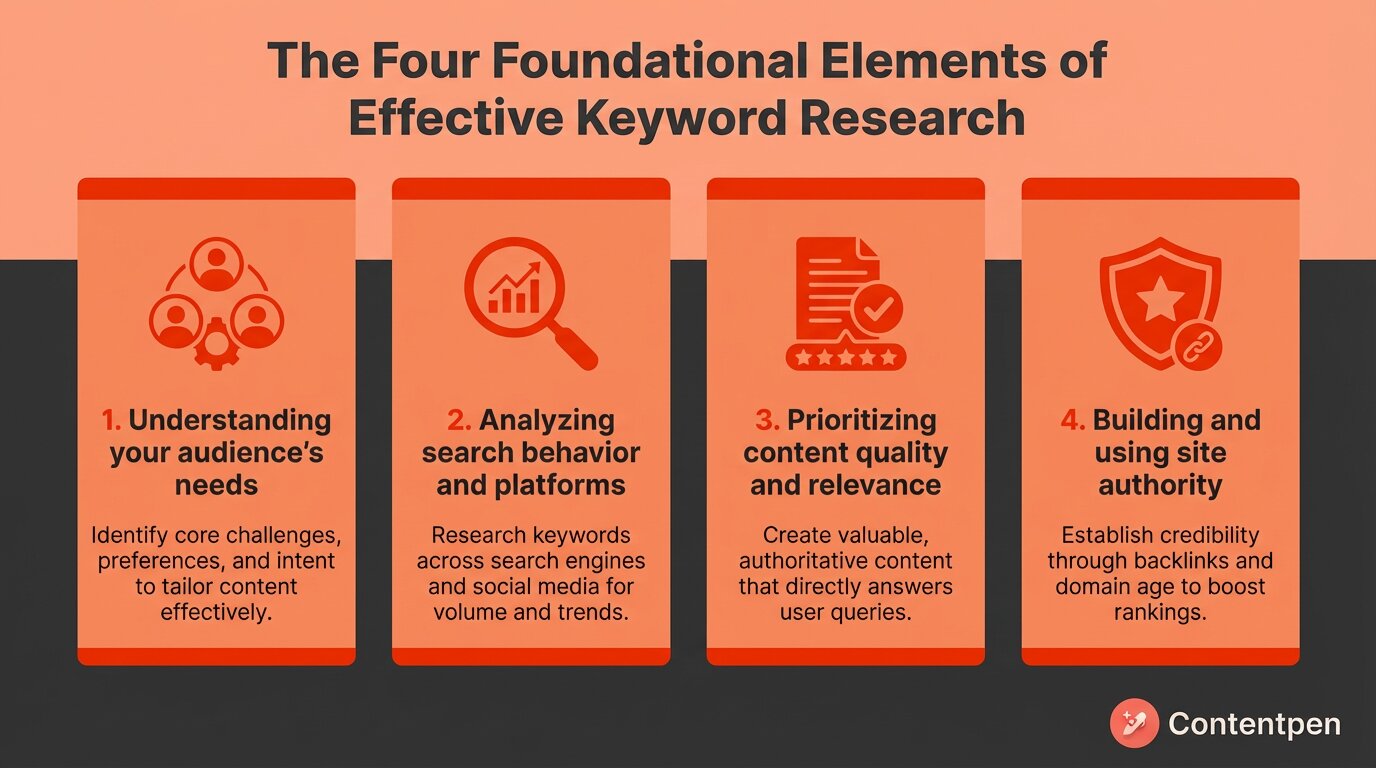
Before you open any tool, it helps to step back and see the bigger structure. A strong SEO keyword research guide does not start with data; it starts with people, behavior, content, and authority.
1. Understanding your audience’s needs
Everything starts with people, not with search volume. You want to know what makes someone start searching, what words they use, and what “success” looks like for them. That insight turns random phrases into clear topics with real meaning.
Talk to actual customers and leads whenever you can. Ask what problem pushed them to search, what they typed into Google, and what content helped them move forward.
Then speak with your sales and support teams, who hear questions and objections every day. As you listen, write down:
- The phrases people repeat
- The pain points they mention
- The way they describe your offer in their own words
Those notes become powerful seed ideas for future keyword research.
2. Analyzing search behavior and platforms
Next, look at how and where your audience already finds you. Google Search Console shows the queries that lead people to your site now, while Google Analytics 4 shows which channels send the most visitors and how they behave. These behavioral signals are made easy to judge with metrics, such as bounce rate, time spent per session, scroll depth, etc.
These tools tell you what is working even before you start new research.
Age and habits also shape search behavior. Younger users often start on YouTube or TikTok, where they type or speak longer, more natural questions. People who like AI assistants often ask full conversational questions, which look close to long-tail keyword phrases. Your job is to match your strategy to these habits instead of forcing everyone into one box.
3. Prioritizing content quality and relevance
You can only rank for a keyword if your page is a good fit and a strong answer. That means every topic you pick should sit close to what your business actually does, rather than chasing whatever your competitors target.
Relevance also means matching search intent. Some queries want how-to guides; others call for side-by-side comparisons or clear pricing pages.
Therefore, aim to be the clearest and most helpful resource for a specific keyword, with structure and depth that beat what is already ranking.
4. Building and using site authority
Authority is the trust your site has built over time in the eyes of search engines. It grows through consistent, helpful content and through backlinks and mentions from other trusted sites. When authority is high, you can target tougher keywords and still have a fair shot at ranking for them.
If your site is new or small, it is smarter to focus on lower competition, lower keyword difficulty terms first. You might pick specific phrases like “how do I find the best keywords for my website as a local plumber” instead of broad head terms.
Over time, as your pages earn links and organic traffic, you can move toward harder keywords. Keep in mind that you are not trying to beat huge brands everywhere on day one; you are picking spots where your content can stand out.
The step-by-step keyword research process
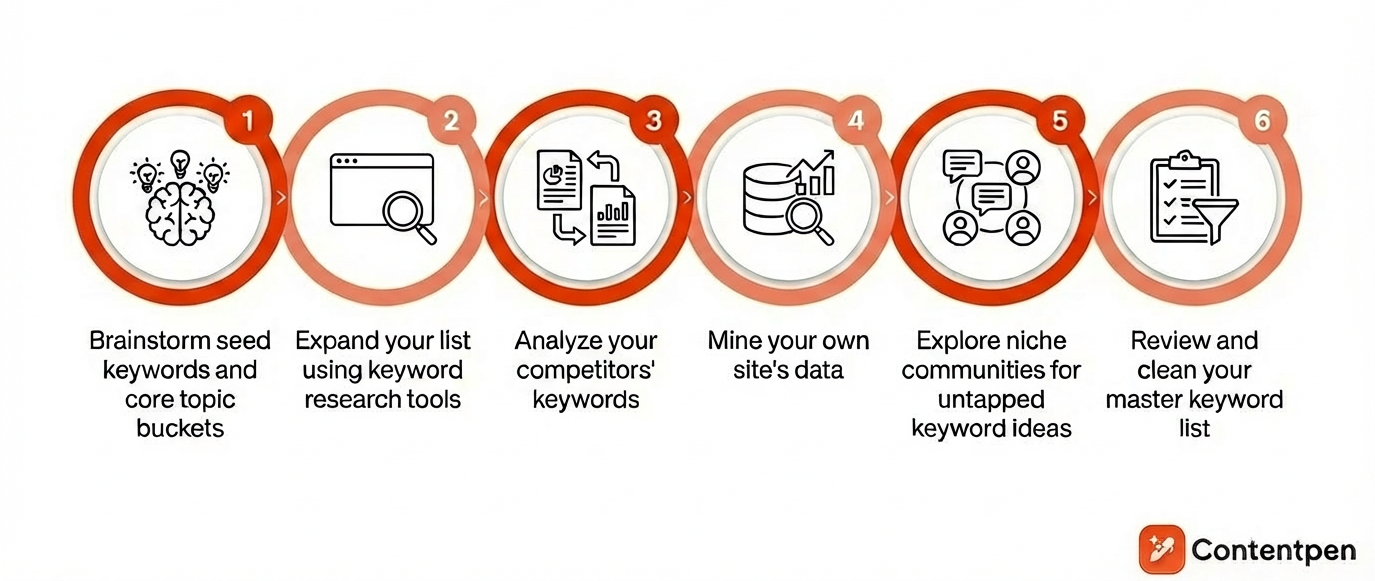
Now it is time to walk through how to do keyword research for SEO in a clear sequence you can reuse. Think of this as going from raw ideas to a ranked list you can plug into your content calendar. The same flow works whether you use free tools or paid platforms.
Step 1: Brainstorm seed keywords and core topic buckets
Start with what you know best, which is your own offer and your customers’ world. Pick 1-3 broad topic buckets that describe what you help people with. For example:
- A coffee company might choose home brewing, coffee equipment, and coffee recipes as its seed keywords.
- A B2B software brand might focus on terms like CRM, sales automation, and customer support.
Under each topic bucket or cluster, write short seed phrases your buyers might type. Stay close to their words, not your internal jargon.
For example, many buyers say “client tracking software,” not “customer relationship management platform.” Drop everything into a simple spreadsheet without judging yet; the point here is to fill the page so later tools have more to work with.
Step 2: Expand your list using keyword research tools
Once you have a list of seeds, turn them into a richer set of ideas. Plug each seed into a keyword research tool of your choice. This is where a basic SEO keyword search becomes a focused process.
Most keyword tools show different types of matches:
- Phrase match results keep your seed phrase in the same order inside longer searches.
- Terms match results include the same words in any order.
- Related terms surface ideas that do not repeat your seed but often show up on the same top-ranking pages.
Contentpen’s built-in keyword research feature lets you enter a seed term and see difficulty, volume, and intent data in the same window where you will eventually write the article. That cuts out the copy-paste loop between a separate tool and your content editor.
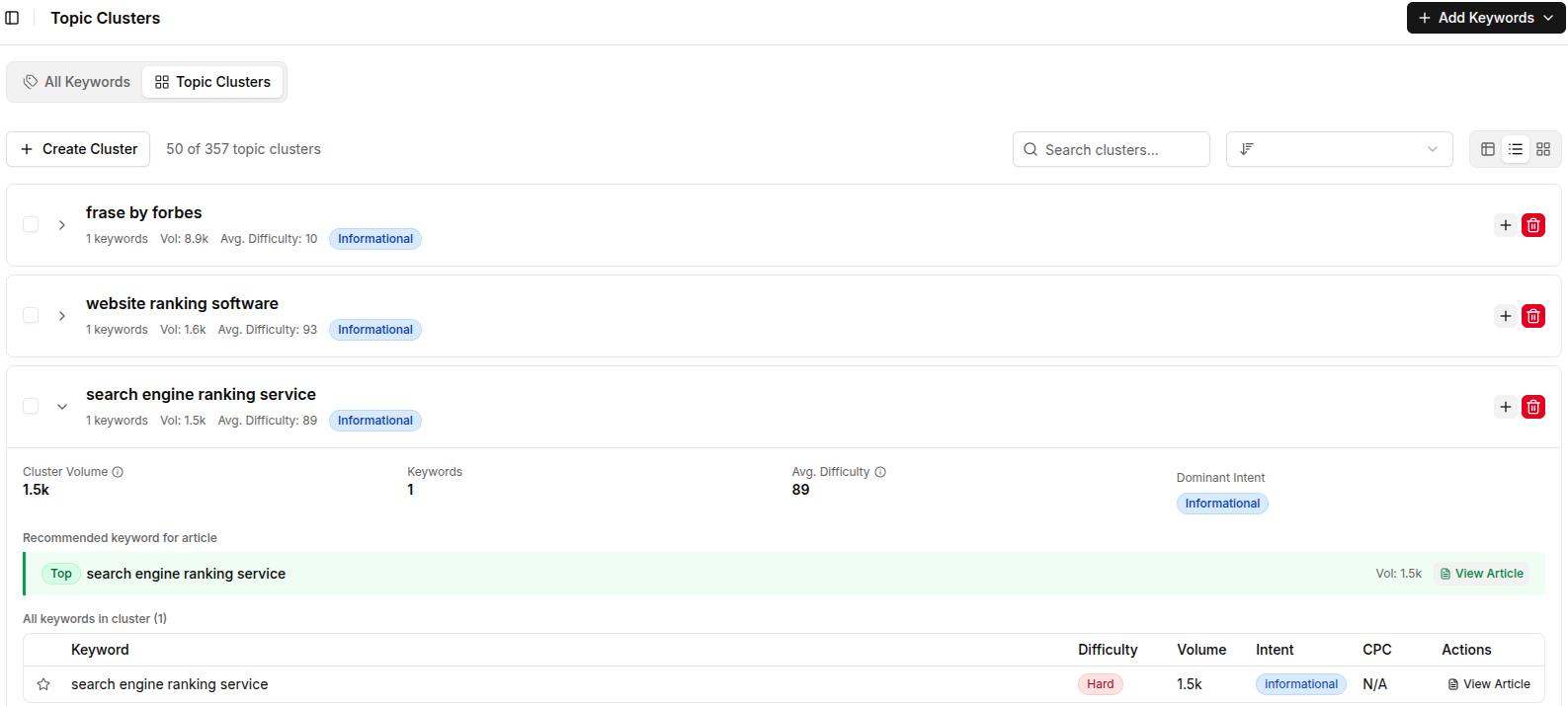
For a deeper walkthrough of how to find high-opportunity keywords directly inside Contentpen, check our step-by-step product guide.
Step 3: Analyze your competitors’ keywords
Your competitors have already done a lot of the work for you. When you learn how to find competitors’ keywords, you see which topics and phrases are proven traffic drivers in your space. This is one of the fastest ways to grow your platforms.
To do this step, we recommend using any of the top competitor analysis tools on the market. You must:
- Start by searching your main seeds in an incognito browser and note which sites keep appearing on the first page in the region of your choice. These are your real SEO competitors, even if they are not the same as your offline rivals.
- Next, use tools like Ahrefs Site Explorer or Semrush keyword research reports to pull the top organic keywords for each of those domains. Many of the phrases you see will be worth testing on your own site.
- Then, run a content gap analysis that compares your site with several rivals at once. This shows keywords that at least one competitor ranks for, while you do not.
You can track this work in a simple table like the one below:
| Competitor | Their top keyword | Your ranking | Opportunity |
| Competitor A | Best espresso under 200 dollars | Not ranking | High |
| Competitor B | Home barista guide | Page 3 | Medium |
Tables like this make it easy to see where you have no presence and where a small push could move you up.
Step 4: Utilize your own site’s data
If your site already gets any search traffic, you have useful keyword clues sitting in your own reports. This is a key part of how to perform keyword research that many people skip.
Open Google Search Console and head to the Performance report. Sort by average position, then filter for queries. These are “striking distance” terms where a better title, refreshed content, or a stronger internal link can move you into the top spots.
Also, check which queries have good impressions but a weak click-through rate. That often means your snippet is not clear or attractive. Small changes to your title or meta description can bring more visitors without writing a brand-new article.
Step 5: Explore niche communities for untapped keyword ideas
Some of the best keyword ideas never show up in tools until a topic is already crowded. You find them first by listening in the places your audience hangs out. This is where long-tail keyword research becomes very crucial.
Browse Reddit, Quora, Facebook Groups, and LinkedIn communities related to your niche. Look for threads with repeated questions, detailed stories, and frustrations.
Copy the way people phrase their problems, because those phrases often mirror how they search. Then, plug these words into a tool or even straight into Google to see related “People also ask” questions and suggested searches.
After you’re done exploring different types of keywords, plan your next piece of content that genuinely answers users’ queries and watch the traffic rise.
Step 6: Review and clean your master keyword list
By now, you may have numerous keyword ideas across your sheet. However, raw keyword volume is not the goal. This step is about trimming and organizing your target words and phrases so you can move into an authoritative position in your niche. You must:
- Scan down the keyword list and remove terms that feel off-topic, too vague, or far outside your current business/service scope.
- Group close word variations into small keyword clusters so you can target several phrases with a single piece of content.
- Add a simple column for business value, where you score each term from 0-5 based on how closely it ties to what you sell.
With this cleaned keyword list ready, you can dive into deeper keyword analysis and start asking how to find the best keywords for SEO for your specific site.
What keyword research actually looks like: A real example
You now have the full six-step process for how to do keyword research for SEO. Now, let’s take a look at how you can replicate the procedure for a real business from start to finish.
The scenario: You run a SaaS platform for HR teams called HireFlow. Your product helps companies automate employee onboarding.
Starting with a seed keyword
You start with the broad topic that describes what your product does, for example, “employee onboarding.”
Using the seed keyword in a tool
If you plug in “employee onboarding” into any keyword tool of your choice, you’ll see several related phrases. Rather than picking from the top of the volume list, you should filter by a few parameters.
Although these filters vary from business to business, there is a general guideline you can follow. Choose keyword difficulty below 40, keyword intent as informational or commercial, and phrases that include words your buyers actually use.
After filtering keywords, you’ll have some standout options. In our case, we used Semrush’s Keyword Magic Tool to converge on the following three phrases:
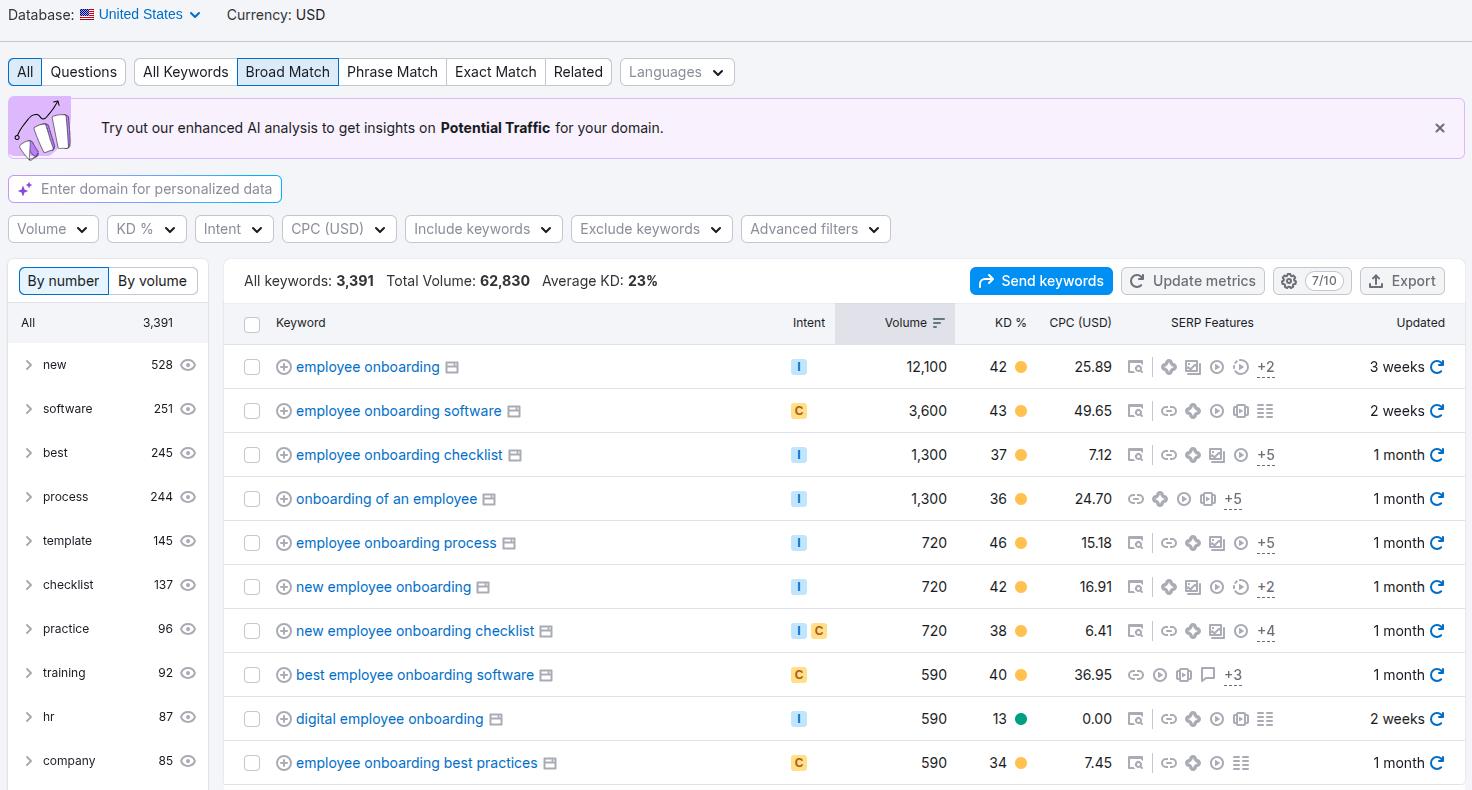
- “employee onboarding software” — Volume: 3,600 / Difficulty: 43 / Intent: Commercial
- “digital employee onboarding” — Volume: 590 / Difficulty: 13 / Intent: Informational
- “employee onboarding checklist” — Volume: 1,300 / Difficulty: 37 / Intent: Informational
Although keyword difficulty should be lower than 40, this is a hard-and-fast rule, especially if the terms you’re targeting are crucial to your business.
Reading the SERP results
The next thing is to search each selected phrase in an incognito browser and look at the top ten results. For “employee onboarding best practices,” every result is a long guide from an HR software brand with high domain authority. Take note of the content type used for the term.
For “how to create an employee onboarding checklist,” the top results are a mix of blog posts from mid-size SaaS brands. Some are thin, some are thorough, but none of them include a downloadable checklist template. This is the content gap that you can cover to rank.
In the top SERP results, also check the following details:
- How deep does the content go? Click on the top three results and read them. Are they thin 800-word posts or comprehensive 3,000-word guides? The depth of what already ranks tells you the minimum standard you need to clear, not just match.
- Who is ranking? Check the domain authorities of the ranking pages. If five of the top ten results come from sites with authority similar to yours, you have a real chance to rank for that keyword.
Deciding what to create
Based on intent, keyword difficulty, and the content gap you spotted (no downloadable template in the top results), it is time to decide the type of piece you’ll publish. Consider the following aspects:
- Keyword to target: “How to create an employee onboarding checklist.”
- Content type: Long-form blog post.
- Angle: A beginner-friendly guide with a free downloadable checklist template embedded at the top.
- Supporting keywords to include: “new hire onboarding checklist,” “employee onboarding process steps,” “onboarding checklist template free.”
Add this list to your keyword map as a high-priority, short-term target and use Contentpen to generate the first draft, pulling in the supporting keywords automatically during the writing process.

Write better blogs in less time, without sacrificing quality.
Let AI handle structure, clarity, and flow while you stay in control of the message.
Try AI blog writing →
This is the loop every keyword decision should follow: seed, expand, check the SERP, decide, write, and publish. The tool does the data work; you do the thinking.
How to analyze keywords: The metrics that actually matter
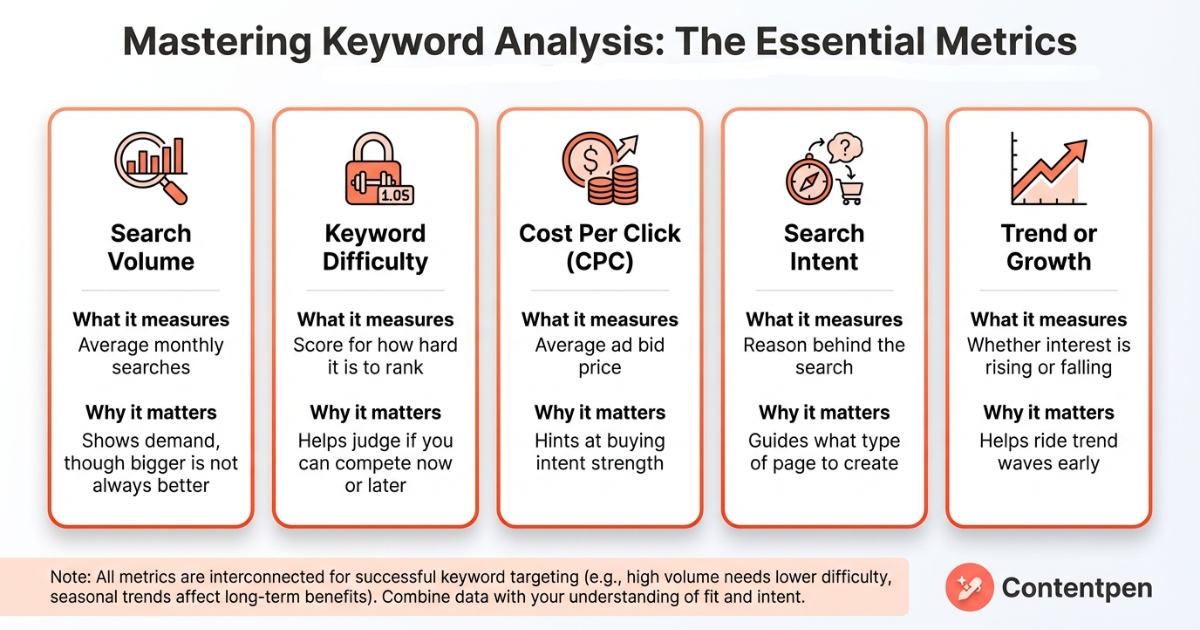
We’re halfway there. The next major step is learning how to do keyword analysis so you can pick targets that bring real traffic and leads. For that, you combine numbers from tools with your own sense of fit and intent.
Here are the main metrics you will see in most SEO keyword research tool dashboards:
| Metric | What it measures | Why it matters |
| Search volume | Average monthly searches | Shows demand, though bigger is not always better |
| Keyword difficulty | Score for how hard it is to rank for a specific keyword | Helps you judge if you can compete for the term now or later |
| Cost per click (CPC) | Average ad bid price | Hints at how strong the buying intent is |
| Search intent | Reason behind the search | Guides what type of page you should create for the keyword |
| Trend or growth | Whether interest is rising or falling | Helps you ride trend waves early and avoid topics that fade quickly |
All of these metrics are connected together. For instance, you cannot rank for a keyword with just a high search volume unless it has a lower difficulty.
Similarly, a seasonal keyword might show higher search volume, but since its trend can fall, there’s no guarantee that you’ll receive the benefits from it that you desired.
Tools like Ahrefs and Semrush now show intent labels and trend graphs for each keyword, which saves time and helps you focus on the right mix.
How to choose the right keyword: A simple decision framework
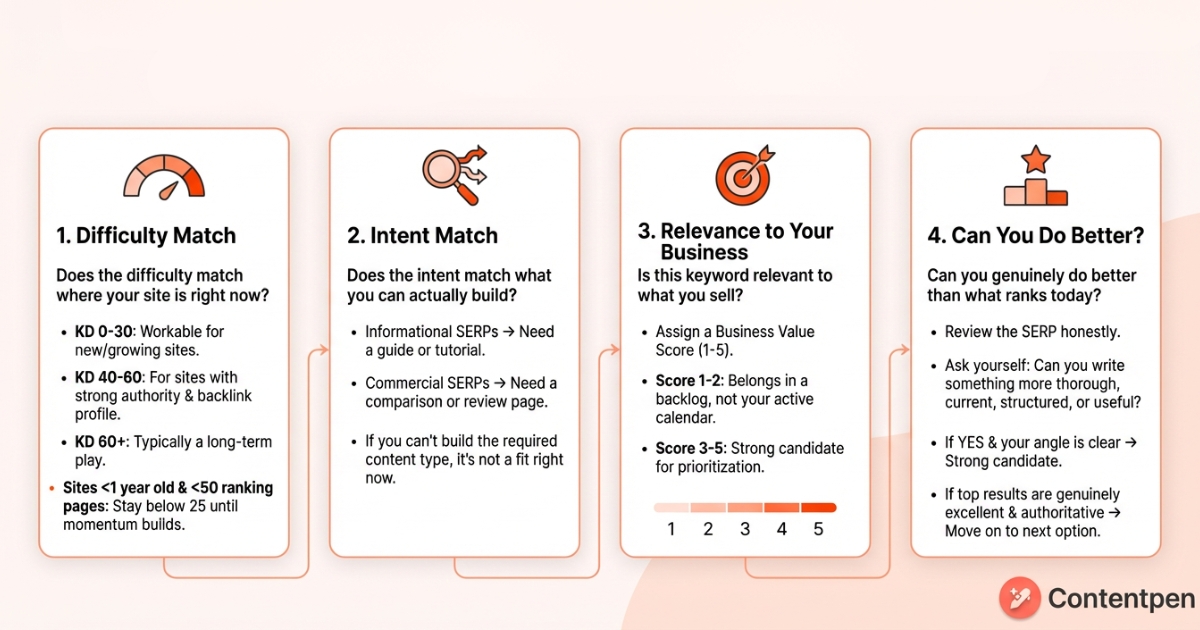
The metrics above tell you what a keyword looks like on paper. This framework tells you whether it is worth your time.
A keyword earns a place on your priority list when it satisfies four conditions at the same time:
Does the difficulty match where your site is right now?
A keyword difficulty score of 0 – 30 is generally workable for new or growing sites. Sites with strong authority and a solid backlink profile can go after terms in the 40 – 60 range.
Anything above 60 is typically a long-term play. If your site is under a year old and has fewer than 50 ranking pages, stay below 25 until you have built some momentum.
Does the intent match what you can actually build?
If the SERP shows that informational content dominates, you need a guide or tutorial. If commercial intent dominates, you need a comparison or review page. If you are not in a position to build the type of content the keyword demands, the keyword is not a fit right now.
Is this keyword relevant to what you sell?
A keyword can have great volume and manageable difficulty, but still be wrong for your site if it attracts readers who will never buy from you or recommend you.
Assign every keyword a business value score from 1 to 5 based on how directly it connects to your product or service. Anything scoring a 2 or below belongs in a backlog, not your active calendar.
Can you genuinely do better than what ranks today?
After reviewing the SERP, ask yourself honestly: can you write something more thorough, more current, better structured, or more useful than the current top results?
If the answer is yes and your angle is clear, the keyword is a strong candidate. If the top results are genuinely excellent and come from sites with far greater authority, move on to the next options. When all your conditions are met, you have found a keyword worth building around.
Keyword research for AI search and LLMs in 2026
Traditional keyword research was built around a typical Google search. That model still matters, but AI search has shifted the SEO game by a lot, introducing AEO (Answer Engine Optimization) into the mix.
Google’s AI Overviews now appear at the top of results for a large share of informational queries, including most “how to” searches. Perplexity, ChatGPT, and other AI platforms are answering millions of questions daily and pulling from a relatively small pool of authoritative sources.
Getting cited by these AI systems requires a slightly different approach from classic SEO, but the two strategies overlap more than most people realize.
What changes for AI search
AI systems favor content that answers questions directly, clearly, and in plain language. This means:
- Keywords phrased as questions tend to perform better than head terms alone.
- Entities matter more than exact phrases. Instead of optimizing for the keyword “keyword research tools,” think about covering the entities connected to it: what keyword research is, the tools involved, the process steps, and the intent types.
- Structure signals clarity. Headings that match the question, concise opening paragraphs that state the answer before expanding on it, and FAQ sections at the end all make it easier for AI systems to extract and attribute your content.
- Authority compounds. Pages that already rank in the top three are significantly more likely to get cited by AI tools. This means the best thing you can do for AI visibility is to build genuinely strong fundamentals first, including on-page SEO and off-page SEO.
Signs a keyword is ready for AI snippet capture
Use this quick check before finalizing any keyword:
- Is it phrased as a question or a clear problem statement?
- Can the answer be stated in one or two sentences before expanding?
- Do your H2 headings directly match likely follow-up questions?
- Is this a topic where your content can become the most comprehensive resource available?
If you are ticking most of those boxes, the keyword is a strong candidate not just for organic rankings but for AI mentions as well.
The best keyword research tools: Free and paid options
You can learn how to do keyword research for SEO for free with several tools, then add paid platforms when you are ready to move faster and smarter. The goal is not to use every tool on the market, but to pick a small set that fits your budget and skills.
Free keyword research tools
Free tools give you plenty of data when you are starting out. They are also helpful if you are testing ideas before you pitch a bigger SEO budget.
- Google Keyword Planner gives you search volume ranges straight from Google for many phrases. You need a free Google Ads account, but you do not have to run ads to see basic numbers. It is a solid way to sense baseline demand and to spot groups of related terms for each offer.
- Google Trends shows how interest in a topic rises or falls over time and across regions. You can compare two terms side by side to see which one your audience prefers right now. This helps you avoid building content around topics that are fading or only peak in one short season.
- Google Search Console focuses on your own site and reveals the queries you already rank for. It is the best free view of your current reach in search, and a must if you want to improve existing pages.
- Ubersuggest keyword research tools give you quick lists of related terms, content ideas, and basic site audits. The free version limits daily searches, but it is great when you want a fast look at how hard a topic might be.
- AnswerThePublic turns search suggestions into neat maps of questions and phrases around a seed keyword. It is perfect when you plan how to conduct keyword research for blog content and want to see what people ask in their own words. Even a few runs per month in the free version can fill your idea bank.
With these tools alone, you can cover how to do free keyword research for most small sites.
Professional keyword research tools
Paid tools give deeper data, better filters, and rich reports that save a lot of time once you move beyond the basics. They are helpful when you handle many pages, clients, or campaigns.
- Ahrefs is known for strong backlink data and detailed keyword metrics. It shows traffic potential, click data, and a parent topic for each term, which is very useful when you plan clusters.
- Semrush offers a wide range of SEO, content, and ads tools in one place, and its Keyword Magic Tool is favored for deep keyword research. You can filter by search intent, question terms, and many other options in a few clicks.
- HubSpot’s Content Strategy Tool helps you plan topics and clusters rather than single keywords. It suggests related subtopics, tracks how each piece of content performs, and links directly to your marketing and sales data.
- ChatGPT and similar AI tools are not a direct source of live metrics, but they are very good for ideation. You can ask for long-tail versions of your main keyword, outlines for articles, or angles for new guides.
If the budget is tight, start by mastering how to do free keyword research with Google tools. As your site grows and you want faster insight, upgrading to a full SEO suite can pay off quickly.
How to organize and prioritize your keywords for maximum impact
Once you have a filtered keyword list, the next step is to turn it into a clear plan. This is where many people stall. They learn how to find keywords for SEO, but do not know which to write about first or how to fit them into their site. A bit of structure here makes everything else easier.
Building topic clusters for topical authority
Search engines tend to favor sites that cover a subject in depth instead of posting scattered, one-off articles. Topic clusters help you do that by grouping related keywords and pages around a single main theme.
At the center of each cluster is a pillar page, which is a broad, detailed guide that targets a head term such as “SEO guide for small businesses.” Around it, you publish cluster posts that go deep into subtopics, like “SEO link-building tips” or “local ranking tactics”.
Each cluster post focuses on a single long-tail phrase and links to the pillar, while the pillar links out to all the cluster posts.
When several phrases lead to the same result, you can often cover them all with one strong article. For example, “whipped coffee,” “whipped coffee recipe,” and “how to make dalgona coffee” belong on a single page. This is also the basis of semantic SEO.
Mapping keywords to the buyer’s journey
Not all keywords serve the same purpose, and treating them as if they do is one of the most common planning mistakes in SEO. The most useful way to organize your list is to map each keyword to a stage in the buyer’s journey: TOFU, MOFU, and BOFU.
| Funnel Stage | What the searcher wants | Keyword format | Example | Best content type |
| TOFU (awareness) | To understand a concept or problem | “What is X,” “Why X,” “Benefits of X” | “What is keyword difficulty“ | Explainer post, glossary |
| MOFU (consideration) | To learn how to solve a problem | “How to X,” “Step-by-step X,” “Best way to X” | “How to do keyword research for SEO” | This article |
| BOFU (decision) | To evaluate and choose a solution | “Best X tool,” “X vs Y,” “X pricing” | “Best keyword research tool for agencies” | Comparison, landing page |
Your target keyword sits squarely in the MOFU stage. The reader already knows they need keyword research; they are looking for the right process and, in many cases, the right tool to help them execute it.
Creating your keyword map and content calendar
To keep your work organized, build a keyword map, which is a simple spreadsheet that assigns each focus keyword to a page. Think of it as a home for every term you care about. It stops you from writing two posts for the same phrase and makes the gaps very clear.
Here is a basic structure you can use:
| Priority | Focus keyword | Supporting keywords | Intent | Page type |
| High | How to do keyword research | Keyword research step by step | Informational | Blog post |
| High | Best keyword research tools | Free keyword research tool | Commercial | Blog post |
| Medium | Keyword difficulty SEO | How to analyze keywords | Informational | Blog post |
Use the priority column to separate short-term, medium, and long-term targets:
- Short-term picks tend to be long-tail, low difficulty, and high in business value.
- Medium-term targets have moderate competition and nice traffic potential.
- Long-term keywords are your “trophy” phrases with high volume and great difficulty that may require more content, links, and time.
This keyword map broadens as your content calendar does. Over time, the sheet also shows progress as items move from “New” to “Published” and as you track rankings.
Common keyword research mistakes to avoid
Most keyword research mistakes are not about effort. They come down to a few habits that are easy to form and surprisingly hard to change.
Planning entire content campaigns around seasonal keywords
A keyword that spikes every November and then disappears for eleven months needs a different content strategy than a keyword with steady, year-round demand.
For instance, we researched the keyword ‘Easter gifts’ in Ahrefs. It rises in search volume around March every year, but dips significantly once the annual event is over.
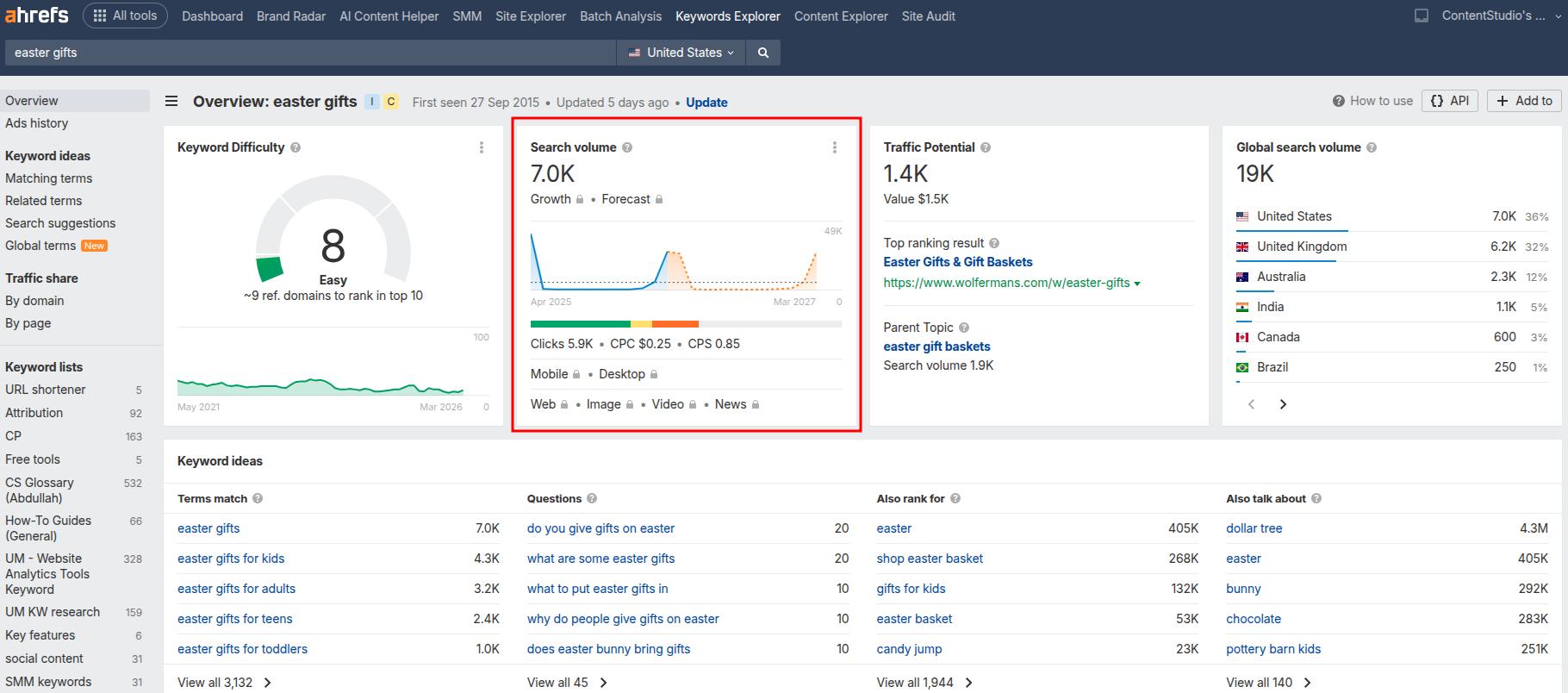
The important takeaway from this keyword example is to target ‘evergreen’ keywords that receive a fair amount of traffic all year round. For instance, ‘how to start a blog’ or ‘what is a webhook’ are timeless topics that will continue attracting audiences due to their informational and educational nature.
Publishing two pages for nearly the same keyword
If you have a blog post targeting “keyword research tools” and another targeting “best keyword research tools,” you are competing against yourself.
Google will pick one to rank and suppress the other, usually not the one you would choose. That is why it is important to consolidate similar topics into one strong page whenever possible so that you have a better chance at dominating SERPs.
Treating keyword research as a one-time task
Search behavior shifts. New competitors enter the space. Tools evolve. A keyword that was low difficulty six months ago might now be contested by a major player right now.
Therefore, it is important to set a quarterly reminder to revisit your core keyword list and refresh your strategy based on what has changed.
Forgetting the content you already have
Before you write anything new, check Google Search Console for pages sitting in positions 5 to 15. A better title, a stronger opening paragraph, or a few additional sections can push those pages into the top three without creating anything from scratch. Those are your quickest wins.
How Contentpen helps you turn keyword research into measurable SEO results
Learning how to do keyword research for SEO is a big step, but putting it into practice week after week is where many teams get stuck. There is data to review, intent to judge, pages to update, and rankings to watch. It is easy to lose track of what matters.
Many businesses face the same problems:
- They do not get enough Google traffic and see competitors outrank them for important phrases.
- They are not sure if the main issue is keywords, content quality, technical SEO, or something else under the hood.
- They also do not have time to become SEO specialists or a budget to waste on guesswork and generic reports.
This is where Contentpen steps in. The AI SEO content writer ensures that you see the website analytics straight from Google Search Console in your writing workflow. It also surfaces quick wins and identifies decaying pages for you so that you can take the required actions before it’s too late.
Turn existing content into growth opportunities

Identify pages losing traffic or CTR
Find quick wins to improve clicks and rankings
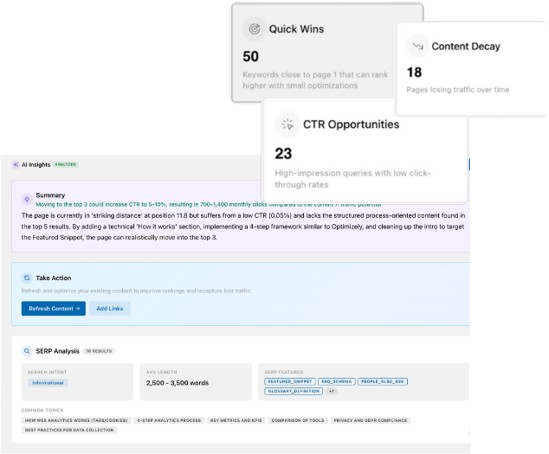
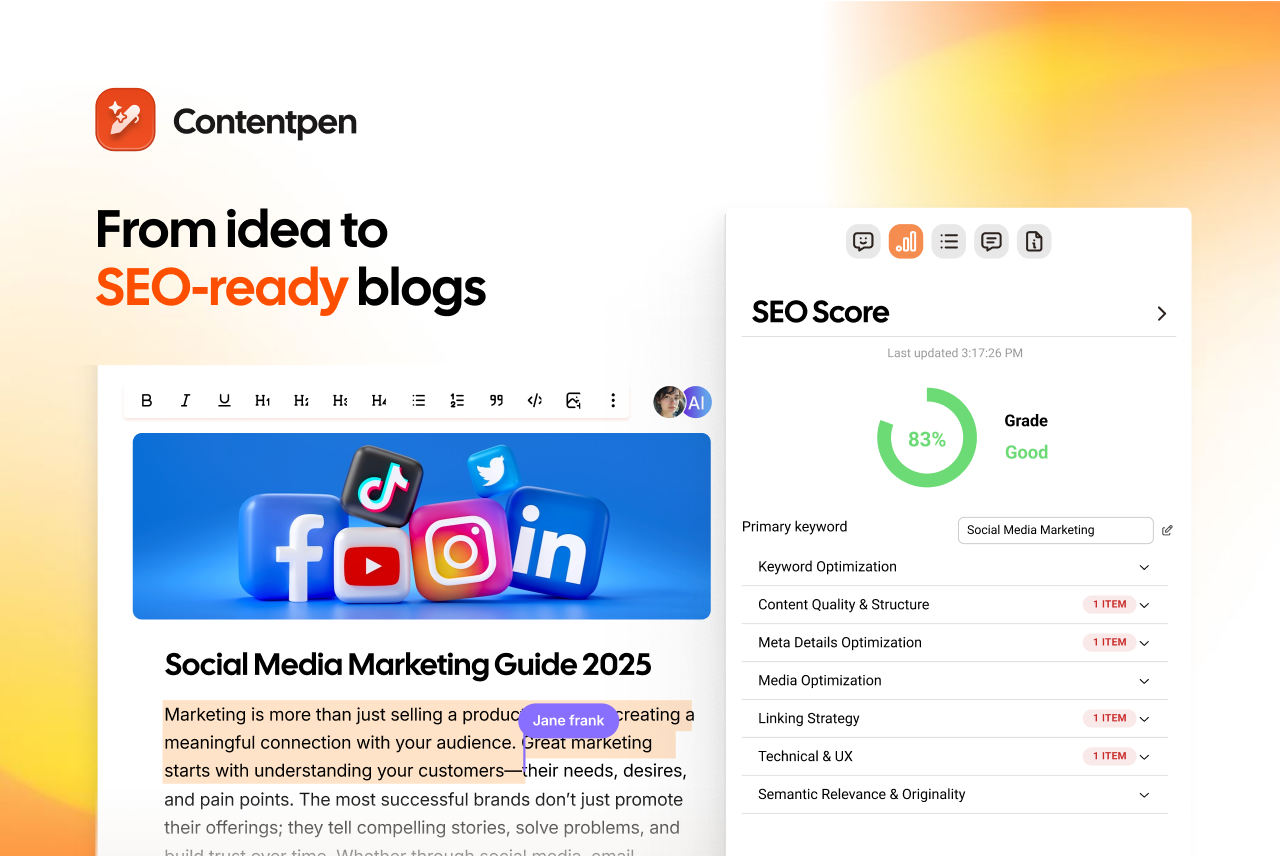
Contentpen not only takes care of your keyword research but also the entire content lifecycle. From SEO scoring to generating article metadata and managing a media library, the tool automates the majority of your tasks so that you can focus on strategizing and implementation.
Final thoughts
Keyword research is the base that connects your content to what people actually type into search engines. When you understand how to do keyword research for SEO, you stop guessing and start meeting your audience at the exact moment they look for help.
The path is clear. You brainstorm seeds, expand them with tools, study competitors, mine your own data, review key metrics, group terms into clusters, and map each keyword to a page.
You can use both free and paid tools for keyword research. The key is regular, focused effort and a consistent content system that helps you achieve and sustain SERP and AI snippet positions alike.
Frequently asked questions
Every quarter, review your main keyword list to see if search volume, difficulty, or intent has changed. At least once a year, compare your plan with your current business goals. Also, repeat research whenever you launch a new offer or notice clear drops in traffic or rankings.
Yes. Google Keyword Planner, Google Trends, Google Search Console, and manual SERP research can allow you to do keyword research for free, especially for newer sites or tighter budgets.
Keyword research itself can be done in a few hours, but results depend on how quickly you publish and how competitive your targets are. For newer sites, it may take 2 to 3 months to see initial movement, while more established sites can see changes within a few weeks.
Yes. Blog posts mostly target informational keywords, whereas product and service pages mostly target commercial or transactional keywords. The research process is the same, but the filters you apply in the keyword research tools shift completely.