Anyword is a popular copywriting platform that focuses on predicting how well your copy performs using AI. For performance marketers, that is genuinely useful. But for content teams that need long-form, SEO and GEO-optimized blogs, Anyword starts to show its limits.
These are some of the reasons why users look for Anyword alternatives. Brands and agencies want to create a complete content automation workflow that helps them boost productivity and conversions with ease.
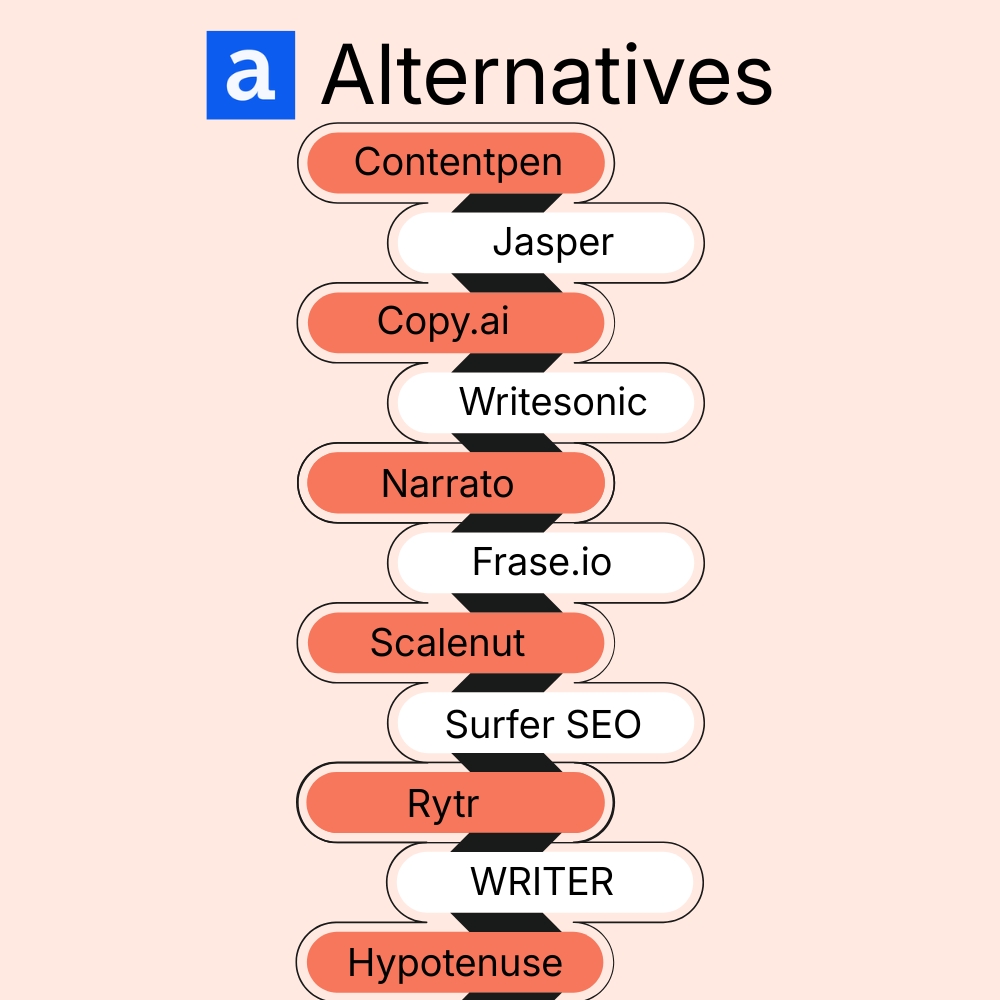
This guide covers the best Anyword alternatives in 2026 that are worth your attention. We will also share our criteria for adding these tools to the list and an honest breakdown of what works well for each option and what doesn’t.
So, let’s get started.
What is Anyword, and what does it do?
Anyword is an AI copywriting platform built specifically for ad teams. Its core differentiator is the predictive performance score, which assigns a conversion likelihood rating to every piece of copy it generates.
Instead of guessing which ad headline, product description, email subject line, or web copy will work, Anyword gives you data-informed guidance before you hit publish.
At a glance, these are the features you will find in Anyword:
- 100+ marketing templates: The tool supports over 100 marketing templates covering ads, emails, landing pages, product descriptions, and social posts.
- Brand voice: The brand voice feature lets you train the AI on your existing content so outputs stay consistent.
- Browser extension: Anyword offers a built-in browser extension that lets you use its AI directly in other tools. It provides a guided content workflow that helps less experienced users generate content step-by-step.
- Wide array of integrations: The platform also integrates with a wide range of tools, including Google Ads, Meta platforms, HubSpot, Salesforce, and others.
- SEO keywords: You can manually add SEO keywords to the tool, though there is no dedicated AI keyword research, live SERP analysis, or gap analysis built into the platform.
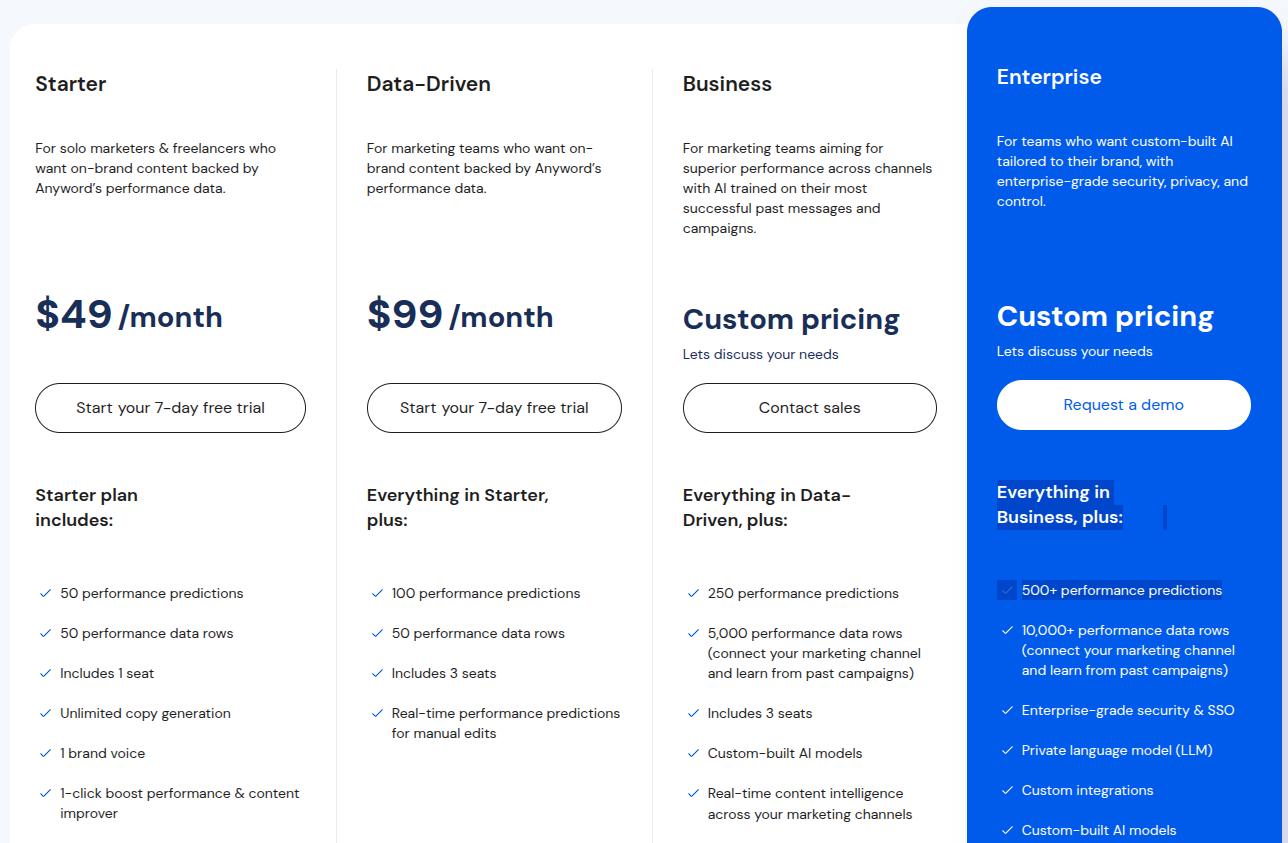
The price starts at $49/month, with the Data-Driven plan at $99/month. Business and Enterprise plans are available at custom pricing, and a 7-day free trial is included (with limited functionality).
Why do users look for Anyword alternatives?
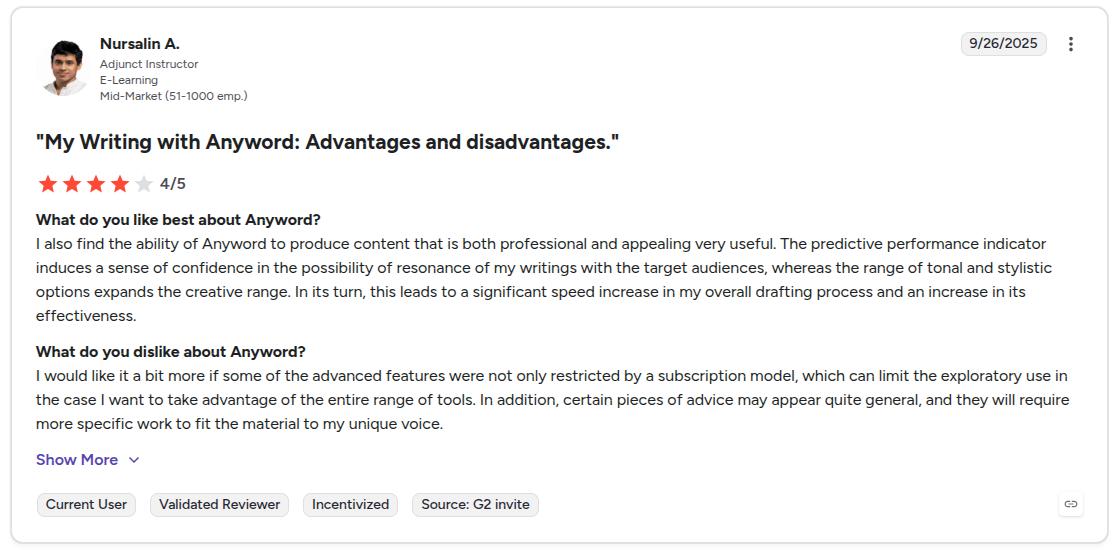
Even among its fans, a few consistent limitations come up repeatedly in reviews on G2 and Capterra.
- Writing quality issues at scale
Anyword’s output tends toward long paragraphs, lengthy sentences, and repetitive structure. The writing leans on AI-typical patterns such as overuse of transitional words like “additionally,” heavy em-dash usage, and words like “hones” that signal AI.
- Limited long-form content capability
Anyword is built around short-form copy: ads, subject lines, product descriptions. Teams that need to produce 2,000+ word SEO blogs or pillar pages will find the blog wizard underwhelming and the output thin without significant manual editing.
- No SEO or GEO optimization
Anyword does not perform live SERP analysis, competitor benchmarking, or GEO scoring for AI answer engines like ChatGPT or Perplexity. You can feed it keywords, but there is no AI-driven keyword research or gap analysis to inform what you should actually be targeting.
- Poor linking capabilities
Internal linking requires a significant knowledge base setup with no guarantee that links will appear correctly in the output. External link anchor text selection is also weak, which matters for teams trying to build topical authority and a proper site hierarchical structure.
- No website analytics or content performance tracking
You can score copy inside Anyword, but there is no way to connect that data to your live site traffic, identify decaying pages, or find near-ranking pages.
In comparison, tools like Contentpen provide you with average position, CTR, clicks, and impressions data directly where you write and publish.
- Limited free plan and content predictions
The 2,500-word limit on the free plan means you cannot generate a single complete, comprehensive blog post before hitting the cap. Also, Anyword’s content predictions can run out quickly, making it difficult for small businesses to keep track of their credits.
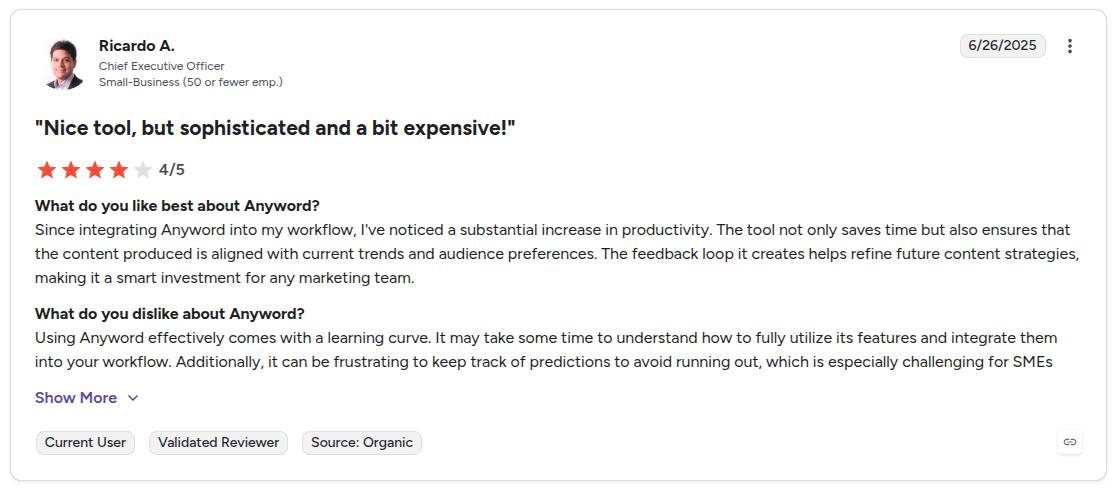
For teams trying to evaluate the tool, the limited free trial and credit-based systems can feel more restrictive than other platforms.
How we tested and selected these alternatives
Our team evaluated each tool hands-on against a defined set of criteria. The details are listed below:
- Content quality and depth: The first criterion is to check if the tool produces long-form output that reads naturally, holds a brand voice, and requires minimal editing, or not. We tested each platform on identical briefs across blog, ad, and email formats.
- SEO and GEO capability: Does the tool analyze live SERPs, suggest semantically relevant keywords, and optimize for AI answer engine visibility? These two signals are increasingly inseparable in 2026.
- Workflow completeness: Can you plan, create, publish, and track content performance from a single platform, or do you need to stitch together five tools to complete the loop?
- Brand voice and customization: Does the tool maintain a consistent tone across long documents, multiple content types, and team members? We looked at knowledge base support, custom prompt targeting, and voice training depth.
- Value for money: We compared the starting price against what you actually get on entry-level plans, including seat limits, word caps, and feature gating.
All the Anyword alternatives on this list were only included if they were genuinely functional and offered something that Anyword doesn’t.
Quick comparison: Top alternatives to Anyword at a glance
Before we move on to each tool entry in detail, below is a quick peek at all the options we’ll cover in this post:
| Tool | Best for | Long-form content | SEO/GEO | Brand voice | Starting price |
| Contentpen | SEO + GEO blog content at scale | Yes | Strong | Yes, with a custom knowledge base | $39/month |
| Jasper AI | Brand-aligned marketing copy | Yes | Moderate | Yes | $69/seat/month |
| Copy.ai | Short-form copy and GTM workflows | Limited | None | Yes | $29/month |
| Writesonic | Long-form SEO content with GEO tracking | Yes | Strong | Yes | $99/month |
| Narrato | Agency content workflows and client management | Yes | Moderate | Yes | $48/month |
| Frase | SEO content briefs and optimization | Yes | Strong | Limited | $49/month |
| Scalenut | SEO- and GEO-optimized content with Social Upreach | Yes | Strong | Limited | $59/month |
| Surfer SEO | Content optimization and SERP analysis | Yes (with Surfer AI) | Strong | Limited | $119/month |
| Rytr | Budget short-form copy | Limited | Basic | Yes | $9/month |
| WRITER | Enterprise brand governance and compliance | Yes | Limited | Yes | $29/seat/month |
| Hypotenuse AI | E-commerce product descriptions at scale | Yes | Moderate | Yes | $29/month |
Now, let’s see a tool overview, followed by its standout features, pros, cons, and pricing details. This is a structure that will be used for each alternative entry throughout the post.
1. Contentpen
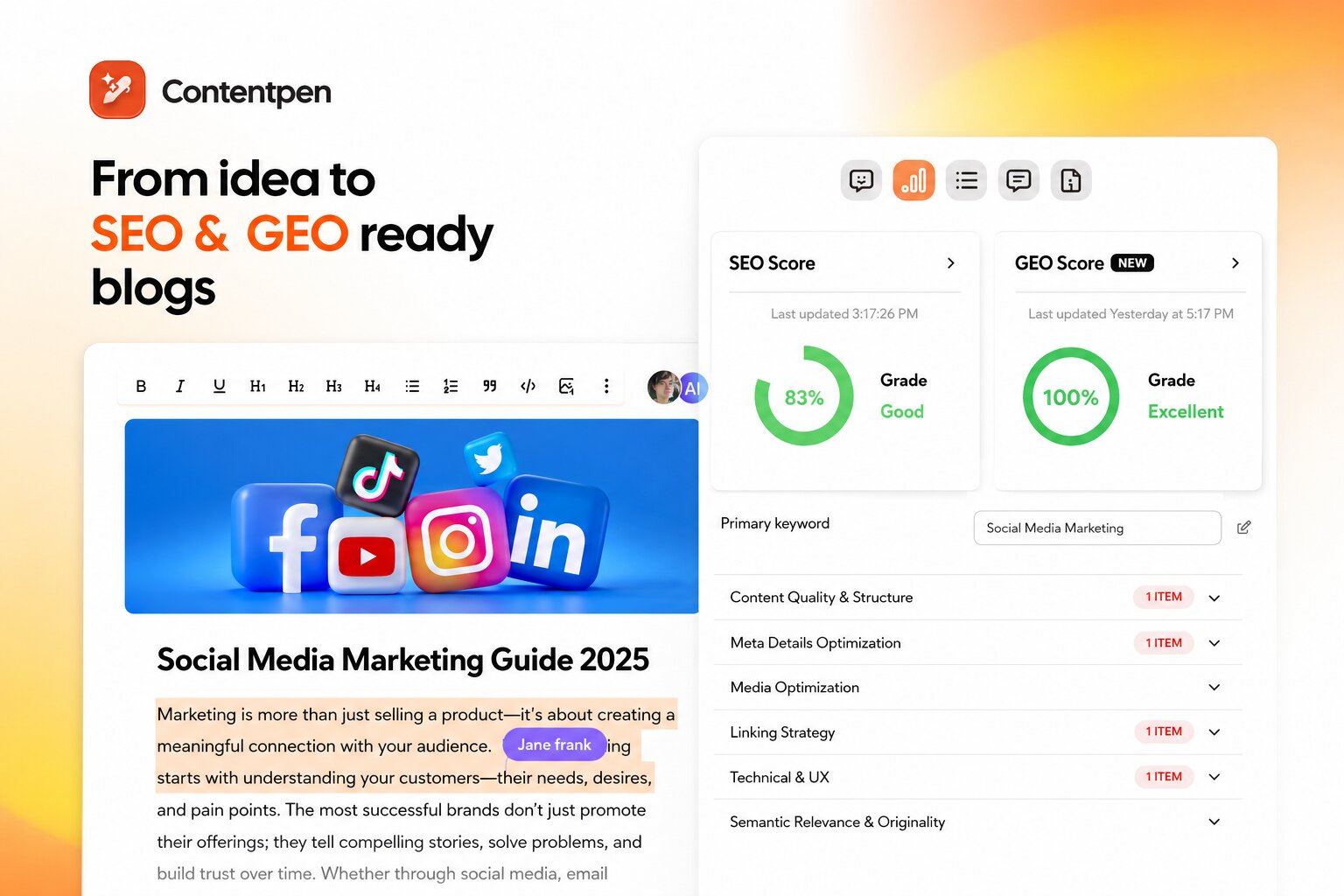
Contentpen is the best Anyword alternative for teams whose main priority is long-form SEO and GEO-optimized content.
Where Anyword scores copy for conversion, Contentpen scores content for search and AI visibility. The live SERP and gap analysis pull competitor data in real-time during content creation, so what you write is built to rank from the first draft.
The GEO scoring layer then optimizes for AI answer engine citation, which is increasingly how content gets discovered in 2026. However, the biggest functional gap between Contentpen and Anyword is in content depth and workflow completeness.
Contentpen handles the full content loop: keyword research, content generation, SEO and GEO scoring, AI image generation, internal linking, and one-click publishing to WordPress, Ghost, Wix, Webflow, Shopify, and ContentStudio.
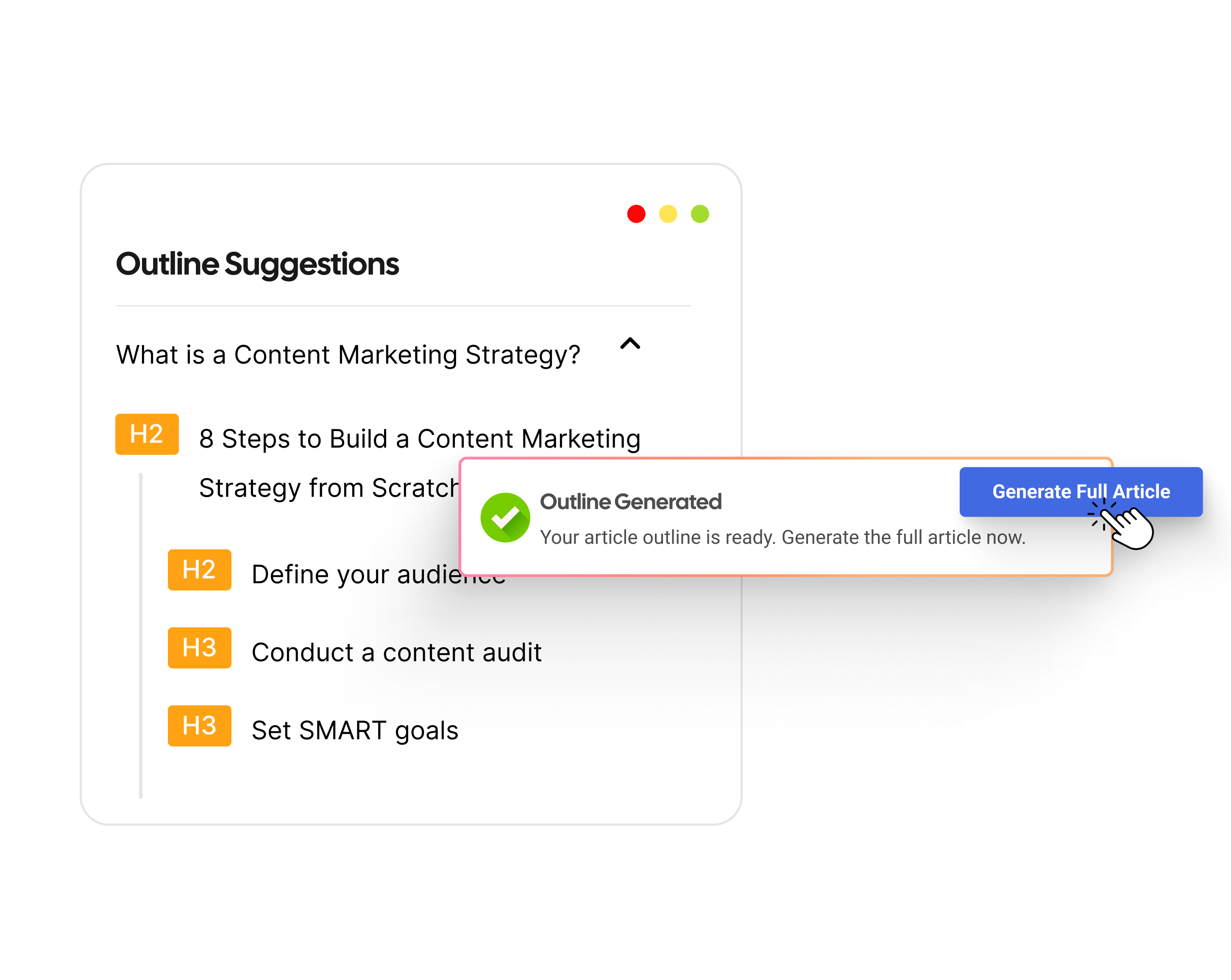
From outline to publish-ready content that fills them

Structured
Consistent
SEO-aligned
Fast
Meanwhile, Anyword does provide you with integrations. But you’ll have to manually edit the content for publishing, make it AEO and SEO-optimized, and perform internal and external linking yourself. The entire content production process with Anyword is tiresome and inefficient.
Brand voice handling is where Contentpen genuinely stands out. You train the platform on your existing content through a custom knowledge base, and every piece of content it generates reflects your documented tone, style, and terminology.
Combined with AI prompt targeting, this gives content teams voice consistency that doesn’t break down, even across bulk generation.
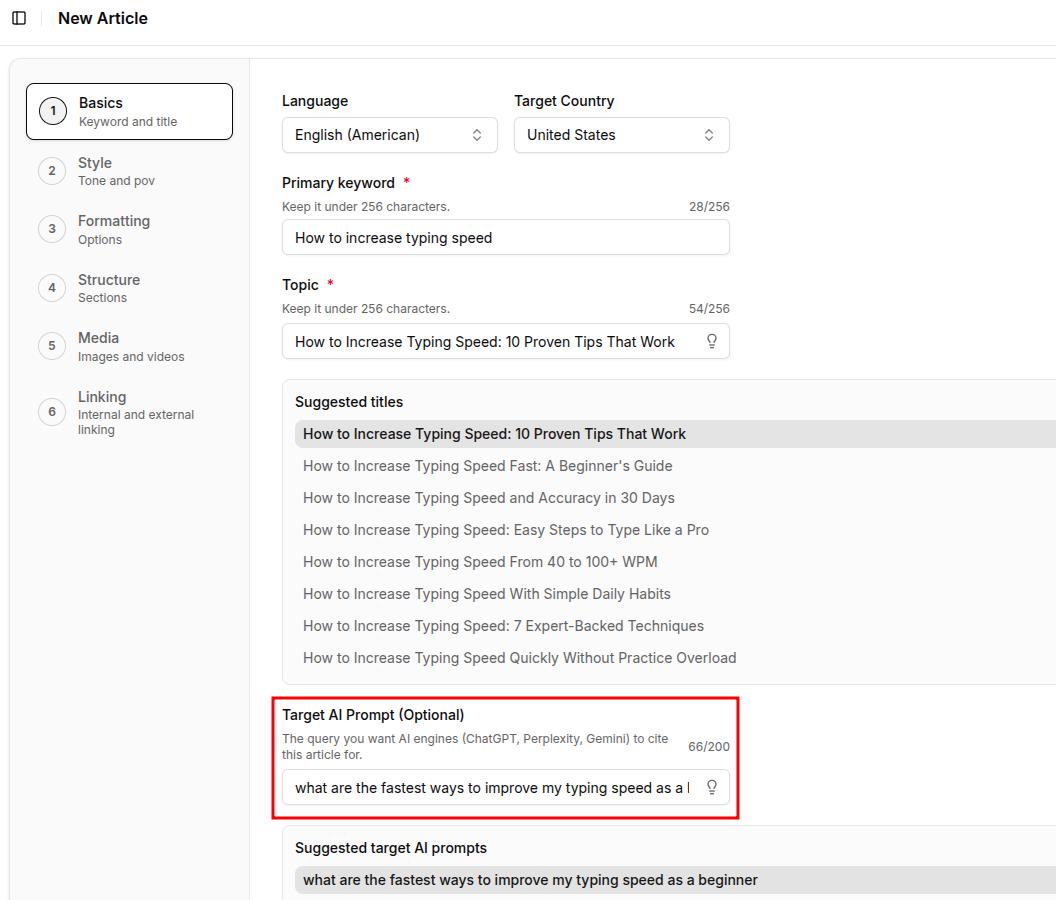
The output is conversational and readable, without the long-paragraph or repetitive-structure problems that Anyword users frequently flag.
What’s worth noting:
- Website analytics with decaying page detection, SEO opportunities, and CTR gap identification
- Bulk content generation to scale production with content presets
- Webhooks for custom notifications and workflow integrations
- Dedicated keyword research with topical clustering
- Automated internal and external linking
Where it works well:
- The only tool on this list that combines long-form content generation with live SERP analysis, GEO scoring, website analytics, and publishing in one place
- Brand voice output is genuinely conversational and consistent, not template-heavy or riddled with AI giveaways
- Bulk generation works at scale without quality degradation
- Organic traffic optimizer and content scheduling cover the full content lifecycle
Where it falls short:
- Not built for ad copy or predictive performance scoring, so it does not replace Anyword for paid media teams
- 7-day trial period is shorter than that of some competing tools
- Primarily a written content platform, so teams with heavy video or graphic design needs will still need a separate tool
Pricing:
Starts at $39/month. A free trial is available.
2. Jasper AI

Jasper has been in the AI writing space long enough to become the default enterprise choice for brand-aligned marketing copy. Its brand voice training and knowledge asset system are the clearest parallels to Anyword’s brand voice feature.
But Jasper goes deeper into long-form content and brand consistency across large writing teams. For agencies managing multiple clients with distinct voices, or large marketing teams where consistency across writers is a real problem, Jasper handles this reliably.
What’s worth noting:
- Brand Voice profiles that store tone, vocabulary, and style guidelines
- Knowledge assets for approved product copy, positioning, and messaging
- Long-form Canvas editor for structured article and document drafting
- Jasper Chat for conversational ideation and drafting
Where it works well:
- Best-in-class brand consistency across a writing team
- Clean, intuitive editor that requires minimal onboarding steps
- Solid for agencies managing multiple clients with distinct voices
Where it falls short:
- More expensive than most Anyword alternatives
- AI image generation is limited and offers no meaningful creative control
Pricing:
Pro plan starts at $69/seat/month. The business plan is custom pricing.
Also read: The best Jasper AI alternative.
3. Copy.ai
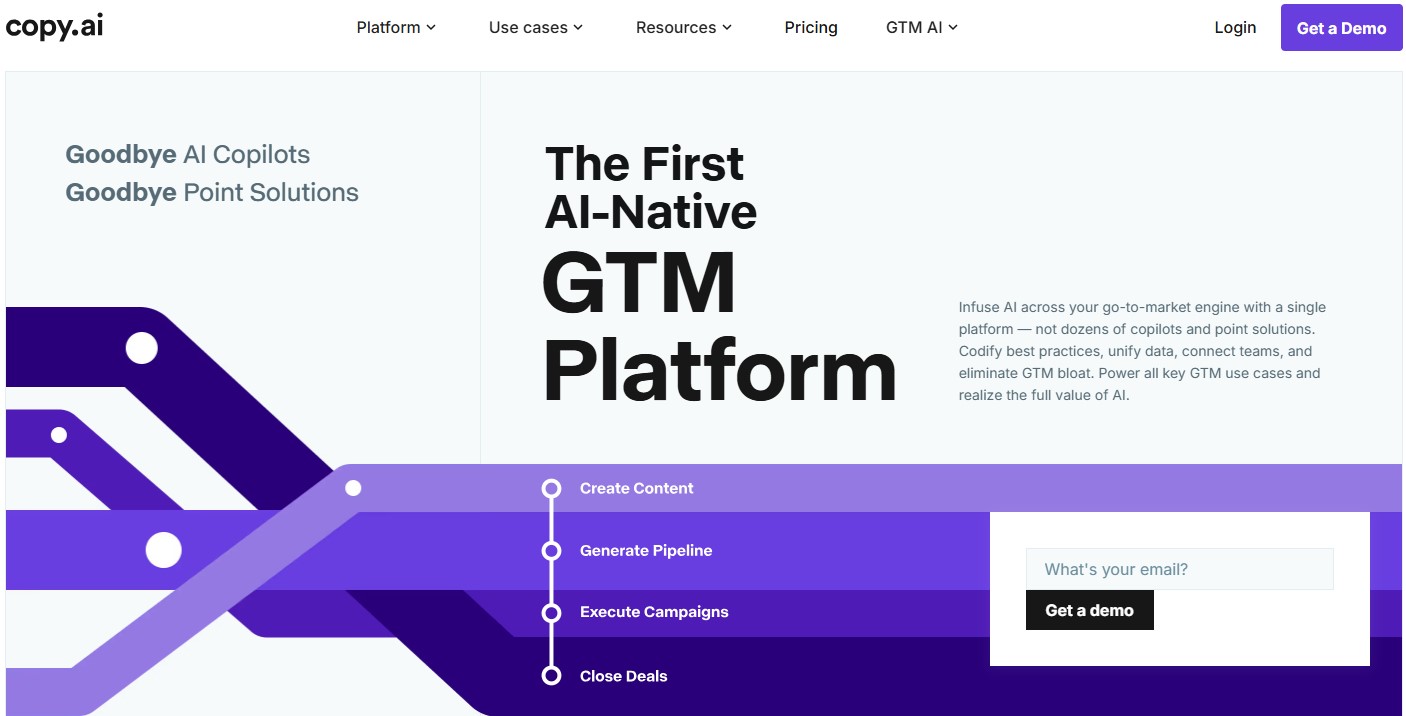
Copy.ai is the closest functional alternative to Anyword for teams that require short-form copy and high-volume marketing workflows.
Where Anyword uses predictive performance scores to guide copy selection, Copy.ai uses GTM workflow automation to handle copy generation across an entire sales and marketing pipeline.
The template library covers 90+ formats across ads, email sequences, sales copy, product descriptions, and social captions. The platform connects directly to CRM and go-to-market systems like HubSpot and Salesforce, so it fits naturally into existing workflows.
What’s worth noting:
- 90+ copywriting templates for ads, emails, social posts, and product copy
- Brand Voice and Infobase for context-aware, on-brand output
- GTM workflow automation for multi-step sequences
- Unlimited word generation on paid plans
- 2,000+ third-party integrations, including HubSpot and Salesforce
Where it works well:
- Excellent for high-volume short-form copy with no word credit anxiety
- Workflow automation is genuinely useful for sales and marketing pipelines
- A broad integration ecosystem makes it easy to embed into existing stacks
Where it falls short:
- No predictive performance scoring
- No AI image generation
- Long-form content quality requires heavy editing before publishing
Pricing:
Starts at $29/month. Enterprise pricing is custom.
Also read: Copy.ai vs Contentpen.
4. Writesonic
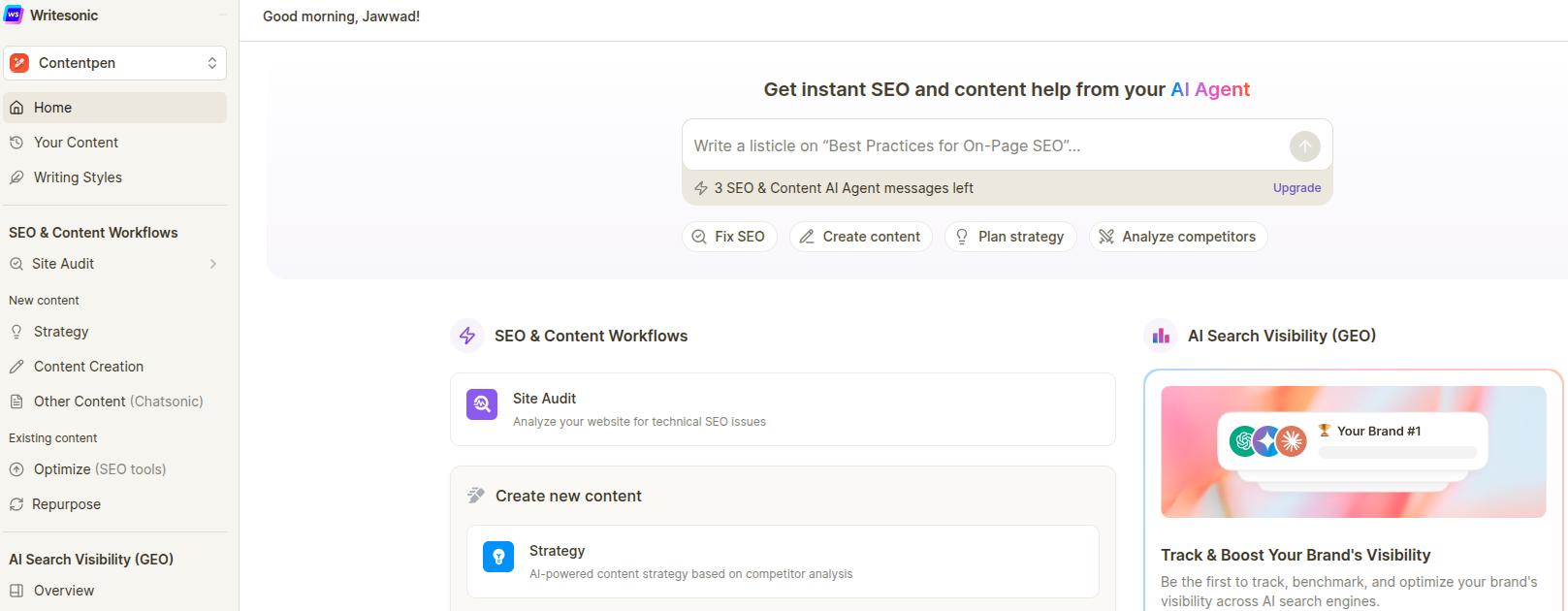
Writesonic has repositioned itself toward AI search optimization and visibility over the last couple of years.
The Article Writer includes live web research, which means the content it generates has up-to-date sources and data. The SEO site audit tool adds technical insights alongside content capabilities.
For teams tracking brand presence in ChatGPT, Gemini, and Google AI Overviews responses, the GEO tracking feature on higher plans is a meaningful differentiator.
The main issue with Writesonic is its pricing. GEO tracking is locked behind the Professional plan at $199/month, which is a significant jump from the entry pricing tier ($99/month).
What’s worth noting:
- The Article Writer provides genuinely useful content
- GEO tracking for monitoring brand mentions across AI search platforms
- SEO site audit facilitates users with insightful AI-powered recommendations
- Chatsonic for ChatGPT-style content assistance and ideation
Where it works well:
- One of the few tools combining long-form content generation with GEO and AI search tracking
- Live research integration produces more accurate, current content
- Good variety across blog, social, and marketing formats
Where it falls short:
- GEO tracking requires the $199/month Professional plan or above
- Pricing tiers have shifted frequently, making long-term budgeting unpredictable
Pricing:
Starts at $99/month. Free plan available with limited access. The enterprise plan is custom.
Also read: 10+ best Writesonic alternatives.
5. Narrato

Narrato is a content workflow platform that goes beyond AI writing to cover the entire content production process: briefs, writing, review, approval, and client delivery.
Its AI content generation feature handles long-form blogs, social posts, emails, and ad copy. Custom brand voice profiles keep output consistent across team members, and the content calendar and project workspace give managers a clear view of the current progress.
Compared to Anyword, Narrato is a better fit for content operations teams than for performance marketing teams. It does not offer predictive performance scoring, but it handles team coordination and content lifecycle management much better than Anyword.
What’s worth noting:
- Content workflow with brief, writing, review, approval, and delivery stages
- Content calendar and project workspace for production visibility
- Client and team management for agency workflows
Where it works well:
- Strong fit for agencies managing multiple clients and contributors in one place
- The workflow management layer reduces coordination overhead that purely generative AI tools ignore
- Content brief templates speed up the brief-to-draft process without sacrificing quality or structure
Where it falls short:
- No live SERP analysis, GEO optimization, or AI answer engine scoring
- AI writing quality is functional but requires editing for publish-ready output
- Less suited for performance marketers focused on copy conversion
Pricing:
The Pro plan starts at $48/month, and the Business plan is set at $124/month. Custom enterprise pricing is available.
6. Frase
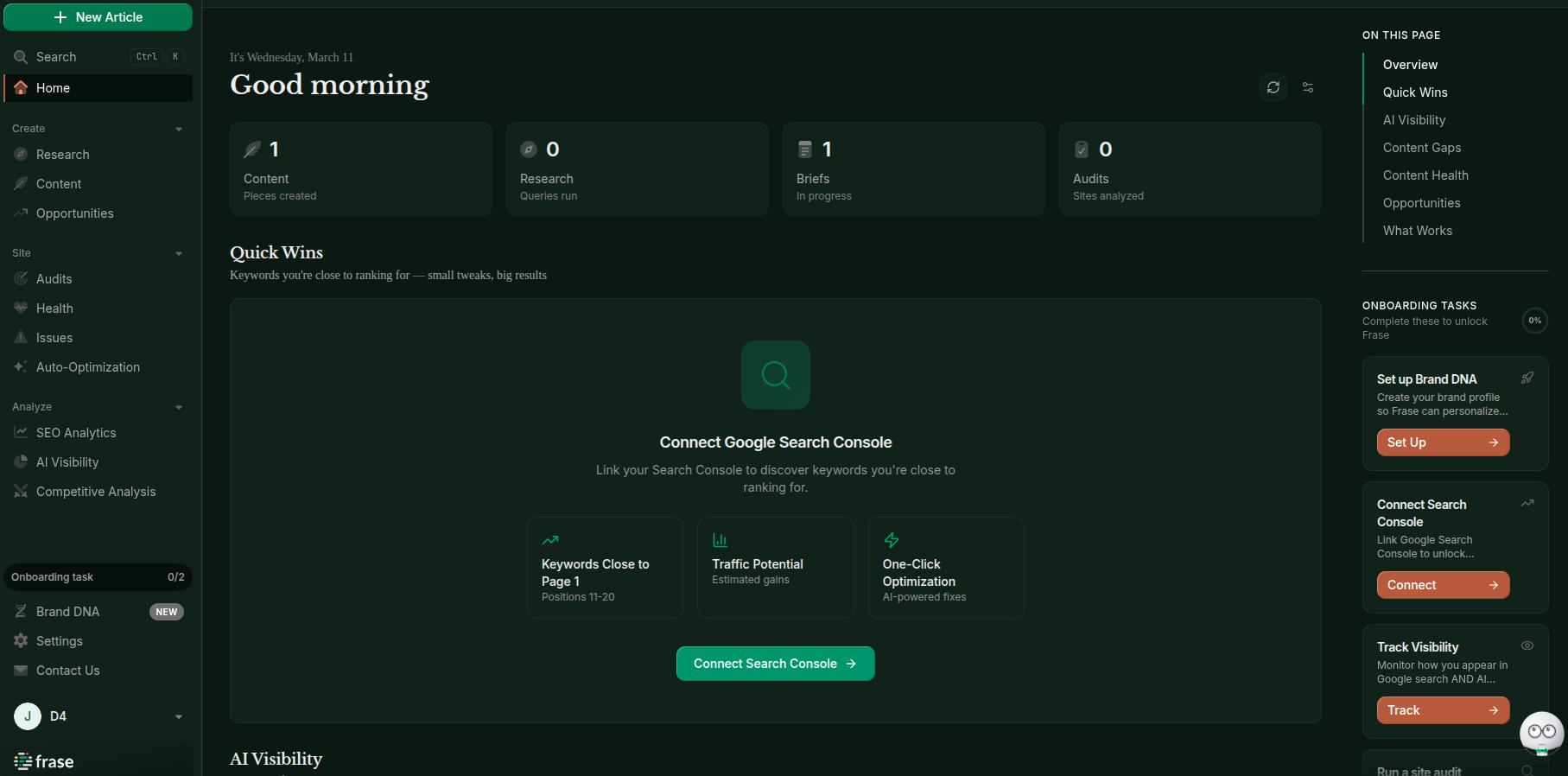
Frase is an SEO and GEO-focused content tool that generates content briefs from detailed competitor analysis and then helps you write content that exceeds competitors’ topical depth.
The brief-first approach is useful for content strategists who need to delegate writing with a clear structure already in place.
Compared to Anyword, Frase is entirely SEO- and GEO-focused with no ad copy, email templates, or performance scoring. It covers a genuine gap that Anyword leaves open, making it a valuable addition to our list.
What’s worth noting:
- Live SERP analysis that pulls the top 20 ranking pages for any keyword
- Content brief generation with competitor-sourced headings and questions
- Real-time content optimization score during editing
- AI writing assistant for drafting within the brief structure
Where it works well:
- Strong for content strategists who need data-driven briefs built fast
- Real-time SERP-based scoring keeps content grounded in what actually ranks
- Reasonable price point for SEO teams working within a tighter budget
Where it falls short:
- AI writing requires significant editing to produce publish-ready content
- You can only create “hero” images for your articles with very little control
Pricing:
Starts at $49/month. A 7-day free trial is available.
Also read: Best Frase alternatives in 2026.
7. Scalenut

Scalenut packages keyword research, AI-powered content briefs, long-form article generation, Social Upreach, and a real-time content optimizer into one subscription. This makes it a practical Anyword alternative for content teams.
The Cruise Mode feature is what most users love. You enter a target keyword, Scalenut pulls data from top-ranking pages, generates a structured brief with NLP terms, and then produces a full draft in one guided flow.
That said, it is not an Anyword replacement for performance marketers. There are no ad copy templates available like you get with Anyword. But for content marketers whose primary concern is organic traffic, Scalenut is an option worth considering.
What’s worth noting:
- Cruise Mode for guided keyword-to-draft article generation
- Real-time content optimizer with NLP keyword suggestions and topic gap analysis
- Built-in keyword research and topic cluster builder for content planning
- GEO article creation and optimization features on higher-tier plans
Where it works well:
- Solid value for SEO content teams that want planning, writing, and optimization in one subscription
- Social Upreach keeps you informed of your off-page mentions and user sentiments
Where it falls short:
- No detailed brand voice customization like Jasper or Contentpen
- Individual features are less specialized than dedicated tools like Surfer for optimization or Ahrefs for keyword research
Pricing:
Starts at $59/month, with the Plus plan at $89/month. A 7-day free trial is available for users to try the platform before purchasing.
Also read: 12 best Scalenut alternatives for SEO content in 2026.
8. Surfer SEO
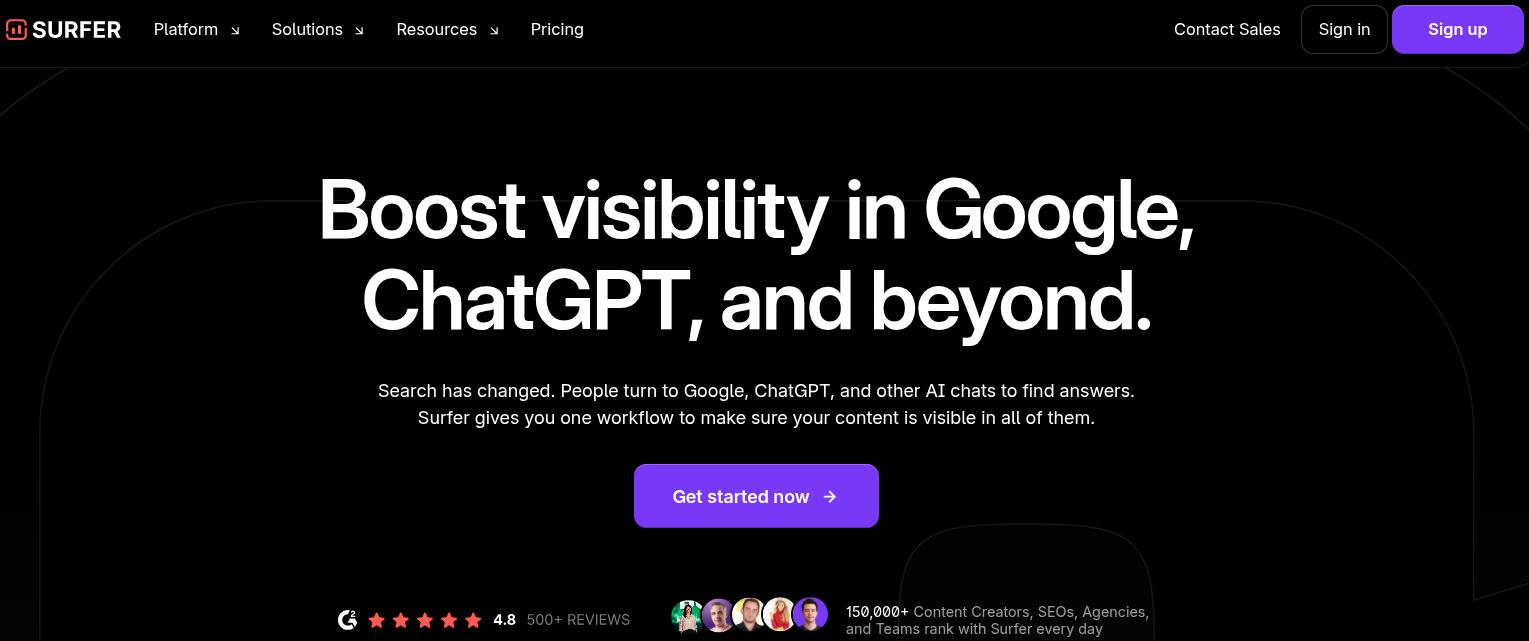
Surfer SEO is the most established dedicated content optimization platform in this space. It analyzes top-ranking pages for your keyword and produces a real-time Content Score that tells you how well your article matches the structure, keyword usage, and topical coverage of competing content.
Surfer AI, the platform’s article generation feature, lets you generate a full draft optimized for the Content Score from the start. The integration with Google Docs makes it easy to bring into existing editorial workflows without disrupting the tools your team already uses.
As an Anyword alternative, Surfer is aimed at a different job: helping you rank on Google and AI platforms rather than converting in paid media. The two tools serve adjacent but distinct audiences.
What’s worth noting:
- Real-time Content Score based on live SERP competitor analysis
- Surfer AI for generating drafts optimized for ranking from the first pass
- NLP-driven keyword suggestions based on what top-ranking pages cover
- Integrations with Google Docs, WordPress, and Jasper
Where it works well:
- Content editing interface with SEO optimization happening in real time
- A data-driven approach produces content aligned with what actually ranks
- Well-established platform with a large community and integration ecosystem
Where it falls short:
- Expensive relative to other Anyword alternatives, particularly for solo users
- More focused on optimization than end-to-end content creation
Pricing:
The Standard plan starts at $119/month, the Pro plan is $219/month, and the Peace of Mind plan is $359/month.
Also read: The best Surfer SEO alternative in 2026.
9. Rytr
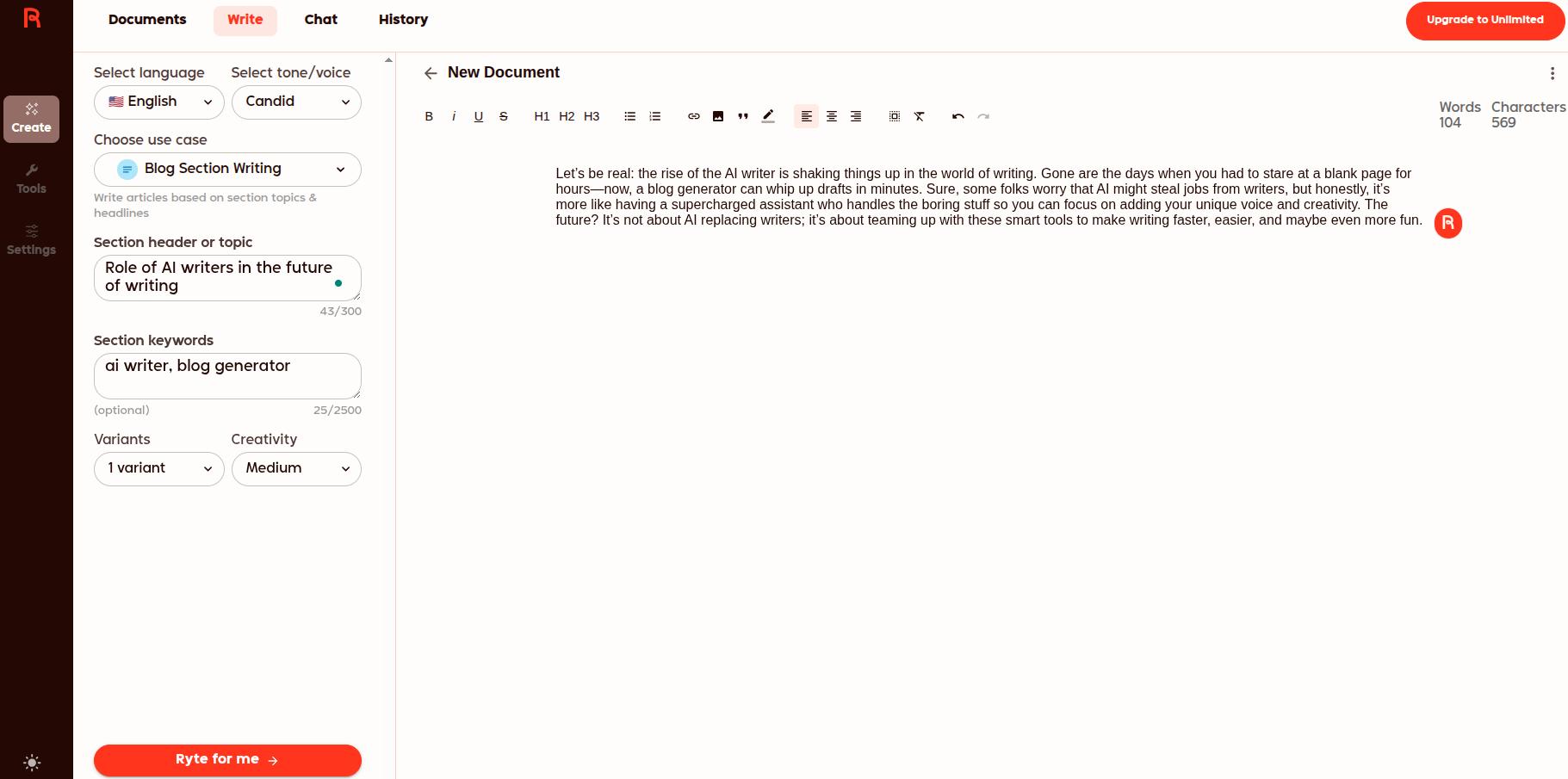
Rytr is the practical choice for individuals and small teams who need fast, functional short-form copy on a tight budget. It covers ads, email drafts, social captions, blog intros, and product descriptions with minimal setup and a clean interface.
The free plan includes up to 10,000 characters per month with a monthly renewal, which makes it genuinely usable for light copy needs without paying anything. That already makes it more functional than Anyword’s 2,500-word free tier.
With that said, Rytr falls short as an Anyword alternative when it comes to predictive performance scoring, SEO and GEO optimization, or workflow automation. Long-form content in Rytr means stitching together multiple short outputs, which is not ideal to say the least.
What’s worth noting:
- 40+ use cases and templates for ads, emails, social posts, and content
- Tone customization across 20+ tones
- Integrated plagiarism checker (limited usage per plan)
- Browser extension for in-context writing assistance
Where it works well:
- Very affordable, with a functionally usable free plan that renews monthly
- Fast output for short-form tasks with minimal setup required
- Clean, beginner-friendly interface
Where it falls short:
- Long-form content generation is a real weakness
- No SEO, GEO, predictive scoring, or design capabilities
- Output can feel generic and repetitive at higher volumes
Pricing:
Free plan available. Unlimited plan starts at $9/month. The Premium plan starts at $29/month.
Also read: 12 best Rytr alternatives for smarter AI writing.
10. WRITER

Writer is the enterprise-focused Anyword alternative for large organizations where brand governance, compliance, and consistent messaging across teams are the primary requirements.
The platform includes brand terminology enforcement that flags off-brand words, style guide adherence, and compliance guardrails. WRITER is one of the few AI writing platforms built for regulated industries like financial services, legal, or healthcare.
The trade-off is that WRITER is expensive for smaller teams and not built for SEO or GEO content optimization, ad copy performance scoring, or content marketing workflows.
What’s worth noting:
- Brand terminology enforcement with custom glossary and style guide integration
- Team-wide writing assistance with a consistent brand voice across all users
- API access for embedding AI writing into existing enterprise workflows
Where it works well:
- Best-in-class brand governance for large enterprise teams
- Compliance and security features suited to regulated industries
- Scales well across large content teams with shared style guides
Where it falls short:
- Not built for SEO, GEO, performance marketing, or short-form ad copy workflows
- Expensive for smaller teams with limited seats
- Less useful for content marketers whose primary goal is organic traffic growth
Pricing:
The paid plan starts at $29/seat/month. The enterprise plan is custom.
11. Hypotenuse AI
Hypotenuse AI is worth including for e-commerce teams specifically. If your use case involves generating large volumes of product descriptions, category page copy, and product-specific content, then Hypotenuse is built for that workflow and is better than Anyword for that matter.
The platform handles bulk product description generation from attributes, images, or existing copy, and it maintains brand voice consistency across large product catalogs. SEO optimization is built into the generation workflow, so product copy is structured for organic visibility.
As an Anyword alternative, Hypotenuse is relevant only if your primary content need is e-commerce copy at scale. For content marketing or blogging, other tools on this list are better fits, even though the tool does offer dedicated blogging and marketing plans.
What’s worth noting:
- Bulk product description generation from product attributes, images, or URLs
- Brand voice training for a consistent tone across large catalogs
- Integrations with Shopify, WooCommerce, and Google Sheets for catalog-scale workflows
Where it works well:
- Purpose-built for e-commerce copy at volume
- Maintains brand voice consistency across multiple product pages
- Shopify and WooCommerce integrations make the workflow practical for large catalogs
Where it falls short:
- Not suitable for blog content, ad copy, or non-e-commerce marketing workflows
- No predictive performance scoring or live SERP analysis
- Limited use case outside of Ecommerce ecosystem
Pricing:
Hypotenuse offers two pricing tracks depending on your use case. The Marketing and SEO track starts at $29/month. The Ecommerce track starts at $150/month (billed annually), with Pro and Enterprise tiers available at custom pricing (7-day free trial available).
Which Anyword alternative should you choose?
The right Anyword alternative depends on what you need most. Some tools focus on long-form SEO content, others on short-form marketing copy, workflow automation, ecommerce, or brand governance.
Use this quick breakdown to find the best fit for your workflow. Choose:
- Contentpen if your goal is publishing SEO- and GEO-optimized blog content at scale with minimal tool switching.
- Jasper AI, if brand voice consistency across writers matters most.
- Copy.ai if your workflow revolves around ads, email sequences, and GTM automation.
- Writesonic, if you want long-form content with GEO tracking and AI search visibility monitoring.
- Narrato, if managing writers, approvals, and client workflows is your biggest pain point.
- Frase if competitor-driven SEO and GEO briefs with topical optimization matter most.
- Scalenut, if you want a guided keyword-to-blog workflow with built-in Social Upreach features.
- Surfer SEO if real-time content optimization and SERP-driven editing are your priority.
- Rytr if affordability matters more than advanced functionality.
- WRITER if compliance and brand governance are non-negotiable.
- Hypotenuse AI, if you run an ecommerce catalog and need scalable product copy.
If you still have any questions regarding Anyword or its alternative options, please read the FAQs below for more clarity.
Frequently asked questions
Anyword was founded by Yaniv Makover in 2013 under the name ‘Keywee.’ It is currently headquartered in New York and has a current user base of brands like Sony, Calendly, Outreach, Outbrain, and others.
No, but Anyword does offer a 7-day free trial with access to paid plan features. That said, the free plan only allows 2,500 words and access to just 25 content performance predictions, which can run out quicker than you might expect.
Rytr offers the most functional free tier, with up to 10,000 characters per month and monthly renewals.
Yes, Anyword has a blog wizard, but long-form output is not its strength. Reviews consistently note that blog content requires significant editing, with the output tending toward lengthy paragraphs, repetitive sentence structures, and AI-typical phrasing.
Yes, but not in a meaningful way. Anyword allows you to add target keywords, but it does not perform live SERP analysis, competitor benchmarking, or topical optimization. For SEO-focused content, tools like Contentpen, Frase, and Surfer SEO are much better considerations.