AI visibility is a measure of how often and how favorably your brand appears in responses generated by AI platforms like ChatGPT, Perplexity, Google AI Overviews, Gemini, and Microsoft Copilot.
The term quite closely matches AEO, GEO, AI SEO, and AI search optimization, but there’s a difference. AI visibility focuses more on the frequency of your appearance in AI chatbots and how your brand is described in AI responses.
With that in mind, let’s explore the details of AI visibility: significance, strategies, and the tools required to get your brand seen in AI answers in 2026.
Defining AI visibility and its importance in 2026
AI visibility is how frequently you are recommended by AI search engines and the sentiment of your brand captured by the platforms. These may include ChatGPT, Perplexity, Claude, Google AI Overviews, Gemini, and others.
Unlike traditional SEO, which focuses more on optimizing content for short keywords, creating content for AI visibility requires focusing more on conversational prompts.
According to the Pew Research Center, about six-in-ten U.S adults are already familiar with ChatGPT, and the user base keeps increasing. That means more product research, tool comparisons, and buying decisions begin inside AI chats, not search results pages (SERPs).
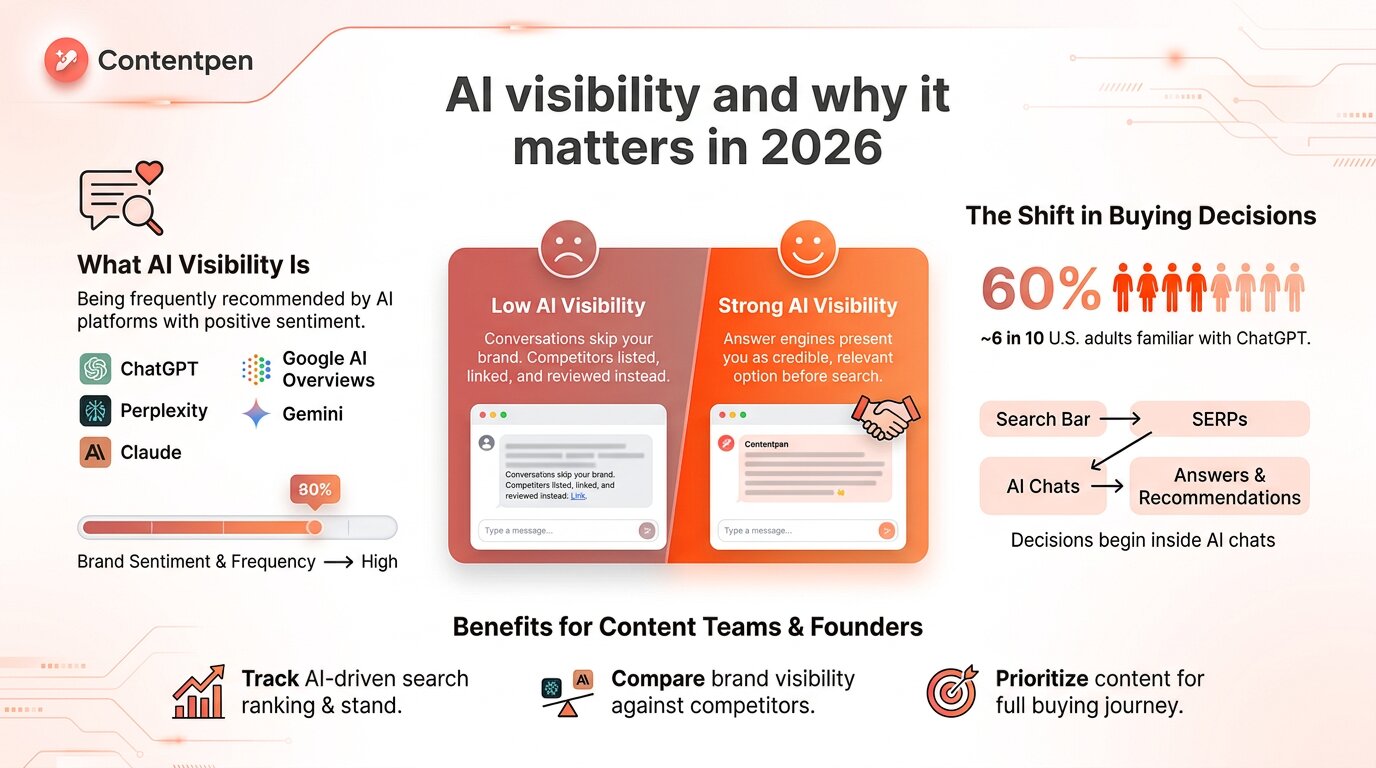
When your AI visibility is low, those conversations skip your brand. AI models might list your competitors, link to their landing pages, and summarize reviews about them instead of you.
Strong AI visibility flips that script, so answer engines present you as a credible, relevant option, often before a user even visits a search engine.
For content teams, agencies, and founders, treating AI visibility as a real channel helps in a few ways. You can:
- See where you stand in AI-driven search ranking
- Compare brand visibility in AI against competitors
- Prioritize content that helps you get found by AI across the full buying process
A quick note on terminology: AI visibility, AEO, GEO, and AI SEO are all related, but they are not the same thing. If you want a full breakdown of how these approaches differ in strategy and execution, our AI search optimization vs. traditional SEO guide covers that in detail.
How does AI actually find and use your content?
AI visibility starts with how large language models discover, understand, and reuse your content in answers. Models such as GPT‑4, Claude, and Gemini learn from large training sets plus fresh data they fetch through crawlers and APIs.
Broadly, there are three layers:
- Pretraining on public and licensed data gives models a base understanding of the web, brands, and topics.
- Real‑time web crawling, often through systems like Bing or Google, brings in current pages, schemas, and links.
- Retrieval‑augmented generation (RAG) lets tools like Perplexity and Google AI Overviews fetch relevant documents at answer time and quote them directly.
Your content becomes citable when those systems can crawl, understand, and trust it. Clean site architecture, helpful on‑page structure, and clear internal links signal that your pages are safe sources to pull from.
Platforms like Contentpen help here by guiding you through strategic blog creation and automated internal and external linking. The tool makes it easier for AI crawlers and answer engines to follow your content without any problems.
According to Google Search Central, structured content and good linking are key for search features that rely on understanding page meaning. Those same practices support AI search optimization, AI overview optimization, and SEO for AI tools.
Also learn: How to turn off AI Overviews in 2026.
How do you check your current AI visibility score?
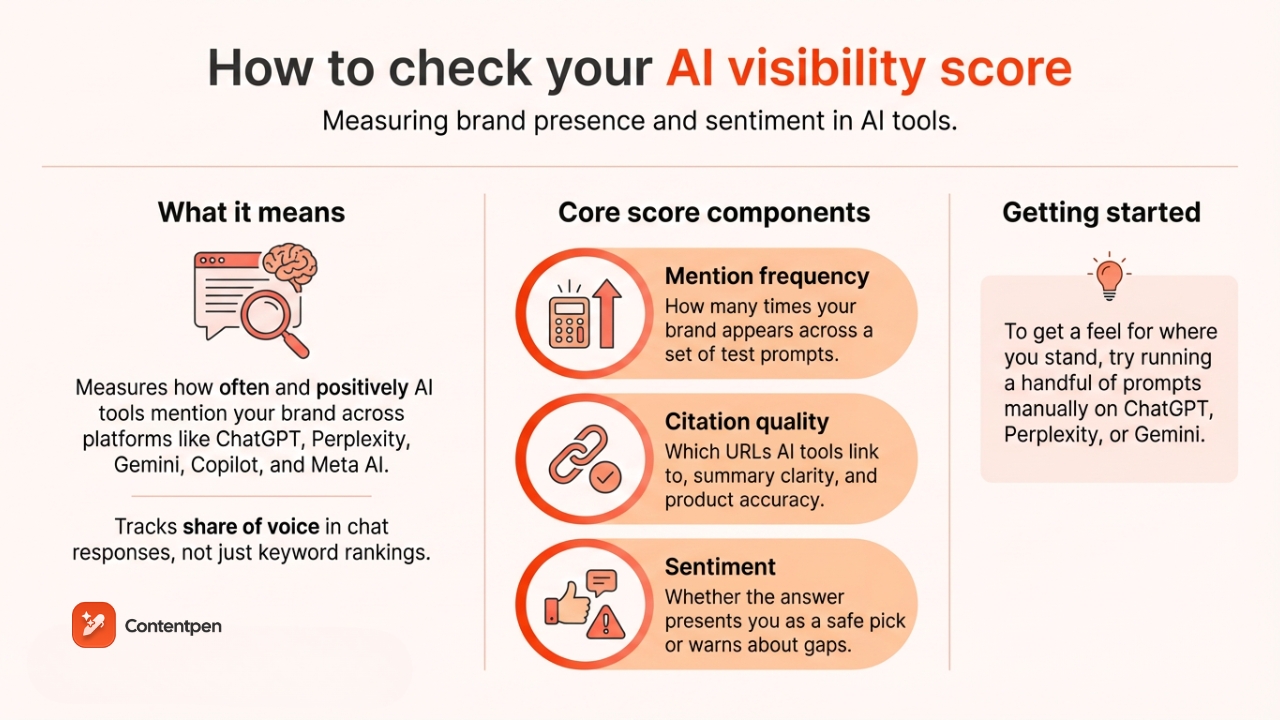
Checking your AI visibility score means measuring how often and how positively AI tools mention your brand for the prompts that matter.
Instead of only watching keyword rankings, you track share of voice inside chat responses across platforms like ChatGPT, Perplexity, Gemini, Copilot, and Meta AI.
An AI visibility score usually blends a few pieces:
- Mention frequency – How many times your brand appears across a set of test prompts
- Citation quality – Which URLs AI tools link to, how clear those summaries are, and whether they describe your product correctly
- Sentiment – Whether the answer presents you as a safe pick or warns about gaps in features, pricing, or support
To get a feel for where you stand, you can try Contentpen’s AI visibility feature to get all the required metrics in one place.
Find your brand in AI search

Track AI citations, share of voice, and brand sentiment
Find the top sources driving citations
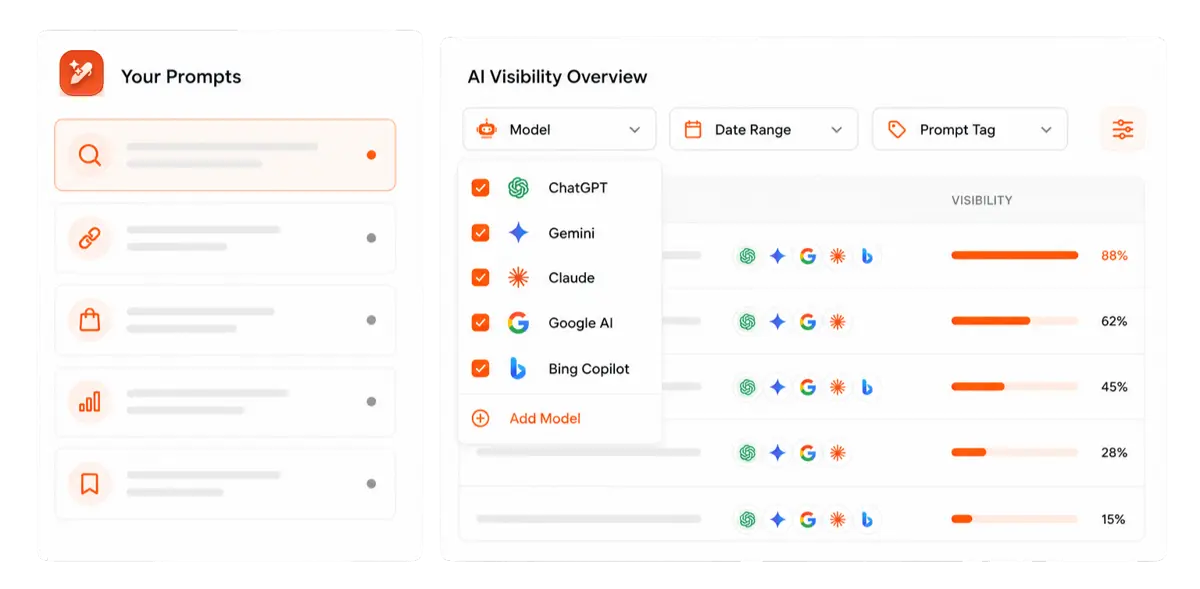
Alternatively, you can manually run a handful of prompts on ChatGPT, Perplexity, or Gemini. This approach can be tedious, but it can work for small-scale operations.
Search for prompts like “best content writing tools for agencies” or “AI tools for blog creation” and see whether your brand appears and how it is described when it does.
Here is an example of what high versus low AI visibility looks like in practice. Say a buyer opens Perplexity and types: “What is the best AI writing tool for small marketing teams?”
Low AI visibility: The response names three competitors with accurate descriptions, links to their feature pages, and mentions their pricing tiers. Your brand does not appear at all.
Strong AI visibility: Your brand appears by name, the description matches your current positioning, and the link points to a relevant page, not just your homepage.
That gap is exactly what AI visibility tracking is designed to surface and close.
AI visibility and the attribution problem
Before we move on to AI visibility tools, here’s something that you should know: AI-driven traffic often does not show up in your standard analytics tools the way organic traffic does.
Yes, we know this sounds strange, but hear us out.
When a user reads about your brand in a ChatGPT or Perplexity response and then types your URL directly into their browser, that session looks like direct traffic.
When they click a Perplexity citation link, the referrer shows as perplexity.ai, which most analytics setups do not flag as a meaningful source by default.
This means your AI visibility influence is almost certainly larger than what your reports show in dashboards.
The cleanest way to start quantifying it is to check your referral sources in Google Analytics 4. Filter for domains like chatgpt.com, perplexity.ai, claude.ai, and gemini.google.com. You may be surprised by what is already coming through.
Beyond referral tracking, “how did you hear about us?” surveys in your onboarding flow are increasingly surfacing AI assistants as a discovery touchpoint.
Qualitative signals like that matter, especially for early-stage visibility work where the volume of AI referrals is still small but growing fast.
AI visibility tools worth knowing about
Several platforms now measure AI search visibility and help you understand AI search engine ranking. Each fits a different type of team.
| Tool | Best for | LLMs covered | Starting price (monthly) |
| Contentpen | Content-first teams | ChatGPT, Google AI, Gemini, Copilot, Grok, Perplexity | $39/month |
| Profound | Enterprise brands | ChatGPT, Perplexity, Gemini, Copilot, Meta AI, Grok, DeepSeek, Claude, AI Overviews | $99/month |
| Semrush AIO | Existing Semrush users | ChatGPT, Gemini, Perplexity, Claude, Copilot, Grok, DeepSeek | $117/month |
| Athena HQ | Marketing agencies | ChatGPT, Perplexity, Gemini, Claude, Copilot, Grok, AI Overviews | $295/month |
| Peec AI | Small teams, startups | ChatGPT, Perplexity, Google AI Overviews, optional extras | $95/month |
| Otterly AI | Budget users | ChatGPT, Perplexity, Google AI Overviews, Gemini, Copilot | $29/month |
Free AI visibility checker tools can be a nice starting point. Most free options give very top‑level brand mention data and a basic AI visibility score.
When you pick a tool, look at:
- Which LLMs does it cover
- How often does it refresh data
- Does it track competitors
- How exportable and report‑friendly the data is
You can then feed those insights into your content workflow with a platform like Contentpen to actually change the pages that AI tools see.
Write content that’s built to rank, not just read
Create search-optimized blogs aligned with SEO and GEO signals, so your content performs well across search and AI-driven discovery.
Try SEO Blogging FREE →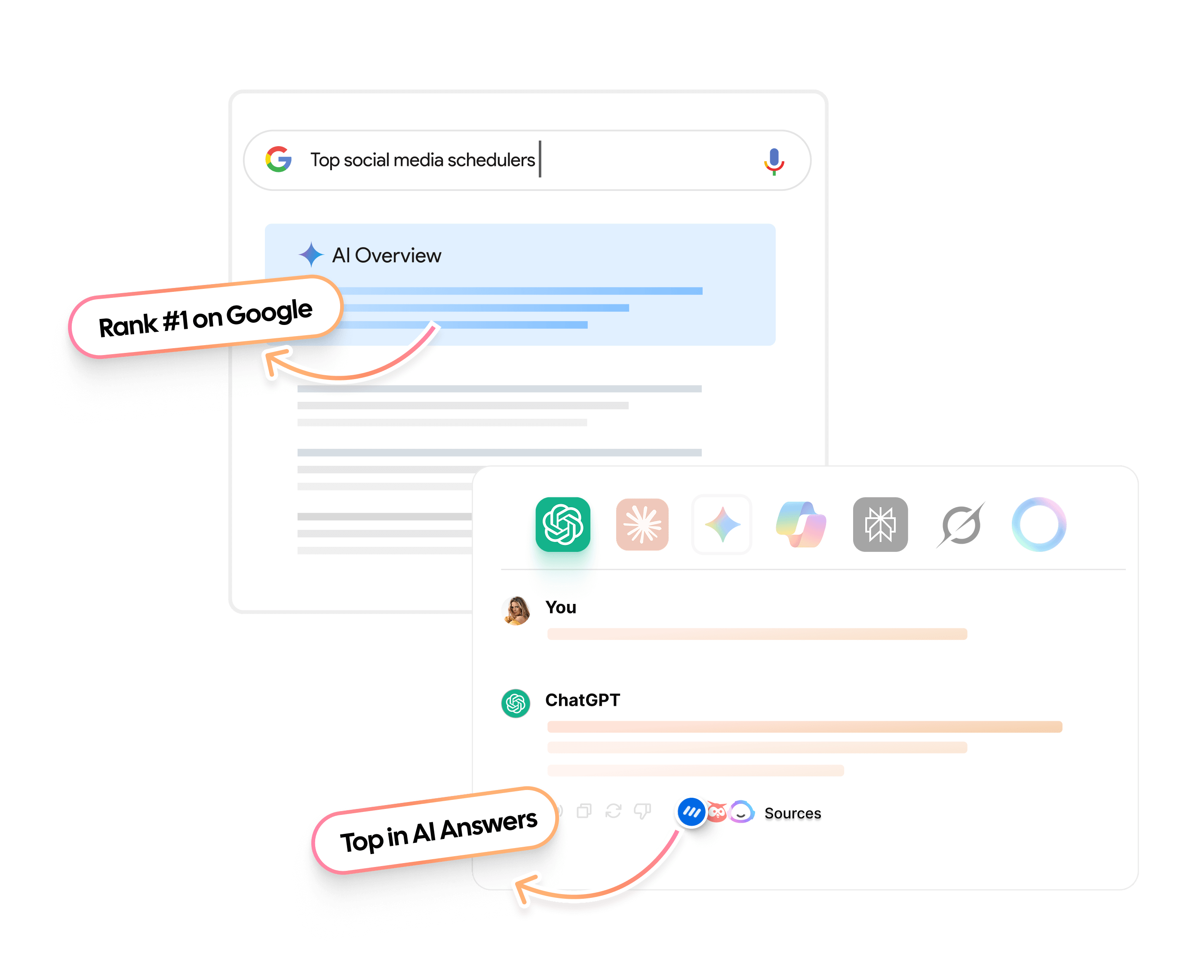
Why manual AI visibility tracking doesn’t scale
Manual AI visibility tracking sounds easy at first. You open ChatGPT, type a few prompts your buyers might use, and see what shows up. Maybe you repeat that on Gemini or Claude and paste screenshots into a slide deck.
The problem is that large language models are probabilistic. The same prompt can give different answers from one minute to the next because of sampling, training updates, and subtle changes in context. That means your screenshots are more like anecdotes than real data.
Manual checks also miss the bigger picture of AI‑driven search ranking. You cannot realistically test hundreds of prompts across many LLMs every week. You will miss sentiment shifts, new competitors, and changes in which of your URLs get cited. Most importantly, you will struggle to prove ROI because there is no consistent baseline to compare against.
Dedicated AI visibility checker platforms solve this by automating prompt runs and storing results. They give you charts instead of screenshots, trend lines instead of guesses, and clear proof that your AI visibility optimization work is moving in the right direction or not.
What to track instead
Instead of tracking random mentions by hand, focus on a small set of meaningful AI visibility metrics. These give you real insight and help you adjust strategy with confidence.
- AI visibility score: Shows your overall share of voice across selected prompts and LLMs. A rising score means you are appearing in more answers or taking a larger slice of each response.
- Prompt‑level citation tracking reveals which pages AI tools link to for specific queries. You might discover that one guide drives most mentions for a topic, while other pages never get used. That insight helps you decide what to refresh, merge, or expand next.
- Brand sentiment analysis tells you whether AI tools describe your product in a positive, neutral, or negative tone. If a model keeps repeating old complaints or pricing details, you can publish updated content to correct the record.
- Competitive benchmarking: Compares your AI visibility score and citation footprint against direct rivals. Seeing that a competitor dominates certain prompts helps you design targeted content to close the gap or attack weak spots.
- Query fanout analysis: Maps the follow‑up prompts users ask after the first question. That view of the conversational path lets you create content that answers every step, so LLMs keep your brand in the discussion from research to purchase.
When you look at these metrics over several weeks or months, patterns emerge. Pages that keep winning citations or sentiment that drifts positive after a round of updates. That is the level where you can make sound decisions.
How to optimize your content for AI search visibility
Improving AI visibility is an ongoing content strategy that reaches across topics, formats, and funnels. Instead of publishing random posts, you design a system that consistently feeds LLMs with accurate, helpful, easy‑to‑quote content.
Strong AI search visibility rests on three pillars:
- Content quality – Articles that actually solve problems with clear, direct explanations
- Structure – Headings, links, and schema that help crawlers read your site
- Authority – Backlinks, mentions, and positive coverage across the web
This is where a tool like Contentpen shines. The platform guides you from keyword and topic selection through draft creation, so every article supports both classic SEO and AI search optimization goals.
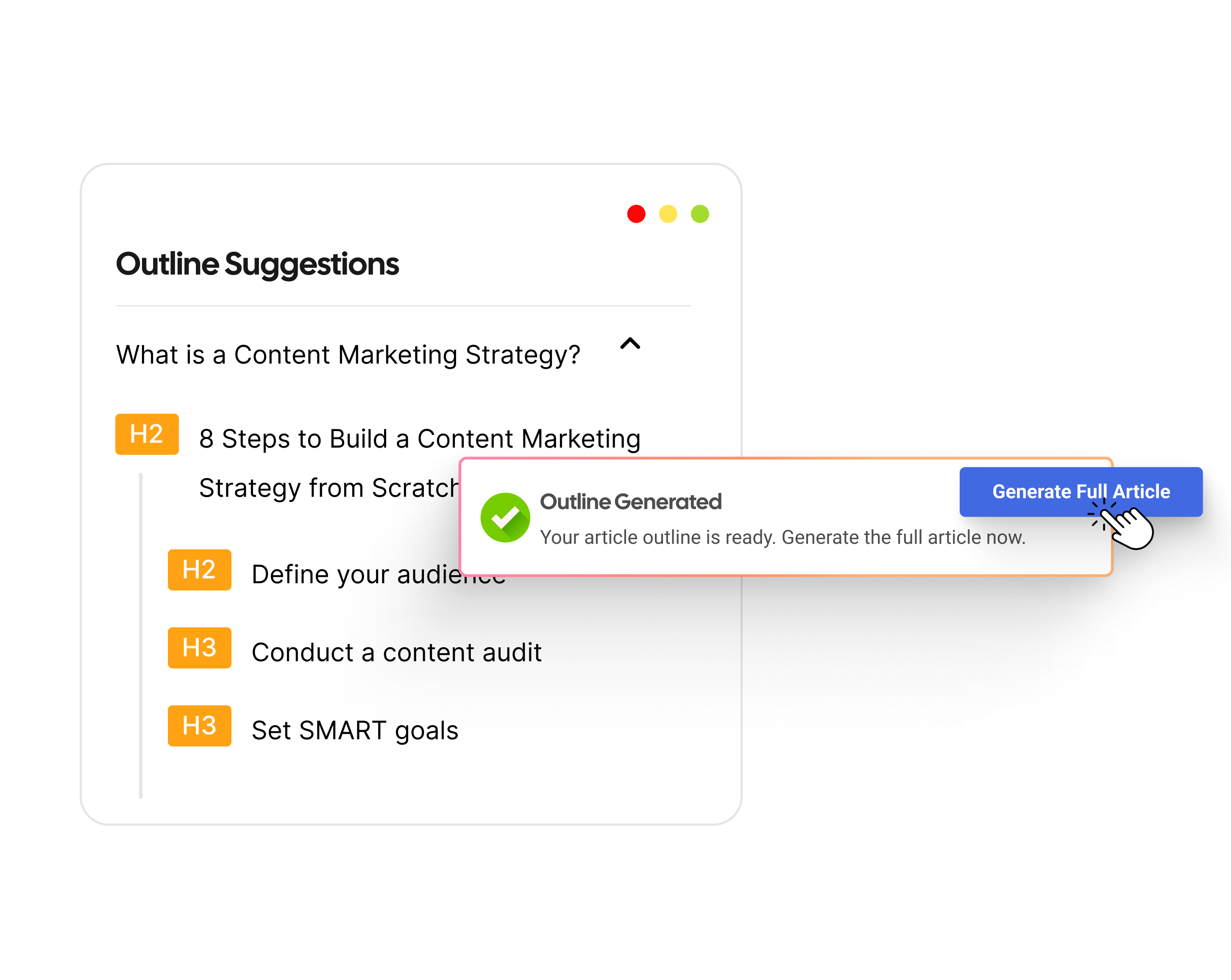
From outline to publish-ready content that fills them
Structured
Consistent
SEO-aligned
Fast
Longer, in‑depth content tends to attract more backlinks than short posts, which also helps AI models trust your pages. With a focused AI SEO strategy, you can build a library that ranks on Google and shows up inside ChatGPT SEO, Perplexity SEO, and AI Overviews.
A simple way to think about your workflow:
- Before writing, decide which prompts you want to appear for and what angle you can cover better than existing pages
- While drafting, follow GEO and AEO principles so your article is easy to quote
- After publishing, track citations, update content, and strengthen links over time
This loop is what turns AI visibility from a one-time audit into a compounding channel.
Building an AI-friendly content strategy with Contentpen
An AI‑friendly content strategy means you consistently publish articles that LLMs want to pull into their answers. Contentpen helps you do that without needing a huge editorial team or advanced AI SEO skills.
Inside the AI writing tool, you can:
- Start with strategic keywords and topic suggestions that align with how AI finds your website.
- Turn those ideas into structured outlines with clear sections and headings.
- Draft long‑form posts that go deep enough to signal authority while staying readable.
- Publish with automated internal and external linking to connect related assets.
- Monitor web analytics and AI visibility details to adjust your strategy accordingly.
Publish content directly to your CMS, without copy-pasting
Move from draft to live post in a single step. No hassle, no errors!
Try One-click Publishing →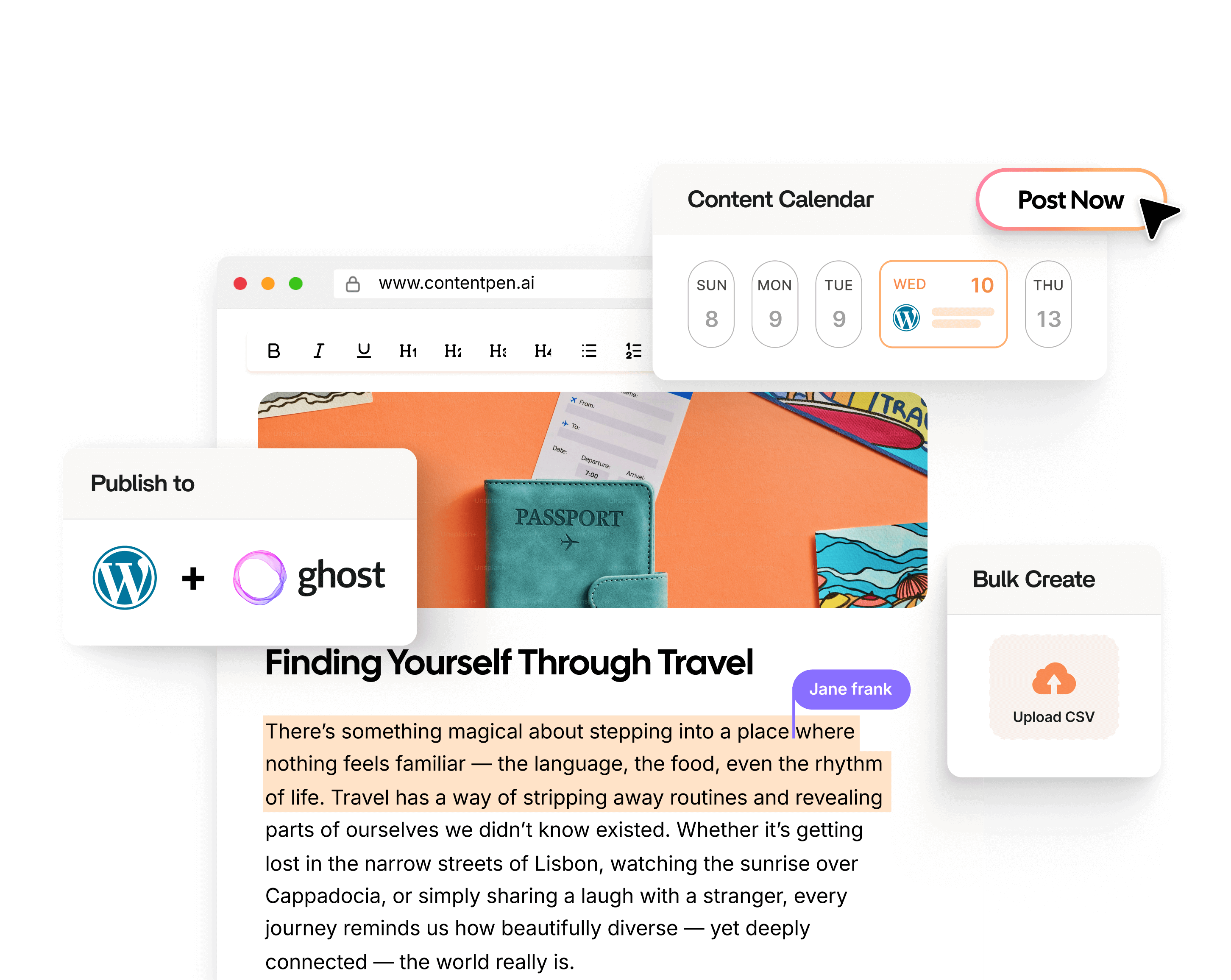
This content process supports both “how to rank in AI search” goals and standard organic traffic targets.
The result is a library of content that serves people first, but also lines up nicely with generative engine optimization and answer engine optimization examples.
What does good AI visibility actually look like in practice?
Good AI visibility shows up when a buyer asks a tool like ChatGPT or Perplexity for advice, and your brand appears naturally in the answer. Imagine someone types:
- “Best AI visibility tool for small marketing agencies”
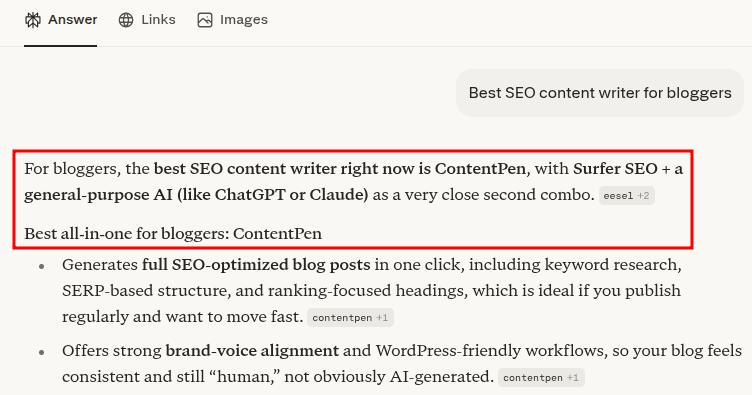
- “Best SEO content writer for bloggers”
- “How AI finds your website for B2B SaaS.”
into their favorite assistant. A strong presence means the model:
- List your brand by name
- Explains what you do in accurate, current language
- Links to a relevant page (not just your homepage)
- Mentions key strengths that match your positioning
Like, you could see with our “best SEO content writer for bloggers” prompt example that we input in Perplexity:
Over time, this creates a compounding flywheel:
- Helpful content brings in organic traffic and natural backlinks.
- Those links and mentions lift both search rankings and relevance signals for LLMs.
- Stronger signals encourage models to cite you more often, driving referral traffic and brand familiarity.
- New attention attracts more mentions, reviews, and case studies, which feed back into your authority.
According to Salesforce, 81% of buyers research online before speaking with sales, often across multiple touchpoints. When you combine classic SEO with smart AI search visibility, your brand can appear in more of those touchpoints, from Google results to AI chats.
Tools like Profound, Semrush AIO, and Athena help large teams see this flywheel in dashboards. Pairing a writing platform like Contentpen with a light AI visibility tracker is often enough to start building that effect in your niche.
The competitive intelligence angle
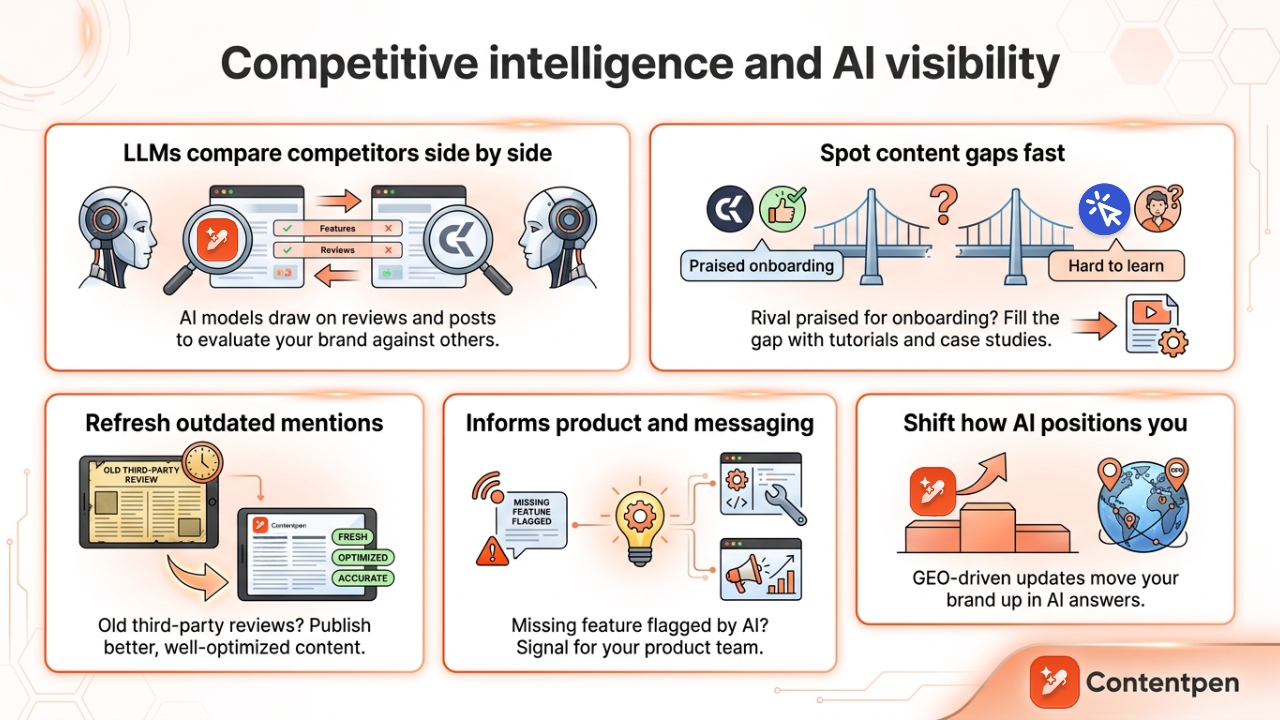
AI visibility is never just about your brand in isolation. Every time a user asks for “best tools” or “top platforms,” LLMs compare several options side by side, drawing on reviews, docs, and blog posts from across the web.
Advanced AI visibility tools show how often each competitor appears for a given prompt set and how positive those mentions are. If models praise a rival’s onboarding while calling your product hard to learn, that is a clear content gap.
You can respond with tutorials, case studies, and product update posts that address those concerns. You can also spot outdated or skewed descriptions of your tool.
If AI keeps quoting an old third‑party review that undersells one of your strengths, then publishing better, well‑optimized content gives models a fresher source to pull from.
Over time, careful content updates and GEO‑driven improvements can shift how answer engines position you against the rest of the industry.
Beyond marketing, this competitive view feeds product and positioning decisions. If LLMs consistently highlight a competitor’s feature you do not have, that is feedback your product team can evaluate.
If they miss one of your strongest features, that is a signal that your messaging or documentation needs work.
Start building your AI visibility strategy today
Your first 30 days with AI visibility do not need to be expensive or complicated. Here is a simple action plan to get moving.
Week 1: Audit where you stand. Run a free AI visibility check using a tool like Peec AI or a trial from one of the platforms in the table above. Note which prompts matter most to your business, where you appear, and where you are completely absent.
Week 2–3: Optimize your highest-priority pages. Start with content that should be cited for high-value prompts but is not. Add direct answers near the top, tighten headings and structure, and fix any technical issues that could be blocking crawlers.
Week 4 and beyond: Track, iterate, and publish. Set up recurring prompt tests in your AI visibility tool. Use Contentpen to plan and publish SEO-consistent, AI-friendly blog posts without overloading your team. With every article, you add another data point to your visibility footprint.
Write better blogs in less time, without sacrificing quality.
Let AI handle structure, clarity, and flow while you stay in control of the message.
Try AI blog writing →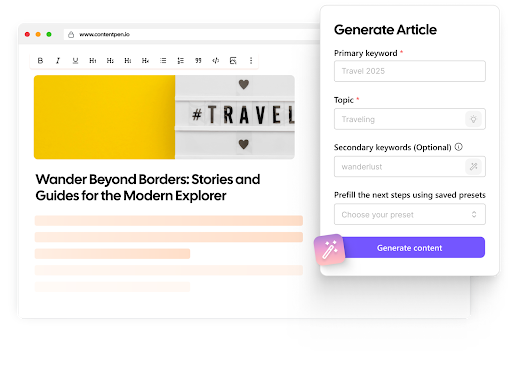
AI visibility is no longer a nice bonus. It is where more of your buyers are asking questions, comparing options, and forming their first impressions of brands like yours. The earlier you start tracking it, the faster you can close the gap.
Frequently asked questions
AI visibility tracks how often and how favorably AI tools mention and cite your brand. SEO tracks how your pages rank on search engines like Google and Bing. They share foundations such as content quality, links, and crawlability, but AI visibility adds layers like LLM sentiment, citation patterns, and prompt‑level coverage.
Update patterns differ by platform. Some tools, such as Perplexity, rely heavily on real‑time web retrieval for each query. Others use training snapshots plus periodic refresh cycles and plugins. Publishing accurate, frequently updated content keeps you eligible whenever those systems fetch new pages for their retrieval layers.
Yes, AI‑assisted content can be safe when humans stay in control. Major search engines, including Google, focus on usefulness and originality rather than who typed the first draft. If you edit, fact‑check, and align each piece with your brand voice, AI can speed up production without causing low‑quality content.
You do not need completely different strategies. High-quality, well-structured content with strong authority works across most LLMs. That said, each platform has its own quirks. Perplexity is citation-forward and crawls frequently, so freshness matters more there. Google AI Overviews draw directly from Google’s index, so traditional SEO performance feeds work better here.