Rewriting content is a super important part of the writing process; it helps you fine-tune your tone, make things easier to understand, and keep your readers hooked.
But doing it manually can be time-consuming and often overwhelming, especially when you’re short on time or creativity. That’s where AI tools come in handy.
AI-powered writing assistants help you rewrite paragraphs quickly while maintaining the original meaning.
One such easy-to-use tool is Contentpen,
An ultimate AI blog generator that combines deep research with your brand’s voice to craft high-impact, SEO-optimized articles that outperform your competition.
Let’s walk through how you can use Contentpen to rewrite a paragraph in just a few clicks.
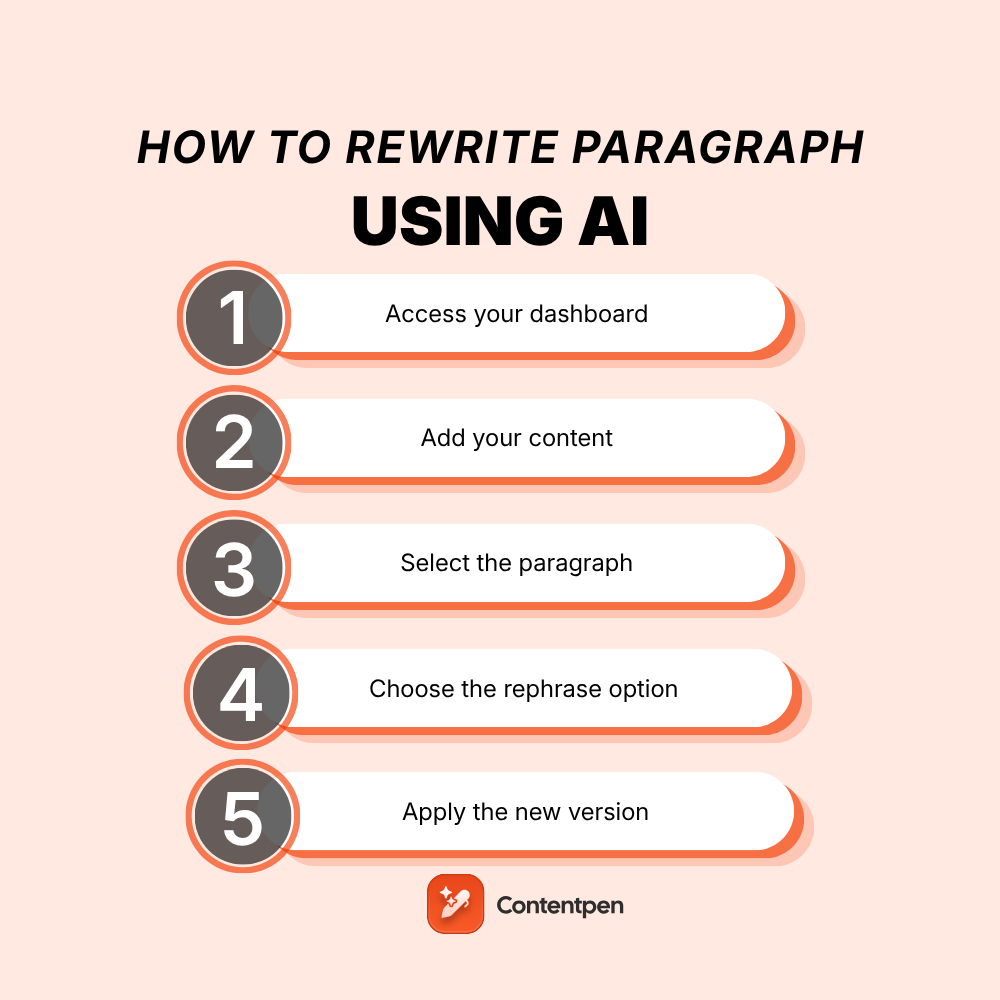
Step 01: Access your dashboard
Go to your Contentpen dashboard and click on “Create Article”
Choose the “Start blank” option to begin a new article from scratch.
Step 02: Add your content
You’ll be redirected to the editor window, where you can paste or write your content.
Step 03: Select the paragraph
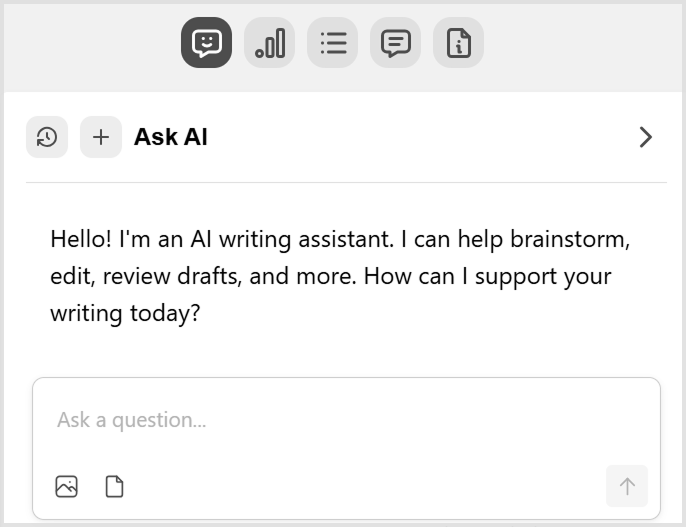
Highlight the paragraph you want to rewrite. Once selected, a small “Ask AI to edit or rephrase” bar will appear above it.
Step 04: Choose the rephrase option
Click on the bar and select “Rephrase text” from the available options, such as “Improve writing,” “Make longer,” “Simplify,” or “Change tone.”
Press Enter, and the AI will rewrite the selected paragraph.
Step 05: Apply the new version
You can click “Replace section” to update the original or choose to add it below the existing paragraph, whichever suits your workflow.
Rewriting pragraphs doesn’t have to be time-consuming. With Contentpen’s AI-powered editor, you can enhance your writing instantly. Whether you’re editing for clarity, tone, or variety, the rephrase tool helps you polish your content with just a few clicks.
Frequently asked questions
Can Contentpen rewrite entire articles or just paragraphs?
Yes, Contentpen can help you rewrite entire articles or specific paragraphs, highlight the text you want to improve, and let the AI handle the rest.
Does the rewrite tool change the meaning of my content?
No, the tool is designed to maintain the original intent while improving wording, tone, and clarity.
Can I choose different tones when rewriting a paragraph?
Absolutely! Alongside the rephrase option, you can select different tones like formal, casual, or persuasive to match your content’s purpose.
Is Contentpen beginner-friendly?
Yes, the interface is intuitive and easy to use, even if you’ve never worked with AI writing tools before.
A sitemap is an XML file that lists your site’s important URLs, such as pages, videos, and other files. It helps search engines like Google discover and index your content more efficiently. But its usefulness doesn’t stop at search engines.
Sitemaps also allow tools like Contentpen to automate internal linking for your blogs and articles. The best news? This process is only a one-time effort and doesn’t require manual tweaking as you add content.
Curious to learn more? Let’s check how to add a sitemap in Contentpen with all methods considered.
2 ways to add a sitemap in Contentpen
There are two ways in which you can enter your sitemap in our AI writing tool:
Through ‘Knowledge Base’ settings
Through ‘Presets’ options
Let’s review them in more detail.
Using the Knowledge Base settings
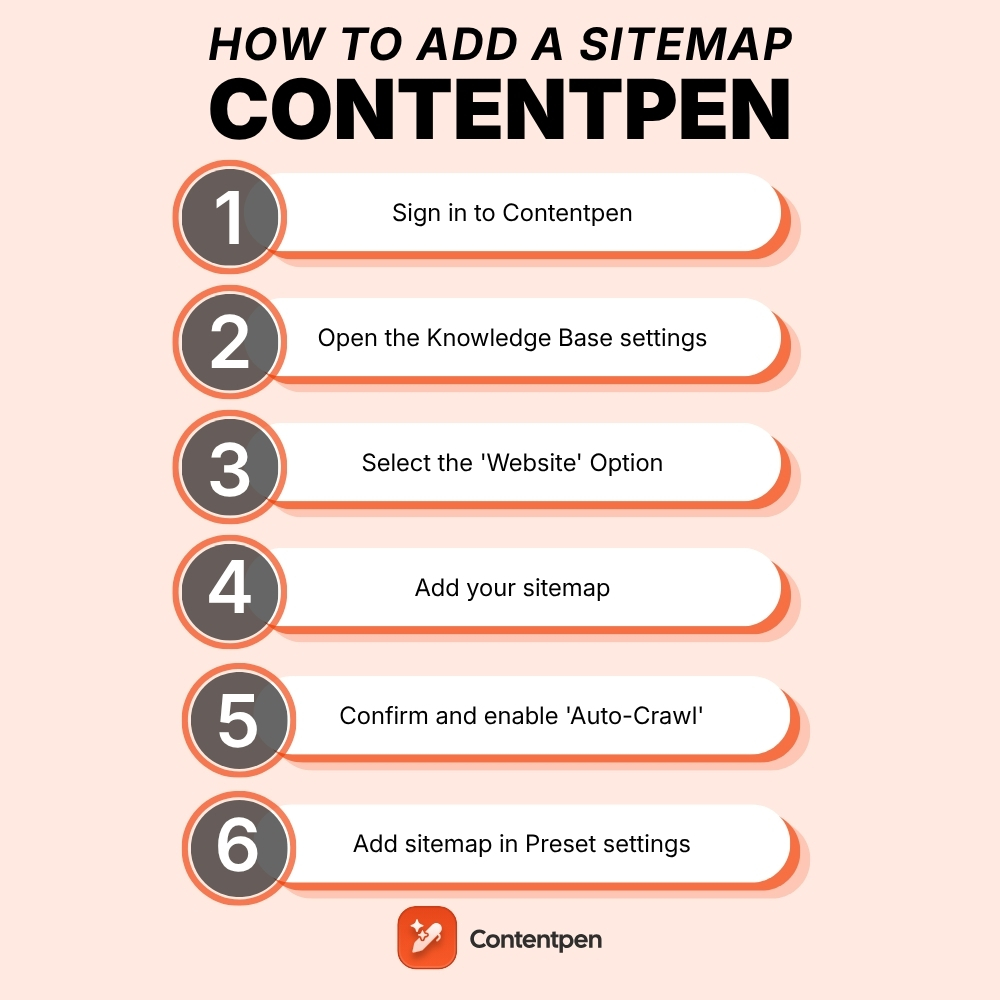
Step 1: Sign in or create an account on Contentpen to access the main dashboard.
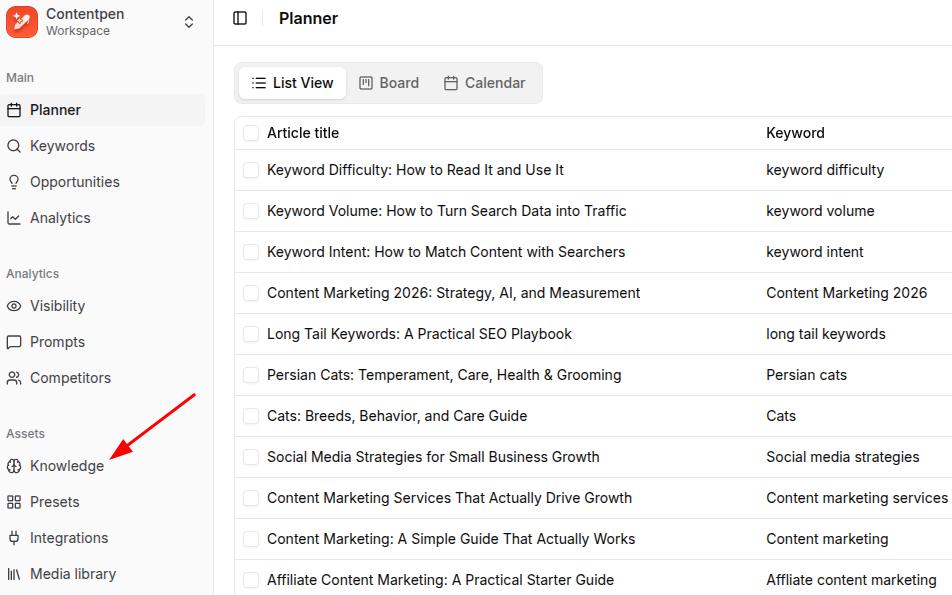
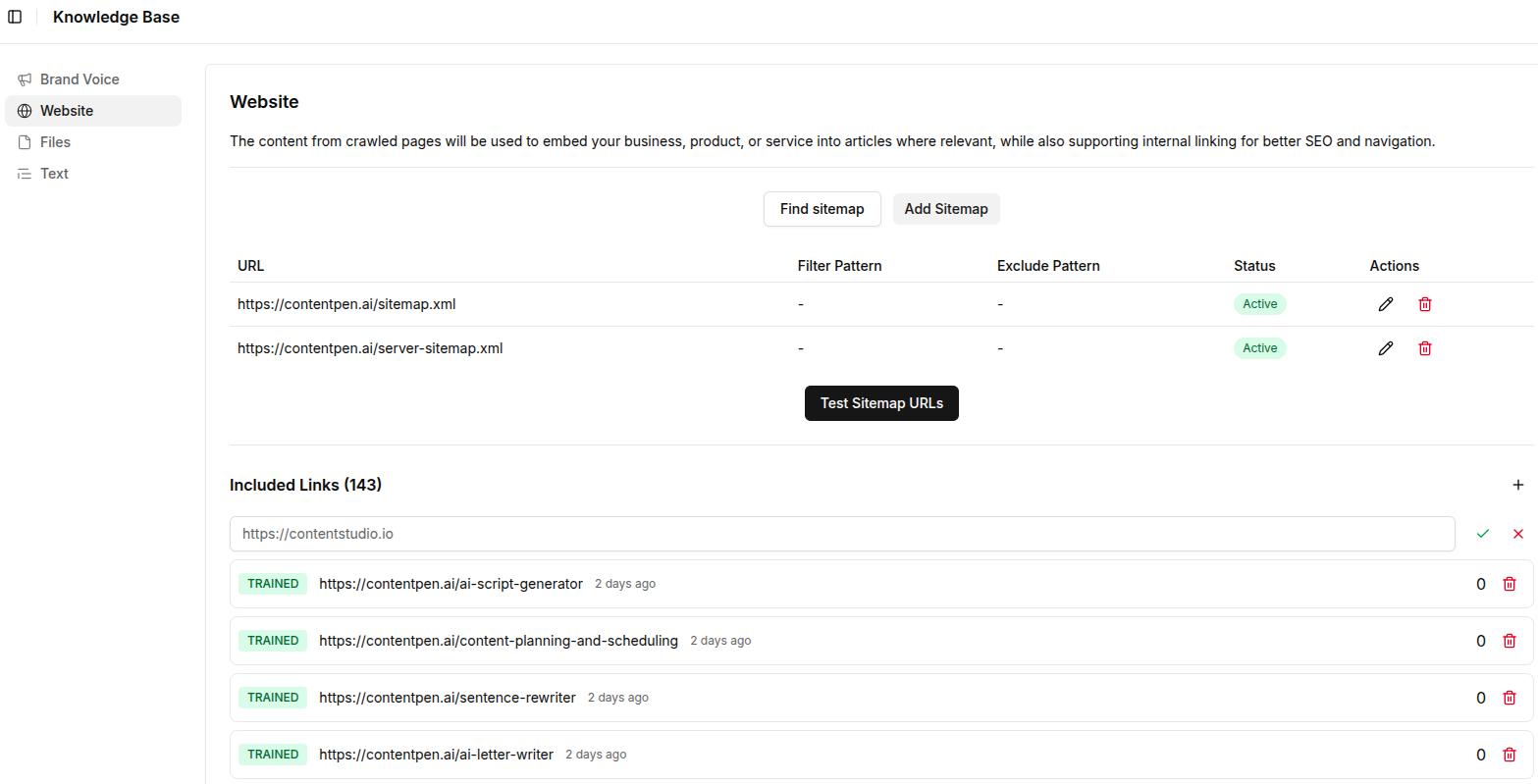
Step 2: From there on, see the ‘Knowledge’ button from the left-side navbar and click on it.
Step 3: Then, click the ‘Website’ option to proceed with setting up your sitemap in Contentpen.
On this screen, you see two buttons, ‘Find Sitemap’ and ‘Add Sitemap.’
Usually, sitemaps follow a familiar pattern:
https://yoursite.com/sitemap.xml
Or
https://yoursite.com/server-sitemap.xml
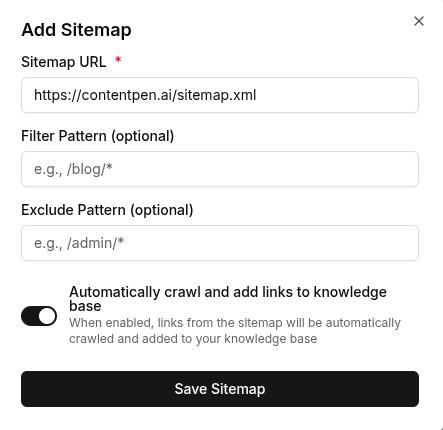
Step 4: If you know yours, click ‘Add Sitemap’ to proceed with the XML sitemap integration inside Contentpen.
On this screen, you can use the Filter and Exclude Pattern (optional) fields as well. In simpler terms, it means:
Filter Pattern – To only include selected categories or pages you prefer to show. For instance, ‘/blog/’.
Exclude Pattern – To leave out specific pages you don’t want found or crawled from the sitemap. For example, ‘/admin/’.
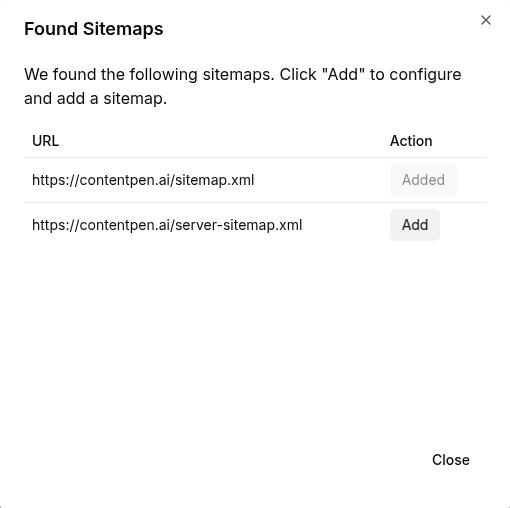
Step 5: Alternatively, if you don’t know your sitemap or want this process to be completely automated, then use the ‘Find Sitemap’ button.
At this screen, enter your domain and hit the ‘Find My Sitemap’ button to let Contentpen automatically discover your XML file(s).
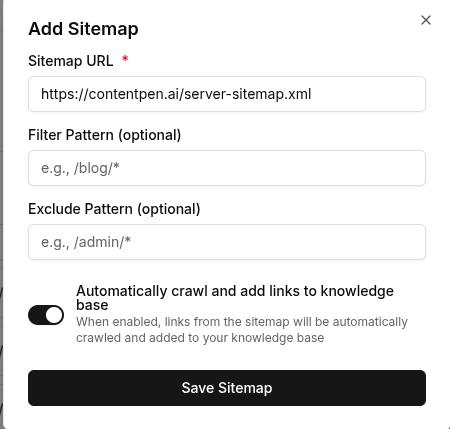
Step 6: Once discovered, click ‘Add’ to include your sitemap in Contentpen and proceed with the same configuration steps as shown earlier in step 4.
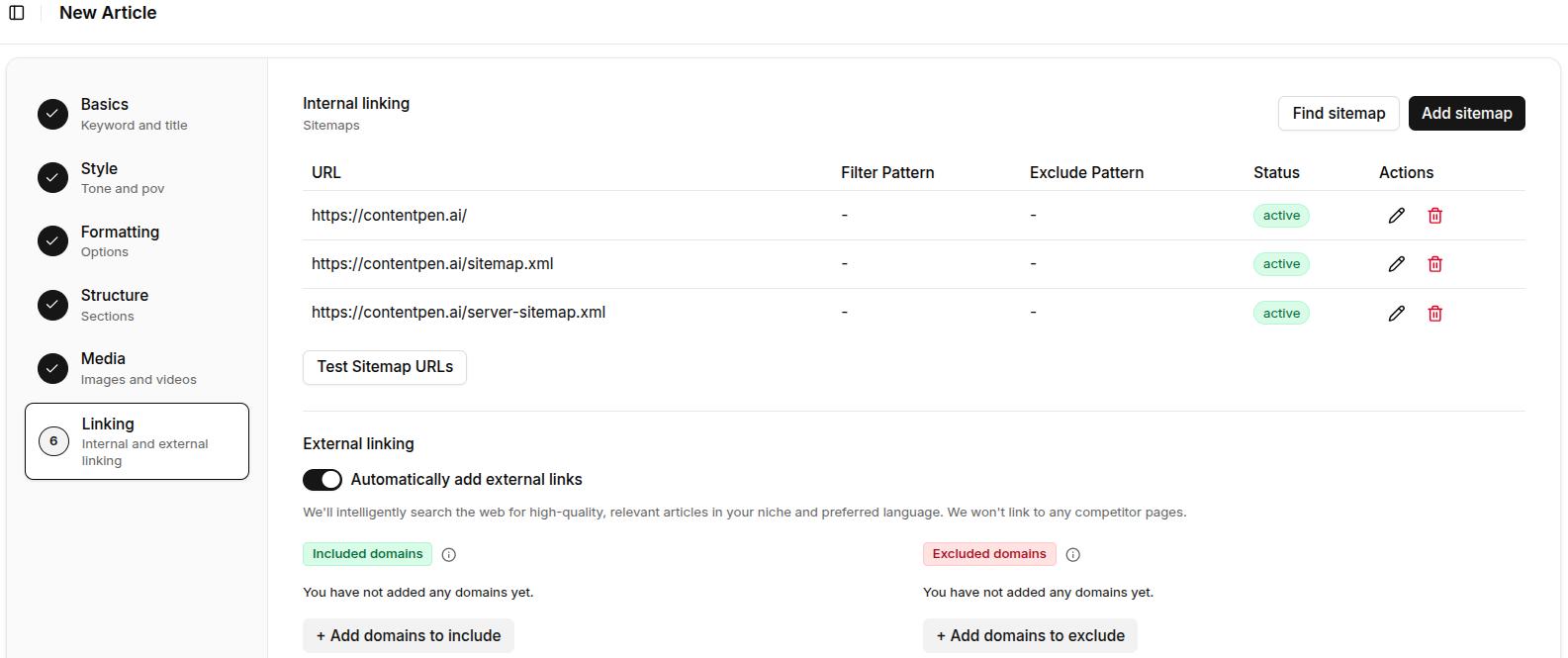
Finally, you can test your added sitemap using the ‘Test Sitemap URLs ‘ button.
Note: Keep the ‘Automatically crawl and add links to knowledge base’ slider on to help Contentpen learn contextual details from your pages. This will ensure smooth internal linking and better on-brand content for your blogs.
Using the Presets settings
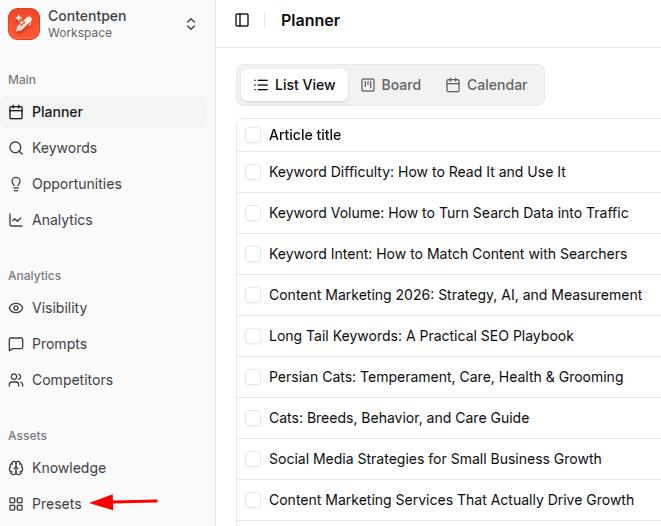
Step 1: For the second method of adding your sitemap to Contentpen, go to the ‘Presets’ options from the main dashboard.
Then, click on the ‘Create New Preset’ button to proceed.
Step 2: Once you are at the preset settings, set up your ‘Style’, ‘Formatting’, ‘Structure’, and ‘Media’ details, as shown in the ‘How to use Contentpen presets’ blog.
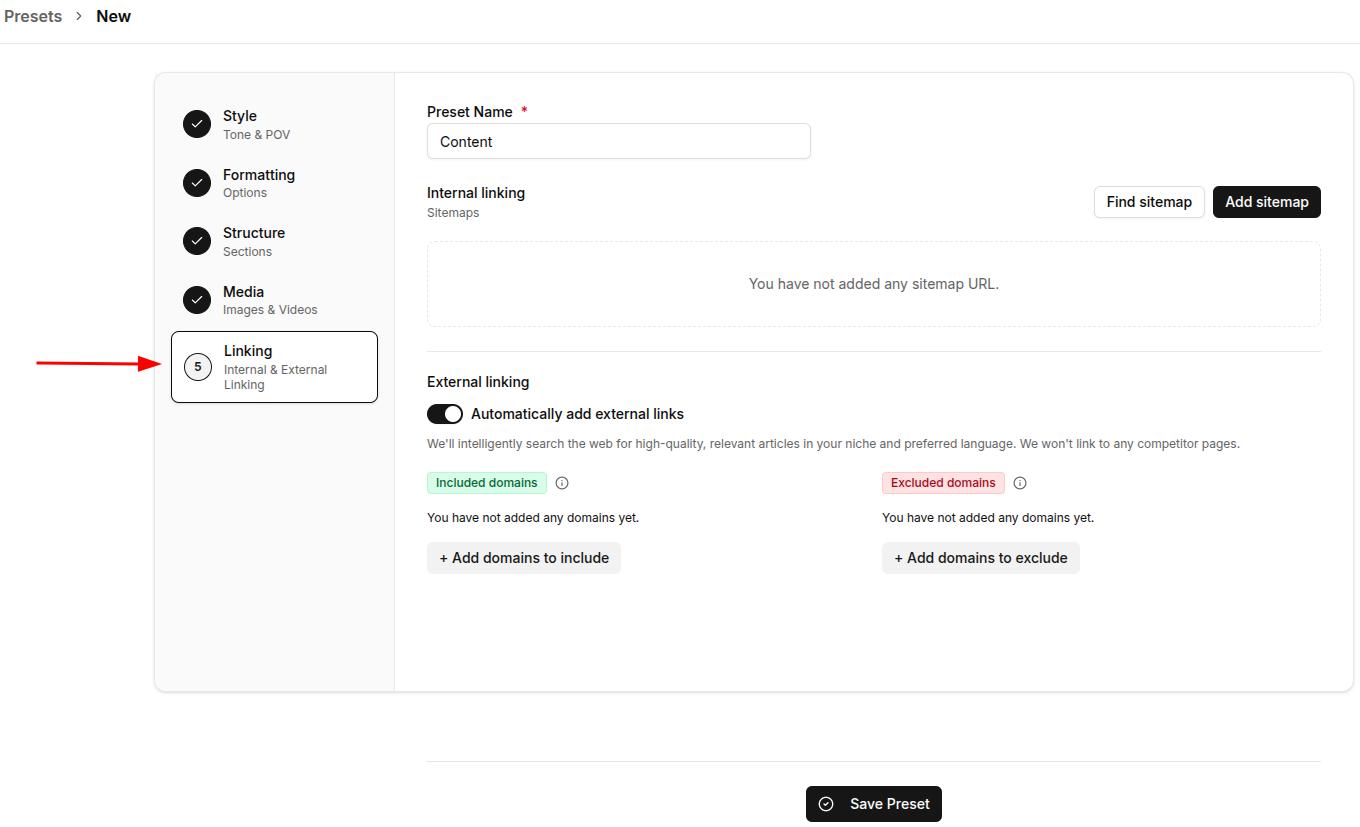
Step 3: After all the other preset options are done, go down to the final ‘Linking’ option.
Here you will find the same ‘Find sitemap’ and ‘Add sitemap’ buttons as in the previous method.
Repeat step 4, or steps 5 and 6 from the Knowledge Base method to achieve a successful Contentpen sitemap setup.
Adding a sitemap in our SEO platform is simple, quick, and designed to make internal linking easier. Whether you prefer to let the system handle it automatically or want to add or adjust it manually, the process is smooth and flexible.
Plus, with powerful customization options like exclude and filter patterns, you stay in full control of what shows up in your content.
Once your sitemap is set up, you can fully automate your linking and content structure, saving hours on manual SEO work.
From outline to publish-ready content
that fills them
Yes. If your website has more than one sitemap (e.g., a separate one for blog posts and products), you can add each one individually through the Knowledge Base or Presets settings.
Does Contentpen use my sitemap for anything other than internal linking?
Yes. Once crawled, your sitemap helps Contentpen build a knowledge base of your existing content, which it uses to generate more contextually relevant and on-brand articles.
Is it possible to include only selected pages in my sitemap?
Yes. The “Filter pattern” feature lets you specify which pages or categories you want to include, giving you complete control of your internal links.
Will my sitemap update automatically when I publish new content?
If you’ve enabled the automated feature, then yes. Your sitemap will update in real time as you publish new content.
What happens if I change my website URL?
In that case, you’ll need to update your sitemap settings with the new URL. You can either fetch it automatically again or manually paste the new sitemap.
Do I need any technical skills to use the sitemap feature?
Not at all. Whether you’re using the automated or manual method, the process is beginner-friendly and takes just a few clicks.
AI-generated content is everywhere now—blog posts, essays, marketing copy, social media captions, product descriptions, and even professional reports.
Tools like ChatGPT and Jasper make writing easier, but they also come with a challenge: AI detection systems are getting smarter.
If you’re a writer, student, or professional, knowing how to avoid AI detection in writing is key to keeping your work authentic.
The good news? You can humanize AI-generated content with the right techniques, making it sound natural and uniquely yours.
This guide will show you exactly how to tweak AI-written text so it feels like something only a human could create. Let’s dive in!
What is AI detection?
AI detection is the process of identifying whether a piece of content – text, images, audio, or video – has been created by artificial intelligence instead of a human.
At its core, AI detection works by comparing a given piece of content against known human-created content and identifying inconsistencies.
These inconsistencies arise because AI models generate text using probability-based predictions rather than organic thought processes.
As a result, AI-generated content often exhibits patterns that are more structured, repetitive, and predictable compared to human writing.
AI detection is widely used in various fields, including:
Academia – To detect AI-assisted assignments and prevent academic dishonesty.
Publishing & journalism – To ensure articles are written by humans and maintain editorial integrity.
Marketing & SEO – To assess content originality and authenticity for search engines and readers.
Legal & compliance – To verify authorship and ensure transparency in official documents.
How does AI detection work?
AI detection algorithms examine multiple characteristics of a text to determine whether it was likely generated by an AI. These include:
Characteristics
Description
Statistical analysis
AI-generated text often follows predictable structures and word choices, distinguishing it from human writing.
Perplexity & burstiness
Human writing has natural variations in sentence length and complexity, whereas AI text is more uniform and structured.
Linguistic cues
AI-generated content lacks emotional depth, inconsistencies, and contextual adaptability, common in human writing.
Metadata & hidden markers
Some AI-generated text includes invisible markers or metadata that indicate AI authorship, making detection easier.
By analyzing these elements, AI detection models can identify AI-generated content with increasing accuracy.
Strategies to avoid AI detection in writing
To effectively avoid AI detection, it’s important to understand how AI-generated content is identified. AI detection tools analyze patterns, sentence structures, and predictability in writing.
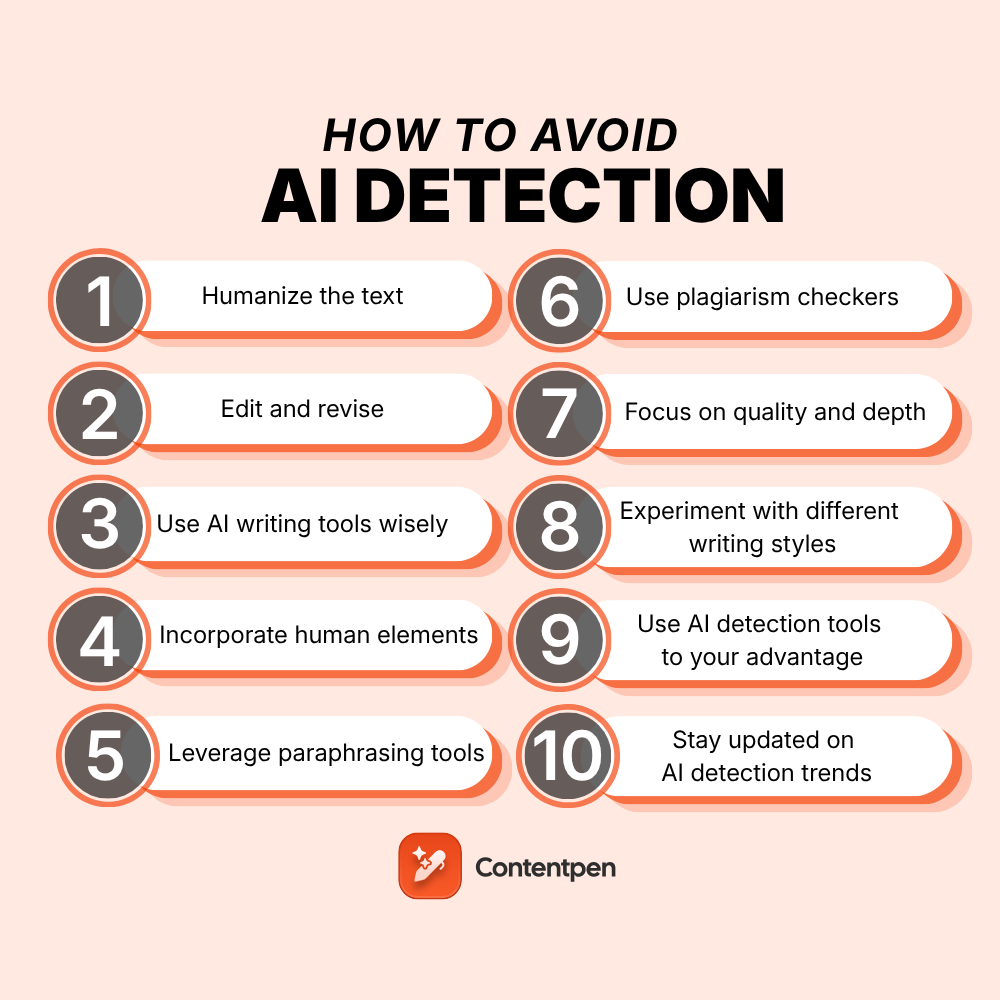
1. Humanize the text
One of the most effective ways to avoid AI detection is to humanize the text. This involves making the content sound more natural and less robotic. Here are some tips to achieve this:
Vary sentence structure: AI-generated content often has a uniform sentence structure. Mix short and long sentences to create a more natural flow. This mimics human writing patterns and reduces predictability.
Use idioms and colloquialisms: Incorporate idiomatic expressions and colloquial language that are less likely to be used by AI. Phrases like “a blessing in disguise” or “hit the nail on the head” add a conversational tone.
Add personal anecdotes: Including personal stories or experiences can make the content feel more authentic and human. A brief personal insight or a relatable scenario enhances engagement.
Use active voice: AI-generated content often relies on passive voice. Switching to active voice can make the text more engaging and human-like. For example, “The team completed the project” sounds more natural than “The project was completed by the team.”
Introduce emotion: Adding emotional elements such as humor, excitement, or empathy makes the content feel more personal and human-written.
2. Edit and revise
Editing is crucial when it comes to avoiding AI detection. Even the best AI-generated content can benefit from a human touch. Here’s how to edit effectively:
Rephrase sentences: Rewrite sentences to make them less predictable and more unique. Avoid formulaic structures that AI tends to follow.
Add nuance: Introduce subtle nuances and variations in tone that are difficult for AI to replicate. This could include rhetorical questions or varied pacing in writing.
Check for consistency: Ensure that the content is consistent in style and tone throughout. Inconsistencies can be a red flag for AI detection tools.
Read aloud: Reading the content aloud can help identify unnatural phrasing and robotic patterns.
Use a second pair of eyes: Having someone else review the content can help pinpoint areas that sound overly mechanical or structured.
3. Use AI writing tools wisely
While AI writing tools are incredibly useful, they should be used as a starting point rather than the final product. Here’s how to use them wisely:
Combine multiple tools: Different AI writing tools are used to generate content, and then the outputs are blended to create a more diverse and less detectable text.
Customize outputs: Most AI tools allow you to customize the output by adjusting parameters like tone, style, and complexity. Experiment with these settings to produce more human-like content.
Avoid over-reliance: Don’t rely solely on AI-generated content. Use it as a foundation and build upon it with your own insights and creativity.
Infuse unique perspectives: AI-generated content often lacks originality. Adding fresh viewpoints, unique examples, and personal insights can enhance authenticity.
4. Incorporate human elements
Adding human elements to your content can significantly reduce the chances of it being flagged as AI-generated.
Here’s how to do it:
Include opinions and perspectives: Share your own opinions, perspectives, and insights to make the content more personal and less generic.
Use real-world examples: Incorporate real-world examples and case studies that are relevant to the topic. This adds depth and authenticity to the content.
Engage with the audience: Write in a conversational tone and engage with the reader by asking questions or encouraging them to think critically.
Break the rules occasionally: AI tends to follow strict grammatical rules. Humans, on the other hand, sometimes break grammar conventions for emphasis or effect, making writing feel more natural.
5. Leverage paraphrasing tools
Paraphrasing tools can be a valuable asset in avoiding AI detection. These tools can help you rephrase AI-generated content to make it less detectable.
Here’s how to use them effectively:
Choose the right tool: Select a paraphrasing tool that offers advanced options for rephrasing, such as changing sentence structure and word choice.
Rephrase strategically: Focus on rephrasing key sections of the content, especially those that are more likely to be flagged by AI detection tools.
Review the output: Always review the paraphrased content to ensure it maintains the original meaning and flows naturally.
Manually adjust where needed: Automated paraphrasing may sometimes produce awkward phrasing. Tweaking the output manually enhances readability.
6. Use plagiarism checkers
Plagiarism checkers can help you identify and eliminate any content that may be flagged as AI-generated.
Here’s how to use them:
Run a plagiarism check: Use a plagiarism checker to scan your content for any similarities with existing AI-generated text.
Make necessary adjustments: If the plagiarism checker flags any content, make the necessary adjustments to ensure it’s unique and original.
Cross-check with AI detection tools: After making adjustments, cross-check the content with AI detection tools to ensure it’s no longer detectable.
Rewrite high-risk sections: AI-generated content often appears similar across different pieces. Identifying and reworking these sections enhances uniqueness.
7. Focus on quality and depth
High-quality, in-depth content is less likely to be flagged as AI-generated.
Here’s how to achieve this:
Research thoroughly: Conduct thorough research on the topic to ensure your content is accurate and well-informed.
Provide detailed insights: Offer detailed insights, analysis, and explanations that go beyond surface-level information.
Use credible sources: Cite credible sources and references to add authority and credibility to your content.
Avoid generic content: AI-generated text often lacks depth. Adding substantial analysis and expert opinions improves authenticity.
8. Experiment with different writing styles
Experimenting with different writing styles can help you create content that is less predictable and more human-like.
Here’s how to do it:
Try different tones: Experiment with different tones, such as formal, informal, persuasive, or informative, to see which one works best for your content.
Mix writing styles: Combine different writing styles, such as narrative, descriptive, and expository, to create a more diverse and engaging piece.
Adapt to the audience: Tailor your writing style to the target audience, taking into account their preferences, interests, and level of expertise.
Switch perspectives: Writing in first-person, second-person, or third-person voice can create variation and make the content less robotic.
9. Use AI detection tools to your advantage
Ironically, AI detection tools can be used to your advantage when trying to avoid AI detection.
Here’s how:
Test your content: Run your content through AI detection tools to see if it gets flagged. Use the feedback to make necessary adjustments.
Analyze the results: Analyze the results from the AI detection tools to identify patterns or characteristics that may be giving away the AI-generated nature of your content.
Iterate and improve: Continuously iterate and improve your content based on the feedback from AI detection tools until it passes as human-written.
Identify common AI pitfalls: Understanding what triggers AI detection helps refine content accordingly.
10. Stay updated on AI detection trends
AI detection technology is constantly evolving, so it’s essential to stay updated on the latest trends and developments.
Here’s how:
Follow industry news: Keep an eye on industry news and updates related to AI detection technology.
Join online communities: Join online communities and forums where professionals discuss AI detection and share tips and strategies.
Experiment with new tools: Experiment with new AI writing and detection tools to stay ahead of the curve and adapt your strategies accordingly.
Monitor detection algorithms: Understanding how AI detection tools evolve can help you refine your approach continuously.
By implementing these strategies, you can create content that appears more organic, engaging, and human-like. Avoiding AI detection isn’t just about tricking algorithms; it’s about producing high-quality, authentic writing that resonates with readers.
As AI detection tools evolve, staying adaptable and refining your approach will help maintain the natural flow and originality of your content.
Ethical considerations in AI-generated content
While knowing how to avoid AI detection is useful, it’s equally important to consider the ethical implications of AI-generated content.
Misuse can lead to trust issues, legal concerns, and reputational damage. Here are key ethical considerations to keep in mind:
1. Transparency: Disclose AI usage
Being transparent about AI-generated content helps maintain trust with your audience. If AI is used to assist in content creation, consider disclosing it. For example:
Ethical approach: “This article was created with AI assistance and edited by a human for accuracy.”
Unethical approach: Passing off AI-generated content as entirely human-written without any modifications.
2. Originality: Avoid plagiarism
AI tools should be used to enhance creativity, not replace it. Always ensure your content is original and not copied from other sources. Ways to maintain originality include:
Paraphrasing thoughtfully: Instead of copy-pasting AI outputs, rewrite them in your own words.
Adding unique insights: Infuse personal experiences, opinions, or industry-specific expertise.
Using plagiarism checkers: Tools like Copyscape or Grammarly can help ensure content remains unique.
3. Quality: Prioritize value over automation
AI-generated content should not compromise quality. Instead of mass-producing low-quality articles, focus on creating high-value content that benefits the reader. Consider:
Fact-checking AI outputs: Verify AI-generated data to prevent misinformation.
Enhancing readability: Edit AI-generated text to improve clarity and engagement.
Avoiding keyword stuffing: AI may overuse keywords for SEO, but natural integration improves readability and ranking.
4. Compliance: Follow legal and ethical guidelines
AI content should align with ethical and legal standards to prevent misleading or deceptive practices. Ensure:
Adherence to regulations: Content should comply with copyright laws and data privacy regulations like GDPR.
Avoiding manipulation: AI should not be used to create false narratives, deepfakes, or misleading product claims.
Respect for cultural sensitivities: AI might lack cultural awareness, so reviewing content for appropriateness is crucial.
By considering these ethical guidelines, you can use our AI writing tool online responsibly while maintaining credibility and trust with your audience.
Conclusion
As AI technology continues to evolve, staying updated on the latest trends and developments is crucial. By following the strategies outlined in this guide and considering the ethical implications, you can create high-quality, undetectable content that resonates with your audience and stands the test of time.
Remember, the goal is not to deceive but to enhance your writing with the help of AI while maintaining authenticity and originality. With the right approach, you can harness the power of AI to create compelling, human-like content that avoids detection and delivers value to your readers.
FAQs on AI-generated content
How can I make AI-generated content more original?
To make AI-generated content more original: – Add your own insights, opinions, and expertise. – Conduct additional research to include unique data or examples. – Blend content from multiple AI tools to create a diverse output. – Use plagiarism checkers to ensure the content is unique.
How can I stay updated on AI detection trends?
To stay updated on AI detection trends: – Follow industry blogs and news outlets covering AI and content creation. – Join online communities or forums focused on AI writing tools and detection. – Experiment with new AI writing and detection tools as they are released. – Attend webinars or conferences on AI and content creation.
Is it ethical to use AI-generated content without disclosure?
The ethics of using AI-generated content depends on the context. In most cases, it’s best to be transparent about using AI tools, especially in academic or professional settings. However, using AI as a tool (without misrepresentation) is generally acceptable if the goal is to enhance creativity and productivity.
Can AI-generated content rank well on search engines?
Yes, AI-generated content can rank well on search engines if it is high-quality, original, and optimized for SEO. However, search engines like Google prioritize content that demonstrates expertise, authoritativeness, and trustworthiness (E-A-T), so human input is often necessary to achieve these qualities.
What should I do if my content is flagged as AI-generated?
If your content is flagged as AI-generated: – Review the flagged sections and rephrase them to sound more human-like. – Add personal insights, examples, or anecdotes to enhance authenticity. – Test the revised content using AI detection tools to ensure it passes.
AI-powered content creation is changing the way businesses, marketers, and writers produce high-quality content.
By automating research, structuring, and optimization, AI-driven content creation tools help streamline the writing process while maintaining relevance and engagement.
This guide will walk you through how to use AI for content creation, covering essential steps, best practices, and optimization techniques.
How does AI work for content creation?
Content creation has traditionally been a manual process requiring extensive research, writing, and editing. However, AI has transformed this landscape by automating content generation, from ideation to final drafts. By leveraging advanced algorithms, AI-powered content creation tools can analyze vast amounts of data, understand context, and generate human-like text efficiently.
How AI analyzes data, understands context, and generates text?
At its core, AI for content creation relies on natural language processing (NLP) and machine learning to interpret text patterns and produce coherent content. These systems are trained on extensive datasets, enabling them to:
Extract relevant information by scanning sources such as articles, reports, and search trends.
Understand language structure and intent to create contextually accurate responses.
Generate well-structured content that aligns with the tone and style required for different formats.
AI-powered content creation tools can analyze input prompts to produce original text that mimics human writing while maintaining clarity and relevance.
The role of AI-powered content creation in automating writing
One of the biggest advantages of AI-powered content creation is its ability to streamline writing tasks. AI can assist with:
Generating blog posts and articles based on specific topics and keywords.
Rewriting existing content to improve readability and engagement.
Enhancing consistency in tone and messaging across multiple platforms.
This automation reduces the time and effort needed to create high-quality content, allowing marketers and businesses to scale their content strategies more efficiently. A modern AI blog-writing tool goes beyond simple text generation.
Platforms like Contentpen AI integrate AI-driven capabilities to:
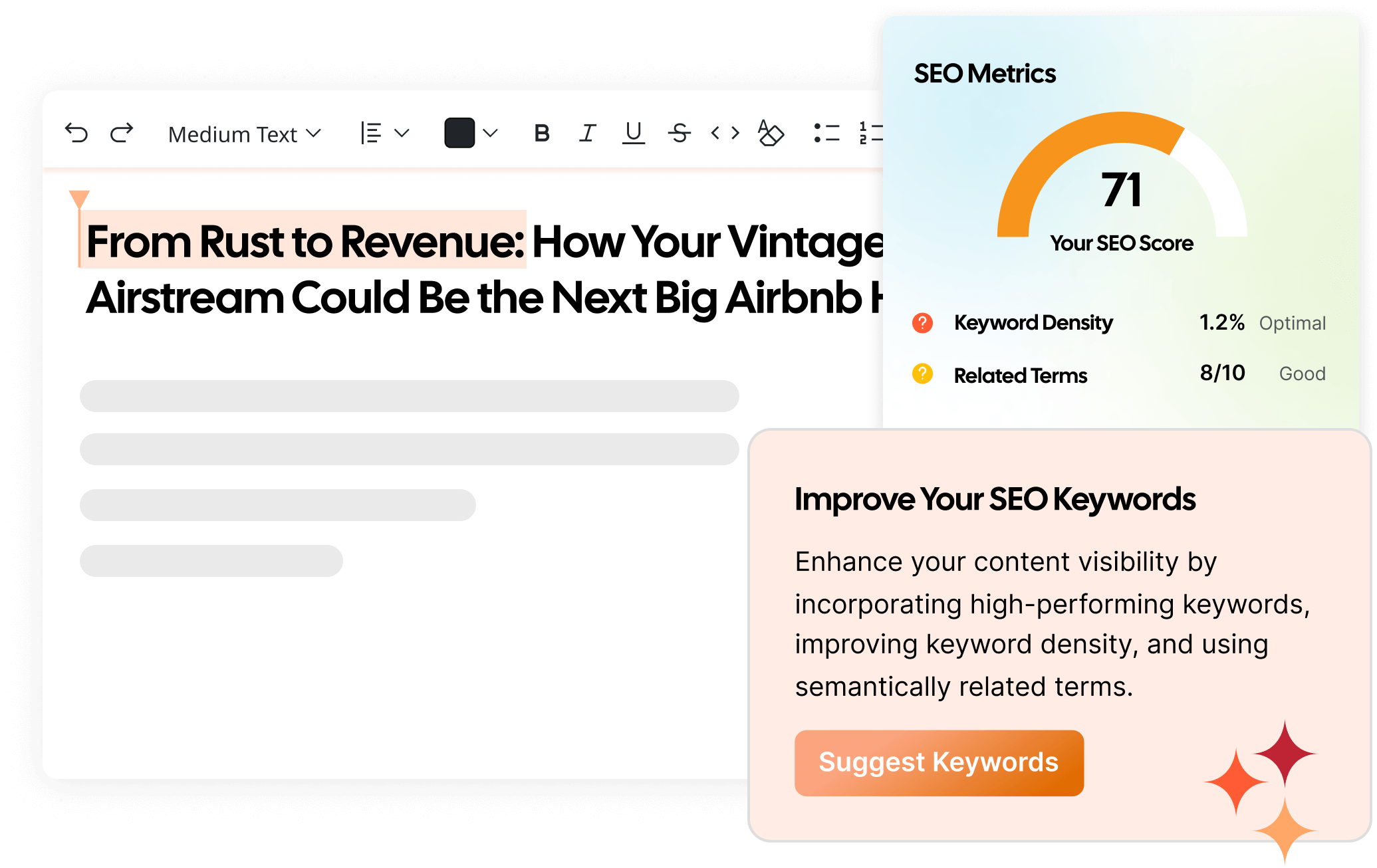
Assist with SEO optimization by suggesting relevant keywords and readability improvements.
Improve writing quality through grammar and style enhancements.
Enable bulk content production without sacrificing consistency or engagement.
By incorporating AI content creation software into their workflows, content creators can produce high-performing content faster while maintaining accuracy and relevance.
How to use AI for content ideation and research?
Finding relevant content topics is one of the biggest challenges in content marketing. Traditional brainstorming often leads to repetitive ideas, missed opportunities, or content that doesn’t align with audience search intent.
AI content creation tools solve this problem by analyzing vast amounts of data, identifying trending topics, and suggesting content ideas that are optimized for SEO and engagement.
Businesses can streamline ideation, improve research efficiency, and develop content that resonates with their audience by using AI content creation software.
Here’s how to leverage AI for better content ideation and research.
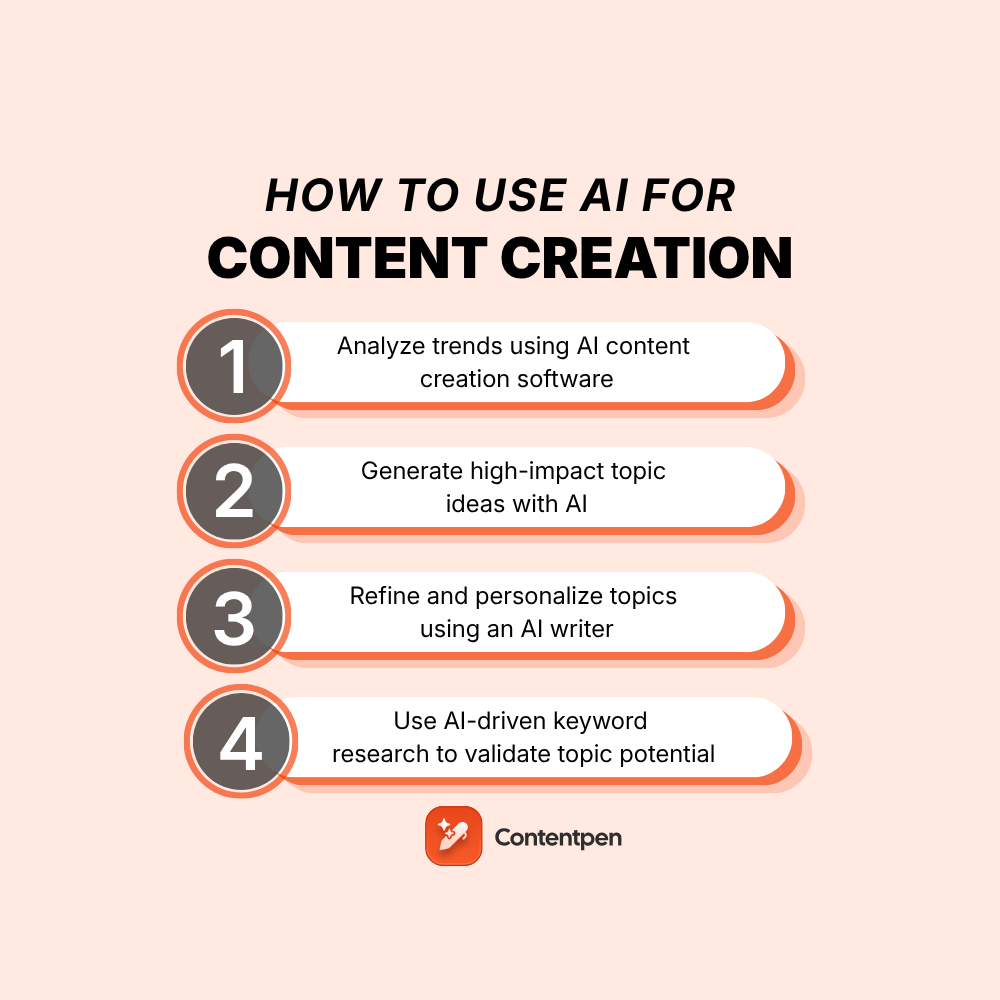
1. Analyze trends using AI content creation software
Before selecting a topic, it’s essential to validate demand by analyzing real-time trends and audience interests. AI content creation software scans search engines, social media, and competitor content to uncover topics with high engagement potential.
Identifies emerging trends by analyzing recent search behavior.
Tracks competitor performance to detect content gaps.
Monitors audience engagement to align content with what users care about.
Instead of relying on intuition, AI ensures every topic is backed by data, making content more relevant and impactful.
2. Generate high-impact topic ideas with AI
Once AI identifies trending topics, it generates content ideas that align with search intent and audience demand. This prevents businesses from creating outdated or low-performing content.
Creates SEO-driven content topics based on keyword and search trend analysis.
Structure topic ideas into detailed outlines for easier content creation.
Suggests multiple content angles to differentiate from existing articles.
For example, instead of “AI content creation tools”, AI might suggest:
“Best AI content creation tools for businesses in 2024”
“How AI content creation software can improve content marketing results”
These AI-generated ideas ensure your content stands out and addresses specific audience needs.
3. Refine and personalize topics using an AI writer
Not all content topics are one-size-fits-all. An AI writer helps refine topic ideas by adjusting them based on audience preferences, content formats, and engagement goals.
Optimizes headlines for higher engagement and SEO rankings.
Recommends content formats (guides, comparisons, or listicles) based on user intent.
Align tone and structure to match your brand voice and target audience.
For example, if AI suggests “AI writing tools”, an AI writer can refine it into:
“Top 5 AI writing tools to streamline your content workflow” (List format)
“How AI writing tools can help marketers improve content quality” (Educational tone)
This ensures content ideas are structured for maximum impact and user engagement.
4. Use AI-driven keyword research to validate topic potential
A great topic isn’t enough—it must be backed by strong keyword research to ensure high search visibility. AI-driven keyword research helps businesses target the right audience with minimal competition.
Identifies high-volume, low-competition keywords to improve rankings.
Analyzes search intent to match content with what users are looking for.
Uncovers long-tail keyword opportunities to reach niche audiences.
For example, instead of “AI content creation tools”, AI might suggest:
“Best AI content creation tools for small businesses” (Less competitive)
“AI content writing tools that improve SEO rankings” (High-intent, targeted search query)
How to create high-quality content using Contentpen’s AI writer?
Creating high-quality content efficiently requires a structured approach. Contentpen’s AI-powered writing tools help you generate, refine, and optimize content that is SEO-friendly, engaging, and aligned with your brand’s voice. Whether you’re writing blog posts, articles, or marketing content, this step-by-step guide will show you how to use Contentpen to streamline your content creation process.
Step 1: Define your topic and keywords
The foundation of any great piece of content starts with a well-defined topic and the right keywords. Contentpen helps streamline this process by allowing you to:
Enter a primary keyword to establish the main focus of your content.
Add secondary keywords to ensure broader coverage and context.
Use saved presets to maintain a consistent format and structure.
By providing clear input, you ensure that AI generates content that is relevant, targeted, and optimized for search rankings.
Step 2: Customize tone and writing style
Your content should align with your brand voice and audience expectations. Contentpen allows you to:
Select a tone of voice (e.g., professional, conversational, authoritative).
Define your target audience (marketers, business owners, developers, etc.).
Choose the point of view (first-person, second-person, or third-person).
These settings guide the AI writer, ensuring the output is tailored for your audience and engages them in the right way.
Step 3: Set formatting preferences for better readability
Well-structured content improves readability and engagement. Contentpen gives you control over how your content is presented by allowing you to:
Bold key phrases to highlight important points.
Italicize text for emphasis or stylistic preference.
Use tables for structured data and clear comparisons.
Include quotes for expert insights and authoritative references.
Organize content with bullet points and numbered lists.
Set heading styles to ensure consistency across your content.
With these customization options, your AI-generated content will not only be informative but also visually appealing and easy to scan.
Step 4: Generate content with structured sections and media
Before finalizing content creation, Contentpen allows you to enhance your article’s structure and visual appeal. You can:
Define the article length (short, medium, or long-form).
Add extra sections such as key takeaways, FAQs, and conclusions.
Select a featured image that aligns with your article.
Choose in-article images with different styles (realistic, abstract, cartoon).
By incorporating well-structured sections and visuals, your content becomes more engaging, informative, and easy to digest.
Step 5: Automate internal and external linking
Effective linking improves SEO, content navigation, and authority, making it a crucial step in AI-powered content creation. Contentpen simplifies this by offering both internal linking suggestions and external linking automation to enhance the content structure and discoverability.
Internal linking for better content navigation
Adding relevant internal links helps connect different pieces of content, improving user experience and SEO. Contentpen allows users to:
Find and add a sitemap to ensure seamless internal linking.
Automatically detect related content to strengthen topic clusters.
Improve content engagement by guiding readers to relevant pages.
External linking for authority and credibility
Quality outbound links enhance content depth and credibility. Contentpen’s AI ensures:
Relevant, high-quality external links are suggested based on niche and language preferences.
Competitor pages are excluded, keeping your strategy focused on growth.
SEO benefits are maximized by linking to authoritative sources without keyword dilution.
By leveraging AI-driven internal and external linking, businesses can enhance content visibility, engagement, and search rankings while keeping content strategy streamlined and effective.
Step 6: Click ‘Create’ to generate your article
Once all preferences are set, click the “Create” button, and Contentpen’s AI content creation software will generate a fully structured article within seconds.
During this process, the AI:
Develops content based on your selected keywords and tone.
Structure headings, subheadings, and paragraphs logically.
Applies formatting, readability, and SEO best practices.
In just a few moments, you’ll have a fully written draft, significantly reducing the time and effort spent on manual writing.
Step 7: Review, refine, and optimize your article
AI-generated content provides a strong foundation, but the final touch ensures it meets quality, accuracy, and engagement standards. Contentpen offers advanced editing and collaboration features so you can:
Manually refine sections for improved clarity and flow.
Regenerate specific sections by giving AI new prompts inside the article.
Find internal linking opportunities to connect related content.
Discover external linking suggestions to add authoritative references.
Use comments and collaboration tools to work with your team on final edits.
This step ensures that your content is polished, optimized, and ready for publication, giving you complete control over the final quality and brand alignment.
How to train AI to improve content quality over time?
AI is more than just a tool for content generation—it is a system that learns and improves over time. By leveraging AI-driven content creation, businesses can refine AI models to match their brand voice, enhance content quality, and align with audience preferences.
When properly trained, AI content creation software becomes more effective at producing high-value, engaging, and optimized content with each use.
AI learns from feedback and iterations
AI continuously adapts based on user inputs, edits, and refinements, ensuring that content evolves to meet quality standards. Every time AI-generated content is reviewed, AI analyzes those changes to make better decisions in the future.
AI tracks user modifications to improve tone, structure, and accuracy.
Feedback loops refine AI-generated outputs, ensuring consistency and alignment with brand messaging.
Pattern recognition helps AI adapt to common content structures and industry-specific writing styles.
By consistently reviewing and fine-tuning AI-generated drafts, businesses can train AI to produce content that requires less editing over time.
How AI-driven content creation adapts based on user input?
Unlike static content templates, AI-driven content creation allows for real-time adaptability. AI refines its outputs by analyzing how users interact with content, making adjustments based on:
Keyword placement and optimization to enhance SEO performance.
Content structure modifications based on formatting and readability preferences.
Tone and messaging refinements that align with audience expectations.
For example, if users frequently adjust AI-generated introductions to include data-driven insights, AI will start prioritizing industry statistics and authoritative references in future drafts. This iterative learning process ensures continuous improvement and brand consistency.
Customizing AI for your brand’s content needs
To maximize AI’s potential, businesses need to train AI to align with their brand identity and audience preferences. This can be done by:
Providing sample articles as a reference for tone, style, and structure.
Defining brand-specific terminology and preferred phrases.
Guiding AI with structured prompts to generate content that fits specific brand guidelines.
By fine-tuning AI’s understanding of brand voice and messaging, businesses can eliminate generic outputs and ensure content uniqueness.
What are the best AI content creation tools?
Choosing the best AI tools for content creation can significantly improve efficiency, quality, and SEO performance. With advanced AI content creation tools, businesses can generate blog posts, social media content, and marketing copy faster while maintaining accuracy and engagement.
Here are some of the best AI tools for content creation:
Contentpen – A powerful AI writing assistant that generates high-quality, SEO-optimized content tailored to brand voice.
Jasper AI – Ideal for long-form content creation with various templates and tone customization.
Copy.ai – Best for short-form content like social media captions and ad copy.
Writesonic – A great tool for AI-generated blogs, product descriptions, and landing pages.
Grammarly – Enhances AI-generated content with grammar, tone, and readability improvements.
Why Contentpen AI stands out for SEO and content quality?
Among the best AI tools for content creation, Contentpen AI stands out due to its SEO-driven approach, customizable content generation, and brand consistency features.
Unlike generic AI writing tools, Contentpen is built to optimize content for search rankings while maintaining high readability and engagement.
SEO-optimized content generation
Keyword integration – Automatically suggests and incorporates high-ranking keywords for better visibility.
Internal and external linking recommendations – Helps improve on-page SEO and authority.
Structured content – Generates SEO-friendly headings, meta descriptions, and optimized formatting to rank higher on search engines.
High-quality, brand-aligned content
Customizable tone and style – Ensures consistency across all content formats.
Advanced formatting controls – Allows users to fine-tune structure, readability, and engagement.
AI-driven content refinement – Users can regenerate, edit, and collaborate to ensure accuracy and brand alignment.
With Contentpen AI, businesses can create well-structured, engaging, and SEO-optimized content that not only ranks well but also resonates with their target audience.
FAQs about using AI for content creation
How does AI help overcome writer’s block?
AI helps overcome writer’s block by generating topic ideas, outlines, and content drafts instantly. When struggling with ideas, AI can provide structured suggestions to kickstart the writing process.
Can AI assist in repurposing existing content?
Yes, AI can assist in repurposing existing content by transforming blog posts into social media captions, email newsletters, or video scripts. Repurposing content with AI allows businesses to maximize content value across multiple platforms.
How does AI personalize content for different audiences?
AI personalizes content by analyzing audience preferences, tone, and language style. By using AI, businesses can generate customized messaging tailored to specific reader demographics.
Can AI help in creating long-form content?
Yes, AI can help in creating long-form content by structuring articles, expanding sections, and ensuring a logical flow. AI-generated long-form content maintains consistency while improving readability.
How do AI tools handle industry-specific content?
AI tools handle industry-specific content by adapting to niche topics and technical language. With proper training, AI can generate detailed and relevant content that aligns with industry standards.
Writing a well-structured, engaging article is easier than ever with Contentpen. This powerful AI writing tool online helps you generate, customize, and optimize content with just a few clicks.
Whether you’re crafting a quick blog post or a detailed guide, Contentpen streamlines the process, saving you time while maintaining quality.
Contentpen is an AI-powered writing assistant designed to help users create high-quality, SEO- and GEO-optimized content efficiently.
The tool comes with the following features:
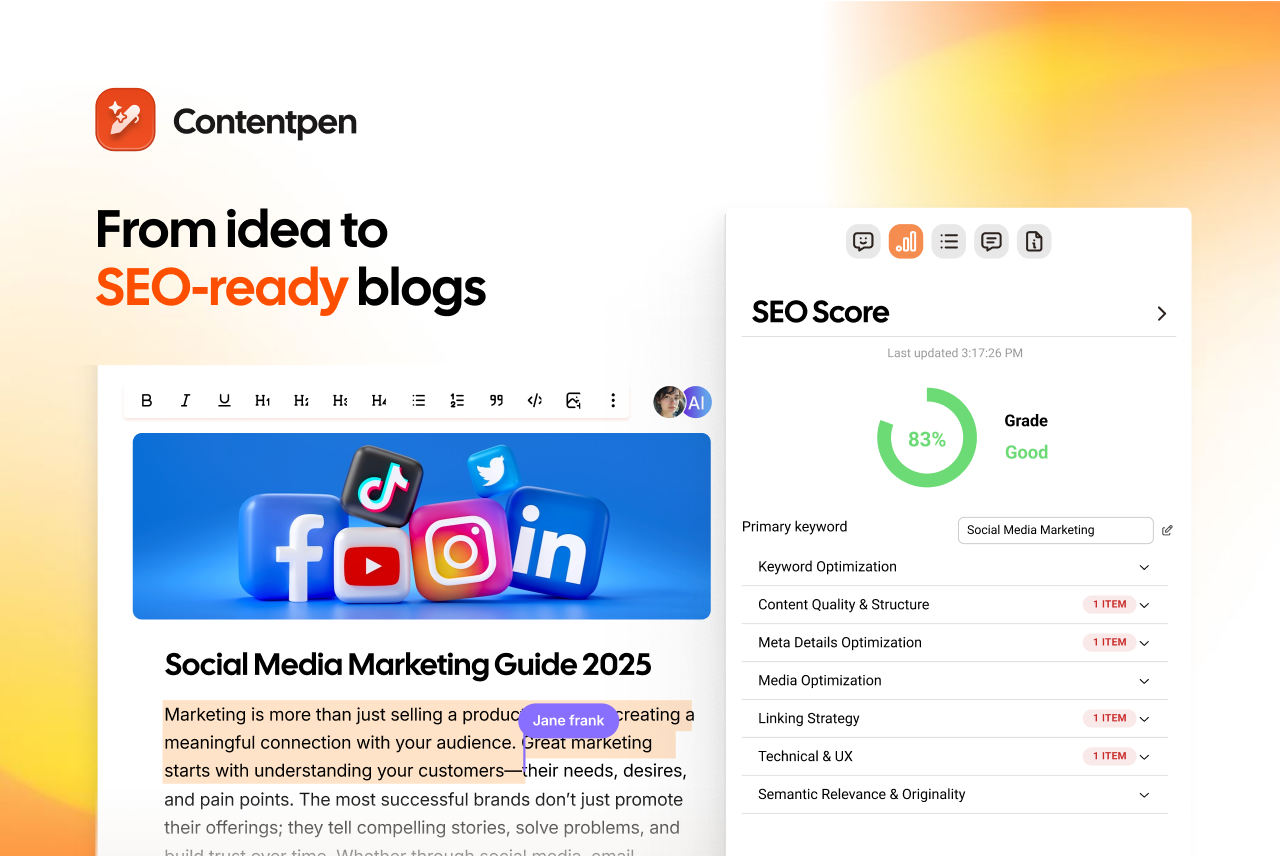
SEO scoring: Contentpen analyzes your meta title and description, content readability, and internal and external linking to provide a realistic SEO score. This scoring helps you identify the areas for improvement and take relevant action.
Keyword research: Contentpen automatically displays keyword difficulty, search volume, and intent for keywords relevant to your niche to help you plan and write content that ranks and converts.
Built-in media library: The media library manages all the uploaded media in one place. You can also store all the in-article and featured images Contentpen generates for you and categorize them using tags and attributes for better searchability.
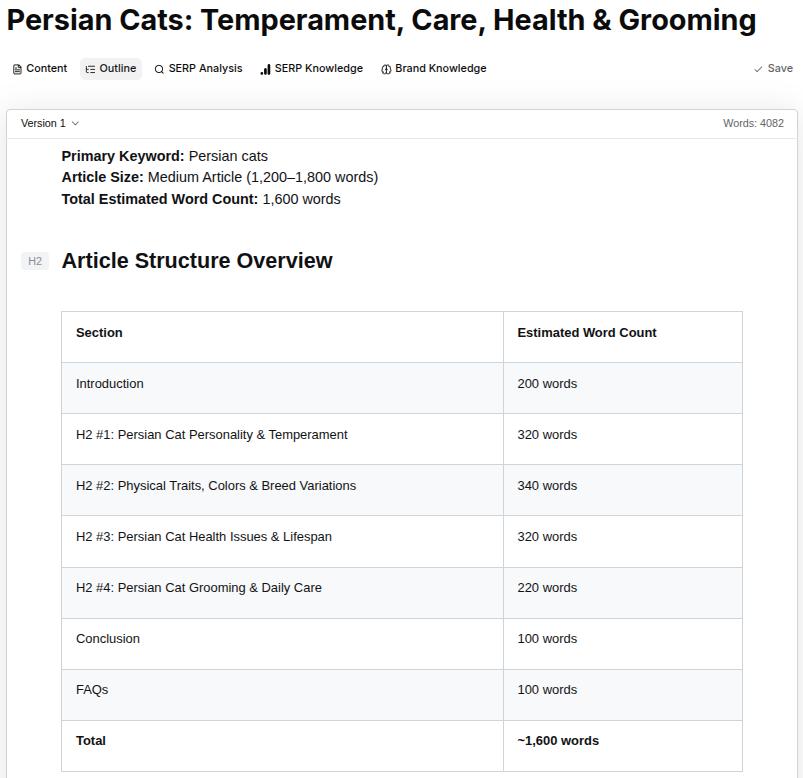
SERP analysis: The SEO platform analyzes all top competitors for a target keyword and creates outlines and writes content that helps you beat your rivals with confidence.
Integrated publishing: With Contentpen, you can publish directly to Ghost, Wix, Webflow, Shopify, WordPress, and ContentStudio. The one-click publishing streamlines workflows and helps you meet deadlines.
Website analytics: See your total clicks, impressions, CTR, and average position directly from Google Search Console in real-time. The tool helps you avoid tool switching so that you can focus on the metrics that matter without compromising productivity.
SEO opportunities: Contentpen surface top page changes (winners) and pages that have lost traffic (losers) so that you can take appropriate action quickly. The AI-powered suggestions also show what you need to do to regain the top SERP positions.
Some other features, such as bulk content generation, content scheduling, etc., also come bundled in the ‘Premium’ package, which you can try with the free 7-day Contentpen trial today.
From outline to publish-ready content
that fills them
Steps to write SEO and GEO-optimized articles with Contentpen
Now that you know the details about our platform, let’s discuss the flow of writing an actual article with Contentpen.
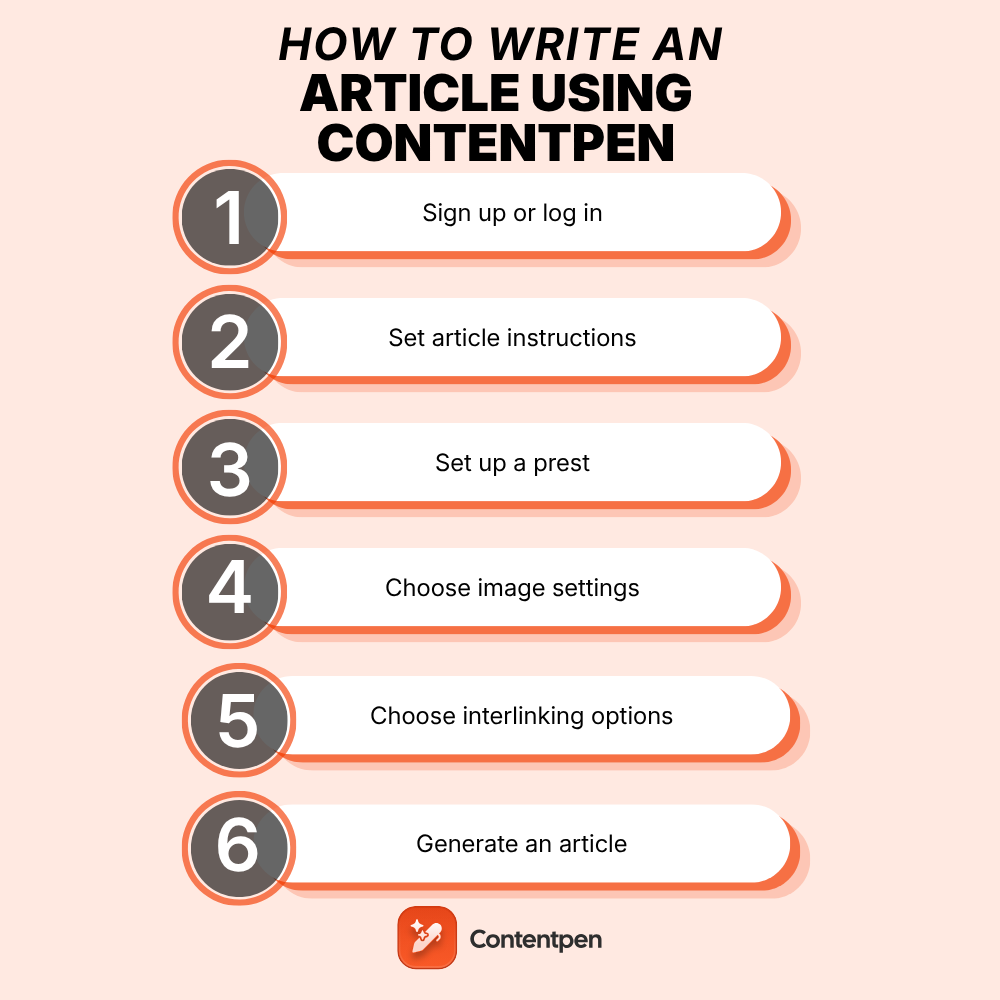
Step 1: Sign up or log in
Visit the Contentpen website and click “Sign up” if you’re a new user or “Log in” if you already have an account.
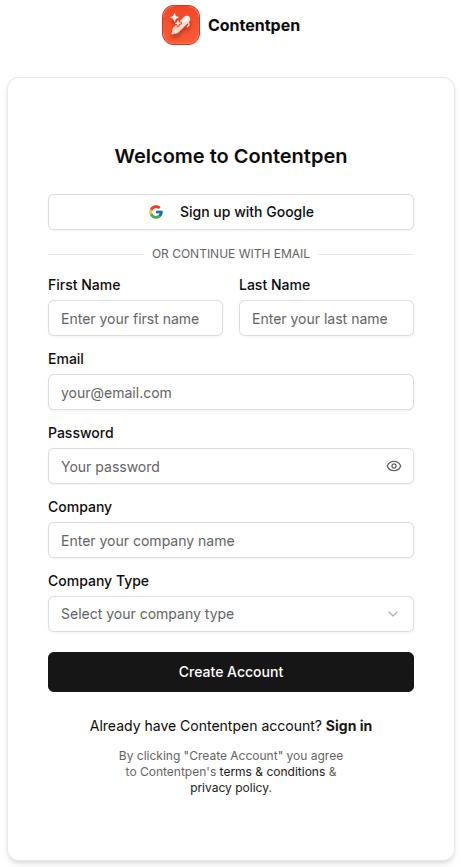
Enter your details, including first and last name, email, password, company name, and type. For first-time users, you will be requested to enter your card details, but don’t worry, you won’t be charged anything. You will gain access to our free 7-day trial, which you can cancel at any time.
After entering all the information, enter your credentials and access your main Contentpen dashboard.
Step 2: Create a new article
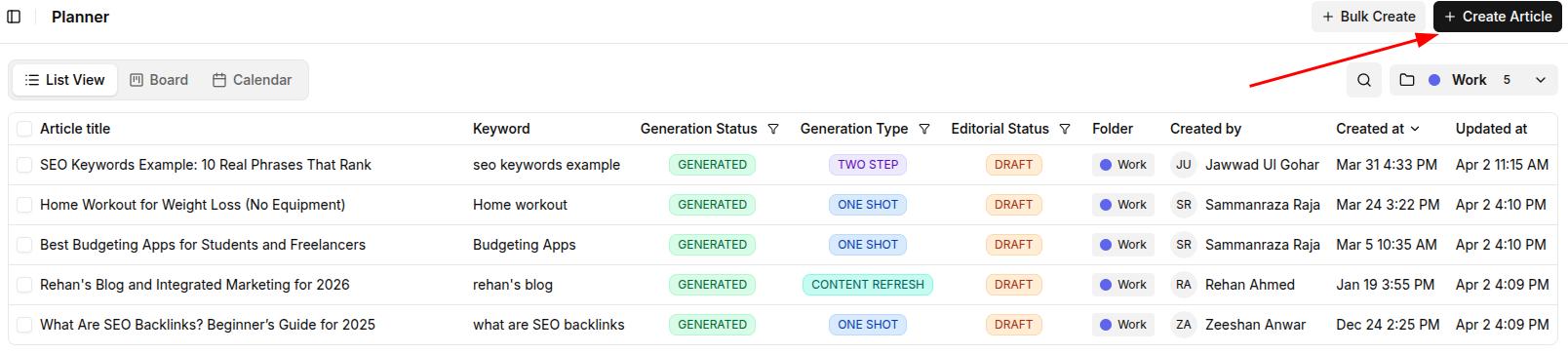
Once inside the dashboard, navigate to the “Planner” section. Click on the “Create Article” button in the upper right corner to start writing.
Step 3: Choose a template
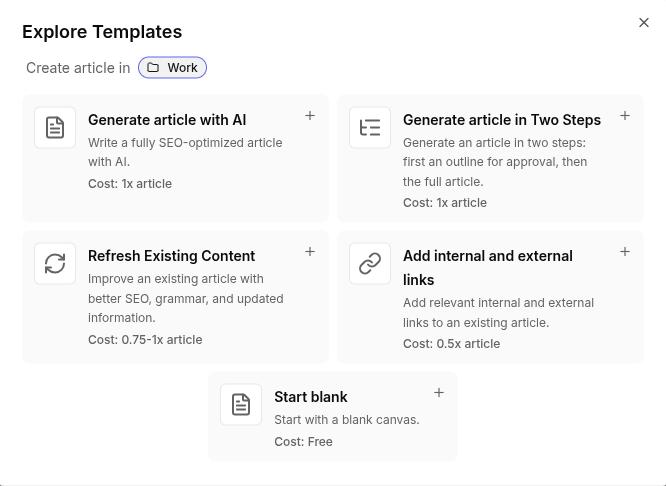
Once you click this button, you’ll see the template screen. Here, you can choose between the following 5 templates:
Generate article with AI: In this mode, Contentpen will create an article in one shot using just your content preset, focus keyword, and secondary keywords.
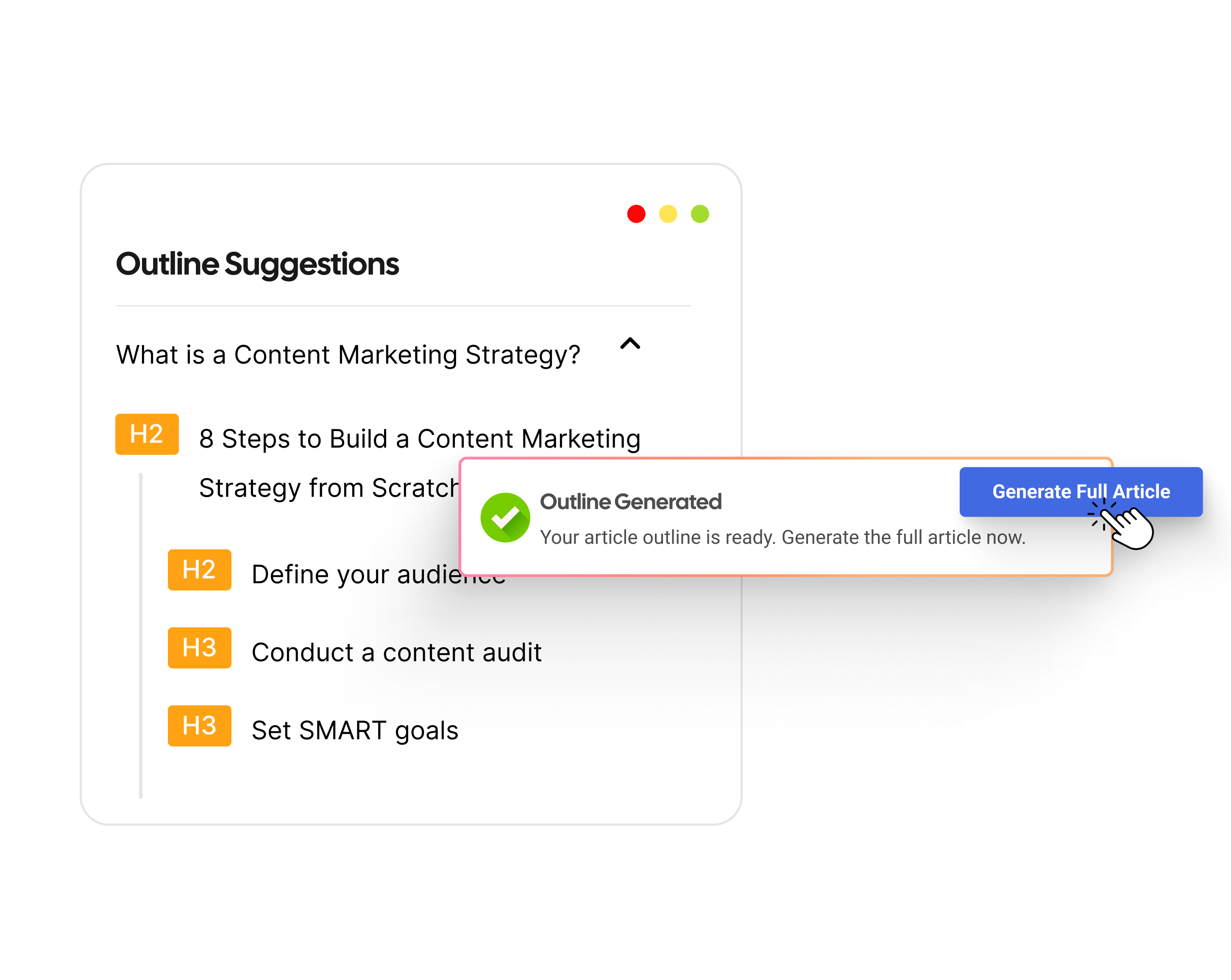
Generate an article in Two Steps: This template works in a two-step process: Contentpen will first create a blog outline, which you can edit or modify according to your needs, before generating the final article.
Refresh Existing Content: If you don’t want to start from scratch, you can also refresh content by adding angles missed by competitors to give you a ranking edge. This mode also generates relevant blog visuals to enhance audience engagement and CTR.
Add internal and external links: With this template, the AI blog writer only modifies the internal and external links in your existing content. However, before choosing this option, make sure you’ve set up the sitemap in Contentpen properly.
Start blank: If you don’t want to receive any AI-generated text and want the creative control yourself, you can start blank. During your write-up, you can take help from our ‘Ask AI’ assistant to refine the clarity and delivery of content.
Step 4: Customize your article settings
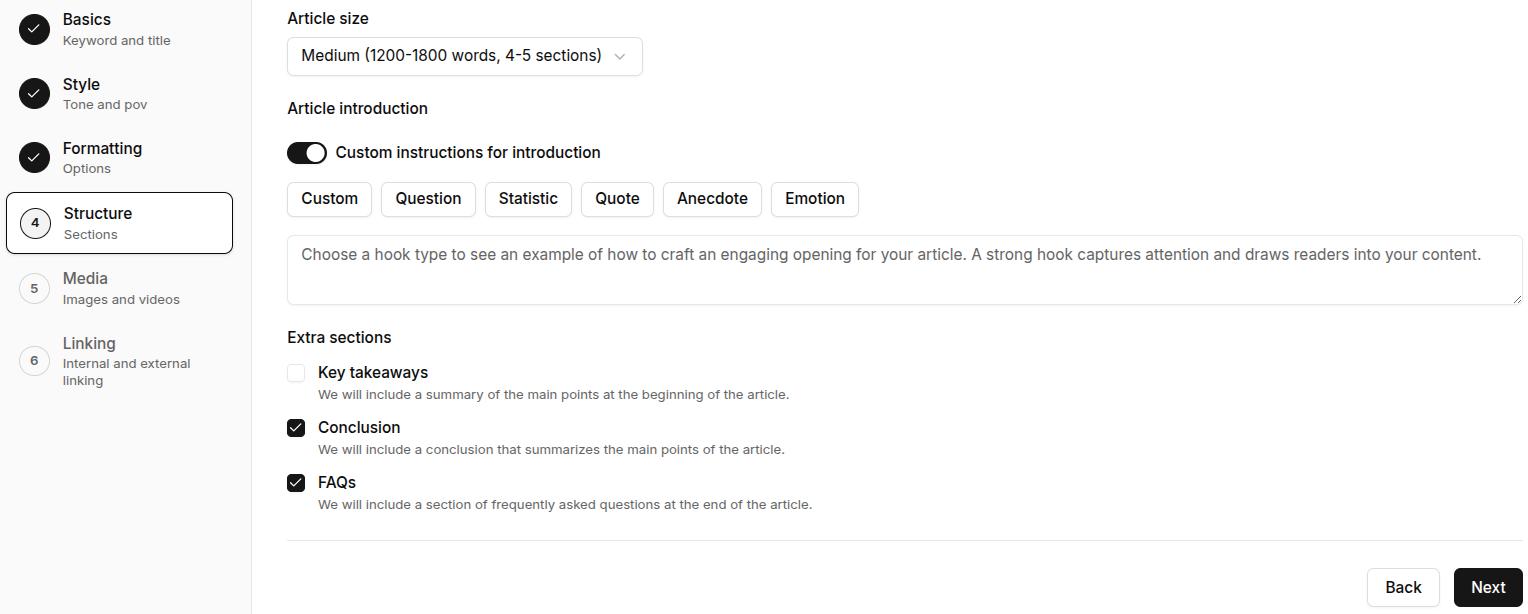
Contentpen offers 6 key customization categories to make the best possible blogs for your requirements.
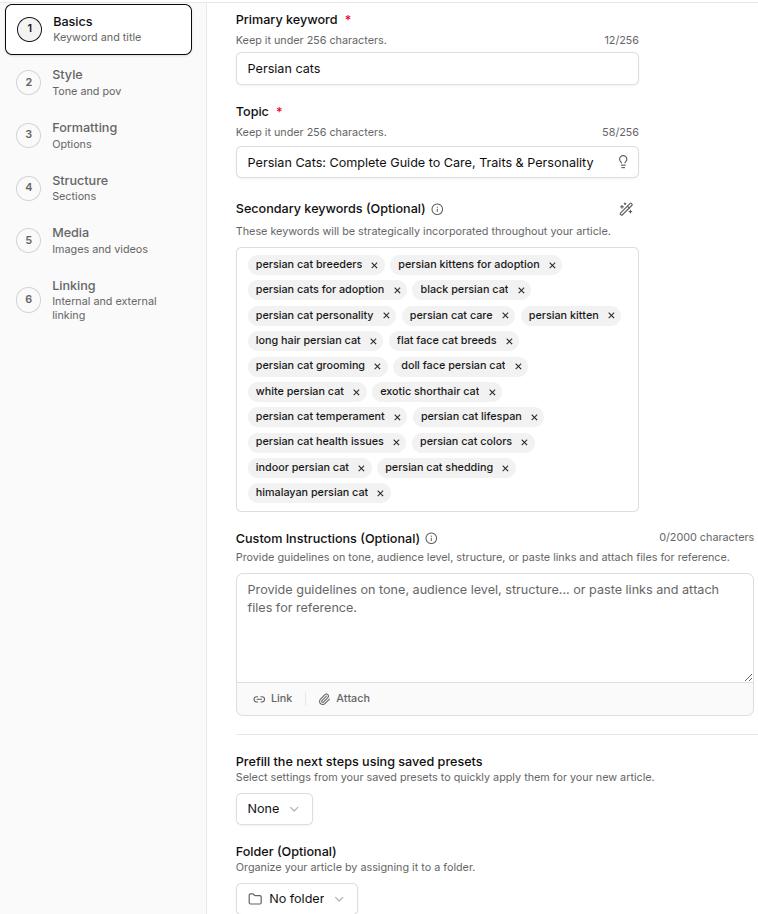
Basics – Add your primary keyword, topic, and secondary keywords, or use our integrated AI for help. Include any custom instructions if needed. Then, choose your Contentpen preset and the content folder before clicking ‘Next’ to proceed.
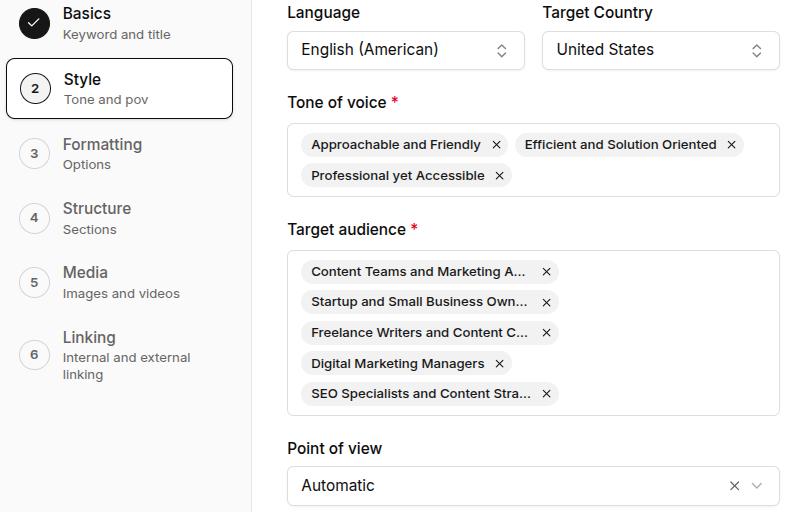
Style – Define the tone of voice, target audience, and point of view you want for your article. You can also choose from 50+ languages to write your article and multiple target countries for a better impact.
Formatting – Choose formatting options like bold, italics, tables, quotes, and lists for your content. Select the heading letter case before moving on to the next stage.
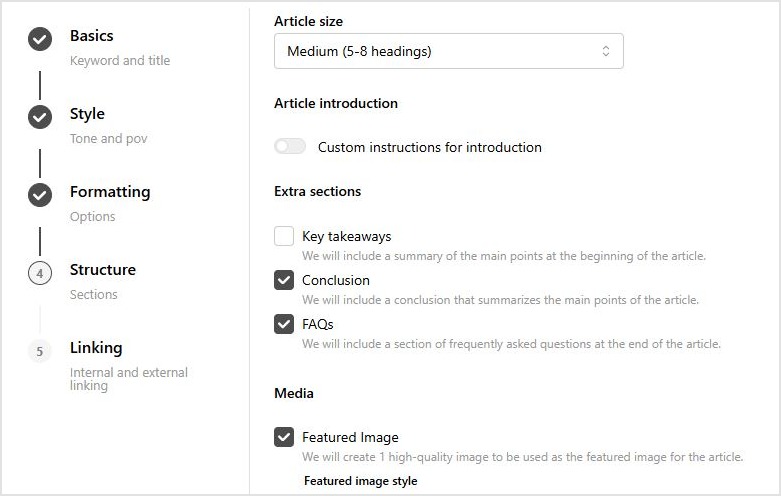
Structure – Set the article size (content length). Here, you can also give custom instructions for the article introduction. Finally, tick the extra sections needed in the blog, for instance, key takeaways, conclusions, and FAQs. Click ‘Next’ to proceed.
Media – Select the type of featured and in-article images you want generated for the article. You can choose between 12 different visual styles to make your content look exactly how you like.
Linking – At this screen, you can customize your internal and external links. Add your sitemap if you haven’t already to enable internal linking. Include or exclude domains that you don’t want to see as external links, or toggle them off entirely.
Pro tip: Use the ‘Test Sitemap URL’ button to double-check if Contentpen can access your site structure for effective internal linking.
Step 5: Generate the article
After completing all the article settings, you may see the ‘Ready to create your article’ screen, where you’ll be asked to save your current settings as a preset or continue to create the article.
After you click ‘Create’, wait for a while until Contentpen is done processing your request. The time taken to complete processing depends on the type of content template and the length of the article selected.
Step 6: Review and optimize your article
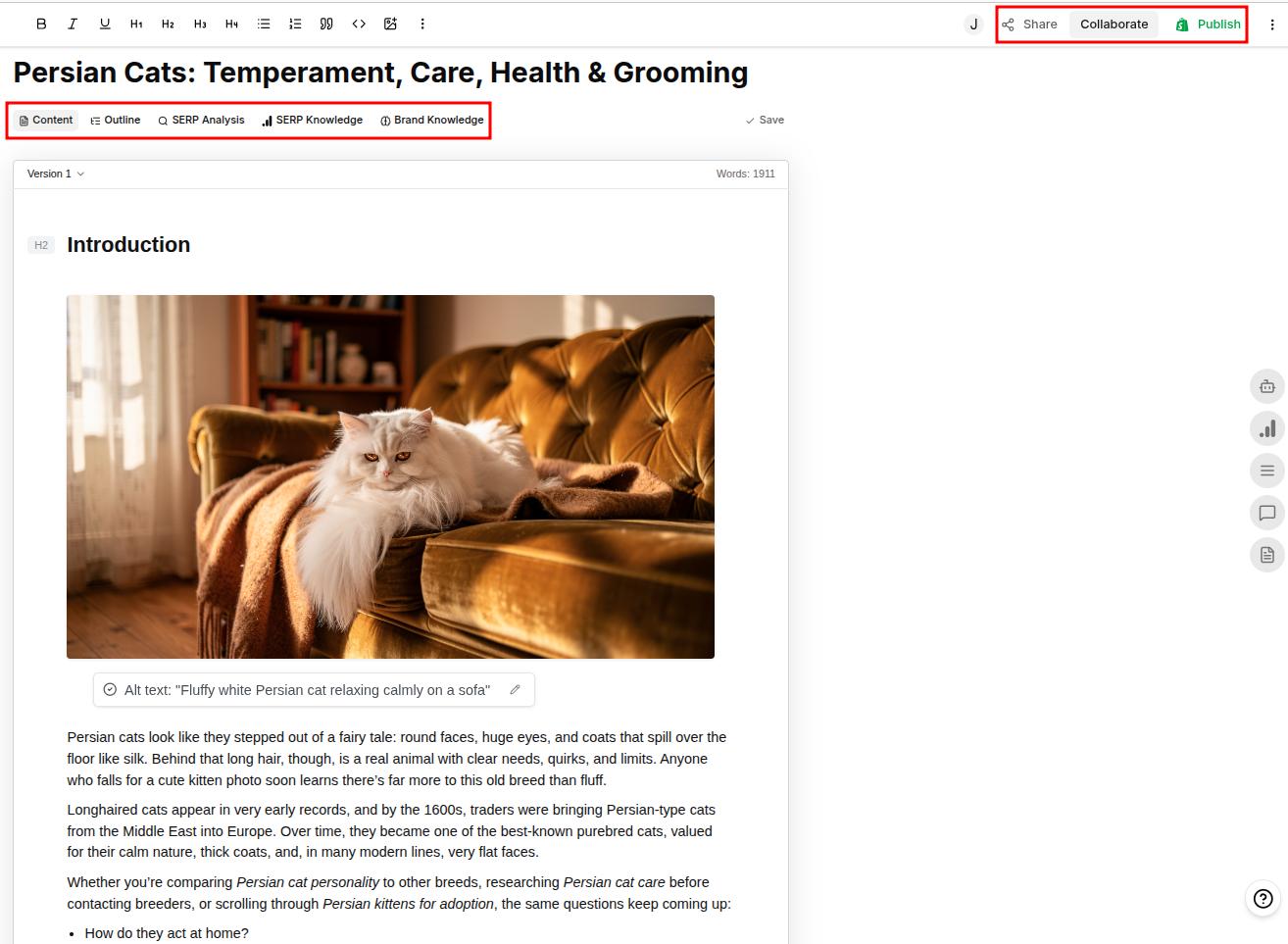
If you’ve closely followed all the steps so far, you’ll now see the tool’s output: a complete SEO- and GEO-optimized article.
Once Contentpen generates your article, do a quick review before publishing.
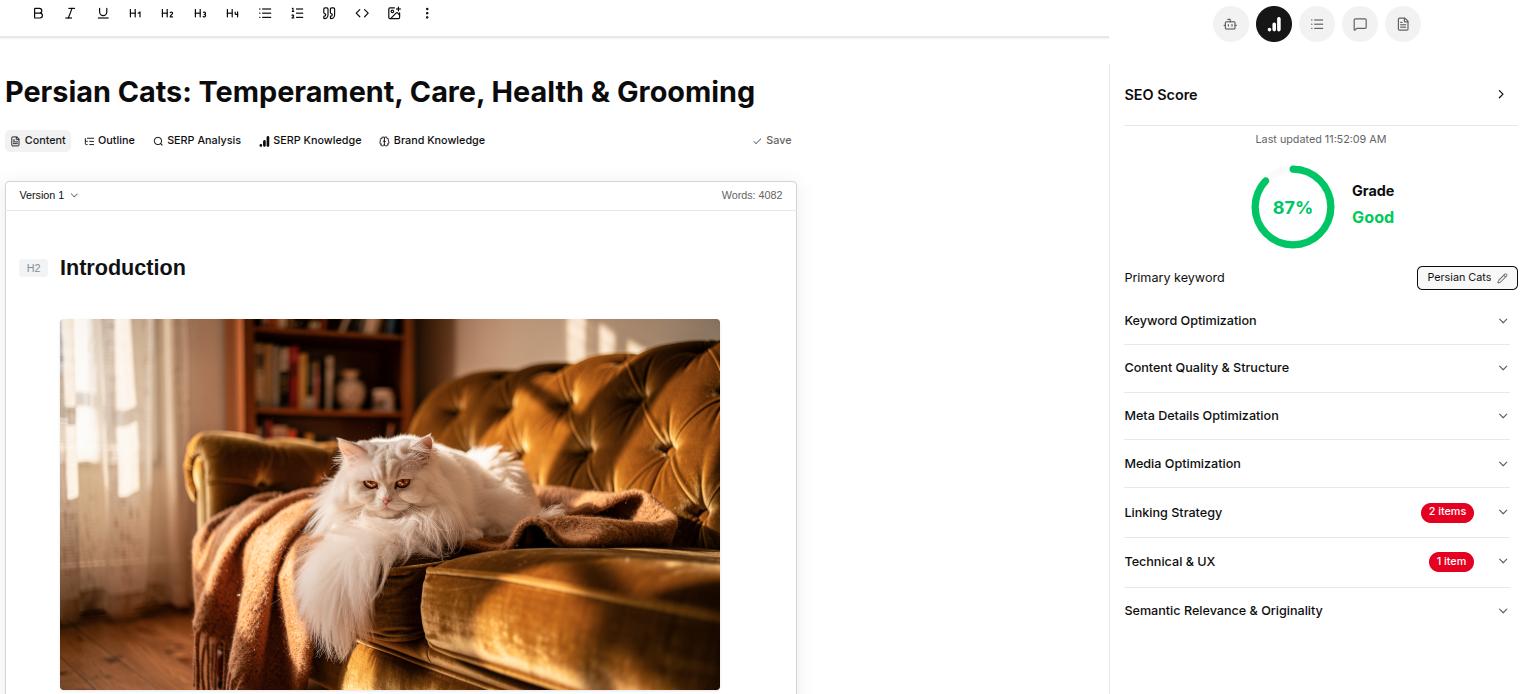
Check your SEO score by clicking the right-hand panel. Contentpen analyzes your meta title and description, keyword usage, readability, and linking strategy to flag what’s working and what’s not. Work through the suggestions to further enhance the SEO score.
Refine with Ask AI. If any section feels off, highlight it and use the ‘Ask AI’ assistant to rephrase, expand, or adjust it. You can also give it broader instructions like “make the introduction more conversational” or “shorten the conclusion.”
Review SEO article settings, including its metadata, slug, target keyword, audience persona, and editorial status.
Add comments in the blog to help your teammates understand your point of view for a particular angle and work together to further polish the article.
What are the best practices for using Contentpen efficiently?
To get the best results, provide clear input instructions to Contentpen. Provide relevant keywords that serve your purpose well, adjust the AI-generated content style and tone to your preference, and review the output once before publishing.
Is the content generated by Contentpen SEO optimized?
Yes, Contentpen ensures that every article is SEO and GEO optimized by satisfying search intents, reviewing competitors’ content, and integrating the right keywords and meta details.
Can I use Contentpen for multiple websites or projects?
Yes, you can create multiple workspaces to manage the content of different brands separately. Each workspace allows the AI to learn from past activities, ensuring improved performance and relevance over time.
What happens if I’m not satisfied with the content?
You can request revisions from the AI assistant or edit the content as needed. Contentpen also offers support to ensure the content meets your standards.
Can I go back to each article setting after publishing the content?
Yes. Contentpen enables you to go back and regenerate your article using different settings through its ‘Regenerate article’ feature.
“No, Google doesn’t penalize AI-generated content if it’s used appropriately”, says Google.
The widespread adoption of AI in content creation has sparked considerable debate about its potential impact on search engine rankings, particularly whether Google penalizes AI-generated content.
This overview explores the potential implications of AI on rankings, factors Google may consider when evaluating such content, and how creators can use AI blog writer tools responsibly to produce high-quality content that meets Google’s standards.
Key takeaways
No, Google does not punishes AI-genereated content.
Yes, Google can detect AI-generated content.
Adhere to the Google guidelines related to the helpful content and EEAT.
AI content can rank on Google. However, humanize and edit where necessary.
Contentpen, the best content generation tool to look for in 2026
1.0 Understanding AI generated content:
AI-generated content refers to text, images, videos, or any other forms of media created by artificial intelligence algorithms without direct human input or creativity. These algorithms, often driven by machine learning and natural language processing, can produce content that mimics human writing styles, facts, and structure.
At the core of many AI content creation tools are technologies like machine learning and natural language processing (NLP). Machine learning allows these systems to analyze and learn from large volumes of data, improving their ability to generate relevant and coherent content over time. Meanwhile, NLP enables the AI to understand and produce human-like language, allowing it to craft narratives that closely resemble those written by people.
The capabilities of AI-generated content have evolved significantly. For instance, AI can now create articles that range from simple reports to complex blogs, mimicking various writing styles and tones depending on the intended audience. Additionally, it can generate visual content, such as images and graphics, that meets specific themes or design requirements. In the realm of videos, AI can even assist in editing and producing films or promotional content based on predefined scripts or concepts.
The million-dollar question is whether Google can detect and truly rank AI-generated content or not.
Let’s take a deep dive into it.
2.0 Can Google detect and penalize AI content?
Yes, Google can detect AI-generated content to some extent. While, Google’s algorithms do not explicitly penalize AI-generated content merely for being AI-generated and it does not specifically target AI-generated content. Its algorithms are designed to assess content quality, relevance, and adherence to Google’s guidelines.
Google’s algorithms use various signals to identify content that may be generated by AI. This includes examining writing styles, structure, coherence, and even specific patterns that are more prevalent in AI-generated texts compared to human-written content.
2.1 So, is AI content good or bad for SEO?
AI-generated content can be a bit of a double-edged sword for SEO, right? On one hand, it’s super efficient for cranking out lots of content that’s optimized for specific keywords.
But here’s the catch: if that content lacks a personal touch or feels too generic, it’s probably not going to resonate with your audience. Nobody wants to read something that sounds robotic or offers no real insights. Think of it this way: it’s like bland food that no one actually enjoys it!
So, the secret sauce? Pairing AI with that all-important human touch. It’s all about making sure your content not only checks the SEO boxes, but also connects with readers in a meaningful way. So, while AI can be a great tool, don’t forget to sprinkle in that personal touch to truly engage your audience!
Danny Sullivan, Google’s Search Liaison, clarified this in 2022, stating:
“Using AI doesn’t make content inherently against our guidelines. If content is helpful and created for people first, it will do well regardless of how it was produced.”
The myth that AI-generated content can get penalized by search engines has been debunked. Let’s further support this with relevant data and insights.
2.2 Semrush analysis shows Google can successfully rank AI-generated content
Semrush took a deep dive into the actual search engine results pages (SERPs) by picking 20,000 random keywords and examining the top 20 results on Google for each one. They compared how AI-generated content stacks up against human-written content in those top search positions.
So, what did they find? Let’s take a look at the results!
While it’s true that human-written content often has a bit of an edge over AI-generated pieces, the difference isn’t as big as you might think.
Take a look at the numbers: 57% of AI-generated content and 58% of content created by humans made it into the top 10. In fact, lots of people have found that AI-assisted writing can perform just as well as, or even better than, what humans come up with. So, it’s pretty clear that AI is making some impressive strides!
You can find the detailed Semrush study here.
3.0 How to create AI generated content that ranks on Google?
Getting the most out of AI in content creation involves:
Using top-quality AI tools
Following Google Search’s guidelines
3.1 Use the best content creation tools
Using the right tools to create AI-generated content can significantly enhance the quality and effectiveness of your output. These advanced tools not only streamline the writing process but also help in generating ideas, improving grammar, and ensuring content relevance.
With various tools available in the market today, each offering unique features tailored to different aspects of content creation, it can be overwhelming to choose the best one. However, one tool that has truly blown me away is Contentpen.
Contentpen AI is a comprehensive writing tool that utilizes multiple specialized agents to streamline and enhance the content creation process, leveraging advanced artificial intelligence technology to ensure every piece of writing aligns with your brand’s identity and meets high-quality standards.
Brand Knowledge agent: An AI that learns and understands your brand’s voice, unique selling points, target audience, and competitors to tailor content effectively.
SERP Analysis agent: An AI that conducts in-depth research to analyze search engine results, identifying top-ranking pages and strategies that resonate with your audience.
Copywriter agent: An AI that drafts engaging content based on selected keywords and SEO practices, creating compelling articles that align with your brand’s narrative.
Reviewer agent: An AI that meticulously reviews and refines the draft, ensuring it meets quality standards and adheres to proven SEO guidelines for optimal performance.
Optimization agent: An AI that enhances the article by adding strategic internal and external links, relevant images, and other elements to ensure comprehensive SEO optimization.
3.1.2 Automate your blog publishing direct to your CMS
Contentpen is designed to seamlessly integrate with WordPress, eliminating the frustrations of manual uploads and tedious formatting. With just a simple click, you can publish your posts directly to your site or even schedule them for a later date. This means you can spend less time on administrative tasks and more time focusing on what truly matters: creating incredible, engaging content that captivates your audience.
3.1.3 Generate blogs in bulk for content publishing at scale
Contentpen has introduced a game-changer with its bulk generation feature, designed specifically for content creators looking to amplify their efforts.Contentpen’s bulk generation capability streamlines the content creation process, allowing you to generate multiple pieces of content effortlessly.
3.1.3 Streamline your task with approval workflow
The approval workflow transforms the way teams collaborate. The approval workflow allows for real-time feedback, making it easy for team members to voice their opinions and for clients to provide their insights instantly. This transparency fosters a collaborative environment where ideas can be shared freely, and adjustments can be made promptly, ensuring that each piece of content is polished to perfection before it goes live.
3.1.4 Ask AI
The magic of Contentpen lies not only in its efficiency but also in its ability to optimize and improve any content piece through its Ask AI feature.
3.2 Follow Google Search’s guideline to generate AI content
3.2.1 Automation can create helpful content
While content automation, including AI, is allowed for content generation, using it primarily to manipulate search rankings violates Google’s spam policies. This means that content created solely to exploit search ranking loopholes risks being flagged as spam. Google employs sophisticated algorithms, like SpamBrain, to detect such practices, which can lead to penalties such as lower rankings or removal from search results. Therefore, content creators should prioritize delivering genuine value, ensuring that AI is used to enhance content quality rather than deceive search engines.
3.2.2 Focus on E-A-T:
Create content that is well-researched and informative. Make sure it meets the needs of your audience. Google prioritizes content that demonstrates E-E-A-T. AI-generated content that lacks credible sources or authorial expertise could be penalized. Strive to create original and unique content that offers a fresh perspective or valuable insights.
3.2.3 User intent and relevance:
Google rewards high-quality content, however it is produced. So create content that satisfies user intent and is relevant to the search query. AI-generated content that fails to address user needs or is irrelevant to the query could be ranked lower.
3.2.4 Human oversight and editing:
Human involvement is crucial to ensure AI-generated content meets quality standards and aligns with brand voice and messaging. Adding personal insights and examples can make the content more engaging and relevant.
3.2.5 Technical quality:
Google expects content to be well-written, formatted, and free of errors. AI-generated content that is poorly written or contains technical errors could be penalized.
3.2.6 Avoid deceptive practices:
Don’t create content just to trick search engines into ranking higher. Focus on providing real value to users. Ensure your content reflects its true purpose. Avoid clickbait or misleading headlines that can annoy users.
3.2.7 Regularly update content:
Keep your content current and relevant. Regular updates help reflect new information and meet user needs effectively.
Conclusion
AI has the potential to revolutionize content creation and significantly impact search engine rankings. By understanding the factors Google considers when evaluating AI-generated content and following responsible AI use guidelines, creators can leverage AI’s power to produce high-quality content that meets Google’s standards and achieves high search rankings.
Potential implications of AI on search engine rankings
Quality and relevance: AI has the potential to generate high-quality, relevant content at scale, which could positively impact search rankings. However, if AI-generated content lacks originality, depth, or accuracy, it could negatively affect rankings.
Efficiency and speed: AI can automate repetitive content creation tasks, enabling faster content production and potentially improving rankings by increasing content freshness and frequency. However, overreliance on AI without human oversight could lead to low-quality content and harm rankings.
User experience: AI can personalize content and enhance user experience, which could indirectly improve rankings by increasing engagement and reducing bounce rates. Conversely, poorly executed AI-generated content could lead to a negative user experience and lower rankings.
Frequently asked questions
Does Google rank AI content?
Yes, Google ranks AI-generated content, but it applies the same criteria it uses for all content. The content must be valuable, relevant, original, and created with user experience in mind. If AI-generated content fulfills these criteria and is well-optimized, it can rank effectively.Add image
Will AI replace SEO?
AI is unlikely to replace SEO but will transform how SEO is practiced. AI can enhance tasks such as keyword research, content creation, and data analysis, allowing SEO professionals to focus more on strategy and creativity. Rather than replacing, AI will serve as a tool to improve efficiency and effectiveness in SEO.
How much AI content is acceptable by Google?
There isn’t a specific threshold for “acceptable” AI content, but it should meet quality standards set by Google. The focus should be on providing valuable, relevant content that engages users. A best practice is to view AI as an assistant for generating drafts and ideas rather than a replacement for human creativity and oversight.
What factors Google may consider when evaluating AI-generated content?
Google evaluates AI-generated content based on several key factors: Quality and relevance: Content must provide real value to users, answering their queries effectively. E-A-T (expertise, authoritativeness, trustworthiness): Google looks for content created by experts in the field, with authoritative sources and accuracy. Originality: Avoidance of plagiarism and ensuring the content adds unique perspectives or information. User engagement: Metrics such as click-through rates, time spent on the page, and bounce rates can indicate how useful the content is to users. Adherence to guidelines: Content must adhere to Google’s guidelines against spammy behavior and manipulation.
How can I get started with using AI for SEO?
To start using AI for SEO: Identify tools: Research and select AI-powered tools such as content generators, keyword research tools, and analytics platforms. Keyword optimization: Use AI to generate keyword ideas by inputting topics relevant to your niche. Content creation: Utilize AI writers to draft content, ensuring to edit and enhance it for quality and relevance. Data analysis: Employ AI for analyzing performance metrics, understanding user behavior, and optimizing your website accordingly. Stay updated: Follow industry trends on AI developments and adapt your strategy based on new features and best practices.