Author: Jawwad

  • How to write a blog post for SEO: A step-by-step guide

    How to write a blog post for SEO: A step-by-step guide

    You spent hours on that last blog post, hit publish, and heard nothing back. No traffic bump, no ranking, no clicks from Google. That kind of silence almost always comes from skipping research and not knowing how to write a blog post for SEO.

    Writing a blog post requires keyword research, building an outline, drafting the content, structuring it, then publishing it with proper meta title, description, and links.

    If you consistently perform this process, you’ll be able to rank better in SERPs and get cited by AI answer engines.

    This guide walks through exactly how to write a blog post for SEO, covering all the steps necessary. You’ll also see where a platform like Contentpen can speed up the process without cutting corners on quality.

    Keep reading to build a system you can repeat for every post.

    Key takeaways

    • Start with keyword research and search intent before writing anything, since the wrong target keyword or intent means nobody finds your post.
    • Build a complete outline first, covering headings, links, and FAQs, so drafting becomes fast and organized.
    • Structure content with clear H2 and H3 headings that help both readers and AI systems scan and extract answers.
    • Optimize your title, meta description, and internal links strategically, since these details drive clicks even after you rank.
    • Always edit, proofread, and read your draft aloud before hitting publish.

    What does it mean to write a blog post for SEO?

    Writing a blog post for SEO means shaping content so it clearly answers a searcher’s question while giving Google and AI tools the signals they need to rank and cite it. 
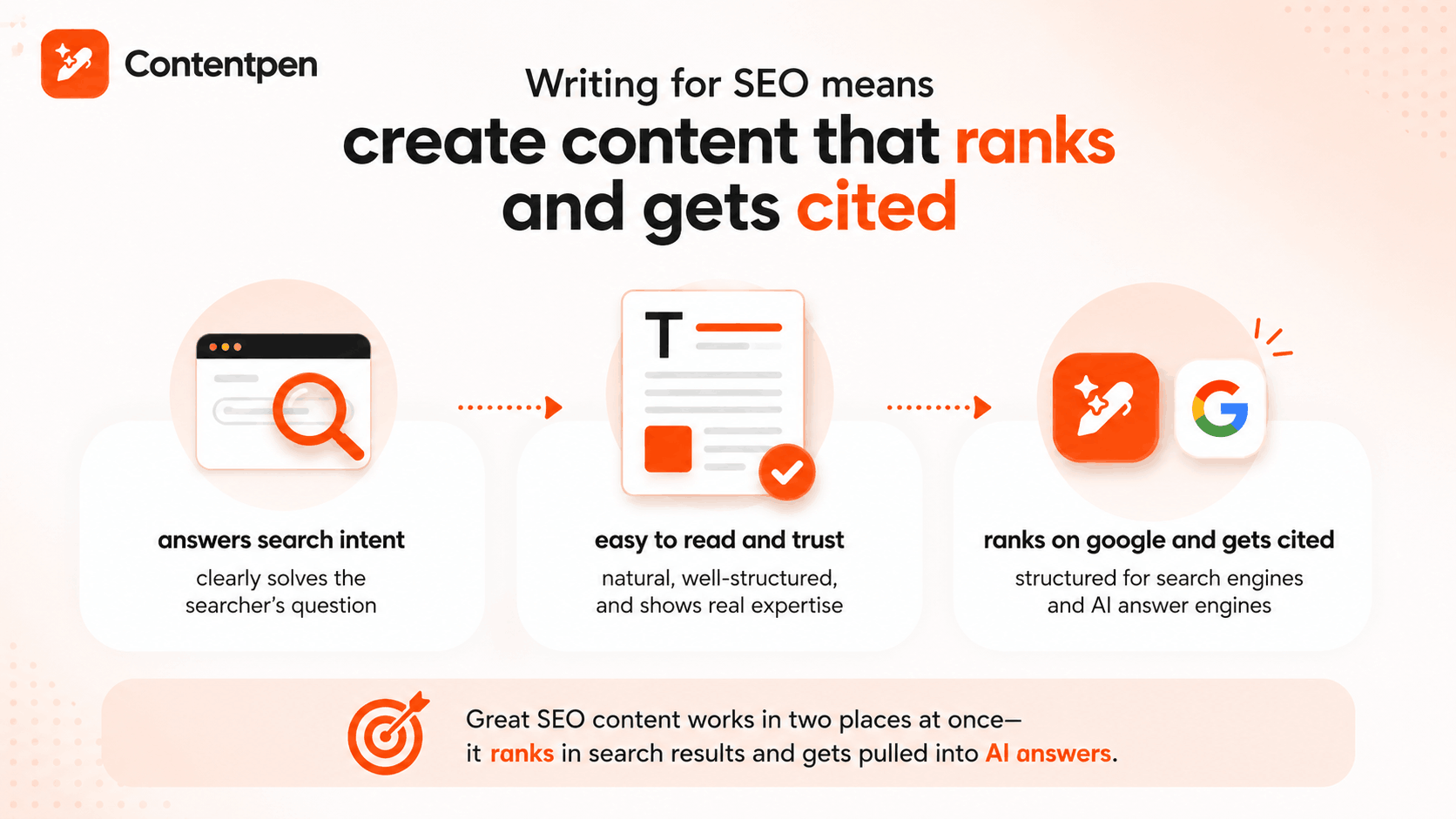
    What writing for SEO means.

    It’s no longer about repeating a keyword as many times as possible. Search engines now reward posts that match intent precisely, read naturally, and demonstrate real expertise rather than generic filler.

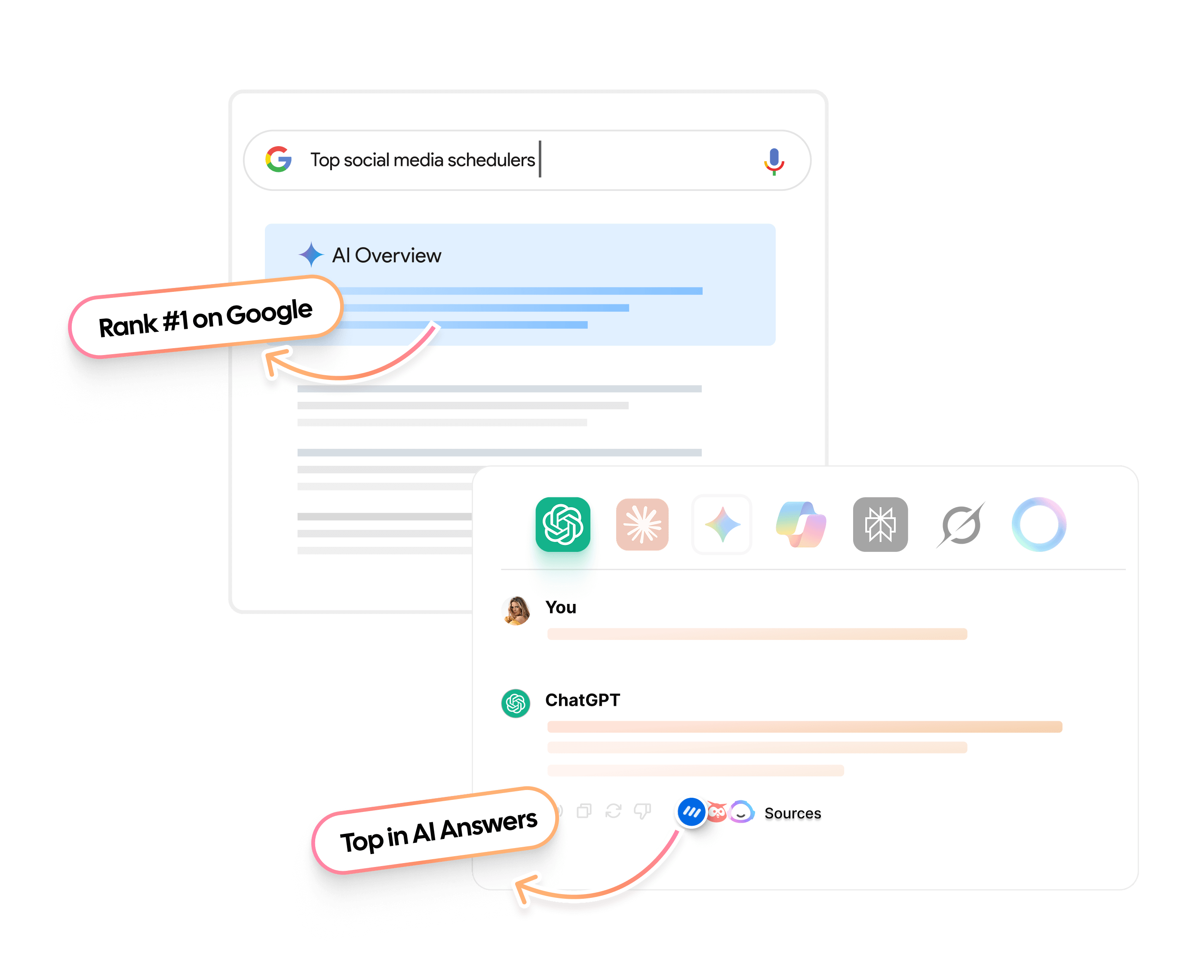
    This matters more now because your content needs to work in two places at once. It has to rank in traditional Google results, and it needs a clear, well-organized structure that lets AI answer engines like ChatGPT and Google’s AI Overviews pull direct quotes from it.

    What counts as SEO-optimized content?

    SEO-optimized content isn’t a separate style of writing. It’s regular, useful writing that also happens to check a few technical boxes: 

    • A clear target keyword
    • A heading structure that mirrors how people actually search
    • Metadata (meta title and description) that accurately describes the page
    • Internal links that connect the specific page to the rest of your site

    If you don’t tick these boxes, you won’t get discovered online, doesn’t matter how well you write content. But if you only chase these boxes, you’ll end up with content that no human wants to read.

    The goal is to create content that works for both humans and robots, something that we highlighted in depth in our On-page SEO guide.

    How do you research keywords and search intent before writing?

    Keyword research means finding the exact phrases people type into Google when looking to learn, buy, or compare two things.

    Researching keywords also means understanding the intent behind the search and trying to address it directly in your content.

    Why does search intent matter so much?

    Most searches actually fall into four intent categories, and knowing which one you’re writing for helps you attract the right type of audience that converts quickly.

    Intent typeWhat the searcher wantsExample queriesBest content format
    InformationalLearn or understand somethingHow to write a travel blog,” “What is SEOGuides, tutorials, how-to articles
    NavigationalReach a specific site or pageContentpen loginHomepages, login pages, feature pages
    CommercialCompare options before a purchaseBest AI blog writers in 2026Comparisons, reviews, use-case breakdowns
    TransactionalComplete an actionTry Contentpen freeProduct pages, pricing pages, sign-up flows

    Checking the current top-ranking pages for your keyword before you create your blog outline confirms which format Google already favors. Try to replicate that to earn the conversions you need for your business.

    How to look for keywords

    Start with Google’s autocomplete suggestions and the “People Also Ask” boxes, both of which reflect real searches happening right now for your target query.
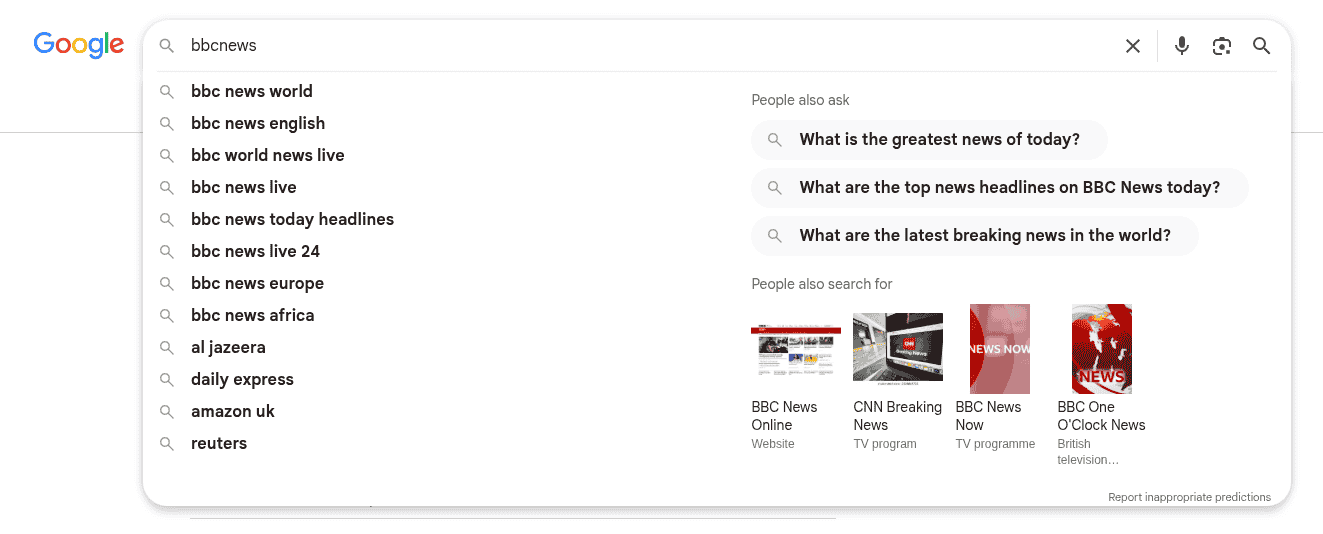
    Google search for the keyword 'bbcnews.'

    Dedicated tools such as Google Keyword Planner, Ahrefs, and Semrush’s Keyword Magic Tool go further, generating thousands of related terms from one seed keyword.

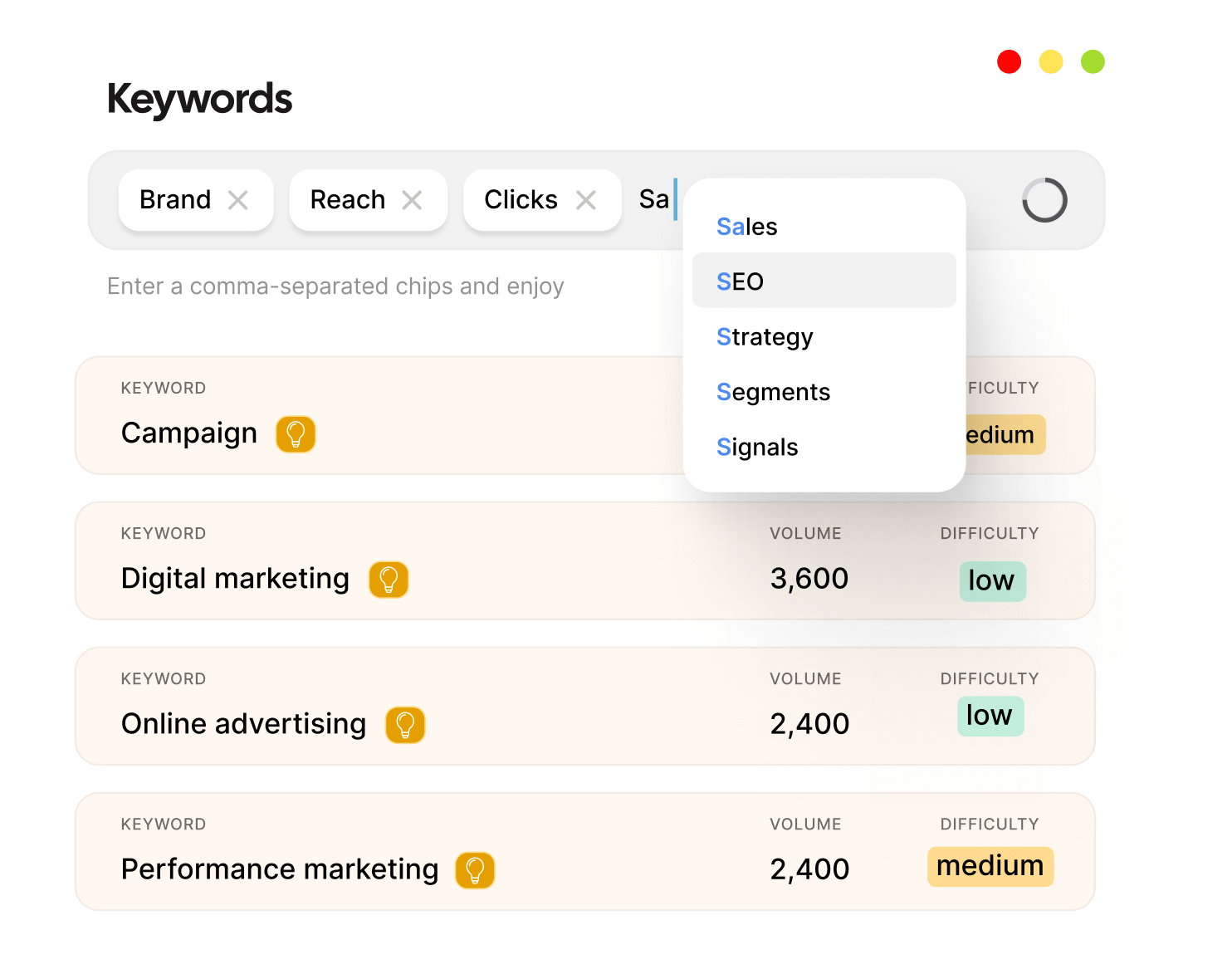
    Other than those tools, you can also use Contentpen’s built-in keyword research tool to get all the required keywords for the content pillars, without ever leaving the platform.

    Automated keyword research

    Work on keywords worth writing for

    Get search terms with real ranking potential, not just high volume.

    Try Keyword Research for FREE
    AI SEO Interface

    Once you have all the best options, weigh each one against search intent, keyword difficulty, and search volume.

    Why long-tail keywords work best for beginners

    Long-tail keywords are longer, more specific search phrases, like “how to write a blog post for beginners” instead of just “blog post.” They carry less competition than broad, one- or two-word terms, which makes them far easier to rank for. 
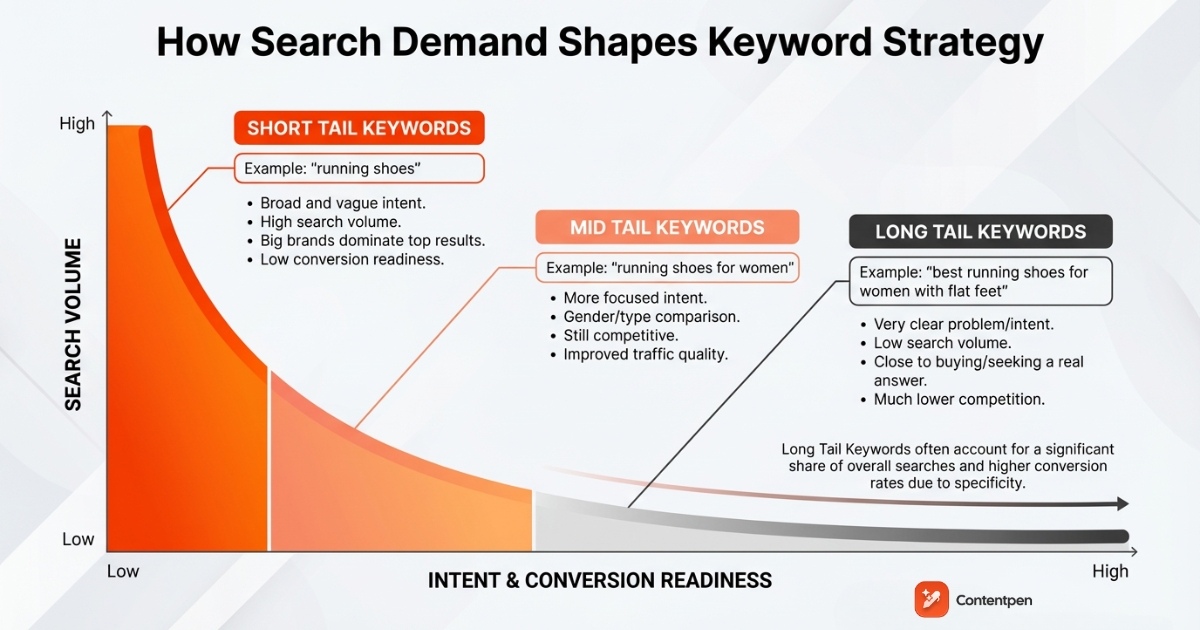
    Search demand curve showing that long tail keywords get less search volume but more conversions.

    Long-tail keywords also attract visitors who know exactly what they want, so the traffic you do earn tends to convert better.

    How do you write a blog post for SEO?

    Structuring a blog post for SEO means organizing it around one target keyword, clear headings, and the supporting elements search engines and readers both expect. 

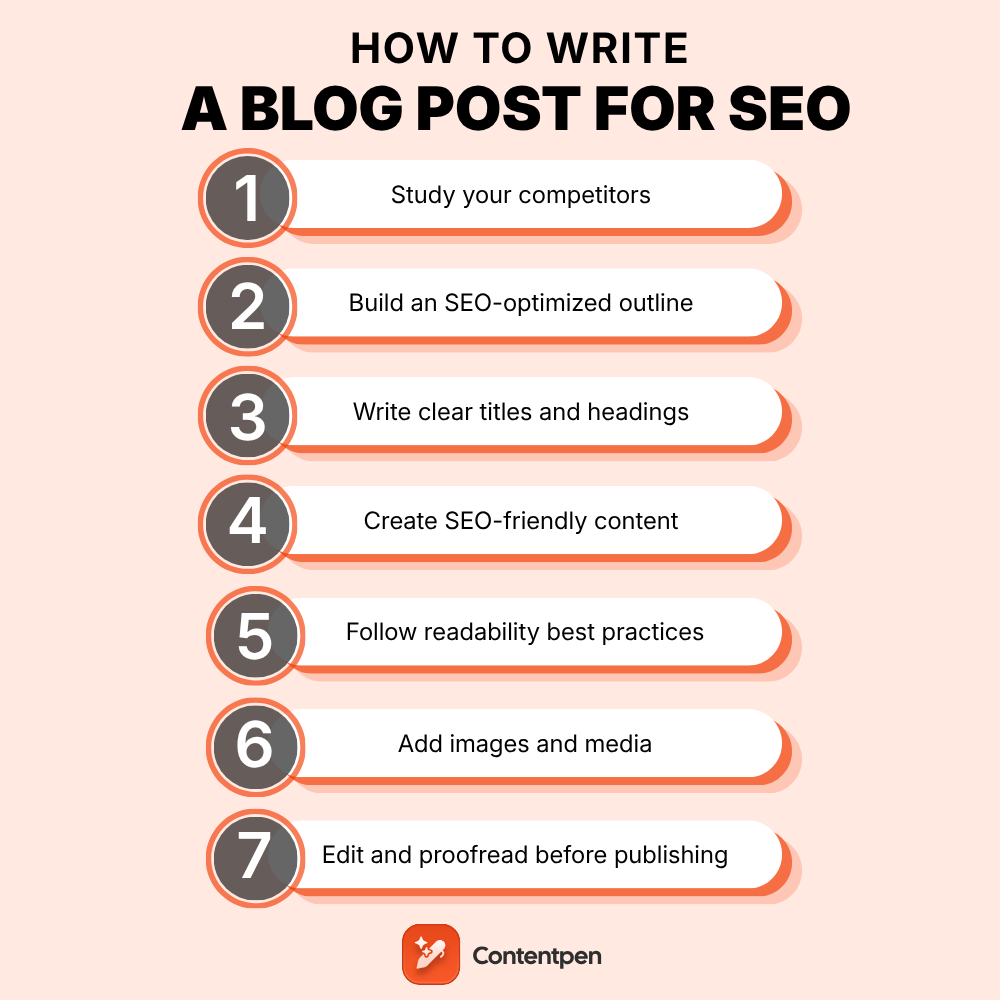
    #1: Study your competitors

    Before you outline anything, spend time studying the top 3-5 articles already ranking for your keyword. Note their structure, the questions they answer well, and the gaps they leave open.

    Then, your job is to close those gaps by providing more value where your competitors fall short, adding current data, or clearer examples to explain a topic.

    #2: Build an SEO-optimized outline

    A solid outline keeps drafting fast and focused instead of a blank-page guessing game. Before typing your introduction, map out the core pieces your post needs.

    • Title and one primary keyword, plus a search intent label so you know how to frame the writing.
    • H2 and H3 headings, internal and external link spots, image placeholders, and your FAQ section.

    Also, make sure to include your notes while writing so that you know what exactly a draft needs after you finish writing it. 

    For example, requesting quotes from a supervisor, senior team lead, or an industry expert. Leave that space open for now and carry on with the rest of the steps.

    #3: Write titles and headings that work for readers and Google

    A strong title includes your keyword early and still makes someone want to click, using formulas like “How to [result], plus [specific detail].” 

    Take a look at this example below for the blog titled “How to start digital marketing as a beginner.”
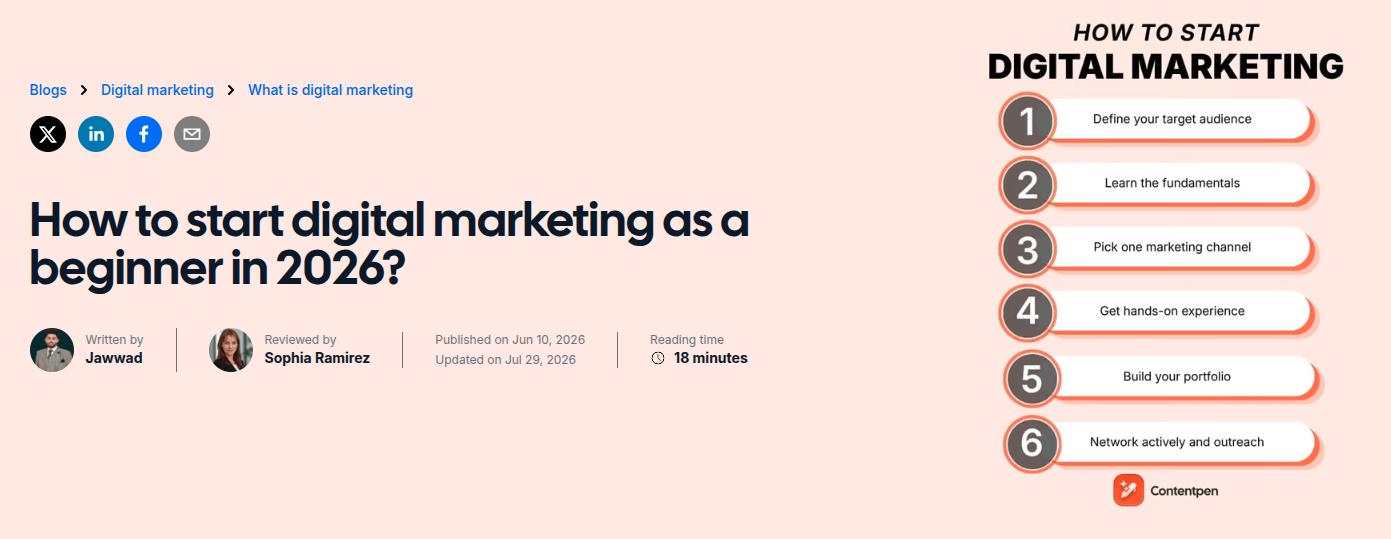
    How to start digital marketing blog used as an example of how to name blogs properly.

    Keep it under 60 characters so Google doesn’t cut it off in search results. 

    Every H2 and H3 after that should tell readers exactly what the section covers. AI systems rely on those same headings to find and extract answers.

    You can place your query-based, long-tail keywords as H2 as well, for example “Can I turn off AI Overviews on Mac?”

    Where you place the keyword across the page matters as much as the outline itself. A quick checklist worth running through before you draft:

    • Title tag and H1: Put the primary keyword near the start so readers and search engines see the topic immediately.
    • Introduction: Work the primary keyword into the first hundred words naturally.
    • Subheadings: Variations like “how to write an SEO-friendly blog post” or “how to write a good blog for SEO” in an H2 or H3 help search engines understand the structure.
    • URL slug: Short and descriptive, with the main keyword included, such as /how-to-write-a-fitness-blog.
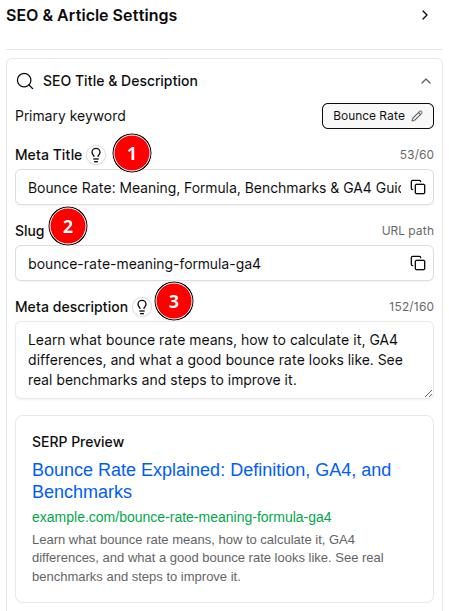
    Metadata information for an article inside Contentpen.
    • Meta description: Include the main keyword and a phrase that reflects the click-through benefit, without overpromising what the page delivers.
    • Image alt text: Short, accurate descriptions, not keyword-stuffed captions.
    • Body content: Let the keyword and its variations appear where they fit naturally instead of forcing an exact phrase into every paragraph.

    This same list doubles as a blog post SEO checklist you can run it through for every draft before it goes live.

    #4: Write SEO-friendly content that people actually want to read

    Writing SEO-friendly content means answering the question behind your keyword and using plain language to explain a concept

    You can dive into technicalities if the topic allows for it, but try to remain as conversational as possible.

    Place your primary keyword naturally within the first 100 words, then let it reappear a few more times only where it genuinely fits. 

    Beyond that, focus entirely on being useful, adding real anecdotes, examples, specific numbers, and details a competitor’s post skipped.

    Google’s own guidance is that its systems are built to reward original, helpful content written for people first. 

    That means you should write original content, not just a reworded version of whatever already ranks.

    You should also weave in your expertise on the subject so that Google and AI engines recognize you as the authority. Over time, you will be rewarded with more traffic and visibility.

    For sensitive topics like health, finance, law, and other YMYL topics, this bar gets stricter. So make sure what you are writing is accurate, up-to-date, and honest.

    #5: Follow readability best practices
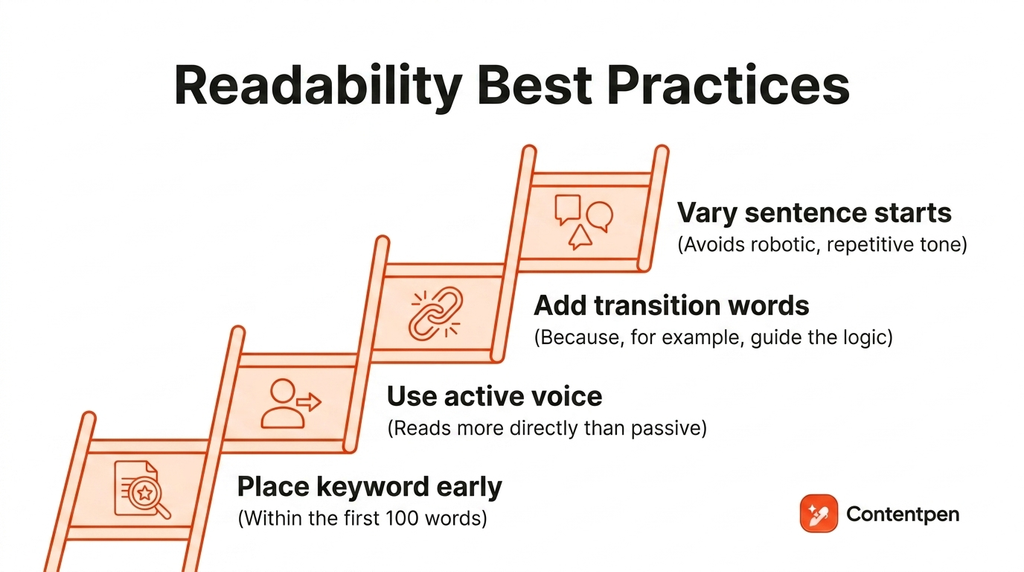
    Readability best practices - Contentpen.ai.

    Readable content wins on both fronts, human attention and machine parsing. 

    Favor active voice over passive, since active sentences read more directly. Use transition words like “because” or “for example” to guide readers through your logic.

    Vary how you start each sentence so the writing doesn’t feel robotic or repetitive.

    Try to break up the text every 200-300 words with images, videos, or any other interactive elements.

    You can also add visual CTAs to not only promote your business but also give the readers a rest before they start processing the rest of your blog post.

    #6: Add images and media to boost engagement

    Text-heavy posts lose readers fast, so break them up with visuals. Industry data suggests blog posts with images can draw 94% more views than text-only posts. Why? Because visuals give the eye a place to rest while scanning a text-heavy piece of content.

    Add descriptive alt text for accessibility, embed a short video where it clarifies a complex step, and consider a table of contents for anything running long.

    To create on-brand images, you can utilize Contentpen’s built-in AI image generator. The tool creates in-article and featured images as infographics, portraits, abstracts, and 9 other styles according to your brand colors, tone, and logo.

    #7: Edit and proofread before you hit publish

    Never publish straight after finishing a draft. Step away for at least a few minutes, then read the whole piece out loud, since that technique catches awkward phrasing silent reading misses. 

    Run it through a grammar tool like Grammarly to correct grammatical and punctuation issues. Then double-check your keyword placements and internal and external links in the article before moving forward.

    Once the draft is ready, publish to your CMS or utilize Contentpen’s one-click publishing to automate the copy-paste process. The tool will ensure all the formatting, image media, and links, etc., are intact to save time in making your posts live.

    How can AI tools like Contentpen speed up writing SEO blog posts?
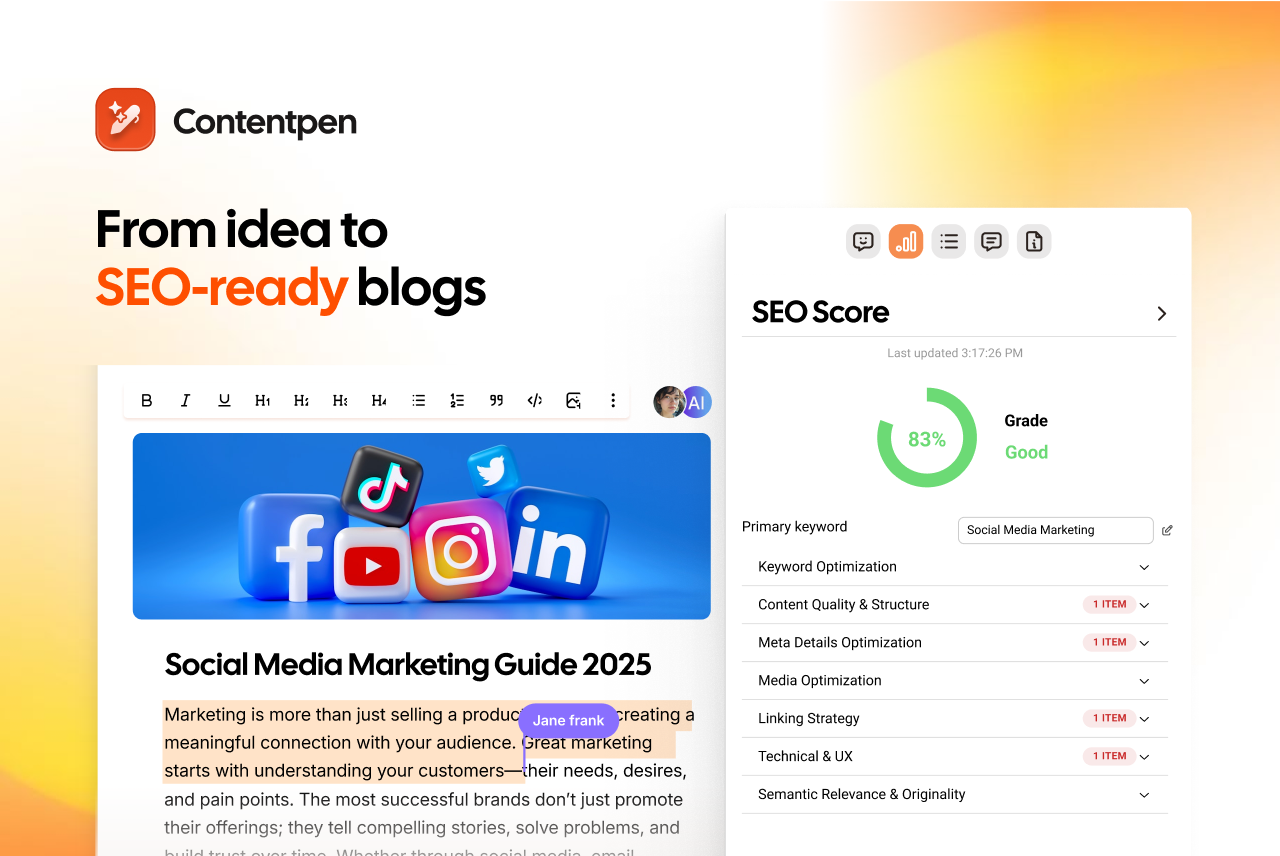
    Contentpen for AI and SEO optimized content - Contentpen.ai.

    AI tools speed up SEO blog writing by handling research, outlining, and drafting in one connected workflow.

    Contentpen, for example, builds keyword research around real search intent, then turns that research into a structured outline before generating a full draft with headings and paragraphs in place.

    That combination means a writer can move from a blank topic idea to a publish-ready draft without much hassle.

    Write better blogs in less time, without sacrificing quality.

    Let AI handle structure, clarity, and flow while you stay in control of the message.

    Try AI blog writing
    AI SEO Interface

    Besides this, Contentpen helps users plan their content calendar and post directly to their preferred CMS platform.

    One newer option worth mentioning here is the AI autopilot feature, which allows for true blogging automation.

    You select a posting frequency, topics for blogs, and a destination to post content. Then, the tool automates keyword research, SERP analysis, drafting, and publishing on its own.

    If you’d rather stay in the loop, you can set it to pause for your review before content is generated for a topic, or for the final edits before it publishes to your CMS.

    What happens after you publish?

    Publishing isn’t the end of it. A new post needs to get in front of readers and earn links before search engines fully trust it for the query you’re targeting.

    It also needs regular maintenance after that to hold its position in the SERPs and AI Overviews.

    On the promotion side, a mix of distribution channels usually works better than relying on one. 

    Share to social platforms where your audience already spends time, feature the post in an email newsletter, and drop it into relevant niche communities or Slack groups where it adds value.

    Keep a consistent publishing schedule so your audience knows when to expect content.

    Since rankings shift due to algorithm updates and competitors publishing newer content, it’s often a good idea to update an existing post rather than write a new one from scratch. 

    That means on the maintenance side, refreshing outdated stats, adding sections that competitors still haven’t added, and tightening internal links is the way to go.

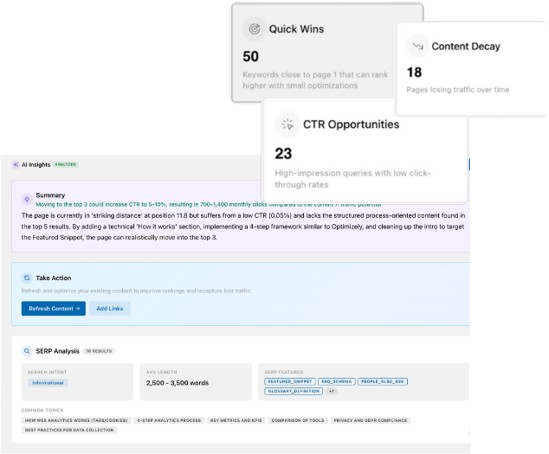
    That said, if you are having trouble keeping the content updated manually, try Contentpen’s SEO opportunities to regain rankings and AI citations with the least effort.

    Just click a button, and the tool will automatically apply fixes in your content to push it to success.

    Turn existing content into growth opportunities

    check

    Identify pages losing traffic or CTR

    check

    Find quick wins to improve clicks and rankings
    Find Content Opportunities
    AI SEO Interface

    Final thoughts

    Writing a blog post for SEO isn’t a mystery skill. It’s a repeatable sequence: Research the keyword and intent, build an outline, draft for the reader first, then optimize the title, links, and metadata before publishing.

    For the next steps, start with one post and run it through this full process end to end. You can try a modified version of this process to better suit it to your needs.

    However, if you want to accelerate content creation for your blogs, then a dedicated platform like Contentpen is your best bet. It frees up your time to work on content strategies rather than repetitive, mundane tasks.

    Frequently asked questions

    What does an SEO blog writing example actually look like? 

    Take a post titled “How to fact-check AI-generated content in 7 steps.” It targets a specific keyword, answers a clear question, uses a numbered structure, and links to related posts on the site. That combination is what makes it work as an SEO content writing example worth modeling.

    Can ChatGPT write SEO content? 

    ChatGPT can draft raw content, but it needs human review, brand voice adjustments, and proper heading structure before it’s genuinely SEO-ready. Dedicated tools like Contentpen build that SEO and GEO structure into the draft automatically, saving that manual cleanup step.

    Will blog posts help with SEO? 

    Yes, consistent, well-researched blog posts build topical authority and bring in organic traffic over time. A single post rarely moves the needle alone, but a library of interconnected, high-quality posts compounds steadily.

    How long should an SEO blog post be?

    There’s no fixed number, though a 2025 Backlinko ranking factors study found first-page articles average around 1,400 words. Treat that as a rough figure, not a target, and write only as long as it takes to fully answer the query.

    How often should you publish SEO blog posts? 

    Consistency matters more than raw frequency, so pick a publishing cadence you can sustain long-term. Pair new posts with periodic refreshes of older content to keep both accurate and competitive in search results.

    Do I need backlinks for a new blog post to rank? 

    Backlinks help, but they aren’t mandatory, especially for niche, long-tail keywords with a clear intent match. Strong on-page structure and genuine depth can rank a post even before it earns external links.

    What’s the difference between SEO and AEO for blog content? 

    SEO focuses on ranking within traditional search engine results pages, while AEO, or answer engine optimization, focuses on getting cited inside AI-generated answers from tools like ChatGPT or Perplexity. Modern blog posts need to satisfy both at once to maximize visibility.

    What does Reddit say about writing blog posts for SEO? 

    Threads on r/SEO and r/blogging tend to repeat the same few points. Write for a specific, narrow query rather than a broad topic, don’t publish without checking what’s already ranking, and don’t expect results before a few months of consistent publishing.
  • How to write a fitness blog: A step-by-step guide

    How to write a fitness blog: A step-by-step guide

    Starting a fitness blog feels overwhelming when you don’t know which step comes first: the niche, the platform, or the content itself. Even if the steps are figured out, you may not know how to write a fitness blog from scratch, which is a problem that a lot of people suffer from.

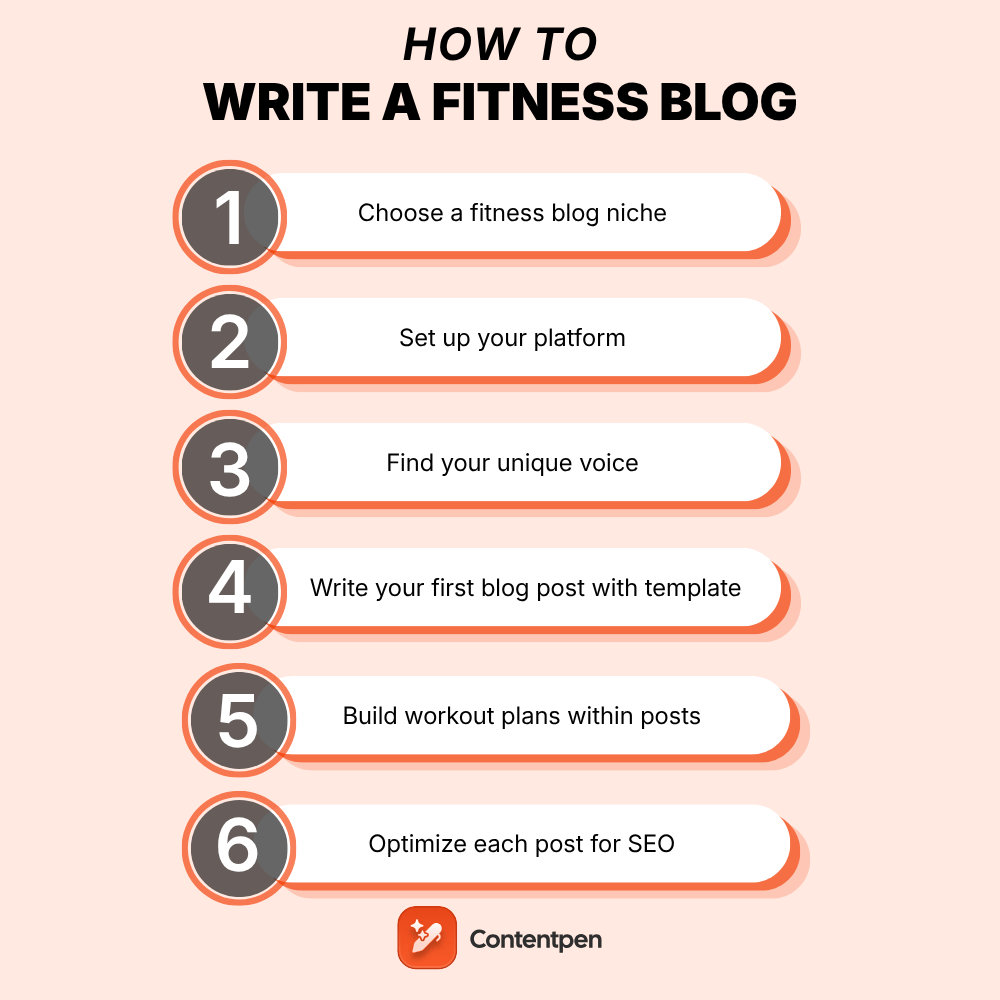
    In today’s post, we’ll learn how to write a fitness blog in 6 easy steps. Whether you’re a personal trainer, a content marketer, or a small gym owner, you’ll walk away with a repeatable process instead of a vague to-do list. 

    Along the way, we’ll point out where tools like Contentpen can speed up the planning and drafting process. 

    So, let’s get into the details, shall we?

    Key takeaways

    • Pick a specific fitness niche before you write your first post, since a focused topic builds a loyal readership faster than covering everything, all at once.
    • Set up a simple, reliable blogging platform with SSL, clean permalinks, and an SEO plugin from day one.
    • Write clear, well-structured posts with headings, actionable steps, and credible sources so readers trust your advice.
    • Optimize every post for search engines with keyword research, meta descriptions, and alt text as you publish, not after.
    • Use AI tools like Contentpen to speed up outlining, drafting, and keyword research so you can publish consistently.

    What is a fitness blog?

    A fitness blog is where you can share your diet, training programs, equipment reviews, and much more with your audience. It is a marketing channel that you own, allowing you to write whatever you want, however you want, if it doesn’t breach search engine policies

    Why should you have a fitness blog?

    As a personal trainer, gym enthusiast, and coach, you should definitely have your own fitness blog. Here’s why:

    • It’s a long-term marketing strategy: Blogs are ideal for long-term marketing of courses, books, or selling affiliate links because your content sits on the Internet forever. It keeps gaining visitors over time if written and updated regularly.
    • It’s free ad estate: Nobody likes display advertisements, but they are a quick way to earn some healthy bucks from your blogs, especially if you rank higher in search and AI results.
    • It’s ideal to capture high-paying clients: Most celebrities and high-profile individuals look for pieces of knowledge that provide them with something fresh and unique. If you are the one to do so, chances are you can land some high-paying consultations.
    • It’s the best way to reach out and help people: How many people do you teach per day? Maybe a couple hundred in your area, if we’re stretching it. With blogging, you will be able to help everyone, worldwide, thanks to the power of the Internet.

    Blogs give you the ideal platform to establish yourself as an authority in your industry. If you keep publishing high-quality, consistent content, over time your blogs rank in search engines and even in AI Overviews, which further improves your chances of landing clients.

    How do you choose a fitness blog niche and topics?

    Pick a focused niche for your fitness blog.

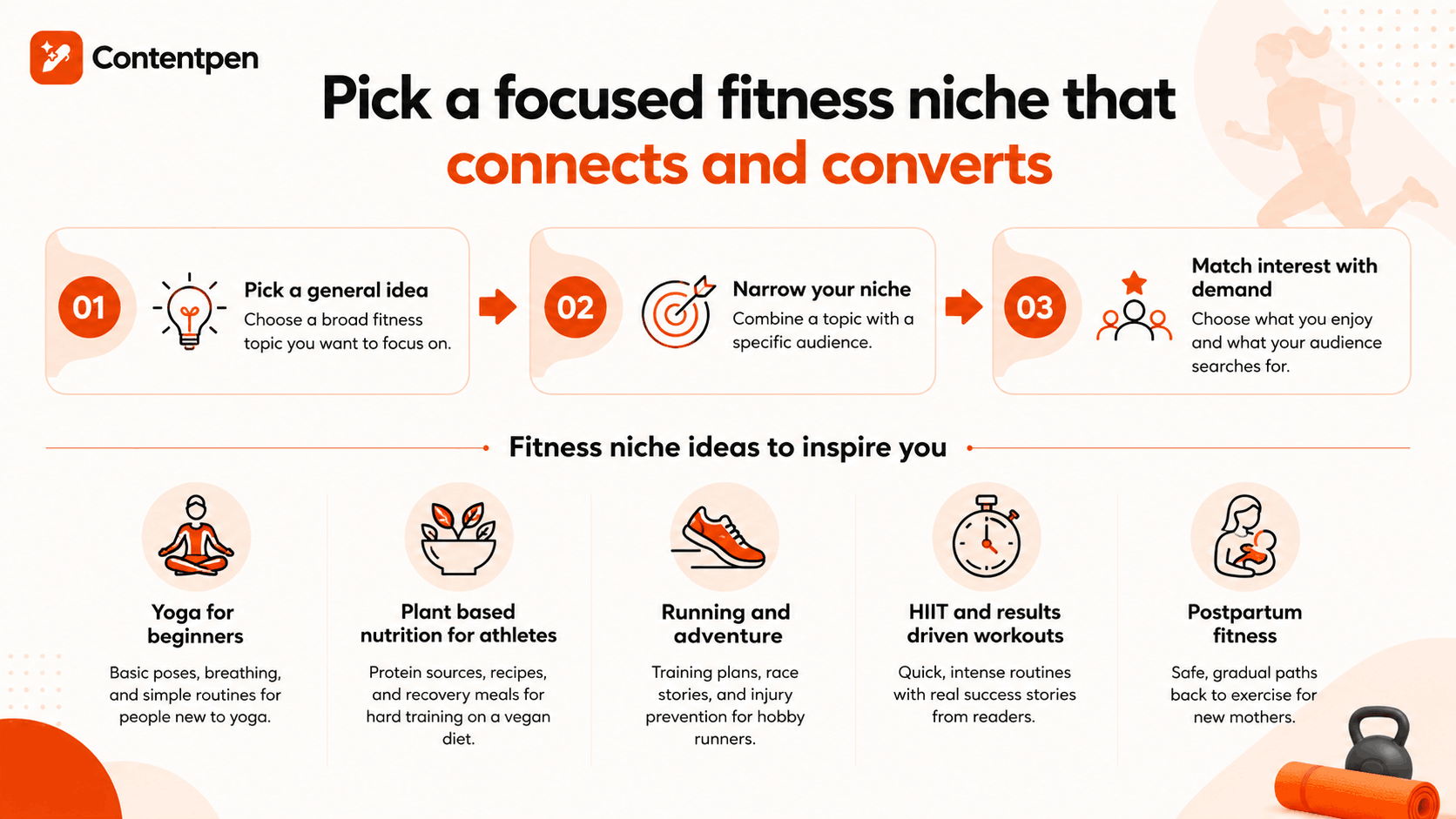
    Choosing a focused niche is the first step of starting to write a fitness blog. This step helps you narrow down your target audience and gives your readers a reason to remember you.

    If you are trying to write about strength training, yoga, nutrition, and gear reviews all at once, you can end up producing content that feels thin and forgettable.

    For starters, pick a general idea that you want your blog to be focused on. For example, ‘Home workouts for people without gym access’ or ‘Gym equipment and gear reviews.’

    Then, you can narrow the niche further by combining a topic with an audience, which tends to perform better because it speaks to a specific reader’s exact situation.

    • Yoga for complete beginners, covering basic poses, breathing, and simple routines for people who’ve never stepped on a mat.
    • Plant-based diets for athletes, focused on protein sources, recipes, and recovery meals for people training hard on a vegan diet.
    • Running adventure content that mixes training plans, race stories, and injury prevention tips for hobby runners.
    • HIIT-focused blogs built around quick, intense workout routines paired with real success stories from readers.
    • Postpartum fitness guidance aimed at new mothers who need safe, gradual paths back to exercise.

    When you’re deciding on your niche, weigh your own experience and interest against what your audience actually searches for. Because whatever you write must be authentic so that you build trust with your audience.

    Best fitness blog topics to start with

    Fitness blog niche ideas.

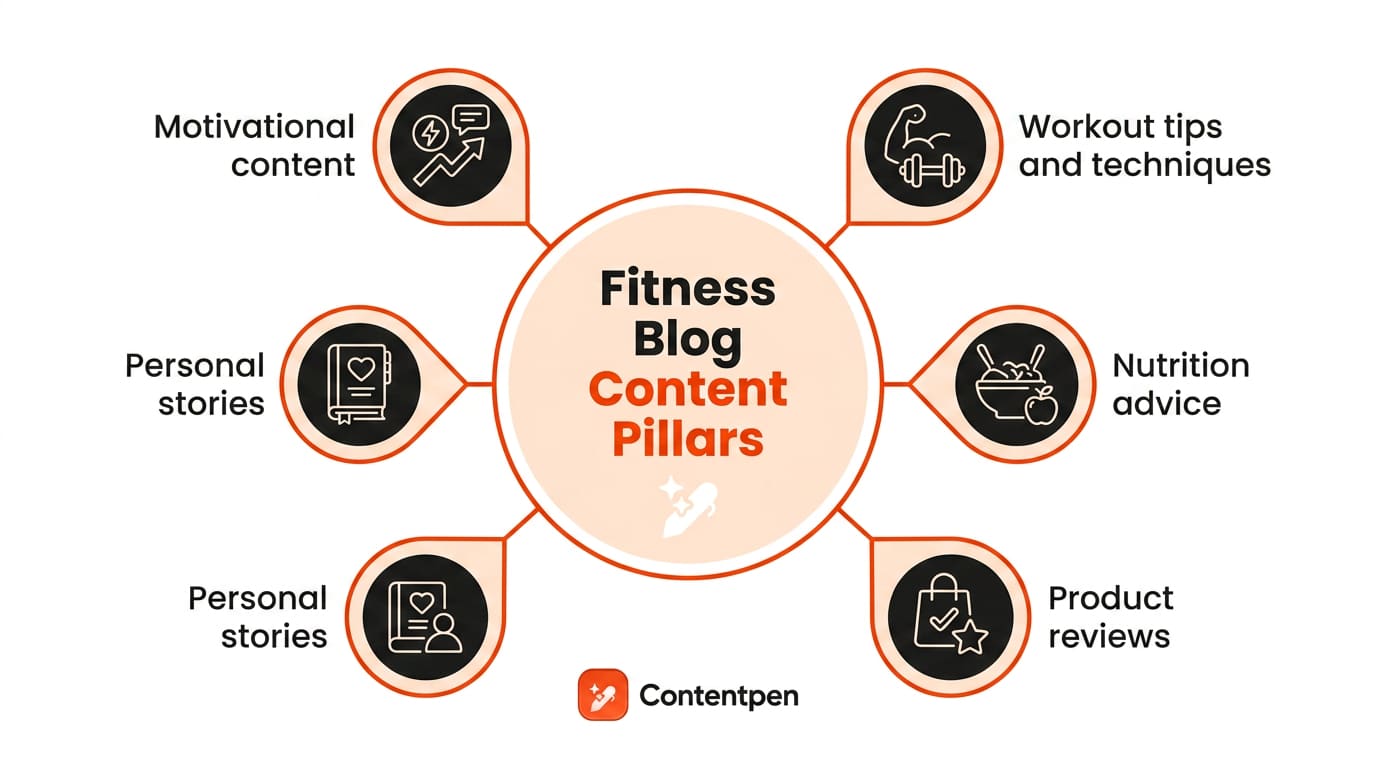
    A handful of content pillars can carry your first few months of posts without you running out of ideas. 

    Workout tips and techniques, nutrition advice, product reviews, personal stories, and motivational content each give you a steady stream of angles to write from. 

    These pillars work because they map to the real questions readers type into search engines when they’re stuck on a fitness goal.

    You can also specialize by activity, such as yoga, HIIT, or running, or by audience segment, such as beginners, seniors, or postpartum readers. 

    Picking two or three pillars and rotating between them keeps your content calendar full while still feeling focused rather than scattered.

    How do you start writing a fitness blog step by step?

    Starting a fitness blog step by step means setting up a platform, choosing a name, and then writing your first post using a repeatable structure you can reuse for future articles. 

    #1: Set up your platform, domain, and blog name

    Set up your platform for fitness blogging.

    Similar to our blog ‘How to write a travel blog’, the first thing you do is choose your blogging platform.

    Today, there are multiple options to choose from:

    • WordPress
    • Wix
    • Webflow
    • Squarespace
    • Blogger

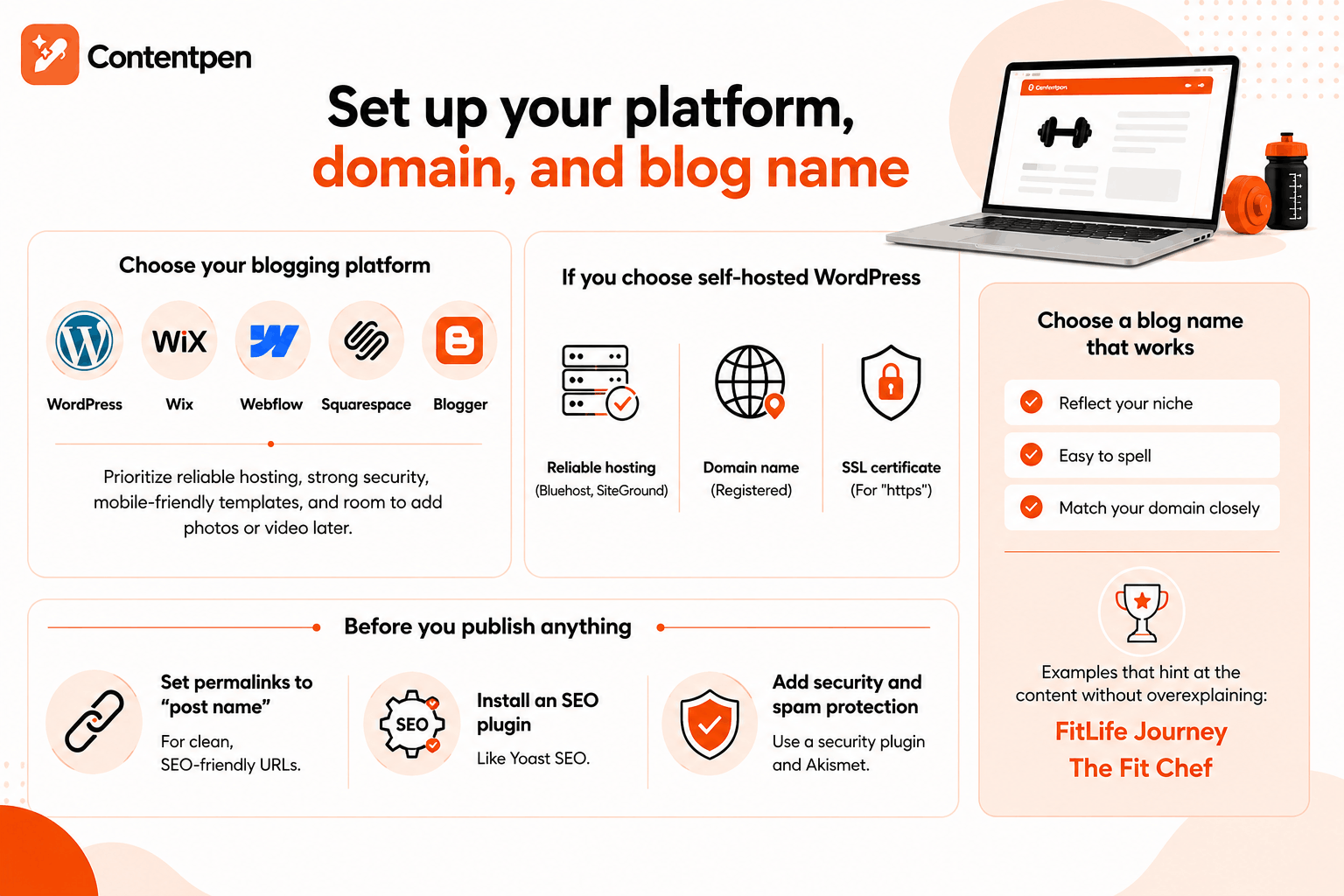
    When comparing platforms, prioritize reliable hosting, strong security, mobile-friendly templates, and room to add photos or video later. 

    If you go with self-hosted WordPress, you’ll need separate hosting from a provider like Bluehost or SiteGround, plus a registered domain name and an SSL certificate for the secure “https” prefix.

    Your blog’s name should reflect your niche, stay easy to spell, and match your domain closely. 

    Names like FitLife Journey or The Fit Chef show how a name can hint at the content inside without overexplaining it. 

    Once your domain is live, set your permalinks to the “post name” structure for clean URLs, and install a basic SEO plugin, like Yoast SEO, plus a security plugin and a spam blocker, like Akismet, before you publish anything.

    #2: Find your unique voice to communicate online

    Blogging requires you to have a voice so fresh and unique that people are attracted to what you have to offer.

    To make this simple, picture how you talk to your clients in real-time. Your advice varies from person to person, doesn’t it? 

    For example, a 60-year-old grandma with knee pain will be recommended a different set of exercises and tips as compared to a 24-year-old young man trying to compete in their first triathlon.

    Now, when you write your fitness blog, you need to channel that same energy, words, definitions, or examples that you use to motivate your students in your blog.

    This will help you find your voice online, allowing you to stand out from others and gain more followers with ease.

    #3: Write your first blog post using a simple template

    A repeatable post template removes the guesswork every time you sit down to write.

    A typical fitness blog should look something like this:

    • Write down your blog post title (should include your primary keyword), preferably between 140-160 characters with spaces.
    • Add a key takeaway section at the top to encourage AI-first formatting and improve content citability.
    • Start with a hook in the introduction that can contain your personal story, a lift gone wrong, or any example. Keep it light, around 100-150 words
    • Break the body into 3-5 subheadings, answering questions people might have for the topic.
    • Cite credible sources and data where needed, and include internal links pointing to your other posts to improve time on site.
    • Close with a short summary and a call to action (CTA), such as downloading the workout guide, following on Instagram, etc.

    Aim for at least 1,000 words per post, since longer, thorough content tends to perform better in search results and gives readers more reason to stay on the page. 

    Break up text-dense sections with images, a short video, or a bulleted list, so the post stays skimmable. Do this every 200-300 words.

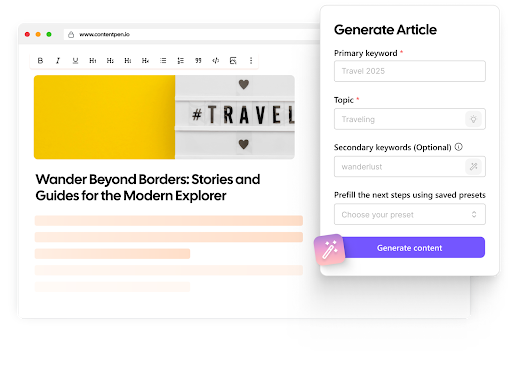
    You can check out this “how-to write a fitness blog template” generated from Contentpen to help you understand the details better.

    How do you write a workout plan or program for readers or clients?

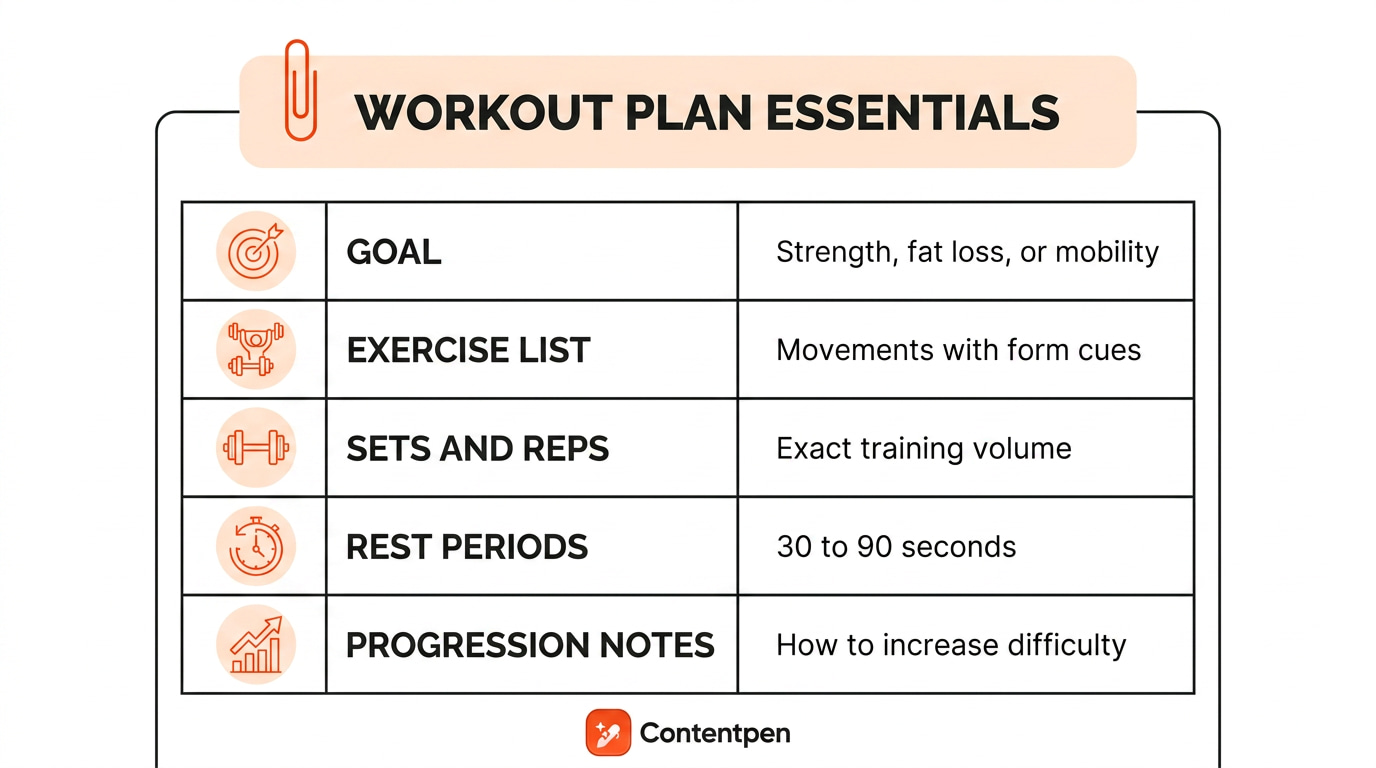
    Workout plan template to be included in your fitness blog.

    A workout plan lays out the exercises, sets, reps, and rest periods a reader needs to follow a routine safely and see results over time, and reporting these details clearly matters. 

    Whether you’re writing for blog readers or a specific coaching client, the structure stays similar, though a client program usually adds personal goals and progression notes based on that person’s fitness level.

    FieldWhat to include
    GoalThe specific outcome, such as building strength, losing fat, or improving mobility
    Exercise listEach movement in order, with a brief form cue for beginners
    Sets and repsThe exact volume, such as three sets of 12 reps
    Rest periodsTime between sets, typically 30 to 90 seconds depending on intensity
    Progression notesHow to increase difficulty over the following weeks

    Using a table or numbered list like this makes your workout content far easier to follow than a paragraph of instructions. Always add modifications for different skill levels, since a beginner and an advanced reader following the same post need different starting points.

    How do you optimize and promote a fitness blog for growth?

    Optimizing and promoting a fitness blog means combining basic SEO work with active outreach across social media, email, and other blogs so real readers actually find your content. 

    Publishing alone rarely builds an audience, since search engines and readers both need signals that your blog is active, trustworthy, and worth returning to.

    SEO basics every fitness blogger should know

    Search engine optimization, often shortened to SEO, is the practice of shaping your content so search engines can understand and rank it for relevant queries. 

    For fitness blogs specifically, that starts with keyword research to find out what your audience actually types into Google, followed by naturally working those terms into your titles, headers, and body text.

    • Write a clear meta description for every post, since this short snippet directly affects whether someone clicks your result over a competitor’s.
    • Add descriptive alt text to every image, which helps both accessibility and search visibility since search engines can’t see images directly.
    • Keep your site mobile-friendly and fast-loading, since slow pages lose visitors and rank lower in search results.
    • Aim to publish on a consistent schedule so users know when to expect your content and follow you.

    Contentpen’s keyword research and answer-first structuring can speed this process up considerably. 

    Automated keyword research

    Work on keywords worth writing for

    Get search terms with real ranking potential, not just high volume.

    Try Keyword Research for FREE
    AI SEO Interface

    The AI blog writer helps you build an SEO- and GEO-ready draft around real search intent within minutes. Automated content creation saves you time to add the stories, examples, and details that only you’d know, making writing fitness blogs an efficient process.

    Promotion channels that drive traffic

    Blog promotion across socials.

    Promotion is the ongoing work of getting your content in front of new readers after you hit publish. 

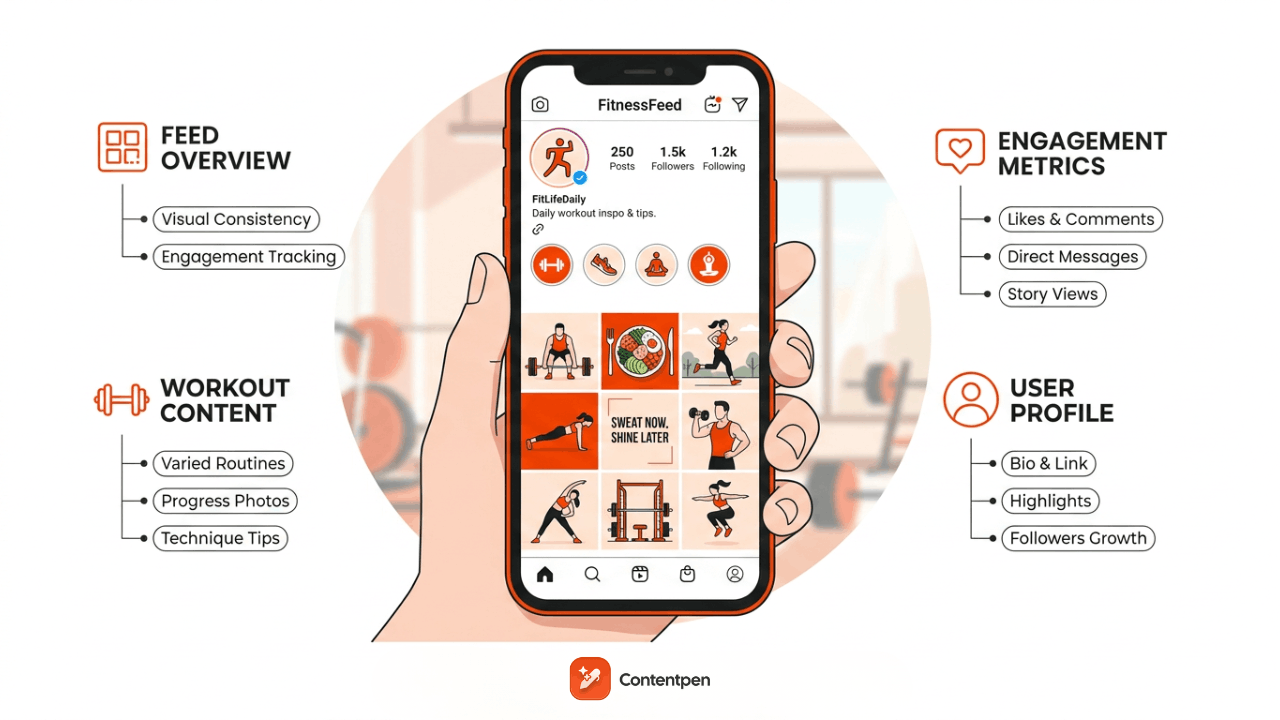
    Social platforms like Instagram, Facebook, and Pinterest work especially well for fitness content because they’re highly visual and engaging.

    Emails also deserve a place in your promotion mix, since a subscriber list gives you a direct line to readers that doesn’t depend on any platform’s algorithm. 

    Pair all this with regular analytics tracking through Google Analytics to see which blog posts perform best and which need a workaround. Then, use smart SEO opportunities from Contentpen to update your content directly with a click, without leaving the interface.

    Turn existing content into growth opportunities

    check

    Identify pages losing traffic or CTR

    check

    Find quick wins to improve clicks and rankings

    Find Content Opportunities
    AI SEO Interface

    Lastly, don’t skip community engagement, since replying to comments and running the occasional poll or Q&A turns casual visitors into loyal readers.

    Can you make money from a fitness blog, and what challenges should you expect?

    Yes, fitness blogs can generate real income, most commonly through a combination of affiliate marketing, display ads, and paid offerings like courses or coaching rather than a one-off revenue source. 

    Building income from your fitness blog will take time. Eventually, after 6-12 months of consistent work, when your blog starts getting steady organic traffic and reach, other content creators may also want to collaborate with you, opening yet another earning opportunity.

    Ways to monetize a fitness blog

    Affiliate marketing lets you earn a commission by linking to fitness gear, supplements, or apps through programs like Amazon Associates.

    Display advertising through networks like Google AdSense adds a passive income layer once your traffic grows, while subscriptions, online courses, and one-on-one coaching let you sell your expertise directly.

    Other ways to earn from your blog include:

    • Sponsored content, where a fitness brand pays for a review or a branded challenge featured on your blog.
    • Digital products like eBooks or workout guides that you create once and sell repeatedly.
    • Crowdfunding or reader donations from a loyal audience who values your ongoing content.

    Whichever methods you choose, always disclose affiliate links clearly, since FTC guidelines require this whenever you might earn a commission from a reader’s purchase.

    Common challenges and how to overcome them

    Building credibility without a formal certification is probably the biggest hurdle new fitness bloggers face. 

    Standing out in a crowded market and keeping content fresh as trends shift add further pressure. Therefore, citing credible sources and being upfront about your experience level goes a long way toward earning trust.

    Finding a fitness mentor or gym mentor through a local gym, a certification program, or an online coaching community can also fill in knowledge gaps and keep you accountable as you grow. 

    Many established bloggers still consult registered dietitians or certified trainers before publishing anything technical, and that habit is worth adopting early.

    Wrapping up

    Learning how to write a fitness blog really comes down to four habits: Picking a focused niche, publishing consistently, writing content people can actually act on, and promoting it once it’s live. 

    None of these steps require a certification or a big budget, just a clear plan and the discipline to follow it post after post.

    Start small. Write one solid post this week using the template above, then build your content calendar from there. 

    Tools like Contentpen can take some of the heavy lifting out of outlining, drafting, and optimizing each post. 

    Write content that’s built to rank, not just read

    Create search-optimized blogs aligned with SEO and GEO signals, so your content performs well across search and AI-driven discovery.

    Try SEO Blogging FREE
    AI SEO Interface

    So, you can spend more time on the parts only you can bring, such as your voice, your experience, and your genuine interest in helping others.

    Frequently Asked Questions

    What is the 3-3-3 rule for fitness?

    The 3-3-3 rule generally refers to doing three exercises, for three sets each, three times a week, a simple structure often used for beginner routines. It’s a popular beginner-friendly blog topic because it’s easy to explain and follow.

    How do I find a fitness mentor or personal training mentor?

    Look for mentors at local gyms, through certification programs, or within online coaching communities on Facebook. Networking through fitness blogs and social media also connects you with experienced trainers willing to share guidance and fitness-related knowledge.

    How often should I publish new fitness blog content?

    A consistent weekly schedule works better than sporadic posting, since it signals activity to both readers and search engines. Quality still matters more than frequency, so don’t sacrifice depth just to hit a deadline.

    What’s the easiest way to keep fitness blog content organized and consistent?

    Use a content calendar to plan topics weeks in advance or consider an AI tool like Contentpen to plan, draft, and schedule posts from one workspace. This keeps your publishing rhythm steady without constant manual effort.

  • How to write a travel blog: A beginner’s step-by-step guide

    How to write a travel blog: A beginner’s step-by-step guide

    Wondering how to write a travel blog when you have never published a single post before? Let’s learn that today so that it doesn’t halt your first steps. 

    The short answer is that you pick a simple platform, write about a trip you have already taken, and publish before it feels perfect. Most beginners get stuck because travel blogging advice online contradicts itself. 

    One site tells you to buy expensive camera gear, another insists you niche down immediately, and a third says you need a flawless website before writing a word. That noise creates analysis paralysis instead of actual writing.

    This guide cuts through all of that and shows you how to write a travel blog step by step. Starting with what you genuinely need before you publish, how to structure a post, and how AI tools such as Contentpen can speed up your research and drafting. 

    Let’s start with the groundwork.

    Key takeaways

    • Starting your blogging journey early beats waiting for a perfect setup, since search engines need months to trust new content anyway.
    • Self-hosted WordPress remains the most flexible platform for long-term growth and future monetization.
    • Strong posts pair personal storytelling with practical, structured value like costs, logistics, and itineraries.
    • Search and AI engines both reward clear structure, real experience, and answer-first writing.
    • Tools like Contentpen can speed up research, drafting, and formatting so you spend more time on the story.

    What do you need before you start a travel blog?

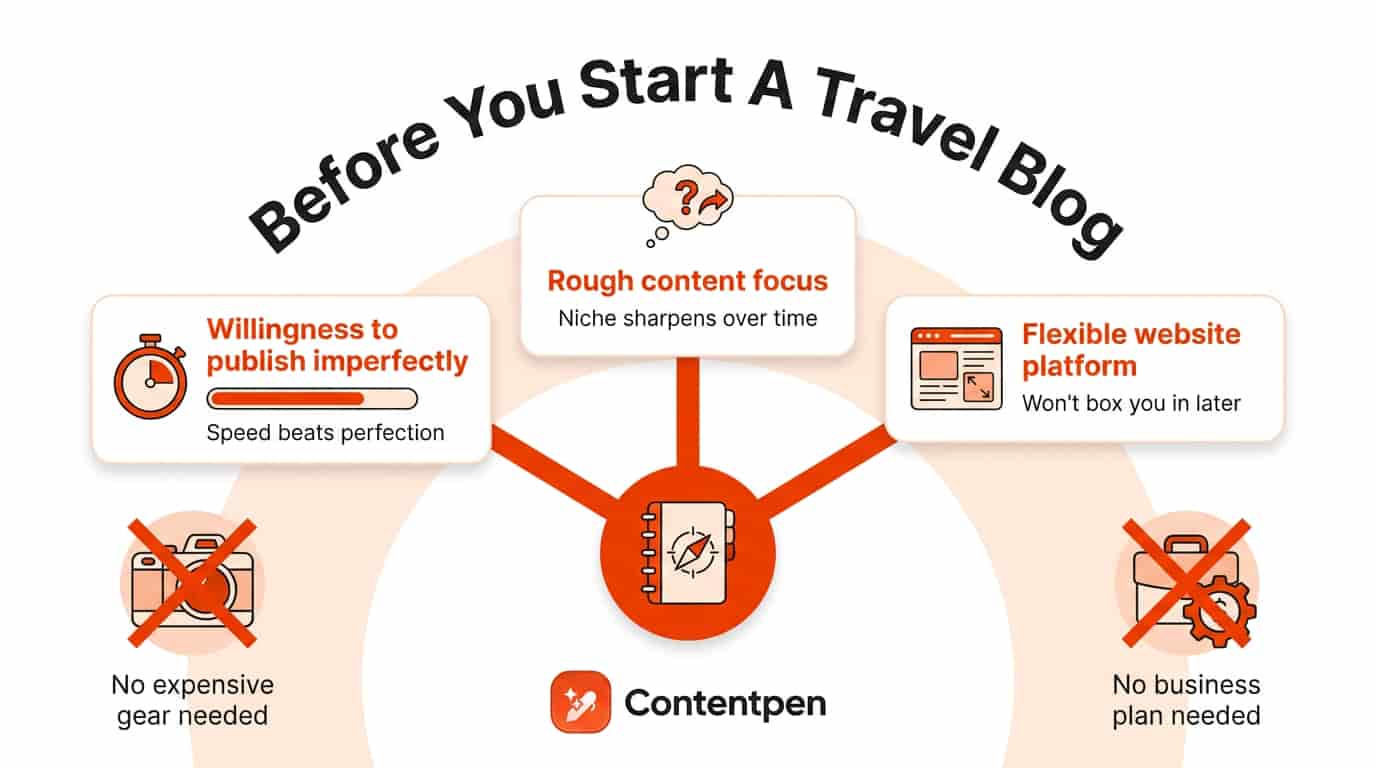
    Prerequisites to start a travel blog.

    Knowing how to write a travel blog starts with three basics: 

    • A rough focus for your content
    • A website platform that will not box you in later
    • A willingness to publish before everything feels ready. 

    You do not need a business plan, a bag full of camera gear, or a professionally designed logo to get going.

    A notebook of trip ideas, your mobile phone camera, and a working hosting account cover the essentials for week one. Your niche, your voice, and even your visual style tend to sharpen naturally once you have a few months of published posts behind you.

    Why picking a niche makes writing easier

    A niche gives every future post a clear filter, so you are not staring at a blank page wondering what to cover next. 

    A family travel blog naturally leads toward posts about kid-friendly hotels and packing lists, while a single-country guide points you toward regional itineraries and visa logistics. 

    Budget backpacking and higher-end travel are two more common lanes, and each shapes tone and topic choices almost automatically. 

    Most bloggers do not lock in a niche on day one anyway. It tends to surface after several months of publishing broadly and noticing which posts readers respond to most.

    How to create a travel blog for free (or cheap)

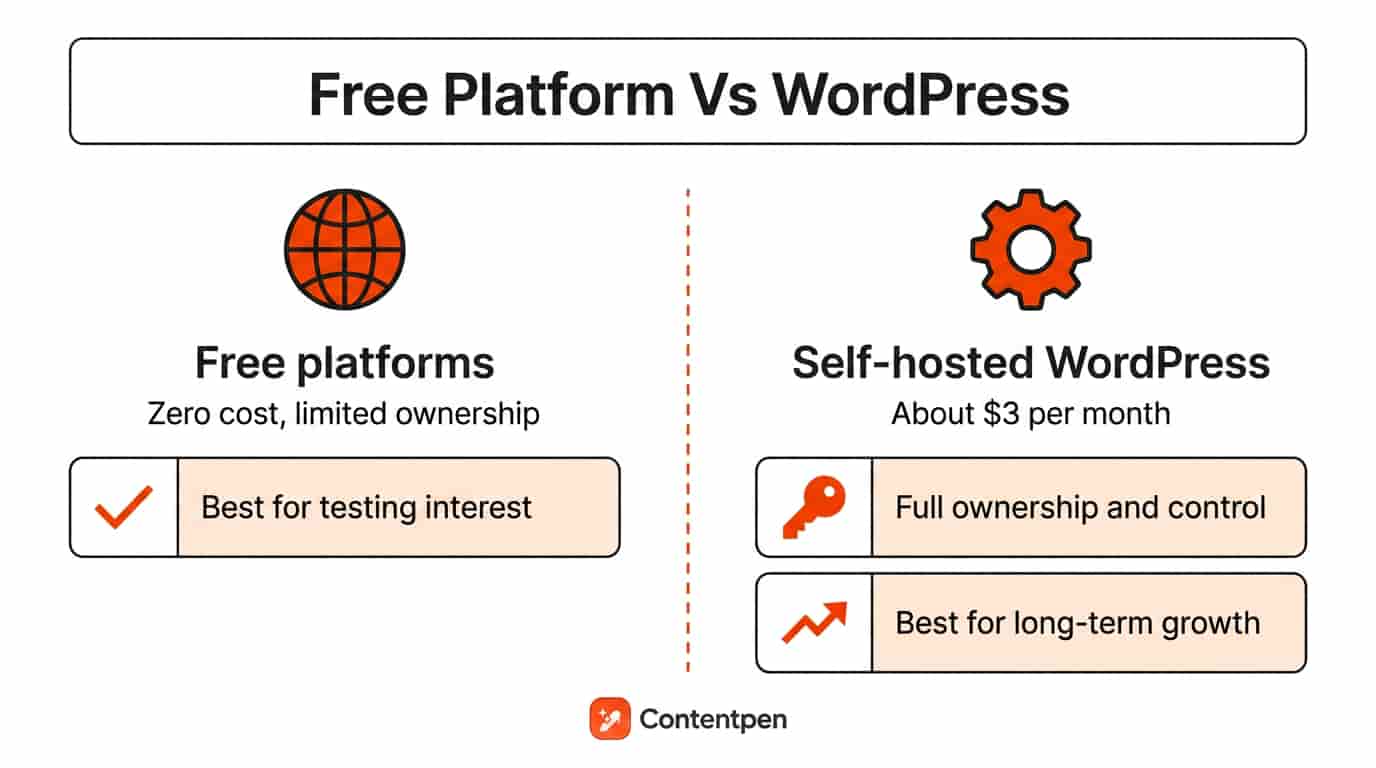
    Free vs. WordPress hosted travel blogs.

    Creating a travel blog for free usually means a platform like Blogger or Medium, but these options limit your ownership and block most real monetization down the road. 

    Self-hosted WordPress costs $4 a month for hosting (annual plan, as of writing this blog), and it gives you full control over design, plugins, and future income streams. 

    Setting it up takes roughly 10 to 15 minutes:

    1. Buy a hosting plan from a reliable provider, such as Bluehost, which also provides you with a free domain (your blog name).
    2. Use the one-click WordPress installer inside your account dashboard.
    3. Pick a free theme to start with. You can pick paid ones later through Elegant Themes or any other provider you like.
    4. Switch your permalinks to the post name format for clean, readable URLs. Such as our travel blog examples post with the link ‘https://Contentpen.ai/blog/travel-blog-examples’.

    Why is naming your travel blog an important step?

    Whichever route you choose, the domain name you register matters more than the platform itself, since that is what builds authority as your blog matures.

    Try to pick something your content can’t grow out of. For instance, if we choose a travel blog name “Exploring Asia”, your readers might naturally feel awry once you start exploring continents other than Asia.

    Similarly, doing something like “Wandering [X]”, “Nomadic [Y]” is also not a good idea since a lot of people have already done it, and honestly, the names have started to feel repetitive. The last thing you want is to get confused with another travelling blogger.

    So choose something personal, unique, easy-to-share, and classy. Most traveloggers start their blogs with their names, which is fine as well. Others, such as Never Ending Footsteps, choose a generic but timeless name that they can use perfectly to represent their future travels.

    How do you structure a travel blog post that people actually read?

    How to write a blog post - Contentpen.ai.

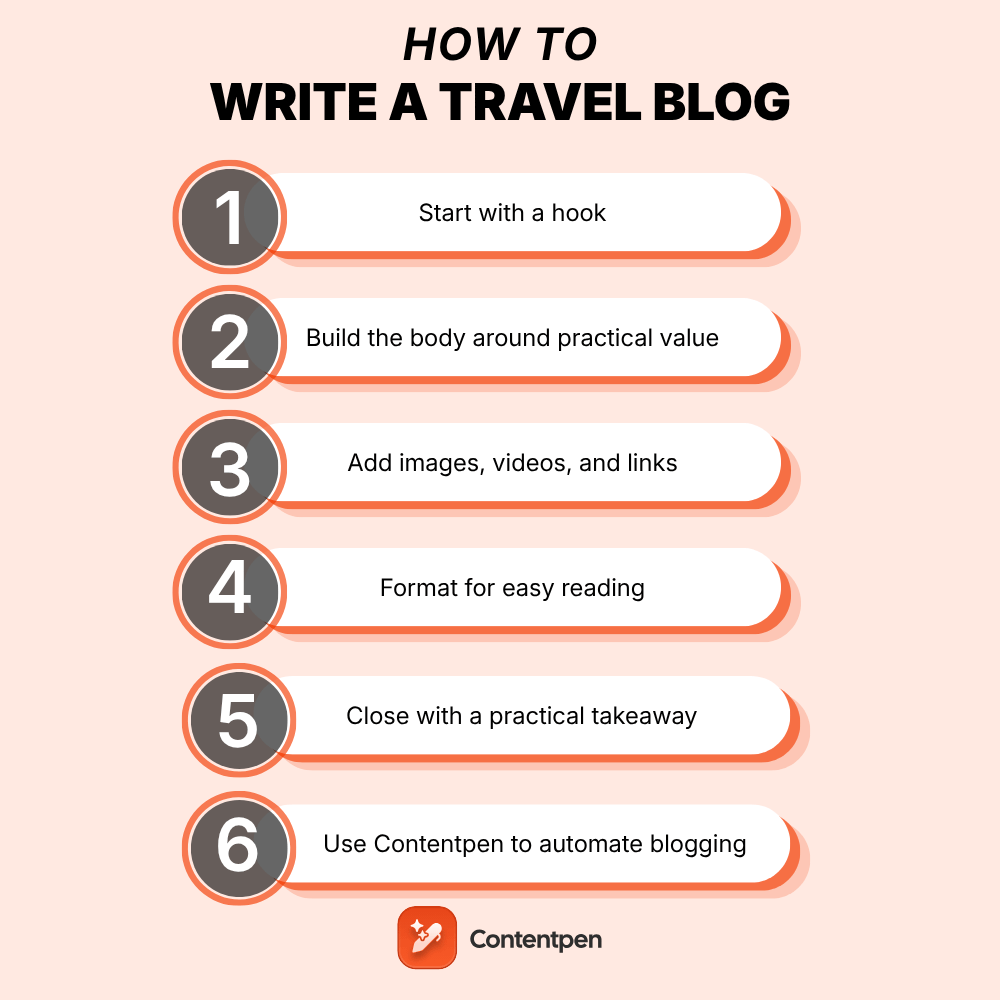
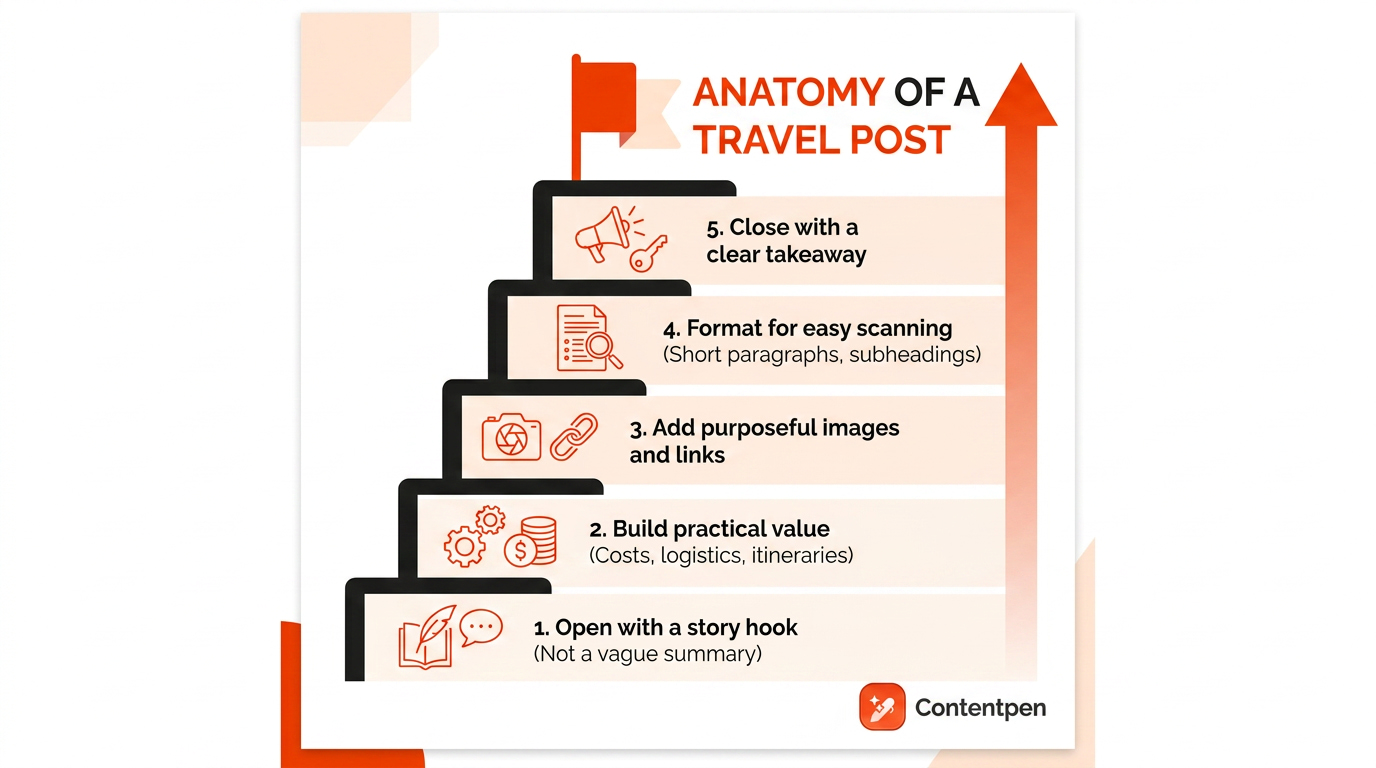
    A travel blog post that people actually read follows a repeatable structure.

    #1: Start with a story or a hook, not a summary

    Open with a specific moment, like the exact instant you realized you had boarded the wrong train, instead of a vague line about how amazing travel is. 

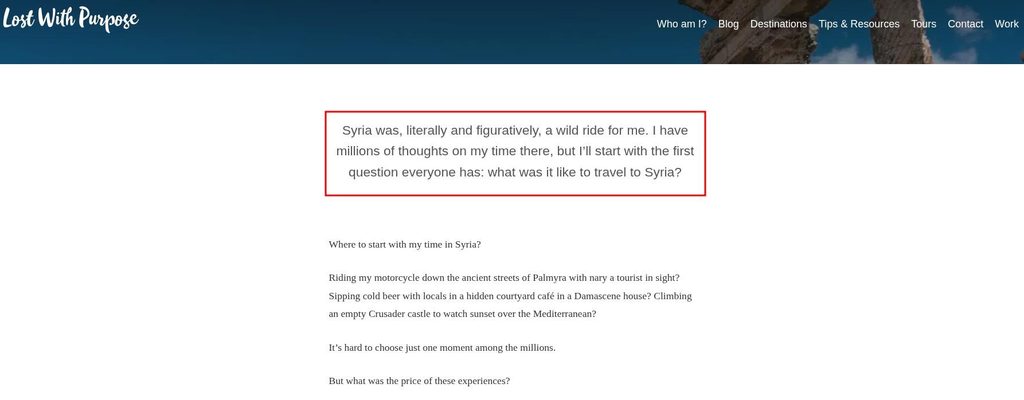
    Lost with Purpose travel blog example.

    Let’s take a look at how Lost With Purpose, another famous travel blogger, started to write their post for their Syria journey. They started with their personal experience to immediately hook the reader into reading the rest of the post.

    Readers and AI search tools both respond better to specifics than to general enthusiasm. Try to answer the reader’s core question within the first few sentences too before getting into more details.

    #2: Build the body around practical value

    Once you have hooked readers, give them what they came for: Itineraries, cost breakdowns, or step-by-step transportation instructions organized under clear subheadings. 

    Write these details while you are actually traveling, using notes or photos captured in the moment, since logistics fade fast from memory. 

    A draft written on the train home is almost always more accurate than one pieced together weeks later.

    #3: Add images, videos, and links with purpose

    Original photos taken specifically for the post do more for reader trust than any stock image ever will. Once again we’ll mention that you don’t need a fancy gadget setup to achieve this; your 5-year-old iPhone is enough if you know your photography basics enough.

    Next, add internal links pointing to related posts on your own site, plus a few external links to authoritative sources, such as an official tourism board page.

    As a travel blogger, you should also look to register with brands for their affiliate programs to earn a bit of extra cash cushioning your travels.

    If you have footage, even a short embedded video gives skimmers a reason to stay on the page longer. You can redirect your blog traffic to your YouTube, TikTok, or other video platforms through these embeds.

    #4: Format for easy reading

    Formatting a blog post is the best way to encourage readers to spend more time on your site, and search engines take notice of that. Your content eventually gets recommended, which means more visitors to sell your digital products to, earn through affiliate links, or display ads.

    Try to break up text every two or three sentences with a subheading, video, or photo. Highlighting key phrases helps skimmers catch the main point of a paragraph without reading every word. 

    You can also create short bullet lists when stating multiple items, for example, things to pack for a 3-day getaway trip to Bali. Such small elements help your site more than you realize.

    #5: Close with a clear takeaway or next step

    End by restating the answer to the question your post opened with, in a sentence or two. Then point readers toward a related post, or invite a specific question in the comments, so the visit does not end the moment they finish reading.

    You can also leave with any other CTA (Call-to-action) you want, for instance, asking the readers to follow your Instagram, or any channel you want to grow.

    How can AI tools speed up writing your travel blog?

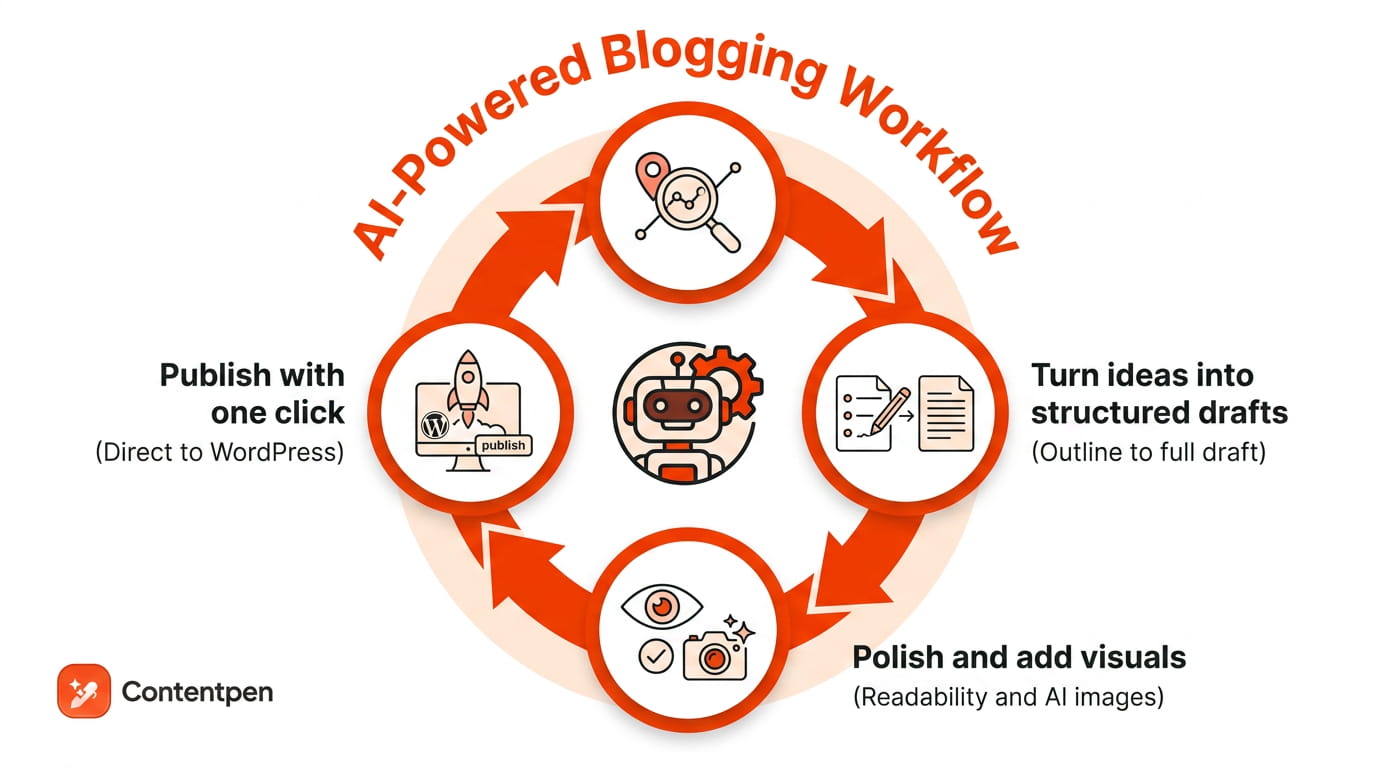
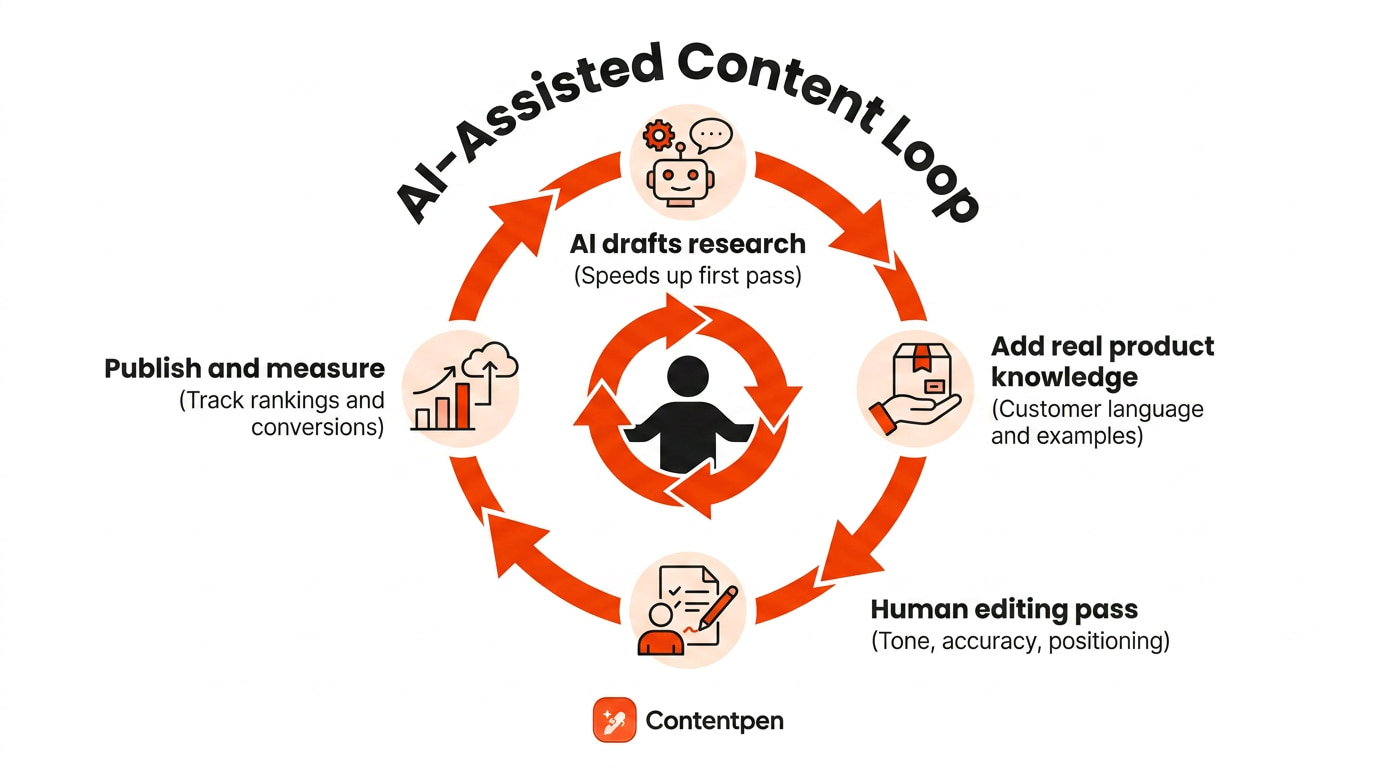
    AI-assisted blog workflow - Contentpen.ai.

    AI tools change how you write a travel blog by handling repetitive early stages, like keyword research and outlining. They allow you more time to spend on storytelling, drama, and examples only you can add, making the entire process of writing a travel blog highly efficient.

    Take Contentpen, for instance. It is an all-in-one AI blogging platform that is built around exactly this workflow for creators who want to publish consistently without burning out their creative fuel.

    Automate SEO writing tasks

    Instead of guessing what to cover or staring at a blank document, you move from a rough topic to a structured, search-ready draft in far less time. You can edit the details as you wish in the editor, along with tuning your SEO and GEO score with the tool.

    Take a look at this example generated from Contentpen for the topic “How I balanced studying and travelling abroad.”

    Balanced studying and travelling abroad blog example generated with Contentpen.

    Believe it or not, this is all AI. Yes!

    AI blog writers have become crazy accurate during the past few years, and Contentpen is the frontrunner. Not just because it’s our product, but because it does generate amazing results for its users.

    We could point you to our testimonials from different niches, including travel, real estate, tech, retail, and others. But the best way to know is to give the tool a go. Try the 7-day free trial now for yourself and see the difference between manual and AI-assisted blogging.

    Sure, you may need to do some edits yourself, but the time these tools save is significant.

    Polish, add visuals, and publish without extra tools

    Beyond drafting, Contentpen also includes the built-in ‘Ask AI’ editor to help you change tone, shorten, expand, or rewrite a particular paragraph entirely.

    Smart AI image generation helps you create your travel destination pictures in whatever style you want, polish existing details, or use as an inspiration to draw something unique.

    A built-in content calendar helps you plan posts around upcoming trips, with one-click WordPress publishing that removes the copy-paste step entirely. 

    In short, quality content does not have to take hours once tools like Contentpen handle research, drafting, and formatting in a single workspace.

    Can travel bloggers make money?

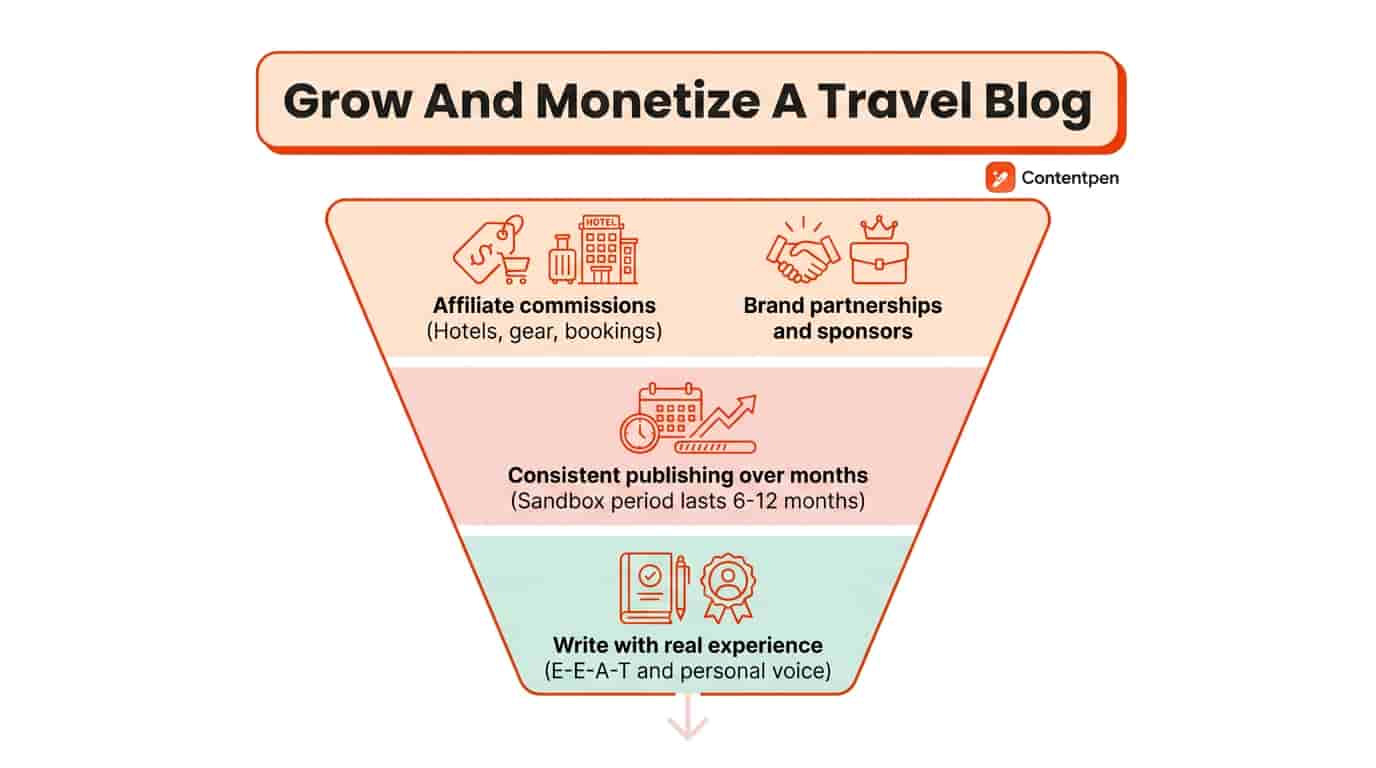
    Travel blogger monetization growth.

    Yes, they do. Travel bloggers can make money, mainly through affiliate commissions, brand partnerships, and sponsored content. However, it typically takes months or years of steady publishing before income becomes meaningful. 

    Growth depends less on a single viral post and more on consistent output, genuinely useful content, and patience while search engines learn to trust your site.

    Brand partnerships and affiliate programs for travel bloggers

    Affiliate marketing is the most common starting point for new travel bloggers, and it works like this:

    • You earn a small commission when a reader books a hotel, rents a car, or buys travel gear through your tracked link.
    • It is realistic, but usually a slow build rather than a quick income stream, so only recommend products you have genuinely used yourself.
    • Adding affiliate links early, even with modest traffic, means you are ready to earn once traffic grows.

    If finding affiliate programs seems like a hassle, you can join specific digital partnership platforms like Travelpayouts to make this process a bit easier.

    Once you have an approved Travelpayouts account, try to join travel-associated affiliate programs, such as:

    • Booking.com
    • GetYourGuide
    • Busbud
    • RentalCars.com
    • Viator
    • Trainline

    The idea is to recommend the hotel you check-in, the restaurant you ate in, and the products/services you used during your travels. If readers tried to take the same itinerary as you and weren’t satisfied, they’ll lose trust, and you’ll lose repeat business. Simple as that.

    Being a consistent poster and building authority over time

    New websites sit in a kind of probationary period, sometimes called a sandbox, where search engines watch a site for months before ranking it meaningfully. 

    Most blogs see very little traffic for 6 to 12 months regardless of writing quality, so domain authority simply needs time to build up. 

    The idea here is to keep going and posting content on a consistent schedule. Do what you love doing, even if your options look bleak. 

    There will be a light at the end of the tunnel if you don’t give up. Sure, this does sound a bit cliché, but data from Productive Blogging shows that most bloggers don’t see more than $100/month on average from their blogs in the first three years!

    Auditing posts that are leaking money

    Besides the patience required to grow a travel blog, you also need your analytical hat and revisit your older posts that don’t perform on Google or AI engines.

    Look for all performance figures in Google Analytics or inside Contentpen analytics to stay in the same writing workflow without interruptions.

    Tie the numbers down to your goals. For instance, if we want more organic traffic and time on page, we might rehash a post with better secondary keyword coverage and internal linking with our recent, most engaging posts.

    Read more: How to do keyword research for SEO (step-by-step guide).

    Contentpen’s SEO opportunities dashboard works closely with analytics and uses built-in AI to analyze and provide you with suggestions to uplift blog performance. You can apply these fixes with a click, saving a lot of effort in the process.

    Turn existing content into growth opportunities

    check

    Identify pages losing traffic or CTR

    check

    Find quick wins to improve clicks and rankings

    Find Content Opportunities
    AI SEO Interface

    Chasing new content is required, but not always the answer behind a travel blog that isn’t earning well. Sometimes, small adjustments to even the meta title, description, or alt text of images could alter different results with existing content.

    Writing with the E-E-A-T framework in mind

    Last, but not least, you need to write with the E-E-A-T framework in mind.

    E-E-A-T stands for Experience, Expertise, Authoritativeness, and Trustworthiness, a framework Google uses to judge content quality. 

    In plain terms, it means writing from real, firsthand travel experience rather than recycled advice you skimmed elsewhere. 

    Posts structured with clear answers and honest detail tend to perform much better in traditional search results. Such content is also increasingly referenced by AI search tools like ChatGPT and Gemini, driving more users to your platform.

    The takeaway

    Learning how to write a travel blog is not about finding one perfect platform or waiting until your photography looks professional. 

    It comes down to publishing consistently, structuring posts so they deliver real value, and letting your own voice do the differentiating work that generic content never can. 

    Start with whatever trip you have already taken, pick a simple platform like self-hosted WordPress, and give each post the structure readers and search engines both respond to well. 

    If you want to move faster from idea to published post, a tool like Contentpen can handle the research, outlining, and formatting side of things for your convenience. Publish the first post today, then adjust everything else as you learn what works.

    Frequently asked questions

    How do I start a travel blog for free?

    Starting for free usually means using platforms like Medium, but they limit ownership. A better low-cost route is self-hosted WordPress, which runs around $4 a month for hosting and gives you full control over content, design, and future income streams.

    How do you write a travel blog for beginners with no experience?

    Start with a trip you have already taken and write it the way you would tell a friend, focusing on specific moments rather than general impressions. If you are nervous about committing to your own site, try guest posting on a smaller, established travel blog first. It builds a portfolio and confidence without the pressure of managing a website.

    How can I create a family travel blog or one for friends and family?

    A family travel blog does not need to be public or monetized, so a simple platform works fine, even a private WordPress site or a shared photo page with captions. Organize posts by trip or year, focus on stories and photos over technical setup, and keep the tone personal.

    How do I get paid for travel writing beyond my own blog?

    Pitch freelance articles to travel publications and websites once you have a few strong writing samples ready to share. Brand partnerships and sponsored content become realistic after you have built an audience online.

  • What is evergreen content? A complete guide for marketers

    What is evergreen content? A complete guide for marketers

    Evergreen content is the type of content you write that stays useful and accurate forever. Unlike a news story or a trending topic, an evergreen post answers a question people keep asking, which keeps it relevant in search and AI results long after it’s published. 

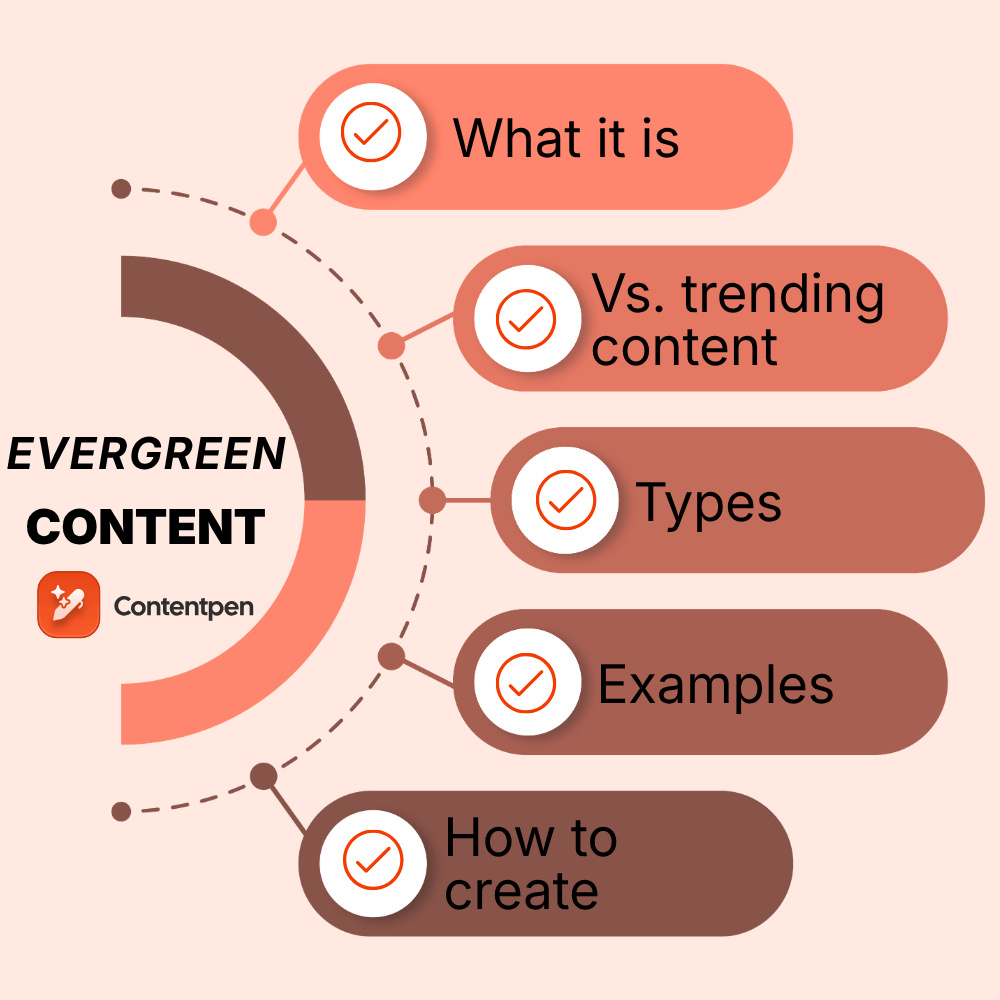
    This guide walks through what evergreen content is, real examples, and a step-by-step process for building an evergreen content strategy. You will also see how a tool like Contentpen can speed up the research and writing process for evergreen posts with the least manual effort.

    So, let’s get started, shall we?

    Key takeaways

    • Evergreen content keeps driving traffic for months or years, unlike posts tied to trends or news cycles.
    • Common formats include how-to guides, FAQs, glossaries, listicles, and checklists that answer recurring questions.
    • Picking keywords with steady search demand and avoiding time-bound language keeps a post useful longer.
    • Strong evergreen posts also need updates every 6-12 months to stay accurate.
    • Tools like Contentpen help speed up topic research, outlining, and optimization for content built to last.

    What is evergreen content?

    Evergreen content is any article, video, or guide that keeps solving a reader’s problem long after publication. The term borrows from evergreen pines and firs in nature that stay green all year round.

    Evergreen content, also known as “timeless content,” keeps delivering value whether someone reads it the week it goes live or five years later.

    For example, a product launch recap or a recap of last month’s conference stays accessible forever, but its usefulness fades fast once the moment passes. 

    Genuine evergreen content is different because it keeps attracting new readers and organic search traffic steadily, often growing rather than spiking and disappearing. 

    That steady, compounding pattern is really the test of whether a piece earns the evergreen label. It is an important concept to learn for someone running a blog.

    Evergreen content vs. trending content

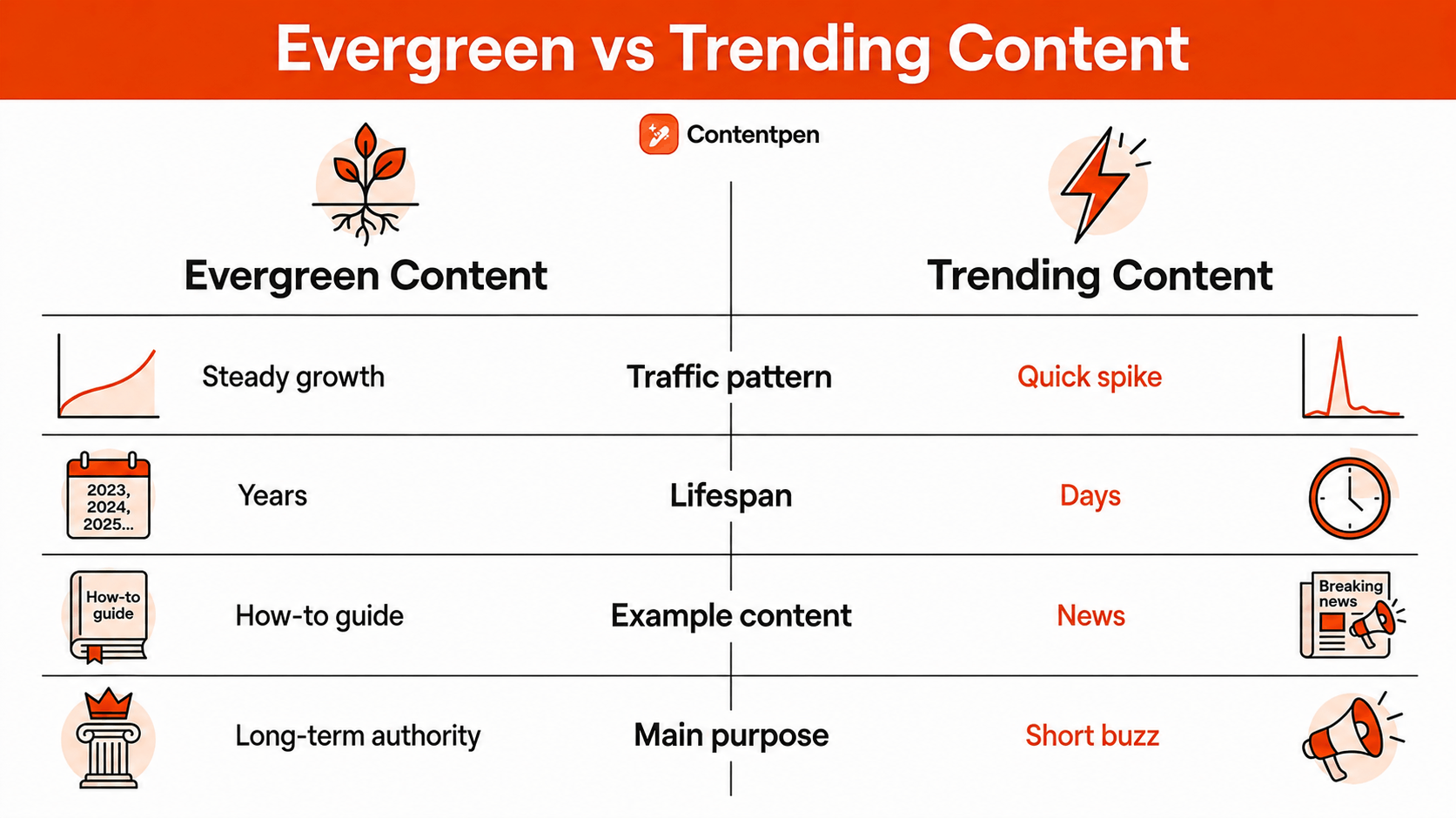
    Evergreen vs. trending content - Contentpen.ai.

    Evergreen content and trending content do different jobs inside the same content strategy, and knowing the difference helps you decide what to write next. 

    Trending content chases a moment, a headline, or a seasonal spike, while evergreen content targets a question that keeps coming up no matter the calendar. Neither approach beats the other on its own. However, they answer different problems for a searcher.

    FactorEvergreen contentTrending content
    Traffic patternSteady, often growing over timeQuick spike, then a sharp drop
    LifespanYearsDays or weeks
    ExampleHow-to guide, FAQ pageBreaking news, holiday sale post
    PurposeLong-term traffic and authorityShort-term visibility and buzz

    Let’s take a few examples of evergreen content to understand the concept even better:

    A strong content plan leans on evergreen posts for compounding traffic while using trending pieces to capture short bursts of attention around real events. Relying on only one type leaves gaps, either in long-term stability or in timely relevance.

    Why does evergreen content matter for marketing and SEO?

    The significance of evergreen content.

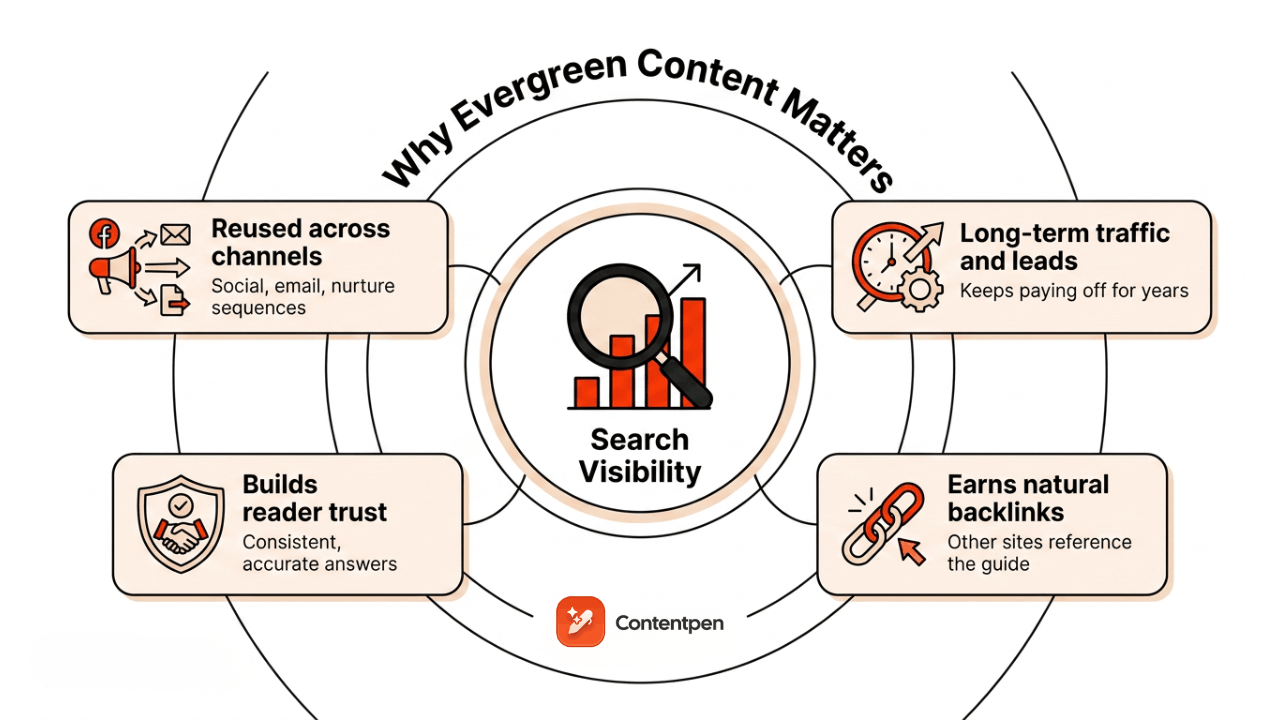
    Evergreen content matters for marketing and SEO because it keeps paying off long after the initial writing effort. 

    A well-researched evergreen article can drive traffic, leads, and sales for years without a full rewrite. Because it tends to hold steady rankings, it gets discovered by new readers consistently instead of spiking once and fading.

    Evergreen content that’s genuinely useful often earns backlinks naturally. Other sites will reference your thorough guide or glossary in a niche, and those links will build your domain authority (DA) over time. 

    When readers keep finding accurate, helpful answers from the same source, that source starts to look like the expert for that particular topic. This pattern not only supports SEO, but also boosts AEO and your chances of winning AI Overviews and citations in other chatbots.

    Because its relevance doesn’t expire, evergreen content can be reused across social captions, email newsletters, and nurture sequences without feeling stale. 

    It also acts as an entry point for new visitors, who can then be guided deeper into a site through internal links. That mix of steady traffic, backlinks, and funnel support is why evergreen content often carries a marketing plan’s foundation.

    What are the types of evergreen content?

    Types of evergreen content.

    Evergreen content examples span nearly every format, since timelessness comes from the topic and approach rather than the medium itself. 

    A blog post, a YouTube tutorial, or an Instagram carousel can all qualify as evergreen if the information stays accurate and useful for years. 

    However, some content formats hold up better than others because they’re published on platforms where algorithm changes aren’t too intense.

    That said, below are the best types of evergreen content that you can find online for all types of niches and industries.

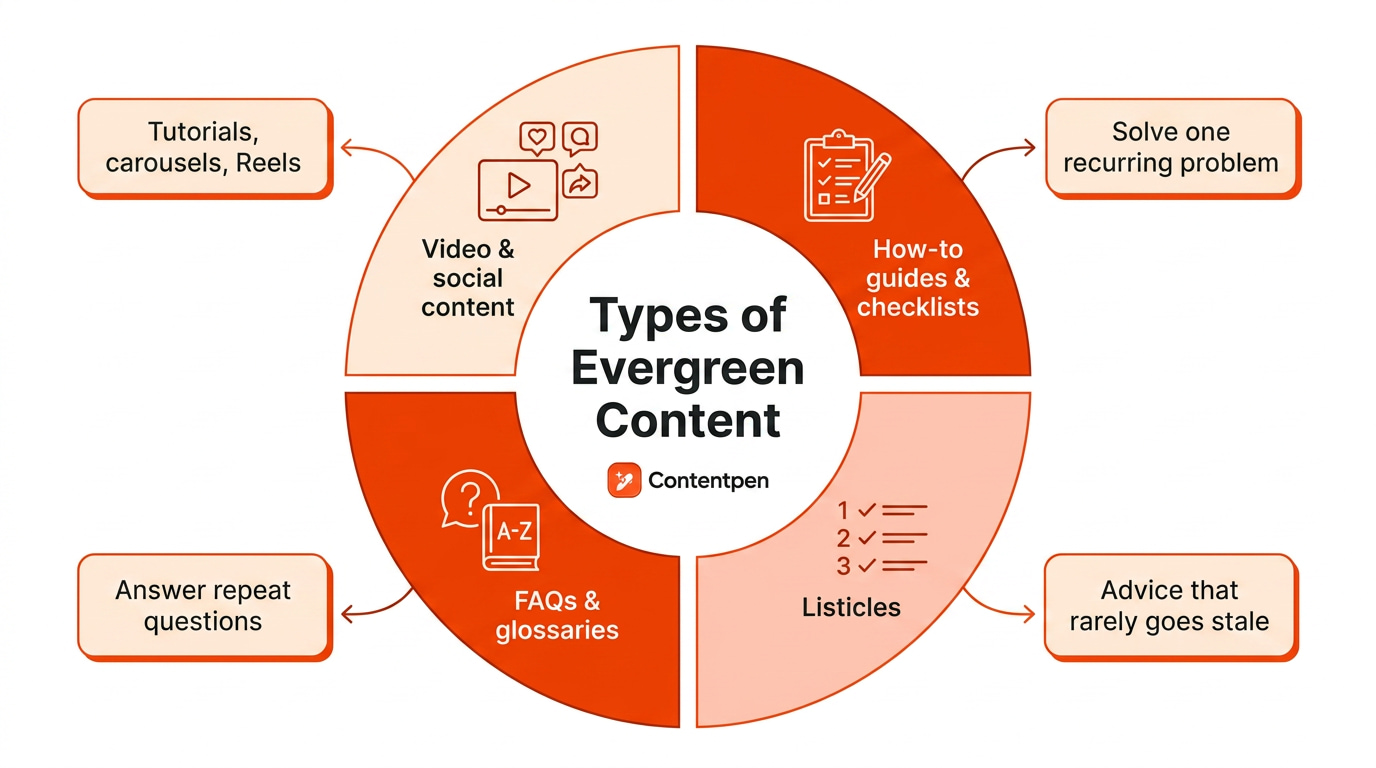
    #1: How-to guides, checklists, and listicles

    How-to guides and checklists rank among the most dependable evergreen formats because they walk readers through solving one specific, recurring problem. 

    For example, a guide on “A packing checklist for moving abroad” stays just as useful in five years as it is today. 

    Listicles work the same way. A post like “5 ways to cut down weight” or “7 meals you can take for higher protein” keeps drawing readers because the underlying advice rarely goes out of style.

    #2: FAQs, glossaries, and educational resources

    FAQ pages and glossaries earn their evergreen status by answering questions that never stop being asked. 

    Educational resources are also excellent for keeping audiences even years after it was created. For example, a video series explaining basic concepts of blogging or creating short videos will keep serving new readers who search for those exact answers in the future.

    #3: Evergreen content on YouTube and social media (including Instagram)

    Evergreen content on YouTube looks like tutorial videos that keep earning views long after upload day. Examples include a cooking demonstration that doesn’t depend on a specific product version or timed release. 

    On Instagram, it usually shows up as saved carousels and Reels answering a question an account’s audience keeps asking. Such as “How to create digital artwork” or “How to save money from your salary.”

    Because none of it depends on a news hook, such content keeps getting rediscovered through search and saves.

    A real-world example: Evergreen content for a moving company

    Consider a moving company’s marketing team building a library of assets that serve customers year-round instead of chasing seasonal promotions alone. 

    Below are a few examples of how they can plan this out:

    • A listicle including a checklist for preparing a short-distance move, plus a separate one for long-distance moves.
    • A how-to guide for packing fragile items safely, covering material wrapping and box labeling techniques that are applicable no matter the season of shifting.
    • An FAQ page for common moving-day questions, alongside a glossary of shipping and moving terms for first-time customers.

    This kind of library keeps answering the same recurring questions no matter when someone searches for them. It means that the moving company can keep on growing its online presence without relying on seasonal or trending topics for reach.

    Also read: Recent innovative marketing examples in 2026.

    How do you create evergreen content?

    Steps to create evergreen content.

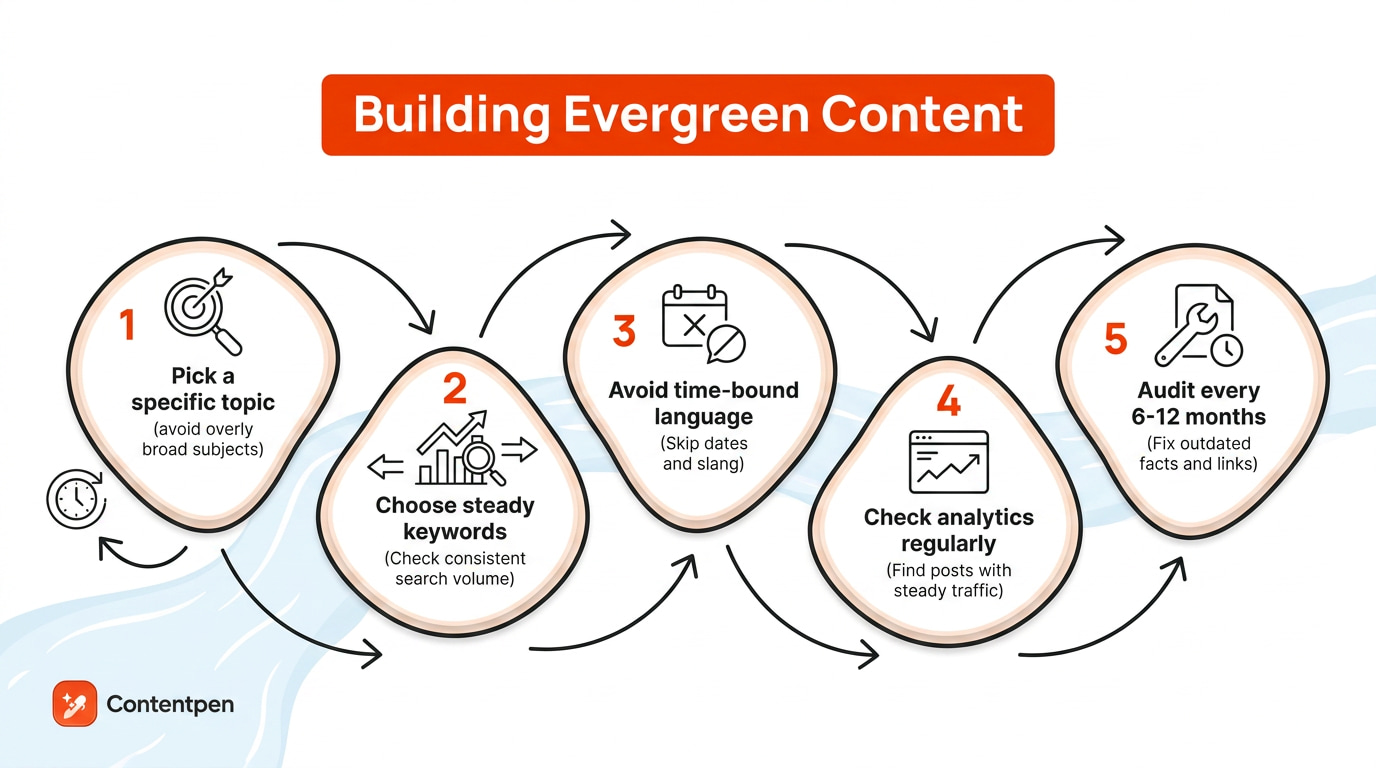
    Follow the given steps to build evergreen assets for your platform with long-term traffic and online visibility benefits.

    Step 1: Pick specific topics

    Creating evergreen content starts with picking specific, well-researched topics instead of a broad one that’s hard to rank for and attracts the wrong readers. 

    You need to stay relevant to your niche and find questions that people ask often or something relevant to your expertise.

    For instance, as a coffee shop owner, you can choose evergreen topics, such as “How to brew Americano coffee” or “Benefits of drinking coffee.”

    Step 2: Choose steady keywords

    Once you have a rough idea of your evergreen topics, choose keywords with steady, consistent search volume rather than a short-lived spike. 

    Use tools like Ahrefs, Semrush, Moz Keyword Explorer, or Google Trends to confirm demand holds up or increases over time. 

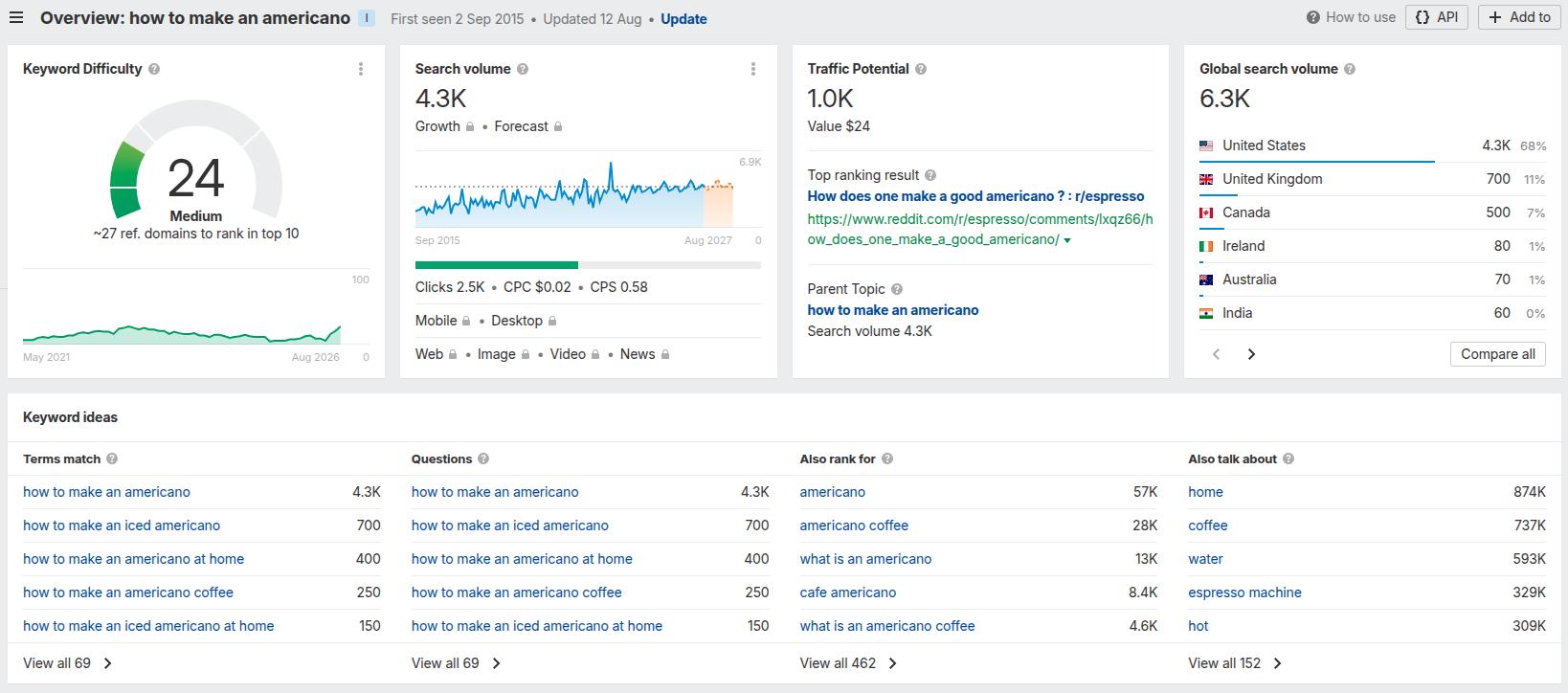
    For instance, the term “How to make an Americano” is an ideal example of a steady keyword, and our data from Ahrefs confirms it.

    How to make an Americano coffee Ahrefs example.

    Notice that the search volume is healthy (4.3k) and only increasing as time goes by. The traffic potential, CPC, and keyword difficulty metrics also meet the criteria of what we can call a “constant organic traffic gainer.”

    Later, you can organize these keywords into clusters with pillars supporting internal site hierarchy and utilize tools like Contentpen to create content for them at scale.

    Overall, if you are in the coffee business, the above SEO keyword example might be a good starting point for creating evergreen content. 

    You can also find more organic evergreen keywords that fit your small business marketing campaign type, model, or niche with Ahrefs or other keyword tools mentioned earlier.

    Step 3: Avoid time-bound language

    While drafting content, try to avoid any time-bound language, for example, references to specific dates and events. 

    Also, avoid any jargon or slang that screams a certain year when read. For instance, “YOLO” (2010s), “delulu” (2020s) – these slang words will age someday, which will not be a good look for your evergreen content.

    Besides this, strong evergreen content also demonstrates real expertise, citing credible sources and covering a topic thoroughly rather than skimming the surface.

    Step 4: Check analytics regularly

    To identify evergreen content you already have, check analytics for posts whose traffic stays steady or keeps climbing months or years after publication. 

    Those are your evergreen candidates worth protecting and expanding. Keeping them accurate matters just as much as creating new content.

    Step 5: Audit every 6-12 months

    This takes us to our final most important part: keep auditing your content to ensure your evergreen pieces are up-to-date.

    A general rule is to audit high-priority posts identified with analytics every quarter and review the rest of the library every 6-12 months.

    Look for any outdated numbers you might have mentioned in the article and fix broken links (if you have any).

    If auditing content manually feels like a lot, let Contentpen’s SEO opportunities work for you. 

    Turn existing content into growth opportunities

    check

    Identify pages losing traffic or CTR

    check

    Find quick wins to improve clicks and rankings

    Find Content Opportunities
    AI SEO Interface

    The tool will automatically surface important updates necessary to help you sustain your organic rankings. You can add the suggested fixes directly to your blogs with just a click.

    Use Contentpen to speed up evergreen content creation

    Contentpen for AI and SEO optimized content - Contentpen.ai.

    Building an evergreen content strategy manually slows everything down, which is where a platform like Contentpen fits in. 

    It handles keyword and topic research based on real search intent, helping you spot the best evergreen topics before you write a single word.

    The platform also builds detailed outlines and answer-first, GEO-optimized content that holds up well in both traditional search and AI chatbots. 

    Beyond drafting, it also includes a content calendar and one-click CMS publishing so that you can create evergreen posts quickly and efficiently.

    Summing it up

    Evergreen content is one of the most reliable ways to build lasting traffic that provides SEO and AEO perks in the long run.

    Getting it right means picking topics people search for again and again, avoiding language that dates quickly, and updating your best posts on at least a quarterly basis.

    The best approach in content marketing is to pair up evergreen and trending pieces together to get steady compounding growth alongside short bursts of visibility. 

    If juggling research, outlining, and optimization across separate tabs feels like too much, Contentpen brings those steps into one workspace. So, you can spend less time managing the process and more time getting the answer right for your readers.

    Write content that’s built to rank, not just read

    Create search-optimized blogs aligned with SEO and GEO signals, so your content performs well across search and AI-driven discovery.

    Try SEO Blogging FREE
    AI SEO Interface

    Frequently asked questions

    What is an evergreen content strategy?

    An evergreen content strategy is a plan for building a library of long-lasting posts through topic research, consistent publishing, and regular audits. It combines targeting steady-demand keywords with periodic updates to keep facts and links accurate for sustained rankings.

    Is evergreen content the same as cornerstone content?

    Not quite. Cornerstone content refers to your most important, comprehensive pieces on core topics. Evergreen content is broader. It just means the topic stays relevant over time. So, a cornerstone post is usually evergreen, but not every evergreen post is a cornerstone piece.

    How many evergreen posts should a blog have?

    There’s no fixed number, but a good target is 60 to 70% of your content library. Trending posts have their place for quick visibility, but a blog leaning too hard on news and trends ends up rebuilding its traffic from zero every few weeks.

    Does evergreen content still need promotion or internal linking?

    Yes, and skipping this step is one of the most common mistakes. Evergreen content earns its steady traffic from search engines over time, but it still needs a push early on. Share it across social and email when it’s first published, then keep linking to it from newer posts.

  • Content marketing for small businesses: 10 easy steps

    Content marketing for small businesses: 10 easy steps

    Small business owners often watch competitors with bigger budgets dominate search results and social feeds, and it feels impossible to catch up. Content marketing for small businesses solves this frustration by trading expensive ads for steady, useful content that earns trust.

    This guide breaks the process into 10 easy steps. It covers everything from finding your audience’s real questions to picking formats and measuring what actually works. 

    You will also see how tools like Contentpen can speed up drafting and keep your content consistent without adding to your workload.

    So, let’s get started.

    Key takeaways

    • Start by learning your audience’s real problems before you pick any content format or platform.
    • Map your content to the customer journey using frameworks like TOFU, MOFU, and BOFU, so you generate both traffic and leads.
    • Pick 3 to 5 SMART KPIs tied directly to leads, bookings, or retention, not vanity metrics like views.
    • Repurpose one strong idea across several channels instead of creating new content for every platform.
    • Use AI tools like Contentpen to draft faster while you add the real expertise and stories only your business can tell.

    What is content marketing and why does it matter for small businesses?

    The small business content gap.

    Content marketing for small businesses means using helpful articles, videos, and posts to educate and build trust with potential customers to improve conversions.

    It works because it answers real questions before, during, and after a sale, which builds a level of trust that a paid banner ad never can. 

    This matters more than ever, especially as small business owners increasingly explore AI tools to keep up the pace with larger competitors.

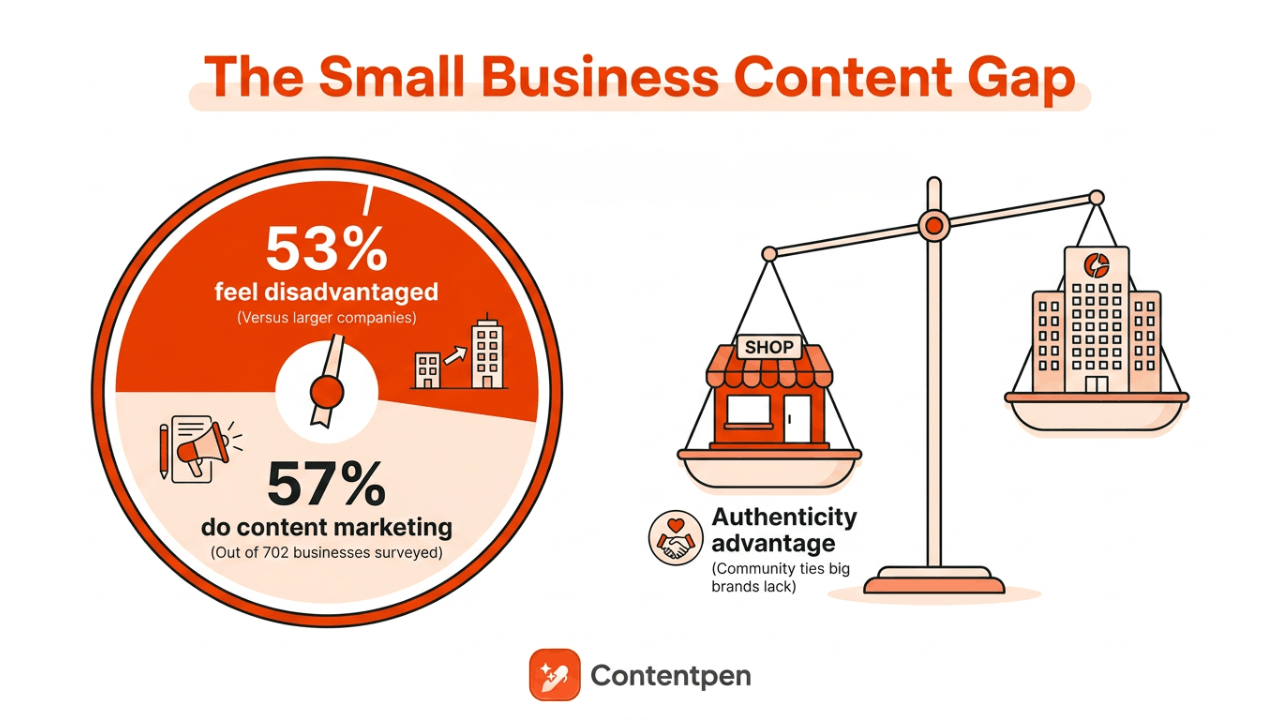
    Research shows that 53% of small and medium business leaders feel at a disadvantage compared to larger companies when it comes to meeting customer expectations. 

    Yet a survey of 702 small businesses by Servicedirect found that only 57% currently do any content marketing at all. That gap is an opportunity for the businesses willing to start.

    Benefits of content marketing for small businesses

    As a small business, you have many advantages over a well-established firm or company that cannot connect on a personal level with their audience.

    #1: Nurtures relationships with audience

    Small businesses can lean more into authenticity and community ties. A national chain cannot share a genuine story about sponsoring your kid’s Little League team or explain the specific coffee bean it sources from a single farm.

    That closeness to your community, paired with consistent and useful content, is what makes a small business content strategy work, even against much bigger marketing budgets.

    In the process, the bond you build and share with your audience makes your business grow and prosper over time.

    #2: Builds an unbeatable online presence

    In 2026, if you are creating helpful, reliable, people-first content online, then you can capture audiences as well as, or better than, what other big brands are doing.

    Good content marketing comes down to answering people’s questions and providing them with value they can’t find anywhere else. That means sharing your expertise, personal experiences, or data/insights from your industry that only you can do.

    The best part is that when you give the exact information people in your industry are searching for, it automatically boosts your SEO (and AEO) as well, further helping your online presence.

    #3: Establishes you as a go-to resource

    Providing quality content consistently will help you build an online presence that’s evergreen and lasting. Soon, users, search engines (Google, Bing, Yahoo), and AI answer engines (ChatGPT, Perplexity, Claude) start recognizing you as an authority on a subject.

    This improves your organic traffic and potentially conversions over time (we’ve talked about conversions in more detail in our SaaS content marketing blog).

    #4: Produces a shareable commodity

    Blog posts, articles, social media carousels, shorts, and long videos are all different formats that small businesses can utilize for content marketing. 

    Once you create different types of content, you make it easy for people to look you up online and share your assets, which drives repeat business.

    That said, creating a shareable commodity is no easy feat (as you’ll see later in this article). But it is absolutely doable for startups, bootstrap companies, and small businesses looking to compete and win a certain niche.

    How do you build a content marketing strategy in 10 easy steps?

    Building a content marketing strategy for beginners comes down to 10 clear actions. Each step below builds on the last, so a solo owner or a two-person marketing team can move through them without feeling overwhelmed.

    Step 1: Get to know your audience’s real problems

    Most small businesses make the mistake of picking a content format before they understand who they are talking to. 

    A tax advisor might serve freelancers, small LLC owners, and people with a one-off tax question, and each group asks very different things. 

    If you have some existing users, you need to advise your team or push yourself to note what they’re actually saying. This will uncover common problems people have that you can solve through helpful content.

    If you don’t have any customers to begin with, try addressing common queries or myths in your industry to spread brand awareness and get an actual audience.

    Remember, the foundation of a strategy is knowing your audience inside out. This means building personas based on real data, not assumptions. Conduct on-ground or online surveys, asking people about their thoughts on a particular service or product.

    Survey analysis and reporting automation can also help organize audience feedback, identify key trends, and turn survey insights into more effective content marketing decisions.

    Step 2: Map your content to the customer journey

    Small business content marketing funnel: TOFU, MOFU, and BOFU.

    Not every reader is ready to buy today, so your content needs to match where they stand in their decision process. 

    The TOFU, MOFU, and BOFU framework sorts content into top, middle, and bottom of funnel stages, moving from problem awareness to comparing options to choosing a service.

    Let’s take an example below of what a homeowner might search for when looking for plumbing problems in their house.

    QueryStage
    “Why does my sink smell bad”TOFU (looking for information)
    “Best pipe repair services online” MOFU (considering options)
    “Pipe repair services near me” BOFU (ready to avail the service)

    Avinash Kaushik offers a very useful model for marketers, called See-Think-Do-Care, which shows how you manage the commercial intent from one stage of the funnel to another. 

    Remember, businesses that only publish top-of-funnel content often get traffic without leads. On the other hand, startups that only target bottom-of-funnel queries often get an audience that may not understand the product too well, eventually slipping away to competitors. 

    Therefore, the idea is to create a content calendar that addresses all the TOFU, MOFU, and BOFU queries properly, creating a healthy mix.

    Build your content around these different queries and look to market your product or service heavily only in the bottom stages of the content marketing funnel.

    Step 3: Set smart goals and 3 to 5 core KPIs

    Before you write anything, decide what success actually looks like for your business. 

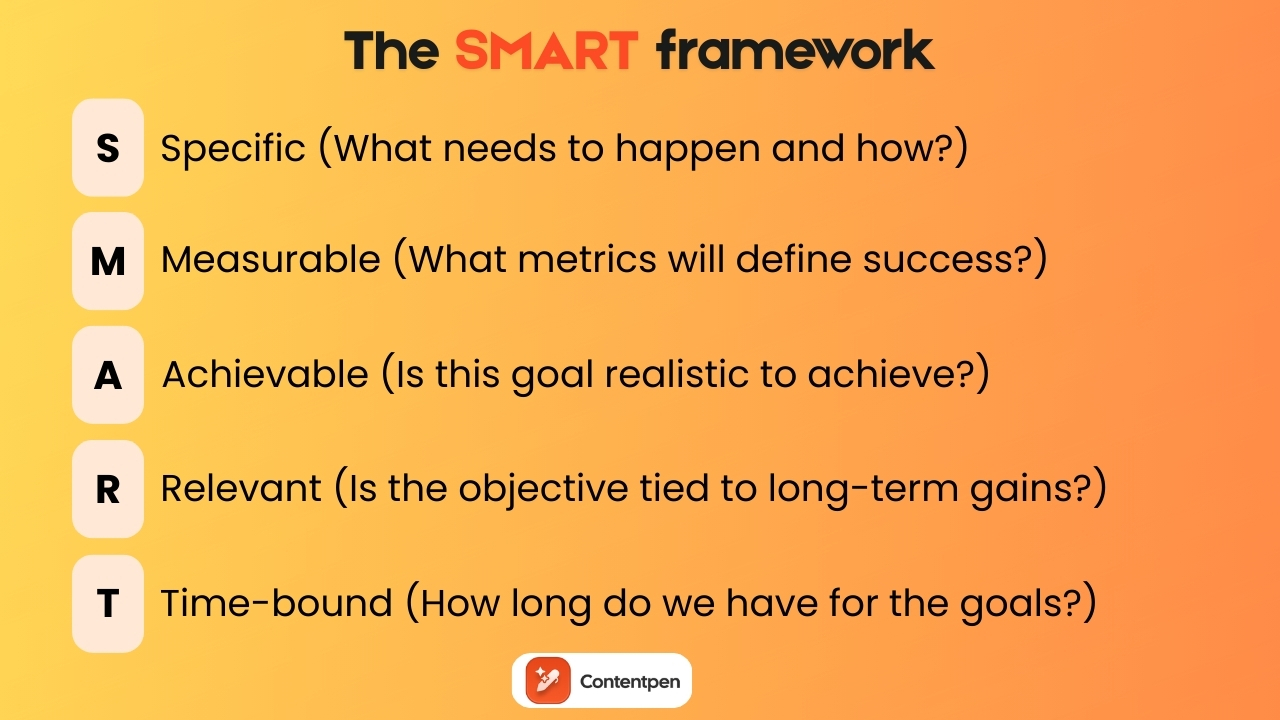
    Use the SMART framework, meaning goals that are specific, measurable, achievable, relevant, and time-bound, and keep them realistic for your budget and staff size. 

    The SMART framework - Contentpen.ai.

    Good examples of SMART goals include:

    • Improving quote requests by 75% in this quarter 
    • Getting at least 200 phone calls this month
    • Get 1000 online bookings through SEO in the trimester
    • Boost organic traffic to at least 6,000 unique visitors per month

    The ideal next step is to pick 3 to 5 KPIs tied directly to revenue or retention rather than tracking every possible metric or number that leads nowhere.

    Also read: 30 recent innovative marketing examples in 2026.

    Step 4: Choose the right content formats for your business

    Content marketing formats for small businesses.

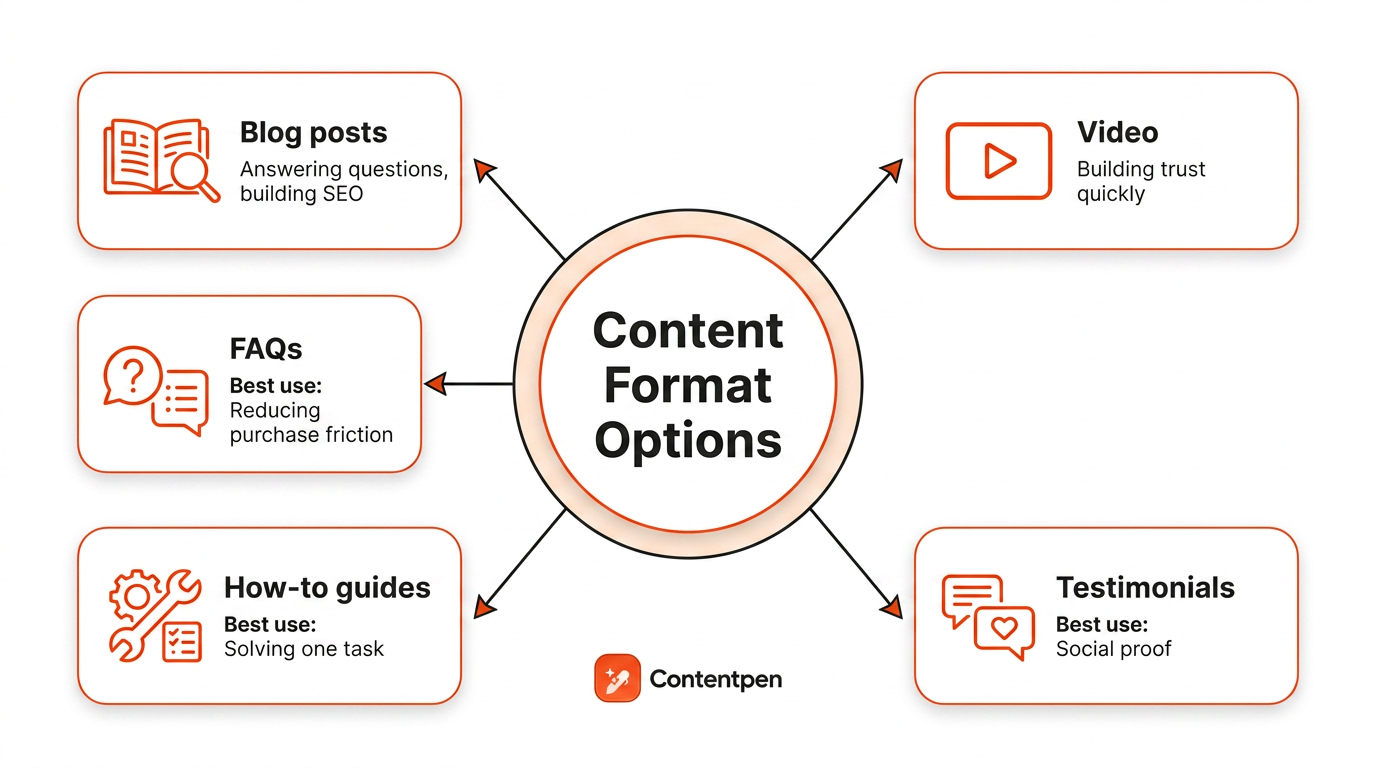
    You do not need every content format, just the one or two that fit your goals and your audience’s habits.

    Most SaaS brands benefit from blogs and articles, while video, testimonials, and reviews also rank highly among small businesses. 

    Below are some examples of different content marketing formats for small businesses:

    FormatBest use caseExample topic
    Blog postsAnswering questions and building SEO“How to prepare your car for a road trip”
    VideoBuilding trust quickly“Behind the scenes of a repair or service”
    TestimonialsSocial proof“What changed my mind about a service”
    How-to guidesSolving one task“A moving house checklist”
    FAQsReducing friction before purchase“Cancellation and payment policy answers”

    The idea is to match the format to the job it needs to do rather than picking randomly. Choose the right format, and you’ll instantly see a rise in engagement and visitors for your platforms.

    Step 5: Use video and visual content to build trust fast

    Using videos to improve engagement and build trust for small businesses - Contentpen.ai.

    Video marketing for small business owners does not require a studio or expensive equipment. A phone camera is often enough to get started. 

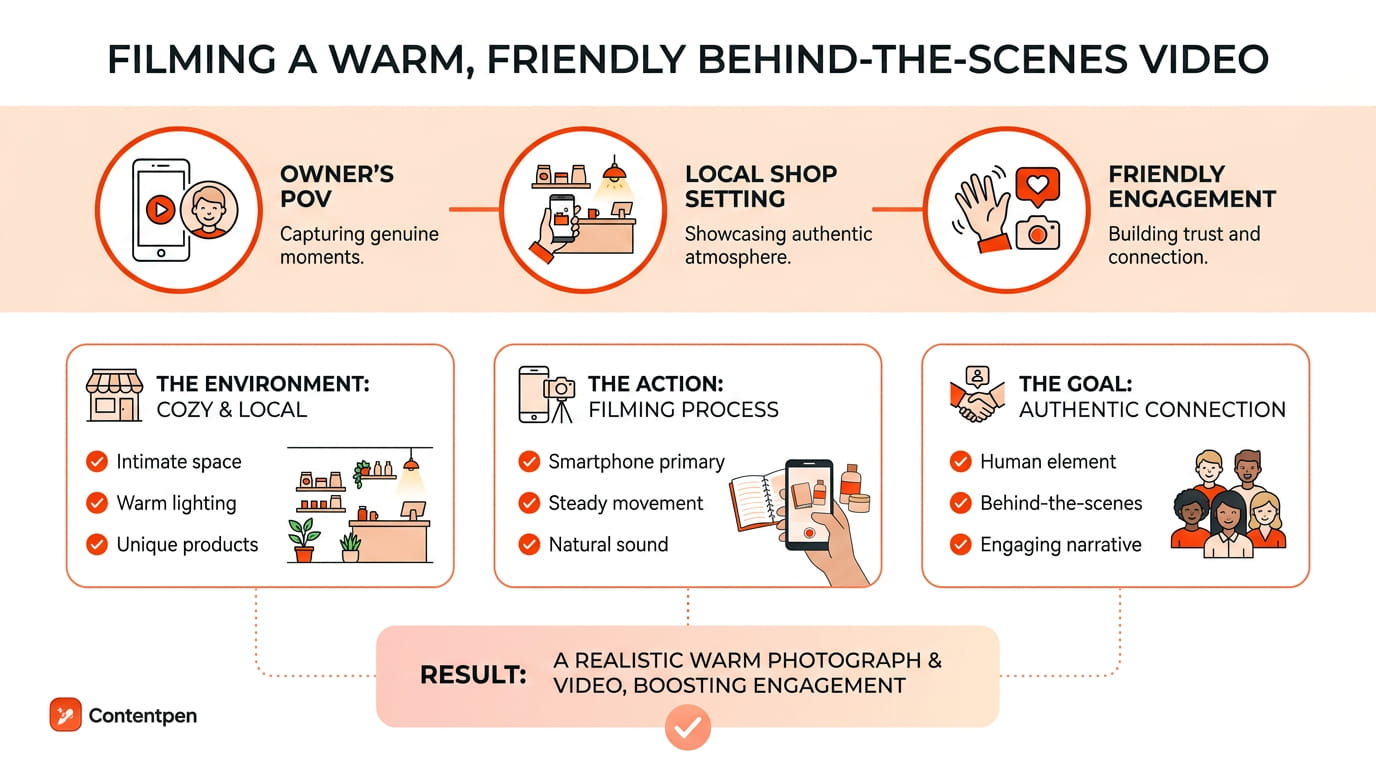
    A quick behind-the-scenes clip, like a technician walking through a repair or a chef explaining a recipe, builds trust faster than text alone because customers see the real people behind the brand. 

    Once you record one video, cut it into shorter clips for social posts and email, stretching one shoot into several weeks of content. Make sure to keep adding something fresh in each post, so you keep your audiences engaged.

    Step 6: Draft high-quality content faster with AI assistance

    Writing consistently is often the hardest part of any small business content strategy. Lean teams often have to juggle multiple deadlines while trying to meet business goals, which can be exhausting to say the least.

    This is where Contentpen fits in. The platform supports the full workflow, from keyword research and outline generation to full drafts with answer-first structuring and built-in FAQs designed for both search engines and AI chatbots

    Write better blogs in less time, without sacrificing quality.

    Let AI handle structure, clarity, and flow while you stay in control of the message.

    Try AI blog writing
    AI SEO Interface

    You still need to add your own examples, verify facts, and adjust the tone so it sounds like your business. 

    That said, the AI blogging tool does cut down the time spent juggling separate tools for SEO, writing, scheduling, and content publishing.
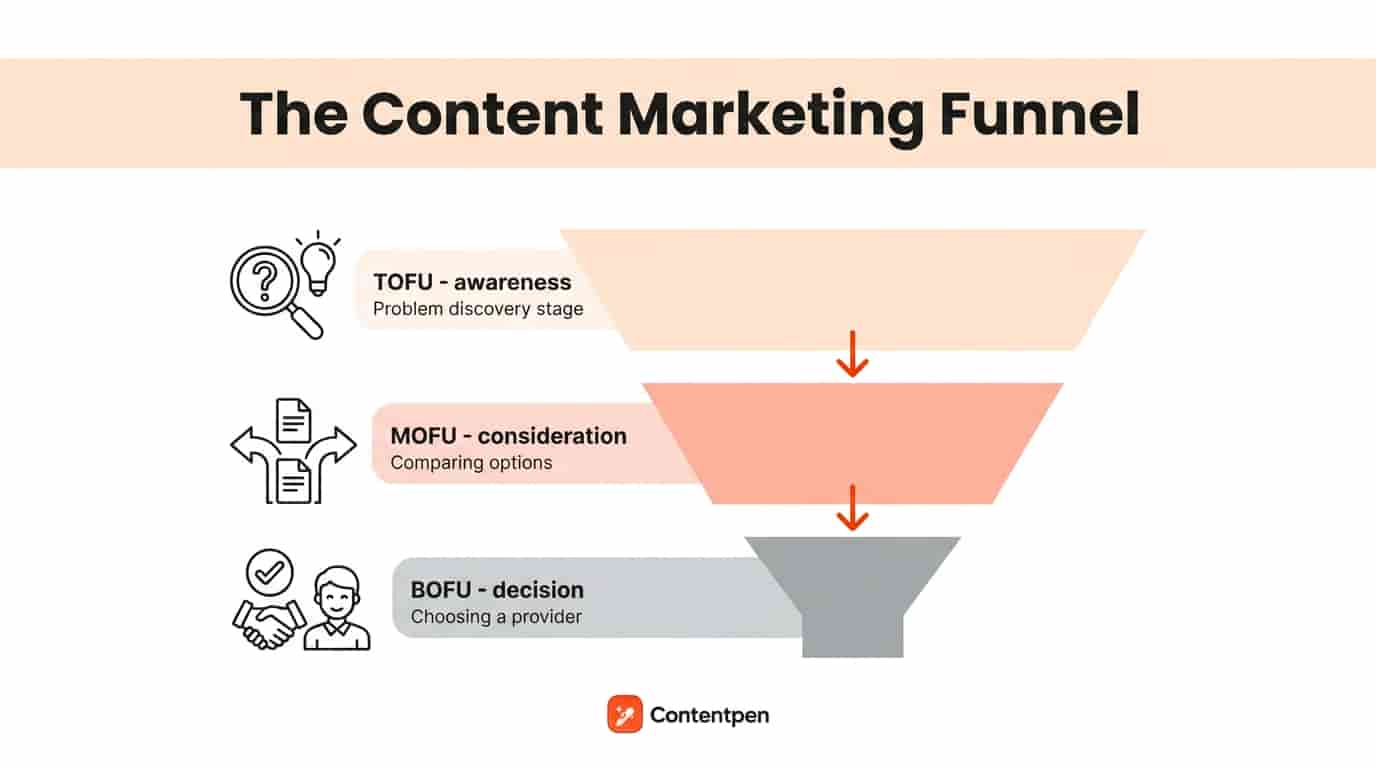
    Step 7: Choose distribution channels where your customers already are

    According to Adobe, the recommended publishing cadences are at least 5-7 posts weekly on Facebook, Instagram, and X. However, platforms like TikTok require more posts, around 1-4 videos daily, to ensure consistent presence and engagement.

    As a B2B business, you can even choose to create whitepapers and leadership-style content on LinkedIn to attract more audiences to your platform.

    In the end, the content distribution channels you choose are completely up to you. But choose ones that are convenient for you and your team right now. You have to start small by picking a few at a time, not all at once.

    Step 8: Repurpose one idea across multiple channels

    Repurposing content is a great idea to keep your marketing channels up and running. It also helps people discover you through different means.

    One blog post can easily be transformed into a social carousel, a short video, or featured in an email newsletter segment. This saves you from creating brand-new material every week for every channel and keeps audiences engaged. 

    A house cleaning service, for example, could turn a “how to prepare for cleaners” article into a checklist graphic that they can share on LinkedIn or feature on their Yelp listing. 

    Another important consideration is to refresh your best-performing posts with new examples, data, or statistics rather than writing one from scratch.

    You can use Contentpen’s refresh mode to help you update content automatically according to new data and SEO/GEO demands.

    Update existing content without rewriting it that fills them

    check

    Improve outdated posts using live URL analysis

    check

    Refresh SEO, structure, and relevance in minutes

    Try Content Refresh
    AI SEO Interface

    Step 9: Build local and community-driven content

    Content marketing works best for SMBs when they lean into what a big brand cannot copy. Like featuring a longtime customer’s story or founder journeys that connect with people.

    A lot of the time, these stories work best combined with social media posting. 

    A famous example is Kiki Couchman, who shares her struggles of launching and selling Sour Milk, a type of Greek Yoghurt with high protein.

    Kiki Couchman Sour Milk Yoghurt brand building through community-driven, social media content.

    Her famous “I’m quitting my job in private equity to start a Yoghurt company” series on Instagram got her 28k+ followers and a lot of support from the community.

    Content marketing that highlights real community ties builds a level of trust that national competitors simply cannot fake. 

    In addition to this, if you partner with a nearby, complementary business, it also extends your reach at little to no cost.

    For example, a bakery teaming up with a coffee shop for a joint event or a comic book store partnering up with an action figurine seller.

    Step 10: Measure results and refine your approach

    Once your content is live, track the 3 to 5 KPIs you set in step 3 using tools like Google Analytics, your social media insights, and your email platform’s reports. 

    If you’re looking to track traffic specifically coming from your blogging efforts, then Contentpen’s web analytics serve that purpose quite well.

    Understand what’s working, and why with real-time analytics

    Track performance and make smarter content decisions with clear insights.

    View Analytics Dashboard
    AI SEO Interface

    Look at which topics and formats bring in actual leads or bookings, not just clicks, and put more effort into those. 

    Dropping formats that get attention but no conversions frees up time for the ones that genuinely move your business forward.

    Should you DIY, hire a freelancer, or work with an agency?

    DIY vs freelancer vs agency comparison for small businesses.

    This is an important question for small businesses looking to scale their content marketing efforts.

    Choosing between doing content yourself, hiring a freelancer, or working with a content marketing agency depends on your budget, time, and how complex your business has become. 

    Here is how each option tends to fit different situations:

    • DIY content works well for solo owners and local service providers who know their customers best but need to keep their scope manageable, such as a few solid articles per month.
    • A freelancer suits business owners who know what they want to say but lack the time or writing skill to turn ideas into polished posts.
    • An agency fits growing businesses with multiple services or locations that need a full strategy tied to measurable outcomes.

    Watch for warning signs regardless of which option you pick. 

    A freelancer or agency that jumps straight to a generic topic list without asking about your customers is unlikely to produce content that actually converts. 

    A good partner instead asks about your business, reviews your existing website, and ties every piece of content back to a KPI like improving leads or bookings.

    AI writing tools support DIY efforts, since they speed up brainstorming and first drafts. But a business owner still needs to add real expertise and check every fact before publishing.
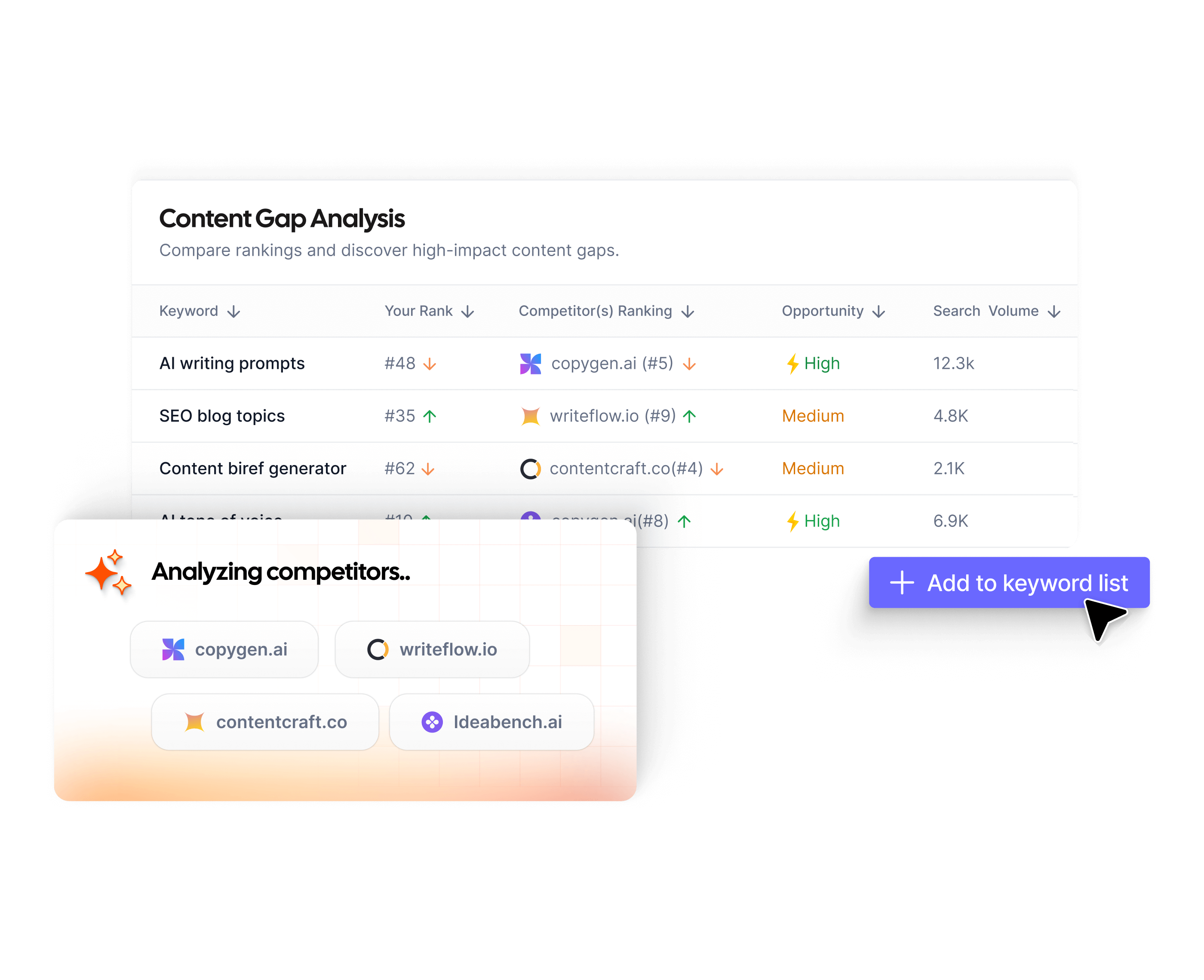
    What does content marketing cost for a small business

    Costs for content marketing strategies for small businesses vary widely depending on how much work you handle in-house versus hiring outside help.

    • DIY content with a basic website, blog hosting, and a free or low-cost email tool typically runs $0 to $100 a month, though your time is the real cost.
    • Freelance writers usually charge $100 to $400 for a couple of articles, or $300 to $1,500 a month for a package of several pieces.
    • Agency retainers that combine strategy and content typically start around $1,000 to $2,000 a month and rise from there for larger projects.

    Weigh any of these numbers against what you get back in leads, bookings, and brand trust rather than focusing on the price tag alone.

    Wrapping up

    Content marketing for small businesses does not require a massive budget or a full-time team to succeed. What it does require is consistency, real audience research, and content that speaks to your customers’ actual problems rather than generic industry talk. 

    Every step in this guide works together to build a content marketing plan that grows steadily over time.

    For the next steps, pick just one step from this list, such as identifying your audience’s top 10 questions, and commit to it this month before adding the next step. 

    Then, use tools like Contentpen to help you publish high-quality content consistently, freeing up your time for the customer relationships and community ties that make your small business content genuinely stand out.

    Write content that’s built to rank, not just read

    Create search-optimized blogs aligned with SEO and GEO signals, so your content performs well across search and AI-driven discovery.

    Try SEO Blogging FREE
    AI SEO Interface

    Frequently asked questions

    How much time should a small business spend on content marketing each week?

    Start with 2 to 4 hours a week, enough for one solid piece of content plus light repurposing into social posts or an email. Consistency matters far more than volume, so a single well-researched article each week beats sporadic bursts of content that stop after a few weeks.

    What is the easiest type of content for a beginner to start with?

    Blog posts or short how-to guides that answer common customer questions are the easiest starting point. They require no cameras, editing software, or special skills, just a clear answer to something your customers already ask you regularly in person or over the phone.

    Can content marketing work without social media?

    Yes, a website with a blog and an email list can succeed on its own. Social media accounts are essentially rented space subject to sudden algorithm changes, while your own website and email list are assets you fully control, which keep working for you over the years.

    How do you come up with business content ideas when you feel stuck?

    Ask your front desk staff, sales team, and support tickets what customers ask most often, since these real questions turn directly into blog ideas or FAQ pages. You can also check Facebook, Reddit communities, and competitor FAQ pages for topics your audience already searches for.

    What is the 5-3-2 rule on Instagram?

    The 5-3-2 rule on Instagram suggests that out of every 10 posts made, 5 should educate or entertain the audience, 3 should highlight community perspectives, and 2 should promote your brand directly. It’s not a hard-and-fast rule, but simply a starting point to know what works on IG.

  • What is a content calendar? Definition, uses, and setup

    What is a content calendar? Definition, uses, and setup

    A content calendar is a written schedule used by teams to organize what content gets published, when it goes live, and who owns each task. 

    If you have ever missed a posting deadline or scrambled to write a caption an hour before it was due, you already know why this matters. 

    Content teams juggle blogs, social posts, emails, and videos all at once, and without one shared plan, things can slip through the cracks quite quickly.

    This guide answers exactly what a content calendar is and why businesses rely on one to stay organized and consistent. You will learn what a good calendar includes, how it differs from an editorial calendar or a social media calendar, and how to build one step by step. 

    Once you see the full picture, building your own calendar becomes a lot less intimidating.

    Key takeaways

    • A content calendar is a schedule that helps you track what you publish, when it goes live, where it posts, and who is responsible for it.
    • It differs slightly from an editorial calendar, a social media calendar, and a content plan, though the terms often overlap.
    • A solid content calendar tracks status, platform, SEO details, and assigned owners for every piece of content.
    • Templates range from free Google Sheets and Google Calendar to dedicated content software like Contentpen.

    What is a content calendar?

    A content calendar is a planning tool that combines a calendar, a scheduling app, and a project tracker into one system for organizing content across every channel a business uses. 

    Defining a content calendar.

    Instead of keeping blog deadlines in one notebook and social post ideas in another, everything lives in a single, shared view. This gives marketing teams, freelancers, and business owners a clear picture of what has been published, what is coming up, and what still needs attention.

    At its core, a content calendar tracks five things for every piece of content: 

    • What you are posting
    • When it goes live
    • Where it will appear
    • Who owns it
    • Current status (e.g., editing, reviewed, published, etc.)

    Some calendars are simple, holding just a few rows in a spreadsheet. Others are built into full content marketing platforms with automation, team collaboration, and analytics baked in. 

    Either way, the goal stays the same: turning content creation into a planned process rather than a last-minute scramble.

    What should a content calendar include?

    What to include in a content calendar.

    A content calendar should include enough detail that anyone on the team can look at it and know exactly what needs to happen next. 

    Most calendars organize this information into columns or fields that stay consistent across every entry.

    FieldPurpose
    Date and timeWhen the piece goes live
    Topic or titleWhat the content is about
    AuthorWho creates the content
    PlatformWhere it gets published
    StatusPlanning, in progress, reviewed, scheduled, or live
    Target audienceWho the content is meant for
    SEO detailsKeywords, meta descriptions, tags
    AssetsLinks to graphics, drafts, or video files in the content

    Even though your requirements from a content calendar can be different, keeping your content data in a structured form is a good idea to enhance team collaboration and productivity.

    Why is a content calendar important?

    A content calendar solves multiple problems for your teams, one of which is centralizing all content activities to enhance collaboration. 

    Besides that, a content calendar:

    • Keeps publishing consistent: Search engines and audiences both reward regular output. A calendar makes that regularity possible.
    • Stops work from getting duplicated or missed: When everyone can see what is planned, nobody writes the same post twice or forgets a deadline because it lived in someone’s head.
    • Shows gaps before they become problems: A quick glance at a calendar organized by content type reveals if you are publishing five blog posts and zero social updates in a given month.
    • Gives every piece of content an owner: Status fields and assigned names mean nothing depends on memory. If a draft is stuck, you know exactly who to ask.
    • Ties content back to goals: A calendar that includes SEO details and target outcomes for a week or a month keeps content decisions grounded in strategy rather than guesswork.

    Teams that skip a content calendar tend to notice the cost later, usually as missed deadlines, duplicated work, or a content mix that quietly drifted away from what the business actually needed.

    How is a content calendar different from other similar terms?

    Different terms for a content calendar.

    A content calendar overlaps heavily with terms like editorial calendar, social media calendar, and content plan, but each one carries a slightly different scope. 

    Marketers often use these words interchangeably, which causes confusion when researching tools or templates. The main difference usually comes down to what type of content is being tracked and whether the document is strategic or tactical.

    What is an editorial calendar?

    An editorial calendar is often used interchangeably with a content calendar, though it traditionally leans toward written and blog-focused content. 

    Take Contentpen’s content calendar as an example:

    Contentpen interface for content calendar.

    It tracks the editorial workflow, meaning drafts, edits, and approvals, rather than just publish dates. Many teams use the terms as synonyms today, especially once blogs, newsletters, and social posts all live in one shared system.

    What is a social media content calendar?

    A social media content calendar focuses on planning posts across platforms such as Instagram, LinkedIn, and TikTok. It usually looks like a grid or monthly view, with each entry showing the platform icon, caption, hashtags, and a linked image or video. 

    Take ContentStudio’s content calendar as an example:

    ContentStudio content calendar.

    Because social platforms move fast, these calendars often get updated daily or weekly, with room for trending topics to be added later.

    What is the difference between a content plan and a content calendar?

    A content plan is the strategy behind your content, covering goals, audience, and content pillars, while a content calendar is the tactical schedule that puts that strategy into action. 

    The plan answers why you are creating content and for whom. The calendar answers when each piece publishes and who is responsible for it. You need both, since a calendar without a plan often produces content that has no clear direction.

    How do you make a content calendar?

    How to build a content calendar.

    You make a content calendar by choosing a format, setting goals, organizing content by type, and then filling in dates, owners, and tasks for each planned piece. 

    The process works whether you are managing a single blog or coordinating content across an entire marketing team. Breaking it into smaller steps makes the whole thing far less overwhelming, and it gives you a repeatable system you can reuse every month or quarter.

    #1: Choose your template or tool

    Start by picking a format that matches your team’s size and budget, since the right tool depends heavily on how complex your content operation is. 

    Google Sheets and Google Calendar work well as free starting points for solo creators or very small teams, offering flexibility in planning content without any cost. 

    As your content volume grows, a dedicated platform becomes more useful, especially one that connects planning directly to the writing process. 

    Contentpen, for example, includes a built-in content calendar alongside keyword research and drafting tools, so you can decide what belongs on the calendar based on real search demand rather than guesswork. 

    Plan once.
    Publish consistently.

    check

    Scheduled

    check

    Organized

    check

    Predictable

    check

    Scalable

    Schedule Your Content
    AI SEO Interface

    Its no-code webhook integrations can also automate handoffs, such as logging a scheduled post or notifying your team once a draft moves into review.

    #2: Set goals and organize by content type

    Every piece of content on your calendar should have a measurable goal, whether that is traffic, engagement, or conversions, so you can judge its performance later.

    Group your planned content by type, such as blog posts, social updates, email campaigns, and videos, to spot gaps in your mix before they become a problem. This step turns a blank calendar into one built around clear priorities and goals.

    #3: Plan key dates and brainstorm ideas

    Mark holidays, product launches, and industry events on your calendar first, since these dates often shape what content needs to go out and when. 

    From there, build a running list of content ideas tied to specific platforms, hashtags, or campaigns. Keeping this list separate from your scheduled entries gives you a pool of ready ideas whenever a posting slot opens up.

    A free social media content calendar template can be found on Hootsuite

    Hootsuite content calendar template.

    You can download this free content calendar by adding your business information and details.

    #4: Assign tasks and track status

    Break each piece of content into smaller steps, such as research, drafting, design, review, and publishing, rather than tracking just the final deadline. Assign an owner and a due date to every step so nothing depends on memory alone.

    What does a content calendar look like?

    Content planner screen - Contentpen.ai.

    A content calendar typically looks like a grid, spreadsheet, or monthly view with columns or day boxes showing what gets published, on which platform, and by whom. 

    The exact layout depends on the tool you choose, but most formats share the same underlying structure once you look past the visual design.

    Common content calendar formats

    Below are some common content calendar formats widely used by teams:

    FormatBest forProsCons
    Grid or spreadsheetTeams tracking many details per postFully customizable columnsFiltering content can be difficult
    Weekly or monthly calendar viewVisualizing posting frequency at a glanceFamiliar layout, quick to scanCan miss out on key asset details
    Project management style (Kanban boards)Teams that work in weekly, monthly, or quarterly sprintsGood for filtering and sifting through dataChallenging to understand at a glance
    Blank templateBrainstorming before schedulingFlexible, low commitmentCreating everything from scratch

    Different formats suit different working styles, and most teams eventually settle on one that matches how they think about their content.

    A simple content calendar example

    Picture a couple of rows on a spreadsheet, something like this:

    • Date: August 25th
    • Blog title: “5 Email Marketing Tips for Small Businesses”
    • Platform: Company blog
    • Keyword: “Email marketing tips”
    • Author: Sarah
    • Status: Scheduled

    That one row filled tells anyone on the team exactly what is happening without needing to ask. Such is the power of content calendars.

    The takeaway

    A content calendar brings order to what would otherwise be a chaotic mix of deadlines, platforms, and half-finished ideas. 

    It saves time, keeps your posting schedule consistent, and makes it far easier to align content with real business goals instead of publishing on instinct. 

    Starting simple with a spreadsheet or Google Calendar is more than enough when you are just getting going.

    As your content volume grows, scaling up to a dedicated tool like Contentpen makes sense, since it connects planning directly to writing, optimizing, and publishing in one workspace. 

    The important part is starting somewhere and building the habit of planning ahead rather than reacting at the last minute.

    Frequently asked questions

    What is a content marketing calendar?

    A content marketing calendar is simply another name for a content calendar, usually with a stronger focus on marketing campaigns. It tracks the same core details, including publish dates, platforms, and owners, but often ties each entry to a specific campaign goal.

    What is a media calendar?

    A media calendar is often used interchangeably with a content or editorial calendar, though it sometimes leans toward paid media or public relations scheduling. It tracks when press releases, paid ads, or media placements go out, alongside regular content.

    What is a content calendar theme?

    A content calendar theme, also called a content pillar, is a recurring topic or focus area that guides what gets scheduled during a given period. For example, a business might dedicate a month to customer success stories or seasonal promotions. Themes keep content varied while still staying aligned with broader marketing goals.

    Are there free content calendar templates available?

    Yes, free templates are widely available through Google Sheets and Google Calendar, making them accessible starting points for solo creators or small teams. Many organizations customize a basic spreadsheet template with tabs for content ideas and a running schedule.

    How far in advance should you plan a content calendar?

    Most marketing teams plan social content at least a month ahead while leaving room for flexibility. Larger campaigns, such as holiday promotions or product launches, often get planned a full quarter or even a year in advance.

  • SaaS content marketing: The complete 2026 strategy guide

    SaaS content marketing: The complete 2026 strategy guide

    SaaS buyers rarely make a quick decision. They read, compare, loop in three or four coworkers, and often disappear for days or weeks before signing up for anything. That slow, crowded process is exactly why SaaS content marketing works differently than content marketing.
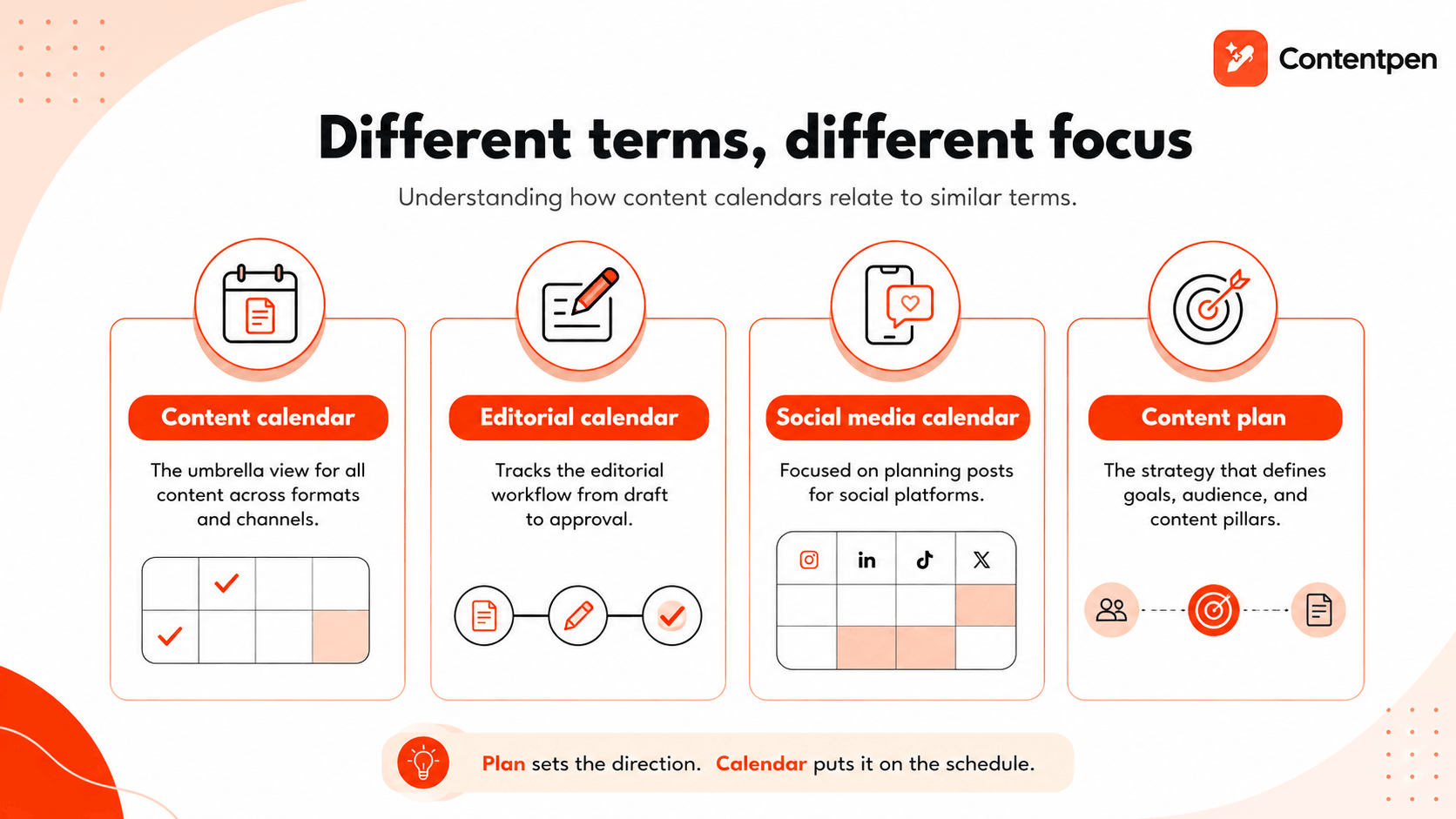
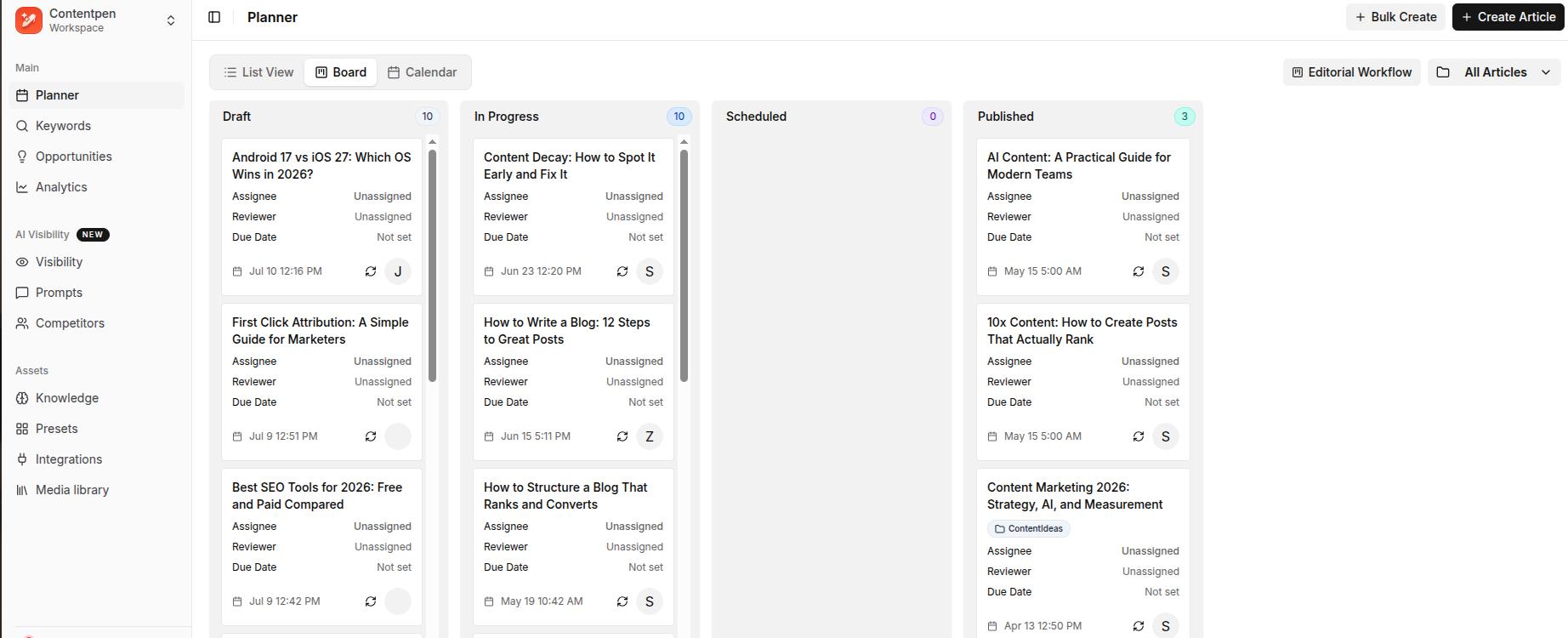
    SaaS content marketing is the practice of creating blog posts, product pages, comparison pages, videos, and other resources built to attract, convert, and keep subscription software customers. 

    It differs from regular content marketing because it must speak to multiple buyers at once, explain a product that isn’t always simple, and tie directly to measurable outcomes.

    This guide covers what the term means, how to build a strategy around it, which content types matter most, real brand examples, and how Contentpen fits into a modern content workflow. Keep reading to see how each piece connects.

    Key takeaways

    • SaaS content marketing has to match the buyer’s actual research process, not just chase search volume.
    • Bottom-of-funnel pages like use cases and comparisons should get built before you scale broad blog content.
    • AI tools speed up drafting, but product knowledge and original insight still decide whether content performs.
    • Distribution and measurement matter just as much as the writing itself, so plan both from day one.

    What is SaaS content marketing?

    How SaaS content marketing drives growth.

    SaaS content marketing means creating and distributing content to attract new software buyers, help them decide to purchase, and keep them subscribed once they’re customers.

    Unlike paid ads, which stop the moment you stop paying, well-built SaaS resources keep pulling in visitors long after they’re published. 

    Strategic content marketing for SaaS companies tends to compound over time. That compounding effect is what makes it worth the up-front investment of time and planning.

    How do you build a SaaS content strategy that actually works?

    A SaaS content strategy that works starts with your audience, goals, product story, and website, not with keyword research. Below are the 10 steps that you should follow to help grow your brand online.

    #1: Know your audience beyond generic personas

    Real SaaS content strategy depends on understanding what your buyers actually do at work, not a made-up persona with a name and a hobby.

    For that, you need to pull real intelligence from the sources where your buyers already describe their problems in their own words.

    • Sit in on a few demo calls and sales conversations each month, since prospects often reveal the exact phrase they’d type into Google when frustrated.
    • Read through support tickets regularly to spot recurring complaints and confusion points that content could resolve before they turn into churn.
    • Watch relevant Slack groups, Reddit threads, or LinkedIn discussions where your audience already argues about tools like yours.
    • Study your highest lifetime value customers specifically, since they often reveal the use case your product actually wins at, not just the one you market hardest.

    Most SaaS products serve more than one type of buyer. Naming these profiles clearly and keeping them visible while planning content keeps every article tied to a real reader instead of a guess.

    #2: Set goals with OKRs, not guesswork

    Next are the goals that you set for your business, which are mostly driven by objectives and key results, or OKRs. It is a measurable outcome that your team can act on to drive results, not something vague like “grow traffic” or “get more subscribers.” 

    Your goals should also match where your company actually stands right now.

    Company stagePrimary focusExample goal
    BootstrappedDirect sign-ups100 product sign-ups a month
    Seed to Series AVisibility30% more blog traffic
    Series B and beyondRetention15% better activation rate

    If your SaaS business is in the early stages, talking directly to customers often helps more than generic content marketing pieces.

    For example, an email marketing platform founder can create Loom videos discussing the product’s honest pros and cons in detail. This will help people recognize the genuine people behind the product and may convince them to buy more than blog posts or anything else.

    Once that same business gets up and running, for instance, 3k MRR or ARR, then visibility comes into the picture.

    A simple example might be:

    • Objective: Driving 400 sign-ups from SEO this quarter.
    • Key results: publishing 6 use case pages, 4 comparison pages, and 40 optimized blog posts

    Treat these as stretch goals rather than guarantees. Hitting 70% to 90% of an OKR is generally considered a solid result, while consistently landing over 100% usually means the target was set too low to begin with.

    Building accurate OKRs takes a bit of trial and error, so lean on last quarter’s actual numbers when setting the next target. This is especially true for large businesses (Series B and beyond) that may focus more on customer retention than gaining new ones.

    #3: Creating a content lifecycle

    SaaS content lifecycle phases.

    SaaS companies should build content that mirrors the customer lifecycle, moving through three phases that answer who you are, how to use you, and why someone should choose you over the alternative. 

    The first phase covers your homepage, product pages, and feature pages. The second covers onboarding and activation content, like a resource hub or learning content similar to what you can find in Semrush Academy. 

    The third phase is where growth happens, through use case pages, comparison pages, and broader blog content aimed at non-branded search terms.

    Since most visitors land on a single page through a search query rather than browsing your entire site, every stage needs its own entry point built to rank on its own. 

    That’s why the smartest sequence is to build bottom-of-funnel pages first, then scale blog and other types of content once some conversion paths already exist.

    #4: Types of content

    Before writing a single blog post, your messaging needs to explain exactly how your product solves a real problem. Your website needs foundational pages, meaning a homepage, feature pages, and use case pages that make the value proposition clear within seconds. 

    Start planning from the bottom of the funnel and build upward toward broader awareness content. This means going from use case pages -> Vs comparisons -> blog posts -> social media posts in that particular order.

    Use case pages

    After your feature and product pages, your use case pages should be the first type of content you create for your SaaS business. This is because the user must learn what your product can do for them before any awareness (blog posts, social posts) comes into play.

    Here is how Contentpen, an AI blog writing tool, does it:

    Use case pages for Contentpen.

    Each URL traces back to the use-cases pillar like this: 

    • Small businesses (https://contentpen.ai/use-cases/small-businesses)
    • Agencies (https://contentpen.ai/use-cases/agencies)
    • Enterprises (https://contentpen.ai/use-cases/enterprises)

    The idea of setting the URL structure like this is to help each type of user navigate the website properly and understand the benefits of the tool clearly.

    You could also structure use case pages under a clear folder like /for/recruitment-outreach, with a central hub page linking out to each one. However, this depends on the CMS you’re using.
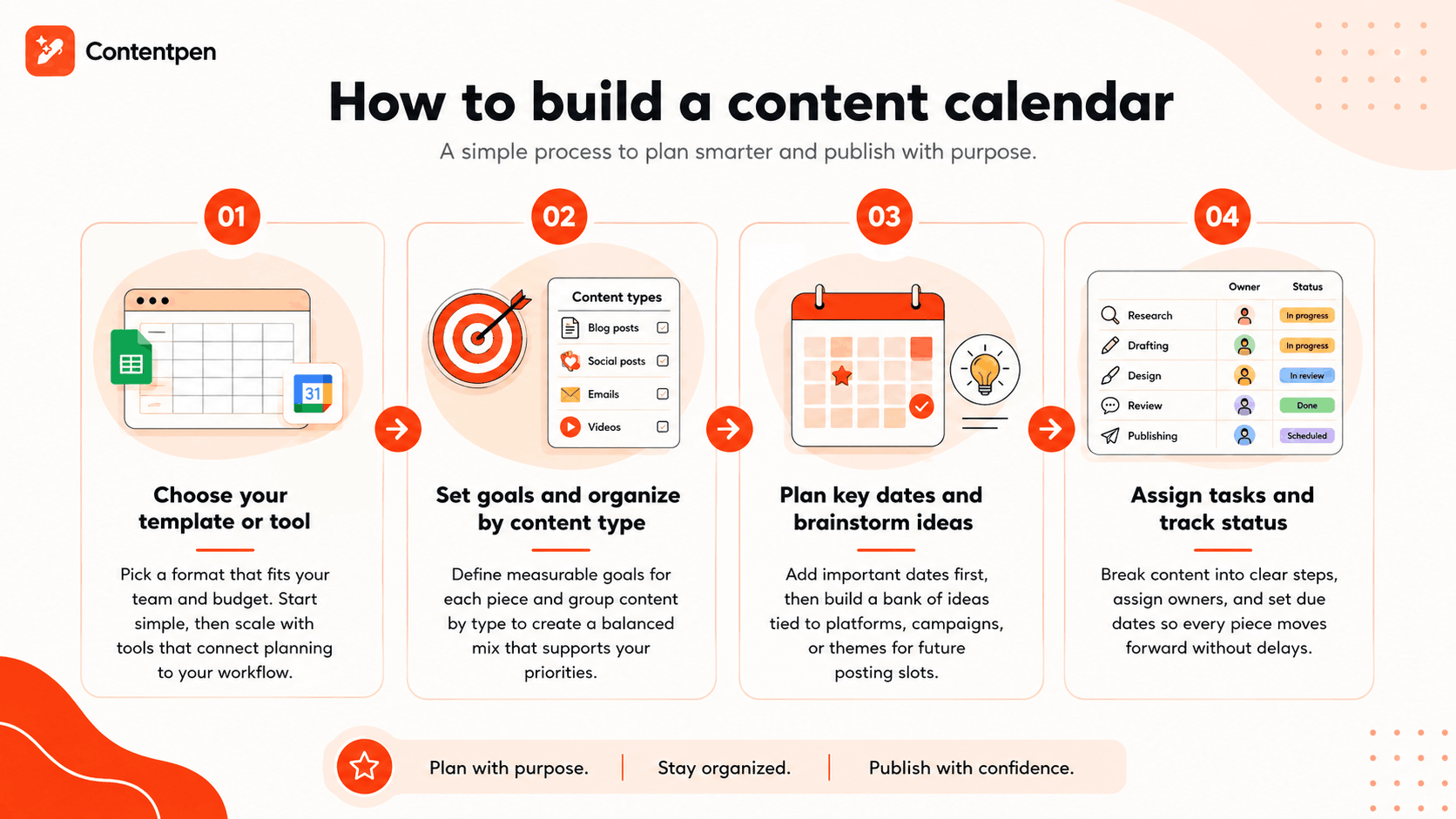
    Some SaaS brands, like Contentpen, differentiate use cases by roles and teams, as shown in the image earlier. This is also an efficient manner of displaying all the required knowledge categorically without overwhelming the reader.
    Vs pages

    After use case pages, you should create pages for those users who are ready to convert (remember we’re trying to get to that ARR/MRR goal first).

    Write honest comparisons between you and other competitors in the space. Highlight true gaps and how your tool fills them.

    Again, we’ll use our Contentpen example:

    Comparison pages for Contentpen.ai.

    Notice that we have multiple comparison pages up on our site, like Contentpen vs. Frase, Contentpen vs. Jasper, and so on. Each page does the job of setting all the SEO and GEO features head-to-head with the competitors to help those near a decision make the right one.

    On the left, we have the feature pages. On the right are the essentials of the company (about us, pricing), and other resources like blogs, SEO glossary, help docs, and the FAQs page

    This is the type of structure you should aim for when creating the best SaaS content marketing strategy.

    Blog posts

    Blog posts remain the biggest traffic driver for most SaaS content marketing programs, but only when they stretch beyond product updates into topics your actual audience searches for.

    One documented case of Joshua Parkinson’s brand, Post Planner, grew from 9,000 to 500,000 monthly unique visitors through consistent publishing of 550+ evergreen posts over 24 months.

    For startups, blogs are an ideal way to improve recurring traffic without spending on ads. If done right, comprehensive, evergreen content keeps bringing in visitors long after it’s been published (doesn’t mean you don’t have to update them every once in a while).

    Ideally, keep blog titles under 60 characters so they don’t get cut off in search results, and keep URLs clean and focused on the target keyword rather than mirroring the full title.

    For example:

    Notice that our blog structure is simple (https://sitename/blog/x-y-z). This helps us keep each post under the main blog page, allowing for easier navigation.

    Social content

    Videos and social content play a supporting role rather than a search-driving one, and each platform rewards different formats.

    • Long-form videos tend to work best on YouTube, where viewers expect a deeper walkthrough or tutorial rather than a quick clip.
    • Short-form video fits TikTok and Instagram Reels, where entertainment or a fast tip beats a polished pitch every time.
    • Short threads or quick tips perform well on platforms like X, where attention spans are shorter, and scrolling is constant.

    Avoid posting the same link or company update across every channel, since that approach rarely earns engagement anywhere. Keep adapting your message to each platform instead of repeating one post everywhere.

    #5: Perform keyword research

    Keyword research is one of the most fundamental things in your SaaS content marketing strategy.

    Regardless of the tool you use, you need to find the queries your audiences are searching for and create content that caters to their needs.

    Keyword research tools to consider

    As a content marketer, you can start by utilizing tools like Ahrefs to find the top keywords for your business.

    For example, a project management SaaS brand might start with head phrases like ‘project management’ or ‘project management software.’ 

    Ahrefs keyword research tool result.

    The next step could be to add filters or modifiers to find keywords that match different stages of the content lifecycle.

    Use terms like ‘How, why, what, examples, example, tool, tools, best, top, guide, template, tutorial, course, courses, inspiration, help.’ 

    Add them to the filters by clicking the ‘Include’ button and pasting them separated by a comma after each term. Choose the option ‘Any word’ instead of ‘All words’ to include instances where either one of these filter words was mentioned alongside our main target head term.

    Ahrefs term filter inside keyword research tool.

    Next, you can plan content pieces by clustering keywords by parent topic. In Ahrefs, you just have to use the option next to the ‘Keywords’ list to see the following results:

    Clusters by parent topic - Ahrefs.

    While clustering and keyword research in Ahrefs, Semrush, or any other keyword tool can be tedious, Contentpen’s keyword research is much smoother.

    Simply enter your target phrase and let the tool generate keywords for it.

    Contentpen keyword generation for a content pillar.

    You can choose how many keywords per topic or cluster you want and let the tool find the best options from Google People Also Ask, Autocomplete, and Related search queries. It also automatically fetches KD, search volume, and CPC for each term.

    Once that’s done, you’ll see a bunch of keywords that you can organize in a new cluster. 

    For this example, we’ll call the new cluster “project management.”

    Topical cluster inside Contentpen.ai.

    Once your cluster is ready, you can generate blogs and articles for each term according to your brand voice directly from the same interface using the ‘Generate Article’ button.

    #6: Conversion rate optimization

    Conversion is the most important part of SaaS marketing strategies. 

    You may get a lot of organic traffic from blogs and improve your brand awareness online. But if users aren’t converting, then you won’t meet your ARR/MRR targets.

    The reality in SaaS is that most users who land on your blogs don’t directly convert. They likely explore some other resources before they make a decision.

    A good SaaS strategy that a lot of big brands do is to provide some free templates and resources for their users to enjoy before they trust you enough for the purchase.

    A good CRO example is from HubSpot.

    HubSpot free resource example on a blog.

    Credits: HubSpot social media content calendar tools blog.

    HubSpot technically converted users from their blog to a free social media content calendar template, and then to their subscription. They gate their free resources, for example, asking people to sign up with their email before accessing them. But this is a solid SaaS strategy.

    You want users in your ecosystem long before they’re your customers. Then, you can consistently keep in touch with them through the contact information received, convince free trial users to make purchases, or upsell if required.

    Therefore, the typical conversion flow for a blog post changes from: 

    • Blog post → Sign up for product

    to:

    • Blog post → Free resource → Sign up for product

    Sure, you can A/B test both conversion flows, since different flows suit different companies and since you can’t provide free resources for every post you make. Then, you can see what mix works better for you and your audience and stick to it.

    How does UI play an important role in CRO?

    Besides free resources, CRO also involves how you prepare and present your CTAs, buttons, and action blocks to the users.

    Take Contentpen as an example. Our blogs have easy-to-follow, interactive buttons in articles that are not going to “pop up” on your screen or disturb your reading flow.

    AI visibility blog example from Contentpen.ai, showing CTA buttons for CRO.

    On the right-hand side, you see a live ‘Start your free trial’ button encouraging users to try out our product for free for 7-days. This block sticks throughout the scroll but doesn’t push itself out of that section.

    Similarly, the ‘Table of contents’ bar stays afloat and opens on a mouse hover, guiding users to a specific section in the guide. 

    Lastly, the ‘Try AI Visibility’ button inside our AI visibility tools blog pushes users to give our AEO features a go without overwhelming them at any point.

    There are multiple buttons on the site to guide users to an action, but neither of them makes the platform feel too “salesy” or “pushy.” This is the balance that you need to find with your SaaS product marketing as well.

    #7: Content distribution

    Another important thing that influences SaaS content marketing strategies is how you distribute your content.

    As a bootstrap, you can try collaborating with microinfluencers with 15-20k loyal followers, relevant to your niche.

    Then, try increasing your online footprint by being active in:

    • Quora discussions where users are discussing brands similar to yours.
    • Reddit forums and threads, answering genuine user questions and being helpful.
    • Medium articles that improve brand awareness and are good for SEO.

    The emphasis remains on being relevant to the platform, following their rules and regulations, and understanding how the platform algorithm works. 

    In our guide to Reddit SEO, we specifically stressed that the platform rewards honest, authentic discussions and transparency in marketing. You can sell, but just not outright, which is a guiding principle for anything you do off-page.

    If you are not pushing content like it’s meant to be on a particular site or forum, you may not see the results you desire.

    How brand consistency is important in content distribution

    Distribution works like a system where each department is different from one another, but everything just fits together like a well-oiled machine.

    For instance, if we’re creating social media posts for Contentpen, we’ll ensure that our carousels and posts follow the same brand colors and styles that our blogs and other channels do.

    Contentpen LinkedIn post following consistent brand style and colors.

    Our keyword cannibalization feature post on LinkedIn follows the same styling we do for our visuals on our blogs, feature pages, and use-case pages. 

    The result is instant recognition by the users as they can instantly tell who posted this carousel, imprinting the brand image in people’s minds.

    #8: ROI and tracking

    The best part about digital marketing is that you can track everything. And we mean EVERYTHING on your platform. This is why optimization and tracking are much easier digitally than traditional advertising or marketing channels.

    For starters, you have tools like Google Analytics 4 (GA 4) and Google Search Console that tell you how much traffic you get and from where. These tools are good for free usage, but the attribution or deep analytical angles are mostly missing.

    Here at Contentpen, we use Usermaven as our advanced tracking and attribution software. It not only tells you the basic metrics (daily visitors, visit duration, etc.) but also which exact sources contributed to these numbers.

    We can set up form tracking to see how many leads we generated from forms or use ‘Custom Events’ to see which buttons users pressed, and what happened next.

    Custom event capturing - Usermaven.com.

    Even though mapping the customer journey is useful, we also utilize UM to see our ‘performance by attribution model.’

    Performance by attribution model - Usermaven.com.

    This tells us exactly the sources through which we got sign-ups, trial conversions, or affiliate plan sign-ups.

    Once you start tracking and attributing your sources properly, you’ll understand the touchpoints leading to better conversions, helping you emphasize your SaaS content marketing efforts accordingly.

    #9: Scaling your content team

    In-house vs agency vs hybrid team model to scale SaaS content marketing.

    Choosing between an in-house team, a SaaS content marketing agency, or some mix of both usually comes down to budget and how fast you need to scale. 

    In-house teams tend to understand your product and brand more deeply, since agencies split attention across several clients at once. 

    That said, full-time hires can be costly, given that there are benefits and other important commitments involved from the employer. In such cases, utilizing freelance writers can be a good way to increase content throughput without adding complex contracts in the mix.

    Most growing SaaS companies land on a hybrid setup. They keep 2-3 in-house content managers to drive strategy while working with freelance writers or a SaaS content marketing agency to handle production volume and scale.

    This mix tends to give you both the product understanding an internal team builds naturally and the extra bandwidth an agency or freelance pool can add during a busy quarter.

    #10: Using AI to streamline content creation

    AI content workflow for SaaS businesses.

    AI speeds up the slow parts of SaaS content marketing, like early research and first drafts, but it doesn’t replace the strategy, product knowledge, or original insight behind good content. 

    If used well, AI tools can create first drafts quickly, freeing writers to spend their time on the things a model can’t add. For example, real customer quotes, original data, or a genuinely useful example pulled from a support ticket. 

    Used poorly, AI just produces generic copy that reads the same as every competitor’s blog, which does nothing for rankings or trust.

    A few habits keep AI-assisted content worth publishing:

    • Use AI to speed up research and get a first draft on the page faster, rather than starting from a blank document every time.
    • Add real product knowledge, customer language, and specific examples that only someone who actually uses the tool would know to include.
    • Edit every draft for tone, accuracy, and competitive positioning before it ever gets close to a publish button.

    Creating expert, authentic, and authoritative content isn’t just rewarded by Google, but it also helps your citations in AI answer engines.

    Where Contentpen fits into your content workflow

    Contentpen is built for AI-assisted content creation without losing the strategy and structure that make content actually rank. 

    The platform takes a topic idea all the way through keyword research, a detailed outline, and a full draft. The content is built with answer-first intros and headings designed to perform in both classic search results and AI answer engines like ChatGPT or Google’s AI Overviews.

    Beyond drafting, Contentpen also includes competitor analysis to flag content gaps worth targeting. It also ships with a built-in content calendar and no-code webhook integrations that connect drafts to a CMS or team notification tool without manual copying and pasting. 

    Publish content directly to your CMS, without copy-pasting

    Move from draft to live post in a single step. No hassle, no errors!

    Try One-click Publishing
    AI SEO Interface

    That said, none of this replaces the work of understanding your audience described earlier in this guide, since even the best tool has nothing meaningful to optimize without a solid strategy feeding it.

    What are real examples of successful SaaS content marketing?

    SaaS brand content playbooks comparison.

    The best SaaS content marketing examples all share one trait: they pick a distinct angle and voice rather than copying a generic blog, video, or post.

    Ahrefs, the leading SEO SaaS tool, built its entire strategy around solving one problem per post, always tying the fix back to its own software. It reportedly grew past $40 million in annual recurring revenue (ARR) in 2019, all without paid Google ads. 

    Other companies lean into approaches that feel almost risky at first glance. Dacast, an OTT streaming platform, names direct competitors inside its own comparison or alternative roundups, which builds user trust through honesty.

    Let’s analyze some more brand playbooks worth studying to learn key SaaS content marketing trends in 2026.

    BrandCore content approachResult worth noting
    AhrefsProduct-tied blog posts solving one SEO problem eachGrew past $40M ARR with no paid Google ads
    ProfitWellPricing page teardowns of known brandsRanks for 55,500+ keywords
    dacastNaming competitors directly in comparison postsRanks for 106,000+ keywords
    HotjarHub-and-spoke content around “heatmaps”Holds the top search spot for the term
    AtlassianOne all-in-one resource page combining video, guides, and visualsCompetes for a term with 47,000 monthly searches

    To sum it up, these content marketing strategy examples show that it is okay to challenge the norm, be authentic, and honest in your analysis that people love. 

    They also show that adding original data, statistics, and thoughts always results in better trust and therefore, sales for your SaaS products.

    Final thoughts

    Winning SaaS content marketing in 2026 starts with a clear product story, builds from the bottom of the funnel, and uses AI to move faster without losing the original insight. 

    Skip straight to blog volume, and you’ll end up with traffic that never converts. Skip strategy entirely, and even the best AI draft won’t rank or get cited by an AI search engine. 

    The path that works is boring but reliable. Use clear messaging, utilize real customer research, and establish a steady publishing habit built around formats that match how your buyers actually search.

    If you’re starting from scratch, don’t try to build every content type at once. Pick one high-intent page, a use case page, or a comparison page against your closest competitor, and get that right before scaling into broader content.

    Frequently asked questions

    What is the 33222 rule of SaaS?

    The 33222 rule is a marketing framework some SaaS teams use to keep messaging simple, generally broken down as 3 value props, 3 channels, 2 calls to action, 2 proof points, and 2 core offers. The idea is to stop teams from overloading a page with too many competing messages.

    Is SaaS being replaced by AI?

    No, SaaS isn’t being replaced by AI, though AI is changing how SaaS products get built, marketed, and supported. AI is a tool inside a SaaS content marketing strategy, speeding up drafts and research, not a replacement for the strategy itself.

    How much does SaaS content marketing cost?

    Costs vary a lot depending on company stage and team setup. Freelance writers and creators can charge less compared to agencies that charge more for full strategy and execution. Startups often start with freelance support before expanding their in-house team.

    How long does it take to see results from SaaS content marketing?

    Meaningful results usually take close to a year. Most teams start seeing real traction after publishing around 50 properly keyword-targeted articles. Consistent weekly publishing (about 4-5 articles per week) matters more than any single standout post.

    What is the difference between B2B SaaS content marketing and B2C content marketing?

    B2B SaaS content marketing deals with longer sales cycles, multiple decision-makers, and more education-heavy content. B2C content marketing usually targets a single buyer making a faster, more emotional decision.

  • 120 blog post ideas to beat writer’s block for good

    120 blog post ideas to beat writer’s block for good

    You’re staring at a blank screen, and all blog post ideas that pop into your head feel stale, obvious, or just plain wrong for your audience. That blank-page panic hits every writer eventually, whether you run a marketing blog or post personal essays for fun. 

    The real problem usually isn’t a shortage of things to say. It’s not knowing which topic actually deserves the next hour of your writing time.

    This guide fixes that fast. Below you’ll find 120 blog post ideas sorted into categories built around real goals, including driving traffic, building trust, connecting with readers, and growing a business. 

    Each list gives you short, adaptable ideas that you can bend to fit your own niche in minutes, with no guesswork required.

    So, let’s get to it, shall we?

    Key takeaways

    • Writer’s block usually comes from unclear direction, not an actual lack of ideas.
    • SEO, trust-building, personal, and business-focused ideas each serve a different purpose, so match the idea to your goal.
    • Pick one idea from the list of 120 others, adapt it to your niche, and start writing today instead of waiting for the perfect topic.
    • AI tools like Contentpen can help turn any idea on this list into a full blog post in minutes to help you save time and effort while drafting content.

    Why do bloggers run out of ideas?

    Explaining writer's block - Contentpen.ai.

    Bloggers run out of ideas when they lose sight of what their audience actually wants to read, not because inspiration has dried up. 

    If writer’s block has you stuck right now, the fastest fix is to stop chasing generic inspiration and start with the questions your readers already keep asking you.

    To find those burning questions, check your email, DMs on social media, and other sources, and write content to address those exact queries. 

    You can even share something from your own experience or pick something up from a conversation you once had with a person of interest and talk about it.

    There are multiple ways to get rid of the writer’s block, but the best way is to simply “write.” 

    We know this sounds a bit odd, but writer’s block is actually just a self-induced state of mind where a person might think “I am not good enough for XYZ audience or I won’t get ranked for this topic, etc.” 

    The best way out is to write, write, and write without any worries of editing or polishing the content. You can edit the draft later.

    Once you’re writing, you may even get more blog ideas that you can use for related subposts later. Note these down for your reference in the future.

    Remember, the best blog is the one that’s written.

    120 blog post ideas to beat writer’s block

    If you can’t seem to shake up your writer’s block, try giving these 120 blog post ideas a go. The ideas below are grouped by a specific goal, so you can jump straight to the category that fits whatever you’re trying to achieve this week.

    SEO and traffic-focused blog ideas

    SEO-traffic blog ideas in 2026.

    These blog post ideas work best when they’re tied to a real, searchable question your audience is already typing into Google.

    • Ultimate guides covering everything readers need to know about one big topic. For instance, “What is blogging?”
    • How-to tutorials that solve one specific, searchable problem. For example, “How to turn your blog into a profitable online business.”
    • Listicles rounding up the best tools, resources, or tips in your niche. Example: “14 best AI blog writers in 2026.”
    • Comparison or “X vs Y” posts that help readers choose between two options, for instance “Webhook vs. API.”
    • Checklists that turn a process into an easy step-by-step task. Take our blog “How to write a blog post” as an example.
    • FAQ posts answering the exact questions people type into Google.
    • Glossary posts defining confusing industry terms in plain language.
    • Seasonal or trending posts tied to a specific time of year.
    • Roundup posts featuring expert tips or product picks for your niche.
    • Beginner’s guides breaking a complex process into simple steps. For example, “How to start a blog in 8 simple steps.”
    • Data-driven posts sharing fresh statistics relevant to your industry.
    • Best-of lists for tools, services, or resources in your space.

    The next step is to build the most complete, useful piece of content available online that answers all users’ questions. This approach consistently draws organic traffic because it matches actual search intent rather than assumptions about what readers might want.

    Trust and authority-building blog ideas

    Trust-building blog ideas work well for freelancers, consultants, and small businesses that need to prove real expertise before a reader becomes a client. 

    • Behind-the-scenes posts showing your actual process or methodology.
    • Case studies walking through a real project and its results.
    • Common mistakes people make in your industry, and how to avoid them.
    • Myth-busting posts correcting misconceptions in your field.
    • Tool or service comparisons that position you as the trusted pick. Example: “The best Jasper AI alternative in 2026.”
    • FAQ roundups answering the questions clients ask most often.
    • Opinion pieces taking a clear stance on a debated industry topic.
    • “What not to do” posts for a common process in your field.
    • Explainer posts breaking a complex topic into plain language. For instance, “What is AEO? Explained for beginners.”
    • Reviews of a product, course, or tool your audience relies on. Example: “Surfer SEO review in 2026.”

    These post ideas show your process and thinking instead of just stating that you’re qualified, which builds far more credibility than a simple about-us claim ever could.

    Personal storytelling and lifestyle blog ideas

    Personal blog post ideas.

    This category works especially well for solo bloggers, creative professionals, and lifestyle brands that want their audience to feel like they actually know them.

    • Your blog’s or business’s origin story, including how you actually started.
    • A mission statement describing what your blog stands for.
    • A personal failure or setback and the lesson you took from it.
    • Your biggest struggle right now, discussed honestly.
    • Your greatest victory to date, with real detail.
    • A controversial topic in your niche, paired with your honest opinion.
    • A genuine, unfiltered look at your daily routine or work process.
    • Things very few people know about you.
    • Top lessons you learned over the past year.
    • How you personally stay healthy, mentally and physically.
    • The difference between self-care and deeper “soul-care” habits.
    • Journal prompts built around a specific theme or struggle.
    • Your morning and evening routines, described in detail.
    • Life hacks that support a simpler, calmer lifestyle.
    • Current frustrations you’re facing and the solutions you’ve found.
    • Milestone-based goals, such as a “30 by 30” style list.
    • Book recommendations tied to personal growth or simple living.
    • A personal transformation story your audience can relate to.
    • Your bucket list, and why those specific items matter to you.
    • What a mental health break genuinely looks like for you.

    Personal storytelling and lifestyle blog ideas build genuine connection because readers respond to honesty far more than polished, generic advice.

    Blog post ideas for students

    Student-run and education-focused blogs need ideas that speak to a very specific stage of life, where tight budgets and first-time independence matter more than polish.

    • How to build a study schedule that actually sticks.
    • Budget-friendly meal ideas for dorm life or a first apartment.
    • What no one tells you about picking a college major.
    • A breakdown of scholarships or grants you wish you’d known about sooner.
    • How to balance a part-time job with a full course load.
    • Study techniques that worked for you, and ones that didn’t.
    • A guide to surviving finals week without burning out.
    • What your first internship actually taught you.
    • How to network in a new city as a student with zero contacts.
    • The real cost of textbooks, and cheaper alternatives that work.
    • A roommate survival guide based on real experience.
    • How to build a resume with little to no work history.
    • What changed for you between freshman year and now.
    • A comparison of note-taking apps built for student use.
    • How to prep for a career fair as a first-time attendee.

    These ideas and blog post examples for students work well for education blogs, campus publications, and newsletters because they mirror the questions students ask their peers, not their professors.

    Business growth blog ideas

    Business blog post ideas in 2026.

    Business growth blog ideas move readers further down the sales funnel instead of just building general awareness.

    • Detailed service or product breakdowns explaining exactly what you offer.
    • Client success stories framed as narrative case studies that spotlight one specific, measurable result a prospect can expect.
    • Posts addressing common objections potential customers raise before buying.
    • “What to expect when working with us” style posts.
    • Pricing or process transparency posts that build early trust.
    • Seasonal posts tied to a launch, promotion, or industry event. For instance, “Google Preferred Sources update in 2026.”
    • Before-and-after posts showing transformation through your product.
    • Interviews with a happy customer, turned into a feature post.
    • Posts explaining the exact problem your product or service solves.
    • Resource roundups featuring tools that complement your own offering.

    These posts work best for startups and small businesses that need blog content to directly support inquiries, bookings, or sales rather than traffic alone.

    Blog post ideas for beginners

    A strong first blog post works as both a filter and a magnet, attracting the right readers while signaling exactly what your blog is about. 

    Skip the generic “Hi, I’m here” introduction and treat your first post more like a mission statement instead. Use these ideas to get started.

    • A clear description of your target audience and why you’re writing for them.
    • Your content roadmap: What topics you’ll cover in the next six months and why.
    • The practical decisions behind launching your blog.
    • What almost stopped you from starting your blog, and how you pushed past it.
    • An explanation of why you chose this specific niche.
    • Lessons you’ve already learned from blogging so far.
    • A roundup of favorite creators or blogs in your niche.
    • Basic SEO tips written specifically for brand-new bloggers.
    • A list of free or low-cost tools built specifically for someone just starting out in blogging.
    • Your “10 commandments” or guiding principles for the blog.

    You may target smaller subangles and aspects of a niche as well. For instance, “how to format a blog post” or “how to improve your blogs for engagement” if you’re focused purely on blogging.

    Blog post ideas for professional writers

    Writers who blog about different niches and publish professionally need ideas that go beyond generic tips, since most of their audience has already read the basics elsewhere. These are some of the ideas that can help you get started with your next post.

    • A breakdown of your actual writing process, start to finish.
    • The book or author that changed how you write.
    • A specific writing habit you had to unlearn.
    • How you handle rejection from a publisher, editor, or client.
    • A comparison of outlining methods for long-form writing.
    • What a realistic writing income looks like at your stage.
    • How you find and vet freelance writing clients.
    • A breakdown of your editing checklist before submitting any draft.
    • The difference between writing for SEO and writing for readers.
    • How you build a writing portfolio with limited samples.
    • A look at your favorite writing tools and why you use them.
    • What burnout looks like for a writer, and how you recover.
    • How you set and actually stick to a daily word count.
    • A guide to pitching your first byline to a publication.
    • The biggest myth about writing for a living, debunked.

    Posts like these work because they speak to other writers as peers, sharing real friction points instead of repeating advice found in every “how to write better” guide.

    Industry and niche-specific blog post ideas

    Some blog post ideas work best when tailored to a specific industry, since a general format like a listicle or FAQ still needs a niche angle to feel genuinely useful.

    • A day in the life of a professional in your industry.
    • The biggest regulatory or compliance change affecting your field this year.
    • A breakdown of certifications or credentials worth pursuing in your industry.
    • How your industry has changed in the past five years.
    • A realistic salary or income breakdown for your field.
    • The tools or software your industry runs on, explained for outsiders.
    • A beginner’s guide to breaking into your industry with no experience.
    • A ‘translate the jargon’ post walking through the five terms clients ask about most.
    • A roundup of conferences or events worth attending in your niche.
    • What clients or customers misunderstand most about your industry.
    • A prediction post on where your industry is heading next year.
    • How automation or AI is changing day-to-day work in your field.
    • A comparison of career paths within the same industry.
    • The ethical gray areas your industry doesn’t talk about enough.
    • A checklist for vetting vendors or partners in your space.
    • What a typical project timeline looks like in your industry.
    • How smaller players in your industry compete with bigger names.
    • A guide to industry-specific compliance for freelancers or solopreneurs.
    • The most outdated practice your industry still clings to.
    • A look at how your industry differs across regions or countries.

    These ideas work across almost any profession, from healthcare to real estate to skilled trades, because they lean on real industry knowledge instead of generic advice that could apply to any blog.

    Content repurposing ideas to save time

    Content repurposing turns material you’ve already created into new blog post ideas without starting from a blank page every time.

    • Turning a popular social media thread into a full-length article.
    • Expanding a webinar, podcast episode, or video transcript into a post.
    • Refreshing an older post with fresh data and statistics.
    • Turning frequent customer questions into a dedicated FAQ post.
    • Compiling several related short posts into one definitive guide.
    • Converting an internal training document into public-facing content.
    • Breaking one long guide into a short series of digestible posts.
    • Transcribing a video and adapting it into written blog format.

    Repurposing content saves real time for lean SEO teams and freelancers, and it can even strengthen search rankings with the least effort and hassle.

    How can you beat writer’s block for good?

    Beating writer’s block for good means building a repeatable system where you write content without distractions, not waiting around for a burst of inspiration to strike.

    A simple weekly habit of picking one idea, matching it to a current goal, and writing keeps a content calendar full all year without the panic of a blank page.

    Build a repeatable idea-to-draft system

    How to create a repeatable system to conquer writer's block.

    Start by batching ideas from our blog topics list into a running document or content calendar. Then commit to using just one idea per week, and match each idea to your current goal rather than picking randomly. 

    Choose SEO-focused blog topics when traffic matters most, trust-building posts when you need more leads, and personal stories when you want stronger reader connection. 

    Favor helpfulness over polish when deciding what to write first, since a genuinely useful post always outperforms an overly refined one that says very little.

    Let AI turn your idea into a finished post fast

    Once you’ve picked unique blog post ideas, AI tools can move it from concept to published draft far faster than manually. 

    Contentpen’s keyword research surfaces topics based on real search intent, so you’re building on validated demand instead of a guess. From there, the tool generates an outline and content for it that satisfies the demands of search engines and AI answer engines for citability.

    From outline to publish-ready content that fills them

    check

    Structured

    check

    Consistent

    check

    SEO-aligned

    check

    Fast

    Generate Outlines FREE
    AI SEO Interface

    Built-in scheduling and one-click publishing in the AI writer keeps your momentum going long after that first idea turns into a live post.

    The takeaway

    Writer’s block is a direction problem, not an inspiration problem, and the 120 blog post ideas are built to solve exactly that. 

    Every category, from SEO guides to personal storytelling to business growth posts, gives you a starting point that’s already proven to work for creators in similar situations.

    Pick one idea today, match it to whatever goal matters most right now, and start writing before you talk yourself out of it. 

    If you want to go straight from an idea to a final draft, a platform like Contentpen can carry that chosen topic through research, outlining, writing, and publishing from a single workspace.

    Frequently asked questions

    What should a good blog post have?

    A good blog post has a clear structure with headings, an intro that answers the reader’s question quickly, and practical detail throughout. It should also end with a clear takeaway or next step, so readers know exactly what to do with the information they just read.

    Which topic is best for blogging?

    The best blog topic depends on your audience’s interests, real questions, and your current goal. If you need traffic, lean into SEO-focused blog post ideas. But if you need trust or sales, choose authority-building or business growth topics instead.

    What are examples of blog posts?

    Some common blog post examples include how-to guides, listicles, case studies, comparison posts, personal stories, and FAQ roundups. Each format suits a different purpose, from quick decision-making to deeper emotional connection with readers.

    How many blog post ideas do I actually need to stay consistent?

    A list of 50 or more ideas is enough to stay consistent for a full year of weekly posting. Using one idea per week for posts and subposts keeps your content calendar full without repeating topics too often.

    Can I use these blog post ideas for LinkedIn or social posts too?

    Yes, most of these ideas adapt easily to shorter formats like LinkedIn posts. Just focus on one key point per post instead of trying to cover everything a full blog article would include.

    How often should I update or repurpose old blog posts instead of writing new ones?

    Refresh high-performing older posts every 6 to 12 months with new information. This maintains search rankings and often takes less time than researching and writing a brand-new post from scratch.

  • Citation SEO: How to build local citations that rank

    Citation SEO: How to build local citations that rank

    Citation SEO is the practice of building and cleaning up online mentions of your business name, address, and phone number across directories, apps, and review sites. 

    These mentions, known as local citations, tell Google your business is real, active, and worth trusting for nearby search queries.

    This guide walks through what citation SEO means, why it shapes local search visibility, how to build citations step by step, and which tools can speed up this process.

    So, let’s get started.

    Key takeaways

    • Citations are online mentions of your business name, address, and phone number (NAP) details that build trust and rankings with Google and help you appear in local user queries.
    • Citation building usually comes first in any local SEO campaign, often within the first month.
    • Tools like Whitespark, BrightLocal, and SE Ranking make auditing and building citations faster and less repetitive.
    • Citation SEO works best when paired with a complete Google Business Profile and strong local content.

    What is citation SEO?

    Citation SEO is the process of managing how your business name, address, and phone number appear on other websites. It directly affects whether Google trusts your business enough to rank it for local queries that people may ask for services or goods in their area.

    Search engines treat these mentions, called local citations, as proof that a business is real and operating exactly where it claims to be. 

    Mainly, there are two types of citations:

    • Structured citations: These are online references on online directories, like Yelp, Facebook, Yellow Pages, etc., where your business details should be mentioned clearly and precisely.
    • Unstructured citations: These are mentions of your business’s name and details in other marketing channels, such as blog posts, social media, news articles, etc., without a specific directory format.

    Google’s local algorithm cross-checks all of this information, and the more consistent it looks, the more confidence it extends to your Google Business Profile listing. 

    That confidence plays directly into whether your business shows up in the Local Pack, Google Maps, or organic local results people scroll past every day.

    Are citations good for SEO?

    Yes, citations are good for SEO, and they work through two separate ranking roles inside Google’s local algorithm. 

    The first role is relevance verification, where Google matches your name, address, and phone number across multiple reputable sites to confirm your business is legitimate and located where it claims. 

    The second role is prominence, where a growing number of accurate citations signals that your business is established and recognized within its market. 

    Citations alone won’t carry a campaign forever, though. They work best stacked alongside a fully optimized Google Business Profile, locally relevant website content, and a healthy backlink profile.

    All of this is part of a broader local citation strategy that gives Google several reasons to trust your listing.

    Why NAP consistency matters

    Why NAP consistency matters in local citations.

    NAP consistency matters because Google treats mismatched business details as a red flag rather than a small mistake. 

    Therefore, it is important to keep the same business name spelled identically everywhere, including even the smallest case variations. 

    For example, write ‘Contentpen’ across all content distribution channels, instead of ‘ContentPen’ or ‘contentPen.’

    Secondly, skip the temptation to stuff extra keywords into every field of your listing, and use one uniform address format including abbreviations and suite numbers. 

    Finally, stick to a single phone number format too, especially if you use call tracking software. All of this helps keep your business details consistent, which in turn helps you build credibility with search engines and a strong visitor flow.

    How to do citations for local SEO (step-by-step)

    Citation building steps in 2026 - Contentpen.ai.

    Doing citation SEO the right way follows a repeatable process, whether you handle it yourself or hire a specialist to manage it. 

    Most local SEO professionals treat citation work as the very first task in a new campaign, often tackling it within the first month before shifting attention to content creation and links. 

    The steps below cover finding, submitting, and maintaining citations so your business information stays accurate everywhere it appears online.

    Step 1. Audit your existing citations

    Before adding anything new, run a full citation audit to see what already exists, what’s accurate, what’s missing, and what contains errors. 

    There are tools available online for this job, including those from Whitespark and BrightLocal. They can find all your existing online listings and help you fill in the new listings or edit existing ones according to your needs.

    If budget is limited, you can use the -site:www.yoursitename.com “yoursitename” search command to see the existing citations for your business on third-party platforms.

    This audit typically comes first in any new local SEO campaign, since it reveals whether you’re starting from scratch or simply cleaning up old mistakes.

    Step 2. Find the right citation sites for your business

    There’s no single list that works for every business, so a little research goes a long way here. 

    A citation finder tool like Whitespark publishes curated lists broken down by country and industry, which saves hours compared to searching blindly for citation SEO opportunities

    You can also run a plain Google search combining your city and industry, then note which directories rank in the first few results, since those are the sites your customers already trust. 

    Pro tip: Also check the Google AI Overviews appearing for your industry and locality. Make a note of the directories that the answer engines are mentioning. Then, try to get your business mentioned there with accurate details for better online visibility and traction.

    Checking where competitors are listed online rounds out the picture and often uncovers gaps worth filling first.

    Step 3. Choose a submission method

    Once you know which sites matter, decide how you’ll actually get listed on them. 

    Your options range from doing every submission by hand to letting an automated local SEO software handle the entire process. The right choice usually comes down to how much time and budget you have available.

    MethodBest forTime investment
    Manual DIY submissionBusinesses with few locations and tight budgetsHigh, since every listing needs an individual entry
    Paid manual serviceOwners who want accuracy without doing the data entry themselvesLow for the owner, moderate turnaround
    Aggregator submissionBusinesses wanting one submission to cascade across many directoriesLow, but results take weeks to propagate
    Automated syncing toolsAgencies or multi-location brands needing ongoing consistencyLow ongoing effort after setup

    No matter what method you choose, we prefer that you keep a human in the feedback loop. You must cross-check all business details so that your citation SEO efforts are actually impactful.

    Step 4. Fill out complete, accurate listings

    Fill in name, address, and phone data to get listed, but complete listings by adding more relevant business information. 

    For example, add your hours of operation, a clear business description, your logo, website link, email address, and a few photos of your office, product, service banners, etc. 

    Cali Rooter plumbing services local citation example on how to fill out your profile online.

    In this local citation example above, you can see Cali Rooter & Plumbing’s local listing with their portfolio presented clearly, business logo, and some on-site shenanigans. Perfect to build trust with users.

    And because fuller profiles look more trustworthy to people, they also give Google bots more confidence to cite and rank your profile, helping you reel in more clients.

    Step 5. Monitor and maintain consistency

    Citation SEO is all about consistency. You have to keep doing them regularly, trickle them through, but not all at once, since Google needs time to index your content as well.

    Citation work doesn’t end once your listings go live. You have to keep monitoring to see how your listings are performing and if you are getting any business from them or not.

    To monitor and maintain consistency in your listings, set up autosync tools or schedule periodic audits so you catch new inconsistencies before they spread. This step is especially necessary after you change your address, phone number, or rebrand your company.

    Once your citation foundation looks solid and consistent, you can shift your attention toward content creation and backlink building, since citations alone offer diminishing returns past a certain point.

    What are the best citation sites and tools for local SEO?

    The best citation sites combine broad reach with real authority, and pairing them with the right citation SEO software makes the whole process faster to manage. 

    Top universal citation sites to look for

    Below is our local SEO citation list that works across nearly any industry or location:

    • Google Business Profile: This is the most critical option for local companies looking to gain Google search and AI Overviews visibility.
    • Facebook Business: Best for brands looking to enhance their social media visibility.
    • Yelp: Recommended for service-based businesses that rely on star reviews for building online reputation and credibility.
    • Apple Maps: Important for iOS users searching for products or services.
    • Yellow Pages: Ideal for service-based businesses trying to reach more traditional, rural, or remote markets.

    Beyond this core group of citation sites, you can also look for industry-specific directories for fields like legal or medical services.

    Comparing citation-building tools

    Citation SEO tools compared.

    Below are the top citation-building tools that we recommend for local businesses in 2026. These will help you build and maintain consistent listings without a lot of hassle.

    ToolStandout featureStarting price
    WhitesparkCitation lists by country and industry, plus audits$1/location/month with separate local SEO services available
    BrightLocalCitation tracker with key citation prioritization$41/month with local SEO audits and rank monitoring
    SE Ranking Local MarketingBusiness listing reports with autosync correction$103.20 with rank tracking across AI engines, keyword research, and GSC integration
    LoganixLow-cost audits and competitor gap reports$4/citation with social media citations unlocking at higher tiers
    YextAutomated push to a large directory networkCustom quote based on locations and listing volume

    Pricing styles vary just as much as features. Check whether you’d rather pay monthly, per citation, or per one-time package before committing to one software. Also, check if you can get a free trial for the software to try it out for your business before buying.

    Beyond citations, building content that earns lasting visibility

    Quality local content supporting citation SEO efforts.

    Citations alone have diminishing returns once your listings are accurate and complete, which is why local content and backlinks carry momentum forward for any citation SEO strategy. 

    Strong, locally relevant content answers questions customers already search for, and it tends to earn the natural links and mentions that citations alone can’t generate.

    This is where Contentpen fits in. It’s an AI blog creation platform built to produce answer-first, well-structured articles designed to earn attention from both Google and AI systems like AI Overviews.

    The AI blog writer generates content with keyword research that covers local patterns such as service-plus-city and near-me searches, helping you get the attention you deserve.

    Write content that’s built to rank, not just read

    Create search-optimized blogs aligned with SEO and GEO signals, so your content performs well across search and AI-driven discovery.

    Try SEO Blogging FREE
    AI SEO Interface

    Final thoughts

    Citation SEO builds the trust and prominence Google needs before it ranks your business locally. However, it is a part of a bigger picture, which involves creating quality, local content that answers people’s questions and earning backlinks that you earn naturally in your industry over time.

    For the next steps, start with an audit, prioritize NAP consistency over volume, and lean on tools like Whitespark or BrightLocal to handle the repetitive work at scale. 

    Once your citations are clean and complete, shift your energy toward the content and links that keep building visibility long after the initial setup is done. 

    If you’re producing that next round of content, Contentpen can help turn local keyword research into structured, answer-first articles without adding another tool to your workflow.

    Frequently asked questions

    What is a citation in SEO?

    A citation in SEO is any online mention of your business name, address, and phone number, whether it appears on a directory, review site, or social page. It doesn’t need a link back to your website to count, since Google reads the consistent data itself as a trust signal.

    How many citations does a business need?

    No fixed number works for every business. The right count depends on your industry, your city, and how many citations your top local competitors already hold. In general, aim for 25-50 citations to gain traction, but no more than 100 in most cases.

    How long does it take for citations to affect rankings?

    Citations build influence gradually rather than overnight. Most businesses notice movement over several weeks to a few months, and results usually compound alongside other signals like reviews, backlinks, and an optimized Google Business Profile.

    Can I build citations for free?

    Yes, manually submitting your business details to major directories like Google Business Profile, Facebook, Yelp, and Apple Maps costs nothing but time. Paid tools and services simply speed up the process and handle bulk submissions across additional directories.

    What’s the difference between a citation and a backlink?

    A citation is a mention of your business name, address, and phone number, which may or may not include a link. A backlink points to your website and is used mainly as an authority signal rather than a local trust signal.

  • Reddit SEO: The complete guide for marketers in 2026

    Reddit SEO: The complete guide for marketers in 2026

    Reddit SEO is the process of optimizing content on Reddit such that it ranks higher in Google results, AI answers, and Reddit’s own search engine.

    Since the rise of AI-generated content, people crave genuine, authentic content from other netizens. That craving for helpful tips and advice and Google’s own E-E-A-T updates have made Reddit one of the most searched and cited platforms in 2026.

    Now, Reddit is part of a much bigger picture of SEO. However, businesses must use it with a “value-first, promotion-second” approach in mind.

    In this post, we will discuss what Reddit SEO is and how to use it for your benefit. We will also learn about some Do’s and Don’ts for the platform so that you can use it without any roadblocks.

    So, let’s get started.

    Key takeaways

    • Reddit became the second-largest site in Google’s US search results (2025) and a leading source cited by AI answer engines.
    • Reddit SEO depends on authentic participation inside communities, not on optimizing a page you own.
    • Karma, relevance, and engagement signals like comments and shares drive what Reddit’s algorithm surfaces.
    • The 90/10 rule keeps brands from getting banned while still building real trust over time.
    • Tools like Contentpen help turn Reddit-sourced questions into publish-ready, optimized articles.

    What is Reddit SEO?

    Reddit SEO means understanding subreddit rules, writing content that matches what people search for, and leading with value before any pitch to gain maximum search and AI visibility.

    Today, Reddit SEO is a rapidly growing type of SEO where many businesses and brands are investing their resources. The reason is Google’s commercial partnership with Reddit.

    In 2024, Reddit signed a deal with Google worth $60 million per year, providing Google with direct access to Reddit’s data API. This enables all Reddit posts, comments, and threads to be easily indexed on Google and get highly cited by AI Overviews

    For PR and brand teams, this is a highly lucrative marketing channel that they can use to win against competitors with thoughtful subreddits.

    Sometimes, Reddit threads even outrank a company’s own landing pages.

    The popularity of Reddit shows in its numbers. By 2025, Reddit became the second-largest site appearing in Google’s US search results, trailing only YouTube and Google.com.

    That jump also lines up with Google’s 2022 EEAT update that marked a wider shift toward rewarding people-first, authentic content over polished marketing copy. 

    Traditional SEO vs Reddit SEO

    Traditional SEO vs. Reddit SEO.

    The mindset shift becomes obvious once you compare Reddit SEO side by side with the traditional web SEO most teams already know. 

    One of the biggest differences is that traditional SEO asks you to build and rank pages you own. While Reddit SEO asks you to earn visibility in subreddits that other mods and members own.

    We also have other key differences to highlight as well:

    Traditional SEOReddit SEO
    Primary goalRank your own pages on GoogleBuild brand presence where your audience is already present
    Content typeStructured, keyword-targeted postsConversational, community-native contributions
    Control over the assetHigh. You own the pageLow, you’re a guest in someone else’s community
    Key success metricRankings and organic trafficBrand mentions, referral traffic, and AI citations

    Both approaches share the same goal of visibility, but Reddit SEO trades control for trust

    Also read: Learn how to do traditional SEO in 2026.

    When search engines and bot crawlers recognize you as a source of authentic, trustworthy information, your AI citability, SERP results, and, therefore, conversions increase drastically.

    Why is Reddit SEO so good right now?

    Reddit search and AI scale - Contentpen.ai.

    Reddit SEO works so well right now because the platform pairs massive scale with a level of trust few marketing channels can match. 

    According to Backlinko, Reddit has more than 443.8 million weekly active users and roughly 116 million daily active users, who generate an estimated 1.4 billion search queries. 

    According to Reddit’s own data, 90% of users trust the platform to learn about new products and brands. This number is more than Google, Amazon, or any other major online platform today.

    Users who trust each platform to learn about a product or service vs. Reddit.

    Such are the reasons why so many searchers now add the word “Reddit” to a Google query just to find opinions that feel less scripted than a company’s website.

    That trust has caught the attention of AI companies too. Google reportedly pays around $60 million a year to license Reddit’s content for AI training, and OpenAI has been reported to be negotiating a similar deal, roughly worth $70 million

    One analysis from Search Engine Land found Reddit was the most frequently cited domain across AI-generated responses. Meaning a well-placed comment can shape AI answers served by ChatGPT or Google’s AI Overviews even long after a thread stops trending.

    How Reddit influences buying decisions

    Reddit no longer sits only at the top of the funnel where people browse for ideas. It now shapes final purchase decisions too. 

    Ross Simmonds, founder of the content marketing agency Foundation Marketing, has pointed out that Reddit’s commercial and transactional intent is growing fast. Large language models pull from Reddit threads to guide real buying decisions every day. 

    How does Reddit’s ranking algorithm work?

    Reddit ranking signals in 2026.

    Reddit’s ranking algorithm rewards content that earns trust from real people, measured mainly through Karma, relevance, and ongoing conversation. 

    Karma is a reputation score built from the net balance of upvotes and downvotes across a user’s history. Please note that it isn’t a strict one-to-one count since Reddit weights it internally. 

    Mainly, there are four types of Karma:

    • Post Karma: This is gained when users genuinely praise your added text, videos, or original links through comments, shares, and upvotes.
    • Comment Karma: Gained when users upvote the comments you leave on other people’s posts.
    • Combined Karma: Your total post and comment Karma combined as a single metric.
    • Community Karma: A localized score tracking upvotes earned specifically inside one individual subreddit. Unlike other types of Karma, this is not visible to the public.

    The ‘Awarder and Awardee Karma’ is tied to giving or receiving community awards. However, Reddit members agree that this specific type of Karma is no longer obtainable.

    Signals that drive the most visibility on Reddit threads

    Four signals drive most of the visibility a thread earns:

    • Relevance matters more than anything else, since content has to genuinely fit the culture of that specific subreddit rather than reading like a pitch dropped into the wrong room.
    • Upvotes act like a public vote of confidence, telling both members and the algorithm that a post deserves more reach.
    • Comments show deeper engagement than a simple vote, and each new reply adds fresh, indexable text that keeps a thread relevant to search crawlers.
    • Shares extend a thread beyond its original subreddit, raising the odds that search engines or AI tools pick it up as a source.

    There’s no way to “game” Reddit here or buy yourself some Karma. You’ll need to earn it over time by creating meaningful, helpful posts, not just in your niche but in general ones as well. This will help you carry that human, authentic feeling to your content.

    You can also write comments in subreddits that express genuine interest, care, or intrigue, all of which will help you earn upvotes, improving your Karma in the process.

    Timing and content freshness

    Posting timing on Reddit for maximum visibility.

    Content posting timing plays a bigger role in Reddit visibility than most marketers expect, since fresh posts get first access to a subreddit’s rising feed. 

    Posting roughly 30 to 60 minutes before your audience typically logs on gives a thread time to gather early upvotes before newer posts crowd it out. 

    For US businesses, the best time to post on Reddit to gain subs and engagement is typically during weekday mornings or midday US time.

    One Reddit community analysis of 120,000 posts across 180 subreddits found that posts published just ahead of peak activity moved into the rising category faster and kept collecting votes longer.

    How to build a Reddit SEO strategy that works

    Building a Reddit SEO strategy starts with treating the platform as a community first, not a billboard. This is confirmed by Ross Simmonds’ statement:

    “I think when you think about Reddit, instead of viewing it as a social platform like Twitter, LinkedIn, or Facebook, you should go back in time and view it as a forum.”

    Credits: BuzzStream.

    Besides this, you can take some actionable steps listed below to help you improve your brand sentiment and visibility online through Reddit SEO.

    #1: Optimize your profile and pick the right subreddits

    Setting up your Reddit profile - Contentpen.ai.

    Your groundwork starts with how your account looks and what people are talking about your brand before you post anything at all. See what complaints they have and what you can do to solve them.

    Coming to account essentials, if you want to post from a personal account, use a hybrid username pairing your brand with a real name, such as u/JohnBrandName. This earns more trust than an obvious company handle, since Redditors respond better to people than logos. 

    However, as a brand, you might want to take up your official username, like reddit.com/user/yourcompanyname, as quickly as possible.

    If nobody has it, sweet! If someone already has it, that’s bad news. In that case, you’ll have to submit a trademark to Reddit, and they can hopefully help you get ownership of that account. 

    Next, write your bio description and sidebar text using phrases your audience actually searches for. For instance, as a New York City bakery, you might add phrases like ‘NYC bakery’, ‘shipping worldwide’, or ‘birthday gifts’ to appear at the top of Reddit results when these terms are searched.

    Finally, add your social links to the profile to improve social trust signals. Then, start your branded subreddit, kind of like this: reddit.com/r/yourcompanyname. If the thread is already created, contact the mods to get access to it.

    You want to take up conversations as soon as possible before others take over the space that you wanted.

    #2: Follow the 90/10 rule for posts and comments

    The 90-10 rule on Reddit - Contentpen.ai.

    The 90/10 rule, as suggested by Reddit itself, keeps you welcome inside a subreddit while still building visibility over time. 

    Around 90% of your activity should offer pure, non-promotional value, answering questions with no pitch attached. While the remaining 10% can mention your brand when it genuinely fits and if the rules of the subreddit allow it. 

    Mattress brand Purple shows how this pays off, having built over 1,700+ contributions and 12,000+ Karma by acting as a helpful voice rather than an advertiser. 

    Mattress brand Purple's Reddit with high Karma and contributions.

    That consistency is what earns a brand the right to be mentioned at all in AI engines and Google SERPs.

    #3: Use keyword research to find Reddit’s real questions

    Reddit holds the exact questions your customers already type into Google, which makes it a genuine keyword research source. 

    Searching “site:reddit.com” with your target keyword shows which threads already rank, so you can compete with a better answer or fill a gap nobody has covered. 

    Focused Reddit search for 'Contentpen' to surface top threads.

    Question-based phrases or long-tail keywords surfaced this way tend to convert well because the person asking is already close to a decision. You just have to provide them with a proposition they can’t refuse.

    Contentpen’s keyword research follows similar logic, pulling from People Also Ask boxes, autocomplete suggestions, and forum-style phrasing to find those same authentic questions. It then builds them into structured, answer-first content that wins AI citations and SERP positions.

    Write content that’s built to rank, not just read

    Create search-optimized blogs aligned with SEO and GEO signals, so your content performs well across search and AI-driven discovery.

    Try SEO Blogging FREE
    AI SEO Interface

    #4: Turn Reddit engagement into backlinks and owned content

    Reddit and your own content work best as a loop rather than a one-way street. Embedding a strong Reddit thread inside a blog post adds trust and can drive readers back to the original conversation, which supports off-page SEO

    The reverse works too. Ross Simmonds has explained that the easiest way to repurpose an article into Reddit content is to ask what single insight resonated most with readers. Then, you can build a native thread around that one idea instead of recycling the whole post.

    Is Reddit SEO still worth the risk?

    Types of Reddit bans.

    Reddit SEO is still worth the effort, but only if you respect how quickly the platform punishes shortcuts. Reddit enforces four types of bans, and understanding them keeps a single mistake from undoing months of work.

    Ban typeWhat it means
    Subreddit banBlocks you from one community, temporarily or permanently
    Site-wide banBlocks all Reddit access for serious or repeated violations
    ShadowbanLets you post, but nobody else can see it
    IP banBlocks new account creation after severe, repeated abuse

    Avoiding all bans comes down to following each subreddit’s rules and keeping self-promotion to roughly 5 to 10% of your activity (as highlighted by the 90-10 rule). 

    SEO isn’t dying here. It’s spreading out across AI answer engines and platforms like Reddit that people trust more than branded content. 

    For marketers willing to show up consistently, Reddit remains one of the highest-value channels in an AI-driven search environment.

    Measuring your Reddit SEO results

    Tracking Reddit SEO results means watching both what happens inside the platform and what shows up in outside search results. 

    On Reddit itself, watch upvotes, comment counts, shares, and views as signs that a post is resonating with a community. 

    Outside the platform, track referral traffic, backlinks pointing to your content, and how often you appear in Google or AI search results. Use SEO analytics and visibility tools like Ahrefs, Semrush, Peec AI, or SE Visibility Analytics to help you.

    If handling multiple tabs slows down your workflow, use Contentpen to create content, optimize for SEO and AEO, and track AI visibility traffic from top sources, including Reddit, in one place.

    Find your brand in AI search

    check

    Track AI citations, share of voice, and brand sentiment

    check

    Find the top sources driving citations

    Try AI Visibility
    AI SEO Interface

    Comparing top performers against weaker posts over time reveals what your audience actually wants more of and what they don’t accept.

    The takeaway

    Reddit SEO rewards patience and honesty over automation and shortcuts, and there’s no way to fast-track past that fact. 

    The brands winning here show up consistently, answer real questions, and only mention themselves when it genuinely helps the conversation. 

    Pairing that community research with a content system like Contentpen makes the payoff bigger. With the AI writer, insights pulled from real Reddit threads can turn into polished, optimized articles for your own site without weeks of manual writing.

    If you’re not sure where to start, pick one subreddit that fits your niche and spend a week doing nothing but leaving genuinely useful comments beyond self-promotion. Everything else in this guide builds from that first step.

    Frequently asked questions

    How long does it take to build Reddit Karma?

    The timeline can depend on multiple factors, including your account’s nature (personal or professional). Usually, most subreddits require accounts to be at least 10 days old with 50 or more Karma before allowing new posts, so you need at least 2-3 weeks of steady commenting.

    Can you buy Reddit Karma or use ads to rank higher?

    No, Karma can only be earned through genuine upvotes on organic posts and comments. Reddit ads don’t add Karma directly, but they do increase how many people see your profile, which can lead to more organic engagement and, indirectly, more Karma.

    What is the best way to find backlink opportunities on Reddit?

    Look for active threads relevant to your niche and contribute genuine value first, without a link. Once you’ve built some credibility in the conversation, mention your business or link to your site only when it directly answers the question and when the subreddit’s rules allow it.

    Should small businesses start their own subreddit or join existing ones?

    Start with existing subreddits to build trust and learn community norms first. Once you have consistent engagement and a track record, consider creating a branded subreddit for more control, or claim moderator status on a fan-run community already tied to your brand.