Author: Jawwad

  • What is technical SEO? Your complete guide to getting started

    What is technical SEO? Your complete guide to getting started

    Are you publishing great content, building links, and still struggling to rank? In many cases, the problem isn’t what you write, it’s whether Google can properly reach and understand it.

    Answering ‘what technical SEO is’ means understanding its fundamentals to build your platforms on the right foundations. It is a part of search engine optimization that ensures search engines can find, crawl, and index your platform without any hurdles.

    If content is the message and links are the word of mouth, technical SEO is the road system that lets search engines reach everything.

    This guide walks you through the basics of doing technical SEO. It will teach you the main technical SEO optimization elements and practical steps to improve site architecture, speed, mobile experience, security, and more. 

    So, ready to get started?

    What is technical SEO?

    Technical SEO is the practice of optimizing a website’s structure, code, and infrastructure so search engines can crawl, render, and index pages efficiently. It focuses on elements such as site architecture, page speed, and control over indexing rather than on-page content.

    Understanding what is SEO and its core aspects is fundamental to grasping how technical optimization fits within the broader scope of search engine basics.

    Technical SEO lives behind the scenes, but visitors still feel it. 

    Fast pages, clean URLs, and stable layouts create a smooth experience. Slow, clunky pages with broken links or strange redirects push people away. 

    For teams, technical SEO in digital marketing is the glue between strategy and results, turning content marketing plans into real visibility and traffic.

    Core technical SEO elements

    Technical SEO covers several connected areas rather than a single one.

    • Site architecture and crawlability
    • Indexing and content visibility control
    • Page speed and Core Web Vitals
    • Mobile optimization and responsiveness
    • Website security (HTTPS)
    • Structured data and schema markup

    Let’s discuss all these core technical SEO elements in more detail.

    Site architecture and crawlability
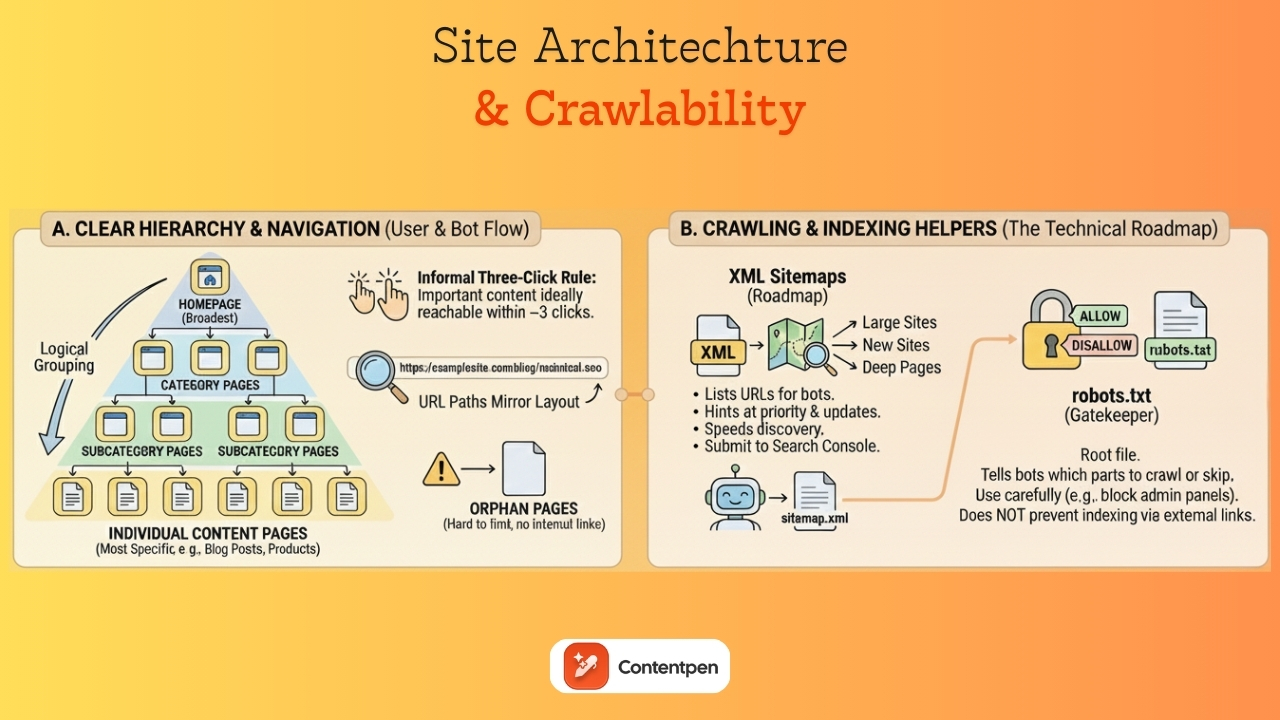
    Site architecture and crawlability - Contentpen.ai

    Site architecture is the way all your pages fit together. 

    A clear structure makes your site easier to use and easier for search engines to crawl. Think of it as a map that shows how people should move from broad topics to specific details.

    Most sites work well with a simple hierarchy:

    • Homepage at the top
    • Category pages next
    • Subcategory pages under those
    • Individual content pages, such as blog posts or product details, are at the bottom.

    An informal three‑click rule says that important content should be reachable within three clicks from the homepage. This is not a strict law, but it helps keep paths short and precise.

    Logical grouping matters. 

    Blog posts should live under a blog or resources section. Product pages should sit under category paths that make sense to visitors. 

    URL paths often mirror this layout.

    For example: A link to https://examplesite.com/blog/technical-seo for an article on technical SEO shows a clear page layout on the website. 

    When pages sit outside the structure with no internal links pointing to them, they become orphan pages, which are hard for both people and bots to find.

    If you do need to change URLs, use permanent 301 redirects from the old addresses to the new ones so both users and search engines land in the right place.

    XML sitemaps: Your website’s roadmap

    An XML sitemap is a special file that lists meaningful URLs on your site in a machine‑readable format. While users rarely see it, search engines use it as a roadmap. It hints at which pages matter most and how often they change, which can speed up discovery.

    Sitemaps are especially helpful for large sites, new sites with few backlinks, and sites where some pages are hard to reach through internal links. 

    The file usually includes each URL, the date it was last modified, and sometimes a rough priority flag. Many content management systems, including standard setups on WordPress and Shopify, automatically generate and update this file as new content goes live.

    You can often find your sitemap at a path such as https://yourdomain.com/sitemap.xml. 

    Once you have the URL, you can submit it to Google Search Console and Bing Webmaster Tools so bots can discover your content more efficiently.

    It is wise to keep sitemaps under size limits and split very large lists into several smaller files. Avoid including URLs that are blocked, noindexed, or return errors, as this might send mixed signals about your site’s actual structure.

    While an XML sitemap does not guarantee indexing, it improves site crawlability, especially when combined with clean internal linking and overall good technical health.

    Understanding and optimizing robots.txt

    A robots.txt file sits at the root of your site and gives high‑level instructions to search engine crawlers. It tells bots which parts of your site they may crawl and which sections they should skip. 

    Because robots.txt works at the folder or pattern level, it is a powerful tool that deserves careful handling.

    Typical uses include blocking admin panels, login pages, staging areas, and scripts or style folders that do not add value in the index.

    It is also essential to know what robots.txt cannot do. Blocking a URL from crawling does not always prevent it from being indexed. If other sites link to that URL, a search engine may still index a bare version of it. 

    For pages that must not appear in results, meta noindex tags or password protection are better options. 

    Google Search Console provides a robots.txt tester to help you see how bots interpret your robots.txt file. Reviewing this small text file during redesigns and migrations is an easy way to avoid sudden drops in visibility.

    Internal linking strategy for SEO
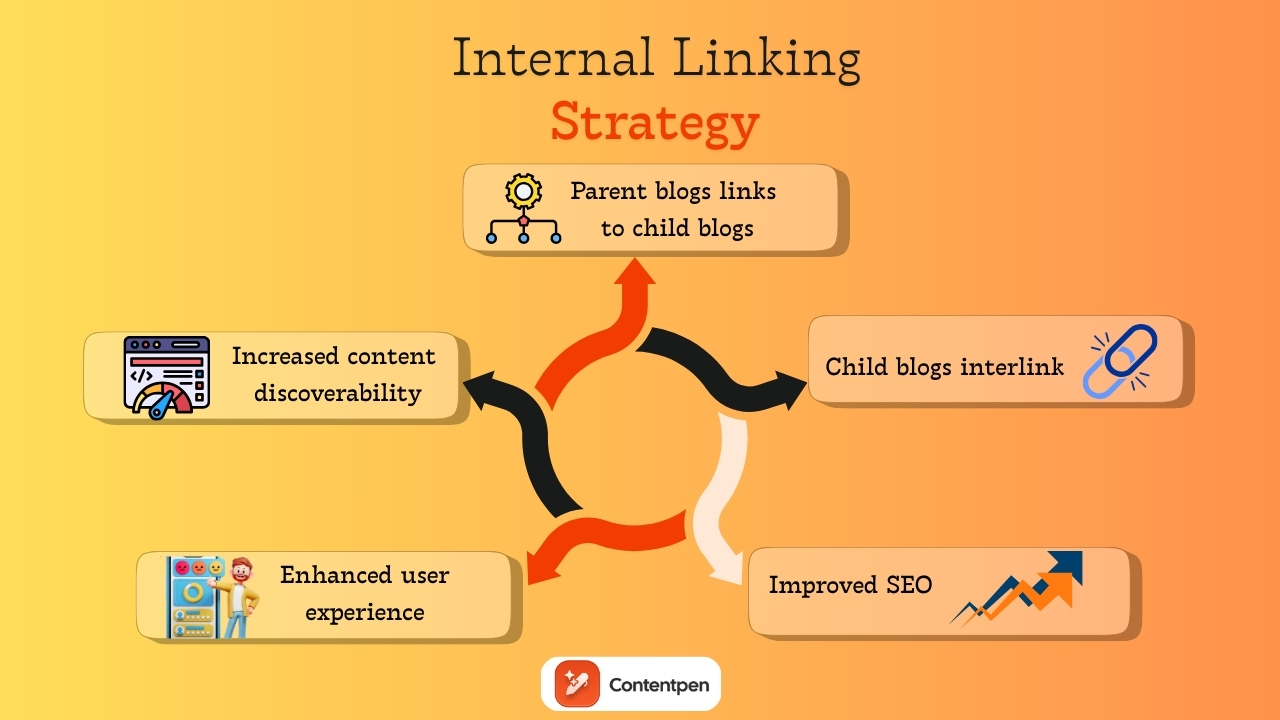
    Internal linking strategy - Contentpen.ai

    Internal links are links from one page on your site to another page on the same domain. They act like signposts for both users and search engines. 

    A thoughtful internal linking pattern makes it easy to move between related topics and helps spread authority from strong pages to newer or deeper ones. You can also take help from Contentpen to automate internal links for your convenience.

    From a technical SEO view, internal links help bots discover content. When every important page is linked from at least one other page, it is far more likely to be crawled. 

    Repeated links from strong sections such as the homepage, category pages, or top guides send a signal that a target page is essential. This supports rankings without needing more external backlinks.

    Managing indexing and content visibility

    Meta robots tags live in the head of a page and give search engines page‑level instructions. They tell crawlers whether they can index the page, follow its links, show a cached copy, or show a text snippet. 

    The most common directive in technical SEO basics is the noindex tag, which tells search engines not to index the page.

    Noindex is useful for pages that add little search value or should be excluded from results. Examples include thank‑you pages after form submissions, internal search results, some PPC landing pages, and certain thin or duplicate pages. 

    These tags should also be used for staging or test versions of a site that should not appear beside live content. 

    However, adding noindex by mistake to key templates such as product pages or blog posts can wipe out organic traffic very quickly.

    That is why you should not block a noindexed page in robots.txt. 

    Simple checks using the site:yourdomain.com search operator and reports in Google Search Console help you track which URLs are indexed and whether meta robots rules are behaving as planned.

    Canonical tags and duplicate content management

    Duplicate content happens when the same or very similar content appears at more than one URL. This can be caused by URL parameters for sorting and filtering, alternate versions, print views, product variations, and syndicated content on partner sites. 

    Google rarely punishes this directly, but it can create messy side effects.

    The main issue with duplicate content on websites is diluted link signals and confusion over which version to rank. 

    If half of your backlinks point to one URL and half to another that show almost the same page, each one looks weaker than it really is. Search engines may guess which page to show in results, and their guess may not match your preference.

    Canonical tags help clean this up. A canonical tag in the page’s head points to the preferred URL for that piece of content. 

    When several pages show similar content, they can all point to the main version. This tells search engines to focus on that URL for indexing and ranking and to fold signals from other versions into it.
    Solving content overload - Contentpen.ai

    Website performance and page speed

    Speed is both a ranking factor and a user experience anchor. Google has used page speed in desktop ranking for years and added mobile speed as a signal in 2018

    A slow site feels painful to use, and people rarely wait. Even a short delay can raise bounce rates and cut conversions in half, especially on mobile.

    From a technical SEO angle, faster sites also use crawl budget more wisely. When servers respond quickly, and pages render with little blocking, bots can crawl more URLs in the same time window. That means new content is discovered and updated pages are refreshed sooner. 

    On the flip side, slow timeouts and heavy resource usage can limit the number of pages a bot can reach during each visit.

    Speed ties directly to business results. Faster pages tend to see higher conversion rates, more pages per session, and better engagement. Moving from very slow to reasonably fast speed often has a bigger impact than shaving the last fraction of a second.

    Understanding Core Web Vitals

    Core Web Vitals are Google’s page experience metrics that measure loading speed, interactivity, and visual stability. They include:

    • Largest Contentful Paint (LCP): Measures loading speed
    • Interaction to Next Paint (INP): Measures responsiveness
    • Cumulative Layout Shift (CLS): Measures visual stability

    Let’s review these metrics in more detail and see how they inform Google’s evaluation of page experience.
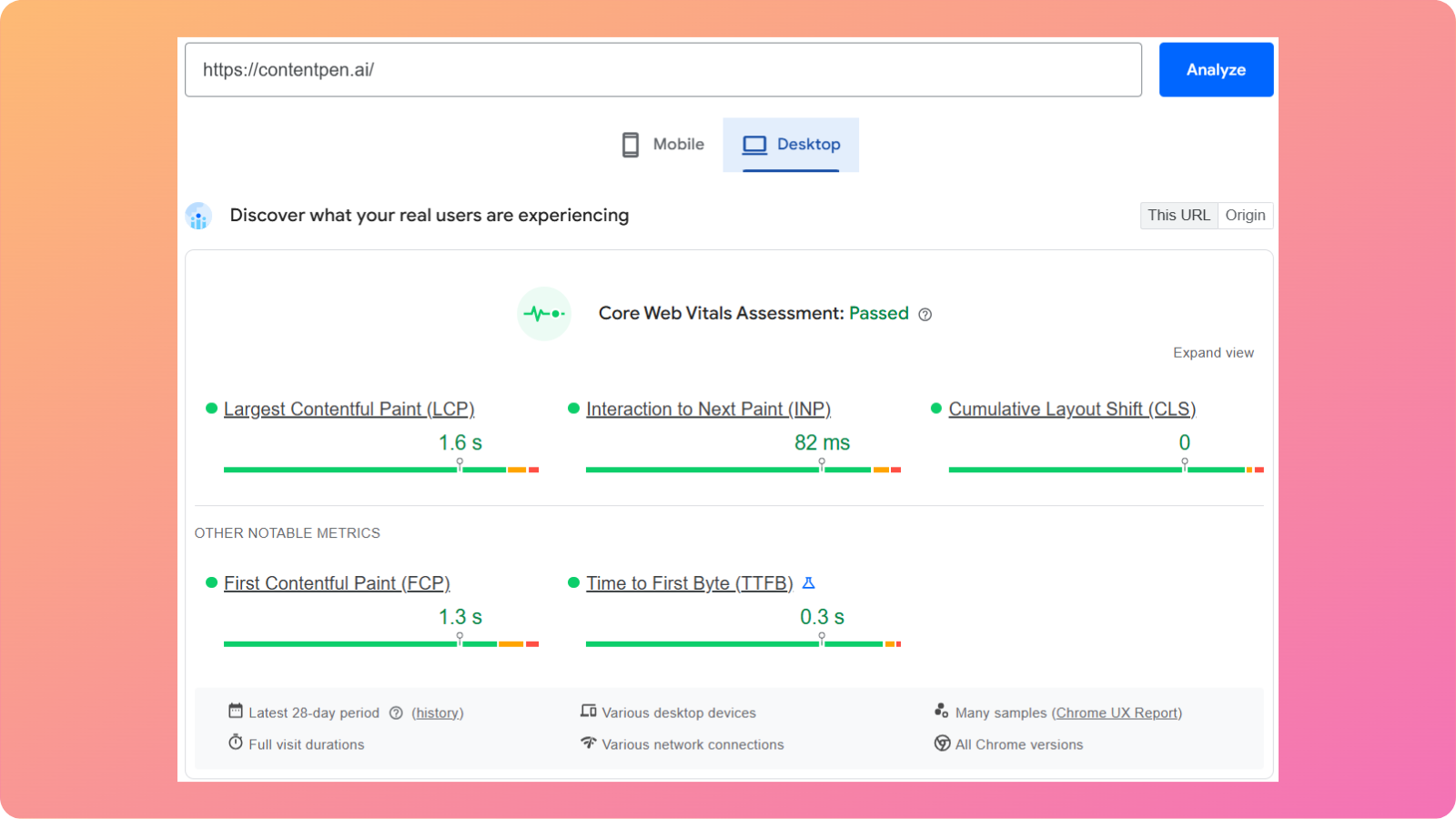
    Contentpen CWV score

    Largest Contentful Paint (LCP)

    LCP measures how long it takes for the most significant content block in the viewport to load. This might be a hero image or a large text block above the fold. 

    A good LCP is 2.5 seconds or less. 

    However, large, uncompressed images, slow servers, and render‑blocking scripts are common problems that hurt this metric.

    Interaction to Next Paint (INP)

    INP replaces the older First Input Delay metric. It looks at how quickly a page responds when a user taps, clicks, or presses a key. 

    Google recommends keeping INP under 200 milliseconds for most interactions. 

    Heavy JavaScript, long tasks on the main thread, and too many third‑party tags often make sites feel sluggish here.

    Cumulative Layout Shift (CLS)

    CLS measures how much content jumps around during page load. If text shifts because an image did not reserve space or an ad drops in late, users can mis‑tap buttons or lose their place on the website. 

    A CLS score of 0.1 or less is considered good. 

    Setting image dimensions, reserving space for ads, and avoiding sudden injected content all help to keep this score under the required limit.

    You can check Core Web Vitals in Google Search Console, PageSpeed Insights, and Chrome DevTools. Reports usually group URLs into good, needs improvement, or poor categories to help you make the right changes with ease.

    Practical ways to improve page speed

    Improving speed starts with a solid look at what slows pages down. You can follow the practices outlined below to boost your site’s performance now.

    Image optimization

    This is one of the easiest wins you can get from a technical SEO aspect.

    To optimize images, you can:

    • Compress photos before uploading: Use modern formats like WebP or AVIF to reduce file sizes while preserving image quality.
    • Use responsive image markup: This lets the browser pick the right size for each screen instead of loading large desktop versions of photos on phones.
    • Lazy-load images: Enabling lazy-loading for media below the fold means the browser fetches them only when needed, reducing initial load time for users.

    Avoid features that block or reduce media interactivity for mobile users, such as horizontal scrolling and large, intrusive pop-ups.

    Reducing requests and code size

    Reducing requests and code file size starts with combining small style sheets where it makes sense, removing unused scripts or plugins, and trimming third‑party tags.

    You should also minify HTML, CSS, and JavaScript files to remove unnecessary whitespace and comments. Enabling server-side compression, such as Gzip or Brotli, further reduces file transfer sizes.

    Improving server performance

    Choosing fast, stable hosting, server‑side caching, and tuned databases reduces time to first byte. 

    If you serve users across regions, a content delivery network (CDN) can help cache static assets on edge servers closer to visitors, which significantly cuts latency.

    When in doubt, start with the changes that affect every page template, then move to smaller gains on individual sections.

    Mobile optimization and responsive design

    Responsive website image

    In practice, sites that use responsive design, where the same HTML adapts to different screens, usually handle mobile optimization well. 

    Websites with separate mobile URLs, such as m.example.com, or dynamic serving need more care to keep content and structured data in sync.

    You can see whether Google has moved a site to mobile‑first indexing through messages and reports in Search Console. 

    If the mobile version hides content, shows lighter product details, or skips schema markup included on desktop, it is wise to set those right. 

    Mobile‑first does not mean desktop visitors do not matter, but it does mean the mobile layout and content must carry equal weight in your SEO planning.

    Essential elements of mobile-friendly websites

    Mobile‑friendly design goes beyond simply shrinking a desktop layout. Responsive design uses flexible grids, fluid images, and media queries so each page looks and works well on phones, tablets, and desktops with a single code base.

    A proper viewport meta tag tells the browser how to scale content to the device width. Without it, many phones render the desktop layout zoomed out, forcing people to pinch and scroll in awkward ways. 

    Make sure the lines do not run too long, and that the contrast between text and background is strong enough for outdoor or low‑light viewing.

    Tap targets such as buttons and links need enough size and spacing so fingers can hit them without mis‑taps. This often means larger buttons, more white space, and rethinking desktop patterns such as tiny menu items in the header.

    HTTPS and website security

    HTTPS is the secure version of the Hypertext Transfer Protocol. It uses SSL or TLS certificates to encrypt the data passing between a browser and a server. 

    This extra layer of security protects passwords, contact forms, payment data, and other sensitive information from leaking.

    Google has treated HTTPS as a ranking signal since 2014. While it is a lighter factor than content quality or links, it still sends a clear message that secure sites are preferred. 

    Modern browsers also label non‑HTTPS pages as “Not secure,” especially when forms are present. That warning can scare visitors away and lower conversion rates, even if the content itself is harmless.

    From a technical SEO perspective, HTTPS is now part of basic online hygiene.

    Implementing HTTPS correctly

    Moving to HTTPS requires planning to ensure you gain security without sacrificing SEO performance. 

    To correctly implement HTTPS for your website, follow the given steps:

    1. Get an SSL or TLS certificate: Most websites offer these for free. Once installed on the server, the certificate lets your site respond over secure URLs. 
    2. Redirect all HTTP requests: Use 301 rules to redirect them to HTTPS versions.
    3. Add the HTTPS in GSC: After the redirect rules go live, add the HTTPS links in Google Search Console and submit updated XML sitemaps.

    Watching error logs, mixed content warnings, and ranking trends over the first few weeks helps you catch and fix any hidden issues before they grow.

    Structured data and schema markup

    Structured data is extra code added to a page that describes the content in a detailed, machine‑friendly way. Regular HTML tells the browser how to display text, images, and links. Structured data tells search engines what those pieces represent.

    “Schema” is the shared vocabulary most sites use for this kind of markup. It provides search engines with information about articles, products, recipes, events, organizations, reviews, and more. 

    With structured data in place, a page can tell the search engine that “this block is a recipe with a cooking time and calorie count,” or “this page is a product with a price, brand, and rating.”

    Google strongly prefers JSON‑LD format for schemas, which wraps this information in a script block separate from the visible HTML. That approach keeps things cleaner for developers and platforms.

    Structured data by itself is not a direct ranking factor, but it does make your pages eligible for rich results such as star ratings, recipe cards, and FAQ drop‑downs. 

    These upgraded snippets stand out in search results and often drive higher click‑through rates.

    Types of schema markup and their benefits

    • Article schema helps Google understand the details of blog posts and news stories. It marks up the headline, author, publish date, and sometimes the image that should appear in results.
    • Product schema applies to e‑commerce pages. It can include price, currency, availability, brand, and review ratings.
    • Breadcrumb schema shows search engines how a page fits within your site’s hierarchy. It marks up the navigation path (for example: Home > Blog > SEO > Technical SEO), helping Google understand site structure and page relationships.

    These are just some examples of types of schemas that exist. This can be a powerful way to support technical SEO in digital marketing for brands that answer complex topics with helpful content.

    Why technical SEO is important

    Technical SEO matters because search engines cannot rank what they cannot reach or understand. You can publish hundreds of strong, optimized articles and still miss most of the organic traffic you deserve if your site has crawling or indexing issues.

    In many technical SEO examples, a single misconfigured tag or directive has removed entire sections of a site from search overnight. Recovering that traffic takes time, leading to lost leads and missed earning opportunities for businesses.

    The right technical SEO strategy also protects against serious issues such as duplicate content, broken internal links, and poorly handled migrations. These can dilute link signals or send users into dead ends.

    When algorithms shift, sites with clean structure, fast page load times, and strong security tend to adapt better.

    Technical SEO vs. On-page SEO vs. Off-page SEO

    Many teams mix technical SEO with on‑page and off‑page work, making planning more complicated than it needs to be. All three matter, but they focus on different parts of the same system.

    On‑page SEO deals with what is present on each page. That includes keyword research, titles and meta descriptions, heading structure, internal links, body copy, media, and content depth.

    Our AI blog writer lives mainly in this space, helping teams create SEO‑ready articles, align them with search intent, and keep on‑page elements in good shape at scale.

    Off‑page SEO refers to signals from outside the site. Backlinks from other domains, mentions of your brand, social chatter, and overall domain authority sit in this pillar.

    Technical SEO focuses on the system that delivers the platform to users. It includes crawlability, XML sitemaps, page speed, Core Web Vitals, mobile optimization, HTTPS, structured data, redirect logic, and international setup.

    Here is a simple way to picture the three SEO pillars:

    SEO typeMain focusSimple examples
    On‑page SEOContent on each URLKeyword use, headings, meta tags, internal links
    Off‑page SEOSignals from other sitesBacklinks, brand mentions, digital PR
    Technical SEOSite infrastructureCrawlability, speed, HTTPS, structured data

    There is some overlap. Internal linking is both a content concern and a technical SEO element. Redirects touch user experience and technical health. The key is to see how these parts work together instead of picking one and ignoring the others.

    How search engines work: Crawling, indexing, and ranking
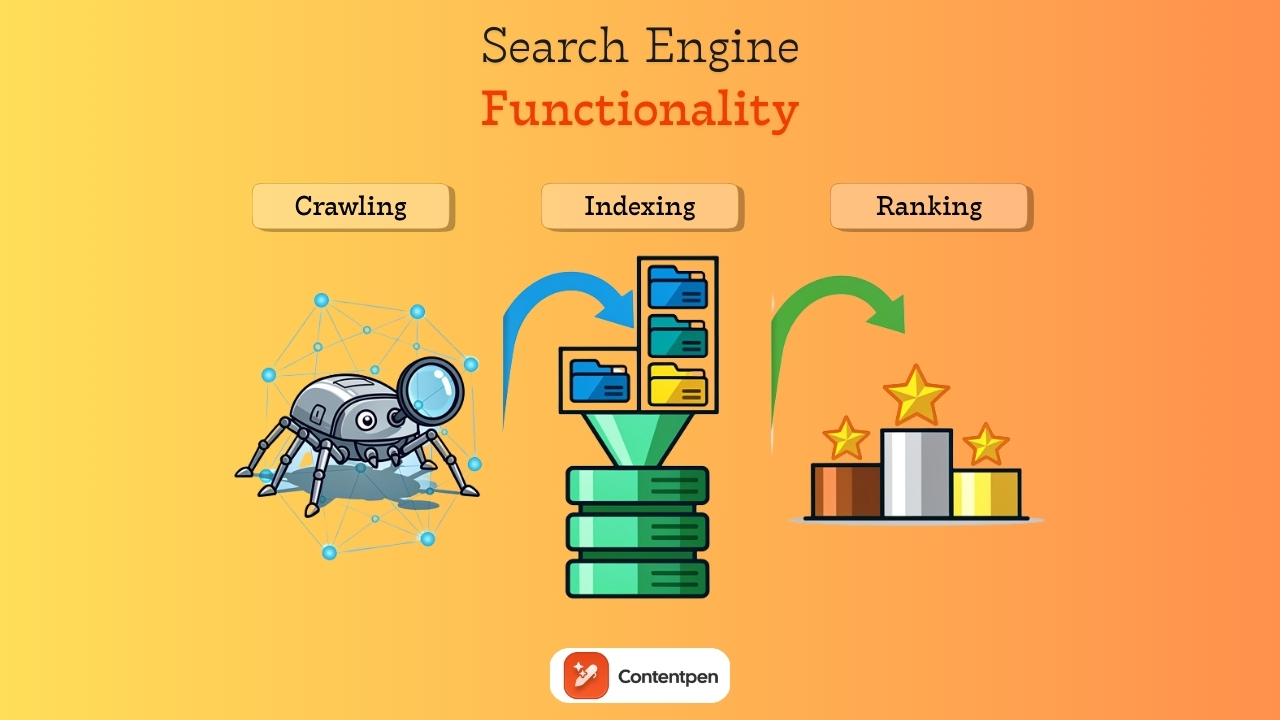
    Search engine functionality - Contentpen.ai

    Search engines process websites in three main steps:

    1. Crawling – Bots discover pages by following internal and external links.
    2. Indexing – Pages are rendered, analyzed, and stored in the search index.
    3. Ranking – Indexed pages are evaluated and ordered based on relevance and quality signals.

    Let’s review them in more detail below.

    Step#1: Search engine crawling

    Crawling is the discovery stage. 

    Search engines send bots, such as Googlebot, to crawl links and discover new or updated pages. These bots move from page to page by following internal links within a site and external links from other sites. 

    Each domain has a crawl budget, which is the rough number of URLs a bot will check on a given visit. If your site wastes that budget on endless parameter pages or duplicate content, important pages may not be crawled as often as they should be.

    Step#2: Page indexing

    Indexing is the storage and understanding stage. 

    After crawling a URL, the search engine tries to render the page, parse the HTML, CSS, and JavaScript, and determine what the page is about. 

    Then, the crawlbot stores that information in its index, which is like a vast, connected library. Not every crawled page is added. Some pages may be skipped because they appear to be duplicates, have low value, are blocked by meta tags, or cause errors.

    Step#3: Ranking pages

    Ranking is the retrieval stage. 

    When someone searches for a phrase such as “best running shoes,” Google does not crawl the web immediately. Instead, it looks into its index, finds the most relevant pages, and shows the best pages based on many factors.

    Technical SEO work aims to keep this path smooth. Clear site architecture and strong internal linking help bots crawl deeper. XML sitemaps highlight essential URLs. Clean HTML and careful JavaScript handling make content easier to render. 

    Similarly, properly used meta robot tags and canonical tags tell search engines which pages to index and which to skip.

    Summing it up

    Technical SEO is the hidden layer that protects and promotes your search engine visibility. Without it, even the sharpest keyword research and the best‑written articles struggle to reach their audience.

    The good news is that the most essential tasks follow a repeatable pattern. You map your site structure, fix broken links, set up XML sitemaps, and keep robots.txt up to date. Over time, this becomes a practical technical SEO checklist rather than a scary set of mysteries.

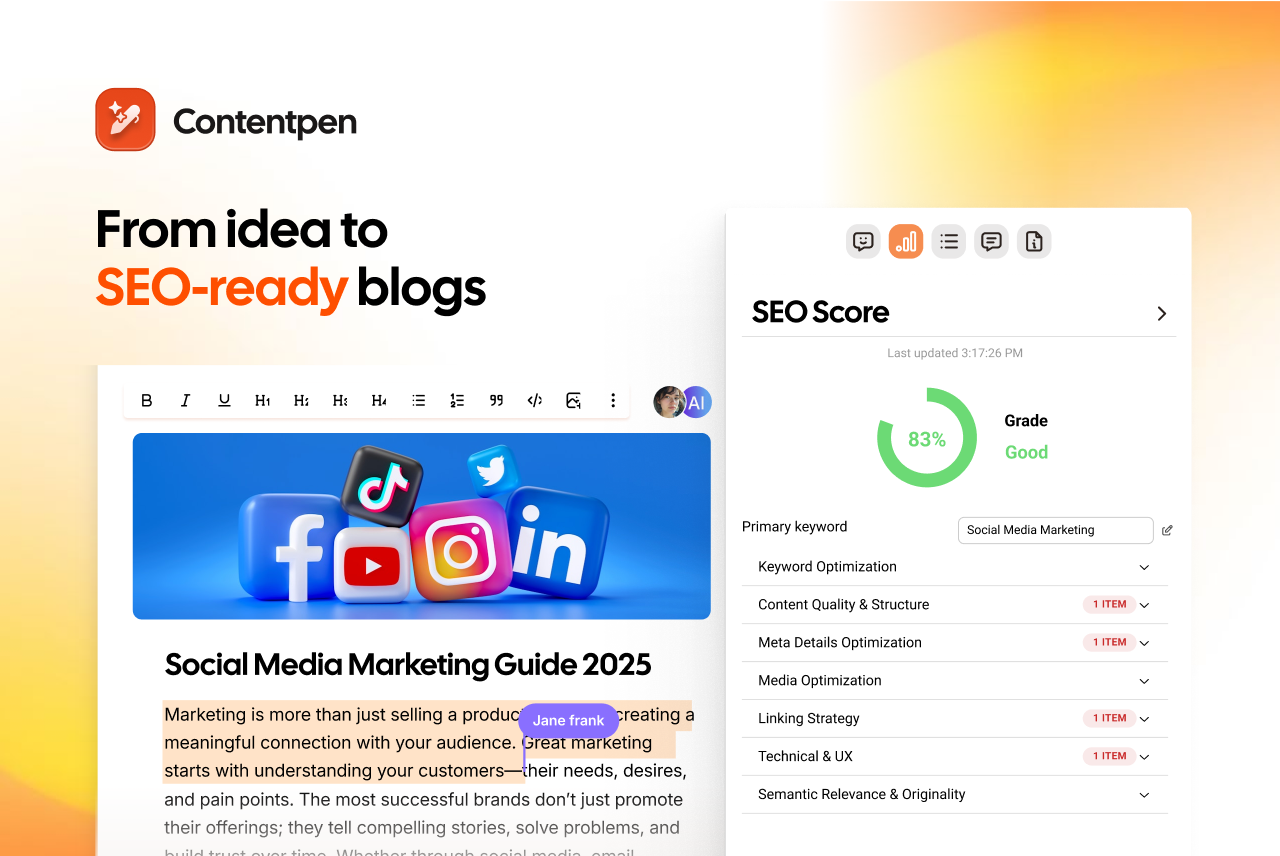
    A platform like Contentpen can support your needs in this regard by generating SEO‑ready articles. It also helps score on‑page elements and frees up resources for teams to focus on the technical aspects of SEO.

    Frequently asked questions

    What is the difference between local SEO and technical SEO?

    Local SEO focuses on improving visibility in location-based searches. Technical SEO focuses on how well search engines can crawl, index, and understand a website.

    What are some technical SEO examples?

    Common technical SEO examples include setting up an XML sitemap, fixing a broken robots.txt file, and adding canonical tags to handle duplicate product pages. Shifting an entire site from HTTP to HTTPS with proper 301 redirects is another classic example of technical SEO.

    What are some technical SEO tools?

    You can use tools such as Google Search Console, PageSpeed Insights, Screaming Frog, and Lighthouse to identify and fix performance issues on your site. You can also use Usermaven to get AI-powered insights with detailed web analytics for your platforms.

    What is a technical SEO audit?

    A technical SEO audit is a systematic review of a website’s technical health to identify issues that affect how search engines access it. The goal is not to change content or build links, but to remove technical barriers that prevent search engines from understanding your platform.

    Do I need a technical SEO certification to handle this work?

    A technical SEO certification course can be helpful if you want structured learning, but it is not required for most sites. Many content and marketing managers learn through practice, guides like this, and hands‑on work with their own platforms.

  • How to do SEO: A complete step-by-step guide for beginners

    How to do SEO: A complete step-by-step guide for beginners

    Typing a question into Google is almost a reflex now. For most people, that is how virtually every online visit begins.

    However, the most challenging part for a business is landing the top positions for a topic and getting discovered by users. This is where SEO becomes essential.

    Search engine optimization can look scary from the outside. There are strange terms, constant algorithm updates, and a lot of opinions. Many beginners bounce between articles and videos, still wondering how to do SEO for a website in a simple, concrete way.

    The good news is that SEO is not about tricks. It is about clear, steady work that helps search engines understand your site and real people trust and enjoy your content.

    This guide gives a practical, step‑by‑step path for SEO beginners. By the end, you will understand how to improve your website’s ranking with minimal effort and hassle.

    So, let’s get started.

    What is SEO and why does it matter?

    Search Engine Optimization, or SEO, is the practice of improving your website so it shows up more often and in better positions in unpaid search results.

    In simple terms, search engine basics is about helping the right people find you when they type relevant questions or problems into Google.

    The main goal is to match real search needs with helpful content, in a format search engines can understand. That means clear topics, strong on-page SEO, and a site that feels safe and easy to use.

    From a business view, SEO supports several important goals:

    • Brand awareness – Showing up often in search so people recognize your name.
    • Lead generation – Bringing in visitors who are already interested in what you offer.
    • Customer acquisition – Turning searchers into paying customers or clients.

    Top organic results often get far more clicks than ads, and that traffic usually converts well because visitors are already interested in what you have to offer. Every optimized page becomes a long‑term asset that can support your goals for years.

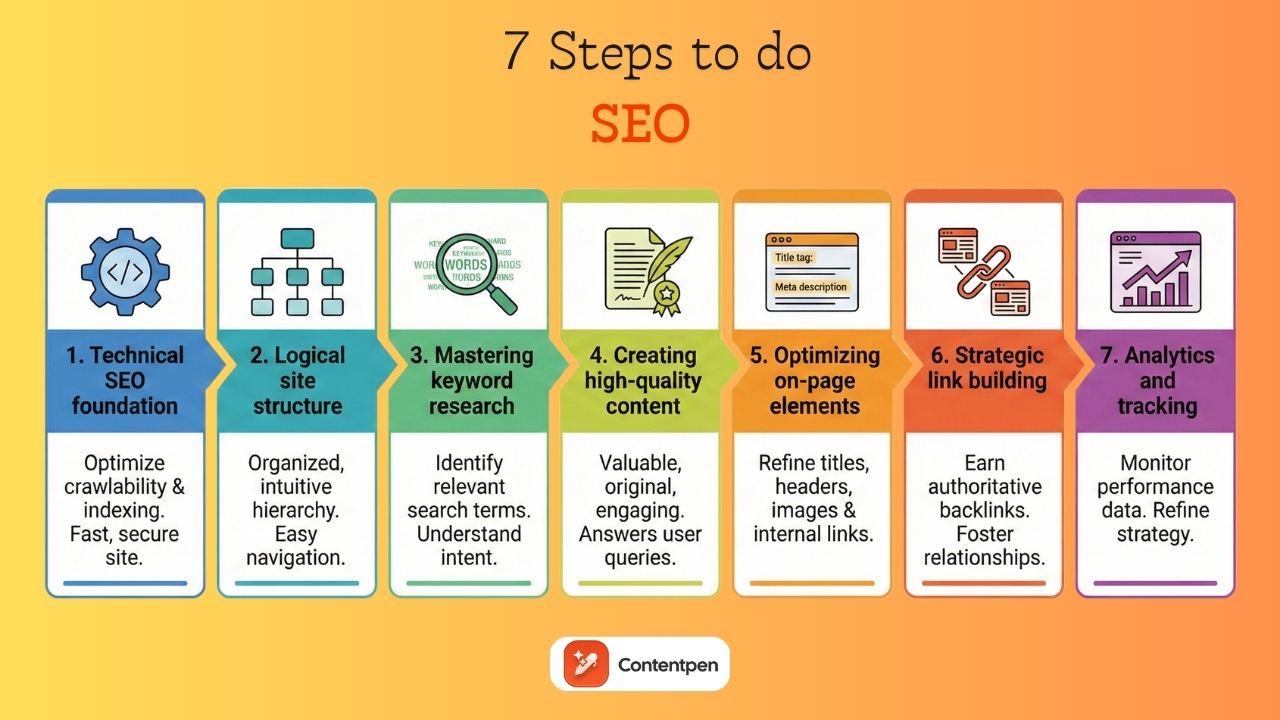
    7 steps to do SEO for a website from scratch

    Below are the seven steps for SEO beginners to start ranking their platforms in the top-ranked positions.

    • Laying the technical foundation for SEO success
    • Building a logical site structure
    • Mastering keyword research
    • Creating high-quality content
    • Optimizing on-page elements
    • Building authority through strategic link building
    • Setting up analytics and tracking progress

    We will discuss these steps in further detail.

    Step 1: Laying the technical foundation for SEO success

    7 steps to do seo - Contentpen.ai

    Technical SEO is the base that supports every other SEO effort. If this base is weak, the impact of your content and links will always be limited.

    HTTPS and site security

    People and search engines both care about safety. HTTPS encrypts data between your visitor’s browser and your server. That protects login details, payment data, and other sensitive information.

    Many hosting providers offer free SSL certificates through services like Let’s Encrypt, and setup is often just a few clicks.

    XML sitemap creation and submission

    An XML sitemap file lists the main URLs you want search engines to see. It does not control which pages rank, but it helps crawlers discover content more quickly, especially on new or extensive sites.

    Most modern platforms can automatically create this file. Once you have the sitemap, you can submit its URL in Google Search Console, so Google knows where to look.

    Robots.txt file creation

    The robots.txt file tells search engine crawlers which parts of your site they may access and which areas they should ignore. It acts as a basic set of instructions placed at the root of your domain.

    For most beginners, the goal is simple: make sure important pages can be crawled and that unnecessary or sensitive areas stay out of search results. Common sections to block include admin panels, login pages, internal search results, or staging environments.

    Fixing crawl errors and indexing issues

    Google Search Console is your central place to monitor technical issues. The Coverage report shows pages with errors, such as 404 not found responses, server errors, or blocked resources.

    Fix broken internal links so visitors and bots do not hit dead ends. If you remove content intentionally, use 301 redirects to redirect traffic to the most relevant alternative. 

    Mobile responsiveness and mobile-first indexing

    Google uses mobile‑first indexing, which means it primarily uses the mobile version of your site to determine rankings. 

    If the mobile experience is poor, your rankings suffer even if the desktop version looks great.

    Check your site on different phones and tablets, and also run it through Google’s Mobile‑Friendly Test. Menus should be easy to tap, text should be readable without zooming, and important content should not be hidden.

    Site speed and Core Web Vitals

    Page speed affects both users and rankings. When pages load slowly, people often hit the back button, which sends bad engagement signals. Google also focuses on speed through a set of metrics called Core Web Vitals that assess loading time, interactivity, and visual stability.

    You can test your site with Google PageSpeed Insights. This tool shows scores along with straightforward suggestions you can follow to improve your chances of appearing in top results.

    Step 2: Building a logical site structure and navigation

    A well-structured site makes it easier for visitors to find what they need and for search engines to understand which topics you cover.

    This area is often called information architecture. It shapes menus, categories, and URL paths. When your structure follows a clear logic, it also supports future content work.

    Creating topical silos and content clusters

    Silo structures - Contentpen.ai

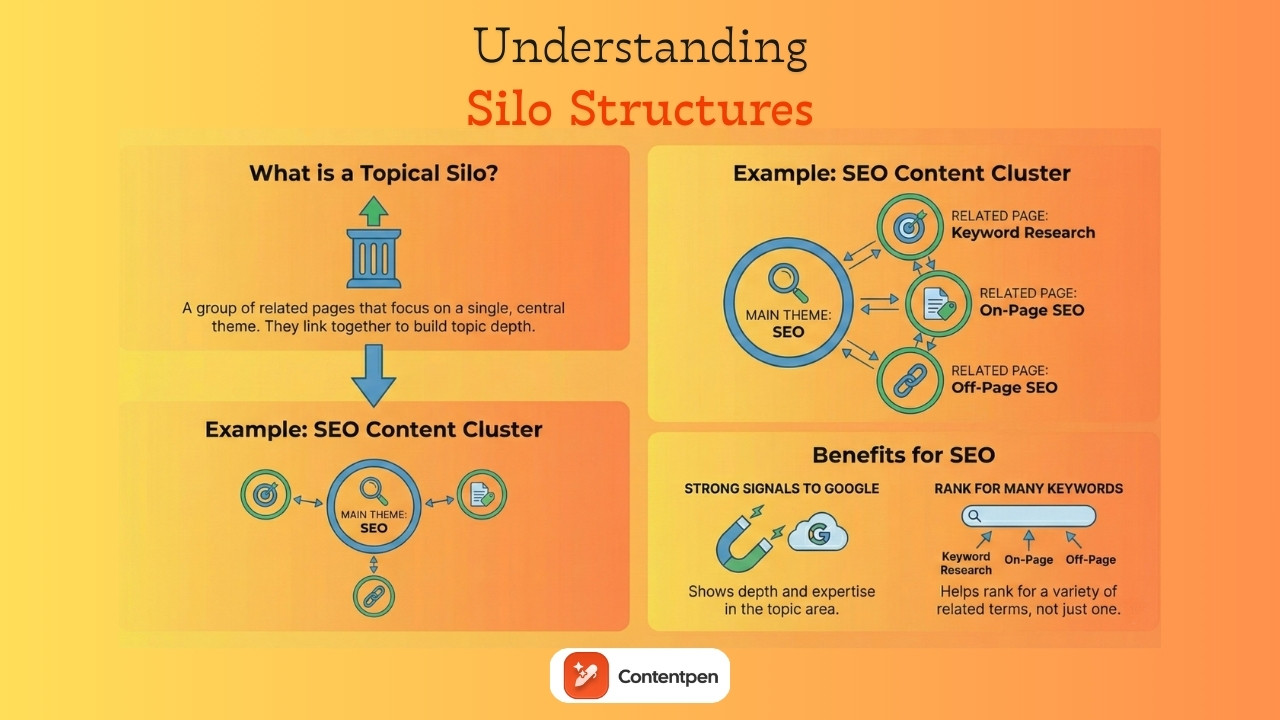
    A topical silo is a group of related pages that focus on a single central theme. For instance, a silo about SEO could include pages on keyword research methods, on-page SEO, and off-page SEO strategies that all link together.

    Creating content with this approach sends strong signals to Google that your site has depth in those areas. It can help you rank for many related keywords, not just one phrase. 

    URL structure best practices

    URLs are more than technical addresses. They appear in browser bars and, sometimes, in search results, as simple breadcrumbs. A good URL tells people and search engines what to expect before they click.

    Try to use short, descriptive paths like example.com/seo-keyword-research rather than codes such as example.com/p?id=8374652. 

    Use hyphens between words, avoid random numbers, and keep everything lower case for consistency.

    Plan your site to reflect your silos when possible. For example, an article about link building might live at example.com/seo/link-building-guide. That path helps show how the page fits into your overall topic map.

    Internal linking strategy

    Internal links connect one page on your site to another. 

    Contextual interlinking and structural interlinking are two core internal linking methods used in SEO:

    • Contextual interlinking: Refers to links placed naturally within the main content of a page (usually within paragraphs). These links connect related topics using relevant anchor text, helping search engines understand content relationships.
    • Structural interlinking: This involves links within a website’s layout or hierarchy, such as navigation menus, breadcrumbs, footer links, and category pages. Structural interlinking defines the site structure, making navigation easier for search engines and humans.

    A strong internal linking strategy helps visitors move deeper into your content. It also passes link equity from strong pages to others.

    Make sure your most important pages, such as key service pages or cornerstone guides, receive links from many relevant articles. 

    Managing duplicate content

    Duplicate content happens when the same or very similar content appears under more than one URL. This is not usually a harsh penalty situation, but it can waste crawl budget and split ranking signals between versions.

    Try to ensure each important page has one main URL. When you must keep multiple URLs that show similar content, use canonical tags.

    Step 3: Mastering keyword research for your niche

    Keyword research is the base of your content plan. It tells you what your audience cares about and how they phrase those needs. Without it, you risk writing content no one is searching for or content that misses the language people actually use.

    The goal is not only to list popular words. It is to understand your niche, search intent, and realistic ranking chances. 

    Understanding search intent

    Search intent is the reason behind a query. For SEO beginners, it helps to group intent into four main types:

    • Informational – The user wants to learn something (for example, “how to do SEO”).
    • Navigational – They want a specific site (for example, “Contentpen login”).
    • Transactional – They are ready to buy (for example, “buy SEO audit”).
    • Commercial investigation – Users are comparing options before buying (for example, “best SEO tools”).

    To match intent, look at the current top results for your target keyword. If they are mostly long guides, that tells you people and Google expect in‑depth content. 

    If they are product pages or comparison posts, adjust your format to line up with that pattern while still adding your own angle.

    Finding primary and secondary keywords

    A primary keyword is the main phrase a page is built around. Secondary keywords are related phrases and questions that support the primary topic. Together, they define what your page covers and help you show up for more searches.

    Start with broad seed phrases or focus keywords related to your business. Then use tools like Google Keyword Planner to explore long-tail and secondary keyword options for each topic.

    You can also explore Google Autocomplete suggestions and read the “People also ask” in related searches to come up with secondary keyword suggestions.

    Pay attention to three things while you collect ideas:

    • Search volume – How many people search for a phrase.
    • Difficulty – How hard it might be to rank.
    • Relevance – How closely a keyword connects to what you actually offer.

    Favor phrases that line up well with your products or services, even if their volume is modest.

    Analyzing keyword opportunity

    Not every keyword is worth chasing right away. Many broad phrases are dominated by powerful sites with years of authority. Targeting those first can lead to frustration and little progress. 

    To find the right keyword opportunities, search each potential keyword and look at the first page of results. Notice who ranks there and what type of keywords they have used.

    If you mostly see giant brands and government or university sites, that phrase may be too hard for now. If you see smaller blogs or sites similar to yours, you have a better shot at ranking.

    Look for content gaps where current pages miss important angles or fail to answer key questions. That is where your content can stand out.

    Balancing keyword optimization with natural writing

    Once you have target keywords, the next task is using them without harming the reading experience. Google is very good at language now.

    Include your primary keyword in the title, at least one heading, the first paragraph, and a few times where it fits. Let secondary phrases appear naturally without stuffing as you explain ideas and answer related questions. 

    A helpful rhythm is to write first for humans in simple, clear language. Then do a light SEO pass, during which you can adjust keywords in content or a heading to reflect a common query.

    SEO‑aware writing tools, like Contentpen, can help here by flagging gaps in your use of target phrases while keeping readability high for the users.

    Step 4: Creating high-quality, SEO-optimized content

    Content is where your research turns into real pages that can rank and convert. Many people focus on tricks, but over the long term, content quality is one of the strongest factors in SEO success. 

    When visitors find your pages helpful and reliable, they stay longer and share them, which supports both SEO and business results.

    The E-E-A-T framework: experience, expertise, authoritativeness, trust

    Google’s quality guidelines talk about E‑E‑A‑T, which stands for Experience, Expertise, Authoritativeness, and Trustworthiness. While this is not a single ranking score, it shapes how Google assesses content quality across many signals.

    • Experience: Show first‑hand knowledge. You might include case studies, real results, or step‑by‑step screenshots from your own work with SEO.
    • Expertise: Provide accurate explanations, correct use of terms, and clear teaching.
    • Authoritativeness: Grows as your site becomes a go‑to resource in your topic area. Publishing consistent, in‑depth content and earning mentions or links from other respected sites both help.
    • Trust: Secure pages with HTTPS and provide honest, transparent claims backed by cited sources.

    When you write with these ideas in mind, you send positive signals to both users and search engines.

    Content depth and comprehensiveness

    There is no magic word count that guarantees rankings. What matters is whether your page fully answers the query and related questions. If readers have to click back and look for another result, your content did not satisfy them.

    A practical way to gauge the required depth is to review the top results for your target keyword. Notice what subtopics they include and how detailed they are. Your goal is not to copy them but to match or exceed the helpful parts while adding your own strengths or newer data.

    Cover the main topic, common follow‑up questions, and practical next steps. On more complex topics, consider a layout where beginners get straightforward basics first and more advanced readers can dig deeper into later sections.

    Solving content overload - Contentpen.ai

    Writing scannable content

    Most visitors skim before they decide to read closely. They look at headings, bold text, and early sentences to see if a page is worth their time. 

    Your writing style and layout should make scanning easy while still delivering strong information.

    To make content easy to skim:

    • Use short paragraphs with three or four sentences.
    • Add descriptive subheadings every couple of hundred words.
    • Utilize lists when you need to break down steps or options.
    • Highlight a few important phrases in bold for fast reading.

    Write in active voice and choose simple words over jargon when possible. Hook readers early by stating what they will learn and why it matters within the first few lines. 

    Smooth transitions between sections help keep people moving through the page instead of dropping off.

    Maintaining originality and avoiding duplicate content

    Copying or rewriting content from other sites is a quick way to lose trust with both users and search engines. It adds nothing new and can violate spam policies.

    Build content from your own experience, data, and opinions. If you refer to other sources, quote only short parts, then add your analysis. 

    Explain what the information means for your reader and how they can apply it. This type of original angle turns a basic summary into a useful resource.

    Updating and refreshing existing content

    Even strong content can go stale. 

    Facts change, screenshots age, and recommendations shift over time. When that happens, rankings can slowly slide as fresher pages arrive. Treating content as living material keeps it working for you.

    Set a review schedule for your main pages, such as once a year or when you notice traffic slowing. During a refresh, update stats, replace old screenshots, fix broken links, and add any new best practices. You can also expand thin sections with clearer steps or examples.

    Contentpen can help you draft updated sections quickly while maintaining the tone and structure, so that you can focus on strategy and correctness.

    Step 5: Optimizing on-page elements for maximum visibility

    On‑page optimization is about sending clear signals to search engines about what each page covers. You have already seen how content quality matters. Now, focus on the HTML elements that wrap that content.

    You can think of this step as labeling your content so both users and bots can understand it. When titles, descriptions, headings, images, and internal links all support the same topic, you build a strong case for relevance.

    Crafting effective title tags

    The title tag is an essential part of your seo checklist and one of the most powerful on‑page signals. It appears as the main clickable line in search results and, in a browser, usually as the tab label.

    Good practices include:

    • Put your primary keyword near the start of the title.
    • Keep the whole thing under about 60 characters to avoid cut‑offs.
    • Make the wording clear and specific so people know what they will get.
    • Give each page a distinct title that does not repeat across the site.

    You can also add a short brand reference at the end. An example would be “Keyword research for SEO – complete beginner guide | Contentpen.” 

    Avoid vague titles such as “Home” or titles stuffed with many repeated keywords, since both send weak or spammy signals.

    Writing compelling meta descriptions

    Meta descriptions do not directly affect rankings, but they strongly influence how many people click your result when it appears. This short snippet under the title is your chance to explain the page’s value quickly.

    Aim for one or two short sentences, roughly 150–160 characters total. Summarize the main benefit or insight, and where it fits, include your primary keyword naturally without sounding forced.

    Using header tags effectively

    Header tags (H1-H6) provide structure to your content. They break the page into logical chunks of topics and subtopics. This helps screen readers, human visitors, and search engines follow your arguments.

    Use one H1 per page for the main title, and include your primary keyword there if it makes sense. 

    Use H2 headings for major sections and H3 headings for subsections. Try to make each heading descriptive so that someone skimming the page can understand the gist of your points just by reading it.

    Question‑style headings such as “What is technical SEO?” or “How do I check my keyword ranking?” can also match common user queries and give you extra relevance.

    Optimizing images with alt text and descriptive filenames

    Images add context and make your pages easier to digest. They also give extra chances to explain your topic through alt text and file names. These small details support both accessibility and SEO.

    Use clear, descriptive file names such as seo-keyword-research-steps.jpg instead of img_1234.jpg. Then write alt text that briefly explains what the image shows and how it relates to the page.

    Strategic internal linking within content

    Internal links inside your articles guide readers toward deeper content and help search engines understand which pages belong together. When you place these links thoughtfully, you help both engagement and rankings.

    While writing, look for natural chances to point to related posts, guides, or service pages. Use anchor text that hints at the target topic instead of generic phrases.

    Aim to include a few relevant internal links in each article, primarily pointing toward cornerstone content and key conversion pages. 

    You can keep a simple list of your main pages handy, or use Contentpen as a writing hub that automatically adds consistent internal links for your convenience.

    Step 6: Building authority through strategic link building

    When another site links to you, it is like a public vote of confidence that your content deserves to rank. Google reads that as a sign that your page has value and should be considered for higher positions.

    Many beginners feel nervous about link building because they hear stories about penalties. The key is to focus on earning links with high‑quality content and honest outreach rather than tricks. Over time, this kind of link profile supports strong domain authority.

    Understanding link equity and domain authority

    Link equity is the value passed through a hyperlink from one page to another. The best links come from relevant, reputable sites in your field and are placed within the main body of the content. A link from a weak or spammy page sends little or none and can even be risky.

    Domain authority is a third‑party metric used by some tools to estimate a site’s likelihood of ranking. While Google does not use this exact number, it often reflects the strength and quality of the site’s backlink profile. Sites with many high‑value links tend to have higher scores.

    White-hat link-building strategies that actually work

    Ethical link building takes more patience, but it yields safer, more stable results. The base of all good link building is content that people actually want to reference. This can include original research, deep guides, tools, or useful templates.

    Guest posts on related sites can be a healthy source of links when done with care. You write a valuable article for another site’s audience and include a relevant link back to your own related content. Both sides gain when the article is strong and on topic.

    Other methods include reaching out to owners of resource pages that list helpful links in your niche, offering your content when it fills a gap. 

    Step 7: Setting up analytics and tracking your progress

    SEO is not guesswork. To decide what to improve, you need data on what is working, what is stuck, and where new opportunities arise. 

    Setting up tracking tools is an integral part of how to do your own SEO in a confident, planned way.

    You do not have to become a data scientist. You just need to watch a handful of key numbers over time and look for patterns.

    Essential tools to use

    To set up analytics and track your SEO progress, we have two essential tools.

    1. Google Search Console: This tool shows how Google views your site in search. After you verify ownership of your domain, you can see which queries bring impressions and clicks, which pages receive those clicks, and how your average positions change.
    2. Google Analytics: GA4 can track where visitors come from, how long they stay, which pages they visit, and whether they complete the desired action. 

    As a better alternative to GA4, you can also use Usermaven for AI-driven insights and detailed web analytics for your platforms.

    Key SEO metrics every beginner should monitor

    A few core metrics give a clear overview of your SEO health. Watching these each month helps you see early wins, plateaus, or problems.

    Here is a simple view of useful metrics:

    MetricWhat does it tell youWhere to check
    Organic trafficHow many visitors arrive from search, and whether that number is risingGoogle Analytics, filter by organic search in Acquisition
    Keyword rankingsHow your pages appear for target queries and how positions change over timeGoogle Search Console, or paid rank tracking tools
    Click‑through rateHow often do people click your result compared with how often it appearsPerformance report in Google Search Console
    Backlink growthWhether more sites are linking to you, and how strong those sites appearLinks report in Search Console or external SEO tools
    Core Web Vitals and speedHow your pages perform on loading, interactivity, and visual stabilityPageSpeed Insights and Core Web Vitals reports
    Conversions from organicHow well search traffic turns into leads or customersGoogle Analytics goals or events filtered by organic traffic

    By watching these numbers, you can answer questions like “how do I check my keyword ranking” and “is my SEO work bringing more leads” with real data, not guesses.

    Setting realistic expectations for SEO timelines

    SEO takes patience. For new sites, it often takes three to six months to see clear gains from consistent work. Competitive niches can take even longer, especially for very broad terms.

    Many factors shape your timeline:

    • Age and history of your domain.
    • Strength of your competitors.
    • Quality and consistency of your content.
    • Technical health and link profile of your site.

    Focus on steady improvement rather than overnight success. Watch for minor signs of progress, like more impressions, a handful of new keywords, or one strong backlink.

    Over time, these wins stack, and traffic growth tends to speed up as your authority grows.

    How AI tools like Contentpen streamline the SEO content process

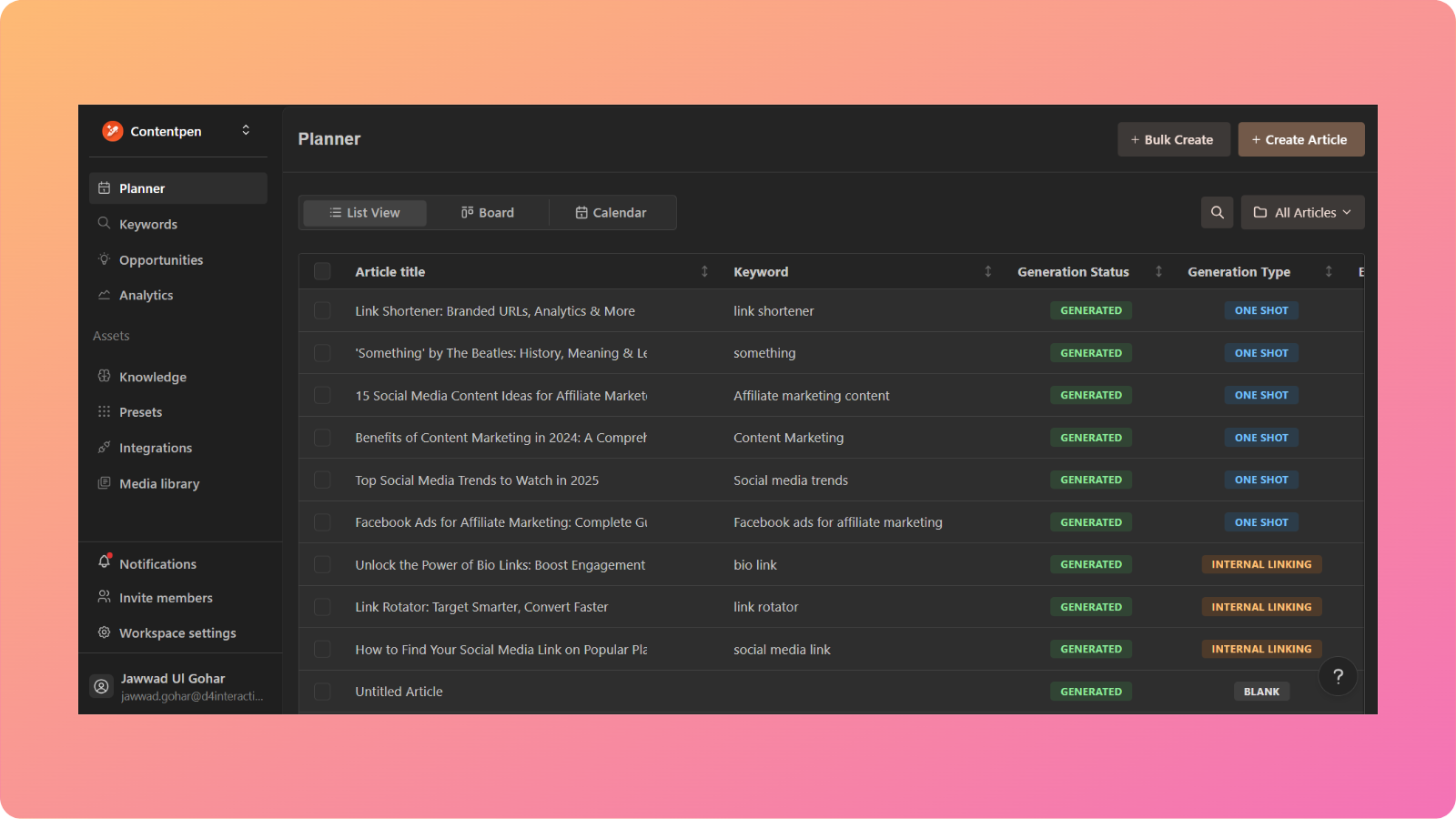
    Contentpen main screen - Contentpen.ai

    By now, it is clear that solid SEO has many moving parts. You need research, writing, on‑page optimization, updates, and tracking. 

    For solo marketers, small teams, and busy agencies, doing all this manually can feel impossible on a tight schedule.

    AI‑powered platforms exist to reduce that load. They help you handle the most time‑intensive tasks faster, so you can focus on strategy and quality control. Contentpen is one such platform, explicitly built around SEO content needs.

    How Contentpen helps beginners implement SEO best practices

    Our SEO platform brings several key Features into one workspace. It can help you:

    • Generate long‑form blog drafts based on your chosen topics and target keywords.
    • Structure articles in a way that supports strong SEO layouts.
    • Spot fundamental gaps in headings, keyword coverage, and formatting.

    While you write or refine text, SEO‑aware guidance in Contentpen highlights areas that may need a more transparent structure or better keyword use. 

    You can also keep your brand voice consistent by uploading your content guidelines into Contentpen and using it as a central place for drafts, outlines, and internal notes. 

    Reusing outlines and drafts makes it easier to publish content on a regular schedule without dropping quality.

    Staying current: How to keep up with SEO changes

    SEO does not stand still. Search systems release updates, new features appear in results, and best practices shift over time. With the popularity of AI search discovery, terms like GEO (Generative Engine Optimization) have also entered circulation.

    For someone learning SEO, the constant change can seem overwhelming at first glance. However, the reassuring part is that core principles remain the same. 

    Helpful, honest content, fast and safe sites, and natural links have been wise goals for many years. 

    What changes more often are the finer tactics and the weight given to certain ranking factors. When you keep your focus on serving users well, you are already on the right side of most updates.

    To stay informed without spending all day on the news, choose a small set of trusted sources. The Google Search Central blog and YouTube channel are good places for official guidance. 

    A few respected SEO blogs or newsletters can also help you understand what new updates mean in practice. You do not need to chase every rumor; watching clear trends is enough.

    Summing it up

    Learning SEO can feel like a big project, but breaking it into steps makes it manageable. You start by making sure search engines can find and crawl your site. Then you organize your structure, research the right keywords, and create content that genuinely helps people.

    From there, you tune on‑page elements, build authority with good links, and track progress with data instead of guesses. 

    Along the way, you must avoid common mistakes, such as chasing impossible keywords or ignoring mobile users. This steady, thoughtful work leads to real improvements in website ranking over time.

    Frequently asked questions

    Can ChatGPT do SEO?

    While AI chatbots like ChatGPT can help draft SEO content, they are not specialized tools for this purpose. On the contrary, tools like Contentpen are made for this task, helping you rank better with minimal effort.

    How long does it take to get to the top of Google?

    There is no fixed time, and no one can guarantee a number one spot. Focus less on the idea of “top of Google” and more on building many rankings across related keywords, which together bring strong traffic.

    Can I do my own SEO?

    Yes, many small businesses and creators learn how to do their own SEO with guides like this. Start with on‑page basics, make sure your site is fast and mobile‑friendly, and create content that answers real questions in your niche. 

    What is the difference between on-page and off-page SEO?

    On‑page SEO covers everything you do on your own site, including content quality, titles, headings, internal links, and technical health. Off‑page SEO focuses on signals from other sites, mainly backlinks and brand mentions.

    How many keywords should I target on one page?

    Most pages work best with one main keyword and a group of closely related secondary phrases. That main keyword sets the focus, while secondary terms cover variations and related questions.

  • Gemini vs ChatGPT: The ultimate comparison for blog writers

    Gemini vs ChatGPT: The ultimate comparison for blog writers

    Google’s Gemini and OpenAI’s ChatGPT are two of the most popular AI tools. But when it comes to choosing between Gemini vs ChatGPT, the choice is not easy for content creators, bloggers, and digital marketers. 

    Both platforms offer advanced features to help you create engaging content, but they approach the task with varying capabilities. ChatGPT has built a massive user base through its conversational fluency and creative output, while Gemini is backed by Google’s vast search and technical infrastructure.

    In this article, we’ll cut through the noise to examine what really matters for writers. We will see which tool produces better content, conducts more effective research, and helps you create blog posts that engage readers and rank well in search results. 

    General overview of ChatGPT’s capabilities

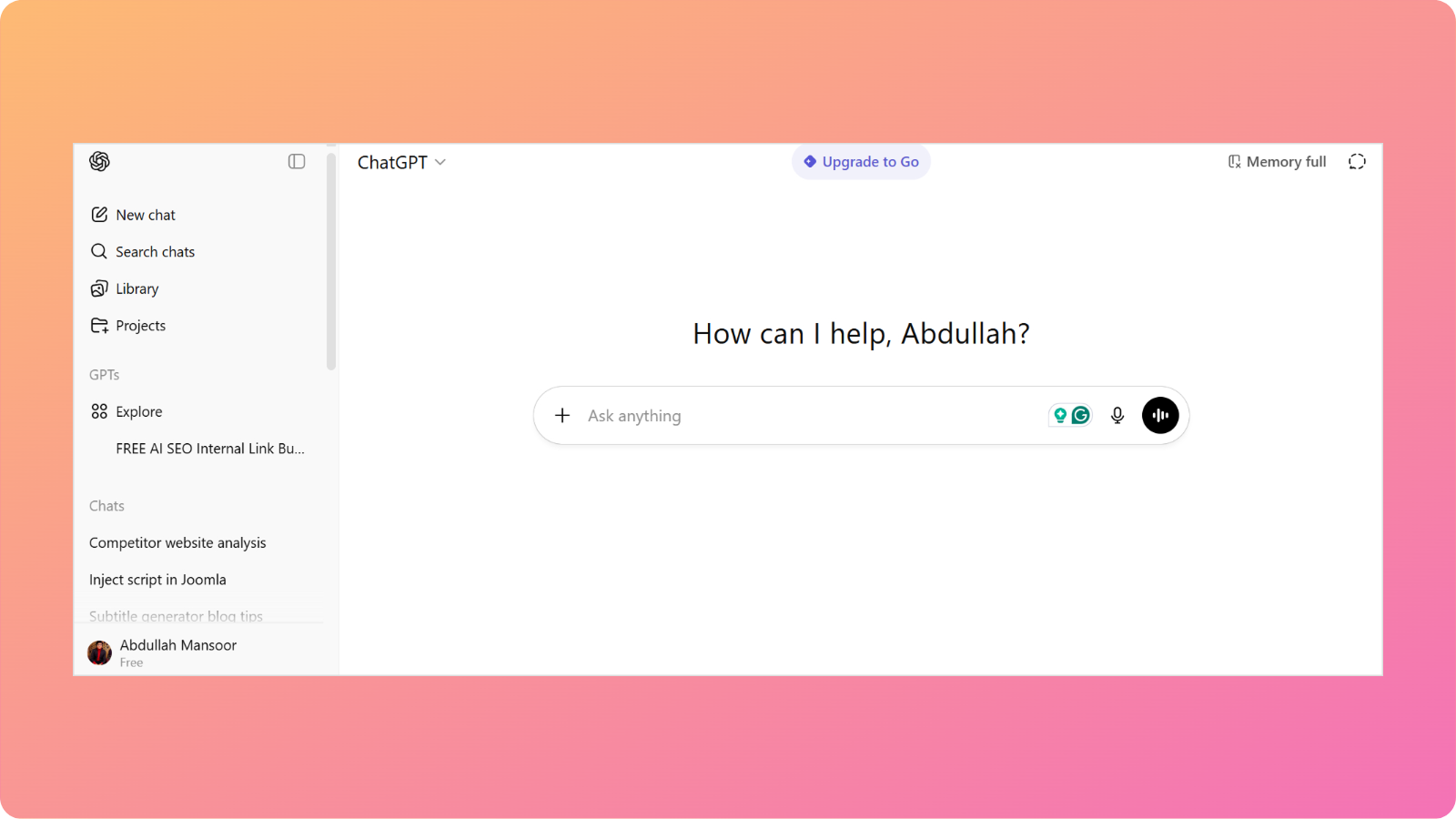
    ChatGPT interface

    ChatGPT has established itself as the leading conversational AI because it feels remarkably human in its interactions. 

    Built on OpenAI’s GPT architecture, it excels at understanding context and maintaining coherent multi-turn conversations. It also adapts its tone to match your needs, whether you’re drafting a technical blog post or a casual article.

    The platform’s writing capabilities extend far beyond simple text generation. ChatGPT has strong creative abilities, crafting compelling narratives, generating metaphors, and varying sentence structure to keep readers engaged. 

    It handles everything from technical documentation to storytelling and media generation with impressive versatility, making it a must-have tool for content creators.

    One of ChatGPT’s standout features is its ability to refine and iterate. 

    You can ask it to make content more concise, restructure arguments, or adjust the tone to align with your brand voice.

    However, ChatGPT’s knowledge is limited by its training data cutoff, though the addition of web search capabilities in newer versions helps bridge this gap. 

    Content creators can make the best use of ChatGPT when they can provide current information or verify facts independently, rather than relying solely on its baseline knowledge.

    General overview of Gemini’s capabilities

    Gemini interface

    Gemini arrives on the scene with the full weight of Google’s technological ecosystem behind it. 

    Unlike ChatGPT, which was developed primarily as a conversational AI, Gemini was designed from the ground up as a multimodal model, meaning it processes and understands text, images, and other data types simultaneously rather than treating them as separate inputs.

    The most significant advantage Gemini brings to content creation is its quick integration with Google’s search infrastructure. 

    When you ask Gemini to research a topic, it doesn’t rely solely on training data, but it actively searches the web. It can cite specific sources, providing a level of factual grounding that’s particularly valuable for blog writers who need accurate, up-to-date information.

    Gemini’s approach to writing tends toward precision and structure. The tool demonstrates strong analytical capabilities, breaking down complex topics into logical frameworks and organizing information hierarchically. 

    Content creators working on informative blog posts, tutorials, or research-heavy articles will find this systematic approach a solid foundation to build on.

    That said, some users find Gemini’s responses can occasionally feel more clinical or algorithmic than ChatGPT’s conversational flow. 

    Comparison Table: Gemini vs ChatGPT at a glance

    The following table summarizes the key differences between ChatGPT and Gemini:

    FeatureChatGPTGemini
    Content creativityHighly creative with natural, flowing proseMore structured and analytical in approach
    Research capabilitiesLimited to training dataNative integration with Google Search for real-time information
    Source citationCitations can be genericBuilt-in citation with specific source links
    Tone adaptabilityExcellent at matching diverse tones and stylesGood, but sometimes defaults to a formal academic tone
    Long-form coherenceStrong contextual memory across conversationsSolid but may require more explicit reminders
    SEO understandingGeneral SEO knowledgeBetter grasp of current search trends
    Content depthExcels at explanatory depth with examplesStrong at comprehensive, fact-based depth

    Let’s compare Gemini vs ChatGPT in detail in terms of their core capabilities:

    Gemini vs ChatGPT in research

    Research capabilities are key to creating high-quality content, code, and other projects. This is where the differences between these AI tools become most apparent. 

    Gemini and ChatGPT image

    ChatGPT relies primarily on its training data, which means its research draws on a vast but static knowledge base. When you ask it to research a topic, it synthesizes information it already “knows” rather than seeking out new sources, except when the web search is enabled. 

    Gemini takes a fundamentally different approach. Its integration with Google Search means it actively retrieves current information from the web, providing citations and links to source material. 

    Verdict

    If we’re strictly talking about blog posts on emerging technologies, recent industry developments, or any time-sensitive topic, Gemini’s research capabilities are far better than ChatGPT’s. 

    Many professional writers find themselves using both Gemini for initial research and fact-checking, and ChatGPT for actually drafting the content.

    Also read: Copilot vs Gemini for content creators.

    Gemini vs ChatGPT in reasoning

    Reasoning ability determines how well an AI can construct logical arguments, identify flaws in reasoning, and build coherent narratives throughout long blog posts.

    ChatGPT vs Gemini side-by-side

    This makes it excellent for opinion pieces, persuasive blog posts, and content that requires building a case through accumulated evidence and examples.

    Gemini demonstrates more methodical, step-by-step reasoning, reflecting its Google origins. When presented with complex problems, it tends to break them down into parts, address each systematically, and then synthesize conclusions. 

    This analytical approach works beautifully for how-to guides, technical tutorials, and educational content.

    Verdict

    ChatGPT often feels more natural when you’re exploring ideas and need the AI to make intuitive recommendations. Meanwhile, Gemini excels when you need structured analysis and want the reasoning process to be transparent and verifiable.

    Also read: Copilot vs ChatGPT comparison.

    Gemini vs ChatGPT in content writing

    Content writing involves everything from blog posts to social media captions, and both AI tools bring distinct writing personalities to the task. 

    ChatGPT’s writing style tends toward fluency and readability. Its sentences flow naturally, transitions feel organic, and the overall reading experience resembles human-written content.

    The tool is effective for narrative blog posts, storytelling, and content where engagement depends on maintaining a conversational connection with readers.

    Gemini’s writing is more uniform in quality but less personal by default. Its content tends to be well-structured and information-dense, prioritizing clarity and completeness over stylistic flair.

    For certain types of blog content, particularly informational articles, guides, and reference material, this straightforward approach serves readers well.

    Also read: Perplexity vs ChatGPT.

    Verdict

    ChatGPT typically requires fewer prompts to capture and maintain a brand voice across multiple pieces. Gemini can certainly adapt to style requirements, but you may need to be more explicit and provide examples of the tone you want to achieve repeatedly.

    Solving content overload - Contentpen.ai

    Gemini vs ChatGPT in media generation

    Visuals are the heart of any type of content. These include compelling images or engaging short videos, depending on the type and nature of your work.

    ChatGPT integrates with DALL-E, OpenAI’s image-generation model, allowing you to create custom illustrations, blog header images, and other visual content directly within the same interface.

    Gemini also offers the newly introduced Nano Banana Pro, which can thoroughly analyze your prompts and create high-quality visuals. 

    Verdict

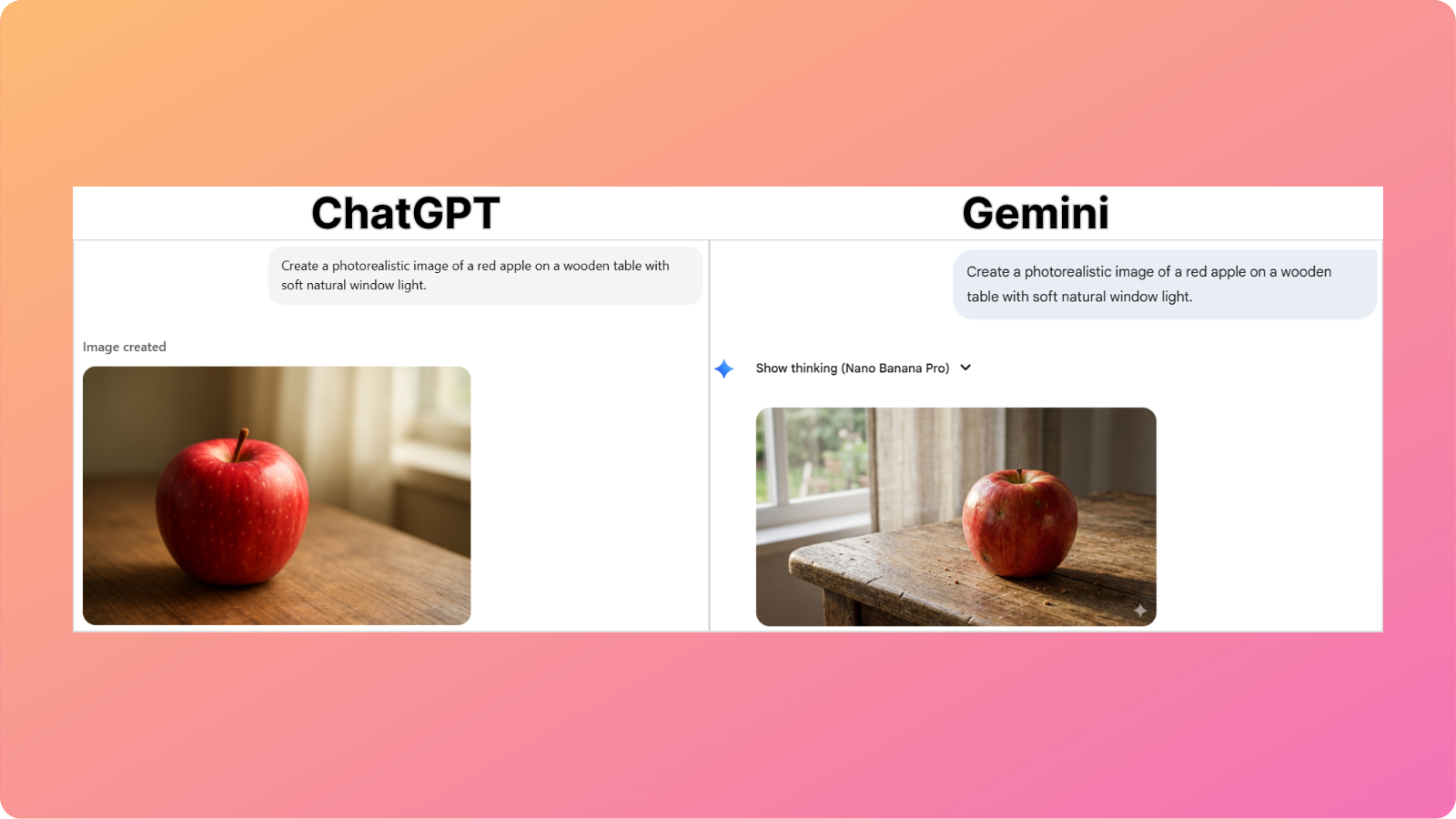
    We tested the image-generation capabilities of both Gemini and ChatGPT using the same prompt. The result is as follows:

    Gemini vs ChatGPT image comparison

    Both tools generated high-quality images as per the prompt. But the image generated by Gemini seems far more realistic than ChatGPT in this instance. 

    Also read: Perplexity vs Gemini: An honest comparison for content writers.

    Gemini vs ChatGPT in SEO understanding

    Search engine optimization remains vital for blog success, and an AI tool’s SEO understanding directly impacts how well it can help you create discoverable content. 

    ChatGPT has general SEO knowledge drawn from its training data, understanding concepts like keyword optimization, meta descriptions, internal linking strategies, and content structure for search engines.

    Gemini’s advantage here stems from its Google heritage and search integration. The tool has a more intuitive understanding of what search engines value because it can reference current search results and trending queries.

    Verdict

    The caveat is that neither tool replaces dedicated SEO writing tools that provide keyword research data, backlink analysis, and technical SEO audits. 

    Both tools are better viewed as content optimization assistants that help you apply SEO principles during the writing process rather than comprehensive SEO platforms.

    Creating a real blog with ChatGPT and Gemini

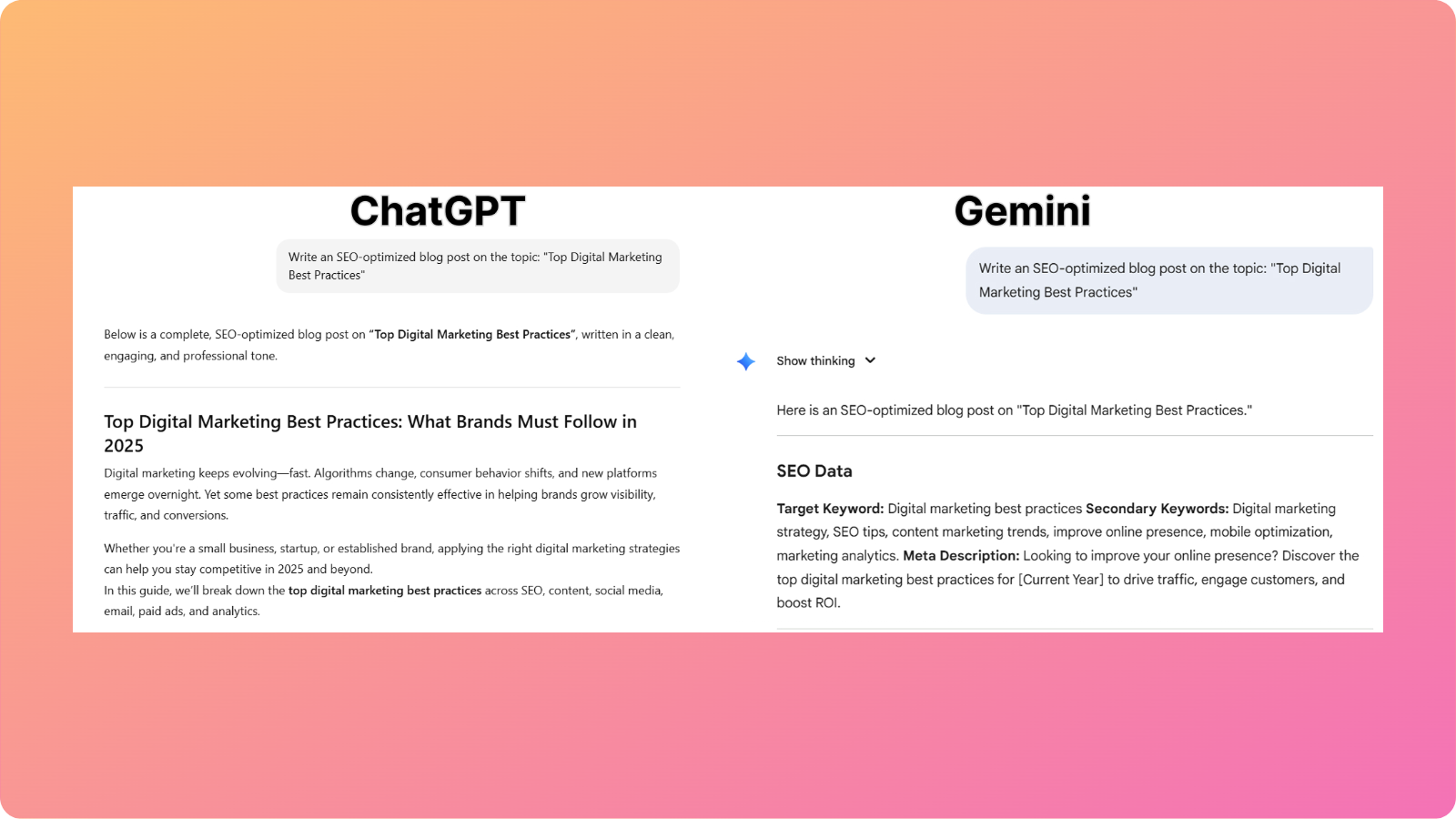
    Theory only gets you so far when evaluating AI writing tools. To understand how ChatGPT and Gemini actually perform for blog writing, we gave both platforms an identical prompt: 

    “Write an SEO-optimized blog post on the topic: Top Digital Marketing Best Practices.”

    The results reveal fundamental differences in how these AI assistants approach content creation.

    Gemini vs ChatGPT blog comparison

    ChatGPT’s approach and output

    ChatGPT immediately structured the post around practical, actionable advice with a clear 2025 timeframe in the title: “Top Digital Marketing Best Practices: What Brands Must Follow in 2025.” 

    The article opened with an engaging hook about the fast-evolving nature of digital marketing, establishing relevance and urgency right away. The content flowed conversationally, using contractions, varied sentence lengths, and direct address to readers. 

    ChatGPT organized the post into ten distinct sections, each covering a specific aspect of digital marketing, from content quality to mobile optimization to analytics. The structure felt intuitive, with each section building logically on the previous one.

    The tool included practical tips for each section, specific examples of content types that perform well, and recommended SEO tools readers could implement immediately.

    However, the piece lacked citations or specific data points to support its claims. When ChatGPT mentioned that “more than 60% of online traffic comes from mobile devices,” it provided no source to prove that statistic.

    Gemini’s approach and output

    Gemini took a markedly different approach, beginning with a structured SEO data section that outlined the target keyword, secondary keywords, and a meta description. This metadata-first approach immediately signaled a more technical, optimization-focused mindset.

    Gemini’s introduction explicitly positioned against common mistakes (“winging it is no longer an option”), establishing the content as corrective guidance for businesses making strategic errors.

    The article organized content into seven core sections rather than ten, suggesting a more distilled approach to the topic. 

    Each section began with a “Why it matters” subsection that provided explicit reasoning before diving into best practices. This structure created a more argumentative, persuasive framework.

    The tool demonstrated more substantial conceptual depth in certain areas. The SEO section didn’t just mention keywords, but it also distinguished between search intent categories (buy, learn, navigate) and emphasized matching content to each. 

    However, Gemini’s prose occasionally felt heavier and less inviting. Sentences like “algorithms favor video content across almost all platforms” conveyed information accurately but lacked the conversational warmth that makes blog content engaging.

    Also read: 12 SEO competitor analysis tools to outsmart your competition.

    User reviews for Gemini and ChatGPT

    Real user experiences often reveal insights that specifications and feature lists can’t capture. According to G2, ChatGPT has a rating of 4.7/5 based on 1,244 reviews, while Gemini has a rating of 4.4/5 based on 324 reviews (as of the time of writing).

    The difference in review volume stems from ChatGPT’s longer market presence and broader adoption.

    ChatGPT pros

    ChatGPT user review

    Users consistently praise ChatGPT as a collaborative writing tool. One user describes it as a “great sparring partner for writing,” noting that it “regularly saves me time” when reviewing blog posts and emails. 

    This collaborative aspect of using ChatGPT to refine specific lines rather than generate everything represents how many professionals actually use the tool.

    ChatGPT cons

    The most common complaint centers on ChatGPT’s tendency to confidently present incorrect information. One user shared an example of when he asked about flight destinations from his local airport, “it claimed that I could fly to several places that I in fact could not. Only when I challenged it did it correct itself.”

    Multiple reviewers emphasize that ChatGPT should NOT be used to replace an actual person.

    Gemini pros

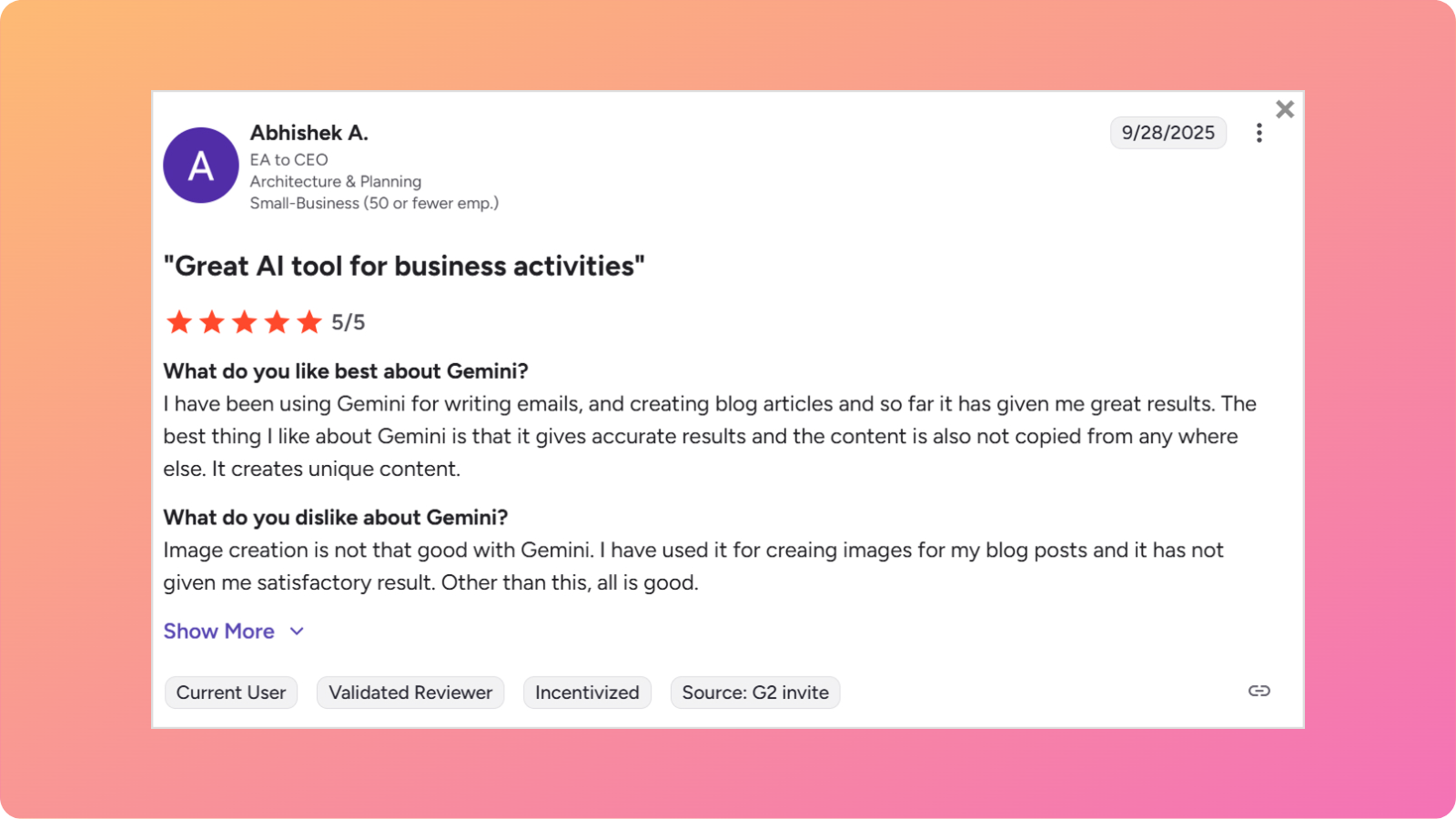
    Gemini user review

    Gemini’s access to current information stands out as its most substantial advantage in user reviews.

    Users who rely on Gemini for emails and blog articles highlight that “it gives accurate results and the content is also not copied from anywhere else. It creates unique content.” For users concerned about plagiarism or duplicate content, this assurance matters significantly.

    Gemini cons

    Many users have identified this problem with Gemini, which tends to struggle with maintaining consistency in conversations. 

    This is a similar problem we encountered in our analysis: you’d have to remind Gemini of the context consistently. Otherwise, it loses all the value in the generated content.

    Overall, the review patterns reveal a clear divide. ChatGPT users appreciate its writing quality and collaborative editing capabilities, but warn about factual accuracy and the need for human oversight. 

    On the other hand, Gemini users value its access to current information and research capabilities but find it lacking for actual content creation, particularly long-form writing.

    Contentpen: A better alternative to Gemini and ChatGPT for blog writing

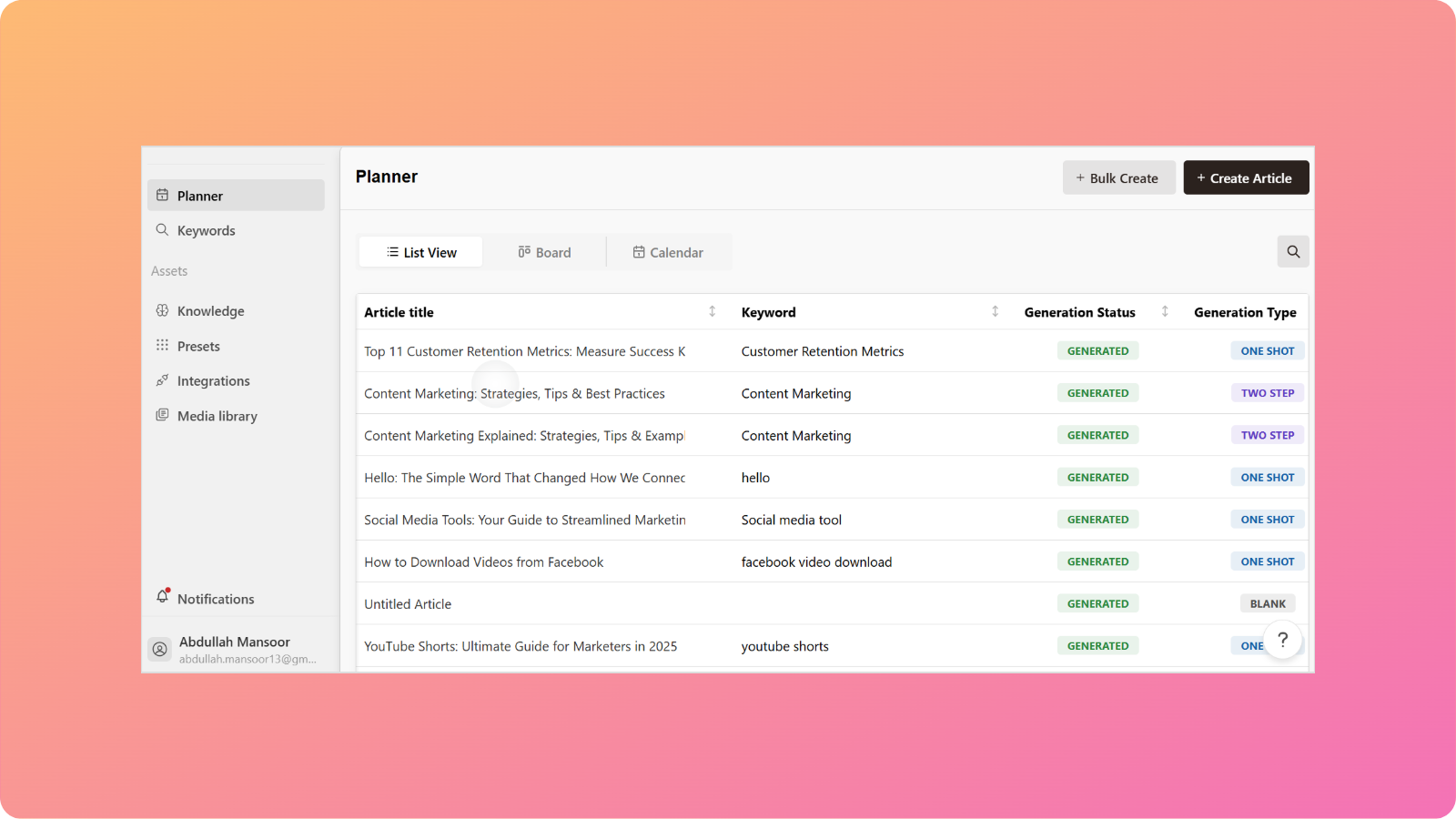
    Main screen interface - Contentpen.ai

    While Gemini and ChatGPT are powerful AI assistants, they were never designed to manage end-to-end blogging workflows.

    This is where Contentpen comes in. It represents a different approach entirely, as it is a specialized platform designed specifically for bloggers and content marketers who need to produce high-quality content at scale.

    Here are the key features of Contentpen that make it a better alternative to both Gemini and ChatGPT for content creation and scheduling.

    • Comprehensive keyword research: The tool uses AI to find the best keywords for your niche and brand, increasing your blog’s chances of ranking on Google and other AI search engines.
    • Pre-planned content calendar: With Contentpen, you can plan months of content automatically, eliminating guesswork and keeping your publishing schedule flowing without manual effort.
    • One-click publishing: Our AI text generator online lets you publish posts directly to CMS platforms like WordPress, Ghost, Shopify, and Webflow, with complete control over formatting, scheduling, and approvals.
    • Bulk content creation: With this feature, you can generate dozens of SEO and GEO-ready blogs at once, scaling your content production effortlessly without sacrificing quality.
    • Automated SERP analysis: Contentpen analyzes SERP gaps in competitor content and identifies opportunities for your blog to rank and stand out.
    • Consistent brand voice: Contentpen helps you maintain a consistent brand voice, tone, and style. All you have to do is upload your brand guidelines once.
    • Media generation and control: Each blog post includes high-quality images. You can also control all your visuals in a built-in media library, eliminating the need for separate image creation tools or switching tabs.

    Although ChatGPT and Gemini are both great at conducting regular tasks and audits, Contentpen is simply a better choice for complete content automation.

    Final verdict: Which AI is better for blog writing?

    Choosing between Gemini and ChatGPT isn’t about finding a universal winner, but about matching the tool to your specific blogging needs. 

    ChatGPT excels at creative, engaging prose with natural flow, making it ideal for personality-driven blogs and content that prioritizes reader connection. Gemini shines in research-heavy, factual content where current information and citations matter most.

    The smartest approach is to combine both: use Gemini for research and fact-gathering, then ChatGPT to craft engaging narratives. 

    Alternatively, you can try Contentpen for content creation and build an efficient workflow that serves your audience and content goals. 

    Frequently asked questions

    Can Gemini overtake ChatGPT?

    It’s uncertain. ChatGPT currently leads in adoption and user satisfaction for content writing, but Gemini’s Google integration gives it advantages in research.

    Is Gemini more censored than ChatGPT?

    Both platforms have censorship policies and safety measures. However, they do allow the creation of standard business and marketing content without significant restrictions.

    What is the 30% rule in AI?

    The rule suggests that AI should handle 30% of a repetitive task, while humans should perform the remaining 70%, focusing on critical thinking, judgment, and creativity.

    What is the knowledge cutoff for Gemini?

    Gemini 3 Pro is the latest Gemini model, with a knowledge cutoff of January 2025. With web search enabled, Gemini can access the latest information in real time.

    What is the knowledge cutoff for ChatGPT?

    ChatGPT’s knowledge cutoff for the GPT 5.2 model is August 2025. However, with web search capabilities, you can access current information.

  • Webhook vs API: Which one should you use? (A simple guide)

    Webhook vs API: Which one should you use? (A simple guide)

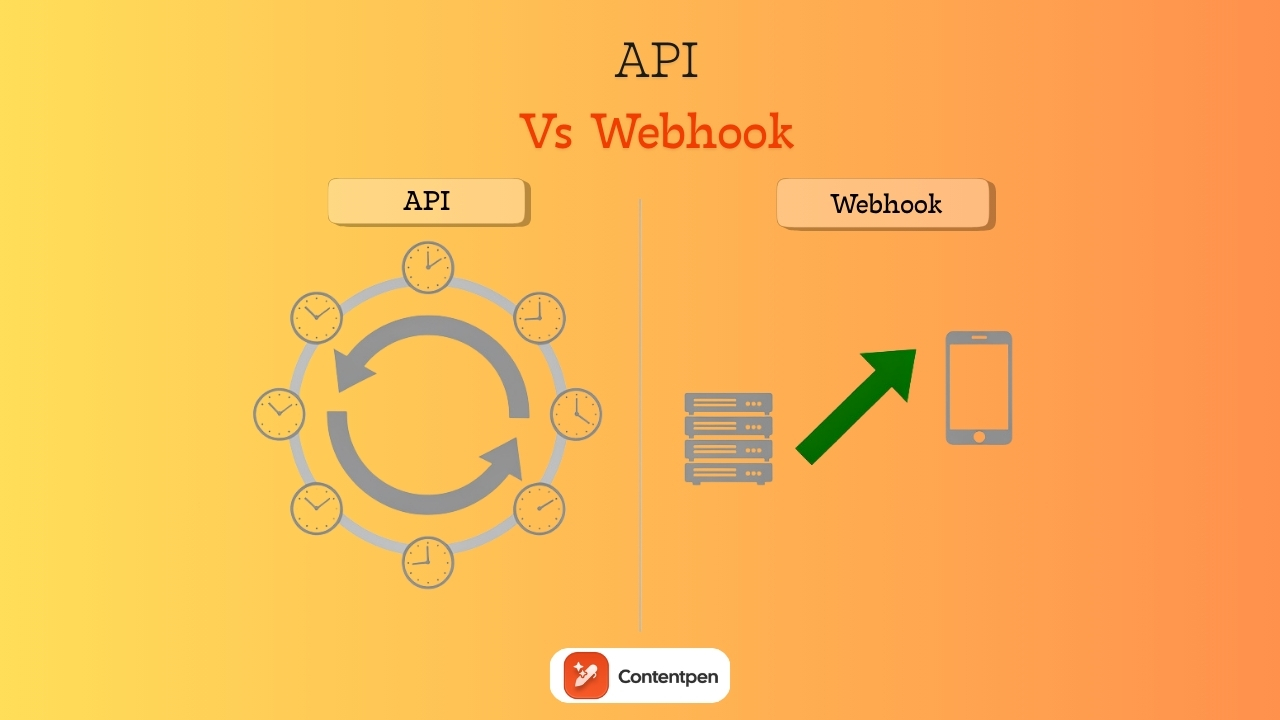
    An API enables two-way communication between software driven by requests. On the other hand, a webhook is a lightweight API that provides one-way data sharing triggered by events. 

    Together, APIs and webhooks enable applications to share data and form the basis of the Internet as we know it today.

    Since webhooks and APIs work differently, developers and creators must know when to use each.

    With this post, we aim to highlight the key difference between webhooks and APIs. We will also explain how each data transfer method works and when to combine them for maximum benefit.

    So, let’s get to it, shall we?

    What is an API?

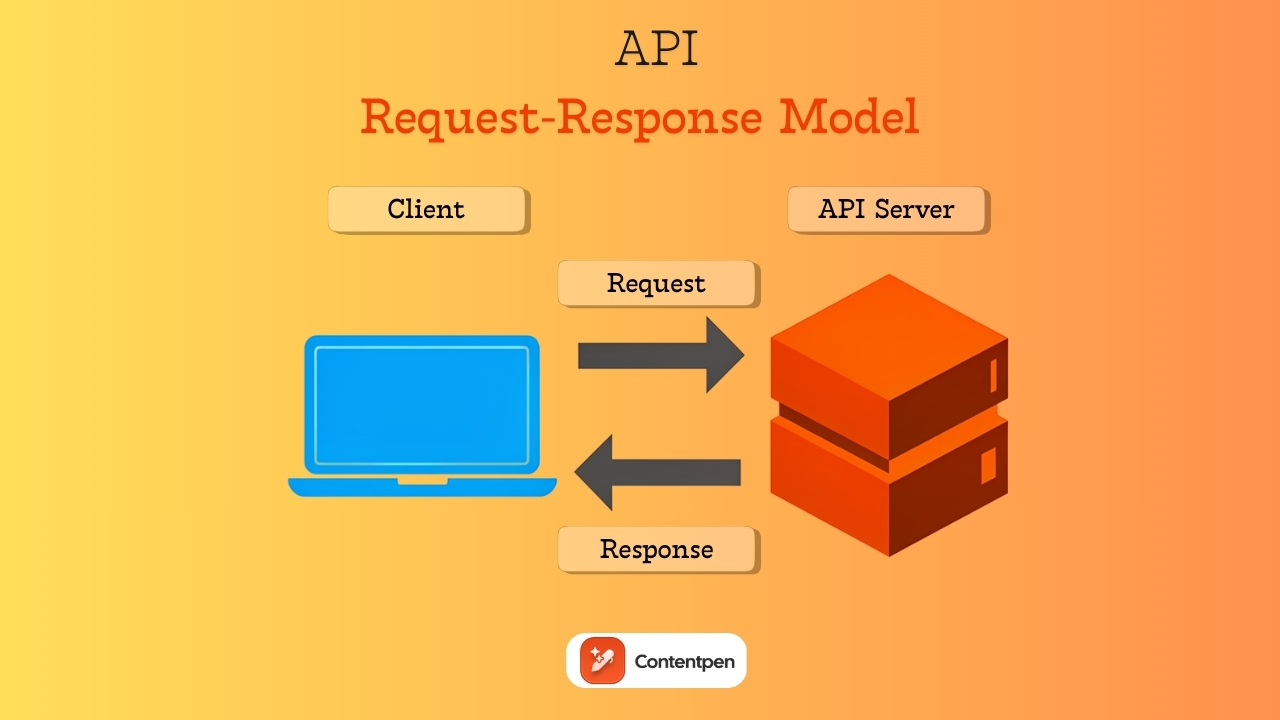
    API request-response model - Contentpen.ai

    An API (Application Programming Interface) is a set of rules that lets one app talk to another.

    In simple terms, your app sends a request to an application, the server does some work, and then sends back a response.

    Most web APIs follow a request-response model, also called a pull model. In your app, the client always starts the conversation. It calls an API endpoint (a specific URL), the server receives the call, looks up or updates data, and then returns a reply.

    This pattern supports full CRUD (create, read, update, and delete) behavior for applications.

    For instance, you can:

    • Create a new blog post
    • Read a list of posts
    • Update a customer record
    • Delete an item from a cart

    That two-way interaction makes APIs the base layer for most API integration methods in modern apps.

    APIs usually send data in JSON or XML format. JSON is more common because it is lighter and easier to handle in JavaScript-heavy frontends. 

    Different API communication patterns exist, but for many content and marketing tools, REST (Representational State Transfer) APIs are the standard. 

    REST is just one way to design APIs, and you will see later how REST APIs and webhooks fit into the bigger picture.

    The anatomy of an API call

    To see what happens in an API call, imagine your app wants a user’s profile from a social network. 

    First, it sends a request to a specific endpoint URL, such as https://example.com/api/users/123. That URL points to the exact resource the server should handle.

    Next, the request includes an HTTP method. Common methods are:

    • GET for reading data
    • POST for creating
    • PUT for updating
    • DELETE for removing

    Headers travel with the request. They often hold an API key or token that proves your app is authorized to request this data, along with metadata about the formats or language.

    Sometimes the call includes query parameters in the URL or a body payload with filters and fields. The server checks the credentials, reads or changes the requested resource, and builds a response

    Along with the data, the server adds a status code:

    • 200 – Signals success
    • 404 – Means the resource was not found
    • 500 – Reports a server error

    You can think of this whole flow as filling in a form with exact fields, sending it in, and then reading a stamped result letter that explains what happened.

    Solving content overload - Contentpen.ai

    What is a webhook?

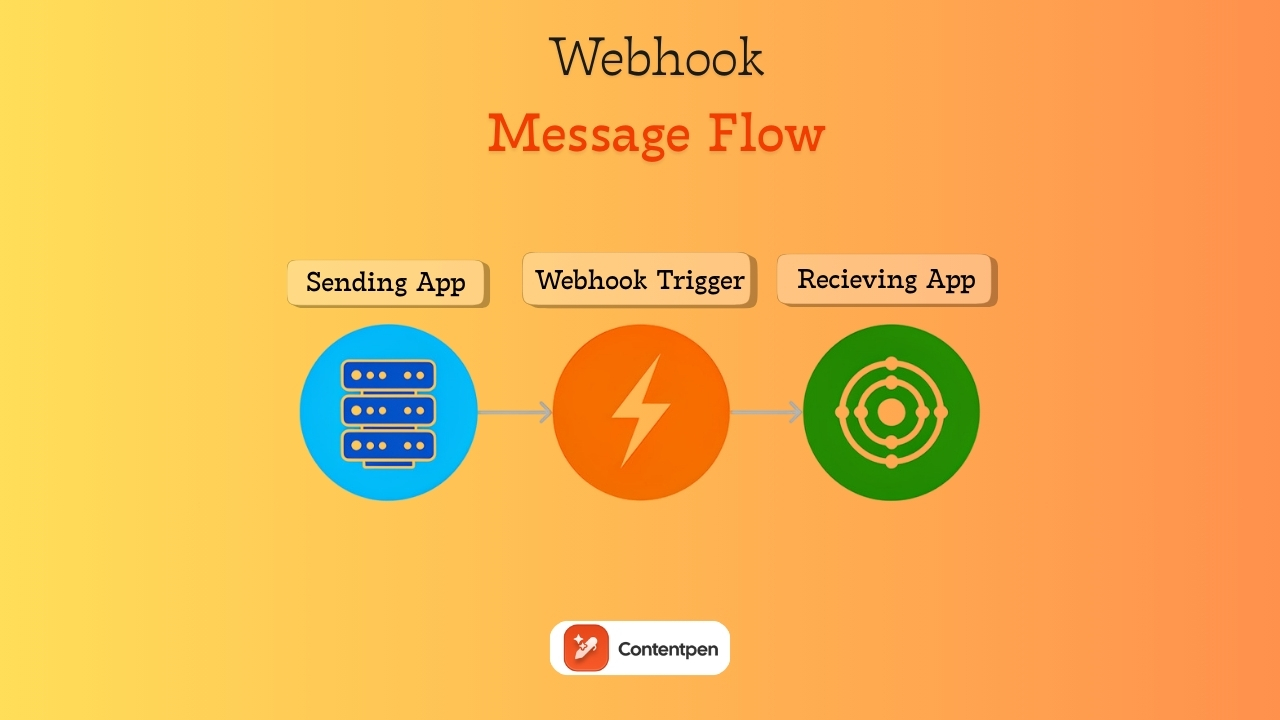
    A webhook is an automated HTTP message that a server sends when a specific event happens. Instead of your app asking for updates, the other system pushes data to you. 

    That is why people often call webhooks a reverse API.

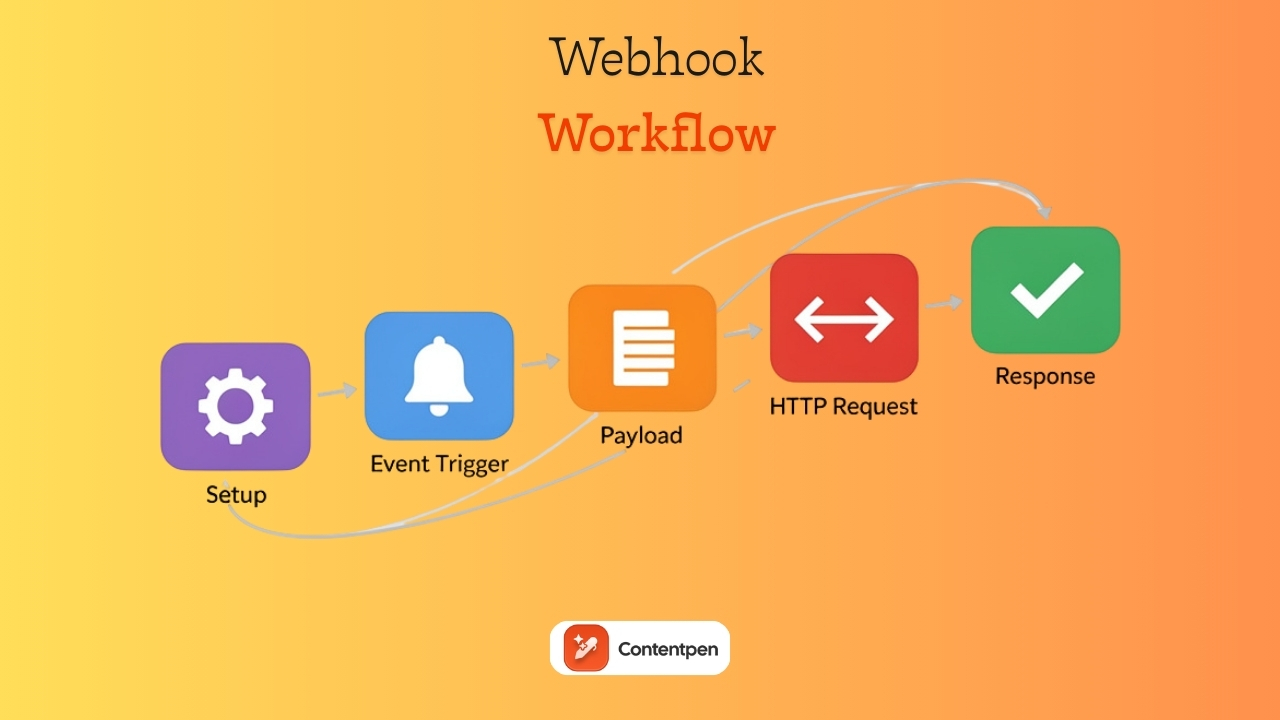
    The core idea behind webhook functionality is the push-based model. Your app sets up a special URL, often called a webhook endpoint, that listens for incoming messages. 

    In the sender app, you paste that URL and choose which events you care about, such as “new lead created” or “payment completed.” From that moment, whenever the event fires, the provider sends an HTTP POST request to your URL with a small JSON payload.

    Webhooks are used for one-way communication. The provider sends the notification, your app receives it, and that is the end of that interaction. 

    A webhook cannot request additional data or update records on the provider. If you need more detail, you often combine the webhook with a follow-up API call.

    From an implementation perspective, webhooks are pretty simple. You:

    1. Set up an HTTP endpoint that accepts POST requests
    2. Parse the JSON
    3. Verify it is valid and trusted
    4. Trigger your own logic

    After you process it, return an HTTP 200 OK to indicate you received the message.

    How webhooks save computing resources

    Imagine an app that checks for new email every 60 seconds through an API. That is 1,440 requests per day. If only 10 actual emails arrive, then 1,430 of those calls do no practical work at all.

    With a webhook, the email server sends a message only when a new email arrives. In this case, you get 10 webhook calls instead of 1,440 API polls. 

    This difference in network traffic, CPU time, and logs can be huge at scale. For large apps, the gap shows up directly on the cloud bill.

    Comparison table: Webhook vs API at a glance

    Now that you understand each method on its own, you can easily compare the webhook vs API difference. Both move data between systems, but they do it in very different styles. That style choice affects performance, cost, and how your workflows behave.

    Here is a quick webhook vs API summary you can scan when you plan your new integration.

    FeatureAPIWebhook
    Communication modelPull request-responsePush event-driven
    Data flowTwo-way bidirectionalOne-way server to client
    InitiatorClient applicationServer-side event
    Real-time updatesNeeds pollingInstant
    Resource efficiencyWastes calls when pollingOnly fires when needed
    Operations supportedFull CRUD for data and actionsEvent notifications
    ComplexityComplex to design and maintainSimpler and lightweight
    Use caseDeep integrations and data queryingReal-time automation flows

    Both integration approaches are not wrong to use. Many intelligent systems mix them. 

    For example, you can let a webhook tell you that something changed, then call the API to pull detailed data or to trigger more actions. That gives you a balanced webhook vs API integration pattern.

    In short:

    • Use an API when you need rich interaction and control over timing
    • Use a webhook when you need real-time signals without noisy traffic

    Real-life examples where APIs excel

    Below are some examples where you should use APIs rather than webhooks for your business use cases or applications.

    Accessing constantly changing data

    Accessing frequently updated data is a classic case for APIs. Think of weather apps that need the latest forecast whenever someone opens the screen. The AccuWeather API does this brilliantly, providing users with up-to-date forecast data.

    Performing complex data operations

    Performing multi-step data operations works best with APIs. An e-commerce backend, like WooCommerce, can use an API to create, update, and delete items in a product catalog. 

    An SEO platform, such as Contentpen, uses APIs so editors can search, filter, and refresh articles inside user dashboards without switching tabs.

    Building deep integrations

    Building deep integrations often requires APIs. Payment gateways connect with banking systems through APIs to process charges, refunds, and payouts. 

    Authentication services check logins, manage sessions, and handle multi-factor prompts through structured API calls. 

    On-demand data retrieval

    On-demand data retrieval fits the request-response style. Search boxes send API calls when users type a query. 

    Reporting tools, like Tabeau AI, call REST APIs when someone wants a fresh analytics view for their dashboards.

    Exposing functionality to many clients

    Exposing functionality to many clients also calls for APIs. Providers such as email senders or messaging services offer public APIs so other apps can hook in. 

    A prime example of this is Contentpen, which provides API integration with powerful CMS platforms such as WordPress, Ghost, Wix, and Webflow.

    Integration menu - Contentpen.ai

    You can also directly integrate with Shopify to publish articles or Google Search Console to analyze search performance.

    The trade-off with APIs is that they take longer to design well and update safely. Changes in your API can affect every client that calls it, so versioning and clear deprecation policies matter a lot.

    When to use a webhook? Scenarios where webhooks win

    Webhooks shine when a state change matters right away, but you do not need constant two-way traffic. For busy content and digital marketing setups, this is where you save effort and money.

    Real-time notifications and alerts

    Real-time notifications and alerts are a perfect job for webhooks. When a payment succeeds during checkout, a webhook can trigger your backend to mark the order as paid within seconds. 

    For example, Slack incoming webhooks let outside tools post messages into channels without hassle.

    Workflow automation

    Workflow automation benefits a lot from webhooks. When someone submits a form on your site, a webhook can tell your CRM to add a new lead. 

    Similarly, when a code hits the main branch in GitHub, a webhook can trigger your CI or CD pipeline to run tests and deploy.

    Cross-platform synchronization

    Cross-platform synchronization works nicely with event-driven updates. A user profile change in one app can trigger a webhook to other apps, keeping the name, email, and other information in sync. 

    Another example of this can be warehouse stock changes. These can trigger webhooks to your storefront, keeping inventory accurate and up to date without manual intervention.

    Event-driven application architecture

    Event-driven application architecture often uses webhooks. Serverless functions such as AWS Lambda or Azure Functions usually respond to webhook-style triggers from external services. 

    Microservices can send HTTP callbacks to each other when their internal state changes. This pattern builds reactive systems in which parts of your app respond to events rather than polling continuously.

    Third-party integration platforms

    Third-party integration platforms rely heavily on webhooks. Tools like Zapier or Make sit in the middle of dozens of SaaS applications.

    When something happens in App A, a webhook tells the platform, which then runs a flow and calls an API in App B. That model makes no-code automation possible without a custom webhook implementation in every small app.

    Webhooks are quick to set up for simple notifications, though you must pay close attention to security and logging.

    Choosing the right integration method: A practical framework

    Choosing between API and webhooks

    Now that we’ve highlighted all the key differences between webhooks and APIs, it is time to discuss a thorough decision framework. This will help you decide which integration method to use for your projects and business applications.

    Step #1: Decide the data updating frequency

    First, decide how often the data changes for your use case. If data updates frequently and users need the latest view when they open a screen, an API makes sense. 

    If data changes only when an event occurs, and you care about speed at that moment, a webhook notification is a better fit.

    Step #2: Determine the direction of data flow

    The second step in developing an integration framework is to determine the direction of data flow.

    When you only need to receive updates, such as “a lead was created” or “an order shipped,” a webhook is enough. 

    But when you need to both read and change data, or run searches and filters, then an API integration is the right choice.

    Step #3: Analyze the required reaction time

    Each application or use case may have different requirements for data reaction time, so choose wisely.

    If your process must fire within seconds of an event, API polling can feel slow and wasteful. In this case, webhooks are better for alerts, tool sync, and many marketing actions. 

    Step #4: Consider the complexity of the integration

    Simple notifications, such as posting a message in or updating a single field, fit nicely in webhook flows. 

    On the other hand, more involved tasks with many filters, joins, and actions require APIs that give you wide control over requests.

    Step #5: Choose who should control action timing

    If users or schedules define actions, then your integration framework should be based on APIs. 

    However, if actions should follow events in other systems without your direct trigger, then webhooks are a better match.

    Webhooks with API: The mixed integration approach

    Today, many mature platforms combine webhooks and APIs to provide a mixed integration framework.

    This approach is better suited to modern-day workflows, where push-pull requests run in parallel to produce clean outputs.

    Let’s take Contentpen as an example, which provides both API and webhook integrations for publishing content. It gives you more control over your content while discouraging polling for simpler tasks.

    Main webhook menu - Contentpen.ai

    In Contentpen, the API integrations let you work directly with the top CMS and SEO tools, while webhooks provide notifications, such as status updates for a blog post.

    Although mixed integrations are standard in many industries, you can still choose only one approach, given the nature and niche of your work.

    Common webhook and API challenges and how to overcome them

    API and webhook setups come with their own set of hurdles, especially as the business scales. Knowing the common traps before they cause problems helps you create integrations that stay stable and easier to run.

    Challenges with API-based systems

    Rate limits are a huge API pain point. Many providers cap the number of calls you can make per minute or per hour to reduce resource waste, but this can affect your business’s functionality.

    To avoid hitting those caps:

    • Cache common responses
    • Queue non-urgent requests
    • Line up API calls so they respect rate limit headers

    Version changes are another problem to handle with APIs.

    When an API introduces new fields, removes old ones, or changes behavior, apps that depend on it can fail. 

    To handle this, you can:

    • Use versioned endpoints
    • Keep backward compatibility as long as possible
    • Watch for deprecation notices from providers
    • Test key flows after each change

    Problems to tackle with webhooks

    Webhooks have their own trouble spots. Your receiving endpoint must remain available, or the messages will fail. 

    In this regard, queue systems and serverless functions can be helpful as they can buffer and process events even during short spikes. 

    Security is another big concern for webhooks. Since endpoints are public URLs, you need to verify that each incoming request is genuinely from the sender. 

    Best practices include:

    • Utilizing HTTPS for all webhook traffic
    • Validating signatures or shared secrets
    • Checking that payloads match the expected format before acting
    • Adding IP allowlists when the provider gives clear address ranges

    Debugging webhooks can feel harder than debugging APIs because you do not see the request as easily. To make this easier:

    • Log incoming headers and payloads
    • Return detailed status codes so you can spot issues
    • Implement tools such as Webhook.site or RequestBin to inspect webhook messages

    In both API and webhook setups, you must add monitoring and alerts, so you know when something fails before your users do.

    Webhook vs. API: The bottom line

    The choice between webhooks and APIs is not a battle between rivals. It is more like choosing between email and text messages. Both send information, but they serve different moments and styles of communication. 

    There is no single correct answer that fits every case. The right pick depends on how fast data needs to flow, who should start the action, and how complex the interaction must be.

    With a clear understanding of webhooks and APIs, you can design integration plans that save developers time, cut infrastructure costs, and keep users happy with faster, more reliable features.

    Frequently asked questions

    Can a webhook replace an API entirely?

    A webhook cannot fully replace an API because it covers only part of the picture. Webhooks send one-way notifications on event triggers, but they cannot handle tasks such as updating profiles or deleting data on the provider.

    What’s the difference between webhooks and WebSockets?

    Both webhooks and WebSockets help with real-time behavior, but they follow very different models. A webhook sends a single HTTP POST when an event fires, while a WebSocket opens a bidirectional channel where the client and server can send messages at any time.

    What’s the difference between API and endpoint?

    An API is the overall interface that defines how two systems communicate. An endpoint is a specific URL within that API that handles a single function or resource.

    Is API always HTTP?

    No. Many modern APIs use HTTP, but they are not limited to it. APIs can also work over protocols like WebSockets, gRPC, SOAP, or even local system calls.

    What are the 4 types of API?

    The four commonly recognized API types are open (public), partner, internal, and composite. These classifications describe who can access the API, not how the API is implemented or transported.

  • What is a webhook and how does it work? Explained

    What is a webhook and how does it work? Explained

    Modern workflows can become redundant and repetitive. The same steps, repeated day after day, can leave you tired and unable to invest your time in crucial tasks.

    This is where webhooks come into the frame.

    Think of them as quiet messengers that move data between tools the moment something happens. No polling, no refresh button, no manual exports.

    In today’s post, you will see webhooks explained step by step, with examples that match real-life scenarios and needs. You will also learn the basic webhook implementation and how to plug them into your own stack without writing code.

    So, let’s begin, shall we?

    The basics of webhooks

    Webhook message flow - Contentpen.ai

    A good starting point for anyone asking ‘what is a webhook’ is this short answer: a webhook is an automated message one app sends to another when a specific event happens

    It delivers data in real time so the receiving tool can respond immediately. This makes webhooks perfect for real-time notifications and lightweight automation between services.

    Let’s take an example of bank alerts to learn more about webhooks. You do not refresh your banking app every minute. You give the bank your phone number once, and it sends a text whenever a charge is made on the card. 

    A webhook behaves the same way for software.

    How webhooks work

    Webhook workflow - Contentpen.ai

    Webhooks use an HTTP callback: one app calls a special URL, and the other app exposes it whenever something important happens.

    Once someone understands what a webhook is, the next step is seeing how webhooks work behind the scenes. The flow is more straightforward than it sounds. 

    One app notices an event, creates a bundle of data about that event, and sends it to a URL in another app. That second app receives the data and takes an action.

    Here is a clear five-step model that applies to almost every webhook integration.

    1. Setup and registration

    Setup and registration begin when the receiving app provides a webhook URL. That URL is like a mailbox that accepts incoming HTTP requests. 

    You paste that URL into the sending app and choose which event should trigger the messages. At that point, the sender knows what to watch for and where to post data.

    2. Event trigger

    The event trigger is the specific action or occurrence in a source application that indicates the other application to send real-time data. 

    For example: A shopper places an order, a contact submits a form, or a user upgrades a subscription plan. The app checks whether this event matches the selection you made during setup. If it does, the webhook flow continues.

    3. Payload generation

    After the trigger, the sender gathers all essential details into a payload. The payload is usually JSON, sometimes XML, or form-encoded key-value pairs. 

    For example: When a sale occurs, the payload might include the order ID, customer name, items, total value, and timestamp of the purchase. 

    A clear structure helps any webhook API or receiving service read the data without much guesswork or effort.

    4. HTTP request

    Once the sender releases the payload, it makes an HTTP POST request to the webhook URL. It places the payload in the request body and may add headers for content type or security. 

    This request is the actual webhook call. 

    It is just a regular HTTP callback under the hood, which keeps the design simple and works with almost any web stack.

    5. Action and response

    Finally, the receiving app listens on that URL and processes each incoming request. 

    It parses the payload, runs through its own logic, and performs an action such as creating a record, sending a message, or updating a status. 

    The receiver then returns an HTTP status code indicating whether the webhook succeeded, completing the data transfer.

    Webhook vs API: Understanding the key differences

    API vs webhook - Contentpen.ai

    Webhooks are types of APIs, but they operate on a different communication model.

    APIs are pull-based, while webhooks are push-based in theory. Both matter. They just handle different parts of the job.

    An API (Application Programming Interface) is a menu of actions one app exposes so another app can request or change data. 

    Webhooks flip that pattern. Instead of constant polling, the server sends data only when an event occurs.

    In practice, most teams use both:

    • A webhook API sends a quick signal that something changed, such as a new charge or signup.
    • Then the receiving app might call the main API to fetch more details or update records.

    To put the webhook vs API talk briefly, use webhooks for instant responses. Use regular API calls for on-demand reads or writes initiated by your own app.

    Common webhook use cases and practical applications

    Webhooks act like glue that holds a tech stack together. They connect tools from separate vendors into smooth flows without heavy custom code.

    For content teams, digital marketing agencies, and small businesses, specific tasks may recur, which can be easily automated with webhooks.

    E-commerce and payment flows

    An online store can send a webhook every time a customer places an order. The webhook can trigger actions in an accounting tool, a shipping platform, and a warehouse app, so invoices, labels, and stock updates happen automatically. 

    Payment providers, such as card processors, can send webhooks for successful charges, failed payments, or refunds, which then control access to digital products in membership tools.

    Furthermore, teams can publish content across platforms using similar webhook-driven automation patterns. Using webhooks keeps data in sync and reduces the risk of errors when batch-processing items.

    Solving content overload - Contentpen.ai

    Marketing and CRM coordination

    When someone fills out a site form, a webhook can push their details into a CRM (customer relationship management) tool right away. 

    The CRM can tag the contact based on the form they used and trigger a nurture sequence within an email platform. 

    Similarly, ad platforms can send leads through webhooks as well, so you do not have to wait for slow exports. With strong webhook integration between lead sources and your database, salespeople can see new prospects in real time.

    Team communication and alerts

    Support tools can fire webhooks when a new ticket is created, a customer replies, or a case is moved to a high-priority queue. 

    These webhooks can post messages in Slack, Microsoft Teams, or other chat tools for instant awareness about the case. 

    Content systems such as WordPress can use webhooks to post in a chat channel when a new post goes live. That makes content launches more visible for editors, SEO specialists, and account managers.

    Development and DevOps automation

    Source code hosts can send webhooks every time someone pushes to a branch or opens a pull request. 

    These events can start CI or CD pipelines in tools like Jenkins or similar platforms. A commit that mentions an issue number can trigger a webhook that moves the ticket to a board, such as Jira. 
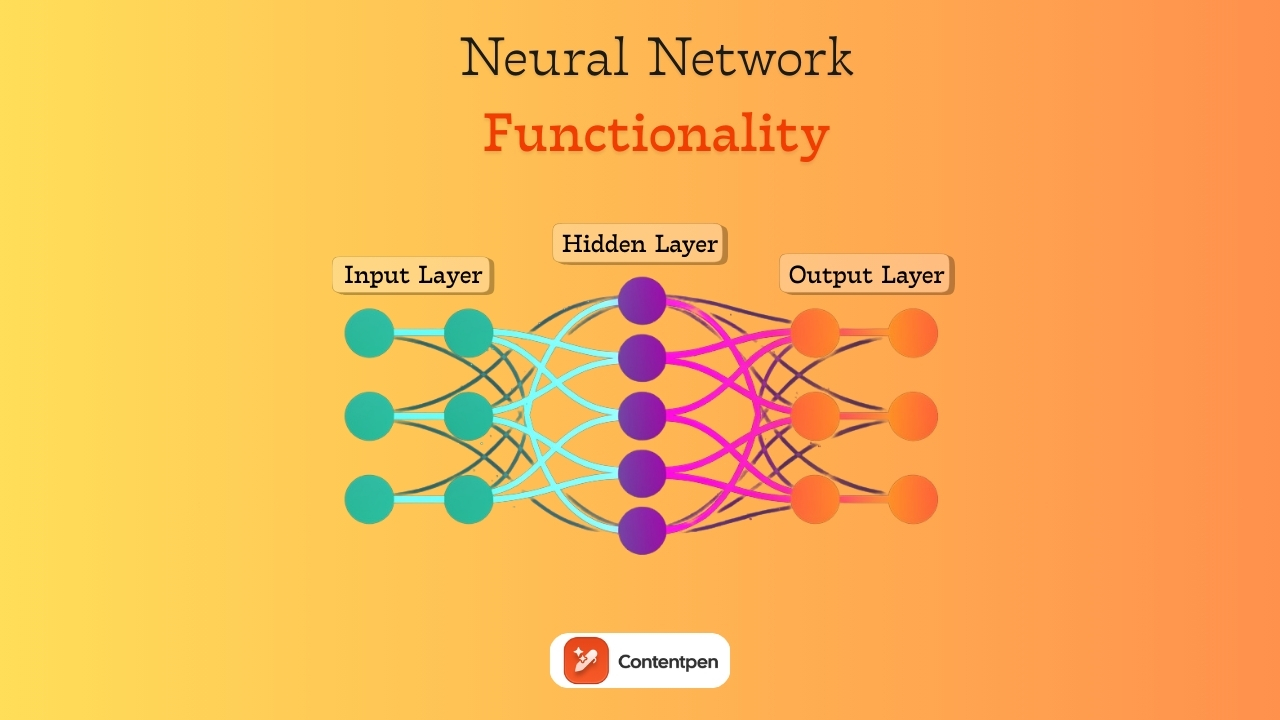
    On the same note, when a build fails, a webhook can open an incident task and notify the team, so fixes start right away.

    Content workflow support for teams

    Many content teams use an AI platform such as Contentpen for research and writing, along with a CMS, project tracker, and analytics tools. 

    When a draft moves from review to approved status, a webhook can perform many tasks. It can create a scheduled publish entry in the CMS, log the piece in a tracking sheet, and share a preview link in a team channel.

    After a post goes live, another webhook can refresh caches or ping SEO monitoring tools to check the SEO health of the page continuously.

    This pattern turns a scattered content workflow into a steady, repeatable system that keeps output moving smoothly without any hiccups.

    IT operations and monitoring

    Monitoring services use webhooks when a server exceeds a CPU threshold, a disk fills up, or an uptime check fails. 

    Automated messages via webhooks can quickly start script repairs, create tickets, and notify on-call staff, often within seconds. 

    These webhook examples are only a starting point. You can automate many other tasks according to your business requirements.

    When you chain several webhooks and actions together, you can build powerful multi-step workflows to boost productivity.

    How to set up and implement webhooks

    Today, most modern tools offer a simple, no-code webhook implementation process so that users of all backgrounds can easily automate their tasks.

    One SEO platform helps you set up and implement webhook integrations effortlessly for content automation.

    1. Get the webhook URL from the receiving app

    Start with the tool that should receive data. This might be a CRM, a project manager, or an automation platform. Open its settings and look for webhooks, integrations, API, or notifications. 

    For demonstration purposes, we will use the free Webhook.site platform to create a dummy webhook URL. 

    Copying webhook URL

    Copy this link; this is where other apps will send HTTP or HTTPs callbacks.

    2. Configure the webhook in the sending app

    Now move to the app where the event happens. In the case of our demonstration, this will be Contentpen.

    Main webhook screen - Contentpen.ai

    Next, go to ‘Integrations’ -> ‘Webhooks’. Click on the ‘Add Webhook’ button to create a new data push request.

    Our tool provides no-code webhook integrations, allowing your team to automate content workflows without any manual intervention.

    3. Specify the trigger event

    Once you are done creating a new webhook instance, decide which event should start it. 

    You might choose from event triggers such as ‘form submitted’, ‘payment completed’, or ‘content published’, depending on your needs.

    In this case, we will use the ‘blog generation completed’ and ‘blog generation failed’ as our parameters to approve the webhook data flow.

    Webhook configuration screen - Contentpen.ai

    On this screen, you will name your webhook, paste the endpoint URL (from Webhook.site), and provide a suitable description.

    Some apps, like Contentpen, let you select multiple events for a single webhook, while others may require a separate webhook per event.

    Click on ‘Save Changes’ and move on to the next step of your basic webhook implementation.

    4. Test the integration

    After you set up the output data formats and other settings in the receiving app, test the webhook implementation to ensure the process completes successfully.

    For this purpose, you can place a fake order, submit a test form, or move a draft through a workflow. 

    Then check the receiving app to see whether the new record appears with the correct values.

    In our test case, we opened Webhook.site to see the results of posting a dummy blog on Contentpen.

    Webhook testing result

    From the screenshot, you can see that the webhook is working successfully.

    With this new webhook, we will receive a blog’s data, including the author name, title, and content, whenever it is generated in Contentpen.

    Similarly, if a blog isn’t created, we will receive a message here with all the details of why the process didn’t proceed as expected.

    Testing and debugging webhooks with essential tools

    Even with careful setup, the first webhook call does not always work as planned. That is normal. 

    Debugging webhooks feels less scary once you have a simple process and the right tools. Two of the most helpful tools in this regard are RequestBin and Postman, along with the free built-in logs many apps offer.

    Debugging webhooks with RequestBin

    RequestBin helps you see precisely what a sending app is posting. You create a temporary URL on the website and paste it into the sending app instead of your actual destination.

    Next, you trigger your event, such as a form fill or test sale. When you refresh RequestBin, you will see the full HTTP request, including headers and the payload body.

    This makes it easy to spot missing fields, incorrect formats, or headers that your target app expects.

    Testing webhooks with Postman

    Postman works from the other side of the webhook data chain. You use it to act like the sending app and call your real webhook endpoint by hand. 

    In Postman, you create a POST request, paste your destination webhook URL, and enter a JSON payload that looks like what the source app should send. 

    When you hit send, you can watch the response and confirm that the receiving app processes the request correctly. If any problems persist, then they must be on the sending side, not the receiver.

    Utilizing webhook delivery logs to check webhooks

    In addition to RequestBin and Postman, you can also lean on webhook delivery logs that many platforms include by default. They show a list of recent calls with timestamps, status codes, and error messages. 

    For instance: A delivery log may show a status code of 200, indicating success, while codes in the 400 or 500 range indicate issues. 

    If you see repeated retries or long delays in the log, that can point to timeouts or rate limits. Later, you can fix these issues at either the sending or receiving end.

    Securing your webhooks best practices

    Webhook protection measures

    A webhook URL is a public endpoint, which means anyone who has it can try to send data there. 

    Strong security measures can keep fake or tampered requests from triggering actions in your systems, avoiding unwanted chaos.

    Threats may come in a few ways:

    • An attacker might try to guess your webhook URL and send bogus data that looks real enough to pass.
    • Someone might capture a valid request and replay it later, causing a single event to run twice.
    • Others might flood an endpoint with calls to slow or crash it.

    The good news is that you can reduce these risks with a few layers of defense.

    Always protect data in webhook transit with HTTPS

    A webhook that uses HTTPS keeps payload data encrypted as it traverses networks. This is the reason why our demonstration also used an HTTPS request rather than plain HTTP.

    On top of this, you can use certificates issued by a trusted authority and renew them on time, so calls do not fail due to expired security certificates.

    Verify payload senders with shared secrets and HMAC signatures

    Many webhook providers let you set a secret value known only to the sender and receiver. When the sender posts a payload, it also calculates an HMAC signature based on the payload and the secret.

    The receiver uses the same secret key to compute its own version and compares the two values. If they match, the request is validated, and it is ensured that the body has not been changed in transit.

    Check timestamps to block replay attempts

    A simple time check adds another layer. The sender includes a timestamp that marks when it created the webhook. The receiver compares that time to the current time and rejects any request that looks too old (like older than a few minutes). 

    When you combine the timestamp with an HMAC signature, attackers cannot change the time without breaking the signature.

    Add tokens, IP checks, and stronger options where needed

    Some apps allow static tokens or API keys passed in headers, which the receiver can validate before doing any work. 

    Firewalls or reverse proxies can limit inbound traffic to the list of IP ranges a sender publishes. 

    High security setups can even use mutual TLS, where both sides present certificates and verify each other before any webhook data flows. 

    Stacking these options together creates a deeper defense and makes casual attacks much harder.

    Summing it up

    A webhook is an automated HTTP or HTTPS callback that passes event data from one app to another in real time. 

    Instead of people shuffling data between tools, webhooks move it quickly and reliably, reducing manual effort.

    In this post, we saw how webhooks work, their everyday use cases, and how to set up and implement them in real-life scenarios

    A good next step is to identify one painful task in your current workflow and set up a small webhook integration to immediately boost productivity for your teams.

    Frequently asked questions

    Can I set up webhooks online?

    Yes. Many platforms let you create and manage webhooks entirely through a browser. You can generate webhook URLs, select events, and monitor deliveries without any installation.

    Do I need coding skills to set up webhooks?

    Most people can set up basic webhooks without writing code. Many apps hide webhook integration behind simple forms where you paste a URL, pick an event, and hit save.

    How do webhooks handle errors and failed deliveries?

    Most webhook providers expect receivers to be down sometimes, so they include a retry logic. When a call fails, the sender tries again after a short wait, then waits longer between later attempts.

    Are webhooks free to use?

    Webhooks themselves are free. However, webhook availability depends on the tool you are using. Some platforms include webhooks in free plans, while others restrict them to paid tiers.

    Can webhooks scale for high-volume applications?

    Yes, webhooks scale well when both sides are designed with volume in mind. Since they send data only when events happen, they waste far less capacity than polling endpoints.

  • Best AI chatbot for business in 2026

    Best AI chatbot for business in 2026

    The rush toward AI tools has been so rapid that choosing among the many options available on the market has become quite challenging.

    The all-important question, ‘which is the best AI chatbot for coding, creating content, or performing other types of tasks?’ keeps haunting businesses and enterprises.

    The answer to this can be a bit more complicated.

    Now, it is no longer about finding an AI assistant; it is about choosing the right mix from dozens of top AI chatbots to perfectly fulfill your needs.

    In this post, we will provide you with an honest breakdown of the best AI chatbots in 2026, highlighting their strengths and weaknesses. By the end, you will be able to make the right decision to automate your workflows and boost productivity across departments.

    So, without further ado, let’s get started.

    What are AI chatbots and how do they work?

    Neural network functionality - Contentpen.ai

    In simpler terms, AI chatbots are software that can hold human-like conversations, either in text or voice, and carry out tasks using artificial intelligence.

    These tools use natural language processing (NLP) and machine learning (ML) algorithms to understand context and provide personalized responses to users.

    On a deeper level, chatbots use neural networks, where each layer serves a purpose. 

    The input layer receives raw, unstructured data from the user and attempts to make sense of it.

    For example: ‘Write me an email explaining to HR why I cannot join the office due to a family emergency.”

    Then, the multiple hidden layers break down this text into tokens or word embeddings for the neurons to process.

    After each node or point in the hidden layer has understood the intent and context of the input, the output layer readies the response and delivers it to the user in a human-readable form.

    Where are chatbots used today?

    Today, modern chatbots are used in many walks of life. These tools are now going beyond scripted, generic responses to provide personalized results for the users.

    Using a similar neural network architecture, these chatbots are trained on millions, and even billions, of parameters, ready to assist users in the best way possible.

    Most AI chatbots can remember past conversations to handle voice calls, book meetings, and trigger workflows intelligently for customer support professionals and other users.

    While tools like ChatGPT are suitable for general use, other chatbots like Perplexity AI can comb through online sources and help users craft an informed academic thesis.

    Related: Gemini vs ChatGPT comparison.

    Therefore, AI chatbots assist marketers, freelancers, business professionals, and everyday users by automating repetitive, mundane workflows.

    What is our criteria to test these AI chatbots?

    Our criteria for evaluating the best AI chatbot in 2026 are as follows.

    • Accuracy: How well does the tool understand and respond to the requests?
    • Knowledge retrieval: Is the chatbot able to extract information accurately from your documents?
    • Agentic capabilities: Can the tool take actions or only answer questions?
    • Integrations: Does the tool integrate with existing systems, calendars, or other tools in the tech stack?
    • Collaboration features: Will your team be able to work together on projects using these tools?

    Choosing the most suitable tool comes down to your niche and the nature of work you want to perform.

    Also read: 12 best SEO competitive analysis tools in 2026.

    Quick Comparison: Top AI chatbots at a glance

    Below are the top 10 chatbots for businesses that we selected today for our run-up:

    ToolBest forStarting priceKey strengthWhy businesses choose it
    ChatGPTGeneral-purpose AI$4/monthMultimodal input processingHandles the majority of tasks with precision
    Google GeminiGoogle Workspace integration$20/monthGeneration of apps via the Gemini APIWorks with commonly used tools like Gmail and Google Drive
    Perplexity AIResearch and competitive intelligence$20/monthDeep internet research with accurate citationsDelivers detailed research reports and documents
    Microsoft CopilotIntegration with Microsoft products$20/monthCopilot visionWorks well with Microsoft 365 tools
    ClaudeDocument analysis and content generation$17/monthClaude codeLong-term contextual retention
    Meta AISocial media marketingFreeUnified chat, image, and short video generationCreates engaging content for Meta platforms
    DeepSeekDeep reasoning and computational thinkingFreeFree deep thinking capabilitiesExcellent for mathematical or logical problem-solving
    Pi AIPersonal useFreeHaving short, meaningful conversationHelpful in answering everyday questions
    Zapier AgentsBuilding and sharing custom chatbots$20/monthNo-code chatbot creation and automationsWorks across multiple apps with automated loops
    Grok AIX integration$30/monthReal-time access to X firehose plusGenerates enhanced lifelike motion and characters

    These chatbots will be evaluated fairly solely on the grounds of their functionality and how they can help modern businesses automate and scale efficiently.

    Let’s review all the top 10 chatbot options you can use today for completing various types of tasks.

    1. ChatGPT – Best overall AI assistant

    ChatGPT interface

    OpenAI’s ChatGPT is one of the most famous and versatile tools for businesses and professionals.

    What does it do?

    ChatGPT helps teams write code, analyze data from documents, create content, and organize projects into steps or agendas.

    Who is it for?

    The tool has become a default AI assistant for business tasks across writing, planning, research, and coding.

    If a team from marketing and sales to development and support can pick only one general‑purpose tool, then ChatGPT would be their usual bet.

    (Also read: Best AI SEO tools in 2026 – tested and ranked).

    Key features

    Amongst many functionalities that ChatGPT can perform, the ones that make it stand out from others are:

    • Creation and refinement of content: With ChatGPT, you can create blog posts, draft emails, shape social calendars, and rewrite copies in different tones.
    • Writing and debugging code: The tool explains errors, proposes fixes, and writes small scripts to help automate internal tasks.
    • Research support: This chatbot can summarize long reports, compare product categories, and surface key trends for competitor analysis.
    • Work organization: ChatGPT helps break big projects into steps, write meeting agendas, and draft surveys with ease.

    With its newer models like GPT-5.2, GPT-5 mini, and GPT-5 nano, the tool keeps on breaching boundaries of what is possible. It also provides its latest DALL-E 3 image-generation model to create visually compelling images and other media.

    Limitations

    While ChatGPT is excellent at handling multimodal inputs (text, voice, and structured data), it does have its limitations.

    • Results can vary depending on the prompt provided
    • Limited direct integrations compared to other chatbots
    • Free usage has restrictions

    Pricing

    OpenAI offers three different pricing plans for individuals and businesses:

    • Free: Limited access to the GPT-5.2 model
    • Go: $4/month
    • Business: $25/month

    2. Google Gemini – Best for Google Workspace users

    Google Gemini interface

    Google Gemini, previously known as Google Bard, is another helpful tool with various applications for business-related tasks.

    What does it do?

    Gemini helps you write code, analyze structured or raw data, and uncover trends and insights to future-proof your business.

    Who is it for?

    This AI chatbot is designed for those who work intensively in Google Workspace and are long-time users of products like Gmail, Google Docs, Sheets, and Calendar.

    It is built for productivity-conscious professionals, such as developers, marketers, and sales personnel.

    Key features

    While Google Gemini has many features to discuss, some of the highlighted ones are discussed below:

    • Dynamic app builder: With Gemini’s ‘dynamic view’, you can create apps and see how they look in real-time.
    • Deep thinking: The tool delves into computational thinking and logical reasoning to help solve complex problems.
    • Information analysis: Similar to ChatGPT, this tool also reads PDFs, image files, and other document types to analyze data trends and uncover meaningful insights.
    • Canvas creation: Gemini can turn your textual ideas into publish-ready infographics, charts, and more.

    Currently, the latest model, Gemini 3, is well integrated with Google applications like Drive and Calendar, helping you stay organized and productive during your shift.

    Limitations

    Like all the other tools, Google Gemini also has some limitations that need to be mentioned.

    • Limited integration outside of Google Workspace
    • Little cross-platform flexibility
    • Can feel less steady or reliable in nuanced writing as compared to other chatbots

    Pricing

    Google Gemini offers three different pricing plans:

    • Free: Limited access
    • Google AI pro: $19.99/month
    • Google AI ultra: $249.99 for 3 months

    3. Perplexity AI – Best for deep research

    Perplexity AI interface

    Perplexity AI is a widely used AI chatbot for market research and competitive intelligence reports.

    What does it do?

    This chatbot understands your input and dives deep into the internet to surface trusted, reliable information with citations to back up that research.

    Who is it for?

    Perplexity is designed for resolving complex research problems. It provides cited responses for marketers and agencies, serving as a data trail or references in reports and documents.

    (Also read: Perplexity vs ChatGPT – which AI tool is better for blogging).

    Key features

    The notable Perplexity AI features are as follows:

    • Deep research: Utilizes advanced reasoning to create a detailed synopsis for a given material, craft a competitive intelligence report, or accomplish similar tasks.
    • Collaborative spaces: Perplexity creates workspaces where you can share ideas and function together as a team.
    • Perplexity labs: The tool turns research results into documents, slide outlines, and other formats.
    • Document processing: Perplexity AI can read and understand extensive PDFs, notes, and other document types to provide detailed analysis.

    Perplexity doesn’t provide a proprietary AI model; instead, it combines a wide range of AI models for deep research.

    Limitations

    This AI chatbot has its own limitations.

    • Limited integration options
    • Shorter memory compared to other chatbots
    • Fewer personality customization options to adjust the tone or style of content

    Pricing

    Perplexity AI offers three different pricing plans:

    • Perplexity pro: $20/month
    • Enterprise pro: $40/seat/month
    • Enterprise max: $325/seat/month
    Solving content overload - Contentpen.ai

    4. Microsoft Copilot – Best for Microsoft ecosystem users

    Microsoft Copilot interface

    Microsoft Copilot is a powerful AI chatbot designed to work seamlessly across Microsoft’s suite of products.

    What does it do?

    Copilot assists users with writing, data analysis, presentations, and task automation directly within Microsoft tools such as Word, Excel, Outlook, Teams, and PowerPoint. 

    Who is it for?

    This chatbot is ideal for businesses and professionals deeply embedded in the Microsoft 365 ecosystem.

    Finance teams, corporate marketers, operations managers, and enterprise users benefit the most from Copilot’s native integrations.

    Key features

    Some of Microsoft Copilot’s most notable capabilities include:

    • Copilot vision: Understands on-screen content to guide users through tasks in real time.
    • Excel intelligence: Builds formulas, analyzes datasets, and generates charts using natural language prompts.
    • Email and meeting assistance: The tool drafts emails, summarizes inboxes, and automatically recaps team meetings.
    • Enterprise-grade security: Copilot inherits Microsoft’s data protection and compliance standards to keep your data safe and secure from threats.

    Copilot works quietly in the background, reducing context switching and helping teams stay focused on execution.

    Limitations

    Just like other tools on our list, this AI chatbot also comes with its own set of caveats.

    • Limited usefulness outside Microsoft products
    • Less flexible for creative or open-ended tasks
    • Advanced features are locked behind higher-tier plans

    Pricing

    Microsoft Copilot offers the following plans:

    • Microsoft 365 premium monthly: $19.99/month
    • Microsoft 365 premium yearly: $199.99/year

    5. Claude – Best for coding and long-form content creation

    Anthropic Claude landing page

    Claude, developed by Anthropic, is known for its thoughtful responses, context-aware writing, and ability to process long, complex documents with ease.

    What does it do?

    Claude helps users analyze contracts, summarize lengthy reports, generate structured content, and reason through nuanced topics. 

    Who is it for?

    The tool is best suited for writers, legal professionals, and teams that work with extensive documentation. It is beneficial when accuracy, clarity, and context retention matter the most.

    (Also read: Claude vs ChatGPT – which AI tool is better for content writing).

    Key features

    Claude offers several standout features for business and professional use:

    • Large context window: Claude processes long documents without losing coherence or clarity.
    • Claude code: The tool assists developers with code understanding, refactoring, and explanations.
    • Clear writing style: Claude produces calm, well-structured responses ideal for formal communication.
    • Strong safety alignment: This AI chatbot is designed to reduce hallucinations and risky outputs.

    Claude’s Opus, Sonnet, and Haiku models can remember and reason over lengthy user inputs. This functionality makes it a dependable tool for producing comprehensive copies or writing effective code.

    Limitations

    While Claude does have a large contextual window, it also has some downsides.

    • No customer-facing deployment
    • Less suited for fast-paced brainstorming
    • Limited options to build shared knowledge bases

    Pricing

    Anthropic’s Claude offers the following pricing plans:

    • Free: Limited access to the latest models
    • Pro: $20/month
    • Max: Starting from $1000/person/month

    6. Meta AI – Best for social media and creative marketing

    Meta AI interface

    Meta AI focuses on helping creators and businesses produce engaging content across Meta’s platforms, including Facebook, Instagram, and WhatsApp.

    What does it do?

    Meta AI generates text, images, and visually appealing short videos for brands and businesses operating on Meta platforms.

    Who is it for?

    This AI chatbot is ideal for social media managers, content creators, and brands that rely heavily on visual storytelling and short-form engagement.

    Key features

    The tool stands out with the following strengths:

    • Unified creative tools: Combines chat, image generation, and short video creation in one place.
    • Platform-native optimization: The tool produces content tailored for Meta’s social networks.
    • Fast ideation: Meta AI generates captions, hooks, and creative prompts quickly and efficiently.
    • Seamless social media insights: Offers suggestions based on trending topics to help optimize post performance.

    Meta AI simplifies the content creation process for brands and agencies through its custom-built Llama models.

    Limitations

    Although Meta AI is a powerful tool for social media content creation and marketing, it still comes with a few caveats.

    • Limited business workflow automation
    • Minimal document analysis features
    • Best suited only for Meta platforms

    Pricing

    Meta AI is free to use.

    7. DeepSeek – Best for reasoning and problem-solving

    DeepSeek landing page

    DeepSeek is a rising AI chatbot known for its strong analytical and reasoning capabilities for technical problem-solving.

    What does it do?

    The chatbot focuses on mathematical reasoning, logic-based problem solving, and step-by-step explanations for complex queries.

    Who is it for?

    This AI chatbot is well-suited for engineers, data scientists, and professionals who need help breaking down detailed, real-life scenarios for advanced applications.

    Key features

    DeepSeek stands out with the following strengths:

    • ‘DeepThink’ reasoning engine: The tool excels at tasks that require multi-step logical reasoning.
    • Clear explanations: DeepSeek breaks complex answers into steps or chunks, allowing you to follow its transparent thinking algorithm and understand the solution with ease.
    • Strong mathematical accuracy: The tool is reliable for mathematical calculations and detailed proofs.
    • High context precision: Maintains accuracy when handling long, technical inputs such as formulas, algorithms, or structured problem statements without drifting off-topic.

    DeepSeek-V3.2 is especially useful for businesses and professionals when precision matters more than creativity.

    Limitations

    Even though DeepSeek is exceptional at reasoning and calculation tasks, it falls short in the following aspects:

    • Limited creative writing abilities
    • Fewer collaboration features
    • Smaller app ecosystem compared to other major platforms

    Pricing

    DeepSeek is free to use.

    Pi AI – Best for personal conversations and guidance

    Pi AI interface

    Pi AI is designed to feel more like a thoughtful companion for personal and professional use than a traditional chatbot.

    What does it do?

    Pi AI engages users in short, meaningful conversations to provide advice, explanations, and support.

    Who is it for?

    This AI chatbot works best for individuals, such as entrepreneurs, leaders, and managers, seeking clarity, reflection, or help with everyday questions.

    Key features

    DeepSeek stands out with the following strengths:

    • Conversational depth: The tool focuses on empathy and clarity in its generated content.
    • Discover mode: Pi AI helps users explore ideas and thoughts through guided dialogue.
    • Minimal interface: Helps reduce distraction and encourages focus.
    • Context-aware follow-ups: The tool remembers the direction of the conversation within a session and asks relevant follow-up questions to keep the discussion meaningful and coherent.

    Pi AI prioritizes human-like interaction over productivity automation or complex content creation, like other chatbots on the list.

    Limitations

    The constraints of using Pi AI are as follows:

    • Not designed for business workflows
    • Limited scalability for teams
    • Unable to carry out intensive document handling

    Pricing

    Pi AI is free to use.

    9. Zapier Agents – Best for workflow automation

    Zapier Agents interface

    Zapier Agents brings chatbot intelligence into automated business workflows for busy professionals.

    What does it do?

    This innovative AI chatbot allows users to build custom chatbots that trigger actions across thousands of connected apps.

    Who is it for?

    This tool is ideal for operations teams, no-code builders, and businesses looking to automate repetitive tasks without writing any code.

    Key features

    Below are the standout features for Zapier Agents explained.

    • No-code agent builder: The tool creates custom AI chatbots without requiring any technical expertise.
    • Extensive app integrations: It works with tools like Slack, Notion, HubSpot, Gmail, and many others.
    • Automated loops: Zapier Agents execute multi-step workflows autonomously without needing any extra effort.
    • Team sharing: The tool allows you to deploy agents across departments with ease.

    Zapier Agents bridges the gap between conversation and action by converting your textual input into streamlined workflows.

    Limitations

    Here are some of the downsides that we discovered with Zapier Agents:

    • Requires ample setup time for enterprise teams
    • Less useful for tasks that require creative input
    • The performance of the workflows depends on the connected apps

    Pricing

    Zapier Agents offers three pricing plans for varying business needs:

    • Free: Limited access to agentic AI capabilities
    • Pro: $50/month
    • Enterprise: Custom pricing

    10. Grok AI – Best for extracting real-time insights from X

    Grok AI interface

    Grok AI is built for users who want instant access to live conversations and trends on X (formerly Twitter). It is also a powerful AI chatbot in 2026 for sophisticated media creation.

    What does it do?

    This AI chatbot assistant analyzes real-time data from X to answer questions, track trends, and generate up-to-date insights. It can also process documents and show fairly adequate reasoning for the majority of the daily tasks.

    Who is it for?

    This tool is best suited for news agencies, analysts, and marketers who rely on real-time public sentiment to cover the latest events and trends.

    Key features

    Here are some of the key features for Grok AI that we believe should be highlighted:

    • Live data access: Unlike other tools that are trained on datasets with certain temporal limits, Grok AI pulls information directly from X’s firehose.
    • Trend analysis: Grok AI easily identifies emerging topics for you to leverage in your posts.
    • Personality-driven responses: The tool offers a more expressive tone in its responses, maintaining that human-like feel in the generated content.
    • Multimedia generation: Grok supports long-form visual outputs that are detailed and character consistent.

    Grok AI’s latest 4.1 model shines when the freshness and accuracy of information are most important.

    Limitations

    Even though Grok is an exceptional tool for media creation and uncovering the latest trends, there are still some limitations worth considering.

    • It is heavily dependent on X data for functionality
    • Limited enterprise integrations
    • Struggles with extended document analysis

    Pricing

    Grok AI offers three pricing plans for users:

    • Free: Limited access to the latest AI model
    • SuperGrok: $30/month
    • SuperGrok Heavy: $300/month

    Which AI chatbot is the best in 2026? [Verdict]

    No chatbot is “best” – it all comes down to your use case, preference, and business application.

    If you want an all-in-one chatbot that handles all your tasks efficiently and you don’t mind heavy prompting, then ChatGPT is a strong consideration.

    But if social media is more your thing and you want a tool that can quickly handle such tasks, then look no further than Meta AI.

    Similarly, tools like Perplexity, DeepSeek, and Grok AI are most suited for businesses and professionals who are more research and detail-oriented.

    However, if you work with restricted ecosystems, such as Microsoft or Google, then offerings like Microsoft Copilot and Google Gemini may be more to your liking.

    Summing it up

    The ‘best AI chatbot ranking’ might not be the most suitable indicator for you to decide on the right tool.

    The decision to choose an AI chatbot for business depends on many factors, including its suitability for your specific application.

    In this post, we highlighted each chatbot’s key features, limitations, and pricing to help you understand all the ins and outs of using them for your needs.

    Now, we hope you can select the appropriate chatbot to accomplish your tasks without any second thoughts or doubts.

    Frequently Asked Questions

    How do I choose the best AI chatbot for my team?

    You should evaluate chatbots based on task fit, data handling, integrations, and scalability rather than popularity alone.

    Can AI chatbots replace human support teams?

    No. While AI chatbots can handle repetitive queries and first-level support, they work best alongside human teams for complex decision-making and relationship-driven tasks.

    What is the difference between an AI chatbot and an AI agent?

    An AI chatbot primarily answers questions, while an AI agent can take actions such as triggering workflows, updating tools, or completing tasks autonomously.

    How often do AI chatbot models improve?

    AI chatbot models evolve rapidly, with frequent updates that improve reasoning, speed, and accuracy. Choosing a tool with active development ensures long-term value.

    Are AI chatbots suitable for small businesses and startups?

    Yes, AI chatbots are especially valuable for small teams because they reduce workload, speed up execution, and provide capabilities that would otherwise require multiple hires.

  • What is on-page SEO? How to optimize pages for robots and readers

    What is on-page SEO? How to optimize pages for robots and readers

    Are you publishing article after article and still stuck on page three of Google? Does it sting a little when a competitor with similar content keeps sitting above you in the results?

    Many people think SEO is either a pile of code only developers touch or a game where only big brands can win.

    That belief leads to random tweaks, guessing at keywords, and asking tools to “check SEO on my site” without a clear plan. 

    On-site SEO is the part you control the most, and even basic on-page SEO tweaks can help you push through the rankings.

    In this guide, you will see a step-by-step workflow for on-site SEO optimization. You will learn how to pick smart keywords, craft title tags, and meta descriptions that quickly earn clicks.

    So, let’s dive in, shall we?

    Understanding the basics and significance of on-page SEO

    On-page SEO, often called on-site SEO, is the practice of improving individual pages on your website so they can rank higher for the right searches and attract visitors.

    It covers both what people see on the page, like headings and copy, and what lives in the HTML, like title tags and meta descriptions.

    This type of SEO includes everything on your site that you directly control, such as:

    • Content quality and depth
    • Keywords, headings, and formatting
    • URL structure
    • Internal links
    • Images and media

    Doing on-page search engine optimization also means improving the user experience, such as enhancing text readability and maintaining a simple, attractive layout. This is part of the SEO checklist that you need to consider for your publication workflows.

    On-page SEO optimization techniques to follow

    You can improve your SERP results and chances to be mentioned in featured snippets by following the given on-page SEO optimization techniques:

    • Keyword research
    • Strategic keyword placement
    • Meta title and description optimization
    • Crafting high-quality content
    • Structuring for readability
    • Building an internal linking strategy
    • Optimizing images and media
    • Improving page speed
    • Using schema markup

    Now, let’s discuss these strategies and techniques in a bit more detail.

    How to conduct keyword research for on-page optimization

    Keyword research and SEO planning materials

    Effective on-page SEO starts with understanding what your audience types into Google when they look for answers, products, or services like yours.

    The strategies for on-page search engine optimization can vary from one organization to another, depending on the niche, search intent, and the target audience they intend to serve.

    With that said, a simple, generic keyword research workflow may look like this:

    1. Brainstorm seed topics: List seed topics that connect to your offers and your audience’s pain points.
    2. Use research tools: Then plug those seed ideas into keyword research platforms like Contentpen. Its keyword module can help surface related terms, questions, and long-tail phrases pulled from real search behavior.
    3. Check volume, difficulty, and competitors: As you review suggestions, pay attention to search volume, keyword difficulty scores, and the kind of competitors already ranking for that phrase.
    4. Prioritize long-tail queries: Long-tail phrases often have lower competition and clearer purchase intent, making them great targets.

    Although looking for the volume of a keyword is essential, you must also consider the search intent relevant to it. This will help you narrow down clicks and secure a more serious audience on the platform.

    Strategic keyword placement throughout your content

    Once you know which keywords to target, the next step is to place them strategically on your website. The goal is to help Google confirm what the page is about without making the copy sound like it was written for robots. 

    There is no perfect density number to chase, but there are parts of the page where keywords matter more.

    Key placement points include:

    • H1 heading – Include your focused keyword once here.
    • Introduction – Place the primary phrase in the first 100–150 words of your content.
    • H2 and H3 subheadings – Weave in primary and secondary keywords where they fit naturally.
    • URL slug – Keep it short and readable with your primary keyword in it.
    • Body copy – Mix the target phrase with natural variations like ‘basic on-page SEO’ or ‘on-site SEO techniques’ (also known as LSI keywords).
    • Image alt text – Describe visuals clearly and add keywords only when they make sense.
    • Meta description – Include the primary keyword once in a natural way.

    Whatever you do, always avoid keyword stuffing, which is where a user repeats exact phrases so often that the text sounds forced.

    Creating title tags and meta descriptions for higher click-through rates

    Title tags and meta descriptions are tiny pieces of HTML that carry a lot of weight. They tell Google what each page is about, helping the search engine crawler to index your pages. 

    When these are written well, you can earn more clicks even before you move up in positions.

    Optimizing title tags for search engines and users

    A meta title is the clickable headline that shows in search results and in the browser tab. It acts as both a ranking signal and a mini advertisement for your content, so it needs to be clear, keyword-focused, and appealing.

    Good practices for title tags include:

    • Aiming for around 40–60 characters to avoid truncation.
    • Placing your primary keyword near the start.
    • Add helpful modifiers like ‘guide,’ ‘checklist,’ ‘fast tips,’ etc.
    • Ensure every page on your site has a unique title tag.

    One simple formula is:

    Primary keyword + modifier + clear benefit

    For example: “On page SEO guide – simple steps to rank higher in 2026.”

    Title tags set the tone for your page and help users know what to expect when they land on your platform.

    Writing meta descriptions that drive clicks

    Meta descriptions sit right under the title in the search results and give people a short preview of your page. They do not directly change rankings, but they have a big impact on whether someone chooses your page or a competitor’s. 

    A clear, honest description also reduces quick bounces, which helps your page perform better over time.

    When you write meta descriptions:

    • Aim for around 140–160 characters
    • Include your primary keyword naturally, preferably at the start
    • Use active voice and explain what the reader gets
    • Add a soft call to action

    For example: “Learn simple on-page SEO techniques that help your site rank on Google. Follow this step-by-step guide and start gaining visibility today.”

    With that said, if you are finding it tough to draft your own meta titles or descriptions, then you can take help from tools like our AI SEO blog writer. It scans your article, studies top competitors, and automatically suggests suitable metadata for your content.

    Creating high-quality content that satisfies search intent

    Creating high-quality optimized content

    On-page SEO is not just about placing keywords in the right spots. The real driver of rankings is whether the content truly answers what searchers wanted when they typed their query.

    To do this well, you need to understand search intent. Some searches are informational, while some show clear buying intent. 

    A simple view of intent types is shown below:

    Intent typeExample queryBest content format
    InformationalWhat is search engine optimizationGuides, explainers, definitions
    NavigationalContentpen loginHomepages, login pages, brand landers
    TransactionalBuy an SEO audit toolProduct pages, pricing pages, service pages
    Commercialbest AI content platformsComparisons, reviews, “best of” roundups

    To understand the right intent for your content, check the first page of Google for your target phrase:

    • Look at what content format appears most often
    • Study what questions the top pages answer
    • Spot what they miss. This is where you can add an information gain.

    For example: How to do SEO – If every top result is showing a basic step-by-step guide to this process. Then you need to take it a step further and write the dos and don’ts of SEO.

    Resolving content overload - Contentpen.ai

    Remember,  a strong copy keeps people hooked and engaged, which sends Google a positive signal that your content is worth ranking.

    Structuring content for readability and AI-powered search

    Modern search is no longer just about blue links and ten results. Large language models and features like AI overviews need to quickly extract clear, concise chunks of text that answer narrow questions. 

    That means your content must work well for both human skimmers and AI systems. For readers, a proper blog structure is what makes a long text feel easy on the eyes.

    You can use question-style headings, such as “How do I optimize my title tag,” so both humans and search engines instantly know what is coming next.

    Short, quotable sentences that stand well on their own are also more likely to be pulled into featured snippets and AI summaries.

    Building an effective internal linking strategy

    Internal linking strategy - Contentpen.ai

    Internal links are links from one page on your site to another, and they are one of the most underused parts of on-page SEO optimization.

    They help search engines understand how your content relates, spread authority from strong pages to newer ones, and guide users to the next helpful piece.

    When search bots crawl your site, they follow internal links to discover new pages and to see which pages you treat as most important. 

    A well-planned internal linking setup makes it easier for crawl bots to map your topics and helps them index deep pages faster.

    Think about your key pages first, such as:

    • High-value service pages
    • Pillar blog posts
    • Detailed guides on on-page SEO and off-page SEO

    Then look for chances across your blog and other content to link to these targets with natural, keyword-rich anchor text, not generic “click here” links. 

    Mix links from the homepage, category pages, and related posts so there are many paths leading to each critical page.

    Optimizing images and media for on-page SEO

    Images, diagrams, and videos make content far more engaging, but they can also slow down pages if you don’t optimize them. 

    Since slow pages hurt user experience, image work is a key part of on-page SEO, not just a design concern.

    To optimize media:

    • Use descriptive file names before upload (for example: on-page-seo-checklist-example.jpg instead of IMG_7890.jpg).
    • Add alt text that clearly describes the image in a short phrase, such as “screenshot of on-page SEO analysis dashboard.”
    • Keep alt text to approximately 150 characters.
    • Compress images so they are as small as possible without looking blurry.
    • Choose appropriate file formats (JPEG and WebP for photos, PNG for simple graphics).
    • Use lazy loading so images load as visitors scroll, not all at once.

    When you handle these steps, you support accessibility, protect your speed, and even open the door to traffic from Google Images.

    Improving page speed and Core Web Vitals

    Mobile and desktop page speed testing

    Page speed has a direct impact on both SEO and revenue. People do not wait around for slow pages, and Google measures that behavior through a group of metrics called Core Web Vitals.

    The main Core Web Vitals are:

    • Largest Contentful Paint (LCP) – How long does it take for the main part of your page to become visible? Aim for 2.5 seconds or less.
    • Interaction to Next Paint (INP) – How quickly the page reacts when a user first interacts. Keep this under 200 milliseconds.
    • Cumulative Layout Shift (CLS) – How much the layout jumps around while loading. Lower is better, so people do not mis-tap buttons or links.

    You can run quick checks with PageSpeed Insights or look at real user data in the Core Web Vitals report inside Google Search Console to resolve these problems. 

    Even small gains matter here as they can have a huge impact on your search engine results.

    Using schema markup for rich snippets

    Schema markup is a small extra layer of code that you add to your pages to describe their content in a way search engines can read with more precision. 

    While schema by itself does not push you up the rankings, it enables rich snippets, which are search results with extra details that can tempt more clicks.

    For content teams and marketers, the most useful schema types often include:

    • Article schema – Tells Google that a page is a blog post or news piece and provides information like author, date, and headline.
    • FAQ schema – Marks up question and answer blocks, which Google can show directly in the search results as expandable sections.
    • How-to schema – Describes step-by-step tutorials.
    • Product, Review, and Local Business schema – Share data about items you sell, ratings, prices, and business details.

    You can generate a schema by using helpers from Google and many WordPress plugins. After adding it, test your pages to confirm that Google can read the markup.

    Because many sites still ignore schema, using it on your high-intent pages can make your results stand out from others in no time.

    The role of external links in on-page SEO

    Some site owners fear that linking to other websites will drain their rankings, but that is not how search works. 

    Thoughtful external links can actually support your on-page SEO by demonstrating that you base your claims on solid sources and by providing readers with extra value.

    When you cite respected studies, industry blogs, or official documentation and link out to them, you signal that you are part of the broader conversation on that topic. 

    Readers get paths to dig deeper if they want more background, which builds trust and can keep them in your content longer. 

    Search engines also use these connections to better understand what your page is about and how it fits into the topic space.

    Keep these practices in mind:

    • Choose external sites that are relevant, trustworthy, and stable
    • Use descriptive anchor text that tells people what they will find when they click
    • Keep the number of external links balanced so they support your points
    • For links that come from sponsorships or that you would rather not vouch for, mark them with attributes like rel=’nofollow’ or rel=’sponsored’.

    By following these practices for external links, you can make sure that your content is established as an authority on the World Wide Web, favoring more clicks.

    Measuring and monitoring your on-page SEO performance

    Tracking SEO performance with analytics dashboards

    On-page SEO is not a one-time checklist you forget about once it is done. Search behavior, competitors, and even your own offerings change over time. 

    So, you need a repeatable way to track performance and decide what to improve next.

    Begin with core metrics:

    • Organic traffic – How many visitors arrive from search, and which pages draw the most attention.
    • Keyword rankings – Where you stand for important phrases such as “rank your site on Google.”
    • Click-through rate (CTR) – How often people pick your result when they see it (from Google Search Console).
    • Engagement metrics – Bounce rate, average time on page, and pages per session, which hint at how well your content matches intent.

    Plan regular content audits every quarter. Look for ways to improve your blog and consider fresh keyword research. 

    Also, during these reviews, try to update outdated stats and screenshots. Strengthen internal links and fix technical problems such as broken links or slow pages.

    The shift to generative engine optimization (GEO)

    Since generative AI systems like ChatGPT, Google’s AI overviews, and others have surfaced, generative engine optimization (GEO) has become more common.

    GEO requires you to answer user questions directly and cut out the fluff from your content. This increases the likelihood of your work being featured in snippets and AI mentions, helping you attract more traffic and eventually get more clicks and visibility.

    Focusing on SEO and GEO is what makes your pages optimized for both robots and readers. 

    Why choose Contentpen for SEO and GEO optimized content

    Contentpen helps your content look more refined, SEO-optimized, and readable for the audience. 

    It allows you to take complete control of your content by incorporating the right keywords, optimizing for organic traffic, and keeping tabs on your SEO score.

    The finalized content is not only ready for more discoverability, but is also easily read and understood by the robots.

    Boosting on-page SEO with SEO scoring

    Our tool utilizes SEO scoring to assist you in performing the right edits before you hit publish.

    It shows your content’s keyword optimization, content structure, meta details, and media optimization indicators in one place, guiding your on-page optimization strategies.

    The tool also shows details regarding the linking strategy and semantic relevance, boosting your platform’s discoverability.

    Keyword research with Contentpen

    Contentpen automatically analyzes your niche and competitors to provide you with the best keywords for ranking.

    The tool saves hours of manual research for keyword research, streamlining your workflows and boosting your productivity in no time.

    Optimizing organic traffic

    Our AI blog writer not only helps you create SEO-optimized content, but also tracks, analyzes, and optimizes organic traffic for your platforms without switching tabs.

    Contentpen is proficient in expanding your reach through smart SEO and GEO optimization tactics, leveraging SERP analysis, structure enhancer, and much more.

    Publishing content at scale also becomes easier with the Contentpen’s scheduling and bulk creation capabilities.

    Summing up

    On-page SEO sits at the heart of strong search performance, and the best part is that it is entirely in your hands. 

    By focusing on page-level details, you give every article, landing page, or product page a better chance of appearing when people search for information related to it.

    Across this guide, you have seen how to move your on-page SEO optimization from guesswork to a straightforward process.

    You can now implement these strategies to win more clicks and retain every customer in your base.

    Frequently asked questions

    What is the difference between on-page and off-page SEO?

    On-page SEO focuses on content optimization, while off-page SEO involves building authority through backlinking.

    How do I get on-page SEO keywords?

    You can use different tools to get these keywords, such as Contentpen, Ahrefs, and others. Make sure to find the ones that match your content and webpage’s intent.

    What are the 4 types of SEO?

    The four main types of SEO are on-page, off-page, technical, and local SEO. These focus on different aspects of a website, helping it reach higher rankings.

    Can I rank without backlinks if I have perfect on-page SEO?

    Great on-page SEO can help you rank for low-competition long-tail searches. However, for more competitive phrases, you usually need a mix of strong on-page work and quality backlinks to reach the top spots.

    What are the 3C’s of SEO writing?

    The 3C’s of SEO writing are content, code, and credibility. This means that you provide high-quality information (content) that is accessible to search engines (code) and is trustworthy to other users (credibility).

  • What is SEO? A practical guide for beginners

    What is SEO? A practical guide for beginners

    Search engine optimization can feel frightening for many, but it doesn’t have to be. With the right tools, strategies, and implementation, your website can achieve the visibility you want, all without much hassle.

    But, ranking a website online starts with two simple questions: ‘What is SEO? and ‘How to do SEO?’

    Getting answers to these questions helps you rank your content and reach the right audience at the right time.

    In this guide, we will walk you through what SEO is, how search engines like Google work, and how to build a practical SEO strategy from scratch. By the end, you should understand the search engine basics well enough to start improving your search rankings. 

    So, let’s get started.

    What is SEO: understanding the fundamentals

    Website traffic analytics showing organic growth

    At its core, search engine optimization (SEO) is the practice of improving a website so that search engines can place it well for people.

    So when people ask what SEO is, the short answer is that it is how a website earns visibility instead of staying hidden.

    When someone types a question or phrase into Google, SEO helps decide whether a page appears near the top, somewhere on page five, or not at all. 

    The purpose of SEO

    Good SEO optimization is less about tricks and more about making helpful content, organizing pages, and fixing technical issues that block search engines.

    The main goal is to appear as high as possible in search rankings for important keywords. The top organic spots capture most clicks, with only 0.63% searchers going beyond the top 10 results. 

    This shows why SEO in digital marketing is such a high priority for brands and agencies, especially those with tighter budgets for paid ads or PPCs.

    Difference Between SEO, SEM, and PPC

    SEO sits inside a bigger bucket called search engine marketing (SEM), which covers every way a business can gain traffic from search engines, both paid and unpaid.

    Search engine optimization focuses on earning visibility in regular, non-ad results, while PPC (pay-per-click) focuses on paying for ad placements in search results.

    Here is a simple comparison:

    AspectSEOPPC
    PaymentNo fee per click; investment is time, content, and toolsPay every time someone clicks an ad
    SpeedSlower to see results, but more durableVery fast visibility, but stops when the budget stops
    PerceptionOften seen as more trustworthy because it is organicSeen as advertising, clearly labeled
    ControlLess control over the exact positionMore control through bids, budget, and targeting

    For most brands, the smartest approach is not SEO versus PPC, but combining them. PPC can bring in fast traffic and test which keywords convert, while SEO builds long-term visibility and reduces reliance on ads over time.

    How search engines work: the three core stages

    To understand what SEO is in practice, it helps to look at how search engines like Google work behind the scenes. The details are complex, but the basic flow comes down to three steps:

    1. Crawling – discovering pages
    2. Indexing – analyzing and storing pages
    3. Ranking – ordering results for each search

    SEO is about making each of these stages as smooth and efficient as possible for both robots and readers.

    Crawling: How search engines discover your content

    Crawling is the discovery step. 

    Search engines send automated programs (often called crawlers, spiders, or bots) to move from page to page across the web.  

    Each link is a path, so when a crawler finds a link, it can follow that link to discover a new page. If those paths are broken or confusing, crawlers may miss important pages. 

    A site with clear internal links, simple navigation, and logical structure can make a lot of difference for the discoverability of your site.

    Indexing: How search engines analyze and store your content

    Once a crawler reaches a page, the next step is indexing. During indexing, the search engine reads the page, looks at text, images, video, and code, and then stores this information in a massive database called the index.

    Pages with clear titles, meta descriptions, headings, and alt text for images are easier for search engines to understand and match to the right searches.

    Ranking: How search engines determine the order of results

    When someone types a query, Google scans its index for relevant pages and uses many SEO ranking factors to decide which ones appear first.

    While there are hundreds of signals in play, focusing on quality content, solid UX, and meaningful SEO backlinks covers the main areas that affect rankings.

    The four types of SEO: on-page, off-page, technical, and local

    There are four main types of search engine optimization (SEO), often called the SEO pillars:

    These define a brand’s presence on the Internet and support each other in one way or another. 

    For instance, fixing a technical issue can help existing pages rank better. Similarly, publishing better content makes link building easier, and strong backlinks help pages hold their positions during algorithm updates.

    On-page SEO: optimizing your content and HTML

    On-page SEO covers everything the visitor sees and the HTML that describes it. This is where writers, editors, and content strategists have the most direct control.

    Key elements of on-page SEO include:

    • Writing content that answers real questions in depth
    • Using keyword research to guide topics and wording (without stuffing)
    • Structuring content with clear H1, H2, and H3 headings
    • Writing descriptive title tags and meta descriptions
    • Adding alt text to images for accessibility and image search
    • Creating clean, descriptive URLs
    • Adding internal links to relevant pages

    Many teams now use SEO tools to track an SEO score for each page and catch missing meta tags or weak headings. Platforms like Contentpen help you incorporate this guidance into the writing flow, so on-page optimization happens as content is created.

    Off-page SEO: building authority and reputation

    Off-page SEO is about how the rest of the web responds to a website. While on-page work explains what a page is about, off-page signals help show how important or trusted that page is.

    The biggest off-page factor is SEO backlinks. When another site links to a page, it acts like a recommendation. A link from a respected, relevant site carries far more weight than many links from low-quality sites.

    Proper off-page signals include:

    • Natural SEO backlinks from blogs, news sites, and partners
    • Brand mentions, even when they are not linked
    • Positive reviews and ratings on third-party platforms
    • Consistent, genuine activity on social channels that encourages sharing

    Because off-page SEO depends on internal links, it is harder to control directly. That makes high-quality content, real outreach, and long-term relationships far more valuable than quick link schemes that risk penalties.

    Technical SEO: optimizing your site’s foundation

    Technical SEO deals with the structure and performance of a site. It addresses how easily search engines can crawl and index pages and how well those pages perform on different devices.

    Core areas of technical SEO include:

    • Crawlability and indexability
    • XML sitemaps
    • Robots.txt File configuration
    • Canonical tags
    • Stable layouts (good Core Web Vitals)
    • Responsive design
    • Structured data (schema markup) for products, FAQs, events, etc.

    For many marketers, technical SEO can feel intimidating. The good news is that modern website builders, plugins, and tools do much of the hard work, or at least flag problems that you can later fix with ease.

    Local SEO: optimizing visibility in location-based searches

    Local SEO focuses on helping businesses appear in location-based searches and map results. When someone searches for “coffee shop near me” or “dentist in Austin,” Google prioritizes businesses that are physically close and relevant to that query.

    Key elements of local SEO include:

    • Google My Business (GMB) profile optimization
    • Local citations and consistency in name, address, and phone number
    • Location-specific content and keyword usage in content
    • Reviews and reputation management
    • Earning backlinks from local vendors, news outlets, or organizations

    Local SEO works best when combined with the other pillars. 

    A fast, mobile-friendly site with helpful content and strong backlinks will rank better locally than a poorly built site with just a Google Business Profile.

    As search engines evolve, optimization is no longer limited to ranking pages alone. AI-driven systems are now reshaping how information is discovered and presented.

    Your step-by-step SEO workflow

    The SEO roadmap details

    Knowing the fundamentals of SEO is helpful, but results come from following a repeatable process. 

    SEO is not a one-time checklist – it is an ongoing cycle, one that is built upon the following steps: Research, strategy, implementation, analysis, and adjustments.

    A solo writer can use this loop for a single blog post, while a large agency can apply it across hundreds of pages. Tools and platforms like Contentpen fit into this process by reducing work during manual research and content creation while also enabling batch processing.

    Step #1: Conducting comprehensive research

    A good search engine optimization starts with conducting solid research. This includes the following elements:

    1. Audience research – roles, pain points, common questions, and the language people use
    2. Keyword research – search volume, difficulty, and intent
    3. Competitor and SERP analysis – who already ranks, what they cover, and where they fall short
    4. Site audit – current rankings, thin content, broken links, and technical issues

    Conducting research is a good starting point, but it will lead you to nothing when you can’t plan and implement a proper strategy.

    Step #2: Planning your SEO strategy

    Once keyword research is completed, the next step is to plan an SEO strategy that is aligned with your business goals.

    A simple plan might look like this:

    1. Choose priority keywords – aim for terms with solid search volume, reasonable difficulty, and strong relevance to what your site offers.
    2. Set measurable goals – for example, increase organic traffic by 25% in six months, or move three key phrases from page two to page one within 90 days.
    3. Map keywords to content – decide which existing pages to improve and which new pages to create.
    4. Build a content calendar – plan when to publish new pieces and when to refresh older content.

    Make sure to document the planning process so others can repeat it without any hiccups.

    Step #3: Implementing the SEO strategy

    After you are done with the planning of your SEO strategy, it is now time to implement it for your website.

    You can do the following to put your strategies into motion:

    1. Schedule technical and off-page tasks – group fixes like site speed improvements and mobile issues into sprints.
    2. Set up monitoring and analytics – use tools like Google Analytics to track traffic, rankings, click-through rates, and conversions. Set up dashboards or regular reports to spot trends early and see which efforts are working.
    3. Commit to Ongoing SEO – Schedule regular content audits, keep refreshing outdated pages, and stay informed about algorithm updates and industry best practices.

    Review this plan regularly (quarterly works well for bulk content creation) and adjust based on new data. Repeat your set processes to reap significant rewards in the long run.

    How SEO is evolving in 2026

    Search is no longer limited to a list of blue links. In recent years, search engines and AI-driven tools have started answering questions directly. The tools summarize information and highlight sources without requiring users to click through multiple pages. 

    Understanding generative engine optimization (GEO)

    In simpler words, GEO is the type of search engine optimization that builds on the foundations of traditional SEO. The only change is in how content is surfaced and used.

    However, let’s clarify one thing here: GEO is not replacing SEO in any way possible. 

    In fact, properly SEO optimized content facilitates generative engine optimization, enabling even more discoverability for your platforms.

    Answer engine optimization (AEO) and how it works

    Similar to generative search optimization is answer engine optimization (AEO). This means modifying your content so that AI search, voice assistants (like Siri or Alexa), and chatbots (like ChatGPT) can identify and present relevant answers to the public based on the query.

    Instead of only ranking pages, generative systems may pull short explanations, definitions, or steps from multiple sources and combine them into a single answer. 

    This means that optimizing content for GEO and AEO requires:

    • Helpful, well-structured content
    • Clear explanations and intent-driven pages
    • Solid technical foundations
    • Genuine authority and expertise in responses

    As search continues to evolve, SEO is becoming less about optimizing for a single format and more about making information easy to find, understand, and trust.

    Although understanding how SEO, GEO, and AEO work is essential, real progress comes from applying these principles through a clear, repeatable process.

    Why SEO matters for your business

    SEO is not just a technical topic for specialists. It is a business decision that affects how many people discover a brand, how they feel about it, and how often they become leads or customers.

    Paid ads stop the moment a budget is paused. SEO work, on the other hand, can keep paying off for months or years as content continues to rank. That is why many teams see SEO in digital marketing as an investment rather than a cost.

    SEO also supports other channels:

    • Strong blog posts and guides can feed email campaigns
    • Helpful articles give sales teams resources to share
    • Well-structured content shared on social media

    For smaller businesses and solo creators, SEO is often the most realistic way to compete with bigger brands that dominate paid ads.

    Driving high-quality, targeted traffic

    One of the biggest strengths of SEO is the type of traffic it brings. SEO is an inbound channel. People come to a site because they are already searching for an answer, product, or service.

    Studies from BrightEdge have reported that organic search can drive more than 50% of all website traffic. 

    Even more important than volume is intent. Someone searching “best project management software for agencies” clearly has a specific need and may be close to buying. While searches like “Most common SEO mistakes” clearly indicate an informational intent.

    Compared with many social feeds, where most users browse casually, search traffic usually arrives with a clear goal. That tends to lead to higher-quality leads and more efficient conversions.

    Building trust and authority

    Appearing near the top of organic results carries strong psychological weight. When people see a brand show up again and again for important queries, they start to assume that the brand knows what it is talking about.

    Pair that with a clean design and straightforward navigation, and visitors are far more likely to stay, return, and eventually buy.

    Over time, returning visitors, positive behavior signals, and brand searches all feed back into how search engines view your site.

    Gaining visibility in different SERP features

    Modern search results contain much more than a simple list of links. For many queries, you will see:

    • Featured snippets – short answer boxes pulled from a page
    • People Also Ask boxes – related questions users often click
    • Local packs – map results for nearby businesses
    • Image and video carousels – visual results for media-friendly topics
    • AI Overviews and summaries – AI-generated answers that cite web pages

    Each of these is another chance for a brand to appear. Thus, choosing a clear structure, good headings, and concise answers in your content will increase the odds that your content will be selected for these spots.

    How Contentpen can help you write SEO-optimized content

    Contentpen features help you write search-engine-optimized content in no time. The SEO platform automates many tedious tasks associated with hunting for keywords, fixing vital SEO elements, and more.

    Keyword research using Contentpen

    Our AI blog writer helps uncover the most relevant and suitable keywords for your niche and search intent. It comes with all the up-to-date data scraped directly from the search engines, helping you implement your SEO strategies with confidence.

    AI Generate Keywords feature - Contentpen.ai

    The tool also comes with the ‘AI Generate Keywords’ feature that allows you to get the best keywords for your type of content with one click.

    Content pillars feature - Contentpen.ai

    You may also create content pillars and topic clusters to organize your SEO efforts for better outreach and visibility on user searches.

    SEO Score for quick content polishing

    Besides keyword research, Contentpen may also assist you in quickly refining your content for a better SEO score. It functions as your SEO checklist, allowing you to ramp up the production workflows and bypass any hurdles in the process.

    Review the SEO score and fix problems - Contentpen.ai

    Understanding and fixing the highlighted issues by the system can help you publish content that is ready to rule the SERP results. You might still need a bit of manual tweaking, but not too much that you’d do otherwise.

    Metadata settings for more discoverability

    Finally, our tool also helps writers, bloggers, content marketers, and businesses come up with compelling Meta titles and descriptions for their pages.

    SEO and article settings - Contentpen.ai

    In this example, the metadata for the blog ‘How to write a summary’ is automatically generated for the user. You can edit the information as per your convenience and use the SERP preview to visualize the data before finalization.

    Summing it up

    Answering the question ‘What is the SEO of a website’ starts with understanding the basics. SEO turns a website from a quiet brochure into a working asset that brings in visitors, leads, and customers around the clock. 

    Instead of relying only on ads or word of mouth, a brand with strong SEO basics can show up at the exact moment someone is looking for answers.

    SEO can feel like a lot at first, especially with new terms and tools in the market. The important thing is to start small with the simple steps so that your site doesn’t end up lost in the abyss of the World Wide Web.

    Frequently asked questions

    How long does SEO take to show results?

    SEO is not instant. For most sites, a realistic window to see clear movement is three to six months, with stronger gains often appearing between six and twelve months.

    Can you do SEO yourself, or do you need to hire an expert?

    Many people can handle a large part of SEO on their own, especially for smaller or simpler sites. Experts are most helpful for deep technical work, complex site structures, or very competitive industries.

    What is the 80/20 rule in SEO?

    The 80/20 rule states that 80% of your organic results come from 20% of your efforts (pages, keywords, backlinks, and content). It is also known as the Pareto Principle.

    How much does SEO cost?

    There is no single price tag for SEO because costs depend on many factors. You do not pay search engines for organic clicks, but you do invest in time, SEO tools, content creation, and possibly outside help.

    Is SEO still relevant with AI and chatbots changing search?

    Yes, SEO is still very important. AI overviews and chatbots rely on content from websites to generate answers. If a site is not well optimized, it is less likely to be chosen or cited by these systems.

  • The ultimate guide to optimized content marketing for SEO success

    The ultimate guide to optimized content marketing for SEO success

    Digital marketers explore every possible route to connect with their target audience and drive more leads. Their efforts usually include a mix of SEO strategies, content marketing, and improving the design and usability of their websites. The goal? To attract, engage, and convert more users.

    But achieving real growth with SEO isn’t something that happens by luck. It requires consistent effort, strategic planning, and a lot of patience. From keyword research and high-quality content creation to technical optimization, every element on the SEO checklist plays a role in improving search visibility.

    Before we dive deeper into how content marketing supports SEO growth, let’s start by understanding the basics.

    What is optimized content marketing?

    Brands and influencers aim to capture as much attention as possible through various content channels, including blogs, newsletters, and social media. However, the attention is the result of a highly effective marketing campaign that creates waves in the industry.

    To get that sort of attention, one needs hyper-targeted, value-driven content. This is where the optimized content marketing comes in. What is optimized content marketing? You might be wondering now!

    Let’s get right into it.

    Definition and importance of optimized content marketing

    Optimized content marketing refers to the process of strategically enhancing the quality of content to increase its reach, visibility, and ranking, thereby achieving specific goals with precision and effectiveness.

    For instance, a software company might want to bring new customers on board by offering the prospects a 30-day free trial with no strings attached. This company may need to position its software as a must-have tool to accomplish the task. Therefore, this company needs to optimize its content marketing strategy accordingly.

    Here’s why optimized content marketing is important for any marketing campaign:

    1. Laser-focused consumer targeting

    The approach of “throwing it at the wall and seeing what sticks” doesn’t always work in content marketing. The laser-sharp targeting enhances your content marketing efforts, enabling brands or individuals to produce highly optimized, effective content that consistently hits the mark.

    2. Content gaps identification

    One of the reasons optimized content marketing is crucial to your digital marketing campaign is that it encourages you to identify content gaps in the space. It lays a strong foundation for your content marketing strategy, which ensures a competitive edge and market dominance.

    Also read: Top 10 AI writing tools to speed up your content creation

    3. Problem-solving content distribution

    Optimized content marketing requires a strategic approach to creating and distributing value-driven content that solves real-life issues faced by the prospective audience. When such high-quality, targeted content gets published, it’s most likely to bring better ranking, more social reach, and increased conversion rate.

    4. Analyzing marketing content performance

    An optimized content marketing campaign can’t be completed without proper monitoring and analysis of the process. It allows marketers or brands to identify weaknesses, ensuring they are addressed next time.

    Why optimized content matters for SEO and conversions

    A website or blog doesn’t stand a chance in the SERP if its content isn’t optimized for SEO, and the same goes for conversion. Let’s shed some light on the role of content optimization in SEO and how it impacts conversion rate.

    Role of content optimization in SEO

    A common perception about SEO is that backlinks, meta tags, and keyword selection are the most important aspects of SEO, which is correct to some extent. However, SEO isn’t complete without content optimization.

    Content optimization encapsulates keyword selection, sentence structuring, on-page optimization, content scanability, and problem-solving ability.

    Therefore, content optimization plays a pivotal role in the SEO growth of a website or blog, which makes it almost irreplaceable in the SEO game.

    Driving conversions with optimized content

    A misconception about high-quality content is that it drives conversion just because it’s well-crafted, grammatically correct, and easy to read. However, it’s not necessarily true that high-quality content would also be optimized for conversion.

    The point is that optimized content is fine-tuned for conversion. Not only is it well-written, but it is also written with a goal in mind. Usually, optimized content pushes the readers to take some action, such as sign up for a trial, fill out the form for a demo, access the downloadable file, or buy the product.

    It’s safe to say that optimized content is crucial for driving conversions, no matter what your niche is.

    It’s quite evident that SEOs and conversion optimization experts heavily rely on content optimization to not just grow organic traffic but also to drive conversions.

    Related: 30 recent innovative content marketing examples.

    How Contentpen supports optimized content marketing

    The outcome of an optimized content marketing campaign isn’t a fluke. It requires a plan of action that translates the content marketing strategy into a high-performance marketing campaign.

    The infusion of AI and automation in content marketing works as an icing on the cake. Let’s discuss how automation and AI-powered tools can help shape an optimized content marketing strategy.

    Here’s the breakdown of how to automate your content optimization workflow:

    1. Keywords hunting

    First things first, your keyword targeting needs to be spot on. The only caveat is that SEO analysis and keyword tracking tools are too expensive for most users. Therefore, everyone needs an affordable and effective solution to this problem.

    Contentpen is an advanced AI blog writing tool that generates high-quality, optimized articles in minutes. The best part about Contentpen is that it has a built-in keywords tracking tool, which works like an alternative to Google Keyword Planner.

    Add keywords

    All users need to do is plug in some keywords in it, and it will automatically start tracking those keywords and report back on various metrics, such as search volume, CPC rate, competition, etc.

    2. Create optimized content using AI

    Once the keywords have been identified, the next step is to create optimized content using AI. Contentpen offers an excellent AI-based article writer. Head over to the Planner tab and click on the “Create Article” button.

    create article

    A pop-up window would appear asking for the type of article to generate. 

    Choose the “Generate article with AI” option to proceed.

    Generate article with AI

    Add article details, such as title, keyword, formatting, structure, and media, to generate an optimized article. 

    Create your preset

    Once all the details have been added, proceed to the next step. 

    Double-check all the data and click on the “Create” button to generate the article.

    Create your article

    Also read: What is AI-generated content.

    3. Automate internal and external links

    Manual internal linking is hard and time-consuming. It may take hours and hours to find the relevant articles and add internal links to a handful of articles. When it comes to optimized content marketing, everyone needs a faster, reliable tool that does internal linking rapidly and accurately.

    This is where Contentpen comes in, as it allows users to generate both internal and external links with a press of a button. Adding internal and external links to an article has never been easier. 

    To add both types of links, go to the “Create Article” section and choose the “Add internal and external links” option.

    Add external or internal links

    Now provide the keyword, topic, and URLs to let the Contentpen process all the details. 

    Add keyword and topic

    At the next stage, Contentpen would ask you to paste the content. So, go ahead and paste the article. 

    Paste your Article

    It will automatically process the internal and external links and include them in your article. Furthermore, Contentpen is intelligently developed to avoid linking to your competitors. 

    Add sitemap

    Add your sitemaps for internal linking. Plus, this is where you can include and exclude websites for external links. 

    Finalize your links

    Once your links are finalized, click on the “Create” button to add links to your article. 

    This is yet another important aspect of automating the content optimization workflow.

    How Contentpen ensures SEO-friendly content every time

    Contentpen is no ordinary AI-writer that just spits out articles on the given topic. It uses technology to learn and train its system to create SEO-friendly, effective content every time the user hits the “Create Article” button.

    Behind its cutting-edge software technology, it utilizes multiple knowledge assets, such as brand voice, website details, and other text-based information about the client’s brand to keep its memory updated.

    Brand voice

    It ensures that the content it produces is SEO-friendly, value-driven, and keyword-oriented, so that every piece of content is aligned with the client’s brand.

    How to optimize content for SEO: Step-by-step checklist

    To understand content optimization, you must start with the basics. These key elements form the foundation of the entire process. Once you’re familiar with them, implementing a structured checklist becomes much easier. Let’s break it down:

    1. Understand keywords and search intent

    Content optimization starts with identifying the right keywords and aligning them with user intent. Keyword research helps uncover niche-relevant terms that guide your content strategy. Understanding search intent ensures you’re targeting the topics your audience is actively searching for. Both are vital for ranking and relevance.

    Best practice: Use your target keywords naturally within your content.

    Common mistake: Avoid keyword stuffing, as it harms readability and makes your content look spammy in the eyes of search engines.

    2. On-page and technical optimization

    Optimization goes beyond the surface. On-page SEO includes placing keywords in the title, subheadings, and early in the content. It also involves internal linking and adding relevant alt texts to images. Technical optimization includes improving page speed, mobile responsiveness, and structured data to ensure search engines can crawl and understand your site effectively.

    Best practice: Always optimize meta titles and descriptions to improve click-through rates.

    Common mistake: Avoid using misleading or clickbait headlines that don’t reflect your content. They can drive visitors away quickly.

    3. Improve user experience and readability

    A key aspect of content optimization is ensuring your content is easy to consume. This includes short paragraphs, clear subheadings, and using bullet points where necessary. These formatting choices help guide the reader’s eye and improve readability.

    Best practice: Always check the mobile version of your content after publishing.

    Common mistake: Ignoring mobile formatting can damage user experience and hurt your rankings.

    Also read: How to avoid AI detection in writing

    4. Add multimedia for engagement

    Adding visuals like images, infographics, or videos increases engagement and adds value to your content.

    Best practice: Use high-quality media to enhance understanding.

    Common mistake: Don’t overlook page speed. Heavy media files can slow down your site if not optimized.

    5. Audit your existing content

    Begin by reviewing your current content. Identify what performs well, what needs improvement, and what should be removed. Old content often holds SEO potential. You just need to refresh and optimize it.

    Best practice: Regularly update outdated content to keep it relevant.

    Common mistake: Never change URLs without proper redirects. This can cause SEO losses.

    6. Optimize for keywords and topics

    Ensure each piece of content targets a specific topic and includes relevant keywords naturally throughout the text. Don’t forget to update your image alt tags and use keywords in headings where appropriate.

    Best practice: Cover as many niche-related subtopics as possible to improve topical authority.

    Common mistake: Ignoring keyword placement in meta tags, headers, or image alt texts reduces SEO effectiveness.

    7. Refine structure and internal linking

    A clean, logical content structure enhances user experience. Use subheadings and anchor links to guide the reader. Internal links help distribute page authority and keep visitors exploring your site.

    Best practice: Use clear, descriptive anchor texts (ideally 3 to 4 words) for linking.

    Common mistake: Avoid over-linking, especially to irrelevant sources, as it can dilute SEO value.

    8. Track and measure performance

    Once your content is optimized, monitor its performance using SEO analytics tools like Google Analytics or Usermaven. Measure user behavior, traffic, bounce rate, and conversions to evaluate success.

    Best practice: Wait 2 to 3 months after optimization to assess results accurately.

    Common mistake: Neglecting performance tracking can lead to missed opportunities for improvement.

    Examples of optimized content that work

    Take a quick look at some of the examples of optimized content that work:

    Ahrefs blog keeps on pushing their conference

    There is nothing wrong with pushing your product sales or event in your content, unless it starts irritating the readers. Ahrefs is doing a decent job here:

    Ahrefs blog

    They have been covering digital marketing conference topics to mention their conference in every piece – that’s basic content marketing.

    However, what they have smartly done is that they’re strategically optimizing their recent articles to get maximum attention for their conference. Not too shabby!

    ContentStudio integrates videos into its blog

    ContentStudio is a sister-concern company of Contentpen. The digital marketing team at ContentStudio has done a pretty good job of optimizing the company’s blog for maximum exposure and search ranking.

    ContentStudio blog

    They have introduced a video section called Video Vault on the official blog and inserted the most relevant and useful videos in it. So, this integration basically optimizes their blog content and increases user engagement. Kudos to that!

    Duolingo uses its branding across its featured images

    Duolingo is a popular language learning platform that helps students learn new languages in a fun way. The language-learning app has an excellent content marketing strategy in place.

    Duolingo blog

    Besides publishing relevant articles on the blog, they utilize their branding, meaning logo, sign, and color scheme, throughout their blog featured images. It optimizes their blog from visual appearance and branding standpoints. It’s a good one!

    Strategies for digital and product content optimization

    Digital and product content optimization needs a systemic approach. Apply the following strategies to establish an empowering digital and product content plan:

    Digital content optimization for web and social media

    Digital content optimization caters to both search engine bots and human audiences. For websites, focus on keyword integration, fast loading speeds, mobile-friendliness, internal linking, and clear structure.

    For social media, use platform-specific content formats, engaging captions, strong visuals, and relevant hashtags. Monitor performance metrics like CTR, engagement rate, and shares to refine your content strategy.

    Product content optimization for e-commerce

    Product content optimization involves creating accurate, detailed, and persuasive content for e-commerce product pages. The purpose is to engage, attract, and convert the audience. Use high-quality images, keyword-rich titles, bullet points, and value-oriented descriptions.

    Include product specs, FAQs, and user reviews to build trust. Moreover, structured data also helps search engines display your product better in search results, increasing visibility and conversions.

    Building a sustainable content optimization strategy

    A long-term content optimization strategy comprises several elements. Start by auditing your existing content, setting performance goals, and using analytics to track results. Then, head over to create content guidelines, templates, and workflows to maintain consistency – whatever works for you.

    Automate routine tasks such as keyword tracking or content rescheduling with AI-integrated tools. Pay attention to regularly updating top-performing content to keep it fresh and relevant. This will allow you to build a strong, sustainable content optimization strategy.

    Leveraging AI for digital and product content optimization

    Brands and influencers heavily rely on AI to create, optimize, and analyze their content. Let’s dig deeper and understand how to leverage AI for product content optimization:

    Improving SEO and visibility

    AI can assist users by suggesting better keywords, writing optimized meta tags, and recommending content structure based on what ranks well. Tools like Contentpen, SurferSEO, and Semrush use AI to improve your SEO automatically.

    Enhancing product descriptions

    AI-based tools can generate compelling, keyword-rich product descriptions at scale to boost e-commerce sales. Not only does it help maintain consistency across listings while saving time, but it also improves conversion rates.

    Personalizing content with minimum effort

    AI can effortlessly tailor content for different user segments based on behavior, location, or preferences. As a result, companies can see higher engagement and better user experience across websites and email campaigns.

    Streamlining content creation

    Content creation has never been this easy. AI can speed up content creation and improve digital marketing campaigns without sacrificing quality. From writing article outlines to generating full social media posts, AI assists at every stage, allowing your team to focus on strategy and creativity.

    Analyzing performance and feedback

    One of the best use cases of AI in digital marketing is content performance analysis. AI-based analysis tools track how your content performs and provide suggestions for updates. Moreover, such tools identify which product pages need improvement or which blog posts can be refreshed for better results.

    FAQs about optimized content marketing

    Addressing frequently asked questions helps bring a brand and its prospective customers closer. So, let’s answer some of those questions:

    What is optimized content?

    Optimized content is a bit of a polished version of an article or website copy. It can be optimized for keywords, readability, SEO score, or internal links.

    How to optimize content for SEO?

    To optimize content for SEO, one must go through all the basic and technical aspects of SEO to improve the overall content performance. It includes improving structure, readability, meta tags, headings, paragraphing, images, internal links, external links, page speed, etc.

    What are the keys to content optimization?

    The keys to content optimization include fixing the structure, improving readability, increasing keyword score, updating the meta tags, and internally linking relevant pages.

    What is the difference between content optimization and digital content optimization?

    Content optimization is the overall process of improving any type of content, such as written, visual, or other, for better performance, readability, SEO, and engagement. However, digital content optimization specifically focuses on optimizing content for digital platforms like websites, social media, and apps, ensuring it meets platform-specific requirements and performs well online.

    Why is product content optimization important?

    The reason why product content optimization is important for the business is that it brings clarity to the brand’s message. The search engines understand the business better, resulting in the influx of organic traffic toward the site. Plus, the website reaches the right audience through SEO sources, making it easier to generate more sales.

    How does Contentpen.ai help with content optimization?

    Contentpen is an excellent AI-powered writing tool for generating fast, effective articles for brands, marketers, influencers, and bloggers. The Planner section helps in crafting AI writing, and the Keywords section keeps on tracking the given keywords, eliminating the need for a third-party keyword research tool.

  • The best Jasper AI alternative: Honest, tested, and reviewed in 2026

    The best Jasper AI alternative: Honest, tested, and reviewed in 2026

    Jasper AI has long been a popular choice among marketers and businesses as an AI writing assistant, and it’s easy to see why. For many teams, it was one of the first tools they adopted, delivering solid results in the early stages of AI-assisted content creation.

    However, as content needs have evolved with greater demand for long-form, SEO, and GEO-driven writing, many users have started exploring Jasper competitors and other solutions. 

    Whether you’re looking for a Jasper AI alternative that offers better SEO features, more affordable pricing, or enhanced team collaboration, there are several excellent options available.

    In this comprehensive guide, we’ll highlight the top alternatives to Jasper AI we’ve evaluated: what they excel at, where they fall short, and how you can use them today. We’ve tested tools similar to Jasper AI and found some that even outperform it in specific areas.

    Comparison table: Top Jasper AI alternatives in 2026

    ToolBest forSEO capabilitiesLong-form content creationTeam collaborationPriceG2 rating
    ContentpenAgencies and SEO teamsAdvanced (analytics + scoring)ExcellentAdvanced workflows$27/month4.9 ⭐
    WritesonicVersatile marketing copyModerate (Surfer integration)GoodBasic$39/month4.7 ⭐
    Copy.aiContent ideationBasicModerateReal-time$24/month4.7 ⭐
    RytrBudget users and freelancersBasicLimitedMinimal$7.50/month4.7 ⭐
    Surfer SEOSEO optimizationAdvanced (on-page scoring)LimitedLimited$99/month4.8 ⭐
    AnywordConversion copyModerate (predictive scoring)LimitedModerate$39/month4.6 ⭐
    Peppertype.aiShort-form contentBasicLimitedModerate$35/month4.6 ⭐
    ScalenutSEO research and clusteringAdvancedExcellentModerate$30/month4.7 ⭐
    FraseContent briefs and strategyAdvancedGoodModerate$39/month4.8 ⭐
    Hypotenuse AIeCommerce contentModerateGoodBasic$150/month4.7 ⭐
    SimplifiedAll-in-one creativesBasicLimitedStrong$19/month4.6 ⭐
    WordtuneEditing and rewritingMinimalLimitedMinimal$9.99/month4.6 ⭐
    eesel AIKnowledge automationMinimalLimitedStrong (internal)$239/month4.6 ⭐
    DashwordSEO briefs and optimizationAdvancedGuidedLimited$99/month4.5 ⭐

    Why look beyond Jasper AI?

    Before exploring Jasper alternatives, it’s important to acknowledge Jasper’s strengths: it’s fast, offers a wide range of templates, and works well for short-to-medium copy. 

    However, for teams producing high-volume, long-form, SEO-friendly content, it can feel somewhat limited.

    Many businesses have started looking for Jasper AI competitors because Jasper struggles with:

    • In-depth research and structured outlines
    • Advanced SEO optimization features
    • Cost-effective scaling
    • Comprehensive workflow management

    That’s why exploring alternatives to Jasper AI has become essential for growing businesses. Understanding how long it takes to write a blog post with traditional methods versus AI-powered tools can help you appreciate the efficiency gains these alternatives provide.

    1. Contentpen: The ultimate Jasper AI alternative for teams and agencies

    Contentpen for AI and SEO optimized content - Contentpen.ai

    Best for: Best for teams that need end-to-end SEO + GEO-driven content creation with analytics, automation, and scalable workflows beyond Jasper’s capabilities.

    When searching for the best Jasper AI alternative, Contentpen consistently ranks at the top for teams and agencies looking to create SEO and GEO-driven blogs.

    What makes Contentpen different from other Jasper competitors?

    SEO analytics and opportunities: Unlike many Jasper AI alternatives, Contentpen provides detailed SEO analytics for your platforms to identify CTR gaps, content decays, and surface quick wins to boost SERP performance.

    Smart linking: Our AI blog writer automatically places the most contextually relevant internal and external links to help you build a strong site structure and topical authority.

    SEO scoring: While similar to Jasper AI tools, which focus mainly on content generation, Contentpen’s built-in SEO scoring and AI-powered insights suggest strategic keywords, perform SERP analysis, and build comprehensive outlines to help your content rank.

    Media handling and creation: Contentpen generates high-quality in-article and featured images for your blogs. The visuals are saved in the built-in media library so you can repurpose them later as needed.

    Bulk creation and team collaboration: Easily produce dozens of posts, manage approvals, assign tasks, and keep campaigns on track with a built-in calendar. If you need to create a blog in less than 10 minutes using content presets, Contentpen makes it possible.

    Seamless publishing: Push finished content directly to your preferred CMS with just a few clicks. You can integrate directly with WordPress, Wix, Webflow, Shopify, or create custom workflows with Webhooks.

    Pricing: Plans start at $27/month (billed annually).

    2. Writesonic

    Writesonic main interface

    Best for: Marketers who need a versatile, template-heavy tool for quick multi-channel content at a lower cost than Jasper.

    Writesonic was one of the first Jasper AI alternatives we tested, and it stood out for its versatility. As a solid alternative to Jasper AI, it offers templates for ads, blogs, emails, landing pages, and product descriptions, plus SurferSEO integration.

    Also read: 10+ best Writesonic alternatives in 2026.

    This Jasper AI competitor works well for producing product descriptions, ad headlines, and social media captions quickly. It’s particularly suited for solo marketers or small businesses needing affordable content.

    However, unlike Jasper AI, Writesonic isn’t designed for long-form strategy or managing campaigns at scale. The drafts often lack brand specificity compared to more advanced Jasper alternatives.

    Pricing: Plans start at $39/month (billed annually).

    3. Copy.ai

    Copy.ai landing page

    Best for: Best for teams that prioritize fast idea generation and automated workflows.

    Copy.ai offers one of the most user-friendly interfaces among Jasper AI competitors. Its Blog Wizard is intuitive and particularly helpful for drafting content step by step, making it a popular Jasper AI alternative for beginners.

    As an alternative to Jasper AI, Copy.ai excels at idea generation and offers excellent headline and topic inspiration. It also supports real-time collaboration, making it suitable for small teams.

    Where this Jasper alternative falls short is in SEO planning and maintaining a consistent tone across posts. While effective for quick drafts, it lacks the depth of more comprehensive Jasper competitors.

    Pricing: Free plan available, with paid plans starting at $24/month (billed annually).

    4. Rytr

    Ryter AI content generation

    Best for: freelancers and budget users who want affordable, decent-quality short-form content without Jasper’s high pricing.

    Rytr is surprisingly capable given its low price point, making it an attractive Jasper alternative for budget-conscious users. This alternative to Jasper AI works well for social captions, blog outlines, and simple email drafts.

    With wide tone selection, template variety, multi-language support, and a built-in plagiarism checker, Rytr offers impressive functionality compared to other tools like Jasper AI in its price range.

    However, it is best suited for individual freelancers or casual bloggers. For users requiring research-backed outlines, advanced workflows, or bulk publishing capabilities, other Jasper AI alternatives are more suitable.

    Pricing: Free plan available, with premium starting at just $7.50/month (billed annually).

    5. Surfer SEO

    Surfer SEO landing page

    Best for: SEO specialists who need data-driven on-page optimization and SERP scoring that Jasper lacks.

    Surfer SEO is a powerful Jasper AI alternative for teams prioritizing search performance and on-page optimization. Rather than functioning purely as a writing assistant, Surfer focuses on data-driven content structuring.

    As an alternative to Jasper AI, Surfer SEO scores your content against SERP competitors to ensure proper keyword usage, structure, and readability. This makes Surfer particularly valuable for SEO specialists and agencies producing ranking-focused long-form content.

    That said, unlike other Jasper AI competitors, Surfer SEO is less focused on bulk generation, brand voice replication, or workflow management. It works best when paired with other writing tools rather than as a standalone AI content writer.

    Pricing: Premium starting at just $99/month (billed annually).

    6. Anyword

    Anyword tool landing page

    Best for: Performance marketers who want predictive scoring and conversion-focused copy optimization.

    Anyword stands out among Jasper AI competitors thanks to its predictive scoring feature. Each time it generates copy, Anyword provides estimated performance scores tailored to your target audience.

    This makes Anyword particularly appealing for conversion-focused marketers seeking alternatives to Jasper AI with advanced analytics. It allows users to create audience segments and customize messaging accordingly.

    However, when compared to other Jasper alternatives for long-form, SEO-driven content or scaling blog operations, Anyword feels less robust.

    Pricing: Plans start at $39/month (billed annually), with advanced features for bigger teams.

    7. Peppertype.ai

    Peppertype landing page

    Best for: Content teams needing faster, cleaner short-form content production with powerful collaboration features.

    Peppertype.ai offers a solid middle ground among Jasper competitors, providing a clean interface that’s faster than Jasper yet more polished than budget alternatives. This alternative to Jasper AI performs well for short-form tasks like ad copy and product descriptions.

    The platform supports collaboration, making it convenient for teams. However, like many tools similar to Jasper AI, Peppertype.ai lacks the depth and strategic capabilities needed for comprehensive content operations.

    Pricing: Plans start at $35/month, with custom options for teams.

    8. Scalenut

    Scalenut landing page

    Best for: SEO-focused content teams that need keyword clustering, SERP analysis, and long-form planning stronger than Jasper.

    Scalenut stands out among Jasper AI alternatives for its strong SEO research capabilities. This Jasper competitor effectively clusters keywords, performs competitor analysis, and identifies SERP gaps that users can target.

    For those whose primary focus is SEO strategy and planning, Scalenut proves to be one of the better Jasper alternatives. Its long-form writing functionality is also reliable compared to other tools like Jasper AI.

    However, its workflow features and brand tone customization are more limited compared to comprehensive Jasper AI competitors.

    Pricing: Starts at $30/month (billed annually), reasonable given its SEO features.

    9. Frase

    Frase AI writer

    Best for: Content strategists who want AI-powered content briefs, competitor insights, and question-based research beyond Jasper’s scope.

    Frase is an excellent Jasper AI alternative for strategists who spend more time planning than writing. This alternative to Jasper AI gathers competitor and SERP data, surfaces key audience questions, and helps craft well-structured content briefs.

    Also explore: Frase vs Contentpen.

    While Frase works well as a guide for writers, it falls short compared to other Jasper competitors when it comes to actually creating and publishing high-quality, on-brand content at scale.

    Pricing: Plans start at $39/month (billed annually), a great value for what it offers.

    10. Hypotenuse AI

    Hypotenuse AI writing tool

    Best for: E-commerce brands that need bulk product descriptions and catalog content more efficiently.

    Hypotenuse AI is a strong Jasper AI alternative for eCommerce users. This alternative to Jasper AI specializes in generating product descriptions, social media captions, and even suggests complementary visuals.

    For long-form blogging, SEO campaigns, or managing content across multiple brands, other Jasper alternatives provide more robust solutions.

    Pricing: $150/month (billed annually) for the Blog Pro version.

    11. Simplified

    Simplified landing page

    Best for: Creators who want an all-in-one platform for writing, design, and social publishing.

    Simplified functions as more than just a writing tool among Jasper AI competitors. It’s a full creative suite where users can write posts, design graphics, edit videos, and schedule content publishing, all within one platform.

    While convenient for small social media campaigns, for deep, SEO-friendly, long-form content at scale, other Jasper AI alternatives offer more specialized capabilities.

    Pricing: A free version is available, with paid plans starting at $19/month (billed annually).

    12. Wordtune

    Wordtune content editor

    Best for: Editors and professionals who want to refine, rewrite, and improve existing content rather than generate from scratch.

    Wordtune takes a different approach compared to most Jasper AI competitors. Rather than generating long content from scratch, it focuses on rewriting, refining, and enhancing existing content.

    As a Jasper AI alternative, Wordtune is ideal for polishing drafts, improving clarity, shortening or expanding sentences, and adjusting tone. It’s widely used by editors, content marketers, and business professionals who want to upgrade content quality without fully automating writing.

    However, compared to other Jasper competitors, Wordtune lacks bulk generation, SEO research, and campaign management features, making it less suitable for scaling blog production independently.

    Pricing: Plans start at $9.99/month (billed annually).

    Also read: Top 10 Wordtune alternatives.

    13. eesel AI

    Eesel AI landing page

    Best for: Content teams focused on internal knowledge automation and support content.

    eesel AI is a standout Jasper AI alternative, which focuses on knowledge management and internal content automation rather than traditional marketing copy.

    This alternative to Jasper AI connects with Google Docs, Zendesk, Confluence, and other knowledge hubs to generate accurate, context-aware responses and content.

    It’s particularly useful for customer support teams, internal documentation, and training materials, making it a functional Jasper competitor in operational content environments.

    While eesel AI performs well for workflow knowledge retrieval and support content, it’s less suited for SEO blogging, brand storytelling, or long-form editorial campaigns compared to other Jasper AI competitors.

    Pricing: Premium starting at just $239/month (billed annually).

    14. Dashword

    Dashword AI writer

    Best for: SEO teams that prioritize content briefs and optimization workflows before writing.

    Dashword is a strategic Jasper AI alternative built primarily for content teams that prioritize SEO planning before writing. Rather than focusing solely on content generation, this alternative to Jasper AI helps marketers research, structure, and optimize posts to improve SERP performance.

    Among Jasper AI competitors, Dashword stands out for its content brief automation and optimization workflow. It analyzes top-ranking pages, extracts relevant keywords, and builds data-backed outlines that writers can follow to create search-focused content.

    However, Dashword lacks built-in workflow automation features, meaning teams may need external tools to manage production pipelines. This is where it lags behind other Jasper AI alternatives.

    Pricing: Free plan available, with premium starting at $99/month.

    Choosing the right Jasper AI alternative

    After testing tools and compiling our Jasper AI alternative review, one thing is clear: there’s no one-size-fits-all solution. Each alternative to Jasper AI has its own strengths, tailored to different needs.

    Tools such as Writesonic, Copy.ai, and Rytr are excellent if you’re creating light, short-form content on a budget. 

    However, for teams, agencies, and businesses that need to produce high-quality, SEO and GEO-driven, brand-aligned content at scale, Contentpen is the better option.

    Write better blogs in less time, without sacrificing quality.

    Let AI handle structure, clarity, and flow while you stay in control of the message.

    Try AI blog writing
    AI SEO Interface

    Frequently asked questions

    How do I choose the right alternative to Jasper AI?

    Consider your goals. If you need fast drafts and social posts, budget Jasper alternatives like Rytr or Copy.ai work well. For scaling high-quality blogs or campaigns, more robust Jasper AI competitors like Contentpen are worth the investment.

    Are free plans among Jasper competitors enough?

    Free plans work for casual use, but if content is central to your business, investing in professional Jasper AI alternatives pays off in quality and efficiency.

    Do all Jasper alternatives support SEO?

    Some Jasper competitors, such as Scalenut and Frase, are more SEO-focused. Contentpen integrates research, outlining, and optimization into one seamless process, making it one of the most comprehensive alternatives to Jasper AI for SEO.

    Can I use multiple tools like Jasper AI together?

    Absolutely. You can pair different Jasper AI alternatives for specific needs. For example, use Contentpen for blogs and Anyword for ad testing to get the best of both Jasper competitors.