Category: AEO

Explore answer engine optimization (AEO) guides, strategies, and tips to optimize your content for AI search and improve visibility.

  • AI visibility: Get your brand seen in AI answers

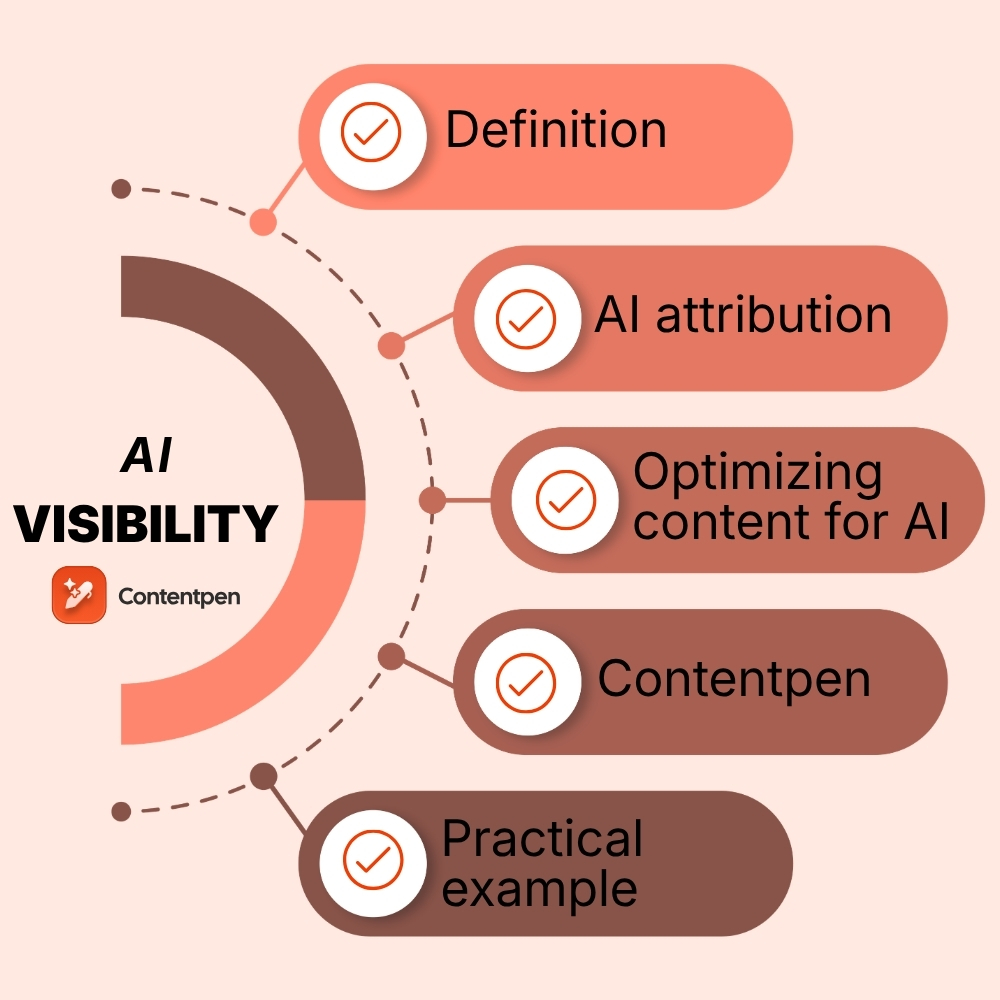
    AI visibility: Get your brand seen in AI answers

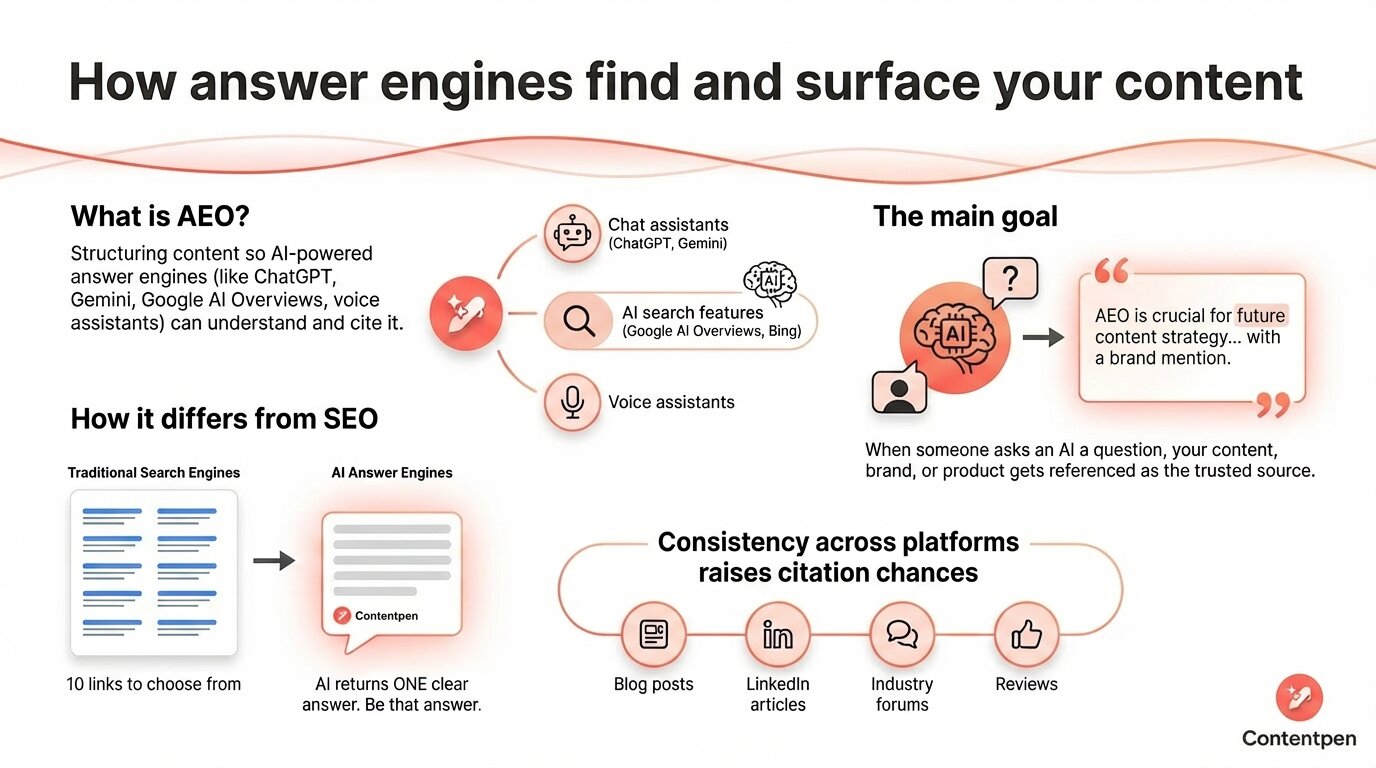
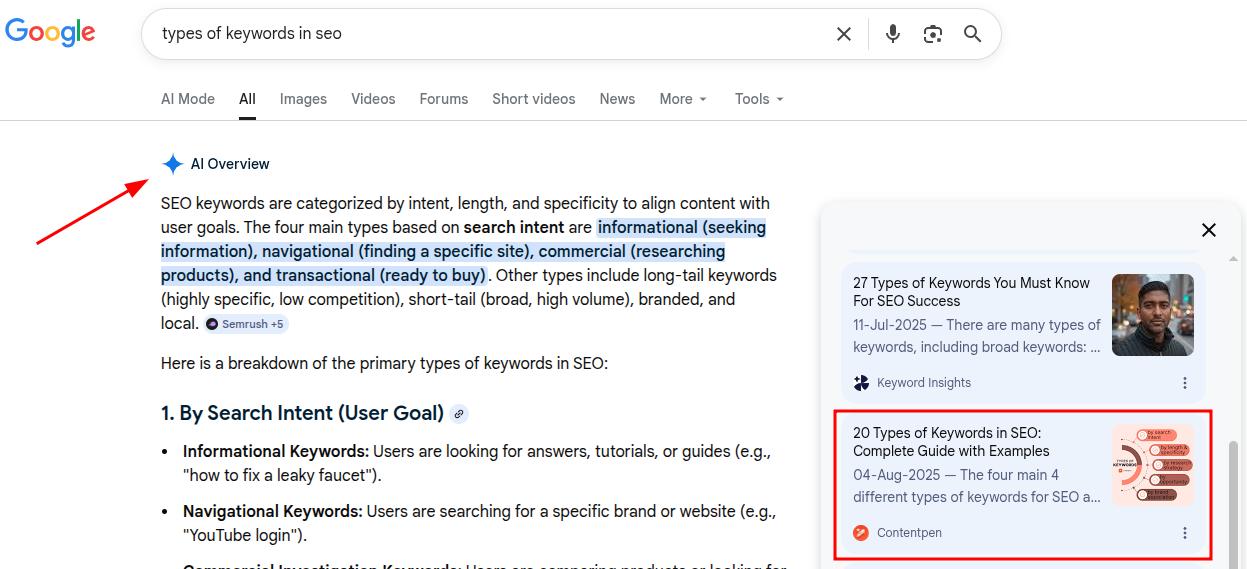
    AI visibility is a measure of how often and how favorably your brand appears in responses generated by AI platforms like ChatGPT, Perplexity, Google AI Overviews, Gemini, and Microsoft Copilot.

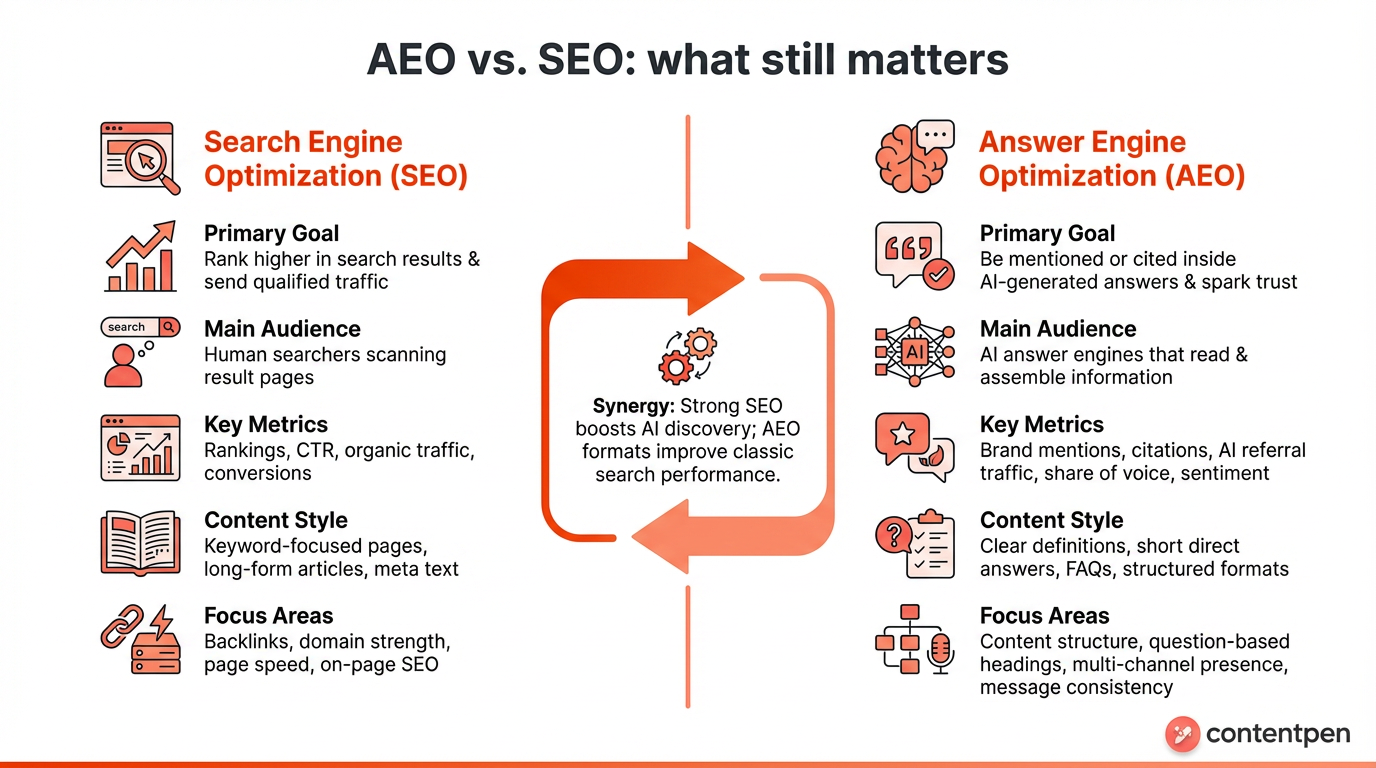
    The term quite closely matches AEO, GEO, AI SEO, and AI search optimization, but there’s a difference. AI visibility focuses more on the frequency of your appearance in AI chatbots and how your brand is described in AI responses.

    With that in mind, let’s explore the details of AI visibility: significance, strategies, and the tools required to get your brand seen in AI answers in 2026.

    Key takeaways

    • AI visibility measures how often and how favorably your brand appears in answers from platforms like ChatGPT, Perplexity, Gemini, and Google AI Overviews.
    • Models find your content through pretraining, real-time crawling, and retrieval-augmented generation. Clean structure and internal linking make your pages easier to cite.
    • Manual prompt checks are unreliable because AI answers vary from one run to the next.
    • AI-driven traffic often shows up as direct or unflagged referral traffic, so checking GA4 referral sources and adding “how did you hear about us?” surveys helps reveal its real impact.
    • A simple 30-day plan of auditing, optimizing priority pages, and publishing consistently turns AI visibility into a compounding channel that Contentpen can support.

    Defining AI visibility and its importance in 2026

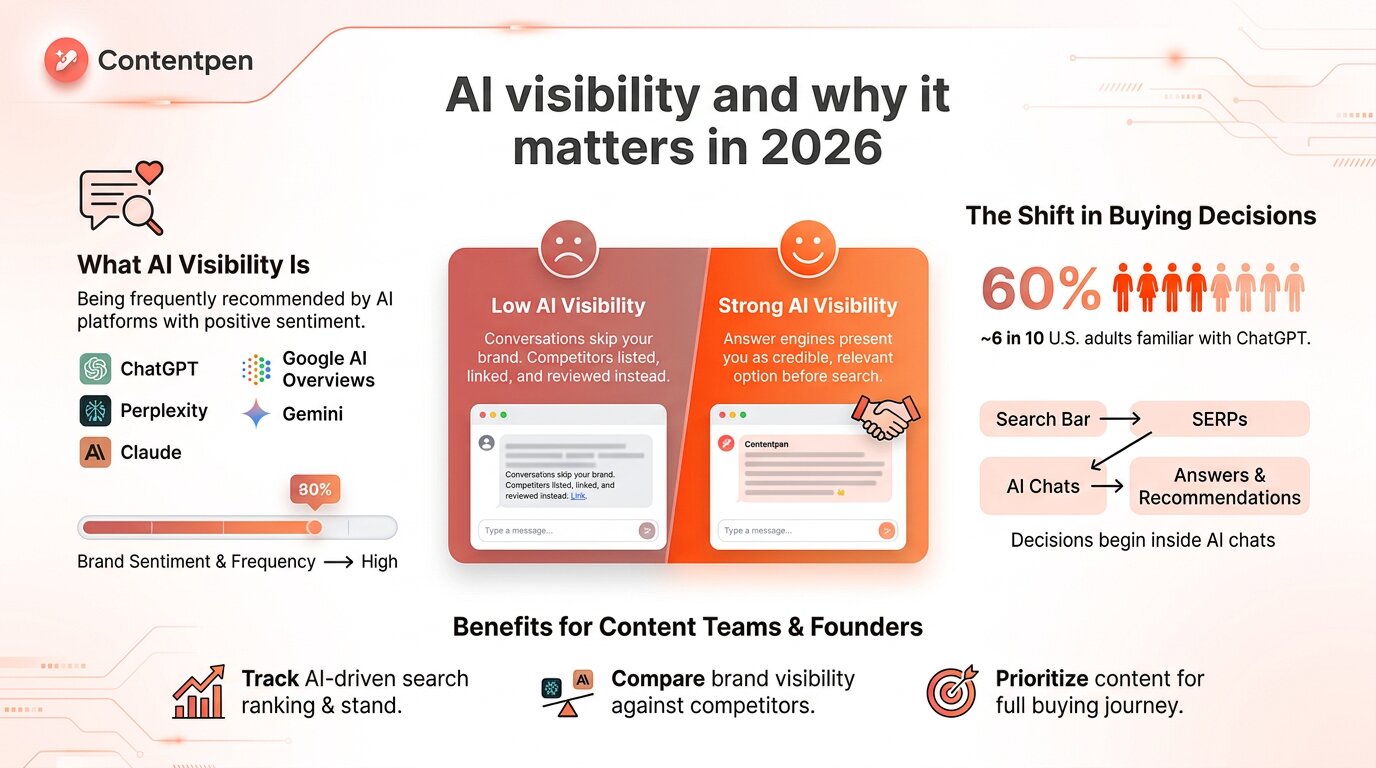
    AI visibility is how frequently you are recommended by AI search engines and the sentiment of your brand captured by the platforms. These may include ChatGPT, Perplexity, Claude, Google AI Overviews, Gemini, and others.

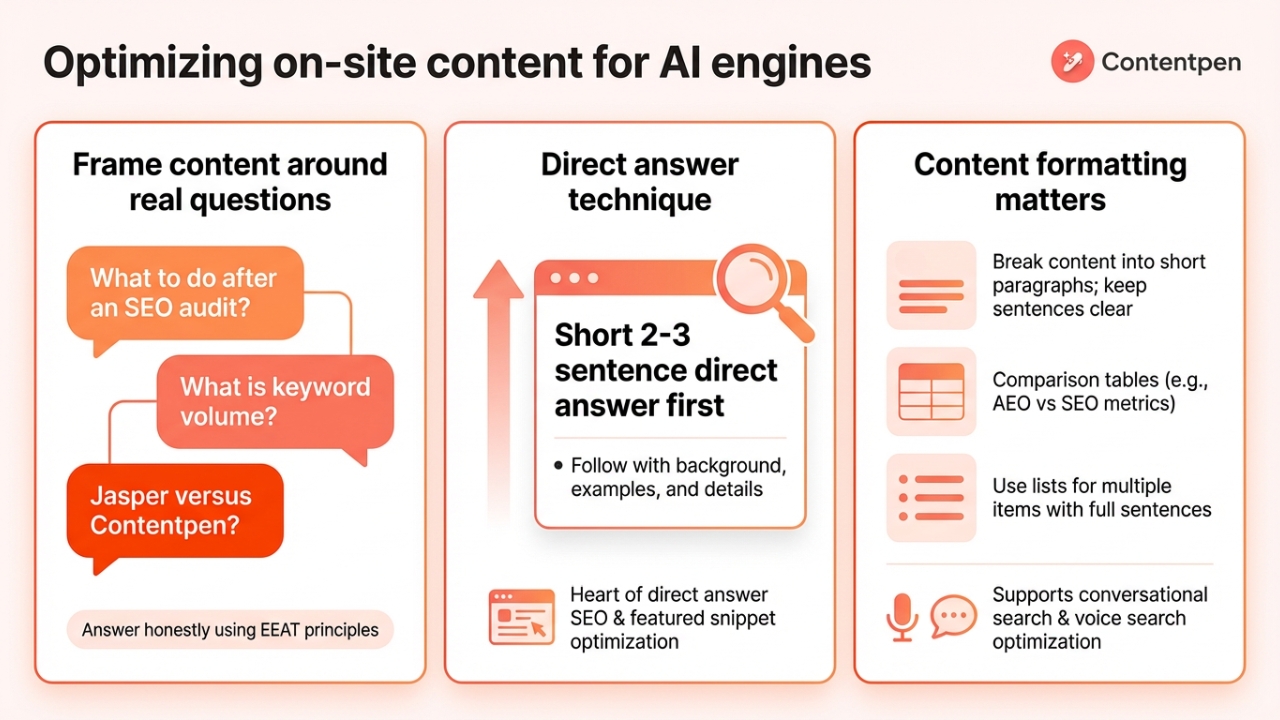
    Unlike traditional SEO, which focuses more on optimizing content for short keywords, creating content for AI visibility requires focusing more on conversational prompts. 

    According to the Pew Research Center, about six-in-ten U.S. adults are already familiar with ChatGPT, and the user base keeps increasing. That means more product research, tool comparisons, and buying decisions begin inside AI chats, not search results pages (SERPs).
    AI visibility and why it matters in 2026 - Contentpen.ai.

    When your AI visibility is low, those conversations skip your brand. AI models might list your competitors, link to their landing pages, and summarize reviews about them instead of you.

    Strong AI visibility flips that script, so answer engines present you as a credible, relevant option, often before a user even visits a search engine.

    For content teams, agencies, and founders, treating AI visibility as a real channel helps in a few ways. You can:

    • See where you stand in AI-driven search ranking
    • Compare brand visibility in AI against competitors
    • Prioritize content that helps you get found by AI across the full buying process

    A quick note on terminology: AI visibility, AEO, GEO, SEO, and AISEO are all related, but they are not the same thing. If you want a full breakdown of how these approaches differ in strategy and execution, our AI search optimization vs. traditional SEO guide covers that in detail.

    How does AI actually find and use your content?

    AI visibility starts with how large language models discover, understand, and reuse your content in answers. Models such as ChatGPT, Claude, and Gemini learn from large training sets plus fresh data they fetch through crawlers and APIs.

    Broadly, there are three layers:

    1. Pretraining on public and licensed data gives models a base understanding of the web, brands, and topics.
    2. Real‑time web crawling, often through systems like Bing or Google, brings in current pages, schemas, and links.
    3. Retrieval‑augmented generation (RAG) lets tools like Perplexity and Google AI Overviews fetch relevant documents at answer time and quote them directly.

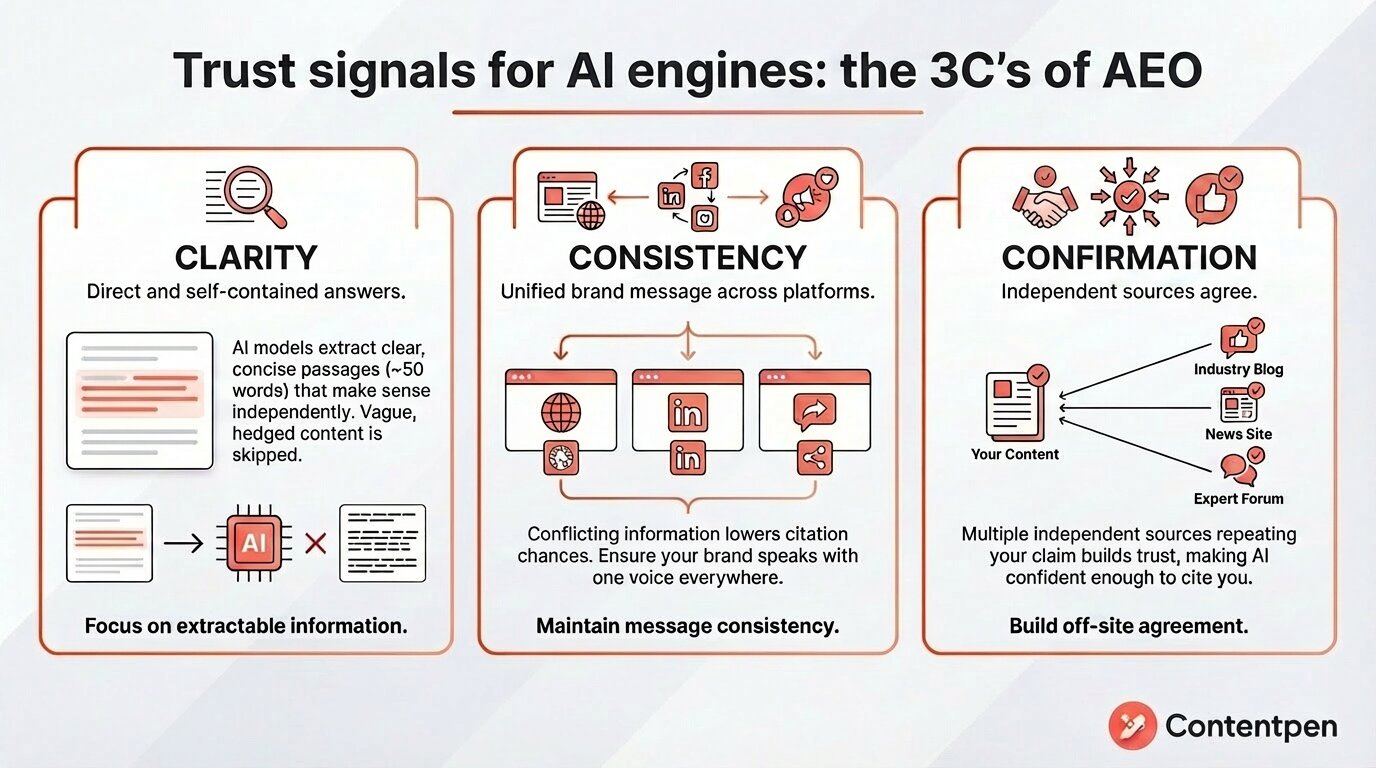
    Your content becomes citable when those systems can crawl, understand, and trust it. Clean site architecture, helpful on‑page structure, and clear internal links signal that your pages are safe sources to pull from.

    Platforms like Contentpen help here by guiding you through strategic blog creation and automated internal and external linking. The tool makes it easier for AI crawlers and answer engines to follow your content without any problems.

    According to Google Search Central, structured content and good linking are key for search features that rely on understanding page meaning. Those same practices support AI search optimization, AI overview optimization, and SEO for AI tools.

    Also learn: How to turn off AI Overviews in 2026.

    How do you check your current AI visibility score?
    How to check your AI visibility score - Contentpen.ai.

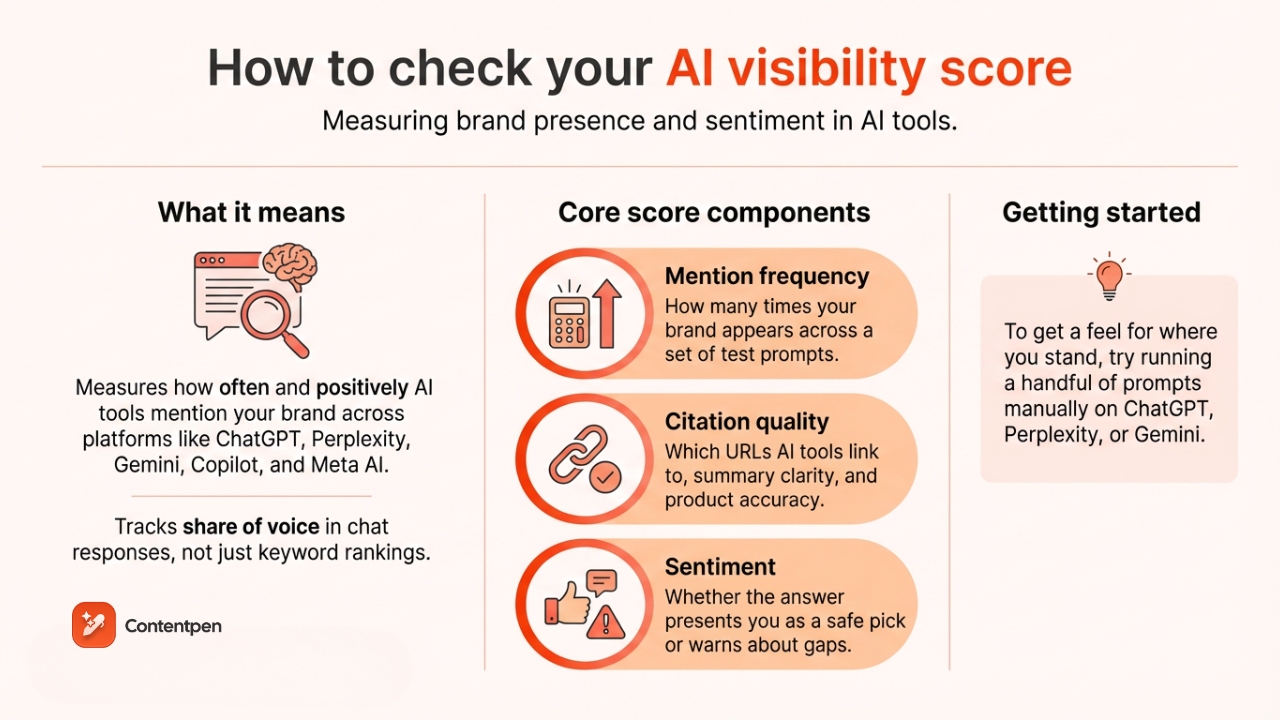
    Checking your AI visibility score means measuring how often and how positively AI tools mention your brand for the prompts that matter. 

    Instead of only watching keyword rankings, you track share of voice inside chat responses across platforms like ChatGPT, Perplexity, Gemini, Copilot, and Meta AI.

    An AI visibility score usually blends a few pieces:

    • Mention frequency – How many times your brand appears across a set of test prompts
    • Citation quality – Which URLs AI tools link to, how clear those summaries are, and whether they describe your product correctly
    • Sentiment – Whether the answer presents you as a safe pick or warns about gaps in features, pricing, or support

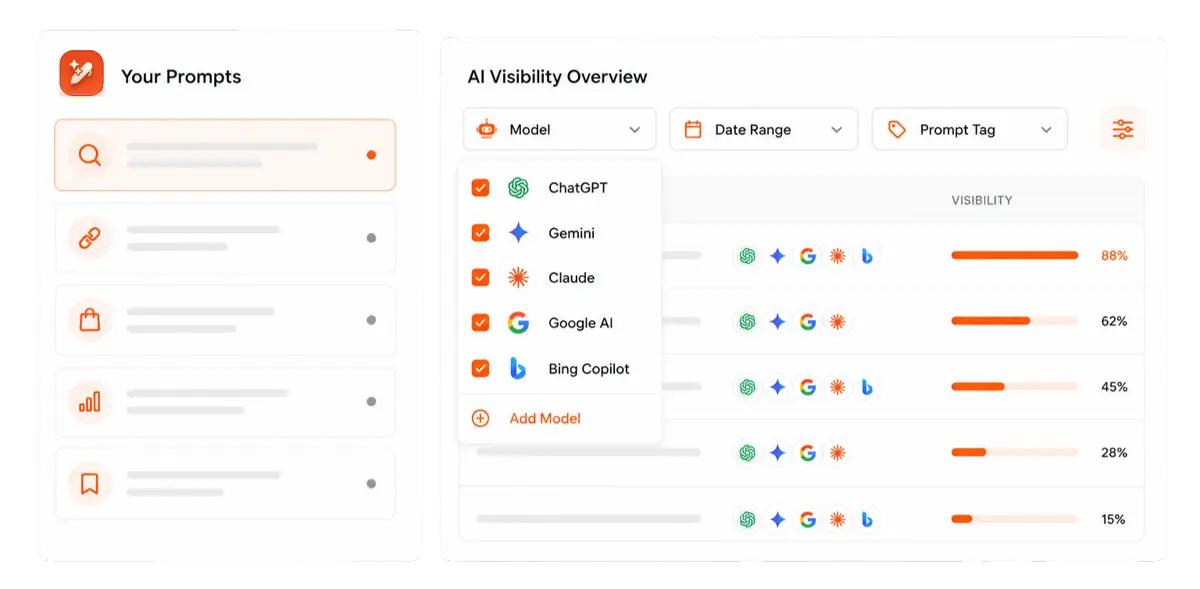
    To get a feel for where you stand, you can try Contentpen’s AI visibility feature to get all the required metrics in one place.
    Find your brand in AI search

    check

    Track AI citations, share of voice, and brand sentiment

    check

    Find the top sources driving citations
    Try AI Visibility →
    AI SEO Interface

    Alternatively, you can manually run a handful of prompts on ChatGPT, Perplexity, or Gemini. This approach can be tedious, but it can work for small-scale operations.

    Search for prompts like “best AI search optimization tools” or “AI tools for blog creation” and see whether your brand appears and how it is described when it does.

    Here is an example of what high versus low AI visibility looks like in practice. Say a buyer opens Perplexity and types: “What is the best AI writing tool for small marketing teams?”

    Low AI visibility: The response names three competitors with accurate descriptions, links to their feature pages, and mentions their pricing tiers. Your brand does not appear at all.

    Strong AI visibility: Your brand appears by name, the description matches your current positioning, and the link points to a relevant page, not just your homepage.

    That gap is exactly what AI visibility tracking is designed to surface and close.

    AI visibility and the attribution problem

    Before we move on to AI visibility tools, here’s something that you should know: AI-driven traffic often does not show up in your standard analytics tools the way organic traffic does.

    Yes, we know this sounds strange, but hear us out.

    When a user reads about your brand in a ChatGPT or Perplexity response and then types your URL directly into their browser, that session looks like direct traffic. 

    When they click a Perplexity citation link, the referrer shows as perplexity.ai, which most analytics setups do not flag as a meaningful source by default.

    This means your AI visibility influence is almost certainly larger than what your reports show in dashboards.

    The cleanest way to start quantifying it is to check your referral sources in Google Analytics 4. Filter for domains like chatgpt.com, perplexity.ai, claude.ai, and gemini.google.com. You may be surprised by what is already coming through.

    Beyond referral tracking, “how did you hear about us?” surveys in your onboarding flow are increasingly surfacing AI assistants as a discovery touchpoint. 

    Qualitative signals like that matter, especially for early-stage visibility work where the volume of AI referrals is still small but growing fast.

    AI visibility tools worth knowing about

    Several platforms now measure AI search visibility and help you understand AI search engine ranking. Each fits a different type of team.

    ToolBest forLLMs coveredStarting price
    ContentpenContent-first teamsChatGPT, Google AI, Copilot, Gemini, Perplexity, Grok, Claude$49/month
    ProfoundEnterprise brandsChatGPT, Perplexity, Gemini, Copilot, Meta AI, Grok, DeepSeek, Claude, AI Overviews$99/month
    Semrush AIOExisting Semrush usersChatGPT, Gemini, Perplexity, Claude, Copilot, Grok, DeepSeek$117/month
    Athena HQMarketing agenciesChatGPT, Perplexity, Gemini, Claude, Copilot, Grok, AI Overviews$295/month
    Peec AISmall teams, startupsChatGPT, Perplexity, Google AI Overviews, optional extras$95/month
    Otterly AIBudget usersChatGPT, Perplexity, Google AI Overviews, Gemini, Copilot$29/month

    Free AI visibility checker tools can be a nice starting point. Most free options give very top‑level brand mention data and a basic AI visibility score.

    When you pick a tool, look at:

    • Which LLMs does it cover
    • How often does it refresh data
    • Does it track competitors
    • How exportable and report‑friendly the data is

    With Contentpen, tracking and content live in the same workspace, so you can act on those insights right away and update the pages AI tools see.

    Write content that’s built to rank, not just read

    Create search-optimized blogs aligned with SEO and GEO signals, so your content performs well across search and AI-driven discovery.

    Try SEO Blogging FREE →
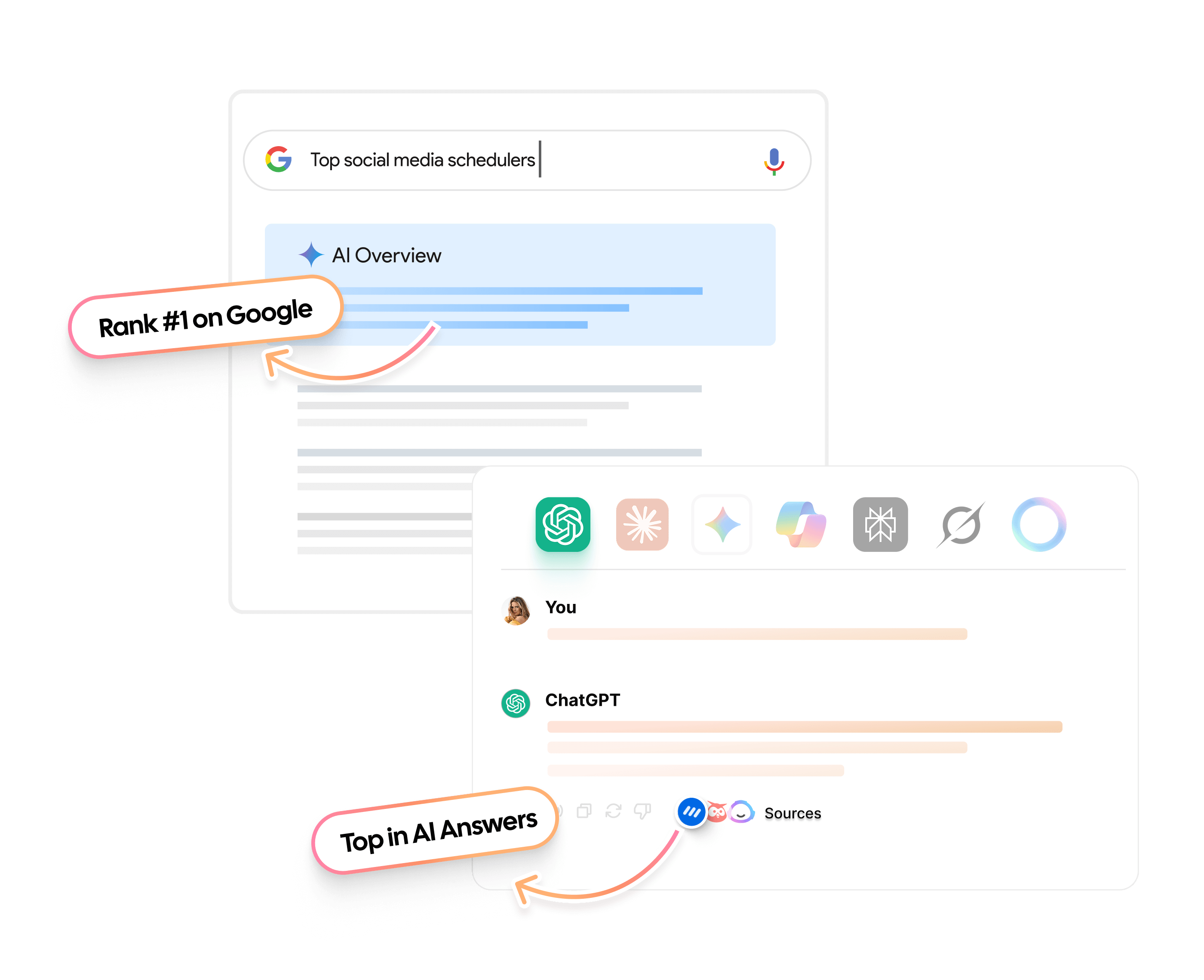
    AI SEO Interface

    Why manual AI visibility tracking doesn’t scale

    Manual AI visibility tracking sounds easy at first. You open ChatGPT, type a few prompts your buyers might use, and see what shows up. Maybe you repeat that on Gemini or Claude and paste screenshots into a slide deck.

    The problem is that large language models are probabilistic. The same prompt can give different answers from one minute to the next because of sampling, training updates, and subtle changes in context. That means your screenshots are more like anecdotes than real data.

    Manual checks also miss the bigger picture of AI‑driven search ranking. You cannot realistically test hundreds of prompts across many LLMs every week. You will miss sentiment shifts, new competitors, and changes in which of your URLs get cited. Most importantly, you will struggle to prove ROI because there is no consistent baseline to compare against.

    Dedicated AI visibility checker platforms solve this by automating prompt runs and storing results. They give you charts instead of screenshots, trend lines instead of guesses, and clear proof that your AI visibility optimization work is moving in the right direction or not.

    What to track instead

    Instead of tracking random mentions by hand, focus on a small set of meaningful AI visibility metrics. These give you real insight and help you adjust strategy with confidence.

    • AI visibility score: Shows your overall share of voice across selected prompts and LLMs. A rising score means you are appearing in more answers or taking a larger slice of each response.
    • Prompt‑level citation tracking reveals which pages AI tools link to for specific queries. You might discover that one guide drives most mentions for a topic, while other pages never get used. That insight helps you decide what to refresh, merge, or expand next.
    • Brand sentiment analysis tells you whether AI tools describe your product in a positive, neutral, or negative tone. If a model keeps repeating old complaints or pricing details, you can publish updated content to correct the record.
    • Competitive benchmarking: Compares your AI visibility score and citation footprint against direct rivals. Seeing that a competitor dominates certain prompts helps you design targeted content to close the gap or attack weak spots.
    • Query fanout analysis: Maps the follow‑up prompts users ask after the first question. That view of the conversational path lets you create content that answers every step, so LLMs keep your brand in the discussion from research to purchase.

    When you look at these metrics over several weeks or months, patterns emerge. Pages that keep winning citations or sentiment that drifts positive after a round of updates. That is the level where you can make sound decisions.

    How to optimize your content for AI search visibility

    Improving AI visibility is an ongoing content strategy that reaches across topics, formats, and funnels. Instead of publishing random posts, you design a system that consistently feeds LLMs with accurate, helpful, easy‑to‑quote content.

    Strong AI search visibility rests on three pillars:

    1. Content quality – Articles that actually solve problems with clear, direct explanations
    2. Structure – Headings, links, and schema that help crawlers read your site
    3. Authority – Backlinks, mentions, and positive coverage across the web

    This is where a tool like Contentpen shines. The platform guides you from keyword and topic selection through draft creation, so every article supports both classic SEO and AI search optimization goals. 

    From outline to publish-ready content that fills them

    check

    Structured

    check

    Consistent

    check

    SEO-aligned

    check

    Fast

    Generate Outlines FREE →
    AI SEO Interface

    Longer, in‑depth content tends to attract more backlinks than short posts, which also helps AI models trust your pages. With a focused AI SEO strategy, you can build a library that ranks on Google and shows up inside ChatGPT SEO, Perplexity SEO, and AI Overviews.

    A simple way to think about your workflow:

    • Before writing, decide which prompts you want to appear for and what angle you can cover better than existing pages
    • While drafting, follow GEO and AEO principles so your article is easy to quote
    • After publishing, track citations, update content, and strengthen links over time

    This loop is what turns AI visibility from a one-time audit into a compounding channel.

    Building an AI-friendly content strategy with Contentpen

    An AI‑friendly content strategy means you consistently publish articles that LLMs want to pull into their answers. Contentpen helps you do that without needing a huge editorial team or advanced AI SEO skills.

    Inside the SEO AEO tool, you can:

    1. Start with strategic keywords and topic suggestions that align with how AI finds your website.
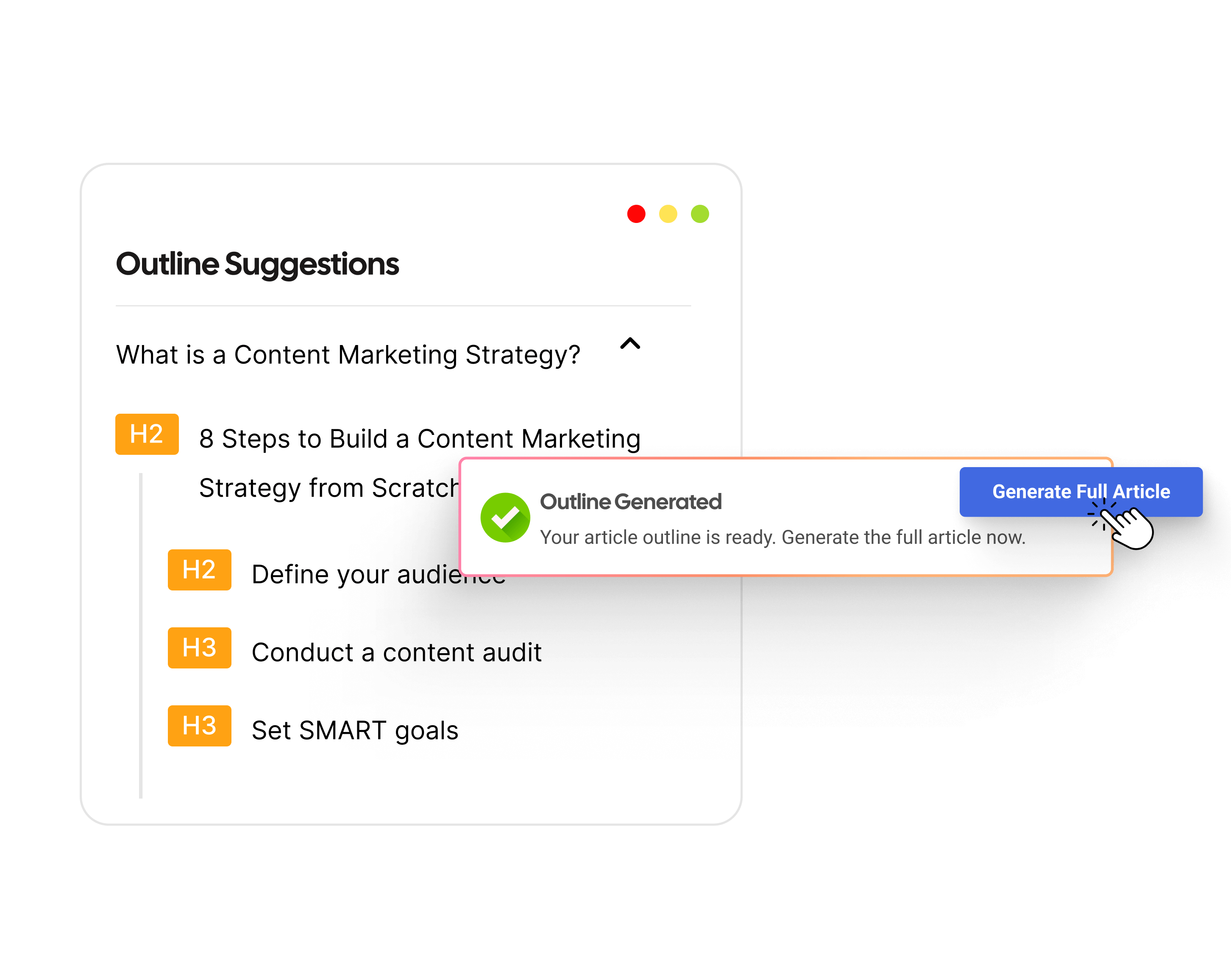
    2. Turn those ideas into structured outlines with clear sections and headings.
    3. Draft long-form posts that go deep enough to signal authority, with SEO and GEO scores showing how easily search engines and AI tools can understand and cite each section.
    4. Publish with automated internal and external linking to connect related assets.
    5. Monitor web analytics and AI visibility to see which prompts mention you and adjust your strategy accordingly.

    Publish content directly to your CMS, without copy-pasting

    Move from draft to live post in a single step. No hassle, no errors!

    Try One-click Publishing →
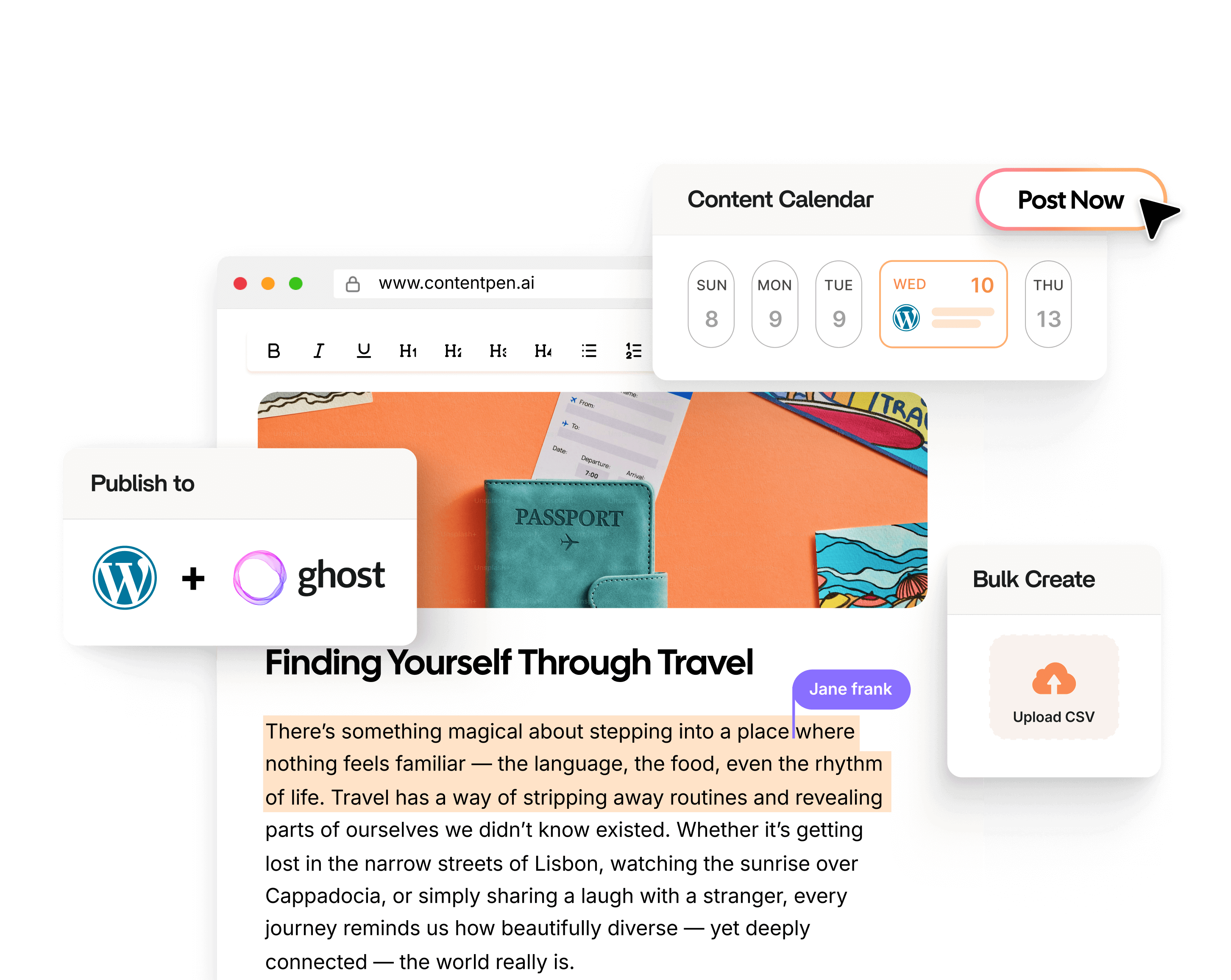
    AI SEO Interface

    This content process supports both “how to rank in AI search” goals and standard organic traffic targets.

    The result is a library of content that serves people first, but also lines up nicely with generative engine optimization and answer engine optimization examples.

    What does good AI visibility actually look like in practice?

    Good AI visibility shows up when a buyer asks a tool like ChatGPT or Perplexity for advice, and your brand appears naturally in the answer. Imagine someone types:

    • “Best AI visibility tool for small marketing agencies”
    • “Best SEO content writer for bloggers”
    • “How AI finds your website for B2B SaaS.”

    into their favorite assistant. A strong presence means the model:

    • Lists your brand by name
    • Explains what you do in accurate, current language
    • Links to a relevant page (not just your homepage)
    • Mentions key strengths that match your positioning

    Like, you could see with our “best SEO content writer for bloggers” prompt example that we input in Perplexity:
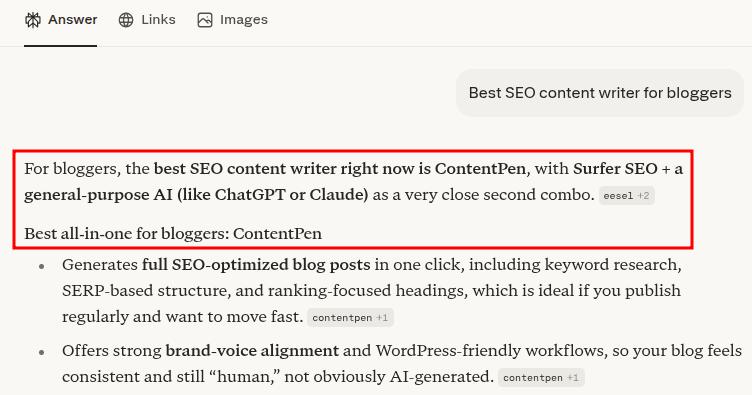
    Perplexity 'SEO content writer for bloggers' example - Contentpen.ai.

    Over time, this creates a compounding flywheel:

    1. Helpful content brings in organic traffic and natural backlinks.
    2. Those links and mentions lift both search rankings and relevance signals for LLMs.
    3. Stronger signals encourage models to cite you more often, driving referral traffic and brand familiarity.
    4. New attention attracts more mentions, reviews, and case studies, which feed back into your authority.

    According to Salesforce, 81% of buyers research online before speaking with sales, often across multiple touchpoints. When you combine classic SEO with smart AI search visibility, your brand can appear in more of those touchpoints, from Google results to AI chats.

    Tools like Profound, Semrush AIO, and Athena help large enterprise teams see this flywheel in dashboards. For most content teams, Contentpen covers both sides in one platform: it creates the content that feeds the flywheel and tracks how your AI visibility grows as a result.

    The competitive intelligence angle
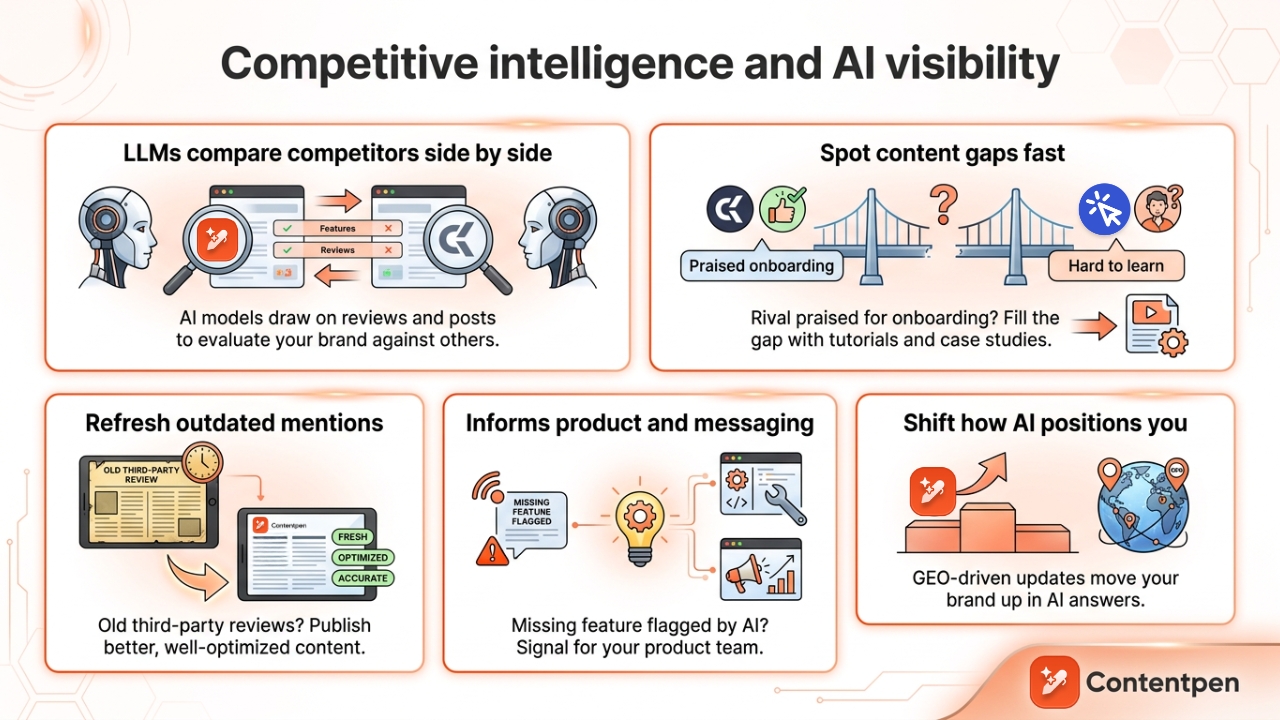
    Competitive intelligence and AI visibility - Contentpen.ai.

    AI visibility is never just about your brand in isolation. Every time a user asks for “best tools” or “top platforms,” LLMs compare several options side by side, drawing on reviews, docs, and blog posts from across the web.

    Advanced AI visibility tools show how often each competitor appears for a given prompt set and how positive those mentions are. If models praise a rival’s onboarding while calling your product hard to learn, that is a clear content gap. 

    You can respond with tutorials, case studies, and product update posts that address those concerns. You can also spot outdated or skewed descriptions of your tool. 

    If AI keeps quoting an old third‑party review that undersells one of your strengths, then publishing better, well‑optimized content gives models a fresher source to pull from. 

    Over time, careful content updates and GEO‑driven improvements can shift how answer engines position you against the rest of the industry.

    Beyond marketing, this competitive view feeds product and positioning decisions. If LLMs consistently highlight a competitor’s feature you do not have, that is feedback your product team can evaluate. 

    If they miss one of your strongest features, that is a signal that your messaging or documentation needs work.

    Start building your AI visibility strategy today

    Your first 30 days with AI visibility do not need to be expensive or complicated. Here is a simple action plan to get moving.

    Week 1: Audit where you stand. Start a free trial of an AI visibility tool such as Contentpen, add 20 to 30 prompts your buyers would ask, and see where you appear and where you are completely absent. Our AI visibility audit guide walks through the process step by step.

    Week 2–3: Optimize your highest-priority pages. Start with content that should be cited for high-value prompts but is not. Add direct answers near the top, tighten headings and structure, and fix any technical issues that could be blocking crawlers.

    Week 4 and beyond: Track, iterate, and publish. Let your AI visibility tool re-run your prompts on a regular schedule. In Contentpen, that happens automatically while you plan and publish AI-friendly blog posts in the same workspace, so you can see how each new article changes your visibility.

    Write better blogs in less time, without sacrificing quality.

    Let AI handle structure, clarity, and flow while you stay in control of the message.

    Try AI blog writing →
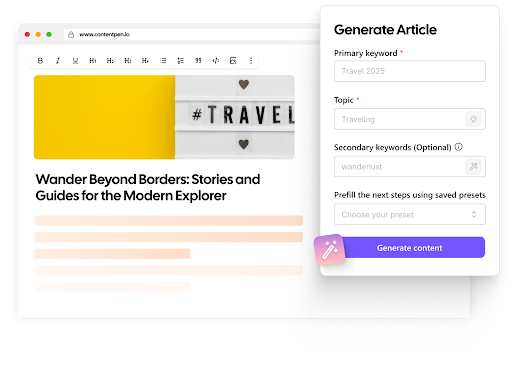
    AI SEO Interface

     AI visibility is no longer a nice bonus. It is where more of your buyers are asking questions, comparing options, and forming their first impressions of brands like yours. The earlier you start tracking it, the faster you can close the gap.

    Frequently asked questions

    What’s the difference between AI visibility and SEO?

    AI visibility tracks how often and how favorably AI tools mention and cite your brand. SEO tracks how your pages rank on search engines like Google and Bing. They share foundations such as content quality, links, and crawlability, but AI visibility adds layers like LLM sentiment, citation patterns, and prompt‑level coverage.

    How often do LLMs update the content they cite?

    Update patterns differ by platform. Some tools, such as Perplexity, rely heavily on real‑time web retrieval for each query. Others use training snapshots plus periodic refresh cycles and plugins. Publishing accurate, frequently updated content keeps you eligible whenever those systems fetch new pages for their retrieval layers.

    Is AI-generated content safe to use for AI visibility optimization?

    Yes, AI‑assisted content can be safe when humans stay in control. Major search engines, including Google, focus on usefulness and originality rather than who typed the first draft. If you edit, fact‑check, and align each piece with your brand voice, AI can speed up production without causing low‑quality content.

    Do I need a separate strategy for each AI platform (ChatGPT, Perplexity, Gemini)?

    You do not need completely different strategies. High-quality, well-structured content with strong authority works across most LLMs. That said, each platform has its own quirks. Perplexity is citation-forward and crawls frequently, so freshness matters more there. Google AI Overviews draw directly from Google’s index, so traditional SEO performance feeds work better here.
  • AI search optimization vs traditional SEO: Key differences explained

    AI search optimization vs traditional SEO: Key differences explained

    When you think about AI search optimization vs traditional seo, the rules of search suddenly feel less clear. Rankings, clicks, AI answers, zero‑click results — all the things start to blur.

    Search algorithms now pull from both classic web indexes and conversational models like ChatGPT, Gemini, and Perplexity. That shift makes old SEO checklists feel incomplete, even if they still matter.

    This guide breaks down the difference between AI search optimization and traditional SEO and why you need both in 2026. 

    You will see how keywords, content structure, links, and metrics change when you move from simple blue links to answer engine optimization and generative engine optimization. By the end, you will know exactly where to adjust your strategy without too much hassle.

    So, let’s get started, shall we?

    What is AI search optimization, and how is it different from traditional SEO?

    AI search optimization vs. traditional SEO - Key differences.

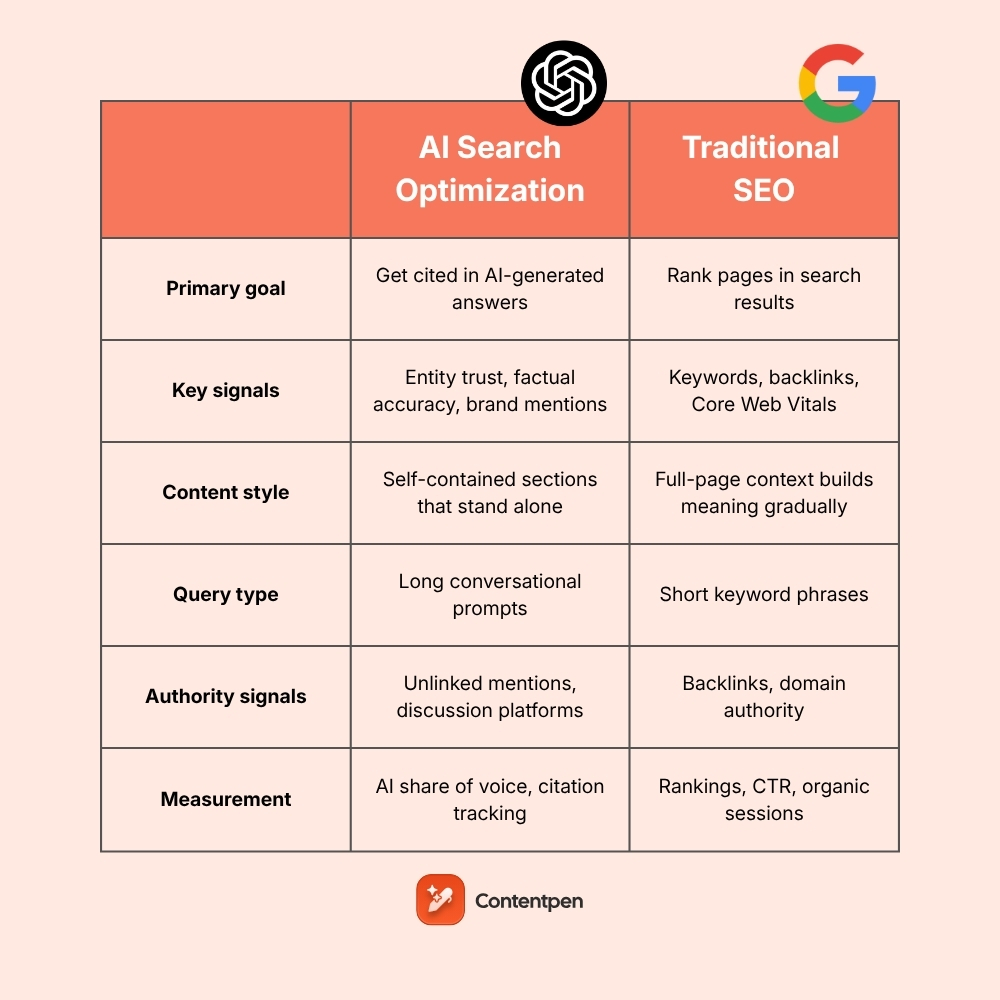
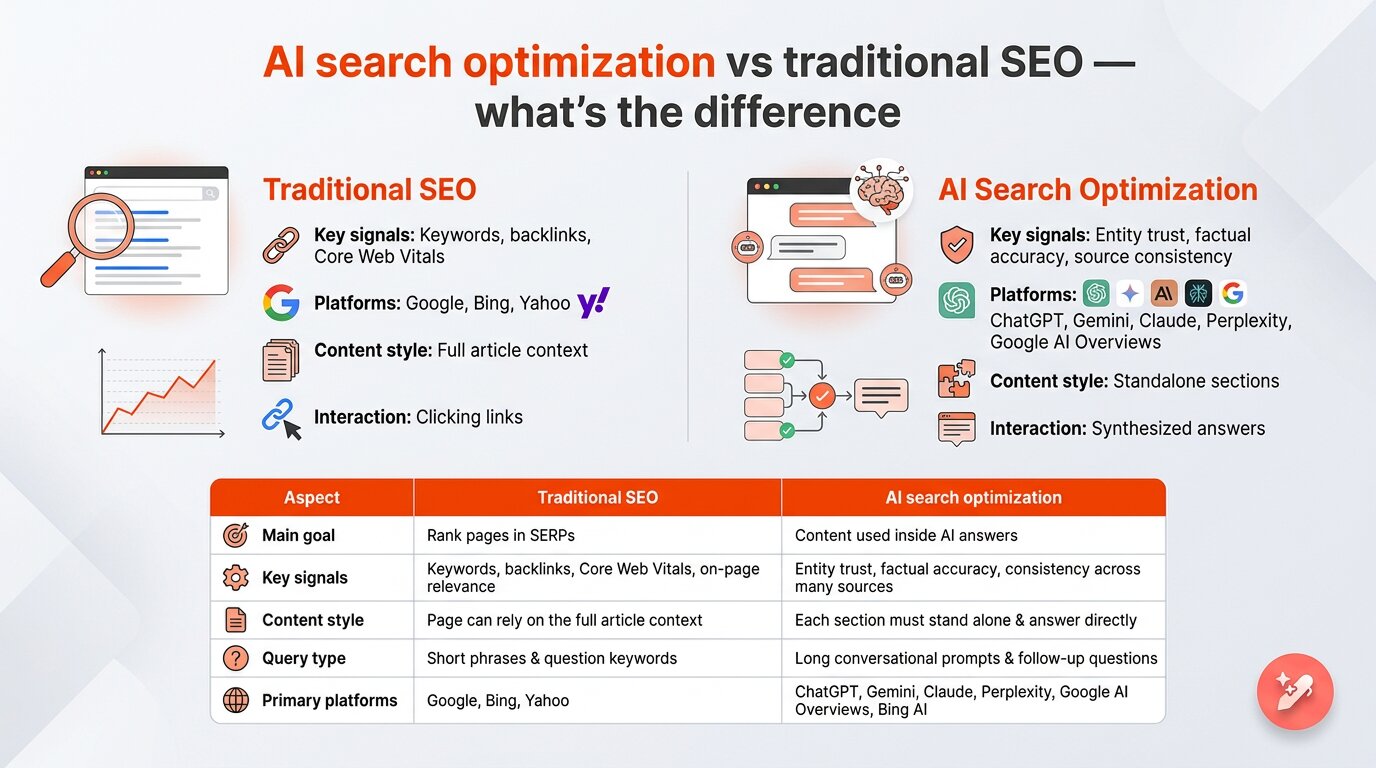
    AI search optimization focuses on getting your content used inside AI‑generated answers, while traditional SEO focuses on getting pages ranked in classic search results. Both share the goal of visibility, but they rely on different signals and show up in different places.

    Traditional SEO works with search engines like Google and Bing. You improve rankings through keyword targeting, SEO backlinks, technical fixes, and strong page experience, so your pages show up as rich snippets or in Google PAA boxes for a query.

    AI search optimization, often called generative engine optimization, focuses on how tools like ChatGPT, Gemini, Claude, Perplexity, Google AI Overviews, and Copilot summaries pick and quote content. These systems do not just rank pages. They synthesize short answers from multiple trusted sources.

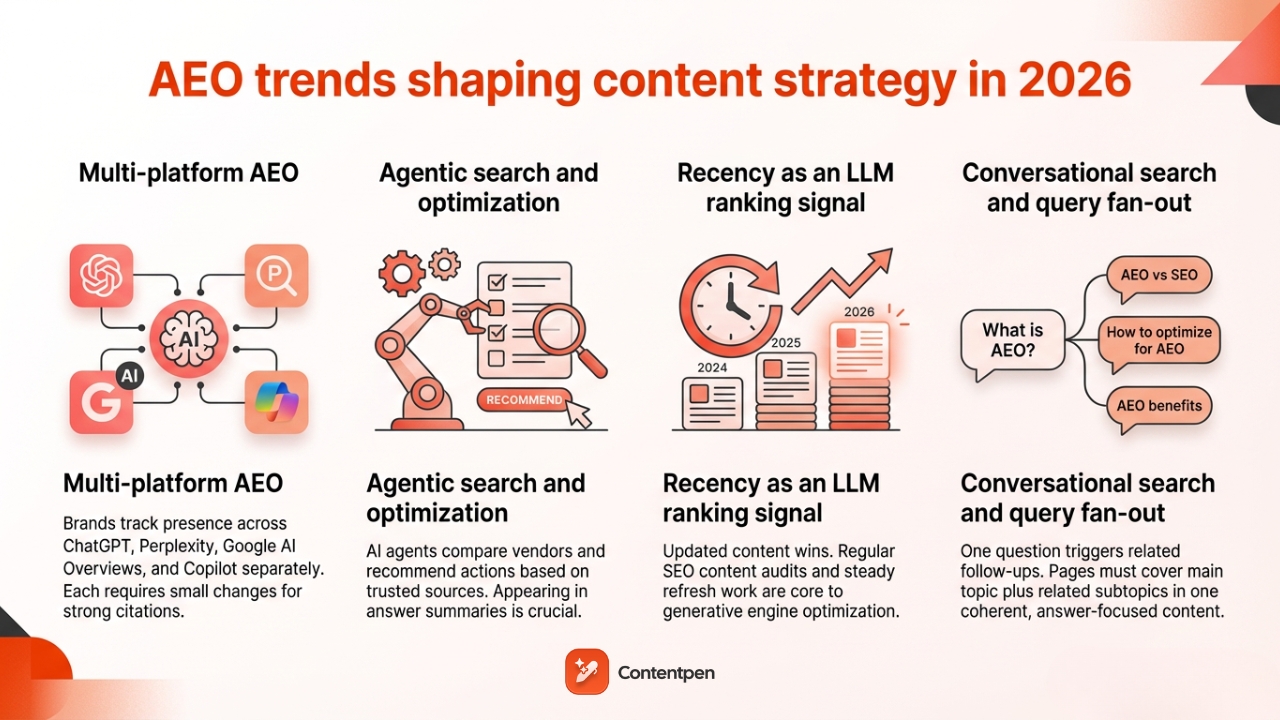
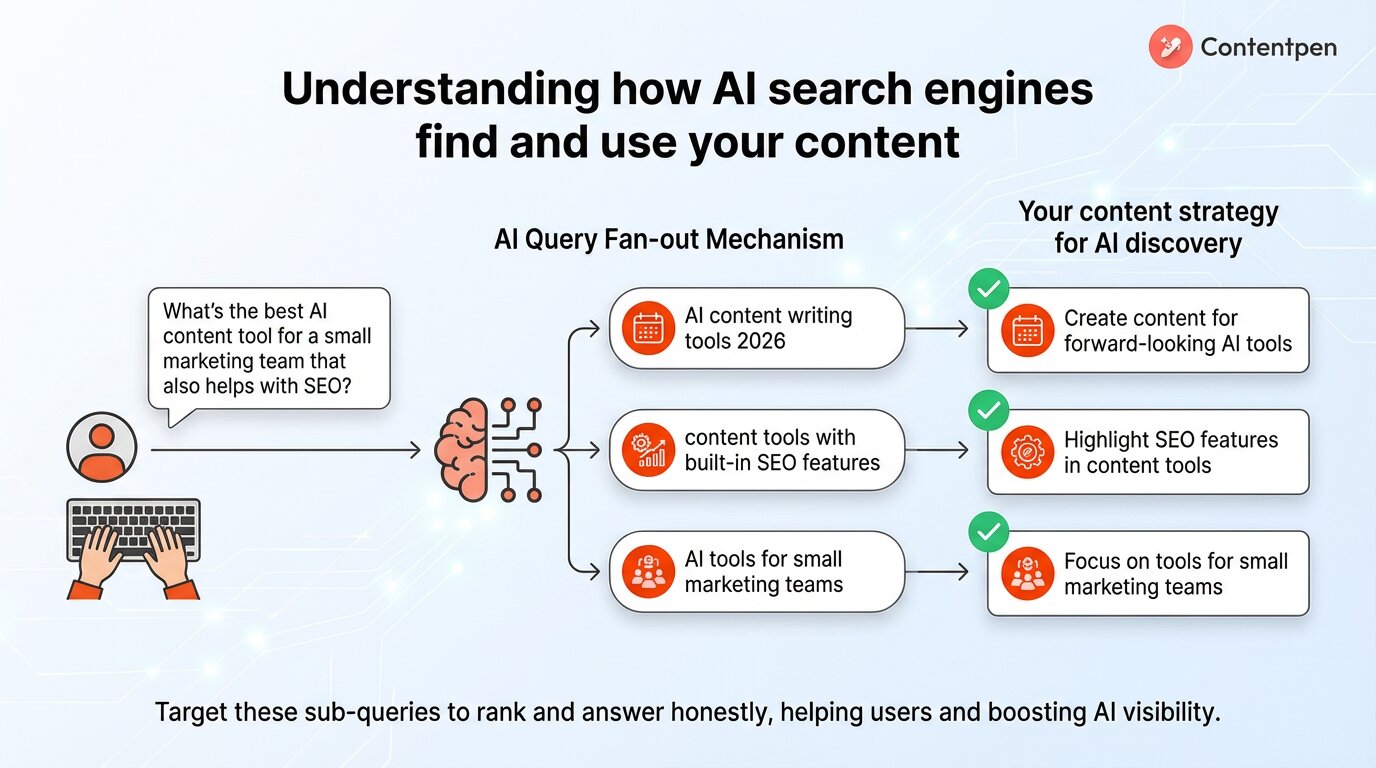
    Here is the key: when a user asks an AI assistant something, the model often performs query fan-out. That means it runs many related background searches, looks across several pages, and then builds a complete answer from the best parts. Your content has to stand out here.

    At a practical level, that leads to three big differences:

    • Where results appear (SERPs vs. chat screens and overviews)
    • How users interact (clicking links vs. reading synthesized answers)
    • How models reuse your work (quoting short passages vs. sending traffic straight to pages)

    For a detailed breakdown between AI search optimization and traditional SEO, check out the table below:

    AspectTraditional SEOAI search optimization
    Main goalRank pages in SERPs for target keywordsGet content used inside AI answers and summaries
    Key signalsKeywords, backlinks, Core Web Vitals, on‑page relevanceEntity trust, factual accuracy, consistency across many sources
    Content stylePage can rely on the full article contextEach section must stand alone and answer directly
    Query typeShort phrases and question keywordsLong conversational prompts and follow‑up questions
    Primary platformsGoogle, Bing, YahooChatGPT, Gemini, Claude, Perplexity, Google AI Overviews, Copilot

    For the GEO-specific comparison, read GEO vs SEO.

    Why can’t you choose one method over the other?

    Which to choose? Traditional SEO vs. AI search optimization.

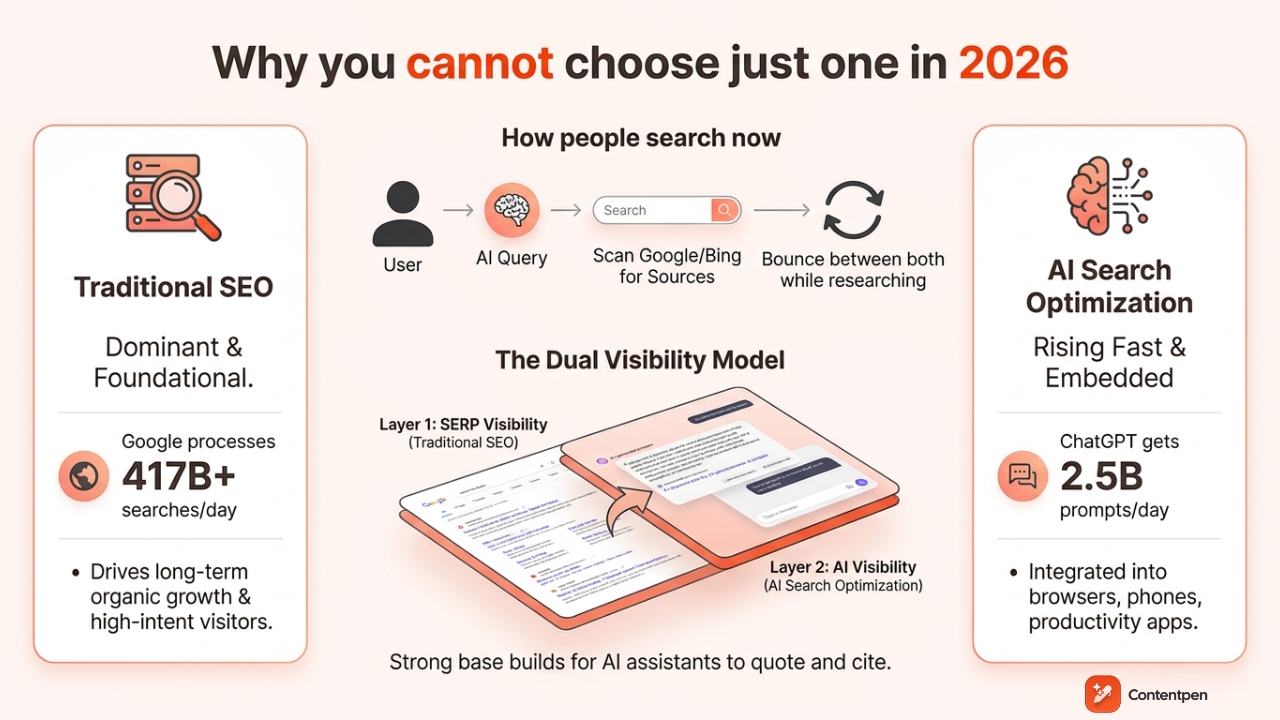
    You cannot pick between AI search optimization and traditional SEO in 2026 because your audience uses both at the same time. 

    Search results now mix classic organic links with AI‑generated overviews, and visibility in only one channel leaves a lot of traffic behind.

    Traditional SEO still carries huge weight. Google continues to process more than 417 billion searches per month, roughly 14 billion every day.

    Therefore, organic traffic remains one of the strongest drivers of long‑term growth and of getting high‑intent visitors, especially for small businesses and agencies that cannot outspend big brands on ads.

    At the same time, AI search is rising fast. ChatGPT gets 2.5 billion prompts each day. Tools like Gemini, Perplexity, and Copilot now sit inside browsers, phones, and productivity apps, so users ask them for summaries, comparisons, and buying advice before they ever click a link.

    Traffic from large language models (LLMs) is still a fraction of organic search, but it’s growing quickly, and many analysts expect the gap to keep narrowing. That means SEO vs AI search is the wrong framing. Your content has to work for both humans skimming a SERP and models drafting an instant answer.

    Also read: How to turn off AI Overviews.

    Think about how people search now:

    • They start with a quick AI query to understand a topic.
    • They scan Google or Bing results when they want sources or to compare options.
    • They bounce between AI answers and websites while they research a purchase.

    So here is the smarter move for 2026. Use the “Dual Visibility Model”, where your content must perform across two systems at the same time.

    Layer 1 → SERP visibility

    Layer 2 → AI visibility

    Strong traditional SEO keeps your site visible in search engines. AI search optimization then builds on that base, so AI assistants and other generative‑AI SEO features can safely quote and cite you in their responses.

    Technical prerequisites before AI optimization make sense

    Before you adjust keywords, restructure content, or build off-page citations, there is one thing to check first. Make sure AI crawlers can actually access your site.

    This is a step many professional marketers skip, but it matters. If your robots.txt file blocks AI crawlers, all your optimization work will not show up in AI-generated answers because the models cannot read your content.

    Here are the two quick checks to run:

    #1: Update your robots.txt file

    Major AI tools use their own crawlers to index the web. GPTBot and OAI-SearchBot (used by ChatGPT), ClaudeBot (used by Claude), PerplexityBot (used by Perplexity), and Bingbot (used by Copilot) all respect robots.txt rules. If you have a disallow for these bots, you may be blocking them without realizing it.

    To allow specific AI crawlers, add the following to your robots.txt file:

    User-agent: GPTBot

    Allow: /

    User-agent: ClaudeBot

    Allow: /

    User-agent: OAI-SearchBot
    Allow: /

    User-agent: PerplexityBot
    Allow: /

    User-agent: Bingbot

    Allow: /

    You can also use the following code to allow all AI chatbots in your robots.txt file:

    User-agent: *

    Allow: /

    Note: Don’t replace your whole robots.txt with this rule. If your file already blocks specific folders, such as admin or checkout pages, keep those rules and add the AI crawler entries alongside them.

    There are also robots.txt file checkers and validators online that you can use to verify AI search indexability and crawlability.

    #2: Check your XML sitemap

    Make sure your sitemap is up to date and submitted to Google Search Console and Bing Webmaster Tools. AI systems that rely on search indexes use sitemaps to discover new and updated content faster.

    Validate your Sitemap using online tools, such as XML-Sitemap, to check whether it’s correctly configured. 

    Think of this as opening the door before you decorate the room. Once crawlers have access, everything else you do, from structured content to off-page mentions, will actually count.

    How AI-driven SEO techniques differ in practice: keywords, content, and links

    How AI-driven SEO techniques differ in practice.

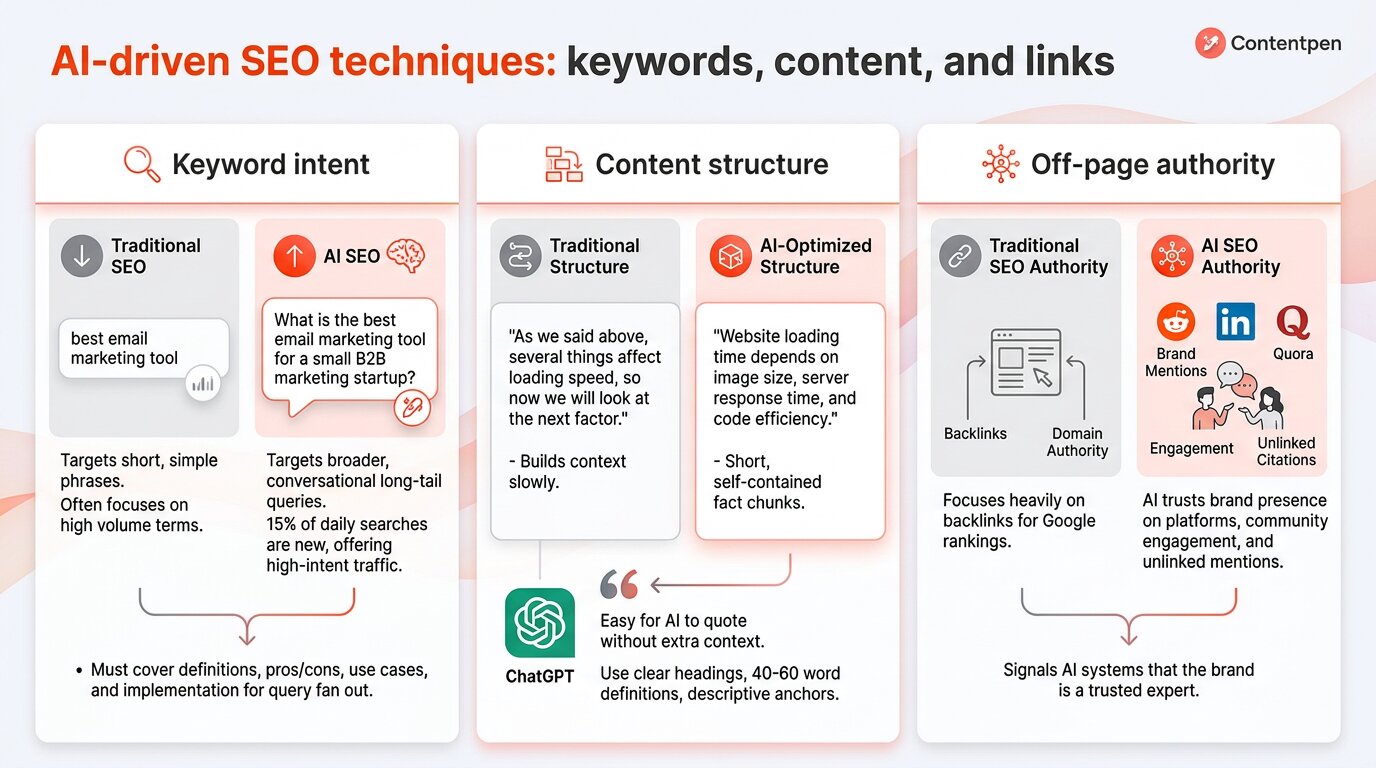
    AI‑driven SEO techniques differ from traditional SEO in how you research queries, structure content, and build authority. When you adjust those three parts, you support both SERP rankings and AI answer inclusion.

    #1: Keyword intent

    First, think about how you research keyword intent. Classic keyword tools push you toward simple phrases. AI search engine optimization calls for something broader, longer, and closer to how people talk to assistants.

    Therefore, utilizing long-tail keywords in this regard is a good idea. Many tools will even show low or no search volume for these phrases. 

    But that is okay, especially when 15% of daily searches are completely new. Meaning, you can capture high-intent traffic with long-tail keywords that are ready to act and convert.

    A good example of AI search optimization vs traditional SEO can be the following:

    In SEO, you mostly target short phrases, such as “best email marketing tool.” But for AI SEO, you mostly go for longer variants, such as “What is the best email marketing tool for a small B2B marketing startup?” 

    Because AI uses query expansion, your content must cover the whole topic, including follow‑up angles, rather than one narrow phrase. That usually means addressing:

    • Definitions and key concepts
    • Pros and cons or trade‑offs
    • Use cases for different segments
    • Next steps or implementation tips

    #2: Content structure

    Then comes content structure. Traditional SEO strategies accept sections that build context slowly. AI content optimization works better with short, self‑contained pieces that a large language model can grab without losing meaning.

    Compare these two lines. Poor structure says, “As we said above, several things affect loading speed, so now we will look at the next factor.” 

    Optimized structure says, “Website loading time depends on image size, server response time, and code efficiency.” The second line gives a clean fact chunk that ChatGPT can quote with no extra context needed.

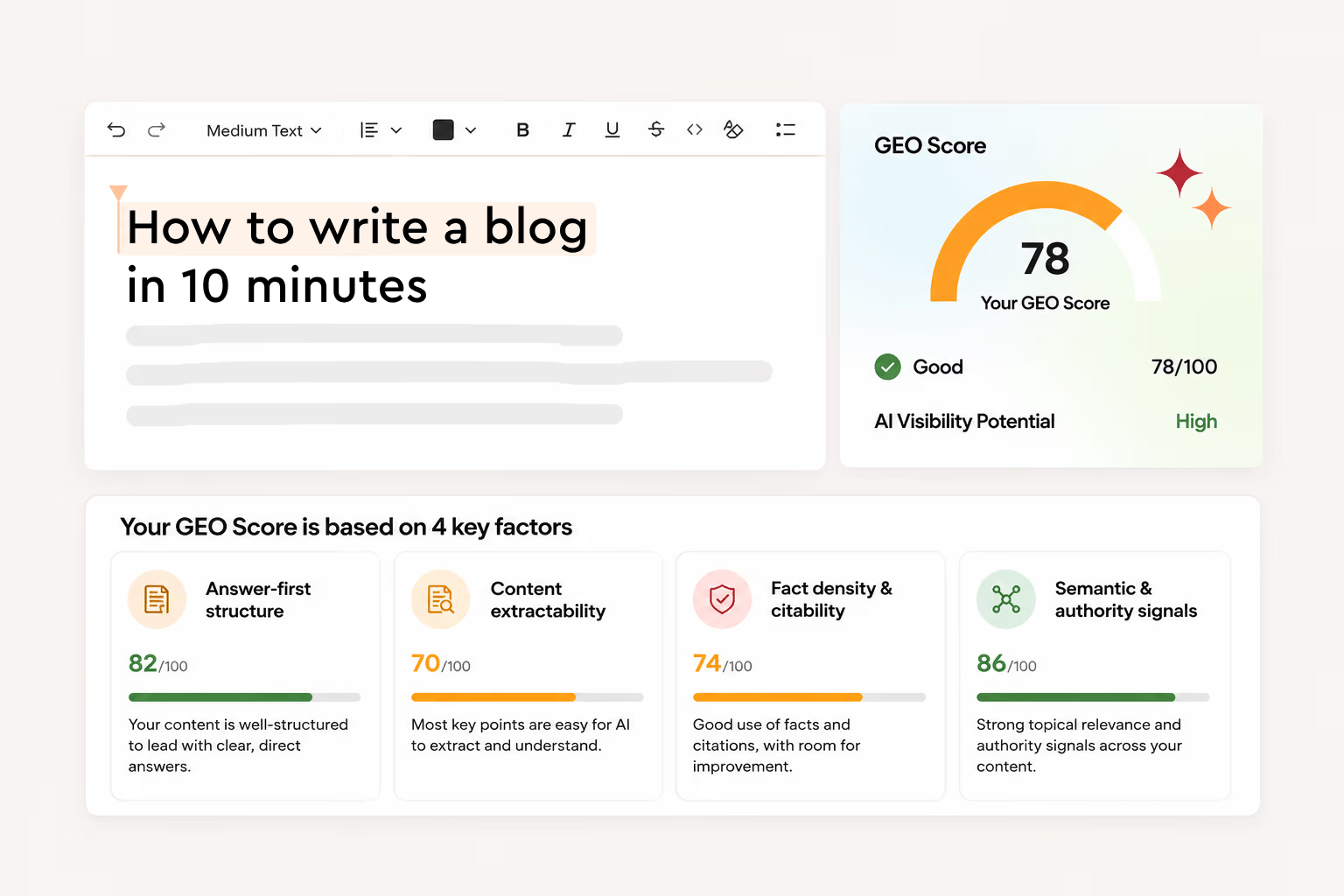
    Even though writing like this can be challenging, you can simplify this process significantly using Contentpen. It scores your content for SEO and GEO as you write, and Fix with AI resolves issues in both scores in one pass, so you can publish citation- and ranking-worthy content.

    Get your content cited by AI, not just ranked on Google!

    See your real-time GEO score as you write to make every piece citation-ready.

    Try GEO Scoring →
     GEO Scoring

    Here is a simple test to check your own content before publishing. Paste any section into ChatGPT and ask, “What does this section say?” If the response loses the core meaning or requires more context, the section fails. Rewrite it until it stands on its own. 

    This one habit will do more for your AI citation rate than most structural changes combined. 

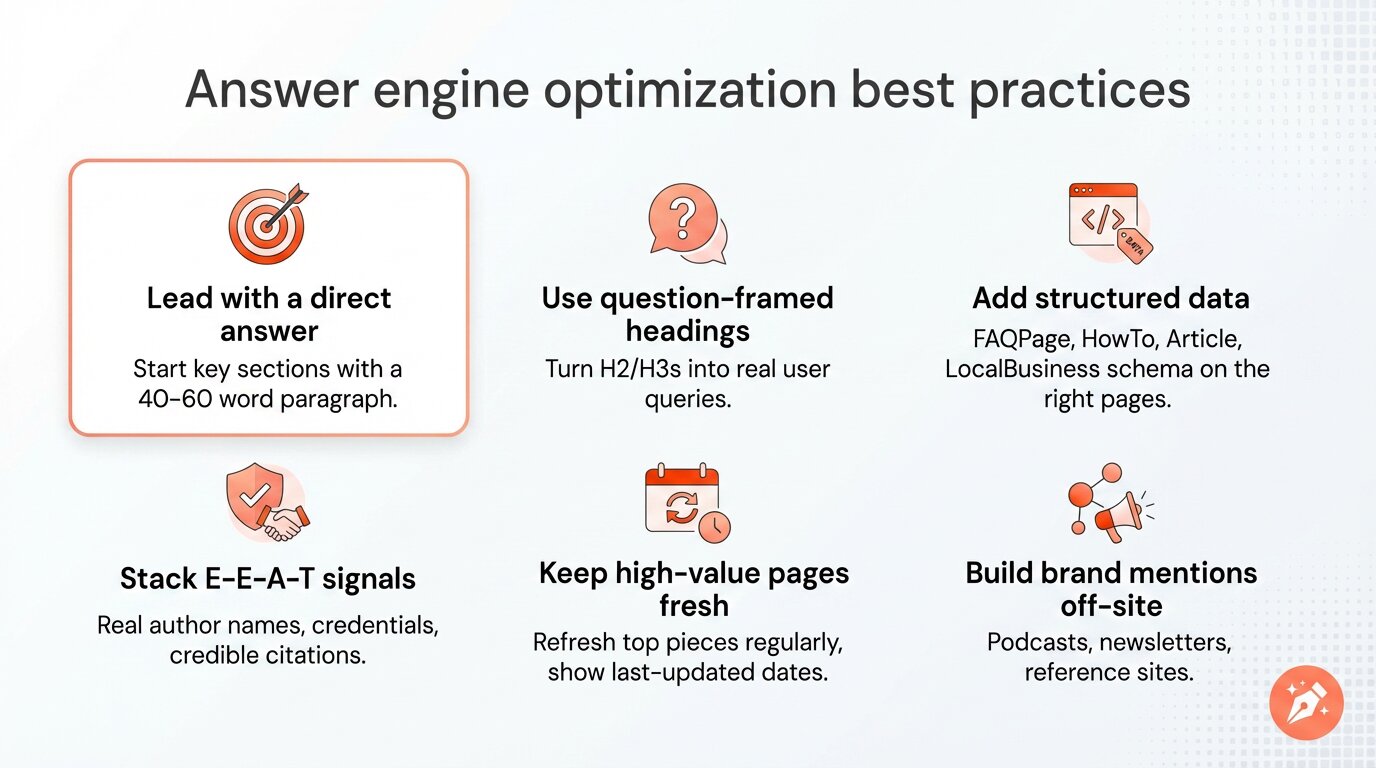
    Also, use clear headings, short paragraphs (40- 60-word definitions, then detailed explanations), and descriptive anchor text. This will help both people and AI models to identify the required information quickly.

    #3: Off-page authority

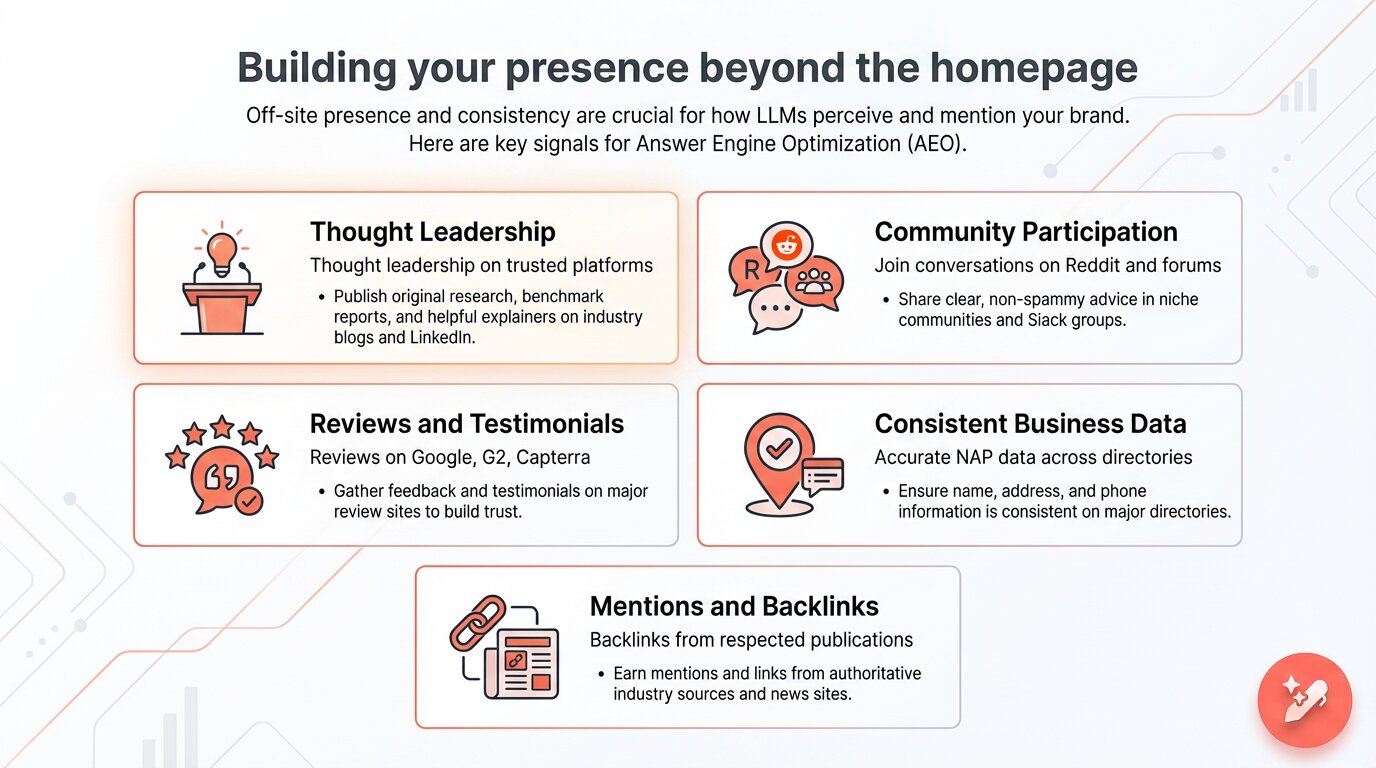
    Finally, authority looks different for both methods. Backlinks still matter for Google, but AI systems care just as much about how often and where your brand is mentioned off-site. 

    This includes your brand presence on Reddit, Quora, LinkedIn, and similar platforms where professionals interact. Answering questions in these communities off-page and engaging with individuals can be a great way of signalling to the AI systems that you are trusted as a brand.

    Unlinked mentions also help AI trust a brand, even if they do not carry that much weight for traditional SEO. 

    This is where Contentpen helps. It gives you in-depth, well-structured articles that are worth referencing in reviews and forums, supporting your SEO and GEO efforts at the same time. Its AI visibility tracking also shows which sources AI engines cite for your competitors but not for you, which is a ready-made list of communities and sites to engage with.

    Write content that’s built to rank, not just read

    Create search-optimized blogs aligned with SEO and GEO signals, so your content performs well across search and AI-driven discovery.

    Try SEO Blogging FREE →
    AI SEO Interface

    The AEO tool also helps you streamline your workflow by enabling seamless publishing directly to top CMS platforms.

    How to measure success across both traditional SEO and AI search

    Measuring AI SEO vs. traditional SEO success means tracking two sets of metrics in parallel. One set shows how you perform on Google and Bing. The other shows how visible you are inside AI answers across tools like ChatGPT, Gemini, and Claude.

    For traditional SEO, your measurement stack stays familiar. You track traffic, rankings, and conversions, then refine pages and links. For AI search optimization, you watch how often assistants mention or cite your brand and how you compare to competitors in those responses.

    Here is a simple comparison of metrics for both sides.

    AreaTraditional SEO metricsAI search visibility metrics
    Traffic and reachOrganic sessions by page in Google Analytics or PlausibleCount of AI responses that mention your brand name from AI search optimization tools and AI monitoring software
    Intent and rankingKeyword positions in Google Search Console, Ahrefs, Semrush, or other AI SEO toolsPrompts where your brand appears vs prompts where only competitors appear
    EngagementClick‑through rate and dwell time on key pagesSentiment in responses, for example, helpful, neutral, or negative wording about your brand
    Business impactForm fills, signups, sales from organic trafficAssisted conversions from visitors who arrive after using AI tools

    AI visibility platforms track AI mentions, citations, AI share of voice (AI-SOV), and sentiment across different models. You can then turn missing prompts into a content roadmap by asking, “Which questions in my niche get AI answers, but not from me?”

    Contentpen covers both halves of this loop in one platform. Its AI visibility tracking, included in every plan, shows which prompts mention your brand, your share of voice and sentiment against competitors, and the sources AI engines cite instead of you, across up to seven engines depending on plan. You can then create targeted articles for the gaps you find, structure them for AI search, and connect them with strong internal linking, then track whether those new articles start earning citations.

    Improve SEO with automated linking that fills them

    check

    Adds context-aware internal and external links automatically

    check

    Uses relevant anchor text to improve SEO and content flow

    Try Auto-Interlinking →
    AI SEO Interface

    Why your AI search wins are invisible in Google Analytics (and what to track instead)

    This is something most marketers run into quickly. You do everything right, structure content for AI, build off-page mentions, optimize for conversational queries, and then open Google Analytics and see nothing has changed.

    That is because AI-driven discovery does not show up as a clean referral source the way a Google organic click does.

    So instead of looking for a single “AI referral” metric, watch these signals instead:

    • Branded search volume. Track your brand name in Google Search Console. A steady rise in branded queries often means people are discovering you through AI tools and then searching for you directly.
    • Direct traffic growth. A meaningful increase in direct visits, especially on pages you have recently optimized for AI, can indicate AI-assisted discovery.
    • Share of voice in AI tools. Run regular prompt audits with AI visibility tools like Contentpen, which track the questions your audience asks across AI engines and show which sources each model cites. If competitors appear and you do not, that is the gap to close.
    • New referring domains. When AI answers cite your content, other writers and bloggers often reference the same pieces. Watch for growth in referring domains to recently published content.

    None of these signals is perfect on its own. But together, they build a picture of whether your AI optimization is working, even when Google Analytics stays quiet.

    Common myths about AI search replacing traditional SEO

    A lot of noise in this space comes from a false either/or framing. It helps to clear up these myths that make people overcorrect in one direction or the other.

    Myth 1: AI search will replace Google soon. AI tools are growing fast, but Google still processes billions of searches daily and is actively building AI Overviews directly into its results. The two systems are converging, not competing. Your job is to be present in both.

    Myth 2: You only need to optimize for AI if you have a large site. Small and mid-size brands often have an easier time getting cited by AI tools because they can dominate narrow, specific topics more easily than broad authority sites can. Topic depth matters more than domain size here.

    Also read: How to perform an AI visibility audit in 2026.

    Myth 3: If my content ranks well on Google, it will automatically show up in AI answers. Not necessarily. AI systems prioritize content that is factually consistent, clearly structured, and well-cited across multiple sources. A page that ranks on Google because of strong backlinks alone may not appear in AI summaries if the content itself is thin or hard to extract.

    Understanding these myths helps you allocate effort correctly, rather than chasing the wrong signals. Over time, good SEO + GEO practices = sustainable results.

    Concluding thoughts

    The future of SEO is not AI search optimization vs traditional seo, but a dual visibility model where you rank in search engines and get cited in AI answers at the same time.

    Classic ranking work keeps you visible on Google and Bing. AI optimization makes sure large language models quote you when users skip straight to an instant answer.

    Strong, accurate content sits at the center of both. Whether you chase traditional SEO or AI search SEO, thin pages with shallow advice will not stand up to AI models that cross‑check many sources before responding.

    Contentpen is an AI search optimization tool that helps you publish clear, long-form content that fits modern SEO techniques and provides clean content chunks that AI can reuse, then tracks whether AI engines actually cite you. That way, you can keep your brand present in both SERPs and AI summaries, and prove it.

    Frequently asked questions

    Is traditional SEO still relevant in 2026?

    Traditional SEO is absolutely still relevant in 2026. Classic optimization feeds many of the authority and quality signals AI systems rely on when they decide which sources to quote. The smarter move is to integrate it with AI‑powered search optimization instead of replacing it.

    What does “query fan-out” mean in the context of AI platforms?

    Query fan-out refers to the way an AI assistant breaks a single prompt into many related background lookups. The model pulls data from several pages, compares facts, and then drafts one combined answer. To show up in AI responses, your content has to cover the wider topic, not just one narrow keyword, and present information in clear, self‑contained sections.

    Does schema markup help with AI search optimization?

    Yes, and it is one of the more underused tools in this space. Schema markup, particularly FAQ schema and Article schema with a dateModified field, helps AI systems understand what your content is about and how current it is. The FAQ schema is especially useful because it formats your answers in a way that AI models can extract cleanly without losing context.

    Are social media mentions counted as off-page authority signals for AI search?

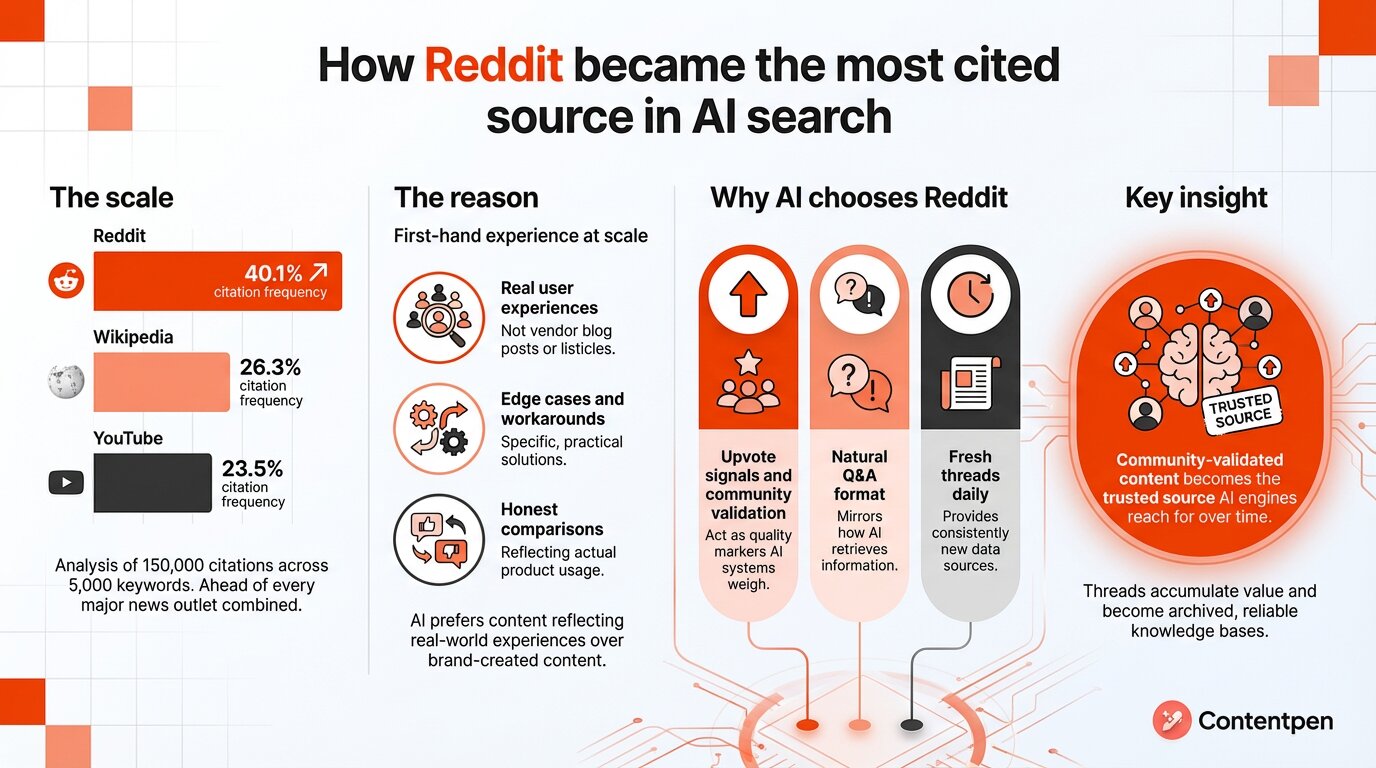
    Yes, but not in the way backlinks work for traditional SEO. AEO examples show that AI systems do not read social media posts directly or count likes and shares as ranking signals. What they do pick up on is the broader pattern of your brand being discussed in places where real people ask and answer questions, such as Reddit threads, Quora answers, and LinkedIn posts.

  • 16+ best AI search optimization tools for 2026

    16+ best AI search optimization tools for 2026

    AI search optimization tools now influence whether your brand shows up inside ChatGPT or gets skipped in AI answers. When people ask Perplexity, Gemini, or Google AI Overviews for advice, those instant summaries can replace a click to your site.

    That is the real problem. Your organic traffic can slide even while your classic rankings look fine in your old dashboards. This is where AI search optimization tools become crucial. These platforms help your content appear in those AI summaries, and not just in SERP results.

    In this guide, you will see 16+ of the best options tested and ranked for 2026 across different categories. You will also see how Contentpen fits into a modern stack, especially if you care about long-form blog posts that attract links.

    Ready to pick tools that work with AI instead of fighting it? Let us start with what these tools actually are and why they matter now.

    What are AI search optimization tools, and why do you need them in 2026?

    AI search optimization tools are platforms that help your site appear in answers from AI systems like ChatGPT, Perplexity, Claude, Gemini, and Google AI Overviews. They focus on how large language models read, summarize, and cite your content. Instead of only tracking rankings, they look at prompts, entities, and citations for your brand.

    Traditional SEO chases positions on classic SERPs with blue links. That still matters, but more people now type full questions into AI chatbots when they want fast guidance, prompting the need for AEO.

    Research from Similarweb shows the average monthly visits for AI tools grew 76% year over year (YOY). This stat and a lot of AEO examples tell us that if your brand is not mentioned or cited in those AI answers, a growing audience never hears about you. 

    AI search optimization tools measure when you are mentioned, which sources those systems lean on, and how you compare to competitors. They are a necessity for brands in 2026 looking to improve share of voice in a niche and establish themselves in an industry.

    Also read: AI search optimization vs. traditional SEO.

    You also need practical help turning insights into content. Many modern AI SEO tools now combine AEO/GEO tracking with AI content optimization, on-page optimization, and automated SEO workflows for internal links, schema, and indexing. 

    These tools also help you write content that satisfies a people-first approach while still being easy for AI systems to parse and trust.

    How we tested and ranked these tools

    This list of AI search optimization tools ranks each product on real-world usefulness for content marketers, agencies, and individuals.

    We focused on how much each tool helps you show up in AI answers and how a busy team can put the insights into action.

    The tools were tested against several core criteria:

    • Prompt-level tracking across ChatGPT, Perplexity, Gemini, Claude, and Google AI Overviews
    • Multi-engine coverage for both classic and AI search
    • Citation and source intelligence for AI answers
    • Competitor benchmarking and share-of-voice views
    • Actionable recommendations instead of raw numbers and charts
    • Ease of use, setup time, and learning curve
    • Pricing and integrations with GA4, Google Search Console, and major CMS platforms

    We also favored products that support answer-first intros, clear headings, and FAQ blocks that AI platforms can easily reuse and cite in their answers.

    Note: The pricing values stated in this article are accurate as of the date of writing this article, but may vary. Always refer to the vendor website for the latest pricing updates before making a decision.

    16+ best AI search optimization tools in 2026

    The 16+ best AI search optimization tools in 2026 cover every part of the modern SEO + GEO stack. You get tools that provide content creation, GEO tracking, AEO audit workflows, technical indexing help, outreach, and reporting. 

    ToolBest forStarting priceFree plan?
    ContentpenGEO-friendly long-form content and AI visibility tracking$49/monthYes, 7-day free trial
    AIclicks.ioAll-in-one GEO and AI visibility tracking$59/monthYes, 3-day free trial
    OtterlyAIGEO audit workflows$29/monthYes
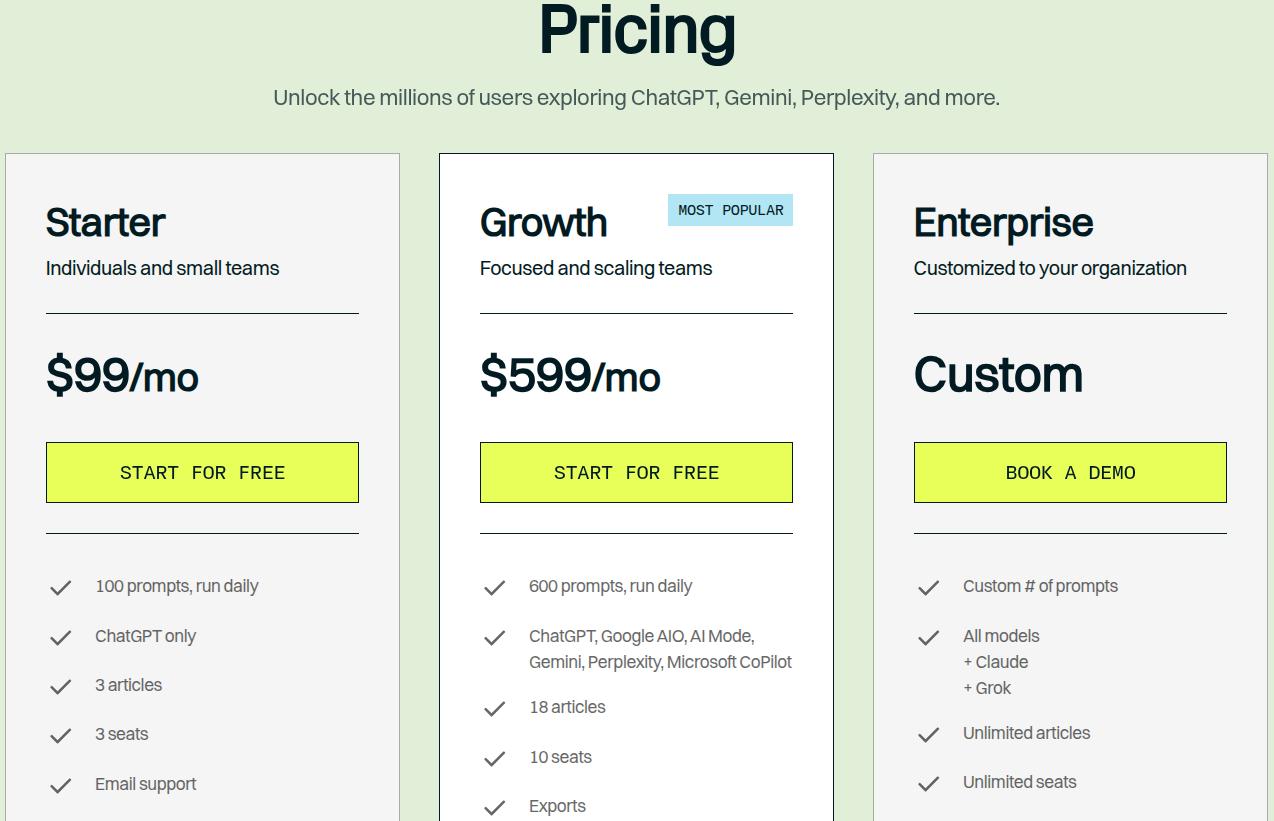
    ProfoundEnterprise-grade AI visibility analytics$99/monthYes, limited
    ClearscopePrecision editorial optimization$129/monthYes, 14-day free trial
    RankabilityAgencies needing NLP and expert coaching$199/monthNo
    MarketMuseBuilding topical authority and content strategy$99/feature/monthYes, limited
    HubSpot AEOAI visibility insights and marketing workflows$45/monthYes, 28-day free trial
    FraseAffordable briefs and AI drafting$49/monthYes, 7-day free trial
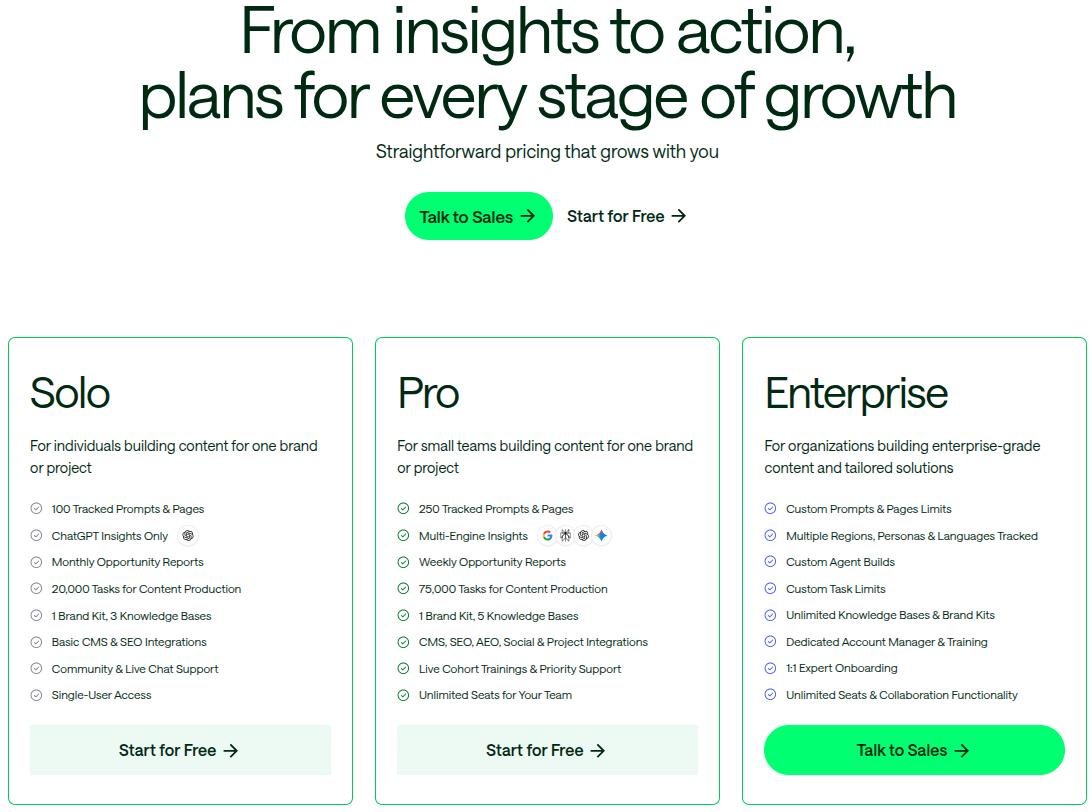
    AirOpsCustom AI workflows at scaleCustom pricingLimited
    WritesonicAI article writing with live SEO data$79/monthLimited
    SE RankingGoogle AI Overview monitoring$129/monthYes, 14-day free trial (complete access)
    GaugeAgentic AI marketing intelligence$99/monthYes, free trial
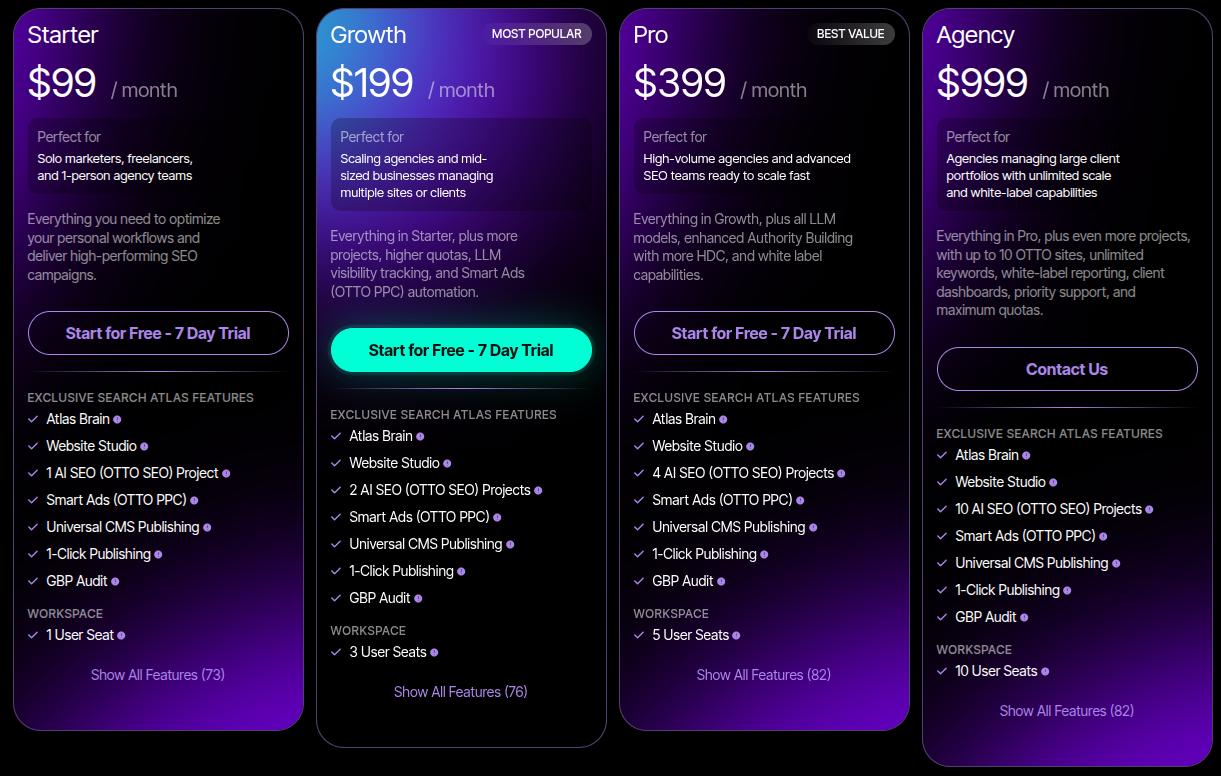
    Search AtlasAutomated AI SEO execution$99/monthYes, 7-day free trial
    IndexlyAutomated indexing and AI crawler access$99/monthYes
    WhatagraphAI-powered SEO and GEO reporting$229/monthYes
    GrackerAIAEO/GEO for cybersecurity brands$99/monthYes, 7-day free trial

    Each detailed tool entry explains what the AI search optimization tool does, standout features, who it suits, and how pricing starts.

    Use this section as a starting line and then mix tools into your own stack to receive maximum gains.

    1. Contentpen — Best for AI-powered blog creation and SEO + GEO content

    Contentpen for AI and SEO optimized content.

    Contentpen is built for one clear job: creating long-form blog content that ranks on Google and gets cited by AI engines. It guides you from topic idea through to a polished, SEO- and GEO-optimized article, then tracks whether ChatGPT, Gemini, Perplexity, and other AI engines actually mention your brand.

    That makes it a natural starting point if you want to rank on Google as well as get cited in AI systems.

    Standout features:

    • Powerful keyword research based on real search intent
    • Detailed outlines so your output does not feel generic
    • Answer-first intros, strong headings, and FAQs that work well for GEO and AI search
    • Live GEO scoring across 17 parameters, with Fix with AI to resolve SEO and GEO issues in one pass
    • AI visibility tracking, covering up to 7 AI engines depending on plan, with share of voice, sentiment, average position, and source gaps against competitors
    • Automated internal and external linking that ties new posts into your site architecture and wider backlink strategy
    • Built-in media library and an AI image generator for better Google Images visibility

    Use cases: 

    Small businesses, freelancers, marketing teams, and agencies that want to ship more high-quality articles without losing control of tone. 

    Worth knowing:

    Contentpen only offers a 7-day free trial, which can be enough in many cases. But new users might take a while to grasp all the features and how to use them properly.

    Pricing: 

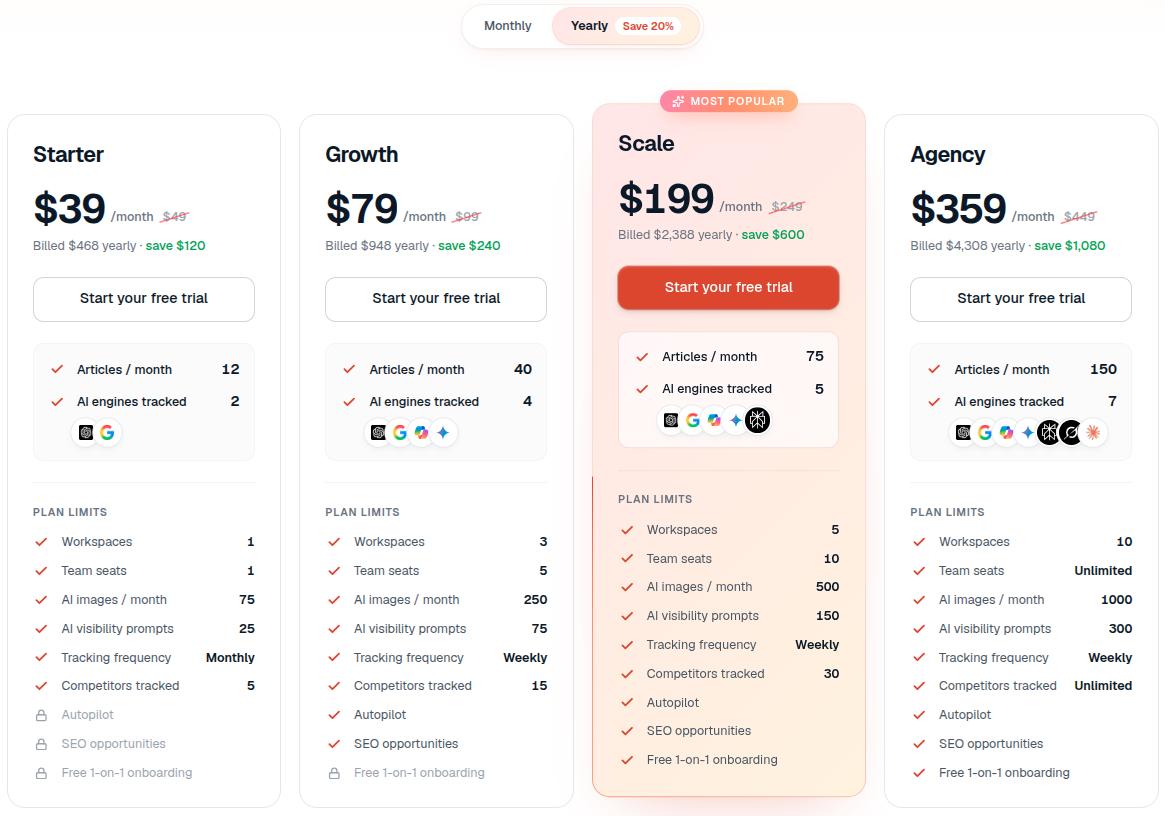
    Contentpen new pricing (billed annually.)

    Starts at $49/month, or $39/month billed annually, with 12 articles, 25 tracked prompts, and 2 AI engines (ChatGPT and Google AI), alongside content creation. Higher plans add more engines, up to all seven on Agency. It is one of the most affordable tools on this list that covers both AI search optimization and content creation.

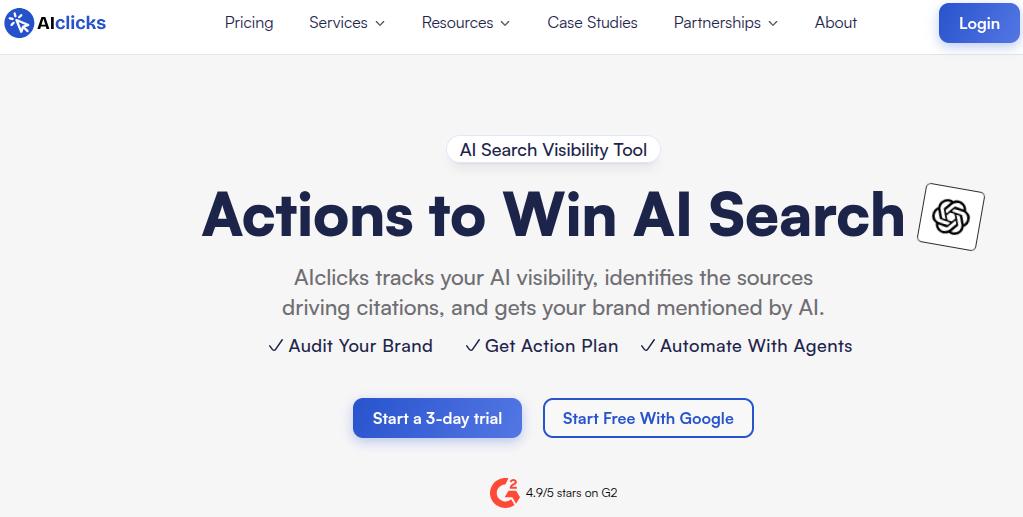
    2. AIclicks.io — Best all-in-one GEO tracking platform

    AIclicks.io landing page.

    AIclicks.io shows you exactly how AI engines talk about your brand. Instead of guessing, you see real prompts users type into ChatGPT, Perplexity, Gemini, Claude, Grok, and Google AI Overviews for your brand, plus whether your site appears in those answers. That makes it one of the most focused AI search optimization tools for GEO.

    Standout features:

    • Tracking of brand mentions across major AI assistants
    • Lists of external domains that AI engines cite, such as Reddit threads, directories, and listicles
    • Competitor benchmarking for prompts and citations
    • An AI-optimized content drafting module that turns visibility gaps into answer-ready briefs

    Use cases: 

    Brands and agencies that want a complete AI visibility command center instead of scattered data. It suits teams that already run classic SEO and now need SEO for AI search as a connected but distinct track. 

    Worth knowing:

    The content drafting module is a supporting feature, not the core strength. If your primary need is producing high volumes of polished, long-form articles, AIclicks will feel limited on that side.

    Pricing: 

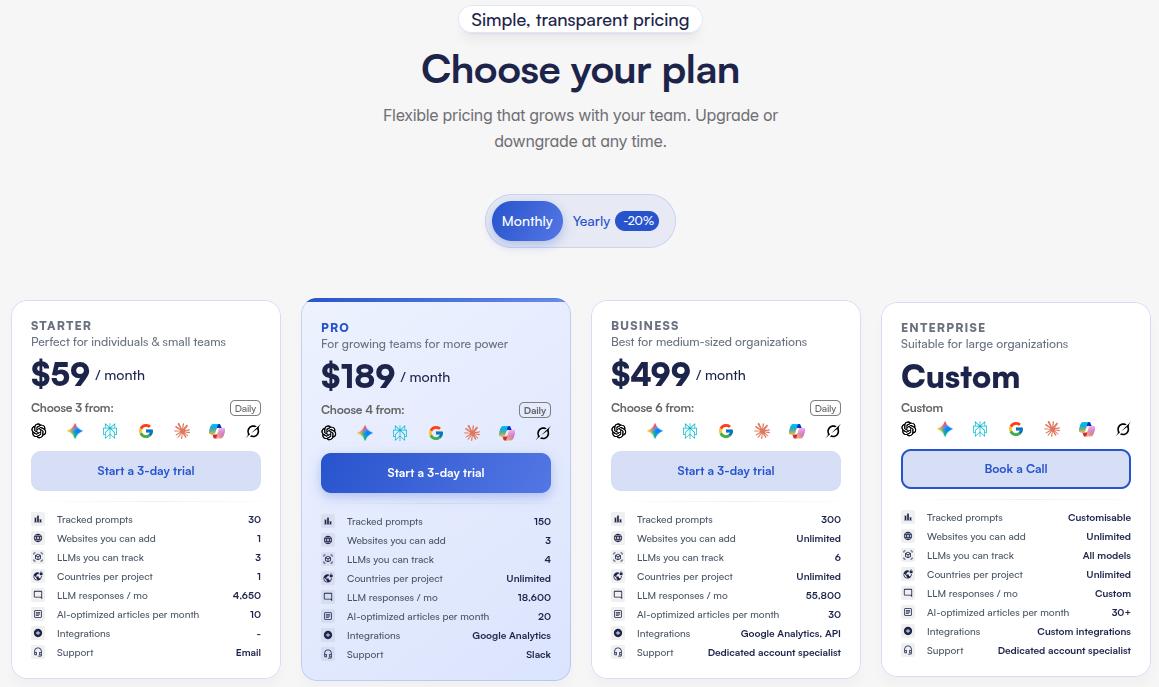
    AIclicks pricing plans.

    Pricing starts at $59/month, with yearly discounts and a refund guarantee that lowers risk while you test.

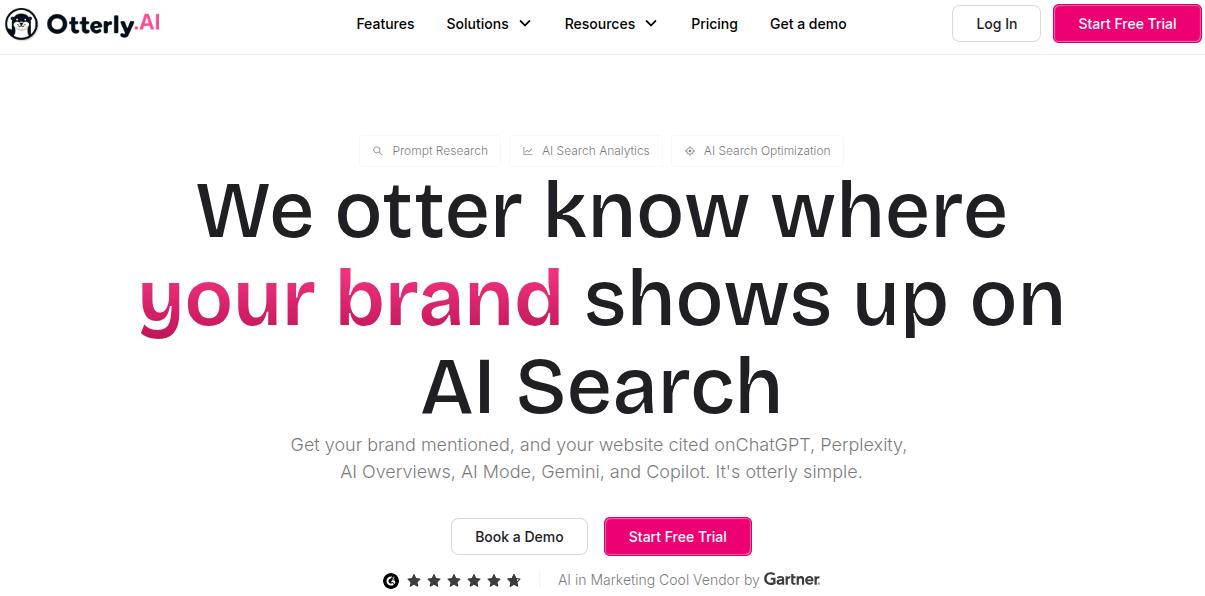
    3. OtterlyAI — Best for GEO audit workflows and agency reporting

    Otterly.AI landing page.

    OtterlyAI was built from the ground up for one job: showing you exactly where your brand appears inside AI-generated answers and giving you a structured path to improve it. Unlike tools that bolt GEO tracking onto a traditional SEO dashboard, Otterly treats prompt monitoring, citation analysis, and brand visibility as the core product. That focus shows in the depth of its audit capabilities.

    Standout features:

    • A GEO Audit that runs a full SWOT-style breakdown of your AI visibility
    • A Brand Visibility Index that combines mentions, coverage, and citation signals into one KPI
    • Prompt Research that converts your seed keywords into the natural-language questions people actually type into AI systems
    • Domain and URL citation tracking that shows which pages on your site get referenced most often by AI engines

    Use cases:

    Agencies that need a clean, repeatable GEO workflow for multiple clients. It is also a strong fit for content strategists who want to move beyond raw visibility data and understand why certain pages get cited while others get skipped.

    Worth knowing:

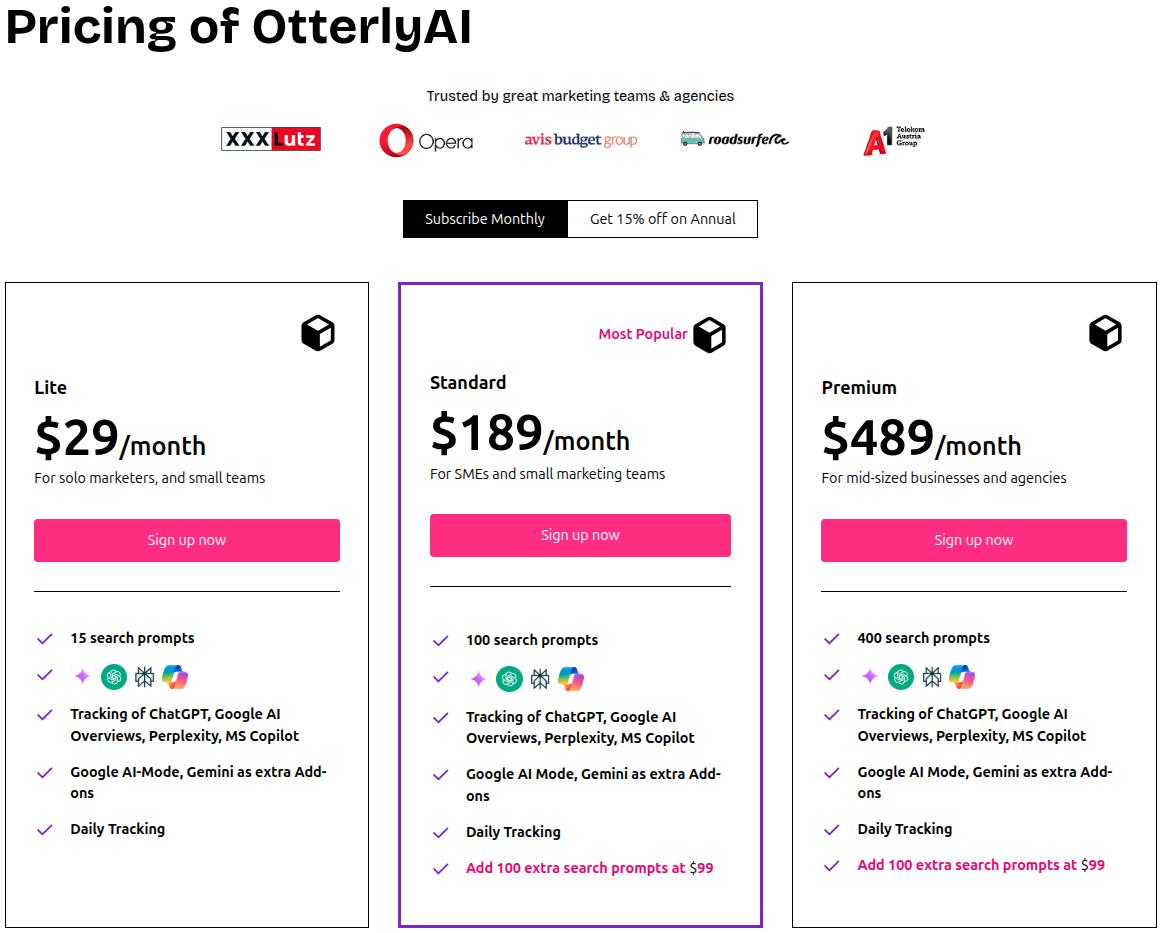
    Otterly’s pricing scales steeply with prompt volume. The Lite plan at $29/month covers only 15 tracked prompts, which run out fast for brands monitoring multiple product lines or markets.

    Pricing:

    OtterlyAI pricing details.

    The ‘Lite’ plan starts at $29/month with 15 search prompts and tracking of ChatGPT, Google AI Overviews, Perplexity, and Copilot.

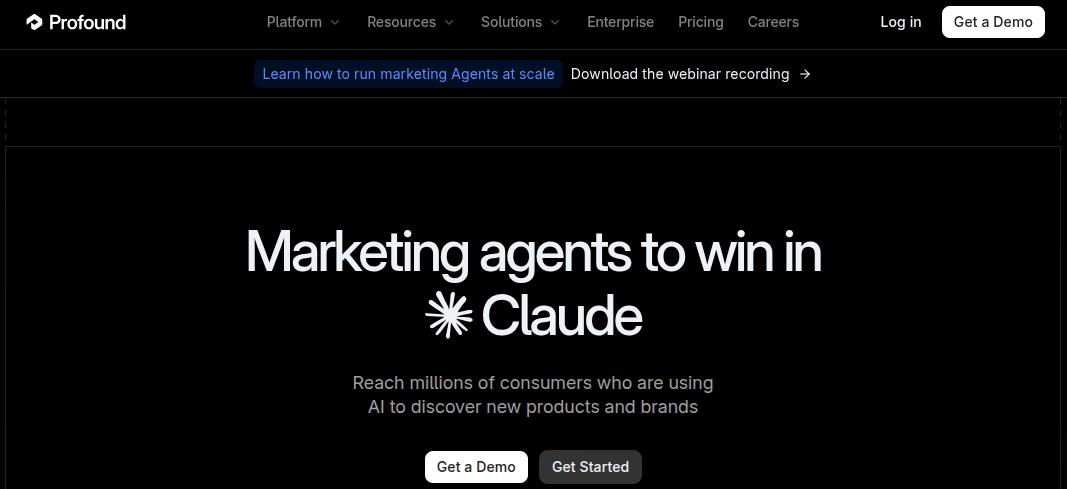
    4. Profound — Best for enterprise-grade AI visibility analytics

    Profound GEO visibility tool.

    Profound is built for teams that need serious depth behind their AI visibility data. It covers the major AI search platforms and focuses on connecting prompt-level tracking with competitive and citation intelligence to build a modern GEO strategy.

    Standout features:

    • Keyword and prompt-level tracking across ChatGPT, Perplexity, Google AI Overviews, and other AI platforms
    • Competitor benchmarking that shows how often rival brands appear for the same prompts, so you can see share-of-voice gaps at a glance
    • Content optimization recommendations tied directly to the visibility gaps

    Use cases:

    Enterprise marketing teams and in-house strategists who run AI visibility as a distinct channel alongside classic SEO. It suits brands that already have content and tracking infrastructure in place and now want deeper intelligence behind what AI systems say about them.

    Worth knowing:

    Profound is priced and built for enterprise teams, which means solo creators, freelancers, and small businesses will likely find it overkill for their needs.

    Pricing:

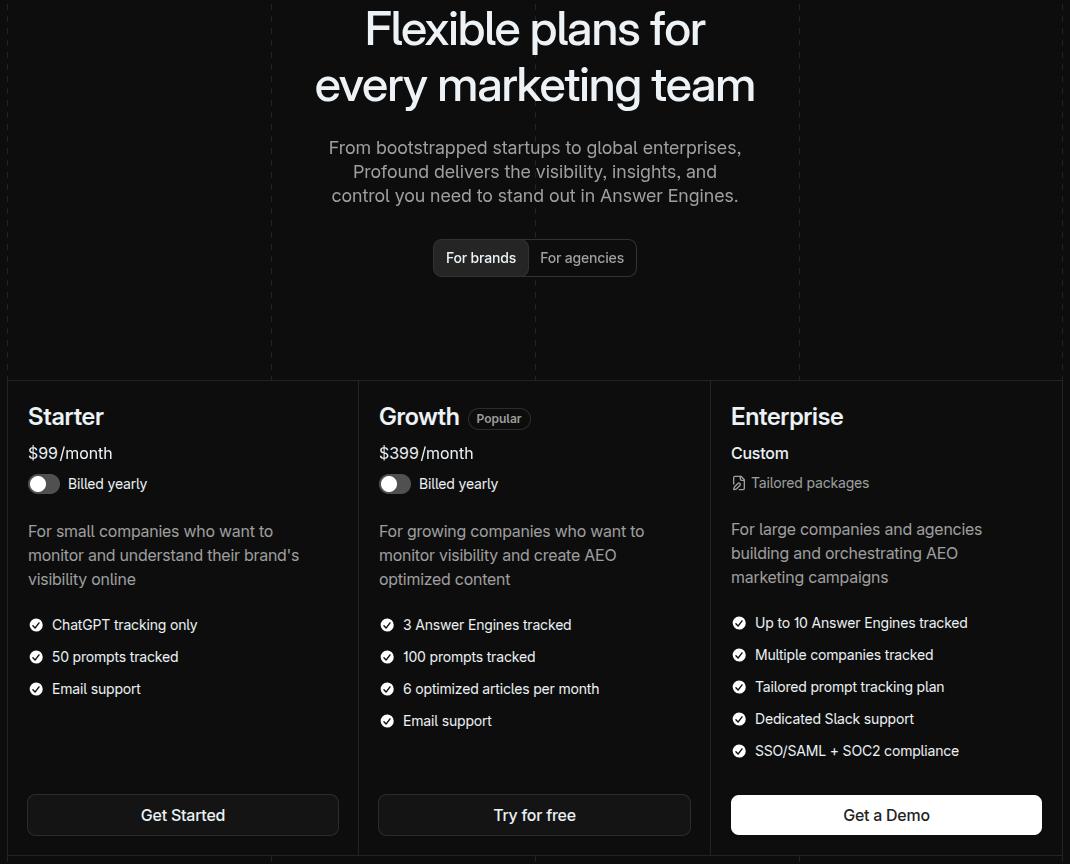
    Profound pricing plans.

    The starting price is $99/month, which provides 50 prompts tracked with email support.

    5. Clearscope — Best for precision-driven editorial teams

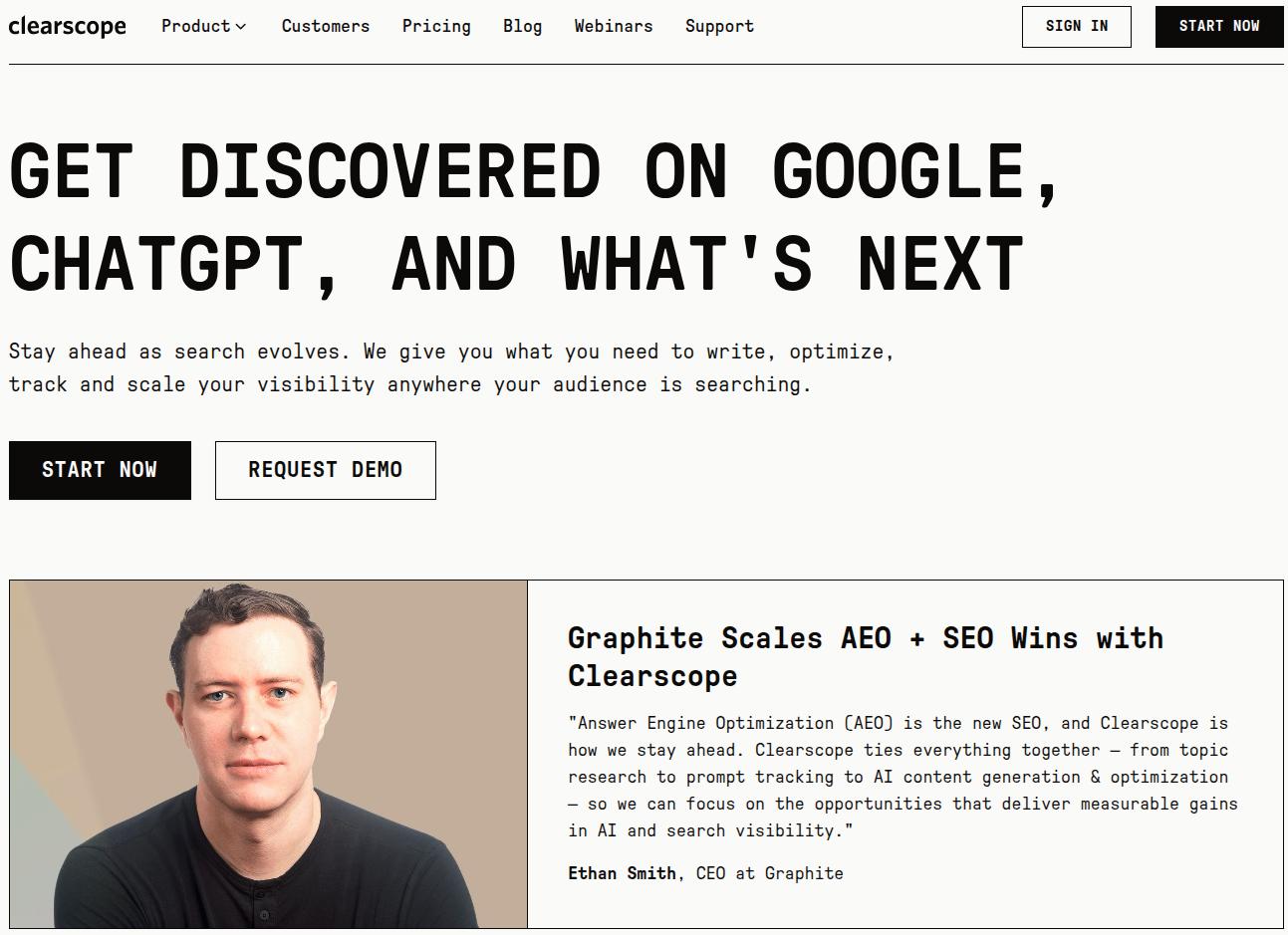
    Clearscope landing page.

    Clearscope is a favorite among editorial teams that want clean, data-backed guidance without noisy dashboards. It scores each article on an A-to-F scale while suggesting related phrases and entities that top-ranking pages already use. The focus stays on human-written quality, not only on AI SEO tools and automation.

    Standout features:

    • Content Reports that surface recommended terms and coverage gaps
    • Content Inventory views that show which pages need updates
    • Topic Research modules that help editors map out new articles
    • A Google Docs add-on that brings optimization into your normal writing workflow

    Use cases: 

    Enterprise content teams, publishers, and agencies that manage multiple writers and editors. It fits nicely in a stack where Contentpen drafts articles and Clearscope refines word choice and coverage. 

    Worth knowing:

    Clearscope focuses on refining content for search engines rather than tracking AI visibility directly. It does not tell you whether your pages are being cited in ChatGPT or Perplexity answers, so teams that need GEO tracking will still need a separate platform alongside it.

    Pricing: 

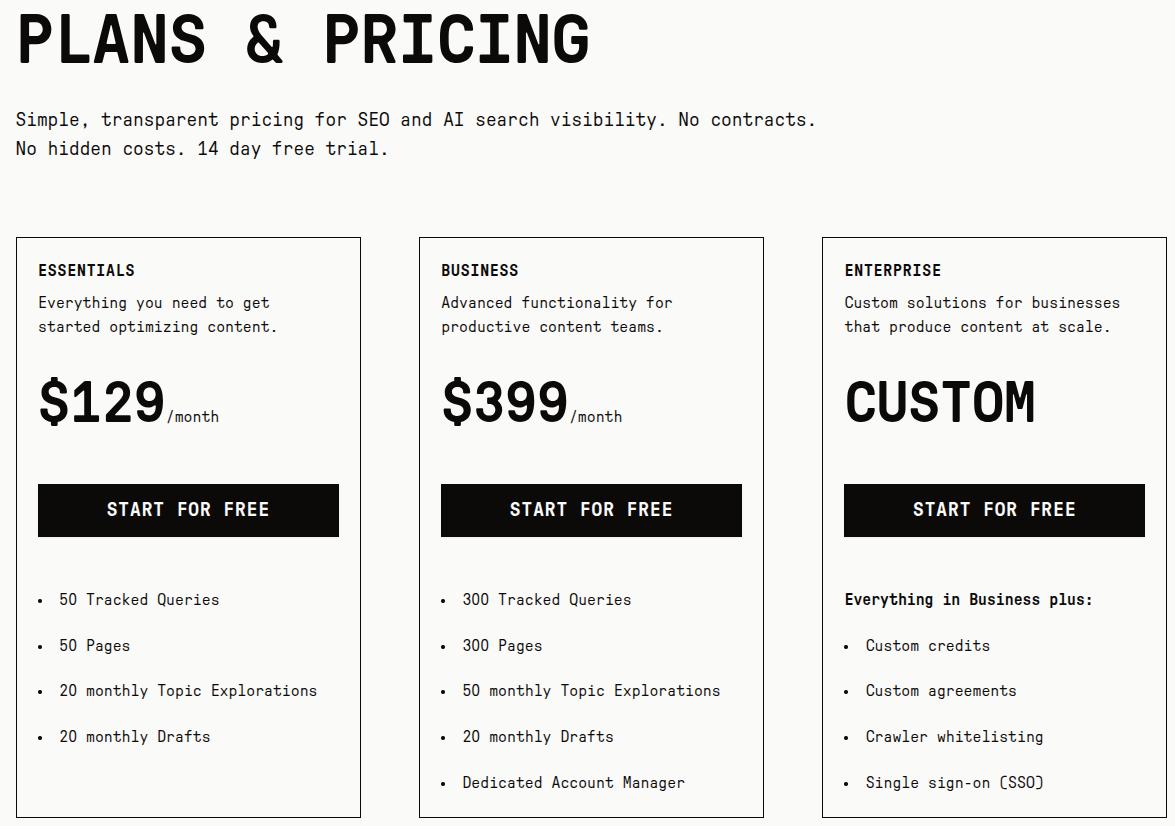
    Clearscope updated pricing 2026.

    Clearscope pricing begins at around $129/month for the ‘Essentials’ plan that provides 50 tracked queries and 20 monthly topic explorations.

    6. Rankability — Best for agencies needing NLP + expert coaching

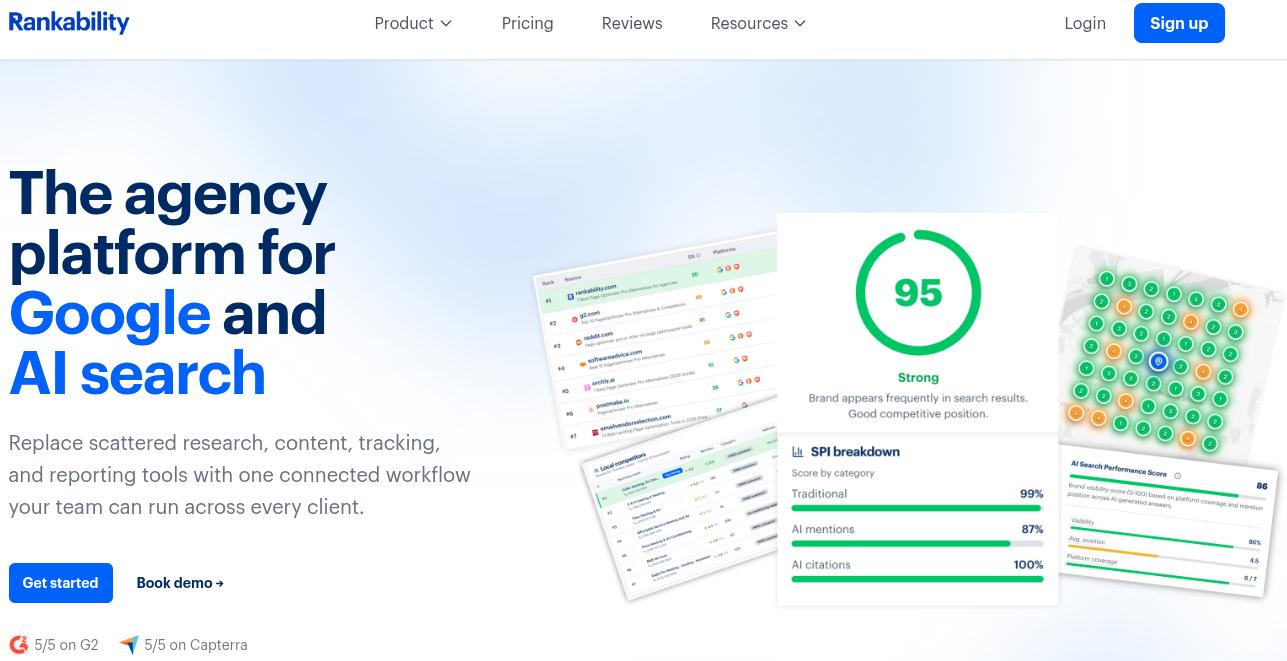
    Rankability main landing page.

    Rankability leans hard into advanced NLP and education, which makes it a strong pick for agencies learning GEO. By blending IBM Watson and Google NLU, it suggests entities and topics that matter in your niche. That means the AI SEO analyzer keeps your content strategies up-to-date according to the changing industry standards.

    Standout features:

    • Real-time content scoring with NLP-backed term suggestions
    • AI-generated briefs to guide writers
    • A built-in AI writer for generating useful first drafts
    • Weekly expert coaching calls that explain why the recommendations matter

    Use cases: 

    SEO and digital marketing agencies that want both tech and coaching in the same place. It works especially well for teams that handle many clients and need repeatable workflows. 

    Worth knowing:

    Rankability is one of the pricier content optimization tools on this list. The weekly coaching calls that justify part of that cost may not suit teams that prefer self-serve workflows or already have strong in-house SEO knowledge. 

    Pricing: 

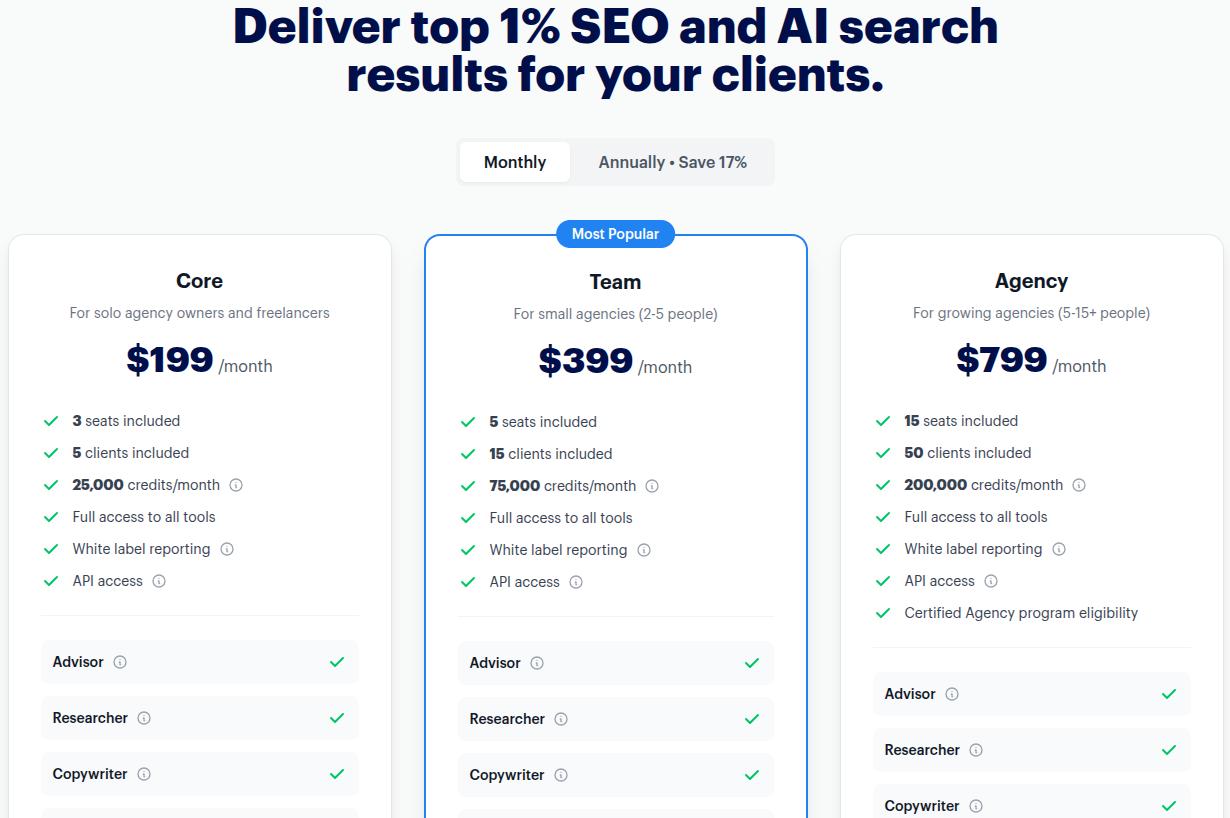
    Rankability pricing plans.

    Plans start at $199/month. You can also get annual plans with higher credit limits and save 17% overall.

    7. MarketMuse — Best for building topical authority and content strategy

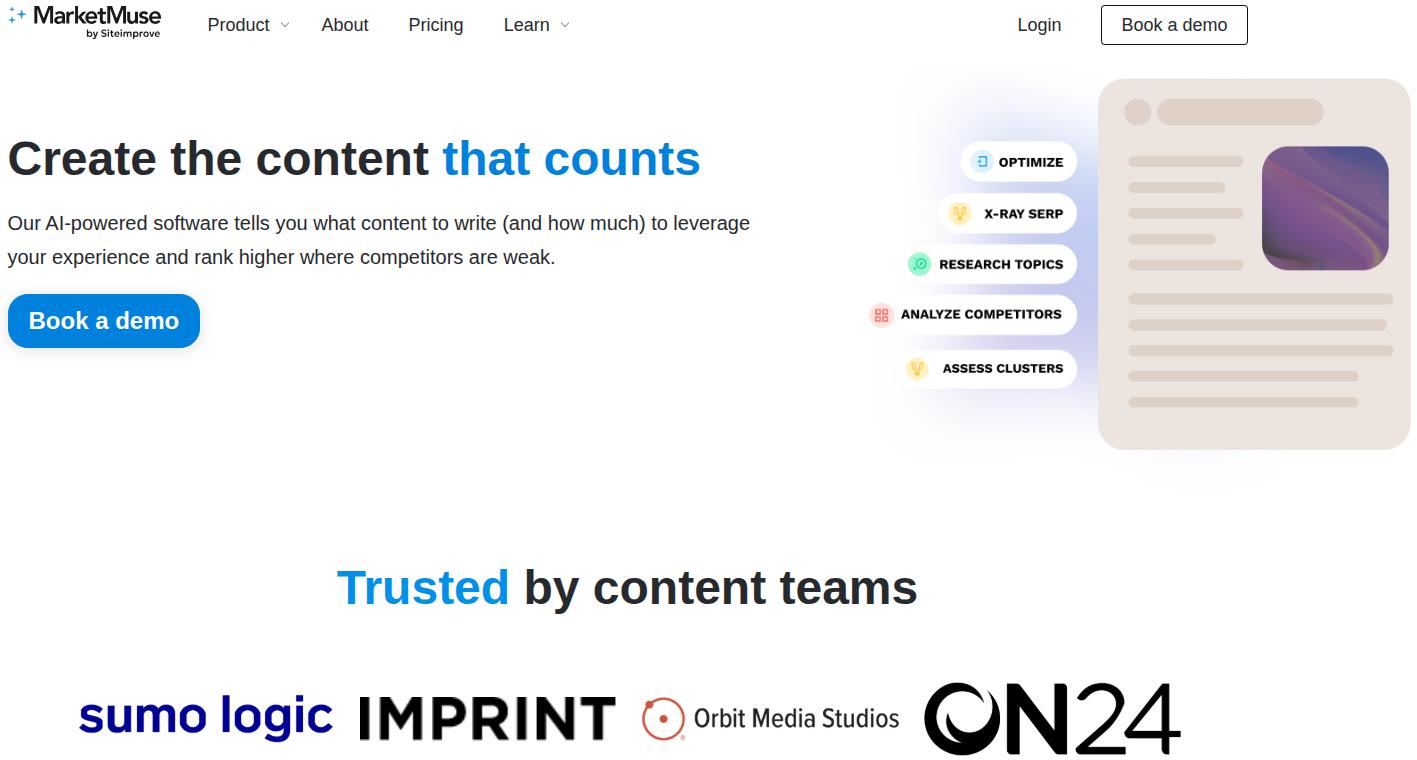
    MarketMuse landing page.

    MarketMuse focuses on building deep topical authority for your niche instead of singular, isolated pages. It scans your entire site to spot coverage gaps, then suggests which themes to expand next. If you manage a big content library, it feels more like a strategy partner than another AI content optimization tool.

    Standout features:

    • SERP X-ray and Heatmap views that show how competitors cover a topic
    • Detailed content briefs with headings, questions, and related ideas
    • Inventory and strategy documents that guide which pages to update, redirect, or expand

    Use cases: 

    Enterprise strategists and large teams that manage a large number of URLs. It pairs well with Contentpen when you want to fill gaps with new long-form posts that AI engines like to cite.

    Worth knowing:

    MarketMuse does not publish its paid plan pricing openly, which makes it harder to evaluate before purchasing the tool. The platform is also better suited to managing and auditing a large existing content library rather than helping you produce new articles quickly from scratch.

    Pricing:

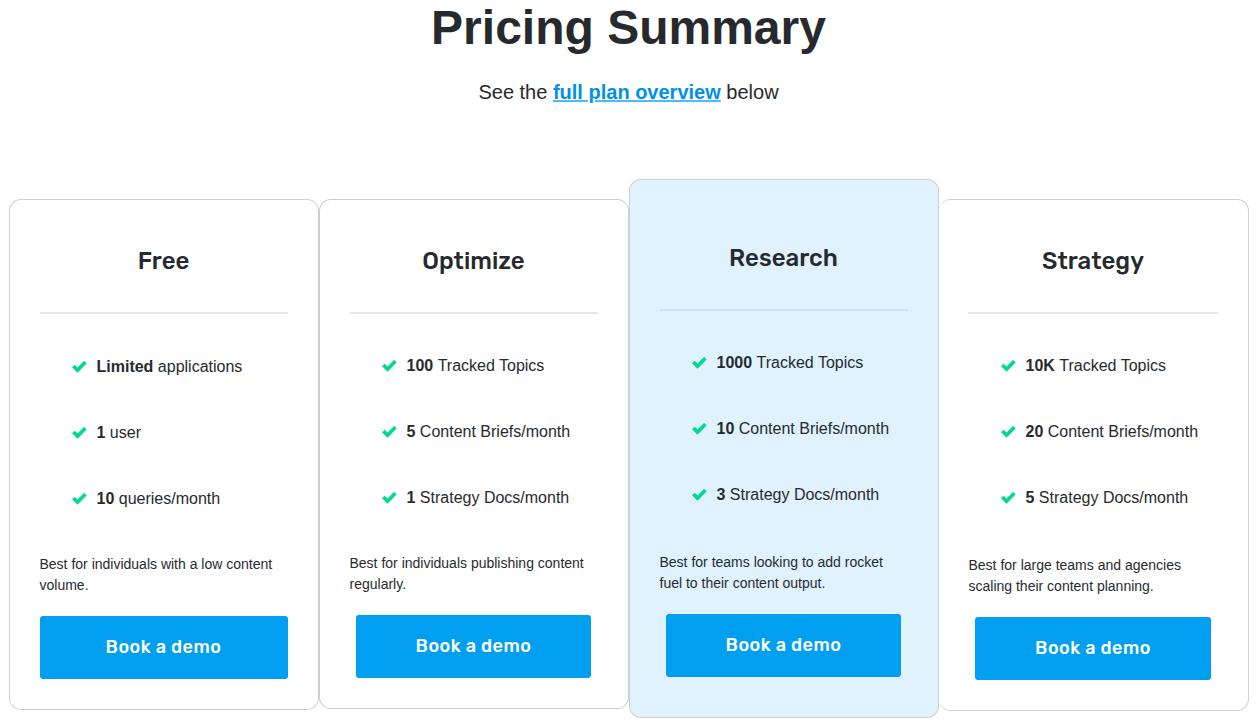
    MarketMuse pricing plans.

    There’s a free plan for MarketMuse with limited applications. No pricing figure is quoted on MarketMuse’s official website for the paid plans. However, MarketMuse’s Capterra page reveals a starting price of $99/feature/month.

    8. HubSpot AEO — Best for AI visibility insights and marketing workflows

    HubSpot AEO.

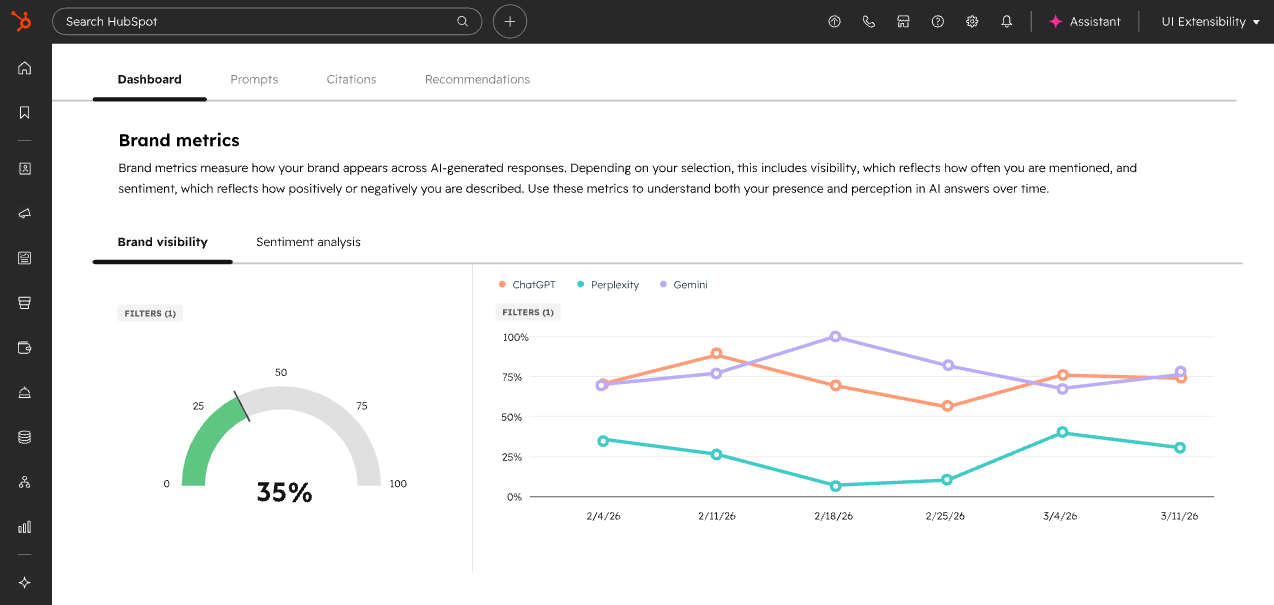
    HubSpot AEO helps brands understand how they appear across AI-powered search platforms like ChatGPT, Gemini, and Perplexity. Instead of focusing only on rankings, the platform tracks prompt-level visibility, brand mentions, competitor presence, and sentiment across AI-generated answers, making it a practical tool for teams adapting to generative search.

    Standout features:

    • AI visibility tracking across ChatGPT, Gemini, and Perplexity
    • Prompt-level monitoring for real user queries
    • Competitor benchmarking and share-of-voice insights
    • Content recommendations to improve AI citations and mentions
    • Integration with HubSpot CRM and marketing workflows

    Use cases: 

    Marketing teams and brands that want to operationalize answer engine optimization without adding a separate enterprise SEO stack. It’s especially useful for businesses already using HubSpot for content, automation, and campaign management.

    Worth knowing:

    HubSpot AEO focuses more on visibility tracking and optimization strategy than on high-volume AI content generation. Teams looking for large-scale content production may still want dedicated writing tools alongside it.

    Pricing:

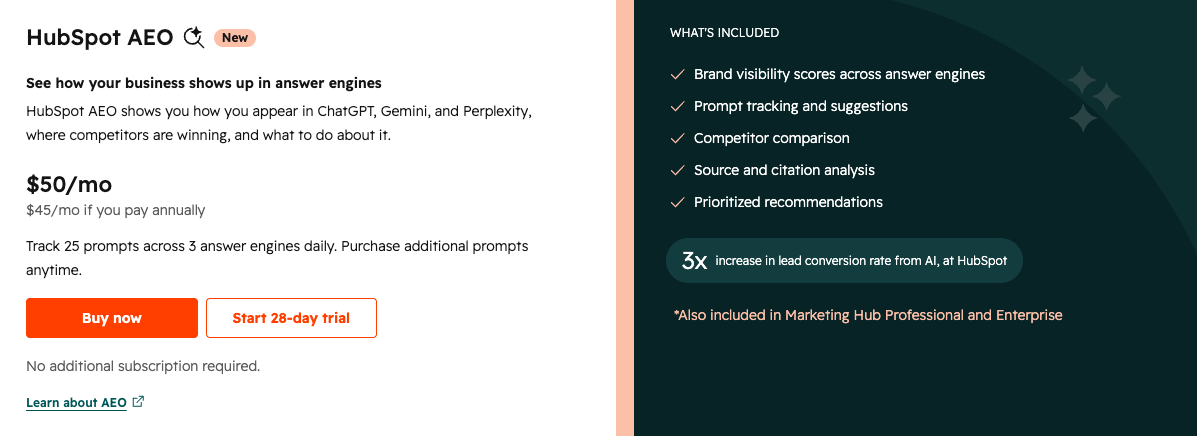
    HubSpot AEO pricing.

    Pricing starts at $45/month, with a 28-day free trial available.

    9. Frase — Best affordable all-in-one AI SEO tool for solo creators

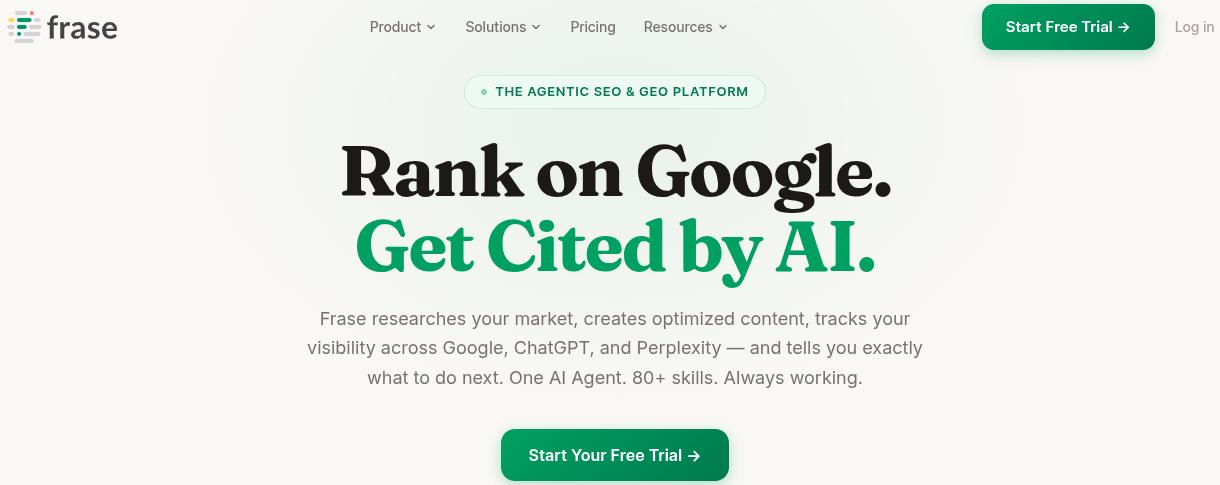
    Frase AI SEO writer.

    Frase helps you move from a keyword idea to a solid draft without too much hassle. It pulls headings, stats, and questions from the top SERP results, then turns them into an outline. That makes it a friendly entry point for solo creators trying AI keyword research tools and AI SEO content generators for the first time.

    Standout features:

    • Automated brief creation from current search results
    • A built-in AI writer for drafts and rewrites
    • A compact research view that highlights the questions competitors answer and the ones they miss
    • An AI image generator that creates relevant visuals for the content

    You can then add helpful FAQs and answer-first intros that AI tools like to quote.

    Use cases: 

    Freelancers, small businesses, and startups that want one tab for research and drafting. Frase is strong when you need speed more than deep GEO tracking.

    Worth knowing: 

    Frase is built for speed and simplicity, which means it trades depth for ease of use. It pulls data from current SERP results rather than tracking AI engine citations directly, so it works best as a drafting and brief tool rather than a full GEO or AEO platform.

    Pricing: 

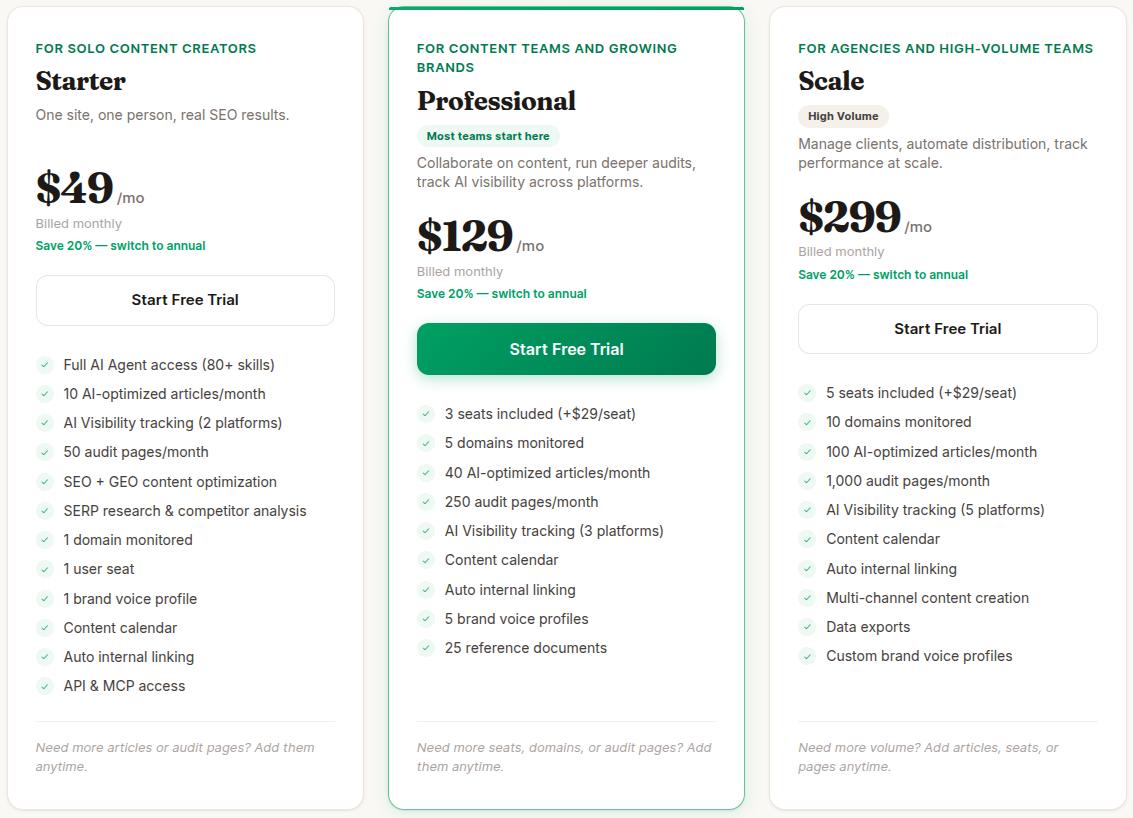
    Frase pricing.

    Paid plans start at $49/month with 10 AI-optimized articles and 50 audits per month. The platform also offers a free trial to test the software before purchasing.

    Also read: Frase vs. Contentpen.

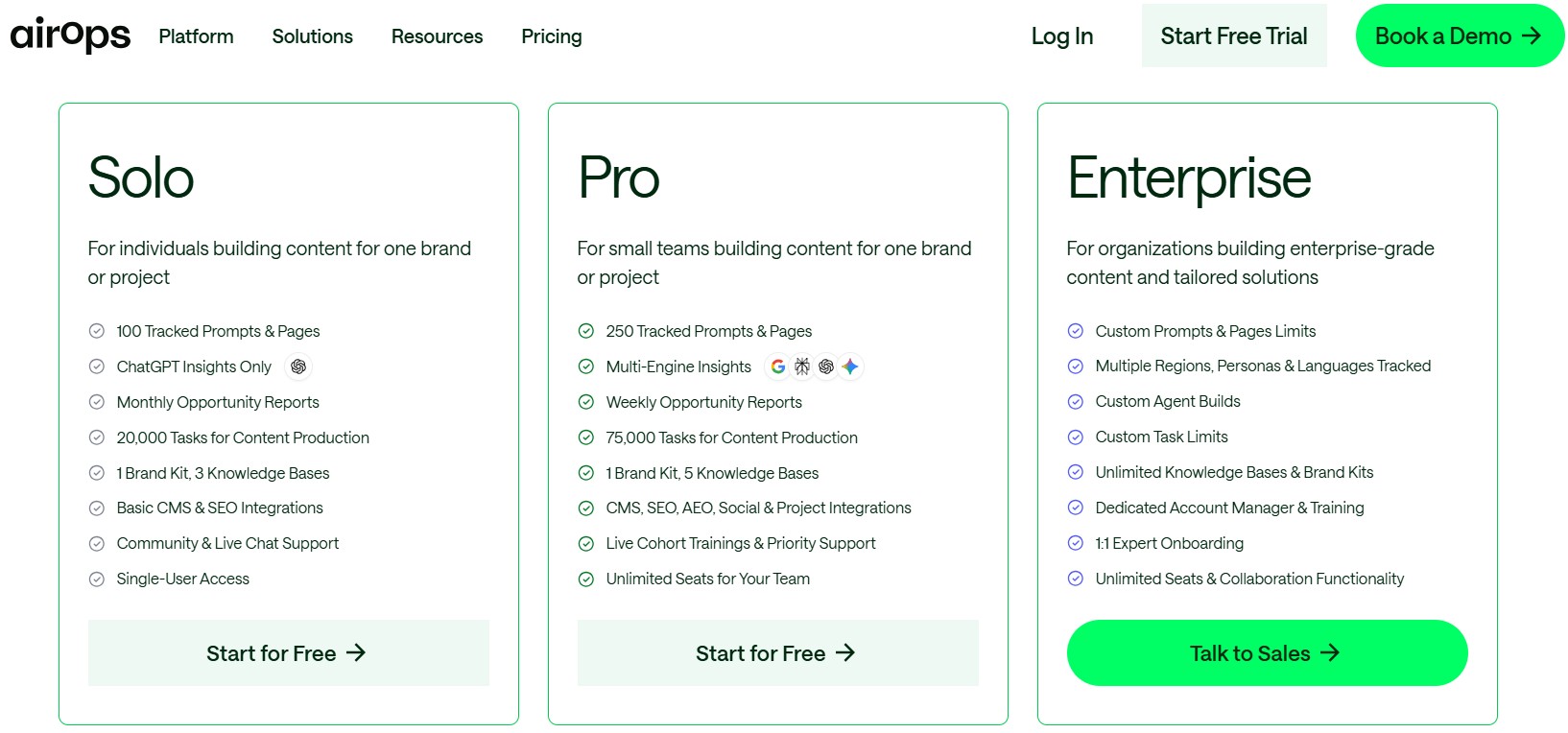
    10. AirOps — Best for custom AI content workflows at scale

    AirOps landing page.

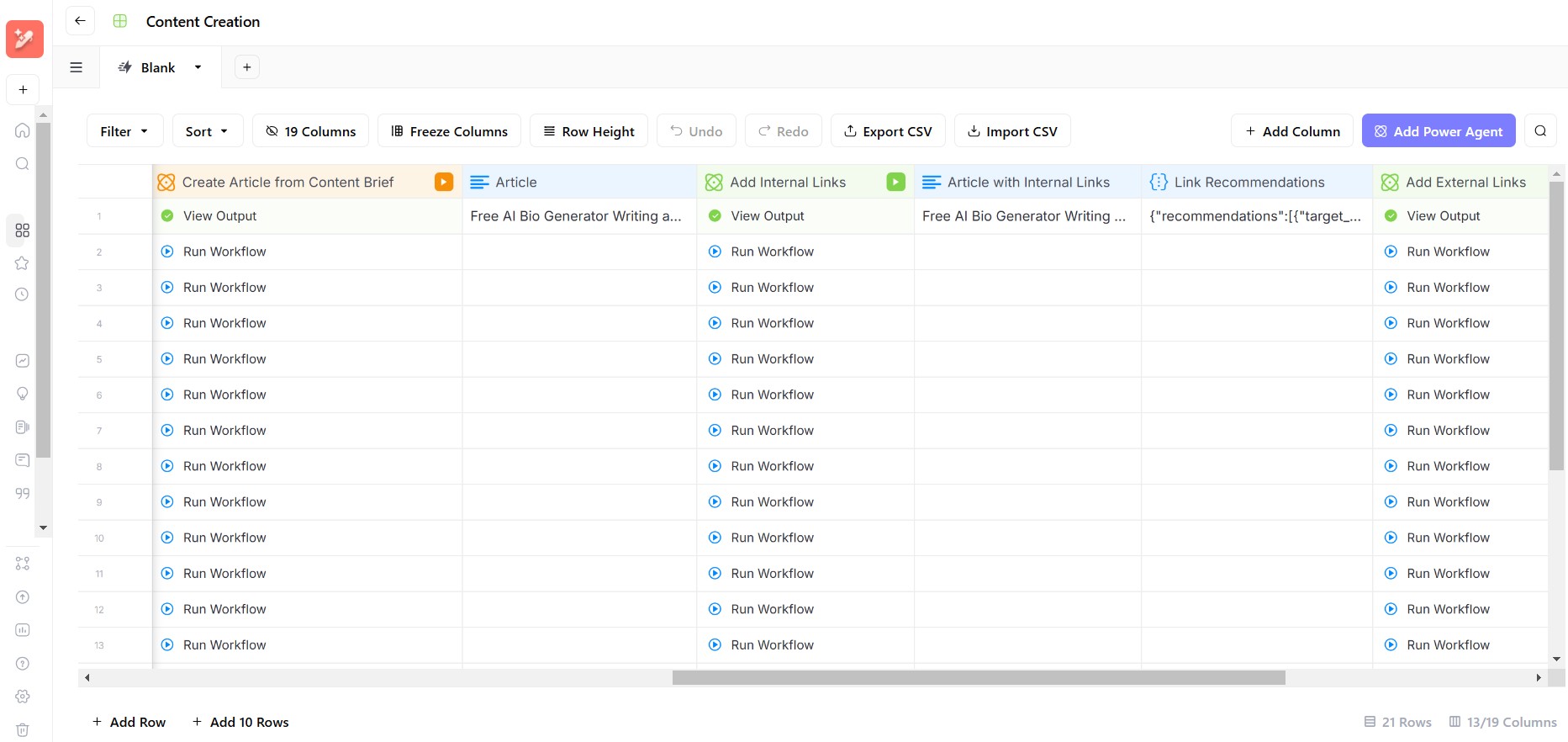
    AirOps helps you design custom AI workflows instead of relying on fixed templates. You can pull in GPT-5.2, GPT-4.1, Claude, Gemini, and other models, then chain them together for programmatic SEO tasks. That flexibility turns it into more than just another SEO content optimization tool, making it a complete content system.

    Standout features:

    • An automatic Brand Kit built from your URL, which captures tone and messaging
    • Connections to Webflow, WordPress, and 7 major CMS platforms to ensure seamless publishing
    • Bulk generate content to scale your platform without sacrificing quality

    Use cases: 

    In-house teams and agencies that are running high-volume campaigns, such as location pages or product descriptions.

    Worth knowing:

    The task-based pricing model is genuinely confusing for new users, and costs can climb quickly on high-volume campaigns before you realize it. Teams without a clear content workflow already in place may also find the flexibility of AirOps more overwhelming than helpful at first.

    Pricing:

    AirOps pricing plans.

    The AI search optimization and content creation tool provides custom pricing plans on its website.

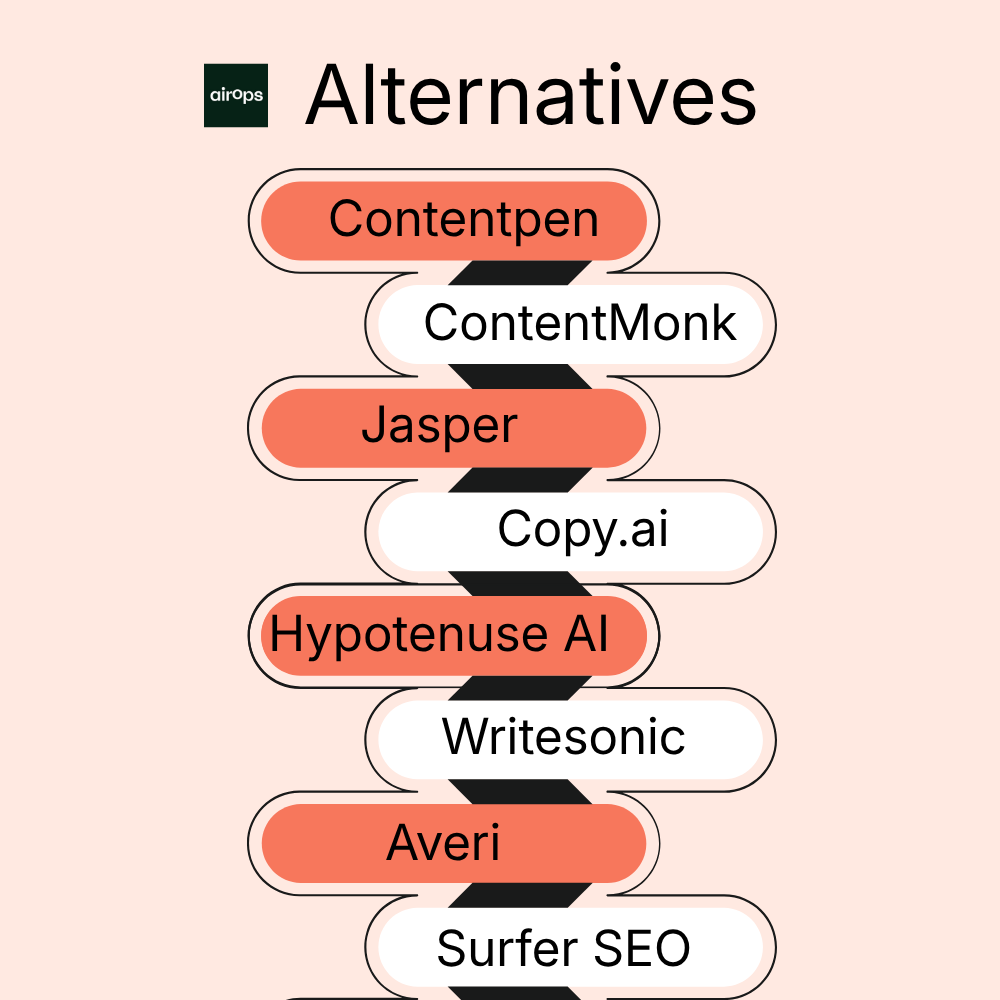
    Related read: 10 best AirOps alternatives in 2026.

    11. Writesonic — Best for AI article writing with real-time SEO data

    Writesonic landing page.

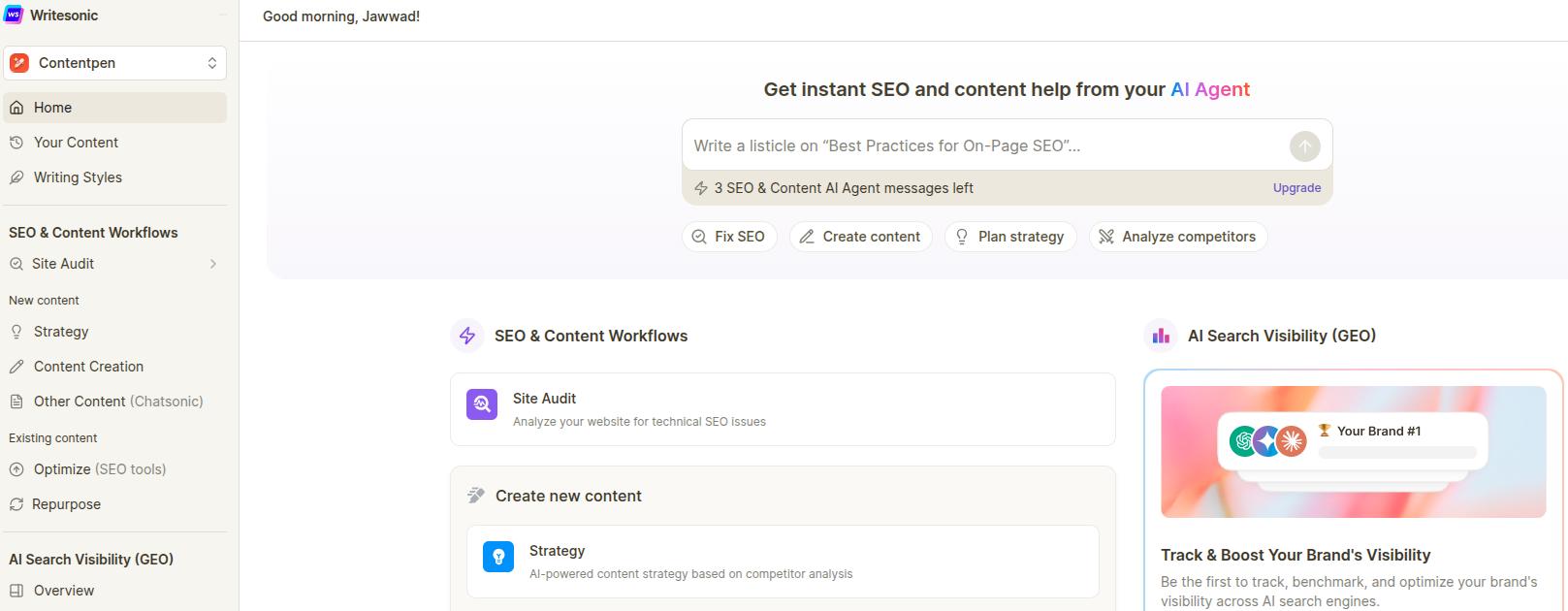
    Writesonic combines multi-model AI writing with live SEO insights. Its Chatsonic agent pulls data from Semrush, Ahrefs, Google Search Console, and other sources to guide drafts. That makes it one of the more data-aware AI SEO tools for general content.

    Standout features:

    • A structured 10-step article writer where you pick audience, tone, competitors, and other parameters to create SEO and GEO-friendly content
    • You can upload internal knowledge guidelines as PDFs so the AI SEO content generator sticks to your brand voice
    • One-click WordPress publishing and built-in fact-checking with citations

    Use cases: 

    Bloggers, content marketers, and small teams that want flexible AI writing backed by real search data. 

    Worth knowing:

    The entry price listed does not reflect the plan most content teams will actually need. Meaningful SEO data integrations and GEO features sit at higher tiers, so the real cost for a serious content operation lands closer to the $199 to $399 range.

    Pricing:

    Writesonic pricing details.

    Pricing starts at $79/month for the ‘Starter’ package and reaches $399/month for the ‘Growth’ package.

    Also read: Writesonic vs. Contentpen.

    12. SE Ranking — Best for Google AI Overview monitoring

    SE Ranking AI Overview monitoring.

    SE Ranking is a dedicated Google AI Overviews and ChatGPT tracker. It shows which keywords trigger an Overview and whether your site is cited in it or not. That helps you shape your content for SEO and AI search, which is a growing requirement for many brands in 2026.

    Standout features:

    • An Organic AI Overlap metric that compares classic top 20 results for a particular query with AI summary links
    • Historical SERP snapshots so you can see how Overviews and ChatGPT citations change over time for a topic
    • Estimates of potential traffic you might gain or lose as Overviews appear for the organic keywords

    Use cases: 

    Teams that are looking for a tool that specializes in AI tracking and audits. It is especially useful for brands in niches where Google AI Overviews are often shown. 

    Worth knowing:

    SE Ranking’s AI tracking features are centered on Google AI Overviews and ChatGPT. So, teams that need broader coverage across Perplexity, Gemini, or Claude will find the monitoring scope narrower than that of dedicated GEO platforms like AIclicks or Otterly.

    Pricing:

    SE Ranking 'Core' and 'Growth' pricing plans.

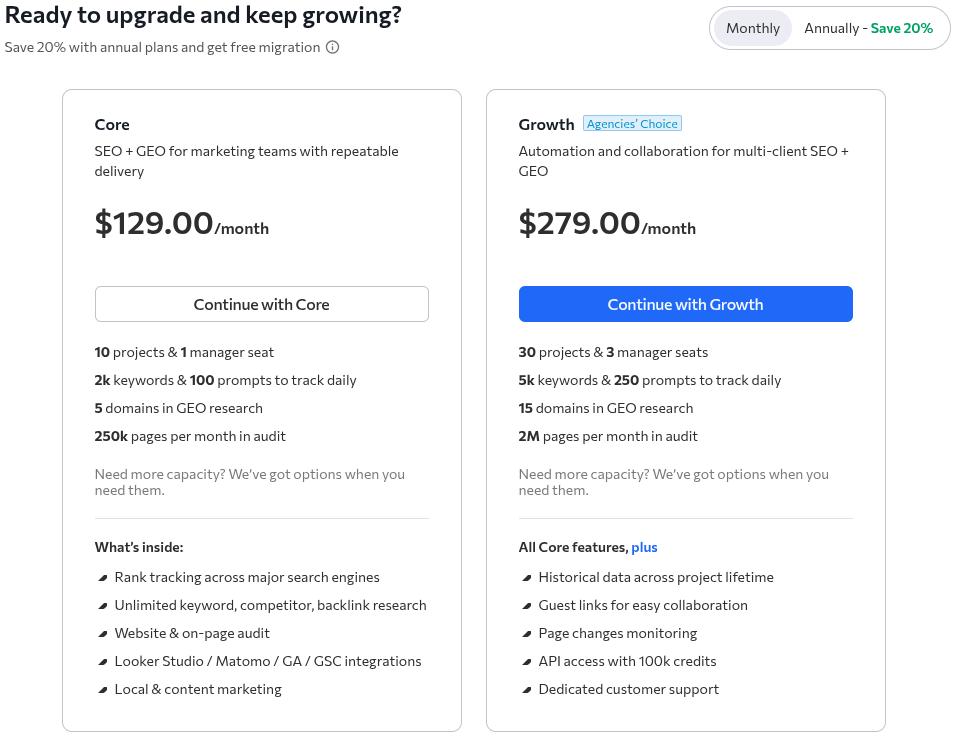
    Paid plans start at $129/month, with 10 projects, 1 manager seat, 2000 keywords, and 100 prompts to track daily.

    13. Gauge — Best for agentic AI marketing intelligence

    Gauge - Best agentic AI marketing intelligence tool.

    Gauge behaves like an AI-powered marketing analyst that watches your AI visibility and website data at the same time. It tracks daily prompts and citations across ChatGPT, Perplexity, Google AI Mode, and AI Overviews. Then it answers simple questions about what to do next for your content.

    Standout features:

    • Direct connections to GA4, Google Search Console, and Semrush, plus its own prompt logs
    • Slack integration so you can ask which pages get the most AI-referred traffic and receive answers with data and suggestions in one place
    • Content briefs aimed at prompts where your brand is currently missing

    Use cases:

    Tech-forward startups and agile teams that like conversational workflows. It suits marketers who want AI search optimization tools that can think along with them, not just report what’s happening. 

    Worth knowing:

    Gauge is strongest when you already have GA4, Search Console, and Semrush connected and active. Teams without that existing data infrastructure in place will get significantly less value from the agentic features, since the agent relies on those sources to generate meaningful recommendations.

    Pricing: 

    Gauge pricing plans.

    According to the official WithGauge website, the Starter plan is $99/month, which provides 100 prompts daily and 3 articles.

    14. Search Atlas — Best for automated AI SEO execution

    Search Atlas  - Agentic SEO and AI visibility tool.

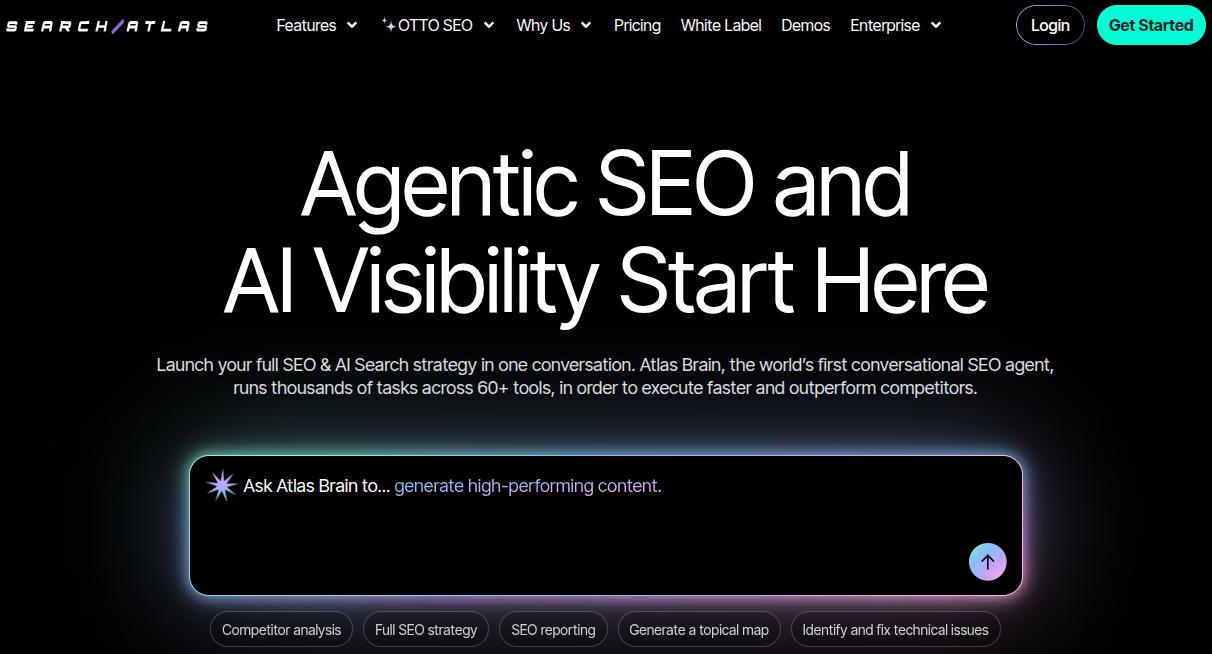
    Most AI search optimization tools tell you what to fix and leave the rest to you. Search Atlas is different because its OTTO SEO agent can actually deploy those fixes to your site once you approve them. That makes it less of a reporting tool and more of an execution platform.

    Standout features:

    • OTTO SEO identifies technical issues such as broken links, missing schema, and poor meta tags, then applies approved fixes directly to your site
    • A QUEST tab that tracks how your brand and content appear across ChatGPT, Gemini, and Perplexity
    • An AI content editor that scores drafts against top-performing competitors in real time and supports topical cluster planning
    • Atlas Brain, a conversational SEO assistant that can run keyword research, analyze competitors, and generate topical maps from a single prompt

    Use cases:

    Agencies and in-house teams that are tired of tools that generate recommendations but require a separate tool to implement them. It also works well for content-heavy sites that need both LLM visibility tracking and technical SEO automation without switching tabs.

    Worth knowing:

    The platform’s breadth is also its main risk. With 30-plus features across SEO, content, local, ads, and LLM visibility, some modules are more polished than others. In our testing, we found occasional instability and slower load times, so teams that need rock-solid reliability on every feature may want to run a thorough trial before committing.

    Pricing:

    Search Atlas pricing details.

    Plans start at $99/month with a 7-day free trial that includes full access to OTTO SEO, Content Genius, and the LLM visibility tools. Higher tiers at $199/month and above add more AI credits, deeper crawl analysis, and white-label reporting for agencies.

    15. Indexly — Best for automated indexing and improving AI visibility

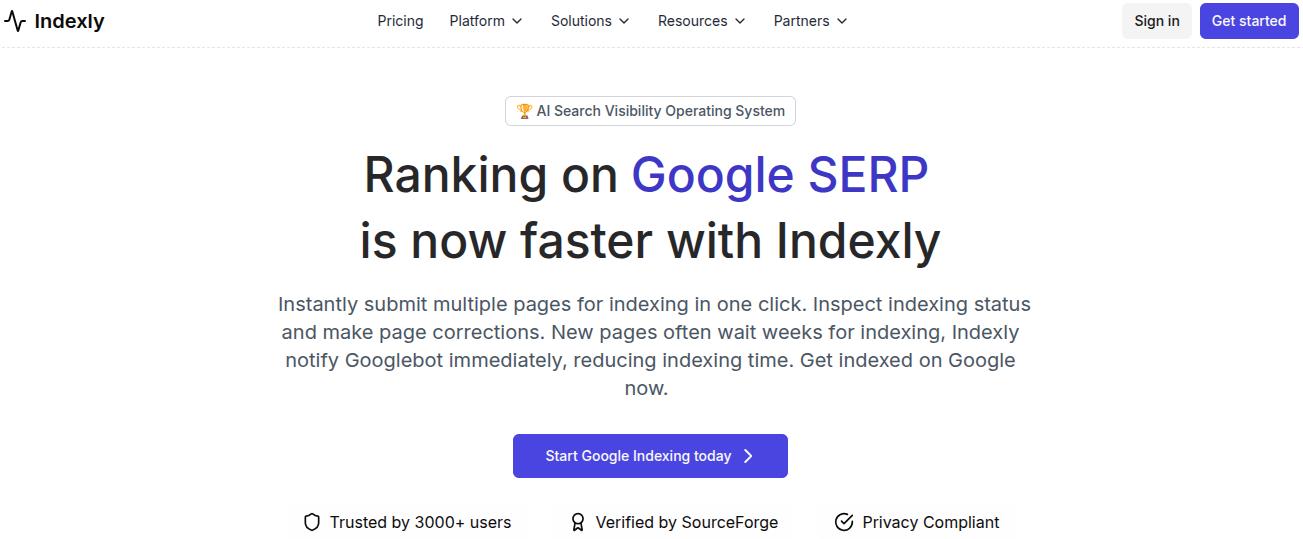
    Indexly landing page.

    Indexly solves a simple but painful problem: getting new and updated pages indexed fast. If Google and Bing do not see your content, neither will AI Overviews or any other chat-based tools. Indexly automates submissions so you do not have to fiddle with Search Console every day.

    Standout features:

    • Daily sitemap scans with automatic submission of unindexed URLs to Google, Bing, Yandex, and Naver through APIs
    • A Bing integration that helps feed content toward ChatGPT and Perplexity
    • Basic impressions, clicks, and ranking data so you can spot indexing issues early
    • AI-optimized content creation that drives qualified leads and visitors

    Use cases: 

    Technical SEO professionals, publishers, and content managers who handle multiple pages each week. 

    Worth knowing:

    Indexly solves one specific problem and does not go much further than that. It is not a content, GEO tracking, or competitive intelligence tool. So it should be treated as a supporting layer in a broader stack rather than a standalone AI search optimization solution.

    Pricing: 

    Indexly pricing plans.

    Pricing for Indexly starts at $99/month, which provides 50 prompts to track for ChatGPT, AI brand sentiment detection, and an SEO + AI technical audit.

    16. Whatagraph — Best for AI-powered SEO + GEO reporting

    Whatagraph SEO and GEO reporting tool.

    Whatagraph pulls data from dozens of platforms into clean, client-ready dashboards. It turns raw numbers from GA4, Google Search Console, Ahrefs, SE Ranking, and other tools into simple visuals. AI features then write easy-to-read summaries so non-technical stakeholders can also follow along and keep up with the data provided.

    Standout features:

    • Whatagraph IQ, which lets you type a prompt to generate a full SEO report
    • IQ Summary that writes narrative recaps in multiple languages
    • IQ Chat helps clients ask questions inside the dashboard regarding key figures and statistics
    • Auto-branding from a logo upload, so reports look on-brand with minimal setup

    Use cases:

    Agencies and performance marketers who spend too much time building custom reports. It is also helpful for professionals who want an AI rank tracking tool, an AI SEO audit tool, and a GEO platform in one place. 

    Worth knowing:

    Whatagraph is the most expensive tool on this list and is priced squarely at agencies billing clients for reporting time. Solo marketers or small in-house teams with simpler reporting needs will likely find the cost hard to justify compared to other alternatives.

    Pricing: 

    Whatagraph pricing.

    Whatagraph pricing starts at $229/month on annual billing for the ‘Start’ plan, which includes Whatagraph IQ, live chat support, and 20 source credits.

    17. GrackerAI — Best for AEO/GEO for cybersecurity companies

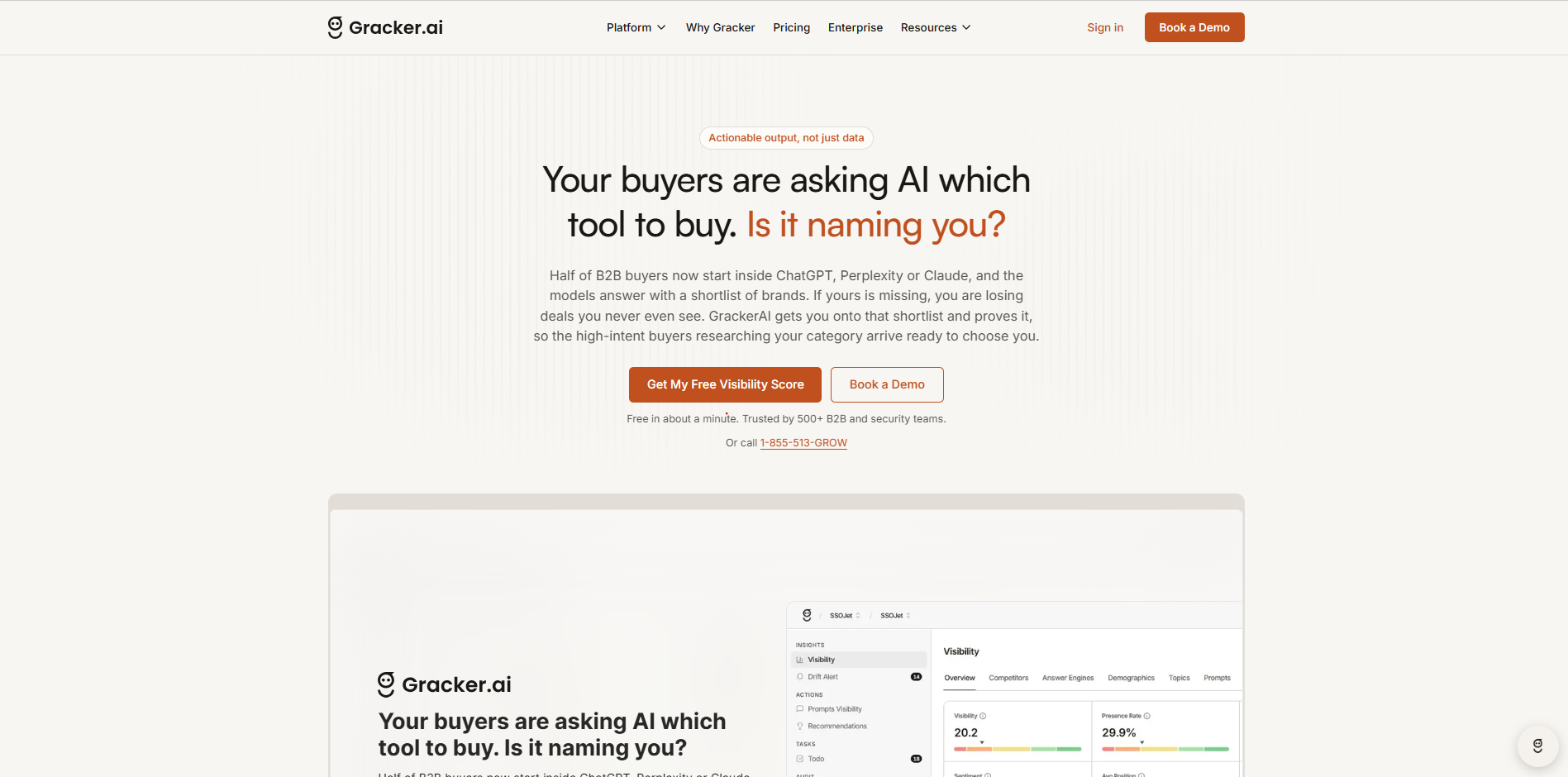
    GrackerAI landing page.

    GrackerAI is an AI visibility platform built exclusively for cybersecurity vendors. It tracks brand mentions across ten engines, including ChatGPT, Perplexity, Claude, Gemini, Copilot, Google AI Overviews, Google AI Mode, DeepSeek, Llama, and Grok.

    The tool pairs that monitoring with diagnostic agents and an article engine that fixes the gaps it finds. Most GEO tools stop at reporting. Gracker closes the loop from “why aren’t we cited” to a published fix.

    Standout features:

    • Per-engine breakdown across all 10 tracked engines with citation frequency, sentiment, average position, and share of voice
    • A Visibility Diagnosis agent that checks any prompt you’re missing, scores your existing page against it, and returns a content brief or a gap report
    • An AEO Audit that crawls the full site and grades every page on AEO Health and Technical Health
    • A Prompt Generator grounded in Google Search Console and Bing Webmaster data, so tracked prompts reflect real buyer queries

    Use cases:

    Cybersecurity marketing teams and founders who need to know if they show up when a buyer asks an AI assistant for a SIEM, IAM, or endpoint security recommendation.

    Worth knowing:

    It takes a while to learn all the capabilities of GrackerAI. Also, just like any other cybersecurity diagnosis tool, you can expect some entity resolution errors for businesses sharing common personal names that require human oversight to resolve.

    Pricing: 

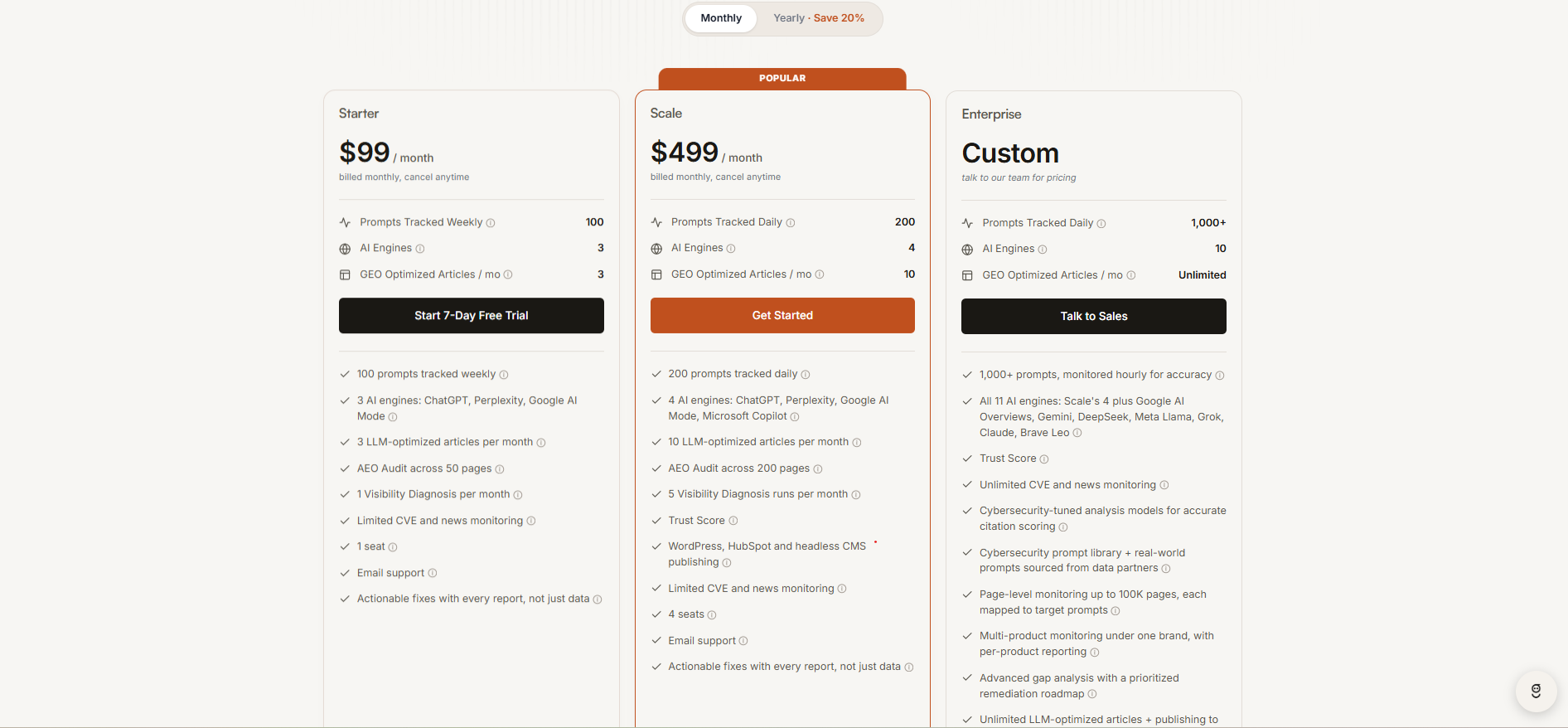
    GrackerAI pricing details.

    GrackerAI pricing starts at $99/month with the Starter plan that provides access to 3 LLMs, 3 articles, and 50 AEO audits. A 7-day free trial is available on the Starter and Scale plans.

    6 bonus tools worth exploring for AI search optimization

    The 16+ tools above cover the core of what most teams need. But the AI search optimization space is moving fast, and several other platforms are worth knowing, depending on your specific situation.

    1. Peec AI tracks brand visibility across ChatGPT, Gemini, Perplexity, and Copilot, with a particular strength in multi-country reporting. If you manage a brand across several markets and need to see how AI visibility differs by region, Peec AI fills that gap.
    2. RankPrompt is built for franchises and multi-location businesses that need to track AI visibility across different cities or service areas. It converts visibility gaps into location-specific content, making it one of the more practical tools for local SEO teams.
    3. Scrunch AI adds bot traffic monitoring. It also shows how AI crawlers are actually interacting with your site, which pages they access, and whether your content is being read before it gets cited.
    4. Goodie focuses on commercial AI visibility, including how your brand and products appear inside AI agent environments like ChatGPT shopping and Google AI Mode. Its Agentic Commerce Optimizer is a genuinely distinct feature for e-commerce brands.
    5. Respona focuses on outreach and link-building for AI search optimization. Since AI engines pull citations from trusted external sources like directories, listicles, and editorial sites, earning those placements matters for GEO just as much as for classic SEO.
    6. Pitchbox covers similar ground to Respona but with a longer track record and deeper integrations with major SEO platforms. The tool pulls live details from target pages to personalize outreach automatically, which keeps reply rates higher without manual work.

    If you’re interested in analytics and user behavior, you can check out our detailed SEO analytics tool guide for more information. 

    How to choose the right AI SEO tool for your needs

    Choosing the right AI SEO tool for your needs starts with one simple question: what do you want to improve first? 

    When you match each tool to a clear job, picking a stack feels far less confusing. Most teams do best with two or three AI search optimization tools that cover content, tracking, and technical basics.

    Begin by mapping tools to goals:

    • Content creation tools such as Contentpen, Writesonic, and Frase help you ship more long-form articles and landing pages.
    • GEO tracking tools like AIclicks.io, OtterlyAI, Gauge, SE Ranking’s AI overview tracker, and Contentpen’s AI visibility tracking tell you how AI engines already talk about your brand.
    • Technical helpers, such as Indexly, handle indexing and raw data.
    • Outreach platforms like Pitchbox secure third-party mentions and backlinks.

    Budget and team size matter as much as feature lists. 

    Solo creators and freelancers usually start with one AI SEO content generator or SEO-optimized AI content generator plus a light AI SEO audit tool. 

    Small teams can add GEO tracking once content volume grows. Larger agencies and in-house teams tend to layer in reporting platforms and outreach tools so they can show impact across the whole funnel.

    Here is a simple way to think about it:

    • Focus on content first. Without consistent, high-quality articles, even the best AI SEO tools have nothing meaningful to optimize.
    • Add AI tools once you see traffic from content. When you know where AI agents already mention you, you can sharpen future posts and landing pages. Over time, this feedback loop makes your content calendar far more targeted.
    • Layer in technical and outreach support as you scale. Raw SERP data and link building matter most when you run multiple pages. These tools keep your AI SEO optimization efforts from stalling because of crawl delays or weak authority.
    • Match pricing tiers to revenue impact. Use early wins from content and GEO tracking to justify higher-tier plans later. That way, your AI SEO platform costs grow with the value you actually see, not based on fear of missing out (FOMO).

    The right tools won’t matter if your content isn’t built to rank

    The right AI search optimization tools only work when your content itself deserves attention. If posts are shallow, poorly structured, or copied, no dashboard can fix that. AI systems favor pages that clearly answer questions and earn trust from other sites.

    Start by focusing on quality and intent. According to Google Search Central, helpful, people-first content is what earns lasting visibility, regardless of whether AI helped write it. That means you need:

    • Clear intros that answer questions fast
    • Scannable headings and short paragraphs
    • Examples grounded in real user problems

    The tool that helps you do all three consistently is Contentpen. By guiding you through keyword and topic selection, outline creation, and headline optimization, it helps you publish link-worthy posts on a steady schedule, then shows you whether AI engines are citing them.

    Write content that’s built to rank, not just read

    Create search-optimized blogs aligned with SEO and GEO signals, so your content performs well across search and AI-driven discovery.

    Try SEO Blogging FREE →
    AI SEO Interface

    Once that foundation is in place, GEO trackers, AI website optimization tools, and outreach platforms have something strong to amplify.

    In short, tools help you measure, refine, and distribute. Content still wins the click, the mention, and the sale. Brands that succeed in 2026 will invest in both smart AI search optimization tools and smarter, more helpful content.

    Frequently asked questions

    What is the best AI tool for SEO in 2026?

    There is no single best AI tool for SEO in 2026 because needs differ. For blog-heavy strategies, Contentpen is a strong choice. AIclicks.io shines when you care about GEO. Indexly helps with indexing automation for your platform.

    Are there free AI tools for SEO optimization?

    Yes, there are several free or low-cost AI tools for SEO optimization. AirOps offers a free Solo plan with a monthly task limit. Indexly provides a free tier for basic indexing, and MarketMuse has a limited exploration plan. Free plans are great for testing, but serious campaigns usually need paid tiers for deeper data and features.

    Can I use just one AI search optimization tool, or do I need a stack?

    One tool is fine to start. If content is your gap, begin with a creation tool like Contentpen. If you’re already publishing consistently but not showing up in AI answers, start with a GEO tracker like AIclicks or Otterly. Add a second tool only once you’ve exhausted what the first one tells you to do.

    Do I need a separate tool for GEO if I already use an SEO platform like Semrush or Ahrefs?

    Most legacy SEO platforms have added AI visibility features, but they are bolt-ons rather than core products. They track a narrow slice of prompts and rarely give you citation-level detail or actionable GEO recommendations. If AI search visibility is a priority, a dedicated GEO tool gives you meaningfully better data than a tab inside a traditional SEO suite.

    What content changes actually improve AI citation rates?

    The highest-impact changes are structural: answer the main question in the first two sentences, use clear, conversational-style H2s and H3s, and add FAQ blocks with direct answers. AI systems also favor content that cites sources, includes specific data points, and covers a topic without gaps.

    Is AI search optimization worth the cost for small businesses?

    It depends on whether your customers are already using AI to find solutions in your category. If they are using AI, not showing up in AI answers is a real revenue problem regardless of your size. Several tools on this list start at around $30 to $60 per month, which is low enough to justify testing before committing to anything bigger.

  • Answer engine optimization examples that you can learn from in 2026

    Answer engine optimization examples that you can learn from in 2026

    According to SparkToro, 68% of Google searches in 2026 end without a click. If your content is not the one being cited by AI platforms, then it might as well not exist.

    That shift raises a tougher question than how to do basic SEO. The real question is how to win in AI search. How does a team move from writing good blog posts to publishing answer‑focused content that shows up in Google AI Overview or ChatGPT‑style summaries?

    In this article, you will see 8 real answer engine optimization examples from brands like Semrush, HubSpot, Reddit, Zapier, and Healthline.

    Then we will see the answer engine optimization best practices and the AEO SEO strategy behind those results. We will also walk you through the emerging trends in 2026 and show how Contentpen helps you optimize content for AI answers at scale.

    So, let’s get started.

    Real-world answer engine optimization examples and what made them work

    The easiest way to understand answer engine optimization is to look at brands already winning in AI search. Any content team, agency, or solo creator can adapt these strategies for better AI discoverability in 2026.

    #1: Semrush turning proprietary data into a citation magnet (data-driven AEO)

    Semrush AEO example: Data-driven approach to answer engine optimization.

    Semrush noticed confusion around how often Google shows AI Overviews and which queries trigger them. Instead of guessing, the team analyzed over 10 million keywords to map AI Overview patterns across Google’s results, then broke the findings into clear, quotable stats.

    Because that dataset was early and deep, answer engines kept reaching for it. When people asked ChatGPT, Perplexity, or Copilot questions about AI Overviews and generative engine optimization statistics, those tools often pulled Semrush numbers. 

    Read more: How to turn off AI Overviews.

    The result was a steady loop of citations, links, and branded searches that boosted both classic SEO and AI search optimization.

    • What worked: Original data at scale, clear stats, and strong branding on the study.
    • Where to try this: Topics where you have proprietary usage data, survey results, or pricing benchmarks nobody else can publish.

    #2: HubSpot scaling question-based content architecture (definition AEO)

    How HubSpot scaled their platform with question-based content.

    HubSpot already ranked for thousands of marketing queries but wanted more wins in position zero spots and AI Overviews. The barrier was not content volume, but structure.

    The team identified a specific problem. Most of HubSpot’s articles were written in a traditional long-form style where the main answer was buried several paragraphs down, under context, background, and supporting arguments. 

    That format worked for featured snippet optimization when Google pulled a mid-page paragraph. It did not work well for AI extraction, which pulls from the very beginning of a section.

    The fix was a template rebuild. Every article was restructured so the first 40 to 60 words under each H2 or H3 heading answered the question that heading raised, without making the reader scroll to find it.

    They framed H2 and H3 headings as full questions, like “Content Strategy Tips” became “How do you build a content strategy from scratch?” They also added the FAQPage schema to key posts, which made their pages highly readable and extractable for both crawlers and humans.

    Over time, this question-based architecture turned HubSpot articles into consistent sources inside Google AI Overviews and other AI summaries, along with the featured snippet wins they were already earning.

    • Takeaway: Design articles so the first screen already answers the main question and signals that structure with clear headings and schema.

    #3: A regional HVAC company winning local voice queries (local AEO)

    A regional HVAC company had an AI visibility tracking problem that most content advice cannot solve. They were not competing for global traffic or brand searches. They needed to appear when someone in Phoenix searched for a term like “Who can fix my heater today?”

    The agency they worked with started from the ground up. Their agency cleaned up the Google Business Profile, fixed NAP details, and built focused landing pages like ‘HVAC repair in Phoenix’ with short, spoken‑friendly answers. 

    LocalBusiness schema was applied across every page, telling AI engines exactly who the brand was, where it operated, and what services it provided. The FAQ schema was layered on top, covering the questions people most commonly ask before booking an HVAC appointment.

    Within a few months, voice assistants started reading the company name in response to near-me prompts. Organic traffic improved, despite the brand’s domain being significantly smaller than the national HVAC chains it was competing against.

    LocalBusiness schema and clear headings around common issues made those pages strong voice search optimization examples.

    • Key move: Write the copy the way people speak into phones or smart speakers, then support it with the right local and structured data.

    #4: Investopedia owning financial definitions at position zero (definition AEO)

    Investopedia answer engine optimization for better SERP position.

    Investopedia focused on direct-answer SEO for finance definitions, where searchers wanted fast clarity more than long theory. Many competitors had long, dense pages that buried the simple explanation somewhere in their content.

    Editors reworked core pages so each one opened with a single plain‑language definition in one short paragraph, then added tables, examples, and deeper context below. 

    This format matched what Google already preferred for definition snippets and lined up with how LLMs scan for clean answers.

    As a result, Investopedia now wins a large share of snippets for financial terms and keeps showing up as one of the most visible sites for those topics in AI chatbots. According to the Spicy Margarita case study, these are the reasons for Investopedia’s success:

    1. They stay in their lane
    2. Content volume and freshness
    3. Best practice blog templates and site structure
    4. E-E-A-T signals
    5. Backlink profile

    Across all four brands, the common pattern is clear. They ship answer‑first content, format it so machines can extract it, and support it with strong authority signals such as data, schema, or consistent entity details.

    • Pattern to copy: Use clear definitions at the top, then structured depth underneath to cover a page comprehensively while building a healthy link profile.

    #5: Stack Overflow’s cautionary contrast (absence of AEO)

    Not every story in AI search is a win. Sometimes the most instructive example is a brand that did not adapt in time.

    Stack Overflow built one of the most comprehensive programming knowledge bases on the internet. At its peak in 2014, the platform was processing over 200,000 questions every month, and developers worldwide relied on it as the go-to source for finding coding answers.

    Then ChatGPT launched in November 2022.

    Within months, question volume started collapsing. By late 2025, monthly questions had fallen to under 50,000, returning the platform to 2008 levels.

    That is a 76% drop in questions since ChatGPT’s release. There’s a 14% drop in visits since 2022, and Prosus, which acquired Stack Overflow for $1.8 billion in 2021, watched its most valuable asset erode in real time.

    The core problem was structural. Stack Overflow’s content was built for human readers scrolling a thread, not for AI engines extracting a clean, self-contained answer. 

    Accepted answers were often buried under comment chains, edge-case debates, and version-specific caveats. There was no consistent answer-first structure and no schema markup guides for AI to trust the responses.

    The lesson here is hard to ignore. Even a dominant, high-authority platform with years of accumulated content can lose AI visibility if the structure is not built for extraction.

    • What would have helped: Clean answer-first formatting at the top of each thread, structured data identifying the accepted answer, and author credential signals on high-stakes topics.

    #6: Reddit’s remarkable AEO (UGC AEO)

    Reddit UGC AEO example.

    Reddit did not run an AEO campaign. It did not restructure its content for AI extraction or add schema markup to subreddit threads. Yet as of early 2026, it is the single most cited domain across ChatGPT, Google AI Overviews, and Perplexity combined.

    A Discovered Labs analysis of 150,000 citations across 5,000 keywords found Reddit had a citation frequency of 40.1%, ahead of Wikipedia at 26.3%, YouTube at 23.5%, and every major news outlet combined. For Perplexity specifically, 24% of all citations in January 2026 came from Reddit alone.

    The reason AI engines love Reddit is not authority in the traditional sense. It is because Reddit threads contain something that most brand content does not: first-hand experience at scale.

    When someone asks ChatGPT, “What project management tool is best for a remote team of five?”, the AI is not looking for a vendor blog post or a review site listicle. It is looking for content that reflects how real people actually experienced the product, including the edge cases, the workarounds, and the honest comparisons. Reddit delivers exactly that.

    Over time, those threads accumulate upvotes, get archived, and become the community-validated sources that AI engines reach for.

    • Why AI chooses Reddit: Upvote signals and community validation act as quality markers that AI systems weigh. Natural Q&A format mirrors how AI retrieves information, and new threads are posted daily, giving AI a consistently fresh source of data.

    #7: Zapier winning organic traffic (programmatic AEO)

    Zapier does not specifically chase high-volume keywords around its own product. Instead, it built a content system that captures demand at the point of intent, across thousands of specific use cases.

    The numbers tell the story. Zapier runs over 50,000 integration pages, each targeting a specific app-to-app combination. A page like /apps/gmail/integrations/slack answers one precise question: ‘How do these two tools connect?’ 

    The format is consistent across every single page, including a plain-English description of the integration, a step-by-step setup guide, and popular automation templates. That structure generates over 5.8 million monthly organic visits, according to data from multiple SEO analysis platforms.

    But the reason this matters for AEO is not the traffic number. It is how the structure performs in AI search.

    Zapier solved the main challenge of programmatic content at scale by requiring app partners to provide accurate descriptions, use cases, and setup documentation during the onboarding process. 

    That means the people who know the app best write its content. Zapier maintains the template and structure. Partners supply the accuracy.

    • What worked: Consistent template structure across all pages, partner-generated content for accuracy, answer-first formatting within each section, and deep internal linking between related integration pages.

    #8: Healthline winning the share of voice in healthcare (YMYL AEO)

    How Healthline leads healthcare share of voice in AI search.

    Health content operates under the strictest quality standards in search. Google classifies medical, financial, legal, and safety topics as YMYL (Your Money or Your Life), meaning AI engines apply significantly higher scrutiny before citing a source in these categories.

    Healthline understood this early. Rather than competing on content volume, the brand built a system that signals trust at every layer of the page.

    Every article opens with a plain-language definition or direct answer to the query, written or reviewed by a named medical professional with visible credentials. 

    The byline includes the reviewer’s name, specialty, and years of experience with an external link to peer-reviewed research. Pages carry a visible “medically reviewed on” date, signaling freshness to both human readers and AI crawlers.

    The results are measurable. A Conductor analysis of 17 million AI-generated responses across health queries found that Healthline holds the largest share of voice in AI Overviews for healthcare content at 5.76%, ahead of the Cleveland Clinic at 4.55% and the Mayo Clinic at 4.13%. 

    • The lesson: In YMYL categories, AI engines are not just looking for correct answers. They are looking for verifiable answers. Therefore, using named experts, dated reviews, and cited research are essential trust signals.

    Pattern classification for AEO examples

    Every example in this article follows one of five distinct AEO patterns. Recognizing which pattern fits your business is the fastest way to decide where to focus first.

    PatternExampleCore mechanismWho does it work for
    Data-driven AEOSemrushProprietary research becomes the only citable source on a topicBrands with access to original usage data, survey results, or internal benchmarks that nobody else can publish
    Definition AEOInvestopedia, HubSpot, HealthlinePlain-language answers at the top of every section match AI extraction patterns and satisfy definitional intentFinance, health, legal, and any category where clarity beats depth at the point of extraction
    UGC AEORedditFirst-hand community experience fills the gaps that branded content cannotAny brand whose audience discusses it in forums, review sites, or social communities
    Programmatic AEOZapierConsistent, structured templates at scale capture thousands of specific use-case queries without manual writingBusinesses with large structured data sets, such as integrations, locations, product combinations, or use cases
    Local AEORegional HVAC companyVoice-search-friendly answers combined with local schema, GBP optimization, and NAP consistency create a verified local entity signalService businesses with geographic targeting that rely on near-me and voice queries for bookings

    The pattern that consistently underperforms is attempting all six at once without data to support any of them. 

    Therefore, you need to start with the one that matches your existing strengths. 

    A brand with original usage data starts with data-driven AEO. A service business with local reach starts with local AEO. A SaaS platform with thousands of use cases starts with programmatic AEO.

    Most brands will eventually use two or three patterns together. The most common combination is data-driven AEO layered with definition AEO and UGC AEO.

    That combination covers the three things AI engines evaluate most heavily: do I trust this source, can I extract a clean answer, and does the wider web confirm what this brand says about itself?

    Answer engine optimization best practices extracted from these examples

    Answer engine optimization best practices summarized.

    Those answer engine optimization examples were not accidents. Each one came from a set of repeatable moves that any content team can use. Think of this section as a compact framework for how to do AEO without guessing.

    1. Lead every key section with a direct answer
      Start important sections with a 40-60-word paragraph that fully answers the question in the heading. This inverted‑pyramid style of writing works for readers and for direct-answer SEO, because answer engines can lift that block into snippets or summaries.
    2. Use question‑framed headings throughout your content
      Turn your H2 and H3 headings into the exact queries people type or speak. Examples include ‘how to appear in AI overviews’ or ‘how to rank in AI search’. This is where semantic SEO and AEO meet, since headings become clear intent signals.
    3. Implement structured data for answer engines on the right pages
      Add FAQPage to question‑heavy posts, HowTo to step‑by‑step guides, Article to long‑form resources, and LocalBusiness or Organization where it fits.
    4. Stack E‑E‑A‑T signals around important topics
      Use real author names and credentials, pull in credible citations, and add first‑person notes, such as in our research, to show real experience. These trust markers help answer engines choose your page when several sites say roughly the same thing.
    5. Keep high‑value pages fresh and clearly dated
      LLMs and AI Overviews lean toward recent content. Conduct an AI visibility audit. Refresh your top pieces at least a couple of times a year, update stats, and show a ‘last updated ‘date.
    6. Build brand mentions beyond your own site
      Work on getting quoted on podcasts, in industry newsletters, and on reference‑style sites. AI search engines treat those mentions like soft links. For many brands, this off‑site work is what separates quiet pages from sites that show up in AI chat and overviews.

    You do not need to apply every best practice on every page. Start with some URLs that already rank on Google page one or pull meaningful traffic. Those are the best options for answer engine optimization in AI because a small lift can turn them into featured snippets or AI citations.

    As Marie Haynes often reminds site owners, “it is not enough to say you are an expert; you have to demonstrate it through your content, authors, and references.”

    Emerging AEO trends in 2026 that you shouldn’t ignore

    AEO trends in 2026 and beyond.

    By 2026, AEO has shifted from a side project to a core content strategy. The question is no longer whether answer engine optimization matters, but how fast a team can adapt its workflow and measurement.

    Key AEO trends to watch in 2026 include:

    • Multi‑platform AEO. Brands now watch their presence in ChatGPT SEO optimization, Perplexity AI SEO, Google AI Overviews, and Copilot separately. Each system favors slightly different sources, so one piece of content might need small changes, extra distribution, or new internal links before it turns into a strong citation magnet.
    • Agentic search and “agent engine optimization.” AI agents are starting to compare vendors, schedule demos, or even place small orders based on the sources they trust. If a brand never appears in answer‑phase summaries, it will probably not show up when those agents recommend actions later.
    • Recency as a ranking signal for LLMs. Many models favor content that is clearly updated, even if older posts have more links. That makes SEO content audits and steady refresh work core parts of generative engine optimization practice.
    • Conversational search and query fan‑out. A single question, such as “What is answer engine optimization?” might trigger follow‑ups about ‘AEO vs SEO’, or ‘how to optimize for answer engines’, all inside one chat. The pages that win here cover the main question plus related subtopics in one coherent, answer‑focused piece of content.

    If teams ignore these shifts, competitors will keep stacking new answer engine optimization examples month after month, while older static content fades from both SERPs and AI responses.

    How Contentpen helps you execute an answer-focused content strategy

    Contentpen SEO and AEO tool.

    After seeing these answer engine optimization examples and trends, a natural question appears: how do you do all of this on a real content calendar without burning out your writers and editors?

    Contentpen is an all-in-one SEO and AEO platform built for teams in that exact spot. Marketing leaders, agencies, and solo creators use it to plan and ship long‑form posts that already follow an answer‑first structure and AEO SEO strategy patterns.

    Get your content cited by AI, not just ranked on Google!

    See your real-time GEO score as you write to make every piece citation-ready.

    Try GEO Scoring →
     GEO Scoring

    As you write, SEO and GEO scores show how well each section is structured for featured snippets and AI answers, and Fix with AI resolves issues in both, so your drafts end up with clear headings, short paragraphs, and direct answers.

    Linking automation suggests and adds internal and external links that build topic clusters, which help the answer engines understand your site structure.

    Contentpen also guides headline choices, meta descriptions, and on‑page SEO, so posts align with audience intent and position‑zero opportunities.

    Also read: 16 best AI visibility tools in 2026.

    Once your content is live, Contentpen’s AI visibility tracking, included in every plan, shows whether these patterns are working for you. You can see your share of voice and the sources AI engines cite across up to seven AI engines, the same kind of data behind the Healthline and Reddit examples above.

    The tool also offers a built‑in media library and AI image generation features to provide assets that not only help your visibility in SERPs and AI platforms but also on Google Images.

    As a next step, register for Contentpen and start creating content that gets discovered and cited at scale without any hassle.

    Final thoughts

    The brands winning in AI search are not lucky. They publish answer engine-optimized content by answering real questions directly, structuring pages, and stacking trust signals around their most important topics.

    AEO will keep changing, but the core stays stable. Helpful content and steady proof of expertise matter in classic SEO, in zero‑click search optimization, and in AI‑powered experiences.

    The good news is that many of your biggest wins are probably hiding in content you already have. With smart rewrites, fresh data, and better formatting, older articles can turn into new AEO wins that show up in AI Overviews and chat tools.

    Turn existing content into growth opportunities

    check

    Identify pages losing traffic or CTR

    check

    Find quick wins to improve clicks and rankings

    Find Content Opportunities →
    AI SEO Interface

    When you are ready to build that kind of system, platforms like Contentpen make it far easier to plan, draft, and ship answer‑focused content on a schedule.

    Frequently asked questions

    What makes an AEO example worth studying?

    Three things: a measurable ‘before’ and ‘after’ effect, a clear enough mechanism followed, and pattern transfers, meaning another brand could apply the same tactic with their own content and data. If an example only worked because of one brand’s unique budget or equity, it is interesting but not instructive.

    How long does it take to see results from AEO work

    For pages that already sit on page one, small AEO tweaks can win a featured snippet or People Also Ask box within a few weeks. Bigger wins in AI chat tools and overviews often show up after several months of steady updates, new links, and stronger authority signals around your brand.

    How do I know if an AEO win is driving real revenue?

    Isolate AI-referred traffic in your analytics and watch what those visitors actually do. Sessions from chat.openai.com, perplexity.ai, and similar sources should be segmented separately. Track time on page, form submissions, demo requests, and purchases. If they are converting at significantly higher rates than organic traffic, the citations are producing a real pipeline.

    How can a team check whether content is being cited in AI answers

    The most direct method is to run your key questions through tools like ChatGPT, Perplexity, or Google AI Overviews and see whether your brand or URLs appear in citations. Some teams also add this step to content audits, so they can spot new opportunities as they gain traction.

  • AI search optimization: How to get cited in 2026

    AI search optimization: How to get cited in 2026

    AI search is already deciding which brands get cited and which ones disappear before a user clicks anything. Due to this situation, AI search optimization is now essential.

    For content teams, agencies, and small businesses, this shift can feel scary. Traffic jumps around, branded searches show AI answers on top, and it is hard to tell how much visibility comes from Google, ChatGPT, Gemini, or Perplexity. 

    The good news is that AI SEO optimization is not a new way to get better clicks and reach. It is the same core SEO done with more care.

    In this guide, you will see how to optimize for AI search engines. You will get a simple playbook you can use on your next article or campaign to see better AI citations and discoverability.

    So, let’s get started.

    What AI search optimization is NOT about

    First, let’s clear up a few things about AI search optimization, because the space is full of noise.

    AI search optimization is not about:

    • Gaming prompts. There are no “magic phrases” that force AI to cite you. AI systems evaluate content quality, authority, and relevance the same way Google does, just applied differently (more on this later).
    • It’s not separate from SEO. Many AI systems rely on search indexes to find content, so strong rankings make you far easier to find and cite.
    • It’s not a one-time fix. AI citation sources rotate. Between 40 and 60% of cited sources change month-to-month across platforms like Google AI Mode and ChatGPT. This isn’t a set-and-forget strategy. It’s an ongoing content and authority-building effort.
    • It’s not just about traffic. The visitors who do arrive from AI citations convert at significantly higher rates than typical organic traffic. Therefore, quality beats search volume here.

    With these pointers in mind, let’s see why answer engine optimization is so important today.

    Why AI search optimization matters more than most people realize

    The numbers are hard to ignore. Over 800 million people now use ChatGPT weekly. Google AI Overviews appear on an estimated 15-25% of all searches, and nearly a third of the US population is projected to use generative AI search in 2026.

    Your audience isn’t waiting around for this to “get big.” They’re already there.

    And here’s the part that catches most brands off guard: around 60% of searches already end without a single click. 

    Zero-click answer for the keyword 'when was Leaning Tower of Pisa built.'

    Like the ‘Leaning Tower of Pisa’ example above, AI answers satisfy the intent right there on the page. So if you’re measuring success purely by traffic or clicks, you’re going to see a gap between your visibility and your numbers.

    Also read: How to turn off AI Overviews.

    How AI search engines actually find and use your content

    Before optimizing for AI search, you need to understand the mechanics of how these platforms work.

    Query fan-out technique explained.

    When someone asks Perplexity or ChatGPT a question, the AI doesn’t paste that question into a search engine verbatim. It breaks the query into smaller sub-searches, called “query fan-out.”

    What that means for your strategy is that your content doesn’t need to match the exact question your audience types. It needs to rank for the sub-queries the AI extracts by addressing them properly in your content.

    For example, a user can type a query, “What’s the best AI content tool for a small marketing team that also helps with SEO?” 

    AI engines will not use the exact wording to search for this query.

    Instead, the AI platforms will break this query down into smaller sub-queries, such as “AI content writing tools 2026,” “content tools with built-in SEO features,” and “AI tools for small marketing teams.”

    So, if you use these sub-queries in your content and answer them honestly to help your users, then AI discovery becomes a lot easier.

    Where does each AI platform get its data?

    Knowing which platform pulls data from where lets you prioritize your efforts accordingly. Below are some popular AI tools and their sources.

    • ChatGPT combines its own crawler (OAI-SearchBot) with third-party search results, so strong rankings across search engines help your visibility there.
    • Google AI Overviews and Gemini draw from Google’s own index.
    • Perplexity crawls the web directly and cites authoritative sources in every response.
    • Copilot runs on Bing’s search index, and Meta AI has also used Bing for web results.

    Traditional SEO isn’t dead. It’s the foundation. If you’re not indexed and ranking, AI tools literally can’t find you. What changes is the layer on top, or the signals that make you citation-worthy vs. just rankable.

    AI search optimization vs. traditional SEO: What actually changes

    Before we dive deep into the comparison of SEO vs AEO, it is important to note that you don’t have to choose between the two. You do need to understand how they’re different.

    The basics still remain the same: you do solid keyword research, optimize metadata, write in a structured way, and take care of your Schemas. Then, take a step forward toward GEO, which builds on traditional SEO. Read our guide on GEO vs SEO to compare them both in detail.

    Other key differences include:

    • People write longer, conversational prompts in AI platforms and refine them with follow‑up questions.
    • The same thread can cover the awareness, comparison, and action stages of a decision.
    • When users finally click through, they already know the basics and come ready with a higher intent.

    That is why AI search optimization focuses on depth, structure, and clear expertise more than quick tricks. You are trying to become the reference text that models feel safe quoting.

    Read more: AI search optimization vs. traditional SEO.

    How to optimize for AI search: What actually works

    How to optimize content for AI search.

    If you want to know how to rank in AI search, think in three layers:

    1. Write people‑first content that answers real questions better than anyone else to create strong EEAT signals for your content.
    2. Build topical strength and brand signals across the web.
    3. Make your site easy for both search bots and LLM crawlers to read.

    These layers map directly to common SEO strategies for AI search engines. Apply the steps below, then watch how AI tools treat that content over the next few months. That feedback will tell you where to double down.

    1. Make sure AI crawlers can read your content

    This sounds obvious, but it’s the most skipped step.

    If your content is buried behind client-side rendered JavaScript, login walls, or a robots.txt that blocks AI crawlers, none of the other work matters. 

    Therefore, check that major AI bots, such as GPTBot, OAI-SearchBot, PerplexityBot, ClaudeBot, and Google’s crawlers, are allowed in your robots.txt file.

    2. Write for chunks, not just pages

    AI systems don’t read your page the way a human does. They extract chunks, or individual sections, paragraphs, and sentences that can answer a specific sub-query. 

    To optimize for chunk-level retrieval, use clear H2s and H3s and ensure that every section on your page can stand alone as a self-contained answer. 

    Also, always prefer to start each section with a direct statement or definition and build on it with examples and case studies later on.

    For example: “An AI content brief is a structured document that outlines the topic, target audience, keywords, and content goals before writing begins. It reduces back-and-forth between writers and editors by aligning expectations upfront.”

    Don’t bury the answer in paragraph four. If someone only reads that one section, they should walk away informed.

    Therefore, the core of optimizing content for AI-generated answers is to create self-contained, extract-ready, and semantically tight passages. In short, answer-first writing.

    3. Build real topical authority

    A single blog post on a topic won’t cut it. AI systems and Google’s algorithms favor brands that have covered a topic deeply across multiple pieces of content. They look for topical depth (going genuinely far and in-depth on specific subtopics).

    Think about your content strategy as a topic cluster, not a collection of individual articles. 

    Pillar-cluster model shown with a diagram.

    One pillar piece covering the full scope, specific supporting articles and pieces tackling narrower questions, and internal linking to connect them all. This is the structure that tells AI, ‘this site is actually authoritative for a particular topic’, helping you get more citations and discoverability.

    4. Answer the questions people are actually asking

    AI tools pull answers from content written in response to real questions. The more directly your content maps to how people actually phrase their queries, the more likely it is to be extracted.

    Use Google’s “People Also Ask” and Autocomplete to find question formats for your topic. Build those questions into your headings. Then, answer them concisely right after each heading.

    Google PAA box for keyword 'keyword volume.'

    Remember that you’re not just optimizing for search engines here; you’re also giving AI a clear, pullable answer to show the users.

    5. Add data, stats, and original insight

    AI chatbots love citing figures, stats, and original data from your blogs or articles. This may include industry benchmarks, research, or survey results that you conducted internally. 

    Content that says “marketers report 34% higher engagement from AI-cited content” is more citation-worthy than content that says “many marketers see better engagement.”

    Also, if you can publish original research, even a small internal study, do it. Other sites will cite it. And when your content is cited by authoritative sources, AI systems notice and use your data inside their answers.

    6. Show who’s behind the content

    E-E-A-T (Experience, Expertise, Authoritativeness, Trustworthiness) isn’t just a Google thing. AI systems are trained to avoid surfacing low-quality or anonymous content. Named authors, detailed bios, links to professional profiles, and demonstrated first-hand experience all strengthen your content’s credibility signals.

    This matters especially for YMYL (Your Money, Your Life) topics, which include finance, health, legal, and anything with real-world consequences. 

    AI tools apply heightened scrutiny here, so you have to be very authoritative and knowledgeable on a topic to write and win.

    7. Use Schema Markup to feed AI direct facts

    Schema markup makes your content machine-readable in a way that plain text doesn’t. 

    FAQ schema, HowTo schema, Article schema, Organization schema, and other types of schema all help AI systems extract accurate, structured facts about your brand and content.

    Think of it as handing AI the answer on a silver platter. The less it has to guess, the more confidently it can cite your brand.

    8. Build a consistent brand presence across the web

    AI systems build their understanding of your brand from everything they can find. This includes your site, third-party mentions, reviews, social profiles, forum discussions, and more.

    Consistency matters a lot here. Your brand name, value proposition, and positioning should read the same way across every channel.

    Reddit threads, LinkedIn posts, YouTube content, and podcast appearances all contribute to what’s called your “AI authority.”

    It’s the aggregate signal that your brand gives off to AI systems, including ChatGPT, Perplexity, Gemini, and others. Over time, this improves your AI visibility, which means more relevant traffic to your platforms.

    Also read: Best AI visibility tools in 2026.

    9. Don’t ignore Bing

    Most AI search conversations focus on Google. But Copilot and Meta AI (Facebook, Instagram, WhatsApp) all run through Bing. That’s a combined audience that you should surely cater to.

    So, if you want to AI search optimize your content, then you should use Bing Webmaster Tools for audits (and it is free) If you get your site indexed and verified there, there’s a high chance of doing great in AI systems as well.

    10. Track AI visibility separately from traffic

    If you’re only measuring success by clicks, AI search will always look underwhelming. 

    Citation volume and brand mention frequency are the metrics that matter here. 
    Tools like Semrush’s AI Toolkit, Profound, or Peec AI let you track your share of voice across AI platforms.

    Contentpen goes a step further and provides its AI visibility tool right where you create content. You can see your AI share of voice, brand sentiment, top citation sources, and competitor data across up to seven AI engines in one place.

    Find your brand in AI search

    check

    Track AI citations, share of voice, and brand sentiment

    check

    Find the top sources driving citations

    Try AI Visibility →
    AI SEO Interface

    Besides the tools, set up manual checks, too.

    Query ChatGPT, Perplexity, and Gemini yourself with prompts your customers would use, and see whether you’re showing up in those or not.

    This process may take a while, but it’s a good starting point for content marketers and individuals trying to learn their AI visibility hands-on.

    AI search optimization examples: What good looks like

    Concepts are helpful, but real patterns make them stick. Here are three simple AEO examples based on what tends to show up in AI answers.

    Example 1 – Structured content that gets cited

    Imagine a fintech blog that targets the question “What is compound interest?” plus related follow‑ups. 

    Take NerdWallet’s compound interest page as an example. It opens with a single plain-English definition: “Compound interest is the money your bank pays you on your balance, plus the money that interest earns over time.”

    NerdWallet example blog.

    Then the page moves through the formula, examples, and explanations with no pop-ups or clutter. 

    When someone asks an AI chatbot what compound interest is, NerdWallet’s structure gives AI a clean, pullable quote for the summary and enough depth to trust and cite the source. 

    A Goodie analysis of AI citation patterns across ChatGPT, Gemini, Claude, and Perplexity found NerdWallet to be the most consistently cited finance domain across all four platforms.

    Example 2 – Brand authority in action

    A project management SaaS with $25M ARR (Annual Recurring Revenue) had solid Google rankings but was appearing in just 8% of AI buyer queries. While competitors dominated 65% of ChatGPT and Perplexity recommendations. 

    The fix wasn’t more blog posts. It was building a consistent brand presence. The brand applied the same brand positioning across platforms, such as Crunchbase, LinkedIn, and niche forum discussions. 

    Within 90 days, their AI citation rate tripled to 24%, and AI-referred leads converted at 2.8x the rate of traditional organic traffic. 

    Discovered case study for a project management SaaS.

    The lesson here is that AI tools build their picture of your brand from all web sources. Conflicting signals reduce confidence, while consistency builds it.

    Example 3 – Multimodal optimization in practice

    Think about an e‑commerce store with rich product pages. Each item has:

    • A detailed copy that anticipates common buyer questions,
    • Clear photos with descriptive alt text,
    • An embedded demo video and transcript,
    • Up‑to‑date merchant feeds and a complete Google Business Profile.

    When someone is researching products or uploading a picture of a similar product and asking Google for details, AI Mode can tie the visual data to that well‑labeled page.

    Google confirmed this capability in its official Search blog. Retailers like Spocket, Etsy, and Wayfair are already integrated into the checkout experience inside AI Mode, as they have invested heavily in AI search optimization.

    For ecommerce brands, this makes every product image an AI-readable asset, not just a visual for human shoppers.

    Tools to help you rank in AI search results

    Think about AI search optimization tools in three buckets: content creation, monitoring, and analytics.

    On the creation side, AI SEO tools can speed up outlines, drafts, and briefs while you keep control of quality. For monitoring, new platforms track brand mentions inside AI responses. Analytics tools then show how visits from AI sources behave, so you can measure real value.

    The key is to let tools assist your AI with SEO strategy instead of driving it. You still decide which questions to target, what angle to take, and how your brand should sound.

    1. Contentpen

    Contentpen is an end‑to‑end AEO tool made for marketing teams, agencies, and solo creators. It plans and writes long-form articles that read clearly and match what both users and AI engines look for.

    As you write, SEO scoring and GEO scoring show how well each draft is optimized for search rankings and AI citations, and Fix with AI resolves issues in both. Contentpen also automates internal and external linking, so your topic clusters send a clear structure to crawlers.

    Once you publish, AI visibility tracking shows whether AI engines are citing you, so you can close the loop between writing and results. When you want consistent, audience-centric articles with regular publishing, this AI search optimization tool helps you streamline workflows and boost productivity.

    Write content that’s built to rank, not just read

    Create search-optimized blogs aligned with SEO and GEO signals, so your content performs well across search and AI-driven discovery.

    Try SEO Blogging FREE →
    AI SEO Interface

    2. Monitoring tools for AI visibility

    Once your content is live, you need to conduct AI visibility audits. Use relevant tools to track your presence inside chatbot answers and AI summaries across several engines.

    Here are a few options you can explore:

    ToolWhat it does
    ContentpenTracks your share of voice, sentiment, and citations across up to 7 AI engines, and shows the sources that cite competitors but not you
    Peec AIWatches prompts across several models and shows when your brand shows up as a cited source.
    SimilarwebIdentifies the most popular AI search platforms referring traffic to competitors.
    OtterlyFollows how often specific prompts return your pages, so you can spot gains or drops over time.
    ProfoundBreaks down which sites AI tools cite alongside you, helping you understand your real content competitors.
    AmIOnAIChecks if your brand appears at all for chosen topics and flags the gaps you might want to fill.
    Mangools AI GraderReviews pages and scores how ready they are for AI search, based on structure, clarity, and topic coverage.

    For the next steps, pick one tool, set up 5-10 prompts that match your core topics, and review the data biweekly or monthly. That steady view will keep your AI search optimization efforts grounded in reality while guiding your upcoming campaigns.

    Measuring success in AI search beyond clicks

    AI Overviews and chat answers can trim raw click counts for some queries. That hurts if you only watch traffic charts.

    When a user reads an AI summary first, they already understand the basics. The links inside that box point to sources chosen as helpful and safe. So someone who still clicks through is usually deeper in the decision process. 

    Kevin Indig’s discussion on Similarweb’s data shows that these visits often last longer and involve more actions. 

    That is why AI search ranking success in 2026 is less about sheer volume and more about the value behind each session.

    To track this, look beyond pageviews. Use your analytics tool to watch these metrics for AI-referred visitors:

    • Time on page and scroll depth – Do AI‑referred visitors actually read?
    • Session duration and pages per session – Do they explore more than one page?
    • Key conversions – Email signups, demo requests, downloads, or direct sales.
    • Micro‑conversions – People looking up your address, tapping your phone number, or sharing your content.

    In analytics, give AI sources their own segment, so visits from perplexity.ai, chat.openai.com, and similar hosts do not blend into the same bucket as organic search.

    For a cleaner view of this, you need an analytics tool that separates AI-referred sessions from everything else and tracks what those visitors actually do.

    You can use Usermaven for this task as well, which is a solid attribution and analytics tool that tracks user behavior to guide your funneling efforts.

    Over time, treat this as an iterative loop:

    1. Measure how your AI‑referred traffic behaves.
    2. See which cited pages perform best.
    3. Adjust structure, copy, and calls‑to‑action accordingly
    4. Check again after the search and model updates.

    That steady feedback is how you stay aligned with AI overview optimization patterns as they shift.

    A quick AEO checklist before you go

    Use this AI search optimization checklist as your starting point in 2026 to get more AI citations and improve discoverability:

    ☑ AI crawlers are allowed in robots.txt (GPTBot, PerplexityBot, ClaudeBot, Googlebot)

    ☑ Each page section starts with a direct, standalone answer

    ☑ H2s are phrased as questions or clear topic statements

    ☑ Content includes specific data points, stats, or original research

    ☑ Author bio includes name, credentials, and external links

    ☑ FAQ schema, Article schema, or HowTo schema implemented where relevant

    ☑ Brand presence is consistent across the site, social, and third-party profiles

    ☑ Site is indexed and verified in Bing Webmaster Tools

    ☑ The topic is covered in depth across a cluster of related content

    ☑ Content is updated regularly for statistical and data accuracy

    ☑ AI visibility is being tracked with a dedicated tool

    If you have ticked off all these items, then congratulations! You have significantly improved your AI citation chances. Now, it is all about sticking to the plan and doing regular audits moving forward.

    Final thoughts

    AI has changed how people search, but the core of AI search optimization is still simple. Do classic SEO well, write for humans first, and make your site easy for both search engines and AI models to trust.

    You saw how people‑first content, clear topic clusters, brand mentions, and sound technical habits all feed into SEO for AI‑generated answers. You also saw that success is not just about top rankings. It is being cited as a source and turning those visits into real outcomes.

    The search scene will keep moving, but these basics are steady. Start small. Pick one key page, tighten the content, clean up the technical SEO aspect, and watch how AI tools respond. 

    If you want help publishing that level of content at scale, try building your next article in Contentpen while staying in charge of your strategy.

    Create rank worthy content at scale

    check

    Faster

    check

    Consistent

    check

    SEO-ready

    check

    Efficient

    Try Bulk Content Creation →
    AI SEO Interface

    Frequently asked questions

    Can you do SEO with AI?

    Yes. You can use AI to speed up keyword research, outlines, draft ideas, and internal link suggestions. Just keep a human in charge of strategy, examples, and final editing so the content stays accurate and on brand.

    What’s the difference between AEO and GEO? 

    Answer Engine Optimization (AEO) focuses on getting your content extracted as a direct answer. Generative Engine Optimization (GEO) focuses on being one of the sources an AI draws from when synthesizing a longer response. In practice, the same content tactics serve both.

    How do you optimize for Google AI Overviews specifically?

    Start with a strong performance in a normal Google search for the query. Then structure each page around clear questions and answers, keep technical issues clean, and avoid preview rules that block snippets. This mix gives you the best shot at being pulled into an AI overview.

    What is the 30% rule in AI search? 

    Research suggests that incorporating statistics, citations, and authoritative references into your content can increase its likelihood of being cited by AI systems by roughly 30%. The takeaway: data-backed content earns more AI citations than vague, unsupported claims.

    Is AI search optimization worth it for small businesses?

    Yes, arguably more so. AI citation carries an implied endorsement, which levels the playing field for brands. A well-structured, authoritative page from a small business can get cited ahead of a large brand’s thin, generic content. Quality and clarity win here, not domain age alone.

  • Answer Engine Optimization (AEO): What is it and how to get started?

    Answer Engine Optimization (AEO): What is it and how to get started?

    Google handles over 160,000 searches every second, yet a lot of those searches never reach a classic search results page at all.

    The reason? AI search.

    Due to the rise of zero-click searches, it is high time for businesses to think about how AI can find, trust, and use their content inside instant answers.

    This is where answer engine optimization (AEO) comes in. It builds on SEO but plays by slightly different rules and with different goals.

    In this post, you will see what AEO actually means, how it compares to SEO, and why it matters right now for your business. It will also give you a simple framework to get started, including some tools that you can use, like Contentpen, to create SEO and AEO/GEO-optimized content.

    So, let’s get started, shall we?

    What is answer engine optimization (AEO)?

    Answer engine optimization is the practice of structuring and improving your content so AI-powered answer engines can easily find, understand, and surface it as an answer to a user’s question. 

    How search engines find and surface your content.

    Instead of only chasing rankings, AEO aims to earn mentions and citations inside those AI-generated replies from:

    • Chat-based assistants such as ChatGPT and Gemini.
    • Search features like Google’s AI Overviews and Bing’s chat-style results.
    • Voice assistants on phones, smart speakers, and cars.
    AI Overview for the keyword 'types of keywords in SEO' showing a result for Contentpen among others.

    Answer engines are not traditional search engines. They pull information from many places, blend it, and return one clear answer instead of showing you ten links to choose from.  AEO overlaps with generative engine optimization, and our AEO vs GEO guide explains where they split.

    That answer might quote your brand, mention your product by name, or pull a passage from your article. Or it might never discover your platform if you haven’t created your content accordingly.

    Related read: How to turn off AI Overviews.

    What is the main goal of AEO?

    The main goal of answer engine optimization is simple. When someone asks an AI about a topic, you want that AI to reference your content and your brand. That could be a blog post on your site, a review, a LinkedIn article, or a comment in an industry forum.

    AEO work is about raising your chances of being the trusted source across all of those touchpoints. And since answer engines read widely, it is important to keep your brand voice and information consistent across platforms.

    Related read: How to build a brand voice using Contentpen?

    Search is turning into chat, and brands now need a question-based SEO strategy that works for both classic SERPs and AI answers. To understand how this fits with your existing work, it helps to compare AEO and SEO side by side.

    AEO vs. SEO: What is the difference (and why both still matter)?

    AEO vs. SEO explained - Contentpen.ai.

    A simple way to frame it is this. SEO helps people find your content. Answer engine optimization helps AI systems use that content to answer someone’s question on the spot. To bring GEO into the comparison, see SEO vs GEO vs AEO.

    Traditional SEO focuses on rankings, clicks, and traffic. You pick keywords, optimize pages, build backlinks, and measure how often people visit your site and convert. 

    Meanwhile, AEO focuses on brand mentions, citations, and share of voice inside AI answers. You care less about ten blue links and more about how often a model like ChatGPT picks you as an example when it explains a topic.

    Here is how the two compare in more detail.

    AspectSearch engine optimization (SEO)Answer engine optimization (AEO)
    Primary goalRank higher in search results and send qualified traffic to your siteBe mentioned or cited inside AI-generated answers and spark trust before the click
    Main audienceHuman searchers scanning result pagesAI answer engines that read and assemble information for humans
    Key metricsRankings, click-through rate, organic traffic, on-site conversionsBrand mentions, citations, AI referral traffic, share of voice, sentiment in answers
    Content styleKeyword-focused pages, long-form articles, and meta text that invite clicksClear definitions, short, direct answers, and structured formats such as FAQs and tables
    Main focus areasBacklinks, domain strength, page speed, on-page SEOContent structure, question-based headings, multi-channel presence, message consistency

    The two disciplines also feed each other. Strong SEO makes your content easier for AI crawlers to discover. If you already rank well and attract links, search engines are more likely to treat your pages as trustworthy. 

    At the same time, AEO-friendly formats such as featured snippet optimization, zero-click search optimization, and voice search optimization can also help your classic search performance. This is because better formatting and no-fluff content send positive user signals to search engines.

    Also read: AI search optimization vs. traditional SEO.

    Why AEO matters for your business right now

    Search behavior is shifting fast. More people now start with a question for an AI system when they compare tools, plan big purchases, or look for service providers. They may still use Google, but they ask it a longer, more natural question and skim the AI Overview before they even glance at the organic results.

    For marketers and founders, that change shows up in the numbers. Around 1.5 billion users utilize AI Overviews in their search flow. A Semrush study found that visitors who arrive through AI search convert at about 4.4 times the rate of visitors from classic organic search.

    That makes sense. Someone who clicks a link after reading an AI answer has already seen context, comparisons, and sometimes rough pricing. They are not just browsing. They are checking the last few details before they talk to sales, start a trial, or book a call.

    Being cited by an AI model also acts like a strong third-party nod. 

    When Google’s AI Overview or an AI answer engine such as Perplexity quotes your brand as an example, it sends a trust signal before a user ever hits your homepage. Over time, that can help smaller teams stand out against bigger competitors that still only think in terms of rankings.

    What makes a source trustworthy to AI engines?

    Not all content gets cited equally. AI answer engines do not just pull from the most popular pages. They look for signals that tell them a source is reliable, consistent, and genuinely useful.

    The clearest pattern, based on how large language models retrieve and weight information, comes down to three things: clarity, consistency, and confirmation (the 3C’s in AEO).

    3C's of AEO: Clarity, Consistency, and Confirmation of information from independent sources.

    Clarity means your answer is direct and self-contained. A model can lift a 50-word passage from your page and have it make complete sense without surrounding context. Vague or hedged writing gets skipped.

    Consistency means your brand says the same things across multiple places. If your website defines AEO one way, your LinkedIn article should also define it the same way to provide an AI engine with a clean signal to work with. Conflicting information lowers your chances of being cited.

    Confirmation means other sources agree with you. When an AI engine sees the same claim repeated across independent pages, it treats that claim as more trustworthy. This is why off-site presence is essential in AEO. You are not just building brand awareness. You are building the kind of multi-source agreement that makes an LLM confident enough to cite you.

    Understanding these three signals changes how you approach content. You stop writing to impress and start writing to be extractable.

    Can small websites compete with big names in AEO?

    In traditional SEO, no. At least not without building domain authority, backlink profiles, and brand recognition that takes months or years to develop.

    However, AEO gives smaller sites more room to compete. AI engines weigh answer quality heavily, so a well-structured, clearly written 60-word definition on a DA 40 site can sometimes be cited over a 3,000-word guide from a major publication.

    This is where you need a content engine like Contentpen to help you write, optimize, and rank for AI in one place.

    Get your content cited by AI, not just ranked on Google!

    See your real-time GEO score as you write to make every piece citation-ready.

    Try GEO Scoring →
     GEO Scoring

    The AEO tool scores every draft for both SEO and GEO as you write, and Fix with AI resolves issues in both, so your content is structured to be cited by AI engines.

    That said, domain authority still matters indirectly. If no other source on the web references your brand, an AI engine has little confirming evidence to work with. 

    The advantage smaller teams actually have is speed and specificity. You can cover emerging sub-topics, publish original framing, and update content faster than a 500-person marketing team working through editorial queues.

    The practical implication: do not try to out-volume the big players. Out-structure them. Write cleaner definitions, tighter comparisons, and more direct how-to answers. That is where the actual competitive gap exists in 2026.

    How to optimize for answer engines: A practical overview

    AEO is not a magic setting. It is a mix of on-site choices, off-site presence, and new ways of measuring success.

    At a high level, you will work in three areas:

    1. Make your own content simple for AI to read and quote.
    2. Shape how your brand appears across the wider web.
    3. Track how often you are mentioned or cited so you can adjust your plan.

    The sections below give a starter playbook that you can follow in 2026 for better answer engine optimization.

    Write clear on-site content

    How to create on-page content for answer engine optimization.

    Start by framing content around real questions. Use headings that sound like things a human would ask an AI answer engine, such as ‘what to do after an AI visibility audit?’

    Some more AEO examples include phrases like ‘what is keyword volume’, ‘how to do keyword research’, or ‘Jasper versus Contentpen’. You can use these wherever you think is right on your page and answer them honestly to be helpful to the reader (remember the EEAT principles).

    Right under each heading for your blogs or articles, give a short, direct answer in the first 2-3 sentences. This technique is the heart of direct answer SEO and featured snippet optimization. You can then follow with background, examples, and extra detail to support your arguments.

    Content formatting also matters. For that, you need to:

    • Break content into short paragraphs and keep sentences clear.
    • Add tables when you compare items such as AEO vs SEO metrics.
    • Use lists when talking about multiple items and write full sentences instead of one-word fragments.

    These choices make life easier for both readers and crawlers and support conversational search optimization as well as classic voice search optimization.

    This is where teams turn to a platform like Contentpen. It helps you and your team produce long-form, well-structured blog posts with clear headings and optimized metadata, which support both SEO and AEO efforts.

    From outline to publish-ready content that fills them

    check

    Structured

    check

    Consistent

    check

    SEO-aligned

    check

    Fast

    Generate Outlines FREE →
    AI SEO Interface

    Invest time and resources in technical optimization

    On the technical side, structured data SEO is now a big part of AEO. 

    Add FAQPage, HowTo, Article, Product, and LocalBusiness, or other types of schema where they fit. This tells both search engines and answer engines exactly what lives on a page. 

    Keep your site fast, indexable, and well-linked with clear meta tags, an XML sitemap, and reasonable internal links pointing to each important URL. Use Core Web Vitals (CWV) to help with your technical optimizations.

    Also, make sure your core content is visible in plain HTML and not hidden behind heavy JavaScript, paywalls, or aggressive popups. If an LLM cannot see it, it cannot cite it.

    Off-site presence and brand consistency

    Answer engines do not stop at your homepage. They read review sites, social feeds, forums, and news articles to figure out which brands seem reliable. Your off-site presence and consistency play a big part in how LLMs talk about you.

    Off-site signals influencing AI answer engine citation probability.

    You can think of this as giving AI more high-quality places to sample your brand. 

    Publishing original research, benchmark reports, or helpful explainers on platforms like LinkedIn, industry blogs, and community sites gives answer engines clear hints that you are the topical expert.

    When you join conversations on Reddit or niche forums and share clear, non-spammy advice, those threads also become material for generative engine optimization.

    Key off-site signals for AEO include:

    • Thought leadership content on platforms your buyers already read
    • Community participation on Reddit, Slack groups, or industry forums
    • Reviews and testimonials on Google, G2, Capterra, Yelp, and similar sites
    • Consistent business data (name, address, phone) across major directories
    • Mentions and backlinks from respected publications in your niche

    Reviews deserve special focus, especially for local and product-led businesses. 

    Answer engines read both star ratings and the actual text of reviews for deeper signals. When people write detailed feedback about your service, location, or pricing, that sentiment can later show up in AI-generated summaries.

    Over time, you can use AEO optimization tools to monitor how all of this data shows up inside AI answers. We will discuss some of these tools below to help.

    Answer engine optimization tools: What to look for

    Because answer engine optimization focuses on mentions and citations, you need a slightly different toolkit from a normal SEO stack. You still care about rankings and traffic, but you also want to know how often AI engines choose your brand when they reply to users.

    Also read: 12 best AI SEO tools in 2026.

    Most AEO tools fall into a few broad groups:

    • Tools that track where and how often you appear in AI answers
    • Tools that help you shape content so you earn more citations
    • Tools that watch sentiment and share of voice against competitors

    You will see AI visibility and citation trackers that let you test prompts across models such as ChatGPT, Google, and Perplexity, and then log when your brand appears. 

    Tools in this space show which pages or off-site assets are feeding those responses, so you can double down on what works. They are also useful when you want to measure AI overview optimization in a more structured way.

    Related read: 16+ AI search optimization tools.

    Another set of tools focuses on share of voice analytics. These platforms compare how often you show up in AI answers against a list of competitors for the same set of questions. That is helpful when you want to report progress on answer engine optimization vs SEO efforts inside your team.

    Then there are platforms that combine tracking with content creation, such as Contentpen. Its AI visibility tracking covers all three tool types above: it logs where your brand appears across up to seven AI engines, compares your share of voice against competitors, and tracks sentiment in AI answers.

    It also helps you create long-form articles that follow AEO best practices, so you can act on what you find in the same workspace.

    Write content that’s built to rank, not just read

    Create search-optimized blogs aligned with SEO and GEO signals, so your content performs well across search and AI-driven discovery.

    Try SEO Blogging FREE →
    AI SEO Interface

    Finally, some tools help you track sentiment. They scan AI answers to see whether your brand is framed in a positive, neutral, or negative light. That insight can guide both future PR and content campaigns.

    Final thoughts

    Search is turning into conversation, and answer engines now sit between your brand and many of your best prospects.

    Answer engine optimization adds a new layer to SEO and focuses on direct answers, citations, and how AI systems talk about you, even when users never click a link.

    The field is still young, which makes this a good moment to act. Starting now with clear, well-structured content, smart schema usage, and a consistent off-site presence can compound over the next few years as AI-powered search keeps growing.

    You do not need a huge team to join this shift. You do need content that speaks your audience’s language and is easy for both humans and models to use. 

    That is exactly where a platform like Contentpen comes in, giving you a steady stream of high-quality, AEO-friendly articles and showing you how often AI engines cite them, without adding more chaos to your process.

    Frequently asked questions

    What is an AEO strategy?

    An AEO strategy is a plan for how you will show up inside AI answers over time. It usually includes structuring content around natural language questions, keeping your site fast and readable, building authority on third-party platforms, and tracking brand mentions in AI tools.

    How is answer engine optimization different from generative engine optimization?

    They overlap but are not the same. Generative engine optimization (GEO) focuses specifically on how generative AI tools, like ChatGPT or Google’s AI Overviews, present your brand in their outputs. AEO is the broader practice that includes GEO but also covers voice assistants, featured snippets, and other direct-answer formats.

    What types of content perform best for AEO?

    Definitions, comparisons, FAQs, and step-by-step guides consistently perform well for AEO. These content formats (if written properly) give AI engines a clean, self-contained passage to extract and quote in answers.

    How long does it take to see AEO results?

    Faster than you might expect for AI Overviews, sometimes weeks, if your content is well-structured and indexed. That said, building consistent brand mentions across the wider web can take 3-6 months of sustained off-site presence.

  • 10 best AirOps alternatives for content teams in 2026

    10 best AirOps alternatives for content teams in 2026

    We tested 10 AirOps alternatives to see which AI writing tool delivers publishable content the quickest without unnecessary complexity. Our rigorous testing revealed that Contentpen delivers SEO and GEO-optimized blogs 6x faster than AirOps.

    Don’t get us wrong; AirOps is a powerful tool for content automation. However, it handles content workflows like an engineering project: too much to do and process, defeating the whole purpose of AI.

    Due to such reasons, it is imperative to look for some solid AirOps alternatives that can handle content, media creation, SEO scoring, and publishing more efficiently.

    In 2026, we have selected 10 alternatives to AirOps that you must try to boost productivity and simplify content workflows.

    So, let’s get to them, shall we?

    Top 10 AirOps alternatives at a glance

    Below is a comparison table showing all the alternatives to AirOps, along with their top strengths, best use cases, and starting price.

    ToolBest ForEase of Use (1–5)Starting Price (billed monthly)Avg. Production TimeTop StrengthBiggest Weakness
    AirOpsTechnical teams, heavy workflows2.5$199/mo2–3 hrsWorkflow flexibilityComplex, pricey
    ContentpenPractical content teams4.8$49/mo15–30 minSimple, results‑drivenLimited trial period
    ContentMonkHigh‑quality long‑form content4.5$49/mo<1 hrOutput qualityLimited deep workflows
    JasperBrand voice at scale4.4$69/seat/mo45–90 minTone consistencyTeam cost adds up
    Copy.aiSales and GTM workflows4.5$29/mo1–2 hrsCRM integrationsStrong features on high tiers
    Hypotenuse AIE‑commerce catalogs4.2$29/mo1–1.5 hrsBatch product contentWeak long‑form content
    WritesonicGEO and AI search tracking3.5$99/moVariesAI search visibilityGEO plans expensive
    AveriStartup content engines4.0$99/mo<1 hrEnd-to-end workflowNot for larger campaigns
    Surfer SEOOn‑page SEO depth4.0$119/moVariesData‑driven guidanceNot a full content stack
    WRITERRegulated enterprises3.0$39/mo<1 hrGovernance and securityHigh budget required
    Relevance AICustom AI agents3.0$29/moVariesFlexibilityNeeds technical skills

    Problems with AirOps

    While AirOps is a powerful content automation platform, it has three major drawbacks that we need to talk about.

    #1: Workflows are too complicated

    The first time we tested AirOps, we ended up spending more than 2 hours trying to create a publish-ready piece. Why? Because everything about AirOps screams, “I need a prompt engineer/content automation expert to operate.”

    AirOps main workflow interface.

    After going through dozens of G2 reviews, we concluded that this problem wasn’t just for us. AirOps IS too complicated for many content marketers, agencies, and freelancers to operate.

    In our testing, a simple blog post workflow with AirOps required 8 steps: keyword research -> brief generation -> article creation -> internal links -> external links -> media inclusion -> SEO optimization -> final article.

    Whereas Contentpen only requires 3 steps: Input instructions -> article generation (using the one-shot mode) -> final output. The result is a 6x faster content production workflow than AirOps.

    The blog creation process is further simplified if you have your Contentpen presets set up for the preliminary settings, such as tone, audience, target country, formatting, structure, and media. At the end, you can create a blog post in less than 10 minutes.

    #2: Repetitive, generic AI writing

    Another problem that we faced with AirOps is its generic AI slop. The content was mediocre at best, with phrases like ‘Here’s the thing’ and ‘Let’s be honest’ repeated very often, making the analysis shallow.

    The content also had some quality gaps that we noticed:

    • Weaker transitions from one section to another
    • Vague CTAs for product placement
    • Weird selection of anchor texts for internal and external linking

    Now, to be fair, AirOps’ custom content Ops setup does allow you to eliminate a lot of these content problems. But it would require immense time and resources to do so.

    #3: Prices can scale too fast, too quickly

    One of the biggest frustrations with tools like AirOps isn’t just the price; it’s the uncertainty behind it.

    AirOps uses a task-based pricing model, where every action (research, prompting, generation, refinement) consumes credits. 

    A screen showing pricing plans for AirOps.

    In practice, this quickly becomes hard to track and even harder to control. Based on real-world usage, generating a single 2,000-word article can consume anywhere from 2,500 to 4,000+ tasks, often resulting in content that still needs significant manual editing.

    That creates two problems:

    • Unpredictable costs (you don’t know how many articles you’ll actually get)
    • Inefficient output (more time spent editing than expected)

    Contentpen takes a fundamentally different approach: clear, output-based pricing instead of task-based consumption. Billed monthly, you get 12 articles for $49, 40 for $99, 75 for $249, or 150 for $449 on the Agency plan, and every plan includes AI visibility tracking.

    This gives you something AirOps doesn’t: predictability. You know exactly how many articles you can produce each month, with no hidden credit drain or unexpected limits mid-workflow.

    How we selected our AirOps alternatives

    Every AI SEO tool on our list of AirOps alternatives went through the same rigorous hands-on testing process, so the comparison you’re reading is based on actual usage.

    Here’s exactly how we evaluated each tool:

    Ease of use and setup time 

    The first thing we timed was how long it took to go from a blank screen to a publish-ready draft. AirOps took us over two hours for a single article. Every alternative was benchmarked against that baseline. 

    If a tool still required heavy configuration, prompt engineering, or multiple platform switches to get a usable output, it scored lower, regardless of how impressive its feature list looked.

    Content quality out of the box 

    We ran each tool on the same brief and compared outputs. We were looking for coherent arguments, smooth transitions, natural keyword usage, and CTAs that actually made sense in context. 

    During our testing, we also looked out for generic AI tells, such as repetitive phrasing or buzzwords (landscape, supercharge, etc.).

    SEO and GEO capability 

    Given that this is fundamentally a content production comparison, we paid close attention to how each tool handled search optimization and asked ourselves the following questions:

    • Native keyword research: Does the tool collect key keyword data, such as KD, intent, CPC, and volume inside the platform or not?
    • SERP analysis: Was the AirOps alternative able to conduct detailed SERP and gap analysis?
    • AI search readiness: Did the tool score drafts for SEO as well as AEO?

    These were the questions that we had in our minds when evaluating each tool.

    Pricing transparency and predictability 

    AirOps’ task-based credit model is one of the most common complaints we found across G2 reviews, and we experienced it firsthand. 

    So we specifically looked at whether each alternative gave you a clear, predictable sense of what you’d actually produce each month for a given budget. Tools with opaque credit systems or aggressive tier jumps were flagged accordingly.

    Publishing and workflow integration 

    We checked whether each tool could connect to the CMS and platforms that real content teams actually use. These include WordPress, Webflow, Shopify, HubSpot, Salesforce, and others.

    Actual use cases

    Some tools on this list are purpose-built for e-commerce teams, some for enterprise compliance, while some are more suited for GTM and sales workflows. 

    Therefore, we considered each tool’s use cases along with its features and functionalities so that you have a clear framework to apply each AirOps alternative in real life.

    The result is the list you’re reading: 10 AirOps tools that each solve a real problem, ranked and described honestly based on what we actually experienced using them.

    1. Contentpen: The best AirOps alternatives

    Contentpen main interface.

    While AirOps is difficult to operate, Contentpen takes a different route. It is an AEO tool that requires minimal human input, generates content that ranks in search engines, and tracks whether AI engines cite your brand.

    The biggest upside with Contentpen is its automated search engine optimization: from keyword research to SEO scoring, SERP analysis, and web analytics, all in one place.

    From outline to publish-ready content that fills them

    check

    Structured

    check

    Consistent

    check

    SEO-aligned

    check

    Fast

    Generate Outlines FREE →
    AI SEO Interface

    Its automated linking assistant, media generation, and alt text creation show that it takes care of every single aspect of on-page SEO. The types of keywords it utilizes in the content flow naturally without the AI buzzwords that many AI writers fail to replicate in their output.

    Notable features

    • Custom brand voice setting: With Contentpen, you can set up your own brand knowledge and brand voice. The blog outputs follow your tone consistently, helping you establish yourself in the niche.
    • Ask AI assistant: Haven’t got the output you hoped for? No problem. Contentpen provides you with its ‘Ask AI’ assistant to help rephrase existing text, shorten, or expand some portions to your liking with custom prompts that you can set up in the workspace.
    • Direct publishing: The biggest pain point for any user is publishing their blogs directly to their webpage. Contentpen solves this by integrating directly with WordPress, Webflow, Shopify, Ghost, Wix, and EmDash, ensuring one-click multi-platform publishing. Webhooks and a Public API cover anything else.
    • Autopilot: If you want AirOps-level automation without building workflows yourself, Autopilot finds topics, writes articles in your brand voice, and publishes on a schedule, with optional approval before anything goes live.

    Pros

    • Helps scale content production with ease.
    • Robust customer support that actually listens and solves problems.
    • Assists in improving share of voice in your niche with consistent, high-quality, SEO- and GEO-optimized content.
    • SEO opportunities allow quick wins, identifying decaying pages, and fixing problems with AI-powered suggestions.
    • AI visibility tracking across up to seven AI engines is included in every plan.

    Cons

    • The trial period expires after only 7 days.
    • No backlink data directory available.

    Pricing

    • Starter: $49/month
    • Growth: $99/month
    • Scale: $249/month
    • Agency: $449/month

    Annual billing saves 20%, bringing Starter down to $39/month. Every plan includes AI visibility tracking, and a custom-priced Enterprise plan is also available.

    2. ContentMonk – Best for long-form content with less hassle

    ContentMonk main tool interface.

    ContentMonk simplifies the problem with AirOps: no more complex workflows. You can get a publish-ready article with 3 clicks, which saves considerable time and effort for your content teams trying to meet tight deadlines.

    In our testing of AirOps alternatives, what we liked about ContentMonk is that you don’t have to leave your editor to do any tasks. You can create a brief, edit as you want, and finalize the content in one place.

    Notable features

    • AI-editing power-ups: The tool makes it very easy to optimize content for clarity, style, and tone. The AI agents speed up this process immensely, enabling you to get to the final content draft quickly and effectively.
    • Efficient content repurposing: ContentMonk truly shines when it comes to content repurposing. It is quite easy to convert a long-form blog to a LinkedIn post or a leadership piece to gain more authority in your niche.
    • Customizable knowledge base: With ContentMonk, you can easily create and edit your knowledge base. The tool will use the insights from this database in your writing to give you that topical expertise you desire.
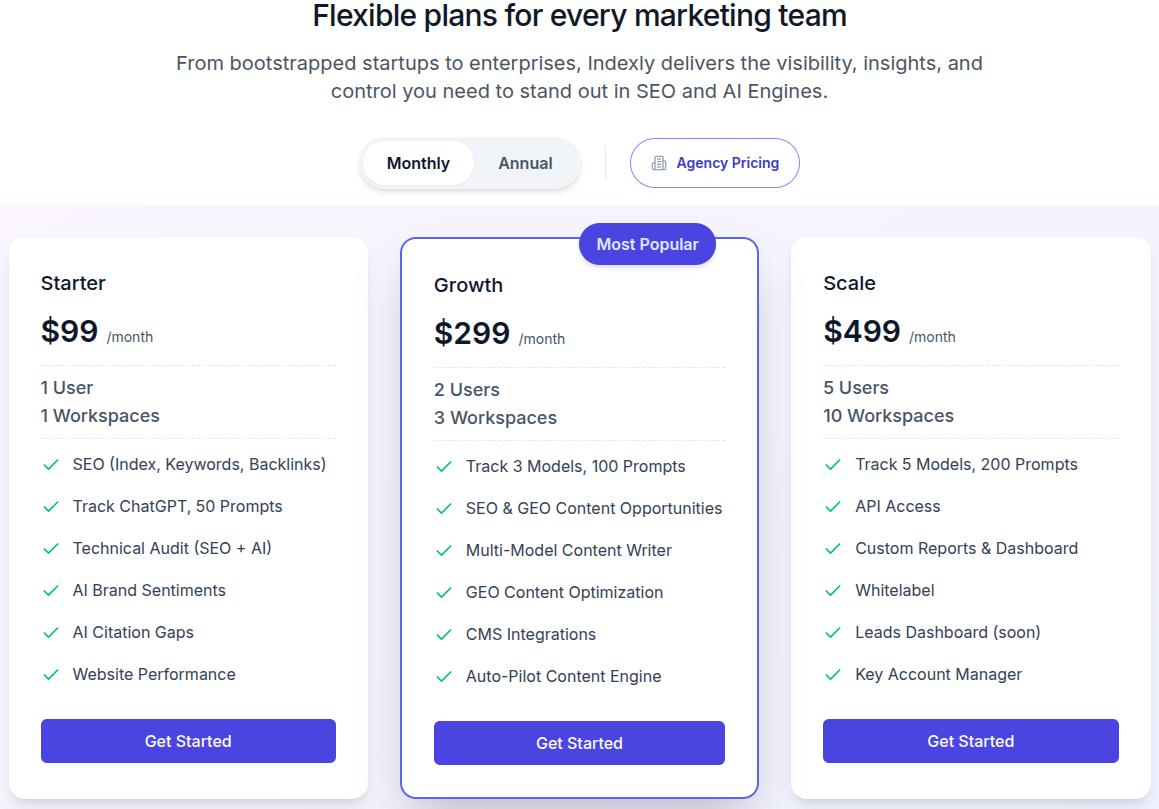
    Pros

    • Significantly cuts down content production with an easier interface.
    • Supports different content types.
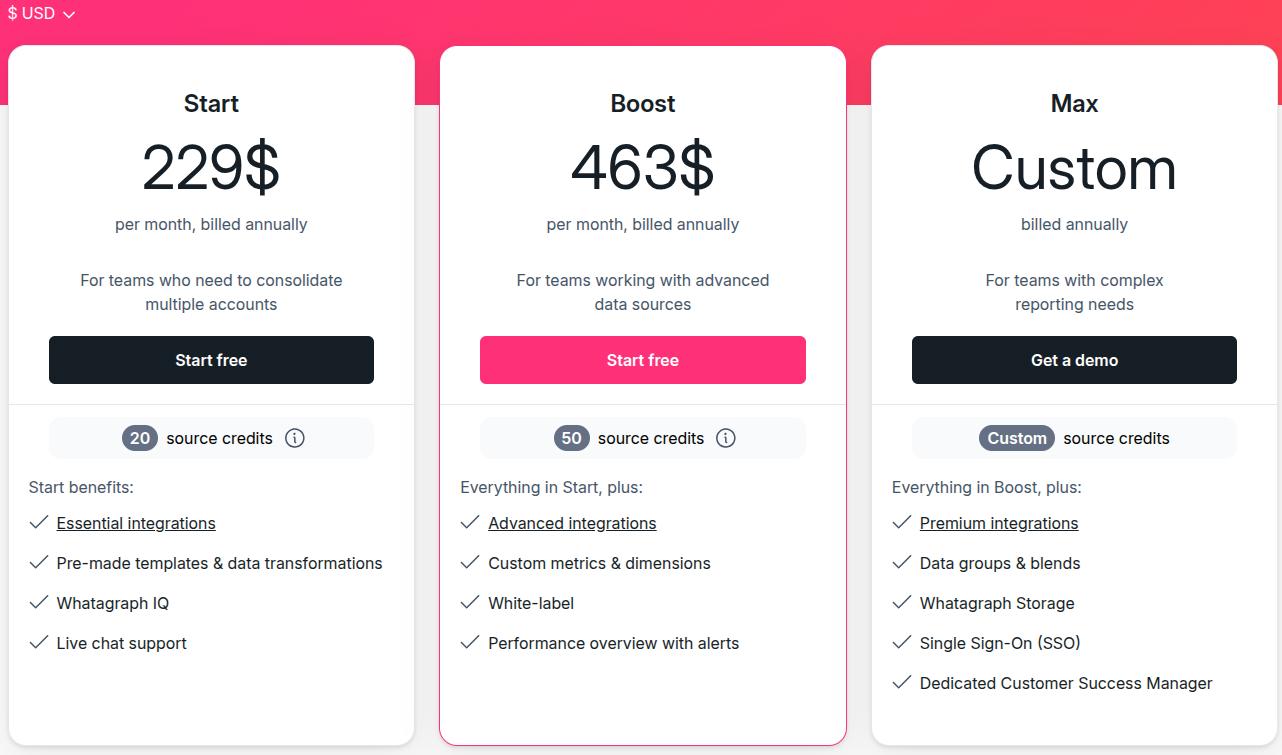
    • Can retain context and writing tone in long-form content.
    • Useful and affordable for individuals, small businesses, and enterprises.

    Cons

    • Lacks the ability to create complex, customized workflows like AirOps.
    • No extended SEO or analytical features that other tools, such as Contentpen, offer.

    Pricing

    • Free: $0/month (1 article free)
    • Starter: $79/month
    • Pro: $199/month

    3. Jasper – Best for maintaining brand voice at scale

    Jasper landing page.

    Unless you’ve been living under a rock, you’ve almost certainly heard of Jasper. It’s arguably the most recognized name in AI writing, and there’s a reason for that: Jasper doesn’t just write content; it learns how you write and replicates it across everything.

    Also read: Jasper vs. Contentpen.

    The idea is simple. You train Jasper on your existing content, including blog posts, ad copy, emails, etc., and it absorbs your brand voice. From that point on, every piece of content it generates sounds exactly like you.

    Notable features

    • Surfer SEO integration: Jasper utilizes Surfer’s Content Score directly in your editor so you can track keyword coverage and NLP-driven optimization without leaving the platform. You’ll still need a separate Surfer subscription for it, though.
    • 50+ content templates: Unlike AirOps, Jasper isn’t trying to be a content automation engine. Instead, it provides users with 50+ marketing templates to allow flexibility and efficiency while generating different types of content.
    • Multi-model routing: Rather than relying on a single LLM, Jasper automatically picks between GPT-4, Claude, and Gemini based on the task. This adds a layer of output reliability, though you don’t control which model fires when.

    Pros

    • It produces a more consistent tone than AirOps, with minimal setup.
    • Strong for multi-channel content (not just blogs or articles).
    • Saves time on rewriting and tone adjustments.

    Cons

    • Lacks the affordability of other AirOps alternatives, therefore not too suitable for small businesses.
    • Long-form output still needs a meaningful editing pass before it’s publish-ready.

    Pricing

    • Pro: $69/seat/month
    • Business: Custom

    Also read: The best Jasper AI alternative in 2026.

    4. Copy.ai – Best for sales and GTM workflows

    Copy.ai landing page.

    Copy.ai has evolved from a basic copy generator into a go-to-market (GTM) workbench where content, sales automation, and CRM data operate in the same workflow. 

    The native Salesforce and HubSpot integrations set it apart from most AirOps alternatives, so you can pull live prospect data into copy and push outputs back into your sales pipeline without leaving the platform.

    Notable features

    • Workflow automation: The tool supports multi-step automated sequences for outbound email, lead research, and sales follow-ups. It has that ‘content-meets-sales’ capability that most pure AI writing tools don’t touch.
    • Multi-LLM access: Copy.ai pulls from OpenAI, Anthropic, and Gemini without you managing API keys, giving you model variety across paid plans without added friction.
    • Copies that convert: Unlike AirOps, Copy.ai provides its users with web copy that actually helps them convert visitors to prospects and eventually, buyers. Its generated outputs are very convincing, which is something that other AI writers miss.

    Pros

    • Great for connecting content with revenue workflows.
    • Saves time on outreach and email sequences.
    • Easier to set up than AirOps for GTM use cases.
    • Flexible for marketing and sales teams working together.

    Cons

    • Long-form content often feels stitched together.
    • Advanced automation features are locked behind higher plans.

    Pricing

    • Chat: $29/month (5 seats)

    Also read: 10+ best Copy.ai alternatives in 2026.

    5. Hypotenuse AI – Best for e-commerce content at scale

    Hypotenuse AI writing tool.

    Hypotenuse AI is one of the few tools that doesn’t try to compete with AirOps head-on. Instead, it dominates a specific use case: bulk product content generation.

    If you’re running an e-commerce store with hundreds (or thousands) of SKUs, this tool can save an enormous amount of time. You can upload a spreadsheet and generate descriptions, meta tags, and even images in bulk.

    Compared to AirOps, it skips the complexity entirely. No workflows, no pipelines, just straight outputs that you can use for your online stores.

    Notable features

    • Bulk generation via CSV: Hypotenuse AI allows you to upload a product catalog as a CSV file. The tool then generates content for every row in the CSV, which helps e-commerce store owners set up their pages with confidence.
    • AI image generation: The tool produces product-aligned images alongside the copy in the same workflow, which is useful for supplemental visuals without jumping to a separate tool.
    • Brand voice customization: Hypotenuse AI allows you to set a brand voice according to your needs. The AI writer strictly obeys this tone in its writing, showcasing a high level of consistency.

    Pros

    • Removes a genuinely painful bottleneck for e-commerce teams wanting content without any complex workflow setup.
    • Reduces your tool stack meaningfully compared to an AirOps-based setup.
    • Pricing is straightforward and predictable.

    Cons

    • The tool may lag a bit when generating content.
    • Limited depth and variety of ideas in copy make it a less viable option for creative agencies.

    Pricing

    The following pricing plans are for the ‘Marketing & SEO’ category:

    • Entry: $29/month
    • Essential: $87/month
    • Blog Pro: $230/month
    • Blog Custom: Custom

    6. Writesonic – Best for GEO and AI search visibility

    Writesonic main interface.

    Like Contentpen, Writesonic is one of the more forward-looking AirOps alternatives, especially if you care about AI search visibility (GEO).

    While AirOps focuses on workflows, Writesonic focuses on where your content shows up in AI-driven search engines like ChatGPT, Perplexity, and Google AI results.

    Also read: Writesonic vs. Contentpen. 

    During testing, its GEO features felt genuinely useful for understanding visibility beyond traditional SEO.

    Notable features

    • Chatsonic with real-time web access: Unlike assistants relying on static training data, Chatsonic pulls live information from the web, reducing hallucination risk meaningfully for time-sensitive content.
    • SEO AI agent: The tool automates the process of keyword research and content planning, allowing you to reach the top of SERPs with ease.
    • Prompt Explorer: With Writesonic, you can discover real user queries tied to your niche, which enables you to create relevant, engaging content for your audience.

    Pros

    • Helpful insights into AI-driven traffic sources.
    • More strategic than AirOps for search visibility.
    • Real-time data access improves content relevance.
    • More than 50+ content templates available for users.

    Cons

    • The tool is expensive for small teams and SMBs.
    • The interface can feel busy and less intuitive for beginners.

    Pricing

    • Starter: $99/month
    • Basic: $249/month
    • Growth: $499/month

    Read more: 10+ best Writesonic alternatives in 2026

    7. Averi – Best for startups needing a full content engine

    Averi main landing page.

    Where AirOps hands you a blank canvas and says, “build your workflow,” Averi builds it for you. Point it at your website, and it reads your brand, generates a content calendar aligned to your growth goals, handles drafting, and tracks performance.

    Publishing integrations with WordPress, Webflow, and Framer mean you can go from idea to live post without touching a separate CMS.

    Notable features

    • Brand-aware content generation: Averi ingests your website and existing content to build a working brand model that carries into every topic suggestion, outline, and draft, without re-prompting your brand context every session.
    • Performance tracking: The tool tracks how published content performs and feeds that data back into future recommendations. Over time, the suggestions sharpen rather than staying static, which is rare at this price point.
    • Automated topic suggestions: Averi suggests topics relevant to your niche and plans your content calendar accordingly.

    Pros

    • Great for lean teams with limited resources.
    • Feels more intuitive to use than AirOps.
    • Provides a powerful performance-feedback loop to create high-ranking pieces.

    Cons

    • Less granular editorial control than most other AirOps alternatives.
    • Not ideal for large-scale or programmatic workflows.

    Pricing

    • Solo Plan: $99/month (1 article free)
    • Team Plan: $199/month
    • Agency Plan: $399/month

    8. Surfer SEO – Best for on-page optimization depth

    Surfer SEO landing page.

    Surfer SEO isn’t trying to replace AirOps or be your primary AI writer. What it does, and does better than AirOps, is tell you exactly what a piece of content needs to rank while you’re still writing it. 

    The tool comes with a Content Editor that scores your draft in real time based on what’s actually ranking for your target keyword. It does provide content generation as well, but it’s limited compared to other tools on the list.

    Notable features

    • Topical map builder: The tool helps you plan content clusters around a core topic, identifying authority gaps and suggesting supporting posts for teams building long-term SEO campaigns.
    • SERP Analyzer: Surfer provides deep competitive analysis showing exactly what top-ranking pages for any keyword are doing structurally. This includes their word counts, headings, and keyword usage, so you know how to write a competitive piece.
    • Real-time Content Score: Surfer scores your draft continuously as you edit, showing exactly where you’re hitting and missing keyword targets, heading structure, and NLP term coverage.

    Pros

    • Improves the ranking potential of AI content.
    • Clear, data-driven guidance.
    • Works well alongside tools like Contentpen.
    • Helps reduce guesswork in SEO.

    Cons

    • Not a complete content workflow tool.
    • Prices can scale steeply with heavy usage.

    Pricing

    • Standard: $119/month
    • Pro: $219/month
    • Peace of Mind: $359/month

    Also read: The best Surfer SEO alternatives in 2026.

    9. WRITER – Best for content in regulated enterprise environments

    WRITER landing page.

    WRITER runs on proprietary Palmyra LLMs, which means your content isn’t processed through public OpenAI or Google endpoints. This is a critical distinction needed for healthcare, finance, and other industries where data handling isn’t negotiable. 

    The platform also offers SOC 2, HIPAA, GDPR compliance, and audit trails for every output, which makes it a unique AirOps alternative.

    Notable features

    • Custom LLM for business writing: WRITER’s proprietary models process content on isolated infrastructure, keeping your data out of public model training pipelines.
    • Governance and compliance layer: Style guides, terminology enforcement, claim detection, and content audit trails are built into the platform. Every output is checked before it leaves the system, which provides a critical level of oversight on the content.
    • Connection to data sources: WRITER connects to your internal data sources, such as documents, databases, and CRM records, and grounds AI outputs in accurate, current business information rather than general training data to avoid hallucinations.

    Pros

    • Ideal for regulated industries (finance, healthcare, legal).
    • Ensures consistent and compliant content.
    • Strong security and audit capabilities.
    • Integrates well with enterprise workflows.

    Cons

    • Expensive and not beginner-friendly.
    • Not optimized for fast content production.

    Pricing

    • Starter: ~$39/month (14-day free trial)
    • Enterprise: Custom

    10. Relevance AI – Best for building custom AI agents for content workflows

    Relevance AI landing page.

    Relevance AI is the closest competitor to AirOps in terms of technical flexibility, but it goes even deeper.

    Instead of giving you a pre-built system, it lets you create custom AI agents and pipelines from scratch. You can connect APIs, route tasks between models, and automate internal processes. That makes it powerful, but also difficult to use for non-technical teams.

    Notable features

    • Custom AI agent builder: The tool facilitates its users with a visual, no-code interface for designing multi-step agents that go well beyond content, from research automation and lead enrichment to internal QnA bots, and more.
    • Pre-built agent marketplace: Relevance AI provides 400+ agents to clone and customize operations across sales and marketing.
    • Bring-your-own API key: Connect your own OpenAI, Anthropic, or other model keys on paid plans, bypassing Relevance AI’s vendor credits entirely. For teams with existing API relationships, this significantly stabilizes your cost.

    Pros

    • Extremely flexible for custom workflows.
    • Suitable for technical teams and developers.
    • Can automate complex internal processes.
    • More customizable than AirOps in some cases.

    Cons

    • Steep learning curve for non-technical users
    • The split pricing model (actions + vendor credits) can produce unpredictable monthly bills at volume.

    Pricing

    • Free: $0/month (200 actions)
    • Pro: $29/month (2500 actions)
    • Team: $349/month (7000 actions)
    • Enterprise: Custom

    When to choose each AirOps alternative?

    After testing and reviewing all the AirOps alternatives, it becomes clear to us that no AI writer is necessarily “bad.” You just have to choose which one suits you the best.

    Choose Contentpen if you want the best AirOps alternative for SEO and GEO-optimized content with no quality compromises. It also suits you if you need predictable per-article pricing instead of AirOps-style credit guesswork, and want AI visibility tracking without a separate tool.

    You can choose the following options for specific use cases:

    • Long-form text generation with content repurposing for LinkedIn: ContentMonk.
    • Brand voice consistency across different channels: Jasper AI.
    • GTM and revenue workflows: Copy.ai.
    • E-commerce businesses wanting copywriting at scale: Hypotenuse AI.
    • Strict compliance, governance, and brand control: WRITER.
    • Building custom AI agents and workflows from scratch: Relevance AI.

    If you’ve made it this far, the pattern is pretty clear. Most AirOps alternatives either simplify content creation or specialize in one part of the workflow.

    Contentpen is one of the few that actually does both, without adding more complexity.

    Write content that’s built to rank, not just read

    Create search-optimized blogs aligned with SEO and GEO signals, so your content performs well across search and AI-driven discovery.

    Try SEO Blogging FREE →
    AI SEO Interface

    If you’re tired of juggling workflows, tracking credits, and fixing AI output, try Contentpen and go from keyword to publish-ready article within minutes.

    Frequently asked questions

    Why is Contentpen considered to be the best AirOps alternative?

    Contentpen handles keyword research, internal linking, media, and SEO scoring all in one place. It also provides the opportunity to build custom workflows with a webhook.

    Can I use ChatGPT instead of AirOps?

    Yes, you can use ChatGPT in place of AirOps for content generation and SEO optimization. However, AI chatbots, such as ChatGPT, Gemini, and others, are not very effective for managing automated content workflows, which AirOps and other alternatives, like Relevance AI, do.

    Is AirOps useful for in-house teams?

    Yes. AirOps is beneficial for in-house teams as it helps with repetitive content workflows, bulk content generation, and content editing.

    Can I edit content on AirOps itself?

    Yes. AirOps does offer a built-in content editor that you can use to modify the generated output according to your needs. The editor is not as advanced as the other tools on the list, but it’s good enough to perform basic functionality.

  • 10+ best Writesonic alternatives in 2026

    10+ best Writesonic alternatives in 2026

    In 2026, creating content at scale is no longer optional; it’s a necessity. AI writing tools have become essential for businesses looking to produce more content quickly without compromising on quality.

    While Writesonic is a popular choice, it’s not perfect. Its credit-based pricing can get expensive as needs grow, and some users report inconsistent quality with long-form content. Others feel its SEO tools fall short in ranking performance.

    Fortunately, we have many more tools available today that can serve as the best Writesonic alternatives in 2026. In this guide, we’ll explore these options by comparing features, pricing, and use cases to help you find the right fit for your content goals.

    So, let’s get started.

    Writesonic alternatives at a glance

    ToolBest ForStandout Feature vs WritesonicLimitationStarting Price (Annual)G2 Rating
    ContentpenSEO and GEO-optimized blogsAI visibility tracking included in every plan, plus SEO opportunitiesBlog-only focus$39/mo4.9 ⭐
    Jasper AIBrand-led campaignsAdvanced brand voice + extensive content templatesExpensive for SMBs$59/seat/mo4.7 ⭐
    Copy.aiSales and outbound copyFaster ad + email ideationWeak SEO depth$24/mo4.7 ⭐
    RytrBudget AI writingCheapest entry + simple UIThin long-form content$7.50/mo4.7 ⭐
    Surfer SEOContent optimizationNLP keyword + SERP scoringNot a standalone AI writer$99/mo4.8 ⭐
    Frase.ioSEO research + briefsPAA mining + intent structuringOccasional system lag$39/mo4.8 ⭐
    SimplifiedComprehensive marketing workflowsWriting + design + video suiteWeak blog depth$19/mo4.6 ⭐
    WordtuneRewriting & editingFluency + tone rewritingNot suitable for long-form content$9.99/mo4.6 ⭐
    ScalenutSEO long-formCruise Mode + topical clusteringComplex UI$30/mo4.7 ⭐
    AnywordPaid ad performancePredictive ROI scoringWeak organic SEO features$39/mo4.8 ⭐
    Article ForgeFull content automation1-click article generationLow nuanced depth$27/mo4.2 ⭐

    Also explore: Best ChatGPT alternatives.

    Why look for Writesonic alternatives?

    The biggest problem with Writesonic right now is that it has started offering all the features in one place. It has an AI optimization engine, SEO audits, an AI article writer, and AI search visibility tracking.

    WriteSonic AI and SEO features

    The problem is the specialization. Each aspect of SEO and GEO-optimized content is covered, but users feel that neither completely fulfils its purpose. This is why they consider Writesonic alternatives. 

    Other problems include cost, inconsistent quality, limited SEO, and collaboration features. 

    1. Cost scalability concerns

    Writesonic’s credit-based pricing model can be very confusing for businesses. Also, as content requirements scale up, costs can increase dramatically, often exceeding initial budget projections.

    The platform’s premium pricing for higher-quality outputs also forces uncomfortable tradeoffs between content quality and budget constraints. In such cases, the Writesonic free version is of no use.

    2. Inconsistent content quality

    The most frequently cited reason for seeking Writesonic alternatives is inconsistent output quality, particularly for longer-form content. 

    Users report that while the Writesonic article writer can produce acceptable short-form content, quality degrades noticeably as word count increases.

    3. Limited advanced SEO capabilities

    As search algorithms have grown more sophisticated in 2026, Writesonic’s relatively basic SEO features have fallen behind industry leaders. The platform lacks advanced capabilities for:

    • Comprehensive search intent analysis
    • Competitive content benchmarking and gap analysis
    • Content structure optimization
    • Internal linking strategy implementation

    Even though Writesonic offers generative engine optimization (GEO), free users can’t access these features, at least not until they sign up to the platform.

    4. Workflow and collaboration friction

    Modern content production typically involves multiple collaborators, which WriteSonic lacks compared to its alternatives. 

    Teams report challenges with managing approval workflows, tracking content revisions, feedback implementation, and integrating with other tools.

    11 alternatives to Writesonic that are worth considering in 2026

    1. Contentpen

    Contentpen SEO and AEO tool.

    Best for: SEO and GEO-optimized blogs with AI-powered insights for better ranking opportunities.

    Contentpen is a strong alternative to Writesonic in creating high-quality, SEO-optimized blog content that drives measurable traffic and conversions. 

    Unlike general-purpose AI writing tools, Contentpen was built from the ground up to focus on creating blog posts that rank in SERPs and AI Overviews. It also tracks your AI visibility in every plan, so you can measure whether that content gets cited.

    Pros:

    • Advanced SEO optimization: Contentpen aligns your content with search intent and conducts in-depth competitor analysis. It identifies content gaps and optimizes meta details, heading structure, and other on-page SEO elements for higher rankings.
    • Intelligent linking: Unlike WriteSonic, Contentpen uses your sitemap for strategic internal linking based on semantic relevance, not just keywords. It maintains optimal link density and ensures natural use of anchor text.
    • Diverse integrations: Contentpen integrates with top CMS platforms, including WordPress, Webflow, Shopify, Ghost, Wix, and EmDash, enabling one-click publishing after content is written.
    • Automatic image generation: Contentpen generates contextually relevant, high-quality images for specific content sections. Contentpen’s in-article and feature images also come with suitable alt texts, helping you with image optimization as well.
    • AI visibility tracking included: Every plan tracks how ChatGPT, Google AI, Gemini, Perplexity, Claude, and other AI engines mention and cite your brand, with share of voice, sentiment, and source gaps. Coverage goes up to seven engines depending on plan, and it’s included from the entry price rather than requiring a higher-priced tier.
    • Predictable pricing: Plans are based on a set number of articles per month instead of Writesonic-style credits, so your costs don’t climb unexpectedly as you scale.

    Cons:

    • Limited trial period: The tool offers only a 7-day trial, which may be too short for many users to evaluate the AI blog writer’s performance.
    • Learning curve: If you are new to content writing and creation, you may take a while to get used to the requirements to publish a rank-ready piece.

    Pricing:

    Pricing starts at $39/month billed annually ($49 monthly).

    Also explore: WriteSonic vs Contentpen.

    2. Jasper AI

    Jasper landing page

    Best for: Brand-led campaigns that require detailed tone and voice customization.

    When we compare Jasper AI vs Writesonic in day-to-day production workflows, the biggest difference comes down to campaign depth vs article automation.

    Writesonic is faster when generating standalone blog drafts. Jasper, on the other hand, is built to orchestrate entire marketing ecosystems: ads, landing pages, emails, and long-form assets under one brand voice.

    Pros:

    • Smarter brand voice training: Jasper has a stronger brand voice system that helps users keep their tone consistent across content using their custom brand knowledge.
    • Unlimited generation on higher tiers: Writesonic’s credit model creates scaling anxiety for businesses. Jasper’s unlimited words model on paid tiers makes cost forecasting far more predictable as content production increases.
    • Deeper template infrastructure: Jasper and Writesonic both offer a similar number of standard templates (50+). However, Jasper’s template output is much richer than Writesonic.

    Cons:

    • Requires structured prompting: The prompting part is extensive with Jasper, especially when producing long-form articles, blog posts, or case studies.
    • Too expensive for SMBs: Jasper is not for startups and small businesses because it falls into the premium tier.

    Pricing:

    Pricing starts at $59/seat/month (billed annually).

    Also read: 14 best Jasper alternatives

    3. Copy.ai

    Copy.ai landing page

    Best for: Sales and outbound copy generation.

    Copy.ai excels at creating conversion-oriented content, with particular strength in sales copy, email sequences, and marketing materials that drive audience action.

    Pros:

    • Faster ideation cycle: When testing multiple ad angles, Copy.ai produces usable variations quicker than Writesonic.
    • Stronger persuasive writing: In our testing, we found that Copy.ai’s writing feels far more persuasive, lively, and natural than Writesonic’s. Cold outreach, sales emails, ad hooks, and product messaging feel sharper and more conversion-aware.

    Cons:

    • Limited SERP optimization: Copy.ai falls short in SEO capabilities compared to Contentpen and other tools on the list.
    • Less suited to organic traffic strategies: The tool performs better in paid acquisition workflows than in SEO ecosystems.

    Pricing:

    Price is $24/month (billed annually).

    4. Rytr

    Ryter landing page

    Best for: Budget AI writing.

    The Writesonic vs Rytr comparison comes up often, especially among users searching for Rytr writing tools or budget AI writers. Rytr offers accessible AI writing capabilities at an affordable price, making it particularly attractive to budget-conscious users and small businesses.

    However, from our testing, the tradeoff is clear: cost vs depth. Writesonic delivers a stronger long-form structure, while Rytr wins on affordability and simplicity.

    Pros:

    • Faster short-form drafting: Rytr generates captions, emails, and blog drafts more quickly than Writesonic and with less prompting and effort.
    • Simpler UI: The tool offers a simpler UI, making onboarding easier than Writesonic’s detailed feature suite.
    • Support for 30+ languages: Rytr supports more languages than Writesonic, enabling users from different regions to create their content with ease.

    Cons:

    • Thinner long-form content: Longer content, such as articles, blogs, and guest posts, can appear to lack value. The same argument can be reworded to lengths, and no deep competitor analysis causes content to lose SERP value.
    • Abrupt structural endings: Sometimes articles are cut mid-thought, requiring manual editing to complete.

    Pricing:

    Pricing starts at $7.50/month (billed annually).

    5. Surfer SEO

    Surfer SEO landing page

    Best for: SEO content optimization for better ranking and visibility.

    Surfer SEO is primarily an SEO-content optimizer first and an AI writer second. However, we’ve found it to be a good alternative to Writesonic, especially for bloggers who prefer improved CTR and conversion rates over other KPIs.

    Pros:

    • Strong NLP keyword mapping: The tool suggests semantically relevant keywords that Google is likely to rank for a particular query. Though WriteSonic does support AI search optimization, the keywords it provides aren’t as well-suited as those from Surfer SEO.
    • SEO audit feature: Surfer audits your underperforming posts in detail and surfaces important actions to address.
    • Built-in content scoring: Similar to Contentpen, Surfer SEO also provides built-in content scoring that forecasts your performance for AI overviews and SERPs.

    Cons:

    • Needs pairing with other tools: Surfer SEO may enhance your wording to improve search engine performance through rewriting or other methods. However, it is not an independent writing tool.
    • Data overload: Beginners may find it difficult to navigate the interface because there are many SEO metrics displayed at once.

    Pricing:

    Pricing starts at $99/month (billed annually).

    6. Frase.io

    Frase AI writer

    Best for: Generating comprehensive SEO content briefs.

    Frase is a powerful Writesonic alternative in all the ways imaginable. Just like Writesonic, Frase also conducts keyword research, tracks AI visibility, writes, and optimizes content in one window.

    What sets Frase.io apart from Writesonic is its ability to write naturally smooth, readable content while providing comprehensive SERP analysis.

    Pros:

    • Question mining: Frase.io extracts questions from the People Also Ask (PAA) sections for a particular query and incorporates them into your content. Although Writesonic can generate FAQs, they’re not as comprehensive or as rank-worthy as Frase.
    • SEO content briefs: The tool provides in-depth SEO briefs for bloggers, content marketers, and freelancers, allowing them to see all SERP gaps quickly and effectively.
    • Answer engine and intent alignment: Frase specifically structures content for answer engines, such as AI Overviews. It also creates blog posts and articles based on the search intent.

    Cons:

    • Random system crashes: The website and competitor analyzer can sometimes crash unexpectedly, which can be frustrating when dealing with tight deadlines and jammed content pipelines.
    • Interface takes time to learn: Frase.io requires time to master all its features and options, with some trial and error to create compelling content.

    Pricing:

    Pricing starts at $39/month (billed annually).

    Also explore: Frase vs Contentpen.

    7. Simplified

    Simplified landing page

    Best for: Combining multiple AI creation workflows in one place.

    When we evaluate Simplified vs Writesonic, the difference becomes clear almost immediately. Writesonic is built primarily for content generation and SEO workflows, while Simplified positions itself as an all-in-one marketing creation suite.

    Simplified offers a comprehensive creative ecosystem that extends beyond AI writing to include design, video, and social media management tools in a unified interface.

    Pros:

    • Stronger social media workflow: Simplified includes post schedulers, caption generators, hashtag suggestions, and platform formatting. Writesonic can generate captions, but Simplified helps you actually package and publish campaigns end-to-end.
    • Built-in collaboration for creatives: With Simplified, you can assign designs, review visuals, and approve copy within shared workspaces, something Writesonic’s editorial collaboration layer doesn’t fully cover.
    • AI asset creation: The tool covers a wide range of AI asset creation, including images and videos for reels, ad campaigns, and YouTube content. This becomes a major production advantage over writing-only tools like Writesonic.

    Cons:

    • Weaker long-form writing: Since Simplified is not a dedicated AI writer, it struggles to produce long-form content in terms of accuracy, coherence, and comprehensiveness.
    • Limited SERP and SEO optimization: Simplified can improve readability for better SEO performance, but that’s about it. It does not have extended SERP, SEO, or GEO features like other tools on the list.

    Pricing:

    Pricing starts at $19/month (billed annually).

    8. Wordtune

    Wordtune content editor

    Best for: Rewriting and editing content for maximum readability and clarity.

    Wordtune takes a different approach by focusing primarily on improving and rewriting existing content rather than generating it from scratch, making it an excellent companion to other writing tools. 

    Pros:

    • Powerful tonal consistency: Whether you’re continuing an existing thought or rewriting a complete paragraph, Wordtune ensures that the selected tone remains consistent.
    • Strong grammar + fluency suggestions: Wordtune provides very reasonable grammar and fluency suggestions without over-optimizing the content. This makes your posts rank-worthy with minimal manual effort.
    • Diverse integration: You can use Wordtune inside Google Docs, Gmail, and browsers using extensions. On the other hand, Writesonic’s integrations are quite limited, which diminishes any productivity gains.

    Cons:

    • Requires prompting for long-form content: You need to consistently provide prompts to Wordtune to generate pillar content or cornerstone blog posts. This makes it not so suitable for longer blog posts, articles, or case studies.
    • No SEO optimization: Wordtune does not provide any SEO optimization features, so you’ll have to pair it with other AI SEO tools to extract the best results.

    Pricing:

    Pricing starts at $9.99/month (billed annually).

    9. Scalenut

    Scalenut landing page

    Best for: Creating long-form SEO content.

    Scalenut competes more directly with Writesonic’s long-form and SEO optimization stack. It combines AI writing, SERP analysis, and content optimization, making it closer to Surfer + AI writer hybrids.

    Pros:

    • Cruise Mode for long-form SEO articles: Cruise Mode is a smart addition from Scalenut, helping users write human-first, AI-cited content for better growth.
    • Topical clustering: Scalenut’s topical clustering is more comprehensive than Writesonic, especially for keywords with informational and commercial intent.
    • Detailed backlink insights: This WriteSonic alternative offers backlink data, keyword planning, and social listening capabilities, making it a unique addition to our list.

    Cons:

    • Fewer marketing copy templates: Scalenut offers fewer marketing copy templates than Writesonic.
    • Complex UI: The user interface is another challenge with Scalenut, especially for marketing beginners who are new to content creation.

    Pricing:

    Pricing starts at $30/month (billed annually).

    10. Anyword

    Anyword tool landing page

    Best for: Monitoring paid ad performance and optimizing messaging.

    Anyword differentiates itself with predictive performance scoring that forecasts content effectiveness before publication, helping marketers optimize messaging for maximum impact.

    Pros:

    • Ad copy optimization across paid channels: Writesonic leans toward blog posts and organic acquisition, while Anyword excels in paid ecosystems. Anyword provides stronger outputs for Meta ads, Google Ads, and display campaigns.
    • Audience persona targeting: Anyword tailors messaging to specific audience segments, which makes it easier to produce funnel-specific copy. In comparison, Writesonic’s audience targeting feels broader and less effective for niche markets.
    • Enterprise-grade campaign testing workflows: Anyword allows users to generate multiple ad variations and prioritize them based on predicted ROI. This reduces the time and resources wasted during A/B testing.

    Cons:

    • Expensive compared to other AI writers: Anyword falls into the premium pricing bracket. For businesses evaluating cost vs scale, Writesonic’s pricing model is more accessible.
    • Not designed for organic traffic flows: There’s minimal keyword clustering, competitor benchmarking, or search intent mapping. This makes Anyword less suitable for organic traffic optimization or detailed ranking strategies.

    Pricing:

    Pricing starts at $39/month (billed annually).

    11. Article Forge

    Article Forge landing page

    Best for: Content automation with minimal human input.

    Article Forge takes content automation to the extreme by generating complete articles from minimal input, making it the fastest but least customizable option among Writesonic alternatives.

    Pros:

    • Built-in LSI keyword integration: The platform automatically includes semantically related terms, helping articles appear more contextually relevant without manual keyword mapping.
    • Useful for low-competition content scaling: Article Forge’s main benefit is its content creation speed. It is ideal for filler blog posts and similar content that don’t require much depth.
    • Minimal input requirement: Unlike Writesonic, which often benefits from structured prompts, outlines, or optimization settings, Article Forge requires very little human input, making it an ideal content-automation companion.

    Cons:

    • Weak brand voice control: There’s limited ability to train tone, messaging, or stylistic consistency, making it harder for brands to maintain identity across content channels.
    • Minimal SEO optimization: Article Forge does not provide any in-depth competitor analysis, search intent mapping, or content scoring features, which costs it a point against Writesonic.

    Pricing:

    Pricing starts at $27/month/user (billed annually).

    Ready to transform your content strategy?

    After conducting a comprehensive analysis of the top Writesonic alternatives available in 2026, Contentpen clearly emerges as the superior choice for businesses serious about creating high-quality, SEO-optimized blog content.

    While each alternative offers distinctive strengths, Contentpen’s specialized focus on AI content creation, combined with its advanced SEO capabilities, SEO analytics, and built-in AI visibility tracking, makes it the ideal solution.

    Companies looking to drive sustainable traffic and conversions through content marketing should consider Contentpen as their daily driver.

    Frequently asked questions

    Why should I choose a Writesonic alternative in 2026?

    While Writesonic remains a popular AI writing tool, users have expressed concerns about its credit-based pricing model, inconsistent quality of long-form content, limited advanced SEO features, and collaboration tools.

    Are there any Writesonic alternatives that handle long-form content creation?

    Yes. Tools like Contentpen are made for long-form blog posts to boost AI discoverability and SERP results. It handles the entire production workflow, from ideation and keyword selection to content generation and publishing, all in a single window.

    How do Writesonic alternatives handle SEO and AEO?

    It varies. Some tools, such as Jasper, integrate with other SEO platforms, while others, like Contentpen, conduct keyword research and clustering, competitor research, and have built-in SEO scoring. Frase is another Writesonic competitor that structures content for answer engines.

    Why Contentpen stands out amongst other Writesonic alternatives?

    Contentpen is the best Writesonic alternative because it offers advanced SEO optimization, brand voice consistency, intelligent linking, and streamlined approval workflows without switching a single tool. This makes it effective for SEO and GEO-optimized content at scale.