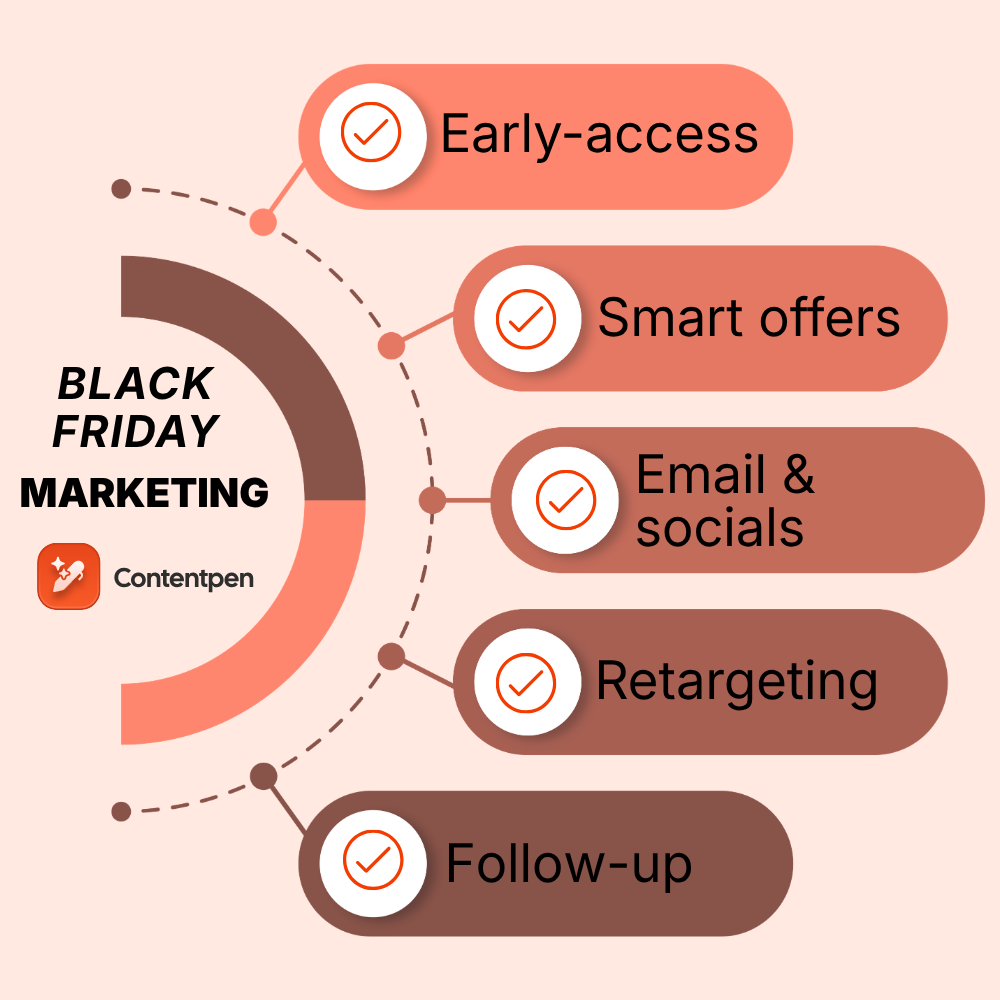
The best Black Friday marketing doesn’t stop working on December 1. A good campaign builds an email list before the sale, makes one clear offer during it, and turns new buyers into long-term customers after it. The discount is just the middle bit.
This guide walks through 14 Black Friday marketing strategies before, during, and after the sale, across the whole BFCM stretch from Thanksgiving to Cyber Monday. Each one comes with what to do, why it works, and what it leaves behind once the countdown timers come down.
It’s written for small businesses, SaaS teams, and online stores that want to maximize their returns from the sales without worrying about how. You will also see a real-life example from Contentpen to help you understand BF marketing.
So, let’s get started.
Key takeaways
- Start with an early-access list. People who raise their hand before the sale are your cheapest, warmest buyers.
- Discount the commitment, not the product. Yearly plans, bundles, and spend thresholds protect margin better than a flat sitewide cut.
- Plan for mobile and AI search. Adobe expects mobile to drive 63% of online spend in the peak period and AI-driven retail traffic to rise by 130% this season.
- The Black Friday marketing tactic that pays off the most happens after the sale, which includes onboarding, retention, and turning campaign content into evergreen pages.
Why Black Friday marketing needs a real plan in 2026
Black Friday and Cyber Monday (BFCM) sales attract major audiences worldwide, especially in SaaS. People can buy software and tools they’ve been targeting all year without breaking their bank.
According to Adobe, a whopping $275.1 billion in US online holiday spending is expected in 2026, up by 6.7% from last year.
Cyber Week alone is expected to bring in $47.5 billion, with Black Friday at $12.9 billion and Cyber Monday as the single biggest online day at $15.1 billion.
As a SaaS company, your goal should not only be to cash in on the BFCM sales, but also to keep continuing to serve your customers long after the event is over.
With the right strategies in place, you ensure that this happens so that you build a long-lasting business model that pushes your recurring revenue to the max.
If you’re still choosing the tools to run your campaign, our list of Black Friday software deals covers marketing, email, and analytics software on sale this year.
The 2026 Black Friday marketing calendar
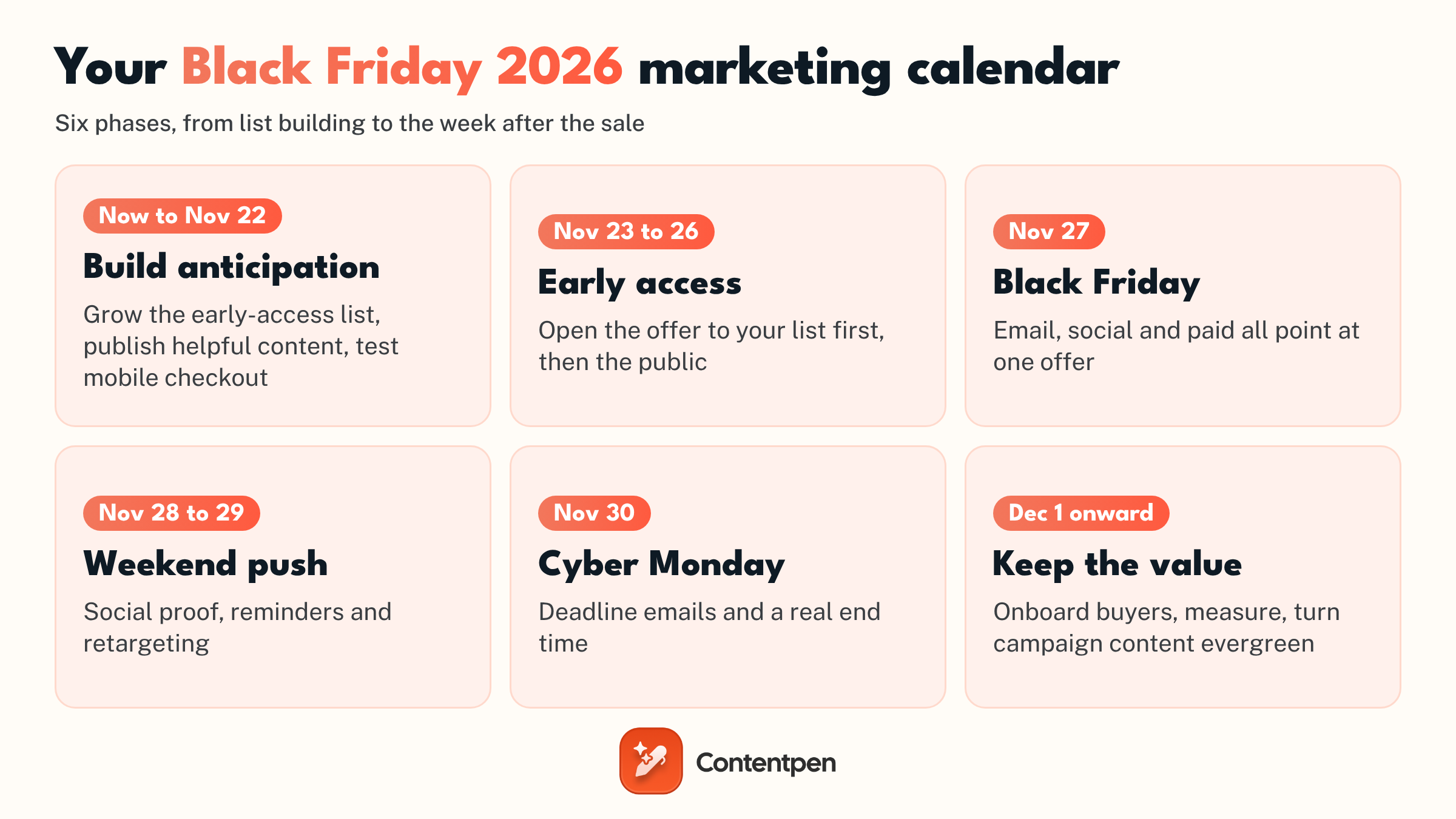
Black Friday falls on November 27, 2026, and Cyber Monday on November 30. Here’s how the weeks around them break down.
| When | Phase | Main job |
|---|---|---|
| Now to Nov 22 | Build anticipation | Grow the early-access list, publish helpful content, test your checkout on mobile to capture most users |
| Nov 23 to 26 | Early access | Open the offer to your list first, then the public |
| Nov 27 (Black Friday) | Launch peak | Email, social, and paid channels all pointing at one offer |
| Nov 28 to 29 | Weekend push | Social proof, reminders, retargeting cart, and pricing-page visitors |
| Nov 30 (Cyber Monday) | Last call | Deadline emails and a real end time |
| Dec 1 onward | Keep the value | Onboard new buyers, measure, and turn campaign content into evergreen pages |
Reading this in mid-November? You haven’t missed it. Compress the first phase into a week and focus on strategies 1, 2, and 6 below.
Before the sale: Strategies that build demand
Building demand for something is all about spreading awareness. You need to tell people what it is you sell and why it is different from other offerings on the market. Apply these strategies to ensure that people are ready to buy once the deals are live.
1. Open an early-access list before you announce the price
Customers love the feeling of exclusivity. They need to be told, “Hey, I’ve got this amazing offer, which I will only give to the first 10 or 15 customers. That can be you if you subscribe today.”
This pitch (which incites the FOMO effect on people), along with selling the product you have fairly and honestly, is the key.
Tell your audience exactly how your tool will help them, why you’re the best in the town (possibly the world), and be transparent about what they’ll get once they subscribe.
What to do: Put up a Black Friday page now with a sign-up form, a hint of the offer, and a promise that list members get the link first.
Why it works: The people who sign up have already told you they’re interested. Emailing them on day one costs you nothing, and they tend to buy faster than cold traffic.
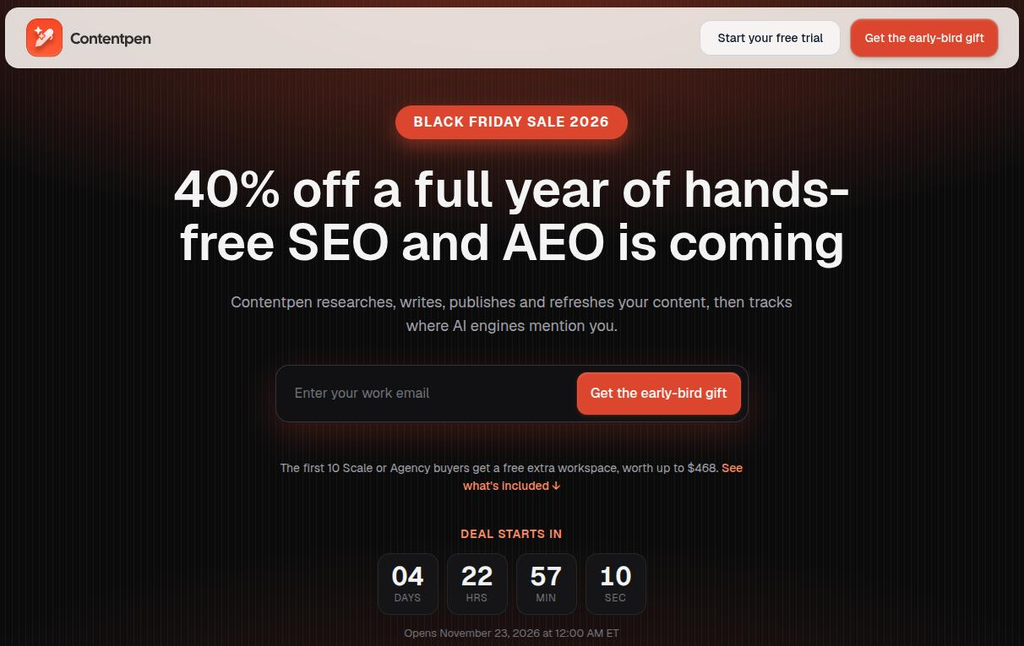
Our example: Contentpen’s Black Friday campaign went up ahead of the sale with one headline (“40% off a full year of hands-free SEO and AEO is coming”). It also has a way to enter your work email to get the early-bird gift.
Now imagine when subscribers see the tag of “a full year of SEO and AEO handled for me?” They immediately get the deal link before it’s announced anywhere else.
What it leaves behind: A list of qualified leads and contacts you keep, whether or not they buy this year. You can initiate drip sequences later to warm them, update them about your product, and much more.
2. Discount the commitment, not the product
Smart brands think in terms of commitment. They want the user to stick with them the longest so that their ARR (annual recurring revenue) and MRR (monthly recurring revenue) don’t die down after Black Friday or Cyber Monday ends.
What to do: Tie your best price to a bigger commitment. For SaaS, that’s yearly billing. For stores, it’s bundles or a free-shipping threshold. For agencies, it’s a prepaid retainer.
Why it works: You trade margin for cash flow and retention. If a yearly customer bought in November, they can’t churn in January.
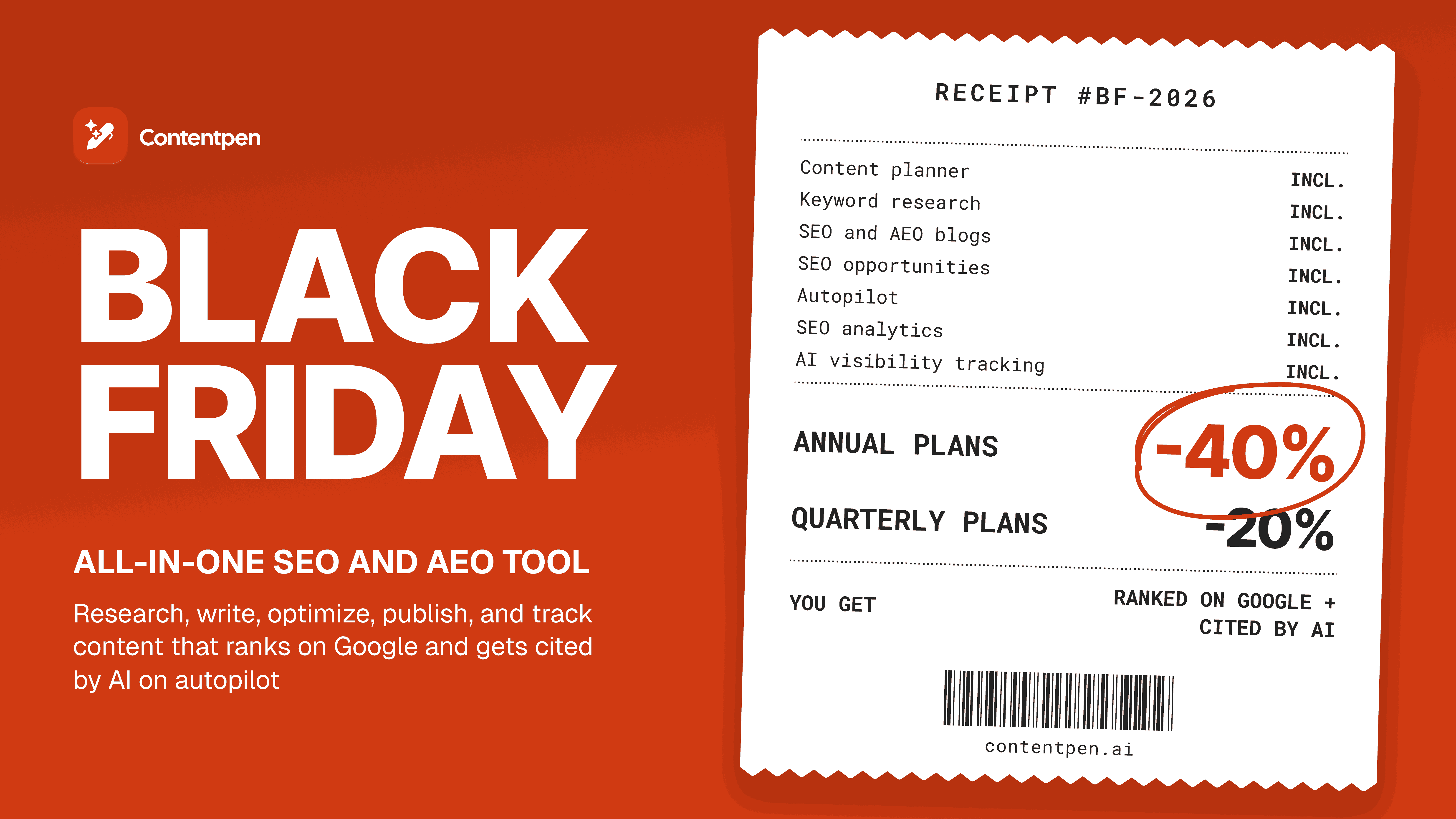
Our example: Contentpen’s sale gives 40% off yearly plans, which is double the usual 20% yearly saving, and adds quarterly billing at 20% off for the first time. Quarterly plans give cautious buyers a lower-commitment way in without cheapening the yearly offer.
What it leaves behind: Customers locked in for months, not a one-off order.
3. Make scarcity real, or skip it
Sometimes, SaaS brands will add a FOMO effect just for fun. They don’t mean it. That’s not how it’s supposed to be.
What to do: If you add urgency, make it true. Be honest about the capped bonus, limited stock, or a hard end date.
Why it works: Shoppers see dozens of countdowns in the same week. The ones they believe are the ones that end, which initiates action.
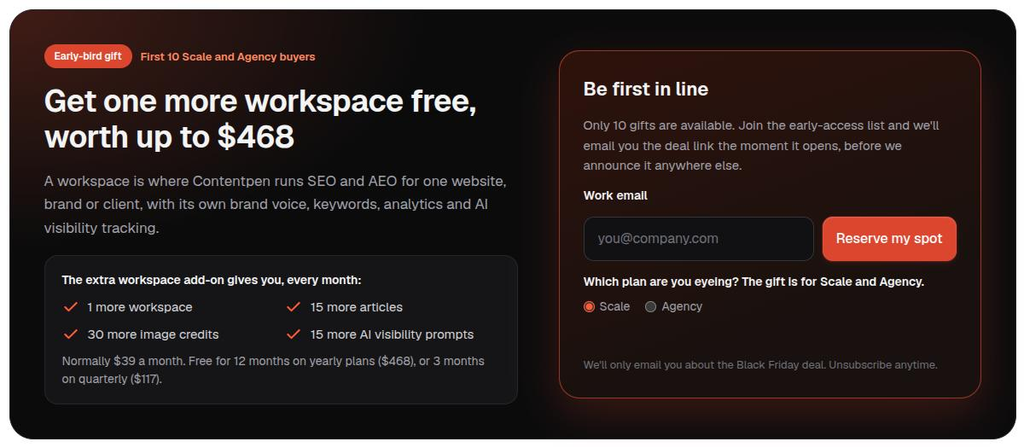
Our example: Contentpen’s Black Friday offer comes with a real scarcity. Only the first 10 Scale or Agency buyers get a free extra workspace that’s worth up to $468. It’s a small, specific, checkable promise, and the page says plainly that joining the list doesn’t guarantee one.
What it leaves behind: Trust. People start believing whatever you put out there, which helps them buy more and buy repeatedly.
“Trust is the most valuable currency in a business.”
4. Publish helpful content before you publish the sale
Content that is aimed at helping people make a decision, compare options, or understand something is always needed for BFCM campaigns.
What to do: Two to four weeks out, publish the content people read while deciding. This can include buying guides, comparisons, “how to choose” posts, and gift guides. Each one should link to your Black Friday page for better internal linking on your site.
Why it works: Buyers research before they buy, and AI assistants pull their answers from exactly this kind of page. A sale page alone gives them nothing to cite, which is exactly what generative engine optimization is about.
What it leaves behind: Pages that keep pulling traffic to your site, even after sales end. This is where your content marketing strategy and your Black Friday plan meet.
That said, ranking the pages is its own job, which is what we’ve covered in our guide to Black Friday SEO.
5. Test the whole journey on a phone
As we saw earlier from Adobe’s data, mobile buyers are increasing day by day, and catering to their flow is essential if you want sales to go up this season.
What to do: Open your ad, landing page, pricing page, and checkout page on a mid-range phone with mobile data. Time it and see where a potential buyer might get frustrated and leave. Fix anything that makes you want to pinch, zoom, or wait longer than usual.
Why it works: With 63% of peak-period spend on Black Friday expected on mobile, a clunky mobile checkout leaks more money than any discount can make back.
Think of it this way: if you won’t shop on your own Black Friday page due to its clunkiness or lazy UI, how do you expect the users to do the same?
What it leaves behind: A faster site for every campaign after this one.
During the sale: Strategies that convert
Once the sales hit live, get busy. Call to your inner marketer, SEO professional, and salesperson to see where you can improve things further.
6. Run a short email sequence with one job per email
Emails are still one of the best ROI content distribution channels on the planet. Yes, it is boring, but boring is what works in business.
What to do: Plan five or six emails, each with a single job. Tease an offer, open early access to BFCM deals, launch offers, remind them of the deadlines, send a ‘last call’ to buy, and a “thank you” note for buyers.
Why it works: One message per email is easier to act on, and each message reaches people at a different stage of the funnel. (Subject line ideas for every stage are further down this page.)
Our example: We planned an email sequence that runs through the Black Friday sale, informing our subscribers when the deal goes live.
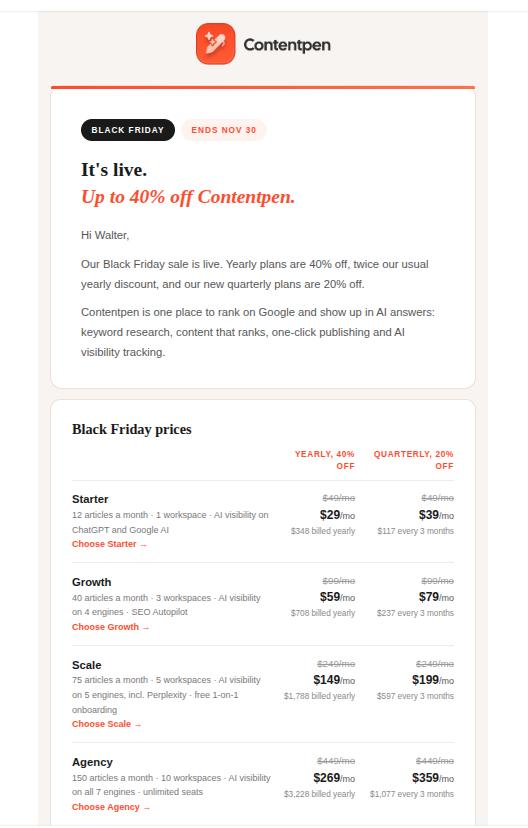
Example subject lines, one per email:
- Tease: “Our biggest discount of the year is coming (you’ll hear first).”
- Early access: “You’re in. Early access starts now”
- Launch: “The Black Friday price you’ve been waiting for”
- Reminder: “Still thinking? Here’s what’s included”
- Last call: “Ends tonight at 11:59 PM ET”
- Thank you: “Here’s how to get your first win”
Keep them short enough to read on a phone, lead with the benefit or the deadline, and test two versions on a small slice of your list before the full send.
What it leaves behind: A tested sequence you can reuse next year for your BFCM campaigns with new discounts and numbers.
7. Use SMS and push messages for deadlines only
SMS and push notifications are two strong ways to reel in buyers during the sale. But be very careful in using them, as you can easily end up in someone’s spam folder if you overuse them.
What to do: Use SMS or push notifications to tell people when early access opens and a few hours before the sale ends.
Why it works: These channels feel personal. It can convince a buyer to make a last-minute decision, kind of like how you get pizza when your favorite pizza place messages you about a late-night buy 1 get 1 discount.
What it leaves behind: A list of subscribers that still opens your texts in December and buys instantly when the fear of missing out starts haunting them.
8. Give social media a daily rhythm
Emails are cool, but not the only way to gain attention online. Today, if you really want visibility, social media is a great way to get it for dirt cheap. The only cost is your consistency.
What to do: Schedule one post a day through Cyber Week. Get people behind on a countdown, a customer result, a behind-the-scenes clip, a reminder, and a final call. Batch them in advance with a scheduler like ContentStudio so you’re not writing captions at midnight for every post.
Why it works: Consistency beats volume. Followers who see your offer three or four times in a week are far more likely to act than those who see it once.
Our example: We built one creative idea and carried it across every channel. “You get ranked on Google and cited by AI” in different variations of what works on each platform (YouTube, TikTok, Facebook, Instagram, X, and LinkedIn). This coordinated effort helps us reel in the maximum returns on our BF deal.
Remember, the idea is not to spam your followers’ feed, but to simmer them with your offers slowly and steadily. Warm them up so that they can make the decision themselves when it matters.
What it leaves behind: An already grown social media presence that can be leveraged to grow visibility for your future product launches and updates.
For the bigger picture on spreading one piece of content across channels, see our guide to content distribution.
9. Retarget the people who already looked
If a person lands on one of your Black Friday pages, it means they were interested. Several tools can help you see what happened with that visit, like Usermaven, Mixpanel, and Amplitude, so your retargeting can be optimized.
Avail Usermaven’s Black Friday offer today to unlock up to $10,000 in setup, tracking, and expert support, with 1M bonus events reserved for the first 100 new customers.
What to do: Point most of your Black Friday ads budget at people who visited your pricing page, started checkout, or opened your emails without buying.
Why it works: Ad costs climb in Cyber Week. Warm audiences convert at a much better rate than cold ones, so every dollar gives you better returns.
What it leaves behind: Cleaner audience lists for campaigns after Black Friday and Cyber Monday.
10. Get into the roundups your buyers already read
When BFCM campaigns are at their peak, most buyers search for listicles and roundups to help them decide which one to get. Being on those lists alerts the buyer to your offer and convinces them to consider you as an option, especially if it comes from a reputed seller or brand.
What to do: Pitch your offer to newsletters, communities, and deal roundups in your niche during the sale. Send the exact discount, dates, and a direct link back to your Black Friday page.
Why it works: Buyers in deal mode browse curated lists. Being on the right one puts you in front of people already holding their card.
What it leaves behind: Referral traffic, and often a link that keeps sending visitors after the sale.
After the sale: Strategies that keep paying off
Black Friday deals end, but your digital marketing efforts shouldn’t. Follow these strategies to keep your customers hooked and subscribed to you for longer.
11. End on time, then follow up properly
What to do: Close the sale when you said you would. If you want a second wave, call it what it is, like a Cyber Week extension with its own end date, and announce it once.
Why it works: Fake extensions train your list to ignore your deadlines. Next year’s campaign depends on this year’s being believed.
What it leaves behind: Loyal customers who know that you do what you say.
12. Onboard Black Friday buyers like they’re your best customers
Getting the users to subscribe is only part of the job. The next is to get them onboarded like they’re your best buddies.
What to do: Send new buyers a short welcome sequence that gets them to their first win in the first week. For SaaS, that’s a setup checklist. For stores, it’s care tips, how-to content, or a reason to come back.
Why it works: Discount buyers churn when they don’t see value fast. A first win turns a bargain hunter into a renewal.
What it leaves behind: Renewals and repeat orders, which is where Black Friday actually pays for itself. Our guide to AI marketing automation covers how to set these sequences up without manually sending every email, social post, or article.
13. Turn campaign content into evergreen pages
What to do: After the sale, strip the discount language from your buying guides and comparisons, update them, and keep them live. Turn the questions customers asked during the sale into an FAQ section.
Why it works: A buying guide written for November can rank all year if it isn’t tied to a dead offer. That’s the whole idea behind evergreen content.
What it leaves behind: Content that keeps your traffic growing without sudden dips after the BFCM campaigns end.
How Contentpen helps: Contentpen is an SEO and AEO tool that keeps watching those pages after you publish them. Its SEO opportunities view flags content decay, quick wins, and CTR fixes every 14 days, so you know which campaign pages to refresh first instead of guessing.
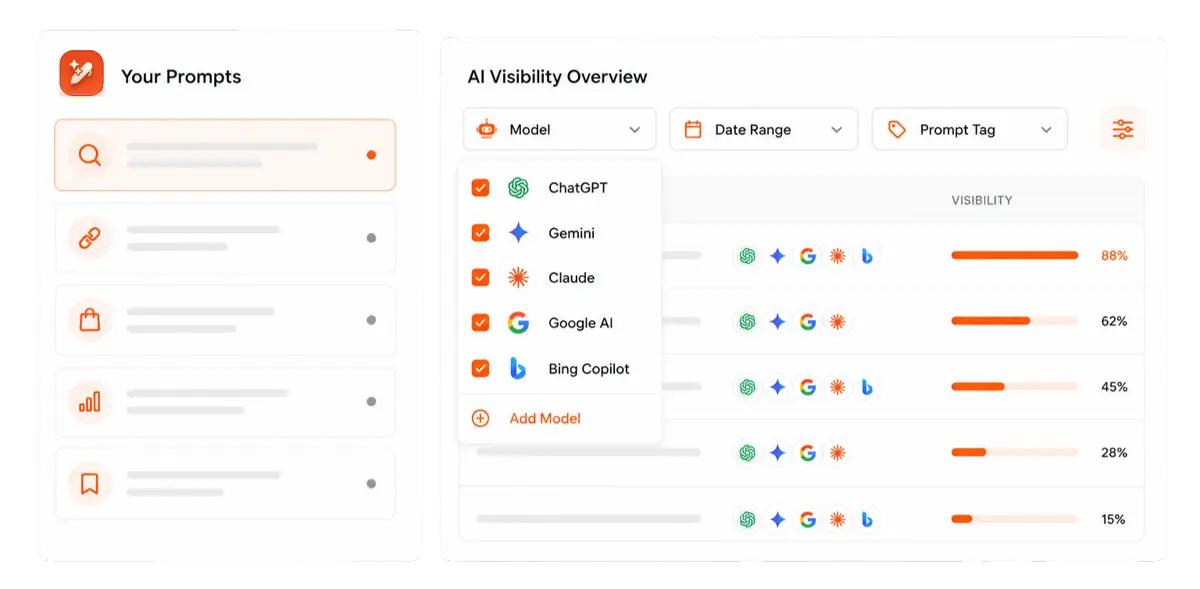
You can also see if AI is picking up your pages or not by heading over to the AI visibility tool inside Contentpen. Compare yourself against competitors, and close those gaps in one place.

Find your brand in AI search

Track AI citations, share of voice, and brand sentiment
Find the top sources driving citations
14. Measure what the sale actually did
Don’t let your Black Friday campaign go to waste. Measure what exactly changed and how using proper tools.
What to do: Track revenue per channel, new versus returning buyers, average order value, and refund rate. Tag every campaign link with UTM parameters, so you’re not guessing which channel did the work.
Why it works: Ad platforms each take credit for the same sale. Your own revenue data is the only honest tiebreaker.
What it leaves behind: Next year’s marketing plan, written from real numbers.
Black Friday promotion ideas by business type
The offer you give on Black Friday depends on what you sell. Here are some promotion ideas that protect margin for each type of business.
| Business | Promotion ideas that protect margin |
|---|---|
| SaaS | Bigger discount on yearly plans, a new quarterly option, bonus seats or workspaces, limited bonuses for the first buyers |
| Online store | Bundles of products bought together, free shipping over a threshold, gift with purchase, early access for subscribers |
| Agency or service business | Prepaid retainer discount, a fixed-price audit or sprint, bonus deliverables instead of lower rates |
| Creator or course seller | Bundle of courses or templates, lifetime access tier, payment plan option, bonus live session |
Notice what’s missing: a flat sitewide percentage. It’s the easiest offer to run and the hardest to stand out with. For more inspiration, our roundup of recent innovative marketing examples shows brands winning attention without slashing prices.
Black Friday marketing examples worth borrowing
Some of the most talked-about Black Friday campaigns didn’t lead with a discount at all. Take a look at these examples below as a case study.
- REI’s #OptOutside: Since 2015, the outdoor retailer has closed its stores on Black Friday and encouraged customers and staff to spend the day outside. Skipping the sale became the campaign, and it earns press every year.
- IKEA’s “Buy Back Friday”: In 2020, IKEA turned Black Friday around and bought back used furniture from their customers for store credit. The campaign perfectly fit its sustainability message and brought shoppers into stores without a discount.
The common thread is a point of view. Each campaign stood for something its buyers already cared about, so the offer felt like part of the brand. Customers pay for originality as much as they do for relevancy and use-case.
Black Friday marketing mistakes to avoid
Before you begin your BFCM campaign, here are a few things NOT to do for your brand.
- Starting on Black Friday: Launch your BF campaign a few weeks earlier rather than on the main event. Buyers usually decide quickly on what they want to buy, and you need to get on that list a bit earlier for consideration.
- Running five offers at once: This is one of the most common mistakes in SaaS. You have to provide one clear offer that converts better than a menu of discounts.
- Fake deadlines and prices: Don’t exaggerate your discounted prices. Such tactics may work once, but they will cost you trust for years to come.
- Forgetting existing customers: A loyalty perk or upgrade offer keeps your best customers from feeling punished for paying full price. Don’t let this happen. Instead, offer some benefits for existing users as well, so that they also feel included.
- Deleting campaign pages on December 1: Don’t delete your Black Friday pages as soon as the deal passes. Instead, update them properly, tell the audience that the discount is over, but keep your links that drive traffic.
Each of these mistakes saves a little effort in November and costs a lot more by next year’s sale.
Final thoughts
Black Friday marketing rewards preparation more than discount size. To start, build the list early, make one honest offer, run every channel at it, and spend as much effort on the week after the sale as the week before.
If your plan includes buying tools for the campaign, our Black Friday AI deals roundup covers video, design, and ad tools that are discounted right now.
And if you’d like your campaign content to keep ranking on Google and getting cited by AI, then try Contentpen today.
Frequently asked questions
Ideally two to four weeks before Black Friday, so you have time to build an early-access list and publish helpful content. If you’re starting in mid-November, focus on an early-access list, one clear offer, and a short email sequence.
Pick one offer that protects your margin, set up a landing page with an email sign-up, test your checkout on a phone, schedule your emails and social posts in advance, and plan how you’ll follow up with new customers after the sale.
Building an early-access list before the sale. It gives you a warm audience to sell to on day one, costs almost nothing, and the list stays valuable long after Black Friday ends.
At least for a few days, from Black Friday through Cyber Monday. A sale of a week or less keeps urgency believable. If you extend it, announce the extension once with a new, firm end date.
BFCM stands for Black Friday Cyber Monday. A BFCM strategy treats the days from Thanksgiving to Cyber Monday as one campaign, with one offer, one end date, and messages that build across the weekend instead of two separate sales.
Both matter. Adobe forecasts Cyber Monday as the biggest online spending day of 2026 at $15.1 billion, while Black Friday is growing faster at 9.2% year over year. Plan your campaign to run across both.