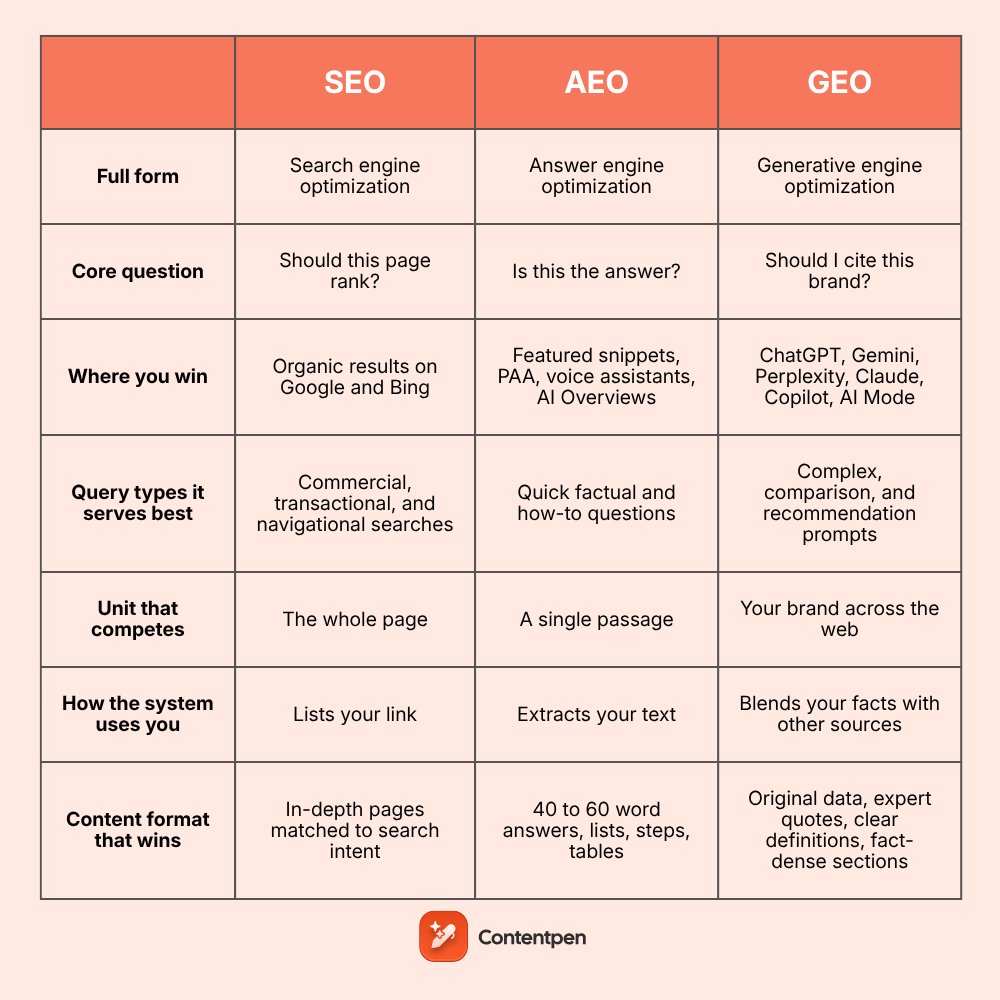
SEO vs GEO vs AEO comes down to where you want to show up. SEO gets your page ranked in search results. AEO gets your content pulled out as the direct answer, and GEO gets your brand cited inside AI answers from tools like ChatGPT and Gemini.
All three share one foundation: useful, well-structured content that machines can trust. The difference is the surface you win on and how you measure the win.
Yet most marketers are being pitched these as three separate services, each with its own playbook and price tag.
That leaves most teams guessing. Do you rewrite everything for AI? Do you stop building links? Do you hire a “GEO specialist” and hope for the best?
You don’t need three strategies. You need one content system that ranks, answers, and earns citations at the same time.
This guide breaks down what each term means, where they overlap, how to measure them, and a 30-day plan to cover all three.
Let’s start with the basics.
Key takeaways
- SEO wins rankings and clicks, AEO wins the direct answer, and GEO wins citations in AI-generated responses.
- AEO is about being extracted. GEO is about being trusted enough to be one of the few sources an AI blends into its answer.
- GEO does not replace SEO. AI engines still pull from pages that are crawlable, indexed, and authoritative.
- AIO, LLMO, AI SEO, and LLM SEO are mostly new labels for parts of AEO and GEO.
- Each layer needs its own metrics: rankings for SEO, answer ownership for AEO, and citation share for GEO.
- One well-built page can serve all three if it leads with a clear answer, uses clean structure, and backs claims with sources.
What do SEO, AEO, and GEO each optimize for?
Think of them as three questions a search system asks about your content. Should this page rank? Is this the answer? Should I trust and cite this brand?
SEO, or search engine optimization: earning the ranked spot
SEO is the practice of getting your pages to rank in the organic results on Google and Bing. The goal is a click to your site.
It rests on three pillars:
- On-page work: keywords, headings, meta data, and content that matches what the searcher wants.
- Technical SEO: crawlability, speed, indexing, canonicals, and mobile usability.
- Off-page signals: backlinks, brand mentions, and overall authority.
AEO, or answer engine optimization: becoming the answer
AEO is the practice of structuring content so a search system can lift it out as the direct answer. That answer might be a featured snippet, a People also ask box, a voice reply, or a line inside Google AI Overviews.
The focus shifts from the whole page to the single passage. Short, self-contained answers under question-based headings tend to win here.
GEO, or generative engine optimization: becoming the cited source
GEO is the practice of making your brand and content the source that large language models cite when they write an answer. Think ChatGPT, Gemini, Perplexity, Claude, Copilot, and Google’s AI Mode.
The term comes from a 2023 research paper by Aggarwal and colleagues. They found that GEO methods could lift visibility in generative engine responses by up to 40%.
GEO cares about more than your own pages. It weighs how often trusted third parties mention you, how consistently your brand is described, and whether your content carries facts worth quoting.
How do SEO, AEO, and GEO compare side by side?
Let’s line them up. Full forms first, then the details that actually change your workflow.
| Factor | SEO | AEO | GEO |
|---|---|---|---|
| Full form | Search engine optimization | Answer engine optimization | Generative engine optimization |
| Core question | Should this page rank? | Is this the answer? | Should I cite this brand? |
| Where you win | Organic results on Google and Bing | Featured snippets, PAA, voice assistants, AI Overviews | ChatGPT, Gemini, Perplexity, Claude, Copilot, AI Mode |
| Query types it serves best | Commercial, transactional, and navigational searches | Quick factual and how-to questions | Complex, comparison, and recommendation prompts |
| Unit that competes | The whole page | A single passage | Your brand across the web |
| How the system uses you | Lists your link | Extracts your text | Blends your facts with other sources |
| Content format that wins | In-depth pages matched to search intent | 40 to 60 word answers, lists, steps, tables | Original data, expert quotes, clear definitions, fact-dense sections |
| Strongest signals | Relevance, backlinks, technical health | Clear answers, heading structure, schema | Authority, third-party mentions, consistent brand info, original data |
| Where the work happens | Mostly on your site, plus link building | Almost entirely on your site | On your site and across reviews, forums, press, and directories |
| Key tactics | Keyword research, on-page optimization, technical fixes, link building | Question-based headings, answer-first copy, FAQ and HowTo schema | Digital PR, community presence, sourced stats, entity consistency |
| Technical must-haves | Crawlable, fast, indexed pages with clean canonicals | Valid structured data and clean HTML | Access for AI crawlers like OAI-SearchBot and PerplexityBot |
| Control over the output | High: your title and meta show as written | Medium: your words, chosen by the engine | Low: the AI rewrites and blends your content |
| Typical outcome | A click | Often a zero-click view | A mention or citation, sometimes a click |
| Speed of results | Slow to build, compounds over time | Can move within weeks on pages that already rank | Slowest, follows authority built over months |
| Main metric | Rankings and organic traffic | Answer ownership | Citation share and AI visibility |
| Risk if you ignore it | AI engines have fewer indexed pages of yours to draw from | Competitors become the default answer | AI tools recommend competitors when buyers ask |
The big takeaway?
The further right you move in the table, the less you control the final output. That’s why GEO leans so heavily on reputation built outside your own site.
Is GEO the same as AEO?
Not quite, though the line is blurry. Many people now use AEO as an umbrella term for all AI answers, which is where the confusion starts.
The cleanest way to split them is by what the system does with your content:
- AEO is extraction: The engine finds one passage on your page and shows it, often word for word.
- GEO is synthesis: The engine reads many sources, writes its own answer, and cites a few of them.
So AEO is mostly won on the page. GEO is won on the page and off it, through reviews, forum threads, directories, and press that mention you.
Want a concrete AEO vs GEO example? Picture someone asking, “What is a canonical tag?”
- AEO win: your 45-word definition appears as the featured snippet, exactly as you wrote it.
- GEO win: someone asks ChatGPT “best way to fix duplicate content issues,” and the answer cites your guide alongside two others.
Is GEO the same as SEO, or is it replacing it?
No, on both counts. GEO sits on top of SEO rather than replacing it.
The reason is simple. AI engines still need to find your content before they can cite it, and most of them lean on web search indexes to do that. If a page can’t be crawled or doesn’t rank anywhere, its odds of being cited drop sharply.
What changes is the scoring. Traditional SEO rewards relevance and links to a page, while GEO rewards how believable and quotable your brand looks across the whole web.
Where do AIO, LLMO, and AI SEO fit in?
If you’ve searched “SEO vs GEO vs AEO vs AIO” or “vs LLMO,” you’ve seen how fast the labels multiply.
The good news?
Most of them describe the same work from a slightly different angle.
| Term | Stands for | What it usually means | Closest to |
|---|---|---|---|
| AIO | AI optimization, or AI Overview optimization | Getting featured in Google AI Overviews, or AI search in general | AEO |
| LLMO | Large language model optimization | Shaping how LLMs describe and recommend your brand | GEO |
| AI SEO | AI search engine optimization | SEO practices adapted for AI-driven results | GEO + AEO |
| LLM SEO | LLM search engine optimization | Same idea as LLMO, framed as an SEO task | GEO |
| GSO | Generative search optimization | Optimizing for hybrid search like Google AI Mode | GEO |
| SXO | Search experience optimization | SEO plus UX and conversion on the landing page | SEO |
Don’t let the alphabet soup derail your planning. If you cover rankings, extractable answers, and brand authority, you’ve covered every one of these.
Why does the difference matter for your traffic in 2026?
Because clicks are getting harder to earn when an AI summary sits on top of the results. The data so far points in one direction.
- A Pew Research Center study of 900 U.S. adults found users clicked a traditional result on 8% of visits when an AI summary appeared, versus 15% without one.
- In the same study, people clicked a link inside the AI summary itself on only about 1% of visits.
- Gartner predicted back in 2024 that traditional search engine volume would drop 25% by 2026 as people shift to AI chatbots and virtual agents.
What does that mean in practice?
Ranking alone no longer guarantees attention. You also need to be the answer, and the brand the AI names when it skips the click entirely.
Understand what’s working, and why with real-time analytics
Track performance and make smarter content decisions with clear insights.
View Analytics Dashboard →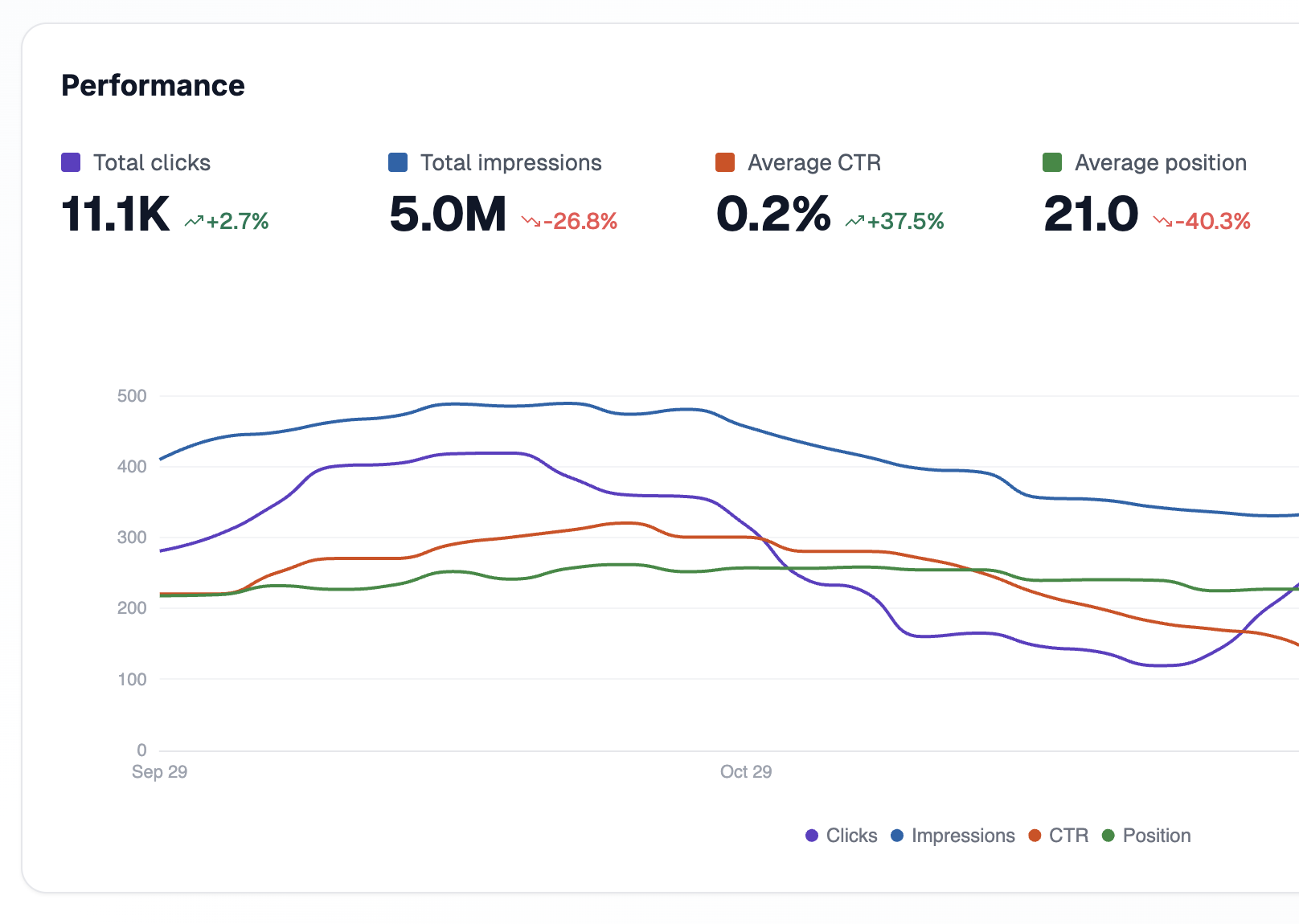
What does one page built for all three look like?
This is the part most comparisons skip. You don’t need three versions of a page. You need one page with three layers baked in.
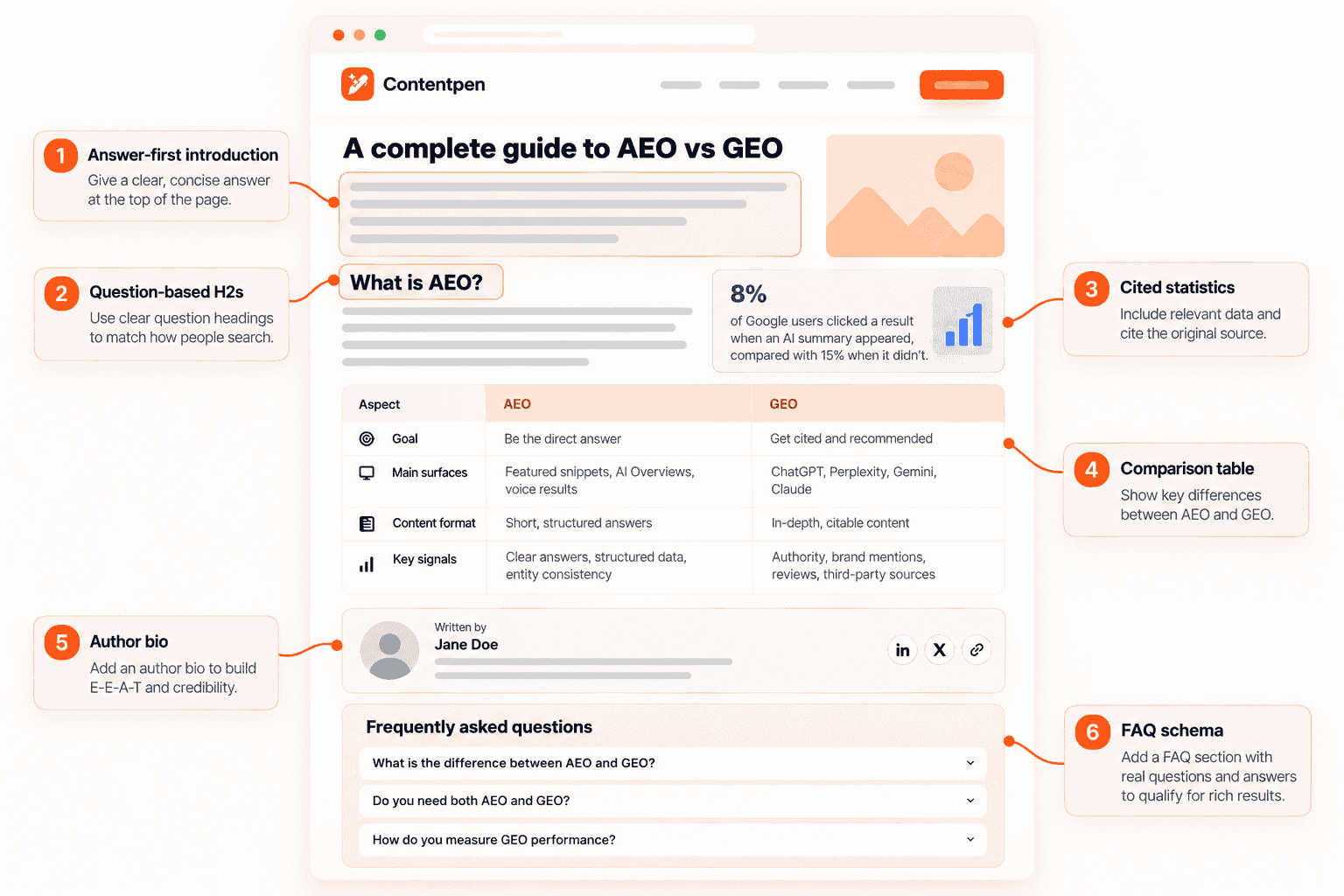
Each part of the page pulls its weight in a different way:
| Page element | SEO job | AEO job | GEO job |
|---|---|---|---|
| Answer in the first 100 words | Matches search intent fast | Gives engines a clean passage to lift | Gives LLMs a quotable summary |
| Question-based H2s and H3s | Targets long-tail queries | Mirrors how people ask | Helps chunk-level retrieval |
| Comparison tables | Earns rich results | Easy to extract | Structured facts LLMs reuse |
| Original data and cited stats | Earns backlinks | Adds precision to answers | Makes you citation-worthy |
| Author bio with real credentials | Supports E-E-A-T | Builds answer trust | Strengthens your brand entity |
| FAQ and article schema | Eligible for rich results | Clarifies Q&A pairs | Helps machines parse context |
| Contextual internal links | Spreads authority | Connects related answers | Shows topical depth |
One tip that pays off across all three: write each section so it makes sense on its own. AI systems often pull a single chunk, not your whole article.
How do you measure each one?
This is where teams go wrong most often. They judge GEO with SEO metrics, then decide it isn’t working.
| Layer | What to track | Where to find it |
|---|---|---|
| SEO | Rankings, impressions, organic clicks, conversions | Google Search Console, Ahrefs, your analytics tool |
| AEO | Featured snippets owned, PAA appearances, AI Overview inclusions | Rank trackers with SERP feature data, manual checks |
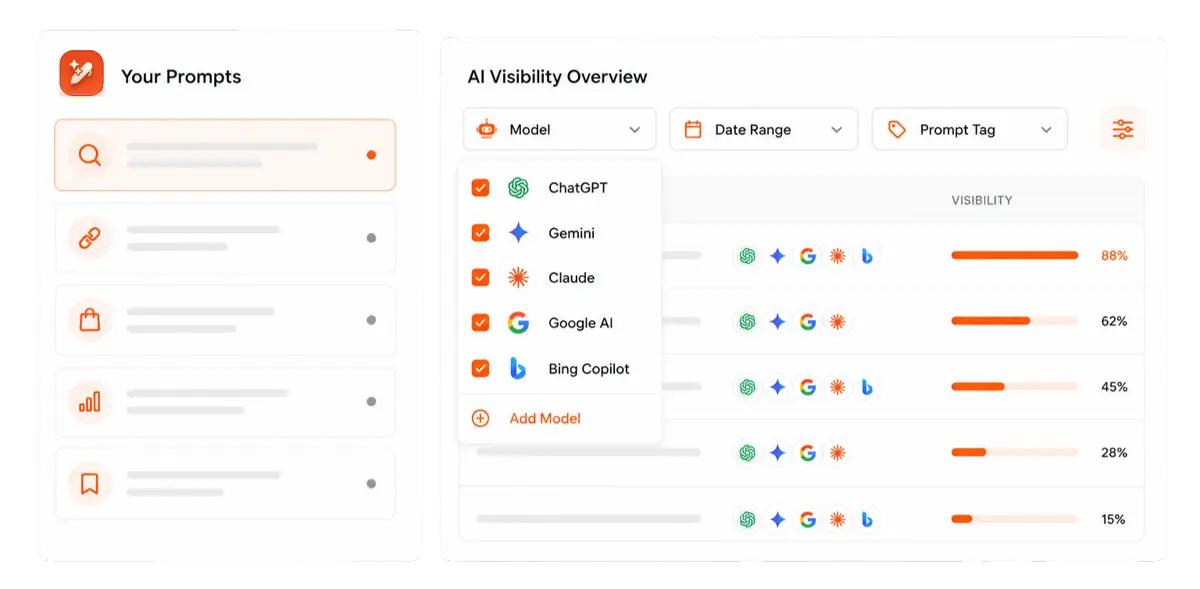
| GEO | Brand mentions and citations in AI answers, sentiment, share of voice against competitors | AI visibility trackers like Contentpen’s AI visibility tool, prompt testing, referral traffic from AI tools |
A simple rule helps. Keep a single content plan, give each layer its own scorecard, and begin GEO with an AI visibility audit so you have a baseline.
Find your brand in AI search

Track AI citations, share of voice, and brand sentiment
Find the top sources driving citations
Which one should your team prioritize first?
Start with SEO if your basics are shaky. Without crawlable, ranking pages, AEO and GEO have very little to work with.
After that, the right mix depends on how your buyers search:
| Business type | Where to lean | Why |
|---|---|---|
| Local services and ecommerce | SEO first, then AEO | Buyers still search with transactional intent and click to buy or book |
| B2B SaaS | All three, with GEO rising | Buyers ask AI tools to compare vendors before they ever visit a site |
| Agencies | All three, sold as one program | Clients want rankings and AI visibility, and reporting both sets you apart |
| Publishers and educators | AEO and SEO | Definitions and how-to answers are prime snippet and AI Overview material |
| New brands with low authority | AEO, then GEO | Clear answers can win features faster than backlinks can build rank |
Not sure where you stand?
Pick five questions your buyers ask. Search them on Google, then ask ChatGPT and Perplexity. Where you’re missing tells you where to start.
A 30-day plan to cover SEO, AEO, and GEO together
Ready to put this into motion? This is a realistic month for a small team.
Week 1: Baseline and fix the foundation
- Record rankings and clicks for your top 20 pages.
- Run 20 to 30 buyer prompts across AI tools and note who gets cited.
- Fix crawl errors, broken canonicals, and pages blocked by robots.txt.
Week 2: Rebuild your top pages for answers
- Add a direct answer in the first 100 words of each priority page.
- Turn vague headings into the questions people actually ask.
- Add a comparison table or step list wherever readers need to choose or act.
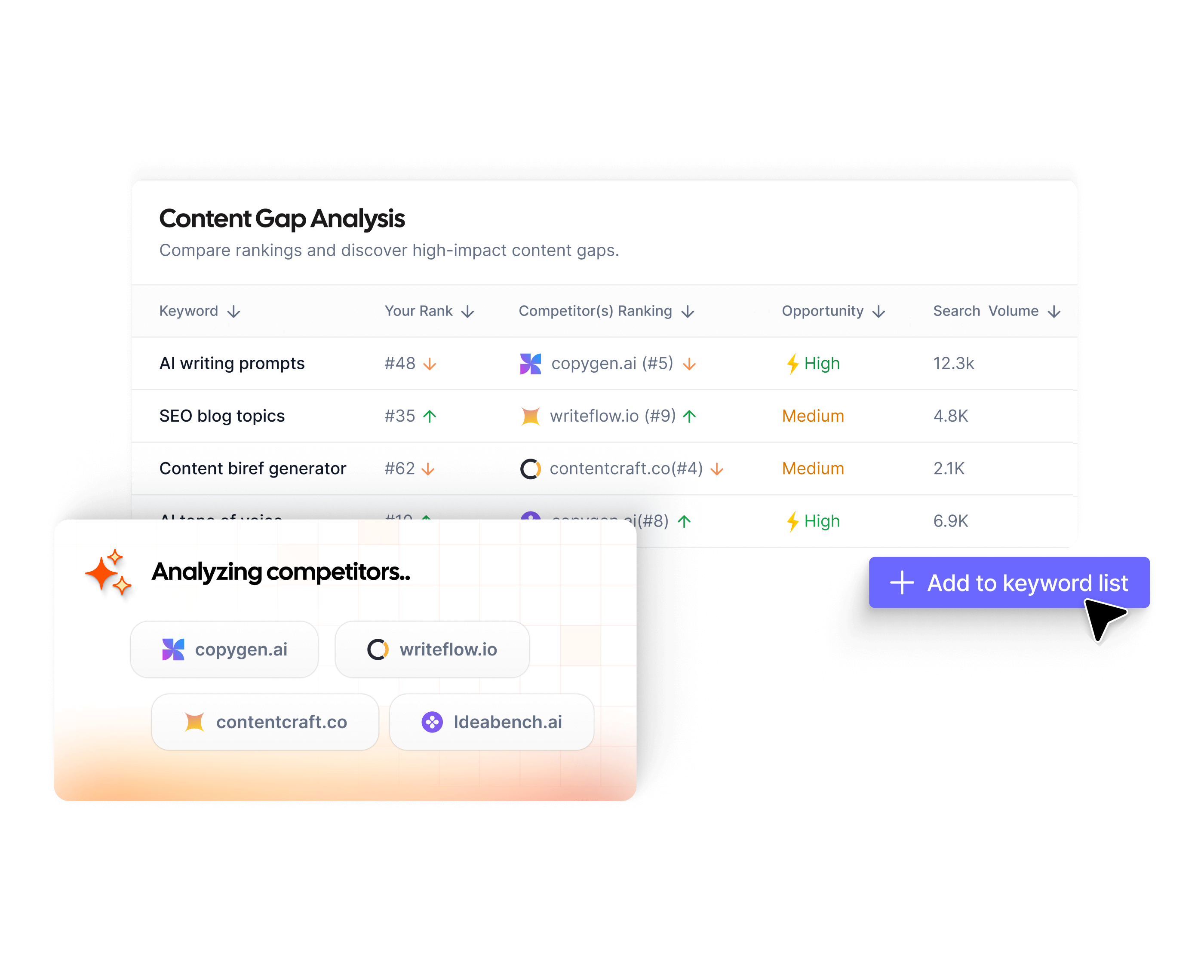
Update existing content without rewriting it that fills them
Improve outdated posts using live URL analysis
Refresh SEO, structure, and relevance in minutes
Week 3: Add proof and structure
- Replace unsourced claims with stats linked to the original study.
- Add FAQ and article schema, plus real author bios.
- Tighten internal linking so related answers point to each other.
- Fill topic gaps using semantic SEO so each page covers the full subject, not just one keyword.
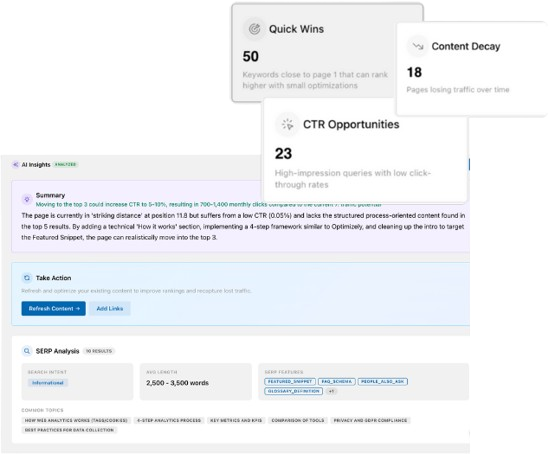
Turn existing content into growth opportunities
Identify pages losing traffic or CTR
Find quick wins to improve clicks and rankings
Week 4: Build authority off your site
- Pitch one data point or expert quote to industry publications.
- Show up where AI engines look for opinions, using Reddit SEO and relevant communities.
- Get listed on trusted review sites and directories, a core part of citation SEO.
- Rerun your week 1 prompts and compare.
Don’t expect GEO to move in a month. Rankings and snippets can shift within weeks, but AI citations tend to follow authority, and authority takes longer.
How Contentpen helps you run all three from one workspace
Juggling a rank tracker, a writing tool, a schema plugin, and an AI monitoring tool gets messy fast. Contentpen is an SEO and AEO tool that brings that whole loop into one place.
It maps neatly to each layer:
- For SEO: find what to write with keyword research and topic clusters, then see what top pages cover with SERP and gap analysis. Google Search Console data sits right inside your workspace.
- For AEO: write in an editor with live SEO and GEO scoring. Failing checks can be fixed with one AI pass, so answers, headings, and structure stay tight.
- For GEO: AI Visibility tracks how ChatGPT, Google AI, Gemini, Perplexity, Copilot, Grok, and Claude mention your brand. It shows share of voice, sentiment, top cited sources, and the source gaps where competitors get cited and you don’t.
Once a draft is ready, automated linking and one-click publishing to WordPress, Shopify, Wix, and other CMSs take care of the busywork. Teams can also connect Contentpen to AI assistants through its API and MCP server.
Managing this for clients? See how Contentpen for agencies handles multiple brands in one account.
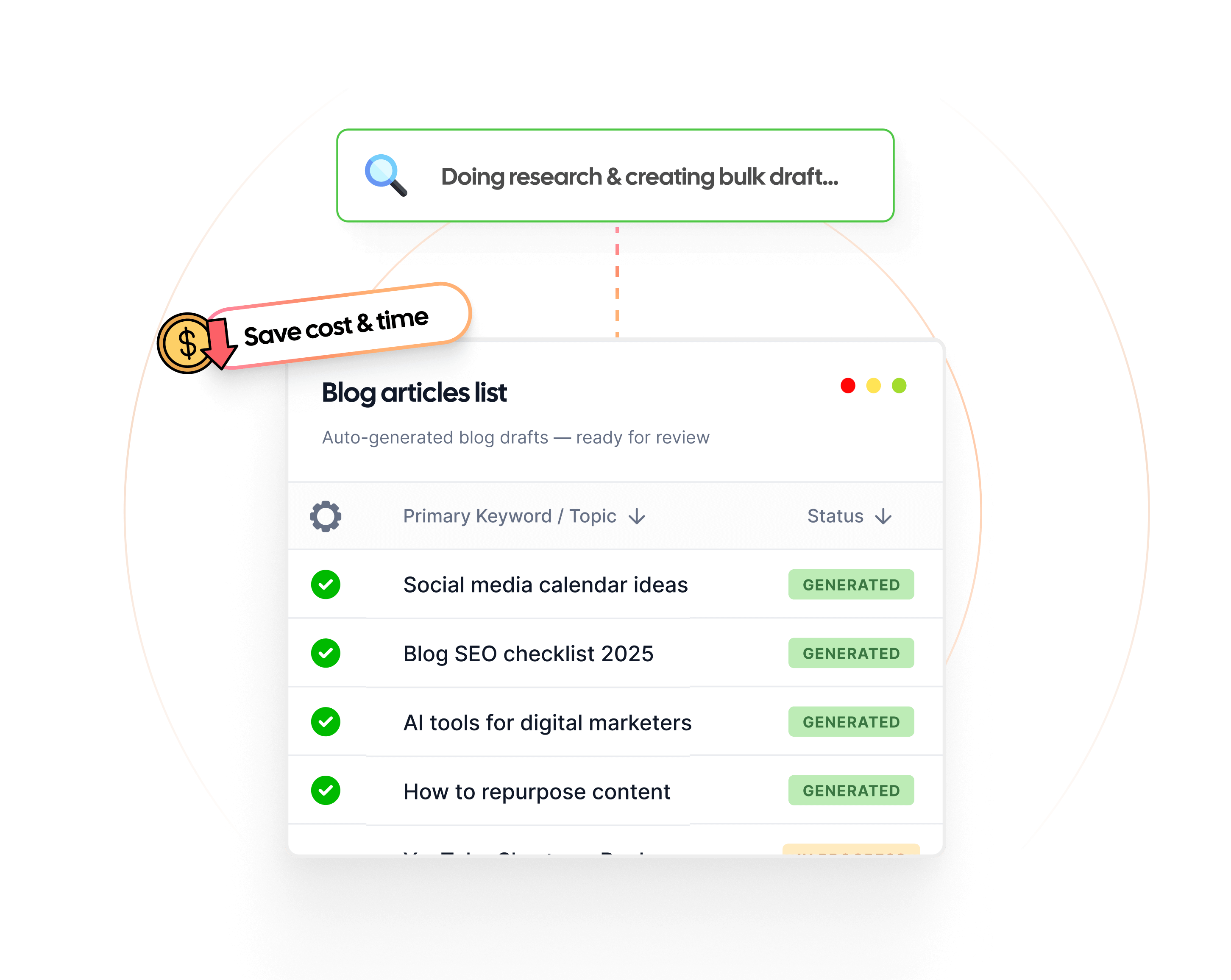
Create rank worthy content at scale
Faster
Consistent
SEO-ready
Efficient
Want to see where you stand across search and AI?
Start with Contentpen today and track your rankings, answers, and AI citations in one place.
One search strategy, three ways to win
SEO, AEO, and GEO aren’t rivals. They’re three layers of the same job: making your content easy to find, easy to extract, and easy to trust.
SEO gets you ranked. AEO gets you chosen as the answer. GEO gets your brand named when an AI writes the answer itself.
Build one strong page at a time, measure each layer on its own terms, and keep earning mentions beyond your site. Do that, and the labels stop mattering.
Frequently asked questions
No. One content team can handle all three with the same workflow. The main additions are answer-first writing, stronger sourcing, and PR or community work for off-site mentions.
No. Schema helps machines understand your page, but it doesn’t force a citation. Content quality and brand authority still decide whether you get picked. Here’s what the evidence says about schema markup for AI search.
If you want AI citations, yes. Blocking bots like OAI-SearchBot or PerplexityBot in robots.txt can keep your pages out of those answers. Some sites block training crawlers like GPTBot but allow search crawlers, so review each one.
Yes. Voice assistants read out a single answer, which is exactly what AEO optimizes for. Short, conversational answers under question headings work well for both.
They can, especially on niche or local topics. AI engines favor clear, specific, well-sourced answers, and a smaller brand that owns a narrow topic can get cited ahead of a generalist.
Yes. Being the passage the AI pulls from keeps your brand in front of searchers, even without a click. Those impressions often turn into branded searches and direct visits later.
Not by itself. What hurts is thin, generic content with no original insight or sources. Use AI to draft faster, then add real expertise, data, and a clear point of view.